DIRECT
APPROACH
WHAT IS SECOND LANGUAGE?
Second language is a language that a person can
speak that is not the first language they learned
naturally as a child.
 Second language is also called “L2”
EXAMPLES OF SECOND LANGUAGES
o English
o French
o Russian
o Spanish
o Creole
o Arabic
o Portuguese
o Italian
APPROACHES TOWARDS SECOND LANGUAGE
Approaches towards second language are:
• Direct
• Communicative
• Total Physical Response
• Contrastive Analyst
We will be looking at the
direct approach
WHAT IS DIRECT APPRAOCH ?
Direct approach was developed as a response to the
Grammar-Translation method. It sought to immerse
the learner in the same way as when a first language
is learnt. All teaching is done in the target language,
grammar is taught inductively, there is a focus on
speaking and listening, and only useful ‘everyday'
language is taught.
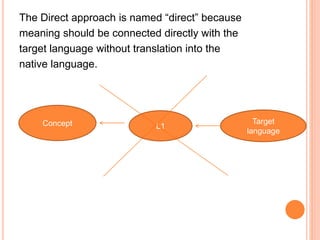
The Direct approach is named “direct” because
meaning should be connected directly with the
target language without translation into the
native language.
Concept L1
Target
language
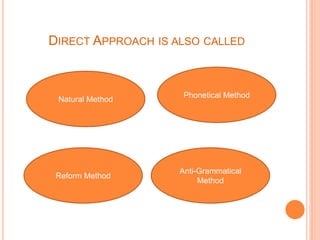
DIRECT APPROACH IS ALSO CALLED
Natural Method
Anti-Grammatical
Method
Reform Method
Phonetical Method
PRINCIPLES OF DIRECT APPROACH
1. Classroom instruction is conducted exclusively
in the target language. The teacher should
demonstrate, not explain or translate.
 NEVER TRANSLATE:
 DEMONSTRATE
2. Only everyday vocabulary and sentences are
taught.
3. Correct pronunciation is emphasized
4. Vocabulary is taught through known words,
demonstration, authentic objects (realia), pictures, and
miming.
5. Grammar is taught inductively. There may never be
an explicit grammar rule given.
• DO NOT GIVE RULES: MAKE THEM FIGURE OUT
THE RULE
6. New teaching points are introduced orally.
7. Both speech and listening comprehension are
taught.
8. The teacher, by asking the student to make a
choice, gets him to correct his own error.
• LEARNING BY SELFCORRECTION
9. The syllabus is based on situations or topics, not
usually on linguistic structures.
• CONTEXTUAL/TOPICAL TEACHING
10. Students should learn to think in the target
language as soon as possible.
11. The purpose of language learning is
communication; therefore students need to learn how
to ask questions as well as answer them.
TECHNIQUES FOR DIRECT APPROACH
Q & A
The teacher asks
questions of any nature
and the students answer.
Dictation
The teacher chooses a
grade appropriate
passage and reads the
text aloud. Teacher
reads the passage three
times .
Reading
Aloud
Students take turn
reading sections of a
passage, play or
dialogue out loud
Paragraph
Writing
The students are asked
to write a passage in
their own words.
ADVANTAGES OF DIRECT APPROACH
It promises to teach the language and Not about the
language.
• It is a natural method which teaches language in the
same way the mother tongue is acquired. Only the
target language is used and the learning is
contextualized..
• Its emphasis on speech made it more attractive for
those who have needs of real communication in the
target language. It is one of the first methods to
introduce the teaching of vocabulary through realias

Second language and Direct approach

  • 1.
  • 2.
    WHAT IS SECONDLANGUAGE? Second language is a language that a person can speak that is not the first language they learned naturally as a child.  Second language is also called “L2”
  • 3.
    EXAMPLES OF SECONDLANGUAGES o English o French o Russian o Spanish o Creole o Arabic o Portuguese o Italian
  • 4.
    APPROACHES TOWARDS SECONDLANGUAGE Approaches towards second language are: • Direct • Communicative • Total Physical Response • Contrastive Analyst We will be looking at the direct approach
  • 5.
    WHAT IS DIRECTAPPRAOCH ? Direct approach was developed as a response to the Grammar-Translation method. It sought to immerse the learner in the same way as when a first language is learnt. All teaching is done in the target language, grammar is taught inductively, there is a focus on speaking and listening, and only useful ‘everyday' language is taught.
  • 6.
    The Direct approachis named “direct” because meaning should be connected directly with the target language without translation into the native language. Concept L1 Target language
  • 7.
    DIRECT APPROACH ISALSO CALLED Natural Method Anti-Grammatical Method Reform Method Phonetical Method
  • 8.
    PRINCIPLES OF DIRECTAPPROACH 1. Classroom instruction is conducted exclusively in the target language. The teacher should demonstrate, not explain or translate.  NEVER TRANSLATE:  DEMONSTRATE 2. Only everyday vocabulary and sentences are taught. 3. Correct pronunciation is emphasized
  • 9.
    4. Vocabulary istaught through known words, demonstration, authentic objects (realia), pictures, and miming. 5. Grammar is taught inductively. There may never be an explicit grammar rule given. • DO NOT GIVE RULES: MAKE THEM FIGURE OUT THE RULE 6. New teaching points are introduced orally. 7. Both speech and listening comprehension are taught.
  • 10.
    8. The teacher,by asking the student to make a choice, gets him to correct his own error. • LEARNING BY SELFCORRECTION 9. The syllabus is based on situations or topics, not usually on linguistic structures. • CONTEXTUAL/TOPICAL TEACHING 10. Students should learn to think in the target language as soon as possible. 11. The purpose of language learning is communication; therefore students need to learn how to ask questions as well as answer them.

  • 11.
    TECHNIQUES FOR DIRECTAPPROACH Q & A The teacher asks questions of any nature and the students answer. Dictation The teacher chooses a grade appropriate passage and reads the text aloud. Teacher reads the passage three times .
  • 12.
    Reading Aloud Students take turn readingsections of a passage, play or dialogue out loud Paragraph Writing The students are asked to write a passage in their own words.
  • 13.
    ADVANTAGES OF DIRECTAPPROACH It promises to teach the language and Not about the language. • It is a natural method which teaches language in the same way the mother tongue is acquired. Only the target language is used and the learning is contextualized.. • Its emphasis on speech made it more attractive for those who have needs of real communication in the target language. It is one of the first methods to introduce the teaching of vocabulary through realias