

Direct method
TEACHING APPROACH
Compiled by:
Phattharakan Phiphitphornsirikun
Wanlapa Thaweeapiradeepiti
Pawarit Pingmuang
OneDrive : https://1drv.ms/p/s!ArzCQwsWFznqh75inAYfuscft9abSA
Google Drive (PDF) : https://drive.google.com/open?id=0BwnH34YiUv2Ra21BZGN4U01zRUU
Online PDF
Direct method
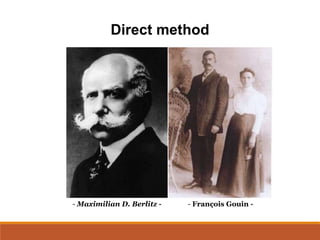
- Maximilian D. Berlitz - - François Gouin -
The Berlitz Story
 The method was developed by Maximilian Berlitz, who migrated from
Germany to the United States. His initial intention was to teach different
languages using the TGM. However, hiring a French guy to be his an
assistant.
 Berlitz hired an instructor to teach to his students, but when he hired the
assistant, he found out that the Frenchman did not speak any English.
Then, Berlitz got a cool, he left the Frenchman, instead of his classroom
and asked him to do his best teaching language to the students.
 Surprisingly, Berlitz came back to the classroom expecting a disaster and
found out that his students were actively interacting with Joly and had
progressed even further than they would have done learning the
material using a nontraditional method.
 The teacher communicated with the student through miming and
gesturing. Grammar is not the essential goal because students were
later able to discover grammatical rules on their own
InnovativeLanguage.com (June 05, 2017), Second Language Learning Methods - Direct Method (Berlitz),
http://blog.innovativelanguage.com/2009/06/16/second-language-learning-methods-direct-method-berlitz/
-Language School-
Direct method
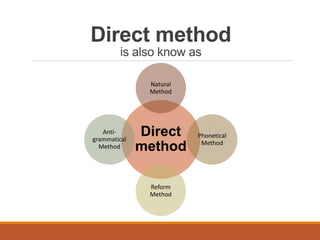
is also know as
Direct
method
Natural
Method
Phonetical
Method
Reform
Method
Anti-
grammatical
Method
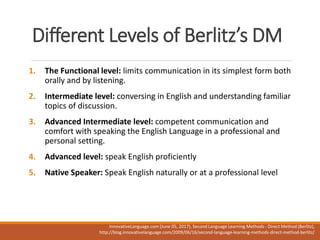
Different Levels of Berlitz’s DM
1. The Functional level: limits communication in its simplest form both
orally and by listening.
2. Intermediate level: conversing in English and understanding familiar
topics of discussion.
3. Advanced Intermediate level: competent communication and
comfort with speaking the English Language in a professional and
personal setting.
4. Advanced level: speak English proficiently
5. Native Speaker: Speak English naturally or at a professional level
InnovativeLanguage.com (June 05, 2017), Second Language Learning Methods - Direct Method (Berlitz),
http://blog.innovativelanguage.com/2009/06/16/second-language-learning-methods-direct-method-berlitz/
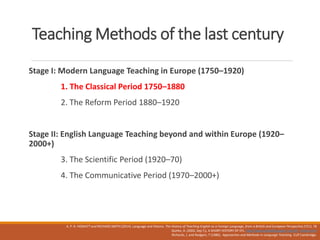
Teaching Methods of the last century
Stage I: Modern Language Teaching in Europe (1750–1920)
1. The Classical Period 1750–1880
2. The Reform Period 1880–1920
Stage II: English Language Teaching beyond and within Europe (1920–
2000+)
3. The Scientific Period (1920–70)
4. The Communicative Period (1970–2000+)
A. P. R. HOWATT and RICHARD SMITH (2014). Language and History. The History of Teaching English as a Foreign Language, from a British and European Perspective,57(1). 78
Quirke, A. (2002, Sep 7,). A SHORT HISTORY OF EFL. http://www.philseflsupport.com/efl_history.htm
Richards, J. and Rodgers, T (1986) . Approaches and Methods in Language Teaching CUP Cambridge.
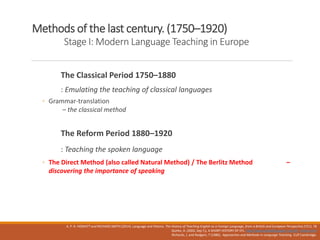
Methods of the last century. (1750–1920)
Stage I: Modern Language Teaching in Europe
The Classical Period 1750–1880
: Emulating the teaching of classical languages
◦ Grammar-translation
– the classical method
The Reform Period 1880–1920
: Teaching the spoken language
◦ The Direct Method (also called Natural Method) / The Berlitz Method –
discovering the importance of speaking
A. P. R. HOWATT and RICHARD SMITH (2014). Language and History. The History of Teaching English as a Foreign Language, from a British and European Perspective,57(1). 78
Quirke, A. (2002, Sep 7,). A SHORT HISTORY OF EFL. http://www.philseflsupport.com/efl_history.htm
Richards, J. and Rodgers, T (1986) . Approaches and Methods in Language Teaching CUP Cambridge.
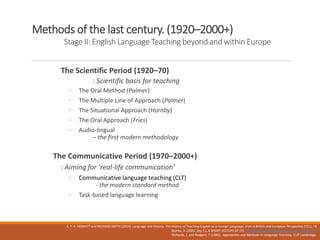
Methods of the last century. (1920–2000+)
Stage II: English Language Teaching beyond and within Europe
The Scientific Period (1920–70)
: Scientific basis for teaching
◦ The Oral Method (Palmer)
◦ The Multiple Line of Approach (Palmer)
◦ The Situational Approach (Hornby)
◦ The Oral Approach (Fries)
◦ Audio-lingual
– the first modern methodology
The Communicative Period (1970–2000+)
: Aiming for ‘real-life communication’
◦ Communicative language teaching (CLT)
- the modern standard method
◦ Task-based language learning
A. P. R. HOWATT and RICHARD SMITH (2014). Language and History. The History of Teaching English as a Foreign Language, from a British and European Perspective,57(1). 78
Quirke, A. (2002, Sep 7,). A SHORT HISTORY OF EFL. http://www.philseflsupport.com/efl_history.htm
Richards, J. and Rodgers, T (1986) . Approaches and Methods in Language Teaching CUP Cambridge.
Other Methods of the last century
The structural approach
Humanistic Approaches – a range of holistic methods applied to language learning
◦ The Silent Way
◦ Suggestopedia
◦ Community Language Learning
◦ Comprehension Approach (Natural Approach, the Learnables, and Total Physical Response (TPR))
Content-based, Task-based, and Participatory Approaches
Learning Strategy Training, Cooperative Learning, and Multiple Intelligences
Immersion
The Lexical Syllabus
Learner Independence
'90s into 21st century
TPR Storytelling
Principled Eclecticism (Newest) – fitting the method to the learner, not the learner to the method
A. P. R. HOWATT and RICHARD SMITH (2014). Language and History. The History of Teaching English as a Foreign Language, from a British and European Perspective,57(1). 78
Quirke, A. (2002, Sep 7,). A SHORT HISTORY OF EFL. http://www.philseflsupport.com/efl_history.htm
Richards, J. and Rodgers, T (1986) . Approaches and Methods in Language Teaching CUP Cambridge.
Teaching methods in categories
Structural methods
◦ Grammar–translation method
◦ Audio-lingual method
Functional methods
◦ The oral approach and situational language
teaching
◦ Directed practice
Proprietary methods
◦ Pimsleur method
◦ Michel Thomas Method
Other
◦ Learning by teaching (LdL)
◦ Computer Assisted Language Learning (CALL)
•Interactive methods
•Direct method/Berlitz Method
•The series method
•Communicative language teaching
•Language immersion
•Silent Way
•Community language learning
•Suggestopedia
•Natural approach
•Total physical response
•Teaching Proficiency through
Reading and Storytelling
•Dogme language teaching
Anthony, E. M. (1963). "Approach, Method, and Technique". ELT Journal (2): 63–43.
Taylor, A. (2010, Feb 1). Language Teaching Methods: An Overview. http://blog.tjtaylor.net/teaching-methods/
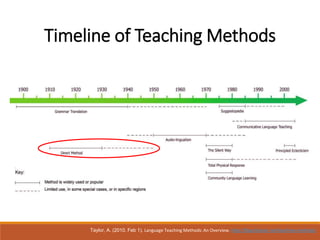
Timeline of Teaching Methods
Direct Method(DM)?
"The believers in the natural method argued that a
foreign language could be taught without
translation or the use of the learner’s native tongue
if meaning was conveyed directly through
demonstration and action.”
- L. Sauveur (1826-1907) -
Direct Method?
 a method of teaching a second/target language through
demonstration or action such as conversation, discussion, or etc. in
the language itself without translation and without the study of
formal grammar.
Merriam-Webster (June 05, 2017), Direct Method, https://www.merriam-webster.com/dictionary/direct%20method
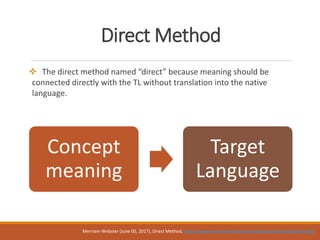
Direct Method
 The direct method named “direct” because meaning should be
connected directly with the TL without translation into the native
language.
Merriam-Webster (June 05, 2017), Direct Method, https://www.merriam-webster.com/dictionary/direct%20method
Concept
meaning
Target
Language
Taylor, A. (2010, Feb 1). Communicative Language Teaching. http://blog.tjtaylor.net/method-communicative/
“The focus is on good pronunciation, with
spontaneous use of the language, no translation,
and little grammar analysis.”
- Alex Taylor (2010) -
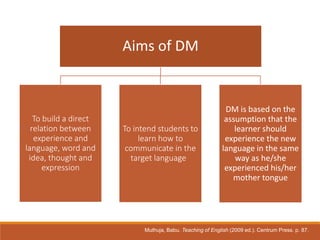
Aims of DM
To build a direct
relation between
experience and
language, word and
idea, thought and
expression
To intend students to
learn how to
communicate in the
target language
DM is based on the
assumption that the
learner should
experience the new
language in the same
way as he/she
experienced his/her
mother tongue
Muthuja, Babu. Teaching of English (2009 ed.). Centrum Press. p. 87.
The Principles of DM (1)
 Classroom instruction is conducted in the target language.
 There is an inductive approach to grammar
 Only everyday vocabulary is taught
 Concrete vocabulary is taught through pictures and objects, while
abstract is taught by association of ideas
 The learner is actively involved in using the language in realistic everyday
situations
 Students are encouraged to think in the target language
 Speaking is taught first before reading or writing
Taylor, A. (2010, Feb 1). Direct and Grammar Translation Methods. http://blog.tjtaylor.net/method-direct-grammar/
 This method states that the printed word should be kept away from
the second language learner for as long as possible
 Translation is completely banished from any classroom activity.
Classroom activities are carried out only in the target language
 Teacher teaches the second/foreign language in the same way as one
learns one’s mother tongue.
 Grammar is taught inductively (i.e. having learners find out rules
through the presentation of adequate linguistic forms in the target
language)
 Both speech and grammar were emphasized.
The Principles of DM (2)
Academia.edu - Share research, (June 05, 2017) Dr.Baiju K.Nath, DIRECT METHOD AND TRANSLATION METHOD IN TEACHING OF
ENGLISH. HTTP://WWW.ACADEMIA.EDU/10886801/DIRECT_METHOD_AND_TRANSLATION_METHOD_IN_TEACHING_OF_ENGLISH
Techniques for applying DM in classroom
1. Question/answer exercise – the teacher asks questions of any type and
the student answers.
2. Dictation – the teacher chooses a grade-appropriate passage and reads
it aloud.
3. Reading aloud – the students take turn reading sections of a passage,
play or a dialogue aloud.
4. Student self-correction – when a student makes a mistake the teacher
offers him/her a second chance by giving a choice.
5. Conversation practice – the students are given an opportunity to ask
their own questions to the other students or to the teacher. This
enables both a teacher-learner interaction as well as a learner-learner
interaction.
6. Paragraph writing – the students are asked to write a passage in their
own words.
muthuja, babu. teaching of english (2009 ed.). centrum press. p. 87.
Advantages
 The language is taught through demonstration and conversation in
context. Therefore, student will acquire fluency spoken English fast. This
also influents student can converse in English with felicity and ease.
 It makes the learning of English language interesting and lively because the
target language skills are really used in classroom
 Students are able to understand what they learn, think about it and then
express their own ideas in correct English about what they have read and
learnt
 This method can be usefully employed from the lowest to the highest
class.
 Fluency of speech, good pronunciation and power of expression are
properly developed.
Pratiwi Lestari and Rahmedia Alfi Rahmi (June 12, 2011)Direct Method as One of Language Teaching Approaches,
HTTPS://NOVAEKASARI09.WORDPRESS.COM/2011/06/12/DIRECT-METHOD-AS-ONE-OF-LANGUAGE-TEACHING-APPROACHES/
Disadvantages
 There are many abstract words which cannot be interpreted directly in
English and much time and energy are wasted in making attempts for the
purpose.
 This method is based on the principles that auditory appeal is stronger
that visual. But there are children with learn more with visual than with
their oral-aural sense like ears and tongue.
 The method ignores systematic written work and reading activities and
sufficient attention is not paid to reading and writing.
 This method may not hold well in higher classes where the translation
method is found suitable.
 There is dearth of teachers trained and interested in teaching English in
this method.
 In larger classes, this method is not properly applied and teaching in this
method does not suit or satisfy the needs of individual students in large
classes.
Pratiwi Lestari and Rahmedia Alfi Rahmi (June 12, 2011)Direct Method as One of Language Teaching Approaches,
HTTPS://NOVAEKASARI09.WORDPRESS.COM/2011/06/12/DIRECT-METHOD-AS-ONE-OF-LANGUAGE-TEACHING-APPROACHES/
Summary
 When – 1900 to 1930s approximately, some limited use into the
1970s
 Focus – Everyday spoken language
 Characteristics – Student learns by associating meaning directly in
English
 Highlight – No translation, Concepts are taught by means of objects
or by natural contexts, Oral training helps in reading and writing,
Grammar is taught indirectly
 Supporters – Maximilian Berlitz
teaching of enghlish (2005 ed.). aph publishing corporation. p. 66.
Taylor, A. (2010, Feb 1). Direct and Grammar Translation Methods. http://blog.tjtaylor.net/method-direct-grammar/
Reference
INNOVATIVE LANGUAGE LEARNING ©. (Tuesday, June 16th, 2009 ). Second Language Learning
Methods - Direct Method (Berlitz). http://blog.innovativelanguage.com/2009/06/16/second-language-
learning-methods-direct-method-berlitz/
Taylor, A. (2010, Feb 1). Language Teaching Methods: An Overview.
http://blog.tjtaylor.net/teaching-methods/
Taylor, A. (2010, Feb 1). Direct and Grammar Translation Methods. http://blog.tjtaylor.net/method-
direct-grammar/
Merriam-Webster (June 05, 2017), Direct Method, https://www.merriam-
webster.com/dictionary/direct%20method
InnovativeLanguage.com (June 05, 2017), Second Language Learning Methods - Direct Method
(Berlitz), http://blog.innovativelanguage.com/2009/06/16/second-language-learning-methods-direct-
method-berlitz/
Academia.edu - Share research, (June 05, 2017) Dr.Baiju K.Nath, DIRECT METHOD AND TRANSLATION
METHOD IN TEACHING OF
ENGLISH. HTTP://WWW.ACADEMIA.EDU/10886801/DIRECT_METHOD_AND_TRANSLATION_METHOD_I
N_TEACHING_OF_ENGLISH
Pratiwi Lestari and Rahmedia Alfi Rahmi (June 12, 2011)Direct Method as One of Language
Teaching Approaches, HTTPS://NOVAEKASARI09.WORDPRESS.COM/2011/06/12/DIRECT-METHOD-AS-
ONE-OF-LANGUAGE-TEACHING-APPROACHES/
Reference
Muthuja, Babu. Teaching of English (2009 ed.). Centrum Press. p. 87.
Anthony, E. M. (1963). "Approach, Method, and Technique". ELT Journal (2): 63–43.
A. P. R. HOWATT and RICHARD SMITH (2014). Language and History. The History of
Teaching English as a Foreign Language, from a British and European Perspective,57(1). 78
teaching of enghlish (2005 ed.). aph publishing corporation. p. 66.
muthuja, babu. teaching of english (2009 ed.). centrum press. p. 87.

Direct method

  • 1.
    Direct method TEACHING APPROACH Compiledby: Phattharakan Phiphitphornsirikun Wanlapa Thaweeapiradeepiti Pawarit Pingmuang
  • 2.
    OneDrive : https://1drv.ms/p/s!ArzCQwsWFznqh75inAYfuscft9abSA GoogleDrive (PDF) : https://drive.google.com/open?id=0BwnH34YiUv2Ra21BZGN4U01zRUU Online PDF
  • 3.
    Direct method - MaximilianD. Berlitz - - François Gouin -
  • 4.
    The Berlitz Story The method was developed by Maximilian Berlitz, who migrated from Germany to the United States. His initial intention was to teach different languages using the TGM. However, hiring a French guy to be his an assistant.  Berlitz hired an instructor to teach to his students, but when he hired the assistant, he found out that the Frenchman did not speak any English. Then, Berlitz got a cool, he left the Frenchman, instead of his classroom and asked him to do his best teaching language to the students.  Surprisingly, Berlitz came back to the classroom expecting a disaster and found out that his students were actively interacting with Joly and had progressed even further than they would have done learning the material using a nontraditional method.  The teacher communicated with the student through miming and gesturing. Grammar is not the essential goal because students were later able to discover grammatical rules on their own InnovativeLanguage.com (June 05, 2017), Second Language Learning Methods - Direct Method (Berlitz), http://blog.innovativelanguage.com/2009/06/16/second-language-learning-methods-direct-method-berlitz/
  • 5.
  • 6.
    Direct method is alsoknow as Direct method Natural Method Phonetical Method Reform Method Anti- grammatical Method
  • 7.
    Different Levels ofBerlitz’s DM 1. The Functional level: limits communication in its simplest form both orally and by listening. 2. Intermediate level: conversing in English and understanding familiar topics of discussion. 3. Advanced Intermediate level: competent communication and comfort with speaking the English Language in a professional and personal setting. 4. Advanced level: speak English proficiently 5. Native Speaker: Speak English naturally or at a professional level InnovativeLanguage.com (June 05, 2017), Second Language Learning Methods - Direct Method (Berlitz), http://blog.innovativelanguage.com/2009/06/16/second-language-learning-methods-direct-method-berlitz/
  • 8.
    Teaching Methods ofthe last century Stage I: Modern Language Teaching in Europe (1750–1920) 1. The Classical Period 1750–1880 2. The Reform Period 1880–1920 Stage II: English Language Teaching beyond and within Europe (1920– 2000+) 3. The Scientific Period (1920–70) 4. The Communicative Period (1970–2000+) A. P. R. HOWATT and RICHARD SMITH (2014). Language and History. The History of Teaching English as a Foreign Language, from a British and European Perspective,57(1). 78 Quirke, A. (2002, Sep 7,). A SHORT HISTORY OF EFL. http://www.philseflsupport.com/efl_history.htm Richards, J. and Rodgers, T (1986) . Approaches and Methods in Language Teaching CUP Cambridge.
  • 9.
    Methods of thelast century. (1750–1920) Stage I: Modern Language Teaching in Europe The Classical Period 1750–1880 : Emulating the teaching of classical languages ◦ Grammar-translation – the classical method The Reform Period 1880–1920 : Teaching the spoken language ◦ The Direct Method (also called Natural Method) / The Berlitz Method – discovering the importance of speaking A. P. R. HOWATT and RICHARD SMITH (2014). Language and History. The History of Teaching English as a Foreign Language, from a British and European Perspective,57(1). 78 Quirke, A. (2002, Sep 7,). A SHORT HISTORY OF EFL. http://www.philseflsupport.com/efl_history.htm Richards, J. and Rodgers, T (1986) . Approaches and Methods in Language Teaching CUP Cambridge.
  • 10.
    Methods of thelast century. (1920–2000+) Stage II: English Language Teaching beyond and within Europe The Scientific Period (1920–70) : Scientific basis for teaching ◦ The Oral Method (Palmer) ◦ The Multiple Line of Approach (Palmer) ◦ The Situational Approach (Hornby) ◦ The Oral Approach (Fries) ◦ Audio-lingual – the first modern methodology The Communicative Period (1970–2000+) : Aiming for ‘real-life communication’ ◦ Communicative language teaching (CLT) - the modern standard method ◦ Task-based language learning A. P. R. HOWATT and RICHARD SMITH (2014). Language and History. The History of Teaching English as a Foreign Language, from a British and European Perspective,57(1). 78 Quirke, A. (2002, Sep 7,). A SHORT HISTORY OF EFL. http://www.philseflsupport.com/efl_history.htm Richards, J. and Rodgers, T (1986) . Approaches and Methods in Language Teaching CUP Cambridge.
  • 11.
    Other Methods ofthe last century The structural approach Humanistic Approaches – a range of holistic methods applied to language learning ◦ The Silent Way ◦ Suggestopedia ◦ Community Language Learning ◦ Comprehension Approach (Natural Approach, the Learnables, and Total Physical Response (TPR)) Content-based, Task-based, and Participatory Approaches Learning Strategy Training, Cooperative Learning, and Multiple Intelligences Immersion The Lexical Syllabus Learner Independence '90s into 21st century TPR Storytelling Principled Eclecticism (Newest) – fitting the method to the learner, not the learner to the method A. P. R. HOWATT and RICHARD SMITH (2014). Language and History. The History of Teaching English as a Foreign Language, from a British and European Perspective,57(1). 78 Quirke, A. (2002, Sep 7,). A SHORT HISTORY OF EFL. http://www.philseflsupport.com/efl_history.htm Richards, J. and Rodgers, T (1986) . Approaches and Methods in Language Teaching CUP Cambridge.
  • 12.
    Teaching methods incategories Structural methods ◦ Grammar–translation method ◦ Audio-lingual method Functional methods ◦ The oral approach and situational language teaching ◦ Directed practice Proprietary methods ◦ Pimsleur method ◦ Michel Thomas Method Other ◦ Learning by teaching (LdL) ◦ Computer Assisted Language Learning (CALL) •Interactive methods •Direct method/Berlitz Method •The series method •Communicative language teaching •Language immersion •Silent Way •Community language learning •Suggestopedia •Natural approach •Total physical response •Teaching Proficiency through Reading and Storytelling •Dogme language teaching Anthony, E. M. (1963). "Approach, Method, and Technique". ELT Journal (2): 63–43.
  • 13.
    Taylor, A. (2010,Feb 1). Language Teaching Methods: An Overview. http://blog.tjtaylor.net/teaching-methods/ Timeline of Teaching Methods
  • 14.
  • 15.
    "The believers inthe natural method argued that a foreign language could be taught without translation or the use of the learner’s native tongue if meaning was conveyed directly through demonstration and action.” - L. Sauveur (1826-1907) -
  • 16.
    Direct Method?  amethod of teaching a second/target language through demonstration or action such as conversation, discussion, or etc. in the language itself without translation and without the study of formal grammar. Merriam-Webster (June 05, 2017), Direct Method, https://www.merriam-webster.com/dictionary/direct%20method
  • 17.
    Direct Method  Thedirect method named “direct” because meaning should be connected directly with the TL without translation into the native language. Merriam-Webster (June 05, 2017), Direct Method, https://www.merriam-webster.com/dictionary/direct%20method Concept meaning Target Language
  • 18.
    Taylor, A. (2010,Feb 1). Communicative Language Teaching. http://blog.tjtaylor.net/method-communicative/ “The focus is on good pronunciation, with spontaneous use of the language, no translation, and little grammar analysis.” - Alex Taylor (2010) -
  • 19.
    Aims of DM Tobuild a direct relation between experience and language, word and idea, thought and expression To intend students to learn how to communicate in the target language DM is based on the assumption that the learner should experience the new language in the same way as he/she experienced his/her mother tongue Muthuja, Babu. Teaching of English (2009 ed.). Centrum Press. p. 87.
  • 20.
    The Principles ofDM (1)  Classroom instruction is conducted in the target language.  There is an inductive approach to grammar  Only everyday vocabulary is taught  Concrete vocabulary is taught through pictures and objects, while abstract is taught by association of ideas  The learner is actively involved in using the language in realistic everyday situations  Students are encouraged to think in the target language  Speaking is taught first before reading or writing Taylor, A. (2010, Feb 1). Direct and Grammar Translation Methods. http://blog.tjtaylor.net/method-direct-grammar/
  • 21.
     This methodstates that the printed word should be kept away from the second language learner for as long as possible  Translation is completely banished from any classroom activity. Classroom activities are carried out only in the target language  Teacher teaches the second/foreign language in the same way as one learns one’s mother tongue.  Grammar is taught inductively (i.e. having learners find out rules through the presentation of adequate linguistic forms in the target language)  Both speech and grammar were emphasized. The Principles of DM (2) Academia.edu - Share research, (June 05, 2017) Dr.Baiju K.Nath, DIRECT METHOD AND TRANSLATION METHOD IN TEACHING OF ENGLISH. HTTP://WWW.ACADEMIA.EDU/10886801/DIRECT_METHOD_AND_TRANSLATION_METHOD_IN_TEACHING_OF_ENGLISH
  • 22.
    Techniques for applyingDM in classroom 1. Question/answer exercise – the teacher asks questions of any type and the student answers. 2. Dictation – the teacher chooses a grade-appropriate passage and reads it aloud. 3. Reading aloud – the students take turn reading sections of a passage, play or a dialogue aloud. 4. Student self-correction – when a student makes a mistake the teacher offers him/her a second chance by giving a choice. 5. Conversation practice – the students are given an opportunity to ask their own questions to the other students or to the teacher. This enables both a teacher-learner interaction as well as a learner-learner interaction. 6. Paragraph writing – the students are asked to write a passage in their own words. muthuja, babu. teaching of english (2009 ed.). centrum press. p. 87.
  • 23.
    Advantages  The languageis taught through demonstration and conversation in context. Therefore, student will acquire fluency spoken English fast. This also influents student can converse in English with felicity and ease.  It makes the learning of English language interesting and lively because the target language skills are really used in classroom  Students are able to understand what they learn, think about it and then express their own ideas in correct English about what they have read and learnt  This method can be usefully employed from the lowest to the highest class.  Fluency of speech, good pronunciation and power of expression are properly developed. Pratiwi Lestari and Rahmedia Alfi Rahmi (June 12, 2011)Direct Method as One of Language Teaching Approaches, HTTPS://NOVAEKASARI09.WORDPRESS.COM/2011/06/12/DIRECT-METHOD-AS-ONE-OF-LANGUAGE-TEACHING-APPROACHES/
  • 24.
    Disadvantages  There aremany abstract words which cannot be interpreted directly in English and much time and energy are wasted in making attempts for the purpose.  This method is based on the principles that auditory appeal is stronger that visual. But there are children with learn more with visual than with their oral-aural sense like ears and tongue.  The method ignores systematic written work and reading activities and sufficient attention is not paid to reading and writing.  This method may not hold well in higher classes where the translation method is found suitable.  There is dearth of teachers trained and interested in teaching English in this method.  In larger classes, this method is not properly applied and teaching in this method does not suit or satisfy the needs of individual students in large classes. Pratiwi Lestari and Rahmedia Alfi Rahmi (June 12, 2011)Direct Method as One of Language Teaching Approaches, HTTPS://NOVAEKASARI09.WORDPRESS.COM/2011/06/12/DIRECT-METHOD-AS-ONE-OF-LANGUAGE-TEACHING-APPROACHES/
  • 25.
    Summary  When –1900 to 1930s approximately, some limited use into the 1970s  Focus – Everyday spoken language  Characteristics – Student learns by associating meaning directly in English  Highlight – No translation, Concepts are taught by means of objects or by natural contexts, Oral training helps in reading and writing, Grammar is taught indirectly  Supporters – Maximilian Berlitz teaching of enghlish (2005 ed.). aph publishing corporation. p. 66. Taylor, A. (2010, Feb 1). Direct and Grammar Translation Methods. http://blog.tjtaylor.net/method-direct-grammar/
  • 26.
    Reference INNOVATIVE LANGUAGE LEARNING©. (Tuesday, June 16th, 2009 ). Second Language Learning Methods - Direct Method (Berlitz). http://blog.innovativelanguage.com/2009/06/16/second-language- learning-methods-direct-method-berlitz/ Taylor, A. (2010, Feb 1). Language Teaching Methods: An Overview. http://blog.tjtaylor.net/teaching-methods/ Taylor, A. (2010, Feb 1). Direct and Grammar Translation Methods. http://blog.tjtaylor.net/method- direct-grammar/ Merriam-Webster (June 05, 2017), Direct Method, https://www.merriam- webster.com/dictionary/direct%20method InnovativeLanguage.com (June 05, 2017), Second Language Learning Methods - Direct Method (Berlitz), http://blog.innovativelanguage.com/2009/06/16/second-language-learning-methods-direct- method-berlitz/ Academia.edu - Share research, (June 05, 2017) Dr.Baiju K.Nath, DIRECT METHOD AND TRANSLATION METHOD IN TEACHING OF ENGLISH. HTTP://WWW.ACADEMIA.EDU/10886801/DIRECT_METHOD_AND_TRANSLATION_METHOD_I N_TEACHING_OF_ENGLISH Pratiwi Lestari and Rahmedia Alfi Rahmi (June 12, 2011)Direct Method as One of Language Teaching Approaches, HTTPS://NOVAEKASARI09.WORDPRESS.COM/2011/06/12/DIRECT-METHOD-AS- ONE-OF-LANGUAGE-TEACHING-APPROACHES/
  • 27.
    Reference Muthuja, Babu. Teachingof English (2009 ed.). Centrum Press. p. 87. Anthony, E. M. (1963). "Approach, Method, and Technique". ELT Journal (2): 63–43. A. P. R. HOWATT and RICHARD SMITH (2014). Language and History. The History of Teaching English as a Foreign Language, from a British and European Perspective,57(1). 78 teaching of enghlish (2005 ed.). aph publishing corporation. p. 66. muthuja, babu. teaching of english (2009 ed.). centrum press. p. 87.