1
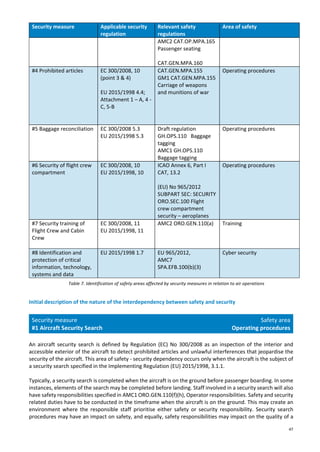
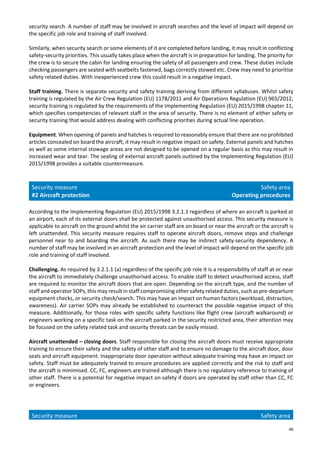
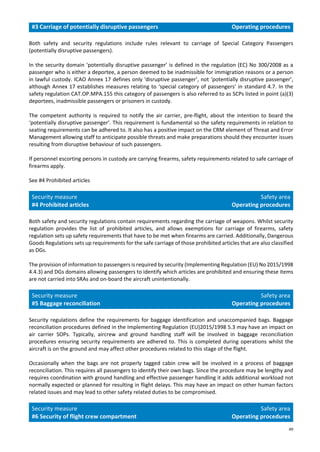
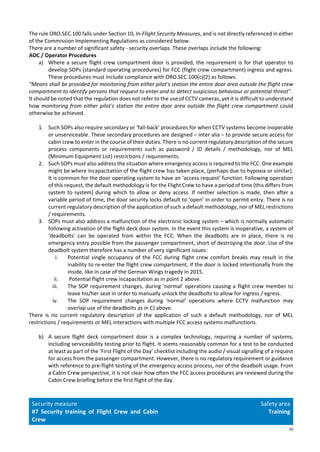
RESEARCH PROJECT EASA.2022.HVP.04
REPORTON SAFETY AREAS AFFECTED BY SECURITY D-1.1
Impact of Security
Measures on Safety
Research conducted by:
An Agency of the European Union
This project has received funding
from the European Union's Horizon Europe Programme
2.
2
Disclaimer
Funded by theEuropean Union. Views and opinions expressed are however those of the author(s) only and do not
necessarily reflect those of the European Union or the European Union Aviation Safety Agency (EASA). Neither the
European Union nor EASA can be held responsible for them.
This deliverable has been carried out for EASA by an external organisation and expresses the opinion of the organisation
undertaking this deliverable. It is provided for information purposes. Consequently, it should not be relied upon as a
statement, as any form of warranty, representation, undertaking, contractual, or other commitment binding in law upon
the EASA.
Ownership of all copyright and other intellectual property rights in this material including any documentation, data and
technical information, remains vested to the European Union Aviation Safety Agency. All logo, copyrights, trademarks, and
registered trademarks that may be contained within are the property of their respective owners. For any use or
reproduction of photos or other material that is not under the copyright of EASA, permission must be sought directly from
the copyright holders.
Reproduction of this deliverable, in whole or in part, is permitted under the condition that the full body of this Disclaimer
remains clearly and visibly affixed at all times with such reproduced part.
DELIVERABLE NUMBER AND TITLE: [Impact of Security on Safety, D1.1]
CONTRACT NUMBER: EASA.2022.PV.04
CONTRACTOR / AUTHOR: CAAi/ Dorota Broom
IPR OWNER: European Union Aviation Safety Agency
DISTRIBUTION: Public
APPROVED BY:
CAAi
AUTHOR
Dorota Broom
REVIEWERS
Apave - Ivan Volpoet
CASRA – Adam Troczynski
CAAi – Nina Smith
MANAGING DEPARTMENT
CAAi – Kevin Sawyer
DATE: 08 September 2023
Contributed to Task 1.1
Dorota Broom - CAAi Technical Advisor Aviation Security (Technical Lead for Task 1.1)
Ivan Volpoet - Apave Lead SME on civil and military Airworthiness
Adam Troczynski - CASRA Technical Expert Aviation Security
Nina Smith - CAA Head of Training and Human Factors Aviation Security
Owen Healey - CAAi Technical Expert Aerodromes
Layla Bromley - CAA Cyber Security Policy Specialist
Ben Bamber - CAAi Flight Operations Training Inspector Senior Technical Adviser
3.
3
TABLE OF CONTENTS
CAAInternational Limited (CAAi) was established in April 2007 as a wholly owned subsidiary of the UK CAA.
The UK Civil Aviation Authority (UK CAA) is the UK's specialist aviation regulator, directly reporting to the
UK Government’s Department for Transport (DfT). Through its skills and expertise, it is recognised as a
world leader in its field. CAAi provides access to the UK CAA’s wealth of expertise and experience within
the five operating groups of the UK CAA (Safety & Airspace Regulation Group, Consumers and Markets
Group, Security Group, Strategy and Policy Group and International Group). Its primary focus is providing
advisory, training, examination and licencing services to agencies, fellow National Aviation Authorities and
industry in over 140 countries. CAAi’s work involves assessment and delivery of targeted safety, security
and environmental improvements and offer unparalleled expertise stemming from insights into best
practices defined by the CAA.
Apave’s core business is to help companies and government services managing their technical,
environmental and human risks in the areas of Oil & Gas / Nuclear / Industry / Transportation. In aviation,
Apave is committed to offering a range of civil and military aviation safety services, covering oversight
authority tasks, audits, technical control, training and consulting services, through specialized and dedicated
entities. Apave’s staff in aviation enjoy extensive knowledge of the International and European regulatory
framework, with a focus on Airworthiness, Flight Operations and Safety Management Systems In 2022 Apave
has strengthened its portfolio through the acquisition of Oppida a cyber-security specialist in many highly
regulated domains and safety and security exposed businesses. Apave has organised its civil and military
aviation risk management consulting services around a unique value proposition with a dedicated entity:
Apave Aeroservices (hereafter referred to as ‘’Apave”) has been designated in 2009 as the Group centre of
excellence to provide risk management solutions to the Aviation community, including aviation authorities,
Air Operators, Industry, Maintenance Organisations (MROs - Maintenance, Repair & Overhaul) and Training
Organisations.
APSS Software & Services Ltd is part of the Center for Adaptive Security Research and Applications (CASRA),
which was founded in 2008. CASRA emerged from the Visual Cognition Research Group of the University of
Zurich, which was founded by Adrian Schwaninger in 1999. Today, CASRA APSS has a workforce of around 35
people, comprising of psychologists, economists, computer scientists, imaging specialists, software
developers, aviation security experts, and more, most of which have an academic degree. The main objective
of CASRA is to increase security and facilitation at airports and other environments involving people and
technology. Through their studies and research on human – machine interaction, it was identified that visual
abilities and training determine largely screeners’ performance. As such CASRA has been working with a
number of aviation security authorities and airports on selection, training and competency assessment
processes providing advisory and research as well as their solutions globally.
4.
4
TABLE OF CONTENTS.........................................................................................................................3
ABBREVIATIONS................................................................................................................................ 5
1. Executive summary.................................................................................................................... 7
2. Methodology ........................................................................................................................... 10
3. Context .................................................................................................................................... 10
4. Objective of the document...................................................................................................... 11
5. Introduction............................................................................................................................. 14
6. Mapping safety - security interdependencies.......................................................................... 18
7. Safety areas affected by security measures............................................................................. 23
7.1 Aircraft safety 23
7.2 Unmanned Aircraft Systems 27
7.3 Area of Air Traffic Services 30
7.4 Area of Aerodrome / Airport Operations 34
7.5 Area of Aerodrome / Airport Operations related to security controls and screening 40
7.6 Area of Air Operations 46
7.7 Area of Ground Operations 52
7.8 Off-airport Operations 55
8. Conclusion ............................................................................................................................... 58
9. Bibliography and references.................................................................................................... 61
5.
5
ABBREVIATIONS
ACRONYM DESCRIPTION
ABP Able-BodiedPassenger
AC Advisory Circular
ACS Area Control Surveillance
ADO Aerodrome Design and Operations
ADV Aerodrome Control and Visual Rating
ADI Aerodrome Control Instrument Rating for Tower
AIC Airport Identification Card
AMC Acceptable Means of Compliance
Annex ICAO Annex (referring to various safety and security annexes)
ATS Air Traffic Services
ATM Air Traffic Management
ATSP Air Traffic Service Provider
AUI Act of Unlawful Interference
BR Basic Regulation
CCTV Closed-Circuit Television
CAT Commercial Air Transport
CBT Computer Based Training
CC Cabin Crew
CIC Crew Identification Card
COG Chemical Oxygen Generator
CRM Crew Resource Management
CS Certification Specifications
DGs Dangerous Goods
DOC Document
DSN Design
EC European Commission
EASA European Union Aviation Safety Agency
EFB Electronic Flight Bag
EU European Union
FCC Flight Crew Compartment
FC Flight Crew
FDM Flight Data Monitoring
GH Ground Handling
GM Guidance Material
HBS Hold Baggage Screening
ICAO International Civil Aviation Organization
ICT Information and Communication Technology
ID Identification
6.
6
IED Improvised ExplosiveDevice
IUEIs Intentional Unauthorised Electronic Interactions
LRBL Least Risk Bomb Location
MEL Minimum Equipment List
MSMs More Stringent Measures
NAAs National Appropriate Authorities
N/A Not Applicable
NCASP National Civil Aviation Security Program
OEMs Original Equipment Manufacturers
SARPs Standards and Recommended Practice
SEC Security
SOP Standard Operating Procedures
SRA Security Restricted Area
TEM Threat and Error Management
UA Unmanned Aircraft
UAS Unmanned Aircraft System
UTM Unmanned Aircraft System Traffic management
7.
7
1.Executive summary
Problem area
ICAOAnnex 17 on Aviation Security, paragraph 2.1.1 states that “each Contracting State shall have as its
primary objective the safety of passengers, crew, ground personnel and the general public in all matters related
to safeguarding international civil aviation against acts of unlawful interference”. Implicit within this
overarching objective is the notion that the application of aviation security measures contributes to the overall
safety of civil aviation.
There are clear examples in civil aviation where security and safety measures overlap or complement each
other whilst in other areas the relationship between safety and security requirements may be less apparent. In
order to understand how well these touchpoints (hereafter referred to as interdependencies) co-exist, it is first
necessary to map out the interdependencies and areas of safety that may be affected by security measures
both at a regulatory and operational perspective.
Having identified those areas where aviation safety is impacted by aviation security measures, we will then be
able to consider the nature of that impact, be it positive or negative, direct or indirect. Whilst the
implementation of aviation security measures has an unambiguous contribution to safety in the widest sense
(the prevention of acts of unlawful inference), there will also likely be opportunities for greater collaboration
and efficiency between the two domains particularly given the emergence of innovative technologies and
operations within civil aviation which span the traditional boundaries between safety and security (e.g. cyber
or unmanned aircraft systems).
The purpose of this research summary is to understand the nature and scope of the interdependencies between
safety and security in order to identify the areas of safety affected by security measures and assess the impact
that security measures have on safety (a systematic impact assessment will be undertaken in Task 2.3 of this
research framework). This report outlines the areas of safety impacted by security measures considering
security measures currently in place but also those that are likely to form part of future regulations or are likely
to form part of a future response to specific threat scenarios. Future deliverables within this project will
consider the specific job roles and responsibilities that are likely affected by the interdependencies (task 1.2).
Safety areas affected by security measures
These safety areas affected by security measures are categorised into eight primary sections that align with
main safety regulatory framework. These main areas are:
• Aircraft and aircraft equipment (including design, certification and airworthiness)
• Unmanned Aircraft Systems
• Air Traffic Services and Management
• Aerodrome / airport operations
• Aerodrome / airport operations relating to security controls, screening and screening equipment1
• Air Operations
• Ground Operations
• Off-airport operations
1
The scope of this research study is confined to civil aviation, and the consideration of screening equipment in context
other than aviation falls outside of the scope of this project.
8.
8
Each primary areais subdivided into more specific areas of safety based on safety – security touchpoints
identified:
• Aircraft and aircraft equipment. Entities who must comply with relevant safety standards and
certification specification include aircraft manufacturers and maintenance organisations. Specific
areas of safety affected by security measures include:
o Aircraft design and certification
o Aircraft systems and system security (cyber security) including information security
o Air carrier emergency procedures and training (analysed in section related to Air Operations)
o Aircraft maintenance in relation to maintenance organisations (MRO, CAMO)
• Unmanned Aircraft Systems. This area refers to the unmanned aircraft (drones) and their operators.
Specific areas of safety affected by security measures include:
o UAS operation
o Aerodrome operational systems
o Area of crisis management, contingency plans, emergency response primarily at the airports
• Air Traffic Services and Air Traffic Management. Area of air traffic control and air traffic management
relevant to entities who apply relevant safety and security measures. Specific areas of safety affected
by security measures include:
o ATS systems and system security (cyber security)
o Infrastructure
o Staff recruitment and training
o Organisational requirements
o Emergency procedures and contingency planning
o Operations
o Management system
• Aerodrome / airport operations. Area of airport design, planning, airport operations relevant to
entities designing and certifying aerodromes and entities managing airport operations. Specific areas
of safety affected by security measures include:
o Management system
o Aerodrome design and certification
o Aerodrome operations
o Aerodrome systems (cyber security)
o Contingency planning and emergency response
o Staff recruitment and training
• Area of aerodrome / airport operations relating to security controls, screening (safety area of
Dangerous Goods). This area is relevant to entities providing airport security controls and screening,
(which in some cases may be delegated to third-party providers.) Measures relating to cargo and
supplies screening were also examined in this section. Safety and security measures in relation to
passengers and baggage screening, cargo and supplies screening were examined. Entities in scope
include Regulated Agent, Regulated Supplier of In-Flight and Airport Supplies. Specific areas of safety
affected by security measures include:
9.
9
o Certification ofscreeners
o Dangerous Goods
o Screeners training and recruitment
o Organisational responsibility
o Operations
o Screening equipment
• Air operations. Area relevant to air carriers and operators including cargo operators. In this area
measures related to air operations were examined. Specific areas of safety affected by security
measures include:
o Operating procedures
o Staff recruitment and training
o Cyber security
• Ground operations. Area relevant specifically to Ground Handling operations. In the current regulatory
environment, Ground Handling entities are not separately regulated. There is a DRAFT Commission
Delegated Regulation laying down requirements and administrative procedures related to ground
handling services. Looking ahead to the future regulatory landscape of ground handling operations,
specific requirements for ground handling are listed separately withing this section. Specific areas of
safety affected by security measures include:
o Ground Handling operating procedures
o Dangerous Goods
• Off-airport operations. This section pertains to off-airport operations conducted by entities such as
Regulated Agents, Known Consignors, Regulated Suppliers, or hauliers. Within this domain, security
measures concerning activities carried out beyond the boundaries of the airport perimeter were
examined. Although these security measures may not currently exhibit a direct impact on the safety
areas within the scope of safety regulations, they were subject to scrutiny for the purpose of this
research due to the significant involvement of numerous entities in such operations.
Specific areas of safety affected by security measures include:
o Transport of Dangerous Goods
o Training
o Organisational responsibility
o Safety Management
Identification of the safety areas impacted by security measures serves as an important primary step in this
research project, providing a clear direction. A detailed analysis of the impact that these security measures
have on safety will be systematically analysed in task 2. In task 2, the threat to aircraft safety will also be
assessed enabling comparison of the areas of safety - security dependency and the areas of the most prominent
threat. This process will facilitate the identification of additional safety areas which necessitate further
investigation, thereby providing a comprehensive understanding of the interdependencies at play.
10.
10
2.Methodology
In order toassess which areas of safety are impacted by security measures the research defines the entities in
scope of both safety and security regulation. For the safety - security interdependency to occur, an entity must
fall within scope of both safety and security regulations and have both safety and security responsibilities, as
defined in legislation or internationally recognised standards (including industry standards). The initial stage of
the research consisted of identifying and reviewing relevant security standards, regulations and guidance
documents that detail security measures that civil aviation entities must comply with. These are listed in section
5, Introduction, Security regulations reviewed in this research. Entities in scope of security regulations were
then identified in section 5, Introduction, Entities in scope of security regulations. The next stage entailed
mapping safety regulations applicable to the relevant entities, which are listed in section 6, Mapping
safety - security interdependencies. EASA Basic Regulation (EU) No 2018/1139 and its Implementing Rules
provided a fundamental starting point to define areas of safety covered by the regulation and provides
initial picture where safety – security dependencies may occur and areas that are further investigated in
this task. To consider the complexity of civil aviation regulatory structure in both safety and security
domains, and in order to comprehensively outline the safety areas influenced by security measures, it was
essential to categorise the primary areas beforehand. The primary categories presented in this study pertain to
the safety regulatory framework.
To identify specific safety areas, each primary area lists the security measures that relevant entities have to
apply. EU and ICAO standards provided the list of security measures considered for the purpose of this research,
including Regulation (EC) 300/2008 (Common Basic Standards), (EU) 2015/1998 (Implementing Regulation),
ICAO Annex 17 and when applicable other security related standards (listed in section 5, Introduction).
Each primary area of safety includes a table where the first column denotes the security measure, followed by
the corresponding regulatory reference (security – second column and safety – third column). The last column
indicates the safety area affected by the respective security measure. The initial description is provided in the
Initial description of the nature of the interdependency between safety and security section. This
constitutes the initial description that will be further investigated during the framework of this research project
(Task 2 and Task 3). Subsequently, the impact of the listed measures on safety areas will be assessed in task 2.
Summary of undertaken tasks:
• Listing applicable security standards and regulations
• Defining entities in scope of security standards and regulations
• Listing safety regulations applicable to entities in scope of security regulations
• Defining primary areas of safety affected by security measures
• Review security measures applicable to the entities in scope of primary areas of safety identified
• Describing the nature of each interdependency
3.Context
The European Union Aviation Safety Agency (hereinafter “EASA”) is an agency of the European Union, which
has been given specific regulatory and executive tasks in the field of aviation safety. The Agency constitutes a
key part of the European Union’s strategy to establish and maintain a high uniform standard of safety and
environmental protection in civil aviation at European level.
11.
11
As part ofthe Horizon Europe Work Programme 2021-2022 on Cluster 5 Climate, Energy and Mobility, the
European Commission has entrusted EASA with the management of one specific research action entitled
“impact of security measures on safety”.
As a result, EASA has awarded a public contract to a consortium of 3 companies:
• CAA International
• Apave Aéroservices
• CASRA
The contract details the four main tasks which are specified in order to achieve the expected outcome which is
to understand the nature and extent of the interdependencies between safety and security in order to assess
the impact of security measures on safety. In doing so, the research project should identify which processes
and job roles are affected by safety–security interdependencies and which certification requirements and
licensing activities are affected. In the medium term, safety risk management techniques that can be applied
to security will produce harmonised risk assessment methods and support integrated policy and decision-
making processes at national and EU level.
The project aim to develop a comprehensive knowledge base for the evaluation of the potential impact of
security measures on the safety performances of aviation systems, personnel and operations, including the
leading indicators for measuring such an impact (positive or negative) as well as the main factors playing a role
in such security-safety dependencies.
The four main tasks are:
• Task 1: Identify the interdependencies between security and safety
• Task 2: Assessment of the impact of security measures on safety
• Task 3: Analysis of certification standards
• Task 4: Integrated risk management
4.Objective of the document
Scope
This report represents deliverable ‘D1.1’ of the Impact of Security Measures on Safety (EASA.2022.HVP.04). The
work presented here represents the output from ‘Task 1’ which includes identification of the safety
areas affected (positively or negatively).
Place of the document in the overall project
This report is an entry for the deliverable D1.2, D1.3 and D2.2 which aims at providing an assessment of the
impact of the security-safety interdependencies on safety. The results of task 1.1 are fundamental for the
direction of the rest of the research project tasks 2, 3 and 4 have direct dependence on the outcomes presented
in this report.
12.
12
Figure 1. Placeand dependencies of D1.1 report in the project
Out of scope of this research
Derogated flights. Flights which are derogated from common basic standards for aviation security, described
in the regulation EU1254/2009 and the amendment EU2016/2096 and adopt alternative security measures fall
out of scope of this research.
Derogated flights include:
• Aircrafts with a maximum take-off weight of less than 15 000 kilograms
• helicopters
• law enforcement flights
• fire suppression flights
• flights for medical services, emergency or rescue services
• research and development flights
• flights for aerial work
• humanitarian aid flights
• flights operated by air carriers, aircraft manufacturers or maintenance companies, transporting neither
passengers and baggage, nor cargo and mail
• flights with aircraft with a maximum take-off weight of less than 45 500 kilograms, owned by a company
for the carriage of own staff and non-fare-paying passengers and goods as an aid to the conduct of
company business
• flights with aircraft with a maximum take-off weight of less than 45 500 kilograms, chartered or leased
in its entirety by a company from an aircraft operator with which it has a written agreement for the
carriage of own staff and non-fare-paying passengers and goods as an aid to the conduct of company
business
• flights with aircraft with a maximum take-off weight of less than 45 500 kilograms, for the carriage of
the owner of the aircraft and of non-fare-paying passengers and goods.
13.
13
Third countries. Securitymeasures only applicable to third countries are out of the scope of this research. Third
countries are countries and territories to which, in accordance with Article 355 of the Treaty on the Functioning
of the European Union, Title VI of Part Three of that Treaty does not apply.2
More Stringent Measures. As per Article 6 of EC300/2008 States may apply more stringent measures (MSM)
than the common basic standards. MSMs are established on basis of national risk assessment and in
compliance with Community law. MSMs are part of State NCASP and are not in scope of this research.
Impact of safety measures on security. Through the review of safety and security standards and regulations
the impact of safety measures on security was included in this report when it was observed, however the full
study of impact of safety measures on security would require a separate comprehensive study. This report does
not provide the full map of those safety measures that may have an impact on aviation security.
2
COMMISSION IMPLEMENTING REGULATION (EU) 2015/1998 of 5 November 2015 laying down detailed measures for
the implementation of the common basic standards on aviation security. Current consolidated version: 01/04/2023
14.
14
5.Introduction
General considerations
Security measures,standards and regulations have historically been developed in reaction to identified threats
or acts of unlawful interference. ICAO Annex 17 on Aviation Security, paragraph 2.1.1 states that “each
Contracting State shall have as its primary objective the safety of passengers, crew, ground personnel and the
general public in all matters related to safeguarding international civil aviation against acts of unlawful
interference”.
The regulation of aviation security has largely developed in reaction to successful or thwarted acts of unlawful
interference with security measures being introduced to reduce the vulnerability of the system or reducing the
risk of similar event from either being successful in the future or from happening again. At a macro level then,
the impact of each security measure on safety is a positive one as security measures are increasing protection
against acts of unlawful inference and therefore reducing the risk of harm. On a more granular level, there is
the possibility that an individual security measure may impact aviation safety operations, systems, equipment
or human factors by creating conditions where there is a potential for increased safety risk or reduction in the
effectiveness of a mitigation. Equally, there is potential that an individual security measures may positively
impact safety. The aim of this study is not to dispute the overarching necessity for implemented security
measures but to look at interactions between safety and security, identifying and analysing areas of
dependency (Fig.2).
Figure 2. Impact of security measures on safety
Definition of aviation security
Article 3 of EC300/2008, Common Basic Standards in the field of civil aviation security, defines Aviation Security
as “the combination of measures and human and material resources intended to safeguard civil aviation against
acts of unlawful interference that jeopardise the security of civil aviation”3
. ICAO Annex 17 defines Aviation
Security as “Safeguarding civil aviation against acts of unlawful interference. This objective is achieved by a
combination of measures and human and material resources.” Acts of unlawful interference are also defined in
Annex 17 as “acts or attempted acts such as to jeopardize the safety of civil aviation.” Aviation security is
therefore an essential element of the overall safety system, and it is composed of three main elements:
a) Measures include international, regional and national standards and recommended practices,
including legally binding regulations, best practice, national rules, processes and individual SOPs
3
REGULATION(EC)No300/2008 OF THE EUROPEAN PARLIAMENT AND OF THE COUNCIL of 11March2008 on common
rules in the field of civil aviation security and repealing Regulation (EC)No2320/2002
The main purpose of introduced security measures is to
prevent acts of unlawful interference, as such, at strategic
level the impact of those measures remains positive.
Security measures may have an impact on aviation systems,
processes, procedures and people, generating additional safety risk
that may contribute to the development of unsafe conditions.
15.
15
established in orderto protect civil aviation from acts of unlawful interference. Legal framework for
aviation security constitutes a collection of security measures. When a new security measure is
introduced, it may have an impact on safety, may duplicate existing safety regulation or contradict
existing safety regulation.
b) Human resources include the human element of the security system. Recruitment, training, skills,
knowledge, human factors, performance and actions. The human element is central to security systems
and staff require specific cognitive abilities, skills, and knowledge to fulfil their assigned security
functions. Several roles and functions within the aviation system include safety and security
responsibilities. Where a safety - security interdependency exists, staff is likely to assess the risks and
make trade-offs and need to be prepared to deal with potentially conflicting priorities. These tasks may
have to be completed simultaneously in a fast-paced environment with some security related
requirements having an impact on aviation safety, personal health and safety or human factors.
c) Material resources include equipment and facilities provided to safeguard civil aviation from acts of
unlawful interference. There is a variety of equipment and material resources used solely in the security
domain, for example screening equipment. Aircraft systems and equipment also provides additional
resources to protect civil aviation against acts of unlawful interference. Systems and equipment
installed on the aircraft for security purposes may impact other safety equipment installed on the
aircraft, on aircraft operations or staff.
In the context of definition of aviation security, this study examines security requirements, processes,
procedures, physical security as well as cyber security measures that may have an impact on safety.
Nature of potential interdependencies
a) Regulatory overlap – when a defined requirement is subject to safety and security regulations. These
are more visible interdependencies where the requirement may be duplicated in both domains. It may
be more challenging for the industry to comply with both safety and security measures if the measures
are referred to in both sets of regulation, for example, perimeter fencing which has specific
requirements from a security perspective and a separate function from a safety perspective.
1. Challenges of regulatory overlap. Entities having to comply with both safety and security
regulations must identify two sources and establish processes and procedures that will satisfy
both and keep track of potential updates of both. Possible issues when overlap occurs:
i. Change to the regulation may result in conflicting rules or rules being established,
changed or withdrawn in uncoordinated manner. With time, areas of duplication may
develop, creating ambiguity and misunderstandings
ii. Those drafting as well as those implementing safety rules may not have access and/or
security vetting to access security detailed measures
iii. Those drafting as well as those implementing security rules may not have skills or
knowledge regarding safety rules and vice versa
iv. Duplication of oversight – compliance monitoring activities conducted through safety
and security oversight. Avoiding duplication of regulation would lead to more efficient
use of NAA’s resources and furthermore would increase efficiency for the industry
regarding compliance monitoring activities
2. On some occasions, even with regulatory overlap the impact of one regulatory domain on the
other is positive when the regulations are converging. This is the case when one source of
regulation specifies the requirements, and the other source provides more detailed
requirements or guidance. An example of this may be safety - security interdependency in case
of security requirements for Carriage of potentially disruptive passengers. Security regulation
require that the appropriate authority notifies an air carrier if it is intended to carry potentially
disruptive passengers. This notification allows the air carrier staff to fully adhere to safety
requirements in relation to seat allocation and enables the crew to implement Threat and Error
Management strategies, allowing the crew to anticipate the issues and be better prepared for
recovery should the situation arise. Similarly, in the area of Dangerous Goods carried as cargo,
the security regulation states, "Assembled explosive and incendiary devices that are not carried
16.
16
in accordance withthe applicable safety rules shall be considered as prohibited" and the safety
regulations describe in detail what these "safety rules" are.
b) Interdependency with either positive, neutral or negative impact – this is identified when specific
security requirements included in security regulations are not directly referred to in safety regulations,
however they may have an impact on safety operations or outcomes. A commonly cited example being
the searching of external aircraft hatches and panels for security purposes. Whilst this is an effective
means of ensuring no prohibited items are present in these areas, there is potential safety risk being
created when these hatches and panels are not being properly closed and the security staff inspecting
them are not appropriately trained (from a safety perspective).
c) Missed opportunity – occurs when there is no direct safety - security interdependency, however
operational experience demonstrates that implementation of additional measures, guidance or
considerations would positively impact safety. When observed these missed opportunities were listed
in this study.
Initial mapping of interdependencies and their impact
In instances where an interdependency is identified, the impact will be systematically assessed during this
research framework (task 2). It needs to be considered that entities applying security measures set up by their
NCASP may conduct relevant risk assessments and as a result they may apply additional measures to counteract
any negative impact on aviation safety. Therefore, some measures reducing the negative impact may have
already been implemented by the industry, although this is not visible through the review of the standards and
regulations alone. For example, wearing the airport ID in the visible place - if the lanyard ID is too long, it can
pose an occupational safety hazard for baggage loaders if it gets tangled in the belt during baggage
loading/unloading. To reduce the impact of this security measure simple solutions are already deployed for
example in the form of the armbands used for ID cards for loaders. These solutions are not necessarily included
in the regulatory framework but are an outcome of operational experience, risk assessments and
considerations for health and safety. Further investigation undertaken in tasks 2 and 3 of this research and
engagement with stakeholders will provide more clarity in those areas.
Security regulations reviewed in this research
The first task of this research was to establish the entities in scope and the security regulations. To establish
this, following documents were reviewed:
• ICAO Annex 17 – Aviation Security. Safeguarding International Civil Aviation against Acts of Unlawful
Interference. Twelfth Edition, July 2022. Annex 17 incorporates measures mandated on States by ICAO
to prevent and suppress all acts of unlawful interference against civil aviation throughout the world.
Annex 17 Standards and Recommended Practices (SARPs) shall be (unless differences are filed)
incorporated into national legislation to be applicable to regulated entities.
o ICAO Annex 17 supplies a list of relevant safety annexes and chapters where security standards
are referred to. This goes some way to signposting the interdependencies and as such these
sections were also examined for the purpose of this research.
• ICAO Doc 8973 – Restricted. Aviation Security Manual. Thirteenth Edition, 2022. Doc 8973 provides
guidance to States on how to comply with Annex 17 SARPs. Doc 8973 applies to the same entities as
Annex 17, predominantly to States and NAA’s. Where applicable, provisions were referenced in this
paper however it must be noted that Doc 8973 only provides guidance not regulatory requirements.
• ICAO Doc 9985 – Air Traffic Management Security Manual (restricted). First Edition, 2013. This manual
complements the Aviation Security Manual (Doc 8973 – Restricted) and provides guidance on security
issues specific to ATM in order to assist States and ATSPs in implementing appropriate security
provisions to meet the published requirements of the NCASP.
17.
17
• ICAO Doc9811 - Manual on the Implementation of the Security Provisions of Annex 6. First Edition,
2002. The objective of Doc 9811 is to provide guidance on the implementation of the security Standards
of Annex 6 and it addresses three major areas: the security of the flight crew area, aeroplane search
procedures and the training programme for flight and cabin crew members.
• Commission Regulation (EC) No 300/2008 of the European Parliament and of the Council of 11 March
2008 on common rules in the field of civil aviation security and repealing Regulation (EC) No 2320/2002.
Current consolidated version: 01/02/2010. Regulation (EC) No 300/2008 sets out common basic rules
and standards for aviation security in order to protect persons and goods entering, leaving or within
the European Union from acts of unlawful interference and provides common interpretation of ICAO
Annex 17. Article 2 of EC300/2008 defines the scope of the regulation – which are all airports or parts
of airports located in the territory of a Member State that are not exclusively used for military purposes,
all operators, including air carriers, providing services at airports (not exclusively used for military
purposes) and all entities applying aviation security standards listed in section Entities in scope of
security regulations (below), that operate from premises located inside or outside airport premises and
provide goods and/or services to or through airports.
• Commission Regulation (EC) No 272/2009 of 2 April 2009 supplementing the common basic standards
on civil aviation security laid down in the Annex to Regulation (EC) No 300/2008 of the European
Parliament and of the Council. Current consolidated version: 21/03/2013. Regulation (EC) No 272/2009
contains general measures designed to amend non-essential elements of the common basic standards
on civil aviation security. Entities in scope of this regulation remain the same as those in scope of
Regulation (EC) No 300/2008 and Implementing Regulation (EU) No 2015/1998.
• Commission Regulation (EU) No 1254/2009 of 18 December 2009 amended by the Commission
Regulation (EU) 2016/2096 of 30 November 2016 setting criteria to allow Member States to derogate
from the common basic standards on civil aviation security and to adopt alternative security measures.
Current consolidated version: 21/12/2016. Regulation (EU) No 2016/2096 sets criteria to allow
Member States to derogate from the common basic standards on civil aviation security and to adopt
alternative security measures that provide adequate protection on basis of local risk assessment.
Flights derogated from common basic standards were considered out of scope of this research.
• Commission Implementing Regulation (EU) 2015/1998 of 5 November 2015 laying down detailed
measures for the implementation of the common basic standards on aviation security. Current
consolidated version: 01/04/2023. The Implementing Regulation lays down detailed measures for the
implementation of the common basic standards on aviation security. All entities in scope of regulation
(EC) No 300/2008 are also in scope of the Implementing Regulation. The Implementing Regulation
provides however, more detail in regard to entities involved in protection of the civil aviation against
acts of unlawful interference and more detailed reference to specific job roles. The Implementing
Regulation (EU) No 2015/1998 was essential to identify implemented security measures that may have
an impact on safety.
• Commission Implementing Decision C(2015)/8005 lays down detailed measures and procedures for the
implementation of the common basic standards on aviation security containing sensitive security
information. This report does not make any specific references to non-public processes or procedures
outlined in the Implementing Decision. All entities in scope of the Implementing Regulation (EU) No
2015/1998 are also in scope of the Implementing Decision.
• (ECAC) Doc 30 Part II Policy statement in the field of civil aviation security replicates EU common basic
standards. Whilst not enforceable in the same way as the EU regulations, it nevertheless sets an agreed
standard for the 44 ECAC member states which is the same as EU regulations.
Entities in scope of security regulations
18.
18
The NCASP shalldefine responsibilities for the implementation of “common basic standards” (as per Annex 1
of the Regulation (EC) No 300/2008) which shall be reflected in the NCASP. These include:
• Airport security
• Demarcated areas of airports
• Aircraft security
• Passenger and cabin baggage
• Hold baggage
• Cargo and Mail
• Air carrier mail and air carrier materials
• In-flight supplies
• Airport supplies
• In-flight security measures
• Staff recruitment and training
• Security equipment
• Additional measures like cyber security or security culture which are not covered by a specific chapter
in the regulation
It is left to the State Authority to assign entities with responsibilities to implement these basic standards and
some of them may be different in different countries (depending on the NCASP arrangements). It can be
concluded however the list of entities in the scope of regulations would typically cover:
• National Appropriate Authorities, Regulators and Compliance/Oversight bodies (where they form part of
the governing structure)
• Entities (including their subcontractors e.g., MRO of air carriers or security service providers of an airport)
as prescribed by the National Civil Aviation Security Program, including but not limited to:
o Airports (typically responsible for access control and passenger/cabin baggage screening)
o Air carriers (typically responsible for aircraft protection and aircraft search)
o Regulated Agents (typically responsible for cargo screening)
o Known Consignors (typically responsible for cargo security controls)
o Regulated Suppliers of In-flight supplies
o Known Suppliers of Airport Supplies
o ATS/ATM
Some entities may fall within the scope of the regulations and have the scope increased because they are or
decide to become vendor for the entity assigned with responsibilities through the NCASP.
This may be the case of e.g., aircraft cleaning company that may have increased security responsibility if it
contracts aircraft search as a service for the aircraft operator.
Other entities may fall within the scope of regulation due to specific NCASP arrangements, e.g., some States
may regulate directly through NCASP security training providers (e.g., ASTO – Aviation Security Training
Organisations).
6.Mapping safety - security interdependencies
ICAO Annex 17 supplies a list of relevant safety Annexes and chapters where security standards are referred
to. This effectively presents the list of safety - security interdependencies and as such these sections were also
examined for the purpose of this research.
19.
19
To identify interdependencies,the European Regulations Framework was examined including each specific
regulation under the framework. The below chart indicates where interdependency may directly or indirectly
occur. Where the specific regulations relate to one area of safety there were grouped like in case of aircrew
and air operations. For additional clarity, the Implementing Rules of EASA Basic Regulation not in scope of this
research were also listed in this chart.
Regulation Area of safety Possible safety – security
dependency
Basic Regulation
(EU) 2018/1139
Airworthiness Aircraft design and
maintenance specifications also
include security related features
Aircrew and Air operations In scope of security standards
and regulations
Aerodromes In scope of security standards
and regulations
ATM/ANS and air traffic controllers In scope of security standards
and regulations
Unmanned aircraft In scope of security
recommended practices
Initial Airworthiness
IR: (EU) No 748/2012
and
Additional airworthiness
specifications for operations
IR: (EU) 2015/640
Aircraft airworthiness Part 21 Initial Airworthiness
include requirements relating to
aircraft design specifications
therefore they may be areas of
interdependency
Continuing Airworthiness IR:
(EU) No 1321/2014
Aircraft airworthiness Maintenance organisations are
not directly in scope of security
regulations, however they may
be responsible for
implementation of security
measures required by the air
carrier, therefore they may be
areas of interdependency
Aircrew
IR: (EU) No 1178/2011
and
Air Operations
IR: (EU) No 965/2012
Air operations including aircrew Air Carriers are also in scope of
security regulations, therefore
there will be areas of
interdependency
Security training is required for
aircrew, therefore there will be
areas of interdependency in
relation to training
20.
20
Regulation Area ofsafety Possible safety – security
dependency
Balloons – Air Operations IR:
(EU) 2018/395
Not in scope Not in scope
Sailplanes – Air Operations
IR: (EU) 2018/1976
Not in scope Not in scope
Third country operators IR:
(EU) No 452/2014
Not in scope Not in scope
ATM/ANS provision of
services –
Air Traffic Management/Air
Navigation Services
IR: (EU) 2017/373
and
Air Traffic Controllers IR:
(EU) 2015/340
Air traffic services, air traffic
management including air traffic control
ATM/ANS are also in scope of
security standards and ICAO
Doc 9985 therefore there may
be areas of interdependency
ATCOs training includes security
elements therefore there may
be areas of interdependency
Interoperability of the
European
ATM Network
IR: (EU) 1079/2012
IR: (EU) 1207/2011
IR: (EU) 1206/2011
IR: (EU) 29/2009
IR: (EC) 262/2009
IR: (EC) 633/2007
IR: (EC) 1033/2006
IR: (EC) 1032/2006
Interoperability Not in scope
Airspace usage requirements
(ACAS II)
IR: (EU) No 1332/2011
Airspace Not in scope
Airspace usage requirements
(PBN)
IR: (EU) 2018/1048
Airspace Not in scope
SERA
IR: (EU) No 923/2012
Rules of the air Not in scope
Aerodromes IR: (EU) No
139/2014
Aerodromes / airport operations Airport operators are also in
scope of security regulations
therefore, there will be areas of
interdependency
Unmanned Aircraft Systems
(UAS)
(Rules and procedures for
the operation of unmanned
aircraft)
IR: (EU) 2019/947
Unmanned aircraft UAS are not in scope of EU
security regulations, however,
are referred to in ICAO Doc
8973, therefore there may be
areas of interdependency
UAS and third-country
operators
of unmanned aircraft
systems)
DR: (EU) 2019/945
UAS – third country operators Not in scope
21.
21
Regulation Area ofsafety Possible safety – security
dependency
Regulatory framework for
the U-space
IR: (EU) 2021/664
U-space Entities in scope of this
regulation may also be in scope
of security regulations
therefore, there may be areas of
interdependency
Information Security
DA: (EU) 2022/1645
IR: (EU) 2023/203
All areas of safety Entities in scope of this
regulation are also in scope of
security regulations therefore,
there may be areas of
interdependency
Other safety standards and regulations considered for the purpose of this research
ICAO Annexes
6 – Operation of Aircraft, 8 –
Airworthiness of Aircraft, 9 –
Facilitation, 11 – Air Traffic
Services, 14 – Aerodromes,
18 – Safe transport of
Dangerous Goods, 19 –
Safety Management
Aircraft operation, airworthiness, air
traffic, dangerous goods, aerodromes,
safety management
ICAO Standards and
Recommended Practices also
contain security related
standards
ICAO Doc 9284-AN/905 Dangerous Goods Some prohibited articles are
also considered DGs, therefore
there may be an area of
interdependency
ICAO Doc 10147 Dangerous Goods Some prohibited articles are
also considered DGs, therefore
there may be areas of
interdependency
Occurrence Reporting IR:
(EU) 376/2014
All areas of safety Occurrence reporting includes
reporting of security related
incidents and security breaches
therefore there may be areas of
interdependency
Draft (EU)Ground Handling
Regulation
Ground operations GH staff have to comply with
relevant security measures
applicable to air carriers and
airport operators, therefore
there will be areas of
interdependency
Certification Specifications
for Large Aeroplanes (CS-25)
Aircraft safety There are security related
certification specifications
therefore there will be areas of
interdependency
Table 1. Mapping safety – security interdependency
22.
22
Table 1 presentsan initial outline of the safety areas that could potentially be impacted by security measures.
These areas encompass airworthiness of the aircraft, unmanned aircraft, air operations, aerodromes, air traffic
services, ground operations, dangerous goods. Entities in scope of these regulations include organisations
responsible for the aircraft safety (both manufactures, operators and maintenance organisations), operators
of the UASs, airport operators, entities responsible for screening (security screening and prevention of
Dangerous Goods), air carriers and operators including cargo, as well as ground handling operators providing
essential services at the airport.
National Appropriate Authorities have defined responsibilities within both safety and security domain, as such
they are in scope of this research. The nature of activities undertaken by NAA’s differs however, from other
considered entities. Task 1 does not focus on those who regulates but on entities that are regulated and must
apply security measures outlined in European Common Basic Standards, regulation (EC) No 300/2008,
Implementing Regulation (EU) 2015/1998 and Implementing Decision (C)2015/8005.
Considering the complexity of safety and security regulatory systems, and safety and security measures given
entities have to apply, it is proposed to group the areas of safety into primary categories first before looking
into more detailed areas. Primary categories of safety areas affected by security are:
• Aircraft and aircraft equipment (including design, certification and airworthiness)
• Unmanned Aircraft Systems
• Air Traffic Services and Management
• Aerodrome (including screening and screening equipment)
• Air Operations
• Ground Operations
23.
23
7.Safety areas affectedby security measures
In order to comprehensively outline the safety areas influenced by security measures, it was essential to
categorise the primary areas beforehand. The main categories presented in this chapter pertain to the
regulatory framework and the principal regulatory domains. Within each of these categories, specific safety
areas impacted by security measures are listed. To compile this list of areas, security measures are identified
based on Regulation (EC) No 300/2008 (Common Basic Standards), Implementing Regulation (EU) No
2015/1998, ICAO Annex 17 and when required other security related standards. The first column denotes the
security measure, followed by the corresponding regulatory reference (security – second column and safety –
third column). The last column indicates the safety area affected by the respective security measure. The initial
description is provided in the Initial analysis of the nature of the interdependency between safety and
security section. This constitutes the initial analysis that will be further investigated during the framework of
this research project (Task 2 and Task 3). Subsequently, the impact of the listed measures on safety areas will
be assessed.
Primary categories of safety areas affected by security are:
• Aircraft and aircraft equipment (including design, certification and airworthiness)
• Unmanned Aircraft Systems
• Air Traffic Services and Management
• Aerodrome (including screening and screening equipment)
• Air Operations
• Ground Operations
7.1 Aircraft safety
This section examines the security measures associated with an aircraft safety including aircraft airworthiness,
aiming to identify specific safety areas that could potentially be impacted by these measures.
Definition of airworthiness refers to the state of the aircraft, engine, propeller or part when it conforms to its
approved design and is in a condition for safe operation4
. SARPs of the ICAO Annex 8 are applicable to aircraft
with a maximum certificated take-off mass greater than 5 700 kg and are intended for the carriage of
passengers or cargo or mail in international air navigation. Aircraft not in scope of Annex 8 and CS-25 are out
of the scope of this research.
Standards and Recommended Practices relating to security features of aircraft design and certification are
contained in ICAO Annex 8 Airworthiness of Aircraft. In the EU, security related requirements specific to aircraft
design are contained in Certification Standards for Large Aeroplanes CS-25.795. As per CS-25 an airworthy
aircraft includes design features that are aimed to minimise the effect of an act of unlawful interference.
The areas that may be affected by these security measures are:
• Aircraft design and certification
• Aircraft systems and system security (cyber security) including information security
• Air carrier emergency procedures and training (analysed in section related to air carrier)
• Aircraft maintenance in relation to maintenance organisations (MRO, CAMO)
4
ICAO, Annex 8 Airworthiness of Aircraft, Thirteenth Edition, July 2022
24.
24
Security measure
that mayhave
impact on safety
Security regulation Relevant safety regulations Area of safety
#1 Least Risk
Bomb Location
(LRBL)
Guidance: Doc 8973,
17.14.7 In-flight
aircraft search
procedures and
Annex 2 to Appendix
44 Dealing with
chemical/biological
events during the
flight
ICAO Annex 8, Part III A,
Chapter 11.2
ICAO Annex 8, Part III B,
Chapter 10.2
CS 25.795 Security
considerations
AMC 25.795(c)(1) Least risk
bomb location
AMC1 ORO.CC.125(c)
Aircraft type specific training
and operator conversion
training
AMC1 ORO.GEN.110(a)
Operator responsibilities
Design and certification
Air carrier emergency
procedures and training
(analysed in section related to
air carrier)
#2 Features of
Interior Design
N/A ICAO Annex 8, Part III A,
Chapter 11.4
ICAO Annex 8, Part III B,
Chapter 10.4
CS 25.795 Security
considerations
AMC 25.795(c)(3) Interior
design to facilitate searches
Design and certification
#3 Protection of
Flight Crew
Compartment
(relating to
aircraft design)
Guidance: Doc 8973,
Aircraft Security
ICAO Annex 8, Part III A,
Chapter 11.3
ICAO Annex 8, Part III B,
Chapter 10.3
CS 25.795 Security
considerations
AMC 25.795(a)(1) Flightdeck
intrusion resistance
Aircraft design and certification
#4 Other security
considerations
(relating to
aircraft design)
N/A CS 25.795 Security
considerations
Aircraft design and certification
#5 Protection of
aircraft
equipment,
systems and
networks
EU2015/1998 1.7 ICAO Annex 8, Chapter 4,
Continuing Airworthiness,
4.2.1.5 and 4.2.1.6
CS 25.1319 Equipment,
systems and network
information protection and
H25.6 Information system
security Instructions for
Continued Airworthiness
Cyber security,
Information security
25.
25
Security measure
that mayhave
impact on safety
Security regulation Relevant safety regulations Area of safety
General AMC for
Airworthiness of Products,
Parts and Appliances (AMC-
20)
#6 Security of
parts, equipment
and tools
N/A ICAO Annex 8, chapter 6,
Maintenance Organisation
Approval
Aircraft maintenance
Table 2. Identification of safety areas affected by security measures in relation to aircraft safety
Initial description of the nature of the interdependency between safety and security
Security Measure
#1 Least Risk Bomb Location (LRBL)
Safety Area
Design and certification
Consideration shall be given during the design of the aeroplane to the provision of a least-risk bomb location
so as to minimise the effects of an explosive device (IED) on the aeroplane and its occupants. CS 25.795 Security
considerations refer to Federal Aviation Administration Advisory Circular (AC) 25.795-6, Least Risk Bomb
Location, issue date 24 October 2008.
LRBL is specific to aircraft type, and it is designed to decrease the effects of explosion in passenger cabin. Its
exact location should not be marked or disclosed to public. Aircraft manufacturers need to take into
consideration aircraft systems and equipment in the vicinity of the LRBL. Additionally, operator emergency
procedures should be developed to maximise positive safety outcomes including flight crew procedures to
reduce cabin pressure and specific to aircraft type, methodology for building up the area. LRBL may therefore
affect aircraft design features, safety and security training of aircrew and aircrew emergency procedures.
For Air Carrier procedures and training see: Section Air Operations, #7 Security training of Flight Crew and Cabin
Crew.
Security measure
#2 Features of Interior Design
Safety area
Design and certification
Consideration shall be given to design features that will deter the easy concealment of weapons, explosives or
other dangerous objects on board aircraft and that will facilitate search procedures for such objects. AMC
25.795(c)(3) Interior design to facilitate searches, refers to interior aircraft design to facilitate searches, issue
date 24 October 2008.
Specific requirements regarding aircraft design standards are included in safety regulations. The level of
complexity of the aircraft and number of stowages and hatches accessible to passengers may affect complexity
of aircraft searches (detailed in Implementing Regulation (EU) No 2015/1998 and Commission Implementing
Decision C2015/8005). This security requirement prevents easy concealment of prohibited articles on-board
the aircraft and ensures aircraft security search or checks (if required) are facilitated. This results in less complex
operational procedures if security check or search is required, also leading to reduced workload. This security
feature impacts the air carrier SOP’s and human factors.
26.
26
Security measure
#3 Protectionof Flight Crew Compartment
Safety area
Design and certification
The flight crew compartment bulkheads, floors and ceilings shall be designed to resist penetration by small
arms fire and grenade shrapnel and to resist forcible intrusion, if these areas are accessible in flight to
passengers and cabin crew. AMC 25.795(a)(1) Flightdeck intrusion resistance refers to Federal Aviation
Administration Advisory Circular (AC) 25.795-1A, Flightdeck Intrusion Resistance, issue date 24 October 2008.
The features of the flight deck compartment described in the above FAA Advisory Circular (AC) 25.795-1A may
have an adverse impact on safety in instances where quick access to the flight deck is required due to flight
crew incapacitation or emergency landing. Flight deck doorknob shape and size is designed to prevent forced
entry, although in some instances it may make entry difficult in normal circumstances potentially having an
impact on emergency procedures.
Dead bolt feature of the flight deck door can be used in two modes. Key operable and key inoperable. Key
inoperable position prevents entry to the flight crew compartment and there is no provision to override this.
This is an essential protection measure in case of hijack when crew could be forced by the perpetrators to open
the doors. However, in the case of flight crew deliberately locking the door, this system prevents crew from
taking any further action.
Security measure
#4 Other security considerations
Safety area
Design and certification
Other security considerations of aircraft design include:
a) Flight deck smoke protection. This feature requires that an aircraft is designed to limit the entry of
smoke, fumes, and noxious gases into the flightdeck in the event of detonation of an explosive or
incendiary device on the aircraft. This security measure should also prevent smoke and fumes entering
the flight deck compartment in the event of fire or smoke in the cabin enabling flight crew to operate
the aircraft safely in an emergency.
b) Passenger cabin smoke protection. This security measure requires that an airplane is designed with
means to prevent passengers from being incapacitated by smoke, fumes, and noxious gases that result
from detonation of an explosive or incendiary device during flight. This feature may also have positive
impact on passenger safety in the event of a fire/smoke in the cabin.
c) Cargo compartment fire suppression. The fire suppression system for the cargo compartment should
be designed to withstand a sudden and extensive explosion and fire, such as could be caused by an
explosive or incendiary device.
d) Survivability of the systems. This feature requires that redundant airplane systems necessary for
continued safe flight and landing must be physically separated by certain minimum distances.
e) Security of chemical oxygen generators. This feature ensures the access to the COG is limited to
prevent tampering and inadvertent activation which would create a risk to safety.
These security considerations of the aircraft design may have potential positive impact on safety not only
against acts of unlawful interference but also during other emergencies.
Security measure
#5 Protection of aircraft equipment, systems
and networks
Safety area
Cyber security
As outlined in CS 25.1319 aircraft equipment, systems and networks, considered separately and in relation to
other systems, must be protected from intentional unauthorised electronic interactions (IUEIs) that may result
in adverse effects on the safety of the aeroplane.
27.
27
Additionally, ICAO Annex8, chapter 4 on continuing airworthiness requires that sensitive aviation security
information is not transmitted when distributing continuing airworthiness information. The sensitive
information transmitted to the appropriate authority should be securely transmitted in accordance with the
ICAO Annex 17. This shows that there is an interdependency between safety and security on the management
of continuing airworthiness.
Security measure
#6 Security of parts, equipment and tools
Safety area
Aircraft maintenance
While security regulations primarily focus on areas other than maintenance organisations, ICAO Annex 8,
Chapter 6 requires maintaining adequate storage security for parts, equipment, tools, and materials within
maintenance organisations. Additionally, there are specific requirements regarding the security of records.
Failing to ensure proper security measures for these aspects could elevate the risk of unlawful interference or
sabotage, potentially leading to the use of unsafe aircraft parts. Therefore, it is evident that a relationship exists
between safety and security in the realm of aircraft maintenance management.
7.2 Unmanned Aircraft Systems
This section examines the security measures associated with unmanned aircraft systems and their operators,
aiming to identify specific safety areas that could potentially be impacted by these measures.
The ‘unmanned aircraft system’ (UAS) also referred to as ‘drone’ is defined by the Regulation (EU) 2019/947 as
“an unmanned aircraft and the equipment to control it remotely”. The ‘unmanned aircraft system operator’
(UAS operator) means “any legal or natural person operating or intending to operate one or more UAS”5
.
ICAO Doc 9873 contains guidance in relation to protection of civil aviation infrastructure against unmanned
aircraft. It focuses on measures that might be taken by States to prevent, respond to, or mitigate the impact of
acts of unlawful interference against civil aviation using UA. These recommendations include approach to
regulation, counter UA technology, incident response and local contingency plans.
Typically, an Unmanned Aircraft System (UAS) comprises three essential components: the Unmanned Aircraft
(UA) itself, the Control Unit (CU) responsible for managing and directing the UA, and a data link (C2 link)
facilitating seamless communication and data transfer between the CU and the UA.
Unmanned aircraft (UA) may include remotely piloted aircraft (RPA), unmanned free balloons or model aircraft,
all operating as part of a system (UAS).
The areas that may be affected by these security measures are:
• UAS operation
• Aerodrome operational systems
• Area of crisis management, contingency plans, emergency response primarily at the airports
Security measure that
may have impact on
safety
Security
regulation
Relevant safety
regulations
Area of safety
#1 Development of UAS
regulations
Guidance: Doc
8973
(EU) 2019/947 & (EU)
2019/945)
(EU) 2022/425
UAS operation
5
Easy Access Rules for Unmanned Aircraft Systems (Regulation (EU) 2019/947 and Regulation (EU) 2019/945)
28.
28
Security measure that
mayhave impact on
safety
Security
regulation
Relevant safety
regulations
Area of safety
#2 Development of UAS
traffic management
Guidance: Doc
8973
(EU) 2019/947,
Annex D to AMC1 to
Article 11
UAS operation
#3 Counter UAS
technology
Guidance: Doc
8973
N/A Aerodrome operational systems
#4 Preparedness and
incident response
Guidance: Doc
8973
(EU) 2019/947,
UAS.SPEC.050
Crisis management
Table 3. Identification of safety areas affected by security measures in relation to UAS
Initial description of the nature of the interdependency between safety and security
Security measure
#1 Development of UAS regulations
Safety area
UAS operations
Unmanned Aircraft Systems (UAS) are not directly encompassed within the scope of the existing security
regulatory framework, and regulations pertaining to drone safety and security are still in their early stages of
development. ICAO Doc 8973 offers guidance to States listing regulatory aspects that could be addressed on
the national level. This guidance includes elements that hold relevance to both safety and security domains.
While some of these elements are also integrated into safety regulations, certain aspects specifically pertaining
to security remain unaddressed by the current regulatory framework.
Aspects of the UAS operations that contribute to aviation safety and are addressed in regulation (EU) 2019/947
& (EU) 2019/945 include:
• Operating limitations, for example exclusion (no-fly) zones near the airports, visual line-of-sight, geo-
fencing
• Registration schemes
• Remote pilot competency and certification
• Remote identification / electronic identification
Regulation (EU) 2019/947 & (EU) 2019/945 refers to security requirements several times when describing
responsibilities of UAS operators and responsibilities of remote pilots, however these security requirements
are not clearly specified in the current security regulatory framework. For example, “the UAS operator should
develop procedures to ensure that the security requirements applicable to the area of operations are compiled
during the intended operation6
” or, as outlined in Article 12(1)(c) - Authorising operations in the ‘specific’
category, “ the UAS operator has provided a statement confirming that the intended operation complies with
any applicable Union and national rules relating to it, in particular, with regard to (…) security (…)”.
This research framework will delve deeper into UAS-related threats to aviation through a detailed assessment
in Task 2.1.
6
Easy Access Rules for Unmanned Aircraft Systems, Cover Regulation to Implementing Regulation (EU) 2019/947, AMC4
Article 11 Rules for conducting an operational risk assessment.
29.
29
Security measure
#2 UAStraffic management
Safety area
UAS operations
The operations and number of UAS operators are continuously increasing, and further developments in this
area will lead to the sharing of airspace between unmanned and manned aircraft.
The aim of Unmanned Aircraft System Traffic Management (UTM) is to ensure the safe, orderly, and efficient
management of UAS operations, collaborating with all parties and involving both airborne and ground-based
functions. UTM is envisioned to be interoperable with existing Air Traffic Management (ATM) systems to
facilitate seamless and scalable operations. Safety is paramount in integrating UAS with manned aircraft and
existing aviation systems. Key principles include regulatory oversight, equitable access to airspace,
qualifications of UAS operators and pilots, security and safety oversight, fostering a safety and security culture,
and facilitating accident/incident reporting. When considering UTM operational approval, States must assess
various factors related to safety security and operational requirements, airspace structure, spectrum
availability, traffic density, automation capabilities, and more7
.
Currently in security context it is recognised that the development of UTM may assist authorities in
identification and recognition of illegally operated unmanned aircraft or unmanned aircraft with malicious
intent. UAS Implementing Regulation (EU) 2019/947 refers to UTM Surveillance Service, UTM Early Conflict
Detection and Resolution Service and UTM Dynamic Geofencing, pointing out that these applications may not
currently exist and these refer to possible future applications of automated traffic management systems for
unmanned aircraft in an UTM/U-space environment.
Security measure
#3 Counter-UAS technology
Safety area
Aerodrome operational systems
Given the rapid advancement of unmanned aircraft systems (UAS) technology, it is crucial to establish suitable
systems that safeguard civil aviation against both intentional and unintentional disruptions caused by UAS.
While a wide range of counter UAS technologies exists, the field is still in its early stages without agreed-upon
standards. The available solutions primarily focus on identifying and mitigating the risks posed by UAS (passive
systems that aim to identify the UA), including techniques such as disabling or destroying the unmanned aircraft
through various means like weaponry, capture or electromagnetic interference (active systems). However, it is
essential to assess the potential implications these measures, both passive and active, may have on overall
aviation safety. For instance, they may interfere with navigational systems, telecommunications, ground
equipment and safety installations, or even pose a risk of bodily injury.
The guidance provided in ICAO Doc 8973 regarding counter-UAS solutions may be essential not only in security
but also in the safety environment, particularly for those involved in development and procurement of such
technologies. It is crucial to consider the effectiveness of these solutions, their suitability in various operational
environments, which entities will be responsible for authorising their use, potential limitations and their future
viability. Additionally, it is important to assess any potential negative impact associated with their utilisation,
including considerations for related to the environment and aviation safety.
Security measure
#4 Preparedness and incident response
Safety area
Crisis management
ICAO Doc 8973 guidance provides recommendations for developing suitable crisis management plans and local
contingency plans, with a specific focus on addressing the malicious use of UA, especially with the intention to
cause disruption. Typically, such contingency plans are integrated into an airport contingency plan, which
covers a broad spectrum of emergency situations encompassing both safety and security related emergencies.
7
ICAO, Unmanned Aircraft Systems Traffic Management (UTM) – A Common Framework with Core Principles for Global
Harmonization, Edition 4.
30.
30
Furthermore, the guidancealso includes instructions on implementing UA sighting reporting mechanisms and
outlines the decision-making process to be followed in the event of UA incursion and different threat scenarios.
The safety domain primarily addresses the non-malicious use of UAS and focuses on UAS operator, remote pilot
skills and knowledge related to possible emergencies including incursions.
UAS.SPEC.050 requires the UAS operator to establish procedures and limitations adopted to the type of the
intended operation and the risk involved, including procedures to ensure that security requirements applicable
to the area of operations are complied with in the intended operation and measures are developed to protect
against unlawful interference and unauthorised access.
7.3 Area of Air Traffic Services
This section examines the security measures associated with air traffic control and air traffic services, aiming
to identify specific safety areas that could potentially be impacted by these measures.
ICAO Annex 17 standard 3.6 requires air traffic service providers operating in that state to establish and
implement appropriate security provisions to meet the requirements of the national civil aviation security
programme of that State. Additionally, security measures relevant to ATS/ATM are contained in ICAO Air Traffic
Management Security Manual (Doc 9985 – Restricted). In the European context, standards pertaining to Air
Traffic Management (ATM) security are integrated into ECAC doc 30 Part II. This document outlines the
objectives, scope, application of these standards, as well as the responsibilities of Member States regarding
ATM security.
It was identified that ATM security has a wider scope than other aviation security measures. There is a dual
scope of security measures implemented by the ATM organisations. Firstly, they are responsible for protection
of its own infrastructure and systems against acts of unlawful interference. Secondly their operational role
involves supporting other partners engaged in civil aviation activities, predominantly aviation security, law
enforcement and national security.
EU security regulation does not directly refer to ATS/ ATM in relation to the above requirements.
ATM security is defined in the ICAO Circular 330 as the contribution of the ATM system to civil aviation security,
national security and defence, and law enforcement; and the safeguarding of the ATM system from security
threats and vulnerabilities8
. ATM security contributes to aviation security by:
• protecting the ATM system against security threats – this is also referred to as internal function
• supporting organisations and authorities engaged in aviation security, national security, defence, and
law enforcement – this is referred to as operational function
The areas that may be affected by these security measures are:
• ATS systems and system security (cyber security)
• Infrastructure
• Staff recruitment and training
• Organisational requirements
• Emergency procedures and contingency planning
• Operations
• Management system
8
ICAO Circular 330, Civil/Military Cooperation in Air Traffic Management, 2011
31.
31
Security measure
that mayhave
impact on safety
Security regulation Relevant safety regulation Area of safety
#1 ICT system
security
Guidance: Doc 9985
Appendix B, 3
EU2017/373
ATM/ANS.OR.D.010 Security
management
Cyber security
#2 Protection of
facilities
Guidance: Doc 9985
Guidance: Doc 8973
11.2.4.9 & 11.2.4.10
EU2017/373
ATM/ANS.OR.B.025 Facilities
requirements
Infrastructure
#3 Personnel
security
Guidance: Doc 9985
Guidance: Doc 8973
EU2017/373
ATM/ANS.OR.B.020
Personnel requirements
Staff recruitment & training
#4 Contingency
planning
Guidance: Doc 9985
Guidance: Doc 8973
17.14.8.5 &
17.14.8.6 17.14.8.7
Annex 11 — Air Traffic
Services, Attachment C
‘Material relating to
contingency planning’
ATS.OR.135 Contingency
arrangements
Organisational requirements
Emergency procedures
#5 ATM
contribution to
safeguarding
against AUI
Guidance: Doc 8973
4.4.1.7 & 10.4.4
&17.3.5
Guidance: Doc9985
Annex 10, 2.1 SSR
Annex 11, 2.24 Service to
aircraft in the event of an
emergency & 5 Alerting
service
Annex 13 Aircraft accident
and incident investigation
Operations
#6 Security
management
system
Guidance: Doc 9985
Guidance: Doc 8973
EU2017/373
ATM/ANS.OR.B.005
Management system
ATM/ANS.OR.D.010 Security
management
Management system
Table 4. Identification of safety areas affected by security measures in relation to air traffic services
Initial description of the nature of the interdependency between safety and security
Security measure
#1 ICT system security
Safety area
Cyber security
The main purpose of this measure is to protect internal systems against security threats and vulnerabilities.
Guidance related to cyber security for ATM/ATS contained in ICAO Doc 9985 Air Traffic Management Security
Manual is based on ICAO Doc 8973. These are minimum requirements that States should require from industry
operators including ATSPs. ATM/ANS is reliant on secure transfer of data, aeronautical information and
software. Cyber security provisions are part of safety regulation (EU) No 2017/373 and are included in following
elements:
• Changes to a functional system
• Contingency plans
32.
32
• Provision ofaeronautical data
• Aeronautical data quality management
• Management system
• Change management procedures
• Personnel requirements
• Record-keeping
• Security management
• Aeronautical information management
• Tools and software
• Validation and verification
• Metadata
• Data error detection and authentication
• Safety assessment and assurance of changes to the functional system
• Verification
• Pre-flight information services
• Aeronautical data and information
• Technical and operational competence and capability
Compromising internal ATM systems have a potential to cause serious safety issues. Remote ATC towers, for
example, depend entirely on adequate data transfer and system protection to operate safely and ensure service
continuity.
Security measure
#2 Protection of facilities
Safety area
Infrastructure
As outlined in ATM/ANS.OR.B.025 a service provider shall ensure that there are adequate and appropriate
facilities to perform and manage all tasks and activities in accordance with the applicable requirements.
Guidance for ATM physical security is outlined in ICAO restricted documents, Doc 9985 and Doc 8973 and
represents recommended best practice.
ATM/ANS organisations must protect internal infrastructure and systems against security threats. As such, at
the high level it contributes to aviation security and ultimately safety. Adequate infrastructure security protects
not only employees but also aviation critical assets and stored information.
The compromise of ATM infrastructure security would have a potential to seriously jeopardise the safety and
security of passengers and staff. ATS facilities can be located both inside and outside of the airport perimeter,
therefore security measures will differ depending on the location.
Security measure
#3 Personnel security
Safety area
Recruitment and training
ICAO Doc 8973 and Doc 9985 provide guidance relevant to personnel security and a description of personnel
security programmes that the ATSP may follow. These guidance documents include risk categorisation,
screening and vetting, personnel termination and transfer, access agreements, third-party personnel,
sanctions, support and visitor control. Where the ATS facilities are located inside the airport perimeter, staff
will also require an airport identification card (AIC) therefore relevant security processes and requirements will
be followed to mitigate what is widely referred to as the insider risk. Safety regulation ATM/ANS.OR.B.020 also
describes personnel requirements, however it is focused on the requirements for accountable manager and
nominated post holders.
Although both safety and security domains refer to personnel requirements, they cover different aspects of
requirements.
33.
33
Security measure
#4 Contingencyplanning
Safety area
Emergency procedures
Contingency plans and arrangements shall extend across a wide variety of emergencies including both safety
and security. Guidance contained in ICAO Doc 9985 & Doc 8973 refers to security elements of contingency
planning, whilst safety regulation ATM/ANS.OR.A.070 requires that a service provider shall have in place
contingency plans for all the services it provides in the case of events which result in significant degradation or
interruption of its operations. Contingency plans are required in case of emergencies in the area of provided
services but also in the area of the ATM own system infrastructure. Continuity of service should be enabled in
the face of major outages, natural disasters, civil unrest or security threats. The main responsibility of ATS is to
maintain flight safety even during unusual or emergency situations.
Security measure
#5 ATM/ATS contribution to safeguarding
against AUI
Safety area
Operations
The ATM operational role consists of providing support to organisations and authorities engaged in aviation
security, national security, defence, and law enforcement. ATM services for aviation security contribute to
safeguarding civil aviation against unlawful interferences. Specific areas include monitoring and detecting
possible cases of unlawful interference, responding to cases of unlawful interference and assistance during
bomb threats scenarios. Coordination and communication with different aviation stakeholders enables
maintaining safety for those directly affected by the AUI and other traffic in the area.
Air traffic controllers should be able to recognise and respond to overt and covert messages indicating the
aircraft may be subject to unlawful interference. ATCO training includes the topic of unlawful interference and
aircraft bomb threat training in Aerodrome Control and Visual Rating (ADV), Aerodrome Control Instrument
Rating for Tower — ADI (TWR), Area Control Surveillance Rating (ACS) and Approach Control Procedural Rating.
Security measure
#6 Security Management System (SeMS & SMS)
Safety area
Management system
ATM/ANS.OR.B.005 outlines requirements for ATM/ANS management system which focuses on both safety
and security. Security management system shall be integral to safety management system.
As outlined in section Aerodrome / Airport operations, #7, the integration of safety and security management
system can result in safety benefits.
Management systems tend to be developed and implemented independently i.e., quality, environment,
occupational health and safety, security and safety. From a security and safety perspective, without a mutual
exchange of information, and taking into consideration third party arrangements, there could be a
misunderstanding/breakdown in the system resulting in an unwanted safety or security event. Joint integrated
management systems encourage coordination rather than independent systems with similar content i.e.,
accountability/responsibility, policies and procedures, sufficient numbers of trained/qualified personnel,
security/safety manuals, compliance monitoring process etc. This also includes safety and security reporting
systems, some of which may be integrated for safety - security occurrences.
34.
34
7.4 Area ofAerodrome / Airport Operations
This section examines the security measures associated with aerodrome operations (excluding security
screening), aiming to identify specific safety areas that could potentially be impacted by these measures.
According to Art. 2.1 (e) of Regulation (EU) 2018/1139, the applicability of the Basic Regulation (BR) in the
domain of aerodromes is as follows:
The design, maintenance and operation of aerodromes, including the safety-related equipment used at those
aerodromes, located in the territory to which the Treaties apply, which:
• are open to public use;
• serve commercial air transport; and
• have a paved instrument runway of 800 metres or more, or exclusively serve helicopters using
instrument approach or departure procedures;
According to Art. 2.7 of the Basic Regulation, a Member State can decide to exempt the design, maintenance
and operation of an aerodrome, and its safety-related equipment, where that aerodrome handles no more
than 10,000 commercial air transport passengers per year and no more than 850 movements related to cargo
operations per year. However, the Member State concerned must ensure that such exemption does not
endanger compliance with the essential requirements for aerodromes that are detailed in the Annex VII of the
Basic Regulation. These aerodromes should remain under the regulatory control of the Member States.
Aerodromes that are controlled and operated by the military, as well as air traffic management and air
navigation services (‘ATM/ANS’) that are provided or made available by the military, should be excluded from
the scope of this research.
Defining ‘airport’. Both safety and security standards and regulations provide requirements that airport
operators have to comply with. Whilst security requirements refer to ‘airport security’ and ‘airport operations’,
safety regulations refer to ‘aerodrome’. Aerodrome is defined in Basic Regulation (EU) No 2018/1139 as a
“defined area, on land or on water, on a fixed, fixed offshore or floating structure, including any buildings,
installations and equipment thereon, intended to be used either wholly or in part for the arrival, departure and
surface movement of aircraft”. Security regulation does not define the ‘airport’. Whilst safety definition refers
to physical structure, buildings, facilities and equipment and operational procedures, security standards and
regulations apply to the entirety of entities operating within the aerodrome perimeter, also including security
screening equipment.
All stakeholders operating within the airport environment are subject to safety - security interdependencies
and should be considered when the airport operator is developing its Airport Security Programme. The
stakeholders with specific safety function include ground handling which may contract de-icing and refuelling
companies, independent aircraft servicing organizations, regulated agent. There are other stakeholders
providing a service such as cleaning companies, known suppliers or regulated entities. Airport law enforcement
entities include customs, border control and immigration authorities. Emergency response services like
firefighting and rescue services, medical services, off-airport authorities responsible for law enforcement
functions and other tenants on airport property.
Individuals responsible for a specific safety function or delivering a service to the airport on behalf of a regulated
entity, fall into the scope of security Implementing Regulation (EU) No 2015/1998. Their security responsibilities
include (but are not limited to): recognising suspicious behaviour and unauthorised access, reporting suspicious
behaviour or unauthorised access, responding appropriately to security incidents.
These same individuals fall into the scope of safety requirements of ADR.OR.D.017 Training and proficiency
check programmes, if they are allowed unescorted access to the movement area and other operational areas
of the aerodrome. All personnel operating within the boundary of an aerodrome, operate within the area
where safety and security responsibilities cross over.
The areas that may be affected by these security measures are:
35.
35
• Management system
•Aerodrome design and certification
• Aerodrome operations
• Aerodrome systems (cyber security)
• Contingency planning and emergency response
• Recruitment and training
Security measure
that may have
impact on safety
Security regulation Relevant safety standards
and regulations
Area of safety
#1 Airport planning
requirements
EC300/2008, 1.1
EU2015/1998 1.1
ICAO Annex 14 Vol 1,
AMC1 ADR.AR.B.005(c)
Management system
Management system
#2 Boundaries EC300/2008, 1.1
EU2015/1998 1.1
ICAO Annex 14 Vol 1,
EU 2018/1139 Definitions
ADR.OR.B.015 Application
for a certificate
GM1 ADR.OR.B.015(b)(2)
Application for a certificate
Certification
#3 Access control
and security
surveillance patrols
EC300/2008, 1.5
EU2015/1998 1.5
ADR.OPS.B.033 Control of
pedestrians
AMC1 ADR.OPS.B.033(a)
Control of pedestrians
AMC1 ADR.OPS.B.033(b)
Control of pedestrians
Operations
#4 Fencing EC300/2008, 1.1
EU2015/1998 1.1
Guidance: Doc 8973,
11.2.2 Airport perimeter
protection
Annex 14 Vol 1, 1.10
CS ADR-DSN.T.920 Fencing
GM1 ADR-DSN.T.920 Fencing
Certification
#5 Identification
and protection of
critical information,
technology,
systems and data
EU2015/1998 1.7 ADR.OR.D.007 (e)
Management of aeronautical
data and aeronautical
information
GM1 ADR.OR.D.007(b)
Management of aeronautical
data and aeronautical
information
ADR.OR.D.030
ADR.OR.D.035
ADR.OPS.A.010
Cyber security
#6 Demarcated
areas
EC300/2008, 2
EU2016/2096
N/A Design
#7 Management
system
Guidance: Doc 8973
Chapter 9.3 Security
Management System
ICAO Annex 19 and
supporting guidance: Doc
9859,
ADR.AR.B.005 Management
system
Management System
36.
36
Security measure
that mayhave
impact on safety
Security regulation Relevant safety standards
and regulations
Area of safety
#8 Aerodrome
emergency
response plan
EU2015/1998, 11
Guidance: Doc 8973
Definitions, Chapter 17
Annex 14, 9.1
ADR.OPS.B.005 Aerodrome
emergency planning
Emergency procedures
#9 Training and
vetting
requirements
Annex 17 3.4
EC 300/2008, 11 Staff
recruitment and
training,
EU 2015/1998, Chapter
11
ADR.OR.D.017 Training and
proficiency check
programmes
Recruitment and Training
#10 Isolated
aircraft parking
position
Guidance: Doc 8973,
17.8 Isolated aircraft
parking position
Annex 14, 3.14
CS ADR-DSN.A.002
Definitions
CS ADR-DSN.F.370 Isolated
aircraft parking position
GM3 ADR.OPS.B.005(a)
Aerodrome emergency
planning
Design
#11 Other
measures
implemented
under airport
operator
responsibility
Annex 17
EC 300/2008
EU 2015/1998
EU139/2014 Operations
Table 5. Identification of safety areas affected by security measures in relation to aerodrome operations
Initial description of the nature of the interdependency between safety and security
Security measure
#1 Airport planning requirements
Safety area
Management system
Security regulations provide requirements for airport planning taking into consideration landside, airside,
security restricted areas and the critical part of the security restricted area. Safety domain refers to
manoeuvring area, movement area or apron. The area of interdependency relating to boundaries are further
described in #2 Boundaries.
AMC1 ADR.AR.B.005(c) describes that coordination arrangements should be established between the
Competent Authority and security agencies to ensure integration of security measures into the design and
construction of an airport and optimisation of security measures. These safety provision allows for better
integration of safety and security domains.
Security measure
#2 Boundaries
Safety area
Certification
37.
37
In the safetydomain, the aerodrome boundary should include, at least, runways, taxiways, aprons, associated
strips, runway end safety areas, stopways, clearways, aerodrome visual aids, fixed aerodrome equipment,
other aerodrome operational areas, and areas adjacent to the movement area.
The movement area is that part of an aerodrome to be used for the take-off, landing and taxiing of aircraft
consisting of the manoeuvring area, the manoeuvring area is the part of an aerodrome to be used for the take-
off, landing and taxiing of aircraft, excluding aprons. The manoeuvring and movement area must be protected
as unauthorised access could increase safety risk. It is imperative that such areas are clearly defined, marked
and maintained to differentiate areas of operation.
Security requirements also define areas of the airport: landside, airside, security restricted areas and critical
parts of the security restricted areas and, if established, demarcated areas. Safety and security areas and
boundaries do not have to correspond which may lead to operational challenges. Effectively, there are two
layers of defined areas and boundaries within the airport/ aerodrome.
GM1 ADR.OR.B.015(b)(2) offers a precaution for those applying for aerodrome certification that the aerodrome
boundary should not be confused with the boundaries established for other purposes, such as fences, the land
ownership boundaries used by local planning authorities, or those used to designate security restricted areas.
Security measure
#3 Access control and security surveillance
patrols
Safety area
Operations
Areas to be controlled consist of landside, terminal and airside (the movement area).
Security personnel and associated vehicles accessing the movement area must have appropriate authorisation
and a vehicle pass. Additionally, knowledge and understanding of aerodrome operations, aircraft turnaround
activities, safe practices and procedures, hazards/risks and related mitigation measures are also required.
When undertaking security patrols and surveillance personnel will have to comply with safety rules regarding
airside driving, entering different areas of the aerodrome, use of the radio and communication with air traffic
control.
See: #9 training and vetting requirements
Security measure
#4 Fencing
Safety area
Certification
Fencing is required as part of aerodrome certification process.
Security Implementing Regulation (EU) No 2015/1998 point 1.1.1.2 defines that the boundary between
landside and airside shall be a physical obstruction that is clearly visible to the general public, and which denies
a person unauthorised access. State NCASP may define more specific requirements of the landside/airside
boundary and fencing. In the safety domain the purpose of fencing is to prevent unauthorised persons and
wildlife that could pose a safety risk to aircraft operations. Aerodrome fencing shall be a barrier that is suitable
to adequately manage wildlife and/or prevent an unauthorised access. Safety regulation takes a wider
approach when specifying the purpose of aerodrome fencing, covering both unauthorised access and animal
control. Security regulation does not take wildlife control into consideration.
Entities designing the aerodrome boundaries and fencing need to comply with both requirements reaching to
both sources of the regulation. GM1 ADR-DSN.T.920 provides additional guidance in relation to parameters of
aerodrome fencing, additionally NCASP may contain additional specific requirements. In instances where
security requirements do not account for safety requirements relating to wildlife, there may be a negative
38.
38
impact on safety.This will be dependent on specific conditions and aerodrome location and will vary from one
aerodrome to another. There may be impact of security regulation on safety and vice versa.
Security measure
#5 Identification and protection of critical
information
Safety area
Cyber security
Security Implementing Regulation (EU) No 2015/1998 1.7 requires measures to be taken to protect critical
information communication technology and systems and data without specifying exact measures to achieve
this.
Aerodrome regulation includes cyber provisions in the following elements:
• Management of Aeronautical Data and Aeronautical Information
• Safety reporting system
• Record keeping
• Data Quality
Security measure
#6 Demarcated areas
Safety area
Design
The term ‘demarcated area’ is currently only referred to in the security domain with no reference to such an
area in safety regulations. Where permitted by the Appropriate Authority an airport may establish a
demarcated area, for flights which have been derogated from basic standards and apply alternative security
measures. Not every airport will have a demarcated area, but where this in use, in particular at an airport which
operates a permanent or critical part, it is important that all staff working at the airport have awareness of the
alternative security measures which apply to the demarcated area, as well as the type of traffic which is
permitted to operate from within this area. The type of traffic operating in this area may bring with it specific
challenges, e.g., crews who may not always be familiar with the requirements applying to demarcated areas.
See: #2 Boundaries
Security measure
#7 Management system
Safety area
Management system
Management systems tend to be developed and implemented independently when they are developed by
separate teams i.e., quality, environment, occupational health and safety, security and safety. From a security
and safety perspective, without a mutual exchange of information, and taking into consideration third party
arrangements, there could be a misunderstanding/breakdown in the system resulting in an unwanted safety -
security event. Joint integrated management systems encourage coordination rather than independent
systems with similar content i.e., accountability/responsibility, policies and procedures, sufficient numbers of
trained/qualified personnel, security/safety manuals, compliance monitoring process etc. This also includes
safety and security reporting systems, considering different approaches may be taken by different entities,
some of which may be integrated for safety - security occurrences. Whilst this does not have a direct impact on
safety, there may be opportunity for better integration of safety and security management systems.
Security measure
#8 Aerodrome emergency response plan
Safety area
Emergency procedures
39.
39
Emergency planning isthe process for preparing an airport to cope with an emergency occurring at the airport
or in the immediate vicinity. The objective of emergency planning is to minimise the effects of an emergency,
particularly in respect of saving lives and maintaining aircraft operations. The plan details the procedures for
coordinating the response of different aerodrome agencies including Security and those agencies in the
surrounding community that could be of assistance in responding to the emergency.
The plan takes into consideration aircraft accidents, emergencies, ground incidents, sabotage including bomb
threats, unlawfully seized aircraft, dangerous goods occurrences etc.
Aerodrome security is an integral part of the emergency response plan and staff should be familiar with its
procedures and participate in joint emergency exercises. There could be a potential impact on safety should
this not be the case.
Knowledge of emergency response procedures is defined in the Implementing Regulation (EU) No 2015/1998,
chapter 11 as a required competency for staff employed by the airport, with exception of those that only
require basic security awareness training. Implementing Regulation, however, does not provide specific details
of emergency response planning. This would typically be included in training designed to deliver the
competencies. In security domain, Doc 8973 provides guidance relating to emergency response plan that may
be adopted by States. Aerodrome emergency planning requirements are outlined more in detail in safety
regulation.
Security measure
#9 Training and vetting requirements
Safety area
Recruitment and training
All personnel allowed unescorted access to movement area or any operational are of an aerodrome is required
to be adequately trained and qualified for such access. Equally, all personnel allowed unescorted access to
security restricted areas and critical parts should be adequately trained and aware of their security related
responsibilities and be appropriately vetted to ensure suitability for the role undertaken. Training requirements
are contained in different regulations, with separate syllabi, oversight and possibly during different sessions.
Nevertheless, personnel operating within the boundaries of an aerodrome will have to observe safety and
security requirements simultaneously. A set of competencies required to operate at the aerodrome includes
both safety and security competencies. For example, being aware of the aircraft movements on the ground or
applying procedures relating to the FOD but at the same time being vigilant and being able to recognise and
report suspicious behaviour or unauthorised access.
When recruiting personnel allowed unescorted access to movement area the entity will have to comply with
personnel requirements described in ADR.OR.D.015 Personnel requirements, but also with security
requirements of the regulation (EC) No 300/2008 and Implementing Regulation (EU) No 2015/1998, chapter
11.
Training requirements and level of staff preparedness for dealing with safety - security interdependencies will
be further investigated in Task 1.2 of this research framework.
Security measure
#10 Isolated aircraft parking position
Safety area
Design
According to the ICAO Annex 14, an aircraft that is known or believed to be the subject of unlawful interference
shall be parked at the suitable, isolated area. Aerodrome regulation, CS ADR-DSN.A.002 defines ‘isolated
aircraft parking position’. This area may also be used for any aircraft that need to be isolated for other reasons.
Doc 8973 provides additional guidance regarding safety considerations for such areas, including location of gas
pipelines, refuelling hydrant pipes, electric power cables or prevailing wind direction. Since Doc 8973 is not a
regulatory requirement, there may be potential for negative impact on safety if Doc 8973 guidance is not
implemented.
40.
40
Isolated aircraft parkingposition and emergency planning. As per GM3 ADR.OPS.B.005(a) aerodrome
emergency planning document should include information on isolated aircraft parking position in regard to
Section 6 — Sabotage including bomb threat (aircraft or structure) and Section 7 — Unlawful seizure of aircraft.
When this guidance material is followed, this would allow for better cooperation and would increase
performance during an emergency, resulting in positive impact on the overall safety.
See: #8 Aerodrome emergency response plan
Security measure
#11 Other measures implemented under
airport operator responsibility
Safety area
Operations
Several other stakeholders providing services at the airport/aerodrome are subject to safety - security
interdependencies. These stakeholders include, but are not limited to, entities providing refuelling, de-icing
services, independent aircraft maintenance organisations, cleaning companies, airport suppliers and in-flight
supplies (if they have access to restricted areas).
Individuals responsible for delivering a service on behalf of an airport operator fall into the scope of security
Implementing Regulation (EU) No 2015/1998 if they are allowed unescorted access to the security restricted
area. Their security responsibilities include (but may not be limited to): recognising suspicious behaviour and
unauthorised access, reporting suspicious behaviour or unauthorised access, responding appropriately to
security incidents.
Same entities fall into the scope of safety requirements of ADR.OR.D.017 Training and proficiency check
programmes, if they are allowed unescorted access to the movement area and other operational areas of the
aerodrome.
See: #9 training and vetting requirements
7.5 Area of Aerodrome / Airport Operations related to security
controls and screening
This section examines the security measures associated with airport related security screening, aiming to
identify specific safety areas that could potentially be impacted by these measures. These security measures
may be implemented directly by the airport or by the contracted third party responsible for screening.
The purpose and methods of security screening are described in the Regulation (EC) 300/2008, Implementing
Regulation (EU) 2015/1998 and non-public Commission Implementing Decision C2015/8005.
Airport operator or another entity assigned with such a responsibility via the NCASP including subcontractors
that conduct screening activities are required to comply with the above regulatory requirements. The activities
examined include screening of passengers and their carry-on baggage, screening of crew and their baggage and
screening of hold baggage. There is no direct safety - security regulatory overlap at the EU legislative framework
level related to screener job-role in this area in a sense that there are no regulatory safety provisions in relations
to screeners. Nevertheless, there are several (EU) 2015/1998 provisions that relate to “safety” in screening
processes and therefore impact screener functions. This would include:
• Attachment 4-C – open catalogue of prohibited articles including provision “without prejudice to
applicable safety rules”
• point 4.4.2 and 5.4.2 - exemptions from bringing prohibited articles “provided safety rules are complied
with”
Additionally, prohibited articles listed in the attachments 1-A, 4-C an 5-B of the Implementing Regulation (EU)
2015/1998 include articles that can be also considered Dangerous Goods.
41.
41
Additionally, those responsiblefor screening passengers and crew, their carry-on baggage, screening cargo and
mail are in scope of Dangerous Goods Regulations as specified in ICAO Doc 9284, part I, 4.1, Note 2.— Security
personnel who are involved with the screening of passengers and crew and their baggage and cargo or mail are
required to be trained irrespective of whether the operator on which the passenger or cargo is to be transported
carries dangerous goods as cargo. Safety - security interdependency in the area of Dangerous Goods prevention
will therefore need to be investigated within the framework of the project.
Consideration - Human Factors. Consideration for human factors is a mature concept in civil aviation safety
domain. Investigating how human capabilities and limitations impact performance takes its roots from the 1979
NASA research study of accidents9
. This was quickly adapted to civil aviation, initially for Flight Crew, and later
extended to Cabin Crew, aircraft engineers and maintenance organisations10
. In aircrew environment it is
referred to as Crew Resource Management (CRM). Aircrew CRM training is highly regulated with significant
training hours being dedicated to enable crew to understand their own limitations and how these affect their
performance. Additionally human factors are also managed through application of Flight Time Limitations (FTL),
Fatigue Risk Management System (FRMS). Human factors and performance requirements are also included in
Initial and Continual Airworthiness regulations for maintenance organisations and their staff. ICAO Doc 10151
Manual on Human Performance (HP) for Regulators “highlights the importance of integrating human
performance (HP) considerations in the development of ICAO Standards and Recommended Practices (SARPs)
and in States’ associated regulatory activities. It supports regulators to make it easy for people in the aviation
system to do the right thing and avoid negative safety consequences”.11
To enable security staff to significantly contribute to overall aviation safety and to further strengthen positive
impact of security measures on safety, it is recommended to investigate the impact of human factors on
screeners to establish what elements of human factors training may contribute to positive safety and security
outcomes.
As with all other staff in aviation environment, security staff are equally exposed to stress, fatigue, errors,
limitations of attention and perception as well as information processing. Despite this, no significant steps have
been taken to increase the understanding of human factors for security staff until recently. The 41st
ICAO
Assembly provided a vital platform to discuss the importance of human factors, and this is now becoming a
priority area for ICAO12
.
There is a potential to further improve safety with the introduction of human factors training for screeners. It
must be noted that those providing screening of passengers and their baggage would be more exposed to
human factors impact. However, general human factors awareness, for example fatigue awareness, limitations
of attention etc. for Regulated Agents providing screening of cargo and mail would also be beneficial.
The list of interdependency areas below was developed based on the analysis of the regulatory framework
conducted by subject-matter experts. It forms a basis for further investigation of the nature of
interdependencies and as such may evolve.
The areas that may be affected by these security measures are:
• Screener certification
• Transport of Dangerous Goods
• Training
• Organisational responsibility
• Operations
• Aerodrome certification (related to equipment)
9
NASA (1980), Resource Management on the Flight Deck, California at:
extension://elhekieabhbkpmcefcoobjddigjcaadp/https://ntrs.nasa.gov/api/citations/19800013796/downloads/1980001
3796.pdf
10
Kanki B.G., Anca J., Chidester T. R., (2019) Crew Resource Management, Third Edition, Elsevier
11
ICAO Doc 10151 Manual on Human Performance (HP) for Regulators First Edition (Advance unedited), 2021
12
ICAO Working Paper, HUMAN FACTORS IN THE AVIATION SECURITY DOMAIN, 41st
Assembly Session, A41-WP130
42.
42
Security measure Securityregulation Relevant safety
regulation
Safety area
#1 Mutual recognition of
screeners’ certification
ICAO Annex 17
EU 2015/1998 11.7.1
Regulation 1139/2021
(art 67.1)
Certification of screeners
#2 Prohibited articles list EU 2015/1998 1-A, 4-C
and 5-B
Regulation 965/2012
Technical Instructions for
safe transport of DG by
air – ICAO Doc 9284 Part
2 Classification of DGs
Dangerous Goods,
Training
#3 Prohibited items
authorisation for carriage
if “in line with safety
rules”
EU 2015/1998 4.4.2 (c),
5.4.2. (b)
Regulation 965/2012,
Technical Instructions for
safe transport of DG by
air
Training
#4 Liquids and gels
restrictions
EU 2015/1998
4.1.3
Regulation 965/2012
Technical Instructions for
safe transport of DG by
air – ICAO Doc 9284 Part
2 Classification of DGs –
Class 2 and 3
2.1.1
Dangerous Goods
#5 Separate screening of
laptops and other large
electrical devices
EU 2015/1998
4.1.2.1
Regulation 965/2012
Technical Instructions for
safe transport of DG by
air – ICAO Doc 9284
Table 8.1
Dangerous Goods
#6 Responsibility for
passenger, cabin baggage
and hold baggage
screening
EU 300/2008 article 10.1 Regulation 965/2012
CAT.GEN.MPA.200 (c)
Dangerous Goods
#7 Screener training EU 2015/1998
11.4.1
Regulation 965/2012
ORO.GEN.110
ICAO 10147
Screener training
#8 Refusal to enter
CPSRA where an alarm
cannot be resolved
EU 2015/1998
4.1.1.2
Regulation 965/2012
CAT.GEN.MPA.200 (c) Dangerous Goods
#9 Exemption from
screening
EU 2015/1998,
ICAO Doc 8973 11.3.2
Regulation 965/2012 Operations
#10 Unpredictability/
randomisation
ICAO Annex 17 4.1.2 N/A Operations
#11 Airport equipment
approval
EU 2015/1998
Chapter 12
EU 139/2014 Subpart B –
aerodrome operational
Aerodrome certification
43.
43
Security measure Securityregulation Relevant safety
regulation
Safety area
services, equipment and
installations (ADR.OPS.B)
#12 Airport equipment –
new technologies
EU 2015/1998
4.1.2.5 – 4.1.2.12
5.1.1 (c)
N/A Dangerous Goods
Table 6. Identification of safety areas affected by security measures in relation to screening
Initial description of the nature of the interdependency between safety and security
Security measure
#1 Mutual recognition of screeners’
certification
Safety area
Certification
The certification is a term used by “security” and equally “safety” EU regulation. Both, “safety” (art 67.1 of the
1139/2021) and “security” regulations have provisions on mutual recognition, “safety” regulation is however
much clearer compared to “security” regulation.
Further investigation within the framework of the project is needed to determine:
• if ambiguity of the “security” regulation has an impact on mutual recognition of screeners’ certification,
the availability of this workforce and the overall security and safety level at the airport will also be
impacted. Airports can gain advantages from implementing a well-defined and organised system for
the mutual recognition of competence and certification among screeners. Such an approach would
facilitate the smooth transfer of staff and streamlined training procedures, particularly in situations
with notable staff shortages that could otherwise hinder overall performance, potentially burdening
the existing workforce with increased workload.
• if there’s a need to further facilitate harmonisation of screeners’ certification rules between EU States
to facilitate mutual recognition of screeners’ certificates. Although existing regulations contain
provisions for mutual recognition of screener certification, their full utilisation is hindered by variations
in deployed equipment and processes.
Security measure
#2 Prohibited articles list
Safety area
Dangerous Goods, Training
There is overlap between the prohibited articles list and dangerous goods as classified in Technical Instructions
for safe transport of DG by air – ICAO Doc 9284, Table 8.1. There are several instances where prohibited articles
defined in the security regulation overlap with articles classified as dangerous goods. This regulatory overlap
may not only impact the “safety” level of airport operations and screeners’ training processes but also impact
the safety of aircraft.
Security measure
#3 Prohibited items authorisation for carriage
if “in line with safety rules”
Safety area
Training
When exemptions to the carriage of prohibited articles are granted, conditions in the Implementing Regulation
(EU) No 2015/1998 4.4.2 outline that the applicable safety rules must be complied with. It should be
44.
44
investigated to whatextent screeners need to be aware of safety precautions and which safety precautions
they have to comply with.
Security measure
#4 Liquids and gels restrictions
Safety area
Dangerous Goods
Restricting certain LAGs reduced its total volume carried by passengers and therefore naturally decreased the
safety hazard of some of these being DGs. With the emergence of new technologies and plans to withdraw
these restrictions some DGs may not be identified, unless new technology has capability to detect DGs in
passenger carry-on baggage.
Security measure
#5 Separate screening of laptops and other
large electrical devices
Safety area
Dangerous Goods
Separate screening of electrical devices enabled screeners to physically see the device and could help in
preventing damaged or counterfeit batteries being allowed into the cabin (safety fire hazard).
With the emergence of new technologies and plans to withdraw these restrictions, some hazardous devices
may not be identified.
Security measure
#6 Responsibility for passenger, cabin baggage
and hold baggage screening
Safety area
Dangerous Goods
Responsibility to perform screening is delegated by the EU Regulation to the National Civil Aviation Security
Program level. Regulation 965/2012 clearly indicates the “operator” is responsible for preventing the transport
of DGs. It needs therefore to be investigated within the framework of the project to what degree this
distribution of responsibilities helps/prevents detection of DGs during passenger, cabin and hold baggage
screening processes.
Security measure
#7 Screener training
Safety area
Training
Security regulation establishes the framework for x-ray image interpretation training and focuses on detection
of prohibited articles. Safety regulation requires screeners to be trained (and complete competency
assessment) for the identification of forbidden dangerous goods.
It needs to be investigated within the framework of the project to what degree these two training processes
could/should/are aligned.
Current studies show that detection performance especially in 2D x-ray image interpretation depends mostly
on the following factors: view difficulty, superposition and container (bag, cargo) complexity. Detection of items
can be trained using CBT systems. Additionally, where new 3D screening technology is being introduced
additional challenges in relation to staff training are visible, for example personal aptitudes and impact on
human factors. Analysis is needed to see if potentially expanding the focus or screeners’ attention beyond
typical “prohibited articles” to cover DGs impacts their detection results for “prohibited articles”.
Training requirements and level of staff preparedness for dealing with safety - security interdependencies will
be further investigated in Task 1.2 of this research framework.
Security measure Safety area
Dangerous Goods
45.
45
#8 Refusal toenter CPSRA where an alarm
cannot be resolved
Provisions that allow screener to refuse entry to CPSRA for the item that cannot be cleared during screening
may contribute to the prevention of “unknown” DGs.
Security measure
#9 Exemptions from screening
Safety area
Operations
Inspection activities in both the “security” and “safety” domains play a critical role in ensuring a high level of
both safety and security. Immediate access is needed to conduct such inspections and sometimes to quickly
detect a “safety” or “security” critical issue. According to ICAO Doc 8973 11.3.2 exemptions from screening
should be granted only in case “screening such persons would negatively impact the safe and secure operations
of an airport”. It can be further investigated how screening exemptions are applied to “safety” and “security”
inspectors and other staff requiring quick access to security restricted areas and to what degree it impacts their
ability to perform their duties.
Security measure
#10 Unpredictability/ randomisation
Safety area
Operations
Part of the robust “safety” record of the aviation industry is because of the very high degree of predictability.
Every operational activity is based on processes and procedures. Following procedures reassures that the high
level of “safety” is maintained. It can be further investigated within the framework of this project if security
“unpredictability” and “randomness” have a potential for impact on safety. Although conceptually security
value of “unpredictability” and “randomness” is great, safety considerations should be taken into account to
ensure e.g. random patrols or random screening activities, especially conducted within or near operationally
critical areas (taxi-ways, runways, parking positions) do not create negative safety conditions (e.g. undercover
patrol vehicle near the taxi way in the night period).
Security measure
#11 Airport equipment approval
Safety area
Aerodrome certification
Certification of screening equipment versus approval/certification of “aerodrome operational services
equipment and installations”. There is currently no link between the “security” and “safety” processes in the
regulations. It needs to be further investigated to understand if this has an impact on airports certification.
Security measure
#12 Airport equipment – new technologies
Safety area
Dangerous Goods
Introduction of automation in cabin and hold baggage screening may have an impact on ability to detect
Dangerous Goods. Conventional x-ray technology resulted in every image being reviewed and analysed by the
screener. EDS technology may be used in a similar way, where all images are being reviewed but has also
capability for automated decision making. Development of algorithms identifying both prohibited articles and
dangerous goods can positively impact safety in the area of dangerous goods identification and prevention.
Gradual emergence of new technologies changed this process and introduced automation. APIDS (Automatic
Prohibited Item Detection) in the context of Explosive Detection Systems (EDS) equipment is becoming
available as a technology to allow automated decision making beyond the use of explosive detection
algorithms. APIDs is already provided for in EU regulation and creates the opportunity to see concepts of
operating in security checkpoint that do not show every image to the screener. This is similar to the concepts
of operation already used in Hold Baggage Screening (HBS), where many images will be “cleared” in the
automatic mode (which is a security/throughput trade off) resulting in images not being subject to human
46.
46
(screener) interpretation anymore.It is therefore important to investigate within the framework of this study
if Original Equipment Manufacturers (OEMs) considered/are considering prevention of DGs transport
compared to solely “prohibited articles” detection. The impact of any “aids”, e.g., algorithms need to be also
investigated especially regarding screener detection rate.
See: HORIZON EUROPE PROJECT: DETECTION OF LITHIUM BATTERIES USING SECURITY SCREENING
EQUIPMENT [EASA.2022.HVP.22]
7.6 Area of Air Operations
This section examines the security measures associated with air operations relevant to air carriers and
operators, aiming to identify specific safety areas that could potentially be impacted by these measures.
The areas that may be affected by these security measures are:
• Operating procedures
• Training
• Cyber security
Security measure Applicable security
regulation
Relevant safety
regulations
Area of safety
#1 Aircraft Security
Search
EC 300/2008
EU 2015/1998, 3.1
272/2009 Part D
C2015/8005
Annex 6, Part I CAT,
13.3
965/2012 – Part CAT
AMC1
ORO.GEN.110(f)(h)
Operator
responsibilities
Operating procedures
#2 Aircraft Protection EC 300/2008
EU 2015/1998, 3.2
N/A Operating procedures
#3 Carriage of potentially
disruptive passengers
EC 300/2008
Article 3, Definitions
EU 2015/1998
4.3; 10; 11.2.3.1 (f);
11.2.3.5 (g);
11.2.3.11 (k)
ICAO Annex 17, 4.7
ICAO Annex 9,
Chapter 6, E
Air Operations
965/2012, Annex IV,
Part – CAT, Operating
Procedures
CAT.OP.MPA.155
Carriage of special
categories of
passengers (SCPs)
AMC3 ORO.MLR.100
Operations manual –
general
CAT.GEN.MPA.105
Responsibilities of the
commander
Operating procedures
47.
47
Security measure Applicablesecurity
regulation
Relevant safety
regulations
Area of safety
AMC2 CAT.OP.MPA.165
Passenger seating
CAT.GEN.MPA.160
#4 Prohibited articles EC 300/2008, 10
(point 3 & 4)
EU 2015/1998 4.4;
Attachment 1 – A, 4 -
C, 5-B
CAT.GEN.MPA.155
GM1 CAT.GEN.MPA.155
Carriage of weapons
and munitions of war
Operating procedures
#5 Baggage reconciliation EC 300/2008 5.3
EU 2015/1998 5.3
Draft regulation
GH.OPS.110 Baggage
tagging
AMC1 GH.OPS.110
Baggage tagging
Operating procedures
#6 Security of flight crew
compartment
EC 300/2008, 10
EU 2015/1998, 10
ICAO Annex 6, Part I
CAT, 13.2
(EU) No 965/2012
SUBPART SEC: SECURITY
ORO.SEC.100 Flight
crew compartment
security – aeroplanes
Operating procedures
#7 Security training of
Flight Crew and Cabin
Crew
EC 300/2008, 11
EU 2015/1998, 11
AMC2 ORO.GEN.110(a) Training
#8 Identification and
protection of critical
information, technology,
systems and data
EU 2015/1998 1.7 EU 965/2012,
AMC7
SPA.EFB.100(b)(3)
Cyber security
Table 7. Identification of safety areas affected by security measures in relation to air operations
Initial description of the nature of the interdependency between safety and security
Security measure
#1 Aircraft Security Search
Safety area
Operating procedures
An aircraft security search is defined by Regulation (EC) No 300/2008 as an inspection of the interior and
accessible exterior of the aircraft to detect prohibited articles and unlawful interferences that jeopardise the
security of the aircraft. This area of safety - security dependency occurs only when the aircraft is the subject of
a security search specified in the Implementing Regulation (EU) 2015/1998, 3.1.1.
Typically, a security search is completed when the aircraft is on the ground before passenger boarding. In some
instances, elements of the search may be completed before landing. Staff involved in a security search will also
have safety responsibilities specified in AMC1 ORO.GEN.110(f)(h), Operator responsibilities. Safety and security
related duties have to be conducted in the timeframe when the aircraft is on the ground. This may create an
environment where the responsible staff prioritise either safety or security responsibility. Security search
procedures may have an impact on safety, and equally, safety responsibilities may impact on the quality of a
48.
48
security search. Anumber of staff may be involved in aircraft searches and the level of impact will depend on
the specific job role and training of staff involved.
Similarly, when security search or some elements of it are completed before landing, it may result in conflicting
safety-security priorities. This usually takes place when the aircraft is in preparation for landing. The priority for
the crew is to secure the cabin for landing ensuring the safety of all passengers and crew. These duties include
checking passengers are seated with seatbelts fastened, bags correctly stowed etc. Crew may need to prioritise
safety related duties. With inexperienced crew this could result in a negative impact.
Staff training. There is separate security and safety training deriving from different syllabuses. Whilst safety
training is regulated by the Air Crew Regulation (EU) 1178/2011 and Air Operations Regulation (EU) 965/2012,
security training is regulated by the requirements of the Implementing Regulation (EU) 2015/1998 chapter 11,
which specifies competencies of relevant staff in the area of security. There is no element of either safety or
security training that would address dealing with conflicting priorities during actual line operation.
Equipment. When opening of panels and hatches is required to reasonably ensure that there are no prohibited
articles concealed on board the aircraft, it may result in negative impact on safety. External panels and hatches
as well as some internal stowage areas are not designed to be opened on a regular basis as this may result in
increased wear and tear. The sealing of external aircraft panels outlined by the Implementing Regulation (EU)
2015/1998 provides a suitable countermeasure.
Security measure
#2 Aircraft protection
Safety area
Operating procedures
According to the Implementing Regulation (EU) 2015/1998 3.2.1.1 regardless of where an aircraft is parked at
an airport, each of its external doors shall be protected against unauthorised access. This security measure is
applicable to aircraft on the ground whilst the air carrier staff are on board or near the aircraft or the aircraft is
left unattended. This security measure requires staff to operate aircraft doors, remove steps and challenge
personnel near to and boarding the aircraft. As such there may be indirect safety-security dependency. A
number of staff may be involved in an aircraft protection and the level of impact will depend on the specific job
role and training of staff involved.
Challenging. As required by 3.2.1.1 (a) regardless of the specific job role it is a responsibility of staff at or near
the aircraft to immediately challenge unauthorised access. To enable staff to detect unauthorised access, staff
are required to monitor the aircraft doors that are open. Depending on the aircraft type, and the number of
staff and operator SOPs, this may result in staff compromising other safety related duties, such as pre-departure
equipment checks, or security check/search. This may have an impact on human factors (workload, distraction,
awareness). Air carrier SOPs may already be established to counteract the possible negative impact of this
measure. Additionally, for those roles with specific safety functions like flight crew (aircraft walkaround) or
engineers working on a specific task on the aircraft parked in the security restricted area, their attention may
be focused on the safety related task and security threats can be easily missed.
Aircraft unattended – closing doors. Staff responsible for closing the aircraft doors must receive appropriate
training to ensure their safety and the safety of other staff and to ensure no damage to the aircraft door, door
seals and aircraft equipment. Inappropriate door operation without adequate training may have an impact on
safety. Staff must be adequately trained to ensure procedures are applied correctly and the risk to staff and
the aircraft is minimised. CC, FC, engineers are trained although there is no regulatory reference to training of
other staff. There is a potential for negative impact on safety if doors are operated by staff other than CC, FC
or engineers.
Security measure Safety area
49.
49
#3 Carriage ofpotentially disruptive passengers Operating procedures
Both safety and security regulations include rules relevant to carriage of Special Category Passengers
(potentially disruptive passengers).
In the security domain ‘potentially disruptive passenger’ is defined in the regulation (EC) No 300/2008 as a
passenger who is either a deportee, a person deemed to be inadmissible for immigration reasons or a person
in lawful custody. ICAO Annex 17 defines only 'disruptive passenger’, not ‘potentially disruptive passenger’,
although Annex 17 establishes measures relating to ‘special category of passengers’ in standard 4.7. In the
safety regulation CAT.OP.MPA.155 this category of passengers is also referred to as SCPs listed in point (a)(3)
deportees, inadmissible passengers or prisoners in custody.
The competent authority is required to notify the air carrier, pre-flight, about the intention to board the
‘potentially disruptive passenger’. This requirement is fundamental so the safety requirements in relation to
seating requirements can be adhered to. It also has a positive impact on the CRM element of Threat and Error
Management allowing staff to anticipate possible threats and make preparations should they encounter issues
resulting from disruptive behaviour of such passengers.
If personnel escorting persons in custody are carrying firearms, safety requirements related to safe carriage of
firearms apply.
See #4 Prohibited articles
Security measure
#4 Prohibited articles
Safety area
Operating procedures
Both safety and security regulations contain requirements regarding the carriage of weapons. Whilst security
regulation provides the list of prohibited articles, and allows exemptions for carriage of firearms, safety
regulation sets up safety requirements that have to be met when firearms are carried. Additionally, Dangerous
Goods Regulations sets up requirements for the safe carriage of those prohibited articles that are also classified
as DGs.
The provision of information to passengers is required by security (Implementing Regulation (EU) No 2015/1998
4.4.3) and DGs domains allowing passengers to identify which articles are prohibited and ensuring these items
are not carried into SRAs and on-board the aircraft unintentionally.
Security measure
#5 Baggage reconciliation
Safety area
Operating procedures
Security regulations define the requirements for baggage identification and unaccompanied bags. Baggage
reconciliation procedures defined in the Implementing Regulation (EU)2015/1998 5.3 may have an impact on
air carrier SOPs. Typically, aircrew and ground handling staff will be involved in baggage reconciliation
procedures ensuring security requirements are adhered to. This is completed during operations whilst the
aircraft is on the ground and may affect other procedures related to this stage of the flight.
Occasionally when the bags are not properly tagged cabin crew will be involved in a process of baggage
reconciliation. This requires all passengers to identify their own bags. Since the procedure may be lengthy and
requires coordination with ground handling and effective passenger handling it adds additional workload not
normally expected or planned for resulting in flight delays. This may have an impact on other human factors
related issues and may lead to other safety related duties to be compromised.
Security measure
#6 Security of flight crew compartment
Safety area
Operating procedures
50.
50
The rule ORO.SEC.100falls under Section 10, In-Flight Security Measures, and is not directly referenced in either
of the Commission Implementing Regulations as considered below.
There are a number of significant safety - security overlaps. These overlaps include the following:
AOC / Operator Procedures
a) Where a secure flight crew compartment door is provided, the requirement is for that operator to
develop SOPs (standard operating procedures) for FCC (flight crew compartment) ingress and egress.
These procedures must include compliance with ORO.SEC.100(c)(2) as follows:
“Means shall be provided for monitoring from either pilot's station the entire door area outside the flight crew
compartment to identify persons that request to enter and to detect suspicious behaviour or potential threat”.
It should be noted that the regulation does not refer to the use of CCTV cameras, yet it is difficult to understand
how monitoring from either pilot's station the entire door area outside the flight crew compartment could
otherwise be achieved.
1. Such SOPs also require secondary or ‘fall-back’ procedures for when CCTV systems become inoperable
or unserviceable. These secondary procedures are designed – inter alia – to provide secure access for
cabin crew to enter in the course of their duties. There is no current regulatory description of the secure
process components or requirements such as password / ID details / methodology, nor of MEL
(Minimum Equipment List) restrictions / requirements.
2. Such SOPs must also address the situation where emergency access is required to the FCC. One example
might be where incapacitation of the flight crew has taken place, (perhaps due to hypoxia or similar).
It is common for the door operating system to have an ‘access request’ function. Following operation
of this request, the default methodology is for the Flight Crew to have a period of time (this differs from
system to system) during which to allow or deny access. If neither selection is made, then after a
variable period of time, the door security locks default to ‘open’ in order to permit entry. There is no
current regulatory description of the application of such a default methodology, nor of MEL restrictions
/ requirements.
3. SOPs must also address a malfunction of the electronic locking system – which is normally automatic
following activation of the flight deck door system. In the event this system is inoperative, a system of
‘deadbolts’ can be operated from within the FCC. When the deadbolts are in place, there is no
emergency entry possible from the passenger compartment, short of destroying the door. Use of the
deadbolt system therefore has a number of very significant issues:
i. Potential single occupancy of the FCC during flight crew comfort breaks may result in the
inability to re-enter the flight crew compartment, if the door is locked intentionally from the
inside, like in case of the German Wings tragedy in 2015.
ii. Potential flight crew incapacitation as in point 2 above.
iii. The SOP requirement changes, during ‘normal’ operations causing a flight crew member to
leave his/her seat in order to manually unlock the deadbolts to allow for ingress / egress.
iv. The SOP requirement changes during ‘normal’ operations where CCTV malfunction may
overlap use of the deadbolts as in C) above.
There is no current regulatory description of the application of such a default methodology, nor of MEL
restrictions / requirements or MEL interactions with multiple FCC access systems malfunctions.
b) A secure flight deck compartment door is a complex technology, requiring a number of systems,
including serviceability testing prior to flight. It seems reasonably common for a test to be conducted
at least as part of the ‘First Flight of the Day’ checklist including the audio / visual signalling of a request
for access from the passenger compartment. However, there is no regulatory requirement or guidance
with reference to pre-flight testing of the emergency access process, nor of the deadbolt usage. From
a Cabin Crew perspective, it is not clear how often the FCC access procedures are reviewed during the
Cabin Crew briefing before the first flight of the day.
Security measure
#7 Security training of Flight Crew and Cabin
Crew
Safety area
Training
51.
51
AMC1 ORO.GEN.110(a) Operatorresponsibilities, AMC2 ORO.GEN.110(a) Operator responsibilities, the
associated Guidance Material, GM1 ORO.GEN.110(a) and additionally the AMC Operator responsibilities AMC1
ORO.AOC.100(a) Application for an air operator certificate would fall under the Implementing Regulation (EU)
No 2015/1998 Section 11 Staff Recruitment & Training. However, not all elements listed below, are reflected
in the Implementing Regulation. This could potentially pose challenges for air carriers and operators who must
align with both the security training requirements of Implementing regulation (EU) No 2015/1998 and security
training programme requirements of AMC1 ORO.GEN.110(a).
There are a number of significant safety - security overlaps contained within the preceding Safety Regulatory
References. These overlaps include issues as delineated in the following training reference requirements:
a) Appropriate self-defence responses
1. There is a health and safety risk in training Flight / Cabin Crew personnel in any sort of self-
defence technique, centred around personal safety.
2. There is a health and safety risk in the application of self-defence techniques to travelling
members of the public.
b) Use of non-lethal protective devices assigned to crew members where use is authorised by the
Member State
1. There is a health and safety risk in the use of non-lethal protective devices directly associated
with the previously mentioned self-defence responses.
2. These devices often also include the use of passenger restraint equipment; there is a health
and safety risk in the use of such restraints, including:
i. Direct physical safety risk to the restrained person(s).
ii. Safety implications regarding the procedures for the participation of restrained
person(s) in a subsequent emergency situation, such as an evacuation.
c) Understanding of behaviour of terrorists so as to facilitate the ability of crew members to cope with
hijacker behaviour and passenger responses. Depending upon the level / nature / content of the
training associated with terrorist behaviours, there is a mental health safety risk to participant cabin
crew when being presented with the nature of terrorist behaviours.
d) In cases where cabin crew are required to attend live situational training exercises regarding various
threat conditions. The nature of such live situational training exercises may involve third party
organisations (Police / specialist firearms officers / Military / Firefighters) and as such will contain a
health and safety risk to Flight / Cabin Crew personnel.
e) Flight crew compartment procedures to protect the aircraft
1. Depending upon the nature of any equipment used (for example) to block access to the flight
deck door (galley cart / trolleys etc) there may be a safety risk involved in the non-standard
and unapproved (by the manufacturer) usage of such equipment.
2. The advice includes the use of able-bodied passengers to block access to the flight deck door.
This may pose a safety risk to the ABPs, to the cabin crew in the event of a misunderstanding
and also to any other passengers in the event of confusion on the part of the ABPs.
f) Aircraft search procedures, in accordance with Regulation (EC) No 300/2008, including identification
of prohibited articles. Regulatory overlap in this area exists with possibility of conflicting information.
Specific references to security training programme are contained in the Implementing Regulation (EU)
No 2015/1998, whilst GM1 ORO.GEN.110(a) Operator responsibilities refers to ICAO Doc 9811
(restricted access) which also contains guidance on the development of training programmes.
g) Guidance on the least risk bomb locations. The guidance and training associated with LRBL (Least Risk
Bomb Location) often includes the practice construction of such a thing against the relevant part of
the aircraft, usually one of the rear doors. If training is conducted on the aircraft, rather than cabin
trainer it could lead to damage or obstruction causing malfunction to the door in question.
h) The CAT operator should establish and maintain a security training programme for ground
personnel to acquaint appropriate employees with preventive measures and techniques in relation
to passengers, baggage, cargo, mail, equipment, stores and supplies intended for carriage so that
they contribute to the prevention of acts of sabotage or other forms of unlawful interference.
1. There are a number of safety / maintenance related issues applicable to the Ground Operations
element of a CAT flight. These include:
52.
52
i. Refuelling
ii. De-Icing
iii.Baggage handling / loading / unloading
iv. Aircraft Cleaning
v. Catering loading / unloading
vi. Line Maintenance Activities
vii. Passenger Handling – embarking / disembarking
All of the above activities have a primary safety function and a secondary security function in terms of access
control, aircraft protection, aircraft search, detection of suspicious behaviour, access to major aircraft systems
and aircraft replenishment – the list is not exhaustive. These training requirements remain the responsibility of
the operator, even when the agent may not be a direct employee of the operator.
The Flight Operations regulatory requirement includes both safety and security, yet the training provision of
‘second tier’ services such as those listed above may not be well provided, monitored, conducted or audited by
the operator.
The safety - security overlap is difficult to define without more granular information, although it seems clear
that all of the safety functions could be affected by an overlapping security function. For example, there is a
requirement for a refueller to be in contact with the flight deck for safety issues during the fuelling of a manned
aircraft. The question might be posed as to the details of his responsibility to observe / report suspicious activity
in the aircraft vicinity and the communication of such information to the flight / cabin crew.
Training requirements and the level of staff preparedness for dealing with safety - security interdependencies
will be further investigated in Task 1.2 of this research framework.
Security measure
#8 Identification and protection of critical
information, technology, systems and data
Safety area
Cyber security
Security Implementing Regulation (EU) No 2015/1998 1.7 requires measures to be taken to protect critical
information communication technology and systems and data without specifying exact measures to achieve
this. Following elements included in the Air Operations regulation include cyber provisions:
• Evidence Based Training Programme
• Portable Electronic Devices
• Electronic Flight Bags
• Use of electronic flight bags (EFBs) -Operational Approval
• Record Keeping
• Flight Data Monitoring
• Aeronautical databases
• Handling of flight recorder recordings: Preservation, production, protection and use
• Management of aeronautical databases
• Flight data monitoring (FDM) system
• Aircraft tracking system
• Documents, manuals and information to be carried
• Information to be retained on the ground
• Dangerous goods information and documentation
7.7 Area of Ground Operations
This section examines the security measures associated with ground operations, aiming to identify specific
safety areas that could potentially be impacted by these measures. In the current regulatory environment,
Ground Handling entities are not separately regulated. There is a DRAFT Commission Delegated Regulation (EU)
53.
53
laying down requirementsand administrative procedures related to ground handling services. Looking ahead
to the future regulatory landscape of ground handling operations, specific requirements for ground handling
are listed separately withing this section.
Listed security measures may be under the responsibility of the air carrier, however typically they are delegated
to the Ground Handling organisations or other supply chain organisations.
The areas that may be affected by these security measures are:
• Ground Handling operating procedures
• Dangerous Goods
Security measure Applicable security
regulation
Relevant safety
regulations
Area of safety
#1 Security search EC 300/2008
EU 2015/1998, 3.1
272/2009 Part D
C2015/8005
Operating procedures
Dangerous Goods
#2 Aircraft protection EC 300/2008
EU 2015/1998, 3.2
N/A Operating procedures
#3 Baggage
reconciliation
EC 300/2008 5.3
EU 2015/1998 5.3
Draft regulation
GH.OPS.110 Baggage
tagging
AMC1 GH.OPS.110
Baggage tagging
Operating procedures
#4 Mail and materials EC 300/2008, 7
EU 2015/1998, 7
AMC2 ORO.GEN.110(a)
Operator responsibilities
CAT.GEN.MPA.200
Transport of dangerous
goods
Operating procedures,
Dangerous Goods
#5 General security
awareness requirements
EC 300/2008
EU2015/1998
ADR.OR.D.017 Training
and proficiency check
programmes
Operating procedures
Table 7. Identification of safety areas affected by security measures in relation to ground operations
Initial description of the nature of the interdependency between safety and security
Security measure
#1 Security search
Safety area
Operating procedures
An aircraft security search is defined by Regulation (EC) No 300/2008 as an inspection of the interior and
accessible exterior of the aircraft to detect prohibited articles and unlawful interferences that jeopardise the
security of the aircraft. This area of safety - security dependency occurs only when the aircraft is the subject of
a security search specified in the Implementing Regulation (EU) 2015/1998, 3.1.1.
Although air carrier is legally responsible for security search of the aircraft (if applicable), ground handling staff
may be responsible for certain elements of the required search like search of aircraft hold. This will be
conducted simultaneously with other handling related duties like loading or unloading of aircraft or safety
54.
54
related responsibilities likereporting observed dangerous goods spillages. Staff performing these duties will
fall into safety – security interdependency area.
Security measure
#2 Aircraft protection
Safety area
Operating procedures
According to the Implementing Regulation (EU) 2015/1998 3.2.1.1 regardless of where an aircraft is parked at
an airport, each of its external doors shall be protected against unauthorised access. This security measure is
applicable to aircraft on the ground whilst the air carrier staff are on board or near the aircraft or the aircraft is
left unattended. This security measure requires staff to operate aircraft doors, remove steps and challenge
personnel near to and boarding the aircraft. As such there may be indirect safety-security dependency. A
number of staff may be involved in an aircraft protection and the level of impact will depend on the specific job
role and training of staff involved.
Challenging. As required by 3.2.1.1 (a) regardless of the specific job role it is a responsibility of staff at or near
the aircraft to immediately challenge unauthorised access. To enable staff to detect unauthorised access, staff
are required to monitor the aircraft doors that are open. Although this is typically responsibility of aircrew, GH
staff is equally responsible for challenging unauthorised access which will be conducted simultaneously with
other ground handling duties.
Aircraft unattended – closing doors, removing steps. Staff responsible for closing the aircraft doors must
receive appropriate training to ensure their safety and the safety of other staff and to ensure no damage to the
aircraft door, door seals and aircraft equipment. Inappropriate door operation without adequate training may
have an impact on safety. Staff must be adequately trained to ensure procedures are applied correctly and the
risk to staff and the aircraft is minimised. CC, FC, engineers are trained although there is no regulatory reference
to training of other staff. There is a potential for negative impact on safety if doors are operated by staff other
than CC, FC or engineers.
Security measure
#3 Baggage reconciliation
Safety area
Operating procedures
Security regulations define the requirements for baggage identification and unaccompanied bags. Baggage
reconciliation procedures defined in the Implementing Regulation (EU) No 2015/1998 5.3 may have an impact
on air carrier SOPs. Typically, aircrew and ground handling staff will be involved in baggage reconciliation
procedures ensuring security requirements are adhered to. This is completed during operations whilst the
aircraft is on the ground and may affect other aircrew and GH procedures related to this stage of the flight. The
baggage reconciliation may be completed directly by the air carrier or may be delegated to ground handling
(GH) entity.
GH is often responsible (on behalf of the air carrier) for correct bag reconciliation which involves bag tagging
and ensuring all bags are accompanied. Currently there are no safety requirements in this area, although draft
Ground Handlin regulation defines procedures for baggage identification like bag tagging. Locating
unaccompanied bags may be part of air carrier SOPs role, although it is not a procedure with specifically
allocated time, it may therefore create additional workload and have an impact on human factors leading to
other safety related duties being compromised.
Security measure
#4 Mail and materials
Safety area
Operating procedures
Materials to be loaded onto an aircraft. There are no safety provisions specifically referring to mail and
materials being loaded onto an aircraft, however AMC2 ORO.GEN.110(a) defines operator responsibilities
55.
55
regarding security trainingprogramme for ground personnel, which include security provisions for mail and
materials being loaded onto an aircraft.
Materials used for passengers and baggage processing. ‘Clean desk’ policies required by security regulation
prevents unauthorised persons to get access to baggage and passenger processing materials like bag labels,
boarding cards.
Security measure
#5 General security awareness requirements
Safety area
Operating procedures
Entities responsible for a specific safety function, and entities delivering a service on behalf of an Air Carrier,
fall into the scope of the Implementing Regulation (EU) No 2015/1998 if they are allowed unescorted access to
the security restricted area. Their security responsibilities include (but may not be limited to): recognising
suspicious behaviour and unauthorised access, reporting suspicious behaviour or unauthorised access and
responding appropriately to security incidents.
Same entities fall into the scope of safety requirements of ADR.OR.D.017 Training and proficiency check
programmes if they are allowed unescorted access to the movement area and other operational areas of the
aerodrome.
Safety - security interdependencies relevant to these roles will be further investigated in Task 1.2 of this
research framework.
7.8 Off-airport Operations
This section examines the security measures associated with off-airport operations, aiming to identify specific
safety areas that could potentially be impacted by these measures. A number of entities falling into scope of
security regulations engage in delivery of goods within the airport/aerodrome yet are situated beyond the
boundaries of the airport. These include Regulated Agents responsible for cargo security measures or Regulated
Supplier of In-flight supplies, hauliers or Known Consignors responsible for cargo security controls. It must be
acknowledged that off-airport operations are not part of current safety regulatory remit, and the most
significant area of interdependency exists between cargo/supplies screening and prevention of prohibited
articles that may be also classified as dangerous goods. In some instances where the goods are being delivered
and loaded directly to the aircraft by a Regulated Agent or a Regulated Supplier of in-flight supplies, additionally
general airport safety and air carrier/operator safety can be affected.
Security measures applied by off-airport entities have are described in the Regulation (EC) 300/2008,
Implementing Regulation (EU) 2015/1998 and non-public Commission Implementing Decision C2015/8005.
The activities examined include screening of cargo and mail, in-flight supplies and supplies and cargo
protection. There is no direct safety - security regulatory overlap at the EU legislative framework level related
to screener job-role in this area in a sense that there are no regulatory safety provisions in relations to
screeners. Nevertheless, there are several (EU) 2015/1998 provisions that relate to “safety” in screening
processes and therefore impact screener functions. This would include:
• point 6.0.2 - referring to “applicable safety rules” for cargo transportation
Additionally, those responsible for screening cargo and mail are in scope of Dangerous Goods Regulations as
specified in ICAO Doc 9284, part I, 4.1, Note 2.— Security personnel who are involved with the screening of
passengers and crew and their baggage and cargo or mail are required to be trained irrespective of whether
the operator on which the passenger or cargo is to be transported carries dangerous goods as cargo. Safety -
security interdependency in the area of Dangerous Goods prevention will therefore need to be investigated
within the framework of the project.
56.
56
All entities andindividuals delivering goods that originate at off-airport premises may additionally contribute
to the overall aviation safety when goods are being delivered directly to the aircraft.
The areas that may be affected by these security measures are:
• Transport of Dangerous Goods
• Training
• Organisational responsibility
• Safety Management
Security measure Security regulation Relevant safety
regulation
Safety area
#1 Prohibited items
authorisation for carriage
if “in line with safety
rules”
EU 2015/1998 6.0.2 Regulation 965/2012,
Technical Instructions for
safe transport of DG by
air
Training
#2 Responsibility for
cargo and in-flight
supplies screening
EC 300/2008 art. 10.1
EU 1998/2015 6.1.1
EU 1998/2015 8
Regulation 965/2012
CAT.GEN.MPA.200 (c)
Organisational
responsibility
#3 Screening of cargo
and mail
EC 300/2008 art. 10.1
EU 1998/2015 6.2
Technical Instructions for
safe transport of DG by
air
Dangerous Goods
#4 Approval of Regulated
Agents and Regulated
Suppliers of in-flight
supplies
EU 1998/2015 6.3
EU 1998/2015 8.1.3
N/A Safety Management
#6 Protection of cargo
and mail
EU 1998/2015 6.6 N/A Safety Management
#7 Security controls in-
flight supplies
EC 300/2008, 8
EU 2015/1998, 8.1
N/A Operating procedures
Dangerous Goods
#8 Protection of in-flight
supplies
EC 300/2008, 8
EU 2015/1998, 8.2
N/A Safety Management
#9 Screener training EU 2015/1998
11.4.1
Regulation 965/2012
ORO.GEN.110
ICAO 10147
Training
Table 7. Identification of safety areas affected by security measures in relation to off-airport operations
Initial description of the nature of the interdependency between safety and security
Security measure
#1 Prohibited items authorisation for carriage if
“in line with safety rules”
Safety area
Training
When exemptions to the carriage of prohibited articles are granted, conditions in the Implementing Regulation
(EU) No 2015/1998 6.0.2 outline that the applicable safety rules must be complied with. It should be
investigated to what extent screeners need to be aware of safety precautions and which safety precautions
they have to comply with.
57.
57
Security measure
#2 Responsibilityfor cargo screening
Safety area
Organisational responsibility
Regulation (EU) No 300/2008 states in 6.1.1 “An air carrier shall not accept cargo or mail for carriage on an
aircraft unless it has applied such controls itself or their application has been confirmed and accounted for by
a regulated agent, a known consignor or an account consignor”. Although operationally the regulated agent is
primarily responsible for screening (in some cases an air carrier may be a regulated agent) the ultimate
accountability for accepting cargo which was screened (when necessary) rests with the aircraft operator. It is
also worth noting cargo is transported under the airway bill (AWB) issued by an airline therefore regulated
agents handling cargo before loading onto the aircraft are considered part of the cargo “supply chain” and
acting as the aircraft operator subcontractors. At the same time the Regulation 965/2012 clearly indicates
“operator” responsibility to prevent the transport of Dangerous Goods. It needs therefore, to be investigated
within the framework of the project to what degree this alignment helps the detection of DGs during cargo
screening processes especially compared to passenger and baggage screening processes.
Security measure
#3 Screening of cargo and mail
Safety area
Dangerous Goods
Screening of cargo is required to reasonably ensure there are no prohibited articles in the consignment. There
is overlap between the prohibited articles list and dangerous goods as classified in Technical Instructions for
safe transport of DG by air – ICAO Doc 9284, Table 8.1. There are several instances where prohibited articles
defined in the security regulation overlap with articles classified as dangerous goods. This regulatory overlap
may not only impact the “safety” level of airport operations and screeners’ training processes but also impact
the safety of aircraft.
Security measure
#4 Approval of Regulated Agents and
Regulated Suppliers of in-flight supplies
Safety area
Safety Management
Any entity that applies security controls of cargo and mail outlined in Implementing regulation (EU) No
2015/1998, chapter 6, shall be approved as a regulated agent. Similarly, entity that applies security controls of
in-flight supplies shall be approved as Regulated Supplier of in-flight supplies. This includes third party logistics
providers responsible for integrated warehousing and transportation services, air carriers and handling agent.
The scope of this approval typically includes verification of security programme and its compliance with the
NCASP. Since Regulated Agents and Regulated Suppliers are delivering goods directly to the aircraft, staff
involved in transportation and loading of goods operates within the areas of safety – security interdependency.
It should be further investigated if the scope of approval of regulated agents should be extended to include
safety considerations for example reporting system, Safety Management System (of both airports and air
operators), verification of safety training of staff involved in delivery of goods.
Security measure
#6 Protection of cargo and mail
Safety area
Safety Management
Protection of cargo and mail entails ensuring security of goods throughout their transportation, handling,
storage, and loading onto aircraft. The objective of protecting cargo and mail is to prevent unauthorised
interference with items intended for aircraft loading, thereby falling under the realm of security concerns.
However, the act of loading goods onto an aircraft introduces a dimension of potential impact on safety,
encompassing risks such as inadvertent damage to the aircraft or its equipment, improper loading, or incidents
that require reporting.
58.
58
Personnel responsible forloading these goods must navigate the interplay between security and safety
considerations. They bear the responsibility of adhering to security requirements whilst being aware of safety
hazards. For example, any observed or induced damages occurring during the loading process must be duly
reported, further underscoring the necessity for a comprehensive approach that addresses both security and
safety imperatives.
Security measure
#7 Security controls of In-flight supplies
Safety area
Dangerous Goods
The air carrier is legally responsible for inflight supplies, although these activities are often contracted to a
third-party provider who apply security measures required by the Implementing regulation (EU) No 2015/1998
chapter 8. Security controls applicable to inflight supplies are required to ensure there are no prohibited articles
concealed within supplies. Some prohibited articles also fall into the category of dangerous goods.
Security measure
#8 Protection of in-flight supplies
Safety area
Safety Management
Protection of in-flight supplies entails ensuring security of goods throughout their transportation, handling,
storage, and loading onto aircraft. The objective of protecting supplies is to prevent unauthorised interference
with items intended for loading onto the aircraft, thereby falling under the realm of security concerns.
However, the act of loading goods onto an aircraft introduces a dimension of potential impact on safety,
encompassing risks such as inadvertent damage to the aircraft, its equipment, or incidents that require
reporting.
Personnel responsible for loading these goods must navigate the interplay between security and safety
considerations. They bear the responsibility of adhering to security requirements whilst being aware of safety
hazards. For example, any observed or induced damages occurring during the loading process must be duly
reported, further underscoring the necessity for a comprehensive approach that addresses both security and
safety imperatives.
8.Conclusion
The objective of Task 1.1 was to identify and understand the areas of interdependency between safety and
security, in other words, which security measures affect safety. Once identified, the nature of these
interdependencies is then described and will subsequently be assessed in task 2. Task 1 is crucial in determining
the direction of the project by identifying the specific safety - security touch points. Civil Aviation is multi-
faceted and complex with many disciplines, some of which will have significant safety - security overlap and
some which will have very little. The exploration phase was therefore all-encompassing and wide reaching to
identify the full extent of the interdependencies between safety and security, not only in the current state but
also scanning the horizon for future relationships between the two domains. The regulation of safety and
security within civil aviation have largely developed independently of each other with limited and sometime
fractious interaction between the two.
Civil aviation is a complex system, in which people, processes and equipment continuously interact and, in
many instances, depend on each other. Aviation security is part of this wider aviation system but is also a
complex system in its own right. One of the challenges observed during this stage of the project was to present
identified interdependencies in a structured and systematic way which required a degree of simplification. It
59.
59
must be notedthat regulatory framework presented in this paper does not represent the entirety of civil
aviation regulations. EASA Basic Regulation structure and its Implementing Rules were used to identify
interdependencies including other specific safety regulations considered relevant for this project.
Interactions with aviation safety and security experts demonstrate that there is both a necessity and a desire
to better integrate safety and security domains. There was a common agreement that even though regulations,
and guidance material encourage safety and security entities cooperation and communication, often the
implementation of this is not fully effective. It was also recognised that this entire project is fundamental to
change the perception, the way experts think about safety and security and the way safety and security is
approached. Without better integration and understanding of interdependencies on the national level, the
industry and staff operating within the areas of interdependency may implement mechanisms and measures
to address these that are not fully visible through compliance monitoring activities and may introduce
additional safety risks.
The purpose of this research summary was to understand the nature and scope of the interdependencies
between safety and security in order to identify the areas of safety affected by security measures to enable the
assessment of the impact that security measures have on safety.
In conclusion, the safety areas impacted by security measures have been systematically categorised into eight
primary sections, in large part, aligned with the main safety regulatory framework:
1. Aircraft and Aircraft Equipment (including design, certification, and airworthiness): This area
encompasses compliance with safety standards and certification specifications for aircraft
manufacturers and maintenance organisations. Specific safety areas impacted by security measures
include aircraft design and certification, aircraft systems with an emphasis on cyber and information
security, air carrier emergency procedures and training (discussed in the section related to Air
Operations), and aircraft maintenance concerning maintenance organisations (MRO, CAMO).
2. Unmanned Aircraft Systems: This domain pertains to unmanned aircraft (drones) and their operators.
Safety areas affected by security measures comprise UAS operations, aerodrome operational systems,
and crisis management and emergency response primarily at airports. The examination of UAS
operations within this section encompassed two distinct aspects. Firstly, it was recognised that even
small, unmanned aircraft, if not adequately managed, can wield considerable influence on overall
safety. Furthermore, the implementation of counter-drone systems at airports has the potential to
impact various other operational systems within the airport environment. Secondly, a forward-looking
perspective was taken into account, acknowledging the imminent potential for UAS to evolve and
seamlessly integrate into the aviation landscape. As commercially operated UAS venture into shared
airspace with manned aircraft, a significant transformation in aviation dynamics is anticipated.
However, it's essential to note that the existing lack of stringent design and manufacturing
requirements in the UAS domain might have a negative impact on safety outcomes in such scenarios.
3. Air Traffic Services and Air Traffic Management: Focusing on air traffic control and management, this
area is pertinent to entities applying both safety and security measures. Specific safety areas influenced
by security measures include ATS systems and their cyber security, infrastructure, staff recruitment and
training, organisational requirements, emergency procedures, contingency planning, operations, and
management systems.
4. Aerodrome/Airport Operations: Concerning airport design, planning, and operations, this section is
relevant to entities designing and certifying aerodromes and managing their operations. Safety areas
impacted by security measures encompass the management system, aerodrome design and
certification, aerodrome operations, aerodrome systems' cyber security, contingency planning and
emergency response, and staff recruitment and training.
5. Aerodrome/Airport Operations related to security controls and screening: This segment addresses
safety aspects related to screening within the airport/aerodrome boundaries, particularly screening of
60.
60
passengers, carry-on baggageand hold baggage. Specific safety areas influenced by security measures
include handling of dangerous goods, screener training and recruitment, organisational responsibility,
operations, and screening equipment. Although this area is not reflected in current regulatory safety
landscape, it was considered important to include, to gain better understanding of the entire safety –
security interdependencies in the aviation system.
6. Air Operations: Relevant to air carriers and operators, including cargo operators, this area focuses on
air operation measures. Specific safety areas affected by security measures encompass operating
procedures, staff recruitment and training, and cyber security.
7. Ground Operations: Specific to Ground Handling operations, this area acknowledges that in the
present regulatory landscape, Ground Handling entities lack separate regulation. Nonetheless, with a
potential future regulatory shift, specific requirements are listed separately within this section. Safety
areas impacted by security measures comprise Ground Handling operating procedures and handling of
dangerous goods.
8. Off-airport Operations. Relevant to Regulated Agents, Known Consignors, Regulated suppliers of in-
flight supplies and hauliers. Ensuring the security of premises and infrastructure is imperative to avert
the introduction of prohibited items into aircraft or airport facilities. Equally vital is the recognition and
identification of Dangerous Goods and prohibited articles. Moreover, in instances where services or
goods are directly delivered to aircraft, the actions of personnel involved can have an added
contribution to overall safety, particularly when these individuals are trained in ramp safety or are
equipped to promptly report any safety-related concerns.
The identification of safety areas influenced by security measures marks a pivotal initial stride in this research
endeavour, offering a clear trajectory. A comprehensive analysis of the impact of security measures on safety
will be systematically undertaken in Task 2. This phase will assess the threats to aircraft safety, enabling a
comparative analysis of the safety - security interdependency areas and the most prominent threats. This
analytical process will facilitate the recognition of additional safety areas necessitating more in-depth
examination, thereby culminating in a comprehensive overview of the intricate interdependencies within the
aviation realm.
61.
61
9.Bibliography and references
CommissionImplementing Regulation (EU) 2015/1998 of 5 November 2015 laying down detailed measures
for the implementation of the common basic standards on aviation security. Current consolidated version:
01/04/2023.
Commission Implementing Regulation (EU) 2023/203, Information Security. February 2023.
Commission Regulation (EC) No 272/2009 of 2 April 2009 supplementing the common basic standards on civil
aviation security laid down in the Annex to Regulation (EC) No 300/2008 of the European Parliament and of
the Council. Current consolidated version: 21/03/2013.
Commission Regulation (EC) No 300/2008 of the European Parliament and of the Council of 11 March 2008
on common rules in the field of civil aviation security and repealing Regulation (EC) No 2320/2002.
Commission Regulation (EU) 2016/2096 of 30 November 2016 amending Regulation (EU) No 1254/2009
Commission Regulation (EU) No 1254/2009 of 18 December 2009 amended by the Commission Regulation
(EU) 2016/2096 of 30 November 2016 setting criteria to allow Member States to derogate from the common
basic standards on civil aviation security and to adopt alternative security measures. Current consolidated
version: 21/12/2016.
EASA Annex III Draft (EU) Ground Handling Regulation
EASA Draft (EU) Ground Handling Regulation. Commission Delegated Regulation (EU) xx laying down
requirements and administrative procedures related to ground handling services pursuant to Regulation (EU)
2018/1139 of the European Parliament and of the Council
EASA Working Paper on the draft EU Ground Handling Regulation. Ground Handling Requirements
Easy Access Rules for Additional Airworthiness Specifications (Regulation (EU) 2015/640). Consolidated
version March 2023.
Easy Access Rules for Aerodromes (Regulation (EU) No 139/2014). Consolidated version June 2023
Easy Access Rules for Air Operations (Regulation (EU) No 965/2012). Consolidated version June 2023.
Easy Access Rules for Air Traffic Controllers’ Licensing and Certification (Regulation (EU) 2015/340). December
2019.
Easy Access Rules for Air Traffic Management/Air Navigation Services (Regulation (EU) 2017/373).
Consolidated version February 2023.
Easy Access Rules for Aircrew (Regulation (EU) No 1178/2011). Consolidated version February 2022.
Easy Access Rules for Airworthiness and Environmental Certification (Regulation (EU) No 748/2012).
Consolidated version March 2023.
Easy Access Rules for Continuing Airworthiness (Regulation (EU) No 1321/2014). Consolidated version
December 2022.
Easy Access Rules for Large Aeroplanes (CS-25). Consolidated version January 2023.
Easy Access Rules for Occurrence Reporting (Regulation (EU) No 376/2014). Current consolidated version
December 2022.
Easy Access Rules for the Basic Regulation (Regulation (EU) 2018/1139). Consolidated version published
January 2023.
Easy Access Rules for Unmanned Aircraft Systems (Regulations (EU) 2019/947 and 2019/945). Consolidated
version September 2022.
ECAC Doc 30 Part II Policy statement in the field of civil aviation security.
FAA memorandum, Subject Information: Certification of strengthened Flight Deck Doors on Transport
Category Airplanes, Original release 6 November 2001
62.
62
Federal Aviation AdministrationAdvisory Circular (AC) 25.795-1A, Flightdeck Intrusion Resistance, issue date
24 October 2008
Federal Aviation Administration Advisory Circular (AC) 25.795-3, Flight deck Protection (smoke and fumes),
issue date 24 October 2008.
Federal Aviation Administration Advisory Circular (AC) 25.795-4, Passenger Cabin Smoke Protection, issue
date 24 October 2008.
Federal Aviation Administration Advisory Circular (AC) 25.795-5, Cargo Compartment Fire Suppression, issue
date 24 October 2008.
Federal Aviation Administration Advisory Circular (AC) 25.795-6, Least Risk Bomb Location, issue date 24
October 2008.
Federal Aviation Administration Advisory Circular (AC) 25.795-7, Survivability of Systems, issue date 24
October 2008.
Federal Aviation Administration Advisory Circular (AC) 25.795-8, Interior design to facilitate searches, issue
date 24 October 2008.
ICAO Annex 11 to the Convention on International Civil Aviation. Air Traffic Services. Fifteenth Edition, July
2018.
ICAO Annex 13 to the Convention on International Civil Aviation. Aircraft Accident and Incident Investigation.
Twelfth Edition, July 2020.
ICAO Annex 14 to the Convention on International Civil Aviation. Aerodromes. Volume I. Aerodrome design
and Operations. Ninth Edition, July 2022.
ICAO Annex 17 – Aviation Security. Safeguarding International Civil Aviation against Acts of Unlawful
Interference. Twelfth Edition, July 2022.
ICAO Annex 18 to the Convention on International Civil Aviation. The Safe Transport of Dangerous Goods by
Air. Fourth Edition, July 2011.
ICAO Annex 19 to the Convention on International Civil Aviation. Safety Management. Second Edition, July
2016.
ICAO Annex 6 to the Convention on International Civil Aviation. Operation of Aircraft. Part I — International
Commercial Air Transport — Aeroplanes. Twelfth Edition, July 2022.
ICAO Annex 8 to the Convention on International Civil Aviation. Airworthiness of Aircraft. Thirteenth Edition,
July 2022.
ICAO Annex 9 to the Convention on International Civil Aviation. Facilitation. Sixteenth Edition, July 2022.
ICAO Circular 330, Civil/Military Cooperation in Air Traffic Management, 2011
ICAO Doc 8973 – Restricted. Aviation Security Manual. Thirteenth Edition, 2022.
ICAO Doc 9811 - Manual on the Implementation of the Security Provisions of Annex 6. First Edition, 2002.
ICAO Doc 9284 — Technical Instructions for the Safe Transport of Dangerous Goods by Air.
ICAO Doc 9985 – Air Traffic Management Security Manual (restricted). First Edition, 2013.
ICAO Doc 10151 Manual on Human Performance (HP) for Regulators, First Edition (Advance unedited), 2021
ICAO Unmanned Aircraft Systems Traffic Management (UTM) – A Common Framework with Core Principles
for Global Harmonization, Edition 4
ICAO UAS Toolkit at: https://www.icao.int/safety/UA/UASToolkit
ICAO Working Paper, Human Factors in the Aviation Security domain, 41st Assembly Session, A41-WP130
Kanki B.G., Anca J., Chidester T. R., (2019) Crew Resource Management, Third Edition, Elsevier
63.
63
NASA (1980), ResourceManagement on the Flight Deck, California at: extension://
elhekieabhbkpmcefcoobjddigjcaadp/https://ntrs.nasa.gov/api/citations/19800013796/downloads/19800013
796.pdf

![2
Disclaimer
Funded by the European Union. Views and opinions expressed are however those of the author(s) only and do not
necessarily reflect those of the European Union or the European Union Aviation Safety Agency (EASA). Neither the
European Union nor EASA can be held responsible for them.
This deliverable has been carried out for EASA by an external organisation and expresses the opinion of the organisation
undertaking this deliverable. It is provided for information purposes. Consequently, it should not be relied upon as a
statement, as any form of warranty, representation, undertaking, contractual, or other commitment binding in law upon
the EASA.
Ownership of all copyright and other intellectual property rights in this material including any documentation, data and
technical information, remains vested to the European Union Aviation Safety Agency. All logo, copyrights, trademarks, and
registered trademarks that may be contained within are the property of their respective owners. For any use or
reproduction of photos or other material that is not under the copyright of EASA, permission must be sought directly from
the copyright holders.
Reproduction of this deliverable, in whole or in part, is permitted under the condition that the full body of this Disclaimer
remains clearly and visibly affixed at all times with such reproduced part.
DELIVERABLE NUMBER AND TITLE: [Impact of Security on Safety, D1.1]
CONTRACT NUMBER: EASA.2022.PV.04
CONTRACTOR / AUTHOR: CAAi/ Dorota Broom
IPR OWNER: European Union Aviation Safety Agency
DISTRIBUTION: Public
APPROVED BY:
CAAi
AUTHOR
Dorota Broom
REVIEWERS
Apave - Ivan Volpoet
CASRA – Adam Troczynski
CAAi – Nina Smith
MANAGING DEPARTMENT
CAAi – Kevin Sawyer
DATE: 08 September 2023
Contributed to Task 1.1
Dorota Broom - CAAi Technical Advisor Aviation Security (Technical Lead for Task 1.1)
Ivan Volpoet - Apave Lead SME on civil and military Airworthiness
Adam Troczynski - CASRA Technical Expert Aviation Security
Nina Smith - CAA Head of Training and Human Factors Aviation Security
Owen Healey - CAAi Technical Expert Aerodromes
Layla Bromley - CAA Cyber Security Policy Specialist
Ben Bamber - CAAi Flight Operations Training Inspector Senior Technical Adviser](https://image.slidesharecdn.com/secimpact-d-1-250528095624-4b06bfa4/85/secimpact_-_d-1-1_-_impact_of_security_measures_on_safety-pdf-2-320.jpg)
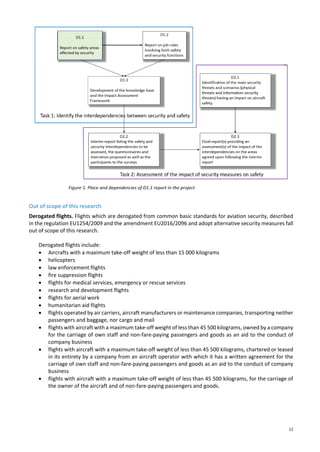
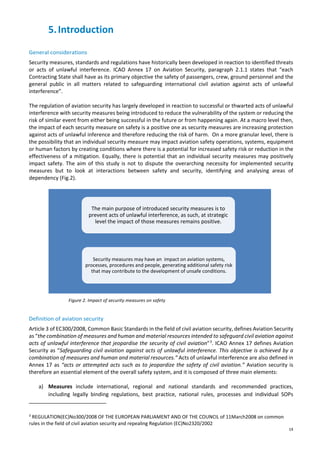
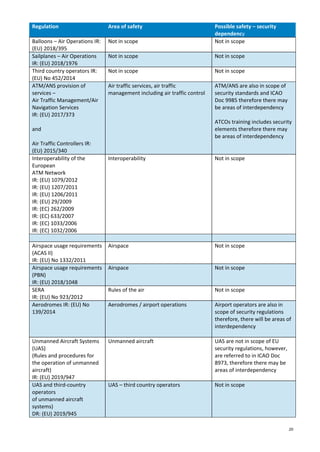
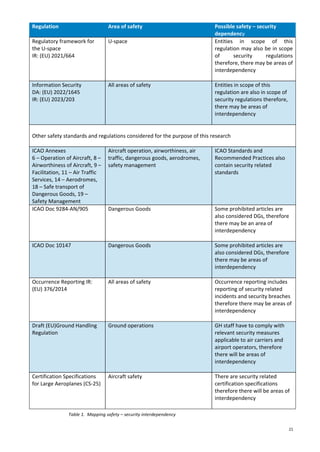
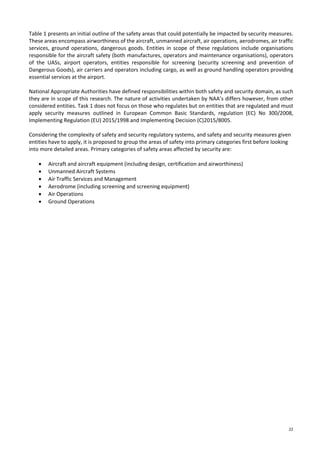
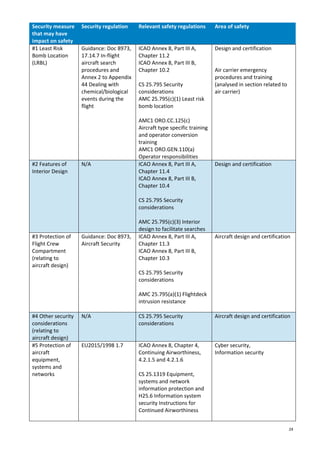
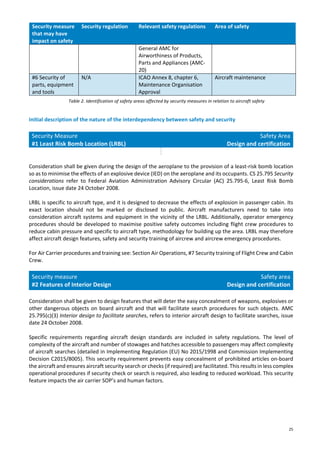
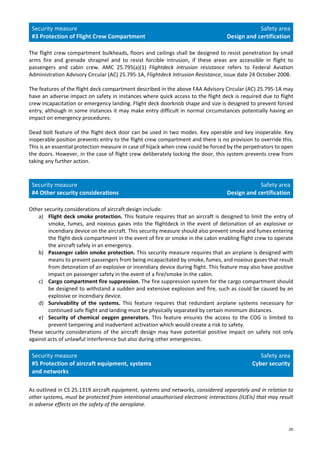
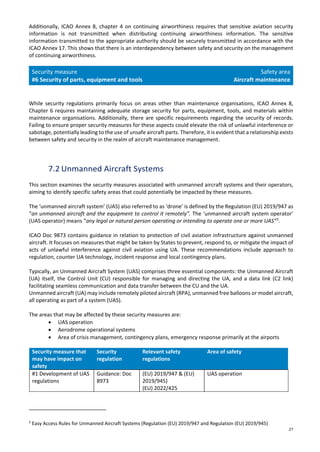
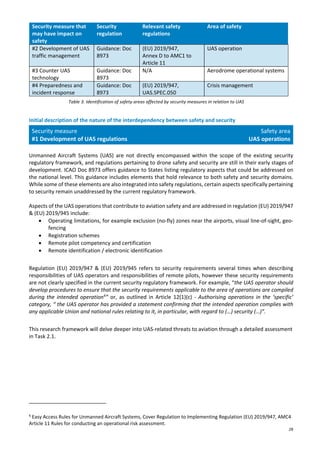
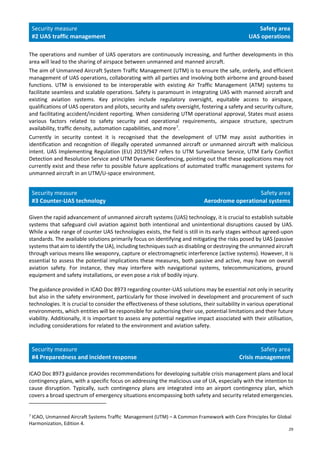
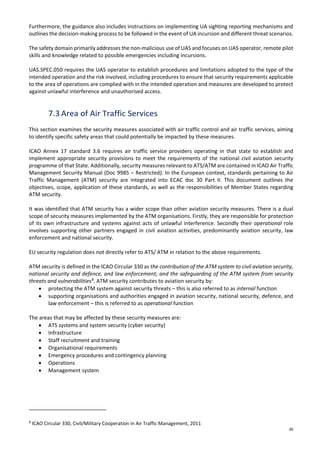
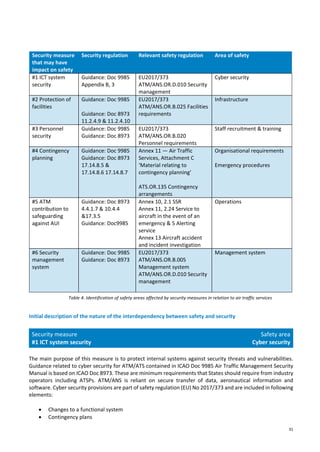
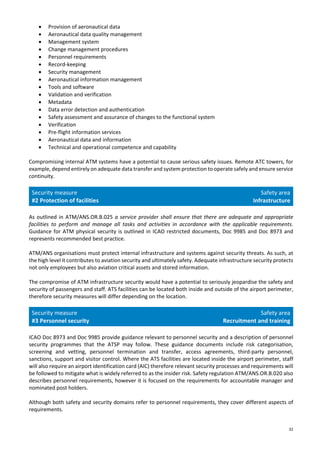
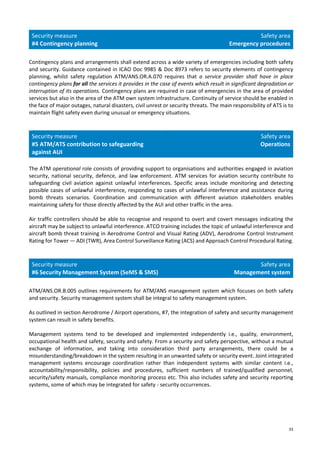
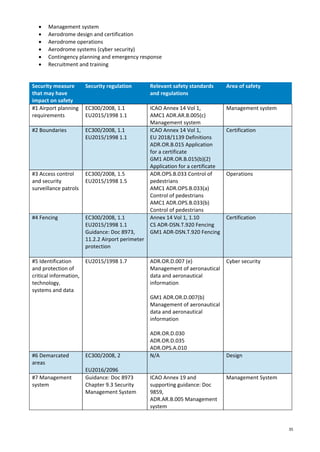
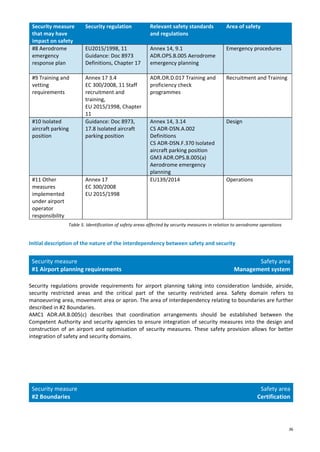
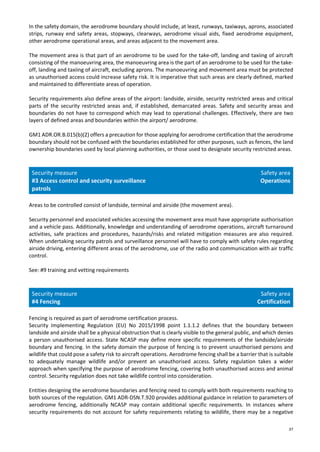
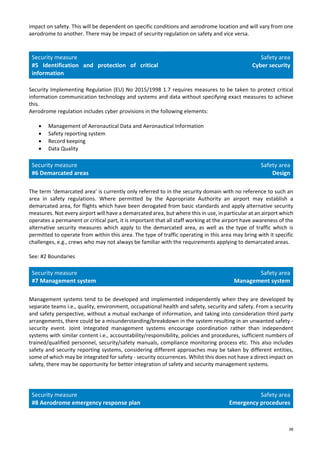
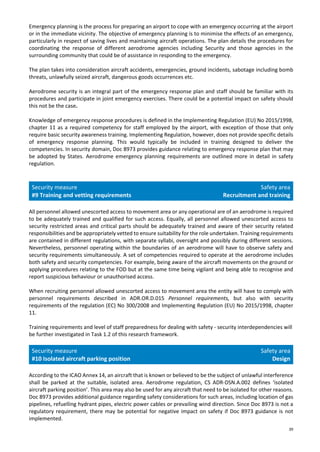
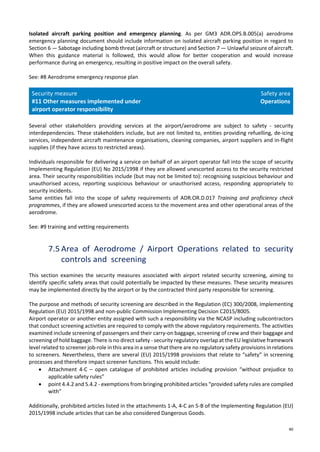
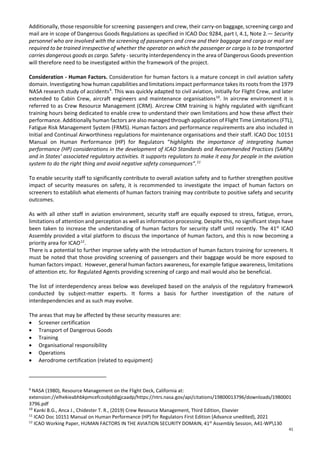
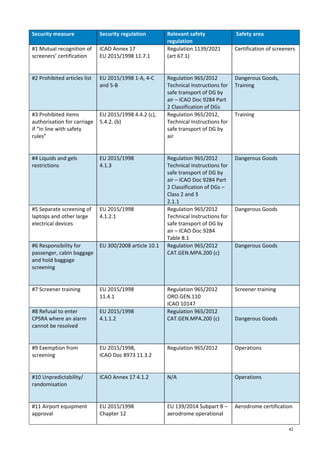
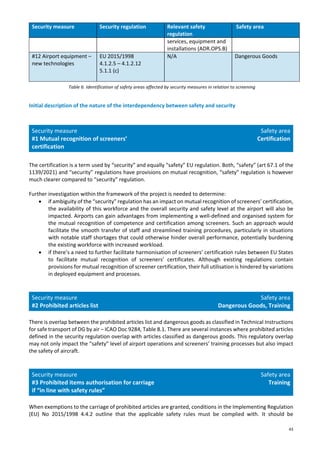
![46
(screener) interpretation anymore. It is therefore important to investigate within the framework of this study
if Original Equipment Manufacturers (OEMs) considered/are considering prevention of DGs transport
compared to solely “prohibited articles” detection. The impact of any “aids”, e.g., algorithms need to be also
investigated especially regarding screener detection rate.
See: HORIZON EUROPE PROJECT: DETECTION OF LITHIUM BATTERIES USING SECURITY SCREENING
EQUIPMENT [EASA.2022.HVP.22]
7.6 Area of Air Operations
This section examines the security measures associated with air operations relevant to air carriers and
operators, aiming to identify specific safety areas that could potentially be impacted by these measures.
The areas that may be affected by these security measures are:
• Operating procedures
• Training
• Cyber security
Security measure Applicable security
regulation
Relevant safety
regulations
Area of safety
#1 Aircraft Security
Search
EC 300/2008
EU 2015/1998, 3.1
272/2009 Part D
C2015/8005
Annex 6, Part I CAT,
13.3
965/2012 – Part CAT
AMC1
ORO.GEN.110(f)(h)
Operator
responsibilities
Operating procedures
#2 Aircraft Protection EC 300/2008
EU 2015/1998, 3.2
N/A Operating procedures
#3 Carriage of potentially
disruptive passengers
EC 300/2008
Article 3, Definitions
EU 2015/1998
4.3; 10; 11.2.3.1 (f);
11.2.3.5 (g);
11.2.3.11 (k)
ICAO Annex 17, 4.7
ICAO Annex 9,
Chapter 6, E
Air Operations
965/2012, Annex IV,
Part – CAT, Operating
Procedures
CAT.OP.MPA.155
Carriage of special
categories of
passengers (SCPs)
AMC3 ORO.MLR.100
Operations manual –
general
CAT.GEN.MPA.105
Responsibilities of the
commander
Operating procedures](https://image.slidesharecdn.com/secimpact-d-1-250528095624-4b06bfa4/85/secimpact_-_d-1-1_-_impact_of_security_measures_on_safety-pdf-46-320.jpg)