CHAPTER 1 – The Social Doctrine of the Catholic Church
CHRISTIAN CHARITY
BEGINS IN GOD HIMSELF
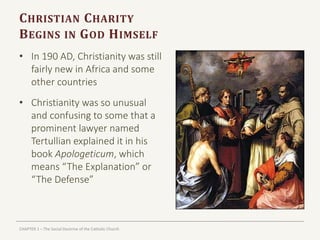
• In 190 AD, Christianity was still
fairly new in Africa and some
other countries
• Christianity was so unusual
and confusing to some that a
prominent lawyer named
Tertullian explained it in his
book Apologeticum, which
means “The Explanation” or
“The Defense”
CHAPTER 1 – The Social Doctrine of the Catholic Church
CHRISTIAN CHARITY
BEGINS IN GOD HIMSELF (continued)
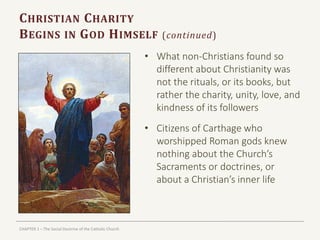
• What non-Christians found so
different about Christianity was
not the rituals, or its books, but
rather the charity, unity, love, and
kindness of its followers
• Citizens of Carthage who
worshipped Roman gods knew
nothing about the Church’s
Sacraments or doctrines, or
about a Christian’s inner life
CHAPTER 1 – The Social Doctrine of the Catholic Church
CHRISTIAN CHARITY BEGINS IN GOD HIMSELF
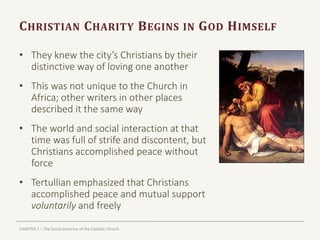
• They knew the city’s Christians by their
distinctive way of loving one another
• This was not unique to the Church in
Africa; other writers in other places
described it the same way
• The world and social interaction at that
time was full of strife and discontent, but
Christians accomplished peace without
force
• Tertullian emphasized that Christians
accomplished peace and mutual support
voluntarily and freely
CHAPTER 1 – The Social Doctrine of the Catholic Church
THE PRINCIPLE OF LOVE
• Christ’s commandment to us is: Love one another
• This principle appears many times in the New Testament and
in the writings of various authors
• Christ’s disciples understood this principle to be an essential
part of the Gospel
– St. John the Apostle wrote of the “New Commandment” as Christ’s
most original teaching
– St. Peter told Christians to “love one another earnestly from the heart”
– St. Paul said, “love one another; for he who loves his neighbor has
fulfilled the law”
CHAPTER 1 – The Social Doctrine of the Catholic Church
THE PRINCIPLE OF LOVE (continued)
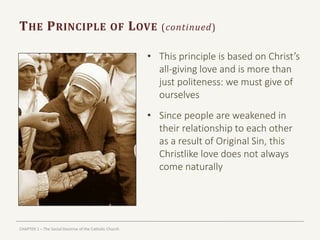
• This principle is based on Christ’s
all-giving love and is more than
just politeness: we must give of
ourselves
• Since people are weakened in
their relationship to each other
as a result of Original Sin, this
Christlike love does not always
come naturally
CHAPTER 1 – The Social Doctrine of the Catholic Church
THE PRINCIPLE OF LOVE (continued)
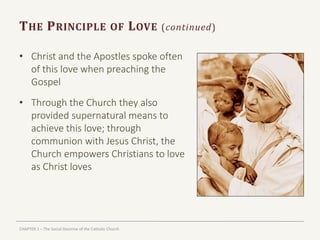
• Christ and the Apostles spoke often
of this love when preaching the
Gospel
• Through the Church they also
provided supernatural means to
achieve this love; through
communion with Jesus Christ, the
Church empowers Christians to love
as Christ loves
CHAPTER 1 – The Social Doctrine of the Catholic Church
THE BLESSED TRINITY:
OUR ORIGIN AND GOAL
• To be happy and live in peace, we must live the true purpose of our
lives
• God has revealed to us the purpose, nature, and destiny of humans,
and has shown us the way to happiness in Heaven through our life
on Earth
• God made us for a love that only he can satisfy, for human beings
are made in His image
• The triune God—the Father, Son, and Holy Spirit—are equal and
love each other equally and perfectly
• God shared His perfect love with us through the passion, death,
resurrection, and ascension of Jesus
CHAPTER 1 – The Social Doctrine of the Catholic Church
THE BLESSED TRINITY:
OUR ORIGIN AND GOAL (continued)
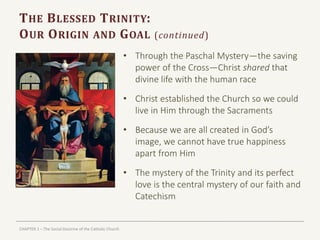
• Through the Paschal Mystery—the saving
power of the Cross—Christ shared that
divine life with the human race
• Christ established the Church so we could
live in Him through the Sacraments
• Because we are all created in God’s
image, we cannot have true happiness
apart from Him
• The mystery of the Trinity and its perfect
love is the central mystery of our faith and
Catechism
CHAPTER 1 – The Social Doctrine of the Catholic Church
THE HOLY SPIRIT:
OUR BOND OF LOVE
• God created us as individuals, and desires that we live in union
with each other through our Faith in Christ
• At the first Pentecost, Jesus gave us the Holy Spirit as a bond of
love between Christians, just as the Spirit is a bond of love in
the Trinity
• Through the Sacraments, especially Baptism and Confirmation,
we receive the Holy Spirit and come to live as children of God
CHAPTER 1 – The Social Doctrine of the Catholic Church
THE HOLY SPIRIT:
OUR BOND OF LOVE (continued)
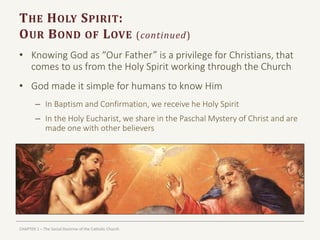
• Knowing God as “Our Father” is a privilege for Christians, that
comes to us from the Holy Spirit working through the Church
• God made it simple for humans to know Him
– In Baptism and Confirmation, we receive he Holy Spirit
– In the Holy Eucharist, we share in the Paschal Mystery of Christ and are
made one with other believers
CHAPTER 1 – The Social Doctrine of the Catholic Church
THE CHURCH: THE BODY OF CHRIST
• The Church is the Mystical Body of Christ: “I am the vine, and
you are the branches” (Jn 15:5)
• Christians are united so closely to each other in Christ, that the
New Testament refers to the Church as “Body of Christ”
• In Acts of the Apostles, we learn that Christ identifies himself
with the persecuted Church, when he asks Saul, “Why do you
persecute me?” (Acts 9:4)
• After his conversion, St. Paul later developed clearly the
doctrine of the Church as the “Body of Christ” and our unity in
the Holy Spirit
– Christians are “one body” as they share the one bread of the Eucharist
CHAPTER 1 – The Social Doctrine of the Catholic Church
THE CHURCH: THE BODY OF CHRIST (continued)
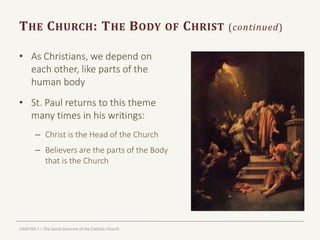
• As Christians, we depend on
each other, like parts of the
human body
• St. Paul returns to this theme
many times in his writings:
– Christ is the Head of the Church
– Believers are the parts of the Body
that is the Church
CHAPTER 1 – The Social Doctrine of the Catholic Church
THE CHURCH: THE BODY OF CHRIST (continued)
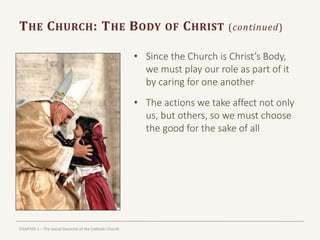
• Since the Church is Christ’s Body,
we must play our role as part of it
by caring for one another
• The actions we take affect not only
us, but others, so we must choose
the good for the sake of all
CHAPTER 1 – The Social Doctrine of the Catholic Church
THE BLESSED TRINITY:
THE PATTERN OF SOCIAL LIFE
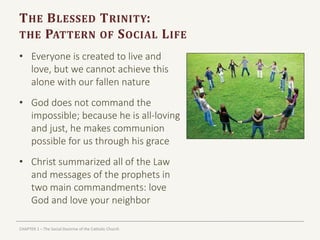
• Everyone is created to live and
love, but we cannot achieve this
alone with our fallen nature
• God does not command the
impossible; because he is all-loving
and just, he makes communion
possible for us through his grace
• Christ summarized all of the Law
and messages of the prophets in
two main commandments: love
God and love your neighbor
CHAPTER 1 – The Social Doctrine of the Catholic Church
THE BLESSED TRINITY:
THE PATTERN OF SOCIAL LIFE (continued)
• By following these Commandments, we can become true
children of God
• St. Augustine said, “If you see charity, you see the Trinity”
• This is the love the pagan citizens of Carthage saw when they
said: See those Christians, how they love another
• The Church gives us both a model and a doctrine for
proclaiming unity
• Christ gave the Church the authority, competence, and grace
to teach his doctrine to all people and bring his Salvation to all
CHAPTER 1 – The Social Doctrine of the Catholic Church
CONCLUSION
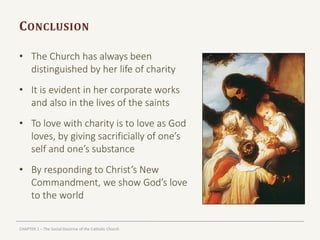
• The Church has always been
distinguished by her life of charity
• It is evident in her corporate works
and also in the lives of the saints
• To love with charity is to love as God
loves, by giving sacrificially of one’s
self and one’s substance
• By responding to Christ’s New
Commandment, we show God’s love
to the world

Sdoc chapter1-model-society

  • 1.
    CHAPTER 1 –The Social Doctrine of the Catholic Church CHAPTER 1 – The Social Doctrine of the Catholic Church
  • 2.
    CHAPTER 1 –The Social Doctrine of the Catholic Church CHRISTIAN CHARITY BEGINS IN GOD HIMSELF • In 190 AD, Christianity was still fairly new in Africa and some other countries • Christianity was so unusual and confusing to some that a prominent lawyer named Tertullian explained it in his book Apologeticum, which means “The Explanation” or “The Defense”
  • 3.
    CHAPTER 1 –The Social Doctrine of the Catholic Church CHRISTIAN CHARITY BEGINS IN GOD HIMSELF (continued) • What non-Christians found so different about Christianity was not the rituals, or its books, but rather the charity, unity, love, and kindness of its followers • Citizens of Carthage who worshipped Roman gods knew nothing about the Church’s Sacraments or doctrines, or about a Christian’s inner life
  • 4.
    CHAPTER 1 –The Social Doctrine of the Catholic Church CHRISTIAN CHARITY BEGINS IN GOD HIMSELF • They knew the city’s Christians by their distinctive way of loving one another • This was not unique to the Church in Africa; other writers in other places described it the same way • The world and social interaction at that time was full of strife and discontent, but Christians accomplished peace without force • Tertullian emphasized that Christians accomplished peace and mutual support voluntarily and freely
  • 5.
    CHAPTER 1 –The Social Doctrine of the Catholic Church THE PRINCIPLE OF LOVE • Christ’s commandment to us is: Love one another • This principle appears many times in the New Testament and in the writings of various authors • Christ’s disciples understood this principle to be an essential part of the Gospel – St. John the Apostle wrote of the “New Commandment” as Christ’s most original teaching – St. Peter told Christians to “love one another earnestly from the heart” – St. Paul said, “love one another; for he who loves his neighbor has fulfilled the law”
  • 6.
    CHAPTER 1 –The Social Doctrine of the Catholic Church THE PRINCIPLE OF LOVE (continued) • This principle is based on Christ’s all-giving love and is more than just politeness: we must give of ourselves • Since people are weakened in their relationship to each other as a result of Original Sin, this Christlike love does not always come naturally
  • 7.
    CHAPTER 1 –The Social Doctrine of the Catholic Church THE PRINCIPLE OF LOVE (continued) • Christ and the Apostles spoke often of this love when preaching the Gospel • Through the Church they also provided supernatural means to achieve this love; through communion with Jesus Christ, the Church empowers Christians to love as Christ loves
  • 8.
    CHAPTER 1 –The Social Doctrine of the Catholic Church THE BLESSED TRINITY: OUR ORIGIN AND GOAL • To be happy and live in peace, we must live the true purpose of our lives • God has revealed to us the purpose, nature, and destiny of humans, and has shown us the way to happiness in Heaven through our life on Earth • God made us for a love that only he can satisfy, for human beings are made in His image • The triune God—the Father, Son, and Holy Spirit—are equal and love each other equally and perfectly • God shared His perfect love with us through the passion, death, resurrection, and ascension of Jesus
  • 9.
    CHAPTER 1 –The Social Doctrine of the Catholic Church THE BLESSED TRINITY: OUR ORIGIN AND GOAL (continued) • Through the Paschal Mystery—the saving power of the Cross—Christ shared that divine life with the human race • Christ established the Church so we could live in Him through the Sacraments • Because we are all created in God’s image, we cannot have true happiness apart from Him • The mystery of the Trinity and its perfect love is the central mystery of our faith and Catechism
  • 10.
    CHAPTER 1 –The Social Doctrine of the Catholic Church THE HOLY SPIRIT: OUR BOND OF LOVE • God created us as individuals, and desires that we live in union with each other through our Faith in Christ • At the first Pentecost, Jesus gave us the Holy Spirit as a bond of love between Christians, just as the Spirit is a bond of love in the Trinity • Through the Sacraments, especially Baptism and Confirmation, we receive the Holy Spirit and come to live as children of God
  • 11.
    CHAPTER 1 –The Social Doctrine of the Catholic Church THE HOLY SPIRIT: OUR BOND OF LOVE (continued) • Knowing God as “Our Father” is a privilege for Christians, that comes to us from the Holy Spirit working through the Church • God made it simple for humans to know Him – In Baptism and Confirmation, we receive he Holy Spirit – In the Holy Eucharist, we share in the Paschal Mystery of Christ and are made one with other believers
  • 12.
    CHAPTER 1 –The Social Doctrine of the Catholic Church THE CHURCH: THE BODY OF CHRIST • The Church is the Mystical Body of Christ: “I am the vine, and you are the branches” (Jn 15:5) • Christians are united so closely to each other in Christ, that the New Testament refers to the Church as “Body of Christ” • In Acts of the Apostles, we learn that Christ identifies himself with the persecuted Church, when he asks Saul, “Why do you persecute me?” (Acts 9:4) • After his conversion, St. Paul later developed clearly the doctrine of the Church as the “Body of Christ” and our unity in the Holy Spirit – Christians are “one body” as they share the one bread of the Eucharist
  • 13.
    CHAPTER 1 –The Social Doctrine of the Catholic Church THE CHURCH: THE BODY OF CHRIST (continued) • As Christians, we depend on each other, like parts of the human body • St. Paul returns to this theme many times in his writings: – Christ is the Head of the Church – Believers are the parts of the Body that is the Church
  • 14.
    CHAPTER 1 –The Social Doctrine of the Catholic Church THE CHURCH: THE BODY OF CHRIST (continued) • Since the Church is Christ’s Body, we must play our role as part of it by caring for one another • The actions we take affect not only us, but others, so we must choose the good for the sake of all
  • 15.
    CHAPTER 1 –The Social Doctrine of the Catholic Church THE BLESSED TRINITY: THE PATTERN OF SOCIAL LIFE • Everyone is created to live and love, but we cannot achieve this alone with our fallen nature • God does not command the impossible; because he is all-loving and just, he makes communion possible for us through his grace • Christ summarized all of the Law and messages of the prophets in two main commandments: love God and love your neighbor
  • 16.
    CHAPTER 1 –The Social Doctrine of the Catholic Church THE BLESSED TRINITY: THE PATTERN OF SOCIAL LIFE (continued) • By following these Commandments, we can become true children of God • St. Augustine said, “If you see charity, you see the Trinity” • This is the love the pagan citizens of Carthage saw when they said: See those Christians, how they love another • The Church gives us both a model and a doctrine for proclaiming unity • Christ gave the Church the authority, competence, and grace to teach his doctrine to all people and bring his Salvation to all
  • 17.
    CHAPTER 1 –The Social Doctrine of the Catholic Church CONCLUSION • The Church has always been distinguished by her life of charity • It is evident in her corporate works and also in the lives of the saints • To love with charity is to love as God loves, by giving sacrificially of one’s self and one’s substance • By responding to Christ’s New Commandment, we show God’s love to the world