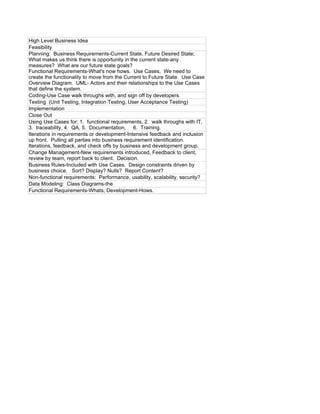
High Level Business Idea
Feasibility
Planning: Business Requirements-Current State, Future Desired State;
What makes us think there is opportunity in the current state-any
measures? What are our future state goals?
Functional Requirements-What's now hows. Use Cases, We need to
create the functionality to move from the Current to Future State. Use Case
Overview Diagram. UML- Actors and their relationships to the Use Cases
that define the system.
Coding-Use Case walk throughs with, and sign off by developers.
Testing (Unit Testing, Integration Testing, User Acceptance Testing)
Implementation
Close Out
Using Use Cases for; 1. functional requirements, 2. walk throughs with IT,
3. traceability, 4. QA, 5. Documentation, 6. Training.
Iterations in requirements or development-Intensive feedback and inclusion
up front. Pulling all parties into business requirement identification.
Iterations, feedback, and check offs by business and development group.
Change Management-New requirements introduced, Feedback to client,
review by team, report back to client. Decision.
Business Rules-Included with Use Cases. Design constraints driven by
business choice. Sort? Display? Nulls? Report Content?
Non-functional requirements: Performance, usability, scalability, security?
Data Modeling: Class Diagrams-the
Functional Requirements-Whats, Development-Hows.
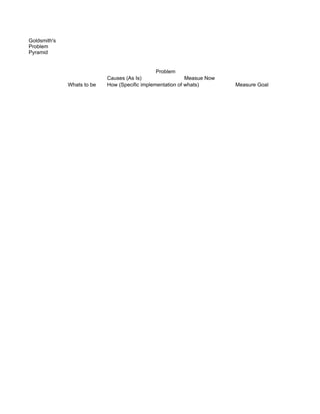
Goldsmith's
Problem
Pyramid


                                                Problem
                            Causes (As Is)                  Measue Now
              Whats to be   How (Specific implementation of whats)       Measure Goal
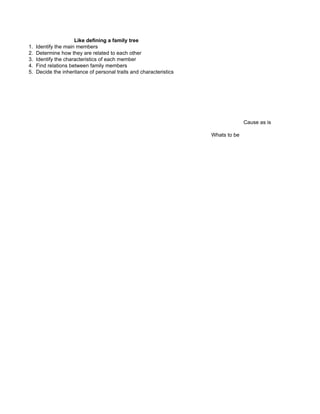
Like defining a family tree
1.   Identify the main members
2.   Determine how they are related to each other
3.   Identify the characteristics of each member
4.   Find relations between family members
5.   Decide the inheritance of personal traits and characteristics


                                                                                   Cause as is

                                                                     Whats to be
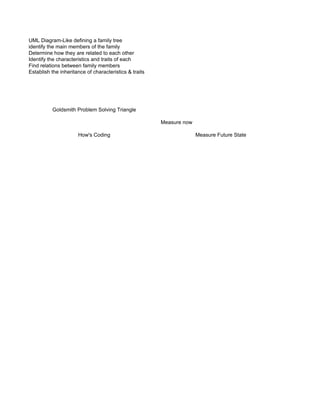
UML Diagram-Like defining a family tree
identify the main members of the family
Determine how they are related to each other
Identify the characteristics and traits of each
Find relations between family members
Establish the inheritance of characteristics & traits


          Goldsmith Problem Solving Triangle

                                                        Measure now

                      How's Coding                                    Measure Future State

Sdlc & BA Concepts

  • 1.
    High Level BusinessIdea Feasibility Planning: Business Requirements-Current State, Future Desired State; What makes us think there is opportunity in the current state-any measures? What are our future state goals? Functional Requirements-What's now hows. Use Cases, We need to create the functionality to move from the Current to Future State. Use Case Overview Diagram. UML- Actors and their relationships to the Use Cases that define the system. Coding-Use Case walk throughs with, and sign off by developers. Testing (Unit Testing, Integration Testing, User Acceptance Testing) Implementation Close Out Using Use Cases for; 1. functional requirements, 2. walk throughs with IT, 3. traceability, 4. QA, 5. Documentation, 6. Training. Iterations in requirements or development-Intensive feedback and inclusion up front. Pulling all parties into business requirement identification. Iterations, feedback, and check offs by business and development group. Change Management-New requirements introduced, Feedback to client, review by team, report back to client. Decision. Business Rules-Included with Use Cases. Design constraints driven by business choice. Sort? Display? Nulls? Report Content? Non-functional requirements: Performance, usability, scalability, security? Data Modeling: Class Diagrams-the Functional Requirements-Whats, Development-Hows.
  • 2.
    Goldsmith's Problem Pyramid Problem Causes (As Is) Measue Now Whats to be How (Specific implementation of whats) Measure Goal
  • 3.
    Like defining afamily tree 1. Identify the main members 2. Determine how they are related to each other 3. Identify the characteristics of each member 4. Find relations between family members 5. Decide the inheritance of personal traits and characteristics Cause as is Whats to be
  • 4.
    UML Diagram-Like defininga family tree identify the main members of the family Determine how they are related to each other Identify the characteristics and traits of each Find relations between family members Establish the inheritance of characteristics & traits Goldsmith Problem Solving Triangle Measure now How's Coding Measure Future State