Scratch
A visual
programming
environment
By :- Shahswat Singh
Scratch
Contents
🞇 Introduction
🞇 History
🞇 Objectives
🞇 Explanation
🞇 Bibliography
Scratch
What is Scratch ?
🞇 Scratch is a visual programming environment that
makes it easy to create interactive stories, music,
games, art, and animations – and share those creations
on the web.
🞇 Scratch presents powerful opportunities for learning –
as people program and share with Scratch, they learn to
think creatively, plan systematically, and work
collaboratively, while also learning important
computational ideas.
Scratch
HISTORY
🞇 The first version of Scratch was developed in 2003 by
the Lifelong Kindergarten group, led by Mitchel
Resnick, at the MIT Media Lab.
🞇 The first official website was originally launched in
2006. Scratch 1.0 was then later available to the public
for download on January 8, 2007.
🞇 Scratch continued to update their site until late 2012
when they released Scratch 2.0 which offered many
updates to the programming system and website design.
Scratch
Objectives of Scratch unit
🞇 Intro to the visual programming environment
🞇 Intro to programming with multimedia
🞇 Story-telling | music-making | game-making
🞇 Intro to programming concepts
objects and attributes
sequence, repetition
conditions, events, I/O
Scratch
Secondary objectives
🞇 Increase student skills with computers
🞇 Increase student interest in programming
🞇 Student achievement on fun project
🞇 Learn Cartesian coordinates, distance computations,
etc.
Scratch
Start scratch and let’s go!
🞇 Open www.scratch.mit.edu and go to option “create”.
🞇 When home, download from www.scratch.mit.edu
🞇 Click on the cat icon
🞇 Or, find “scratch” under “Programs”
🞇 Scratch programming environment comes up quickly
Scratch
Major components
🞇 At left: the stage with sprite[s] or objects or actors
🞇 Center: operations and attributes for the sprites
🞇 At right: scripts or program[s] for the behavior[s] of the
sprites
🞇 A sprite is a small graphic that can be moved
independently around the screen, producing animated
effects .
🞇 Blocks are puzzle-piece shapes that are used to create
code in Scratch .
Scratch
Programming In Scratch!
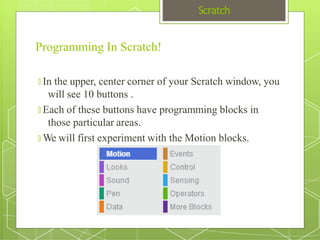
🞇 In the upper, center corner of your Scratch window, you
will see 10 buttons .
🞇 Each of these buttons have programming blocks in
those particular areas.
🞇 We will first experiment with the Motion blocks.
Scratch
Motion!
🞇 Motion blocks are the blocks that control
a sprite's movement.
🞇 There are 17 Motion blocks in Scratch 2.0 .
🞇 Ex:-
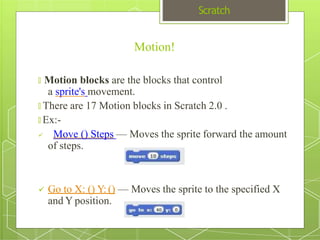
 Move () Steps — Moves the sprite forward the amount
of steps.
 Go to X: () Y: () — Moves the sprite to the specified X
and Y position.
Scratch
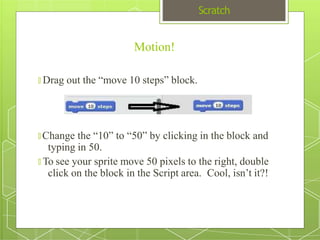
🞇 Change the “10” to “50” by clicking in the block and
typing in 50.
🞇 To see your sprite move 50 pixels to the right, double
click on the block in the Script area. Cool, isn’t it?!
Motion!
🞇 Drag out the “move 10 steps” block.
Scratch
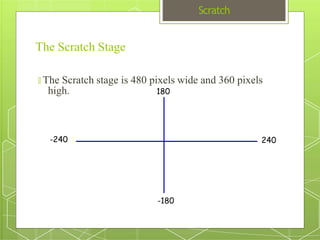
high.
The Scratch Stage
🞇 The Scratch stage is 480 pixels wide and 360 pixels
-240 240
180
-180
Scratch
Looks!
🞇 Looks blocks are the blocks that control a sprite's look.
🞇 There are 23 Looks blocks in Scratch 2.0.
🞇 Ex:-
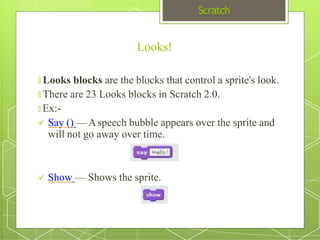
 Say () —Aspeech bubble appears over the sprite and
will not go away over time.
 Show — Shows the sprite.
Scratch
Sound!
🞇 Sound blocks are the blocks that control sound and
MIDI functions.
🞇 There are 13 Sound blocks in Scratch 2.0.
🞇 Ex:-
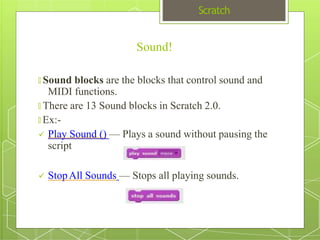
 Play Sound () — Plays a sound without pausing the
script
 StopAll Sounds — Stops all playing sounds.
Scratch
Pen!
🞇 Pen blocks are the blocks that control the pen.
🞇 There are 11 Pen blocks in Scratch 2.0.
🞇 Ex:-
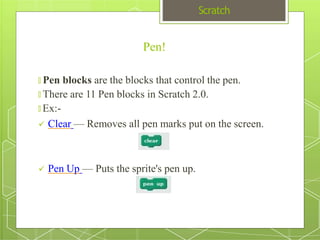
 Clear — Removes all pen marks put on the screen.
 Pen Up — Puts the sprite's pen up.
Scratch
Data!
🞇 Variables blocks are the blocks that hold values
and strings.
🞇 There are 5 Variables blocks in Scratch 2.0.
🞇 Ex:-
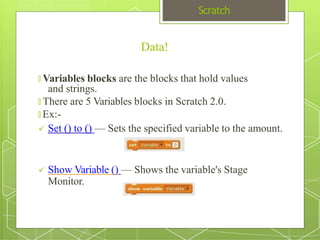
 Set () to () — Sets the specified variable to the amount.
 Show Variable () — Shows the variable's Stage
Monitor.
Scratch
Data!
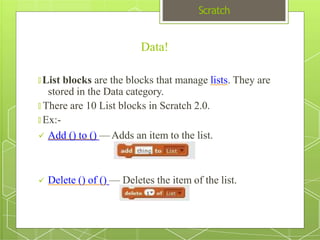
🞇 List blocks are the blocks that manage lists. They are
stored in the Data category.
🞇 There are 10 List blocks in Scratch 2.0.
🞇 Ex:-
 Add () to () —Adds an item to the list.
 Delete () of () — Deletes the item of the list.
Scratch
Event!
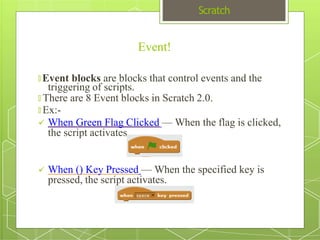
🞇 Event blocks are blocks that control events and the
triggering of scripts.
🞇 There are 8 Event blocks in Scratch 2.0.
🞇 Ex:-
 When Green Flag Clicked — When the flag is clicked,
the script activates.
 When () Key Pressed — When the specified key is
pressed, the script activates.
Scratch
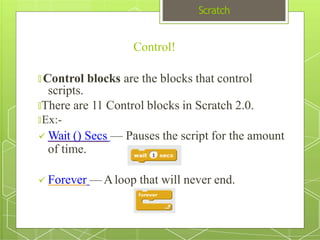
🞇 Control blocks are the blocks that control
scripts.
🞇There are 11 Control blocks in Scratch 2.0.
🞇Ex:-
 Wait () Secs — Pauses the script for the amount
of time.
 Forever —Aloop that will never end.
Control!
Scratch
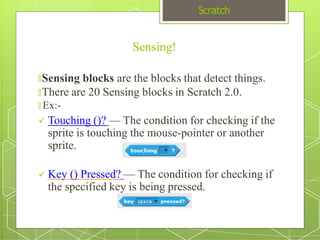
🞇Sensing blocks are the blocks that detect things.
🞇There are 20 Sensing blocks in Scratch 2.0.
🞇 Ex:-
 Touching ()? — The condition for checking if the
sprite is touching the mouse-pointer or another
sprite.
 Key () Pressed? — The condition for checking if
the specified key is being pressed.
Sensing!
Scratch
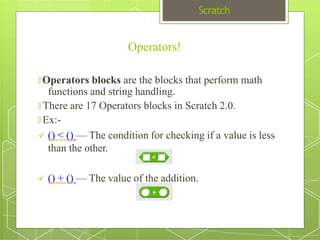
Operators!
🞇 Operators blocks are the blocks that perform math
functions and string handling.
🞇 There are 17 Operators blocks in Scratch 2.0.
🞇 Ex:-
 () < () — The condition for checking if a value is less
than the other.
 () + () — The value of the addition.
Scratch
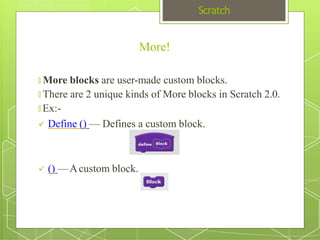
More!
🞇 More blocks are user-made custom blocks.
🞇 There are 2 unique kinds of More blocks in Scratch 2.0.
🞇 Ex:-
 Define () — Defines a custom block.
 () —Acustom block.
Scratch
Let’s make a small program that on hover on
sprite say
“hello world”
Scratch
Bibliography
🞇 Books :-
 Malan, David. "Scratch for Budding Computer Scientists".
Harvard School of Engineering and Applied Sciences.
Retrieved 25 January 2014.
 Harvey, Brian. "Brian Harvey user contributions page". Scratch.
, July 2008.
🞇 Research papers :-
 “Learning Computing through Creating and Connecting”,
Brennan,K. ; Harvard Univ., Cambridge, MA, USA, 16 July
2013
 "Scratch for budding computer scientists". ACM SIGCSE
Bulletin 39 (1): 223–7. March 2007.
Scratch

scratch-141107045720-conversion-gate02.pptx

  • 1.
  • 2.
    Scratch Contents 🞇 Introduction 🞇 History 🞇Objectives 🞇 Explanation 🞇 Bibliography
  • 3.
    Scratch What is Scratch? 🞇 Scratch is a visual programming environment that makes it easy to create interactive stories, music, games, art, and animations – and share those creations on the web. 🞇 Scratch presents powerful opportunities for learning – as people program and share with Scratch, they learn to think creatively, plan systematically, and work collaboratively, while also learning important computational ideas.
  • 4.
    Scratch HISTORY 🞇 The firstversion of Scratch was developed in 2003 by the Lifelong Kindergarten group, led by Mitchel Resnick, at the MIT Media Lab. 🞇 The first official website was originally launched in 2006. Scratch 1.0 was then later available to the public for download on January 8, 2007. 🞇 Scratch continued to update their site until late 2012 when they released Scratch 2.0 which offered many updates to the programming system and website design.
  • 5.
    Scratch Objectives of Scratchunit 🞇 Intro to the visual programming environment 🞇 Intro to programming with multimedia 🞇 Story-telling | music-making | game-making 🞇 Intro to programming concepts objects and attributes sequence, repetition conditions, events, I/O
  • 6.
    Scratch Secondary objectives 🞇 Increasestudent skills with computers 🞇 Increase student interest in programming 🞇 Student achievement on fun project 🞇 Learn Cartesian coordinates, distance computations, etc.
  • 7.
    Scratch Start scratch andlet’s go! 🞇 Open www.scratch.mit.edu and go to option “create”. 🞇 When home, download from www.scratch.mit.edu 🞇 Click on the cat icon 🞇 Or, find “scratch” under “Programs” 🞇 Scratch programming environment comes up quickly
  • 8.
    Scratch Major components 🞇 Atleft: the stage with sprite[s] or objects or actors 🞇 Center: operations and attributes for the sprites 🞇 At right: scripts or program[s] for the behavior[s] of the sprites 🞇 A sprite is a small graphic that can be moved independently around the screen, producing animated effects . 🞇 Blocks are puzzle-piece shapes that are used to create code in Scratch .
  • 9.
    Scratch Programming In Scratch! 🞇In the upper, center corner of your Scratch window, you will see 10 buttons . 🞇 Each of these buttons have programming blocks in those particular areas. 🞇 We will first experiment with the Motion blocks.
  • 10.
    Scratch Motion! 🞇 Motion blocksare the blocks that control a sprite's movement. 🞇 There are 17 Motion blocks in Scratch 2.0 . 🞇 Ex:-  Move () Steps — Moves the sprite forward the amount of steps.  Go to X: () Y: () — Moves the sprite to the specified X and Y position.
  • 11.
    Scratch 🞇 Change the“10” to “50” by clicking in the block and typing in 50. 🞇 To see your sprite move 50 pixels to the right, double click on the block in the Script area. Cool, isn’t it?! Motion! 🞇 Drag out the “move 10 steps” block.
  • 12.
    Scratch high. The Scratch Stage 🞇The Scratch stage is 480 pixels wide and 360 pixels -240 240 180 -180
  • 13.
    Scratch Looks! 🞇 Looks blocksare the blocks that control a sprite's look. 🞇 There are 23 Looks blocks in Scratch 2.0. 🞇 Ex:-  Say () —Aspeech bubble appears over the sprite and will not go away over time.  Show — Shows the sprite.
  • 14.
    Scratch Sound! 🞇 Sound blocksare the blocks that control sound and MIDI functions. 🞇 There are 13 Sound blocks in Scratch 2.0. 🞇 Ex:-  Play Sound () — Plays a sound without pausing the script  StopAll Sounds — Stops all playing sounds.
  • 15.
    Scratch Pen! 🞇 Pen blocksare the blocks that control the pen. 🞇 There are 11 Pen blocks in Scratch 2.0. 🞇 Ex:-  Clear — Removes all pen marks put on the screen.  Pen Up — Puts the sprite's pen up.
  • 16.
    Scratch Data! 🞇 Variables blocksare the blocks that hold values and strings. 🞇 There are 5 Variables blocks in Scratch 2.0. 🞇 Ex:-  Set () to () — Sets the specified variable to the amount.  Show Variable () — Shows the variable's Stage Monitor.
  • 17.
    Scratch Data! 🞇 List blocksare the blocks that manage lists. They are stored in the Data category. 🞇 There are 10 List blocks in Scratch 2.0. 🞇 Ex:-  Add () to () —Adds an item to the list.  Delete () of () — Deletes the item of the list.
  • 18.
    Scratch Event! 🞇 Event blocksare blocks that control events and the triggering of scripts. 🞇 There are 8 Event blocks in Scratch 2.0. 🞇 Ex:-  When Green Flag Clicked — When the flag is clicked, the script activates.  When () Key Pressed — When the specified key is pressed, the script activates.
  • 19.
    Scratch 🞇 Control blocksare the blocks that control scripts. 🞇There are 11 Control blocks in Scratch 2.0. 🞇Ex:-  Wait () Secs — Pauses the script for the amount of time.  Forever —Aloop that will never end. Control!
  • 20.
    Scratch 🞇Sensing blocks arethe blocks that detect things. 🞇There are 20 Sensing blocks in Scratch 2.0. 🞇 Ex:-  Touching ()? — The condition for checking if the sprite is touching the mouse-pointer or another sprite.  Key () Pressed? — The condition for checking if the specified key is being pressed. Sensing!
  • 21.
    Scratch Operators! 🞇 Operators blocksare the blocks that perform math functions and string handling. 🞇 There are 17 Operators blocks in Scratch 2.0. 🞇 Ex:-  () < () — The condition for checking if a value is less than the other.  () + () — The value of the addition.
  • 22.
    Scratch More! 🞇 More blocksare user-made custom blocks. 🞇 There are 2 unique kinds of More blocks in Scratch 2.0. 🞇 Ex:-  Define () — Defines a custom block.  () —Acustom block.
  • 23.
    Scratch Let’s make asmall program that on hover on sprite say “hello world”
  • 24.
    Scratch Bibliography 🞇 Books :- Malan, David. "Scratch for Budding Computer Scientists". Harvard School of Engineering and Applied Sciences. Retrieved 25 January 2014.  Harvey, Brian. "Brian Harvey user contributions page". Scratch. , July 2008. 🞇 Research papers :-  “Learning Computing through Creating and Connecting”, Brennan,K. ; Harvard Univ., Cambridge, MA, USA, 16 July 2013  "Scratch for budding computer scientists". ACM SIGCSE Bulletin 39 (1): 223–7. March 2007.
  • 25.