135
19(2): 135-141, 2024 www.thebioscan.com
Methods of comparative analysis in the study of samples of Uzbek and world
literature
Abduvalitov Nurzhan Buranovich 1, Abduvalitov Ergash Buranevich 2
1
Doctor of Philosophy (PhD) of Pedagogical Sciences, 2
Doctor of Pedagogical Sciences (DSc)
Sayfullaev Baurzhan Nurumbet oglu teacher
Tashkent State Pedagogical University named after Nizami
DOI: https://doi.org/10.63001/tbs.2024.v19.i02.pp135-141
In recent years, the integration method of comparative study of
national and world literature has been developing, since the
identification of multilateral dialectical ties between literature,
other types of artistic creativity and social activities can enrich
teaching with new pedagogical solutions.
Fiction develops in connection with the laws of the development
of social consciousness. Therefore, the main methodological
provisions characterizing the interaction of literature - one of the
main phenomena of verbal art, are included in the categories of
philosophy, literary criticism, psychology, pedagogy. The category
of interaction of literature is based on the general philosophical
category. The category of interaction is the most important
methodological principles of natural and social phenomena. The
general philosophical meaning of the category of interaction is
determined by its ability to "explain the essence of the universal
human cause," which contains the idea of the literary necessity
of movement, which is the source of the manifestation of the
features of matter. Interaction is the unity of artistic
consciousness and the variety of forms of expression.
Literature analysis and methodology
The characteristic features of the manifestation of interaction in
artistic reflection are, first of all, the personal reflection of
reality, equally dependent on the change in the object of artistic
reflection and the object under the influence of force. When
studying the interaction of literature, it is important to clarify the
features and essence of artistic reflection, since in this process
the essence of the interaction between the reader and the work
of art is revealed.
The problem of students' perception of a work of art requires
solving two problems. This is an objective analysis of the text of
a work of art and an objective analysis of human feelings. In
addition, these problems provide for the consideration of all
literature in a broader framework. There are two such approaches
here: an objective analysis of the texts to be compared and an
analysis of the feelings resulting from such a comparison in the
reader.
ABSTRACT
This article examined the question of scientific and theoretical justification of the method of comparative analysis of the
study of Uzbek literature in combination with world literature. The issues of studying world and Uzbek literature in
harmony are also widely covered, on the one hand, students' mastering in organic relations the most striking examples of
world literature, on the other hand, the insufficient methodological development of the problem of comparative study of
Uzbek and foreign literature
KEYWORDS
fiction,
comparative training,
functional analysis,
psychology of creativity,
organic relations,
universality,
functionality,
generalizability,
compactness,
unity of artistic
consciousness,
analytical skills
Received on:
30-06-2024
Accepted on:
11-10-2024
Corresponding author
136
The psychological study of literature is carried out in one of these
two directions. At the same time, firstly, the psychology of the
creator is analyzed in connection with how it is expressed in a
particular work, and secondly, the experience of the reader
accepting this work is provided. In our opinion, the use of both
methods that separate each other is ineffective. Based on this,
the general direction of this method can be expressed as a process
from the form of a work of art to the training of aesthetic reaction
and its general laws through the functional analysis of its elements
and structure.
As it turned out, an important feature of any element in a work
of art is associated with the emotional attitude that arises from
the reader. A necessary aspect of the problem under consideration
is to familiarize the reader with the art. For many of them, this
connection is found in literature lessons, where there is a need
for aesthetic and aesthetic activities in general.
In our opinion, the content of aesthetic activity is always a process
of getting out of meaning. When contacting a work of art, a task
should be created that contributes to the emergence of an
emotional reaction, and a response - generalization, an answer -
disclosure of personal meaning.
Comparison of literary phenomena allows you to eliminate
emotionality, indifference and slander, stimulate, generalize
reactions, reveal the meaning provided for various authors and
different readers.
When organizing work to identify and study relations between
national and world literature, the school cannot take into account
the age characteristics of students. It is no coincidence that
Binobarin, middle school students often ask the question "why?,"
ask about the sufficiency and validity of the supposed concepts.
Adolescents are an important stage in the development of mental
abilities. The thinking activities of secondary school students are
independent. They trace the desire for generalization, the search
for general principles and laws behind specific facts.
The period of secondary education is important in the formation
of analytical skills of students, since the level of knowledge of
children of this age is insufficient, as in high school. Adolescents
are characterized by their own characteristics: activity,
insufficient understanding of the specific and historical conditions
in which the described events took place, lack of life experience.
So, there is always an objective psychological impossibility of a
direct interpretation of realities, stability in aesthetic
assessment, solidarity with some types of human experience.
Therefore, high school students tend to look for a path without
defeat.
The development of the mind in adolescence is closely related to
the development of creative abilities, including not only the
development of data, but also the manifestation of intellectual
initiative and the creation of something new. When explaining to
high school students about cultural ties, a certain folk life should
be studied in close cooperation with the literature of this people,
in this process it should be brought to reflect the features of world
literature.
Comparative study of literary connections and literary influence
is a common didactic method and mental operation by which
similarity and differences between things and phenomena can be
determined, resulting in a positive effect at all stages of
education. The psychological and pedagogical justification of the
comparison creates the basis for its operational side, work with
various materials.
Fiction is intended to describe not the decoration of the life of
the nation that seems exotic to others, but the inner world, which
reflects the most sacred lands characteristic of the population of
the nation. As for the nation, it exists in the world of the psyche.
As you know, you cannot defeat a person with a strong spirit. It
can be physically destroyed, but it is impossible to break and
return out of the way. If this spirit belongs to the whole nation, it
becomes a powerful insurmountable force.
Fiction differs from other spheres of social thinking in that this
irresistible force has the ability to indicate the side of
1
Yuldoshev K. To get to know each other, you need to read each
other//Enlightenment. - Oshkent: 2008. – № 6. Article 5.
manifestation in each individual person. Because for fiction, it is
not the case that happened in society that is important, but the
spirit of the individuals who took part in this event. As the
methodologist K. Yuldoshev noted in this regard, "Literature is an
art form that has unequal opportunities to reflect the spirit of
an individual person. Because any people are made up of
individuals, their literature clearly shows the peculiarities
inherent in the spirit of a particular nation"1
. Indeed, literature
that can describe the unique spirit of individuals has a high status
in human presentation.
Literature collects rich cultural and spiritual values of different
eras, therefore it occupies a special place in acquaintance with
national and world culture. Literate and intensive reading of
works of art is formed among students, mainly from school years.
In modern education, students are required not only to tie the
work studied to life, but also to compare it with other works. As
a result, the student forms ideas about the surrounding world and
a holistic worldview, the ability to analyze general and particular
aspects in the essence of events is acquired.
In this regard, R. Niozmetova noted: "On the example of life, the
literary fate of the heroes depicted in the literary work, readers
(students) express social and aesthetic relations between
people... However, the description of dialogue with the
personalities of different areas of life is reflected in fiction as part
of a generalization of the qualities characteristic of each person,
and in the future many works are devoted to these issues, which
indicates that the feelings inherent in people are ultimately
beauty. "
Today, attention is increasing to strengthening the sense of self-
awareness in the hearts of students, the issue of preserving their
national characteristics and on this basis mastering the advanced
aspects of world culture is being raised. In this regard, the
creation of conditions for the study of Uzbek and world literature
in the relationship and the introduction of effective methods is
required in secondary schools. The combination and comparative
study of national and world literature can be considered the
optimal way to teach literature in general education schools.
The formation of universal values in the education of a spiritually
mature person requires a revision of a number of principles in the
process of literary education. The formation of the artistic
language of students, the development of spiritual values is
encouraged through familiarization with Uzbek and world
literature. Understanding similar phenomena in Uzbek and world
literature will lead to an understanding of a single literary
process.
The study of Uzbek literature in combination with world literature
is closely related to the scientific and theoretical justification of
the method of comparative analysis. This problem creates the
basis for special surveys due to the lack of methodological
materials at the reference level. In most theoretical and
methodological surveys, opinions are still contradictory that the
problem of studying the literature of Uzbek and other peoples in
connectivity has been solved.
The question of the study of world and Uzbek literature in
continuity is connected, on the one hand, with the mastering by
students in organic relations of the most striking examples of
world literature, on the other hand, with the insufficient
methodological development of the problem of comparative study
of Uzbek and foreign literature. The basis for the study of Uzbek
literature in connection with world literature is not only literary
connections or typological rapprochements, but also a whole
methodology of comparative historical literary criticism. In the
dynamics of literary education for middle and high schools, the
need to create systemic instructions before studying language
relations became clear.
In his youth, the desire to specify methodological directions, the
study of the artistic word in art schools, the unity of the world
literary process associated with interlanguage relations and
correspondence in the national literature of various peoples,
137
corresponds to the most modern concepts of the study of
interethnic literary relations.
The study of Uzbek literature in connection with world literature
will allow studying specific historical conditions, national features
and general laws of the literary process. Teaching methodology,
theoretical justification of principles and ways of formation of
skills of independent comparative analysis of literary phenomena
in students (works of art, authors, methods, etc.), at the same
time it is advisable to take into account age and comparable
opportunities, interests of students.
Comparative analysis is considered as a criterion for the formation
of skills and qualifications of students:
1) determination of psychological and pedagogical conditions for
using the comparison method in literary analysis, as well as the
psychological and pedagogical impact of comparison as a
stimulating factor for independent educational activities of
students;
2) identification of authors of Uzbek and world literature and their
works of fiction, the use of which is effective;
3) implementation of the concept of comparative study of the
literature in terms of duality, taking into account development
factors;
4) determination of methods within the framework of the
comparison method and their application in the study of the
relationship between national and world literature in the
educational process;
5) coverage of the content in students of the technique of forming
ideas about the unity of the literary process, artistry, writer's
style;
6) development of a system of creative tasks for comparison,
analysis and perception of samples of Uzbek and world literature;
The concept of creativity, educational (didactic) analysis aimed
at understanding the semantic layers of the text, gives a result
that was made on the basis of effective approaches in literary
education. These approaches include the comparison method.
Comparative analysis is an effective tool for ensuring the
interaction of the literature.
The theory of using the method of comparative analysis was
developed by Russian scientists N.A. Sobolev, N.I. Kudryashev,
A.K. Kiselev, S.S. Raspopova, O.I. Tareva. In particular, in the
study of N.A. Sobolev, the content of the comparison of the
method is aimed at a specific goal; at the base of worthwhile and
important features, based on logical sequence, as well as an
explanation of similarities and differences2
.
The Russian methodologist S. Raspopova will put forward the idea
of creating an integral and suitable system of literary education
for schoolchildren to study the literature of different peoples.
Comparative study of literature of different peoples will make it
possible to understand the unity of both national and universal
human values, to understand the general criteria of moral,
aesthetic, spiritual education and a whole literary phenomenon3
.
The question of comparative analysis in the field of teaching
methods of Uzbek literature has been studied in the direction of
research topics of such scientists, as M.Mirkosimova,
K.Yuldosheva, K.Husanbaeva, E.Abduvalitov. In particular, in the
research work of M.Mirkosimova on the formation and
improvement of the qualifications of literary analysis of students
is noted, that as part of a comparative study of works created by
different creators or individual writers, the stages of their
creativity growth will be identified, color methods will be studied,
the opportunity to get acquainted with the creative process will
be created. The requirements of this method of comparative
analysis are:
1. First check that the work to be compared has been read by
students;
2
Sobolev N.A. Methodical equalizable analysis of productive at school.
Tutorials. A tool for stednts and three-thousandth verbalists. - Smolensk,
1976. - S. 16.
3
Raspopova S.S. Methods of comparative analysis of Russian and worldly
literature in a three-volume process of grades 10-11. Autoref.
kand.ped.nauk. - Moscow, 1998. - S. 47.
2. Drawing up a plan for organizing a lesson with the study of the
available opinions of students;
3. The teacher's ability to directly and targeted choose important
and acceptable episodes, dialogues, images from works on the
basis of which comparative analysis is supposed, preparation of
lecture development, sending students for analysis;
4. How to use the comparative analysis method during the lesson,
the teacher clearly defines from the very beginning4
.
– адабий асарни санъатнинг бошқа турлари билан солиштириш
кабилар
Methodologist K. Yuldoshev, relying on many years of observations
in comparison, noted that this approach identified previously
unexplained edges of the text, expands the scale of comparable
objects, goes beyond the text of the work, images and their
prototypes, realism and expressiveness, the attitude of critics to
this bitics, this work speaking about the coverage by aesthetic
creatures of such aspects as their typology, concludes:
- compare a work of art with its life basis, and images - with
prototypes;
- comparison of different versions of the work and different
editions;
- compare elements such as images, canvases, landscapes and
portrait images in a work of art;
- comparison of bits of different literatures or individual elements
in different works;
- comparison of views of different scientists on the basis of one
work;
- comparison of a certain work of one writer with other bits of this
author;
- comparison of works of different genres;
4
Mirkosimova M.M. Methods of formation and improvement of
qualifications of literary analysis of students. Ped. science. doc.... diss.
autoref. - Takshkent, 1995. - Art. 25
5
Kazakh Sputnik. Comparison - method of increasing the analysis
efficiency//Global education and development of the national
methodology. Materials of the IV traditional Republican Scientific and
Practical Conference. - Takshkent, MOSHDUTAU, 2020. - Art. 29
138
- compare a literary work with other types of art5
.
In the research of K. Husanbaeva on teaching students
independent thinking, the method of comparing new knowledge is
assessed as a comparison with previous ones, as a type of
independent study of new concepts. "Based on the comparison of
topics, it is very difficult to choose educational material as a
teacher, as well as to occupy it with students. The reason is that
this method is always used in various situations, situations.
Comparative mastering of complex topics will require ten who are
not worried about gaining knowledge, and then thought
violence"6
. The study mainly focuses on the comparative study of
the images of the heroes of the work.
In the research work of E. Abduvalitov, devoted to the study of
the literature of fraternal peoples in close contact with national
literature, the essence of the concept of comparative study of
literature or comparative studies in literary criticism gives the
following conclusions: comparative study of literature, but not the
same phenomenon. Comparative study of the literature of
fraternal peoples involves activities in accordance with
pedagogical logic. The essence of the works compared in
comparative studies is checked from a philological point of view,
and when comparative study of the literature of fraternal peoples
through a comparative analysis of the studied works, students
form certain spiritual qualities”7
.
Author's style and skill of comparative study of samples of Uzbek
and world literature in the research of S. Kambarova on the
organization of independent training; objectivity in the image of
historical conditions, events and artistic reality; the uniqueness of
the character of the heroes, or a certain continuity in the
presentation of landscapes of the historical and social period. In
particular, in the 6th grade, an excerpt from P. Kodirov's work
"Starry Nights" by the German writer F. Würtlen "The Prince of
Andijan" was analyzed in terms of the character of the heroes,
historical conditions; In the 7th grade, the theme and ideological
proximity of N. Narkobilov's work "Wild Horse" in the book "A wolf
roamed the valley" will be analyzed: problems of freedom and
courage, dedication and fidelity at the heart of the actions of
Horse and Wolf Chungalak8
.
Comparative analysis and practice
Our country has long been one of the centers of mutual dialogue
and exchange of experience between various peoples and nations
in the social, cultural and economic spheres. This, in turn, may
indicate the spread of Uzbek literature, art and culture at the
world level and the occupation of its worthy place, or that
literature and culture of peoples influenced the national thinking
and spirituality of our people. The study of the spiritual heritage
of the peoples of the world provides a basis for assessing and
comparing the possibilities of national literature. Experiments and
directions in the literature of the peoples of the world are
synthesized by the traditions of other peoples, which also leads to
the enrichment of national literature and the improvement of the
scale of the image. Thus, any literary influence along with the
national traditions of a certain people and the individualization of
the creator is a phenomenon based on rebirth, partially updates.
These aspects are especially noticeable on the example of wallets
in the plot of samples of world and Uzbek folklore.
Similarities in the plot of motifs or works concerning a certain
creative life are often found in the oral and written literature of
the peoples of the world, including the Uzbek people. This is
important for the study of important signs of the biography or
creativity of the writer. For example, in the 5th grade of
secondary schools, a number of stories by the famous Greek
Freeman Aesop, which opened the eyes of the author's artistic
accent "I," allow you to compare the plot of Uzbek folk tales or
legends common among the people. For example, it will be
possible to study Aesop's biography in accordance with the
following stories:
"When Aesop's master Xanthe orders him to buy the most amazing
thing in the world, he buys the tongue of a pig. Roasts the tongue,
roasts and cooks in place of the snack.
When he asked: "What could be better and better than language?
After all, the whole world of philosophy and science does not rely
on language? Without language, nothing can be done - neither get,
nor give, nor buy. Rules, laws, regulations in the state - all
6
Husanbaeva K. Literature is a factor in the formation of spirituality and
independent thinking. -Toshkent: Publishing house of the National Library
of Uzbekistan named after Alisher Navoi, 2009. - Art. 107
7
Abduvalitov E.B. Comparative study of literature of fraternal peoples in
general education schools (on the example of literature lessons of the V-
IX classes of schools, whose education is conducted in Uzbek, Kazakh,
Kyrgyz, Karakalpak and Turkmen). Ped. science. doc. (DSc)... diss. -
Takshkent, 2020. - Art. 189
because of language. The basis of our lives is language. There's
nothing like language in the world.'
The next day, when they ordered to make dishes from the worst,
Aesop prepares the tongue again. "Is there anything in the world
other than language? Language brings us scandals, intrigues, liars,
screams, envy, conflict, war: what else could be worse than
language? "9
.
During the reviews, it became known that the students are
familiar with both Aesop's personality and other plot works that
correspond to the worldview. In particular, in the legends of the
ruler of Lukmoni, famous for wisdom and wisdom among the
peoples of the East, when asked by his master, he replied: "The
sweetest meat is meat, heart, and language",10
the received
answers was that his words will be narrated.
The national features of the creating people are not only
interdisciplinary similarities, but also the teacher's instructions on
the extent to which differences in work, their beliefs, way of
thinking, dreams and important problems for that time are
reflected. - the expression of creativity, style and poetic features
of the work, as well as to a certain extent the system of state
management, the spiritual appearance of the members of society
will serve as the basis for reading the fact that several centuries
ago everyone was in the spotlight. For example, in the Eastern
European fairy tale "Language and Heart," it is noted that the
interpretation of moral problems is covered as follows:
"A man bought Lukman and persuaded to serve him, testing his
knowledge and wisdom from time to time. One day by way of
interrogation he ordered:
- Hey Lukman, kill for me a sheep and bring me the best part.
"All right,”- said Lukman and killed the sheep, and put its tongue
and heart to his master.
After a significant period, the holder called him again and said:
- Hey Lukman, kill for me a sheep and bring me the worst part.
Lukman killed the sheep and raised its heart again with its tongue.
Holder said:
- Why did you raise its tongue and heart even if I ask the best part
of the sheep?
Lukman said:
- Hey Holder, if it is pure, then nothing is better than tongue and
heart. If it is not pure, nothing is worse than them "11
.
Apparently, the fairy tale clearly shows that our ancestors did not
ignore not only one-sided, but also mutually exclusive features.
We can say that the works of different peoples allow us to assess
their vision in the literature of peoples that differ in time and
territory, in the form of nomads in the plot, and in the other -
testify to the existing typological similarity between the works.
Thus, the roots of thinking in folklore works in a certain sense
serve as the basis for saying that they arose as a result of
interaction between different peoples.
If esoponic approaches can be regarded as a phenomenon of
creative feeding from the folklore of the peoples of the world (a
8
Kambarova S. Technology for the formation of an independent culture
of students in the system of general secondary education. Ped. science.
doc. (PhD)... diss. - Samarkand, 2019. - p. 53-85.
9
Aesope legends. Translator Mehri Bona. - Tashkent: Art flex, 2010. -
Art. 134.
10
https://qadriyat.uz/ibrat/1273-luqmoni-hakimning-ogliga-qilgan-gozal-
nasihatlari
11
http://erkatoy.uz/uzb/kutubxona/ertaklar/4341-til-va-yurak
139
combination with the plot of questions in Kalil and Dimna), then,
on the other hand, based on the plot characteristic of his work is
also a tradition in the work of writers of different peoples. For
example, in Uzbek literature, this character can be traced in the
works of Gulkhani. It is noteworthy that in the work of Gulkhani,
following the Aesopian traditions will differ from the other in the
image of a system of images, the author's goal, ideas. The question
of exit plots in the 6th grade also creates the conditions for
comparisons when studying Gulkhani's work "Zarbulmasal."
The event of the fruitful use of folklore traditions faces a number
of questions of Aesop's work. In particular, when comparing
Aesop's "Eagle, crown and shepherd" with the Indian folk epic
"Kalila and Dimna," the language of the work, the system of images
or harmony in the conclusions will be analyzed. Let's pay attention
to the following questions:
From the question "Eagle, crown and shepherd". Eagle, brutally
landed from a high crown, overturned the lamb. Crown watched
this, burned with envy and came to him. Crown brazenly went and
rushed into the ravine: the paws wrapped in thick wool, failed to
take off or escape. Shepherd, seeing him eating in his heart,
immediately grabbed him: shaved his wings and brought him to
the children to drown himself. When asked "What kind of bird is
this?" the shepherd replied: "I know what it is, but he considers
himself a eagle?!."
At last, I'll mark you by lot and you can't do anything if you
laugh”12
.
From “Kalila and Dimna”:
'There was one washer. Every day he saw a laundry room in the
water lip and one eye that held worms and sand in that water.
One day, one lochin grabbed a thick porridge and threw away
leftover meat. Looking at this, he said to himself: "- This bird
catches large birds with a small dwarf, and I go with this form and
admiration to small things. Now try to catch more courgettes,
heels.
At that point, one courgette wanted to sink into its lip and the
eye bounced off it. However, Pigeon flew out from the left side.
The eye fell on his lip and his mouth sank. After trying to get rid,
the laundry rushed, ran and grabbed him and took him home. A
friend on the road asked him:
"What's in your hand?"
The washer said:
- Eyes who want to do one dirty job. Superfluous than necessary,
ran and destroyed his life. I put this question so that you know: do
not do your job, you want to stick to a profession that you will not
come to, and the consequences will be the same.”13
.
Thus, similar plots give grounds to draw conclusions from
circumstances that have arisen for certain reasons, or to promote
ideas about what has developed as a reflection of literary ties
between different peoples.
The process of comparative study of issues is planned:
1. Familiarization of readers with the collatable text of the work;
2. Preparation of questions and instructions for the analysis of
works;
3. Assessment of the authors' ability to visually reflect opinion;
4. Identify important features of the images to be mapped;
5. Identification of leading features of issues.
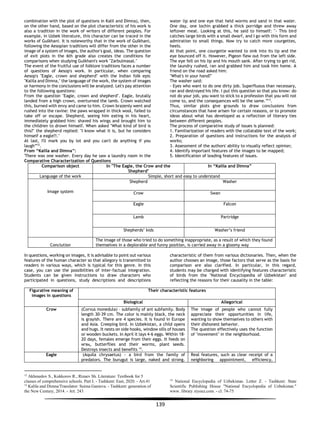
Comparative Characterization of Questions
Comparison object In "The Eagle, the Crow and the
Shepherd"
In “Kalila and Dimna”
Language of the work Simple, short and easy to understand
Image system
Shepherd Washer
Crow Swan
Eagle Falcon
Lamb Partridge
Shepherds’ kids Washer’s friend
Conclution
The image of those who tried to do something inappropriate, as a result of which they found
themselves in a deplorable and funny position, is carried away in a gloomy way
In questions, working on images, it is advisable to point out various
features of the human character so that allegory is transmitted to
readers in various ways, which is typical for this genre. In this
case, you can use the possibilities of inter-factual integration.
Students can be given instructions to draw characters who
participated in questions, study descriptions and descriptions
characteristic of them from various dictionaries. Then, when the
author chooses an image, those factors that serve as the basis for
comparison are also clarified. In particular, in this regard,
students may be charged with identifying features characteristic
of birds from the "National Encyclopedia of Uzbekistan" and
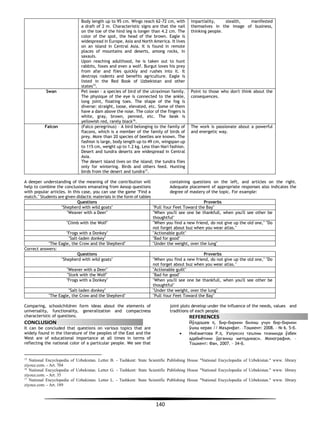
reflecting the reasons for their causality in the table:
Figurative meaning of
images in questions
Their characteristic features
Biological Allegorical
Crow (Corvus monedula) – subfamily of ant subfamily. Body
length 30-39 cm. The color is mainly black, the neck
is grayish. There are 4 species. It is found in Europe
and Asia. Creeping bird. In Uzbekistan, a child opens
and hugs. It nests on side hooks, window sills of houses
or wooden buckets. In April it lays 4-6 eggs. Within 18-
20 days, females emerge from their eggs. It feeds on
игвқ, butterflies and their worms, plant seeds.
Destroys insects and benefits 14
.
The image of people who cannot fully
appreciate their opportunities in life,
wanting to show themselves to others with
their dishonest behavior.
The question effectively uses the function
of "movement" in the neighborhood.
Eagle (Aquila chrysaetus) - a bird from the family of
predators. The burugut is large, naked and strong.
Real features, such as clear receipt of a
neighboring appointment, efficiency,
12
Akhmedov S., Kokkorov R., Rizaev Sh. Literature: Textbook for 5
classes of comprehensive schools. Part I. - Tashkent: East, 2020. - Art.41
13
Kalila and Dimna/Translator: Suima Ganieva. - Tashkent: generation of
the New Century, 2014. - Art. 243
14
National Encyclopedia of Uzbekistan. Letter Z. - Tashkent: State
Scientific Publishing House "National Encyclopedia of Uzbekistan."
www. library ziyouz.com. - cl. 74-75
140
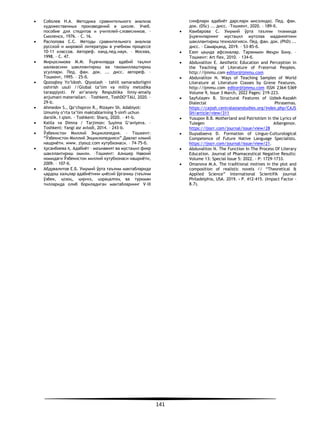
Body length up to 95 cm. Wings reach 62-72 cm, with
a draft of 2 m. Characteristic signs are that the nail
on the toe of the hind leg is longer than 4.2 cm. The
color of the spot, the head of the brown. Eagle is
widespread in Europe, Asia and North America. It lives
on an island in Central Asia. It is found in remote
places of mountains and deserts, among rocks, in
saxauls.
Upon reaching adulthood, he is taken out to hunt
rabbits, foxes and even a wolf. Burgut loves his prey
from afar and flies quickly and rushes into it. It
destroys rodents and benefits agriculture. Eagle is
listed in the Red Book of Uzbekistan and other
states15
.
impartiality, stealth, manifested
themselves in the image of business,
thinking people.
Swan Pet swan - a species of bird of the utraximon family.
The physique of the eye is connected to the ankle,
long joint, floating toes. The shape of the fog is
diverse: straight, loose, elevated, etc. Some of them
have a dam above the nose. The color of the fingers is
white, gray, brown, penned, etc. The beak is
yellowish red, rarely black16
.
Point to those who don't think about the
consequences.
Falcon (Falco peregrinus) – A bird belonging to the family of
flacons, which is a member of the family of birds of
prey. More than 20 species of beetles are known. The
fashion is large, body length up to 49 cm, wingspan up
to 115 cm, weight up to 1.2 kg. Less than Nari fashion.
Desert and tundra deserts are widespread in Central
Asia.
The desert island lives on the island; the tundra flies
only for wintering. Birds and others feed. Hunting
birds from the desert and tundra17
.
The work is passionate about a powerful
and energetic way.
A deeper understanding of the meaning of the contribution will
help to combine the conclusions emanating from Aesop questions
with popular articles. In this case, you can use the game "Find a
match." Students are given didactic materials in the form of tables
containing questions on the left, and articles on the right.
Adequate placement of appropriate responses also indicates the
degree of mastery of the topic. For example:
Questions Proverbs
"Shepherd with wild goats" "Pull Your Feet Toward the Bay"
"Weaver with a Deer" "When you'll see one be thankfull, when you'll see other be
thoughtful"
"Climb with the Wolf" "When you find a new friend, do not give up the old one," "Do
not forget about buz when you wear atlas."
"Frogs with a Donkey" "Actionable guilt"
"Salt-laden donkey" "Bad for good"
"The Eagle, the Crow and the Shepherd" "Under the weight, over the lung"
Correct answers:
Questions Proverbs
"Shepherd with wild goats" "When you find a new friend, do not give up the old one," "Do
not forget about buz when you wear atlas."
"Weaver with a Deer" "Actionable guilt"
"Stork with the Wolf" "Bad for good"
"Frogs with a Donkey" "When you'll see one be thankfull, when you'll see other be
thoughtful"
"Salt-laden donkey" "Under the weight, over the lung"
"The Eagle, the Crow and the Shepherd" "Pull Your Feet Toward the Bay"
Comparing, schoolchildren form ideas about the elements of
universality, functionality, generalization and compactness
characteristic of questions.
It can be concluded that questions on various topics that are
widely found in the literature of the peoples of the East and the
West are of educational importance at all times in terms of
reflecting the national color of a particular people. We see that
15
National Encyclopedia of Uzbekistan. Letter B. - Tashkent: State Scientific Publishing House "National Encyclopedia of Uzbekistan." www. library
ziyouz.com. - Art. 704
16
National Encyclopedia of Uzbekistan. Letter G. - Tashkent: State Scientific Publishing House "National Encyclopedia of Uzbekistan." www. library
ziyouz.com. - Art. 35
17
National Encyclopedia of Uzbekistan. Letter L. - Tashkent: State Scientific Publishing House "National Encyclopedia of Uzbekistan." www. library
ziyouz.com. - Art. 189
joint plots develop under the influence of the needs, values and
traditions of each people.
Йўлдошев Қ. Бир-бирини билиш учун бир-бирини
ўқиш керак // Маърифат. –Тошкент: 2008. – № 6. 5-б.
• Ниёзметова Р.Ҳ. Узлуксиз таълим тизимида ўзбек
адабиётини ўрганиш методикаси. Монография. –
Тошкент: Фан, 2007. – 34-б.
141
• Соболев Н.А. Методика сравнительного анализа
художественных произведений в школе. Учеб.
пособие для стеднтов и учителей-словесников. –
Смоленск, 1976. – С. 16.
• Распопова С.С. Методы сравнительного анализа
русской и мировой литературы в учебном процессе
10-11 классов. Автореф. канд.пед.наук. – Москва,
1998. – С. 47.
• Мирқосимова М.М. Ўқувчиларда адабий таҳлил
малакасини шакллантириш ва такомиллаштириш
усуллари. Пед. фан. док. ... дисс. автореф. –
Тошкент, 1995. – 25-б.
• Qozoqboy Yo‘ldosh. Qiyoslash – tahlil samaradorligini
oshirish usuli //Global ta’lim va milliy metodika
taraqqiyoti. IV an’anaviy Respublika ilmiy-amaliy
anjumani materiallari. –Toshkent, ToshDO‘TAU, 2020. –
29-b.
• Аhmedov S., Qo‘chqorov R., Rizayev Sh. Adabiyot:
Umumiy o‘rta ta’lim maktablarining 5-sinfi uchun
darslik. I qism. – Toshkent: Sharq, 2020. – 41-b.
• Kalila va Dimna / Tarjimon: Suyima G‘aniyeva. –
Toshkent: Yangi asr avlodi, 2014. – 243-b.
• Ўзбекистон Миллий Энциклопедия. – Тошкент:
“Ўзбекистон Миллий Энциклопедияси” Давлат илмий
нашриёти. www. ziyouz.com кутубхонаси. – 74–75-б.
• Ҳусанбоева Қ. Адабиёт – маънавият ва мустақил фикр
шакллантириш омили. –Тошкент: Алишер Навоий
номидаги Ўзбекистон миллий кутубхонаси нашриёти,
2009. – 107-б.
• Абдувалитов Е.Б. Умумий ўрта таълим мактабларида
қардош халқлар адабиётини қиёсий ўрганиш (таълим
ўзбек, қозоқ, қирғиз, қорақалпоқ ва туркман
тилларида олиб бориладиган мактабларнинг V–IX
синфлари адабиёт дарслари мисолида). Пед. фан.
док. (DSc) ... дисс. –Тошкент, 2020. – 189-б.
• Камбарова С. Умумий ўрта таълим тизимида
ўқувчиларнинг мустақил мутолаа маданиятини
шакллантириш технологияси. Пед. фан. док. (PhD) ...
дисс. – Самарқанд, 2019. – 53-85-б.
• Eзоп ҳақида афсоналар. Таржимон Меҳри Бону. –
Тошкент: Art flex, 2010. – 134-б.
• Abduvalitov E. Aesthetic Education and Perception in
the Teaching of Literature of Fraternal Peoples.
http://ijmmu.com editor@ijmmu.com
• Abduvalitov N. Ways of Teaching Samples of World
Literature at Literature Classes by Grene Features.
http://ijmmu.com editor@ijmmu.com ISSN 2364-5369
Volume 9, Issue 3 March, 2022 Pages: 219-223.
• Sayfulayev B. Structural Features of Uzbek-Kazakh
Dialectal Phrasemas.
https://cajssh.centralasianstudies.org/index.php/CAJS
SH/article/view/311
• Yusupov B.B. Motherland and Patriotism in the Lyrics of
Tulegen Aibergenov.
https://ijssrr.com/journal/issue/view/28
• Duysabaeva D. Formation of Linguo-Culturological
Competence of Future Native Language Specialists.
https://ijssrr.com/journal/issue/view/21.
• Abduvalitov N. The Function In The Process Of Literary
Education. Journal of Phamaceutical Negative Results:
Volume 13: Special Issue 5: 2022. - P: 1729-1733.
• Omanova М.А. The traditional motives in the plot and
composition of realistic novels // “Theoretical &
Applied Science” International Scientifik journal
Philadelphia, USA. 2019. - P. 412-415. (Impact Factor -
8.7).

scopus database journal scopus database journal

  • 1.
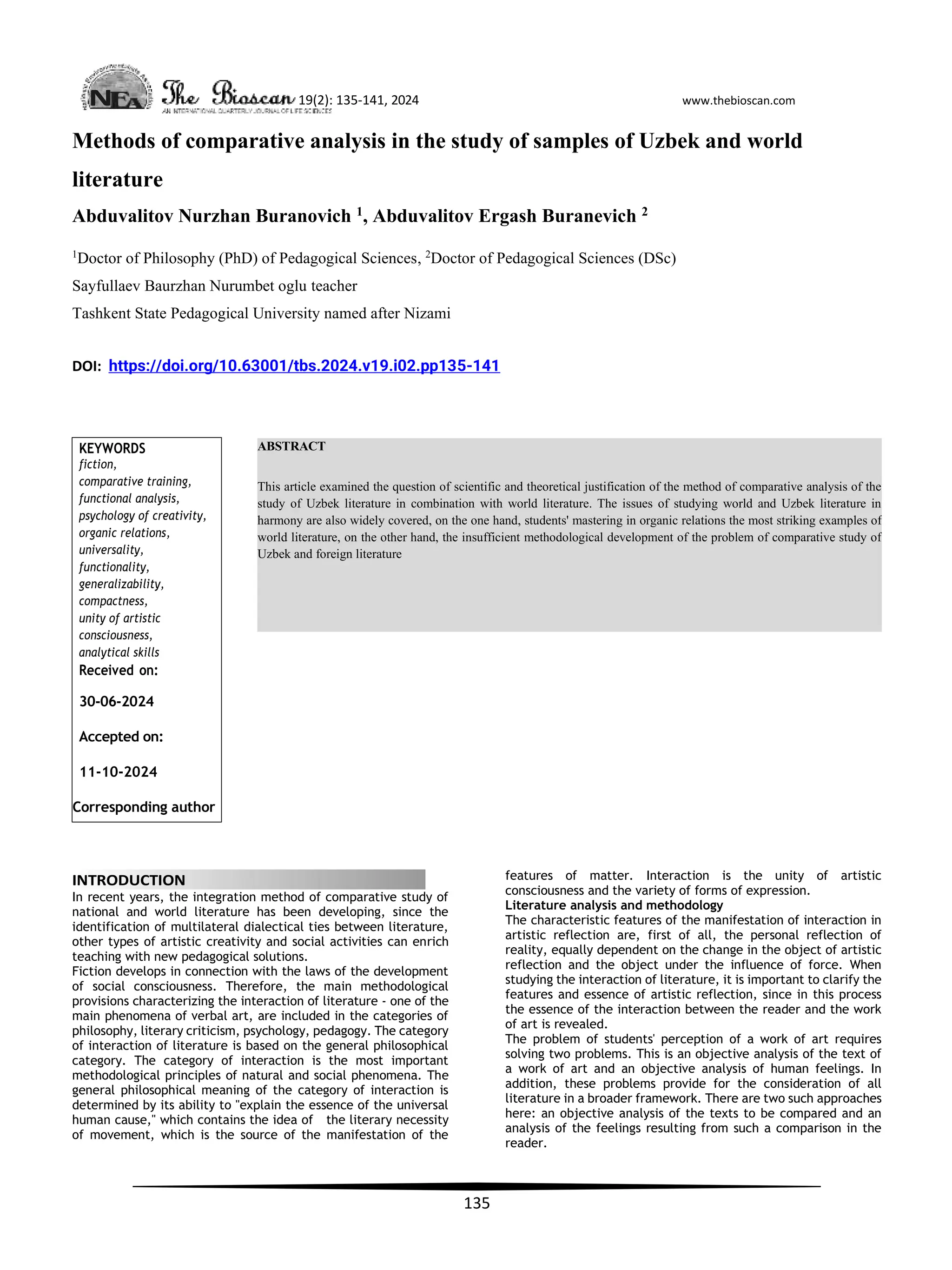
    135 19(2): 135-141, 2024www.thebioscan.com Methods of comparative analysis in the study of samples of Uzbek and world literature Abduvalitov Nurzhan Buranovich 1, Abduvalitov Ergash Buranevich 2 1 Doctor of Philosophy (PhD) of Pedagogical Sciences, 2 Doctor of Pedagogical Sciences (DSc) Sayfullaev Baurzhan Nurumbet oglu teacher Tashkent State Pedagogical University named after Nizami DOI: https://doi.org/10.63001/tbs.2024.v19.i02.pp135-141 In recent years, the integration method of comparative study of national and world literature has been developing, since the identification of multilateral dialectical ties between literature, other types of artistic creativity and social activities can enrich teaching with new pedagogical solutions. Fiction develops in connection with the laws of the development of social consciousness. Therefore, the main methodological provisions characterizing the interaction of literature - one of the main phenomena of verbal art, are included in the categories of philosophy, literary criticism, psychology, pedagogy. The category of interaction of literature is based on the general philosophical category. The category of interaction is the most important methodological principles of natural and social phenomena. The general philosophical meaning of the category of interaction is determined by its ability to "explain the essence of the universal human cause," which contains the idea of the literary necessity of movement, which is the source of the manifestation of the features of matter. Interaction is the unity of artistic consciousness and the variety of forms of expression. Literature analysis and methodology The characteristic features of the manifestation of interaction in artistic reflection are, first of all, the personal reflection of reality, equally dependent on the change in the object of artistic reflection and the object under the influence of force. When studying the interaction of literature, it is important to clarify the features and essence of artistic reflection, since in this process the essence of the interaction between the reader and the work of art is revealed. The problem of students' perception of a work of art requires solving two problems. This is an objective analysis of the text of a work of art and an objective analysis of human feelings. In addition, these problems provide for the consideration of all literature in a broader framework. There are two such approaches here: an objective analysis of the texts to be compared and an analysis of the feelings resulting from such a comparison in the reader. ABSTRACT This article examined the question of scientific and theoretical justification of the method of comparative analysis of the study of Uzbek literature in combination with world literature. The issues of studying world and Uzbek literature in harmony are also widely covered, on the one hand, students' mastering in organic relations the most striking examples of world literature, on the other hand, the insufficient methodological development of the problem of comparative study of Uzbek and foreign literature KEYWORDS fiction, comparative training, functional analysis, psychology of creativity, organic relations, universality, functionality, generalizability, compactness, unity of artistic consciousness, analytical skills Received on: 30-06-2024 Accepted on: 11-10-2024 Corresponding author
  • 2.
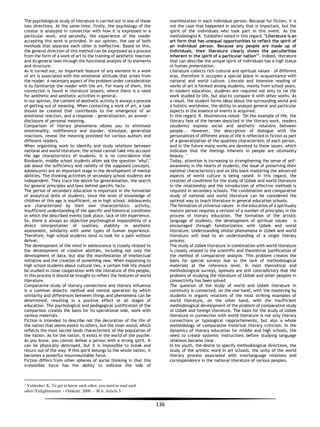
    136 The psychological studyof literature is carried out in one of these two directions. At the same time, firstly, the psychology of the creator is analyzed in connection with how it is expressed in a particular work, and secondly, the experience of the reader accepting this work is provided. In our opinion, the use of both methods that separate each other is ineffective. Based on this, the general direction of this method can be expressed as a process from the form of a work of art to the training of aesthetic reaction and its general laws through the functional analysis of its elements and structure. As it turned out, an important feature of any element in a work of art is associated with the emotional attitude that arises from the reader. A necessary aspect of the problem under consideration is to familiarize the reader with the art. For many of them, this connection is found in literature lessons, where there is a need for aesthetic and aesthetic activities in general. In our opinion, the content of aesthetic activity is always a process of getting out of meaning. When contacting a work of art, a task should be created that contributes to the emergence of an emotional reaction, and a response - generalization, an answer - disclosure of personal meaning. Comparison of literary phenomena allows you to eliminate emotionality, indifference and slander, stimulate, generalize reactions, reveal the meaning provided for various authors and different readers. When organizing work to identify and study relations between national and world literature, the school cannot take into account the age characteristics of students. It is no coincidence that Binobarin, middle school students often ask the question "why?," ask about the sufficiency and validity of the supposed concepts. Adolescents are an important stage in the development of mental abilities. The thinking activities of secondary school students are independent. They trace the desire for generalization, the search for general principles and laws behind specific facts. The period of secondary education is important in the formation of analytical skills of students, since the level of knowledge of children of this age is insufficient, as in high school. Adolescents are characterized by their own characteristics: activity, insufficient understanding of the specific and historical conditions in which the described events took place, lack of life experience. So, there is always an objective psychological impossibility of a direct interpretation of realities, stability in aesthetic assessment, solidarity with some types of human experience. Therefore, high school students tend to look for a path without defeat. The development of the mind in adolescence is closely related to the development of creative abilities, including not only the development of data, but also the manifestation of intellectual initiative and the creation of something new. When explaining to high school students about cultural ties, a certain folk life should be studied in close cooperation with the literature of this people, in this process it should be brought to reflect the features of world literature. Comparative study of literary connections and literary influence is a common didactic method and mental operation by which similarity and differences between things and phenomena can be determined, resulting in a positive effect at all stages of education. The psychological and pedagogical justification of the comparison creates the basis for its operational side, work with various materials. Fiction is intended to describe not the decoration of the life of the nation that seems exotic to others, but the inner world, which reflects the most sacred lands characteristic of the population of the nation. As for the nation, it exists in the world of the psyche. As you know, you cannot defeat a person with a strong spirit. It can be physically destroyed, but it is impossible to break and return out of the way. If this spirit belongs to the whole nation, it becomes a powerful insurmountable force. Fiction differs from other spheres of social thinking in that this irresistible force has the ability to indicate the side of 1 Yuldoshev K. To get to know each other, you need to read each other//Enlightenment. - Oshkent: 2008. – № 6. Article 5. manifestation in each individual person. Because for fiction, it is not the case that happened in society that is important, but the spirit of the individuals who took part in this event. As the methodologist K. Yuldoshev noted in this regard, "Literature is an art form that has unequal opportunities to reflect the spirit of an individual person. Because any people are made up of individuals, their literature clearly shows the peculiarities inherent in the spirit of a particular nation"1 . Indeed, literature that can describe the unique spirit of individuals has a high status in human presentation. Literature collects rich cultural and spiritual values of different eras, therefore it occupies a special place in acquaintance with national and world culture. Literate and intensive reading of works of art is formed among students, mainly from school years. In modern education, students are required not only to tie the work studied to life, but also to compare it with other works. As a result, the student forms ideas about the surrounding world and a holistic worldview, the ability to analyze general and particular aspects in the essence of events is acquired. In this regard, R. Niozmetova noted: "On the example of life, the literary fate of the heroes depicted in the literary work, readers (students) express social and aesthetic relations between people... However, the description of dialogue with the personalities of different areas of life is reflected in fiction as part of a generalization of the qualities characteristic of each person, and in the future many works are devoted to these issues, which indicates that the feelings inherent in people are ultimately beauty. " Today, attention is increasing to strengthening the sense of self- awareness in the hearts of students, the issue of preserving their national characteristics and on this basis mastering the advanced aspects of world culture is being raised. In this regard, the creation of conditions for the study of Uzbek and world literature in the relationship and the introduction of effective methods is required in secondary schools. The combination and comparative study of national and world literature can be considered the optimal way to teach literature in general education schools. The formation of universal values in the education of a spiritually mature person requires a revision of a number of principles in the process of literary education. The formation of the artistic language of students, the development of spiritual values is encouraged through familiarization with Uzbek and world literature. Understanding similar phenomena in Uzbek and world literature will lead to an understanding of a single literary process. The study of Uzbek literature in combination with world literature is closely related to the scientific and theoretical justification of the method of comparative analysis. This problem creates the basis for special surveys due to the lack of methodological materials at the reference level. In most theoretical and methodological surveys, opinions are still contradictory that the problem of studying the literature of Uzbek and other peoples in connectivity has been solved. The question of the study of world and Uzbek literature in continuity is connected, on the one hand, with the mastering by students in organic relations of the most striking examples of world literature, on the other hand, with the insufficient methodological development of the problem of comparative study of Uzbek and foreign literature. The basis for the study of Uzbek literature in connection with world literature is not only literary connections or typological rapprochements, but also a whole methodology of comparative historical literary criticism. In the dynamics of literary education for middle and high schools, the need to create systemic instructions before studying language relations became clear. In his youth, the desire to specify methodological directions, the study of the artistic word in art schools, the unity of the world literary process associated with interlanguage relations and correspondence in the national literature of various peoples,
  • 3.
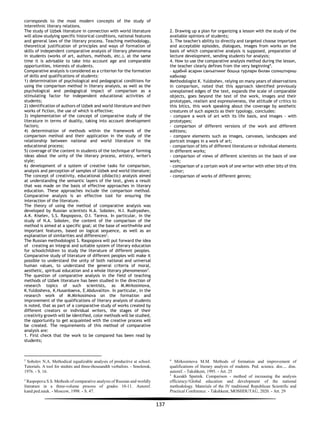
    137 corresponds to themost modern concepts of the study of interethnic literary relations. The study of Uzbek literature in connection with world literature will allow studying specific historical conditions, national features and general laws of the literary process. Teaching methodology, theoretical justification of principles and ways of formation of skills of independent comparative analysis of literary phenomena in students (works of art, authors, methods, etc.), at the same time it is advisable to take into account age and comparable opportunities, interests of students. Comparative analysis is considered as a criterion for the formation of skills and qualifications of students: 1) determination of psychological and pedagogical conditions for using the comparison method in literary analysis, as well as the psychological and pedagogical impact of comparison as a stimulating factor for independent educational activities of students; 2) identification of authors of Uzbek and world literature and their works of fiction, the use of which is effective; 3) implementation of the concept of comparative study of the literature in terms of duality, taking into account development factors; 4) determination of methods within the framework of the comparison method and their application in the study of the relationship between national and world literature in the educational process; 5) coverage of the content in students of the technique of forming ideas about the unity of the literary process, artistry, writer's style; 6) development of a system of creative tasks for comparison, analysis and perception of samples of Uzbek and world literature; The concept of creativity, educational (didactic) analysis aimed at understanding the semantic layers of the text, gives a result that was made on the basis of effective approaches in literary education. These approaches include the comparison method. Comparative analysis is an effective tool for ensuring the interaction of the literature. The theory of using the method of comparative analysis was developed by Russian scientists N.A. Sobolev, N.I. Kudryashev, A.K. Kiselev, S.S. Raspopova, O.I. Tareva. In particular, in the study of N.A. Sobolev, the content of the comparison of the method is aimed at a specific goal; at the base of worthwhile and important features, based on logical sequence, as well as an explanation of similarities and differences2 . The Russian methodologist S. Raspopova will put forward the idea of creating an integral and suitable system of literary education for schoolchildren to study the literature of different peoples. Comparative study of literature of different peoples will make it possible to understand the unity of both national and universal human values, to understand the general criteria of moral, aesthetic, spiritual education and a whole literary phenomenon3 . The question of comparative analysis in the field of teaching methods of Uzbek literature has been studied in the direction of research topics of such scientists, as M.Mirkosimova, K.Yuldosheva, K.Husanbaeva, E.Abduvalitov. In particular, in the research work of M.Mirkosimova on the formation and improvement of the qualifications of literary analysis of students is noted, that as part of a comparative study of works created by different creators or individual writers, the stages of their creativity growth will be identified, color methods will be studied, the opportunity to get acquainted with the creative process will be created. The requirements of this method of comparative analysis are: 1. First check that the work to be compared has been read by students; 2 Sobolev N.A. Methodical equalizable analysis of productive at school. Tutorials. A tool for stednts and three-thousandth verbalists. - Smolensk, 1976. - S. 16. 3 Raspopova S.S. Methods of comparative analysis of Russian and worldly literature in a three-volume process of grades 10-11. Autoref. kand.ped.nauk. - Moscow, 1998. - S. 47. 2. Drawing up a plan for organizing a lesson with the study of the available opinions of students; 3. The teacher's ability to directly and targeted choose important and acceptable episodes, dialogues, images from works on the basis of which comparative analysis is supposed, preparation of lecture development, sending students for analysis; 4. How to use the comparative analysis method during the lesson, the teacher clearly defines from the very beginning4 . – адабий асарни санъатнинг бошқа турлари билан солиштириш кабилар Methodologist K. Yuldoshev, relying on many years of observations in comparison, noted that this approach identified previously unexplained edges of the text, expands the scale of comparable objects, goes beyond the text of the work, images and their prototypes, realism and expressiveness, the attitude of critics to this bitics, this work speaking about the coverage by aesthetic creatures of such aspects as their typology, concludes: - compare a work of art with its life basis, and images - with prototypes; - comparison of different versions of the work and different editions; - compare elements such as images, canvases, landscapes and portrait images in a work of art; - comparison of bits of different literatures or individual elements in different works; - comparison of views of different scientists on the basis of one work; - comparison of a certain work of one writer with other bits of this author; - comparison of works of different genres; 4 Mirkosimova M.M. Methods of formation and improvement of qualifications of literary analysis of students. Ped. science. doc.... diss. autoref. - Takshkent, 1995. - Art. 25 5 Kazakh Sputnik. Comparison - method of increasing the analysis efficiency//Global education and development of the national methodology. Materials of the IV traditional Republican Scientific and Practical Conference. - Takshkent, MOSHDUTAU, 2020. - Art. 29
  • 4.
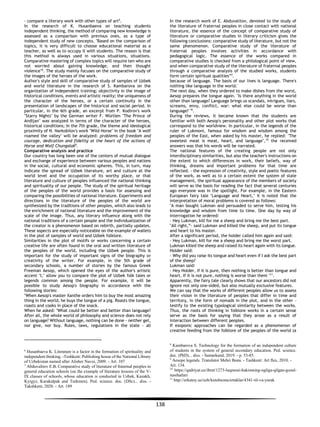
    138 - compare aliterary work with other types of art5 . In the research of K. Husanbaeva on teaching students independent thinking, the method of comparing new knowledge is assessed as a comparison with previous ones, as a type of independent study of new concepts. "Based on the comparison of topics, it is very difficult to choose educational material as a teacher, as well as to occupy it with students. The reason is that this method is always used in various situations, situations. Comparative mastering of complex topics will require ten who are not worried about gaining knowledge, and then thought violence"6 . The study mainly focuses on the comparative study of the images of the heroes of the work. In the research work of E. Abduvalitov, devoted to the study of the literature of fraternal peoples in close contact with national literature, the essence of the concept of comparative study of literature or comparative studies in literary criticism gives the following conclusions: comparative study of literature, but not the same phenomenon. Comparative study of the literature of fraternal peoples involves activities in accordance with pedagogical logic. The essence of the works compared in comparative studies is checked from a philological point of view, and when comparative study of the literature of fraternal peoples through a comparative analysis of the studied works, students form certain spiritual qualities”7 . Author's style and skill of comparative study of samples of Uzbek and world literature in the research of S. Kambarova on the organization of independent training; objectivity in the image of historical conditions, events and artistic reality; the uniqueness of the character of the heroes, or a certain continuity in the presentation of landscapes of the historical and social period. In particular, in the 6th grade, an excerpt from P. Kodirov's work "Starry Nights" by the German writer F. Würtlen "The Prince of Andijan" was analyzed in terms of the character of the heroes, historical conditions; In the 7th grade, the theme and ideological proximity of N. Narkobilov's work "Wild Horse" in the book "A wolf roamed the valley" will be analyzed: problems of freedom and courage, dedication and fidelity at the heart of the actions of Horse and Wolf Chungalak8 . Comparative analysis and practice Our country has long been one of the centers of mutual dialogue and exchange of experience between various peoples and nations in the social, cultural and economic spheres. This, in turn, may indicate the spread of Uzbek literature, art and culture at the world level and the occupation of its worthy place, or that literature and culture of peoples influenced the national thinking and spirituality of our people. The study of the spiritual heritage of the peoples of the world provides a basis for assessing and comparing the possibilities of national literature. Experiments and directions in the literature of the peoples of the world are synthesized by the traditions of other peoples, which also leads to the enrichment of national literature and the improvement of the scale of the image. Thus, any literary influence along with the national traditions of a certain people and the individualization of the creator is a phenomenon based on rebirth, partially updates. These aspects are especially noticeable on the example of wallets in the plot of samples of world and Uzbek folklore. Similarities in the plot of motifs or works concerning a certain creative life are often found in the oral and written literature of the peoples of the world, including the Uzbek people. This is important for the study of important signs of the biography or creativity of the writer. For example, in the 5th grade of secondary schools, a number of stories by the famous Greek Freeman Aesop, which opened the eyes of the author's artistic accent "I," allow you to compare the plot of Uzbek folk tales or legends common among the people. For example, it will be possible to study Aesop's biography in accordance with the following stories: "When Aesop's master Xanthe orders him to buy the most amazing thing in the world, he buys the tongue of a pig. Roasts the tongue, roasts and cooks in place of the snack. When he asked: "What could be better and better than language? After all, the whole world of philosophy and science does not rely on language? Without language, nothing can be done - neither get, nor give, nor buy. Rules, laws, regulations in the state - all 6 Husanbaeva K. Literature is a factor in the formation of spirituality and independent thinking. -Toshkent: Publishing house of the National Library of Uzbekistan named after Alisher Navoi, 2009. - Art. 107 7 Abduvalitov E.B. Comparative study of literature of fraternal peoples in general education schools (on the example of literature lessons of the V- IX classes of schools, whose education is conducted in Uzbek, Kazakh, Kyrgyz, Karakalpak and Turkmen). Ped. science. doc. (DSc)... diss. - Takshkent, 2020. - Art. 189 because of language. The basis of our lives is language. There's nothing like language in the world.' The next day, when they ordered to make dishes from the worst, Aesop prepares the tongue again. "Is there anything in the world other than language? Language brings us scandals, intrigues, liars, screams, envy, conflict, war: what else could be worse than language? "9 . During the reviews, it became known that the students are familiar with both Aesop's personality and other plot works that correspond to the worldview. In particular, in the legends of the ruler of Lukmoni, famous for wisdom and wisdom among the peoples of the East, when asked by his master, he replied: "The sweetest meat is meat, heart, and language",10 the received answers was that his words will be narrated. The national features of the creating people are not only interdisciplinary similarities, but also the teacher's instructions on the extent to which differences in work, their beliefs, way of thinking, dreams and important problems for that time are reflected. - the expression of creativity, style and poetic features of the work, as well as to a certain extent the system of state management, the spiritual appearance of the members of society will serve as the basis for reading the fact that several centuries ago everyone was in the spotlight. For example, in the Eastern European fairy tale "Language and Heart," it is noted that the interpretation of moral problems is covered as follows: "A man bought Lukman and persuaded to serve him, testing his knowledge and wisdom from time to time. One day by way of interrogation he ordered: - Hey Lukman, kill for me a sheep and bring me the best part. "All right,”- said Lukman and killed the sheep, and put its tongue and heart to his master. After a significant period, the holder called him again and said: - Hey Lukman, kill for me a sheep and bring me the worst part. Lukman killed the sheep and raised its heart again with its tongue. Holder said: - Why did you raise its tongue and heart even if I ask the best part of the sheep? Lukman said: - Hey Holder, if it is pure, then nothing is better than tongue and heart. If it is not pure, nothing is worse than them "11 . Apparently, the fairy tale clearly shows that our ancestors did not ignore not only one-sided, but also mutually exclusive features. We can say that the works of different peoples allow us to assess their vision in the literature of peoples that differ in time and territory, in the form of nomads in the plot, and in the other - testify to the existing typological similarity between the works. Thus, the roots of thinking in folklore works in a certain sense serve as the basis for saying that they arose as a result of interaction between different peoples. If esoponic approaches can be regarded as a phenomenon of creative feeding from the folklore of the peoples of the world (a 8 Kambarova S. Technology for the formation of an independent culture of students in the system of general secondary education. Ped. science. doc. (PhD)... diss. - Samarkand, 2019. - p. 53-85. 9 Aesope legends. Translator Mehri Bona. - Tashkent: Art flex, 2010. - Art. 134. 10 https://qadriyat.uz/ibrat/1273-luqmoni-hakimning-ogliga-qilgan-gozal- nasihatlari 11 http://erkatoy.uz/uzb/kutubxona/ertaklar/4341-til-va-yurak
  • 5.
    139 combination with theplot of questions in Kalil and Dimna), then, on the other hand, based on the plot characteristic of his work is also a tradition in the work of writers of different peoples. For example, in Uzbek literature, this character can be traced in the works of Gulkhani. It is noteworthy that in the work of Gulkhani, following the Aesopian traditions will differ from the other in the image of a system of images, the author's goal, ideas. The question of exit plots in the 6th grade also creates the conditions for comparisons when studying Gulkhani's work "Zarbulmasal." The event of the fruitful use of folklore traditions faces a number of questions of Aesop's work. In particular, when comparing Aesop's "Eagle, crown and shepherd" with the Indian folk epic "Kalila and Dimna," the language of the work, the system of images or harmony in the conclusions will be analyzed. Let's pay attention to the following questions: From the question "Eagle, crown and shepherd". Eagle, brutally landed from a high crown, overturned the lamb. Crown watched this, burned with envy and came to him. Crown brazenly went and rushed into the ravine: the paws wrapped in thick wool, failed to take off or escape. Shepherd, seeing him eating in his heart, immediately grabbed him: shaved his wings and brought him to the children to drown himself. When asked "What kind of bird is this?" the shepherd replied: "I know what it is, but he considers himself a eagle?!." At last, I'll mark you by lot and you can't do anything if you laugh”12 . From “Kalila and Dimna”: 'There was one washer. Every day he saw a laundry room in the water lip and one eye that held worms and sand in that water. One day, one lochin grabbed a thick porridge and threw away leftover meat. Looking at this, he said to himself: "- This bird catches large birds with a small dwarf, and I go with this form and admiration to small things. Now try to catch more courgettes, heels. At that point, one courgette wanted to sink into its lip and the eye bounced off it. However, Pigeon flew out from the left side. The eye fell on his lip and his mouth sank. After trying to get rid, the laundry rushed, ran and grabbed him and took him home. A friend on the road asked him: "What's in your hand?" The washer said: - Eyes who want to do one dirty job. Superfluous than necessary, ran and destroyed his life. I put this question so that you know: do not do your job, you want to stick to a profession that you will not come to, and the consequences will be the same.”13 . Thus, similar plots give grounds to draw conclusions from circumstances that have arisen for certain reasons, or to promote ideas about what has developed as a reflection of literary ties between different peoples. The process of comparative study of issues is planned: 1. Familiarization of readers with the collatable text of the work; 2. Preparation of questions and instructions for the analysis of works; 3. Assessment of the authors' ability to visually reflect opinion; 4. Identify important features of the images to be mapped; 5. Identification of leading features of issues. Comparative Characterization of Questions Comparison object In "The Eagle, the Crow and the Shepherd" In “Kalila and Dimna” Language of the work Simple, short and easy to understand Image system Shepherd Washer Crow Swan Eagle Falcon Lamb Partridge Shepherds’ kids Washer’s friend Conclution The image of those who tried to do something inappropriate, as a result of which they found themselves in a deplorable and funny position, is carried away in a gloomy way In questions, working on images, it is advisable to point out various features of the human character so that allegory is transmitted to readers in various ways, which is typical for this genre. In this case, you can use the possibilities of inter-factual integration. Students can be given instructions to draw characters who participated in questions, study descriptions and descriptions characteristic of them from various dictionaries. Then, when the author chooses an image, those factors that serve as the basis for comparison are also clarified. In particular, in this regard, students may be charged with identifying features characteristic of birds from the "National Encyclopedia of Uzbekistan" and reflecting the reasons for their causality in the table: Figurative meaning of images in questions Their characteristic features Biological Allegorical Crow (Corvus monedula) – subfamily of ant subfamily. Body length 30-39 cm. The color is mainly black, the neck is grayish. There are 4 species. It is found in Europe and Asia. Creeping bird. In Uzbekistan, a child opens and hugs. It nests on side hooks, window sills of houses or wooden buckets. In April it lays 4-6 eggs. Within 18- 20 days, females emerge from their eggs. It feeds on игвқ, butterflies and their worms, plant seeds. Destroys insects and benefits 14 . The image of people who cannot fully appreciate their opportunities in life, wanting to show themselves to others with their dishonest behavior. The question effectively uses the function of "movement" in the neighborhood. Eagle (Aquila chrysaetus) - a bird from the family of predators. The burugut is large, naked and strong. Real features, such as clear receipt of a neighboring appointment, efficiency, 12 Akhmedov S., Kokkorov R., Rizaev Sh. Literature: Textbook for 5 classes of comprehensive schools. Part I. - Tashkent: East, 2020. - Art.41 13 Kalila and Dimna/Translator: Suima Ganieva. - Tashkent: generation of the New Century, 2014. - Art. 243 14 National Encyclopedia of Uzbekistan. Letter Z. - Tashkent: State Scientific Publishing House "National Encyclopedia of Uzbekistan." www. library ziyouz.com. - cl. 74-75
  • 6.
    140 Body length upto 95 cm. Wings reach 62-72 cm, with a draft of 2 m. Characteristic signs are that the nail on the toe of the hind leg is longer than 4.2 cm. The color of the spot, the head of the brown. Eagle is widespread in Europe, Asia and North America. It lives on an island in Central Asia. It is found in remote places of mountains and deserts, among rocks, in saxauls. Upon reaching adulthood, he is taken out to hunt rabbits, foxes and even a wolf. Burgut loves his prey from afar and flies quickly and rushes into it. It destroys rodents and benefits agriculture. Eagle is listed in the Red Book of Uzbekistan and other states15 . impartiality, stealth, manifested themselves in the image of business, thinking people. Swan Pet swan - a species of bird of the utraximon family. The physique of the eye is connected to the ankle, long joint, floating toes. The shape of the fog is diverse: straight, loose, elevated, etc. Some of them have a dam above the nose. The color of the fingers is white, gray, brown, penned, etc. The beak is yellowish red, rarely black16 . Point to those who don't think about the consequences. Falcon (Falco peregrinus) – A bird belonging to the family of flacons, which is a member of the family of birds of prey. More than 20 species of beetles are known. The fashion is large, body length up to 49 cm, wingspan up to 115 cm, weight up to 1.2 kg. Less than Nari fashion. Desert and tundra deserts are widespread in Central Asia. The desert island lives on the island; the tundra flies only for wintering. Birds and others feed. Hunting birds from the desert and tundra17 . The work is passionate about a powerful and energetic way. A deeper understanding of the meaning of the contribution will help to combine the conclusions emanating from Aesop questions with popular articles. In this case, you can use the game "Find a match." Students are given didactic materials in the form of tables containing questions on the left, and articles on the right. Adequate placement of appropriate responses also indicates the degree of mastery of the topic. For example: Questions Proverbs "Shepherd with wild goats" "Pull Your Feet Toward the Bay" "Weaver with a Deer" "When you'll see one be thankfull, when you'll see other be thoughtful" "Climb with the Wolf" "When you find a new friend, do not give up the old one," "Do not forget about buz when you wear atlas." "Frogs with a Donkey" "Actionable guilt" "Salt-laden donkey" "Bad for good" "The Eagle, the Crow and the Shepherd" "Under the weight, over the lung" Correct answers: Questions Proverbs "Shepherd with wild goats" "When you find a new friend, do not give up the old one," "Do not forget about buz when you wear atlas." "Weaver with a Deer" "Actionable guilt" "Stork with the Wolf" "Bad for good" "Frogs with a Donkey" "When you'll see one be thankfull, when you'll see other be thoughtful" "Salt-laden donkey" "Under the weight, over the lung" "The Eagle, the Crow and the Shepherd" "Pull Your Feet Toward the Bay" Comparing, schoolchildren form ideas about the elements of universality, functionality, generalization and compactness characteristic of questions. It can be concluded that questions on various topics that are widely found in the literature of the peoples of the East and the West are of educational importance at all times in terms of reflecting the national color of a particular people. We see that 15 National Encyclopedia of Uzbekistan. Letter B. - Tashkent: State Scientific Publishing House "National Encyclopedia of Uzbekistan." www. library ziyouz.com. - Art. 704 16 National Encyclopedia of Uzbekistan. Letter G. - Tashkent: State Scientific Publishing House "National Encyclopedia of Uzbekistan." www. library ziyouz.com. - Art. 35 17 National Encyclopedia of Uzbekistan. Letter L. - Tashkent: State Scientific Publishing House "National Encyclopedia of Uzbekistan." www. library ziyouz.com. - Art. 189 joint plots develop under the influence of the needs, values and traditions of each people. Йўлдошев Қ. Бир-бирини билиш учун бир-бирини ўқиш керак // Маърифат. –Тошкент: 2008. – № 6. 5-б. • Ниёзметова Р.Ҳ. Узлуксиз таълим тизимида ўзбек адабиётини ўрганиш методикаси. Монография. – Тошкент: Фан, 2007. – 34-б.
  • 7.
    141 • Соболев Н.А.Методика сравнительного анализа художественных произведений в школе. Учеб. пособие для стеднтов и учителей-словесников. – Смоленск, 1976. – С. 16. • Распопова С.С. Методы сравнительного анализа русской и мировой литературы в учебном процессе 10-11 классов. Автореф. канд.пед.наук. – Москва, 1998. – С. 47. • Мирқосимова М.М. Ўқувчиларда адабий таҳлил малакасини шакллантириш ва такомиллаштириш усуллари. Пед. фан. док. ... дисс. автореф. – Тошкент, 1995. – 25-б. • Qozoqboy Yo‘ldosh. Qiyoslash – tahlil samaradorligini oshirish usuli //Global ta’lim va milliy metodika taraqqiyoti. IV an’anaviy Respublika ilmiy-amaliy anjumani materiallari. –Toshkent, ToshDO‘TAU, 2020. – 29-b. • Аhmedov S., Qo‘chqorov R., Rizayev Sh. Adabiyot: Umumiy o‘rta ta’lim maktablarining 5-sinfi uchun darslik. I qism. – Toshkent: Sharq, 2020. – 41-b. • Kalila va Dimna / Tarjimon: Suyima G‘aniyeva. – Toshkent: Yangi asr avlodi, 2014. – 243-b. • Ўзбекистон Миллий Энциклопедия. – Тошкент: “Ўзбекистон Миллий Энциклопедияси” Давлат илмий нашриёти. www. ziyouz.com кутубхонаси. – 74–75-б. • Ҳусанбоева Қ. Адабиёт – маънавият ва мустақил фикр шакллантириш омили. –Тошкент: Алишер Навоий номидаги Ўзбекистон миллий кутубхонаси нашриёти, 2009. – 107-б. • Абдувалитов Е.Б. Умумий ўрта таълим мактабларида қардош халқлар адабиётини қиёсий ўрганиш (таълим ўзбек, қозоқ, қирғиз, қорақалпоқ ва туркман тилларида олиб бориладиган мактабларнинг V–IX синфлари адабиёт дарслари мисолида). Пед. фан. док. (DSc) ... дисс. –Тошкент, 2020. – 189-б. • Камбарова С. Умумий ўрта таълим тизимида ўқувчиларнинг мустақил мутолаа маданиятини шакллантириш технологияси. Пед. фан. док. (PhD) ... дисс. – Самарқанд, 2019. – 53-85-б. • Eзоп ҳақида афсоналар. Таржимон Меҳри Бону. – Тошкент: Art flex, 2010. – 134-б. • Abduvalitov E. Aesthetic Education and Perception in the Teaching of Literature of Fraternal Peoples. http://ijmmu.com editor@ijmmu.com • Abduvalitov N. Ways of Teaching Samples of World Literature at Literature Classes by Grene Features. http://ijmmu.com editor@ijmmu.com ISSN 2364-5369 Volume 9, Issue 3 March, 2022 Pages: 219-223. • Sayfulayev B. Structural Features of Uzbek-Kazakh Dialectal Phrasemas. https://cajssh.centralasianstudies.org/index.php/CAJS SH/article/view/311 • Yusupov B.B. Motherland and Patriotism in the Lyrics of Tulegen Aibergenov. https://ijssrr.com/journal/issue/view/28 • Duysabaeva D. Formation of Linguo-Culturological Competence of Future Native Language Specialists. https://ijssrr.com/journal/issue/view/21. • Abduvalitov N. The Function In The Process Of Literary Education. Journal of Phamaceutical Negative Results: Volume 13: Special Issue 5: 2022. - P: 1729-1733. • Omanova М.А. The traditional motives in the plot and composition of realistic novels // “Theoretical & Applied Science” International Scientifik journal Philadelphia, USA. 2019. - P. 412-415. (Impact Factor - 8.7).