Science Tech Fair:
Celebrating Science,
Technology,
Innovation, and
Sustainability
Join us for a day of exciting science, technology, and
sustainability explorations. This event will feature interactive
exhibits, captivating demonstrations, and inspiring student
projects.
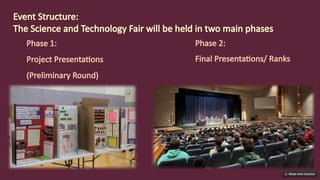
Phase 2:
Final Presentations/ Ranks
Event Structure:
The Science and Technology Fair will be held in two main phases
Phase 1:
Project Presentations
(Preliminary Round)
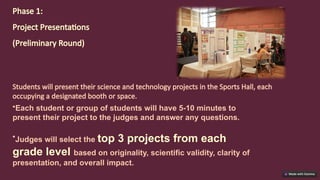
Phase 1:
Project Presentations
(Preliminary Round)
Students will present their science and technology projects in the Sports Hall, each
occupying a designated booth or space.
•Each student or group of students will have 5-10 minutes to
present their project to the judges and answer any questions.
•Judges will select the top 3 projects from each
grade level based on originality, scientific validity, clarity of
presentation, and overall impact.
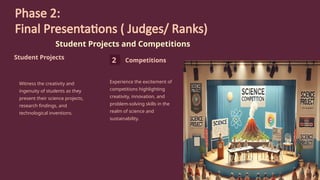
Student Projects and Competitions
Student Projects
Witness the creativity and
ingenuity of students as they
present their science projects,
research findings, and
technological inventions.
2 Competitions
Experience the excitement of
competitions highlighting
creativity, innovation, and
problem-solving skills in the
realm of science and
sustainability.
Phase 2:
Final Presentations ( Judges/ Ranks)
What is the science
fair project?
• It is your independent research of a science
topic using the scientific method or
Engineering Design. All work and ideas are
yours giving you “ownership” of the research
problem & results. By doing a science fair
project, you will find yourself doing the job of a
practicing, professional scientist, giving you a
taste of how the body of knowledge we call
science is accumulated.
Why should I
participate in the
competition?
• Learn the scientific methods.
• Discover your passions.
• Develop project management skills.
• Acquire research skills.
• Hone public speaking skills.
Categories for the
projects:
•Biology
•Chemistry
•Physics & Astronomy.
N.B: projects must have
a community impact
by solving real life
problems.
Your project has to
be related to one of
the main science
domains (Biology-
Chemistry- Physics).
• Participants from Grade 9 with a suitable
approved project will take an extra FF
level in science.
• Participants from G10 to 12 in the
science fair with a suitable approved
project will take an extra FF level in the
relevant science domain.
• G9,11 & 12 students Projects integrating
science with technology will take an
extra FF level in both science and ICT
ImportantDue
dates in
Trimester2
 Submitting final projects registration
forms on Classera : Tri2 week
2 .Receiving projects approval from
teachers (week 3).
 Final project submissions with charts
to teachers (Week 5)
Science Fair Event
Phase 1: On Tuesday 3rd
of
February 2026(Week 6/Sports
Hall).
Phase 2 : On Monday 9th
of
February 2026 (Week 7/Nour
Hall).
Steps for
participating in
the competition:
 Fill in the registration form and submit it
to your science teacher.
 Wait for your teacher consent on your
idea based on your written abstract.
 Start working on your project .
 Meet the deadlines set by your teacher
for the follow up.
Components for
the projects:
 Chart (scientific method or
engineering design)
 Working models if any
 2-3 min video presentation or a ppt. is
preferable.
StepsformakingtheProject:
 Choose a topic, be sure it interests you and that it has a
real life impact or solving a real life problem.
 Fill in the registration form with the abstract and make
sure it’s clear abstract to take your teacher’s approval
based on it.
 Write the project’s purpose as a research question.
 Form a hypothesis “what do you think is going to
happen? What do you think the results of your
experiment will be?”
 Plan your project. How will you test your hypothesis?
What experiment will you do? How will you measure
the results? Where will you keep your information? Be
sure to keep notes and write down everything.
 Collect your materials and equipment.
Steps for
making the
Project:
StepsformakingtheProject:
 Conduct your experiment and check all measurements to
make sure you are correct.
 Record and analyze your data and organize the information
in an orderly manner.
 Draw conclusion, what did you learn from the experiment?
Did you approve or disapprove the hypothesis.“it’s not
wrong if your hypothesis is wrong”.
 Prepare your titles, charts, drawings, graphs and diagrams
for the sketch. Keep it neat, colorful and large enough to be
seen.
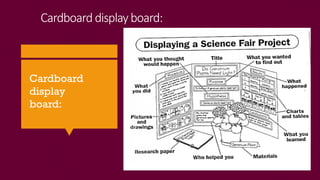
 Construct your display on the cardboard display board.
 Prepare and practice your presentation to tell us everything
about your project.
 Plan a timeline so you don’t leave everything to the last
minute.
Steps for
making the
Project:
Rules for the
projects:
 Never eat or drink during making an experiment
and always keep your area clean.
 Wear protective goggles during making any
experiments.
 Don’t touch, taste or inhale any chemicals.
 Don’t perform any experiment that will harm a
person.
 Dispose waste properly.
Cardboard displayboard:
Cardboard
display
board:
Tips for your oralpresentation:
 Look sharp, dress nice, be polite and speak clearly.
 Introduce yourself and point to the title of the display
and tell your audience why you chose to study.
 State your problem that you studied and tell them about
your hypothesis.
 Talk about what you learned while researching your
topic.
 Talk about the sources that helped you understand your
topic.
 Talk about the project & explain the steps.
 Be sure to include all the materials involved & point to
the pictures on your display board.
 Refer to your hypothesis and its connection with the
results produced.
 Make sure to read your table and graphs.
Tips for your
oral
presentation:
Thank
you

Science-Tech-Fair-Celebrating-Science-Technology (1).pptx

  • 1.
    Science Tech Fair: CelebratingScience, Technology, Innovation, and Sustainability Join us for a day of exciting science, technology, and sustainability explorations. This event will feature interactive exhibits, captivating demonstrations, and inspiring student projects.
  • 2.
    Phase 2: Final Presentations/Ranks Event Structure: The Science and Technology Fair will be held in two main phases Phase 1: Project Presentations (Preliminary Round)
  • 3.
    Phase 1: Project Presentations (PreliminaryRound) Students will present their science and technology projects in the Sports Hall, each occupying a designated booth or space. •Each student or group of students will have 5-10 minutes to present their project to the judges and answer any questions. •Judges will select the top 3 projects from each grade level based on originality, scientific validity, clarity of presentation, and overall impact.
  • 4.
    Student Projects andCompetitions Student Projects Witness the creativity and ingenuity of students as they present their science projects, research findings, and technological inventions. 2 Competitions Experience the excitement of competitions highlighting creativity, innovation, and problem-solving skills in the realm of science and sustainability. Phase 2: Final Presentations ( Judges/ Ranks)
  • 5.
    What is thescience fair project? • It is your independent research of a science topic using the scientific method or Engineering Design. All work and ideas are yours giving you “ownership” of the research problem & results. By doing a science fair project, you will find yourself doing the job of a practicing, professional scientist, giving you a taste of how the body of knowledge we call science is accumulated.
  • 6.
    Why should I participatein the competition? • Learn the scientific methods. • Discover your passions. • Develop project management skills. • Acquire research skills. • Hone public speaking skills.
  • 7.
    Categories for the projects: •Biology •Chemistry •Physics& Astronomy. N.B: projects must have a community impact by solving real life problems.
  • 8.
    Your project hasto be related to one of the main science domains (Biology- Chemistry- Physics). • Participants from Grade 9 with a suitable approved project will take an extra FF level in science. • Participants from G10 to 12 in the science fair with a suitable approved project will take an extra FF level in the relevant science domain. • G9,11 & 12 students Projects integrating science with technology will take an extra FF level in both science and ICT
  • 9.
    ImportantDue dates in Trimester2  Submittingfinal projects registration forms on Classera : Tri2 week 2 .Receiving projects approval from teachers (week 3).  Final project submissions with charts to teachers (Week 5)
  • 10.
    Science Fair Event Phase1: On Tuesday 3rd of February 2026(Week 6/Sports Hall). Phase 2 : On Monday 9th of February 2026 (Week 7/Nour Hall).
  • 11.
    Steps for participating in thecompetition:  Fill in the registration form and submit it to your science teacher.  Wait for your teacher consent on your idea based on your written abstract.  Start working on your project .  Meet the deadlines set by your teacher for the follow up.
  • 12.
    Components for the projects: Chart (scientific method or engineering design)  Working models if any  2-3 min video presentation or a ppt. is preferable.
  • 13.
    StepsformakingtheProject:  Choose atopic, be sure it interests you and that it has a real life impact or solving a real life problem.  Fill in the registration form with the abstract and make sure it’s clear abstract to take your teacher’s approval based on it.  Write the project’s purpose as a research question.  Form a hypothesis “what do you think is going to happen? What do you think the results of your experiment will be?”  Plan your project. How will you test your hypothesis? What experiment will you do? How will you measure the results? Where will you keep your information? Be sure to keep notes and write down everything.  Collect your materials and equipment. Steps for making the Project:
  • 14.
    StepsformakingtheProject:  Conduct yourexperiment and check all measurements to make sure you are correct.  Record and analyze your data and organize the information in an orderly manner.  Draw conclusion, what did you learn from the experiment? Did you approve or disapprove the hypothesis.“it’s not wrong if your hypothesis is wrong”.  Prepare your titles, charts, drawings, graphs and diagrams for the sketch. Keep it neat, colorful and large enough to be seen.  Construct your display on the cardboard display board.  Prepare and practice your presentation to tell us everything about your project.  Plan a timeline so you don’t leave everything to the last minute. Steps for making the Project:
  • 15.
    Rules for the projects: Never eat or drink during making an experiment and always keep your area clean.  Wear protective goggles during making any experiments.  Don’t touch, taste or inhale any chemicals.  Don’t perform any experiment that will harm a person.  Dispose waste properly.
  • 16.
  • 17.
    Tips for youroralpresentation:  Look sharp, dress nice, be polite and speak clearly.  Introduce yourself and point to the title of the display and tell your audience why you chose to study.  State your problem that you studied and tell them about your hypothesis.  Talk about what you learned while researching your topic.  Talk about the sources that helped you understand your topic.  Talk about the project & explain the steps.  Be sure to include all the materials involved & point to the pictures on your display board.  Refer to your hypothesis and its connection with the results produced.  Make sure to read your table and graphs. Tips for your oral presentation:
  • 18.