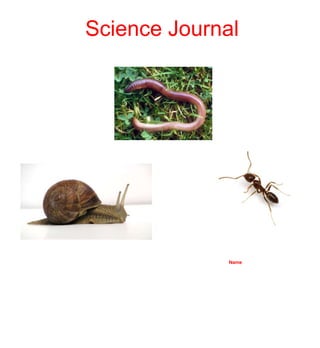
Science Journal


              Name
What do I know?
Students brainstorm and record their prior knowledge of minibeasts.
In Our Schoolyard.
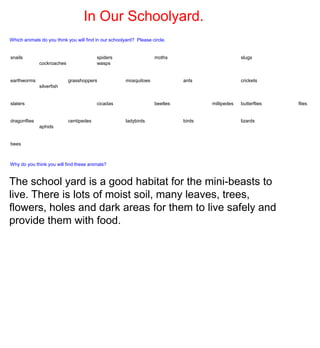
Which animals do you think you will find in our schoolyard? Please circle.


snails                                   spiders                    moths                          slugs
              cockroaches                wasps


earthworms                  grasshoppers               mosquitoes             ants                 crickets
              silverfish


slaters                                  cicadas                    beetles           millipedes   butterflies   flies


dragonflies                 centipedes                 ladybirds              birds                lizards
              aphids


bees


Why do you think you will find these animals?


The school yard is a good habitat for the mini-beasts to
live. There is lots of moist soil, many leaves, trees,
flowers, holes and dark areas for them to live safely and
provide them with food.
In Our Schoolyard.
Which animals do you think you will find in our schoolyard? Please circle.


snails                                   spiders                    moths                          slugs
              cockroaches                wasps


earthworms                  grasshoppers               mosquitoes             ants                 crickets
              silverfish


slaters                                  cicadas                    beetles           millipedes   butterflies   flies


dragonflies                 centipedes                 ladybirds              birds                lizards
              aphids


bees


Why do you think you will find these animals?
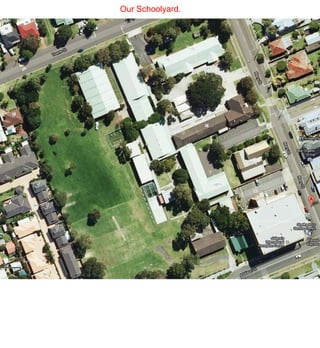
Scanned maps drawn by teams while on safari.
On the satellite map of our school yard, mark where you found each animal. Use a different coloured

mark for each different animal. Record your Legend.


                                                         LEGEND
Our Schoolyard.
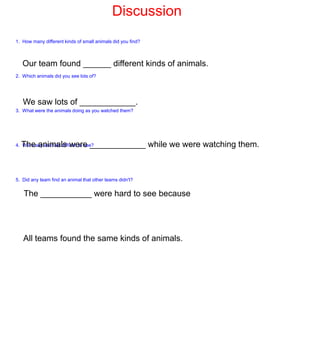
Discussion
1. How many different kinds of small animals did you find?


   Our team found ______ different kinds of animals.
2. Which animals did you see lots of?


   We saw lots of ____________.
3. What were the animals doing as you watched them?


  The animals were ____________ while we were watching them.
4. Were any animals difficult to see?


5. Did any team find an animal that other teams didn't?


   The ___________ were hard to see because


   All teams found the same kinds of animals.
Earthworms


Snails

             Ants
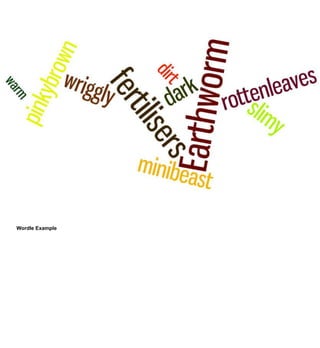
Wordle Example
Sketches:
Earthworm
Snail
Ant
before researching.
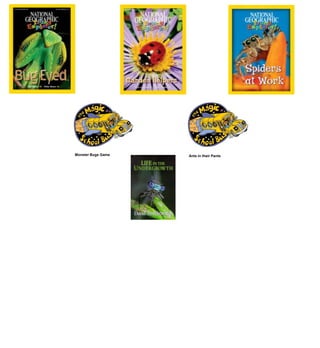
Monster Bugs Game   Ants in their Pants
Sketches:
Earthworm
Snail
Ant
after researching.
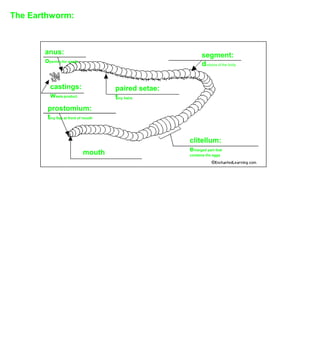
The Earthworm:


       anus:                                                segment:
       opening for waste                                    divisons of the body


         castings:                    paired setae:
         waste product                tiny hairs
        prostomium:
        tiny flap at front of mouth


                                                      clitellum:
                             mouth                    enlarged part that
                                                      contains the eggs
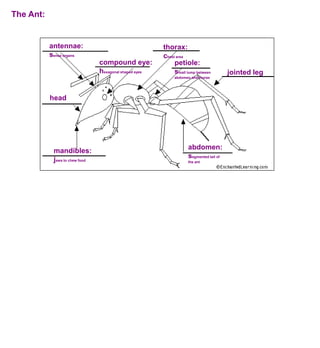
The Ant:


           antennae:                                    thorax:
           sense organs                                 chest area
                                compound eye:                petiole:
                                hexagonal shaped eyes        small lump between         jointed leg
                                                             abdomen and thorax


           head


                                                                    abdomen:
            mandibles:
                                                                    segmented tail of
            jaws to chew food                                       the ant
The Snail:
                                                   eyespots:
                                                   eyes at the tip
                                                   of the tentacles


       shell:
       hard spiral
       protective covering


                             foot:                head
                             soft muscular part
                             to help movement
Schoolyard safari ppt

Schoolyard safari ppt

  • 1.
  • 2.
    What do Iknow? Students brainstorm and record their prior knowledge of minibeasts.
  • 3.
    In Our Schoolyard. Whichanimals do you think you will find in our schoolyard? Please circle. snails spiders moths slugs cockroaches wasps earthworms grasshoppers mosquitoes ants crickets silverfish slaters cicadas beetles millipedes butterflies flies dragonflies centipedes ladybirds birds lizards aphids bees Why do you think you will find these animals? The school yard is a good habitat for the mini-beasts to live. There is lots of moist soil, many leaves, trees, flowers, holes and dark areas for them to live safely and provide them with food.
  • 4.
    In Our Schoolyard. Whichanimals do you think you will find in our schoolyard? Please circle. snails spiders moths slugs cockroaches wasps earthworms grasshoppers mosquitoes ants crickets silverfish slaters cicadas beetles millipedes butterflies flies dragonflies centipedes ladybirds birds lizards aphids bees Why do you think you will find these animals?
  • 6.
    Scanned maps drawnby teams while on safari.
  • 7.
    On the satellitemap of our school yard, mark where you found each animal. Use a different coloured mark for each different animal. Record your Legend. LEGEND
  • 8.
  • 9.
    Discussion 1. How manydifferent kinds of small animals did you find? Our team found ______ different kinds of animals. 2. Which animals did you see lots of? We saw lots of ____________. 3. What were the animals doing as you watched them? The animals were ____________ while we were watching them. 4. Were any animals difficult to see? 5. Did any team find an animal that other teams didn't? The ___________ were hard to see because All teams found the same kinds of animals.
  • 10.
  • 11.
  • 12.
  • 13.
    Monster Bugs Game Ants in their Pants
  • 14.
  • 15.
    The Earthworm: anus: segment: opening for waste divisons of the body castings: paired setae: waste product tiny hairs prostomium: tiny flap at front of mouth clitellum: mouth enlarged part that contains the eggs
  • 16.
    The Ant: antennae: thorax: sense organs chest area compound eye: petiole: hexagonal shaped eyes small lump between jointed leg abdomen and thorax head abdomen: mandibles: segmented tail of jaws to chew food the ant
  • 17.
    The Snail: eyespots: eyes at the tip of the tentacles shell: hard spiral protective covering foot: head soft muscular part to help movement