Presentation Title
Speaker’s name
Presentation title
Speaker’s name
"Scaling Up" Housing
First in Canada
Cameron Keller
President, Kaleidoscope Training
and Consulting
Former National Vice President, Programs
and Priorities with Mental Health
Commission of Canada
Outline
• Project findings and outcomes
• Inter-sectoral collaboration
• Integrated Knowledge Translation
• What are we doing now?
• Sustainability strategy
• Scaling up and scaling out
• Results: The story
• Critical influences
• Final summary of lessons learned
At Home/Chez Soi: Participants
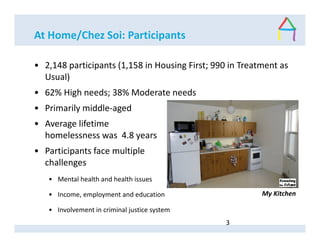
• 2,148 participants (1,158 in Housing First; 990 in Treatment as
Usual)
• 62% High needs; 38% Moderate needs
• Primarily middle-aged
• Average lifetime
homelessness was 4.8 years
• Participants face multiple
challenges
• Mental health and health issues
• Income, employment and education
• Involvement in criminal justice system
3
My Kitchen
Key Findings
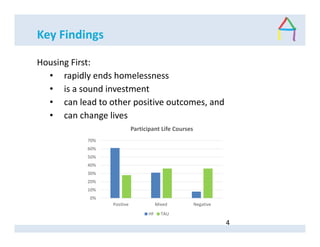
Housing First:
• rapidly ends homelessness
• is a sound investment
• can lead to other positive outcomes, and
• can change lives
0%
10%
20%
30%
40%
50%
60%
70%
Positive Mixed Negative
Participant Life Courses
HF TAU
4
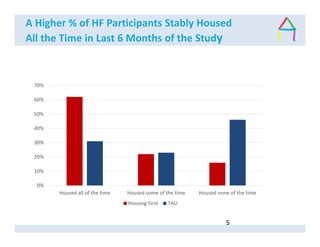
A Higher % of HF Participants Stably Housed
All the Time in Last 6 Months of the Study
0%
10%
20%
30%
40%
50%
60%
70%
Housed all of the time Housed some of the time Housed none of the time
Housing First TAU
5
Social and Health Outcome Findings
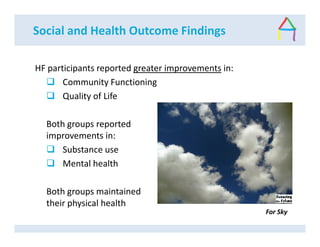
HF participants reported greater improvements in:
Community Functioning
Quality of Life
Both groups reported
improvements in:
Substance use
Mental health
Both groups maintained
their physical health
For Sky
Economic benefits
7
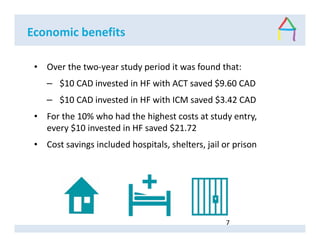
• Over the two-year study period it was found that:
– $10 CAD invested in HF with ACT saved $9.60 CAD
– $10 CAD invested in HF with ICM saved $3.42 CAD
• For the 10% who had the highest costs at study entry,
every $10 invested in HF saved $21.72
• Cost savings included hospitals, shelters, jail or prison
Summary of Key Findings
1. Housing First is doable in Canadian cities
2. Fidelity to a Housing First model is essential
3. Housing First can rapidly end homeless
4. Housing First produces other positive outcomes
5. Housing First makes good use of public dollars
6. A small minority of individuals present with additional
needs and fail to settle in HF
8
Need for Inter-Sectoral Collaboration
“evidence of effectiveness alone is rarely enough to ensure
adoption of interventions” (Leff & Muklern, 2002)
• Housing First is a system intervention – multiple components
and sectors
• Relationships are key
• Need to do things differently, foster collaboration
• Support learning together
• Importance of a local change
agent/facilitator
• Consider long-term sustainability
and system change
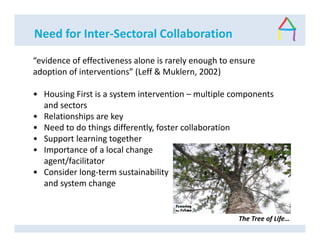
The Tree of Life…
Inter-Sectoral Collaboration – What we learned
• Common goal and expert facilitation keeps
process on track when conflicts arise
• All players have to be willing to
collaborate, compromise and tolerate
ambiguity
• It takes time (and patience) to convince
skeptics and build trust
• PWLE involvement was KEY
“At its core, the process of bringing an
intervention to the public is in some
part a matter of social conflict and
construction.” Bell, 1998
10
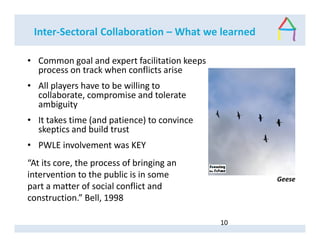
Geese
What Happened After the At Home / Chez Soi
(AHCS) Research Demonstration Project ?
• Model evidence-based programs sometimes
• cease to exist after the demonstration phase
• have little impact on policy
• are not widely adopted in new settings
• Creating a “research-practice gap”
• Which has led to the development of Integrated
Knowledge Translation (IKT) to reduce this gap
Goals of Integrated Knowledge
Translation in AHCS
• Sustainability – support the sustainability of AHCS
programs
• Contribute to International Awareness of
research findings about implementation and
outcomes of Housing First (HF)
• Scaling Up (Westley et al., 2014) – transform
policy and practice for people who are homeless
and living with mental health issues
• Scaling Out – expand HF to other settings in
Canada
Integrated Knowledge Translation
“Evidence of effectiveness alone is rarely enough to ensure
adoption of interventions” (Leff & Mulkern, 2002)
• IKT involves ongoing exchange and linkage with decision-
makers
• IKT requires allegiance to research and participatory
principles
• Research requires orderly, phased process of scientific
investigation
• Participation requires that the interests and values of
various groups in public systems be reflected
Key Strategies for Integrated Knowledge
Translation During the Demonstration Project
Build HF literacy and competency in the field – creation of
on-line Canadian Housing First Toolkit; National Film Board
production of Here at Home
Ensure broad engagement in AHCS HF implementation and
findings – Interim Findings and Final Report
Build national linkages to address homelessness and
affordable housing issues – National Working Group
Involve Persons with Lived Experience throughout the
process
Key Strategies for Integrated Knowledge
Translation During the Demonstration Project
National and Site Sustainability Committees
Assistance from Government Relations Committee of the
Mental Health Commission of Canada (MHCC)
Comprehensive briefings of government of Canada,
including the Prime Minister’s Office, and the provincial
governments that hosted the 5 AHCS sites
Framing the “ask” as one year of transitional funding from
the federal government
What are we doing Now?
• Since At Home/Chez Soi there has been increased HF adoption
across Canada
• In April 2014, the Federal government invested $600million
to renew it’s Homelessness Partnering Strategy towards HF
• Other provinces and territories have shifted towards HF
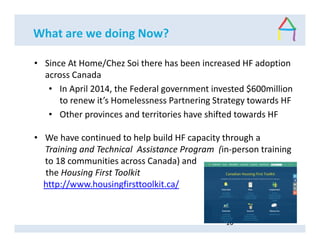
• We have continued to help build HF capacity through a
Training and Technical Assistance Program (in-person training
to 18 communities across Canada) and
the Housing First Toolkit
http://www.housingfirsttoolkit.ca/
16
What are we doing Now?
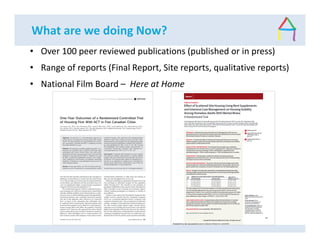
• Over 100 peer reviewed publications (published or in press)
• Range of reports (Final Report, Site reports, qualitative reports)
• National Film Board – Here at Home
At Home/Chez Soi Sustainability Strategy
“Think about sustainability from Day 1”
Did we have a strategy? Not so much…
Adopt Integrated Knowledge Translation approach
Engaging researchers in various stages of research process
National Working Group
Site Advisory Committees
Engagement increases relevance and buy-in to results
Understanding Sustainability of the Initiative
Site level: sustainability of services
Federal level:
ensuring “safe landing” of project
policy impact of AH/CS at federal level
Homeless Partnering Strategy – HPS
An opportunity to examine specific research
questions:
What strategies contributed to federal-level sustainability?
What was the role of the the key stakeholders in the this process?
In general, how do research results make their away into policy?
Discussion: Conceptual Implications
Policy streams theory:
Convergence of Problems, Policy Ideas, and Politics
Problem: what to do about At Home/Chez Soi? (HF works but
people may lose housing)
Policy Idea: shift Homelessness Partnering Stream towards
Housing First
Politics: framing of findings; having powerful allies, both
external and internal to gov’t
Scaling Up
Timing is everything…
A window of opportunity for policy change opens up with the
federal government review of its Homelessness Partnering
Strategy (HPS) program whose funding term expires in 2014
In the March, 2013 federal budget, the Canadian government
renews and repurposes HPS, calling for a shift in funding to HF
Big 10 Canadian communities, which receive 80% of HPS
funding, are to allocate 65% of funding to HF
The 51 smaller communities and Aboriginal communities are
to allocate 40% to HF
$600 million is allocated for the 5-year renewal, 2014-19
Scaling Out HF Across Canada
Training and Technical Assistance (TTA) – MHCC
commits funding to a 3-year project (2013-16)
HF founder, Dr. Sam Tsemberis, hired to lead the TTA
18 Canadian communities received training that included:
An initial training in the basics of HF for a wide range of community
stakeholders in housing, mental health, justice, etc.
A second training that focused on HF skills and was aimed at HF
teams
A fidelity assessment to determine the degree to which programs
adhered to HF principles; used for self-improvement
Telephone consultation
Results: The Story
The context: impending end of AH/CS project
The emotional climate: stress, uncertainty and urgency
The challenge: how to ensure “safe landing” before final
results in context where no single point of accountability for
homelessness
The key players: AH/CS leadership; MHCC GR; Senator Kirby;
government decision-makers, champions and go-betweens
• The strategy: Integrated KT; interim report; brief up and
down; federally & provincially; access key insiders
Results: The Story
Some Key events/turning points:
Jan 2011: establishing Sustainability Task Force
May 2011: Federal Election
Aug 2011: learning that feds wouldn’t continue funding beyond end of
project
Dec 2011: MHCC decision to get GR department involved
New Year 2012: draft interim results become available
“Full-court press” briefings begin, positive turning points include:
Post-election 2011 : briefing of Diane Finley, federal Minister responsible for homelessness
Spring 2012: advice from PMO staff (former HRSDC political staffer):
“don’t give me a project that’s going to require additional investment
in homelessness, give me a project that reforms government spending in an
inefficient existing program ”
Results: The Story
The resolution:
June 2012: Senator Kirby meets with provincial Deputy Ministers
August 14 2012: letter from provinces proposing bi-lateral agreement
August 14, 2012: bringing senior PMO staff on side
August & beyond: closing the loop with Finance & HRSDC
(homelessness)
October 2012 (in camera) cabinet decision to renew HPS mandate
Fall 2012: bi-lateral transitional $ negotiated between feds &
provinces
March 2013: HPS policy shift publically announced in budget
– “[the budget announcement] to me that was one of the most stunning
demonstrations of translational impact of at that point were still
interim findings.”
Critical Influences
The importance of the AHCS findings
Framing: the importance of how the results
were communicated
The focus on cost-effectiveness
Broad resonance of framing within the current political
context
The value of researcher/decision-maker
relationships
Ownership over the results motivation to move results
forward advice about how to present the findings
Timing
Critical Influences
Key individuals who act as go-betweens
mediating/translating between knowledge producers
and decision-makers
Key organizations
Mental Health Commission of Canada
• Canadian Alliance to End Homelessness and other aligned
organizations
Lessons Learned
What worked well?
Avoid shaming
More than 2/3 of the programs continued
Overall, good fidelity to the Housing First model
Research findings were important for sustaining programs
Ongoing IKT and sustainability conversations with local, provincial,
and national stakeholders
Sustainability worked well when it was aligned with local and
provincial policy
Leadership and local partnerships for Housing First were important
There is a need for ongoing training and technical assistance
Seizing the window of opportunity to shape policy change
A lot of patience

Scaling up Housing First in Canada

  • 1.
    Presentation Title Speaker’s name Presentationtitle Speaker’s name "Scaling Up" Housing First in Canada Cameron Keller President, Kaleidoscope Training and Consulting Former National Vice President, Programs and Priorities with Mental Health Commission of Canada
  • 2.
    Outline • Project findingsand outcomes • Inter-sectoral collaboration • Integrated Knowledge Translation • What are we doing now? • Sustainability strategy • Scaling up and scaling out • Results: The story • Critical influences • Final summary of lessons learned
  • 3.
    At Home/Chez Soi:Participants • 2,148 participants (1,158 in Housing First; 990 in Treatment as Usual) • 62% High needs; 38% Moderate needs • Primarily middle-aged • Average lifetime homelessness was 4.8 years • Participants face multiple challenges • Mental health and health issues • Income, employment and education • Involvement in criminal justice system 3 My Kitchen
  • 4.
    Key Findings Housing First: •rapidly ends homelessness • is a sound investment • can lead to other positive outcomes, and • can change lives 0% 10% 20% 30% 40% 50% 60% 70% Positive Mixed Negative Participant Life Courses HF TAU 4
  • 5.
    A Higher %of HF Participants Stably Housed All the Time in Last 6 Months of the Study 0% 10% 20% 30% 40% 50% 60% 70% Housed all of the time Housed some of the time Housed none of the time Housing First TAU 5
  • 6.
    Social and HealthOutcome Findings HF participants reported greater improvements in: Community Functioning Quality of Life Both groups reported improvements in: Substance use Mental health Both groups maintained their physical health For Sky
  • 7.
    Economic benefits 7 • Overthe two-year study period it was found that: – $10 CAD invested in HF with ACT saved $9.60 CAD – $10 CAD invested in HF with ICM saved $3.42 CAD • For the 10% who had the highest costs at study entry, every $10 invested in HF saved $21.72 • Cost savings included hospitals, shelters, jail or prison
  • 8.
    Summary of KeyFindings 1. Housing First is doable in Canadian cities 2. Fidelity to a Housing First model is essential 3. Housing First can rapidly end homeless 4. Housing First produces other positive outcomes 5. Housing First makes good use of public dollars 6. A small minority of individuals present with additional needs and fail to settle in HF 8
  • 9.
    Need for Inter-SectoralCollaboration “evidence of effectiveness alone is rarely enough to ensure adoption of interventions” (Leff & Muklern, 2002) • Housing First is a system intervention – multiple components and sectors • Relationships are key • Need to do things differently, foster collaboration • Support learning together • Importance of a local change agent/facilitator • Consider long-term sustainability and system change The Tree of Life…
  • 10.
    Inter-Sectoral Collaboration –What we learned • Common goal and expert facilitation keeps process on track when conflicts arise • All players have to be willing to collaborate, compromise and tolerate ambiguity • It takes time (and patience) to convince skeptics and build trust • PWLE involvement was KEY “At its core, the process of bringing an intervention to the public is in some part a matter of social conflict and construction.” Bell, 1998 10 Geese
  • 11.
    What Happened Afterthe At Home / Chez Soi (AHCS) Research Demonstration Project ? • Model evidence-based programs sometimes • cease to exist after the demonstration phase • have little impact on policy • are not widely adopted in new settings • Creating a “research-practice gap” • Which has led to the development of Integrated Knowledge Translation (IKT) to reduce this gap
  • 12.
    Goals of IntegratedKnowledge Translation in AHCS • Sustainability – support the sustainability of AHCS programs • Contribute to International Awareness of research findings about implementation and outcomes of Housing First (HF) • Scaling Up (Westley et al., 2014) – transform policy and practice for people who are homeless and living with mental health issues • Scaling Out – expand HF to other settings in Canada
  • 13.
    Integrated Knowledge Translation “Evidenceof effectiveness alone is rarely enough to ensure adoption of interventions” (Leff & Mulkern, 2002) • IKT involves ongoing exchange and linkage with decision- makers • IKT requires allegiance to research and participatory principles • Research requires orderly, phased process of scientific investigation • Participation requires that the interests and values of various groups in public systems be reflected
  • 14.
    Key Strategies forIntegrated Knowledge Translation During the Demonstration Project Build HF literacy and competency in the field – creation of on-line Canadian Housing First Toolkit; National Film Board production of Here at Home Ensure broad engagement in AHCS HF implementation and findings – Interim Findings and Final Report Build national linkages to address homelessness and affordable housing issues – National Working Group Involve Persons with Lived Experience throughout the process
  • 15.
    Key Strategies forIntegrated Knowledge Translation During the Demonstration Project National and Site Sustainability Committees Assistance from Government Relations Committee of the Mental Health Commission of Canada (MHCC) Comprehensive briefings of government of Canada, including the Prime Minister’s Office, and the provincial governments that hosted the 5 AHCS sites Framing the “ask” as one year of transitional funding from the federal government
  • 16.
    What are wedoing Now? • Since At Home/Chez Soi there has been increased HF adoption across Canada • In April 2014, the Federal government invested $600million to renew it’s Homelessness Partnering Strategy towards HF • Other provinces and territories have shifted towards HF • We have continued to help build HF capacity through a Training and Technical Assistance Program (in-person training to 18 communities across Canada) and the Housing First Toolkit http://www.housingfirsttoolkit.ca/ 16
  • 17.
    What are wedoing Now? • Over 100 peer reviewed publications (published or in press) • Range of reports (Final Report, Site reports, qualitative reports) • National Film Board – Here at Home
  • 18.
    At Home/Chez SoiSustainability Strategy “Think about sustainability from Day 1” Did we have a strategy? Not so much… Adopt Integrated Knowledge Translation approach Engaging researchers in various stages of research process National Working Group Site Advisory Committees Engagement increases relevance and buy-in to results
  • 19.
    Understanding Sustainability ofthe Initiative Site level: sustainability of services Federal level: ensuring “safe landing” of project policy impact of AH/CS at federal level Homeless Partnering Strategy – HPS An opportunity to examine specific research questions: What strategies contributed to federal-level sustainability? What was the role of the the key stakeholders in the this process? In general, how do research results make their away into policy?
  • 20.
    Discussion: Conceptual Implications Policystreams theory: Convergence of Problems, Policy Ideas, and Politics Problem: what to do about At Home/Chez Soi? (HF works but people may lose housing) Policy Idea: shift Homelessness Partnering Stream towards Housing First Politics: framing of findings; having powerful allies, both external and internal to gov’t
  • 21.
    Scaling Up Timing iseverything… A window of opportunity for policy change opens up with the federal government review of its Homelessness Partnering Strategy (HPS) program whose funding term expires in 2014 In the March, 2013 federal budget, the Canadian government renews and repurposes HPS, calling for a shift in funding to HF Big 10 Canadian communities, which receive 80% of HPS funding, are to allocate 65% of funding to HF The 51 smaller communities and Aboriginal communities are to allocate 40% to HF $600 million is allocated for the 5-year renewal, 2014-19
  • 22.
    Scaling Out HFAcross Canada Training and Technical Assistance (TTA) – MHCC commits funding to a 3-year project (2013-16) HF founder, Dr. Sam Tsemberis, hired to lead the TTA 18 Canadian communities received training that included: An initial training in the basics of HF for a wide range of community stakeholders in housing, mental health, justice, etc. A second training that focused on HF skills and was aimed at HF teams A fidelity assessment to determine the degree to which programs adhered to HF principles; used for self-improvement Telephone consultation
  • 23.
    Results: The Story Thecontext: impending end of AH/CS project The emotional climate: stress, uncertainty and urgency The challenge: how to ensure “safe landing” before final results in context where no single point of accountability for homelessness The key players: AH/CS leadership; MHCC GR; Senator Kirby; government decision-makers, champions and go-betweens • The strategy: Integrated KT; interim report; brief up and down; federally & provincially; access key insiders
  • 24.
    Results: The Story SomeKey events/turning points: Jan 2011: establishing Sustainability Task Force May 2011: Federal Election Aug 2011: learning that feds wouldn’t continue funding beyond end of project Dec 2011: MHCC decision to get GR department involved New Year 2012: draft interim results become available “Full-court press” briefings begin, positive turning points include: Post-election 2011 : briefing of Diane Finley, federal Minister responsible for homelessness Spring 2012: advice from PMO staff (former HRSDC political staffer): “don’t give me a project that’s going to require additional investment in homelessness, give me a project that reforms government spending in an inefficient existing program ”
  • 25.
    Results: The Story Theresolution: June 2012: Senator Kirby meets with provincial Deputy Ministers August 14 2012: letter from provinces proposing bi-lateral agreement August 14, 2012: bringing senior PMO staff on side August & beyond: closing the loop with Finance & HRSDC (homelessness) October 2012 (in camera) cabinet decision to renew HPS mandate Fall 2012: bi-lateral transitional $ negotiated between feds & provinces March 2013: HPS policy shift publically announced in budget – “[the budget announcement] to me that was one of the most stunning demonstrations of translational impact of at that point were still interim findings.”
  • 26.
    Critical Influences The importanceof the AHCS findings Framing: the importance of how the results were communicated The focus on cost-effectiveness Broad resonance of framing within the current political context The value of researcher/decision-maker relationships Ownership over the results motivation to move results forward advice about how to present the findings Timing
  • 27.
    Critical Influences Key individualswho act as go-betweens mediating/translating between knowledge producers and decision-makers Key organizations Mental Health Commission of Canada • Canadian Alliance to End Homelessness and other aligned organizations
  • 28.
    Lessons Learned What workedwell? Avoid shaming More than 2/3 of the programs continued Overall, good fidelity to the Housing First model Research findings were important for sustaining programs Ongoing IKT and sustainability conversations with local, provincial, and national stakeholders Sustainability worked well when it was aligned with local and provincial policy Leadership and local partnerships for Housing First were important There is a need for ongoing training and technical assistance Seizing the window of opportunity to shape policy change A lot of patience