Scalatra	
  2.2	
  

NOVEMBER	
  2012	
  
2	


Short	
  introduc,on	
  
And	
  overview	
  of	
  	
  
New	
  features	
  
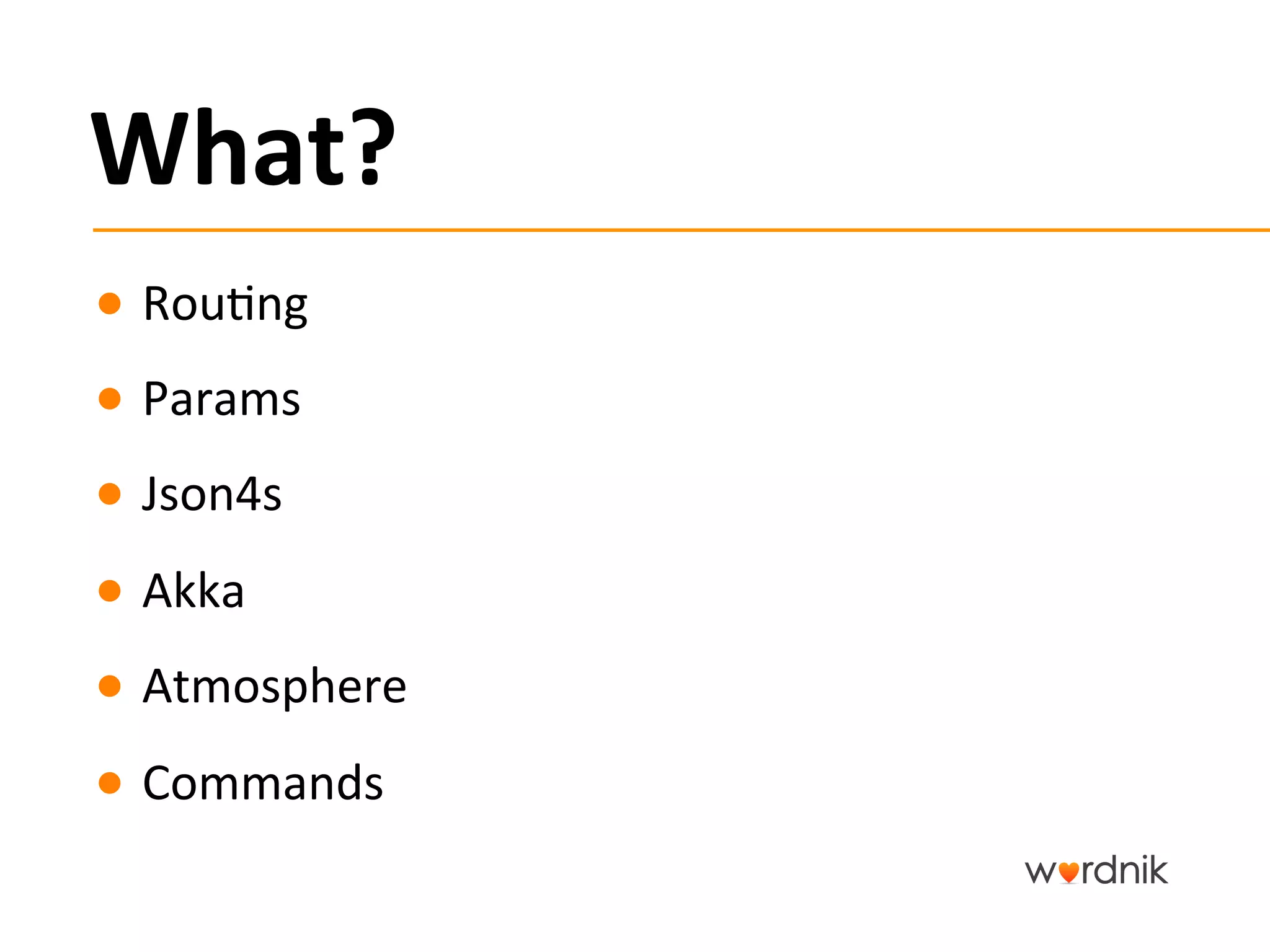
What?	
  
●  Rou5ng	
  
●  Params	
  
●  Json4s	
  
●  Akka	
  
●  Atmosphere	
  
●  Commands	
  
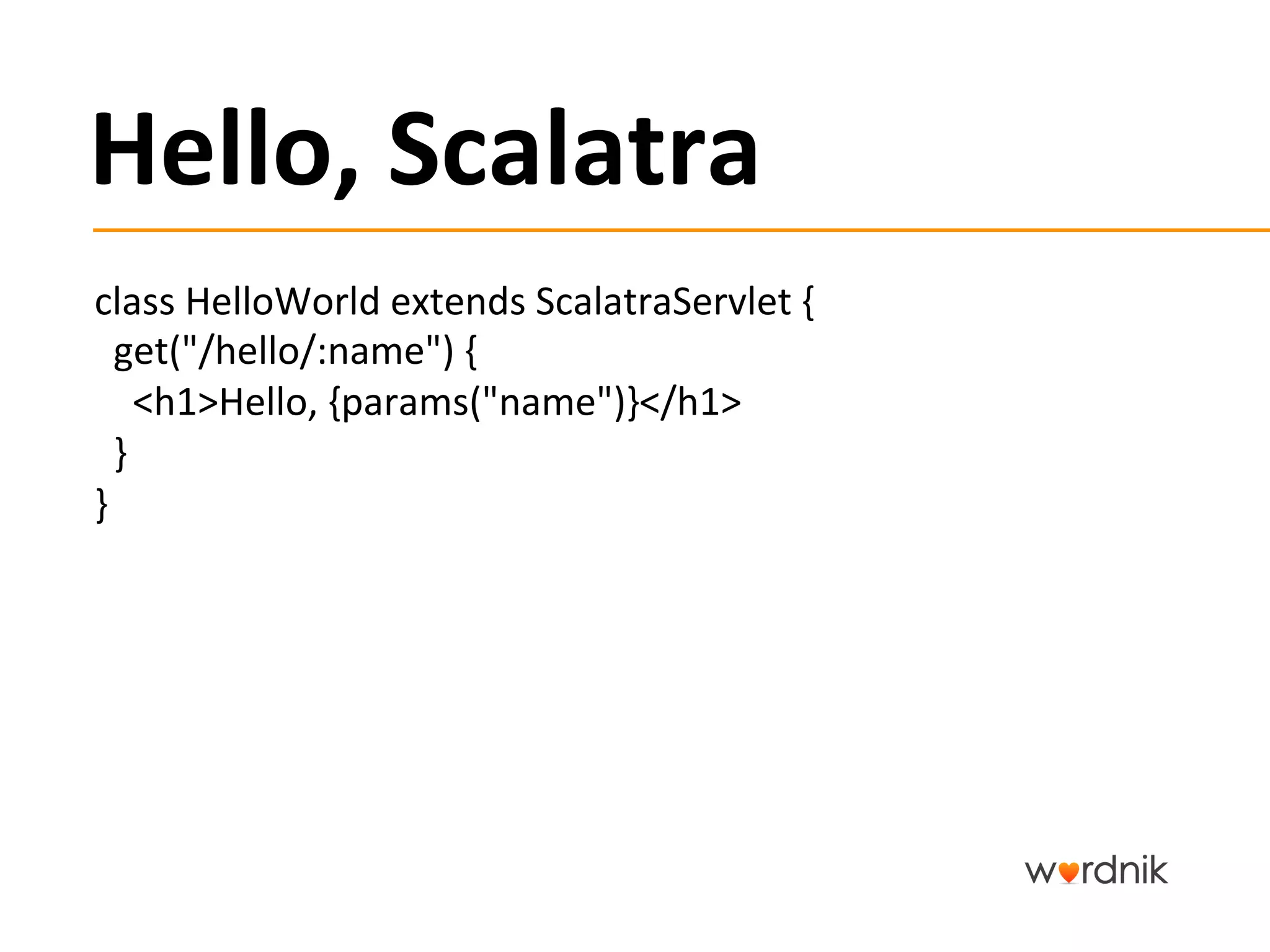
Hello,	
  Scalatra	
  
class	
  HelloWorld	
  extends	
  ScalatraServlet	
  {	


  get("/hello/:name")	
  {	


  <h1>Hello,	
  {params("name")}</h1>	


  }	
  
}	
  
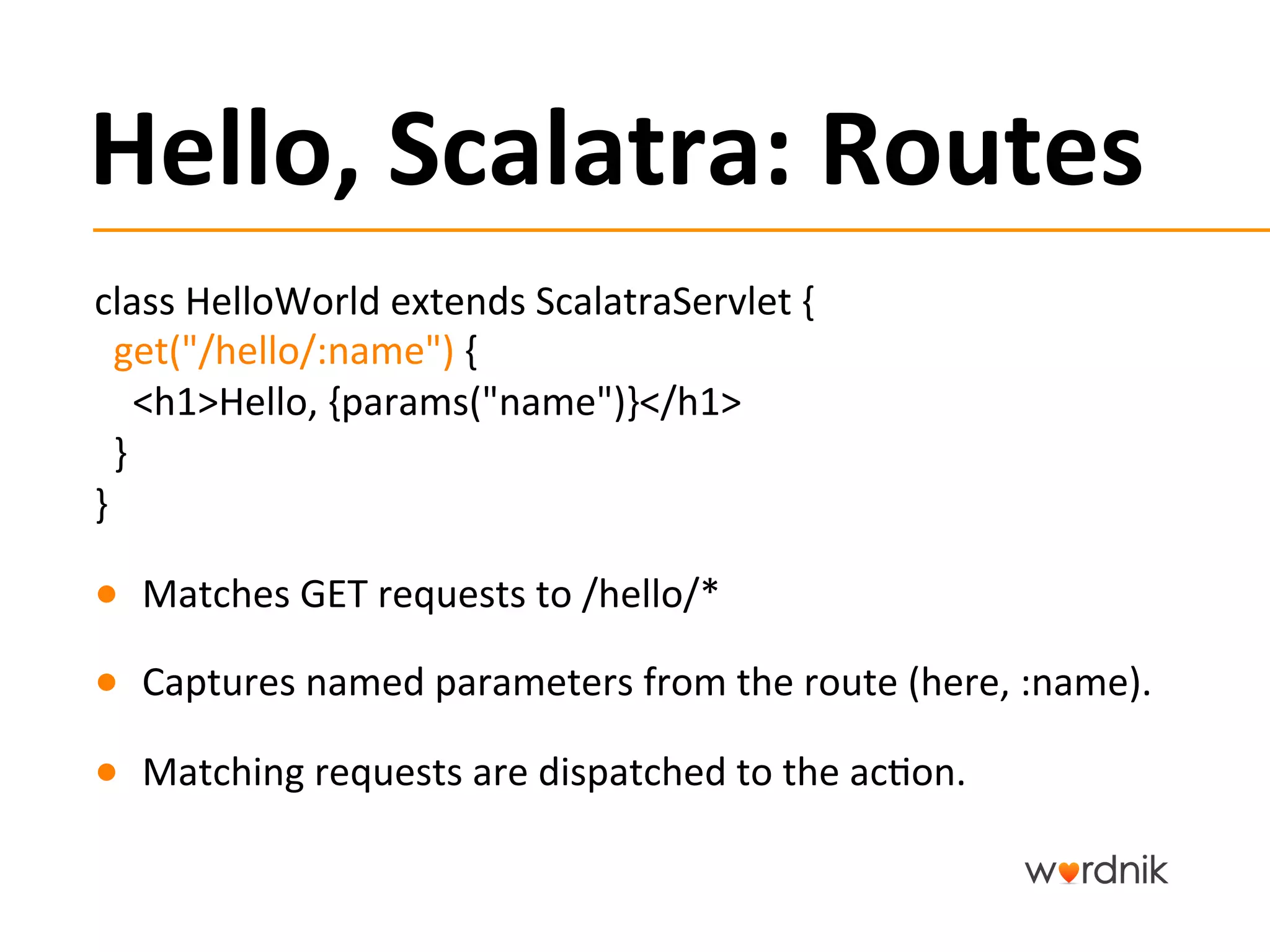
Hello,	
  Scalatra:	
  Routes	
  
class	
  HelloWorld	
  extends	
  ScalatraServlet	
  {	


  get("/hello/:name")	
  {	


  <h1>Hello,	
  {params("name")}</h1>	


  }	
  
}	
  

●  Matches	
  GET	
  requests	
  to	
  /hello/*	
  

●  Captures	
  named	
  parameters	
  from	
  the	
  route	
  (here,	
  :name).	
  

●  Matching	
  requests	
  are	
  dispatched	
  to	
  the	
  ac5on.	
  
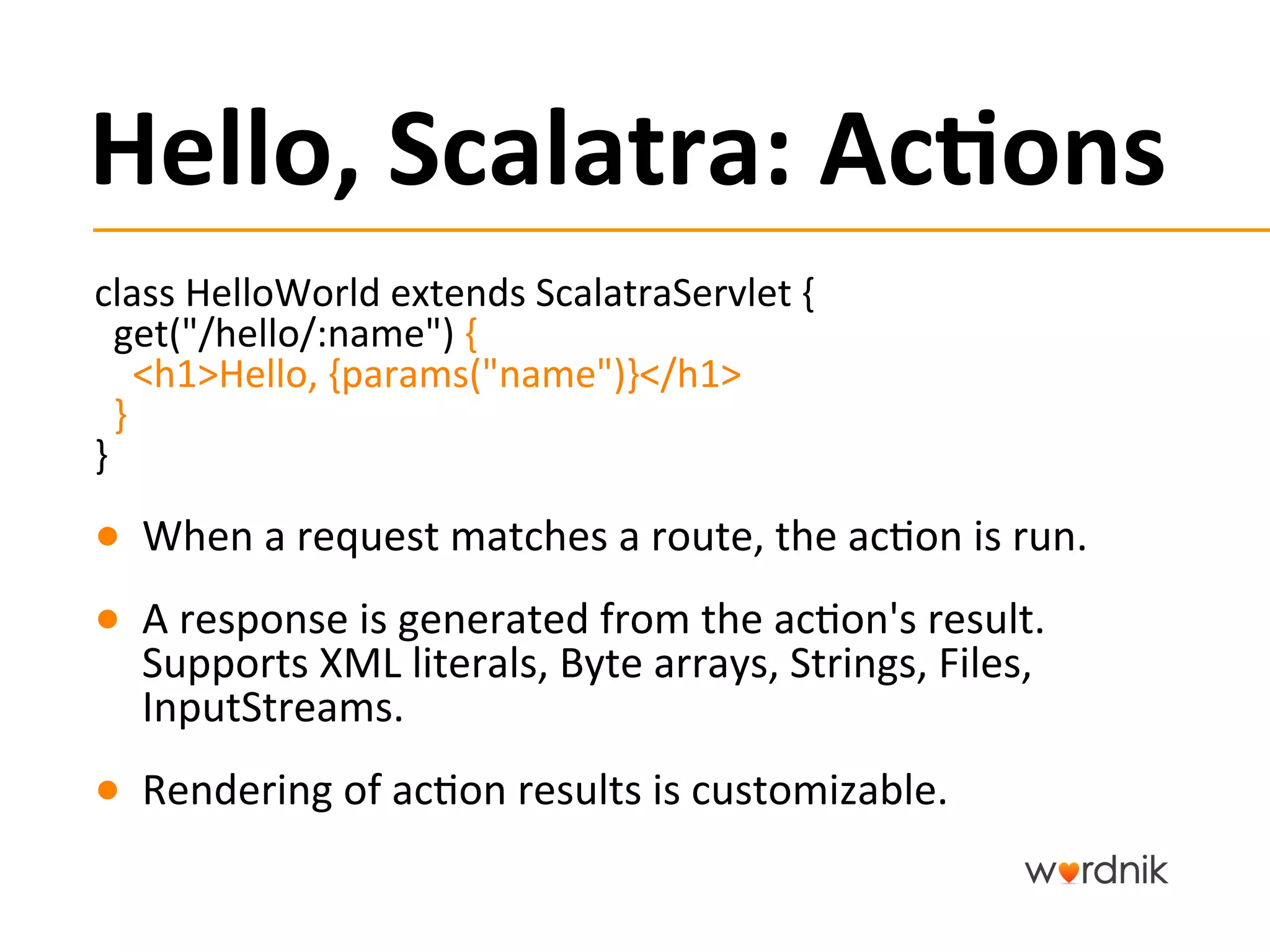
Hello,	
  Scalatra:	
  Ac,ons	
  
class	
  HelloWorld	
  extends	
  ScalatraServlet	
  {	


  get("/hello/:name")	
  {	


  <h1>Hello,	
  {params("name")}</h1>	


  }	
  
}	
  
●  When	
  a	
  request	
  matches	
  a	
  route,	
  the	
  ac5on	
  is	
  run.	
  
●  A	
  response	
  is	
  generated	
  from	
  the	
  ac5on's	
  result.	
  
   Supports	
  XML	
  literals,	
  Byte	
  arrays,	
  Strings,	
  Files,	
  
   InputStreams.	
  
●  Rendering	
  of	
  ac5on	
  results	
  is	
  customizable.	
  
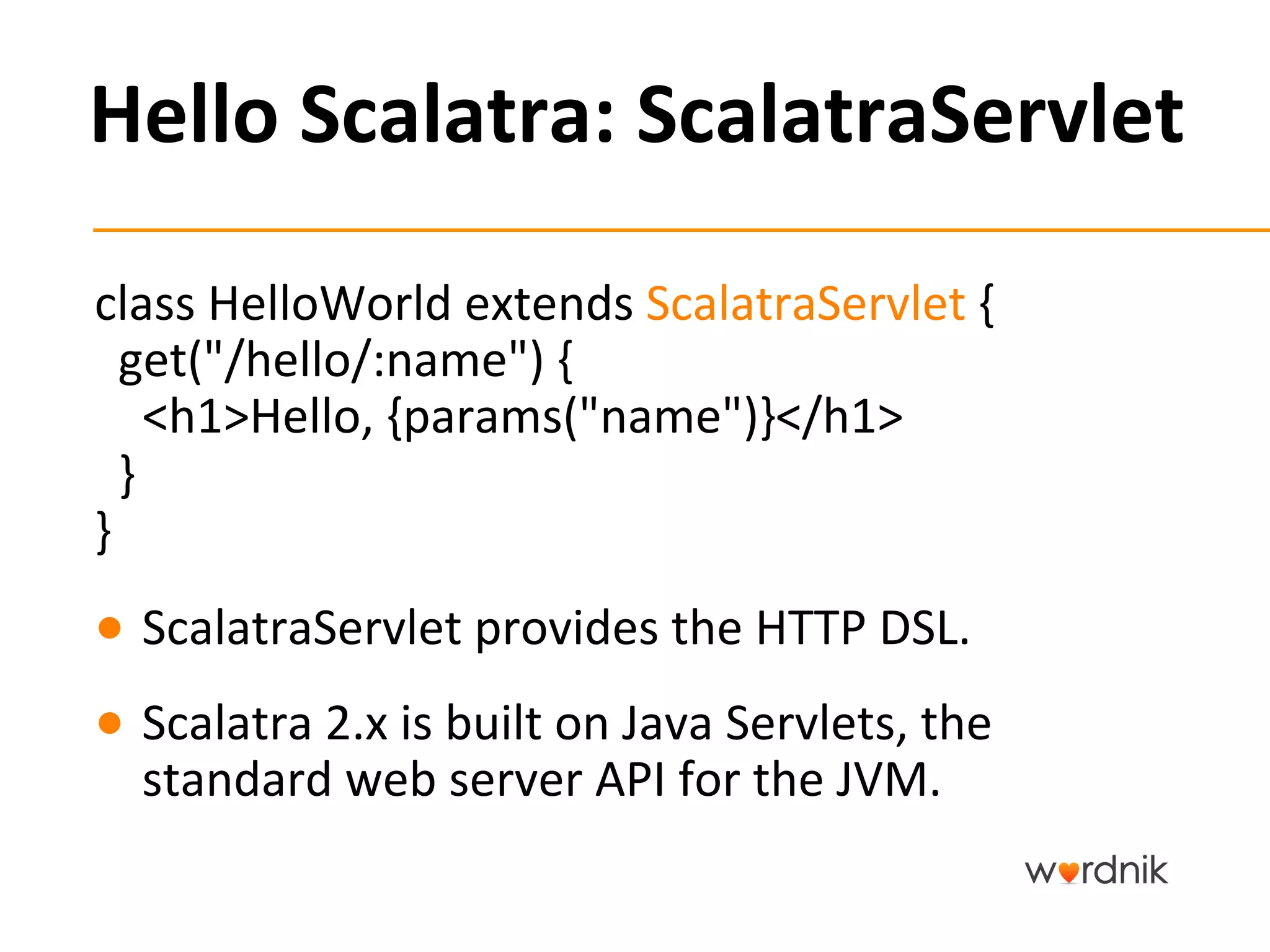
Hello	
  Scalatra:	
  ScalatraServlet	
  

class	
  HelloWorld	
  extends	
  ScalatraServlet	
  {	


  get("/hello/:name")	
  {	


  <h1>Hello,	
  {params("name")}</h1>	


  }	
  
}	
  
●  ScalatraServlet	
  provides	
  the	
  HTTP	
  DSL.	
  
●  Scalatra	
  2.x	
  is	
  built	
  on	
  Java	
  Servlets,	
  the	
  
   standard	
  web	
  server	
  API	
  for	
  the	
  JVM.	
  
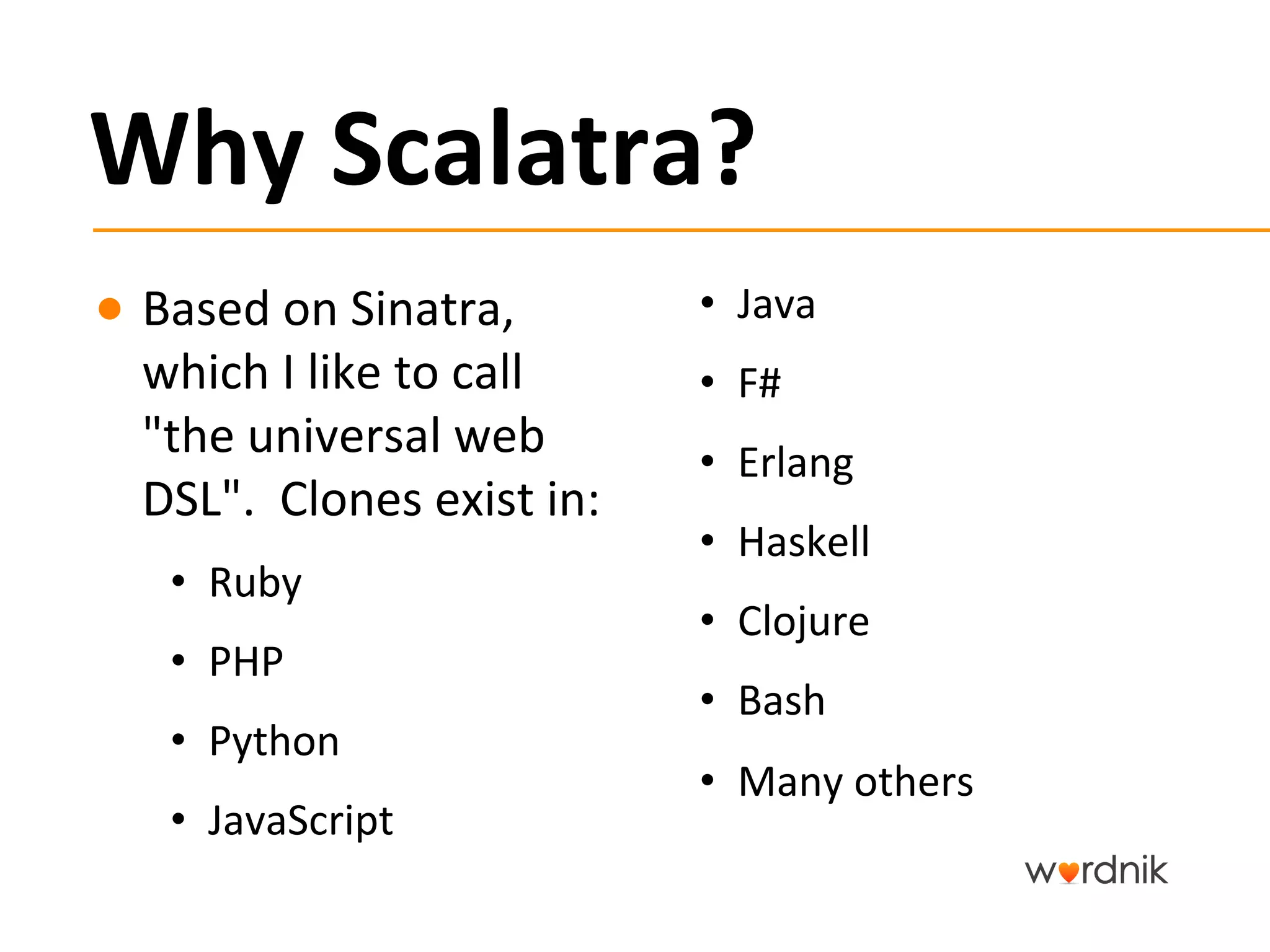
Why	
  Scalatra?	
  
●  Based	
  on	
  Sinatra,	
                 •  Java	
  
   which	
  I	
  like	
  to	
  call	
        •  F#	
  
   "the	
  universal	
  web	
                •  Erlang	
  
   DSL".	
  	
  Clones	
  exist	
  in:	
  
                                             •  Haskell	
  
      •  Ruby	
  
                                             •  Clojure	
  
      •  PHP	
  
                                             •  Bash	
  
      •  Python	
  
                                             •  Many	
  others	
  
      •  JavaScript	
  
Scalatra	
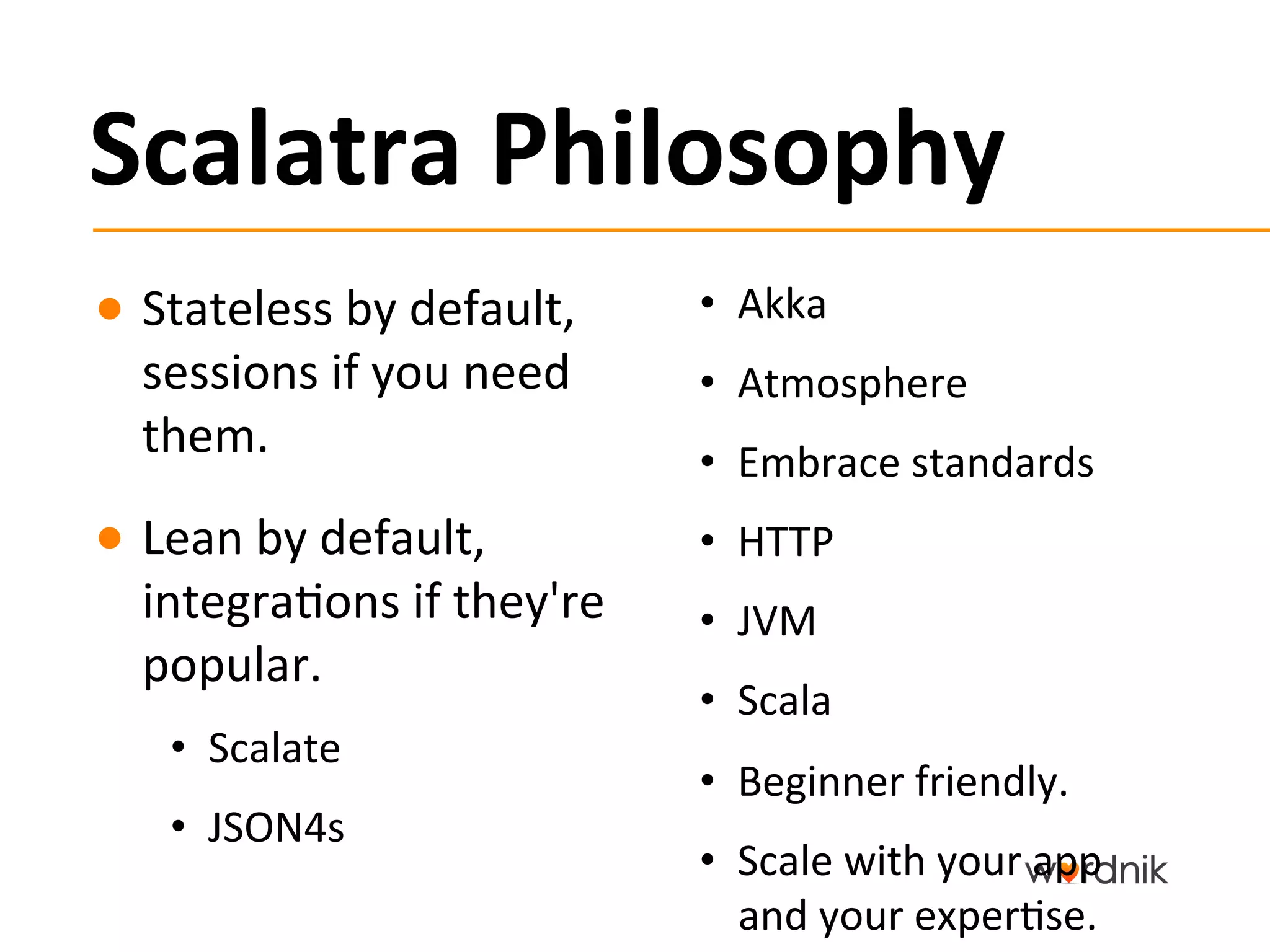
  Philosophy	
  
●  Stateless	
  by	
  default,	
       •  Akka	
  
   sessions	
  if	
  you	
  need	
     •  Atmosphere	
  
   them.	
                             •  Embrace	
  standards	
  
●  Lean	
  by	
  default,	
            •  HTTP	
  
   integra5ons	
  if	
  they're	
      •  JVM	
  
   popular.	
  
                                       •  Scala	
  
     •  Scalate	
  
                                       •  Beginner	
  friendly.	
  
     •  JSON4s	
  
                                       •  Scale	
  with	
  your	
  app	
  
                                          and	
  your	
  exper5se.	
  
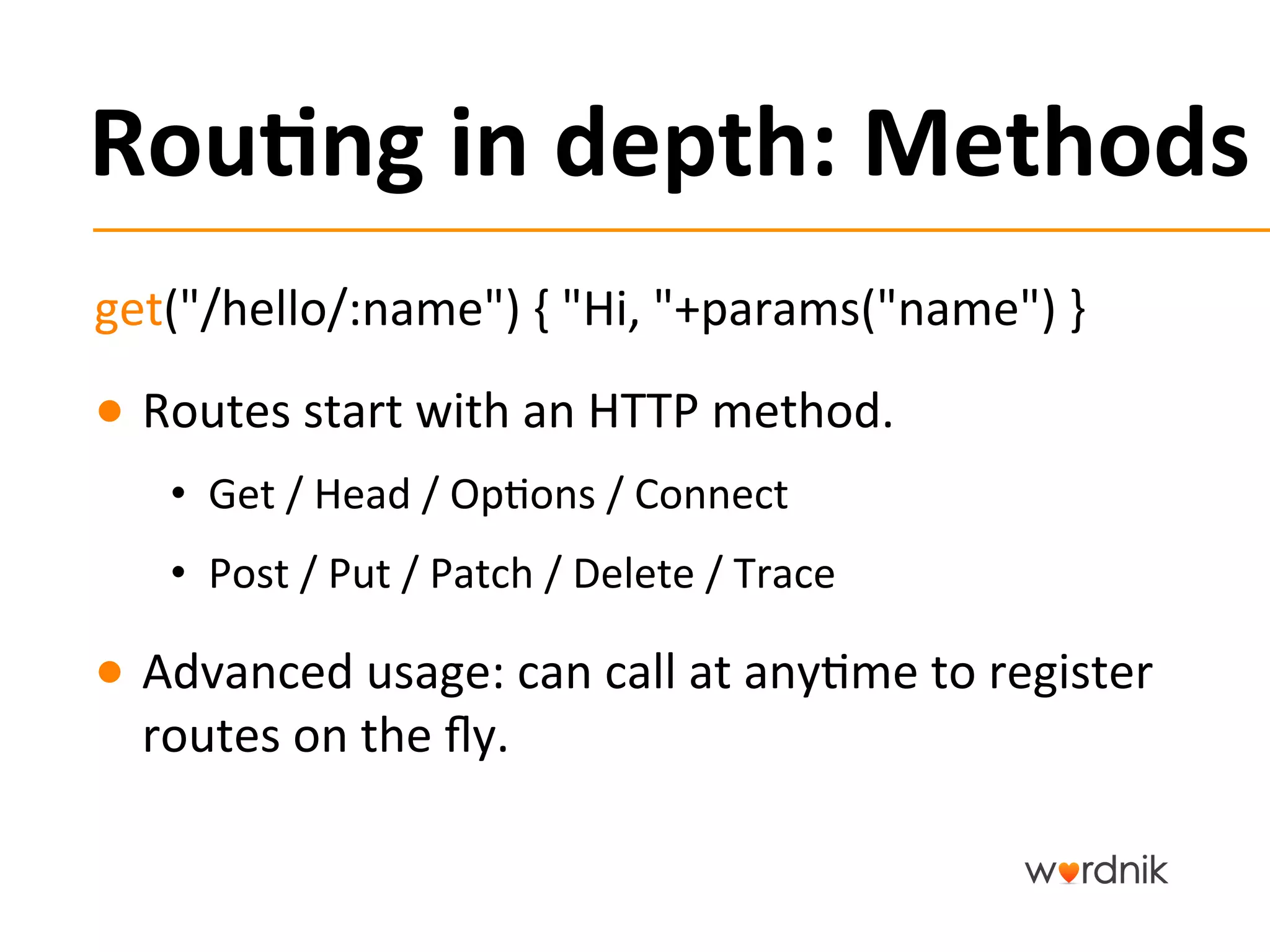
Rou,ng	
  in	
  depth:	
  Methods	
  
get("/hello/:name")	
  {	
  "Hi,	
  "+params("name")	
  }	
  
●  Routes	
  start	
  with	
  an	
  HTTP	
  method.	
  
     •  Get	
  /	
  Head	
  /	
  Op5ons	
  /	
  Connect	
  
     •  Post	
  /	
  Put	
  /	
  Patch	
  /	
  Delete	
  /	
  Trace	
  

●  Advanced	
  usage:	
  can	
  call	
  at	
  any5me	
  to	
  register	
  
   routes	
  on	
  the	
  fly.	
  
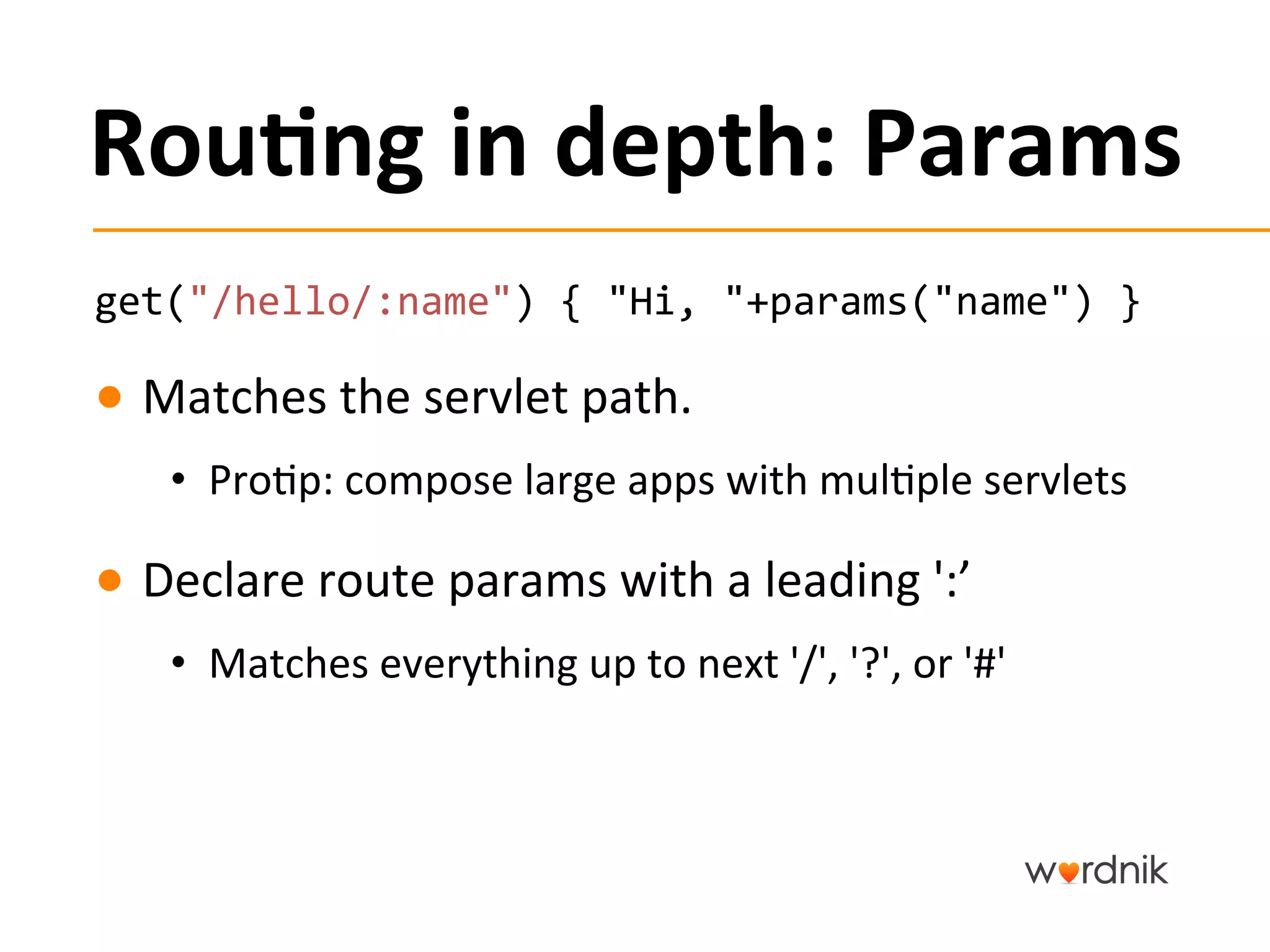
Rou,ng	
  in	
  depth:	
  Params	
  
get("/hello/:name")	
  {	
  "Hi,	
  "+params("name")	
  }	
  

●  Matches	
  the	
  servlet	
  path.	
  
     •  Pro5p:	
  compose	
  large	
  apps	
  with	
  mul5ple	
  servlets	
  

●  Declare	
  route	
  params	
  with	
  a	
  leading	
  ':’	
  
     •  Matches	
  everything	
  up	
  to	
  next	
  '/',	
  '?',	
  or	
  '#'	
  
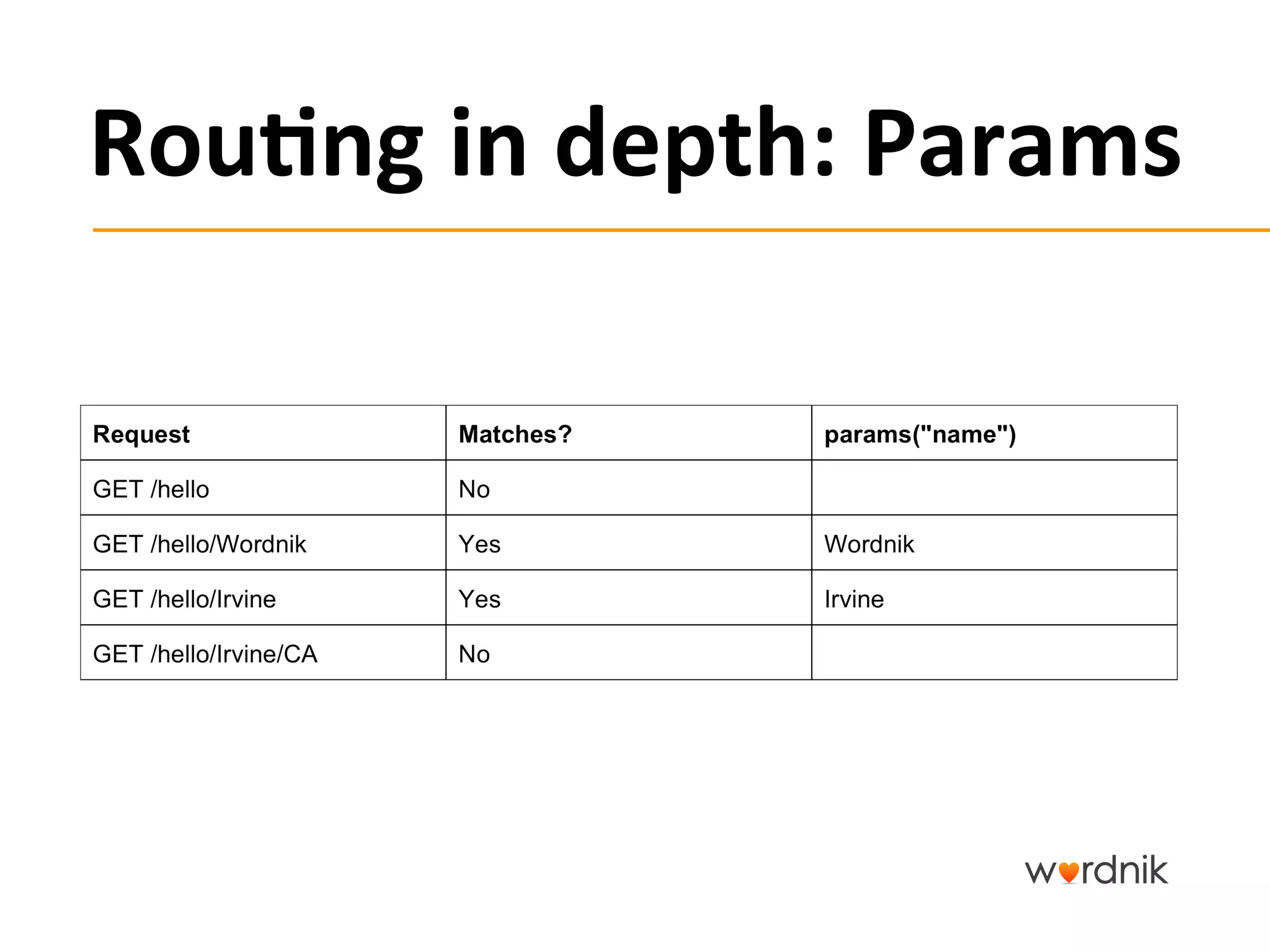
Rou,ng	
  in	
  depth:	
  Params	
  
Rou,ng	
  in	
  depth:	
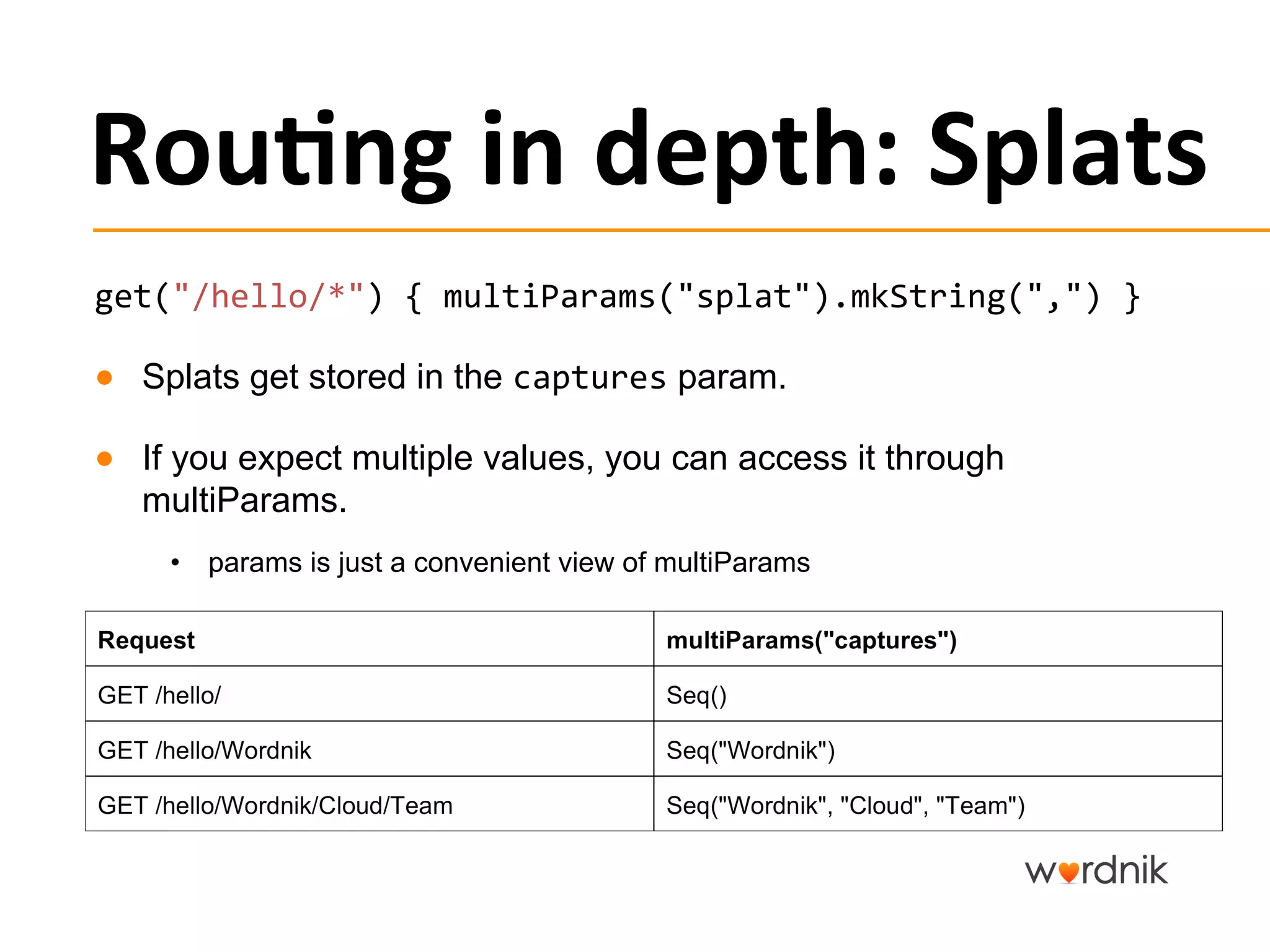
  Splats	
  
get("/hello/*")	
  {	
  multiParams("splat").mkString(",")	
  }	
  

●  Splats get stored in the captures param.

●  If you expect multiple values, you can access it through
   multiParams.
    •  params is just a convenient view of multiParams
Rou,ng	
  in	
  depth:	
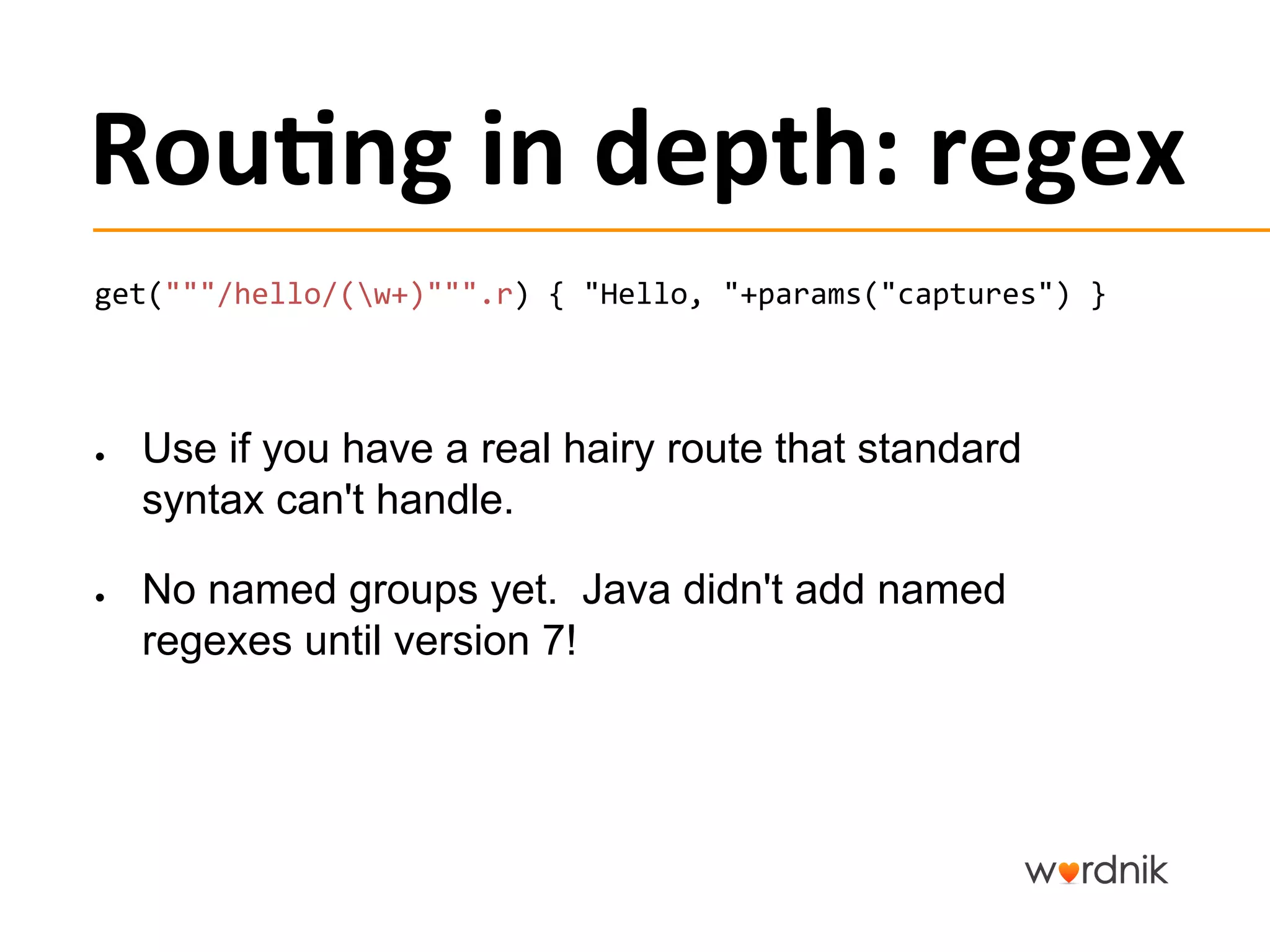
  regex	
  
get("""/hello/(w+)""".r)	
  {	
  "Hello,	
  "+params("captures")	
  }	


●      Use if you have a real hairy route that standard
       syntax can't handle.

●      No named groups yet. Java didn't add named
       regexes until version 7!
Rou,ng	
  in	
  depth:	
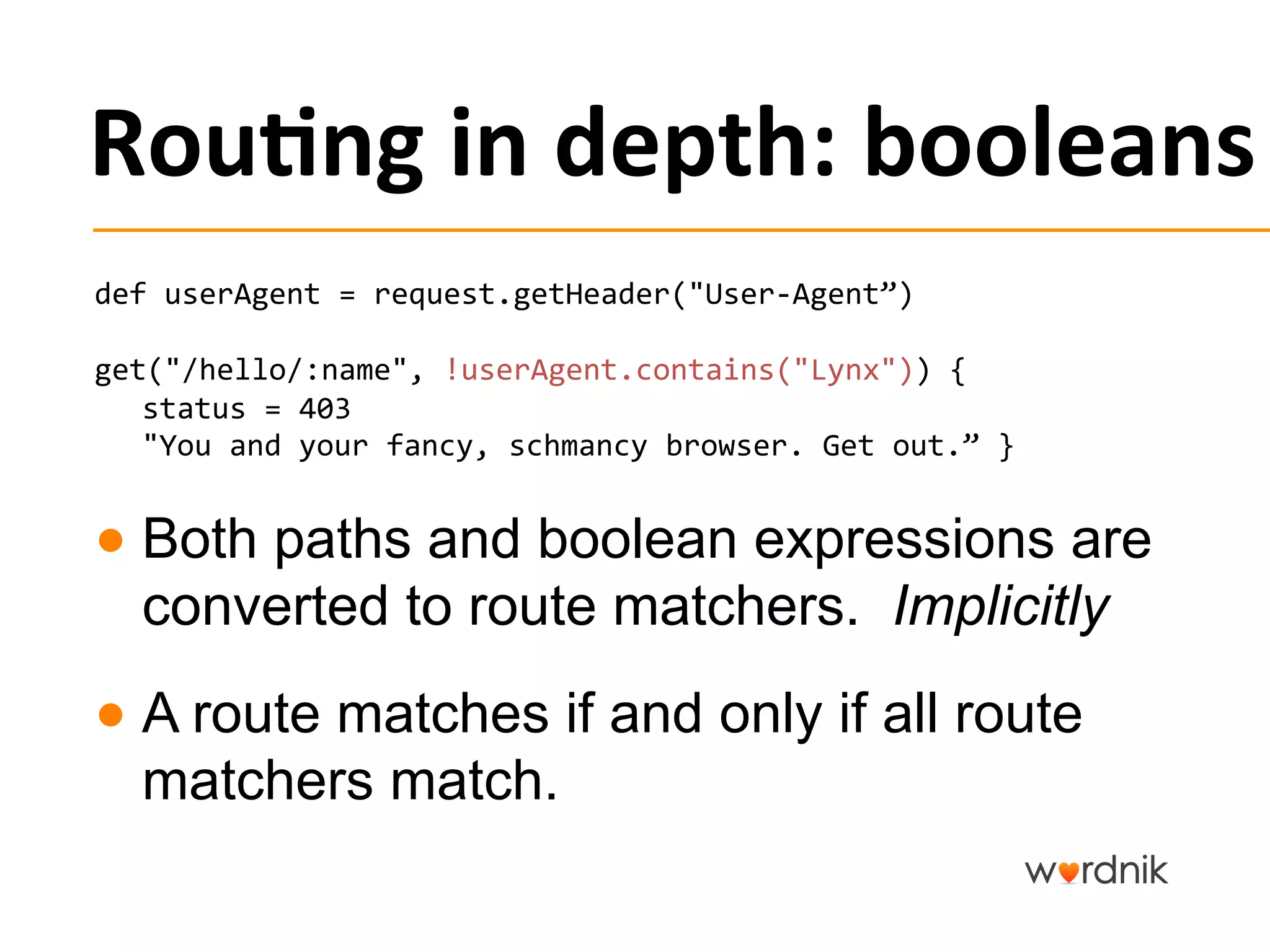
  booleans	
  
def	
  userAgent	
  =	
  request.getHeader("User-­‐Agent”)	
  

get("/hello/:name",	
  !userAgent.contains("Lynx"))	
  {	
  	
  
   status	
  =	
  403	
  
   "You	
  and	
  your	
  fancy,	
  schmancy	
  browser.	
  Get	
  out.”	
  }	


●  Both paths and boolean expressions are
   converted to route matchers. Implicitly
●  A route matches if and only if all route
   matchers match.
Ac,ons	
  in	
  depth:	
  return	
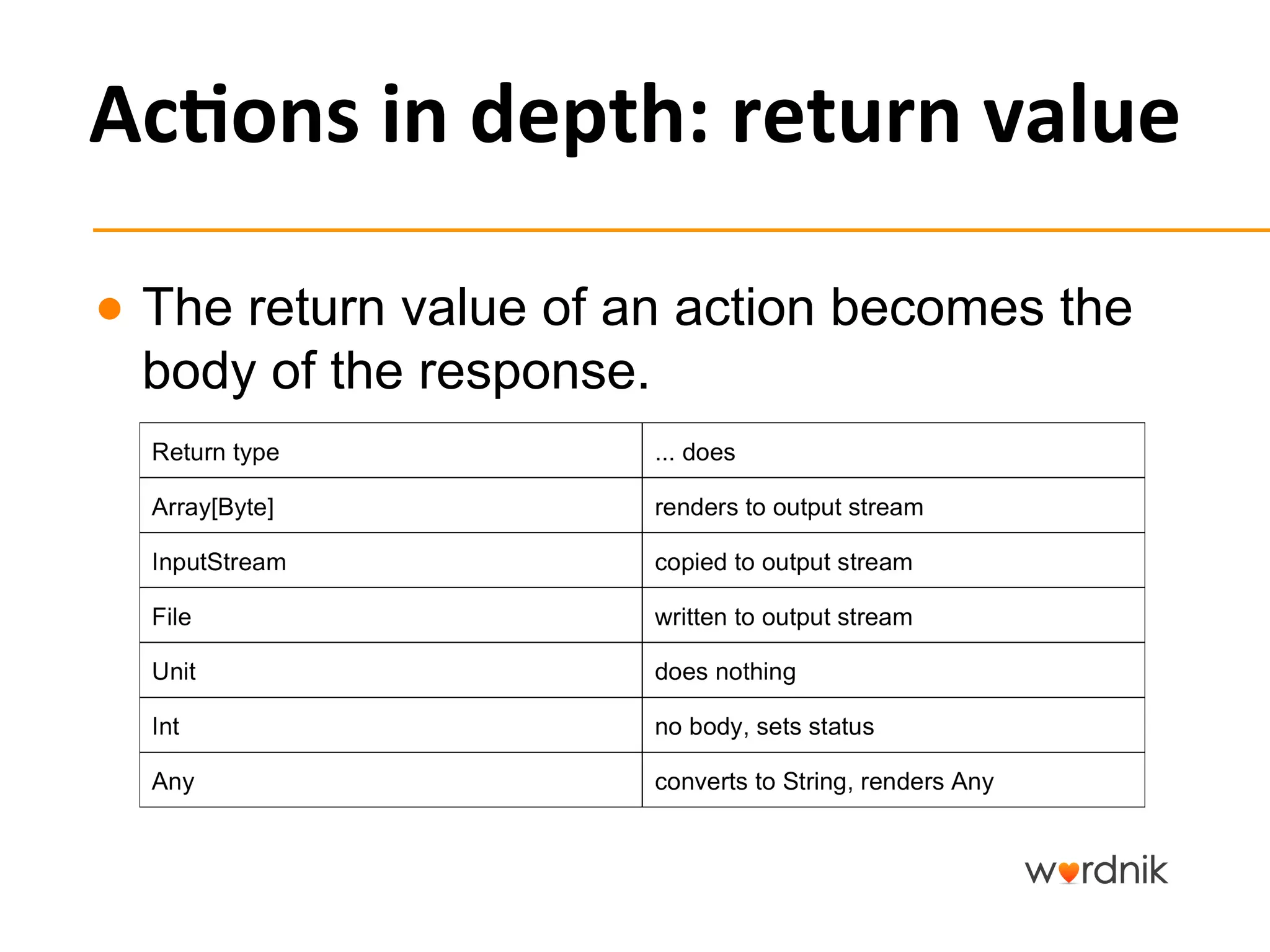
  value	
  

●  The return value of an action becomes the
   body of the response.
	
  
•  It's just a
                                        •  Override
Ac,ons	
  in	
  depth:	
  render	
  pipeline	


protected	
  def	
  renderPipeline:	
  RenderPipeline	
  =	
  {	


  case	
  bytes:	
  Array[Byte]	
  =>	


  response.outputStream.write(bytes)	


  case	
  is:	
  java.io.InputStream	
  =>	


  using(is)	
  {	
  util.io.copy(_,	
  response.outputStream)	
  }	
  
}	


●  It's just a partial function.
●  Override it. Use orElse to delegate to
   the default.
Ac,ons	
  in	
  depth:	
  mutable	
  
Ac,ons	
  in	
  depth:	
  mutable	
  
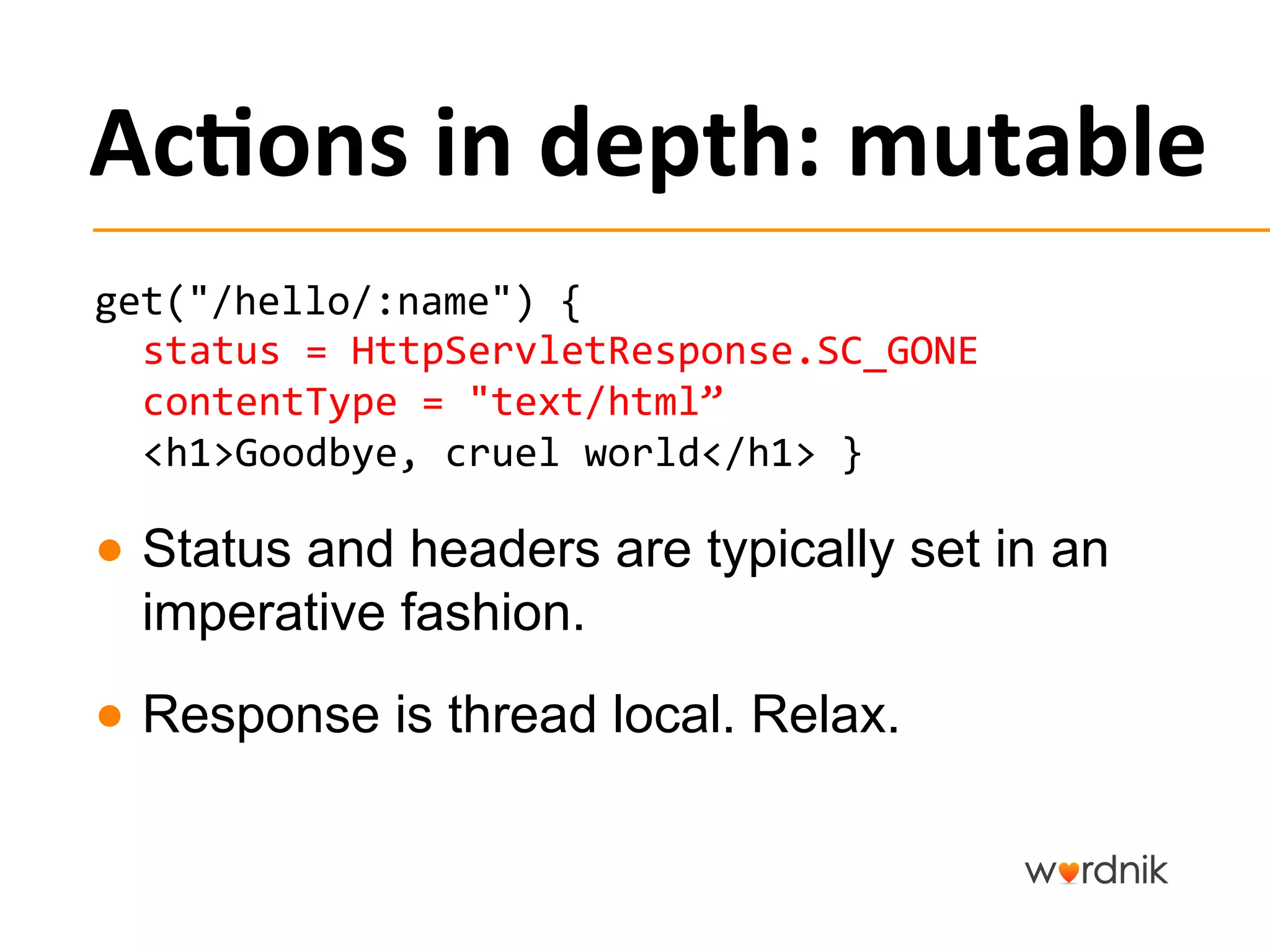
get("/hello/:name")	
  {	
  
  status	
  =	
  HttpServletResponse.SC_GONE	
  	
  
  contentType	
  =	
  "text/html”	
  
  <h1>Goodbye,	
  cruel	
  world</h1>	
  }	
  

●  Status and headers are typically set in an
   imperative fashion.	
  
●  Response is thread local. Relax.
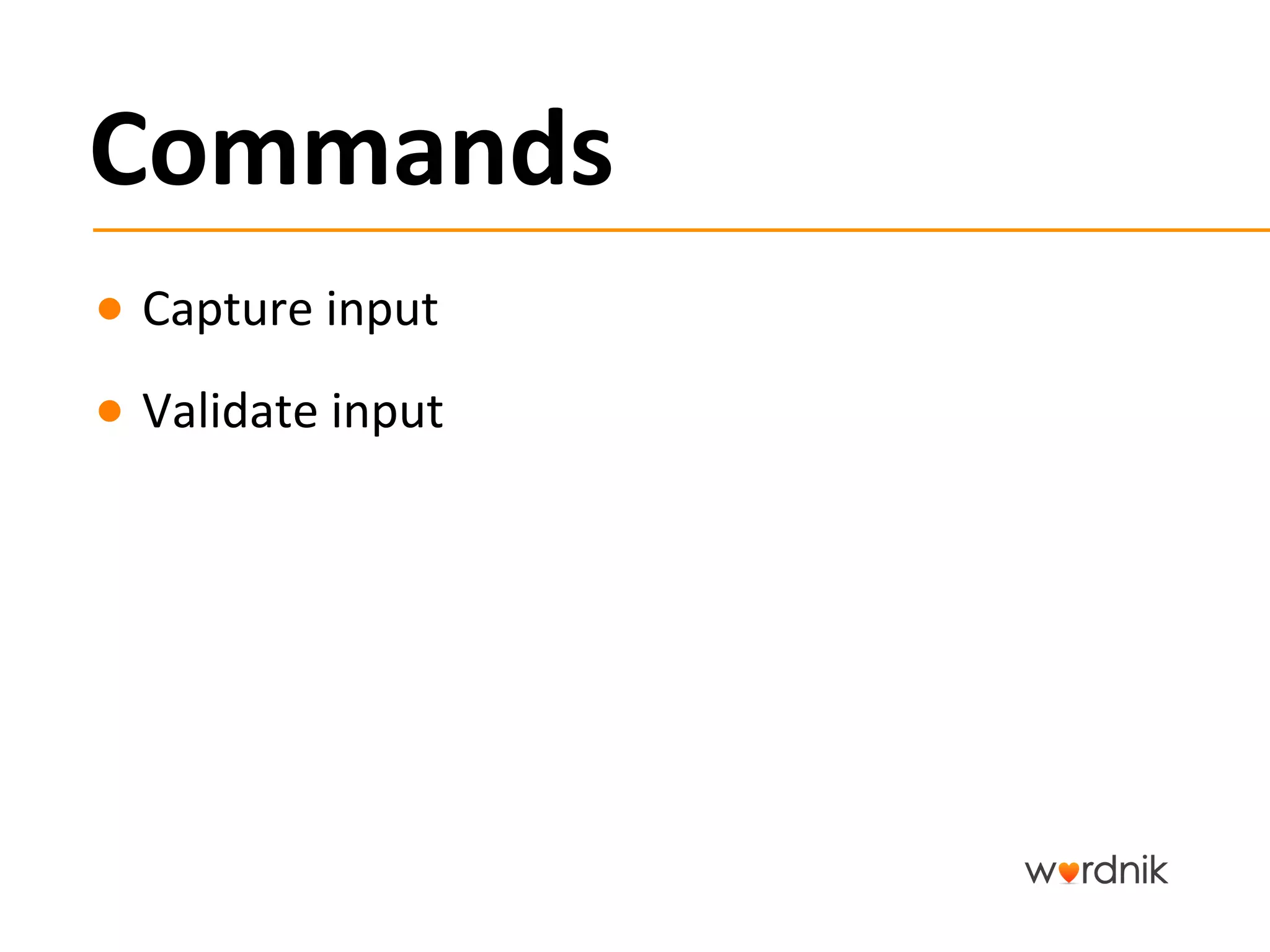
Commands	
  
●  Capture	
  input	
  
●  Validate	
  input	
  
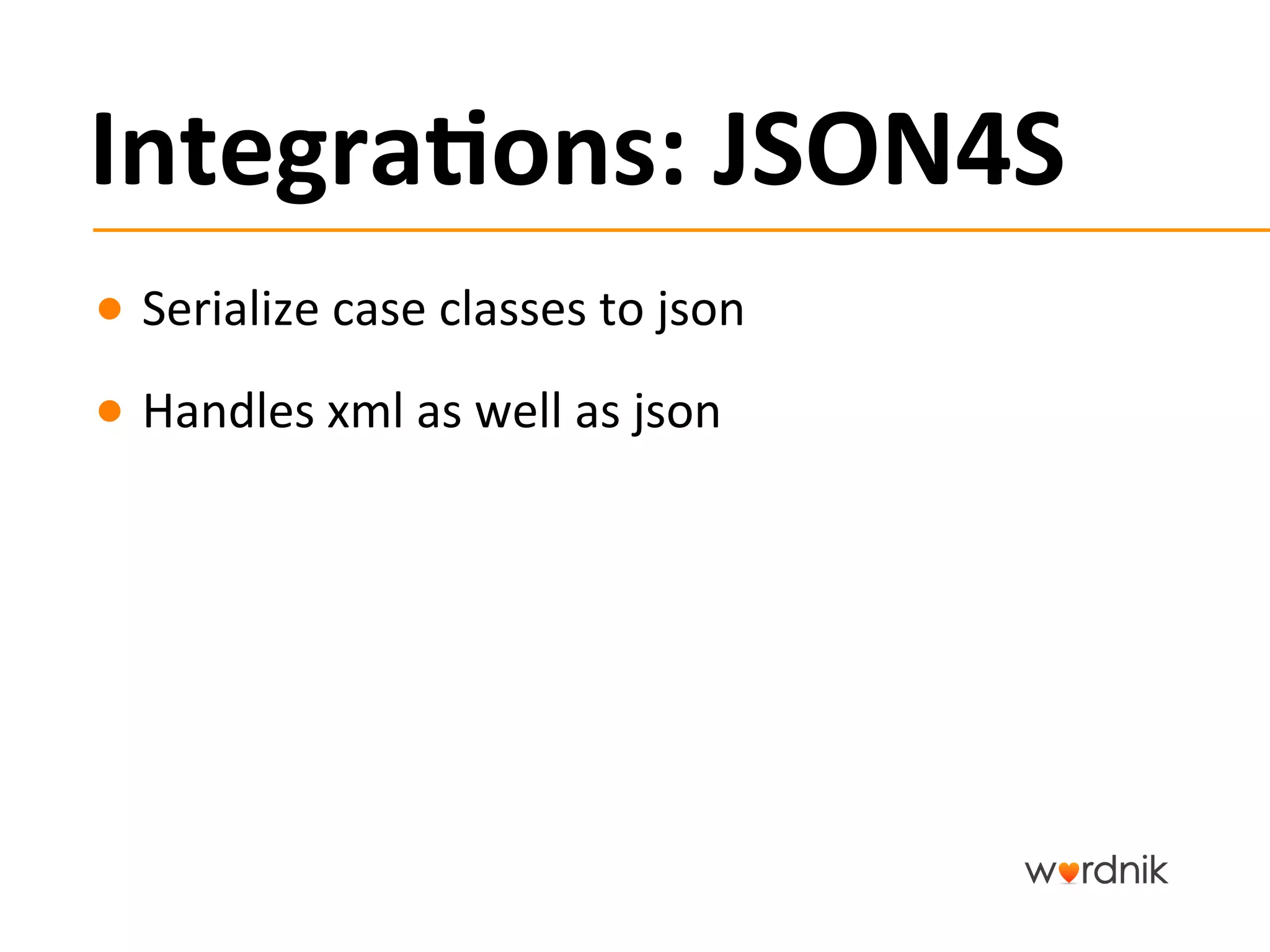
Integra,ons:	
  JSON4S	
  
●  Serialize	
  case	
  classes	
  to	
  json	
  
●  Handles	
  xml	
  as	
  well	
  as	
  json	
  
Integra,ons:	
  Akka	
  
●  Takes	
  advantage	
  of	
  servlet	
  3.0	
  async	
  support	
  
Integra,ons:	
  Atmosphere	
  
●  WebSocket	
  	
  
●  Server	
  side	
  events	
  
●  Like	
  socket.io	
  but	
  not	
  socket.io	
  

Scalatra 2.2

  • 1.
  • 2.
    2   Short  introduc,on   And  overview  of     New  features  
  • 3.
    What?   ●  Rou5ng   ●  Params   ●  Json4s   ●  Akka   ●  Atmosphere   ●  Commands  
  • 4.
    Hello,  Scalatra   class  HelloWorld  extends  ScalatraServlet  {          get("/hello/:name")  {          <h1>Hello,  {params("name")}</h1>      }   }  
  • 5.
    Hello,  Scalatra:  Routes   class  HelloWorld  extends  ScalatraServlet  {          get("/hello/:name")  {          <h1>Hello,  {params("name")}</h1>      }   }   ●  Matches  GET  requests  to  /hello/*   ●  Captures  named  parameters  from  the  route  (here,  :name).   ●  Matching  requests  are  dispatched  to  the  ac5on.  
  • 6.
    Hello,  Scalatra:  Ac,ons   class  HelloWorld  extends  ScalatraServlet  {          get("/hello/:name")  {          <h1>Hello,  {params("name")}</h1>      }   }   ●  When  a  request  matches  a  route,  the  ac5on  is  run.   ●  A  response  is  generated  from  the  ac5on's  result.   Supports  XML  literals,  Byte  arrays,  Strings,  Files,   InputStreams.   ●  Rendering  of  ac5on  results  is  customizable.  
  • 7.
    Hello  Scalatra:  ScalatraServlet   class  HelloWorld  extends  ScalatraServlet  {      get("/hello/:name")  {          <h1>Hello,  {params("name")}</h1>      }   }   ●  ScalatraServlet  provides  the  HTTP  DSL.   ●  Scalatra  2.x  is  built  on  Java  Servlets,  the   standard  web  server  API  for  the  JVM.  
  • 8.
    Why  Scalatra?   ● Based  on  Sinatra,   •  Java   which  I  like  to  call   •  F#   "the  universal  web   •  Erlang   DSL".    Clones  exist  in:   •  Haskell   •  Ruby   •  Clojure   •  PHP   •  Bash   •  Python   •  Many  others   •  JavaScript  
  • 9.
    Scalatra  Philosophy   ● Stateless  by  default,   •  Akka   sessions  if  you  need   •  Atmosphere   them.   •  Embrace  standards   ●  Lean  by  default,   •  HTTP   integra5ons  if  they're   •  JVM   popular.   •  Scala   •  Scalate   •  Beginner  friendly.   •  JSON4s   •  Scale  with  your  app   and  your  exper5se.  
  • 10.
    Rou,ng  in  depth:  Methods   get("/hello/:name")  {  "Hi,  "+params("name")  }   ●  Routes  start  with  an  HTTP  method.   •  Get  /  Head  /  Op5ons  /  Connect   •  Post  /  Put  /  Patch  /  Delete  /  Trace   ●  Advanced  usage:  can  call  at  any5me  to  register   routes  on  the  fly.  
  • 11.
    Rou,ng  in  depth:  Params   get("/hello/:name")  {  "Hi,  "+params("name")  }   ●  Matches  the  servlet  path.   •  Pro5p:  compose  large  apps  with  mul5ple  servlets   ●  Declare  route  params  with  a  leading  ':’   •  Matches  everything  up  to  next  '/',  '?',  or  '#'  
  • 12.
  • 13.
    Rou,ng  in  depth:  Splats   get("/hello/*")  {  multiParams("splat").mkString(",")  }   ●  Splats get stored in the captures param. ●  If you expect multiple values, you can access it through multiParams. •  params is just a convenient view of multiParams
  • 14.
    Rou,ng  in  depth:  regex   get("""/hello/(w+)""".r)  {  "Hello,  "+params("captures")  }     ●  Use if you have a real hairy route that standard syntax can't handle. ●  No named groups yet. Java didn't add named regexes until version 7!
  • 15.
    Rou,ng  in  depth:  booleans   def  userAgent  =  request.getHeader("User-­‐Agent”)   get("/hello/:name",  !userAgent.contains("Lynx"))  {     status  =  403   "You  and  your  fancy,  schmancy  browser.  Get  out.”  }   ●  Both paths and boolean expressions are converted to route matchers. Implicitly ●  A route matches if and only if all route matchers match.
  • 16.
    Ac,ons  in  depth:  return  value   ●  The return value of an action becomes the body of the response.  
  • 17.
    •  It's justa •  Override Ac,ons  in  depth:  render  pipeline   protected  def  renderPipeline:  RenderPipeline  =  {      case  bytes:  Array[Byte]  =>          response.outputStream.write(bytes)      case  is:  java.io.InputStream  =>          using(is)  {  util.io.copy(_,  response.outputStream)  }   } ●  It's just a partial function. ●  Override it. Use orElse to delegate to the default.
  • 18.
  • 19.
    Ac,ons  in  depth:  mutable   get("/hello/:name")  {   status  =  HttpServletResponse.SC_GONE     contentType  =  "text/html”   <h1>Goodbye,  cruel  world</h1>  }   ●  Status and headers are typically set in an imperative fashion.   ●  Response is thread local. Relax.
  • 20.
    Commands   ●  Capture  input   ●  Validate  input  
  • 21.
    Integra,ons:  JSON4S   ● Serialize  case  classes  to  json   ●  Handles  xml  as  well  as  json  
  • 22.
    Integra,ons:  Akka   ● Takes  advantage  of  servlet  3.0  async  support  
  • 23.
    Integra,ons:  Atmosphere   ● WebSocket     ●  Server  side  events   ●  Like  socket.io  but  not  socket.io