Demystifying
Shapeless
Jared Roesch
@roeschinc
https://github.com/jroesch
1
Who I am
2
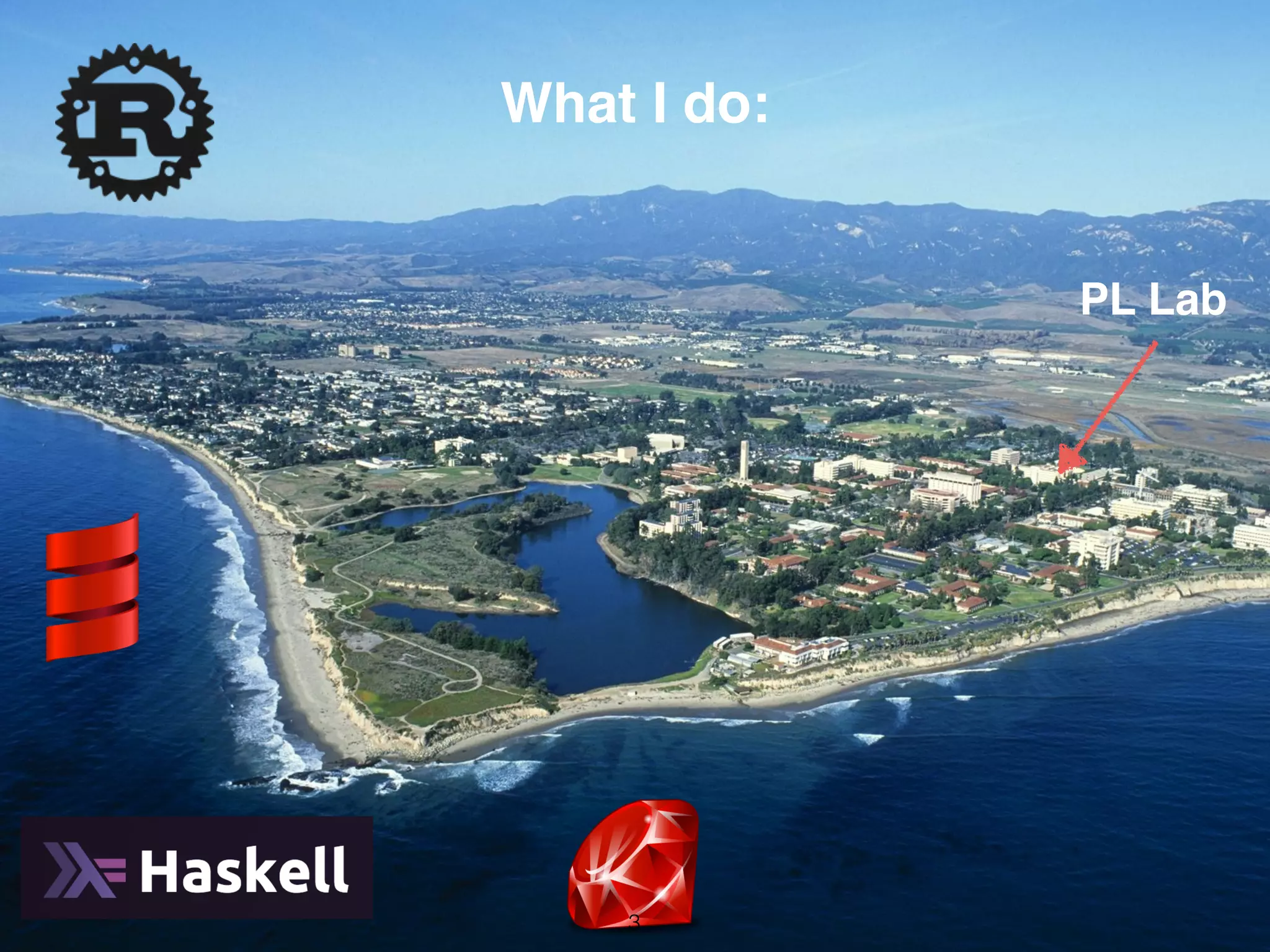
What I do:
PL Lab
3
What is Shapeless?
• https://github.com/milessabin/shapeless
• A library from Miles Sabin and co.
• A playground for advanced typed FP
4
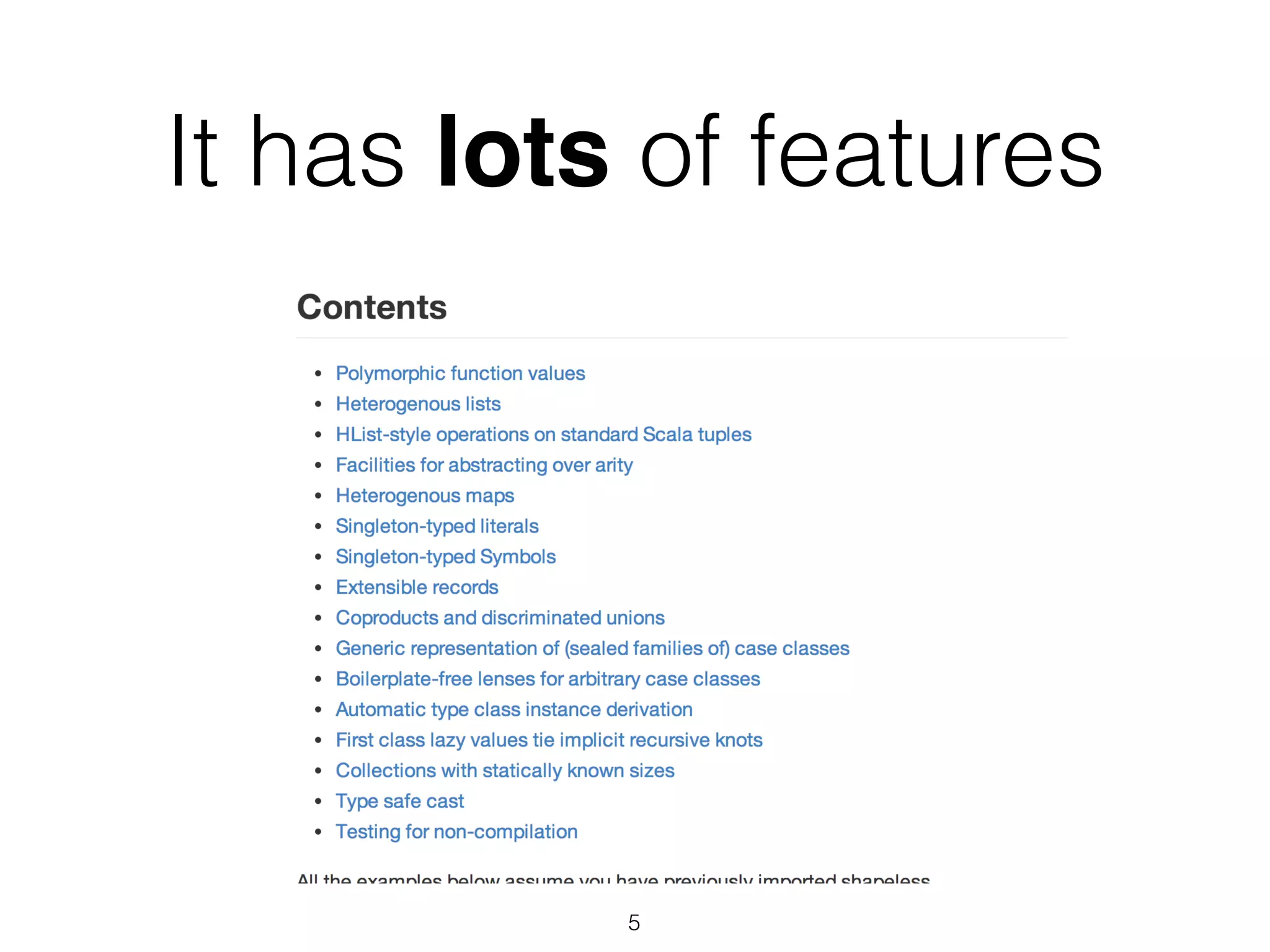
It has lots of features
5
object size extends Poly1 {
implicit def int = at[Int] (x => 1)
implicit def string = at[String] (s => s.length)
implicit def tuple[A, B] = at[(A, B)] (t => 2)
}
!
val list = 1 :: “foo” :: (‘x’, ‘a’) :: HNil
list.map(size) // => 1 :: 3 :: 2 :: HNil
We can do flexible things like:
6
Inspiration
• Scrap Your Boilerplate
• Generic Deriving in Haskell
• Dependently typed languages
7
Static reasoning
• allows for us to implement powerful compile time
abstractions
• you only pay a minor cost with extra compile time,
and passing around proof terms
8
Type safe casting of an arbitrary List to Product:
9
case class Point(x: Int, y: Int)
val xs: List[Any] = List(1,2)
xs.as[Point]
https://gist.github.com/jroesch/52727c6d77a9d98458d5
scala> val q = sql("select name, age from person")
scala> q() map (_ get "age")
res0: List[Int] = List(36, 14)
compile time checked SQL:
from: https://github.com/jonifreeman/sqltyped
10
Dependent Types
• relaxation of the “phase distinction”
• simply: remove the distinction between types and
values (allow types to depend on values)
• many things billed as type level programming are
attempts at emulating dependent types
11
The phase distinction exists in Scala:
!
Vect : (Nat, Type) => Type
!
we would like to write something like this:
!
trait Vect[N <: Nat, A]
!
we are still writing this:
!
Vect : (Type, Type) => Type
12
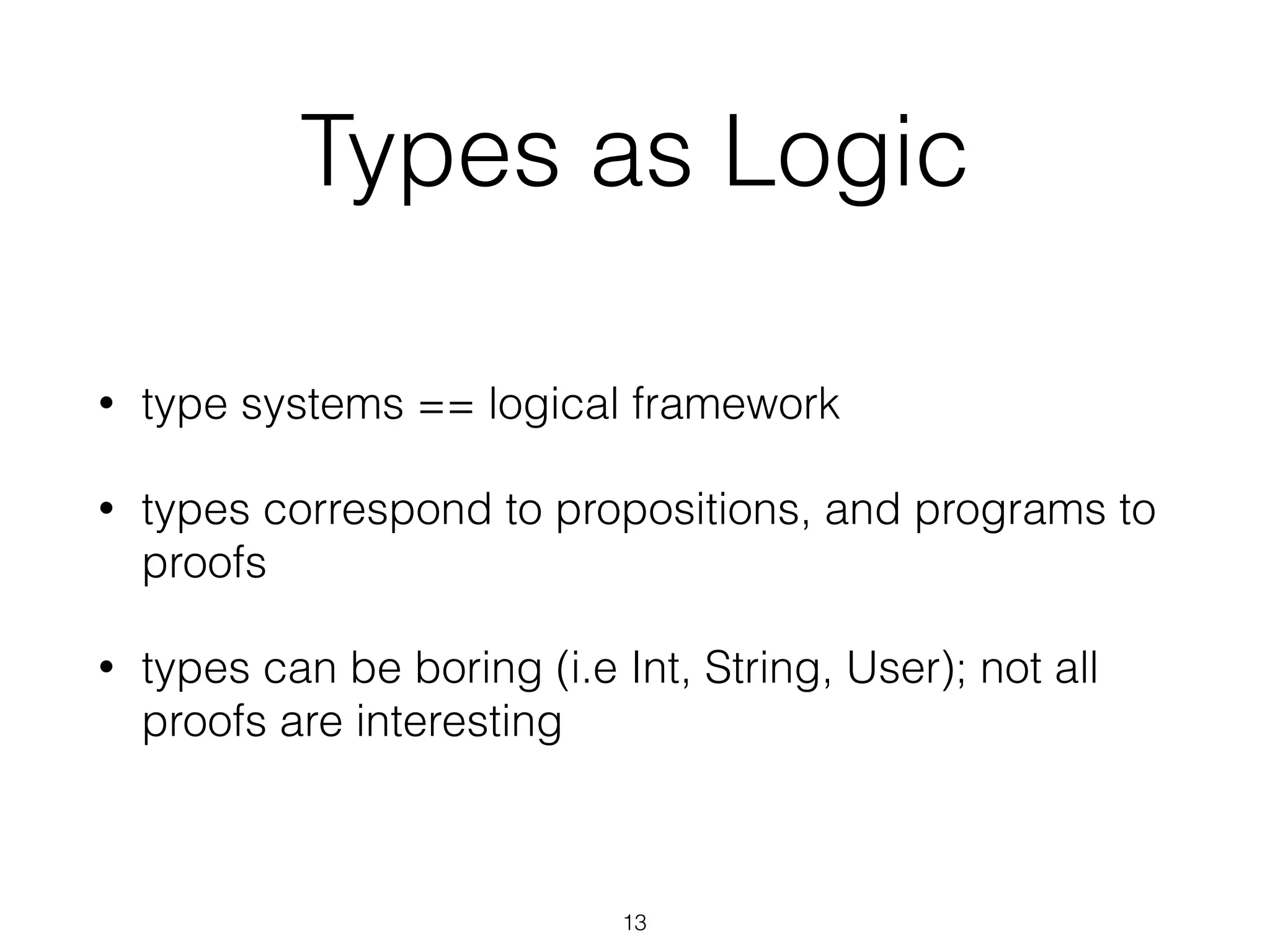
Types as Logic
• type systems == logical framework
• types correspond to propositions, and programs to
proofs
• types can be boring (i.e Int, String, User); not all
proofs are interesting
13
How do we emulate
dependent types?
• We still have the phase distinction to get around
• We need to promote values to the type level (i.e 0
can either act as a value or type)
• Vect[0, Int] and val x = 0
14
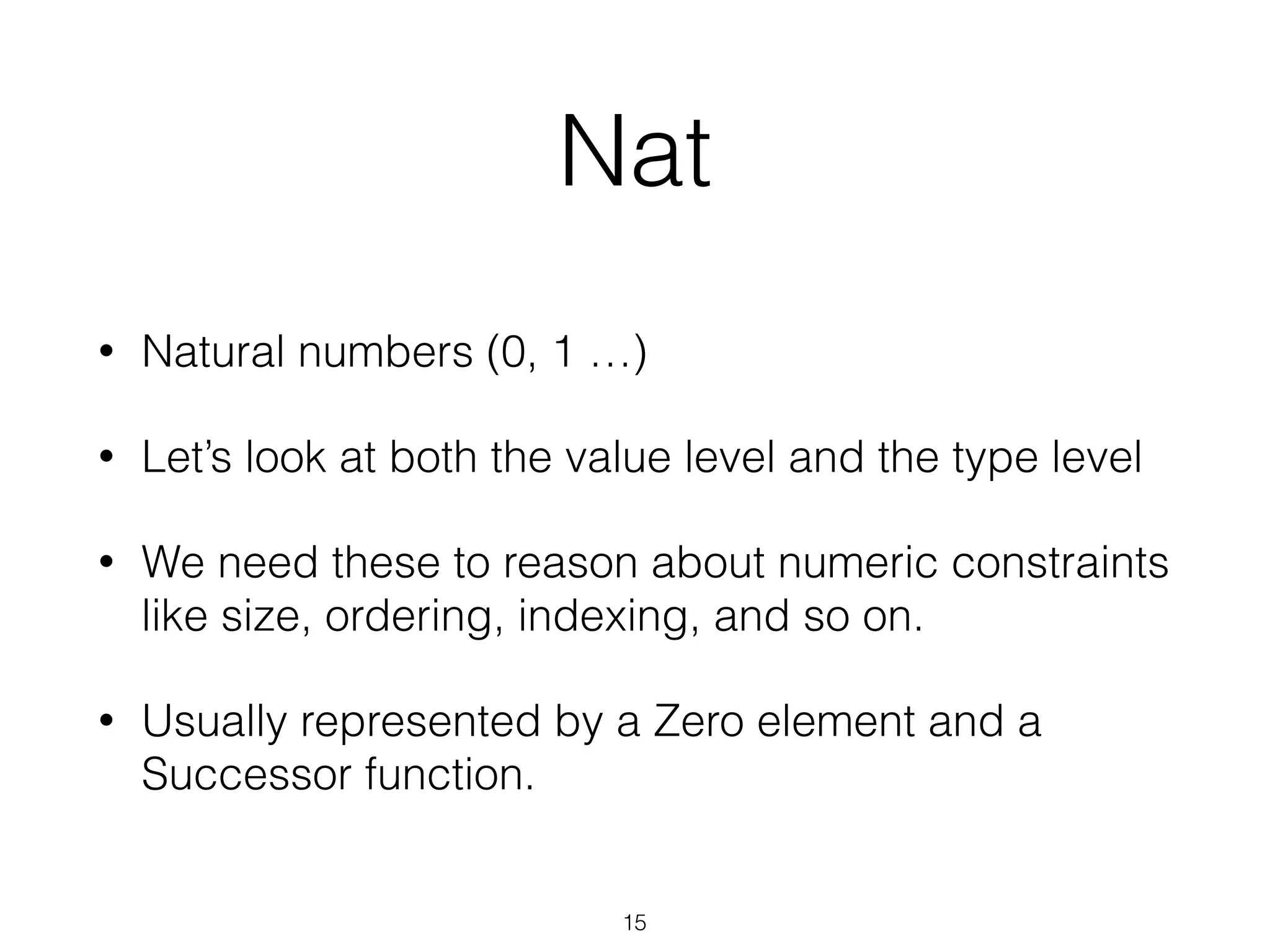
Nat
• Natural numbers (0, 1 …)
• Let’s look at both the value level and the type level
• We need these to reason about numeric constraints
like size, ordering, indexing, and so on.
• Usually represented by a Zero element and a
Successor function.
15
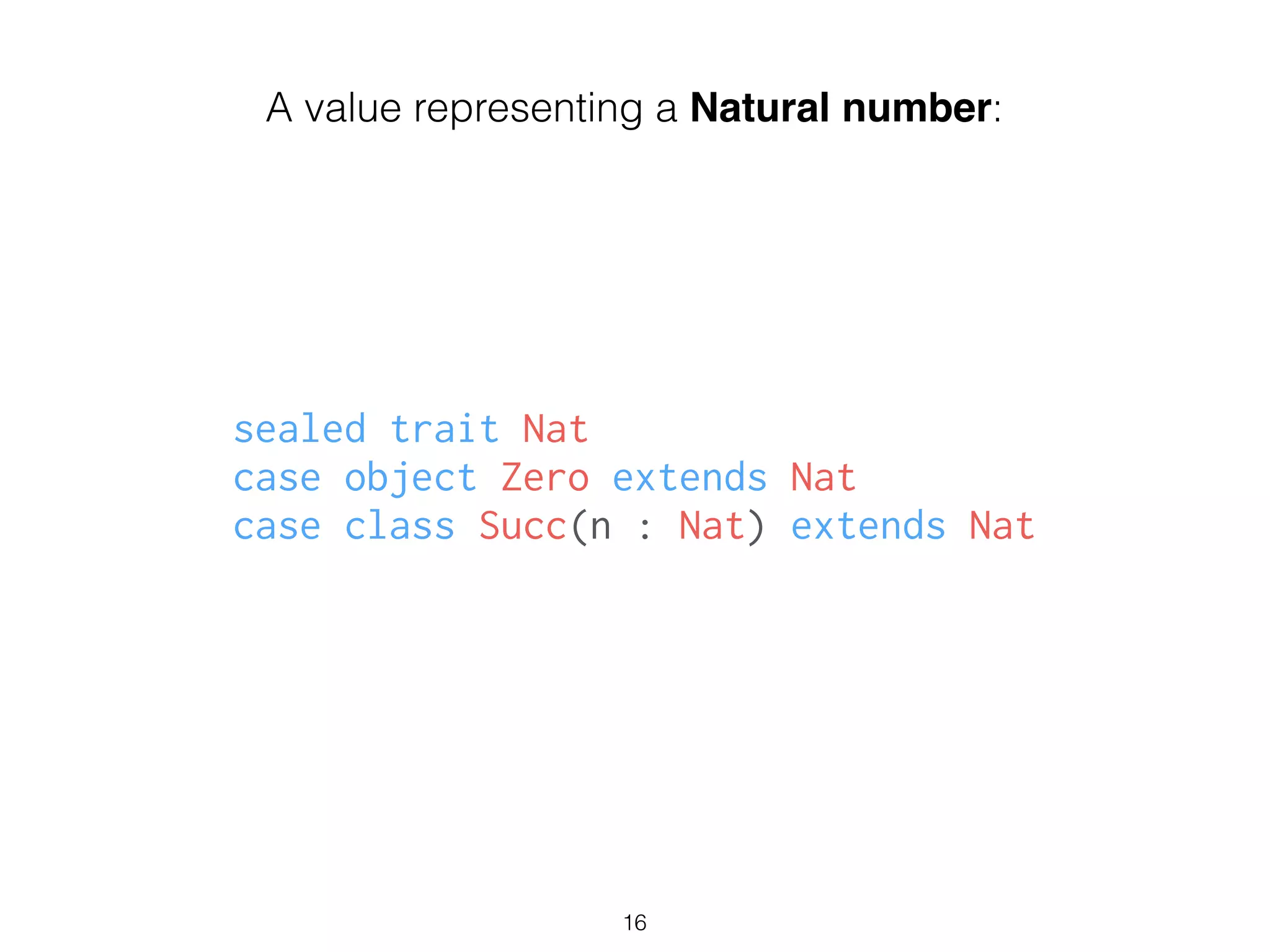
sealed trait Nat
case object Zero extends Nat
case class Succ(n : Nat) extends Nat
16
A value representing a Natural number:
How do we encode a type level representation of naturals?
17
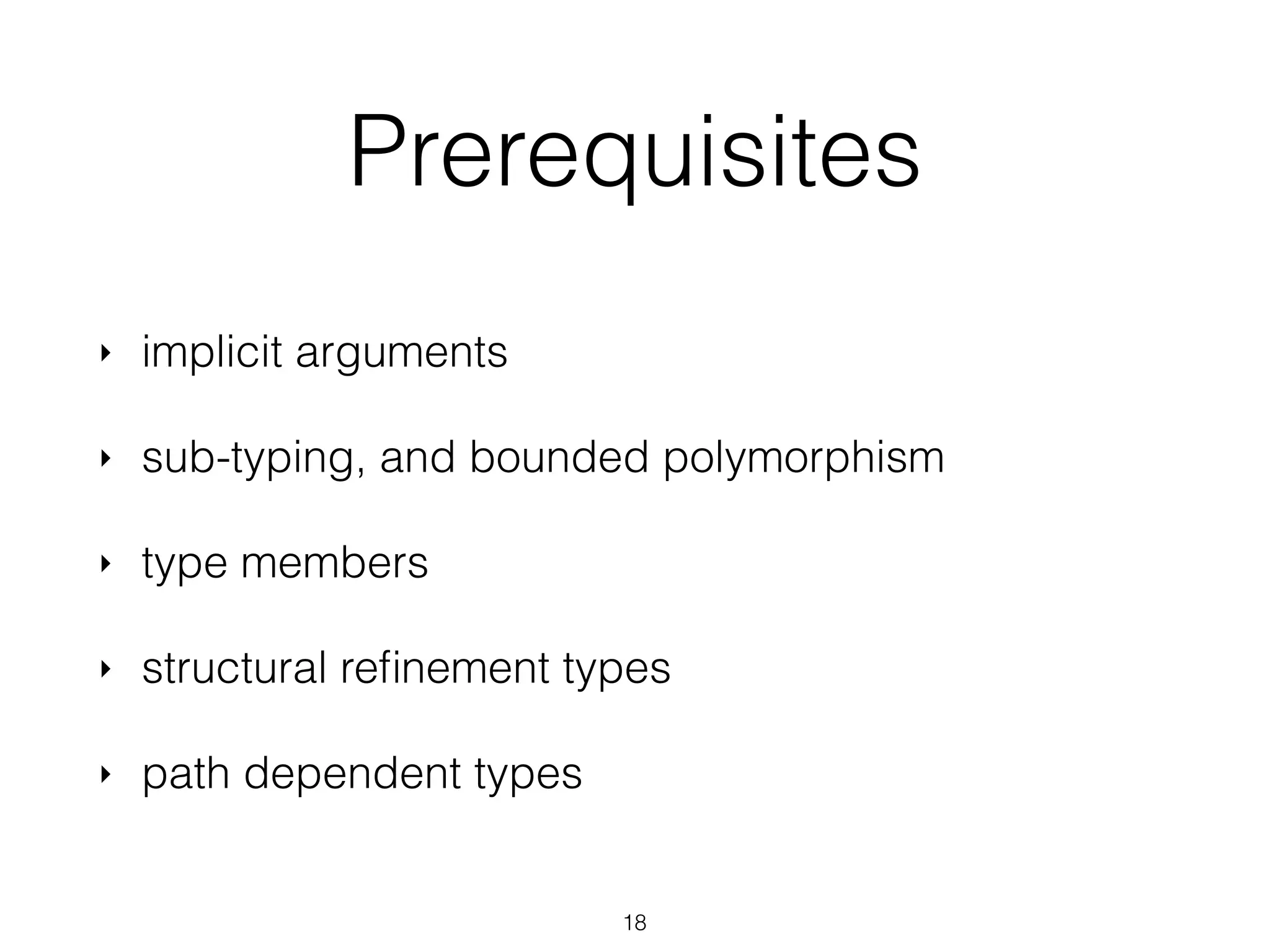
Prerequisites
‣ implicit arguments
‣ sub-typing, and bounded polymorphism
‣ type members
‣ structural refinement types
‣ path dependent types
18
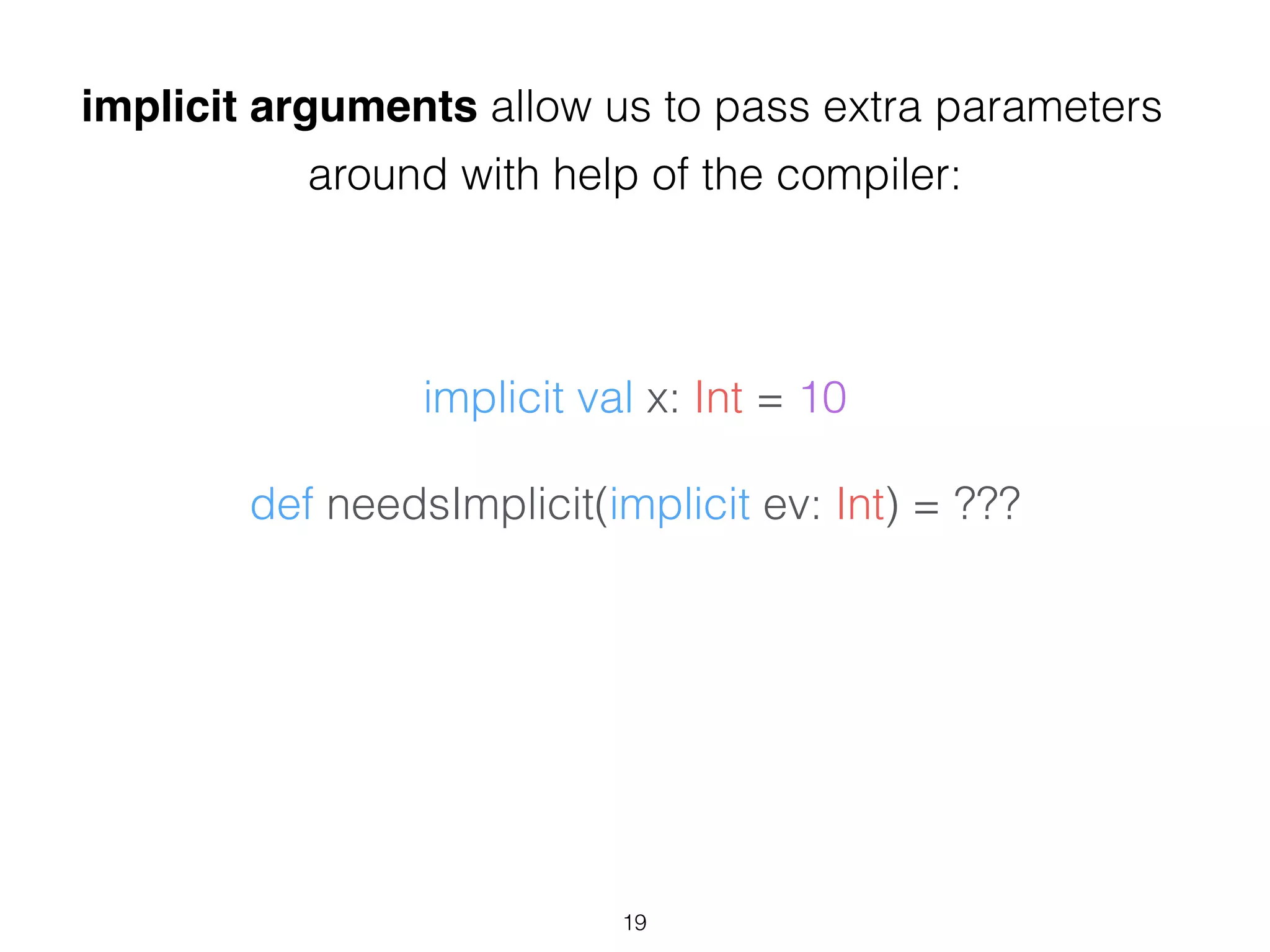
implicit val x: Int = 10
!
def needsImplicit(implicit ev: Int) = ???
implicit arguments allow us to pass extra parameters
around with help of the compiler:
19
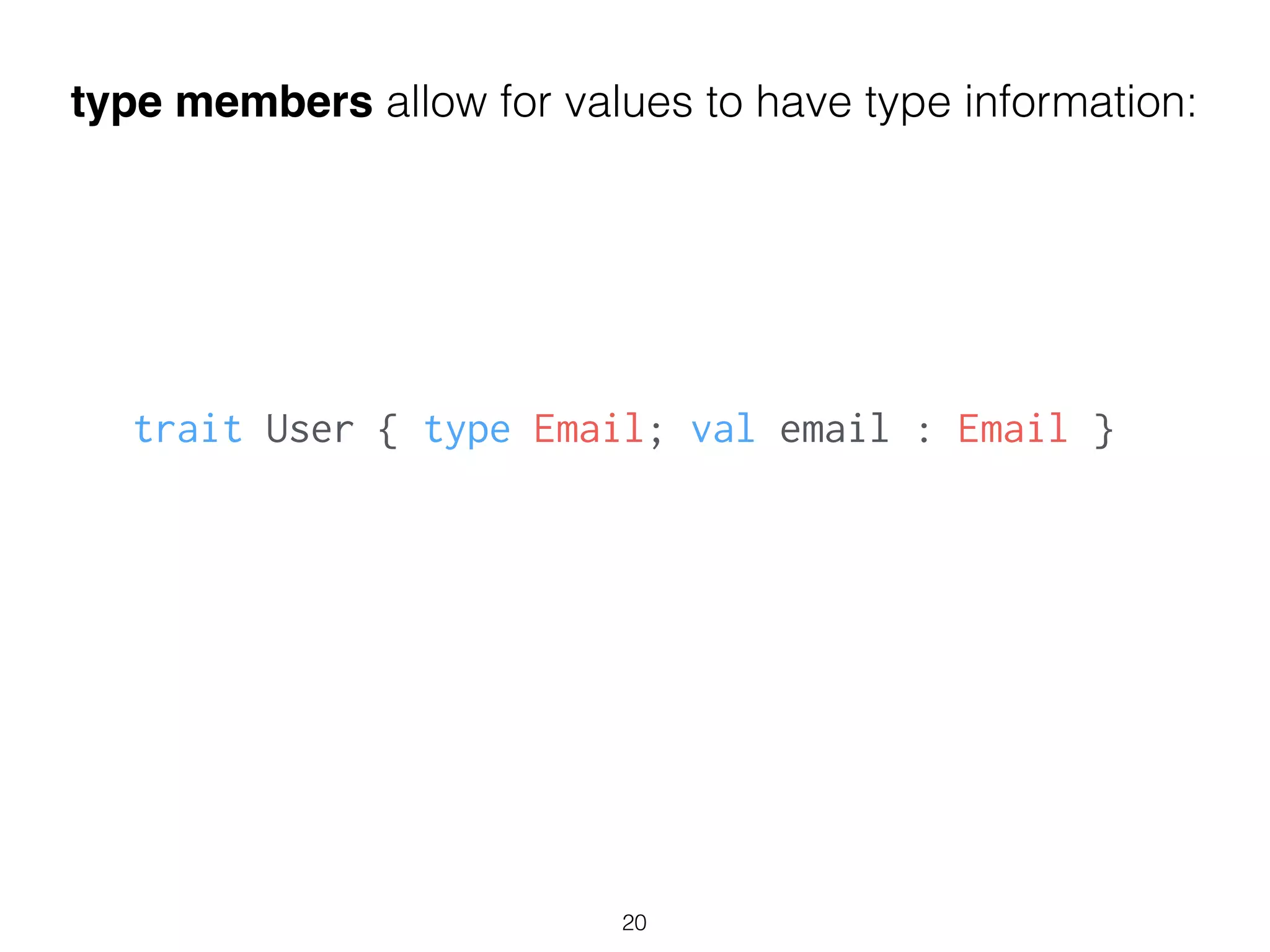
type members allow for values to have type information:
trait User { type Email; val email : Email }
!
20
def userWithEmail[E](e : E) = new User {
type Email = E
val email = e
}
!
21
We make a type part of the value:
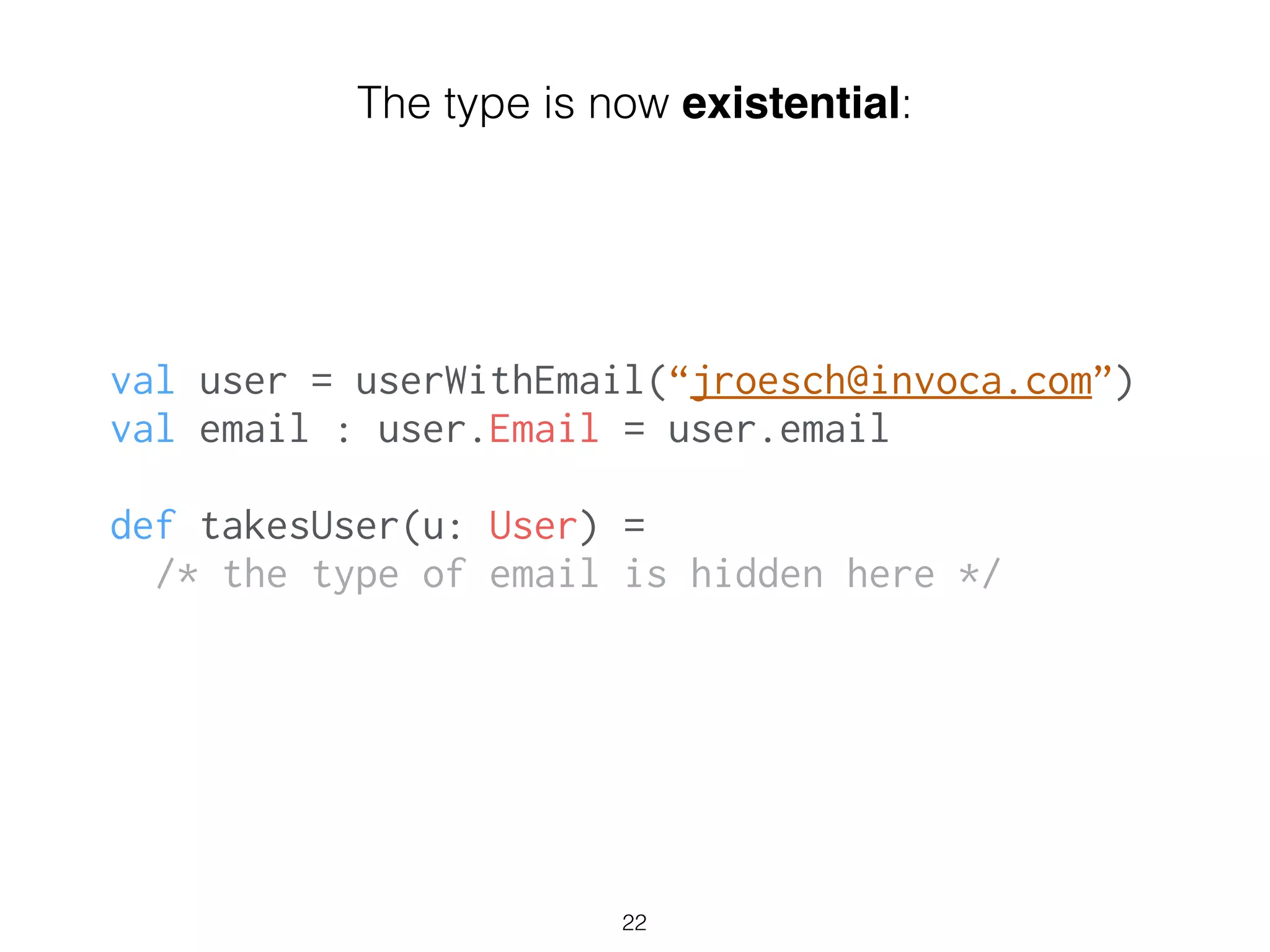
val user = userWithEmail(“jroesch@invoca.com”)
val email : user.Email = user.email
!
def takesUser(u: User) =
/* the type of email is hidden here */
22
The type is now existential:
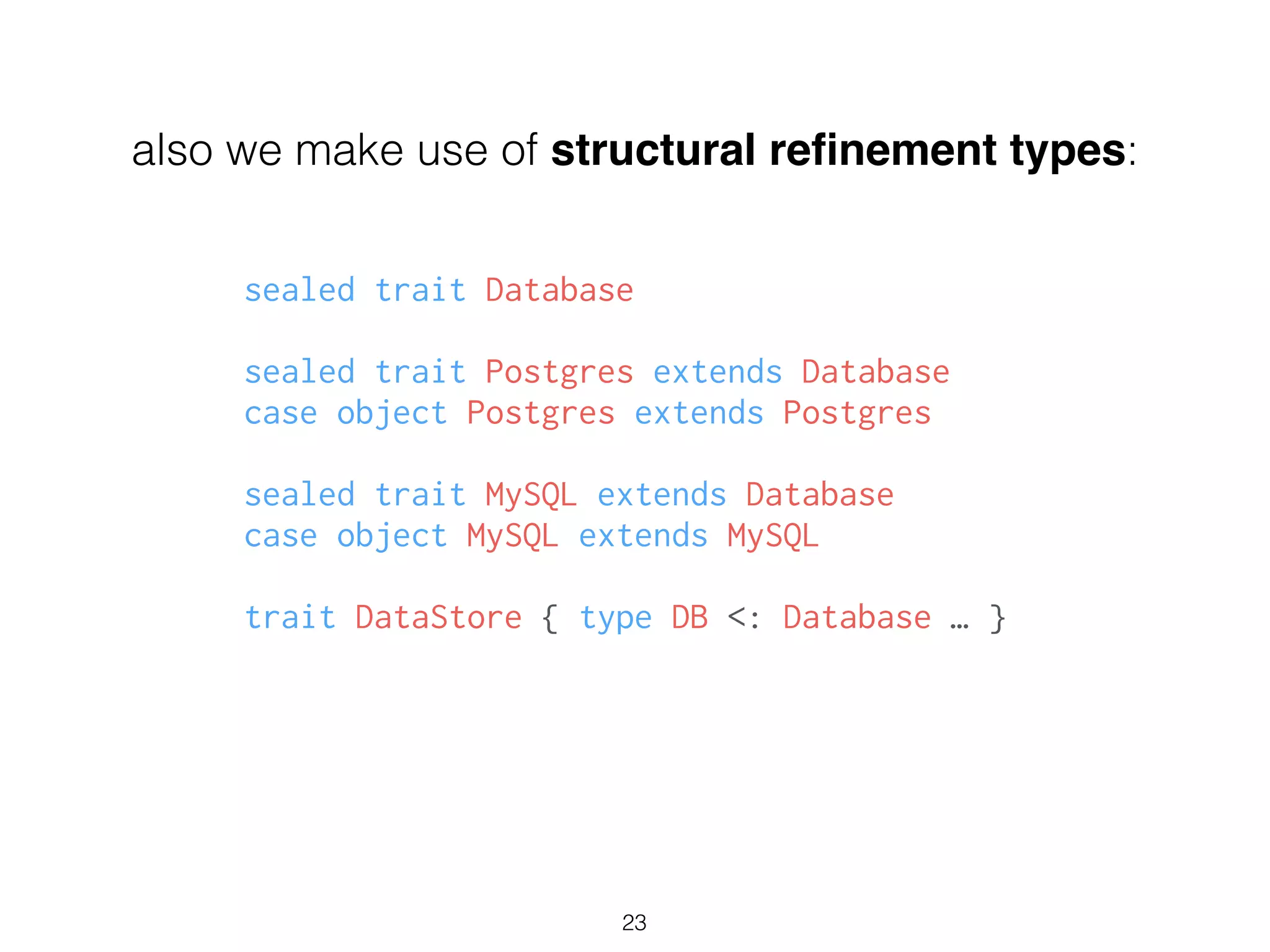
also we make use of structural refinement types:
sealed trait Database
!
sealed trait Postgres extends Database
case object Postgres extends Postgres
!
sealed trait MySQL extends Database
case object MySQL extends MySQL
!
trait DataStore { type DB <: Database … }
23
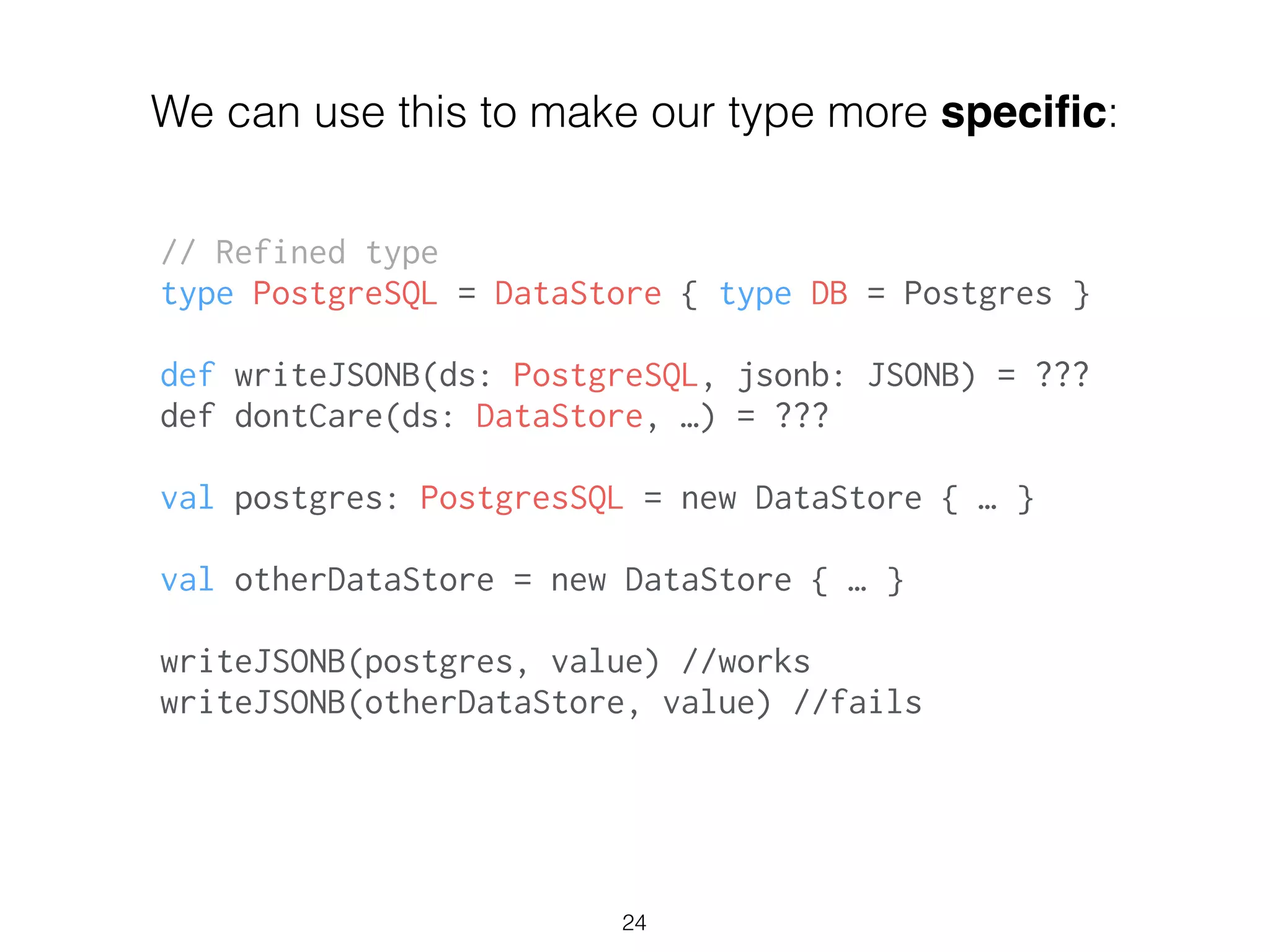
// Refined type
type PostgreSQL = DataStore { type DB = Postgres }
!
def writeJSONB(ds: PostgreSQL, jsonb: JSONB) = ???
def dontCare(ds: DataStore, …) = ???
!
val postgres: PostgresSQL = new DataStore { … }
!
val otherDataStore = new DataStore { … }
!
writeJSONB(postgres, value) //works
writeJSONB(otherDataStore, value) //fails
24
We can use this to make our type more specific:
trait Unrefined
type Refined = Unrefined { type T = String }
!
implicitly[Refined <:< Unrefined]
25
refined types are subtypes of unrefined types:
trait ObligationFor[N <: Nat]
!
def proof[N <: Nat](implicit ev: ObligationFor[N])
26
we can use this sub-typing rule and type bounds to our
advantage during implicit selection:
vs
def proof(implicit ev: ObligationFor[Nat])
/* Shapeless Typelevel Natural */
trait Nat {
type N <: Nat
}
!
class _0 extends Nat {
type N = _0
}
!
class Succ[P <: Nat]() extends Nat {
type N = Succ[P]
}
27
implicit def intToNat(i: Int): Nat = …
!
val n: Nat = 1
!
type One = n.N // Succ[_0]
28
We can add an implicit conversion for Naturals:
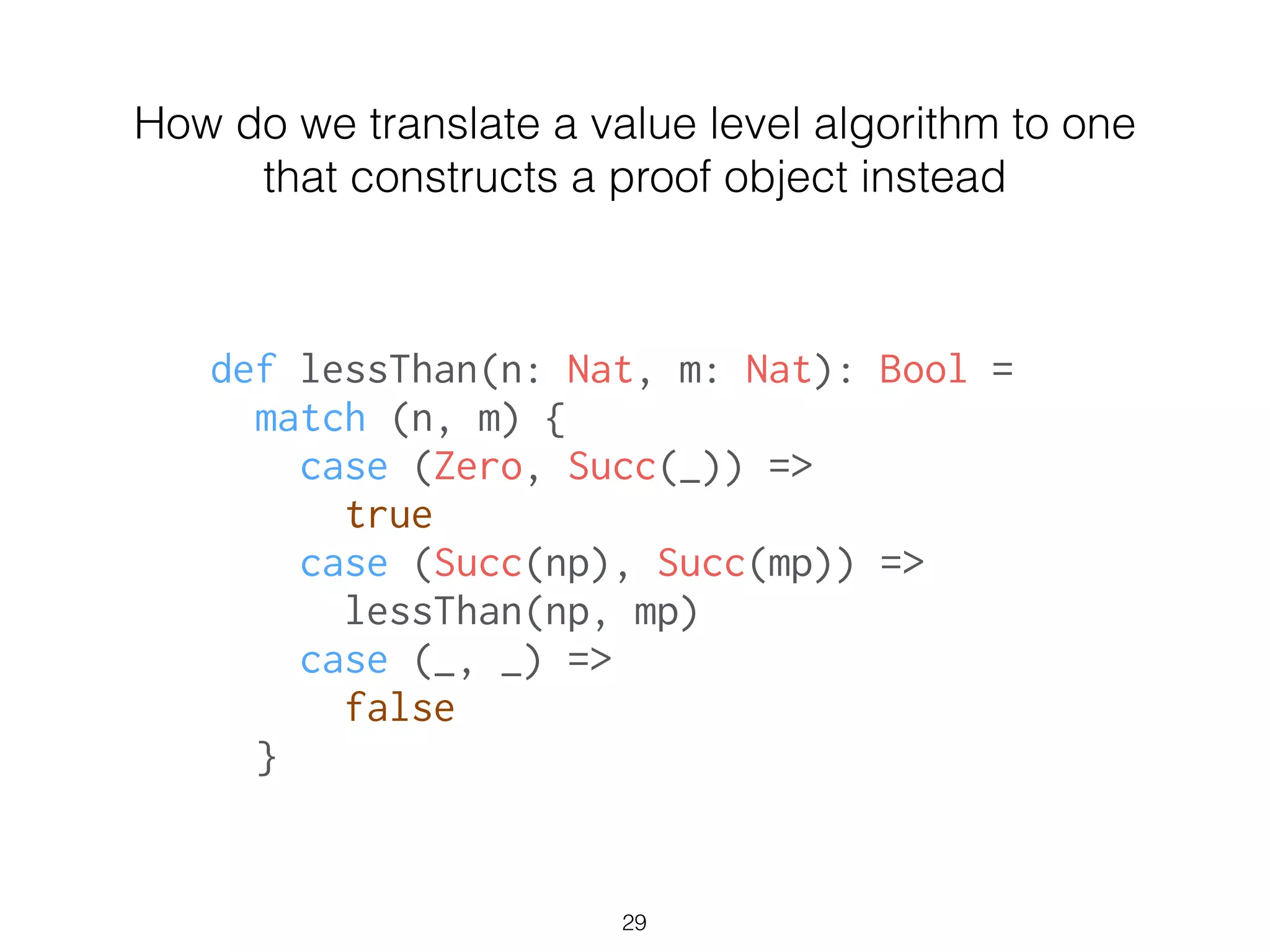
def lessThan(n: Nat, m: Nat): Bool =
match (n, m) {
case (Zero, Succ(_)) =>
true
case (Succ(np), Succ(mp)) =>
lessThan(np, mp)
case (_, _) =>
false
}
How do we translate a value level algorithm to one
that constructs a proof object instead
29
How do we translate this piece of code?
30
trait LessThan[N <: Nat, M <: Nat]
31
Take our proof and translate it to a type:
// Typelevel LessThan
trait LessThan[N <: Nat, M <: Nat]
!
// We need ways to construct our proofs.
implicit def lessThanBase[M <: Nat] =
new LessThan[_0, Succ[M]] {}
!
implicit def lessThanStep[N <: Nat, M <: Nat]
(implicit lessThanN: LessThan[N, M]) =
new LessThan[Succ[N], Succ[M]] {}
!
def lessThan(n : Nat, m : Nat)
(implicit lessThan: LessThan[n.N, m. N]): Boolean =
true
32
HList
sealed trait HList
!
case class ::[+H, +T <: HList](head : H, tail : T)
extends HList
!
sealed trait HNil extends HList
case object HNil extends HNil
33
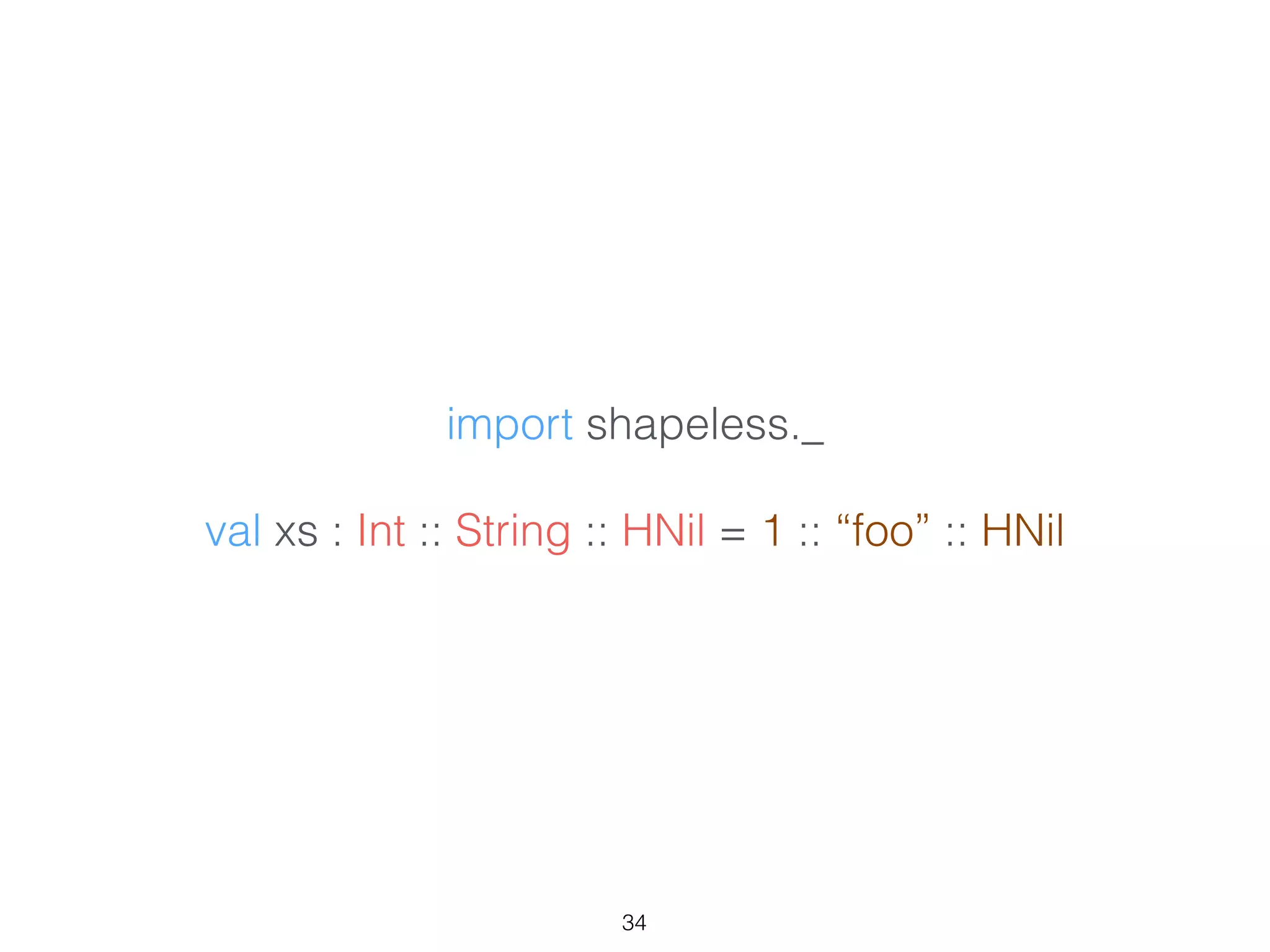
import shapeless._
!
val xs : Int :: String :: HNil = 1 :: “foo” :: HNil
34
trait IsHCons[L <: HList] {
type H
type T <: HList
def head(l : L) : H
def tail(l : L) : T
}
35
object IsHCons {
…
!
type Aux[L <: HList, Head, Tail <: HList] =
IsHCons[L] { type H = Head; type T = Tail }
!
implicit def hlistIsHCons[Head, Tail <: HList] =
new IsHCons[Head :: Tail] {
type H = Head
type T = Tail
def head(l : Head :: Tail) : H = l.head
def tail(l : Head :: Tail) : T = l.tail
}
}
36
def head(implicit c : IsHCons[L]) : c.H = c.head(l)
!
def tail(implicit c : IsHCons[L]) : c.T = c.tail(l)
We then demand proof when we implement methods on
HList’s:
37
Proofs as black boxes
• Proof objects can be treated as black boxes, we
only need to know what relationship they express,
not proof details.
• We can use shapeless as a standard library of
useful tools.
38
case class Point(x: Int, y: Int)
!
val generic = Generic.Aux[Point, Int :: Int :: HNil] =
Generic[Point]
!
val point = Point(1,2)
!
val list: Int :: Int :: HNil = generic.to(point)
!
assert(generic.from(list) == point)
39
Applying it
• We can build things using many of the same ideas
• typed SQL, JSON with schema, static string
encoding, and plenty of other uses (ex. Spray)
40
41
sealed trait Encoding
…
!
trait EncodedString[E <: Encoding] { … }
…
!
def staticEncoding[E <: Encoding](enc: E, s: String)
= macro StaticEncoding.encodeAs[E]
42
trait Transcode[Initial <: Encoding] {
type Result <: Encoding
!
def transcode(s: EncodedString[Initial]):
EncodedString[Result]
}
43
trait Concatable[Prefix <: Encoding, Suffix <: Encoding] {
type Result <: Encoding
/* Concat is a little verbose, we just ask for
both our strings. */
def concat(s1: EncodedString[Prefix],
s2: EncodedString[Suffix])
/* We get proof that a transcode can happen for both */
(implicit t1: Transcode.Aux[Prefix, Result]
t2: Transcode.Aux[Suffix, Result]):
/* And we get the result */
EncodedString[Result]
}
44
def concat[E1 <: Encoding, E2 <: Encoding]
(s1: EncodedString[E1], s2: EncodedString[E2])
(implicit c: Concatable[E1, E2]) =
c.concat(s1, s2)
An extended example
• Let’s encode a proof that one HList is a subset of
another HList.
• But is it useful?
45
Imagine our own implementation of a SQL DSL:
!
case class User(
id: Id
name: String,
age: Int,
email: String,
deviceId: Long
)
!
// Create Table
SQL.create[User]
!
SQL.insert(
User(1, “Jared”, 21, “jroesch@cs.ucsb.edu”, 1)
)
!
// successful update
SQL.update[User](“id” ->> 1, “age” ->> 22)
!
// fails to compile
SQL.update[User](“id” ->> 1, bogusField” ->> 1337)
!
… // Queries and so on
46
// successful update
SQL.update[User](“id” ->> 1, “age” ->> 22)
!
// fails to compile
SQL.update[User](“id” ->> 1, bogusField” ->> 1337)
47
48
def subList[A](sub: List[A], list: List[A]): Boolean =
(sub, list) match {
case (Nil, _) =>
true
case (x :: xs, y :: ys) if x == y =>
true && subList(xs, ys)
case (subp, first :: remanning) =>
subList(subp, remaining)
}
49
trait SubSeq[Sub <: HList, Super <: HList]
50
object SubSeq extends LowPrioritySubSeq {
type Aux[L <: HList, S <: HList] = SubSeq[L] {
type Sub = S
}
…
}
51
/* Low priority case where we just keep scanning the list. */
trait LowPrioritySubSeq {
implicit def hconsSubSeq[Sub <: HList, SH, ST <: HList]
(implicit subseq: SubSeq.Aux[Sub, ST]) =
new SubSeq[Sub] {
type Sub = SH :: ST
}
}
52
object SubSeq extends LowPrioritySubSeq {
…
/* HNil is a SubSeq of any HList */
implicit def hnilSubSeq[H <: HList] =
new SubSeq[HNil] {
type Sub = H
}
!
…
}
53
object SubSeq extends LowPrioritySubSeq {
…
implicit def hconsSubSeqIso
[H, SH, T <: HList, ST <: HList]
(implicit iso: H =:= SH,
subseq: SubSeq.Aux[T, ST]) =
new SubSeq[H :: T] {
type Sub = SH :: ST
}
}
54
There are few ways to improve upon our last example, I’ll
leave it as a fun puzzle for you.
55
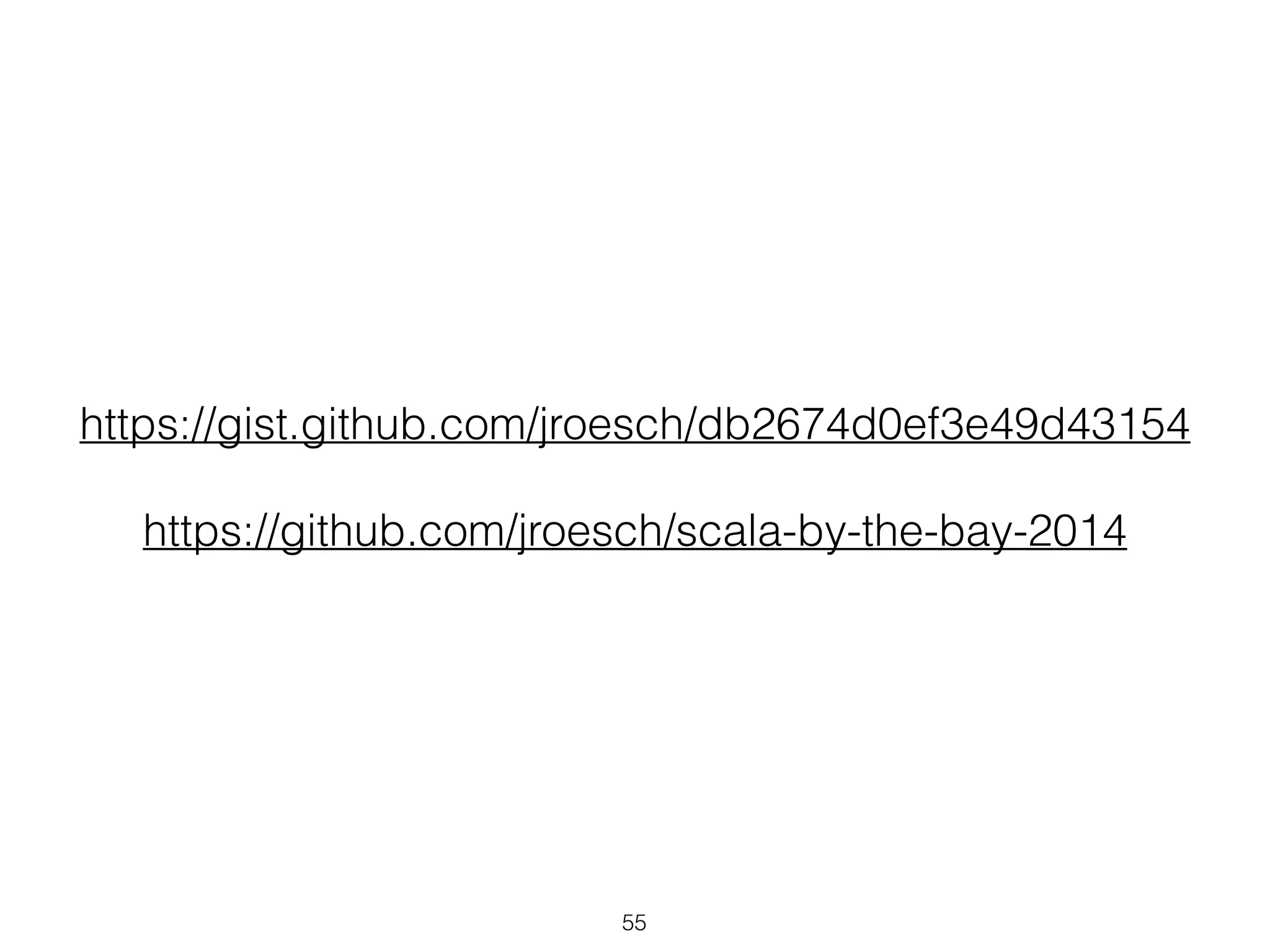
https://gist.github.com/jroesch/db2674d0ef3e49d43154
!
https://github.com/jroesch/scala-by-the-bay-2014
Acknowledgements
• Thanks to Miles Sabin, the PL Lab, Adelbert
Chang, and Pete Cruz.
56
Thank you for your time, questions?
57

Demystifying Shapeless

  • 1.
  • 2.
  • 3.
  • 4.
    What is Shapeless? •https://github.com/milessabin/shapeless • A library from Miles Sabin and co. • A playground for advanced typed FP 4
  • 5.
    It has lotsof features 5
  • 6.
    object size extendsPoly1 { implicit def int = at[Int] (x => 1) implicit def string = at[String] (s => s.length) implicit def tuple[A, B] = at[(A, B)] (t => 2) } ! val list = 1 :: “foo” :: (‘x’, ‘a’) :: HNil list.map(size) // => 1 :: 3 :: 2 :: HNil We can do flexible things like: 6
  • 7.
    Inspiration • Scrap YourBoilerplate • Generic Deriving in Haskell • Dependently typed languages 7
  • 8.
    Static reasoning • allowsfor us to implement powerful compile time abstractions • you only pay a minor cost with extra compile time, and passing around proof terms 8
  • 9.
    Type safe castingof an arbitrary List to Product: 9 case class Point(x: Int, y: Int) val xs: List[Any] = List(1,2) xs.as[Point] https://gist.github.com/jroesch/52727c6d77a9d98458d5
  • 10.
    scala> val q= sql("select name, age from person") scala> q() map (_ get "age") res0: List[Int] = List(36, 14) compile time checked SQL: from: https://github.com/jonifreeman/sqltyped 10
  • 11.
    Dependent Types • relaxationof the “phase distinction” • simply: remove the distinction between types and values (allow types to depend on values) • many things billed as type level programming are attempts at emulating dependent types 11
  • 12.
    The phase distinctionexists in Scala: ! Vect : (Nat, Type) => Type ! we would like to write something like this: ! trait Vect[N <: Nat, A] ! we are still writing this: ! Vect : (Type, Type) => Type 12
  • 13.
    Types as Logic •type systems == logical framework • types correspond to propositions, and programs to proofs • types can be boring (i.e Int, String, User); not all proofs are interesting 13
  • 14.
    How do weemulate dependent types? • We still have the phase distinction to get around • We need to promote values to the type level (i.e 0 can either act as a value or type) • Vect[0, Int] and val x = 0 14
  • 15.
    Nat • Natural numbers(0, 1 …) • Let’s look at both the value level and the type level • We need these to reason about numeric constraints like size, ordering, indexing, and so on. • Usually represented by a Zero element and a Successor function. 15
  • 16.
    sealed trait Nat caseobject Zero extends Nat case class Succ(n : Nat) extends Nat 16 A value representing a Natural number:
  • 17.
    How do weencode a type level representation of naturals? 17
  • 18.
    Prerequisites ‣ implicit arguments ‣sub-typing, and bounded polymorphism ‣ type members ‣ structural refinement types ‣ path dependent types 18
  • 19.
    implicit val x:Int = 10 ! def needsImplicit(implicit ev: Int) = ??? implicit arguments allow us to pass extra parameters around with help of the compiler: 19
  • 20.
    type members allowfor values to have type information: trait User { type Email; val email : Email } ! 20
  • 21.
    def userWithEmail[E](e :E) = new User { type Email = E val email = e } ! 21 We make a type part of the value:
  • 22.
    val user =userWithEmail(“jroesch@invoca.com”) val email : user.Email = user.email ! def takesUser(u: User) = /* the type of email is hidden here */ 22 The type is now existential:
  • 23.
    also we makeuse of structural refinement types: sealed trait Database ! sealed trait Postgres extends Database case object Postgres extends Postgres ! sealed trait MySQL extends Database case object MySQL extends MySQL ! trait DataStore { type DB <: Database … } 23
  • 24.
    // Refined type typePostgreSQL = DataStore { type DB = Postgres } ! def writeJSONB(ds: PostgreSQL, jsonb: JSONB) = ??? def dontCare(ds: DataStore, …) = ??? ! val postgres: PostgresSQL = new DataStore { … } ! val otherDataStore = new DataStore { … } ! writeJSONB(postgres, value) //works writeJSONB(otherDataStore, value) //fails 24 We can use this to make our type more specific:
  • 25.
    trait Unrefined type Refined= Unrefined { type T = String } ! implicitly[Refined <:< Unrefined] 25 refined types are subtypes of unrefined types:
  • 26.
    trait ObligationFor[N <:Nat] ! def proof[N <: Nat](implicit ev: ObligationFor[N]) 26 we can use this sub-typing rule and type bounds to our advantage during implicit selection: vs def proof(implicit ev: ObligationFor[Nat])
  • 27.
    /* Shapeless TypelevelNatural */ trait Nat { type N <: Nat } ! class _0 extends Nat { type N = _0 } ! class Succ[P <: Nat]() extends Nat { type N = Succ[P] } 27
  • 28.
    implicit def intToNat(i:Int): Nat = … ! val n: Nat = 1 ! type One = n.N // Succ[_0] 28 We can add an implicit conversion for Naturals:
  • 29.
    def lessThan(n: Nat,m: Nat): Bool = match (n, m) { case (Zero, Succ(_)) => true case (Succ(np), Succ(mp)) => lessThan(np, mp) case (_, _) => false } How do we translate a value level algorithm to one that constructs a proof object instead 29
  • 30.
    How do wetranslate this piece of code? 30
  • 31.
    trait LessThan[N <:Nat, M <: Nat] 31 Take our proof and translate it to a type:
  • 32.
    // Typelevel LessThan traitLessThan[N <: Nat, M <: Nat] ! // We need ways to construct our proofs. implicit def lessThanBase[M <: Nat] = new LessThan[_0, Succ[M]] {} ! implicit def lessThanStep[N <: Nat, M <: Nat] (implicit lessThanN: LessThan[N, M]) = new LessThan[Succ[N], Succ[M]] {} ! def lessThan(n : Nat, m : Nat) (implicit lessThan: LessThan[n.N, m. N]): Boolean = true 32
  • 33.
    HList sealed trait HList ! caseclass ::[+H, +T <: HList](head : H, tail : T) extends HList ! sealed trait HNil extends HList case object HNil extends HNil 33
  • 34.
    import shapeless._ ! val xs: Int :: String :: HNil = 1 :: “foo” :: HNil 34
  • 35.
    trait IsHCons[L <:HList] { type H type T <: HList def head(l : L) : H def tail(l : L) : T } 35
  • 36.
    object IsHCons { … ! typeAux[L <: HList, Head, Tail <: HList] = IsHCons[L] { type H = Head; type T = Tail } ! implicit def hlistIsHCons[Head, Tail <: HList] = new IsHCons[Head :: Tail] { type H = Head type T = Tail def head(l : Head :: Tail) : H = l.head def tail(l : Head :: Tail) : T = l.tail } } 36
  • 37.
    def head(implicit c: IsHCons[L]) : c.H = c.head(l) ! def tail(implicit c : IsHCons[L]) : c.T = c.tail(l) We then demand proof when we implement methods on HList’s: 37
  • 38.
    Proofs as blackboxes • Proof objects can be treated as black boxes, we only need to know what relationship they express, not proof details. • We can use shapeless as a standard library of useful tools. 38
  • 39.
    case class Point(x:Int, y: Int) ! val generic = Generic.Aux[Point, Int :: Int :: HNil] = Generic[Point] ! val point = Point(1,2) ! val list: Int :: Int :: HNil = generic.to(point) ! assert(generic.from(list) == point) 39
  • 40.
    Applying it • Wecan build things using many of the same ideas • typed SQL, JSON with schema, static string encoding, and plenty of other uses (ex. Spray) 40
  • 41.
    41 sealed trait Encoding … ! traitEncodedString[E <: Encoding] { … } … ! def staticEncoding[E <: Encoding](enc: E, s: String) = macro StaticEncoding.encodeAs[E]
  • 42.
    42 trait Transcode[Initial <:Encoding] { type Result <: Encoding ! def transcode(s: EncodedString[Initial]): EncodedString[Result] }
  • 43.
    43 trait Concatable[Prefix <:Encoding, Suffix <: Encoding] { type Result <: Encoding /* Concat is a little verbose, we just ask for both our strings. */ def concat(s1: EncodedString[Prefix], s2: EncodedString[Suffix]) /* We get proof that a transcode can happen for both */ (implicit t1: Transcode.Aux[Prefix, Result] t2: Transcode.Aux[Suffix, Result]): /* And we get the result */ EncodedString[Result] }
  • 44.
    44 def concat[E1 <:Encoding, E2 <: Encoding] (s1: EncodedString[E1], s2: EncodedString[E2]) (implicit c: Concatable[E1, E2]) = c.concat(s1, s2)
  • 45.
    An extended example •Let’s encode a proof that one HList is a subset of another HList. • But is it useful? 45
  • 46.
    Imagine our ownimplementation of a SQL DSL: ! case class User( id: Id name: String, age: Int, email: String, deviceId: Long ) ! // Create Table SQL.create[User] ! SQL.insert( User(1, “Jared”, 21, “jroesch@cs.ucsb.edu”, 1) ) ! // successful update SQL.update[User](“id” ->> 1, “age” ->> 22) ! // fails to compile SQL.update[User](“id” ->> 1, bogusField” ->> 1337) ! … // Queries and so on 46
  • 47.
    // successful update SQL.update[User](“id”->> 1, “age” ->> 22) ! // fails to compile SQL.update[User](“id” ->> 1, bogusField” ->> 1337) 47
  • 48.
    48 def subList[A](sub: List[A],list: List[A]): Boolean = (sub, list) match { case (Nil, _) => true case (x :: xs, y :: ys) if x == y => true && subList(xs, ys) case (subp, first :: remanning) => subList(subp, remaining) }
  • 49.
    49 trait SubSeq[Sub <:HList, Super <: HList]
  • 50.
    50 object SubSeq extendsLowPrioritySubSeq { type Aux[L <: HList, S <: HList] = SubSeq[L] { type Sub = S } … }
  • 51.
    51 /* Low prioritycase where we just keep scanning the list. */ trait LowPrioritySubSeq { implicit def hconsSubSeq[Sub <: HList, SH, ST <: HList] (implicit subseq: SubSeq.Aux[Sub, ST]) = new SubSeq[Sub] { type Sub = SH :: ST } }
  • 52.
    52 object SubSeq extendsLowPrioritySubSeq { … /* HNil is a SubSeq of any HList */ implicit def hnilSubSeq[H <: HList] = new SubSeq[HNil] { type Sub = H } ! … }
  • 53.
    53 object SubSeq extendsLowPrioritySubSeq { … implicit def hconsSubSeqIso [H, SH, T <: HList, ST <: HList] (implicit iso: H =:= SH, subseq: SubSeq.Aux[T, ST]) = new SubSeq[H :: T] { type Sub = SH :: ST } }
  • 54.
    54 There are fewways to improve upon our last example, I’ll leave it as a fun puzzle for you.
  • 55.
  • 56.
    Acknowledgements • Thanks toMiles Sabin, the PL Lab, Adelbert Chang, and Pete Cruz. 56
  • 57.
    Thank you foryour time, questions? 57