Quick Swift Tour
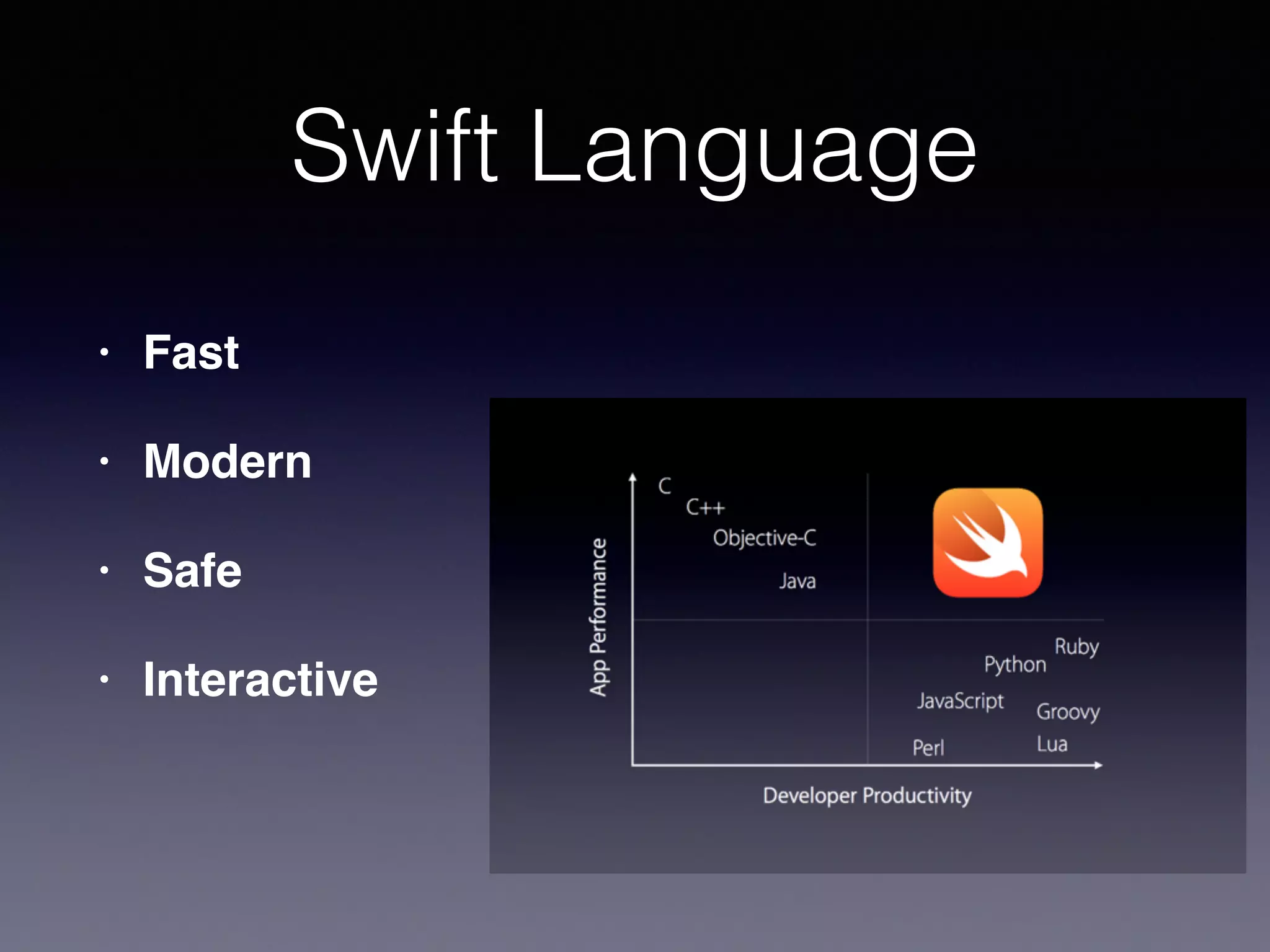
Swift Language 
• Fast! 
• Modern! 
• Safe! 
• Interactive
Fast 
• Swift code is compiled and optimised by the 
advanced LLVM compiler 
• ARM and x86-64 native code 
• Tuned native collections 
• Swift-specific optimiser 
• C-like procedural performance
Modern 
• Clean syntax! 
• No headers! 
• No semicolons ! 
• Multiple return values! 
• Optional arguments ! 
• Closures! 
• Generics
Safe 
• Type safety with type inference! 
• No uninitialized data! 
• Array bounds checks! 
• Restricts direct access to pointers! 
• Automatically manages memory using ARC
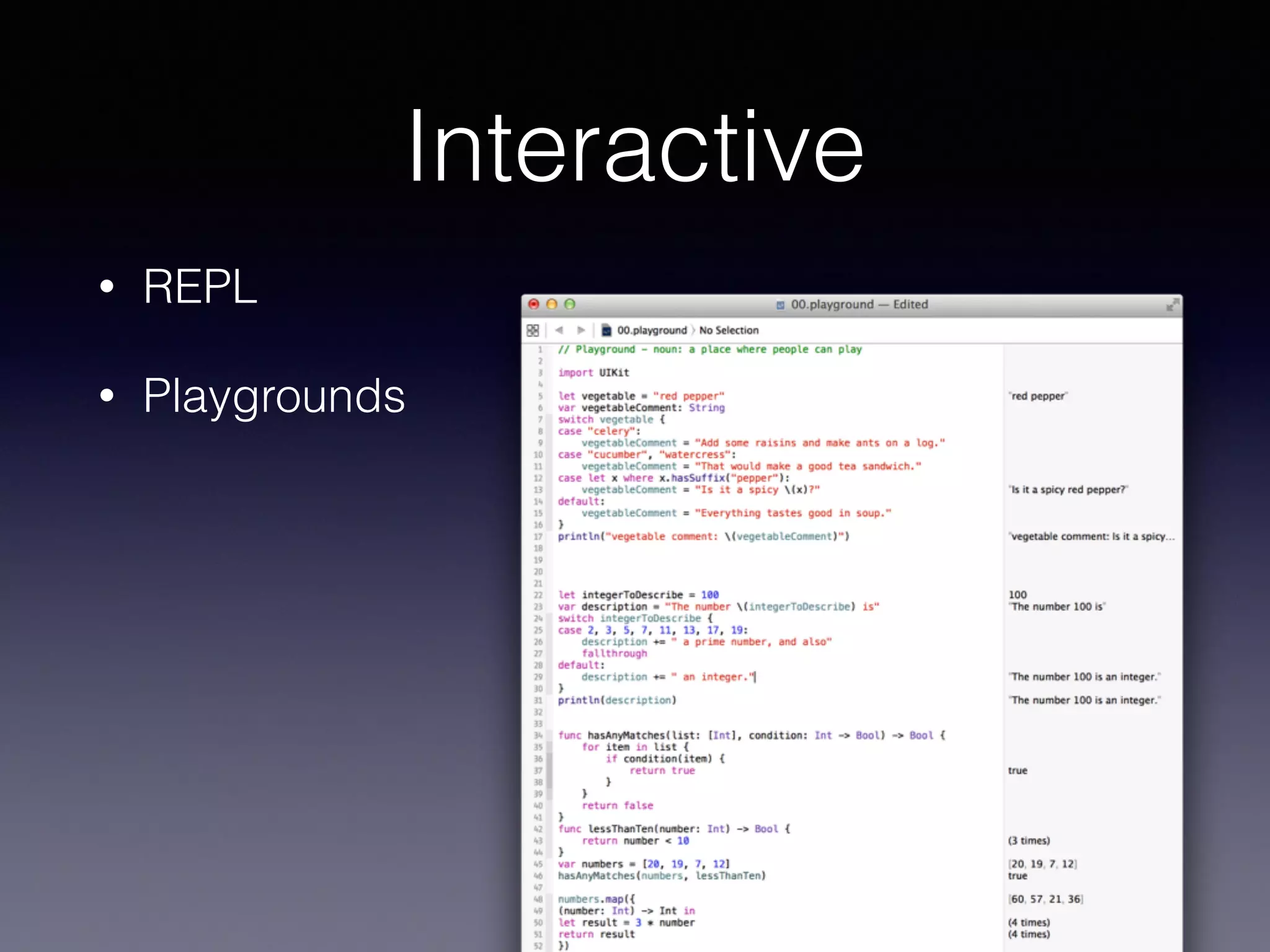
Interactive 
• REPL 
• Playgrounds
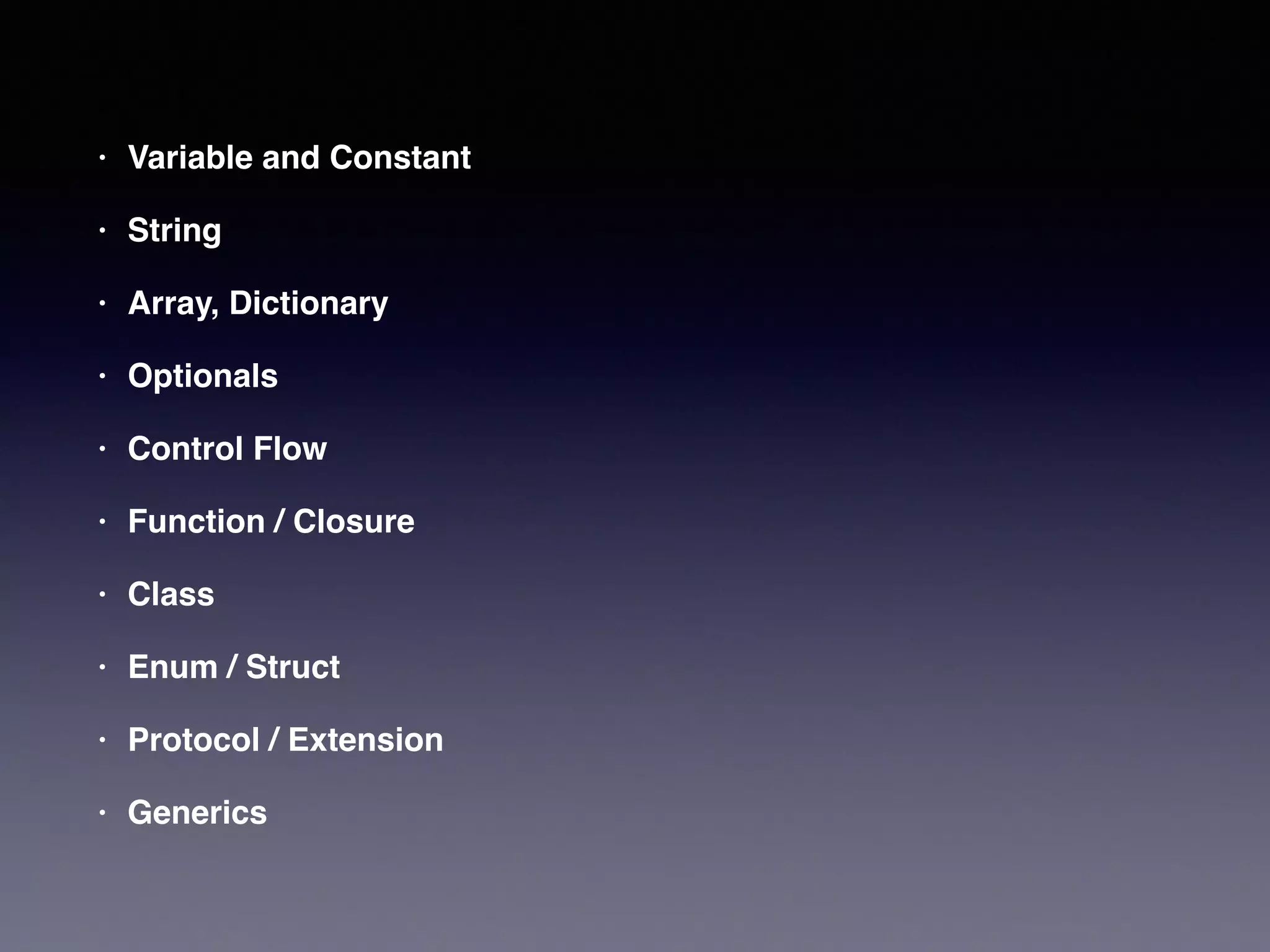
Swift Tour
• Variable and Constant! 
• String! 
• Array, Dictionary! 
• Optionals! 
• Control Flow! 
• Function / Closure! 
• Class! 
• Enum / Struct! 
• Protocol / Extension! 
• Generics
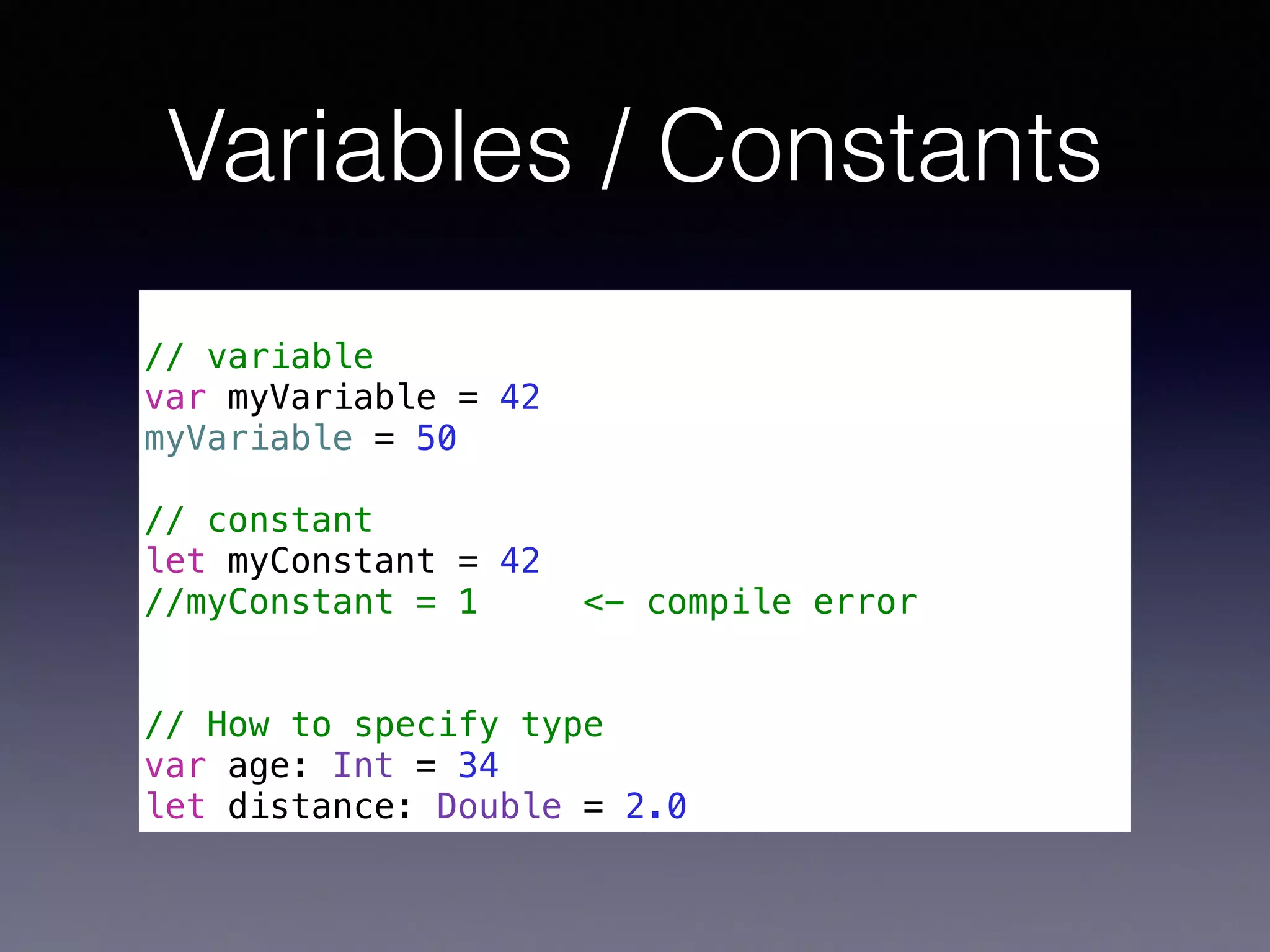
Variables / Constants 
! 
// variable 
var myVariable = 42 
myVariable = 50 
! 
// constant 
let myConstant = 42 
//myConstant = 1 <- compile error 
! 
! 
// How to specify type 
var age: Int = 34 
let distance: Double = 2.0
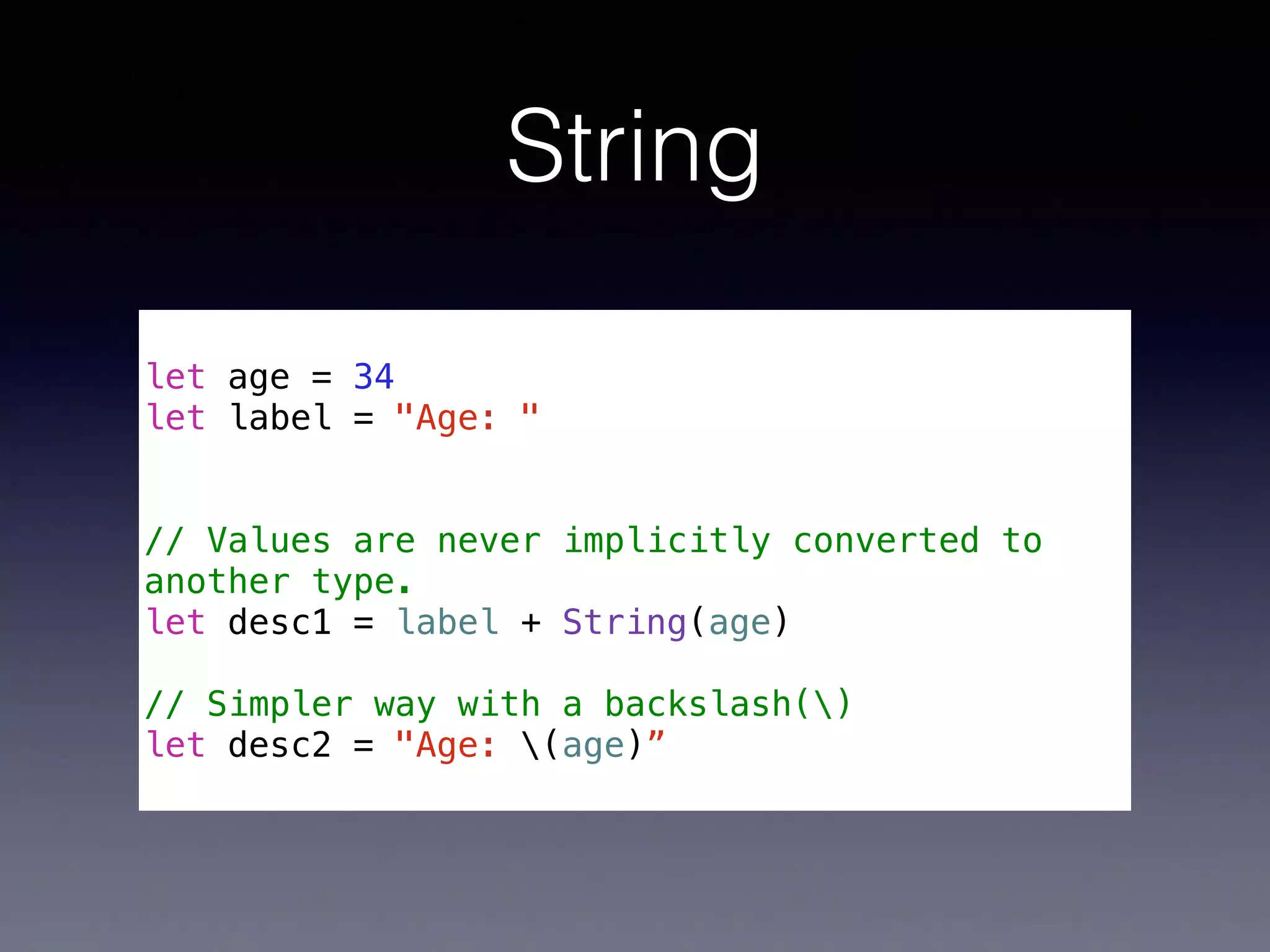
String 
! 
let age = 34 
let label = "Age: " 
! 
! 
// Values are never implicitly converted to 
another type. 
let desc1 = label + String(age) 
! 
// Simpler way with a backslash() 
let desc2 = "Age: (age)”
Array, Dictionary 
! 
// Create arrays and dictionaries using brackets ([]) 
! 
// Array 
var iOSMembers = ["ichinose", "hato", "horimi", 
"tasaka", "watanabe"] 
! 
// Dictionary 
let appMember = ["ios": iOSMembers] 
! 
! 
// Use initializer syntax to create an empty array or 
dictionary 
var emptyArray = [String]() 
var emptyDict = [String: Int]()
Optionals
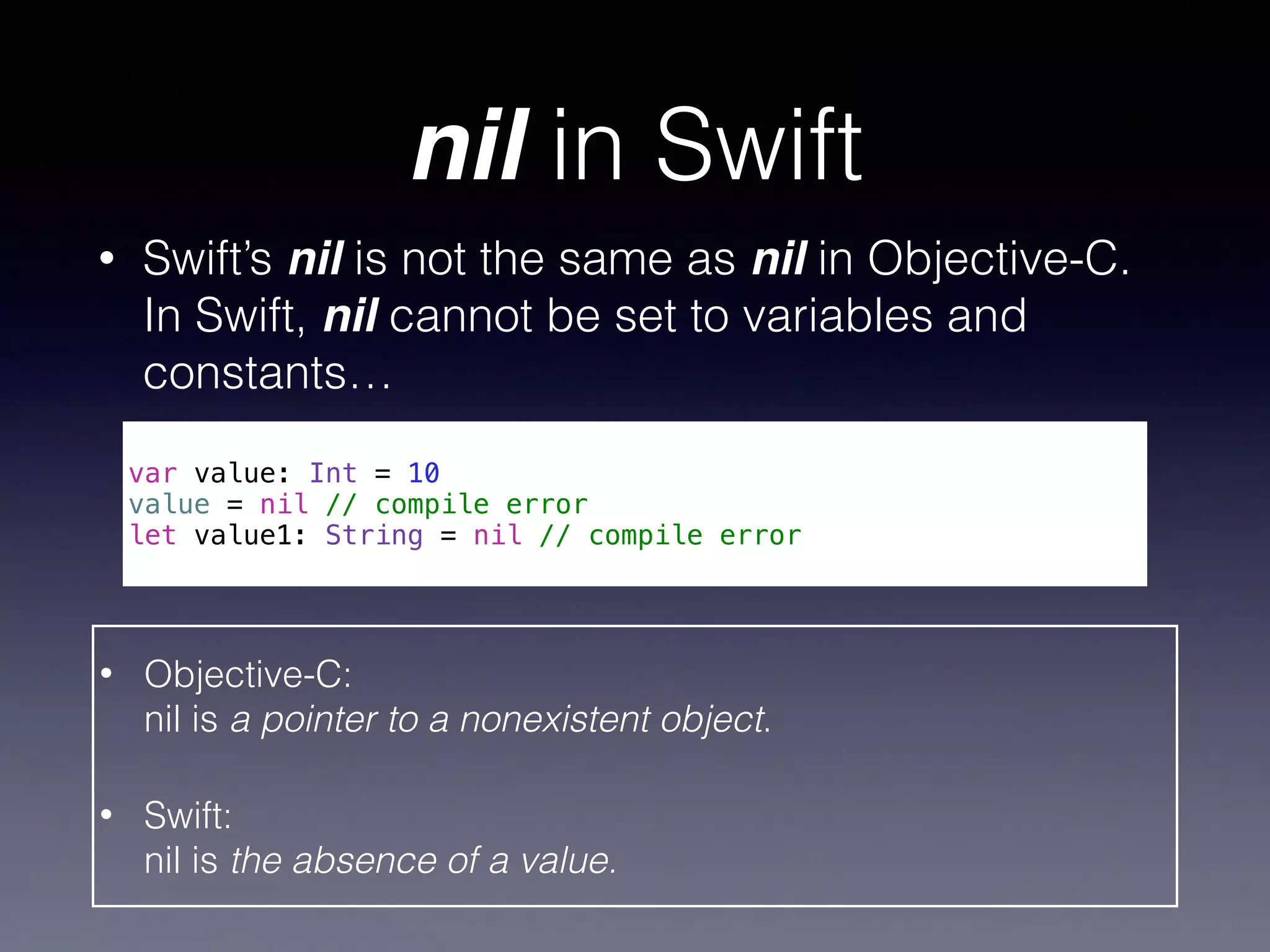
nil in Swift 
• Swift’s nil is not the same as nil in Objective-C. 
In Swift, nil cannot be set to variables and 
constants… 
! 
var value: Int = 10 
value = nil // compile error 
let value1: String = nil // compile error 
• Objective-C: 
nil is a pointer to a nonexistent object. 
• Swift: 
nil is the absence of a value.
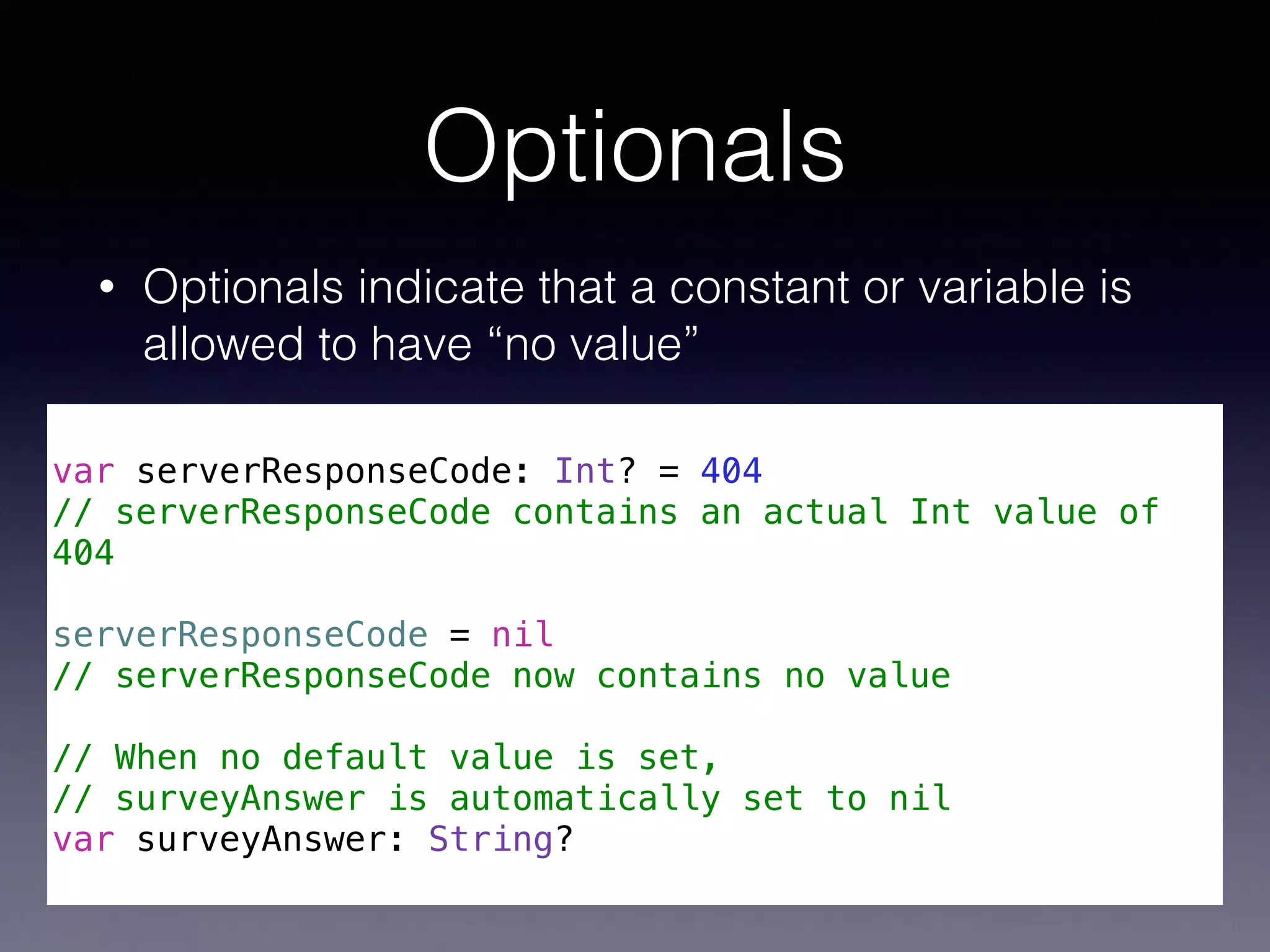
Optionals 
• Optionals indicate that a constant or variable is 
allowed to have “no value” 
! 
var serverResponseCode: Int? = 404 
// serverResponseCode contains an actual Int value of 
404 
! 
serverResponseCode = nil 
// serverResponseCode now contains no value 
! 
// When no default value is set, 
// surveyAnswer is automatically set to nil 
var surveyAnswer: String?
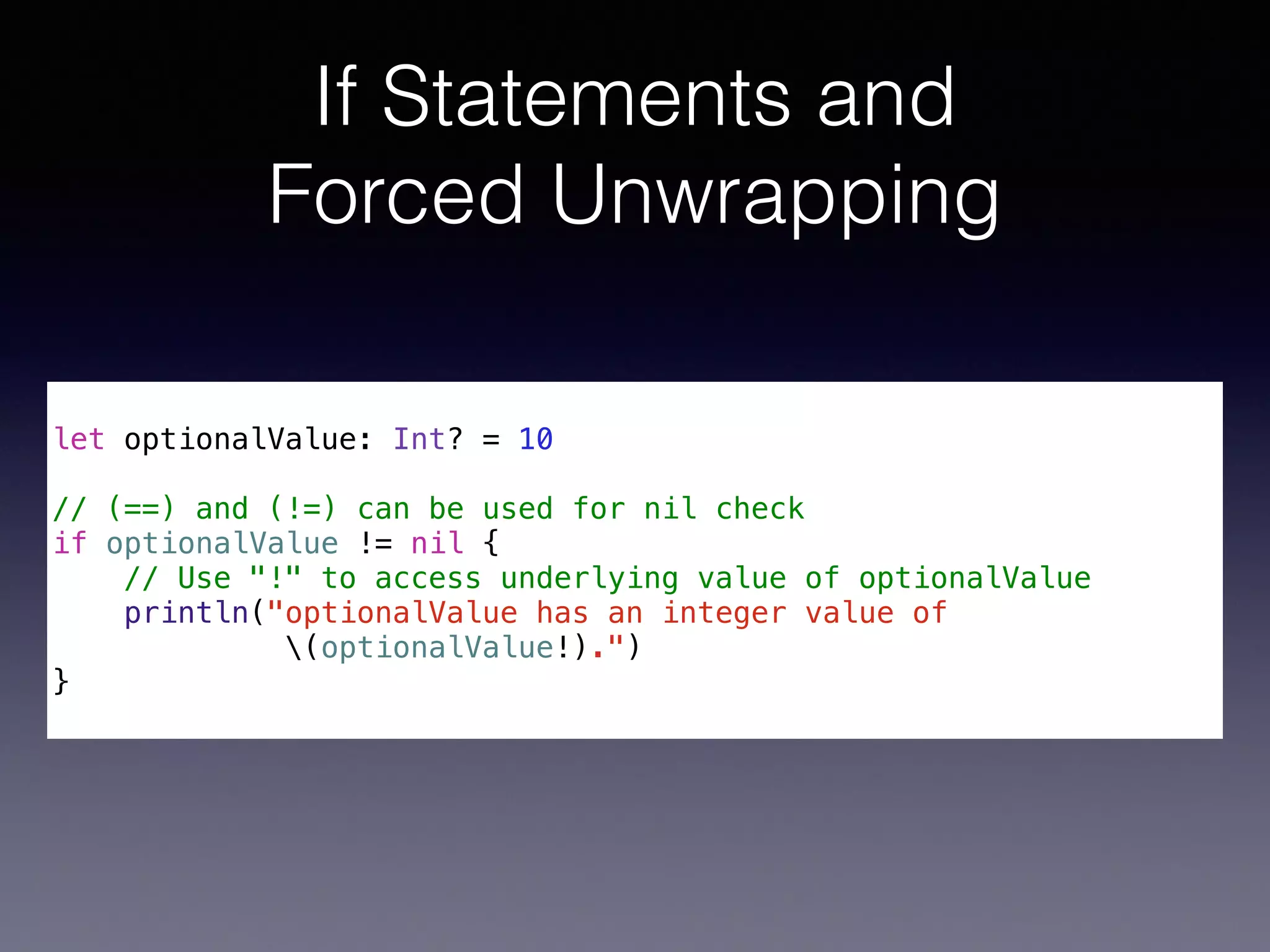
If Statements and 
Forced Unwrapping 
! 
let optionalValue: Int? = 10 
! 
// (==) and (!=) can be used for nil check 
if optionalValue != nil { 
// Use "!" to access underlying value of optionalValue 
println("optionalValue has an integer value of 
(optionalValue!).") 
}
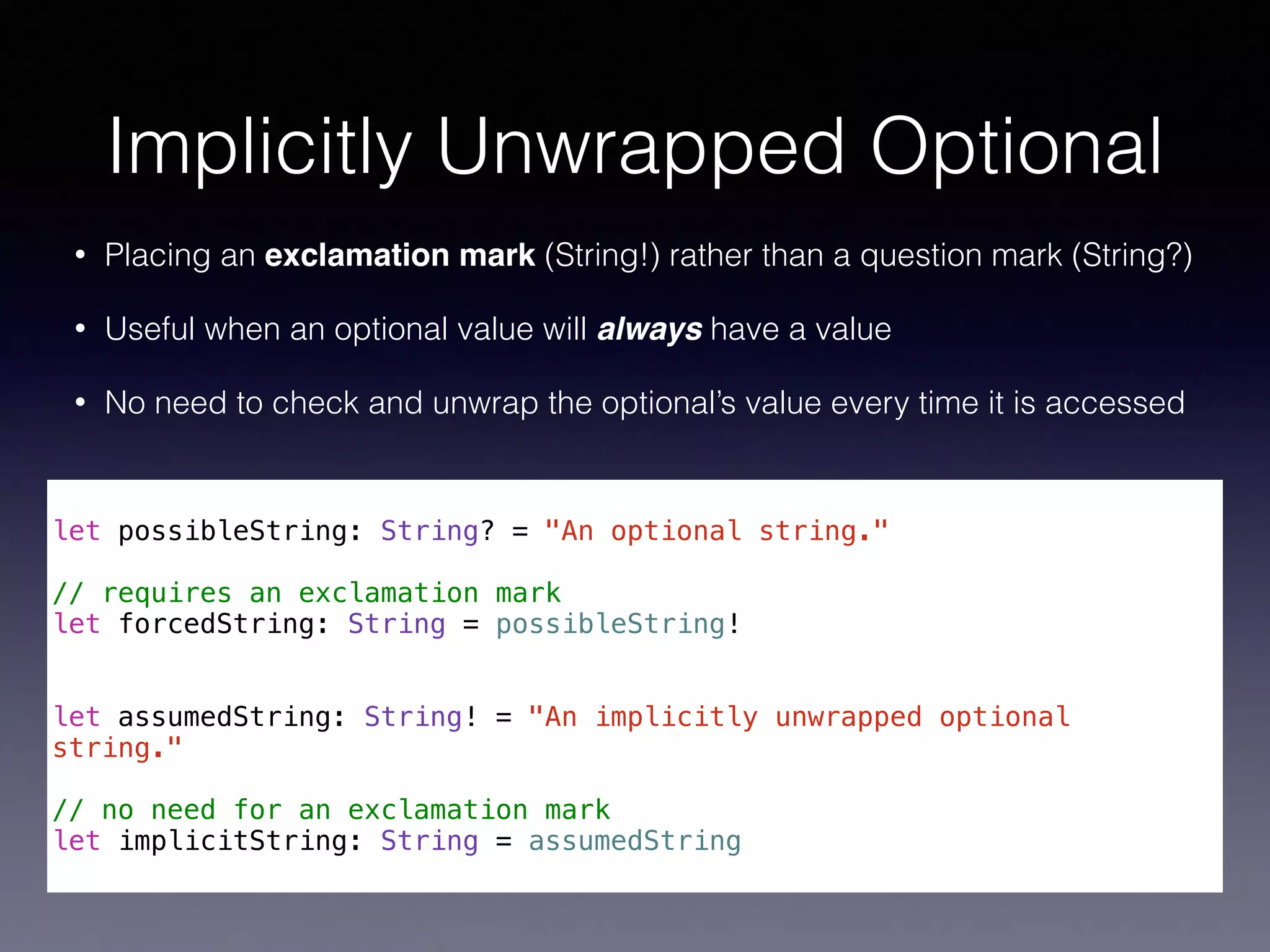
Implicitly Unwrapped Optional 
• Placing an exclamation mark (String!) rather than a question mark (String?) 
• Useful when an optional value will always have a value 
• No need to check and unwrap the optional’s value every time it is accessed 
! 
let possibleString: String? = "An optional string." 
! 
// requires an exclamation mark 
let forcedString: String = possibleString! 
!! 
let assumedString: String! = "An implicitly unwrapped optional 
string." 
! 
// no need for an exclamation mark 
let implicitString: String = assumedString
Control Flow
for 
! 
var firstForLoop = 0 
for i in 0...3 { // equal to 0..<4 
firstForLoop += i 
} 
!! 
let interestingNumbers = [ 
"Prime": [2, 3, 5, 7, 11, 13], 
"Fibonacci": [1, 1, 2, 3, 5, 8], 
] 
var largest = 0 
// key and value can be passed 
for (kind, numbers) in interestingNumbers { 
for number in numbers { 
if number > largest { 
largest = number 
} 
} 
}
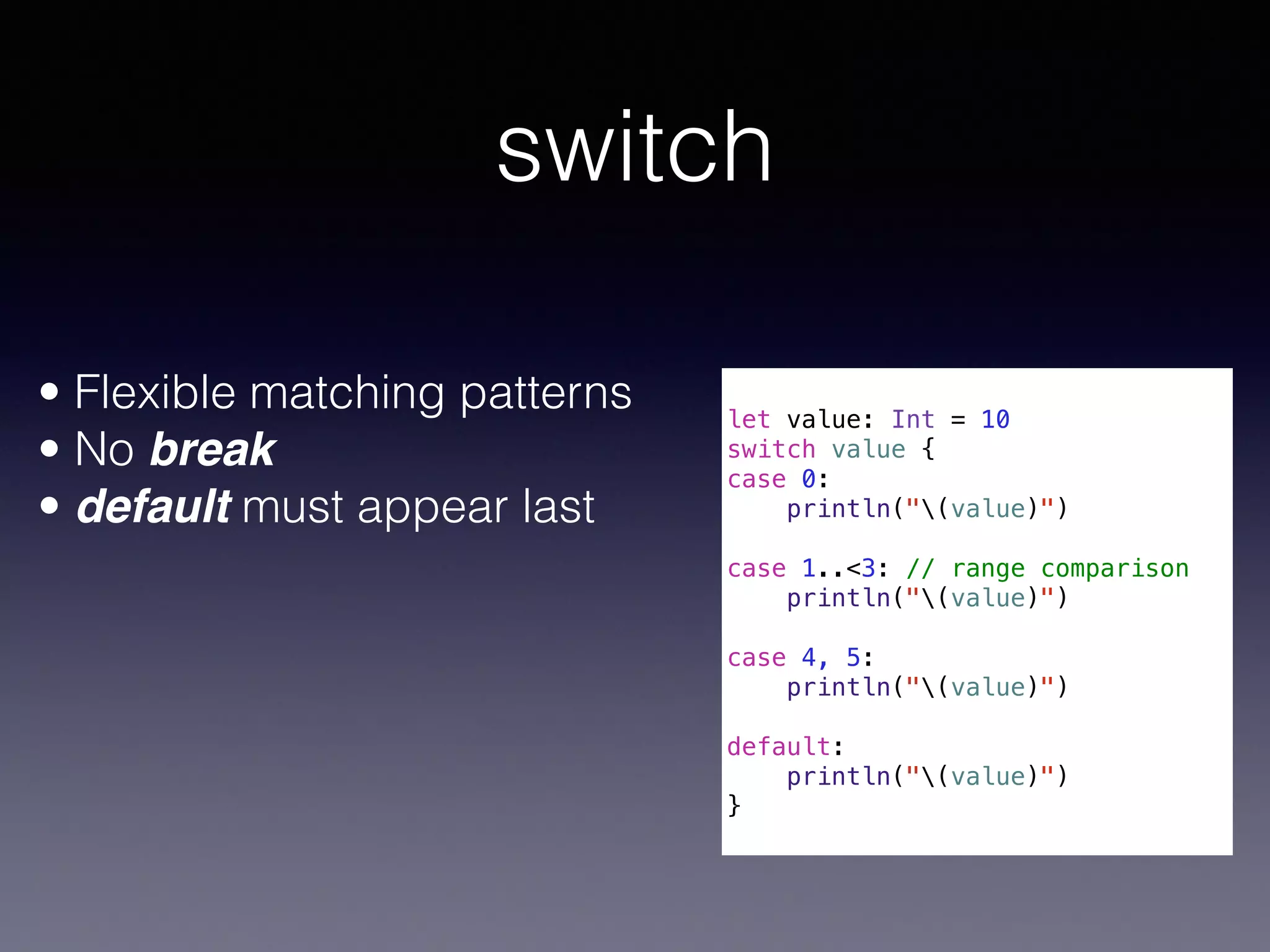
switch 
! 
let value: Int = 10 
switch value { 
case 0: 
println("(value)") 
case 1..<3: // range comparison 
println("(value)") 
case 4, 5: 
println("(value)") 
default: 
println("(value)") 
} 
• Flexible matching patterns 
• No break 
• default must appear last
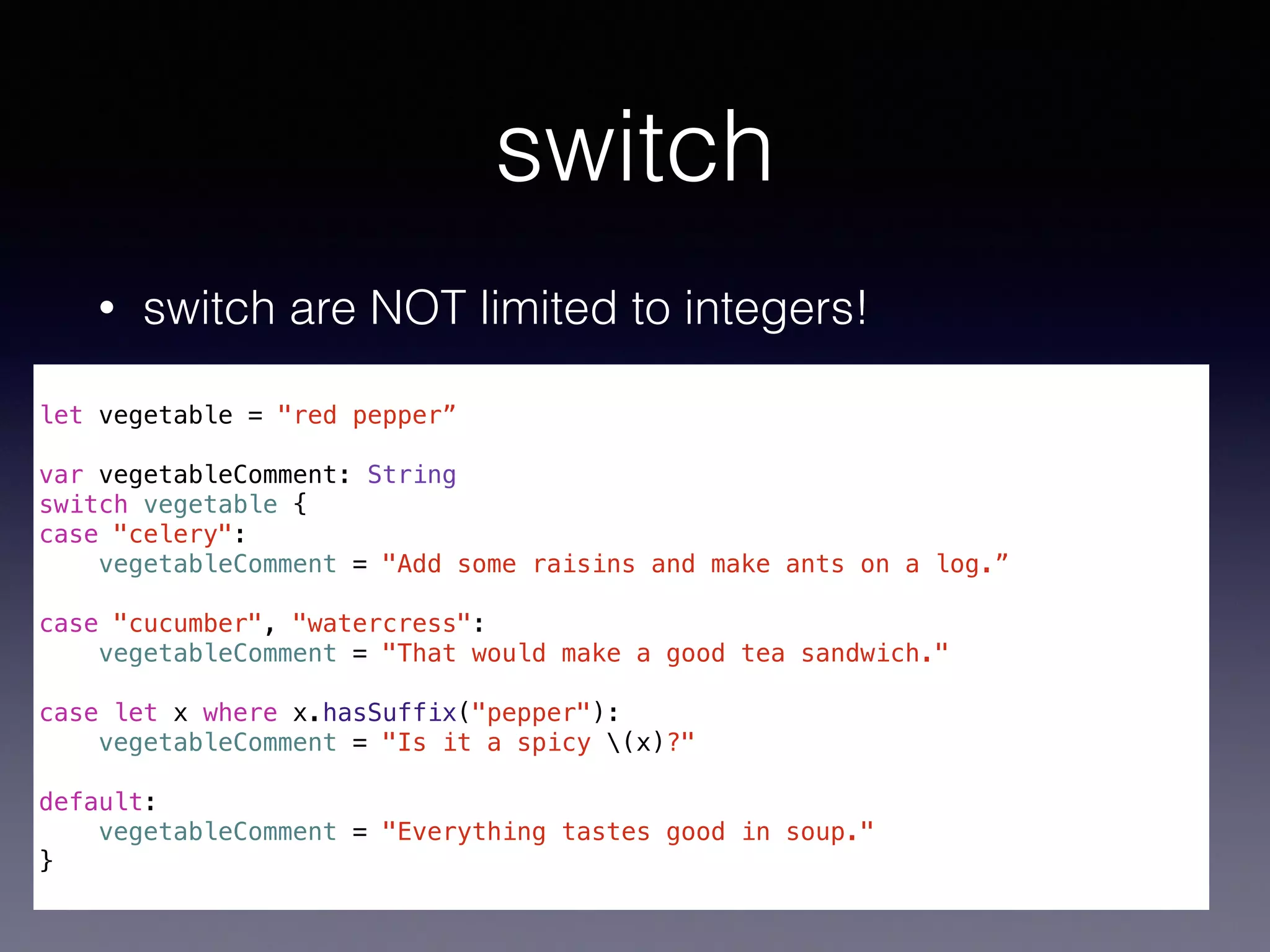
switch 
• switch are NOT limited to integers! 
! 
let vegetable = "red pepper” 
! 
var vegetableComment: String 
switch vegetable { 
case "celery": 
vegetableComment = "Add some raisins and make ants on a log.” 
! 
case "cucumber", "watercress": 
vegetableComment = "That would make a good tea sandwich." 
! 
case let x where x.hasSuffix("pepper"): 
vegetableComment = "Is it a spicy (x)?" 
! 
default: 
vegetableComment = "Everything tastes good in soup." 
}
Functions and Closures
Functions 
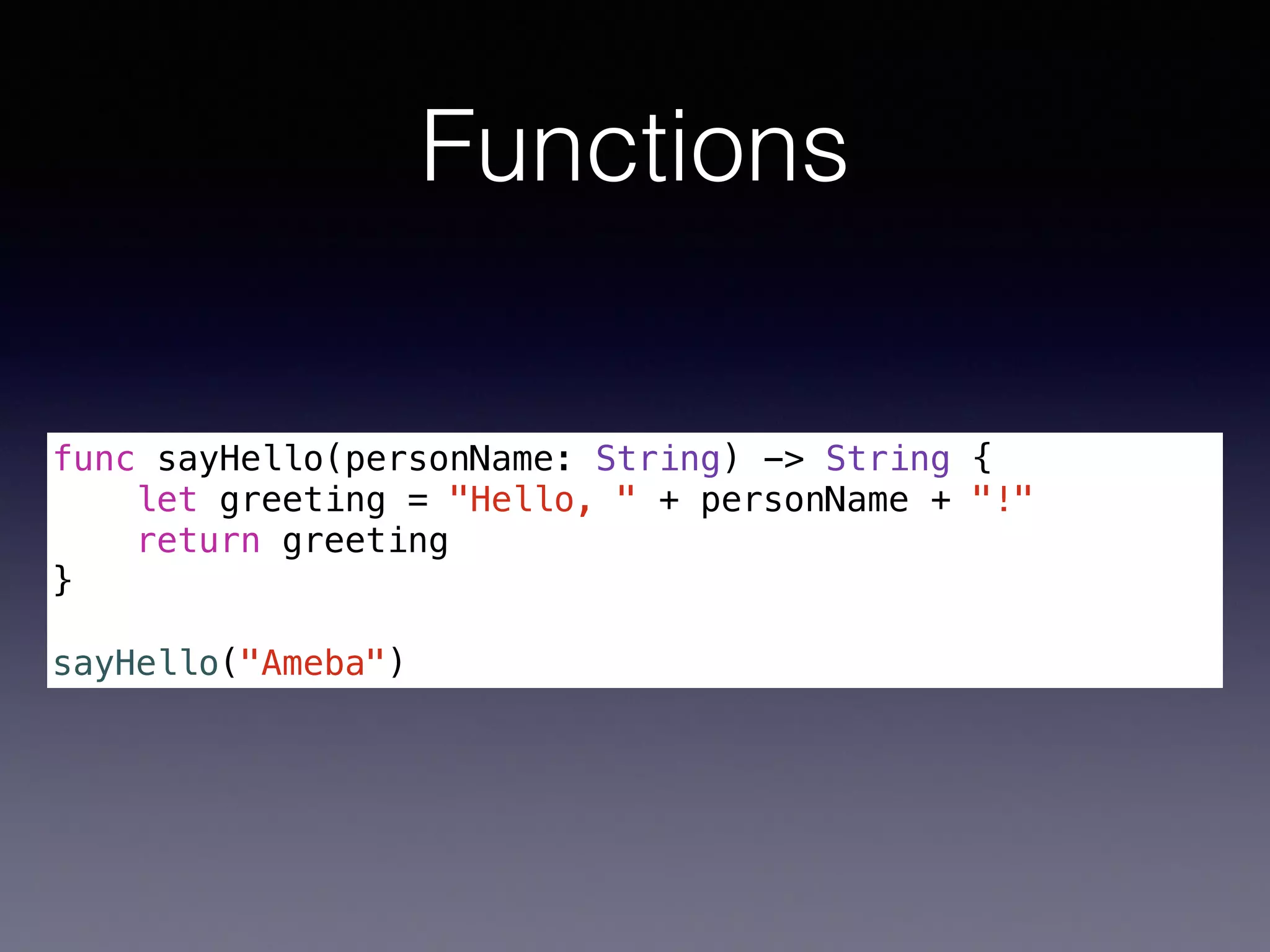
func sayHello(personName: String) -> String { 
let greeting = "Hello, " + personName + "!" 
return greeting 
} 
! 
sayHello("Ameba")
Functions 
• Functions are first-class type. 
// return value 
func makeIncrementer() -> (Int -> Int) { 
func addOne(number: Int) -> Int { 
return 1 + number 
} 
return addOne 
} 
! 
// argument 
func hasAnyMatches(list: [Int], condition: Int -> Bool) -> Bool { 
for item in list { 
if condition(item) { return true } 
} 
return false 
} 
func lessThanTen(number: Int) -> Bool { 
return number < 10 
} 
var numbers = [20, 19, 7, 12] 
hasAnyMatches(numbers, lessThanTen)
Closures 
• Similar to blocks in Objective-C! 
• Simple Syntax 
! 
// Closure Expression Syntax 
{ (parameters) -> return type in 
statements 
} 
! 
// e.g. 
let names = ["horimi", "ichinose", "watanabe", "hato", "tasaka"] 
var reversed = sorted(names, { (s1: String, s2: String) -> Bool in 
return s1 > s2 
})
Closures 
! 
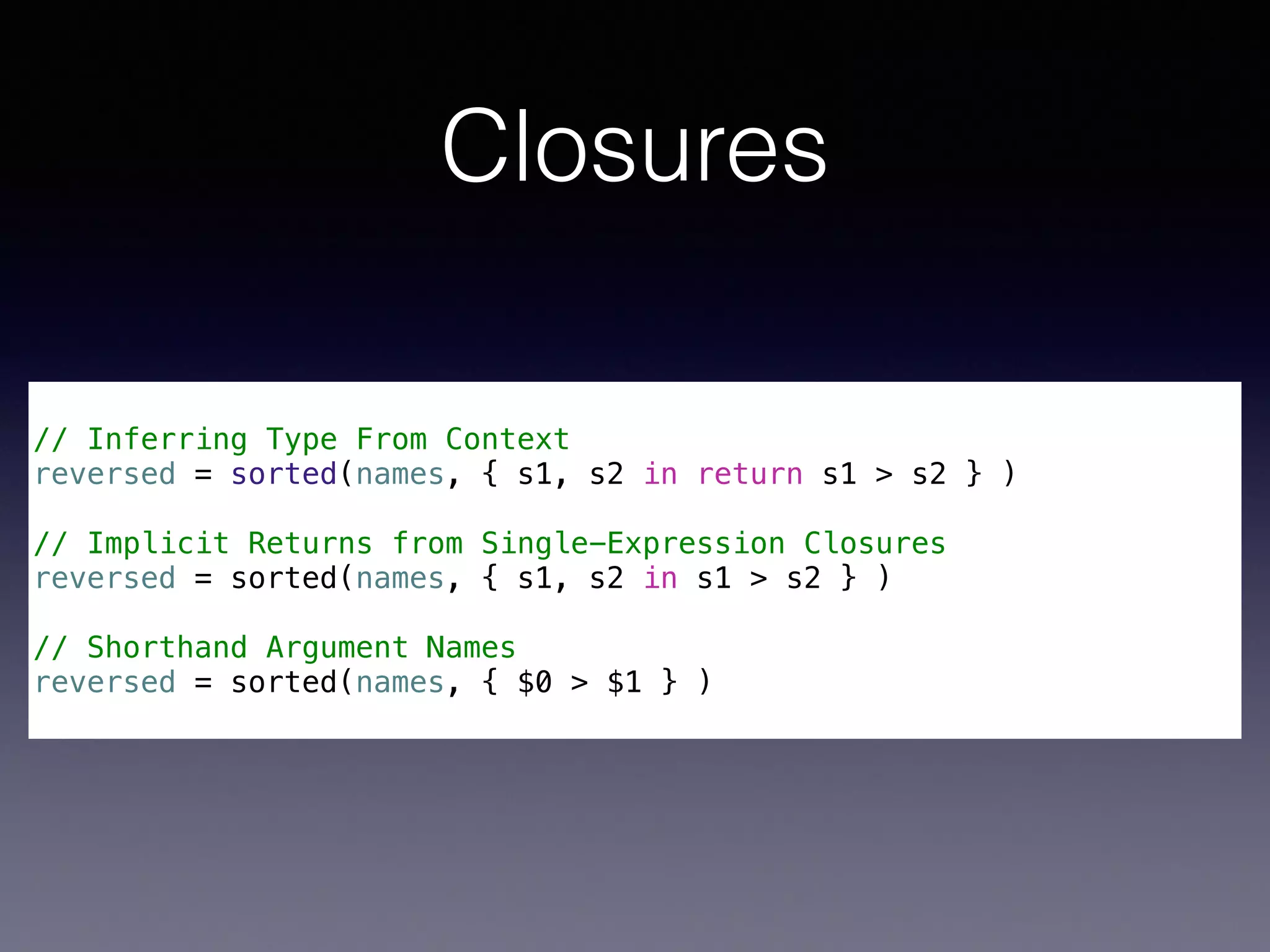
// Inferring Type From Context 
reversed = sorted(names, { s1, s2 in return s1 > s2 } ) 
! 
// Implicit Returns from Single-Expression Closures 
reversed = sorted(names, { s1, s2 in s1 > s2 } ) 
! 
// Shorthand Argument Names 
reversed = sorted(names, { $0 > $1 } )
Class
Class 
! 
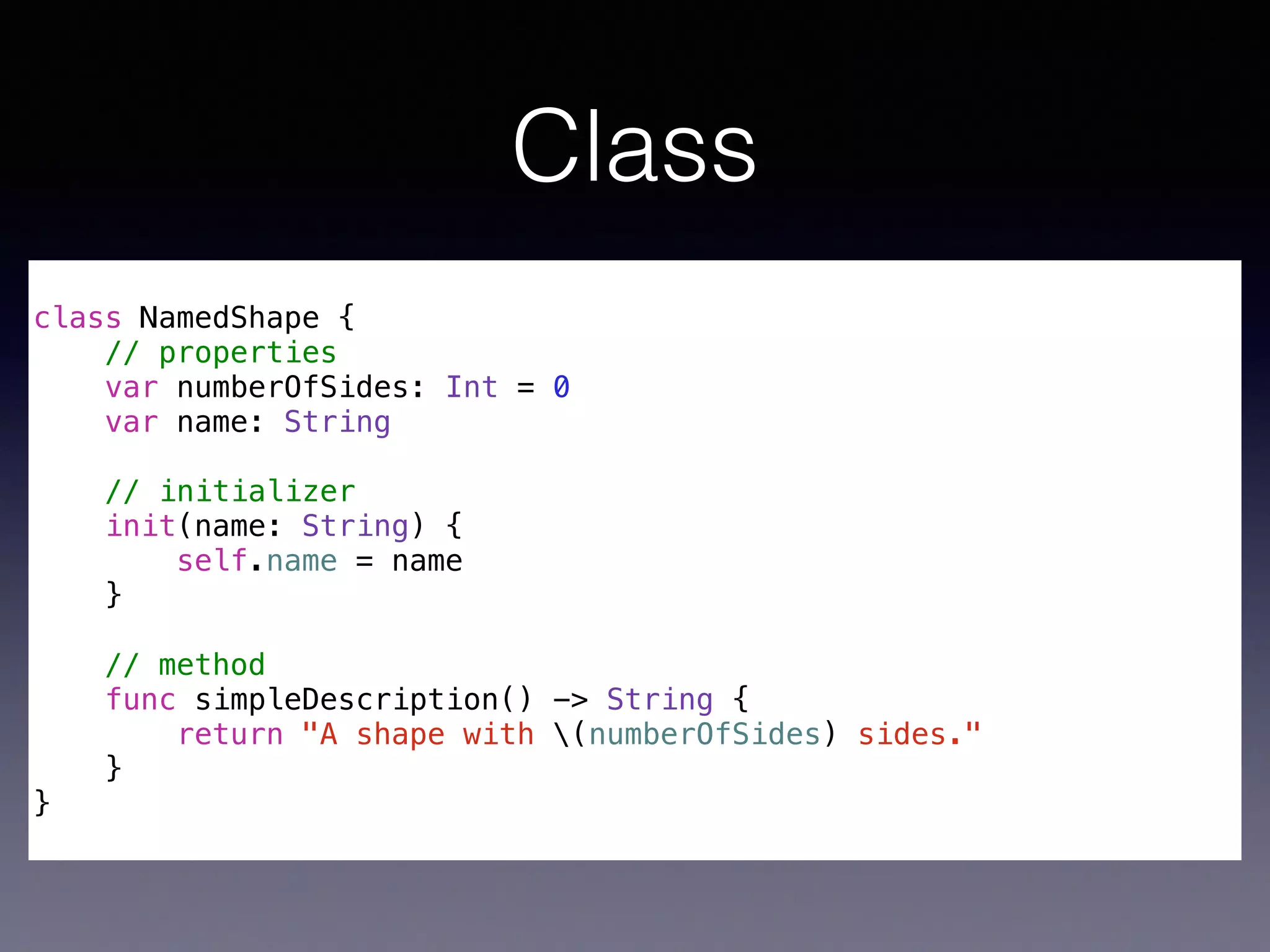
class NamedShape { 
// properties 
var numberOfSides: Int = 0 
var name: String 
// initializer 
init(name: String) { 
self.name = name 
} 
// method 
func simpleDescription() -> String { 
return "A shape with (numberOfSides) sides." 
} 
}
Inheritance 
! 
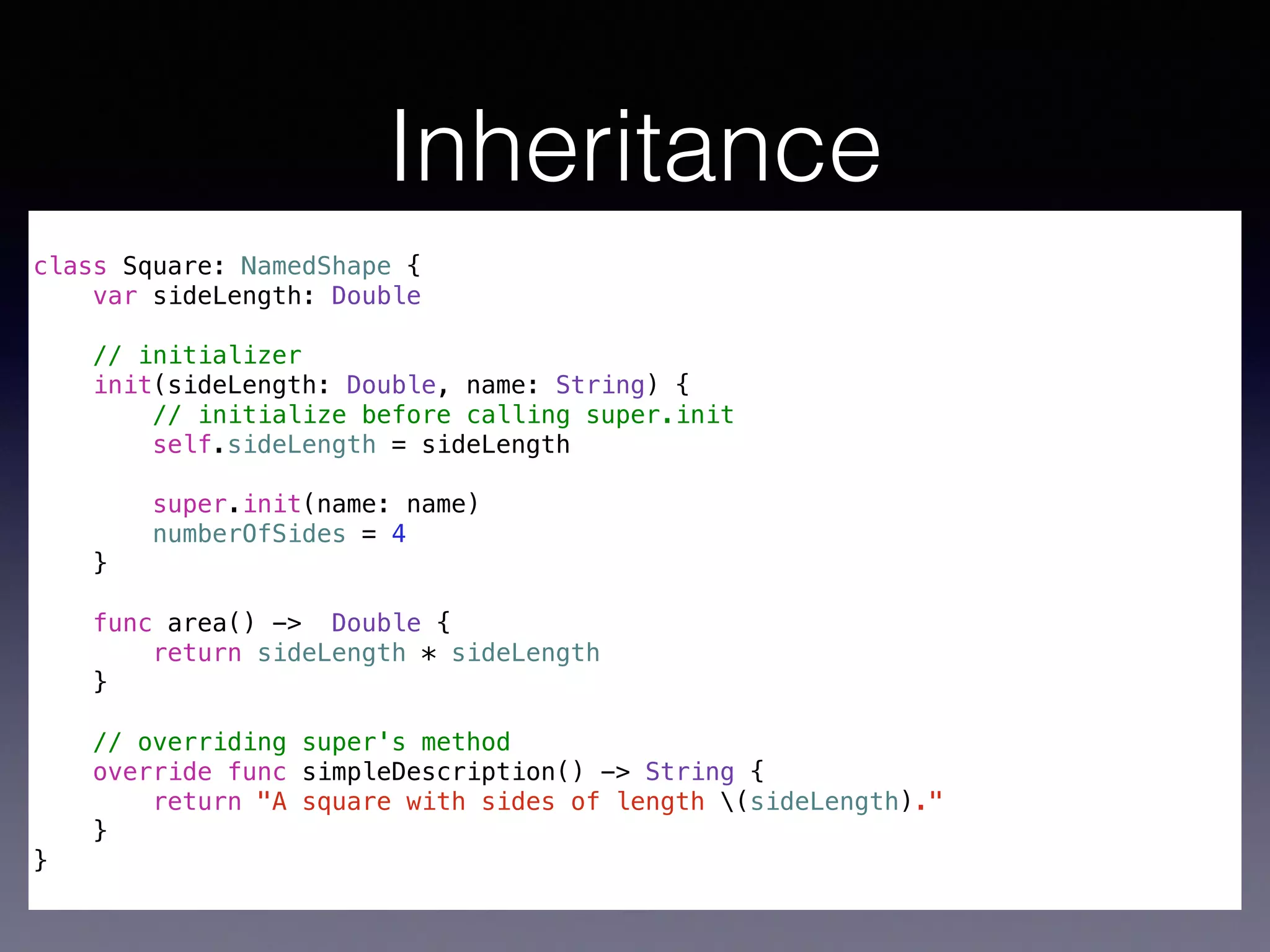
class Square: NamedShape { 
var sideLength: Double 
! 
// initializer 
init(sideLength: Double, name: String) { 
// initialize before calling super.init 
self.sideLength = sideLength 
super.init(name: name) 
numberOfSides = 4 
} 
func area() -> Double { 
return sideLength * sideLength 
} 
// overriding super's method 
override func simpleDescription() -> String { 
return "A square with sides of length (sideLength)." 
} 
}
getter/setter 
! 
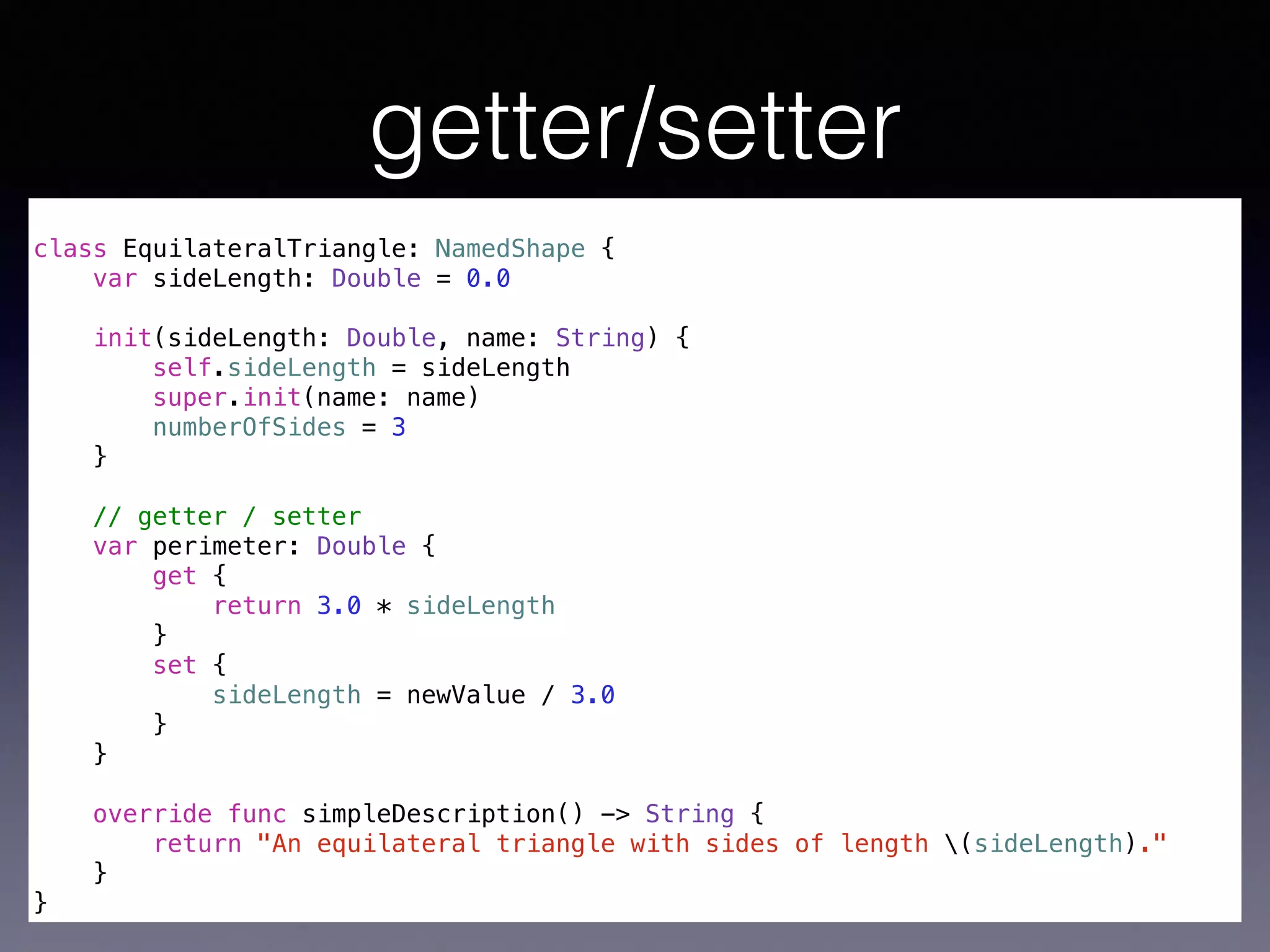
class EquilateralTriangle: NamedShape { 
var sideLength: Double = 0.0 
init(sideLength: Double, name: String) { 
self.sideLength = sideLength 
super.init(name: name) 
numberOfSides = 3 
} 
! 
// getter / setter 
var perimeter: Double { 
get { 
return 3.0 * sideLength 
} 
set { 
sideLength = newValue / 3.0 
} 
} 
override func simpleDescription() -> String { 
return "An equilateral triangle with sides of length (sideLength)." 
} 
}
Property Observers 
! 
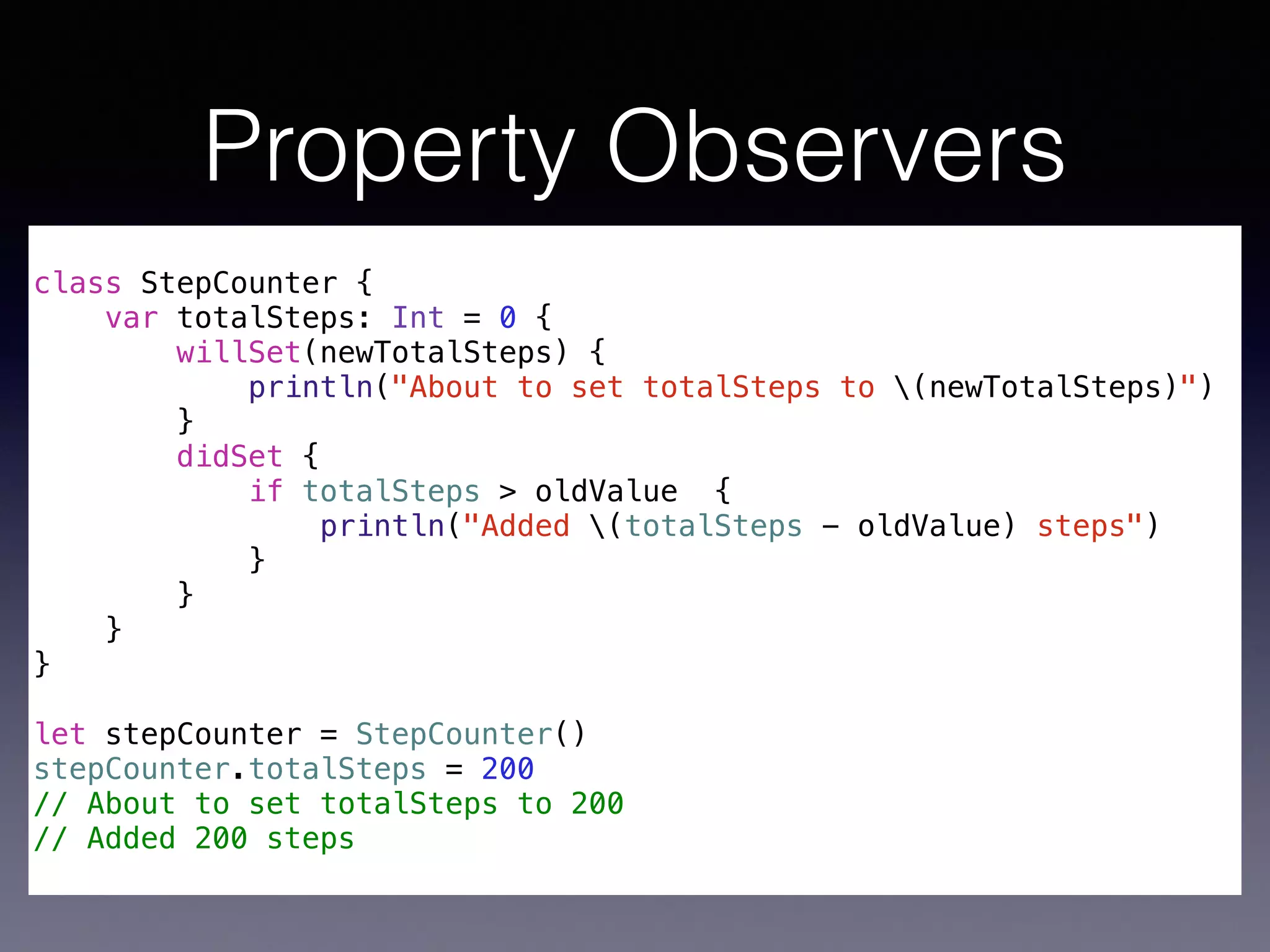
class StepCounter { 
var totalSteps: Int = 0 { 
willSet(newTotalSteps) { 
println("About to set totalSteps to (newTotalSteps)") 
} 
didSet { 
if totalSteps > oldValue { 
println("Added (totalSteps - oldValue) steps") 
} 
} 
} 
} 
! 
let stepCounter = StepCounter() 
stepCounter.totalSteps = 200 
// About to set totalSteps to 200 
// Added 200 steps
Enum and Struct
Enum 
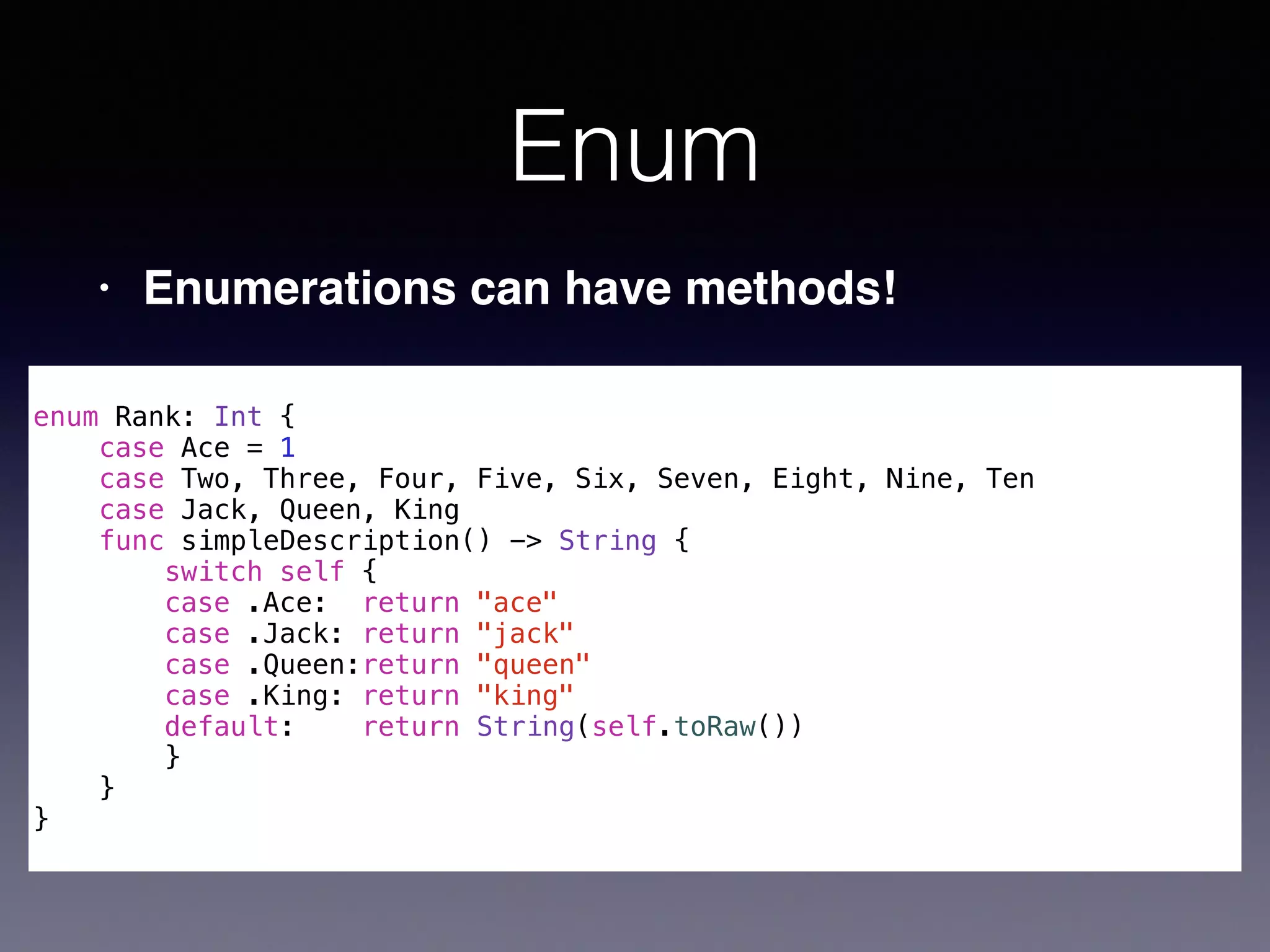
• Enumerations can have methods! 
! 
enum Rank: Int { 
case Ace = 1 
case Two, Three, Four, Five, Six, Seven, Eight, Nine, Ten 
case Jack, Queen, King 
func simpleDescription() -> String { 
switch self { 
case .Ace: return "ace" 
case .Jack: return "jack" 
case .Queen:return "queen" 
case .King: return "king" 
default: return String(self.toRaw()) 
} 
} 
}
Struct 
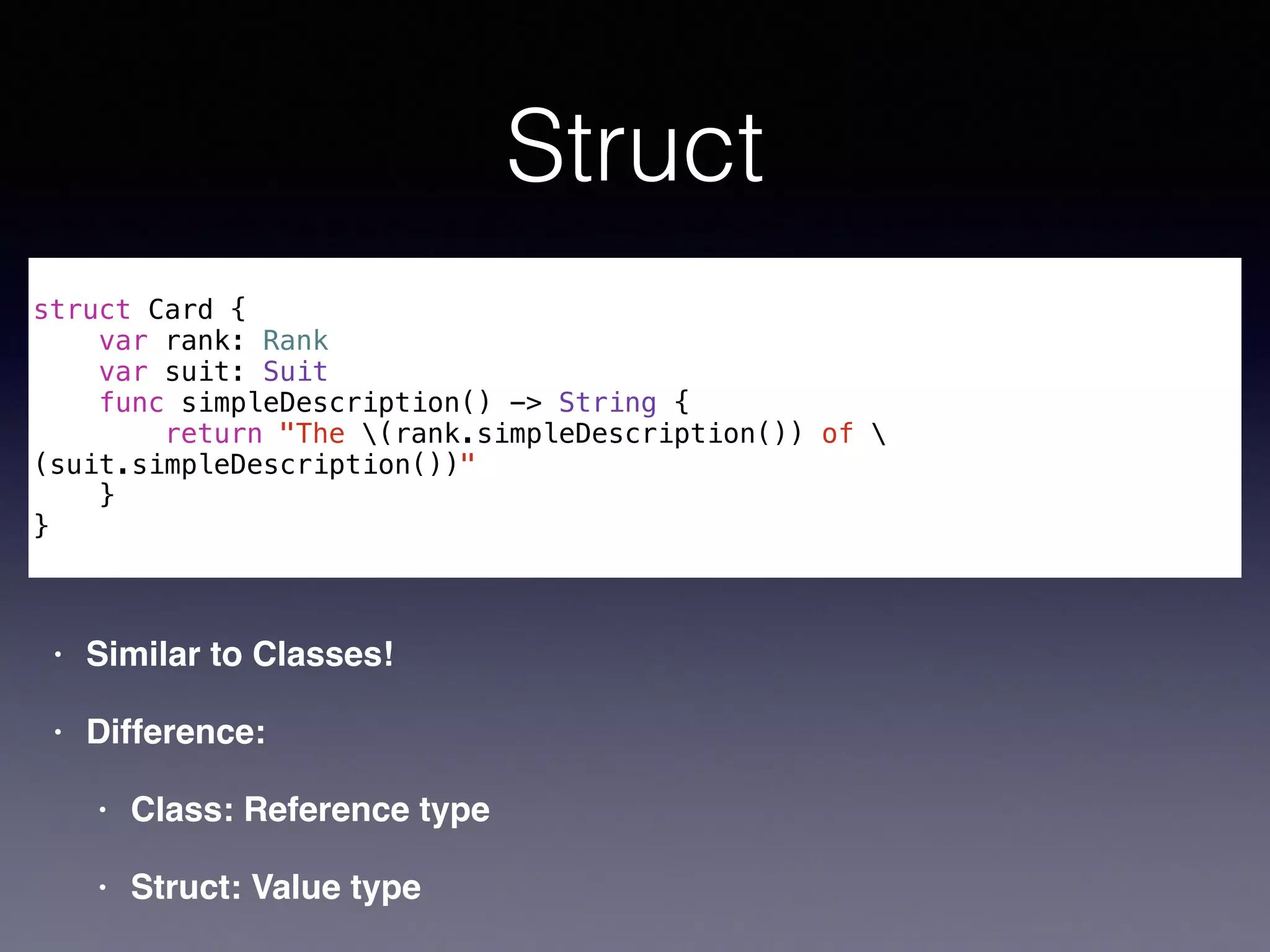
! 
struct Card { 
var rank: Rank 
var suit: Suit 
func simpleDescription() -> String { 
return "The (rank.simpleDescription()) of  
(suit.simpleDescription())" 
} 
} 
• Similar to Classes!! 
• Difference:! 
• Class: Reference type! 
• Struct: Value type
Protocols and Extensions
Protocols 
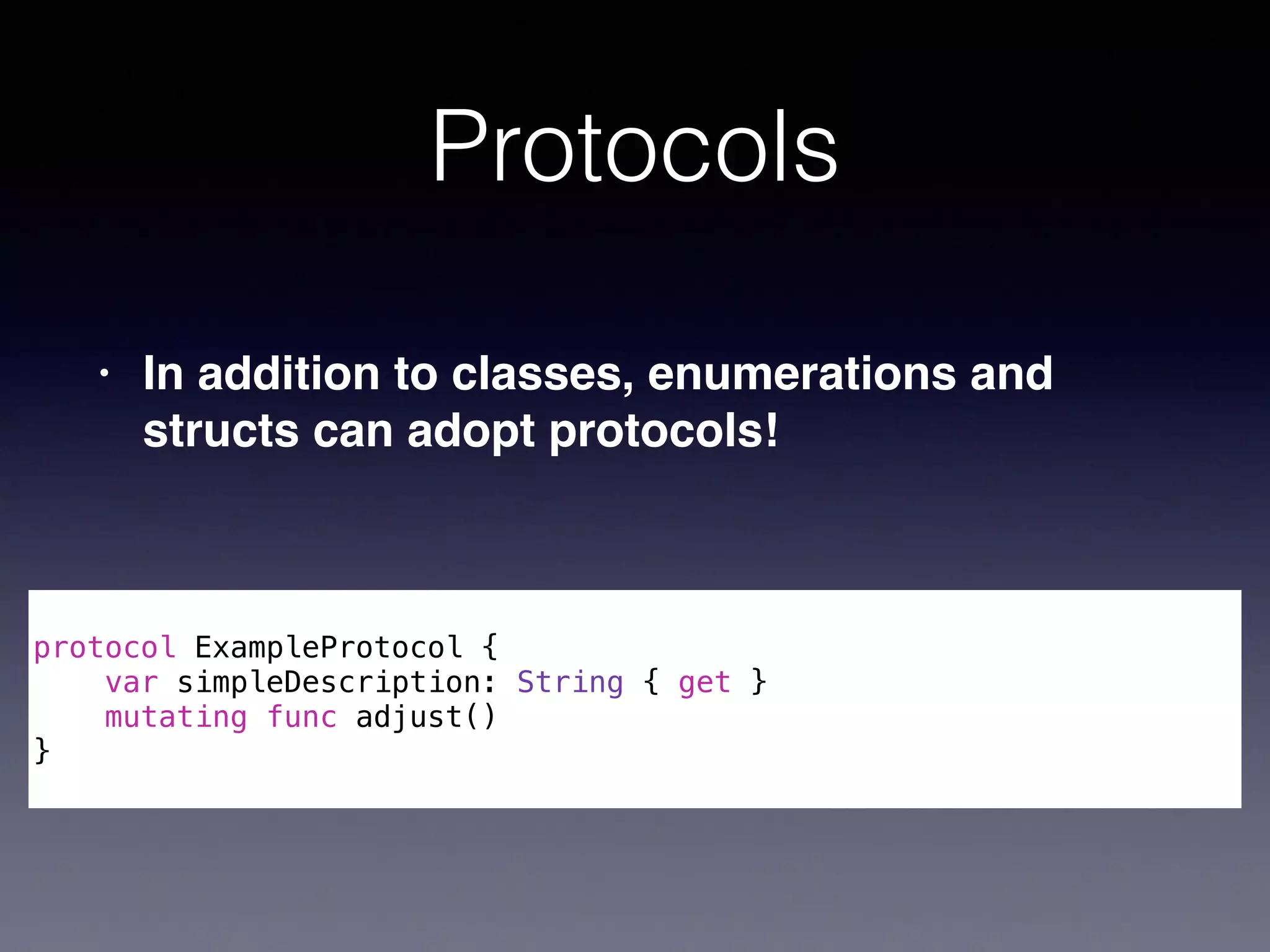
! 
protocol ExampleProtocol { 
var simpleDescription: String { get } 
mutating func adjust() 
} 
• In addition to classes, enumerations and 
structs can adopt protocols!
Protocols 
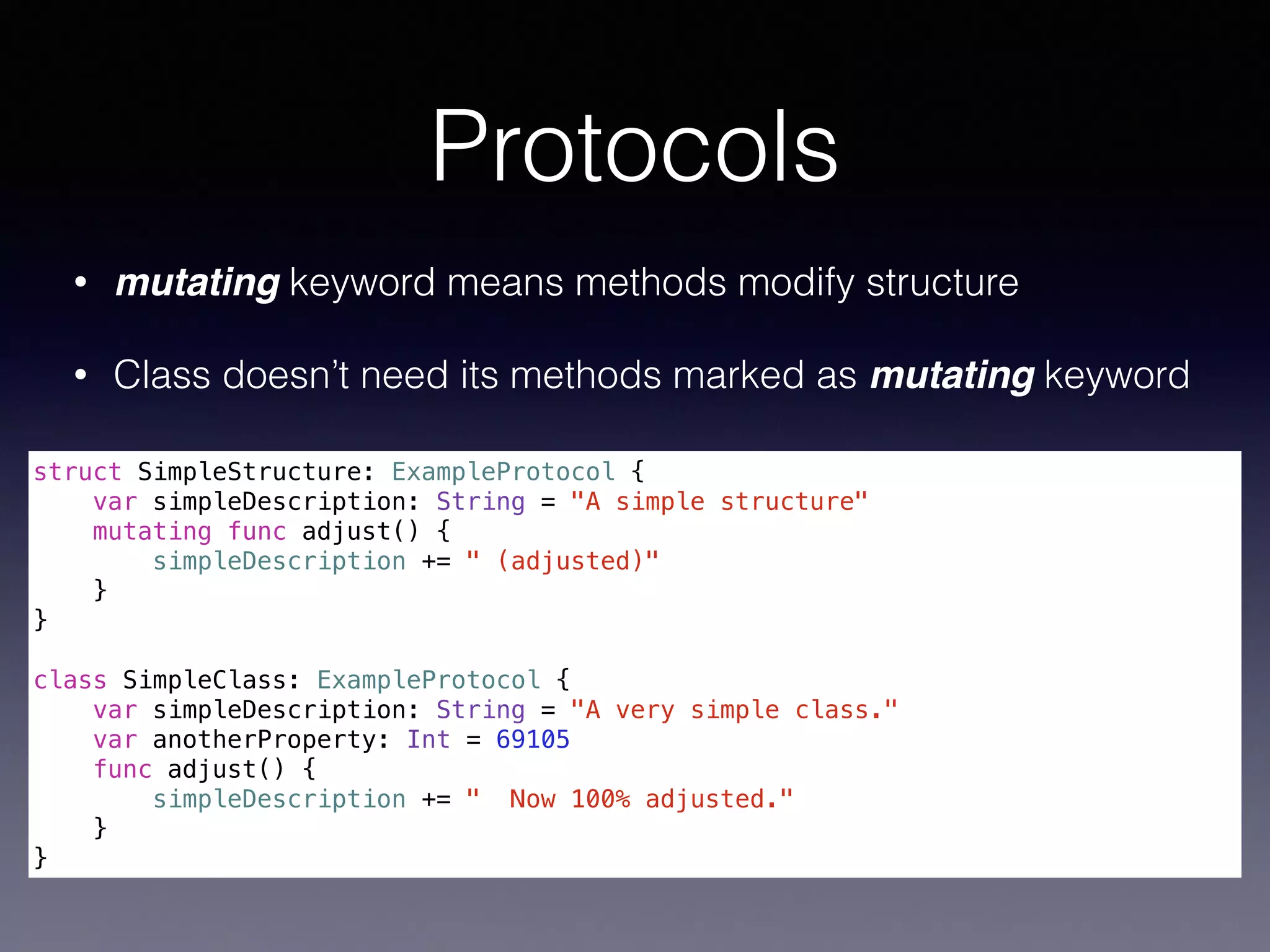
struct SimpleStructure: ExampleProtocol { 
var simpleDescription: String = "A simple structure" 
mutating func adjust() { 
simpleDescription += " (adjusted)" 
} 
} 
! 
class SimpleClass: ExampleProtocol { 
var simpleDescription: String = "A very simple class." 
var anotherProperty: Int = 69105 
func adjust() { 
simpleDescription += " Now 100% adjusted." 
} 
} 
• mutating keyword means methods modify structure 
• Class doesn’t need its methods marked as mutating keyword
Extensions 
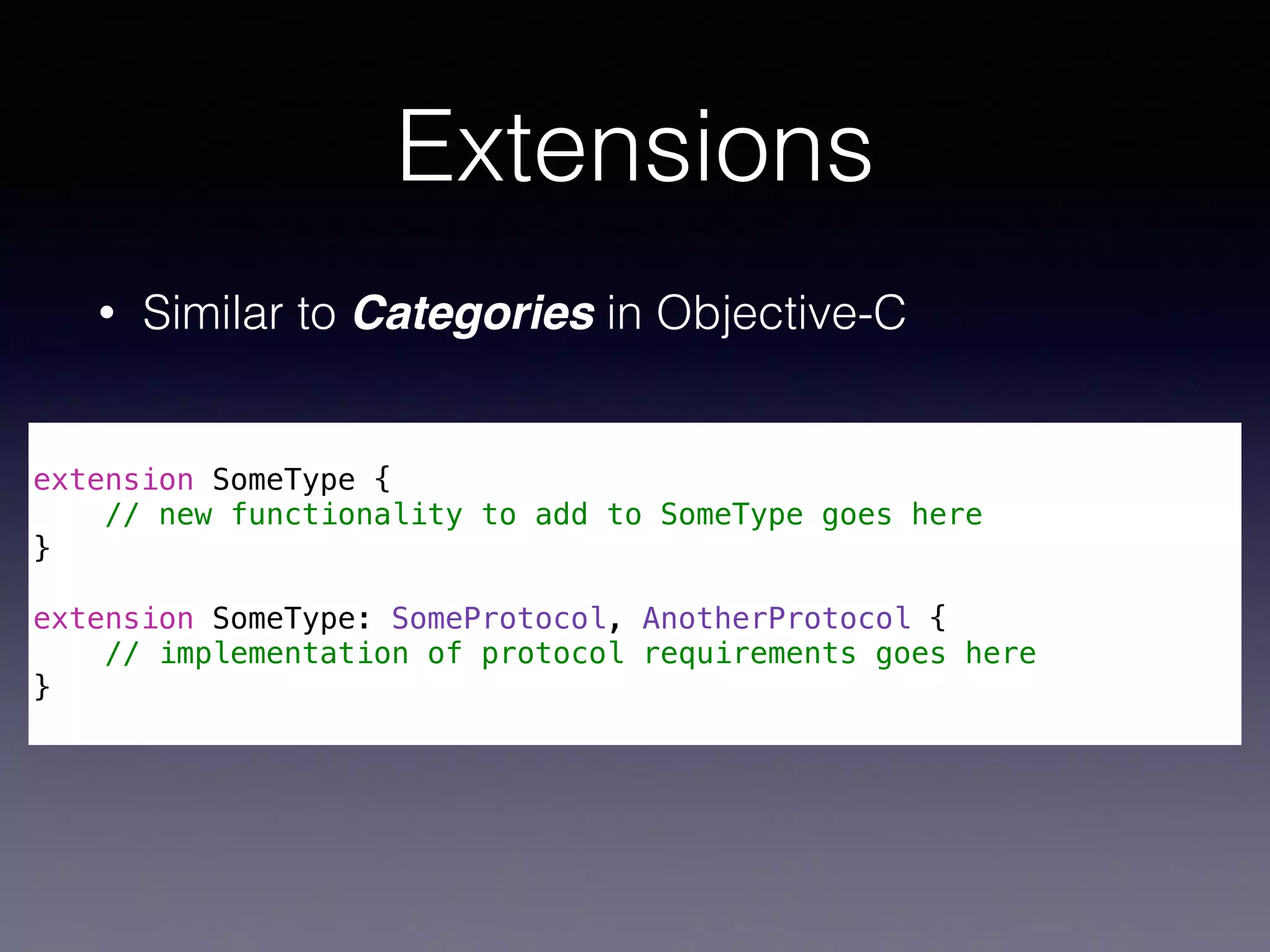
• Similar to Categories in Objective-C 
! 
extension SomeType { 
// new functionality to add to SomeType goes here 
} 
! 
extension SomeType: SomeProtocol, AnotherProtocol { 
// implementation of protocol requirements goes here 
}
Generics 
• Generics is Template in C++ 
• Much of the Swift standard library is built with generic code 
! 
func repeat<ItemType>(item: ItemType, times: Int) -> [ItemType] { 
var result = [ItemType]() 
for i in 0..<times { 
result += item 
} 
return result 
} 
repeat("knock", 4)
Wrap Up 
• Looking through basic Swift features 
• Non Objective-C can get familiar, maybe. 
• To Learn Swift, 
check out The Swift Programming Language. 
https://developer.apple.com/library/ios/ 
documentation/Swift/Conceptual/ 
Swift_Programming_Language/
Thank you!

Quick swift tour

  • 1.
  • 2.
    Swift Language •Fast! • Modern! • Safe! • Interactive
  • 3.
    Fast • Swiftcode is compiled and optimised by the advanced LLVM compiler • ARM and x86-64 native code • Tuned native collections • Swift-specific optimiser • C-like procedural performance
  • 4.
    Modern • Cleansyntax! • No headers! • No semicolons ! • Multiple return values! • Optional arguments ! • Closures! • Generics
  • 5.
    Safe • Typesafety with type inference! • No uninitialized data! • Array bounds checks! • Restricts direct access to pointers! • Automatically manages memory using ARC
  • 6.
    Interactive • REPL • Playgrounds
  • 7.
  • 8.
    • Variable andConstant! • String! • Array, Dictionary! • Optionals! • Control Flow! • Function / Closure! • Class! • Enum / Struct! • Protocol / Extension! • Generics
  • 9.
    Variables / Constants ! // variable var myVariable = 42 myVariable = 50 ! // constant let myConstant = 42 //myConstant = 1 <- compile error ! ! // How to specify type var age: Int = 34 let distance: Double = 2.0
  • 10.
    String ! letage = 34 let label = "Age: " ! ! // Values are never implicitly converted to another type. let desc1 = label + String(age) ! // Simpler way with a backslash() let desc2 = "Age: (age)”
  • 11.
    Array, Dictionary ! // Create arrays and dictionaries using brackets ([]) ! // Array var iOSMembers = ["ichinose", "hato", "horimi", "tasaka", "watanabe"] ! // Dictionary let appMember = ["ios": iOSMembers] ! ! // Use initializer syntax to create an empty array or dictionary var emptyArray = [String]() var emptyDict = [String: Int]()
  • 12.
  • 13.
    nil in Swift • Swift’s nil is not the same as nil in Objective-C. In Swift, nil cannot be set to variables and constants… ! var value: Int = 10 value = nil // compile error let value1: String = nil // compile error • Objective-C: nil is a pointer to a nonexistent object. • Swift: nil is the absence of a value.
  • 14.
    Optionals • Optionalsindicate that a constant or variable is allowed to have “no value” ! var serverResponseCode: Int? = 404 // serverResponseCode contains an actual Int value of 404 ! serverResponseCode = nil // serverResponseCode now contains no value ! // When no default value is set, // surveyAnswer is automatically set to nil var surveyAnswer: String?
  • 15.
    If Statements and Forced Unwrapping ! let optionalValue: Int? = 10 ! // (==) and (!=) can be used for nil check if optionalValue != nil { // Use "!" to access underlying value of optionalValue println("optionalValue has an integer value of (optionalValue!).") }
  • 16.
    Implicitly Unwrapped Optional • Placing an exclamation mark (String!) rather than a question mark (String?) • Useful when an optional value will always have a value • No need to check and unwrap the optional’s value every time it is accessed ! let possibleString: String? = "An optional string." ! // requires an exclamation mark let forcedString: String = possibleString! !! let assumedString: String! = "An implicitly unwrapped optional string." ! // no need for an exclamation mark let implicitString: String = assumedString
  • 17.
  • 18.
    for ! varfirstForLoop = 0 for i in 0...3 { // equal to 0..<4 firstForLoop += i } !! let interestingNumbers = [ "Prime": [2, 3, 5, 7, 11, 13], "Fibonacci": [1, 1, 2, 3, 5, 8], ] var largest = 0 // key and value can be passed for (kind, numbers) in interestingNumbers { for number in numbers { if number > largest { largest = number } } }
  • 19.
    switch ! letvalue: Int = 10 switch value { case 0: println("(value)") case 1..<3: // range comparison println("(value)") case 4, 5: println("(value)") default: println("(value)") } • Flexible matching patterns • No break • default must appear last
  • 20.
    switch • switchare NOT limited to integers! ! let vegetable = "red pepper” ! var vegetableComment: String switch vegetable { case "celery": vegetableComment = "Add some raisins and make ants on a log.” ! case "cucumber", "watercress": vegetableComment = "That would make a good tea sandwich." ! case let x where x.hasSuffix("pepper"): vegetableComment = "Is it a spicy (x)?" ! default: vegetableComment = "Everything tastes good in soup." }
  • 21.
  • 22.
    Functions func sayHello(personName:String) -> String { let greeting = "Hello, " + personName + "!" return greeting } ! sayHello("Ameba")
  • 23.
    Functions • Functionsare first-class type. // return value func makeIncrementer() -> (Int -> Int) { func addOne(number: Int) -> Int { return 1 + number } return addOne } ! // argument func hasAnyMatches(list: [Int], condition: Int -> Bool) -> Bool { for item in list { if condition(item) { return true } } return false } func lessThanTen(number: Int) -> Bool { return number < 10 } var numbers = [20, 19, 7, 12] hasAnyMatches(numbers, lessThanTen)
  • 24.
    Closures • Similarto blocks in Objective-C! • Simple Syntax ! // Closure Expression Syntax { (parameters) -> return type in statements } ! // e.g. let names = ["horimi", "ichinose", "watanabe", "hato", "tasaka"] var reversed = sorted(names, { (s1: String, s2: String) -> Bool in return s1 > s2 })
  • 25.
    Closures ! //Inferring Type From Context reversed = sorted(names, { s1, s2 in return s1 > s2 } ) ! // Implicit Returns from Single-Expression Closures reversed = sorted(names, { s1, s2 in s1 > s2 } ) ! // Shorthand Argument Names reversed = sorted(names, { $0 > $1 } )
  • 26.
  • 27.
    Class ! classNamedShape { // properties var numberOfSides: Int = 0 var name: String // initializer init(name: String) { self.name = name } // method func simpleDescription() -> String { return "A shape with (numberOfSides) sides." } }
  • 28.
    Inheritance ! classSquare: NamedShape { var sideLength: Double ! // initializer init(sideLength: Double, name: String) { // initialize before calling super.init self.sideLength = sideLength super.init(name: name) numberOfSides = 4 } func area() -> Double { return sideLength * sideLength } // overriding super's method override func simpleDescription() -> String { return "A square with sides of length (sideLength)." } }
  • 29.
    getter/setter ! classEquilateralTriangle: NamedShape { var sideLength: Double = 0.0 init(sideLength: Double, name: String) { self.sideLength = sideLength super.init(name: name) numberOfSides = 3 } ! // getter / setter var perimeter: Double { get { return 3.0 * sideLength } set { sideLength = newValue / 3.0 } } override func simpleDescription() -> String { return "An equilateral triangle with sides of length (sideLength)." } }
  • 30.
    Property Observers ! class StepCounter { var totalSteps: Int = 0 { willSet(newTotalSteps) { println("About to set totalSteps to (newTotalSteps)") } didSet { if totalSteps > oldValue { println("Added (totalSteps - oldValue) steps") } } } } ! let stepCounter = StepCounter() stepCounter.totalSteps = 200 // About to set totalSteps to 200 // Added 200 steps
  • 31.
  • 32.
    Enum • Enumerationscan have methods! ! enum Rank: Int { case Ace = 1 case Two, Three, Four, Five, Six, Seven, Eight, Nine, Ten case Jack, Queen, King func simpleDescription() -> String { switch self { case .Ace: return "ace" case .Jack: return "jack" case .Queen:return "queen" case .King: return "king" default: return String(self.toRaw()) } } }
  • 33.
    Struct ! structCard { var rank: Rank var suit: Suit func simpleDescription() -> String { return "The (rank.simpleDescription()) of (suit.simpleDescription())" } } • Similar to Classes!! • Difference:! • Class: Reference type! • Struct: Value type
  • 34.
  • 35.
    Protocols ! protocolExampleProtocol { var simpleDescription: String { get } mutating func adjust() } • In addition to classes, enumerations and structs can adopt protocols!
  • 36.
    Protocols struct SimpleStructure:ExampleProtocol { var simpleDescription: String = "A simple structure" mutating func adjust() { simpleDescription += " (adjusted)" } } ! class SimpleClass: ExampleProtocol { var simpleDescription: String = "A very simple class." var anotherProperty: Int = 69105 func adjust() { simpleDescription += " Now 100% adjusted." } } • mutating keyword means methods modify structure • Class doesn’t need its methods marked as mutating keyword
  • 37.
    Extensions • Similarto Categories in Objective-C ! extension SomeType { // new functionality to add to SomeType goes here } ! extension SomeType: SomeProtocol, AnotherProtocol { // implementation of protocol requirements goes here }
  • 38.
    Generics • Genericsis Template in C++ • Much of the Swift standard library is built with generic code ! func repeat<ItemType>(item: ItemType, times: Int) -> [ItemType] { var result = [ItemType]() for i in 0..<times { result += item } return result } repeat("knock", 4)
  • 39.
    Wrap Up •Looking through basic Swift features • Non Objective-C can get familiar, maybe. • To Learn Swift, check out The Swift Programming Language. https://developer.apple.com/library/ios/ documentation/Swift/Conceptual/ Swift_Programming_Language/
  • 40.