Soft Computing
Lection 1
Introduction
What is SC?
“Soft computing is a collection of methodologies that aim to
exploit the tolerance for imprecision and uncertainty to achieve
tractability, robustness, and low solution cost.
Its principal constituents are fuzzy logic, neurocomputing, and
probabilistic reasoning. Soft computing is likely to play an
increasingly important role in many application areas, including
software engineering. The role model for soft computing
is the human mind.”
[Zadeh, 1994]
What is SC?
Soft computing is not precisely defined.
It consists of distinct concepts and techniques which aim to overcome the
difficulties encountered in real world problems.
These problems result from the fact that our world seems to be imprecise,
uncertain and difficult to categorize.
Possibly our world is uncertain really (see Quantum Theory, theory of
relativity).
But question what is in reality and what is appeared in mind is senseless
(R.A.Wilson, “Quantum Psychology”)
What is SC?
Another possible definition of soft computing is to consider it as an anti-thesis
to the concept of computer we now have, which can be described with all the
adjectives such as hard, crisp, rigid, inflexible and stupid. Along this track,
one may see soft computing as an attempt to mimic natural creatures: plants,
animals, human beings, which are soft, flexible, adaptive and clever. In this
sense soft computing is the name of a family of problem-solving methods that
have analogy with biological reasoning and problem solving (sometimes
referred to as cognitive computing).
The basic methods included in cognitive computing are fuzzy logic (FL),
neural networks (NN) and genetic algorithms (GA) - the methods which
do not derive from classical theories.
Reasons of necessary of
uncertainty in AI
• Objective (features of whole environment)
– Uncertainty of our world and limited
capabilities of our senses
• Subjective (features of interaction with
concrete environment)
– Different experience of different persons and
peoples, in particular, it maps on features of
semantics of different languages
Single absolute truth is exist:
Absolute truths are not exist
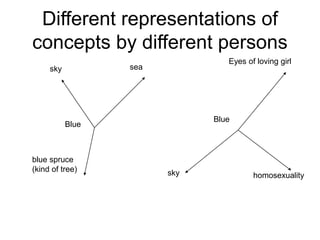
Different representations of
concepts by different persons
Blue
sky sea
blue spruce
(kind of tree)
Blue
Eyes of loving girl
homosexuality
sky
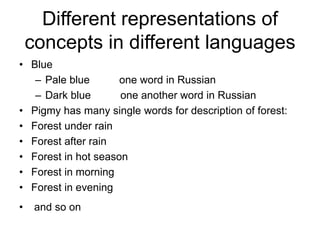
Different representations of
concepts in different languages
• Blue
– Pale blue one word in Russian
– Dark blue one another word in Russian
• Pigmy has many single words for description of forest:
• Forest under rain
• Forest after rain
• Forest in hot season
• Forest in morning
• Forest in evening
• and so on
The tools for soft computing
• Fuzzy logic models
• Neural networks
• Genetic algorithms
• Probabilistic reasoning
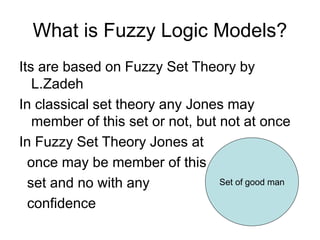
What is Fuzzy Logic Models?
Its are based on Fuzzy Set Theory by
L.Zadeh
In classical set theory any Jones may
member of this set or not, but not at once
In Fuzzy Set Theory Jones at
once may be member of this
set and no with any
confidence
Set of good man
Examples of tasks solving by Fuzzy
models
• Control of clothes washer
• Making of decision in diagnostic systems (expert
systems in medicine, for example)
• Making of decision in business planning
May be used knowledge such as:
If temperature is high then diagnose is grippe with
confidence 80%
If speed is slow then increase transfer of fuel
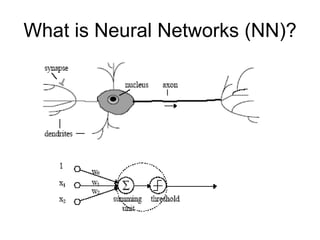
What is Neural Networks (NN)?
• NN consists of many number of simple elements
(neurons) connected between them in system
• Whole system is able to solve of complex tasks
and to learn for it like a natural brain
• For user NN is black box with Input vector
(source data) and Output vector (result)
Examples of tasks:
Recognition of images (visual, speech and so on)
Prediction of situations (cost of actions, currency)
Classification and clusterization of images (for
example, in diagnostic systems)
What is Neural Networks (NN)?
What is Genetic Algorithms or
Evaluation Programming?
• Solving is described as vector of features
• Function of estimation of solving (of vector)
• Process of birth and selection of vectors of
features
• Result is suboptimal solving of problem:
Examples of application:
Finding of optimal (suitable) path,
Finding of better structure of neural network
Finding of configuration of robot
Optimal cutting
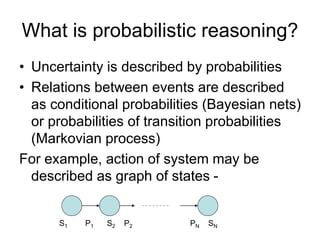
What is probabilistic reasoning?
• Uncertainty is described by probabilities
• Relations between events are described
as conditional probabilities (Bayesian nets)
or probabilities of transition probabilities
(Markovian process)
For example, action of system may be
described as graph of states -
S1 P1 S2 P2 PN SN
Examples of applications of
probabilistic reasoning
• Recognition of speech
• Navigation of mobile robots
• And so on
Difference between fuzziness and
probability (from modeling of world)
• Probability deal with unknown entity (time,
property before any event). After any event the
entity become known.
• Fuzziness is own property of any entity or
(concept or object or property). It may be more
or less but not disappears practically.
• May be fuzzy probability and probability of
fuzziness
• Probability may be use for simulation of
fuzziness

SC01_IntroductionSC-Unit-I.ppt

  • 1.
  • 2.
    What is SC? “Softcomputing is a collection of methodologies that aim to exploit the tolerance for imprecision and uncertainty to achieve tractability, robustness, and low solution cost. Its principal constituents are fuzzy logic, neurocomputing, and probabilistic reasoning. Soft computing is likely to play an increasingly important role in many application areas, including software engineering. The role model for soft computing is the human mind.” [Zadeh, 1994]
  • 3.
    What is SC? Softcomputing is not precisely defined. It consists of distinct concepts and techniques which aim to overcome the difficulties encountered in real world problems. These problems result from the fact that our world seems to be imprecise, uncertain and difficult to categorize. Possibly our world is uncertain really (see Quantum Theory, theory of relativity). But question what is in reality and what is appeared in mind is senseless (R.A.Wilson, “Quantum Psychology”)
  • 4.
    What is SC? Anotherpossible definition of soft computing is to consider it as an anti-thesis to the concept of computer we now have, which can be described with all the adjectives such as hard, crisp, rigid, inflexible and stupid. Along this track, one may see soft computing as an attempt to mimic natural creatures: plants, animals, human beings, which are soft, flexible, adaptive and clever. In this sense soft computing is the name of a family of problem-solving methods that have analogy with biological reasoning and problem solving (sometimes referred to as cognitive computing). The basic methods included in cognitive computing are fuzzy logic (FL), neural networks (NN) and genetic algorithms (GA) - the methods which do not derive from classical theories.
  • 5.
    Reasons of necessaryof uncertainty in AI • Objective (features of whole environment) – Uncertainty of our world and limited capabilities of our senses • Subjective (features of interaction with concrete environment) – Different experience of different persons and peoples, in particular, it maps on features of semantics of different languages
  • 6.
    Single absolute truthis exist: Absolute truths are not exist
  • 7.
    Different representations of conceptsby different persons Blue sky sea blue spruce (kind of tree) Blue Eyes of loving girl homosexuality sky
  • 8.
    Different representations of conceptsin different languages • Blue – Pale blue one word in Russian – Dark blue one another word in Russian • Pigmy has many single words for description of forest: • Forest under rain • Forest after rain • Forest in hot season • Forest in morning • Forest in evening • and so on
  • 9.
    The tools forsoft computing • Fuzzy logic models • Neural networks • Genetic algorithms • Probabilistic reasoning
  • 10.
    What is FuzzyLogic Models? Its are based on Fuzzy Set Theory by L.Zadeh In classical set theory any Jones may member of this set or not, but not at once In Fuzzy Set Theory Jones at once may be member of this set and no with any confidence Set of good man
  • 11.
    Examples of taskssolving by Fuzzy models • Control of clothes washer • Making of decision in diagnostic systems (expert systems in medicine, for example) • Making of decision in business planning May be used knowledge such as: If temperature is high then diagnose is grippe with confidence 80% If speed is slow then increase transfer of fuel
  • 12.
    What is NeuralNetworks (NN)? • NN consists of many number of simple elements (neurons) connected between them in system • Whole system is able to solve of complex tasks and to learn for it like a natural brain • For user NN is black box with Input vector (source data) and Output vector (result) Examples of tasks: Recognition of images (visual, speech and so on) Prediction of situations (cost of actions, currency) Classification and clusterization of images (for example, in diagnostic systems)
  • 13.
    What is NeuralNetworks (NN)?
  • 14.
    What is GeneticAlgorithms or Evaluation Programming? • Solving is described as vector of features • Function of estimation of solving (of vector) • Process of birth and selection of vectors of features • Result is suboptimal solving of problem: Examples of application: Finding of optimal (suitable) path, Finding of better structure of neural network Finding of configuration of robot Optimal cutting
  • 15.
    What is probabilisticreasoning? • Uncertainty is described by probabilities • Relations between events are described as conditional probabilities (Bayesian nets) or probabilities of transition probabilities (Markovian process) For example, action of system may be described as graph of states - S1 P1 S2 P2 PN SN
  • 16.
    Examples of applicationsof probabilistic reasoning • Recognition of speech • Navigation of mobile robots • And so on
  • 17.
    Difference between fuzzinessand probability (from modeling of world) • Probability deal with unknown entity (time, property before any event). After any event the entity become known. • Fuzziness is own property of any entity or (concept or object or property). It may be more or less but not disappears practically. • May be fuzzy probability and probability of fuzziness • Probability may be use for simulation of fuzziness