L.D. College of Engineering
Rubber Technology
B.E. Semester 6th
Compounding & Processing
Techniques of SBR & ACM
Group:- 4
Ravi Bhikadiya (140280126001)
Akshay Kavar (140280126007)
Nilesh Patel (140280126014)
Dhruvik Pipaliya (140280126017)
Ravi Sardhara (140280126022)
Chirag Zalavadiya (140280126029)
Rahul Kumar Rathva (130280126023)
SBR (Styrene Butadiene Rubber)
Styrene-butadiene rubber (SBR), a general-
purpose synthetic rubber, produced from a copolymer
of styrene and butadiene. Exceeding all other synthetic rubbers
in consumption, SBR is used in great quantities in automobile
and truck tires, generally as an abrasion-resistant replacement
for natural rubber (produced from polyisoprene).
Properties
Properties E-SBR S-SBR
Tensile strength 20 18
Elongation 635 565
Mooney Viscocity 51.6 48
Tg -50 -65
Compounding of SBR
SBR is a mixture of approximately 75 percent butadiene
(CH2=CH-CH=CH2) and 25 percent styrene (CH2=CHC6H5). In
most cases these two compounds are copolymerized (their
single-unit molecules linked to form long, multiple-unit
molecules) in an emulsion process, in which a soap like surface-
acting agent disperses, or emulsifies, the materials in a
water solution. Other materials in the solution include free-
radical initiators, which begin the polymerization process, and
stabilizers, which prevent deterioration of the final product.
Upon polymerization, the styrene and butadiene repeating units
are arranged in a random manner along the polymer chain.
The polymer chains are crosslinked in the vulcanization process.
For many purposes SBR directly replaces natural
rubber, the choice depending simply on economics. Its particular
advantages include excellent abrasion resistance, crack
resistance, and generally better aging characteristics.
Components Parts by weight
Styrene 25
Butadiene 75
Water 180
Fatty Acid soap 5
Mercaptan 0.5
Potassium persulphate 0.3
SBR Processing
1. Emulsion Polymerization Process
2. Solution Polymerization Process
Emulsion polymerization
E-SBR produced by emulsion polymerization is initiated by free
radicals. Reaction vessels are typically charged with the two
monomers, a free radical generator, and a chain transfer agent
such as an alkyl mercaptain. Radical initiators include potassium
persulfate and hydro peroxides in combination with ferrous
salts. Emulsifying agents include various soaps. By growing
organic radicals, mercaptans (e.g. dodecylthiol), control the
molecular weight, and hence the viscosity, of the product.
Typically, polymerizations are allowed to proceed only to ca.
70%, a method called "short stopping". In this way, various
additives can be removed from the polymer.
Solution polymerization
Solution-SBR is produced by an anionic polymerization process.
Polymerization is initiated by alkyl lithium compounds. Water is
strictly excluded. The process is homogeneous (all components
are dissolved), which provides greater control over the process,
allowing tailoring of the polymer. The compound adds to one of
the monomers, generating a carbanion that then adds to another
monomer, and so on. Relative to E-SBR, S-SBR is increasingly
favored because it offers improved wet grip and rolling
resistance, which translate to greater safety and better fuel
economy, respectively.
ACM (Poly Acrylic Rubber)
Poly acrylate Compositions
(Compounding)
Polyacrylate elastomers are polymers of acrylic acid
esters with added reactive curesite monomers. Polyacrylate
backbone monomers are responsible for the overall balance of
physical properties and chemical resistance of ACM polymer.
Backbone monomers account for 95–99% of the weight of a
normal polyacrylate elastomer. These may consist of one or
more different types of acrylic monomers. Typical backbone
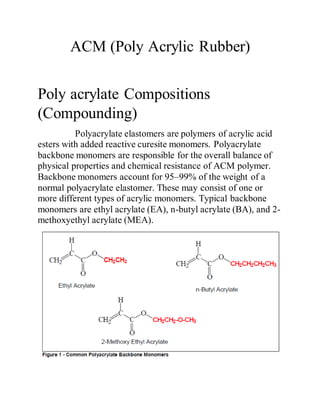
monomers are ethyl acrylate (EA), n-butyl acrylate (BA), and 2-
methoxyethyl acrylate (MEA).
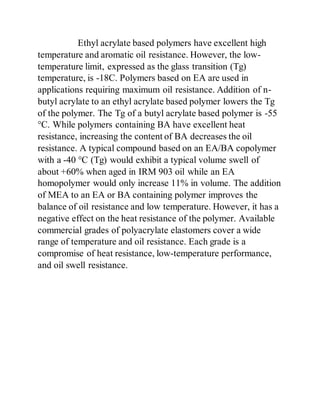
Ethyl acrylate based polymers have excellent high
temperature and aromatic oil resistance. However, the low-
temperature limit, expressed as the glass transition (Tg)
temperature, is -18C. Polymers based on EA are used in
applications requiring maximum oil resistance. Addition of n-
butyl acrylate to an ethyl acrylate based polymer lowers the Tg
of the polymer. The Tg of a butyl acrylate based polymer is -55
°C. While polymers containing BA have excellent heat
resistance, increasing the content of BA decreases the oil
resistance. A typical compound based on an EA/BA copolymer
with a -40 °C (Tg) would exhibit a typical volume swell of
about +60% when aged in IRM 903 oil while an EA
homopolymer would only increase 11% in volume. The addition
of MEA to an EA or BA containing polymer improves the
balance of oil resistance and low temperature. However, it has a
negative effect on the heat resistance of the polymer. Available
commercial grades of polyacrylate elastomers cover a wide
range of temperature and oil resistance. Each grade is a
compromise of heat resistance, low-temperature performance,
and oil swell resistance.
Basic Recipe of Compounding
Polyacrylates generally offer a lower-cost solution
versus the other oil-resistant, high-temperature types such as
FVMQ (fluorinated silicone) and FKM (fluorinated
hydrocarbon) elastomers. Polyacrylates also offer improved
high-temperature resistance over HNBR (hydrogenated nitrile)
and ECO/CO (epichlorohydrin ethylene oxide) elastomers.
Improved oil resistance is their major advantage over the AEM
(acrylic/ethylene) and MQ/VMQ (silicone/vinyl functional
silicone) materials.
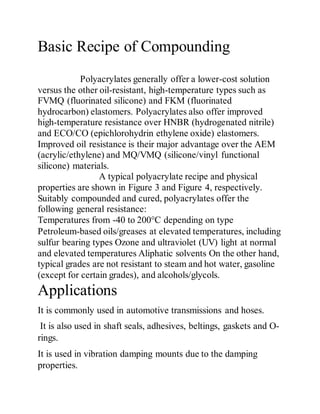
A typical polyacrylate recipe and physical
properties are shown in Figure 3 and Figure 4, respectively.
Suitably compounded and cured, polyacrylates offer the
following general resistance:
Temperatures from -40 to 200°C depending on type
Petroleum-based oils/greases at elevated temperatures, including
sulfur bearing types Ozone and ultraviolet (UV) light at normal
and elevated temperatures Aliphatic solvents On the other hand,
typical grades are not resistant to steam and hot water, gasoline
(except for certain grades), and alcohols/glycols.
Applications
It is commonly used in automotive transmissions and hoses.
It is also used in shaft seals, adhesives, beltings, gaskets and O-
rings.
It is used in vibration damping mounts due to the damping
properties.
ACM Processing
 A polymerization process in aqueous emulsion for the
preparation of a member selected from the group consisting
of rubber and acrylic elastomers, said elastomers having a
polymeric chain, characterized by the fact that said
polymerization is carried out through a continuous,
uniformly fed in a pre-mixture of the monomers with a
chain transfer agent is previously prepared in a separate
vessel and then, mixture is added drop by drop at a uniform
rate into the reaction vessel.
 the mixture of the monomers with the chain transfer agent
may be prepared in the optional presence of oxygen.
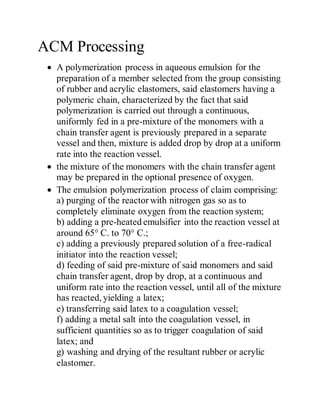
 The emulsion polymerization process of claim comprising:
a) purging of the reactor with nitrogen gas so as to
completely eliminate oxygen from the reaction system;
b) adding a pre-heated emulsifier into the reaction vessel at
around 65° C. to 70° C.;
c) adding a previously prepared solution of a free-radical
initiator into the reaction vessel;
d) feeding of said pre-mixture of said monomers and said
chain transfer agent, drop by drop, at a continuous and
uniform rate into the reaction vessel, until all of the mixture
has reacted, yielding a latex;
e) transferring said latex to a coagulation vessel;
f) adding a metal salt into the coagulation vessel, in
sufficient quantities so as to trigger coagulation of said
latex; and
g) washing and drying of the resultant rubber or acrylic
elastomer.

SBR & ACM

  • 1.
    L.D. College ofEngineering Rubber Technology B.E. Semester 6th Compounding & Processing Techniques of SBR & ACM Group:- 4 Ravi Bhikadiya (140280126001) Akshay Kavar (140280126007) Nilesh Patel (140280126014) Dhruvik Pipaliya (140280126017) Ravi Sardhara (140280126022) Chirag Zalavadiya (140280126029) Rahul Kumar Rathva (130280126023)
  • 2.
    SBR (Styrene ButadieneRubber) Styrene-butadiene rubber (SBR), a general- purpose synthetic rubber, produced from a copolymer of styrene and butadiene. Exceeding all other synthetic rubbers in consumption, SBR is used in great quantities in automobile and truck tires, generally as an abrasion-resistant replacement for natural rubber (produced from polyisoprene). Properties Properties E-SBR S-SBR Tensile strength 20 18 Elongation 635 565 Mooney Viscocity 51.6 48 Tg -50 -65
  • 3.
    Compounding of SBR SBRis a mixture of approximately 75 percent butadiene (CH2=CH-CH=CH2) and 25 percent styrene (CH2=CHC6H5). In most cases these two compounds are copolymerized (their single-unit molecules linked to form long, multiple-unit molecules) in an emulsion process, in which a soap like surface- acting agent disperses, or emulsifies, the materials in a water solution. Other materials in the solution include free- radical initiators, which begin the polymerization process, and stabilizers, which prevent deterioration of the final product. Upon polymerization, the styrene and butadiene repeating units are arranged in a random manner along the polymer chain. The polymer chains are crosslinked in the vulcanization process. For many purposes SBR directly replaces natural rubber, the choice depending simply on economics. Its particular advantages include excellent abrasion resistance, crack resistance, and generally better aging characteristics. Components Parts by weight Styrene 25 Butadiene 75 Water 180 Fatty Acid soap 5 Mercaptan 0.5 Potassium persulphate 0.3
  • 4.
    SBR Processing 1. EmulsionPolymerization Process 2. Solution Polymerization Process Emulsion polymerization E-SBR produced by emulsion polymerization is initiated by free radicals. Reaction vessels are typically charged with the two monomers, a free radical generator, and a chain transfer agent such as an alkyl mercaptain. Radical initiators include potassium persulfate and hydro peroxides in combination with ferrous salts. Emulsifying agents include various soaps. By growing organic radicals, mercaptans (e.g. dodecylthiol), control the molecular weight, and hence the viscosity, of the product. Typically, polymerizations are allowed to proceed only to ca. 70%, a method called "short stopping". In this way, various additives can be removed from the polymer. Solution polymerization Solution-SBR is produced by an anionic polymerization process. Polymerization is initiated by alkyl lithium compounds. Water is strictly excluded. The process is homogeneous (all components are dissolved), which provides greater control over the process, allowing tailoring of the polymer. The compound adds to one of the monomers, generating a carbanion that then adds to another monomer, and so on. Relative to E-SBR, S-SBR is increasingly favored because it offers improved wet grip and rolling resistance, which translate to greater safety and better fuel economy, respectively.
  • 5.
    ACM (Poly AcrylicRubber) Poly acrylate Compositions (Compounding) Polyacrylate elastomers are polymers of acrylic acid esters with added reactive curesite monomers. Polyacrylate backbone monomers are responsible for the overall balance of physical properties and chemical resistance of ACM polymer. Backbone monomers account for 95–99% of the weight of a normal polyacrylate elastomer. These may consist of one or more different types of acrylic monomers. Typical backbone monomers are ethyl acrylate (EA), n-butyl acrylate (BA), and 2- methoxyethyl acrylate (MEA).
  • 6.
    Ethyl acrylate basedpolymers have excellent high temperature and aromatic oil resistance. However, the low- temperature limit, expressed as the glass transition (Tg) temperature, is -18C. Polymers based on EA are used in applications requiring maximum oil resistance. Addition of n- butyl acrylate to an ethyl acrylate based polymer lowers the Tg of the polymer. The Tg of a butyl acrylate based polymer is -55 °C. While polymers containing BA have excellent heat resistance, increasing the content of BA decreases the oil resistance. A typical compound based on an EA/BA copolymer with a -40 °C (Tg) would exhibit a typical volume swell of about +60% when aged in IRM 903 oil while an EA homopolymer would only increase 11% in volume. The addition of MEA to an EA or BA containing polymer improves the balance of oil resistance and low temperature. However, it has a negative effect on the heat resistance of the polymer. Available commercial grades of polyacrylate elastomers cover a wide range of temperature and oil resistance. Each grade is a compromise of heat resistance, low-temperature performance, and oil swell resistance.
  • 7.
    Basic Recipe ofCompounding Polyacrylates generally offer a lower-cost solution versus the other oil-resistant, high-temperature types such as FVMQ (fluorinated silicone) and FKM (fluorinated hydrocarbon) elastomers. Polyacrylates also offer improved high-temperature resistance over HNBR (hydrogenated nitrile) and ECO/CO (epichlorohydrin ethylene oxide) elastomers. Improved oil resistance is their major advantage over the AEM (acrylic/ethylene) and MQ/VMQ (silicone/vinyl functional silicone) materials. A typical polyacrylate recipe and physical properties are shown in Figure 3 and Figure 4, respectively. Suitably compounded and cured, polyacrylates offer the following general resistance: Temperatures from -40 to 200°C depending on type Petroleum-based oils/greases at elevated temperatures, including sulfur bearing types Ozone and ultraviolet (UV) light at normal and elevated temperatures Aliphatic solvents On the other hand, typical grades are not resistant to steam and hot water, gasoline (except for certain grades), and alcohols/glycols. Applications It is commonly used in automotive transmissions and hoses. It is also used in shaft seals, adhesives, beltings, gaskets and O- rings. It is used in vibration damping mounts due to the damping properties.
  • 8.
    ACM Processing  Apolymerization process in aqueous emulsion for the preparation of a member selected from the group consisting of rubber and acrylic elastomers, said elastomers having a polymeric chain, characterized by the fact that said polymerization is carried out through a continuous, uniformly fed in a pre-mixture of the monomers with a chain transfer agent is previously prepared in a separate vessel and then, mixture is added drop by drop at a uniform rate into the reaction vessel.  the mixture of the monomers with the chain transfer agent may be prepared in the optional presence of oxygen.  The emulsion polymerization process of claim comprising: a) purging of the reactor with nitrogen gas so as to completely eliminate oxygen from the reaction system; b) adding a pre-heated emulsifier into the reaction vessel at around 65° C. to 70° C.; c) adding a previously prepared solution of a free-radical initiator into the reaction vessel; d) feeding of said pre-mixture of said monomers and said chain transfer agent, drop by drop, at a continuous and uniform rate into the reaction vessel, until all of the mixture has reacted, yielding a latex; e) transferring said latex to a coagulation vessel; f) adding a metal salt into the coagulation vessel, in sufficient quantities so as to trigger coagulation of said latex; and g) washing and drying of the resultant rubber or acrylic elastomer.