THE NATURE OF MATERIALS Atomic Structure and the Elements Bonding between Atoms and Molecules Crystalline Structures Noncrystalline (Amorphous) Structures Engineering Materials
Importance of Materials in Manufacturing Manufacturing is a transformation process  It is the material that is transformed And it is the behavior of the material when subjected to the forces, temperatures, and other parameters of the process that determines the success of the operation
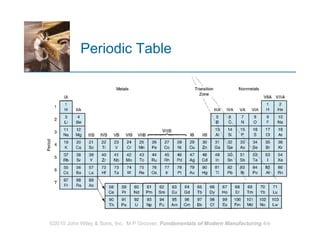
Element Groupings The elements can be grouped into families and relationships established between and within the families by means of the Periodic Table Metals occupy the left and center portions of the table Nonmetals are on right Between them is a transition zone containing  metalloids  or  semi‑metals
Periodic Table
Atomic Structure and the Elements The basic structural unit of matter is the atom  Each atom is composed of a positively charged nucleus, surrounded by a sufficient number of negatively charged electrons so the charges are balanced  More than 100 elements, and they are the chemical building blocks of all matter
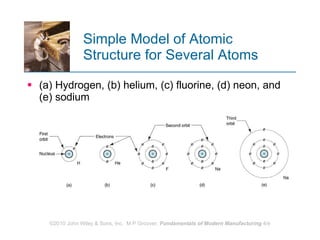
Simple Model of Atomic Structure for Several Atoms (a) Hydrogen, (b) helium, (c) fluorine, (d) neon, and (e) sodium
Bonding between Atoms and Molecules Atoms are held together in molecules by various types of bonds Primary bonds  - generally associated with formation of molecules Secondary bonds  - generally associated with attraction between molecules Primary bonds are much stronger than secondary bonds
Primary Bonds Characterized by strong atom‑to‑atom attractions that involve exchange of valence electrons  Following forms:  Ionic Covalent Metallic
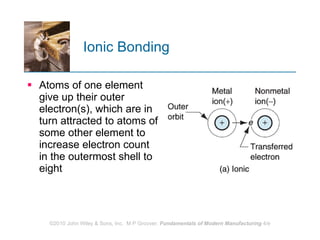
Ionic Bonding Atoms of one element give up their outer electron(s), which are in turn attracted to atoms of some other element to increase electron count in the outermost shell to eight
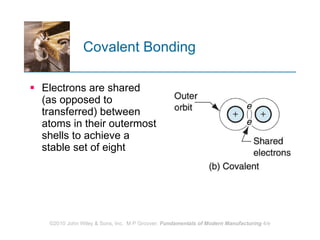
Covalent Bonding Electrons are shared (as opposed to transferred) between atoms in their outermost shells to achieve a stable set of eight
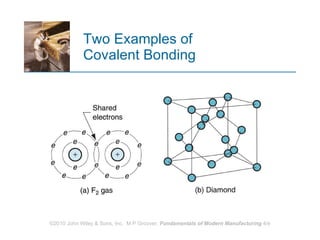
Two Examples of  Covalent Bonding
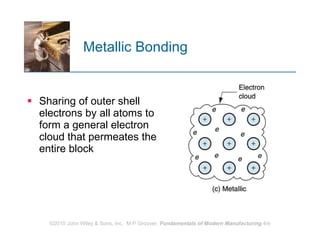
Metallic Bonding Sharing of outer shell electrons by all atoms to form a general electron cloud that permeates the entire block
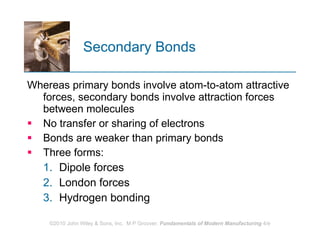
Secondary Bonds Whereas primary bonds involve atom‑to‑atom attractive forces, secondary bonds involve attraction forces between molecules  No transfer or sharing of electrons  Bonds are weaker than primary bonds Three forms:  Dipole forces London forces Hydrogen bonding
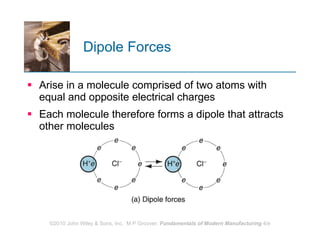
Dipole Forces Arise in a molecule comprised of two atoms with equal and opposite electrical charges Each molecule therefore forms a dipole that attracts other molecules
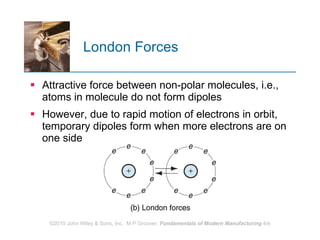
London Forces Attractive force between non-polar molecules, i.e., atoms in molecule do not form dipoles However, due to rapid motion of electrons in orbit, temporary dipoles form when more electrons are on one side
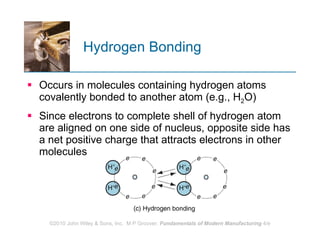
Hydrogen Bonding Occurs in molecules containing hydrogen atoms covalently bonded to another atom (e.g., H 2 O) Since electrons to complete shell of hydrogen atom are aligned on one side of nucleus, opposite side has a net positive charge that attracts electrons in other molecules
Macroscopic Structures of Matter Atoms and molecules are the building blocks of a more macroscopic structure of matter When materials solidify from the molten state, they tend to close ranks and pack tightly, arranging themselves into one of two structures:  Crystalline Noncrystalline
Crystalline Structure Structure in which atoms are located at regular and recurring positions in three dimensions  Unit cell  - basic geometric grouping of atoms that is repeated  The pattern may be replicated millions of times within a given crystal  Characteristic structure of virtually all metals, as well as many ceramics and some polymers
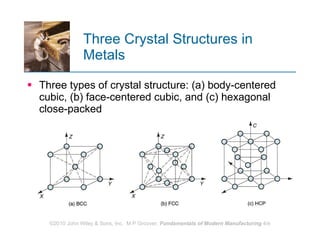
Three Crystal Structures in Metals Three types of crystal structure: (a) body-centered cubic, (b) face-centered cubic, and (c) hexagonal close-packed
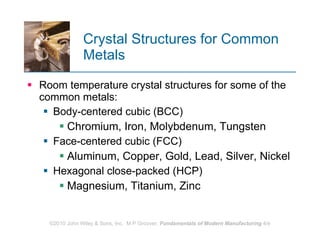
Crystal Structures for Common Metals  Room temperature crystal structures for some of the common metals: Body‑centered cubic (BCC)  Chromium, Iron, Molybdenum, Tungsten Face‑centered cubic (FCC)  Aluminum, Copper, Gold, Lead, Silver, Nickel Hexagonal close‑packed (HCP) Magnesium, Titanium, Zinc
Imperfections (Defects) in Crystals Imperfections often arise due to inability of solidifying material to continue replication of unit cell, e.g., grain boundaries in metals  Imperfections can also be introduced purposely; e.g., addition of alloying ingredient in metal Types of defects: (1) point defects, (2) line defects, (3) surface defects
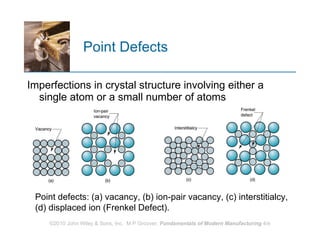
Point Defects Imperfections in crystal structure involving either a single atom or a small number of atoms Point defects: (a) vacancy, (b) ion‑pair vacancy, (c) interstitialcy,  (d) displaced ion (Frenkel Defect).
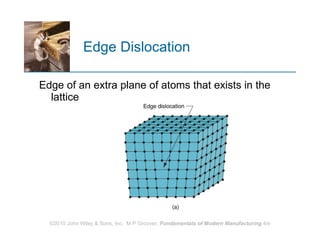
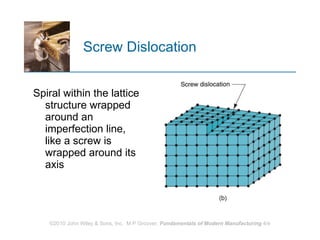
Line Defects  Connected group of point defects that forms a line in the lattice structure Most important line defect is a  dislocation , which can take two forms:  Edge dislocation Screw dislocation
Edge Dislocation Edge of an extra plane of atoms that exists in the lattice
Screw Dislocation Spiral within the lattice structure wrapped around an imperfection line, like a screw is wrapped around its axis
Surface Defects  Imperfections that extend in two directions to form a boundary  Examples: External: the surface of a crystalline object is an interruption in the lattice structure  Internal: grain boundaries are internal surface interruptions
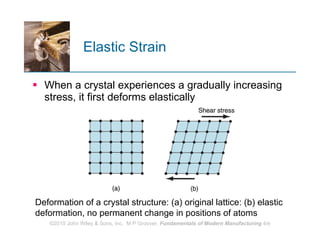
Elastic Strain When a crystal experiences a gradually increasing stress, it first deforms elastically Deformation of a crystal structure: (a) original lattice: (b) elastic deformation, no permanent change in positions of atoms
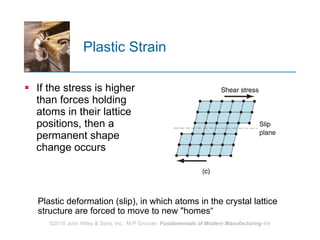
Plastic Strain If the stress is higher than forces holding atoms in their lattice positions, then a permanent shape change occurs Plastic deformation (slip), in which atoms in the crystal lattice structure are forced to move to new "homes“
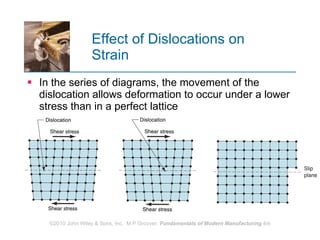
Effect of Dislocations on Strain In the series of diagrams, the movement of the dislocation allows deformation to occur under a lower stress than in a perfect lattice
Slip on a Macroscopic Scale Slip occurs many times over throughout the metal when subjected to a deforming load, thus causing it to exhibit its macroscopic behavior in the stress-strain relationship  Dislocations are a good‑news‑bad‑news situation  Good news in manufacturing – the metal is easier to form Bad news in design – the metal is not as strong as the designer would like
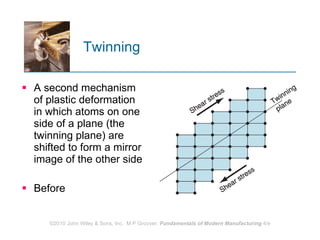
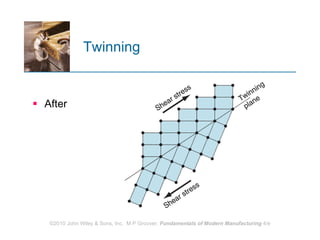
Twinning A second mechanism of plastic deformation in which atoms on one side of a plane (the twinning plane) are shifted to form a mirror image of the other side  Before
Twinning After
Polycrystalline Nature of  Metals A block of metal may contain millions of individual crystals, called grains  Such a structure is called  polycrystalline   Each grain has its own unique lattice orientation But collectively, the grains are randomly oriented in the block
Grains and Grain Boundaries in Metals How do polycrystalline structures form?  As a volume of metal cools from the molten state and begins to solidify, individual crystals nucleate at random positions and orientations throughout the liquid  These crystals grow and finally interfere with each other, forming at their interface a surface defect ‑ a grain boundary ,  which are transition zones, perhaps only a few atoms thick
Noncrystalline (Amorphous) Structures Water and air have noncrystalline structures A metal loses its crystalline structure when melted Some engineering materials have noncrystalline forms in their solid state Glass Many plastics  Rubber
Features of Noncrystalline Structures Two features differentiate noncrystalline (amorphous) from crystalline materials:  Absence of long‑range order in molecular structure  Differences in melting and thermal expansion characteristics
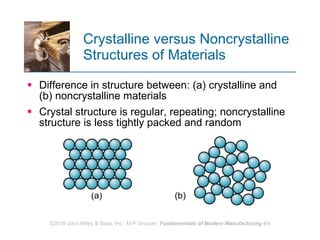
Crystalline versus Noncrystalline Structures of Materials Difference in structure between: (a) crystalline and (b) noncrystalline materials Crystal structure is regular, repeating; noncrystalline structure is less tightly packed and random (a)   (b)
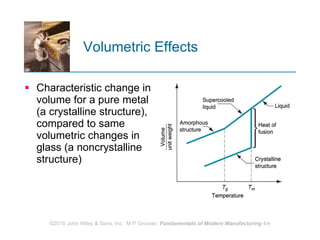
Volumetric Effects Characteristic change in volume for a pure metal (a crystalline structure), compared to same volumetric changes in glass (a noncrystalline structure)
Summary: Characteristics of Metals Crystalline structures in the solid state, almost without exception  BCC, FCC, or HCP unit cells Atoms held together by metallic bonding Properties: high strength and hardness, high electrical and thermal conductivity FCC metals are generally ductile
Summary: Characteristics of Ceramics Most ceramics have crystalline structures, while glass (SiO 2 ) is amorphous  Molecules characterized by ionic or covalent bonding, or both  Properties: high hardness and stiffness, electrically insulating, refractory, and chemically inert
Summary: Characteristics of Polymers Many repeating  mers  in molecule held together by covalent bonding Polymers usually carbon plus one or more other elements: H, N, O, and Cl  Amorphous (glassy) structure or mixture of amorphous and crystalline  Properties: low density, high electrical resistivity, and low thermal conductivity, strength and stiffness vary widely

Ch02

  • 1.
    THE NATURE OFMATERIALS Atomic Structure and the Elements Bonding between Atoms and Molecules Crystalline Structures Noncrystalline (Amorphous) Structures Engineering Materials
  • 2.
    Importance of Materialsin Manufacturing Manufacturing is a transformation process It is the material that is transformed And it is the behavior of the material when subjected to the forces, temperatures, and other parameters of the process that determines the success of the operation
  • 3.
    Element Groupings Theelements can be grouped into families and relationships established between and within the families by means of the Periodic Table Metals occupy the left and center portions of the table Nonmetals are on right Between them is a transition zone containing metalloids or semi‑metals
  • 4.
  • 5.
    Atomic Structure andthe Elements The basic structural unit of matter is the atom Each atom is composed of a positively charged nucleus, surrounded by a sufficient number of negatively charged electrons so the charges are balanced More than 100 elements, and they are the chemical building blocks of all matter
  • 6.
    Simple Model ofAtomic Structure for Several Atoms (a) Hydrogen, (b) helium, (c) fluorine, (d) neon, and (e) sodium
  • 7.
    Bonding between Atomsand Molecules Atoms are held together in molecules by various types of bonds Primary bonds - generally associated with formation of molecules Secondary bonds - generally associated with attraction between molecules Primary bonds are much stronger than secondary bonds
  • 8.
    Primary Bonds Characterizedby strong atom‑to‑atom attractions that involve exchange of valence electrons Following forms: Ionic Covalent Metallic
  • 9.
    Ionic Bonding Atomsof one element give up their outer electron(s), which are in turn attracted to atoms of some other element to increase electron count in the outermost shell to eight
  • 10.
    Covalent Bonding Electronsare shared (as opposed to transferred) between atoms in their outermost shells to achieve a stable set of eight
  • 11.
    Two Examples of Covalent Bonding
  • 12.
    Metallic Bonding Sharingof outer shell electrons by all atoms to form a general electron cloud that permeates the entire block
  • 13.
    Secondary Bonds Whereasprimary bonds involve atom‑to‑atom attractive forces, secondary bonds involve attraction forces between molecules No transfer or sharing of electrons Bonds are weaker than primary bonds Three forms: Dipole forces London forces Hydrogen bonding
  • 14.
    Dipole Forces Arisein a molecule comprised of two atoms with equal and opposite electrical charges Each molecule therefore forms a dipole that attracts other molecules
  • 15.
    London Forces Attractiveforce between non-polar molecules, i.e., atoms in molecule do not form dipoles However, due to rapid motion of electrons in orbit, temporary dipoles form when more electrons are on one side
  • 16.
    Hydrogen Bonding Occursin molecules containing hydrogen atoms covalently bonded to another atom (e.g., H 2 O) Since electrons to complete shell of hydrogen atom are aligned on one side of nucleus, opposite side has a net positive charge that attracts electrons in other molecules
  • 17.
    Macroscopic Structures ofMatter Atoms and molecules are the building blocks of a more macroscopic structure of matter When materials solidify from the molten state, they tend to close ranks and pack tightly, arranging themselves into one of two structures: Crystalline Noncrystalline
  • 18.
    Crystalline Structure Structurein which atoms are located at regular and recurring positions in three dimensions Unit cell - basic geometric grouping of atoms that is repeated The pattern may be replicated millions of times within a given crystal Characteristic structure of virtually all metals, as well as many ceramics and some polymers
  • 19.
    Three Crystal Structuresin Metals Three types of crystal structure: (a) body-centered cubic, (b) face-centered cubic, and (c) hexagonal close-packed
  • 20.
    Crystal Structures forCommon Metals Room temperature crystal structures for some of the common metals: Body‑centered cubic (BCC) Chromium, Iron, Molybdenum, Tungsten Face‑centered cubic (FCC) Aluminum, Copper, Gold, Lead, Silver, Nickel Hexagonal close‑packed (HCP) Magnesium, Titanium, Zinc
  • 21.
    Imperfections (Defects) inCrystals Imperfections often arise due to inability of solidifying material to continue replication of unit cell, e.g., grain boundaries in metals Imperfections can also be introduced purposely; e.g., addition of alloying ingredient in metal Types of defects: (1) point defects, (2) line defects, (3) surface defects
  • 22.
    Point Defects Imperfectionsin crystal structure involving either a single atom or a small number of atoms Point defects: (a) vacancy, (b) ion‑pair vacancy, (c) interstitialcy, (d) displaced ion (Frenkel Defect).
  • 23.
    Line Defects Connected group of point defects that forms a line in the lattice structure Most important line defect is a dislocation , which can take two forms: Edge dislocation Screw dislocation
  • 24.
    Edge Dislocation Edgeof an extra plane of atoms that exists in the lattice
  • 25.
    Screw Dislocation Spiralwithin the lattice structure wrapped around an imperfection line, like a screw is wrapped around its axis
  • 26.
    Surface Defects Imperfections that extend in two directions to form a boundary Examples: External: the surface of a crystalline object is an interruption in the lattice structure Internal: grain boundaries are internal surface interruptions
  • 27.
    Elastic Strain Whena crystal experiences a gradually increasing stress, it first deforms elastically Deformation of a crystal structure: (a) original lattice: (b) elastic deformation, no permanent change in positions of atoms
  • 28.
    Plastic Strain Ifthe stress is higher than forces holding atoms in their lattice positions, then a permanent shape change occurs Plastic deformation (slip), in which atoms in the crystal lattice structure are forced to move to new "homes“
  • 29.
    Effect of Dislocationson Strain In the series of diagrams, the movement of the dislocation allows deformation to occur under a lower stress than in a perfect lattice
  • 30.
    Slip on aMacroscopic Scale Slip occurs many times over throughout the metal when subjected to a deforming load, thus causing it to exhibit its macroscopic behavior in the stress-strain relationship Dislocations are a good‑news‑bad‑news situation Good news in manufacturing – the metal is easier to form Bad news in design – the metal is not as strong as the designer would like
  • 31.
    Twinning A secondmechanism of plastic deformation in which atoms on one side of a plane (the twinning plane) are shifted to form a mirror image of the other side Before
  • 32.
  • 33.
    Polycrystalline Nature of Metals A block of metal may contain millions of individual crystals, called grains Such a structure is called polycrystalline Each grain has its own unique lattice orientation But collectively, the grains are randomly oriented in the block
  • 34.
    Grains and GrainBoundaries in Metals How do polycrystalline structures form? As a volume of metal cools from the molten state and begins to solidify, individual crystals nucleate at random positions and orientations throughout the liquid These crystals grow and finally interfere with each other, forming at their interface a surface defect ‑ a grain boundary , which are transition zones, perhaps only a few atoms thick
  • 35.
    Noncrystalline (Amorphous) StructuresWater and air have noncrystalline structures A metal loses its crystalline structure when melted Some engineering materials have noncrystalline forms in their solid state Glass Many plastics Rubber
  • 36.
    Features of NoncrystallineStructures Two features differentiate noncrystalline (amorphous) from crystalline materials: Absence of long‑range order in molecular structure Differences in melting and thermal expansion characteristics
  • 37.
    Crystalline versus NoncrystallineStructures of Materials Difference in structure between: (a) crystalline and (b) noncrystalline materials Crystal structure is regular, repeating; noncrystalline structure is less tightly packed and random (a) (b)
  • 38.
    Volumetric Effects Characteristicchange in volume for a pure metal (a crystalline structure), compared to same volumetric changes in glass (a noncrystalline structure)
  • 39.
    Summary: Characteristics ofMetals Crystalline structures in the solid state, almost without exception BCC, FCC, or HCP unit cells Atoms held together by metallic bonding Properties: high strength and hardness, high electrical and thermal conductivity FCC metals are generally ductile
  • 40.
    Summary: Characteristics ofCeramics Most ceramics have crystalline structures, while glass (SiO 2 ) is amorphous Molecules characterized by ionic or covalent bonding, or both Properties: high hardness and stiffness, electrically insulating, refractory, and chemically inert
  • 41.
    Summary: Characteristics ofPolymers Many repeating mers in molecule held together by covalent bonding Polymers usually carbon plus one or more other elements: H, N, O, and Cl Amorphous (glassy) structure or mixture of amorphous and crystalline Properties: low density, high electrical resistivity, and low thermal conductivity, strength and stiffness vary widely