Access to Capital 101: Funding Options to Start
and Grow Your Small Business
April 5th, 2019
Claudia Moreno
Southern California Outreach Manager
Small Business Majority
About Small Business Majority
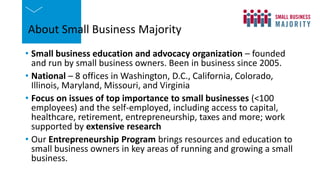
• Small business education and advocacy organization – founded
and run by small business owners. Been in business since 2005.
• National – 8 offices in Washington, D.C., California, Colorado,
Illinois, Maryland, Missouri, and Virginia
• Focus on issues of top importance to small businesses (<100
employees) and the self-employed, including access to capital,
healthcare, retirement, entrepreneurship, taxes and more; work
supported by extensive research
• Our Entrepreneurship Program brings resources and education to
small business owners in key areas of running and growing a small
business.
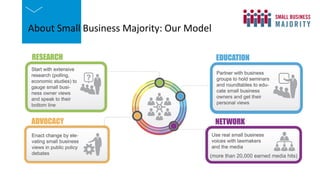
About Small Business Majority: Our Model
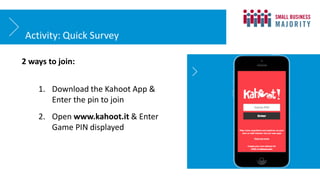
Activity: Quick Survey
2 ways to join:
1. Download the Kahoot App &
Enter the pin to join
2. Open www.kahoot.it & Enter
Game PIN displayed
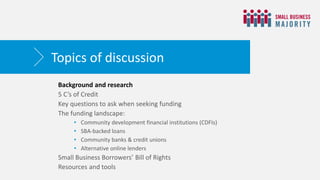
Background and research
5 C’s of Credit
Key questions to ask when seeking funding
The funding landscape:
• Community development financial institutions (CDFIs)
• SBA-backed loans
• Community banks & credit unions
• Alternative online lenders
Small Business Borrowers’ Bill of Rights
Resources and tools
Topics of discussion
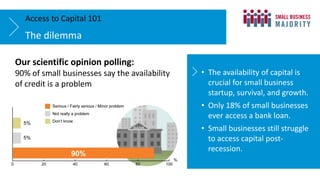
The dilemma
• The availability of capital is
crucial for small business
startup, survival, and growth.
• Only 18% of small businesses
ever access a bank loan.
• Small businesses still struggle
to access capital post-
recession.
Access to Capital 101
Our scientific opinion polling:
90% of small businesses say the availability
of credit is a problem
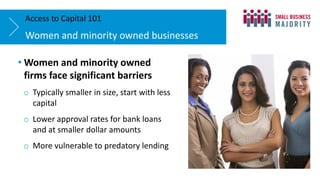
Women and minority owned businesses
Access to Capital 101
• Women and minority owned
firms face significant barriers
o Typically smaller in size, start with less
capital
o Lower approval rates for bank loans
and at smaller dollar amounts
o More vulnerable to predatory lending
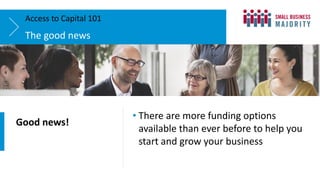
The good news
Access to Capital 101
• There are more funding options
available than ever before to help you
start and grow your business
Good news!
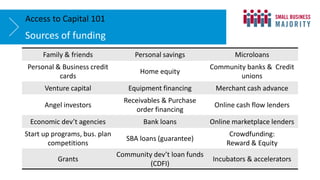
Family & friends Personal savings Microloans
Personal & Business credit
cards
Home equity
Community banks & Credit
unions
Venture capital Equipment financing Merchant cash advance
Angel investors
Receivables & Purchase
order financing
Online cash flow lenders
Economic dev’t agencies Bank loans Online marketplace lenders
Start up programs, bus. plan
competitions
SBA loans (guarantee)
Crowdfunding:
Reward & Equity
Grants
Community dev’t loan funds
(CDFI)
Incubators & accelerators
Sources of funding
Access to Capital 101
Background and research
5 C’s of Credit
Key questions to ask when seeking funding
The funding landscape:
• Community development financial institutions (CDFIs)
• SBA-backed loans
• Community banks & credit unions
• Alternative online lenders
Small Business Borrowers’ Bill of Rights
Resources and tools
Access to Capital 101
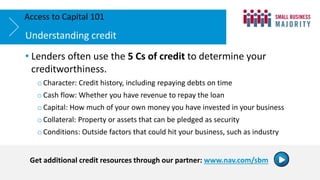
• Lenders often use the 5 Cs of credit to determine your
creditworthiness.
o Character: Credit history, including repaying debts on time
o Cash flow: Whether you have revenue to repay the loan
o Capital: How much of your own money you have invested in your business
o Collateral: Property or assets that can be pledged as security
o Conditions: Outside factors that could hit your business, such as industry
Understanding credit
Access to Capital 101
Get additional credit resources through our partner: www.nav.com/sbm
Background and research
5 C’s of Credit
Key questions to ask when seeking funding
The funding landscape:
• Community development financial institutions (CDFIs)
• SBA-backed loans
• Community banks & credit unions
• Alternative online lenders
Small Business Borrowers’ Bill of Rights
Resources and tools
Access to Capital 101
Important questions to consider
Access to Capital 101
• What do you need the money for?
• How much money do you need?
• How long will it take you to pay it back?
• What is the current financial shape
of your business?
• How long have you been in business?
• How much collateral, if any, do
you have to put up for the loan?
• How quickly do you need the money?
• Are you seeking debt or equity financing?
Background and research
Key questions to ask when seeking funding
The funding landscape:
• Community development financial institutions (CDFIs)
• SBA-backed loans
• Community banks & credit unions
• Alternative online lenders
Small Business Borrowers’ Bill of Rights
Resources and tools
Access to Capital 101
• Community development financial institutions (CDFIs) offer loans
(usually less than $250k) for entrepreneurs who are typically
ineligible for traditional bank loans; may be used for wide range of
business purposes
• CDFIs are dedicated to responsible affordable lending to underserved
entrepreneurs and low-income communities
o Revolving loan funds through private and gov’t funding
o Often provide in-depth support that includes mentoring and technical
assistance
o Many CDFIs offer microloan programs, loans less than $50K
Community development financial institutions
Access to Capital 101
+ Pros
• Competitive rates
• Great for entrepreneurs unable to secure
traditional bank loans
• CDFIs usually offer add’l business
technical assistance support
Community development financial institutions
Access to Capital 101
Resource:
Opportunity Finance Network is a national membership organization of CDFIs
across the country. Find a CDFI near you:
www.venturize.org/mission-driven-lenders-locator-map
– Cons
• Smaller value loans may not be
sufficient
• Personal collateral and guaranteed
often required
The U.S. Small Business Administration (SBA) guarantees a portion of loans to
provide incentive for institutions to approve loans to small businesses that are
riskier borrowers and not poised to obtain traditional bank loans
• SBA is not a lender, but a guarantor
• Loans cover a wide range of uses incl. start-ups, working capital, inventory,
real estate, equip, etc.
• Primary programs: Advantage and Grow Loan (previously known as 7(a) and
CDC/504)
• Programs also available for microloans, disaster relief, export assistance and
veteran and military
SBA loan programs (guarantee)
Access to Capital 101
• SBA Community Advantage Program
o Provides mission-based lenders like CDFIs access to loan guarantees for up to
85% of loans up to $250,000
o Targets small business, for-profit borrowers in underserved markets, offering
affordable rates no more than the prime rate+6% (typically ranging between
7-9%)
o A borrower’s qualification is not dependent on the size of their business
balance sheet or the amount of collateral
o Lenders participating in the program have access to SBA’s management and
technical assistance programs
SBA loan programs (cont.)
Access to Capital 101
What you need to know
• Very competitive rates
• Longer loan terms
• No balloon payments
SBA loan programs (cont.)
Access to Capital 101
Resources:
• Find an SBA approved-lender near you: www.sba.gov/tools/linc
• Partners: SCORE, Women’s Business Centers, SBDCs
• SmartBiz Loans: www.smallbusinessportal.org/smartbiz
• Work with SBA lender to gather
required documentation
• Review application checklist
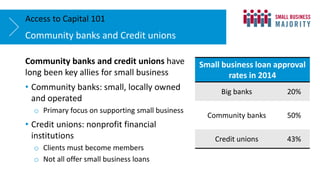
Community banks and credit unions have
long been key allies for small business
• Community banks: small, locally owned
and operated
o Primary focus on supporting small business
• Credit unions: nonprofit financial
institutions
o Clients must become members
o Not all offer small business loans
Community banks and Credit unions
Access to Capital 101
Small business loan approval
rates in 2014
Big banks 20%
Community banks 50%
Credit unions 43%
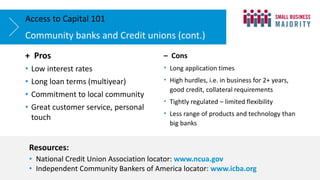
+ Pros
• Low interest rates
• Long loan terms (multiyear)
• Commitment to local community
• Great customer service, personal
touch
Community banks and Credit unions (cont.)
Access to Capital 101
Resources:
• National Credit Union Association locator: www.ncua.gov
• Independent Community Bankers of America locator: www.icba.org
– Cons
• Long application times
• High hurdles, i.e. in business for 2+ years,
good credit, collateral requirements
• Tightly regulated – limited flexibility
• Less range of products and technology than
big banks
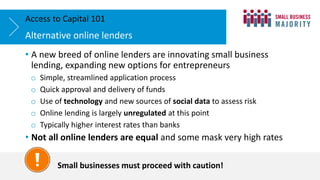
• A new breed of online lenders are innovating small business
lending, expanding new options for entrepreneurs
o Simple, streamlined application process
o Quick approval and delivery of funds
o Use of technology and new sources of social data to assess risk
o Online lending is largely unregulated at this point
o Typically higher interest rates than banks
• Not all online lenders are equal and some mask very high rates
Alternative online lenders
Access to Capital 101
Small businesses must proceed with caution!
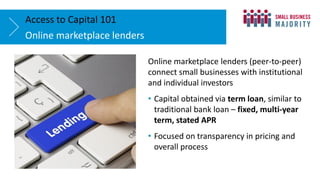
Online marketplace lenders
Access to Capital 101
Online marketplace lenders (peer-to-peer)
connect small businesses with institutional
and individual investors
• Capital obtained via term loan, similar to
traditional bank loan – fixed, multi-year
term, stated APR
• Focused on transparency in pricing and
overall process
• Online cash flow lenders generally offer short-term loans, typically
used for working capital
o Short-term (6-12 months); high interest (20-50%+)
o Non-traditional underwriting algorithms incl. social, online data
• Loan payments are made by daily deductions of a fixed amount or
percent of sales, rather than citing interest rate; require access to
business bank account or payment systems
• Be cautious of opaque pricing, high interest rates
Online cash flow lenders
Access to Capital 101
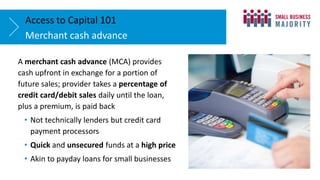
Merchant cash advance
Access to Capital 101
A merchant cash advance (MCA) provides
cash upfront in exchange for a portion of
future sales; provider takes a percentage of
credit card/debit sales daily until the loan,
plus a premium, is paid back
• Not technically lenders but credit card
payment processors
• Quick and unsecured funds at a high price
• Akin to payday loans for small businesses
Tips
• MCAs should be a last resort
• Be cautious of deceptive and aggressive sales/advertising
o Keywords: Fast cash, no credit score, no collateral needed
• Proper cash flow planning is highly recommended
• Carefully review and understand all fees, terms and penalties
Merchant cash advance
Access to Capital 101
• In crowdfunding, entrepreneurs raise funds by reaching out to a
large number of people (investors) through an online platform.
o Lots of smaller sums of money takes the place of one or two large
investors
• Entrepreneurs create an online campaign about their
venture/idea, indicate amount of money they’re seeking, what it’ll
be used for, and what contributors (or investors) will get in return.
o The best campaigns inspire people to donate or invest.
o Reward vs. Equity crowdfunding
Crowdfunding
Access to Capital 101
What is an Individual Development Account (IDA)?
• An IDA is a special matched savings program designed to help people save for a
specific financial goal, like starting a small business
How does an IDA work?
• The IDA account is a special savings account set up as a joint account between you
and the IDA partner agency
• When you save in an IDA, your savings of up to $2,000 are matched 2:1
How do I know if I qualify?
• Eligibility is based on annual household gross income and household net worth,
including business assets, retirement savings and cash
For more information, visit idaresources.org
Individual Development Accounts
Access to Capital 101
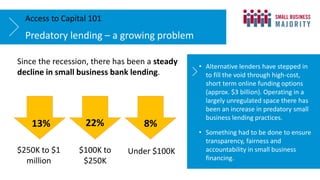
Predatory lending – a growing problem
• Alternative lenders have stepped in
to fill the void through high-cost,
short term online funding options
(approx. $3 billion). Operating in a
largely unregulated space there has
been an increase in predatory small
business lending practices.
• Something had to be done to ensure
transparency, fairness and
accountability in small business
financing.
$250K to $1
million
$100K to
$250K
Under $100K
13% 22% 8%
Since the recession, there has been a steady
decline in small business bank lending.
Access to Capital 101
Background and research
Key questions to ask when seeking funding
The funding landscape:
• Community development financial institutions (CDFIs)
• SBA-backed loans
• Community banks & credit unions
• Alternative online lenders
Small Business Borrowers’ Bill of Rights
Resources and tools
Access to Capital 101
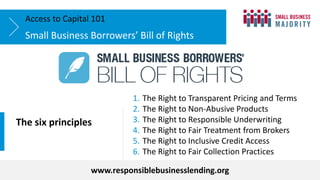
Small Business Borrowers’ Bill of Rights
Access to Capital 101
The six principles
www.responsiblebusinesslending.org
1. The Right to Transparent Pricing and Terms
2. The Right to Non-Abusive Products
3. The Right to Responsible Underwriting
4. The Right to Fair Treatment from Brokers
5. The Right to Inclusive Credit Access
6. The Right to Fair Collection Practices
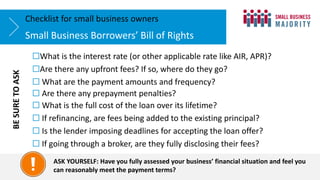
☐What is the interest rate (or other applicable rate like AIR, APR)?
☐Are there any upfront fees? If so, where do they go?
☐ What are the payment amounts and frequency?
☐ Are there any prepayment penalties?
☐ What is the full cost of the loan over its lifetime?
☐ If refinancing, are fees being added to the existing principal?
☐ Is the lender imposing deadlines for accepting the loan offer?
☐ If going through a broker, are they fully disclosing their fees?
Small Business Borrowers’ Bill of Rights
Checklist for small business owners
ASK YOURSELF: Have you fully assessed your business’ financial situation and feel you
can reasonably meet the payment terms?
BE
SURE
TO
ASK
The Responsible Business Lending Coalition developed the Small
Business Borrowers’ Bill of Rights.
Responsible Business Lending Coalition
Access to Capital 101
www.responsiblebusinesslending.org
Background and research
Key questions to ask when seeking funding
The funding landscape:
• Community development financial institutions (CDFIs)
• SBA-backed loans
• Community banks & credit unions
• Alternative online lenders
Small Business Borrowers’ Bill of Rights
Resources and tools
Access to Capital 101
Resources
Access to Capital 101
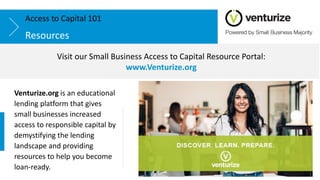
Venturize.org is an educational
lending platform that gives
small businesses increased
access to responsible capital by
demystifying the lending
landscape and providing
resources to help you become
loan-ready.
Visit our Small Business Access to Capital Resource Portal:
www.Venturize.org
Venturize features a variety of tools and resources to help you:
• Understand the basics of small business lending
• Compare loan options
• Learn about the different types of lenders and loans
• Improve your credit score IQ
• Identify questions to ask potential lenders
• Locate a responsible lender near you
How can Venturize help you?
Access to Capital 101
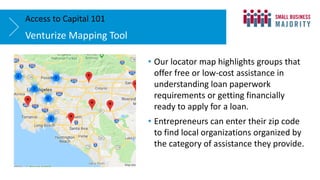
Venturize Mapping Tool
Access to Capital 101
• Our locator map highlights groups that
offer free or low-cost assistance in
understanding loan paperwork
requirements or getting financially
ready to apply for a loan.
• Entrepreneurs can enter their zip code
to find local organizations organized by
the category of assistance they provide.
Resources
Access to Capital 101
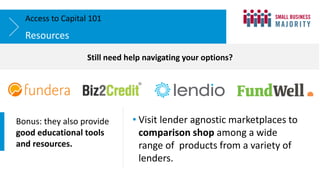
• Visit lender agnostic marketplaces to
comparison shop among a wide
range of products from a variety of
lenders.
Bonus: they also provide
good educational tools
and resources.
Still need help navigating your options?
@SmlBizMajority
Small Business Majority
Connect with us!
smlbizmajority
@SmlBizMajority
Small Business Majority
Connect with us!
smlbizmajority
Join Our Network
o Ways to get involved:
• Receive a monthly newsletter
• Share your small business story
for media requests
• Letters to the editor/Op-eds
• Regional and state events
• Free webinars for businesses
• Policy/advocacy updates
• Resources and education
@SmlBizMajority
Small Business Majority
Connect with us!
smlbizmajority
@SmlBizMajority
Small Business Majority
Connect with us!
smlbizmajority
Questions?
Claudia Moreno
Southern California Outreach Manager
(909) 816-4236 | cmoreno@smallbusinessmajority.org
Small Business Majority
www.smallbusinessmajority.org
Small Business Access to Capital Resource Portal
www.smallbusinessportal.org/capital

sbm-powerpoint.pdf

  • 1.
    Access to Capital101: Funding Options to Start and Grow Your Small Business April 5th, 2019 Claudia Moreno Southern California Outreach Manager Small Business Majority
  • 2.
    About Small BusinessMajority • Small business education and advocacy organization – founded and run by small business owners. Been in business since 2005. • National – 8 offices in Washington, D.C., California, Colorado, Illinois, Maryland, Missouri, and Virginia • Focus on issues of top importance to small businesses (<100 employees) and the self-employed, including access to capital, healthcare, retirement, entrepreneurship, taxes and more; work supported by extensive research • Our Entrepreneurship Program brings resources and education to small business owners in key areas of running and growing a small business.
  • 3.
    About Small BusinessMajority: Our Model
  • 4.
    Activity: Quick Survey 2ways to join: 1. Download the Kahoot App & Enter the pin to join 2. Open www.kahoot.it & Enter Game PIN displayed
  • 5.
    Background and research 5C’s of Credit Key questions to ask when seeking funding The funding landscape: • Community development financial institutions (CDFIs) • SBA-backed loans • Community banks & credit unions • Alternative online lenders Small Business Borrowers’ Bill of Rights Resources and tools Topics of discussion
  • 6.
    The dilemma • Theavailability of capital is crucial for small business startup, survival, and growth. • Only 18% of small businesses ever access a bank loan. • Small businesses still struggle to access capital post- recession. Access to Capital 101 Our scientific opinion polling: 90% of small businesses say the availability of credit is a problem
  • 7.
    Women and minorityowned businesses Access to Capital 101 • Women and minority owned firms face significant barriers o Typically smaller in size, start with less capital o Lower approval rates for bank loans and at smaller dollar amounts o More vulnerable to predatory lending
  • 8.
    The good news Accessto Capital 101 • There are more funding options available than ever before to help you start and grow your business Good news!
  • 9.
    Family & friendsPersonal savings Microloans Personal & Business credit cards Home equity Community banks & Credit unions Venture capital Equipment financing Merchant cash advance Angel investors Receivables & Purchase order financing Online cash flow lenders Economic dev’t agencies Bank loans Online marketplace lenders Start up programs, bus. plan competitions SBA loans (guarantee) Crowdfunding: Reward & Equity Grants Community dev’t loan funds (CDFI) Incubators & accelerators Sources of funding Access to Capital 101
  • 10.
    Background and research 5C’s of Credit Key questions to ask when seeking funding The funding landscape: • Community development financial institutions (CDFIs) • SBA-backed loans • Community banks & credit unions • Alternative online lenders Small Business Borrowers’ Bill of Rights Resources and tools Access to Capital 101
  • 11.
    • Lenders oftenuse the 5 Cs of credit to determine your creditworthiness. o Character: Credit history, including repaying debts on time o Cash flow: Whether you have revenue to repay the loan o Capital: How much of your own money you have invested in your business o Collateral: Property or assets that can be pledged as security o Conditions: Outside factors that could hit your business, such as industry Understanding credit Access to Capital 101 Get additional credit resources through our partner: www.nav.com/sbm
  • 12.
    Background and research 5C’s of Credit Key questions to ask when seeking funding The funding landscape: • Community development financial institutions (CDFIs) • SBA-backed loans • Community banks & credit unions • Alternative online lenders Small Business Borrowers’ Bill of Rights Resources and tools Access to Capital 101
  • 13.
    Important questions toconsider Access to Capital 101 • What do you need the money for? • How much money do you need? • How long will it take you to pay it back? • What is the current financial shape of your business? • How long have you been in business? • How much collateral, if any, do you have to put up for the loan? • How quickly do you need the money? • Are you seeking debt or equity financing?
  • 14.
    Background and research Keyquestions to ask when seeking funding The funding landscape: • Community development financial institutions (CDFIs) • SBA-backed loans • Community banks & credit unions • Alternative online lenders Small Business Borrowers’ Bill of Rights Resources and tools Access to Capital 101
  • 15.
    • Community developmentfinancial institutions (CDFIs) offer loans (usually less than $250k) for entrepreneurs who are typically ineligible for traditional bank loans; may be used for wide range of business purposes • CDFIs are dedicated to responsible affordable lending to underserved entrepreneurs and low-income communities o Revolving loan funds through private and gov’t funding o Often provide in-depth support that includes mentoring and technical assistance o Many CDFIs offer microloan programs, loans less than $50K Community development financial institutions Access to Capital 101
  • 16.
    + Pros • Competitiverates • Great for entrepreneurs unable to secure traditional bank loans • CDFIs usually offer add’l business technical assistance support Community development financial institutions Access to Capital 101 Resource: Opportunity Finance Network is a national membership organization of CDFIs across the country. Find a CDFI near you: www.venturize.org/mission-driven-lenders-locator-map – Cons • Smaller value loans may not be sufficient • Personal collateral and guaranteed often required
  • 17.
    The U.S. SmallBusiness Administration (SBA) guarantees a portion of loans to provide incentive for institutions to approve loans to small businesses that are riskier borrowers and not poised to obtain traditional bank loans • SBA is not a lender, but a guarantor • Loans cover a wide range of uses incl. start-ups, working capital, inventory, real estate, equip, etc. • Primary programs: Advantage and Grow Loan (previously known as 7(a) and CDC/504) • Programs also available for microloans, disaster relief, export assistance and veteran and military SBA loan programs (guarantee) Access to Capital 101
  • 18.
    • SBA CommunityAdvantage Program o Provides mission-based lenders like CDFIs access to loan guarantees for up to 85% of loans up to $250,000 o Targets small business, for-profit borrowers in underserved markets, offering affordable rates no more than the prime rate+6% (typically ranging between 7-9%) o A borrower’s qualification is not dependent on the size of their business balance sheet or the amount of collateral o Lenders participating in the program have access to SBA’s management and technical assistance programs SBA loan programs (cont.) Access to Capital 101
  • 19.
    What you needto know • Very competitive rates • Longer loan terms • No balloon payments SBA loan programs (cont.) Access to Capital 101 Resources: • Find an SBA approved-lender near you: www.sba.gov/tools/linc • Partners: SCORE, Women’s Business Centers, SBDCs • SmartBiz Loans: www.smallbusinessportal.org/smartbiz • Work with SBA lender to gather required documentation • Review application checklist
  • 20.
    Community banks andcredit unions have long been key allies for small business • Community banks: small, locally owned and operated o Primary focus on supporting small business • Credit unions: nonprofit financial institutions o Clients must become members o Not all offer small business loans Community banks and Credit unions Access to Capital 101 Small business loan approval rates in 2014 Big banks 20% Community banks 50% Credit unions 43%
  • 21.
    + Pros • Lowinterest rates • Long loan terms (multiyear) • Commitment to local community • Great customer service, personal touch Community banks and Credit unions (cont.) Access to Capital 101 Resources: • National Credit Union Association locator: www.ncua.gov • Independent Community Bankers of America locator: www.icba.org – Cons • Long application times • High hurdles, i.e. in business for 2+ years, good credit, collateral requirements • Tightly regulated – limited flexibility • Less range of products and technology than big banks
  • 22.
    • A newbreed of online lenders are innovating small business lending, expanding new options for entrepreneurs o Simple, streamlined application process o Quick approval and delivery of funds o Use of technology and new sources of social data to assess risk o Online lending is largely unregulated at this point o Typically higher interest rates than banks • Not all online lenders are equal and some mask very high rates Alternative online lenders Access to Capital 101 Small businesses must proceed with caution!
  • 23.
    Online marketplace lenders Accessto Capital 101 Online marketplace lenders (peer-to-peer) connect small businesses with institutional and individual investors • Capital obtained via term loan, similar to traditional bank loan – fixed, multi-year term, stated APR • Focused on transparency in pricing and overall process
  • 24.
    • Online cashflow lenders generally offer short-term loans, typically used for working capital o Short-term (6-12 months); high interest (20-50%+) o Non-traditional underwriting algorithms incl. social, online data • Loan payments are made by daily deductions of a fixed amount or percent of sales, rather than citing interest rate; require access to business bank account or payment systems • Be cautious of opaque pricing, high interest rates Online cash flow lenders Access to Capital 101
  • 25.
    Merchant cash advance Accessto Capital 101 A merchant cash advance (MCA) provides cash upfront in exchange for a portion of future sales; provider takes a percentage of credit card/debit sales daily until the loan, plus a premium, is paid back • Not technically lenders but credit card payment processors • Quick and unsecured funds at a high price • Akin to payday loans for small businesses
  • 26.
    Tips • MCAs shouldbe a last resort • Be cautious of deceptive and aggressive sales/advertising o Keywords: Fast cash, no credit score, no collateral needed • Proper cash flow planning is highly recommended • Carefully review and understand all fees, terms and penalties Merchant cash advance Access to Capital 101
  • 27.
    • In crowdfunding,entrepreneurs raise funds by reaching out to a large number of people (investors) through an online platform. o Lots of smaller sums of money takes the place of one or two large investors • Entrepreneurs create an online campaign about their venture/idea, indicate amount of money they’re seeking, what it’ll be used for, and what contributors (or investors) will get in return. o The best campaigns inspire people to donate or invest. o Reward vs. Equity crowdfunding Crowdfunding Access to Capital 101
  • 28.
    What is anIndividual Development Account (IDA)? • An IDA is a special matched savings program designed to help people save for a specific financial goal, like starting a small business How does an IDA work? • The IDA account is a special savings account set up as a joint account between you and the IDA partner agency • When you save in an IDA, your savings of up to $2,000 are matched 2:1 How do I know if I qualify? • Eligibility is based on annual household gross income and household net worth, including business assets, retirement savings and cash For more information, visit idaresources.org Individual Development Accounts Access to Capital 101
  • 29.
    Predatory lending –a growing problem • Alternative lenders have stepped in to fill the void through high-cost, short term online funding options (approx. $3 billion). Operating in a largely unregulated space there has been an increase in predatory small business lending practices. • Something had to be done to ensure transparency, fairness and accountability in small business financing. $250K to $1 million $100K to $250K Under $100K 13% 22% 8% Since the recession, there has been a steady decline in small business bank lending. Access to Capital 101
  • 30.
    Background and research Keyquestions to ask when seeking funding The funding landscape: • Community development financial institutions (CDFIs) • SBA-backed loans • Community banks & credit unions • Alternative online lenders Small Business Borrowers’ Bill of Rights Resources and tools Access to Capital 101
  • 31.
    Small Business Borrowers’Bill of Rights Access to Capital 101 The six principles www.responsiblebusinesslending.org 1. The Right to Transparent Pricing and Terms 2. The Right to Non-Abusive Products 3. The Right to Responsible Underwriting 4. The Right to Fair Treatment from Brokers 5. The Right to Inclusive Credit Access 6. The Right to Fair Collection Practices
  • 32.
    ☐What is theinterest rate (or other applicable rate like AIR, APR)? ☐Are there any upfront fees? If so, where do they go? ☐ What are the payment amounts and frequency? ☐ Are there any prepayment penalties? ☐ What is the full cost of the loan over its lifetime? ☐ If refinancing, are fees being added to the existing principal? ☐ Is the lender imposing deadlines for accepting the loan offer? ☐ If going through a broker, are they fully disclosing their fees? Small Business Borrowers’ Bill of Rights Checklist for small business owners ASK YOURSELF: Have you fully assessed your business’ financial situation and feel you can reasonably meet the payment terms? BE SURE TO ASK
  • 33.
    The Responsible BusinessLending Coalition developed the Small Business Borrowers’ Bill of Rights. Responsible Business Lending Coalition Access to Capital 101 www.responsiblebusinesslending.org
  • 34.
    Background and research Keyquestions to ask when seeking funding The funding landscape: • Community development financial institutions (CDFIs) • SBA-backed loans • Community banks & credit unions • Alternative online lenders Small Business Borrowers’ Bill of Rights Resources and tools Access to Capital 101
  • 35.
    Resources Access to Capital101 Venturize.org is an educational lending platform that gives small businesses increased access to responsible capital by demystifying the lending landscape and providing resources to help you become loan-ready. Visit our Small Business Access to Capital Resource Portal: www.Venturize.org
  • 36.
    Venturize features avariety of tools and resources to help you: • Understand the basics of small business lending • Compare loan options • Learn about the different types of lenders and loans • Improve your credit score IQ • Identify questions to ask potential lenders • Locate a responsible lender near you How can Venturize help you? Access to Capital 101
  • 37.
    Venturize Mapping Tool Accessto Capital 101 • Our locator map highlights groups that offer free or low-cost assistance in understanding loan paperwork requirements or getting financially ready to apply for a loan. • Entrepreneurs can enter their zip code to find local organizations organized by the category of assistance they provide.
  • 38.
    Resources Access to Capital101 • Visit lender agnostic marketplaces to comparison shop among a wide range of products from a variety of lenders. Bonus: they also provide good educational tools and resources. Still need help navigating your options?
  • 39.
    @SmlBizMajority Small Business Majority Connectwith us! smlbizmajority @SmlBizMajority Small Business Majority Connect with us! smlbizmajority Join Our Network o Ways to get involved: • Receive a monthly newsletter • Share your small business story for media requests • Letters to the editor/Op-eds • Regional and state events • Free webinars for businesses • Policy/advocacy updates • Resources and education
  • 40.
    @SmlBizMajority Small Business Majority Connectwith us! smlbizmajority @SmlBizMajority Small Business Majority Connect with us! smlbizmajority Questions? Claudia Moreno Southern California Outreach Manager (909) 816-4236 | cmoreno@smallbusinessmajority.org Small Business Majority www.smallbusinessmajority.org Small Business Access to Capital Resource Portal www.smallbusinessportal.org/capital