SVERI’s College ofPharmacy, Pandharpur
on
"Aligning for Success: Course and Program
Outcomes (COs & POs) in NBA Accreditation"
Heartily Welcome
Organized by
Thusdayday, 16th
January, 2025
to the Session
by
Dr. S. B. Bhosale
Head Mechanical Engg. Dept. & Associate Professor,
SVERI’s College of Engineering, Pandharpur (An Autonomous Institute)
One Week FDP on “Quality Metrics in Higher Education: NBA, NAAC, NIRF, and ISO"
13th
January to 18th
January, 2025
2.
HOD Profile
Name: Dr.Shrikrushna B. Bhosale
Designation: Associate Professor & Head of the Department
Qualification: B. E. (Prod.), M. Tech. (Manufacturing), Ph. D. (Mech.)
from National Institute of Technology, Silchar, Assam
Experience: 15 Years Teaching Experience
Area of
Research:
Conventional & Non-conventional Machining, Material
Science, Composite Materials, Optimization
Research
Publication:
11 SCI/SCOPUS Papers, 14 Peer Reviewed Journal Papers
with 134 Citations, h index-9, i10 index-4
Conferences : 10 papers
Book Chapters: 04
Reviewer : Reputed Journals like Elsevier, Springer, Taylor & Francis
PG Guide: PG Recognition from P.A.H. Solapur University, Solapur,
Guided 05 PG Students
Membership: Life Member of ISTE, AMIE 2
3.
Vision, Mission andProgram Educational Objectives
INSTITUTE DEPARTMENT
VISION (ASPIRATION)
To be nationally recognized among the
best institutes in India for excellence in
technical education.
To be nationally recognized for excellence
in education, geared with research, in the
field of Mechanical Engineering
MISSION (APPROACH)
M1:- To impart value-based technical
education through innovation and
excellence, empowering individuals to
become leaders in their fields to create
positive impact.
M2:- To create an ambiance of
academic excellence, research, and life
skills by fostering a learning
environment that empowers individuals
to achieve their full potential.
M3:- To foster strong relationships
amongst all our stakeholders by
inculcating a personal touch and mutual
respect in all our interactions.
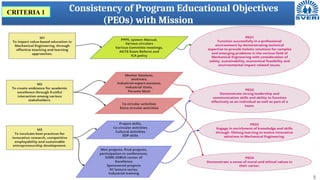
M1:- To impart value-based education in
Mechanical Engineering, through
effective teaching and learning
approaches.
M2:- To create ambiance for academic
excellence through fruitful interaction
among various stakeholders.
M3:- To inculcate best practices for
innovative research, competitive
employability and sustainable
entrepreneurship development.
3
PROGRAMME EDUCATIONAL OBJECTIVES
(PEOs)
PEO 1:- Function successfully in a professional
environment by demonstrating technical expertise to
provide holistic solutions for complex and emerging
problems in the field of Design Engineering, Heat Power,
Renewable Energy, Automation, Industrial Engineering,
Manufacturing and related Management with
consideration of safety, sustainability, economical
feasibility and environmental impact related issues.
PEO 2:- Demonstrate strong leadership and
communication skills and ability to function effectively
as an individual as well as part of a team.
PEO 3:- Engage in enrichment of knowledge and skills
through lifelong learning to evolve innovative solutions
in Mechanical Engineering.
PEO 4:- Demonstrate a sense of moral and ethical values
in their career.
CRITERIA 1
4.
4
Programme Outcomes (POs)Programme Specific
Outcomes (PSOs)
PROGRAM OUTCOMES (POs) PROGRAM SPECIFIC OUTCOMES
(PSOs)
PO1: Engineering Knowledge
PO2: Problem Analysis
PO3: Design/Development of Solutions
PO4: Conduct investigations of
complex problems
PO5: Modern Tool usage
PO6: Engineer & Society
PO7: Environment & Sustainability
PO8: Ethics
PO9: Individual & Team work
PO10: Communication
PO11: Project Management & Finance
PO12: Life long learning
PSO1:- Design a system, component or
process to meet desired needs within
realistic constraints such as economic,
environmental, social, regulatory, ethical,
health and safety, manufacturability and
sustainability.
PSO2:- Design and conduct experiments,
as well as to analyze and interpret data, in
different areas of Design Engineering,
Heat Power, Renewable Energy,
Automation, Industrial Engineering,
Manufacturing and related Management.
PSO3:- Use techniques, skills and
upcoming software, machine tools and
processes necessary in the practice of
Mechanical Engineering profession.
CRITERIA 1
15
POs Target AttainmentAction Taken
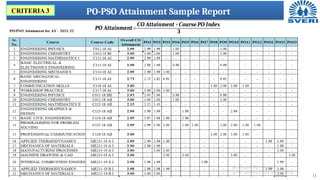
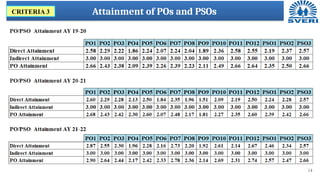
PO1 2.46 2.90 Practice sessions, guest lectures, and application-based assignments initiated
PO2 2.26 2.64 Add on/ Certificate courses, Industry Expert Lectures, Vocational Training
PO3 2.18 2.44 Industrial visit (IV), Add on/Certified course, Vocational Training, more real time problem assigned
PO4 2.01 2.17 Procurement of software, additional numerical problem-solving sessions, Project Exposure
PO5 2.14 2.42 Guest Lecture, Add on/Certified course, Industrial MoU
PO6 2.28 2.33 Industrial visit (IV), Mini & Final Year Projects, NSS Activities, Industrial Training
PO7 2.53 2.78 Industrial visit (IV), Mini & Final Year Projects, NSS Activities, Expert Lectures
PO8 2.28 2.36 Cultural Programs, NSS activities, Yoga Sessions and Everyday National Anthem, Expert Sessions through IIC
PO9 1.96 2.14 Mini & Final Year Projects, Participation in Various activities, NSS, Sports & Cultural activities
PO10 2.45 2.69 Mock Interviews, National & International Conferences, Effective Report writing, CIP
PO11 2.11 2.31 Session on Project Management, Estimated cost analysis in Synopsis, Student bodies for Technical Symposium
PO12 2.60 2.74 MoU’s, Use of ICT Tools, library resources, NPTEL, IV, Industrial Training
PSO 1 2.27 2.57 Industrial Visit, Industry Expert Lecture, Session through IIC, Project
PSO 2 2.18 2.47 Guest lecture, Project
PSO 3 2.42 2.66 Industry Expert Lecture, MOU
PO Attainment with action taken
CRITERIA 7
16.
16
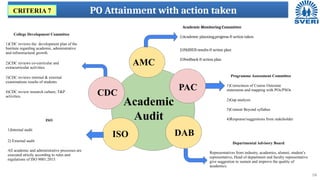
DAB
Academic
Audit
Academic Monitoring Committee
1)Academicplanning,progress & action taken
2)PAHSUS results & action plan
3)Feedback & action plan
Programme Assessment Committee
1)Correctness of Course Outcome
statements and mapping with POs/PSOs
2)Gap analysis
3)Content Beyond syllabus
4)Response/suggestions from stakeholder
Departmental Advisory Board
Representatives from industry, academics, alumni, student’s
representative, Head of department and faculty representative
give suggestion to sustain and improve the quality of
academics.
ISO
1)Internal audit
2) External audit
All academic and administrative processes are
executed strictly according to rules and
regulations of ISO 9001:2015.
College Development Committee
1)CDC reviews the development plan of the
Institute regarding academic, administrative
and infrastructural growth.
2)CDC reviews co-curricular and
extracurricular activities.
3)CDC reviews internal & external
examinations results of students
4)CDC review research culture, T&P
activities.
ISO
CDC
AMC
PAC
PO Attainment with action taken
CRITERIA 7
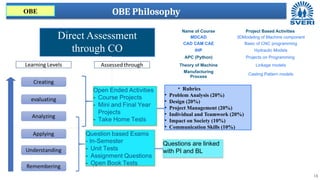
Direct Assessment
through CO
Questionsare linked
with PI and BL
• Rubrics
• Problem Analysis (20%)
• Design (20%)
• Project Management (20%)
• Individual and Teamwork (20%)
• Impact on Society (10%)
• Communication Skills (10%)
Name of Course Project Based Activities
MDCAD 3DModeling of Machine component
CAD CAM CAE Basic of CNC programming
IHP Hydraulic Models
APC (Python) Projects on Programming
Theory of Machine Linkage models
Manufacturing
Process
Casting Pattern models
18
OBE Philosophy
OBE
19.
19
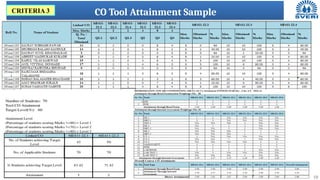
● Preparation ofassessment plan ensuring the alignment of
CO and the expected level of cognitive levels achieved
through CO.
● The plan clarifies the assessment method to be adopted and
ensures that all assessments are aligned with the COs.
● Course Outcomes (CO) are evaluated using the following
criteria:
○ Level 1: if between 60% and 70% of students achieve
the tool attainment level.
○ Level 2: if between 70% and 80% of students achieve
the tool attainment level.
○ Level 3: if 80% or more of students achieve the tool
attainment level.
● Target Level for Assessment tools set to 60% of the total
marks for Internal tools passing percentage marks for
External tools
Indirect Assessment of CO-Curricular
and Extracurricular
● Attainment Calculated using Exit, Course
End, Employer, Alumni, Industrial Visit,
Guest Lecture, Cultural Activities based
surveys
○ Level 1: if between 60% and 70% of
students achieve the tool attainment
level.
○ Level 2: if between 70% and 80% of
students achieve the tool attainment
level.
○ Level 3: if 80% or more of students
achieve the tool attainment level.
Evaluation of Course Outcome
OBE Philosophy
OBE