DRAFT
Savatech Group
Programe Elastomers – Rubber compounds
DRAFT
2
Introduction to Savatech Group
 More than 90 years of rubber knowledge and tradition
 Highly specialized niche player for technical rubber products
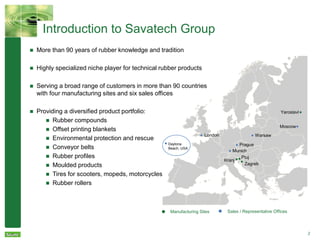
 Serving a broad range of customers in more than 90 countries
with four manufacturing sites and six sales offices
 Providing a diversified product portfolio:
 Rubber compounds
 Offset printing blankets
 Environmental protection and rescue
 Conveyor belts
 Rubber profiles
 Moulded products
 Tires for scooters, mopeds, motorcycles
 Rubber rollers
Manufacturing Sites Sales / Representative Offices
Munich
WarsawLondon
Prague
Kranj
Moscow
Zagreb
Yaroslavl
Ptuj
Daytona
Beach, USA
DRAFT
3
Walk Through Time
1920 In Kranj the company ATLANTA IMPORTS AND EXPORTS was formed.
1921 The company Atlanta was renamed to a new company VULKAN.
1931 The Kranj company became the property of the Vienna firm Semperit.
1940 The sole owner of the tyre factory in Kranj became the firm Continental.
1946 Nationalisation and a change of the name to SAVA Rubber Products.
1956 Official opening of Plant II in Gaštej.
1967 Signing of the licence agreement with Semperit.
1972 Sava / Semperit Car Tyres commenced production.
1997 Signing of the Joint Venture Agreement between the Sava corporation and
the Goodyear concern for production of tyres.
2002 Sava d.d. organized rubber production in SAVATECH d.o.o.
2013 Savatech d.o.o. became a part of the CGS Group.
DRAFT
4
 Compounds on the basis of natural rubber and
synthetic rubbers: EPDM, SBR, BR, NBR, CR,
CSM, CIIR, HNBR, etc.
 Base material for further production process
Elastomers
Product Range
Applications
 Automotive industry
 Home appliances
 Building industry
 Nutritional industry
 Transportation
 Applications within electro industry
 Processing technologies
Market Position
 Leading market position in Slovenia
 Strong market position in Ex-YU
 Several notable customers in EU
 Strong R&D support
 Well equipped central laboratory with highly
skilled personnel
 Knowledge enriched by experience and
tradition
 Rubber compounds to meet customers’
requirements
 Implementation of new materials
 Steady process development
Strengths
Development
DRAFT
5
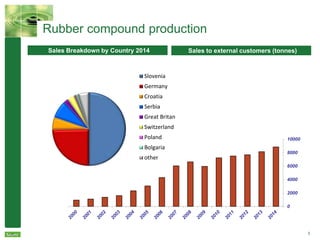
Rubber compound production
Slovenia
Germany
Croatia
Serbia
Great Britan
Switzerland
Poland
Bolgaria
other
Sales Breakdown by Country 2014 Sales to external customers (tonnes)
0
2000
4000
6000
8000
10000
DRAFT
6
Compound mixing technology
Raw material handling
 Every raw material is checked according to
the certificate and specification before
unloading
 Material tracking with a by BAR code
 Material tracking through the SAP
management program
 Constant warehouse temperature control
DRAFT
7
Compound mixing technology
Automatic weighing and dosing system
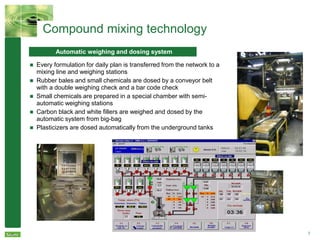
 Every formulation for daily plan is transferred from the network to a
mixing line and weighing stations
 Rubber bales and small chemicals are dosed by a conveyor belt
with a double weighing check and a bar code check
 Small chemicals are prepared in a special chamber with semi-
automatic weighing stations
 Carbon black and white fillers are weighed and dosed by the
automatic system from big-bag
 Plasticizers are dosed automatically from the underground tanks
DRAFT
8
Compound mixing technology
Rubber compound mixing lines
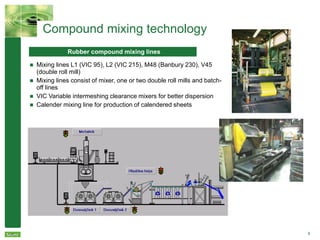
 Mixing lines L1 (VIC 95), L2 (VIC 215), M48 (Banbury 230), V45
(double roll mill)
 Mixing lines consist of mixer, one or two double roll mills and batch-
off lines
 VIC Variable intermeshing clearance mixers for better dispersion
 Calender mixing line for production of calendered sheets
DRAFT
9
Compound mixing technology
Automatic control of mixing procedures
 Formulations, mixing procedures and parameters are
automatically transferred with a daily plan to mixing lines.
 Fully automatic mixing procedures.
 Mixing procedure is optimized by analyzing of mixing
histograms which are valuable data about process
efficiency.
DRAFT
10
Compound mixing technology
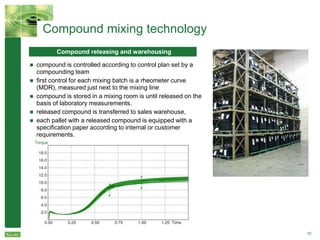
Compound releasing and warehousing
 compound is controlled according to control plan set by a
compounding team
 first control for each mixing batch is a rheometer curve
(MDR), measured just next to the mixing line
 compound is stored in a mixing room is until released on the
basis of laboratory measurements.
 released compound is transferred to sales warehouse,
 each pallet with a released compound is equipped with a
specification paper according to internal or customer
requirements.
DRAFT
11
Research & Development – Overview
Research & Development
Central R&D
- Central laboratory
- Strategic projects
- Implementation of new
development tools
- Indok
- Development cooperation
- Project management
- Problem solving activities
- Training of employees
R&D in business
units
- Development of new
products
- Technologies
DRAFT
12
Quality Management
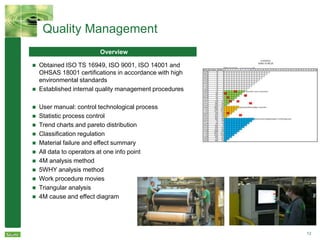
Overview
 Obtained ISO TS 16949, ISO 9001, ISO 14001 and
OHSAS 18001 certifications in accordance with high
environmental standards
 Established internal quality management procedures
 User manual: control technological process
 Statistic process control
 Trend charts and pareto distribution
 Classification regulation
 Material failure and effect summary
 All data to operators at one info point
 4M analysis method
 5WHY analysis method
 Work procedure movies
 Triangular analysis
 4M cause and effect diagram
DRAFT
13
THANK YOU

Savatech Rubber compounds 2015 Julij

  • 1.
  • 2.
    DRAFT 2 Introduction to SavatechGroup  More than 90 years of rubber knowledge and tradition  Highly specialized niche player for technical rubber products  Serving a broad range of customers in more than 90 countries with four manufacturing sites and six sales offices  Providing a diversified product portfolio:  Rubber compounds  Offset printing blankets  Environmental protection and rescue  Conveyor belts  Rubber profiles  Moulded products  Tires for scooters, mopeds, motorcycles  Rubber rollers Manufacturing Sites Sales / Representative Offices Munich WarsawLondon Prague Kranj Moscow Zagreb Yaroslavl Ptuj Daytona Beach, USA
  • 3.
    DRAFT 3 Walk Through Time 1920In Kranj the company ATLANTA IMPORTS AND EXPORTS was formed. 1921 The company Atlanta was renamed to a new company VULKAN. 1931 The Kranj company became the property of the Vienna firm Semperit. 1940 The sole owner of the tyre factory in Kranj became the firm Continental. 1946 Nationalisation and a change of the name to SAVA Rubber Products. 1956 Official opening of Plant II in Gaštej. 1967 Signing of the licence agreement with Semperit. 1972 Sava / Semperit Car Tyres commenced production. 1997 Signing of the Joint Venture Agreement between the Sava corporation and the Goodyear concern for production of tyres. 2002 Sava d.d. organized rubber production in SAVATECH d.o.o. 2013 Savatech d.o.o. became a part of the CGS Group.
  • 4.
    DRAFT 4  Compounds onthe basis of natural rubber and synthetic rubbers: EPDM, SBR, BR, NBR, CR, CSM, CIIR, HNBR, etc.  Base material for further production process Elastomers Product Range Applications  Automotive industry  Home appliances  Building industry  Nutritional industry  Transportation  Applications within electro industry  Processing technologies Market Position  Leading market position in Slovenia  Strong market position in Ex-YU  Several notable customers in EU  Strong R&D support  Well equipped central laboratory with highly skilled personnel  Knowledge enriched by experience and tradition  Rubber compounds to meet customers’ requirements  Implementation of new materials  Steady process development Strengths Development
  • 5.
    DRAFT 5 Rubber compound production Slovenia Germany Croatia Serbia GreatBritan Switzerland Poland Bolgaria other Sales Breakdown by Country 2014 Sales to external customers (tonnes) 0 2000 4000 6000 8000 10000
  • 6.
    DRAFT 6 Compound mixing technology Rawmaterial handling  Every raw material is checked according to the certificate and specification before unloading  Material tracking with a by BAR code  Material tracking through the SAP management program  Constant warehouse temperature control
  • 7.
    DRAFT 7 Compound mixing technology Automaticweighing and dosing system  Every formulation for daily plan is transferred from the network to a mixing line and weighing stations  Rubber bales and small chemicals are dosed by a conveyor belt with a double weighing check and a bar code check  Small chemicals are prepared in a special chamber with semi- automatic weighing stations  Carbon black and white fillers are weighed and dosed by the automatic system from big-bag  Plasticizers are dosed automatically from the underground tanks
  • 8.
    DRAFT 8 Compound mixing technology Rubbercompound mixing lines  Mixing lines L1 (VIC 95), L2 (VIC 215), M48 (Banbury 230), V45 (double roll mill)  Mixing lines consist of mixer, one or two double roll mills and batch- off lines  VIC Variable intermeshing clearance mixers for better dispersion  Calender mixing line for production of calendered sheets
  • 9.
    DRAFT 9 Compound mixing technology Automaticcontrol of mixing procedures  Formulations, mixing procedures and parameters are automatically transferred with a daily plan to mixing lines.  Fully automatic mixing procedures.  Mixing procedure is optimized by analyzing of mixing histograms which are valuable data about process efficiency.
  • 10.
    DRAFT 10 Compound mixing technology Compoundreleasing and warehousing  compound is controlled according to control plan set by a compounding team  first control for each mixing batch is a rheometer curve (MDR), measured just next to the mixing line  compound is stored in a mixing room is until released on the basis of laboratory measurements.  released compound is transferred to sales warehouse,  each pallet with a released compound is equipped with a specification paper according to internal or customer requirements.
  • 11.
    DRAFT 11 Research & Development– Overview Research & Development Central R&D - Central laboratory - Strategic projects - Implementation of new development tools - Indok - Development cooperation - Project management - Problem solving activities - Training of employees R&D in business units - Development of new products - Technologies
  • 12.
    DRAFT 12 Quality Management Overview  ObtainedISO TS 16949, ISO 9001, ISO 14001 and OHSAS 18001 certifications in accordance with high environmental standards  Established internal quality management procedures  User manual: control technological process  Statistic process control  Trend charts and pareto distribution  Classification regulation  Material failure and effect summary  All data to operators at one info point  4M analysis method  5WHY analysis method  Work procedure movies  Triangular analysis  4M cause and effect diagram
  • 13.