SAReserve Bank - NPS Update, April 2002
April, 2002
SAMOS Business Continuity
SARB-Link Renewal
Oversight in the SA NPS
Risk Reduction Measures
Common Monetary Area Cross-border Transactions
A Review of the SADC Payment System Project
THE EVOLUTION OF SAMOS
The South African Multiple Option Settlement System, SAMOS, is a vital
component of the National Payment System (NPS). Regular reviews of
its functionality are conducted to accommodate the different and chan-
ging requirements for the settlement process.
SAMOS Version 4.0, implemented on 6th October 2001, includes the
Continuous Batch Processing Line (CBPL) settlement option that
enables banks to meet only net obligations in a full batch. CBPL enables
a NPS operator or a Financial Market Exchange (FME) to send instruc-
tions in batches for settlement to SAMOS on behalf of banks linked to a
payment stream. Banks have to meet their net obligations in the batch,
and settlement takes place when all banks have funded accounts rela-
ting to the agreement.
Presently STRATE, the securities settlement body, uses the CBPL func-
tionality to submit settlement instructions to facilitate the settlement of
trades on equities.
Another major inclusion in SAMOS Version 4.0 is an enhancement to
accommodate reference numbers on SWIFT formatted transactions
originating from sources outside South Africa. This has enabled benefi-
ciary banks to reconcile payment and settlement information originating
from different sources.
SAMEX, the South African Reserve Bank (SARB) front-end system inter-
facing to SAMOS, has been re-developed to run on the Windows NT
platform. Functionality on the enhanced SAMEX enables it to interface
with SAMOS Version 4.0.
The introduction of Separate Trading of Registered Interest and Principal
of South African Government Securities (STRIPS), by the National
Treasury on the 15th of January 2002 had resulted in SAMOS having to
accommodate the new bonds as collateral. The proximity of the imple-
mentation date of SAMOS Version 4.0 to
the implementation of the STRIPS resulted
in having to provide a subsequent
enhancement, to allow the use of the
bonds as collateral in SAMOS on the 15th
of January 2002. The permanent feature to
accommodate this requirement will be
included in the new version of SAMOS.
This is scheduled for the latter part of 2002.
South African Reserve Bank
WHAT IS EMV, and what does it mean for bankers, etc ?
SAMOS Version 4
Use of STRIP Bonds as Collateral on SAMOS
NPSNPS UpdateUpdateNewsletter of the National Payment System (NPS) Department
SAReserve Bank - NPS Update, April 2002
SAMOS BUSINESS CONTINUITY
Background
The attack on the World Trade Centre dramatically brought into focus the necessity for organisations to have solid and effec-
tive business continuity arrangements. In an increasingly integrated business environment, businesses can rarely afford to
be offline as this could result in financial ruin.
The nature of the SAMOS system also requires that participants be able to submit instructions to the system at all times
during operational hours. It is the responsibility of each participant to ensure that contingency arrangements are in place to
facilitate continuity of their business operations and in particular their interface to the SAMOS system.
The SA Reserve Bank has also embarked on a project to review the current BCP arrangements and specifically as they
relate to the SAMOS system. This project is focussed on two areas namely, internal to the SA Reserve Bank as provider of
settlement services as well as external as the overseer of the National Payment System. In this process the following pha-
ses will form the basis of the review;
• Business risk analysis
• Contingency evaluation and planning
• Testing
• Review ongoing compliance arrangements.
Impact and Contingency
The impact analysis of the unavailability and current contingency arrangements for various facilities that relate to the settle-
ment system are detailed below;
Financial Instrument Register
Scenario: Clearing Manager Application is down.
Impact: Reserve of collateral cannot take place. This could result in insufficient capacity to settle obligations.
Contingency: Loans will have to be granted to the participant requiring funds using a manual process. SARB will pay
funds into the settlement account of the participant requiring funds and attach a script logged at the FIR
using a manual process.
Assumptions: The SAMOS system is up and SARB Finance department grant the approval for this arrangement.
SWIFT message carrier
Scenario: SWIFT encryption unit is faulty, SWIFT telecommunication line is down or SWIFT interface gateway is down.
Impact: Participants making exclusive use of SWIFT message service will be unable to participate on SAMOS.
Circulation of available funds will be restricted.
Contingency: Participating banks may use SAMEX (MQ) to submit their instructions to SAMOS. SA Reserve Bank as NPS
operator may also provide MQ facilities to use for single and batch settlements.
Assumptions: The SAMEX interface is available or the SARB NPS operator facility is available.
SWIFT security solution
Scenario: Keys used for Bilateral Key Exchange (BKE) have expired or the relevant hardware is dysfunctional. resul-
ting in messages not reaching SAMOS.
Impact: Messages sent by participant are not reaching SAMOS.
Contingency: Initiate the BKE process. Participating banks may use SAMEX (MQ) to submit their instructions to SAMOS.
2
SAReserve Bank - NPS Update, April 2002
SA Reserve Bank as NPS operator may also provide MQ facilities to use for single and batch settlements.
Assumptions: Relevant SWIFT support staff is available both at the SARB and participant site. The SAMEX interface is
available or the SARB NPS operator facility is available.
SAMEX (MQ) security solution
Scenario: Certificates and keys used for security have expired.
Impact: Messages sent by participant are not reaching SAMOS.
Contingency: The participant’s security officers come to SARB to renew these certificates. SWIFT certified participants
might use SWIFT to submit their instructions to SAMOS. SA Reserve Bank as NPS operator or Bankserv
may also provide facilities to use for single and batch settlements. Participants may make arrangements to
use the Participant Disaster Recovery Facility at the SARB.
Assumptions: Relevant participant security officers as well as the certification authority are available. SWIFT connectivity
is available. The SARB NPS operator facility or Bankserv connectivity is available.
SAMEX (MQ) message carrier
Scenario: The relevant SAMEX hardware (server, security devices or frame relay access device or communication line)
is dysfunctional.
Impact: Participant cannot generate messages or generated messages are not reaching SAMOS.
Contingency: SWIFT certified participants might use SWIFT to submit their instructions to SAMOS. SA Reserve Bank as
NPS operator or Bankserv may also provide facilities to use for single and batch settlements. Participants
may make arrangements to use the Participant Disaster Recovery Facility at the SARB.
Assumptions: Relevant participant security officers as well as the certification authority are available. SWIFT connectivity
is available. The SARB NPS operator facility or Bankserv connectivity is available. The Participant Disaster
Recovery Facility and relevant role players are available.
Collateral Market Values
Scenario: The Money and Capital Market department’s market value upload facility is not available.
Impact: No new market values will be electronically uploaded. Collateral might be over or under valued for loans
granted in SAMOS. Depending on the magnitude of the disaster the market values of collateral may be
volatile.
Contingency: Market values can be manually changed using the SAMOS Management system. Depending on the volati-
lity of the rate, the Money and Capital Market department would need to take this volatility into considera-
tion. The previous day's values can be used until correct values can be provided.
Assumptions: Market value figures are available.
SARB’s Ledger system (CBS)
Scenario: The CBS application is not available.
Impact: In the event of CBS being needed for manual settlement, due to SAMOS being unavailable, the impact
could be systemic in that no settlements can be processed. If the SARB CBS interface to SAMOS is
unavailable the SARB Finance department will have difficulty in reconciling payments.
Contingency: A report can be produced by the SAMOS Customer Support Centre for CBS (Finance Dept) that reflects
the amounts on the SAMOS settlement accounts for take on. SARB's Finance Department should put
3
SAReserve Bank - NPS Update, April 2002
manual procedures in place as back-up for CBS.
Assumptions: The SAMOS system is available.
Bankserv (ACB)- PCH
Scenario: The clearinghouse system is not available.
Impact: If the problem is connectivity to SAMOS then it can have an impact on participants' capacity to settle if
batched transactions have to be settled as single instructions. Banks will have difficulty in determining their
final positions.
Contingency: Bankserv's contingency plan. The current contingency arrangement for code line clearing is a second
machine with the same software and hardware as the production machine, on the same site. If the settle-
ment figures are available then the NPS operator backup facility at SARB Jhb (MMJ) can be used. Single
settlement instructions can be sent to effect the gross settlement by participants at source.
Assumptions: Bankserv’s continuity plans will surfice to continue their business. SARB NPS operator facility is available.
SAMOS Customer Support Centre
Scenario: SAMOS Customer Support Centre facility is not available.
Impact: Unable to provide support to participants. Monitoring and call logging facilities are lost.
Contingency: Revert to manual process if necessary for logging calls and refer to paper based documentation for par-
ticipant support.
Assumptions: The SAMOS system is available. The telephone communication link to participants is available and only the
mainframe application access and/or other SAMOS management tools are unavailable.
SAMOS system
Scenario: The SAMOS system is not available.
Impact: No electronic settlement will be possible.
Contingency: Banks may have to revert back to the previous method (prior to SAMOS) of settlement using SARB's CBS
system. Batches will be settled manually on CBS. Single SIs need to be routed to a PCH (i.e. ZAPS) for
end of day settlement. Banks that do not form part of ZAPS can also revert back to using cheques for pay-
ment as an interim measure. Bankserv’s systems would be temporarily changed to remove validations for
transaction amount limits. SARB will generate ledger statements from CBS to enable participating banks
to reconcile.
Assumptions: Participants have connectivity to Bankserv. Bankserv systems are available. There would be sufficient time
to remove the transaction limits from Bankserv systems. The CBS system is available.
Way forward
Participants will be invited to take part in the Work group that will identify weak links in the overall system where pressure
may develop and set out the contingency plans for the payment industry.
Current participants include:
- SARB (MMJ, MCM, NPSD, Finance Dept)
- Settlement banks
- Bankserv
- UNEXCOR
- STRATE (JSE).
Participants are however responsible to ensure that their BCP plans are in place.
4
SAReserve Bank - NPS Update, April 2002
SARB-LINK RENEWAL
This project was registered and initiated to investigate possible alternates to current infrastructure, to point
out and remedy single points of failure as well as to identify various components of the SARB-Link infra-
structure which are either outdated or reached the maximum of their capacity usage.
During the investigation, the current SARB-Link environment was documented, an assessment was made
of this environment and alternative products or upgrades to existing products were identified where appli-
cable. Finally a recommendation report was compiled which included single points of failure, outdated
equipment and technological advancements on the current infrastructure, and a presentation on these re-
commendations was presented to Business Systems and Technology Department and National Payment
System Department management. These recommendations were approved, and the procurement phase
initiated.
This renewal project included investigations into the current security solution, and possible replacements
thereof, as well as the future implementation of the latest SWIFT offering called SWIFT Net. These investi-
gations were at the time not conclusive due to time constraints of the project, and the limited availability of
information. Business Systems and Technology Department and National Payment System Department
management then further tasked the project team to initiate a sub project to investigate these replacements
in more detail. This project became known as the “SARB-Link Renewal - Phase 3 Project”. This investiga-
tion now ran parallel to the actual implementation of Phases 1 and 2.
5
SA Reserve Bank
SARB-Link Infrastructure
Diagram 1.1 removed
SAReserve Bank - NPS Update, April 2002
The Phase 1 and 2 implementation was completed at the end of October 2001, and some of the technical
advantages of these renewal phases were the following:
1. Provision of a redundant route for internal SAMOS users.
2. Replacement of the out-dated Cascade Frame Relay Switch.
3. Increase in available ports for new participants.
4. Created the possibility for participants to now connect via Cisco equipment.
5. Replacement of outdated Ethernet Hubs with more manageable Cisco switches.
6. SARB-Link became a single protocol network – IP. (Previously IP and SNA)
7. Removal of the McData Controllers, which were seen as a single point of failure, and in doing so also
decreasing operational costs on maintenance.
8. Removal of the extremely costly SNAX connectivity software from the Tandem Platform, resulting in
an extensive operational saving.
9. A more manageable SARB-Link Environment.
10. Initiated a move to an Ethernet only network. (Currently Token-Ring and Ethernet)
6
SA Reserve Bank
SARB-Link Infrastructure
Diagram 1.2 removed
SAReserve Bank - NPS Update, April 2002
As can be seen from the mentioned advantages, the implementation of Phase 1 and 2 proved to be very be-
neficial to the SAMOS system and the SA Reserve Bank as a whole.
* Diagram 1.2 (on page 6) depicts the current configuration, however also includes the completed move to
Ethernet as per point 10 above, which has been initiated as a sub-project and is currently in progress.
As previously mentioned, the “SARB-Link Renewal - Phase 3 Project” investigation has been completed, and
the results and recommendations presented to both Business Systems and Technology Department and
National Payment System Department management met with favourable responses. With regard to the secu-
rity recommendations, a mandate to continue with gaining the approval of the Security Architecture Task
Group (SATG) was received from management, and a meeting has been scheduled for mid November. The
SATG is responsible for the security infrastructure within SARB-Link, and any proposed changes have to be
approved by them. The SATG is made up from members of participating financial institutions.
The security recommendations take the form of an IPSEC (Secure Internet Protocol) solution using PKI (Public
Key Infrastructure) with an onsite Certification Authority, running on a Windows 2000 platform, to replace the
current Map solution. This solution has been proposed for the following major reasons:
This solution has also been tested on the SARB-Link test environment, and the proposal was drawn up with
the assistance of the South African Certification Authority (SACA).
With regard to the SWIFT-Net investigation, the proposal is that we go ahead with formal plans to replace our
existing X.25 SWIFT service with the new IP based SWIFT-Net service (FIN Service) when it becomes avai-
lable in South Africa (2003). Part of this investigation has taken into account the equipment which could pos-
sibly be used for the most redundant implementation, and based on these findings a budgetary figure has
been included in next years BSTD budget. Closer co-operation between SWIFT and SARB has already begun
taking place in order to begin discussing testing methods, finalizing dates and ensuring the correct solutions.
Further information on the above can be obtained from the Infrastructure Development and Deployment divi-
sion of BSTD upon request, by contacting Koos Risseeuw (012) 313-3458 or Andrew Jennings (012) 313-
3654.
1. Viable replacement for current Map Solution.
2. Leverage SAMEX NT infrastructure.
3. Open Standard Security Protocol.
4. Leading Vendor support.
5. Lowest cost of ownership for digital certificate solutions.
6. Reduction of extremely high maintenance and operational costs.
7. Flexible with ease of configuration.
7
SAReserve Bank - NPS Update, April 20028
The National Payment System forms a vital part of the economic
and financial infrastructure of the country. The efficient functioning
of the payment system allows transactions to be effected safely and
on time and thus makes a key contribution to overall economic per-
formance of the country. Payment systems can also involve signif-
icant exposures and risks for participants. The payment system
can also be a channel for the transmission of disturbances from one
part of the economy or financial system to another. The potential of
“systemic risk” is an important reason why the central bank must
be involved in the design and operations of payment systems.
The Bank for International Settlement (BIS) defines payment sys-
tem oversight as follows: “…oversight of payment systems is a
central bank task, principally intended to promote the smooth func-
tioning of payment systems and to protect the financial system
OVERSIGHT IN THE SOUTH AFRICAN NATIONAL PAYMENT SYSTEM
Members of the NPS Oversight team are Johann Bence, Johnny Pienaar (contracter),
Wayne Kotze, Mike Stocks and in front Magaret Olivier and Raadhika Sookoo.
SAReserve Bank - NPS Update, April 2002
from possible domino effects which may occur when one or more
participants in the payment system incur credit or liquidity pro-
blems. Payment systems oversight aims at a given system (e.g. a
funds transfer system) rather than individual participants.”
The South African Reserve Bank’s (the Bank) oversight of payment
systems is an integral part of its wider responsibilities for monetary
and financial stability. Oversight of payment systems is therefore a
key element in the Bank’s responsibility for the stability of the
financial system as a whole. As the values moving through pay-
ment systems have increased, the robustness of the payment sys-
tems and risk management have become issues of increasing
importance. The focus of the Bank’s oversight function is therefore
to identify potential risk posed by the design and operation of pay-
ment systems and to take steps to control the risk. The Bank’s
oversight role also relates closely to its operational role as provider
of the settlement medium (central bank money) and as ultimate
provider of liquidity to the banking system and the economy as a
whole.
The main objective for the Bank in overseeing payment systems is
to ensure that sufficient weight is given to risk reduction and ma-
nagement in their design and operation. The focus must also be on
efficiency, e.g. whether a system processes payments in a timely
and reliable way, at a reasonable cost.
The Oversight function of the National Payment System
Department (NPSD) is a relatively new function in the Department,
which has been established to address risk in the payment system
and to ensure that the payment system conforms with the inter-
national trend relating to systemically important payment systems.
The Oversight section of the NPSD has embarked upon profiling
each of the participants in the National Payment System. The pro-
files are the first step in trying to monitor the payment flows and
to identify risk in the National Payment System so that corrective
action can be taken in order to minimise possible impacts of the
risk on other payment system participants and the payment sys-
tems as a whole. Individual profiles will allow analysts in NPSD to
understand the system participants’ operations and the risk that
the system participants face daily. As the profiles evolve over time,
the National Payment System participants will be included in the
development and enhancement process to ensure quality informa-
tion is used on a high level when looking at the system as a whole.
9
SAReserve Bank - NPS Update, April 2002
RISK REDUCTION MEASURES
Introduction
The SAMOS system has to-date been in operation for more than three years. Over this period, the banks, including
the Reserve Bank, have learnt to utilise the system and its facilities as well as plan and apply strategies within the
settlement arena.
From the outset, one of the focus areas of the National Payment System Department (NPSD) has been to steer the
National Payment System, and the participants, towards compliance with the Bank for International Settlements’
(BIS) core principles for systemically important payment systems. In addition to, and in support of this drive, prac-
tices which bring risk to the payment system are identified, evaluated, and measures established to reduce the risks
where possible.
Risk Reduction Measures
As mentioned above, the NPSD is committed to reducing risk in the payment system. To this end, the department
published Position Paper 1/2000 during September 2000, identifying the measures that would be implemented to
reduce risk in the system.
The areas addressed and the results achieved as a result of the risk reduction initiative include:
Payment Clearing House (PCH) Agreements
The drafting and signing of PCH agreements, between PCH participants, was aimed at formalising procedures
between participants in the various payment streams. It was of particular concern to the NPSD that, although par-
ticipants in the various PCH’s operate according to certain technical rules, no formal agreement was in place between
them relating to bi-lateral arrangements, item limits or settlement assurance. In the case of failure by one or more of
the participants to meet their settlement obligations, chaos could result. In addition, there appeared to be a per-
ception that the Reserve Bank would automatically assure settlement should one, or more, participant fail to meet
their obligations.
Resulting from this initiative, the PCH agreements governing the batched payment streams have been signed by all
banks participating in the respective payment streams.
The remaining agreements to be signed include the Card Agreement and the Bond Exchange (BESA) Agreement.
Item Limits
To address the excessive exposures created in the various payment streams, item limits in each payment stream
have been incorporated into the PCH agreements.
The motivation for implementing item limits stems from evidence that should the “high values” be removed from these
payment streams, the value of payments which could be settled across the Real-Time Line (RTL) could be increased
to exceed 90% of total value settled in the SAMOS system.
Currently, with the item limits implemented to-date, the total value processed in the ZAPS payment stream has
decreased from R1.4 trillion per month in October 1998 to R6 billion in September 2001. This decrease corresponds
with an increase in the RTL.
The settlement patterns across the other payment streams are being closely monitored as the items limits in each
payment stream are implemented.
10
SAReserve Bank - NPS Update, April 2002
Item Limits have been implemented in all payment streams by the end of January 2002.
Settlement Assurance
Prior to the implementation of the SAMOS system only a few formal agreements existed between the participating
parties and these were focussed upon the task and not the reduction of risk and risk exposures.
In terms of the South African National Payment System Strategy and Framework document (“Blue Book”) principles
relating to risk reduction and the BIS Core Principles, clauses needed to be drafted into the PCH Agreements where-
by settlement of the PCH batches would be assured by the participants. These clauses imply that the participants in
a PCH would provide assurance, in the form of collateral acceptable to the Reserve Bank, to assure coverage of, at
least, the greatest net debit position and preferably twice the greatest net debit position, in the PCH. Should a par-
ticipant, therefore, fail to meet its obligation in the batch settlement on a particular day, the Reserve Bank would have
the option to attach the collateral provided by the participants in order to fund the settlement account of the defaul-
ting party, and thereby assure settlement. The activation of this process would have to be managed and co-ordina-
ted in terms of other options that the Reserve Bank may wish to exercise in its role as banker to the banks or over-
seer of financial stability in a crisis situation. The implementation of settlement assurance of the PCH batches would
ensure that the banking community have a role to play in funding banks which face a liquidity shortage in such a cri-
sis situation.
However, the provision of collateral to cover the greatest net debit position in the PCH batches, in terms of current
practices, would currently pose a major problem as it is doubtful that the banks could afford to collateralise these
positions. The only other option available to the banks implies that high-values would have to be removed from the
relative payment streams in order to make the provision of settlement assurance practicable.
The effect of the implementation of item limits will be monitored over a period to determine to what extent settlement
assurance may have to be applied. As noted above, the implementation of the item limits to reduce these exposures
and settlement assurance will be phased in over a period.
Settlement on day-of-value
Moving to settlement on day-of-value and discontinuing the practice of back-dating settlement of the PCH batches
represents the last phase of the current risk reduction measures envisaged in the NPS and is largely dependent on
the successful removal of high values from the inappropriate payment streams into the SAMOS immediate finality
facility in the RTL.
The motivation to move to settlement on the day of value can best be summarised by the comment IV.1 in the BIS
document “Core Principles for Systemically Important Payment Systems” which states the following, “Between the
time when payments are accepted for settlement by the payment system (including satisfaction of any relevant risk
management tests, such as the application of limits on exposures or availability of liquidity) and the time when final
settlement actually occurs, participants may still face credit and liquidity risks. These risks are exacerbated if they
extend overnight, in part because likely time for the relevant authorities to close insolvent institutions is between busi-
ness days. Prompt final settlement helps to reduce these risks. As a minimum standard, final settlement should occur
at the end of the day of value.”
The BIS Task Force responsible for drafting the core principles also documented, inter alia, (in their discussion do-
cumentation), the following,”In systems that conduct a net settlement at a designated time, the time between a) the
completion of the processing cycle during which payments are accepted and b) the extinguishing of net claims
through the settlement process should be kept to a minimum.”
With effect from 7 May 2001 all PCH batches are being settled immediately upon receipt in the SAMOS system and
are no longer scheduled for 07:00 on the next business day. This means that the overnight exposure of between 8
and 14 hours in the settlement system has been eliminated. This implies that settlement of payment obligations for
all payments, including the PCH batches, now occur on the intended day of value.
11
SAReserve Bank - NPS Update, April 2002
Throughput in the SAMOS System and results achieved
The implementation of the risk reduction measures have had positive results.
The removal of the Temporary (“Dummy”) Collateral and the implementation of the facility to allow the banks to
reserve the available Cash Reserve Contra Account balance in SAMOS has had a positive effect. Although few banks
have availed themselves of this facility, the overall liquidity management of the banks has improved with fewer occur-
rences of insufficient funds in the SAMOS system.
The option given to the banks to either reduce their exposures in the PCH environment by implementing item limits,
as opposed to the Reserve Bank requiring the banks to collateralise their greatest net debit position, has been
favourably accepted.
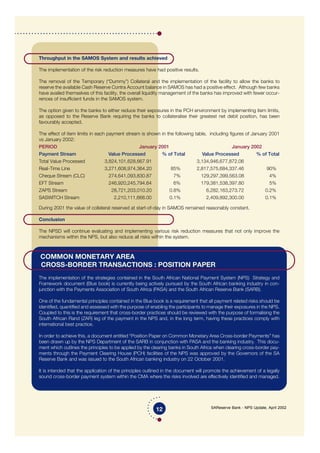
The effect of item limits in each payment stream is shown in the following table, including figures of January 2001
vs January 2002:
PERIOD January 2001 January 2002
Payment Stream Value Processed % of Total Value Processed % of Total
Total Value Processed 3,824,101,628,667.91 3,134,946,677,872.06
Real-Time Line 3,271,608,974,364.20 85% 2,817,575,684,337.46 90%
Cheque Stream (CLC) 274,641,093,830.87 7% 129,297,399,563.08 4%
EFT Stream 246,920,245,794.64 6% 179,381,538,397.80 5%
ZAPS Stream 28,721,203,010.20 0.8% 6,282,163,273.72 0.2%
SASWITCH Stream 2,210,111,668.00 0.1% 2,409,892,300.00 0.1%
During 2001 the value of collateral reserved at start-of-day in SAMOS remained reasonably constant.
Conclusion
The NPSD will continue evaluating and implementing various risk reduction measures that not only improve the
mechanisms within the NPS, but also reduce all risks within the system.
12
COMMON MONETARY AREA
CROSS-BORDER TRANSACTIONS : POSITION PAPER
The implementation of the strategies contained in the South African National Payment System (NPS) Strategy and
Framework document (Blue book) is currently being actively pursued by the South African banking industry in con-
junction with the Payments Association of South Africa (PASA) and the South African Reserve Bank (SARB).
One of the fundamental principles contained in the Blue book is a requirement that all payment related risks should be
identified, quantified and assessed with the purpose of enabling the participants to manage their exposures in the NPS.
Coupled to this is the requirement that cross-border practices should be reviewed with the purpose of formalising the
South African Rand (ZAR) leg of the payment in the NPS and, in the long term, having these practices comply with
international best practice.
In order to achieve this, a document entitled “Position Paper on Common Monetary Area Cross-border Payments” has
been drawn up by the NPS Department of the SARB in conjunction with PASA and the banking industry. This docu-
ment which outlines the principles to be applied by the clearing banks in South Africa when clearing cross-border pay-
ments through the Payment Clearing House (PCH) facilities of the NPS was approved by the Governors of the SA
Reserve Bank and was issued to the South African banking industry on 22 October 2001.
It is intended that the application of the principles outlined in the document will promote the achievement of a legally
sound cross-border payment system within the CMA where the risks involved are effectively identified and managed.
SAReserve Bank - NPS Update, April 200213
WHAT IS EMV, AND WHAT DOES IT MEAN FOR BANKERS, RETAILERS AND
CONSUMERS?
During your travels, you would have been inconvenienced by the diversity of electrical plugs in different countries: 3 square
pins in UK; 2 flat pins in France; 2 round pins in USA; 2 flat pins (angled) in Australia etc.; and what about your GSM mobile
phone? Same problem: works great in the UK and some countries in Europe, but is mostly useless in North America and
other parts of the world. This frustration is entirely due to a lack of interoperability.
As we become aware of the enormous opportunities and challenges, unequalled in the history of commerce, accompany-
ing the dramatic developments in smart card technology, the question of a single, common operating standard demands
attention. The banks, and other major players, recognise that smart cards provide vastly superior storage and processing
capacity together with flexibility, impossible on magnetic stripe. They also offer opportunities for multiple applications at the
highest levels of operational security. As the expanding global developments in e-commerce, mobile commerce and vir-
tual commerce start to impact the marketplace, smart card issues become critically important.
Key among these concerns, apart from security, is the question relating to operating standards - agreed global standards
enabling credit and debit card interoperability.
In response to the demands of their member banks, the major international card payment associations - Europay,
Mastercard and Visa - having identified the issue, established the EMV initiative as a worldwide industry working group. The
objective of the EMV process is to facilitate the introduction of chip technology into the international payment systems by
developing joint specifications.
Inline with initiatives throughout the world, the EMV Forum South Africa, has been established. The EMV Forum is driven
by real business issues including:
• Achieving domestic and global interoperability and avoiding inflexible and limited proprietary schemes;
• Keeping pace with future products and services springing from the foundation of chip technology;
• Countering escalating fraud and payments security risks, and providing cardholder authentication.
The EMV Forum is a major initiative by South African Banks, the leading Card Associations and more recently, Retailers, to
initiate and implement the global EMV chip card standard into the South African payments system. It is a chapter of EMVCo,
LLC, the international operation formed in February 1999 by Europay International, MasterCard International and Visa
International to manage, maintain and enhance the EMV Integrated Circuit Card Specifications for Payment Systems.
EMVCo will ensure that single terminal and card approval processes are developed at a level that will allow cross payment
system interoperability through compliance with the EMV specifications. Europay, MasterCard and Visa have worked
together over the last few years to develop specifications that define a set of requirements to ensure interoperability between
chip cards and terminals on a global basis, regardless of the manufacturer, the financial institution, or where the card is used.
The overall objective of the international EMV process is to facilitate the introduction of chip technology into the international
payment system by developing joint specifications. Locally, the EMV Forum's objectives are to:
• Ensure interoperability and mutual acceptance of EMV chip cards at point of sale, bank branches, ATMs and other
devices in "bank-owned", "retailer-owned" and "client-owned" environments.
• Ensure ongoing liaison with the appropriate Government offices and agencies regarding mutual developments and chip-
related initiatives.
• Ensure co-ordination and liaison with thye SA Retail Payments Issues Forum (*SARPIF) on EMV chip matters.
• Agree on the minimum common implementation requirements and migration timeframes for the acceptance of EMV chip
cards.
• Reach agreement on switching, clearing and settlement of EMV transactions.
• Ensure two-way communication with vendors/suppliers and retailers on standards and mandatory requirements.
• Co-ordianate EMV related training conducted by Visa, Mastercard and other training initiatives.
• Be the conduit for the gathering and sharing of information of common interest.
• Function as a formal working group on EMV standards and to provide input, where necessary, to other industry bodies.
For more information please visit the Forum’s website at www.emv.co.za.
SAReserve Bank - NPS Update, April 2002
A REVIEW OF THE SADC PAYMENT SYSTEM PROJECT
The SADC Payment System Project suffered seriously from a loss of momentum arising directly from a shortage of funds.
This led to the delay in implementing the SADC Payment System Project in the Democratic Republic of Congo (DRC) and
Seychelles, the cancellation of the Annual Regionally Workshops for the years 2000 and 2001. Additionally the project
team have been unable to continue with the building of the required capacity in the SADC region, in terms of the results
of the profiling project which was completed during November 1999.
The loss of momentum, notwithstanding, the project continued making progress with the various other projects that are
being undertaken, as follows:
• The SADC Settlement Project.
• Guide to Developing a Strategic Framework for Payment System Modernisation.
• Updating of the publication, “Payment Systems in the Southern African Development Community”, (the Green Book).
• Assistance to several individual SADC member countries with the development of their clearing and settlement sys-
tems.
• Informal discussions with the Common Market for Eastern and Southern Africa (COMESA).
SADC Settlement Project
As a first step in the implementation of a decision taken by the Committee of Central Bank Governors (CCBG) in
SADC at their meeting held in Cape Town in September 2000, the SADC Payment System Project team arranged
a meeting of Country Leaders in Pretoria on 26 and 27 November 2000. The major objectives of this meeting were
to establish from the country leaders whether countries were prepared to participate in the project to develop com-
bined business and technical specifications for regional payment systems, to calculate resource requirements and
to initiate the planning of the way forward. In this regard, a series of four analysis sessions were held for the initial
development of the combined specifications based on common business requirements for the above mentioned
systems.
Two further workshops were held also in Pretoria during periods 11 to 12 June and 13 to 15 June 2001. The pur-
pose was to draft the Business Requirements Model for the SADC suitable real time gross settlement (RTGS) sys-
tem. Consultants were also invited for an expert input.
A tremendous amount of work was done by a combined SADC RTGS System Project team which consisted of
up to three members from each participating country (Angola, Botswana, DRC, Mozambique, Swaziland, Tanzania
and Zambia), members of the SADC Payment System Project team and a team of IT Professionals appointed by
the IT-Forum, including three consultants.
A group of fifty-four vendors identified by the participating countries were requested to respond to a pre-qualifica-
tion questionnaire. Pre-qualification of vendors was undertaken and the request for proposal (RFP document) was
issued to seventeen vendors who were qualified to tender for the provision of a suitable RTGS system. A vendor’s
briefing was held in Johannesburg and twelve vendors indicated that they would submit proposals, but by the clo-
sing date of 12 December 2001, only four proposals were received. Three of these were found to be substantive-
ly responsive during a pre-evaluation assessment.
A Bids Evaluation Workshop was held in Pretoria during the period 14 to 18 January 2002, where the three sub-
stantive bids were evaluated on a technical basis and thereafter on a financial basis. Arising from this process, two
bidders were identified as being able to provide the solutions required by the region and were requested to pre-
sent their solution to the project team at a workshop held in Pretoria during the period 13 to 15 February, 2002.
A final report on the project which was started in February, 2001, has been prepared and presented to the
Governors at the SADC Committee of Central Bank Governors meeting on 11 April, 2002.
14
SAReserve Bank - NPS Update, April 200215
Representatives from SADC countries attending the RTGS Bids Evaluation workshop at
Centurion Lake Hotel, 14 - 18 January 2002.
The Green Book Project
The Green Book which assisted in putting the SADC Payment System Project on the international “map” con-
tains information up to approximately 1997. Additionally, some statistics supplied are not in accordance with the
Bank for International Settlements (BIS) standards. The project has been launched to update the Green Book
as at December 2000, and to improve the overall quality of the statistics provided by the region.
There are severe difficulties which are being experienced with this project, which is delaying the release of the
relevant data. These difficulties will be discussed and resolved in the next meeting of the country leaders.
Guide to Developing a Strategic Framework for Payment System Modernisation
The development of the four volumes of the “Guide to Developing a Strategic Framework for Payment System
Modernisation” were completed in the final draft format. The volumes have since been combined into a single
document. The finalised document is expected to be printed by April 2002 and have it available on the SADC-
Bankers web-site at the same time.
SAReserve Bank - NPS Update, April 2002
Information regarding this publication can be obtained from:
ACB Automated Clearing Bureau
Bankserv SA Bankers Services Co Ltd
BCP Business Continuity Planning
BKE Bilateral Key Exchange
BSTD Business Systems and Technology Dept
CBPL Continuous Batch Processing Line
CD Central Depository
CPL Continuous-Processing Line
CSC Customer Support Centre
EFT Electronic Funds Transfers
FIR Financial Instrument Register
FME Financial Market Exchange
MICR Magnetic Ink Character Recognition
PCH Payment Clearing House
REPOs Repurchase Agreements
RTL Real-Time Line
RTGS Real-Time Gross Settlement (system)
SACA South African Certification Authority
SAMEX The external interface supplied to banks
by the Reserve Bank in order to enable
banks to access the SAMOS system
SAMOS South African Multiple Option Settlement
(system)
SARB-LINK Settlement message-exchange service
SCD Settlement Cycle Date
SI Settlement Instruction
STP Straight-Through Processing
STRATE Share Transactions Totally Electronic
16
Assistance to individual SADC member countries
The project team has continued to give assistance to individual SADC member countries in respect of va-
rious aspects of the development of Clearing and Settlement systems and other matters relating to the
modernisation of payment systems in the relevant countries.
Informal discussions with COMESA
At a request from the Chairman of the COMESA Committee of Central Bank Governors to the Chairman
of the SADC Committee of Central Bank Governors, the SADC Payment System Project team arranged
two informal meetings with the combined COMESA/IMF team to discuss the possibility of COMESA and
SADC co-operating on the development of a cross-border payment system.
The Editor
Eretha du Toit
Contact details:
Telephone +27 12 313-4107
Fax +27 12 313-4288
Design & Layout
Amine van Heerden
What does .... mean?
SA Reserve Bank
National Payment System Department
PO Box 427
PRETORIA
0001
Internet Address
www.reservebank.co.za

Sarb nps update apr2002

  • 1.
    SAReserve Bank -NPS Update, April 2002 April, 2002 SAMOS Business Continuity SARB-Link Renewal Oversight in the SA NPS Risk Reduction Measures Common Monetary Area Cross-border Transactions A Review of the SADC Payment System Project THE EVOLUTION OF SAMOS The South African Multiple Option Settlement System, SAMOS, is a vital component of the National Payment System (NPS). Regular reviews of its functionality are conducted to accommodate the different and chan- ging requirements for the settlement process. SAMOS Version 4.0, implemented on 6th October 2001, includes the Continuous Batch Processing Line (CBPL) settlement option that enables banks to meet only net obligations in a full batch. CBPL enables a NPS operator or a Financial Market Exchange (FME) to send instruc- tions in batches for settlement to SAMOS on behalf of banks linked to a payment stream. Banks have to meet their net obligations in the batch, and settlement takes place when all banks have funded accounts rela- ting to the agreement. Presently STRATE, the securities settlement body, uses the CBPL func- tionality to submit settlement instructions to facilitate the settlement of trades on equities. Another major inclusion in SAMOS Version 4.0 is an enhancement to accommodate reference numbers on SWIFT formatted transactions originating from sources outside South Africa. This has enabled benefi- ciary banks to reconcile payment and settlement information originating from different sources. SAMEX, the South African Reserve Bank (SARB) front-end system inter- facing to SAMOS, has been re-developed to run on the Windows NT platform. Functionality on the enhanced SAMEX enables it to interface with SAMOS Version 4.0. The introduction of Separate Trading of Registered Interest and Principal of South African Government Securities (STRIPS), by the National Treasury on the 15th of January 2002 had resulted in SAMOS having to accommodate the new bonds as collateral. The proximity of the imple- mentation date of SAMOS Version 4.0 to the implementation of the STRIPS resulted in having to provide a subsequent enhancement, to allow the use of the bonds as collateral in SAMOS on the 15th of January 2002. The permanent feature to accommodate this requirement will be included in the new version of SAMOS. This is scheduled for the latter part of 2002. South African Reserve Bank WHAT IS EMV, and what does it mean for bankers, etc ? SAMOS Version 4 Use of STRIP Bonds as Collateral on SAMOS NPSNPS UpdateUpdateNewsletter of the National Payment System (NPS) Department
  • 2.
    SAReserve Bank -NPS Update, April 2002 SAMOS BUSINESS CONTINUITY Background The attack on the World Trade Centre dramatically brought into focus the necessity for organisations to have solid and effec- tive business continuity arrangements. In an increasingly integrated business environment, businesses can rarely afford to be offline as this could result in financial ruin. The nature of the SAMOS system also requires that participants be able to submit instructions to the system at all times during operational hours. It is the responsibility of each participant to ensure that contingency arrangements are in place to facilitate continuity of their business operations and in particular their interface to the SAMOS system. The SA Reserve Bank has also embarked on a project to review the current BCP arrangements and specifically as they relate to the SAMOS system. This project is focussed on two areas namely, internal to the SA Reserve Bank as provider of settlement services as well as external as the overseer of the National Payment System. In this process the following pha- ses will form the basis of the review; • Business risk analysis • Contingency evaluation and planning • Testing • Review ongoing compliance arrangements. Impact and Contingency The impact analysis of the unavailability and current contingency arrangements for various facilities that relate to the settle- ment system are detailed below; Financial Instrument Register Scenario: Clearing Manager Application is down. Impact: Reserve of collateral cannot take place. This could result in insufficient capacity to settle obligations. Contingency: Loans will have to be granted to the participant requiring funds using a manual process. SARB will pay funds into the settlement account of the participant requiring funds and attach a script logged at the FIR using a manual process. Assumptions: The SAMOS system is up and SARB Finance department grant the approval for this arrangement. SWIFT message carrier Scenario: SWIFT encryption unit is faulty, SWIFT telecommunication line is down or SWIFT interface gateway is down. Impact: Participants making exclusive use of SWIFT message service will be unable to participate on SAMOS. Circulation of available funds will be restricted. Contingency: Participating banks may use SAMEX (MQ) to submit their instructions to SAMOS. SA Reserve Bank as NPS operator may also provide MQ facilities to use for single and batch settlements. Assumptions: The SAMEX interface is available or the SARB NPS operator facility is available. SWIFT security solution Scenario: Keys used for Bilateral Key Exchange (BKE) have expired or the relevant hardware is dysfunctional. resul- ting in messages not reaching SAMOS. Impact: Messages sent by participant are not reaching SAMOS. Contingency: Initiate the BKE process. Participating banks may use SAMEX (MQ) to submit their instructions to SAMOS. 2
  • 3.
    SAReserve Bank -NPS Update, April 2002 SA Reserve Bank as NPS operator may also provide MQ facilities to use for single and batch settlements. Assumptions: Relevant SWIFT support staff is available both at the SARB and participant site. The SAMEX interface is available or the SARB NPS operator facility is available. SAMEX (MQ) security solution Scenario: Certificates and keys used for security have expired. Impact: Messages sent by participant are not reaching SAMOS. Contingency: The participant’s security officers come to SARB to renew these certificates. SWIFT certified participants might use SWIFT to submit their instructions to SAMOS. SA Reserve Bank as NPS operator or Bankserv may also provide facilities to use for single and batch settlements. Participants may make arrangements to use the Participant Disaster Recovery Facility at the SARB. Assumptions: Relevant participant security officers as well as the certification authority are available. SWIFT connectivity is available. The SARB NPS operator facility or Bankserv connectivity is available. SAMEX (MQ) message carrier Scenario: The relevant SAMEX hardware (server, security devices or frame relay access device or communication line) is dysfunctional. Impact: Participant cannot generate messages or generated messages are not reaching SAMOS. Contingency: SWIFT certified participants might use SWIFT to submit their instructions to SAMOS. SA Reserve Bank as NPS operator or Bankserv may also provide facilities to use for single and batch settlements. Participants may make arrangements to use the Participant Disaster Recovery Facility at the SARB. Assumptions: Relevant participant security officers as well as the certification authority are available. SWIFT connectivity is available. The SARB NPS operator facility or Bankserv connectivity is available. The Participant Disaster Recovery Facility and relevant role players are available. Collateral Market Values Scenario: The Money and Capital Market department’s market value upload facility is not available. Impact: No new market values will be electronically uploaded. Collateral might be over or under valued for loans granted in SAMOS. Depending on the magnitude of the disaster the market values of collateral may be volatile. Contingency: Market values can be manually changed using the SAMOS Management system. Depending on the volati- lity of the rate, the Money and Capital Market department would need to take this volatility into considera- tion. The previous day's values can be used until correct values can be provided. Assumptions: Market value figures are available. SARB’s Ledger system (CBS) Scenario: The CBS application is not available. Impact: In the event of CBS being needed for manual settlement, due to SAMOS being unavailable, the impact could be systemic in that no settlements can be processed. If the SARB CBS interface to SAMOS is unavailable the SARB Finance department will have difficulty in reconciling payments. Contingency: A report can be produced by the SAMOS Customer Support Centre for CBS (Finance Dept) that reflects the amounts on the SAMOS settlement accounts for take on. SARB's Finance Department should put 3
  • 4.
    SAReserve Bank -NPS Update, April 2002 manual procedures in place as back-up for CBS. Assumptions: The SAMOS system is available. Bankserv (ACB)- PCH Scenario: The clearinghouse system is not available. Impact: If the problem is connectivity to SAMOS then it can have an impact on participants' capacity to settle if batched transactions have to be settled as single instructions. Banks will have difficulty in determining their final positions. Contingency: Bankserv's contingency plan. The current contingency arrangement for code line clearing is a second machine with the same software and hardware as the production machine, on the same site. If the settle- ment figures are available then the NPS operator backup facility at SARB Jhb (MMJ) can be used. Single settlement instructions can be sent to effect the gross settlement by participants at source. Assumptions: Bankserv’s continuity plans will surfice to continue their business. SARB NPS operator facility is available. SAMOS Customer Support Centre Scenario: SAMOS Customer Support Centre facility is not available. Impact: Unable to provide support to participants. Monitoring and call logging facilities are lost. Contingency: Revert to manual process if necessary for logging calls and refer to paper based documentation for par- ticipant support. Assumptions: The SAMOS system is available. The telephone communication link to participants is available and only the mainframe application access and/or other SAMOS management tools are unavailable. SAMOS system Scenario: The SAMOS system is not available. Impact: No electronic settlement will be possible. Contingency: Banks may have to revert back to the previous method (prior to SAMOS) of settlement using SARB's CBS system. Batches will be settled manually on CBS. Single SIs need to be routed to a PCH (i.e. ZAPS) for end of day settlement. Banks that do not form part of ZAPS can also revert back to using cheques for pay- ment as an interim measure. Bankserv’s systems would be temporarily changed to remove validations for transaction amount limits. SARB will generate ledger statements from CBS to enable participating banks to reconcile. Assumptions: Participants have connectivity to Bankserv. Bankserv systems are available. There would be sufficient time to remove the transaction limits from Bankserv systems. The CBS system is available. Way forward Participants will be invited to take part in the Work group that will identify weak links in the overall system where pressure may develop and set out the contingency plans for the payment industry. Current participants include: - SARB (MMJ, MCM, NPSD, Finance Dept) - Settlement banks - Bankserv - UNEXCOR - STRATE (JSE). Participants are however responsible to ensure that their BCP plans are in place. 4
  • 5.
    SAReserve Bank -NPS Update, April 2002 SARB-LINK RENEWAL This project was registered and initiated to investigate possible alternates to current infrastructure, to point out and remedy single points of failure as well as to identify various components of the SARB-Link infra- structure which are either outdated or reached the maximum of their capacity usage. During the investigation, the current SARB-Link environment was documented, an assessment was made of this environment and alternative products or upgrades to existing products were identified where appli- cable. Finally a recommendation report was compiled which included single points of failure, outdated equipment and technological advancements on the current infrastructure, and a presentation on these re- commendations was presented to Business Systems and Technology Department and National Payment System Department management. These recommendations were approved, and the procurement phase initiated. This renewal project included investigations into the current security solution, and possible replacements thereof, as well as the future implementation of the latest SWIFT offering called SWIFT Net. These investi- gations were at the time not conclusive due to time constraints of the project, and the limited availability of information. Business Systems and Technology Department and National Payment System Department management then further tasked the project team to initiate a sub project to investigate these replacements in more detail. This project became known as the “SARB-Link Renewal - Phase 3 Project”. This investiga- tion now ran parallel to the actual implementation of Phases 1 and 2. 5 SA Reserve Bank SARB-Link Infrastructure Diagram 1.1 removed
  • 6.
    SAReserve Bank -NPS Update, April 2002 The Phase 1 and 2 implementation was completed at the end of October 2001, and some of the technical advantages of these renewal phases were the following: 1. Provision of a redundant route for internal SAMOS users. 2. Replacement of the out-dated Cascade Frame Relay Switch. 3. Increase in available ports for new participants. 4. Created the possibility for participants to now connect via Cisco equipment. 5. Replacement of outdated Ethernet Hubs with more manageable Cisco switches. 6. SARB-Link became a single protocol network – IP. (Previously IP and SNA) 7. Removal of the McData Controllers, which were seen as a single point of failure, and in doing so also decreasing operational costs on maintenance. 8. Removal of the extremely costly SNAX connectivity software from the Tandem Platform, resulting in an extensive operational saving. 9. A more manageable SARB-Link Environment. 10. Initiated a move to an Ethernet only network. (Currently Token-Ring and Ethernet) 6 SA Reserve Bank SARB-Link Infrastructure Diagram 1.2 removed
  • 7.
    SAReserve Bank -NPS Update, April 2002 As can be seen from the mentioned advantages, the implementation of Phase 1 and 2 proved to be very be- neficial to the SAMOS system and the SA Reserve Bank as a whole. * Diagram 1.2 (on page 6) depicts the current configuration, however also includes the completed move to Ethernet as per point 10 above, which has been initiated as a sub-project and is currently in progress. As previously mentioned, the “SARB-Link Renewal - Phase 3 Project” investigation has been completed, and the results and recommendations presented to both Business Systems and Technology Department and National Payment System Department management met with favourable responses. With regard to the secu- rity recommendations, a mandate to continue with gaining the approval of the Security Architecture Task Group (SATG) was received from management, and a meeting has been scheduled for mid November. The SATG is responsible for the security infrastructure within SARB-Link, and any proposed changes have to be approved by them. The SATG is made up from members of participating financial institutions. The security recommendations take the form of an IPSEC (Secure Internet Protocol) solution using PKI (Public Key Infrastructure) with an onsite Certification Authority, running on a Windows 2000 platform, to replace the current Map solution. This solution has been proposed for the following major reasons: This solution has also been tested on the SARB-Link test environment, and the proposal was drawn up with the assistance of the South African Certification Authority (SACA). With regard to the SWIFT-Net investigation, the proposal is that we go ahead with formal plans to replace our existing X.25 SWIFT service with the new IP based SWIFT-Net service (FIN Service) when it becomes avai- lable in South Africa (2003). Part of this investigation has taken into account the equipment which could pos- sibly be used for the most redundant implementation, and based on these findings a budgetary figure has been included in next years BSTD budget. Closer co-operation between SWIFT and SARB has already begun taking place in order to begin discussing testing methods, finalizing dates and ensuring the correct solutions. Further information on the above can be obtained from the Infrastructure Development and Deployment divi- sion of BSTD upon request, by contacting Koos Risseeuw (012) 313-3458 or Andrew Jennings (012) 313- 3654. 1. Viable replacement for current Map Solution. 2. Leverage SAMEX NT infrastructure. 3. Open Standard Security Protocol. 4. Leading Vendor support. 5. Lowest cost of ownership for digital certificate solutions. 6. Reduction of extremely high maintenance and operational costs. 7. Flexible with ease of configuration. 7
  • 8.
    SAReserve Bank -NPS Update, April 20028 The National Payment System forms a vital part of the economic and financial infrastructure of the country. The efficient functioning of the payment system allows transactions to be effected safely and on time and thus makes a key contribution to overall economic per- formance of the country. Payment systems can also involve signif- icant exposures and risks for participants. The payment system can also be a channel for the transmission of disturbances from one part of the economy or financial system to another. The potential of “systemic risk” is an important reason why the central bank must be involved in the design and operations of payment systems. The Bank for International Settlement (BIS) defines payment sys- tem oversight as follows: “…oversight of payment systems is a central bank task, principally intended to promote the smooth func- tioning of payment systems and to protect the financial system OVERSIGHT IN THE SOUTH AFRICAN NATIONAL PAYMENT SYSTEM Members of the NPS Oversight team are Johann Bence, Johnny Pienaar (contracter), Wayne Kotze, Mike Stocks and in front Magaret Olivier and Raadhika Sookoo.
  • 9.
    SAReserve Bank -NPS Update, April 2002 from possible domino effects which may occur when one or more participants in the payment system incur credit or liquidity pro- blems. Payment systems oversight aims at a given system (e.g. a funds transfer system) rather than individual participants.” The South African Reserve Bank’s (the Bank) oversight of payment systems is an integral part of its wider responsibilities for monetary and financial stability. Oversight of payment systems is therefore a key element in the Bank’s responsibility for the stability of the financial system as a whole. As the values moving through pay- ment systems have increased, the robustness of the payment sys- tems and risk management have become issues of increasing importance. The focus of the Bank’s oversight function is therefore to identify potential risk posed by the design and operation of pay- ment systems and to take steps to control the risk. The Bank’s oversight role also relates closely to its operational role as provider of the settlement medium (central bank money) and as ultimate provider of liquidity to the banking system and the economy as a whole. The main objective for the Bank in overseeing payment systems is to ensure that sufficient weight is given to risk reduction and ma- nagement in their design and operation. The focus must also be on efficiency, e.g. whether a system processes payments in a timely and reliable way, at a reasonable cost. The Oversight function of the National Payment System Department (NPSD) is a relatively new function in the Department, which has been established to address risk in the payment system and to ensure that the payment system conforms with the inter- national trend relating to systemically important payment systems. The Oversight section of the NPSD has embarked upon profiling each of the participants in the National Payment System. The pro- files are the first step in trying to monitor the payment flows and to identify risk in the National Payment System so that corrective action can be taken in order to minimise possible impacts of the risk on other payment system participants and the payment sys- tems as a whole. Individual profiles will allow analysts in NPSD to understand the system participants’ operations and the risk that the system participants face daily. As the profiles evolve over time, the National Payment System participants will be included in the development and enhancement process to ensure quality informa- tion is used on a high level when looking at the system as a whole. 9
  • 10.
    SAReserve Bank -NPS Update, April 2002 RISK REDUCTION MEASURES Introduction The SAMOS system has to-date been in operation for more than three years. Over this period, the banks, including the Reserve Bank, have learnt to utilise the system and its facilities as well as plan and apply strategies within the settlement arena. From the outset, one of the focus areas of the National Payment System Department (NPSD) has been to steer the National Payment System, and the participants, towards compliance with the Bank for International Settlements’ (BIS) core principles for systemically important payment systems. In addition to, and in support of this drive, prac- tices which bring risk to the payment system are identified, evaluated, and measures established to reduce the risks where possible. Risk Reduction Measures As mentioned above, the NPSD is committed to reducing risk in the payment system. To this end, the department published Position Paper 1/2000 during September 2000, identifying the measures that would be implemented to reduce risk in the system. The areas addressed and the results achieved as a result of the risk reduction initiative include: Payment Clearing House (PCH) Agreements The drafting and signing of PCH agreements, between PCH participants, was aimed at formalising procedures between participants in the various payment streams. It was of particular concern to the NPSD that, although par- ticipants in the various PCH’s operate according to certain technical rules, no formal agreement was in place between them relating to bi-lateral arrangements, item limits or settlement assurance. In the case of failure by one or more of the participants to meet their settlement obligations, chaos could result. In addition, there appeared to be a per- ception that the Reserve Bank would automatically assure settlement should one, or more, participant fail to meet their obligations. Resulting from this initiative, the PCH agreements governing the batched payment streams have been signed by all banks participating in the respective payment streams. The remaining agreements to be signed include the Card Agreement and the Bond Exchange (BESA) Agreement. Item Limits To address the excessive exposures created in the various payment streams, item limits in each payment stream have been incorporated into the PCH agreements. The motivation for implementing item limits stems from evidence that should the “high values” be removed from these payment streams, the value of payments which could be settled across the Real-Time Line (RTL) could be increased to exceed 90% of total value settled in the SAMOS system. Currently, with the item limits implemented to-date, the total value processed in the ZAPS payment stream has decreased from R1.4 trillion per month in October 1998 to R6 billion in September 2001. This decrease corresponds with an increase in the RTL. The settlement patterns across the other payment streams are being closely monitored as the items limits in each payment stream are implemented. 10
  • 11.
    SAReserve Bank -NPS Update, April 2002 Item Limits have been implemented in all payment streams by the end of January 2002. Settlement Assurance Prior to the implementation of the SAMOS system only a few formal agreements existed between the participating parties and these were focussed upon the task and not the reduction of risk and risk exposures. In terms of the South African National Payment System Strategy and Framework document (“Blue Book”) principles relating to risk reduction and the BIS Core Principles, clauses needed to be drafted into the PCH Agreements where- by settlement of the PCH batches would be assured by the participants. These clauses imply that the participants in a PCH would provide assurance, in the form of collateral acceptable to the Reserve Bank, to assure coverage of, at least, the greatest net debit position and preferably twice the greatest net debit position, in the PCH. Should a par- ticipant, therefore, fail to meet its obligation in the batch settlement on a particular day, the Reserve Bank would have the option to attach the collateral provided by the participants in order to fund the settlement account of the defaul- ting party, and thereby assure settlement. The activation of this process would have to be managed and co-ordina- ted in terms of other options that the Reserve Bank may wish to exercise in its role as banker to the banks or over- seer of financial stability in a crisis situation. The implementation of settlement assurance of the PCH batches would ensure that the banking community have a role to play in funding banks which face a liquidity shortage in such a cri- sis situation. However, the provision of collateral to cover the greatest net debit position in the PCH batches, in terms of current practices, would currently pose a major problem as it is doubtful that the banks could afford to collateralise these positions. The only other option available to the banks implies that high-values would have to be removed from the relative payment streams in order to make the provision of settlement assurance practicable. The effect of the implementation of item limits will be monitored over a period to determine to what extent settlement assurance may have to be applied. As noted above, the implementation of the item limits to reduce these exposures and settlement assurance will be phased in over a period. Settlement on day-of-value Moving to settlement on day-of-value and discontinuing the practice of back-dating settlement of the PCH batches represents the last phase of the current risk reduction measures envisaged in the NPS and is largely dependent on the successful removal of high values from the inappropriate payment streams into the SAMOS immediate finality facility in the RTL. The motivation to move to settlement on the day of value can best be summarised by the comment IV.1 in the BIS document “Core Principles for Systemically Important Payment Systems” which states the following, “Between the time when payments are accepted for settlement by the payment system (including satisfaction of any relevant risk management tests, such as the application of limits on exposures or availability of liquidity) and the time when final settlement actually occurs, participants may still face credit and liquidity risks. These risks are exacerbated if they extend overnight, in part because likely time for the relevant authorities to close insolvent institutions is between busi- ness days. Prompt final settlement helps to reduce these risks. As a minimum standard, final settlement should occur at the end of the day of value.” The BIS Task Force responsible for drafting the core principles also documented, inter alia, (in their discussion do- cumentation), the following,”In systems that conduct a net settlement at a designated time, the time between a) the completion of the processing cycle during which payments are accepted and b) the extinguishing of net claims through the settlement process should be kept to a minimum.” With effect from 7 May 2001 all PCH batches are being settled immediately upon receipt in the SAMOS system and are no longer scheduled for 07:00 on the next business day. This means that the overnight exposure of between 8 and 14 hours in the settlement system has been eliminated. This implies that settlement of payment obligations for all payments, including the PCH batches, now occur on the intended day of value. 11
  • 12.
    SAReserve Bank -NPS Update, April 2002 Throughput in the SAMOS System and results achieved The implementation of the risk reduction measures have had positive results. The removal of the Temporary (“Dummy”) Collateral and the implementation of the facility to allow the banks to reserve the available Cash Reserve Contra Account balance in SAMOS has had a positive effect. Although few banks have availed themselves of this facility, the overall liquidity management of the banks has improved with fewer occur- rences of insufficient funds in the SAMOS system. The option given to the banks to either reduce their exposures in the PCH environment by implementing item limits, as opposed to the Reserve Bank requiring the banks to collateralise their greatest net debit position, has been favourably accepted. The effect of item limits in each payment stream is shown in the following table, including figures of January 2001 vs January 2002: PERIOD January 2001 January 2002 Payment Stream Value Processed % of Total Value Processed % of Total Total Value Processed 3,824,101,628,667.91 3,134,946,677,872.06 Real-Time Line 3,271,608,974,364.20 85% 2,817,575,684,337.46 90% Cheque Stream (CLC) 274,641,093,830.87 7% 129,297,399,563.08 4% EFT Stream 246,920,245,794.64 6% 179,381,538,397.80 5% ZAPS Stream 28,721,203,010.20 0.8% 6,282,163,273.72 0.2% SASWITCH Stream 2,210,111,668.00 0.1% 2,409,892,300.00 0.1% During 2001 the value of collateral reserved at start-of-day in SAMOS remained reasonably constant. Conclusion The NPSD will continue evaluating and implementing various risk reduction measures that not only improve the mechanisms within the NPS, but also reduce all risks within the system. 12 COMMON MONETARY AREA CROSS-BORDER TRANSACTIONS : POSITION PAPER The implementation of the strategies contained in the South African National Payment System (NPS) Strategy and Framework document (Blue book) is currently being actively pursued by the South African banking industry in con- junction with the Payments Association of South Africa (PASA) and the South African Reserve Bank (SARB). One of the fundamental principles contained in the Blue book is a requirement that all payment related risks should be identified, quantified and assessed with the purpose of enabling the participants to manage their exposures in the NPS. Coupled to this is the requirement that cross-border practices should be reviewed with the purpose of formalising the South African Rand (ZAR) leg of the payment in the NPS and, in the long term, having these practices comply with international best practice. In order to achieve this, a document entitled “Position Paper on Common Monetary Area Cross-border Payments” has been drawn up by the NPS Department of the SARB in conjunction with PASA and the banking industry. This docu- ment which outlines the principles to be applied by the clearing banks in South Africa when clearing cross-border pay- ments through the Payment Clearing House (PCH) facilities of the NPS was approved by the Governors of the SA Reserve Bank and was issued to the South African banking industry on 22 October 2001. It is intended that the application of the principles outlined in the document will promote the achievement of a legally sound cross-border payment system within the CMA where the risks involved are effectively identified and managed.
  • 13.
    SAReserve Bank -NPS Update, April 200213 WHAT IS EMV, AND WHAT DOES IT MEAN FOR BANKERS, RETAILERS AND CONSUMERS? During your travels, you would have been inconvenienced by the diversity of electrical plugs in different countries: 3 square pins in UK; 2 flat pins in France; 2 round pins in USA; 2 flat pins (angled) in Australia etc.; and what about your GSM mobile phone? Same problem: works great in the UK and some countries in Europe, but is mostly useless in North America and other parts of the world. This frustration is entirely due to a lack of interoperability. As we become aware of the enormous opportunities and challenges, unequalled in the history of commerce, accompany- ing the dramatic developments in smart card technology, the question of a single, common operating standard demands attention. The banks, and other major players, recognise that smart cards provide vastly superior storage and processing capacity together with flexibility, impossible on magnetic stripe. They also offer opportunities for multiple applications at the highest levels of operational security. As the expanding global developments in e-commerce, mobile commerce and vir- tual commerce start to impact the marketplace, smart card issues become critically important. Key among these concerns, apart from security, is the question relating to operating standards - agreed global standards enabling credit and debit card interoperability. In response to the demands of their member banks, the major international card payment associations - Europay, Mastercard and Visa - having identified the issue, established the EMV initiative as a worldwide industry working group. The objective of the EMV process is to facilitate the introduction of chip technology into the international payment systems by developing joint specifications. Inline with initiatives throughout the world, the EMV Forum South Africa, has been established. The EMV Forum is driven by real business issues including: • Achieving domestic and global interoperability and avoiding inflexible and limited proprietary schemes; • Keeping pace with future products and services springing from the foundation of chip technology; • Countering escalating fraud and payments security risks, and providing cardholder authentication. The EMV Forum is a major initiative by South African Banks, the leading Card Associations and more recently, Retailers, to initiate and implement the global EMV chip card standard into the South African payments system. It is a chapter of EMVCo, LLC, the international operation formed in February 1999 by Europay International, MasterCard International and Visa International to manage, maintain and enhance the EMV Integrated Circuit Card Specifications for Payment Systems. EMVCo will ensure that single terminal and card approval processes are developed at a level that will allow cross payment system interoperability through compliance with the EMV specifications. Europay, MasterCard and Visa have worked together over the last few years to develop specifications that define a set of requirements to ensure interoperability between chip cards and terminals on a global basis, regardless of the manufacturer, the financial institution, or where the card is used. The overall objective of the international EMV process is to facilitate the introduction of chip technology into the international payment system by developing joint specifications. Locally, the EMV Forum's objectives are to: • Ensure interoperability and mutual acceptance of EMV chip cards at point of sale, bank branches, ATMs and other devices in "bank-owned", "retailer-owned" and "client-owned" environments. • Ensure ongoing liaison with the appropriate Government offices and agencies regarding mutual developments and chip- related initiatives. • Ensure co-ordination and liaison with thye SA Retail Payments Issues Forum (*SARPIF) on EMV chip matters. • Agree on the minimum common implementation requirements and migration timeframes for the acceptance of EMV chip cards. • Reach agreement on switching, clearing and settlement of EMV transactions. • Ensure two-way communication with vendors/suppliers and retailers on standards and mandatory requirements. • Co-ordianate EMV related training conducted by Visa, Mastercard and other training initiatives. • Be the conduit for the gathering and sharing of information of common interest. • Function as a formal working group on EMV standards and to provide input, where necessary, to other industry bodies. For more information please visit the Forum’s website at www.emv.co.za.
  • 14.
    SAReserve Bank -NPS Update, April 2002 A REVIEW OF THE SADC PAYMENT SYSTEM PROJECT The SADC Payment System Project suffered seriously from a loss of momentum arising directly from a shortage of funds. This led to the delay in implementing the SADC Payment System Project in the Democratic Republic of Congo (DRC) and Seychelles, the cancellation of the Annual Regionally Workshops for the years 2000 and 2001. Additionally the project team have been unable to continue with the building of the required capacity in the SADC region, in terms of the results of the profiling project which was completed during November 1999. The loss of momentum, notwithstanding, the project continued making progress with the various other projects that are being undertaken, as follows: • The SADC Settlement Project. • Guide to Developing a Strategic Framework for Payment System Modernisation. • Updating of the publication, “Payment Systems in the Southern African Development Community”, (the Green Book). • Assistance to several individual SADC member countries with the development of their clearing and settlement sys- tems. • Informal discussions with the Common Market for Eastern and Southern Africa (COMESA). SADC Settlement Project As a first step in the implementation of a decision taken by the Committee of Central Bank Governors (CCBG) in SADC at their meeting held in Cape Town in September 2000, the SADC Payment System Project team arranged a meeting of Country Leaders in Pretoria on 26 and 27 November 2000. The major objectives of this meeting were to establish from the country leaders whether countries were prepared to participate in the project to develop com- bined business and technical specifications for regional payment systems, to calculate resource requirements and to initiate the planning of the way forward. In this regard, a series of four analysis sessions were held for the initial development of the combined specifications based on common business requirements for the above mentioned systems. Two further workshops were held also in Pretoria during periods 11 to 12 June and 13 to 15 June 2001. The pur- pose was to draft the Business Requirements Model for the SADC suitable real time gross settlement (RTGS) sys- tem. Consultants were also invited for an expert input. A tremendous amount of work was done by a combined SADC RTGS System Project team which consisted of up to three members from each participating country (Angola, Botswana, DRC, Mozambique, Swaziland, Tanzania and Zambia), members of the SADC Payment System Project team and a team of IT Professionals appointed by the IT-Forum, including three consultants. A group of fifty-four vendors identified by the participating countries were requested to respond to a pre-qualifica- tion questionnaire. Pre-qualification of vendors was undertaken and the request for proposal (RFP document) was issued to seventeen vendors who were qualified to tender for the provision of a suitable RTGS system. A vendor’s briefing was held in Johannesburg and twelve vendors indicated that they would submit proposals, but by the clo- sing date of 12 December 2001, only four proposals were received. Three of these were found to be substantive- ly responsive during a pre-evaluation assessment. A Bids Evaluation Workshop was held in Pretoria during the period 14 to 18 January 2002, where the three sub- stantive bids were evaluated on a technical basis and thereafter on a financial basis. Arising from this process, two bidders were identified as being able to provide the solutions required by the region and were requested to pre- sent their solution to the project team at a workshop held in Pretoria during the period 13 to 15 February, 2002. A final report on the project which was started in February, 2001, has been prepared and presented to the Governors at the SADC Committee of Central Bank Governors meeting on 11 April, 2002. 14
  • 15.
    SAReserve Bank -NPS Update, April 200215 Representatives from SADC countries attending the RTGS Bids Evaluation workshop at Centurion Lake Hotel, 14 - 18 January 2002. The Green Book Project The Green Book which assisted in putting the SADC Payment System Project on the international “map” con- tains information up to approximately 1997. Additionally, some statistics supplied are not in accordance with the Bank for International Settlements (BIS) standards. The project has been launched to update the Green Book as at December 2000, and to improve the overall quality of the statistics provided by the region. There are severe difficulties which are being experienced with this project, which is delaying the release of the relevant data. These difficulties will be discussed and resolved in the next meeting of the country leaders. Guide to Developing a Strategic Framework for Payment System Modernisation The development of the four volumes of the “Guide to Developing a Strategic Framework for Payment System Modernisation” were completed in the final draft format. The volumes have since been combined into a single document. The finalised document is expected to be printed by April 2002 and have it available on the SADC- Bankers web-site at the same time.
  • 16.
    SAReserve Bank -NPS Update, April 2002 Information regarding this publication can be obtained from: ACB Automated Clearing Bureau Bankserv SA Bankers Services Co Ltd BCP Business Continuity Planning BKE Bilateral Key Exchange BSTD Business Systems and Technology Dept CBPL Continuous Batch Processing Line CD Central Depository CPL Continuous-Processing Line CSC Customer Support Centre EFT Electronic Funds Transfers FIR Financial Instrument Register FME Financial Market Exchange MICR Magnetic Ink Character Recognition PCH Payment Clearing House REPOs Repurchase Agreements RTL Real-Time Line RTGS Real-Time Gross Settlement (system) SACA South African Certification Authority SAMEX The external interface supplied to banks by the Reserve Bank in order to enable banks to access the SAMOS system SAMOS South African Multiple Option Settlement (system) SARB-LINK Settlement message-exchange service SCD Settlement Cycle Date SI Settlement Instruction STP Straight-Through Processing STRATE Share Transactions Totally Electronic 16 Assistance to individual SADC member countries The project team has continued to give assistance to individual SADC member countries in respect of va- rious aspects of the development of Clearing and Settlement systems and other matters relating to the modernisation of payment systems in the relevant countries. Informal discussions with COMESA At a request from the Chairman of the COMESA Committee of Central Bank Governors to the Chairman of the SADC Committee of Central Bank Governors, the SADC Payment System Project team arranged two informal meetings with the combined COMESA/IMF team to discuss the possibility of COMESA and SADC co-operating on the development of a cross-border payment system. The Editor Eretha du Toit Contact details: Telephone +27 12 313-4107 Fax +27 12 313-4288 Design & Layout Amine van Heerden What does .... mean? SA Reserve Bank National Payment System Department PO Box 427 PRETORIA 0001 Internet Address www.reservebank.co.za