Mobile or Ubiquitous ?
Eco-systems for Enhanced Human Memory
Sarah Clinch
Lancaster University
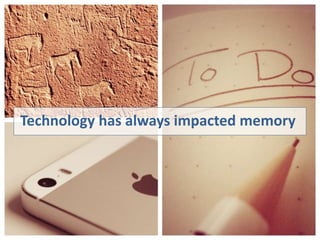
Technology has always impacted memory
Three technology trends for
Human Memory Augmentation
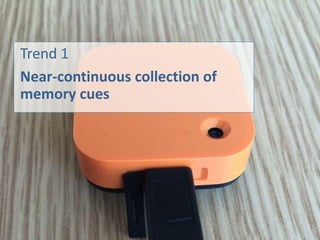
Trend 1
Near-continuous collection of
memory cues
Trend 2
Advances in data storage &
processing
Trend 3
The presence of ubiquitous
displays
A Glimpse of the Future
• Combining current technology trends offers
the potential to create memory augmentation
systems that radically change the way we think
about and use human memory.
• Wide range of application areas including:
- Behaviour Change
- Learning
- Supporting Failing Memories
- Selective Recall
- Recall Based Advertising
Examples
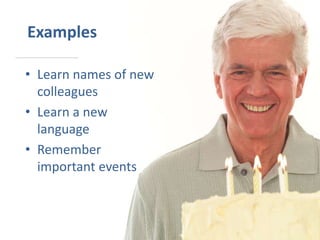
• Learn names of new
colleagues
• Learn a new
language
• Remember
important events
Approaches to memory data
collection, storage and
presentation
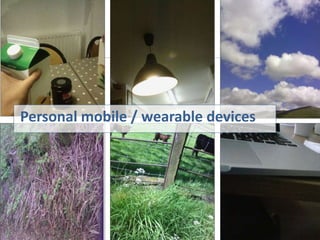
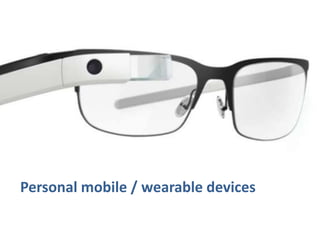
Personal mobile / wearable devices
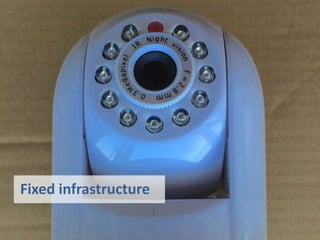
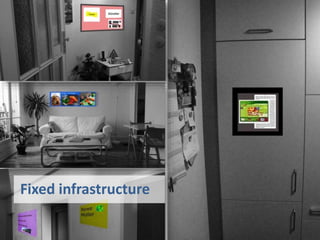
Fixed infrastructure
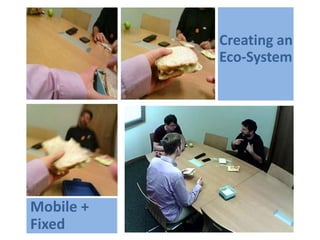
Creating an
Eco-System
Mobile +
Fixed
The Recall House
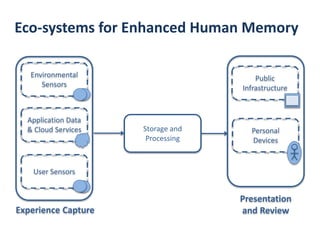
Eco-systems for Enhanced Human Memory
Storage and
Processing
Environmental
Sensors
User Sensors
Application Data
& Cloud Services Personal
Devices
Public
Infrastructure
Experience Capture
Presentation
and Review
Summary
• In the future mobile and ubiquitous systems
are going to be used to enhance human
cognition.
• Building combined wearable, mobile and
infrastructure support for memory
augmentation offers new opportunities and
raises many new challenges.
Sarah Clinch
School of Computing and Communications
InfoLab21, Lancaster University
s.clinch@comp.lancs.ac.uk
The research leading to these results has received funding from the
European Union Seventh Framework Programme (FP7/2007-2013) under
grant agreement number 612933.
http://recall-fet.eu/

Sarah Clinch

Editor's Notes

  • #3 Why are we capturing information? RECALL specifically aims to support episodic and autobiographical memory, i.e. memory of actual experiences. How are we going to use this captured information? RECALL is primarily aiming to acquire cues that can be played back in order to improve memory recall.
  • #5 near-continuous collection of memory cues has become possible Microsoft’s SenseCam, social networks interaction logs. Challenge – Information sources Images and Video Personal vs Infrastructure Acquisition Quality Assessment Non-visual data Mobile Phone Email & Calendar Info
  • #6 near-continuous collection of memory cues has become possible advances in data storage and processing enables widespread mining of stored cues both in terms of cues collected by an individual and in terms of complex networks of related cues contributed by others. Challenge – acquisition & access Joint Memory How can I receive your memory stream? How to distribute infrastructure memory? Sharing Memory Who owns memory? How to control memory distribution
  • #7 the presence of ubiquitous displays both in the environment and via personal devices (phones, watches, glass) provides many new opportunities for displaying memory cues to trigger recall. Challenge – context aware cueing Training Recall Through Cuing (Replay) What to replay? Extracting key episodes in recorded events When/Where to replay? Ambient / wearable
  • #8 Re-think and re-define the notion of memory augmentation Using capture technology and information retrieval to nurture the human mind Fundamentally improve physiological parameters, not just clever prosthetics!
  • #11 Explicit capture: Smartphone camera roll, GoPro video stream Location checkin, calendar entry, social media post Implicit capture: SenseCam / NC / MeCam photo/video stream WiFi/BT presence detection / GPS trace Proximity detection / conversation detection Wearable health monitoring data
  • #13 Stable, carefully positioned sensors Typically larger field of view (i.e. more memory cues) Reuse of existing infrastructure Removes constraints of mobility (e.g. size/power consumption) and wearability (e.g. aesthetics) Moves maintenance burden away from users
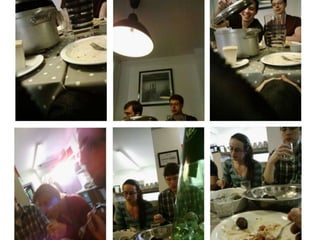
  • #16 2.75 day study including 21 researchers Stayed in an instrumented hostel environment Wore/carried a variety of mobile capture devices Schedule incorporating a wide range of tasks e.g. cooking, hiking, dining, workshop discussions 42,959 images (34.9 Gigabytes) 248.15 hours of video (245.2 Gigabytes) Plus indoor and outdoor location traces
  • #20 Re-think and re-define the notion of memory augmentation Using capture technology and information retrieval to nurture the human mind Fundamentally improve physiological parameters, not just clever prosthetics! We can do this … the wrong way: users carry ever increasing amounts of technology and infrastructure owners collect and act on ever-richer user profiles the right way: users control how and when infrastructure is leveraged to augment cognition without revealing personal information Building combined mobile and infrastructure support for memory augmentation raises many new challenges. Experience Provenance how do users ensure the provenance of the data they store as memories? Memory Protection How can we develop mechanisms to enforce the wide variety of policies desired by individuals to exercise control over access to their memories? (Technical/social/legal) Memory Manipulation How can a user tell if their memories are being manipulated? Privacy of Bystanders How to protect bystanders while still allowing substantial data collection for human memory augmentation?