CO2-CH4 Reforming over Nickel Catalysts Supported on
Mesoporous Nanocrystalline Zirconia with High Surface Area
Mehran Rezaei,*,† Seyed Mahdi Alavi,† Saeid Sahebdelfar,‡ Liu Xinmei,§ Ling Qian,§ and
Zi-Feng Yan*,§
Chemical Engineering Department, Iran UniVersity of Science and Technology, Tehran, Iran,
Petrochemical Research & Technology Company (NPC-RT), Tehran, Iran, and State Key Laboratory for
HeaVy Oil Processing, Key Laboratory of Catalysis, CNPC, China UniVersity of Petroleum,
Dongying 257061, China
ReceiVed NoVember 28, 2006. ReVised Manuscript ReceiVed January 13, 2007
Mesoporous nanocrystalline zirconia with a high surface area and pure tetragonal crystallite phase has been
prepared by the surfactant-assisted route, using a Pluronic P123 block copolymer surfactant. The synthesized
zirconia showed a surface area of 174 m2 g-1 after calcination at 700 °C for 4 h. X-ray diffraction and nitrogen
adsorption analysis showed that the tetragonal phase and mesoporous structure were stable toward higher
temperatures. The synthesized zirconia was employed as support for nickel catalysts for the production of
syngas by dry reforming reaction. It was shown that the 5% Ni/ZrO2 catalyst exhibited stable activity for
syngas production with a decrease of about 4% in methane conversion after 50 h of reaction. The addition of
cerium oxide to the nickel catalyst improved its stability and decreased the coke deposition.
Introduction
The steam reforming of CH4 produces a synthesis gas with
a ratio of H2/CO > 3, which is too high to be suitable for
Fischer-Tropsch synthesis.1 The replacement of H2O by CO2
has received considerable attention from an environmental point
of view. It gives a lower and more suitable H2/CO ratio needed
for the synthesis of long-chain hydrocarbons.2,3 The major
drawback of this reaction, however, is the rapid deactivation
caused by carbon deposition via the Boudouard reaction (2CO
T C + CO2) and/or CH4 decomposition. Many efforts have
focused on the development of metal catalysts which bear high
catalytic performances toward synthesis gas formation and are
also resistant to carbon deposition, thus displaying stable long-
term operation. Noble metal catalysts are less sensitive to carbon
deposition.3-5 However, base metals, such as Ni, Fe, and Co,
are often preferred considering the high cost and limited
availability of noble metals. Among these metals, nickel might
be the optimum active component of the potential catalyst
designed.5 Usually, Ni has been supported on different carriers
such as MgO, Al2O3, promoted Al2O3, TiO2, CeO2, and so forth.
However, it tends to deactivate by coke formation and the
sintering of nickel particles,5,6 which is closely related to the
catalyst structure and composition.7 Among these supports, ZrO2
has a high thermal stability as a catalyst support.8-10 ZrO2 has
three polymorphs: monoclinic (m-phase, below 1170 °C),
tetragonal (t-phase, between 1170 and 2370 °C), and cubic (c-
phase, above 2370 °C).11 Among them, the tetragonal phase
(t-ZrO2) has both acid and basic properties,12 and the t-ZrO2
phase is active for some reactions.13 The use of zirconia requires
a high specific surface area and suitable pore structure for
catalysis applications. However, zirconium oxides generally have
surface areas of 50 m2 g-1 or less, which is rather low compared
with those of conventional supports such as SiO2, Al2O3, or
TiO2. Higher surface areas are attainable with amorphous
zirconia (200-300 m2 g-1), but this was usually achieved at
the expense of much lower thermal stability.14 The unique
properties of nanoparticles make them of interest for catalysis
applications. For example, nanocrystalline materials composed
of crystallites in the 1-10 nm size range possess very high
surface-to-volume ratios because of the fine grain size. These
materials are characterized by a very high number of low-
coordination-number atoms at edge and corner sites which can
provide a large number of catalytically active sites. Recently,
many methods have been explored in order to get superfine ZrO2
powders with high surface area, such as the glycothermal
process,15 the alcohothermal-supercritical fluid drying pro-
* Authors to whom correspondence should be addressed. Fax: +86 546
8391971 (Z.Y.), +98 21 77896620 (M.R.). E-mail: zfyancat@hdpu.edu.cn
(Z.Y.), me_rezaei@iust.ac.ir (M.R.).
† Iran University of Science and Technology.
‡ Petrochemical Research & Technology Company (NPC-RT).
§ China University of Petroleum.
(1) Ashcroft, A. T.; Cheetham, A. K.; Foord, J. S.; Green, M. L. H.;
Vernon, P. D. F. Nature 1991, 352, 149.
(2) Gadalla, A. M.; Bower, B. Chem. Eng. Sci. 1998, 43, 3049.
(3) Bradford, M. C. J.; Vannice, M. A. Catal. ReV. Sci. Eng. 1999, 41,
1.
(4) Wang, H. Y.; Au, C. T. Appl. Catal., A 1997, 155, 239.
(5) Rostrup-Nielsen, J. R.; Bak, Hansen, J. H. J. Catal. 1993, 141, 38.
(6) Wang, S.; Lu, G. Q. Appl. Catal., A 1998, 169, 271.
(7) Wang, S.; Lu, G. Q. Appl. Catal., B 1998, 16, 269.
(8) Tai, C. Y.; Hsiao, B. Y.; Chiu, H. Y. Colloids Surf., A 2004, 237,
105.
(9) Ma, T.; Huang, Y.; Yang, J.; He, J.; Zhao, L. Mater. Des. 2004, 25,
515.
(10) Lee, M. H.; Tai, C. Y.; Lu, C. H. J. Eur. Ceram. Soc. 1999, 19,
2593.
(11) Luo, T. Y.; Liang, T. X.; Li, C. S. Mater. Sci. Eng., A 2004, 366,
206.
(12) Yamaguchi, T. Catal. Today 1994, 20, 199.
(13) Centi, G.; Cerrato, G.; D’Angelo, S.; Finardi, U.; Giamello, E.;
Morterra, C.; Perathoner, S. Catal. Today 1996, 27, 265.
(14) Cao, Y.; Hu, J. C.; Hong, Z. S.; Deng, J. F.; Fan, K. N. Catal. Lett.
2002, 81 (1-2), 107.
(15) Kongwudthiti, S.; Praserthdam, P.; Silveston, P. Ceram. Int. 2003,
29, 807.
581
Energy & Fuels 2007, 21, 581-589
10.1021/ef0606005 CCC: $37.00 © 2007 American Chemical Society
Published on Web 03/01/2007
cess,16 CO2 supercritical drying,17 the sol-gel method,18 the
solid-state reaction method,19 and so forth. The surfactant-
assisted synthesis of nano inorganic materials has also attracted
considerable interest because of its effective soft template effect,
reproducibility, and simple maneuverability.20,21
In this paper, we first investigated the effect of some
important process parameters on the structural properties of
zirconia to obtain mesoporous nanocrystalline zirconia with a
high surface area by the surfactant-assisted route, and then the
synthesized zirconia was used as support for the nickel catalyst,
and the activity and stability of the synthesized catalysts were
investigated in dry reforming reaction for the production of
synthesis gas.
Experimental Section
Materials. The starting materials were ZrO(NO3)2‚6H2O, Ce-
(NO3)3‚6(H2O), and Ni(NO3)2‚6H2O as Zr and Ce and Ni precursors.
Pluronic P123 block copolymer and ammonium hydroxide were
used as the surfactant and precipitation agent, respectively.
Zirconia Preparation. In the surfactant-assisted route, aqueous
ammonia (25 wt %) was added dropwise at room temperature to
an aqueous solution containing a zirconium precursor (0.03 molar)
and a Pluronic P123 block copolymer surfactant under rapid stirring.
After precipitation, the slurry was stirred for another 30 min and
then refluxed at different temperatures for a certain time under
continuous stirring. The mixture was cooled to room temperature,
filtered, and washed, first with deionized water and finally with
acetone for an effective removal of the surfactant. The final product
was dried at 110 °C for 24 h and calcined at different temperatures.
(16) Su, C.; Li, J.; He, D.; Cheng, Z.; Zhu, Q. Appl. Catal., A 2000,
202, 81.
(17) Stöcker, C.; Baiker, A. J. Non-Cryst. Solids 1998, 223, 165.
(18) Aguilar, D. H.; Torres-Gonzalez, L. C.; Torres-Martinez, L. M.;
Lopez, T.; Quintana, P. J. Solid State Chem. 2000, 158, 349.
(19) Liu, X.; Lu, G.; Yan, Z. F. J. Nat. Gas Chem. 2003, 12, 161.
(20) Kang, Z. H.; Wang, E. B.; Jiang, M.; Lian, S. Y. Nanotechnology
2004, 15, 55.
(21) Kang, Z. H.; Wang, E. B.; Jiang, M.; Lian, S. Y.; Li, Y. G.; Hu, C.
W. Eur. J. Inorg. Chem. 2003, 370.
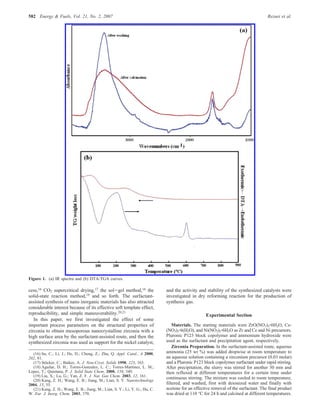
Figure 1. (a) IR spectra and (b) DTA/TGA curves.
582 Energy & Fuels, Vol. 21, No. 2, 2007 Rezaei et al.
Another sample was prepared by the conventional precipitation
method by the addition of an ammonia solution to an aqueous
solution of a zirconium precursor at room temperature and with
careful control of the pH at 11, followed by drying at 110 °C and
calcination at 700 °C for 4 h.
Catalyst Preparation. Supported nickel catalysts were prepared
by excess-solution impregnation using zirconia powder and an
aqueous solution of Ni(NO3)2‚6H2O of the appropriate concentration
to obtain different nickel contents. After impregnation, the powder
was dried at 80 °C and calcined at 700 °C for 2 h. The Ce-promoted
catalyst was prepared by the subsequent impregnation of Ce(NO3)3‚
6H2O and nickel nitrate in the same procedure as described above.
Characterization. The surface areas (BET) were determined by
nitrogen adsorption at -196 °C using an automated gas adsorption
analyzer (the Tristar 3000, Micromeritics). The pore size distribution
was calculated from the desorption branch of the isotherm by the
Barrett, Joyner, and Halenda method. The X-ray diffraction (XRD)
patterns were recorded on an X-ray diffractometer (PANalytical
X’Pert-Pro) using a Cu KR monochromatized radiation source and
a Ni filter in the range 2θ ) 10-80°. The relative amounts of
tetragonal and monoclinic ZrO2 present in samples and the
crystallite sizes were estimated as described elsewhere.16 Thermo-
gravimetric (TGA) and differential thermal analyses (DTA) were
carried out in a Netzsch STA 409 system in a static air atmosphere
at a heating rate of 10 °C/min. Infrared spectra were recorded on
a NEXus Fourier transform infrared (FTIR) spectrophotometer using
KBr pellets containing a 1% weight sample in KBr. The nickel
dispersion and Ni metal surface area were measured by H2
chemisorption at 40 °C, assuming that chemisorption stoichiometry
is H/Ni ) 1 and that a Ni atom occupies 0.065 nm2 on a Ni particle.
Temperature-programmed reduction (TPR-H2) was performed
in an automatic apparatus (ChemBET-3000 TPR/TPD, Quantach-
rome) equipped with a thermal conductivity detector. The fresh
catalyst (200 mg) was subjected to a heat treatment (10 °C/min up
to 825 °C) in a gas flow (30 mL/min) of the mixture H2/Ar (10:
90). Prior to the TPR-H2 experiment, the samples were heat treated
under an inert atmosphere, at 350 °C for 3 h. Temperature-
programmed oxidation (TPO) profiles of spent catalysts were
performed in a similar apparatus by introducing a gas flow (30
mL/min) of the mixture O2/He (5:95) over 50 mg of spent catalysts,
and the temperature was increased with a heating rate of 10 °C/
min up to 800 °C. Scanning electron microscopy (SEM) was
performed with a JEOL JSM-5600LV scanning electron microscope
operated at 15 kV.
Catalytic Performance Evaluation. Activity measurements
were carried out in a fixed-bed continuous-flow reactor made of a
7-mm-i.d. quartz tube at atmospheric pressure. The reactor was
charged with 200 mg of the prepared catalyst. Prior to the reaction,
the catalyst was reduced in situ at 650 °C for 4 h in flowing H2
(30 mL/min) and cooled down to 500 °C in a flow of Ar (30 mL/
min). After that, a reactant gas feed consisting of a mixture of CH4
and CO2 (CH4/CO2 ) 50/50 vol %) was introduced into the reactor,
and the activity tests were performed at different temperatures,
ranging from 500 to 700 °C in steps of 50 °C that were kept for 30
min at each temperature. The loss in catalyst activity at 700 °C
was monitored up to 50 h on-stream. The gas compositions of the
reactants and products were analyzed using a gas chromatograph
equipped with a thermal conductivity detector and a Carbosphere
column.
Results and Discussion
FTIR and TGA/DTA Analyses. Figure 1a shows the FTIR
spectra of the sample prepared at a pH of 11, a refluxing
temperature of 80 °C, a refluxing time of 24 h, and a P123-to-
zirconium molar ratio of 0.03. It is seen that the intensity of
the symmetry-stretching 2920 cm-1 and 2850 cm-1 mode of
the methyl groups of the block copolymer surfactant (PEO-
block-PPO) is weak after the washing step, indicating that there
is still some surfactant remaining in the pores. However, the
peaks arising from the surfactant completely disappear after the
heat treatment at a low temperature (300 °C). It means that the
surfactant can be easily removed by calcination at a low
temperature.
The TGA and DTA curves of this sample are also shown in
Figure 1b. The DTA curve presents three major peaks, of which,
two are endothermic and the other is exothermic. The first
endothermic peak appears at a low temperature of about 100
°C, which corresponds to the elimination of residual water, and
the second one at about 250 °C is due to the removal of the
hydroxyl group bonded on the surface of zirconia. The
exothermic peak at about 600 °C, usually called the “glow
exotherm”, is attributed to the crystallization of amorphous
zirconia. Simultaneously, the TG curve is leveled off at about
500 °C, meaning that the organic residues have been removed
completely, and it also confirmed the FTIR results.
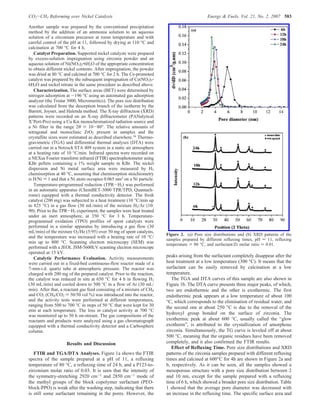
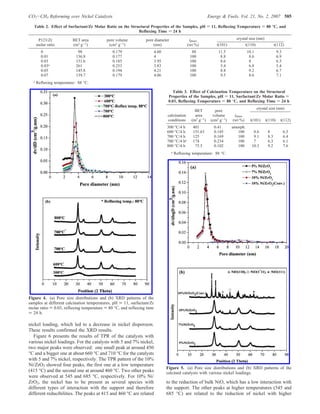
Effect of Refluxing Time. Pore size distributions and XRD
patterns of the zirconia samples prepared with different refluxing
times and calcined at 600°C for 4h are shown in Figure 2a and
b, respectively. As it can be seen, all the samples showed a
mesoporous structure with a pore size distribution between 2
and 10 nm, except for the sample prepared with a refluxing
time of 6 h, which showed a broader pore size distribution. Table
1 showed that the average pore diameter was decreased with
an increase in the refluxing time. The specific surface area and
Figure 2. (a) Pore size distributions and (b) XRD patterns of the
samples prepared by different refluxing times, pH ) 11, refluxing
temperature ) 80 °C, and surfactant/Zr molar ratio ) 0.01.
CO2-CH4 Reforming oVer Nickel Catalysts Energy & Fuels, Vol. 21, No. 2, 2007 583
pore volume of the samples were also increased by an increase
in the refluxing time, which showed the higher thermal stability
for the samples prepared with longer refluxing times. Figure
2b showed the complete transformation of the monoclinic phase
to the tetragonal phase at refluxing times of longer than 6 h.
The crystallite sizes of the samples, Table 1, showed a
significant decrease with an increasing of the refluxing time.
Of interest is that the tetragonal phase was stabilized at room
temperature without the addition of any dopants. The thermo-
dynamically most stable ZrO2 phase at room temperature is the
m-phase. Probably, the nanosize effect of the ZrO2 crystallites
leads to the thermal stabilization of the t-phase.22,23 Garvie et
al. suggested that the difference in the surface energy between
the tetragonal and monoclinic phases could cause the tetragonal
phase to be thermodynamically stable for very small crystals.23,24
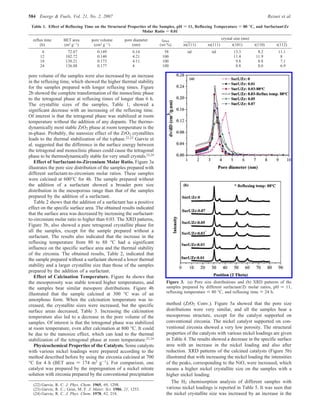
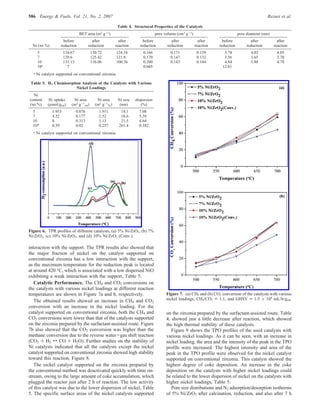
Effect of Surfactant-to-Zirconium Molar Ratio. Figure 3a
illustrates the pore size distribution of the samples prepared with
different surfactant-to-zirconium molar ratios. These samples
were calcined at 600°C for 4h. The sample prepared without
the addition of a surfactant showed a broader pore size
distribution in the mesoporous range than that of the samples
prepared by the addition of a surfactant.
Table 2 shows that the addition of a surfactant has a positive
effect on the specific surface area. The obtained results indicated
that the surface area was decreased by increasing the surfactant-
to-zirconium molar ratio to higher than 0.03. The XRD patterns,
Figure 3b, also showed a pure tetragonal crystallite phase for
all the samples, except for the sample prepared without a
surfactant. The results also indicated that the increase in the
refluxing temperature from 80 to 88 °C had a significant
influence on the specific surface area and the thermal stability
of the zirconia. The obtained results, Table 2, indicated that
the sample prepared without a surfactant showed a lower thermal
stability and a larger crystallite size than those of the samples
prepared by the addition of a surfactant.
Effect of Calcination Temperature. Figure 4a shows that
the mesoporosity was stable toward higher temperatures, and
the samples bear similar mesopore distributions. Figure 4b
illustrated that the sample calcined at 300 °C was of an
amorphous form. When the calcination temperature was in-
creased, the crystallite sizes were increased, but the specific
surface areas decreased, Table 3. Increasing the calcination
temperature also led to a decrease in the pore volume of the
samples. Of interest is that the tetragonal phase was stabilized
at room temperature, even after calcination at 800 °C. It could
be due to the nanosize effect, which can lead to the thermal
stabilization of the tetragonal phase at room temperature.23,24
Physicochemical Properties of the Catalysts. Some catalysts
with various nickel loadings were prepared according to the
method described before by using the zirconia calcined at 700
°C for 4 h (BET area ) 174 m2 g-1). For comparison, one
catalyst was prepared by the impregnation of a nickel nitrate
solution with zirconia prepared by the conventional precipitation
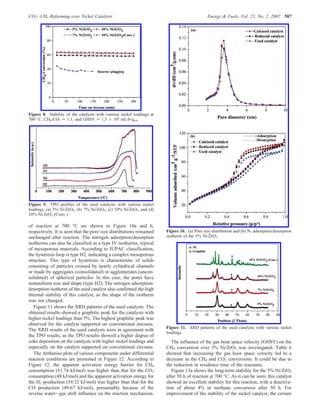
method (ZrO2 Conv.). Figure 5a showed that the pore size
distributions were very similar, and all the samples bear a
mesoporous structure, except for the catalyst supported on
conventional zirconia. The nickel catalyst supported on con-
ventional zirconia showed a very low porosity. The structural
properties of the catalysts with various nickel loadings are given
in Table 4. The results showed a decrease in the specific surface
area with an increase in the nickel loading and also after
reduction. XRD patterns of the calcined catalysts (Figure 5b)
illustrated that with increasing the nickel loading the intensities
of the peaks, corresponding to the NiO, were increased, which
means a higher nickel crystallite size on the samples with a
higher nickel loading.
The H2 chemisorption analysis of different samples with
various nickel loadings is reported in Table 5. It was seen that
the nickel crystallite size was increased by an increase in the
(22) Garvie, R. C. J. Phys. Chem. 1965, 69, 1298.
(23) Garvie, R. C.; Goss, M. F. J. Mater. Sci. 1986, 21, 1253.
(24) Garvie, R. C. J. Phys. Chem. 1978, 82, 218.
Table 1. Effect of Refluxing Time on the Structural Properties of the Samples, pH ) 11, Refluxing Temperature ) 80 °C, and Surfactant/Zr
Molar Ratio ) 0.01
crystal size (nm)
reflux time
(h)
BET area
(m2 g-1)
pore volume
(cm3 g-1)
pore diameter
(nm)
tphase
(wt %) m(1
h11) m(111) t(101) t(110) t(112)
6 72.67 0.149 6.14 58 nd nd 13.3 8.2 11.1
12 102.72 0.140 4.21 100 11.4 11.9 8
18 130.21 0.173 4.11 100 9.8 8.8 7.1
24 136.88 0.177 4 100 8.8 8.6 6.9
Figure 3. (a) Pore size distributions and (b) XRD patterns of the
samples prepared by different surfactant/Zr molar ratios, pH ) 11,
refluxing temperature ) 80 °C, and refluxing time ) 24 h.
584 Energy & Fuels, Vol. 21, No. 2, 2007 Rezaei et al.
nickel loading, which led to a decrease in nickel dispersion.
These results confirmed the XRD results.
Figure 6 presents the results of TPR of the catalysts with
various nickel loadings. For the catalysts with 5 and 7% nickel,
two major peaks were observed: one small peak at around 450
°C and a bigger one at about 660 °C and 710 °C for the catalysts
with 5 and 7% nickel, respectively. The TPR pattern of the 10%
Ni/ZrO2 showed four peaks, the first one at a low temperature
(415 °C) and the second one at around 460 °C. Two other peaks
were observed at 545 and 685 °C, respectively. For 10% Ni/
ZrO2, the nickel has to be present as several species with
different types of interaction with the support and therefore
different reducibilities. The peaks at 415 and 460 °C are related
to the reduction of bulk NiO, which has a low interaction with
the support. The other peaks at higher temperatures (545 and
685 °C) are related to the reduction of nickel with higher
Table 2. Effect of Surfactant/Zr Molar Ratio on the Structural Properties of the Samples, pH ) 11, Refluxing Temperature ) 80 °C, and
Refluxing Time ) 24 h
crystal size (nm)
P123/Zr
molar ratio
BET area
(m2 g-1)
pore volume
(cm3 g-1)
pore diameter
(nm)
tphase
(wt %) t(101) t(110) t(112)
0 98 0.179 4.60 88 11.5 10.1 9.3
0.01 136.8 0.177 4 100 8.8 8.6 6.9
0.03 151.6 0.185 3.95 100 8.6 8 6.5
0.03a 261 0.253 3.83 100 5.4 6.8 5.4
0.05 145.8 0.194 4.21 100 8.8 9.2 6.7
0.07 139.7 0.179 4.06 100 9.5 8.6 7.1
a Refluxing temperature: 88 °C.
Figure 4. (a) Pore size distributions and (b) XRD patterns of the
samples at different calcination temperatures, pH ) 11, surfactant/Zr
molar ratio ) 0.03, refluxing temperature ) 80 °C, and refluxing time
) 24 h.
Table 3. Effect of Calcination Temperature on the Structural
Properties of the Samples, pH ) 11, Surfactant/Zr Molar Ratio )
0.03, Refluxing Temperature ) 80 °C, and Refluxing Time ) 24 h
crystal size (nm)
calcination
conditions
BET
area
(m2 g-1)
pore
volume
(cm3 g-1)
tphase
(wt %) t(101) t(110) t(112)
300 °C/4 h 401 0.41 amorph.
600 °C/4 h 151.63 0.185 100 8.6 8 6.5
700 °C/4 h 125 0.169 100 9.1 8.3 6.4
700 °C/4 ha 174 0.234 100 7 6.3 6.1
800 °C/4 h 75.5 0.102 100 10.3 9.2 7.6
a Refluxing temperature: 88 °C.
Figure 5. (a) Pore size distributions and (b) XRD patterns of the
calcined catalysts with various nickel loadings.
CO2-CH4 Reforming oVer Nickel Catalysts Energy & Fuels, Vol. 21, No. 2, 2007 585
interaction with the support. The TPR results also showed that
the major fraction of nickel on the catalyst supported on
conventional zirconia has a low interaction with the support,
as the maximum temperature for the reduction peak is located
at around 420 °C, which is associated with a low dispersed NiO
exhibiting a weak interaction with the support, Table 5.
Catalytic Performance. The CH4 and CO2 conversions on
the catalysts with various nickel loadings at different reaction
temperatures are shown in Figure 7a and b, respectively.
The obtained results showed an increase in CH4 and CO2
conversion with an increase in the nickel loading. For the
catalyst supported on conventional zirconia, both the CH4 and
CO2 conversions were lower than that of the catalysts supported
on the zirconia prepared by the surfactant-assisted route. Figure
7b also showed that the CO2 conversion was higher than the
methane conversion due to the reverse water-gas shift reaction
(CO2 + H2 T CO + H2O). Further studies on the stability of
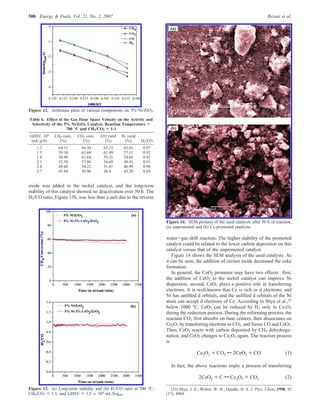
Ni catalysts indicated that all the catalysts except the nickel
catalyst supported on conventional zirconia showed high stability
toward this reaction, Figure 8.
The nickel catalyst supported on the zirconia prepared by
the conventional method was deactivated quickly with time on-
stream, owing to the large amount of coke accumulation, which
plugged the reactor just after 2 h of reaction. The low activity
of this catalyst was due to the lower dispersion of nickel, Table
5. The specific surface areas of the nickel catalysts supported
on the zirconia prepared by the surfactant-assisted route, Table
4, showed just a little decrease after reaction, which showed
the high thermal stability of these catalysts.
Figure 9 shows the TPO profiles of the used catalysts with
various nickel loadings. As it can be seen, with an increase in
nickel loading, the area and the intensity of the peak in the TPO
profile were increased. The highest intensity and area of the
peak in the TPO profile were observed for the nickel catalyst
supported on conventional zirconia. This catalyst showed the
highest degree of coke deposition. An increase in the coke
deposition on the catalysts with higher nickel loadings could
be related to the lower dispersion of nickel on the catalysts with
higher nickel loadings, Table 5.
Pore size distributions and N2 adsorption/desorption isotherms
of 5% Ni/ZrO2 after calcination, reduction, and also after 7 h
Table 4. Structural Properties of the Catalysts
BET area (m2 g-1) pore volume (cm3 g-1) pore diameter (nm)
Ni (wt %)
before
reduction
after
reduction
after
reaction
before
reduction
after
reduction
after
reaction
before
reduction
after
reduction
after
reaction
5 134.67 130.72 124.16 0.166 0.171 0.159 3.78 4.02 4.05
7 129.6 125.42 121.8 0.170 0.147 0.132 3.56 3.65 3.70
10 131.13 116.06 100.36 0.200 0.143 0.144 4.84 3.88 4.78
10a 7 0.045 12.61
a Ni catalyst supported on conventional zirconia.
Table 5. H2 Chemisorption Analysis of the Catalysts with Various
Nickel Loadings
Ni
content
(wt %)
H2 uptake
(µmol/gcat)
Ni area
(m2 g-1
cat)
Ni area
(m2 g-1
Ni)
Ni size
(nm)
dispersion
(%)
5 1.953 0.076 1.911 14.1 7.08
7 4.52 0.177 2.52 18.6 5.39
10 8 0.313 3.13 21.5 4.64
10* 0.59 0.02 0.257 261.4 0.382
a Ni catalyst supported on conventional zirconia.
Figure 6. TPR profiles of different catalysts, (a) 5% Ni/ZrO2, (b) 7%
Ni/ZrO2, (c) 10% Ni/ZrO2, and (d) 10% Ni/ZrO2 (Conv.).
Figure 7. (a) CH4 and (b) CO2 conversion of the catalysts with various
nickel loadings, CH4/CO2 ) 1:1, and GHSV ) 1.5 × 10⁴
mL/h‚gcat.
586 Energy & Fuels, Vol. 21, No. 2, 2007 Rezaei et al.
of reaction at 700 °C are shown in Figure 10a and b,
respectively. It is seen that the pore size distributions remained
unchanged after reaction. The nitrogen adsorption/desorption
isotherms can also be classified as a type IV isotherms, typical
of mesoporous materials. According to IUPAC classification,
the hysteresis loop is type H2, indicating a complex mesoporous
structure. This type of hysteresis is characteristic of solids
consisting of particles crossed by nearly cylindrical channels
or made by aggregates (consolidated) or agglomerates (uncon-
solidated) of spherical particles. In this case, the pores have
nonuniform size and shape (type H2). The nitrogen adsorption/
desorption isotherm of the used catalyst also confirmed the high
thermal stability of this catalyst, as the shape of the isotherm
was not changed.
Figure 11 shows the XRD patterns of the used catalysts. The
obtained results showed a graphitic peak for the catalysts with
higher nickel loadings than 5%. The highest graphitic peak was
observed for the catalyst supported on conventional zirconia.
The XRD results of the used catalysts were in agreement with
the TPO results, as the TPO results showed a higher degree of
coke deposition on the catalysts with higher nickel loadings and
especially on the catalyst supported on conventional zirconia.
The Arrhenius plots of various components under differential
reaction conditions are presented in Figure 12. According to
Figure 12, the apparent activation energy barrier for CH4
consumption (51.74 kJ/mol) was higher than that for the CO2
consumption (48 kJ/mol) and the apparent activation energy for
the H2 production (54.32 kJ/mol) was higher than that for the
CO production (49.67 kJ/mol), presumably because of the
reverse water-gas shift influence on the reaction mechanism.
The influence of the gas hour space velocity (GHSV) on the
CH4 conversion over 5% Ni/ZrO2 was investigated. Table 6
showed that increasing the gas hour space velocity led to a
decrease in the CH4 and CO2 conversions. It could be due to
the reduction in residence time of the reactants.
Figure 13a shows the long-term stability for the 5% Ni/ZrO2
after 50 h of reaction at 700 °C. As it can be seen, this catalyst
showed an excellent stability for this reaction, with a deactiva-
tion of about 4% in methane conversion after 50 h. For
improvement of the stability of the nickel catalyst, the cerium
Figure 8. Stability of the catalysts with various nickel loadings at
700 °C, CH4/CO2 ) 1:1, and GHSV ) 1.5 × 10⁴
mL/h‚gcat.
Figure 9. TPO profiles of the used catalysts with various nickel
loadings, (a) 5% Ni/ZrO2, (b) 7% Ni/ZrO2, (c) 10% Ni/ZrO2, and (d)
10% Ni/ZrO2 (Conv.).
Figure 10. (a) Pore size distribution and (b) N2 adsorption/desorption
isotherm of the 5% Ni/ZrO2.
Figure 11. XRD patterns of the used catalysts with various nickel
loadings.
CO2-CH4 Reforming oVer Nickel Catalysts Energy & Fuels, Vol. 21, No. 2, 2007 587
oxide was added to the nickel catalyst, and the long-term
stability of this catalyst showed no deactivation over 50 h. The
H2/CO ratio, Figure 13b, was less than a unit due to the reverse
water-gas shift reaction. The higher stability of the promoted
catalyst could be related to the lower carbon deposition on this
catalyst versus that of the unpromoted catalyst.
Figure 14 shows the SEM analysis of the used catalysts. As
it can be seen, the addition of cerium oxide decreased the coke
formation.
In general, the CeO2 promoter may have two effects: first,
the addition of CeO2 to the nickel catalyst can improve Ni
dispersion; second, CeO2 plays a positive role in transferring
electrons. It is well-known that Ce is rich in d electrons, and
Ni has unfilled d orbitals, and the unfilled d orbitals of the Ni
atom can accept d electrons of Ce. According to Shyu et al.,25
below 1000 °C, CeO2 can be reduced by H2 only to Ce2O3
during the reduction process. During the reforming process, the
reactant CO2 first absorbs on base centers, then dissociates on
Ce2O3 by transferring electrons to CO2, and forms CO and CeO2.
Then, CeO2 reacts with carbon deposited by CH4 dehydroge-
nation, and CeO2 changes to Ce2O3 again. The reaction process
is
In fact, the above reactions imply a process of transferring
(25) Shyu, J. Z.; Webor, W. H.; Oandhi, H. S. J. Phys. Chem. 1998, 92
(17), 4964.
Figure 12. Arrhenius plots of various components on 5% Ni/ZrO2.
Table 6. Effect of the Gas Hour Space Velocity on the Activity and
Selectivity of the 5% Ni/ZrO2 Catalyst, Reaction Temperature )
700 °C and CH4/CO2 ) 1:1
GHSV, 104
(mL/g‚h)
CH4 conv.
(%)
CO2 conv.
(%)
CO yield
(%)
H2 yield
(%) H2/CO
1.2 64.12 66.34 65.23 63.01 0.97
1.5 59.30 63.68 61.49 57.11 0.92
1.8 56.98 61.64 59.31 54.65 0.92
2.1 52.30 57.08 54.69 49.91 0.91
2.4 49.40 54.22 51.81 46.99 0.90
2.7 45.84 50.96 48.4 43.28 0.89
Figure 13. (a) Long-term stability and (b) H2/CO ratio at 700 °C,
CH4/CO2 ) 1:1, and GHSV ) 1.5 × 10⁴ mL/h‚gcat.
Figure 14. SEM pictures of the used catalysts after 50 h of reaction,
(a) unpromoted and (b) Ce-promoted catalysts.
Ce2O3 + CO2 T 2CeO2 + CO (1)
2CeO2 + C T Ce2O3 + CO2 (2)
588 Energy & Fuels, Vol. 21, No. 2, 2007 Rezaei et al.
oxygen. While CO2 dissociates and subsequently forms CO, the
affinity of the absorbed oxygen Oads or oxygen-containing
species to the surface carbon partially inhibits the carbon
deposition of the reforming reaction.
Conclusion
Mesoporous nanocrystalline zirconia with a high surface area
and tetragonal crystallite phase has been effectively synthesized
by the surfactant-assisted route for catalysis applications. The
obtained results showed that the refluxing time and temperature
have a significant effect on the specific surface area, and
increasing them led to obtaining the zirconia with higher thermal
stability. The tetragonal phase was also effectively stabilized
at room-temperature due to the nanosize effect. The nickel
catalysts supported on the zirconia prepared by the surfactant-
assisted route showed an excellent stability for this reaction over
50 h of reaction, while the nickel catalyst supported on the
conventional zirconia was deactivated quickly due to coke
formation, which also plugged the reactor. The obtained results
also indicated that the addition of cerium oxide to the nickel
catalyst improved its stability and decreased the coke formation.
These results also revealed that this type of zirconia has a good
potential for catalysis applications.
EF0606005
CO2-CH4 Reforming oVer Nickel Catalysts Energy & Fuels, Vol. 21, No. 2, 2007 589

sarachef

  • 1.
    CO2-CH4 Reforming overNickel Catalysts Supported on Mesoporous Nanocrystalline Zirconia with High Surface Area Mehran Rezaei,*,† Seyed Mahdi Alavi,† Saeid Sahebdelfar,‡ Liu Xinmei,§ Ling Qian,§ and Zi-Feng Yan*,§ Chemical Engineering Department, Iran UniVersity of Science and Technology, Tehran, Iran, Petrochemical Research & Technology Company (NPC-RT), Tehran, Iran, and State Key Laboratory for HeaVy Oil Processing, Key Laboratory of Catalysis, CNPC, China UniVersity of Petroleum, Dongying 257061, China ReceiVed NoVember 28, 2006. ReVised Manuscript ReceiVed January 13, 2007 Mesoporous nanocrystalline zirconia with a high surface area and pure tetragonal crystallite phase has been prepared by the surfactant-assisted route, using a Pluronic P123 block copolymer surfactant. The synthesized zirconia showed a surface area of 174 m2 g-1 after calcination at 700 °C for 4 h. X-ray diffraction and nitrogen adsorption analysis showed that the tetragonal phase and mesoporous structure were stable toward higher temperatures. The synthesized zirconia was employed as support for nickel catalysts for the production of syngas by dry reforming reaction. It was shown that the 5% Ni/ZrO2 catalyst exhibited stable activity for syngas production with a decrease of about 4% in methane conversion after 50 h of reaction. The addition of cerium oxide to the nickel catalyst improved its stability and decreased the coke deposition. Introduction The steam reforming of CH4 produces a synthesis gas with a ratio of H2/CO > 3, which is too high to be suitable for Fischer-Tropsch synthesis.1 The replacement of H2O by CO2 has received considerable attention from an environmental point of view. It gives a lower and more suitable H2/CO ratio needed for the synthesis of long-chain hydrocarbons.2,3 The major drawback of this reaction, however, is the rapid deactivation caused by carbon deposition via the Boudouard reaction (2CO T C + CO2) and/or CH4 decomposition. Many efforts have focused on the development of metal catalysts which bear high catalytic performances toward synthesis gas formation and are also resistant to carbon deposition, thus displaying stable long- term operation. Noble metal catalysts are less sensitive to carbon deposition.3-5 However, base metals, such as Ni, Fe, and Co, are often preferred considering the high cost and limited availability of noble metals. Among these metals, nickel might be the optimum active component of the potential catalyst designed.5 Usually, Ni has been supported on different carriers such as MgO, Al2O3, promoted Al2O3, TiO2, CeO2, and so forth. However, it tends to deactivate by coke formation and the sintering of nickel particles,5,6 which is closely related to the catalyst structure and composition.7 Among these supports, ZrO2 has a high thermal stability as a catalyst support.8-10 ZrO2 has three polymorphs: monoclinic (m-phase, below 1170 °C), tetragonal (t-phase, between 1170 and 2370 °C), and cubic (c- phase, above 2370 °C).11 Among them, the tetragonal phase (t-ZrO2) has both acid and basic properties,12 and the t-ZrO2 phase is active for some reactions.13 The use of zirconia requires a high specific surface area and suitable pore structure for catalysis applications. However, zirconium oxides generally have surface areas of 50 m2 g-1 or less, which is rather low compared with those of conventional supports such as SiO2, Al2O3, or TiO2. Higher surface areas are attainable with amorphous zirconia (200-300 m2 g-1), but this was usually achieved at the expense of much lower thermal stability.14 The unique properties of nanoparticles make them of interest for catalysis applications. For example, nanocrystalline materials composed of crystallites in the 1-10 nm size range possess very high surface-to-volume ratios because of the fine grain size. These materials are characterized by a very high number of low- coordination-number atoms at edge and corner sites which can provide a large number of catalytically active sites. Recently, many methods have been explored in order to get superfine ZrO2 powders with high surface area, such as the glycothermal process,15 the alcohothermal-supercritical fluid drying pro- * Authors to whom correspondence should be addressed. Fax: +86 546 8391971 (Z.Y.), +98 21 77896620 (M.R.). E-mail: zfyancat@hdpu.edu.cn (Z.Y.), me_rezaei@iust.ac.ir (M.R.). † Iran University of Science and Technology. ‡ Petrochemical Research & Technology Company (NPC-RT). § China University of Petroleum. (1) Ashcroft, A. T.; Cheetham, A. K.; Foord, J. S.; Green, M. L. H.; Vernon, P. D. F. Nature 1991, 352, 149. (2) Gadalla, A. M.; Bower, B. Chem. Eng. Sci. 1998, 43, 3049. (3) Bradford, M. C. J.; Vannice, M. A. Catal. ReV. Sci. Eng. 1999, 41, 1. (4) Wang, H. Y.; Au, C. T. Appl. Catal., A 1997, 155, 239. (5) Rostrup-Nielsen, J. R.; Bak, Hansen, J. H. J. Catal. 1993, 141, 38. (6) Wang, S.; Lu, G. Q. Appl. Catal., A 1998, 169, 271. (7) Wang, S.; Lu, G. Q. Appl. Catal., B 1998, 16, 269. (8) Tai, C. Y.; Hsiao, B. Y.; Chiu, H. Y. Colloids Surf., A 2004, 237, 105. (9) Ma, T.; Huang, Y.; Yang, J.; He, J.; Zhao, L. Mater. Des. 2004, 25, 515. (10) Lee, M. H.; Tai, C. Y.; Lu, C. H. J. Eur. Ceram. Soc. 1999, 19, 2593. (11) Luo, T. Y.; Liang, T. X.; Li, C. S. Mater. Sci. Eng., A 2004, 366, 206. (12) Yamaguchi, T. Catal. Today 1994, 20, 199. (13) Centi, G.; Cerrato, G.; D’Angelo, S.; Finardi, U.; Giamello, E.; Morterra, C.; Perathoner, S. Catal. Today 1996, 27, 265. (14) Cao, Y.; Hu, J. C.; Hong, Z. S.; Deng, J. F.; Fan, K. N. Catal. Lett. 2002, 81 (1-2), 107. (15) Kongwudthiti, S.; Praserthdam, P.; Silveston, P. Ceram. Int. 2003, 29, 807. 581 Energy & Fuels 2007, 21, 581-589 10.1021/ef0606005 CCC: $37.00 © 2007 American Chemical Society Published on Web 03/01/2007
  • 2.
    cess,16 CO2 supercriticaldrying,17 the sol-gel method,18 the solid-state reaction method,19 and so forth. The surfactant- assisted synthesis of nano inorganic materials has also attracted considerable interest because of its effective soft template effect, reproducibility, and simple maneuverability.20,21 In this paper, we first investigated the effect of some important process parameters on the structural properties of zirconia to obtain mesoporous nanocrystalline zirconia with a high surface area by the surfactant-assisted route, and then the synthesized zirconia was used as support for the nickel catalyst, and the activity and stability of the synthesized catalysts were investigated in dry reforming reaction for the production of synthesis gas. Experimental Section Materials. The starting materials were ZrO(NO3)2‚6H2O, Ce- (NO3)3‚6(H2O), and Ni(NO3)2‚6H2O as Zr and Ce and Ni precursors. Pluronic P123 block copolymer and ammonium hydroxide were used as the surfactant and precipitation agent, respectively. Zirconia Preparation. In the surfactant-assisted route, aqueous ammonia (25 wt %) was added dropwise at room temperature to an aqueous solution containing a zirconium precursor (0.03 molar) and a Pluronic P123 block copolymer surfactant under rapid stirring. After precipitation, the slurry was stirred for another 30 min and then refluxed at different temperatures for a certain time under continuous stirring. The mixture was cooled to room temperature, filtered, and washed, first with deionized water and finally with acetone for an effective removal of the surfactant. The final product was dried at 110 °C for 24 h and calcined at different temperatures. (16) Su, C.; Li, J.; He, D.; Cheng, Z.; Zhu, Q. Appl. Catal., A 2000, 202, 81. (17) Stöcker, C.; Baiker, A. J. Non-Cryst. Solids 1998, 223, 165. (18) Aguilar, D. H.; Torres-Gonzalez, L. C.; Torres-Martinez, L. M.; Lopez, T.; Quintana, P. J. Solid State Chem. 2000, 158, 349. (19) Liu, X.; Lu, G.; Yan, Z. F. J. Nat. Gas Chem. 2003, 12, 161. (20) Kang, Z. H.; Wang, E. B.; Jiang, M.; Lian, S. Y. Nanotechnology 2004, 15, 55. (21) Kang, Z. H.; Wang, E. B.; Jiang, M.; Lian, S. Y.; Li, Y. G.; Hu, C. W. Eur. J. Inorg. Chem. 2003, 370. Figure 1. (a) IR spectra and (b) DTA/TGA curves. 582 Energy & Fuels, Vol. 21, No. 2, 2007 Rezaei et al.
  • 3.
    Another sample wasprepared by the conventional precipitation method by the addition of an ammonia solution to an aqueous solution of a zirconium precursor at room temperature and with careful control of the pH at 11, followed by drying at 110 °C and calcination at 700 °C for 4 h. Catalyst Preparation. Supported nickel catalysts were prepared by excess-solution impregnation using zirconia powder and an aqueous solution of Ni(NO3)2‚6H2O of the appropriate concentration to obtain different nickel contents. After impregnation, the powder was dried at 80 °C and calcined at 700 °C for 2 h. The Ce-promoted catalyst was prepared by the subsequent impregnation of Ce(NO3)3‚ 6H2O and nickel nitrate in the same procedure as described above. Characterization. The surface areas (BET) were determined by nitrogen adsorption at -196 °C using an automated gas adsorption analyzer (the Tristar 3000, Micromeritics). The pore size distribution was calculated from the desorption branch of the isotherm by the Barrett, Joyner, and Halenda method. The X-ray diffraction (XRD) patterns were recorded on an X-ray diffractometer (PANalytical X’Pert-Pro) using a Cu KR monochromatized radiation source and a Ni filter in the range 2θ ) 10-80°. The relative amounts of tetragonal and monoclinic ZrO2 present in samples and the crystallite sizes were estimated as described elsewhere.16 Thermo- gravimetric (TGA) and differential thermal analyses (DTA) were carried out in a Netzsch STA 409 system in a static air atmosphere at a heating rate of 10 °C/min. Infrared spectra were recorded on a NEXus Fourier transform infrared (FTIR) spectrophotometer using KBr pellets containing a 1% weight sample in KBr. The nickel dispersion and Ni metal surface area were measured by H2 chemisorption at 40 °C, assuming that chemisorption stoichiometry is H/Ni ) 1 and that a Ni atom occupies 0.065 nm2 on a Ni particle. Temperature-programmed reduction (TPR-H2) was performed in an automatic apparatus (ChemBET-3000 TPR/TPD, Quantach- rome) equipped with a thermal conductivity detector. The fresh catalyst (200 mg) was subjected to a heat treatment (10 °C/min up to 825 °C) in a gas flow (30 mL/min) of the mixture H2/Ar (10: 90). Prior to the TPR-H2 experiment, the samples were heat treated under an inert atmosphere, at 350 °C for 3 h. Temperature- programmed oxidation (TPO) profiles of spent catalysts were performed in a similar apparatus by introducing a gas flow (30 mL/min) of the mixture O2/He (5:95) over 50 mg of spent catalysts, and the temperature was increased with a heating rate of 10 °C/ min up to 800 °C. Scanning electron microscopy (SEM) was performed with a JEOL JSM-5600LV scanning electron microscope operated at 15 kV. Catalytic Performance Evaluation. Activity measurements were carried out in a fixed-bed continuous-flow reactor made of a 7-mm-i.d. quartz tube at atmospheric pressure. The reactor was charged with 200 mg of the prepared catalyst. Prior to the reaction, the catalyst was reduced in situ at 650 °C for 4 h in flowing H2 (30 mL/min) and cooled down to 500 °C in a flow of Ar (30 mL/ min). After that, a reactant gas feed consisting of a mixture of CH4 and CO2 (CH4/CO2 ) 50/50 vol %) was introduced into the reactor, and the activity tests were performed at different temperatures, ranging from 500 to 700 °C in steps of 50 °C that were kept for 30 min at each temperature. The loss in catalyst activity at 700 °C was monitored up to 50 h on-stream. The gas compositions of the reactants and products were analyzed using a gas chromatograph equipped with a thermal conductivity detector and a Carbosphere column. Results and Discussion FTIR and TGA/DTA Analyses. Figure 1a shows the FTIR spectra of the sample prepared at a pH of 11, a refluxing temperature of 80 °C, a refluxing time of 24 h, and a P123-to- zirconium molar ratio of 0.03. It is seen that the intensity of the symmetry-stretching 2920 cm-1 and 2850 cm-1 mode of the methyl groups of the block copolymer surfactant (PEO- block-PPO) is weak after the washing step, indicating that there is still some surfactant remaining in the pores. However, the peaks arising from the surfactant completely disappear after the heat treatment at a low temperature (300 °C). It means that the surfactant can be easily removed by calcination at a low temperature. The TGA and DTA curves of this sample are also shown in Figure 1b. The DTA curve presents three major peaks, of which, two are endothermic and the other is exothermic. The first endothermic peak appears at a low temperature of about 100 °C, which corresponds to the elimination of residual water, and the second one at about 250 °C is due to the removal of the hydroxyl group bonded on the surface of zirconia. The exothermic peak at about 600 °C, usually called the “glow exotherm”, is attributed to the crystallization of amorphous zirconia. Simultaneously, the TG curve is leveled off at about 500 °C, meaning that the organic residues have been removed completely, and it also confirmed the FTIR results. Effect of Refluxing Time. Pore size distributions and XRD patterns of the zirconia samples prepared with different refluxing times and calcined at 600°C for 4h are shown in Figure 2a and b, respectively. As it can be seen, all the samples showed a mesoporous structure with a pore size distribution between 2 and 10 nm, except for the sample prepared with a refluxing time of 6 h, which showed a broader pore size distribution. Table 1 showed that the average pore diameter was decreased with an increase in the refluxing time. The specific surface area and Figure 2. (a) Pore size distributions and (b) XRD patterns of the samples prepared by different refluxing times, pH ) 11, refluxing temperature ) 80 °C, and surfactant/Zr molar ratio ) 0.01. CO2-CH4 Reforming oVer Nickel Catalysts Energy & Fuels, Vol. 21, No. 2, 2007 583
  • 4.
    pore volume ofthe samples were also increased by an increase in the refluxing time, which showed the higher thermal stability for the samples prepared with longer refluxing times. Figure 2b showed the complete transformation of the monoclinic phase to the tetragonal phase at refluxing times of longer than 6 h. The crystallite sizes of the samples, Table 1, showed a significant decrease with an increasing of the refluxing time. Of interest is that the tetragonal phase was stabilized at room temperature without the addition of any dopants. The thermo- dynamically most stable ZrO2 phase at room temperature is the m-phase. Probably, the nanosize effect of the ZrO2 crystallites leads to the thermal stabilization of the t-phase.22,23 Garvie et al. suggested that the difference in the surface energy between the tetragonal and monoclinic phases could cause the tetragonal phase to be thermodynamically stable for very small crystals.23,24 Effect of Surfactant-to-Zirconium Molar Ratio. Figure 3a illustrates the pore size distribution of the samples prepared with different surfactant-to-zirconium molar ratios. These samples were calcined at 600°C for 4h. The sample prepared without the addition of a surfactant showed a broader pore size distribution in the mesoporous range than that of the samples prepared by the addition of a surfactant. Table 2 shows that the addition of a surfactant has a positive effect on the specific surface area. The obtained results indicated that the surface area was decreased by increasing the surfactant- to-zirconium molar ratio to higher than 0.03. The XRD patterns, Figure 3b, also showed a pure tetragonal crystallite phase for all the samples, except for the sample prepared without a surfactant. The results also indicated that the increase in the refluxing temperature from 80 to 88 °C had a significant influence on the specific surface area and the thermal stability of the zirconia. The obtained results, Table 2, indicated that the sample prepared without a surfactant showed a lower thermal stability and a larger crystallite size than those of the samples prepared by the addition of a surfactant. Effect of Calcination Temperature. Figure 4a shows that the mesoporosity was stable toward higher temperatures, and the samples bear similar mesopore distributions. Figure 4b illustrated that the sample calcined at 300 °C was of an amorphous form. When the calcination temperature was in- creased, the crystallite sizes were increased, but the specific surface areas decreased, Table 3. Increasing the calcination temperature also led to a decrease in the pore volume of the samples. Of interest is that the tetragonal phase was stabilized at room temperature, even after calcination at 800 °C. It could be due to the nanosize effect, which can lead to the thermal stabilization of the tetragonal phase at room temperature.23,24 Physicochemical Properties of the Catalysts. Some catalysts with various nickel loadings were prepared according to the method described before by using the zirconia calcined at 700 °C for 4 h (BET area ) 174 m2 g-1). For comparison, one catalyst was prepared by the impregnation of a nickel nitrate solution with zirconia prepared by the conventional precipitation method (ZrO2 Conv.). Figure 5a showed that the pore size distributions were very similar, and all the samples bear a mesoporous structure, except for the catalyst supported on conventional zirconia. The nickel catalyst supported on con- ventional zirconia showed a very low porosity. The structural properties of the catalysts with various nickel loadings are given in Table 4. The results showed a decrease in the specific surface area with an increase in the nickel loading and also after reduction. XRD patterns of the calcined catalysts (Figure 5b) illustrated that with increasing the nickel loading the intensities of the peaks, corresponding to the NiO, were increased, which means a higher nickel crystallite size on the samples with a higher nickel loading. The H2 chemisorption analysis of different samples with various nickel loadings is reported in Table 5. It was seen that the nickel crystallite size was increased by an increase in the (22) Garvie, R. C. J. Phys. Chem. 1965, 69, 1298. (23) Garvie, R. C.; Goss, M. F. J. Mater. Sci. 1986, 21, 1253. (24) Garvie, R. C. J. Phys. Chem. 1978, 82, 218. Table 1. Effect of Refluxing Time on the Structural Properties of the Samples, pH ) 11, Refluxing Temperature ) 80 °C, and Surfactant/Zr Molar Ratio ) 0.01 crystal size (nm) reflux time (h) BET area (m2 g-1) pore volume (cm3 g-1) pore diameter (nm) tphase (wt %) m(1 h11) m(111) t(101) t(110) t(112) 6 72.67 0.149 6.14 58 nd nd 13.3 8.2 11.1 12 102.72 0.140 4.21 100 11.4 11.9 8 18 130.21 0.173 4.11 100 9.8 8.8 7.1 24 136.88 0.177 4 100 8.8 8.6 6.9 Figure 3. (a) Pore size distributions and (b) XRD patterns of the samples prepared by different surfactant/Zr molar ratios, pH ) 11, refluxing temperature ) 80 °C, and refluxing time ) 24 h. 584 Energy & Fuels, Vol. 21, No. 2, 2007 Rezaei et al.
  • 5.
    nickel loading, whichled to a decrease in nickel dispersion. These results confirmed the XRD results. Figure 6 presents the results of TPR of the catalysts with various nickel loadings. For the catalysts with 5 and 7% nickel, two major peaks were observed: one small peak at around 450 °C and a bigger one at about 660 °C and 710 °C for the catalysts with 5 and 7% nickel, respectively. The TPR pattern of the 10% Ni/ZrO2 showed four peaks, the first one at a low temperature (415 °C) and the second one at around 460 °C. Two other peaks were observed at 545 and 685 °C, respectively. For 10% Ni/ ZrO2, the nickel has to be present as several species with different types of interaction with the support and therefore different reducibilities. The peaks at 415 and 460 °C are related to the reduction of bulk NiO, which has a low interaction with the support. The other peaks at higher temperatures (545 and 685 °C) are related to the reduction of nickel with higher Table 2. Effect of Surfactant/Zr Molar Ratio on the Structural Properties of the Samples, pH ) 11, Refluxing Temperature ) 80 °C, and Refluxing Time ) 24 h crystal size (nm) P123/Zr molar ratio BET area (m2 g-1) pore volume (cm3 g-1) pore diameter (nm) tphase (wt %) t(101) t(110) t(112) 0 98 0.179 4.60 88 11.5 10.1 9.3 0.01 136.8 0.177 4 100 8.8 8.6 6.9 0.03 151.6 0.185 3.95 100 8.6 8 6.5 0.03a 261 0.253 3.83 100 5.4 6.8 5.4 0.05 145.8 0.194 4.21 100 8.8 9.2 6.7 0.07 139.7 0.179 4.06 100 9.5 8.6 7.1 a Refluxing temperature: 88 °C. Figure 4. (a) Pore size distributions and (b) XRD patterns of the samples at different calcination temperatures, pH ) 11, surfactant/Zr molar ratio ) 0.03, refluxing temperature ) 80 °C, and refluxing time ) 24 h. Table 3. Effect of Calcination Temperature on the Structural Properties of the Samples, pH ) 11, Surfactant/Zr Molar Ratio ) 0.03, Refluxing Temperature ) 80 °C, and Refluxing Time ) 24 h crystal size (nm) calcination conditions BET area (m2 g-1) pore volume (cm3 g-1) tphase (wt %) t(101) t(110) t(112) 300 °C/4 h 401 0.41 amorph. 600 °C/4 h 151.63 0.185 100 8.6 8 6.5 700 °C/4 h 125 0.169 100 9.1 8.3 6.4 700 °C/4 ha 174 0.234 100 7 6.3 6.1 800 °C/4 h 75.5 0.102 100 10.3 9.2 7.6 a Refluxing temperature: 88 °C. Figure 5. (a) Pore size distributions and (b) XRD patterns of the calcined catalysts with various nickel loadings. CO2-CH4 Reforming oVer Nickel Catalysts Energy & Fuels, Vol. 21, No. 2, 2007 585
  • 6.
    interaction with thesupport. The TPR results also showed that the major fraction of nickel on the catalyst supported on conventional zirconia has a low interaction with the support, as the maximum temperature for the reduction peak is located at around 420 °C, which is associated with a low dispersed NiO exhibiting a weak interaction with the support, Table 5. Catalytic Performance. The CH4 and CO2 conversions on the catalysts with various nickel loadings at different reaction temperatures are shown in Figure 7a and b, respectively. The obtained results showed an increase in CH4 and CO2 conversion with an increase in the nickel loading. For the catalyst supported on conventional zirconia, both the CH4 and CO2 conversions were lower than that of the catalysts supported on the zirconia prepared by the surfactant-assisted route. Figure 7b also showed that the CO2 conversion was higher than the methane conversion due to the reverse water-gas shift reaction (CO2 + H2 T CO + H2O). Further studies on the stability of Ni catalysts indicated that all the catalysts except the nickel catalyst supported on conventional zirconia showed high stability toward this reaction, Figure 8. The nickel catalyst supported on the zirconia prepared by the conventional method was deactivated quickly with time on- stream, owing to the large amount of coke accumulation, which plugged the reactor just after 2 h of reaction. The low activity of this catalyst was due to the lower dispersion of nickel, Table 5. The specific surface areas of the nickel catalysts supported on the zirconia prepared by the surfactant-assisted route, Table 4, showed just a little decrease after reaction, which showed the high thermal stability of these catalysts. Figure 9 shows the TPO profiles of the used catalysts with various nickel loadings. As it can be seen, with an increase in nickel loading, the area and the intensity of the peak in the TPO profile were increased. The highest intensity and area of the peak in the TPO profile were observed for the nickel catalyst supported on conventional zirconia. This catalyst showed the highest degree of coke deposition. An increase in the coke deposition on the catalysts with higher nickel loadings could be related to the lower dispersion of nickel on the catalysts with higher nickel loadings, Table 5. Pore size distributions and N2 adsorption/desorption isotherms of 5% Ni/ZrO2 after calcination, reduction, and also after 7 h Table 4. Structural Properties of the Catalysts BET area (m2 g-1) pore volume (cm3 g-1) pore diameter (nm) Ni (wt %) before reduction after reduction after reaction before reduction after reduction after reaction before reduction after reduction after reaction 5 134.67 130.72 124.16 0.166 0.171 0.159 3.78 4.02 4.05 7 129.6 125.42 121.8 0.170 0.147 0.132 3.56 3.65 3.70 10 131.13 116.06 100.36 0.200 0.143 0.144 4.84 3.88 4.78 10a 7 0.045 12.61 a Ni catalyst supported on conventional zirconia. Table 5. H2 Chemisorption Analysis of the Catalysts with Various Nickel Loadings Ni content (wt %) H2 uptake (µmol/gcat) Ni area (m2 g-1 cat) Ni area (m2 g-1 Ni) Ni size (nm) dispersion (%) 5 1.953 0.076 1.911 14.1 7.08 7 4.52 0.177 2.52 18.6 5.39 10 8 0.313 3.13 21.5 4.64 10* 0.59 0.02 0.257 261.4 0.382 a Ni catalyst supported on conventional zirconia. Figure 6. TPR profiles of different catalysts, (a) 5% Ni/ZrO2, (b) 7% Ni/ZrO2, (c) 10% Ni/ZrO2, and (d) 10% Ni/ZrO2 (Conv.). Figure 7. (a) CH4 and (b) CO2 conversion of the catalysts with various nickel loadings, CH4/CO2 ) 1:1, and GHSV ) 1.5 × 10⁴ mL/h‚gcat. 586 Energy & Fuels, Vol. 21, No. 2, 2007 Rezaei et al.
  • 7.
    of reaction at700 °C are shown in Figure 10a and b, respectively. It is seen that the pore size distributions remained unchanged after reaction. The nitrogen adsorption/desorption isotherms can also be classified as a type IV isotherms, typical of mesoporous materials. According to IUPAC classification, the hysteresis loop is type H2, indicating a complex mesoporous structure. This type of hysteresis is characteristic of solids consisting of particles crossed by nearly cylindrical channels or made by aggregates (consolidated) or agglomerates (uncon- solidated) of spherical particles. In this case, the pores have nonuniform size and shape (type H2). The nitrogen adsorption/ desorption isotherm of the used catalyst also confirmed the high thermal stability of this catalyst, as the shape of the isotherm was not changed. Figure 11 shows the XRD patterns of the used catalysts. The obtained results showed a graphitic peak for the catalysts with higher nickel loadings than 5%. The highest graphitic peak was observed for the catalyst supported on conventional zirconia. The XRD results of the used catalysts were in agreement with the TPO results, as the TPO results showed a higher degree of coke deposition on the catalysts with higher nickel loadings and especially on the catalyst supported on conventional zirconia. The Arrhenius plots of various components under differential reaction conditions are presented in Figure 12. According to Figure 12, the apparent activation energy barrier for CH4 consumption (51.74 kJ/mol) was higher than that for the CO2 consumption (48 kJ/mol) and the apparent activation energy for the H2 production (54.32 kJ/mol) was higher than that for the CO production (49.67 kJ/mol), presumably because of the reverse water-gas shift influence on the reaction mechanism. The influence of the gas hour space velocity (GHSV) on the CH4 conversion over 5% Ni/ZrO2 was investigated. Table 6 showed that increasing the gas hour space velocity led to a decrease in the CH4 and CO2 conversions. It could be due to the reduction in residence time of the reactants. Figure 13a shows the long-term stability for the 5% Ni/ZrO2 after 50 h of reaction at 700 °C. As it can be seen, this catalyst showed an excellent stability for this reaction, with a deactiva- tion of about 4% in methane conversion after 50 h. For improvement of the stability of the nickel catalyst, the cerium Figure 8. Stability of the catalysts with various nickel loadings at 700 °C, CH4/CO2 ) 1:1, and GHSV ) 1.5 × 10⁴ mL/h‚gcat. Figure 9. TPO profiles of the used catalysts with various nickel loadings, (a) 5% Ni/ZrO2, (b) 7% Ni/ZrO2, (c) 10% Ni/ZrO2, and (d) 10% Ni/ZrO2 (Conv.). Figure 10. (a) Pore size distribution and (b) N2 adsorption/desorption isotherm of the 5% Ni/ZrO2. Figure 11. XRD patterns of the used catalysts with various nickel loadings. CO2-CH4 Reforming oVer Nickel Catalysts Energy & Fuels, Vol. 21, No. 2, 2007 587
  • 8.
    oxide was addedto the nickel catalyst, and the long-term stability of this catalyst showed no deactivation over 50 h. The H2/CO ratio, Figure 13b, was less than a unit due to the reverse water-gas shift reaction. The higher stability of the promoted catalyst could be related to the lower carbon deposition on this catalyst versus that of the unpromoted catalyst. Figure 14 shows the SEM analysis of the used catalysts. As it can be seen, the addition of cerium oxide decreased the coke formation. In general, the CeO2 promoter may have two effects: first, the addition of CeO2 to the nickel catalyst can improve Ni dispersion; second, CeO2 plays a positive role in transferring electrons. It is well-known that Ce is rich in d electrons, and Ni has unfilled d orbitals, and the unfilled d orbitals of the Ni atom can accept d electrons of Ce. According to Shyu et al.,25 below 1000 °C, CeO2 can be reduced by H2 only to Ce2O3 during the reduction process. During the reforming process, the reactant CO2 first absorbs on base centers, then dissociates on Ce2O3 by transferring electrons to CO2, and forms CO and CeO2. Then, CeO2 reacts with carbon deposited by CH4 dehydroge- nation, and CeO2 changes to Ce2O3 again. The reaction process is In fact, the above reactions imply a process of transferring (25) Shyu, J. Z.; Webor, W. H.; Oandhi, H. S. J. Phys. Chem. 1998, 92 (17), 4964. Figure 12. Arrhenius plots of various components on 5% Ni/ZrO2. Table 6. Effect of the Gas Hour Space Velocity on the Activity and Selectivity of the 5% Ni/ZrO2 Catalyst, Reaction Temperature ) 700 °C and CH4/CO2 ) 1:1 GHSV, 104 (mL/g‚h) CH4 conv. (%) CO2 conv. (%) CO yield (%) H2 yield (%) H2/CO 1.2 64.12 66.34 65.23 63.01 0.97 1.5 59.30 63.68 61.49 57.11 0.92 1.8 56.98 61.64 59.31 54.65 0.92 2.1 52.30 57.08 54.69 49.91 0.91 2.4 49.40 54.22 51.81 46.99 0.90 2.7 45.84 50.96 48.4 43.28 0.89 Figure 13. (a) Long-term stability and (b) H2/CO ratio at 700 °C, CH4/CO2 ) 1:1, and GHSV ) 1.5 × 10⁴ mL/h‚gcat. Figure 14. SEM pictures of the used catalysts after 50 h of reaction, (a) unpromoted and (b) Ce-promoted catalysts. Ce2O3 + CO2 T 2CeO2 + CO (1) 2CeO2 + C T Ce2O3 + CO2 (2) 588 Energy & Fuels, Vol. 21, No. 2, 2007 Rezaei et al.
  • 9.
    oxygen. While CO2dissociates and subsequently forms CO, the affinity of the absorbed oxygen Oads or oxygen-containing species to the surface carbon partially inhibits the carbon deposition of the reforming reaction. Conclusion Mesoporous nanocrystalline zirconia with a high surface area and tetragonal crystallite phase has been effectively synthesized by the surfactant-assisted route for catalysis applications. The obtained results showed that the refluxing time and temperature have a significant effect on the specific surface area, and increasing them led to obtaining the zirconia with higher thermal stability. The tetragonal phase was also effectively stabilized at room-temperature due to the nanosize effect. The nickel catalysts supported on the zirconia prepared by the surfactant- assisted route showed an excellent stability for this reaction over 50 h of reaction, while the nickel catalyst supported on the conventional zirconia was deactivated quickly due to coke formation, which also plugged the reactor. The obtained results also indicated that the addition of cerium oxide to the nickel catalyst improved its stability and decreased the coke formation. These results also revealed that this type of zirconia has a good potential for catalysis applications. EF0606005 CO2-CH4 Reforming oVer Nickel Catalysts Energy & Fuels, Vol. 21, No. 2, 2007 589