Robustly separating the wheat from the chaff in
multiway data
Eric C. Chi with Tamara G. Kolda
October 11, 2010
Eric Chi Robustly separating wheat from chaff 1
Wheat, Chaff, and fitting models to data
World View
“Wheat” “Chaff”
Data = Systematic Variation + non-Systematic Variation
Eric Chi Robustly separating wheat from chaff 2
Wheat, Chaff, and fitting models to data
World View
“Wheat” “Chaff”
Data = Systematic Variation + non-Systematic Variation
This talk
Systematic Variation (Wheat): multilinear
Eric Chi Robustly separating wheat from chaff 2
The “best” multilinear fit to the data
Which multilinear model “best” fits the data?
Measure of lack of fit: loss
Many choices:
2-norm
1-norm
Different losses = different assumptions about the statistical behavior
of the non-Systematic variation (Chaff).
Eric Chi Robustly separating wheat from chaff 3
The “best” multilinear fit to the data
Which multilinear model “best” fits the data?
Measure of lack of fit: loss
Many choices:
2-norm
1-norm
Different losses = different assumptions about the statistical behavior
of the non-Systematic variation (Chaff).
Why is this important?
Poor separation of wheat and chaff if chaff does not behave as
expected.
Eric Chi Robustly separating wheat from chaff 3
Many ways to extract wheat from the data
min
u i
(xi − u)2
Eric Chi Robustly separating wheat from chaff 4
Extract wheat with least squares
min
u i
(xi − u)2
Least Squares Solution 1
Eric Chi Robustly separating wheat from chaff 5
What happens if we spike the data with outliers?
min
u i
(xi − u)2
Least Squares Solution 1
Eric Chi Robustly separating wheat from chaff 6
Least squares is sensitive to outliers.
min
u i
(xi − u)2
Least Squares Solution 1
Least Squares Solution 2
Eric Chi Robustly separating wheat from chaff 7
Extract wheat with least 1-norm
min
u i
|xi − u|
Least Squares Solution 1
Least 1−norm Solution
Eric Chi Robustly separating wheat from chaff 8
When is a least squares solution the “best” solution?
Least Squares (LS) Solution = most “likely” u when
non-Systematic Variation is Gaussian.
The least squares solution is the maximum likelihood estimate (mle)
of u:
xi = u + ei .
where ei ∼ i.i.d. N(0,1).
Eric Chi Robustly separating wheat from chaff 9
When is a least 1-norm solution the “best” solution?
Least 1-norm Solution = mle of u when
non-Systematic Variation is Laplacian.
xi = u + ei .
where ei
i.i.d.
∼ f (x) = exp(−|x|)/2.
Eric Chi Robustly separating wheat from chaff 10
Gaussian and Laplacian densities
e
density
0.0
0.1
0.2
0.3
0.4
0.5
−6 −4 −2 0 2 4 6
Eric Chi Robustly separating wheat from chaff 11
Justifying the Gaussian assumption
STAT 101
non-Systematic variation = accumulation of many small random effects
Eric Chi Robustly separating wheat from chaff 12
Justifying the Gaussian assumption
STAT 101
non-Systematic variation = accumulation of many small random effects
(Central Limit Theorem)
Eric Chi Robustly separating wheat from chaff 12
Justifying the Gaussian assumption
STAT 101
non-Systematic variation = accumulation of many small random effects
(Central Limit Theorem)
Practice
Least squares is easy and fast to compute
Eric Chi Robustly separating wheat from chaff 12
Justifying the Gaussian assumption
STAT 101
non-Systematic variation = accumulation of many small random effects
(Central Limit Theorem)
Practice
Least squares is easy and fast to compute (Convenience).
Eric Chi Robustly separating wheat from chaff 12
Assumptions: multilinear wheat
Example: Iris data
150 samples of 3 species of iris flowers
4 measurements on sepal and petal dimensions
Data is a two-way array: X ∈ R150×4
Bilinear wheat (rank 2)
X ≈ u1 ◦ v1 + u2 ◦ v2
xij ≈ ui1vj1 + ui2vj2
u1, u2 ∈ R150
v1, v2 ∈ R4
Eric Chi Robustly separating wheat from chaff 13
Extracting bilinear wheat with least squares
min
150
i=1
4
j=1
(xij −
2
r=1
uir vjr )2
ui1
ui2
−1.0
−0.5
0.0
0.5
1.0
q
qq
q
q
q
q
q
q
q
q
q
q
q
q
q
q
q
q
q
qq
q q
q
q
q
q
q
qq
q
q
q
q
q
q
q
q
qq
q
q
q
q
q
q
q
q
q
−3 −2 −1 0 1 2 3
Eric Chi Robustly separating wheat from chaff 14
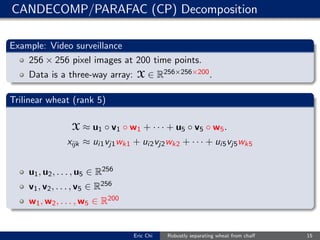
CANDECOMP/PARAFAC (CP) Decomposition
Example: Video surveillance
256 × 256 pixel images at 200 time points.
Data is a three-way array: X ∈ R256×256×200.
Trilinear wheat (rank 5)
X ≈ u1 ◦ v1 ◦ w1 + · · · + u5 ◦ v5 ◦ w5.
xijk ≈ ui1vj1wk1 + ui2vj2wk2 + · · · + ui5vj5wk5
u1, u2, . . . , u5 ∈ R256
v1, v2, . . . , v5 ∈ R256
w1, w2, . . . , w5 ∈ R200
Eric Chi Robustly separating wheat from chaff 15
Extracting multilinear wheat
Least Squares
min
256
i=1
256
j=1
200
k=1
(xijk −
5
r=1
uir vjr wkr )2
Eric Chi Robustly separating wheat from chaff 16
Extracting multilinear wheat
Least Squares
min
256
i=1
256
j=1
200
k=1
(xijk −
5
r=1
uir vjr wkr )2
Least 1-norm
min
256
i=1
256
j=1
200
k=1
|xijk −
5
r=1
uir vjr wkr |
Eric Chi Robustly separating wheat from chaff 16
Violating Gaussian assumptions: Who cares?
What if the non-Systematic variation is really non-Gaussian?
Neuroimaging: Movement artifacts.
Video Surveillance: Foreground/Background separation.
non-Gaussian how?
Sparse large perturbations.
Perturbations are large but not too large.
Eric Chi Robustly separating wheat from chaff 17
Minimizing the 1-norm loss
Least 1-norm is harder to solve than Least Squares!
The loss is non-differentiable.
Smooth approximation to 1-norm
ijk
xijk −
R
r=1
uir vjr wkr ≈
ijk
xijk −
R
r=1
uir vjr wkr
2
+
for small > 0.
Eric Chi Robustly separating wheat from chaff 18
Majorization-Minimization
Solve a hard optimization problem
ijk
xijk −
R
r=1
uir vjr wkr
2
+
as a series of easy ones (weighted least squares).
Minimize surrogate loss functions (quadratic functions).
Eric Chi Robustly separating wheat from chaff 19
MM Algorithm
Loss =
i
(xi − u)2 +
u
Loss
Less
More
very bad optimal less bad
Eric Chi Robustly separating wheat from chaff 20
MM Algorithm
Loss =
i
(xi − u)2 +
u
Loss
Less
More
very bad optimal less bad
q
Eric Chi Robustly separating wheat from chaff 21
MM Algorithm
Loss =
i
(xi − u)2 +
u
Loss
Less
More
very bad optimal less bad
q
Eric Chi Robustly separating wheat from chaff 22
MM Algorithm
Loss =
i
(xi − u)2 +
u
Loss
Less
More
very bad optimal less bad
q
Eric Chi Robustly separating wheat from chaff 23
MM Algorithm
Loss =
i
(xi − u)2 +
u
Loss
Less
More
very bad optimal less bad
q
Eric Chi Robustly separating wheat from chaff 24
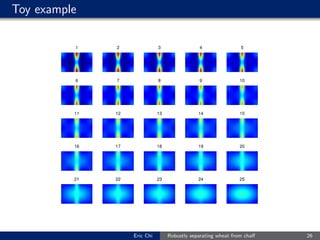
Toy example
X ∈ R25×25×25
Slice = mix of A and B.
Eric Chi Robustly separating wheat from chaff 25
Toy example
1
6
11
16
21
2
7
12
17
22
3
8
13
18
23
4
9
14
19
24
5
10
15
20
25
Eric Chi Robustly separating wheat from chaff 26
Toy example: Trilinear Wheat + Gaussian Chaff
1
6
11
16
21
2
7
12
17
22
3
8
13
18
23
4
9
14
19
24
5
10
15
20
25
Eric Chi Robustly separating wheat from chaff 27
Toy example: A slice up close
Observed True Wheat Gauassian Chaff
5 10 15 20 25
5
10
15
20
25
5 10 15 20 25
5
10
15
20
25
5 10 15 20 25
5
10
15
20
25
Eric Chi Robustly separating wheat from chaff 28
Extracting from Gaussian Chaff by Least Squares
Observed Extracted Wheat Difference
5 10 15 20 25
5
10
15
20
25
5 10 15 20 25
5
10
15
20
25
5 10 15 20 25
5
10
15
20
25
Eric Chi Robustly separating wheat from chaff 29
Extracting from Gaussian Chaff by Least 1-norm
Observed Extracted Wheat Difference
5 10 15 20 25
5
10
15
20
25
5 10 15 20 25
5
10
15
20
25
5 10 15 20 25
5
10
15
20
25
Eric Chi Robustly separating wheat from chaff 30
Trilinear wheat + non-Gaussian Chaff
1
6
11
16
21
2
7
12
17
22
3
8
13
18
23
4
9
14
19
24
5
10
15
20
25
Eric Chi Robustly separating wheat from chaff 31
Extracting from non-Gaussian Chaff by Least Squares
Observed Extracted Wheat Difference
5 10 15 20 25
5
10
15
20
25
5 10 15 20 25
5
10
15
20
25
5 10 15 20 25
5
10
15
20
25
Eric Chi Robustly separating wheat from chaff 32
Extracting from non-Gaussian Chaff by Least 1-norm
Observed Extracted Wheat Difference
5 10 15 20 25
5
10
15
20
25
5 10 15 20 25
5
10
15
20
25
5 10 15 20 25
5
10
15
20
25
Eric Chi Robustly separating wheat from chaff 33
Caveats
Costs
Computational: 1-norm minimization is more work than least squares.
Statistical: Robustness versus efficiency tradeoff
Limitations
Trouble with sparse tensor data.
Best suited for dense tensor data?
Eric Chi Robustly separating wheat from chaff 34
Summary
Least Squares (i.i.d. Gaussian errors)
Wide applicability, easy to compute solution, statistical efficiency.
But not always appropriate.
Observed Extracted Wheat Difference
5 10 15 20 25
5
10
15
20
25
5 10 15 20 25
5
10
15
20
25
5 10 15 20 25
5
10
15
20
25
5 10 15 20 25
5
10
15
20
25
5 10 15 20 25
5
10
15
20
25
5 10 15 20 25
5
10
15
20
25
Eric Chi Robustly separating wheat from chaff 35
Summary
Least 1-norm (i.i.d. Laplacian errors)
Can accomodate Gaussian errors and non-Gaussian errors.
But not as easy to compute, less statistical efficiency.
Observed Extracted Wheat Difference
5 10 15 20 25
5
10
15
20
25
5 10 15 20 25
5
10
15
20
25
5 10 15 20 25
5
10
15
20
25
5 10 15 20 25
5
10
15
20
25
5 10 15 20 25
5
10
15
20
25
5 10 15 20 25
5
10
15
20
25
Eric Chi Robustly separating wheat from chaff 36
Future Work
Real data
More sophisticated robust loss functions: β divergences
Robust factorizations for data on different scales:
Binary
Non-negative data.
Eric Chi Robustly separating wheat from chaff 37
Thank you!
Observed Extracted Wheat Difference
Images from wikipedia.org
Eric C. Chi
echi@rice.edu
Eric Chi Robustly separating wheat from chaff 38

Robustly Separating the Wheat from the Chaff in Multiway Data

  • 1.
    Robustly separating thewheat from the chaff in multiway data Eric C. Chi with Tamara G. Kolda October 11, 2010 Eric Chi Robustly separating wheat from chaff 1
  • 2.
    Wheat, Chaff, andfitting models to data World View “Wheat” “Chaff” Data = Systematic Variation + non-Systematic Variation Eric Chi Robustly separating wheat from chaff 2
  • 3.
    Wheat, Chaff, andfitting models to data World View “Wheat” “Chaff” Data = Systematic Variation + non-Systematic Variation This talk Systematic Variation (Wheat): multilinear Eric Chi Robustly separating wheat from chaff 2
  • 4.
    The “best” multilinearfit to the data Which multilinear model “best” fits the data? Measure of lack of fit: loss Many choices: 2-norm 1-norm Different losses = different assumptions about the statistical behavior of the non-Systematic variation (Chaff). Eric Chi Robustly separating wheat from chaff 3
  • 5.
    The “best” multilinearfit to the data Which multilinear model “best” fits the data? Measure of lack of fit: loss Many choices: 2-norm 1-norm Different losses = different assumptions about the statistical behavior of the non-Systematic variation (Chaff). Why is this important? Poor separation of wheat and chaff if chaff does not behave as expected. Eric Chi Robustly separating wheat from chaff 3
  • 6.
    Many ways toextract wheat from the data min u i (xi − u)2 Eric Chi Robustly separating wheat from chaff 4
  • 7.
    Extract wheat withleast squares min u i (xi − u)2 Least Squares Solution 1 Eric Chi Robustly separating wheat from chaff 5
  • 8.
    What happens ifwe spike the data with outliers? min u i (xi − u)2 Least Squares Solution 1 Eric Chi Robustly separating wheat from chaff 6
  • 9.
    Least squares issensitive to outliers. min u i (xi − u)2 Least Squares Solution 1 Least Squares Solution 2 Eric Chi Robustly separating wheat from chaff 7
  • 10.
    Extract wheat withleast 1-norm min u i |xi − u| Least Squares Solution 1 Least 1−norm Solution Eric Chi Robustly separating wheat from chaff 8
  • 11.
    When is aleast squares solution the “best” solution? Least Squares (LS) Solution = most “likely” u when non-Systematic Variation is Gaussian. The least squares solution is the maximum likelihood estimate (mle) of u: xi = u + ei . where ei ∼ i.i.d. N(0,1). Eric Chi Robustly separating wheat from chaff 9
  • 12.
    When is aleast 1-norm solution the “best” solution? Least 1-norm Solution = mle of u when non-Systematic Variation is Laplacian. xi = u + ei . where ei i.i.d. ∼ f (x) = exp(−|x|)/2. Eric Chi Robustly separating wheat from chaff 10
  • 13.
    Gaussian and Laplaciandensities e density 0.0 0.1 0.2 0.3 0.4 0.5 −6 −4 −2 0 2 4 6 Eric Chi Robustly separating wheat from chaff 11
  • 14.
    Justifying the Gaussianassumption STAT 101 non-Systematic variation = accumulation of many small random effects Eric Chi Robustly separating wheat from chaff 12
  • 15.
    Justifying the Gaussianassumption STAT 101 non-Systematic variation = accumulation of many small random effects (Central Limit Theorem) Eric Chi Robustly separating wheat from chaff 12
  • 16.
    Justifying the Gaussianassumption STAT 101 non-Systematic variation = accumulation of many small random effects (Central Limit Theorem) Practice Least squares is easy and fast to compute Eric Chi Robustly separating wheat from chaff 12
  • 17.
    Justifying the Gaussianassumption STAT 101 non-Systematic variation = accumulation of many small random effects (Central Limit Theorem) Practice Least squares is easy and fast to compute (Convenience). Eric Chi Robustly separating wheat from chaff 12
  • 18.
    Assumptions: multilinear wheat Example:Iris data 150 samples of 3 species of iris flowers 4 measurements on sepal and petal dimensions Data is a two-way array: X ∈ R150×4 Bilinear wheat (rank 2) X ≈ u1 ◦ v1 + u2 ◦ v2 xij ≈ ui1vj1 + ui2vj2 u1, u2 ∈ R150 v1, v2 ∈ R4 Eric Chi Robustly separating wheat from chaff 13
  • 19.
    Extracting bilinear wheatwith least squares min 150 i=1 4 j=1 (xij − 2 r=1 uir vjr )2 ui1 ui2 −1.0 −0.5 0.0 0.5 1.0 q qq q q q q q q q q q q q q q q q q q qq q q q q q q q qq q q q q q q q q qq q q q q q q q q q −3 −2 −1 0 1 2 3 Eric Chi Robustly separating wheat from chaff 14
  • 20.
    CANDECOMP/PARAFAC (CP) Decomposition Example:Video surveillance 256 × 256 pixel images at 200 time points. Data is a three-way array: X ∈ R256×256×200. Trilinear wheat (rank 5) X ≈ u1 ◦ v1 ◦ w1 + · · · + u5 ◦ v5 ◦ w5. xijk ≈ ui1vj1wk1 + ui2vj2wk2 + · · · + ui5vj5wk5 u1, u2, . . . , u5 ∈ R256 v1, v2, . . . , v5 ∈ R256 w1, w2, . . . , w5 ∈ R200 Eric Chi Robustly separating wheat from chaff 15
  • 21.
    Extracting multilinear wheat LeastSquares min 256 i=1 256 j=1 200 k=1 (xijk − 5 r=1 uir vjr wkr )2 Eric Chi Robustly separating wheat from chaff 16
  • 22.
    Extracting multilinear wheat LeastSquares min 256 i=1 256 j=1 200 k=1 (xijk − 5 r=1 uir vjr wkr )2 Least 1-norm min 256 i=1 256 j=1 200 k=1 |xijk − 5 r=1 uir vjr wkr | Eric Chi Robustly separating wheat from chaff 16
  • 23.
    Violating Gaussian assumptions:Who cares? What if the non-Systematic variation is really non-Gaussian? Neuroimaging: Movement artifacts. Video Surveillance: Foreground/Background separation. non-Gaussian how? Sparse large perturbations. Perturbations are large but not too large. Eric Chi Robustly separating wheat from chaff 17
  • 24.
    Minimizing the 1-normloss Least 1-norm is harder to solve than Least Squares! The loss is non-differentiable. Smooth approximation to 1-norm ijk xijk − R r=1 uir vjr wkr ≈ ijk xijk − R r=1 uir vjr wkr 2 + for small > 0. Eric Chi Robustly separating wheat from chaff 18
  • 25.
    Majorization-Minimization Solve a hardoptimization problem ijk xijk − R r=1 uir vjr wkr 2 + as a series of easy ones (weighted least squares). Minimize surrogate loss functions (quadratic functions). Eric Chi Robustly separating wheat from chaff 19
  • 26.
    MM Algorithm Loss = i (xi− u)2 + u Loss Less More very bad optimal less bad Eric Chi Robustly separating wheat from chaff 20
  • 27.
    MM Algorithm Loss = i (xi− u)2 + u Loss Less More very bad optimal less bad q Eric Chi Robustly separating wheat from chaff 21
  • 28.
    MM Algorithm Loss = i (xi− u)2 + u Loss Less More very bad optimal less bad q Eric Chi Robustly separating wheat from chaff 22
  • 29.
    MM Algorithm Loss = i (xi− u)2 + u Loss Less More very bad optimal less bad q Eric Chi Robustly separating wheat from chaff 23
  • 30.
    MM Algorithm Loss = i (xi− u)2 + u Loss Less More very bad optimal less bad q Eric Chi Robustly separating wheat from chaff 24
  • 31.
    Toy example X ∈R25×25×25 Slice = mix of A and B. Eric Chi Robustly separating wheat from chaff 25
  • 32.
  • 33.
    Toy example: TrilinearWheat + Gaussian Chaff 1 6 11 16 21 2 7 12 17 22 3 8 13 18 23 4 9 14 19 24 5 10 15 20 25 Eric Chi Robustly separating wheat from chaff 27
  • 34.
    Toy example: Aslice up close Observed True Wheat Gauassian Chaff 5 10 15 20 25 5 10 15 20 25 5 10 15 20 25 5 10 15 20 25 5 10 15 20 25 5 10 15 20 25 Eric Chi Robustly separating wheat from chaff 28
  • 35.
    Extracting from GaussianChaff by Least Squares Observed Extracted Wheat Difference 5 10 15 20 25 5 10 15 20 25 5 10 15 20 25 5 10 15 20 25 5 10 15 20 25 5 10 15 20 25 Eric Chi Robustly separating wheat from chaff 29
  • 36.
    Extracting from GaussianChaff by Least 1-norm Observed Extracted Wheat Difference 5 10 15 20 25 5 10 15 20 25 5 10 15 20 25 5 10 15 20 25 5 10 15 20 25 5 10 15 20 25 Eric Chi Robustly separating wheat from chaff 30
  • 37.
    Trilinear wheat +non-Gaussian Chaff 1 6 11 16 21 2 7 12 17 22 3 8 13 18 23 4 9 14 19 24 5 10 15 20 25 Eric Chi Robustly separating wheat from chaff 31
  • 38.
    Extracting from non-GaussianChaff by Least Squares Observed Extracted Wheat Difference 5 10 15 20 25 5 10 15 20 25 5 10 15 20 25 5 10 15 20 25 5 10 15 20 25 5 10 15 20 25 Eric Chi Robustly separating wheat from chaff 32
  • 39.
    Extracting from non-GaussianChaff by Least 1-norm Observed Extracted Wheat Difference 5 10 15 20 25 5 10 15 20 25 5 10 15 20 25 5 10 15 20 25 5 10 15 20 25 5 10 15 20 25 Eric Chi Robustly separating wheat from chaff 33
  • 40.
    Caveats Costs Computational: 1-norm minimizationis more work than least squares. Statistical: Robustness versus efficiency tradeoff Limitations Trouble with sparse tensor data. Best suited for dense tensor data? Eric Chi Robustly separating wheat from chaff 34
  • 41.
    Summary Least Squares (i.i.d.Gaussian errors) Wide applicability, easy to compute solution, statistical efficiency. But not always appropriate. Observed Extracted Wheat Difference 5 10 15 20 25 5 10 15 20 25 5 10 15 20 25 5 10 15 20 25 5 10 15 20 25 5 10 15 20 25 5 10 15 20 25 5 10 15 20 25 5 10 15 20 25 5 10 15 20 25 5 10 15 20 25 5 10 15 20 25 Eric Chi Robustly separating wheat from chaff 35
  • 42.
    Summary Least 1-norm (i.i.d.Laplacian errors) Can accomodate Gaussian errors and non-Gaussian errors. But not as easy to compute, less statistical efficiency. Observed Extracted Wheat Difference 5 10 15 20 25 5 10 15 20 25 5 10 15 20 25 5 10 15 20 25 5 10 15 20 25 5 10 15 20 25 5 10 15 20 25 5 10 15 20 25 5 10 15 20 25 5 10 15 20 25 5 10 15 20 25 5 10 15 20 25 Eric Chi Robustly separating wheat from chaff 36
  • 43.
    Future Work Real data Moresophisticated robust loss functions: β divergences Robust factorizations for data on different scales: Binary Non-negative data. Eric Chi Robustly separating wheat from chaff 37
  • 44.
    Thank you! Observed ExtractedWheat Difference Images from wikipedia.org Eric C. Chi echi@rice.edu Eric Chi Robustly separating wheat from chaff 38