UREDNI[TVO
Glavni i odgovorni urednik:
Prim. dr Avdo ]erani}
Pomo}nik glavnog i odgovornog urednika:
dr D`enana Detanac
Tehni~ki urednik:
dr D`email Detanac
Nau~ni savet Me|unarodni nau~ni savet
Prof. dr Aleksandar Karamarkovi} (Srbija) Prof. dr Ivan Damjanov (SAD)
Prof. dr Branka Nikoli} (Srbija) Prof. dr Milan R.Kne`evi} ([panija)
Prof. dr Radivoj Koci} (Srbija) Prof. dr Ino Hused`inovi} (Hrvatska)
Prof. dr Ivan Dimitrijevi} (Srbija) Prof. dr Anastasika Poposka (Makedonija)
Prof. dr Stojan Sekuli} (Srbija) Prof. dr Sergio Zylbersztejn (Brazil)
Prof. dr Marina Savin (Srbija) Prof. dr Beniamino Palmieri (Italija)
Prof. dr Milica Berisavac (Srbija) Prof. dr Sahib H. Muminagi} (Bosna i Hercegovina)
Prof. dr Milan Kne`evi} (Srbija) Prof. dr Osman Sinanovi} (Bosna i Hercegovina)
Prof. dr Milo{ Jovanovi} (Srbija) Prof. dr Selma Uzunovi}-Kamberovi} (Bosna i Hercegovina)
Prof. dr Sne`ana Jan~i} (Srbija) Prof. dr Agima Ljaljevi} (Crna Gora)
Prof. dr ^edomir S. Vu~eti} (Srbija) Prof. dr Suada Helji} (Bosna i Hercegovina)
Prof. dr Slobodan Obradovi} (Srbija) Prof. dr Milica Martinovi} (Crna Gora)
Prof. dr Slobodan Grebeldinger (Srbija) Prof. dr Nermina Had`igrahi} (Bosna i Hercegovina)
Prof. dr Slobodan M. Jankovi} (Srbija) Prof. dr Miralem Musi} (Bosna i Hercegovina)
Prof. dr @ivan Maksimovi} (Srbija) Prof. dr Spase Jovkovski (Makedonija)
Prof. dr Zlata Janji} (Srbija) Prof. dr Evangelos J. Giamarellos-Bourboulis (Gr~ka)
Prof. dr Svetislav Milenkovi} (Srbija) Prof. dr Paolo Pelosi (Italija)
Prof. dr Radmilo Jankovi} (Srbija) Prof. dr Zsolt Molnar (Ma|arska)
Lektor za engleski jezik
Selma Mehovi}
Dizajn
Prim. dr Avdo ]erani}
Izdava~
Udru`enje lekara Sanamed, Novi Pazar
^ASOPIS IZLAZI TRI PUTA GODI[NJE
Adresa uredni{tva
„SANAMED“, Ul. Palih boraca 52, 36300 Novi Pazar, Srbija
email: sanamednp2006ªgmail.com, www.sanamed.rs
[tampa
„ProGraphico“, Novi Pazar
Tira`
500
Pretplata
Godi{nja pretplata: 4000 din. za doma}e ustanove; 1500 din. za pojedince; za inostranstvo 75 eura (u dinarskoj
protivrednosti po kursu na dan uplate). Pretplatu vr{iti na ra~un 205-185654-03, Komercijalna banka. Za sve do-
datne informacije kontaktirati Uredni{tvo.
ISSN-1452-662X
EDITORIAL BOARD
Editor-in-chief:
Prim. dr Avdo ]erani}
Associate Editor:
dr D`enana Detanac
Technical Editor:
dr D`email Detanac
Scientific council International scientific council
Prof. dr Aleksandar Karamarkovi} (Serbia) Prof. dr Ivan Damjanov (USA)
Prof. dr Branka Nikoli} (Serbia) Prof. dr Milan R.Kne`evi} (Spain)
Prof. dr Radivoj Koci} (Serbia) Prof. dr Ino Hused`inovi} (Croatia)
Prof. dr Ivan Dimitrijevi} (Serbia) Prof. dr Anastasika Poposka (R. Macedonia)
Prof. dr Stojan Sekuli} (Serbia) Prof. dr Sergio Zylbersztejn (Brazil)
Prof. dr Marina Savin (Serbia) Prof. dr Beniamino Palmieri (Italy)
Prof. dr Milica Berisavac (Serbia) Prof. dr Sahib H. Muminagi} (Bosnia and Herzegovina)
Prof. dr Milan Kne`evi} (Serbia) Prof. dr Osman Sinanovi} (Bosnia and Herzegovina)
Prof. dr Milo{ Jovanovi} (Serbia) Prof.drSelmaUzunovi}-Kamberovi}(BosniaandHerzegovina)
Prof. dr Sne`ana Jan~i} (Serbia) Prof. dr Agima Ljaljevi} (Montenegro)
Prof. dr ^edomir S. Vu~eti} (Serbia) Prof. dr Suada Helji} (Bosnia and Herzegovina)
Prof. dr Slobodan Obradovi} (Serbia) Prof. dr Milica Martinovi} (Montenegro)
Prof. dr Slobodan Grebeldinger (Serbia) Prof. dr Nermina Had`igrahi} (Bosnia and Herzegovina)
Prof. dr Slobodan M. Jankovi} (Serbia) Prof. dr Miralem Musi} (Bosnia and Herzegovina)
Prof. dr @ivan Maksimovi} (Serbia) Prof. dr Spase Jovkovski (R. Macedonia)
Prof. dr Zlata Janji} (Serbia) Prof. dr Evangelos J. Giamarellos-Bourboulis (Greece)
Prof. dr Svetislav Milenkovi} (Serbia) Prof. dr Paolo Pelosi (Italy)
Prof. dr Radmilo Jankovi}(Serbia) Prof. dr Zsolt Molnar (Hungary)
English language editor
Selma Mehovi}
Design
Prim dr Avdo ]erani}
Publisher
Association of medical doctors “Sanamed”, Novi Pazar
ISSUED three times a year.
Editorial address
“SANAMED”, Ul. Palih boraca 52, 36 300 Novi Pazar, Serbia
email: sanamednpªgmail.com, www.sanamed.rs
Print
“ProGraphico”, Novi Pazar
Circulation
500
Subscription
Annual subscriptions: 4000 RSD for domestic institutions and 1500 RSD for individuals. For readers abroad, an-
nual subscription is 75 Euro (in Dinar equivalent at the exchange rate on the day of payment). For further instruc-
tions and informations, contact Editorial Board.
ISSN-1452-662X
CONTENTS
• AWORD FROM THE EDITOR .................................................................................................................
• ORIGINAL ARTICLE
• THE EFFECTS OF CHRONIC LEAD POISONING ON THE VALUES
OF HYPERTENSION IN CHILDREN
Zivkovic Jovan,
1
Savic Zoran
2
1
Faculty of Medicine, University of Pri{tina, based in Kosovska Mitrovica
2
Health Center Kosovska Mitrovica
• PROFESSIONAL ARTICLE
• CORRELATION BETWEEN DOMESTIC VIOLENCE AGAINSTWOMEN AND NEUROTICISM ...
Numanovic S. Almedina,
1
Jovicic M. Milena
2
1
International University of Novi Pazar, Novi Pazar, Serbia
2
Clinical Center Kragujevac, Psychiatric Clinic, Kragujevac, Serbia
• CASE REPORT
• EARLYDIAGNOSIS OF CRANIOSYNOSTOSIS IN INFANTS AT PRIMARYHEALTH CARE ..........
Skoric Jasmina
Children and Youth Health Care Center “Simo Milo{evi}”, Belgrade, Serbia
• COCAINE CARDIOMYOPATHY— ACASE REPORT...........................................................................
Georgiev Antonio,
1
Zhivadinovik Julija
2
1
University Clinic for Cardiology, Medical Faculty, Skopje, University “Ss. Cyril and Metodius”, R. Macedonia
2
Institute of Anatomy, Medical Faculty, Skopje, University “Ss. Cyril and Metodius”, R. Macedonia
• REVIEW ARTICLE
• SENTINELLYMPH NODE CONCEPT IN DIFFERENTIATED THYROID CANCER...........................
Markovic Ivan, Dzodic Radan
Medical faculty University of Belgrade, Institute of oncology and radiology of Serbia, Belgrade, Serbia
• SYSTEMIC DISORDERS AFFECTING DENTALPATHOLOGY...........................................................
Knezevic R. Milan,
1
Andjelic S. Gordana,
2
Knezevic M. Milena
3
1
FEBOMFS, University Las Palmas, Spain
2
Institute for Medical Research, Military Medical Academy, Belgrade, Serbia
3
Medical School, University Las Palmas, Spain
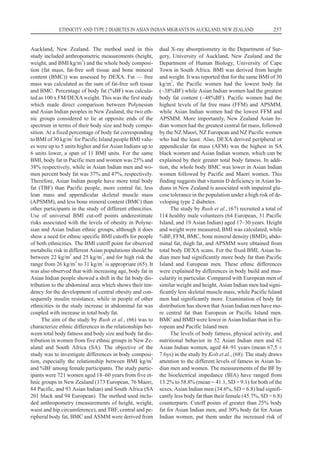
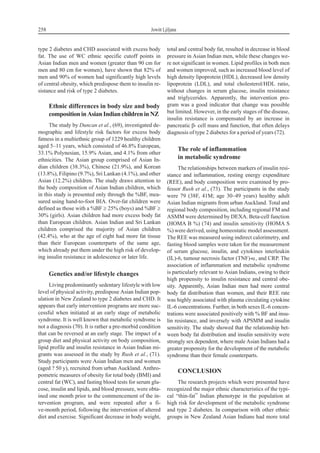
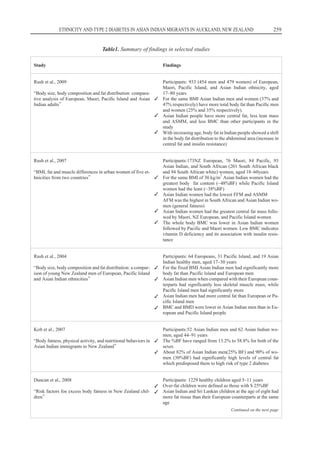
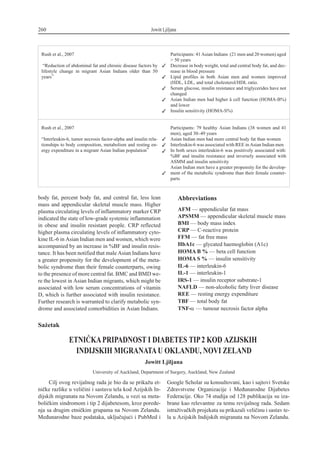
• ETHNICITY AND TYPE 2 DIABETES IN ASIAN INDIAN MIGRANTS
IN AUCKLAND, NEW ZEALAND...........................................................................................................
Jowitt Ljiljana
University of Auckland, Department of Surgery, Auckland, New Zealand
• INSTRUCTIONS FOR AUTHORS............................................................................................................
Broj 9(3)/2014
SADR@AJ
• RE^ UREDNIKA.......................................................................................................................................
• ORIGINALNI NAU^NI RAD
• DEJSTVO HRONI^NOG TROVANJA OLOVOM NA VREDNOST
KRVNOG PRITISKAKOD DECE.............................................................................................................
@ivkovi} Jovan,
1
Savi} Zoran
2
1
Medicinski fakultet Univerziteta u Pri{tini, sa sedi{tem u Kosovskoj Mitrovici
2
Zdravstveni centar Kosovska Mitrovica
• STRU^NI RAD
• KORELACIJAIZMEU PORODI^NOG NASILJANAD @ENAMAI NEUROTICIZMA.....................
Numanovi} S. Almedina,
1
Jovi~i} M. Milena
2
1
Internacionalni univerzitet Novi Pazar, Novi Pazar, Srbija
2
Klini~ki centar Kragujevac, Klinika za psihijatriju, Kragujevac, Srbija
• PRIKAZ SLU^AJA
• RANA DIJAGNOSTIKA KRANIOSINOSTOZE KOD ODOJ^ADI
U PRIMARNOJ ZDRAVSTVENOJ ZA[TITI ...........................................................................................
Skoric Jasmina
Dom zdravlja „Simo Milo{evi}“, Slu`ba za zdravstvenu za{titu dece i omladine ^ukarica, Beograd, Srbija
• KOKAINSKAKARDIOMIOPATIJA— PRIKAZ SLU^AJA...................................................................
Georgiev Antonio,
1
Zhivadinovik Julija
2
1
Univerzitetska Klinika za kardiologiju, Univerzitet „Sv. ]irilo i Metodije“, Medicinski fakultet, Skoplje, R. Makedonija
2
Institut za anatomiju, Univerzitet „Sv. ]irilo i Metodije“, Medicinski fakultet, Skoplje, R. Makedonija
• REVIJALNI RAD
• KONCEPT STRA@ARSKIH LIMFNIH NODUSA
KOD DIFERENTOVANOG TIROIDNOG KARCINOMA .......................................................................
Markovi} Ivan, D`odi} Radan
Medicinski fakultet Univerziteta u Beogradu, Institut za onkologiju i radiologiju Srbije, Beograd, Srbija
• SISTEMSKE BOLESTI KOJE UTI^U NAZUBNU PATOLOGIJU..........................................................
Kne`evi} R. Milan,
1
An|eli} S. Gordana,
2
Kne`evi} M. Milena
3
1
FEBOMFS, University Las Palmas, Spain
2
Institute for Medical Research, Military Medical Academy, Belgrade, Serbia
3
Medical School, University Las Palmas, Spain
• ETNI^KA PRIPADNOST I DIABETES TIP 2 KOD AZIJSKIH
INDIJSKIH MIGRANATAU OKLANDU, NOVI ZELAND.....................................................................
Jowitt Ljiljana
University of Auckland, Department of Surgery, Auckland, New Zealand
• UPUTSTVO AUTORIMA..........................................................................................................................
Broj 9(3)/2014
Recenzenti / Reviewers
Aleksandar Karamarkovi} (Serbia)
Ivan Dimitrijevi} (Serbia)
Radivoj Koci} (Serbia)
Radan D`odi} (Serbia)
Stojan Sekuli} (Serbia)
Marina Savin (Serbia)
Milan Kne`evi} (Serbia)
Milo{ Jovanovi} (Serbia)
Milica Berisavac (Serbia)
Sne`ana Jan~i} (Serbia)
Sa~a ^aki} (Serbia)
Branka Nikoli} (Serbia)
Suada Helji} (Bosnia and Herzegovina)
Slobodan M. Jankovi} (Serbia)
Rada Trajkovi} (Serbia)
Velimir Kosti} (Serbia)
Ksenija Bo`i} (Serbia)
Svetlana Pavlovi} (Serbia)
Nermina Babi} (Bosnia and Herzegovina)
Miralem Musi} (Bosnia and Herzegovina)
Emina Alimanovi} Halilovi} (Bosnia and Herzegovina)
Nermina Had`igrahi} (Bosnia and Herzegovina)
Maja Abram (Croatia)
Zijad Durakovi} (Croatia)
Aida Salihagi} Kadi} (Croatia)
Goran Spasojevi} (Bosnia and Herzegovina)
Ljubica @ivi} (Serbia)
Hasan @uti} (Bosnia and Herzegovina)
Lejla Ibrahimagi} [eper (Bosnia and Herzegovina)
Jasna Lovri} (Croatia)
Vladislava Vesovi} Poti} (Serbia)
Ivica Stojkovi} (Serbia)
Slobodan Milisavljevi} (Serbia)
Zoran Todorovi} (Serbia)
Lep{a Zori} (Serbia)
Ivan Dobri} (Croatia)
Jovan Mladenovi} (Serbia)
Sergio Zylbersztejn (Brazil)
Spase Jovkovski (R. Macedonia)
Dejan Petrovi} (Serbia)
Samir Delibegovi} (Bosnia and Herzegovina)
Naima Arslanagi} (Bosnia and Herzegovina)
Nada Ma~vanin (Serbia)
Gordana Petru~evska (R. Macedonia)
Todorovi} Vladimir (Montenegro)
Neboj{a Krsti} (Serbia)
Miodrag V. [o} (Montenegro)
Eugen Carasevici (Romania)
Andrey Eu. Kratnov (Russia)
Kostandina L. Korneti-Pekevska (R. Macedonia)
Sne`ana Lazi} (Serbia)
Sanja Milenkovi} (Serbia)
Slavica Vujisi} (Montenegro)
Vasileios K. Nitsas (Greece)
Miroslava Gojni} Dugali} (Serbia)
Tatjana ur|evi} Mirkovi} (Serbia)
Zoran Miju{kovi} (Serbia)
Radmila Gudovi} (Serbia)
^edomir Dimitrovski (R. Macedonia)
Katarina Vukojevi} (Croatia)
Marija [orak (Serbia)
Dragana Nik~i} (Bosnia and Herzegovina)
Alexander Hinev (Bulgaria)
Svetoslav Kalevski (Bulgaria)
Milos Tatar (Slovakia)
Ludek Vajner (Czech Republic)
Miroslav Votava (Czech Republic)
Patricia Rosarie Casey (Ireland)
Claus Peter Hovendal (Denmark)
Vladimir Tsyrkunov (Belarus)
@ivana Gavri} (Bosnia and Herzegovina)
Budimka D. Novakovi} (Serbia)
Nada Majki}-Singh (Serbia)
Radoica Joki} (Serbia)
Izet Hozo (Croatia)
Milan Vi{nji} (Serbia)
Snje`ana Mili}evi} (Bosnia and Herzegovina)
Ralph Pinnock (Australia)
A. Yasemin Öztop (Turkey)
Branka Radoj~i} (Serbia)
Ljiljana Kesi} (Serbia)
Alexander Rapoport (Latvia)
Dejan Vulovi} (Serbia)
Sun~ica Sre}kovi} (Serbia)
Vesna Kesi} (Serbia)
Slobodanka uki} (Serbia)
Fahrija Skoki} (Bosnia and Herzegovina)
Suzana Pavlja{evi} (Bosnia and Herzegovina)
Milovan Matovi} (Serbia)
Zsolt Molnar (Hungary)
Emir Tupkovi} (Bosnia and Herzegovina)
Mai Rosenberg (Estonia)
ISSN-1452-662X
Peter Laszlo Kanizsai (Hungary)
Janko Kersnik (Slovenia)
Miklós Garami (Hungary)
Fatima Numanovi} (Bosnia and Herzegovina)
Bo`ena Pejkovi} (Slovenia)
Ervin Alibegovi} (Bosnia and Herzegovina)
@eljko Mijailovi} (Serbia)
Vesna Ko`elj (Slovenia)
Mirko Omejc (Slovenia)
Karmen Lon~arek (Croatia)
Mina Cvjetkovi} Bo{njak (Serbia)
Branko Kolari} (Croatia)
Andrej ^retnik (Slovenia)
Iztok Taka~ (Slovenia)
Nela onovi} (Serbia)
Anastasika Poposka (R. Macedonia)
Sr|an Vlajkovi} (New Zealand)
Mirjana Be}arevi} (Serbia)
Kenan Arnautovi} (USA)
Biljana Antonijevi} (Serbia)
Milkica Ne{i} (Serbia)
Vesna Matovi} (Serbia)
Irena Ho~evar-Bolte`ar (Slovenia)
Vu~kovi} Darinka (Croatia)
Ivica Ma`urani} (Croatia)
Darko Ka{telan (Croatia)
Grozdanko Grbe{a (Serbia)
Enes M. Kanli} (USA)
Branislav Ba{kot (Serbia)
Ivan Kopitovi} (Serbia)
Vjekoslav Gerc (Bosnia and Herzegovina)
Nihada Ahmetovi} (Bosnia and Herzegovina)
Jasna Huremovi} (Bosnia and Herzegovina)
Risto Kozomara (Bosnia and Herzegovina)
Mevludin Meki} (Bosnia and Herzegovina)
Elvira Konji} (Bosnia and Herzegovina)
Handan Ankarali (Turkey)
Anton Gali} (Bosnia and Herzegovina)
Amila Kapetanovi} (Bosnia and Herzegovina)
Gorica Sbutega Milo{evi} (Serbia)
Modesto Leite Rolim Neto (Brazil)
Zijah Rifatbegovi} (Bosnia and Herzegovina)
Hajrudin Halilovi} (Bosnia and Herzegovina)
Alija Ge`o (Bosnia and Herzegovina)
Beniamino Palmieri (Italia)
Branka Bedeni~ (Croatia)
Vesna [kodri} Trifunovi} (Serbia)
Badr Eldin Mostafa (Egypt)
Tarek Mohmmed Tawfik Amin (Egypt)
Mostafa Hamed Nabih (Egypt)
Marina Titli} (Croatia)
Jasneet Singh Bhullar (USA)
Antonio Georgiev (Macedonia)
Jasmina Guti} (Bosnia and Herzegovina)
Ilker Sengul (Turkey)
Jiri Pasta (Czech Republic)
Abdulzahra Hussain (UK)
Claudio Feliciani (Italy)
Pavel Rozsíval (Czech Republic)
Lejla Me{ali} (Bosnia and Herzegovina)
Blanka Koristkova (Czech Republic)
Christian D. Rolfo (Belgium)
Marko Boban (Croatia)
Georges Khalil (Lebanon)
JarosÓaw Damian Kasprzak (Poland)
Khalid S. Al-Gelban (Kingdom of Saudia Arabia)
Vladimir Startsev (Russia)
Berislav Vekic (Serbia)
Francesco Signorelli (France)
Dilek Ozturk (Turkey)
Ferdinand Rudolf Waldenberger (Austria)
Yog Raj Sharma (India)
E. F. Ehtuish (Libya)
George Blaskó (Hungary)
Nabila Talat Baila (Pakistan)
Costas Karabatsas (Greece)
Syed Nasir Ali Shah (China)
Oztekin Oto (Turkey)
Du{anka Krajnovi} (Serbia)
Yuyu Song (USA)
Kartheek R. Balapala (Malaysia)
Mohamed Alaa El Din Abdou Habib (Egypt)
Marko Bo`i} (Slovenia)
Krstina Doklesti} (Serbia)
Mirjana Janicijevic Petrovic, Serbia
Zlatan Stojanovi}, Bosnia and Herzegovina
Yaºam Kemal Akpak, Turkey
Radmilo Jankovic, Serbia
Paolo Pelosi, Italy
Evangelos J. Giamarellos-Bourboulis, Greece
Ljiljana Gvozdenovi}, Serbia
Milica Labudovi} Borovi}, Serbia
Krassimir Metodiev, Bulgaria
Tatjana Terzi}, Serbia
Elhassan Mohamed Elhassan, Sudan
Vassil Borislavov Traykov, Bulgaria
Gazment Koduzi, Albania
Zoran Mihailovic, Serbia
Huiting Dong, China
Lydia G. Katrova, Bulgaria
Ljiljana M. Jowitt, New Zealand
Ivana Marasovi} [u{njara, Croatia
Elias J. Arbid, Lebanon
Arben Gjata, Albania
Tatjana [imurina, Croatia
Aleksandra M. Kne`evi}, Serbia
Radmila Obradovic, Serbia
Erika N. Eskina, Russia
Aleksandra Tomi} Lu~i}, Serbia
Miranda Muhvi} Urek, Croatia
Miroslava Jasovic Gasic, Serbia
Kemal Dizdarevic, Bosnia and Herzegovina
Jovan @ivkovi}, Serbia
RIJE^ UREDNIKA
Uzimaju}i papir da napi{em par re~enica ~ini
mi i obavezu, i zadovoljstvo da ne{to ka`em i osvr-
nem se saradnicima uredni{tva sa iskrenim i du`nim
po{tovanjem, jer oni daju poseban ton ovome {to svi
skupa radimo.
Kako sam po struci hirurg i slikar, podsjeti me to
na jedan davni period iza nas. Postoji negde zapisa-
no da „zlatno doba hirurgije je period poslije 1870.
godine, kada se posebno izu~ava anatomija“. Jedan
paradoks tog vremjena i vremjena u kome `ivimo,
izaziva ~u|enje. Tada su se umjetnici, i to sa velikim
problemima interesovali za ljudsko tijelo, njegov iz-
gled i proporcije. „Tako je Donatelo (1386–1486),
prvi slikar koji je radio disekcije ljudskog tijela. Leo-
nardo da Vin~i (1452–1519), je zasnovao portretsku i
fiziolo{ku anatomiju i tvrdio je da je sam uradio tri-
desetak disekcija ljudskog tijela.“
Paradoks se ogleda u tome da su se ljudi koji
nikada nisu imali na umu da se bave medicinom ba-
vili ljudskim tijelom ne bi li dali svoj doprinos nauci
radi bli`ih spoznaja u re{avanju svih tajni za to do-
ba, u korist ~ovjeka, u borbi za o~uvanje zdravlja.
Danas, kada se tajne u medicini mijenjaju iz nedje-
lje u nedjelju, i kada postoje uslovi sa najsavreme-
nijim pristupom u tehnici i kada znaju za lije~enje
obolelih, toliko postoji nezainteresovanost, i to ba{
kod onih koji su najpozvaniji da se uklju~e u razne
programe i postanu deo medicinske nauke za do-
brobit dru{tva. Tragi~no je {to je opao taj tonus i
mnogi lekari zaustavljaju sebe u daljem radu na pr-
voj stepenici obrazovanja, na koju stanu po zavr{e-
noj specijalizaciji.
Pa dobro, nijesu motivisani da pi{u, da stvara-
ju, ali je jo{ tragi~nije {to neki ba{ tada pomisle da
oni ve} sve znaju i da su se ve} umorili za dalje usa-
vr{avanje. Neki su i opasni po druge jer su se uvrsti-
li u one ljude koji „ne znaju, a misle da znaju“, i
njih se treba kloniti.
Takvi pojedinci su izbrisali hijerarhiju, oni bi
da gaze po u~iteljima, misle da je njih sam Bog po-
slao da re{avaju probleme, a pacijent im je no}na
mora, i on je taj koji mora da trpi, ~eka i tra`i spas.
[ta bi rekao Leonardo da Vin~i kada bi video hirur-
ga koji ne zna anatomiju a ide da operi{e ~ovjeka?
To je taj paradoks za koji ne znam da li sam ga
plasti~no prikazao, ali znam da sam ga upotrijebio
namjerno, `ele}i da se osvrnem na na{ rad od prvog
broja SANAMED-a, kada smo ga izdavali jednom
godi{nje i koji je od tada sazreo i stao u red ~asopi-
sa starih nekoliko decenija i sada ve} izlazi tri puta
godi{nje, a po kvalitetu mnogi nam ve} i zavide, i
ve}ina nam ~estita na njegovom uzrastu.
Po ko zna koji put moram da zahvalim na{im
saradnicima, a posebno sada{njoj ekipi mladih le-
kara koji svojim entuzijazmom potvr|uju, kroz kva-
litet onoga {to ~ine, da je vjera u ~ovjeka vrijedna
samo onda kad, „zna{ da zna, a on zna da zna“ i to-
ga treba slijediti.
Sam `ivot predstavlja vje~itu borbu da bi se sti-
glo na vrh. Ako ste rije{ili da budete u~esnik u toj bor-
bi, budite ponosni {to imate izazov, bez obzira {to }ete
do tog vrha biti mnogo puta povre|eni i neshva}eni.
U na{em ~asopisu ima mnogo mesta za takve
entuzijaste.
Koristim priliku da svima ~estitam Novu Godi-
nu i po`elim puno uspeha u profesionalnom i privat-
nom `ivotu.
Srda~an pozdrav,
Prim. dr Avdo ]erani}
glavni i odgovorni urednik
THE EFFECTS OF CHRONIC LEAD POISONING
ON THE VALUES OF HYPERTENSION IN CHILDREN
Zivkovic Jovan,
1
Savic Zoran
2
1
Faculty of Medicine, University of Pri{tina, based in Kosovska Mitrovica
2
Health Center Kosovska Mitrovica
Primljen/Received 20. 11. 2014. god. Prihva}en/Accepted 20. 12. 2014. god.
Abstract: Introduction: During the treatment of
Roma children from Kosovska Mitrovica suffering
from chronic lead poisoning (which began in the sec-
ond half of the last decade), hypertension has also been
observed. The examination and treatment were con-
ducted under the patronage of World Health Organiza-
tion, Ministry of Health of the Republic of Serbia and
local administration. Aim of this work is show corre-
lation between lead levels in blood and hypertension in
children. Materials and methods: Lead from capil-
lary blood flow was measured by Lead care analyzer.
Extracted blood from a vein measured lead level in the
toxicological laboratory of the Institute „Karajovi}“
Belgrade. The pressure was measured by standard de-
vices with changeable cuffs and has been expressed in
mmHg. Hypertension has been observed in 159 chil-
dren. They were divided into four groups. First group:
non-Roma children (n = 32) with blood lead level of up
to 10 mcg/dl. Second group: Roma children (n = 31)
with blood lead level of up to 10 mcg/dl. Third group:
Roma children (n = 53) with blood lead levels of 10–45
mcg/dl. Fourth group: Roma children (n = 43) with blood
lead levels more than 45 mcg/dl, with an average value
of 61.6 mcg/dl. Results: There is a statistically signifi-
cant difference in the elevation of systolic blood pres-
sure between group (chi-square = 31,179; p < 0,001),
the first (x = 107,2 mmHg) and the fourth group (x =
114,6 mmHg), the second (x = 104,5 mmHg) and fou-
rth group, third (x =106,4 mmHg) and fourth group.
There is a statistically significant difference in the ele-
vation of diastolic blood pressure between group
(chi-square = 32,028; p < 0,001), the first (x = 67,7
mmHg) and the fourth group (x =73,4 mmHg), the sec-
ond (x = 66 mmHg) and third group (x = 69 mmHg),
second and fourth group, third and fourth group of chil-
dren. It is concluded that when the value of lead in the
blood was higher its effect on blood pressure was more
pronounced. Conclusion: Most children with lead lev-
els over 45 mcg/dl have developed an increased blood
pressure as well, which required further observation
and testing. Twelve of the children from the fourth gro-
up have significant hypertension. But, none of the chil-
dren have shown severe hypertension values.
Key words: children, lead in the blood, hyperten-
sion.
INTRODUCTION
Lead has been known to man before all other met-
als. It has been used widely for a very long time. Ever
since the ancient and Roman times, the production and
use of lead have been constantly increasing throughout
history (with only slight oscillations). Many of the an-
cient civilizations, such as Egypt, Greece, Rome and
Phoenicia, were familiar with lead (1). There is histori-
cal evidence that indicates the exploitation of lead in
pre-Roman times in the northern region of Kosovo and
Metohija (today’s territory of Trep~a). Year 1927 is
considered a milestone — the English company “Trep-
ca Mines Limited” began working on the opening of
the mine, while the production started in 1939 when
the lead smelter was built (2). Lead can enter the body
by inhalation and ingestion, while the absorption of
lead through undamaged skin is insignificant. Lead can
also be transported transplacentally (3). When lead is
inhaled, the absorption occurs within the whole respi-
ratory tract, especially in bronchioles and alveoli (4).
After the absorption, lead is transported by blood,
mostly by erythrocytes (about 95% of the intake), then
by protein fractions of plasma, and minimally in terms
of ionic transport. Ionized lead represents metaboli-
cally active nucleus of the entire amount of lead in the
body responsible for toxic effects. Lead toxicity may
have multiple mechanisms. As other heavy metals, lead
UDK: 615.9:546.815(497.115); 616.12-008.331.1-053.2(497.115)
2014; 9(3): 215–222 ID: 212447500
ISSN-1452-662X Originalni nau~ni rad
forms a series of complexes with ligands that contain
sulphur, nitrogen or oxygen. The interaction of lead
with sulphur groups, amine and simple amino acids
(inhibition of enzyme activity) is especially significant
(5, 6).
Chronic lead poisoning is common, especially in
children. Lead affects many systems and organs in hu-
man body: hematopoietic system, hearing, peripheral
and autonomic nervous system, skeletal system, liver,
kidneys, reproductive system, metabolism of vitamin
D, etc (7). There is no hard evidence of heart damage
due to chronic lead poisoning. Lead poisoning causes
spasms of the smooth muscles of blood vessels (especi-
ally of smaller blood vessels of the central nervous sys-
tem, kidneys and bowels). The main effect of lead poi-
soning on the cardiovascular system is hypertension
with all its consequences (8).
Hypertension is a health problem of national sig-
nificance. It is one of the main risk factors for athero-
sclerosis and consequential cardiovascular, cerebrova-
scular and renal diseases, which are the leading cause of
morbidity and mortality in our country, as well as other
developed countries and many developing countries.
The primary goal of pediatricians and other child
care medical personnel is to recognize children and ad-
olescents who either have the risk factors for develop-
ing hypertension, or have already developed it, and ta-
ke preventive and therapeutic measures in a timely
manner (since hypertension in childhood and adoles-
cence is one of the strongest predictors of adult hyper-
tension) (9).
AIM OF THE STUDY
The aim of this study is to process and represent
the test results of examined children chronically poiso-
ned by lead in Kosovska Mitrovica, using statisti-
cal-epidemiological methods, as well as to show corre-
lation between lead levels in blood and hypertension in
children.
MATERIALS AND METHODS
Examination and treatment of Roma children,
identified as the group with the highest risk for lead po-
isoning by the World Health Organization, started in
the second half of the last decade. The investigation in-
cluded almost all Roma children from North Kosovska
Mitrovica within the age group of 1–14. The research
also included two control groups- Roma children from
Leposavi} and non-Roma children from Kosovska Mi-
trovica.
Lead Care Analyzer (No 70–2233) at Kosovska
Mitrovica Public Health Institute was used for determi-
nation of capillary blood lead levels. Venous blood
lead levels were determined in toxicological laboratory
of the Institute for Occupational Health “Karajovi}”,
Belgrade.
Basic hematological and biochemical analyses
were performed in the central laboratory of Health
Center Kosovska Mitrovica (Le, Le formula, Er, Hb,
Hct, MCV, MCH, MCHC, Tr, feritin, AST, ALT, Urea,
Cr, serum Fe). Children with lead levels above 40 mi-
crogr/dl were treated with “Chemet”, a medication
used for the first time in Europe with these children.
For analysis of obtained data, descriptive-statisti-
cal methods were used, as well as methods for testing
the statistical hypotheses. Among the descriptive met-
hods, measures of central tendency (arithmetic mean)
were used and measures of variability (standard devia-
tion) and relative numbers. The methods used for test-
ing statistical hypotheses were: Kruskal-Wallis with
Mann-Whitney post hoc test and chi-square test. For
analysis of correlation, the Spearman’s rho test was
used. For variable of age in children, ANOVAwas per-
formed. Distribution of results was normal. For the rest
of analysis Kruskal-Wallis test was performed. After
the application of Bonferroni correction, there was no
change in significance. Statistical processing was done
by SPSS21 software program. Statistical hypotheses
were tested at a significance level of 0.05.
During the investigation, the blood pressure of
159 children (ages 5–14) was monitored in order to de-
termine the effects of chronic lead poisoning. The gro-
ups were formed based on the recommendation by The
World Health Organization. The children were divided
into four groups. The first group (n = 32) consisted of
non-Roma children with blood lead levels of up to 10
mcg/dl (the average lead level of 7.78 mcg/dl). Roma
children from Kosovska Mitrovica and Leposavic we-
re first joined based on the capillary blood lead level,
and then divided into the remaining three groups: the
second group (n = 31) consisted of Roma children with
blood lead levels of up to 10 mcg/dl (the average lead
level being 7.7 mcg/dl); the third group (n = 53) consi-
sted of Roma children with blood lead levels between
10 and 45 mcg/dl (the average lead level value of 25.47
mcg/dl); the forth group (n = 43) consisted of Roma
children with blood lead levels greater than 45 mcg/dl
(the average lead level of 61.70 mcg/dl).
Each child’s blood pressure was measured several
times and the average values were calculated. The
blood pressure was measured using the auscultatory
method. The values are expressed in millimeters of
mercury (mmHg).
The following table provided by WHO was used
for blood pressure interpretation:
216 Zivkovic Jovan, Savic Zoran
These values represent the lower limits of high
blood pressure in accordance with the age and gender
of the children. Each value, equal or higher, represents
marginal blood pressure, HTN degree I or II and requi-
res further examination.
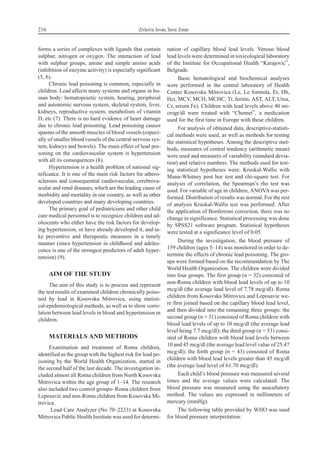
It is evident from Table 1 that gender does not af-
fect the blood pressure values, and was therefore disre-
garded from further research (recommended by WHO).
RESEARCH/INVESTIGATION
RESULTS
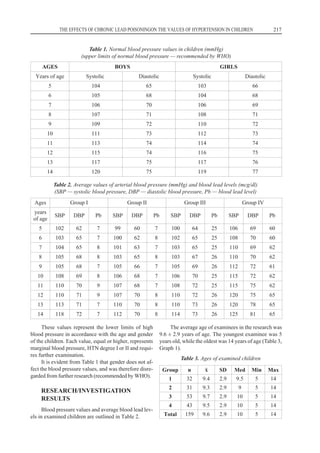
Blood pressure values and average blood lead lev-
els in examined children are outlined in Table 2.
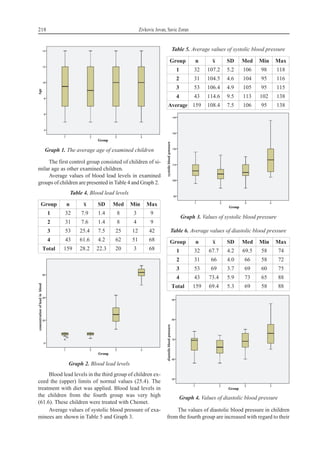
The average age of examinees in the research was
9.6 ± 2.9 years of age. The youngest examinee was 5
years old, while the oldest was 14 years of age (Table 3,
Graph 1).
Table 3. Ages of examined children
THE EFFECTS OF CHRONIC LEAD POISONINGON THE VALUES OF HYPERTENSION IN CHILDREN 217
Table 1. Normal blood pressure values in children (mmHg)
(upper limits of normal blood pressure — recommended by WHO)
AGES BOYS GIRLS
Years of age Systolic Diastolic Systolic Diastolic
5 104 65 103 66
6 105 68 104 68
7 106 70 106 69
8 107 71 108 71
9 109 72 110 72
10 111 73 112 73
11 113 74 114 74
12 115 74 116 75
13 117 75 117 76
14 120 75 119 77
Ages Group I Group II Group III Group IV
years
of age
SBP DBP Pb SBP DBP Pb SBP DBP Pb SBP DBP Pb
5 102 62 7 99 60 7 100 64 25 106 69 60
6 103 65 7 100 62 8 102 65 25 108 70 60
7 104 65 8 101 63 7 103 65 25 110 69 62
8 105 68 8 103 65 8 103 67 26 110 70 62
9 105 68 7 105 66 7 105 69 26 112 72 61
10 108 69 8 106 68 7 106 70 25 115 72 62
11 110 70 9 107 68 7 108 72 25 115 75 62
12 110 71 9 107 70 8 110 72 26 120 75 65
13 113 71 7 110 70 8 110 73 26 120 78 65
14 118 72 7 112 70 8 114 73 26 125 81 65
Table 2. Average values of arterial blood pressure (mmHg) and blood lead levels (mcg/dl)
(SBP — systolic blood pressure, DBP — diastolic blood pressure, Pb — blood lead level)
Group n x SD Med Min Max
1 32 9.4 2.9 9.5 5 14
2 31 9.3 2.9 9 5 14
3 53 9.7 2.9 10 5 14
4 43 9.5 2.9 10 5 14
Total 159 9.6 2.9 10 5 14
The first control group consisted of children of si-
milar age as other examined children.
Average values of blood lead levels in examined
groups of children are presented in Table 4 and Graph 2.
Table 4. Blood lead levels
Blood lead levels in the third group of children ex-
ceed the (upper) limits of normal values (25.4). The
treatment with diet was applied. Blood lead levels in
the children from the fourth group was very high
(61.6). These children were treated with Chemet.
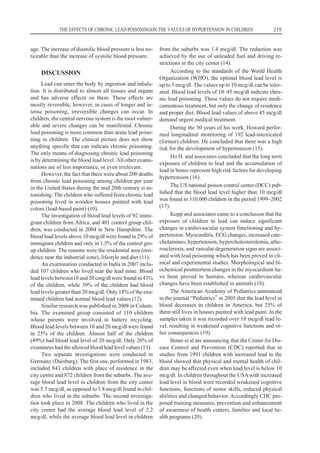
Average values of systolic blood pressure of exa-
minees are shown in Table 5 and Graph 3.
Table 5. Average values of systolic blood pressure
Table 6. Average values of diastolic blood pressure
The values of diastolic blood pressure in children
from the fourth group are increased with regard to their
218 Zivkovic Jovan, Savic Zoran
Graph 1. The average age of examined children
Group n x SD Med Min Max
1 32 7.9 1.4 8 3 9
2 31 7.6 1.4 8 4 9
3 53 25.4 7.5 25 12 42
4 43 61.6 4.2 62 51 68
Total 159 28.2 22.3 20 3 68
Graph 2. Blood lead levels
Group n x SD Med Min Max
1 32 107.2 5.2 106 98 118
2 31 104.5 4.6 104 95 116
3 53 106.4 4.9 105 95 115
4 43 114.6 9.5 113 102 138
Average 159 108.4 7.5 106 95 138
Graph 3. Values of systolic blood pressure
Group n x SD Med Min Max
1 32 67.7 4.2 69.5 58 74
2 31 66 4.0 66 58 72
3 53 69 3.7 69 60 75
4 43 73.4 5.9 73 65 88
Total 159 69.4 5.3 69 58 88
Graph 4. Values of diastolic blood pressure
age. The increase of diastolic blood pressure is less no-
ticeable than the increase of systolic blood pressure.
DISCUSSION
Lead can enter the body by ingestion and inhala-
tion. It is distributed to almost all tissues and organs
and has adverse effects on them. These effects are
mostly reversible, however, in cases of longer and in-
tense poisoning, irreversible changes can occur. In
children, the central nervous system is the most vulner-
able and severe changes can be manifested. Chronic
lead poisoning is more common than acute lead poiso-
ning in children. The clinical picture does not show
anything specific that can indicate chronic poisoning.
The only means of diagnosing chronic lead poisoning
is by determining the blood lead level. All other exami-
nations are of less importance, or even irrelevant.
However, the fact that there were about 200 deaths
from chronic lead poisoning among children per year
in the United States during the mid 20th century is as-
tonishing. The children who suffered from chronic lead
poisoning lived in wooden houses painted with lead
colors (lead-based paint) (10).
The investigation of blood lead levels of 92 immi-
grant children from Africa, and 401 control group chil-
dren, was conducted in 2004 in New Hampshire. The
blood lead levels above 10 mcg/dl were found in 29% of
immigrant children and only in 1.5% of the control gro-
up children. The reasons were the residential area (resi-
dence near the industrial zone), lifestyle and diet (11).
An examination conducted in India in 2007 inclu-
ded 107 children who lived near the lead mine. Blood
lead levels between10 and 20 cmg/dl were found in 43%
of the children, while 39% of the children had blood
lead levels greater than 20 mcg/dl. Only 18% of the exa-
mined children had normal blood lead values (12).
Similar research was published in 2008 in Colum-
bia. The examined group consisted of 110 children
whose parents were involved in battery recycling.
Blood lead levels between 10 and 20 mcg/dl were found
in 25% of the children. Almost half of the children
(49%) had blood lead level of 20 mcg/dl. Only 26% of
examinees had the allowed blood lead level values (13).
Two separate investigations were conducted in
Germany (Duisburg). The first one, performed in 1983,
included 843 children with place of residence in the
city centre and 872 children from the suburbs. The ave-
rage blood lead level in children from the city center
was 5.3 mcg/dl, as opposed to 1.8 mcg/dl found in chil-
dren who lived in the suburbs. The second investiga-
tion took place in 2008. The children who lived in the
city center had the average blood lead level of 2.2
mcg/dl, while the average blood lead level in children
from the suburbs was 1.4 mcg/dl. The reduction was
achieved by the use of unleaded fuel and driving re-
strictions in the city center (14).
According to the standards of the World Health
Organization (WHO), the optimal blood lead level is
up to 5 mcg/dl. The values up to 10 mcg/dl can be toler-
ated. Blood lead levels of 10–45 mcg/dl indicate chro-
nic lead poisoning. These values do not require medi-
camentous treatment, but only the change of residence
and proper diet. Blood lead values of above 45 mcg/dl
demand urgent medical treatment.
During the 50 years of his work, Howard perfor-
med longitudinal monitoring of 192 lead-intoxicated
(former) children. He concluded that there was a high
risk for the development of hypertension (15).
Ho H. and associates concluded that the long term
exposure of children to lead and the accumulation of
lead in bones represent high risk factors for developing
hypertension (16).
The US national poison control center (DCC) pub-
lished that the blood lead level higher than 10 mcg/dl
was found in 310.000 children in the period 1999–2002
(17).
Kopp and associates came to a conclusion that the
exposure of children to lead can induce significant
changes in cardiovascular system functioning and hy-
pertension. Myocarditis, ECG changes, increased cate-
cholamines, hypertension, hypercholesterolemia, athe-
rosclerosis, and vascular degeneration signs are associ-
ated with lead poisoning which has been proved in cli-
nical and experimental studies. Morphological and bi-
ochemical postmortem changes in the myocardium ha-
ve been proved in humans, whereas cardiovascular
changes have been established in animals (18).
The American Academy of Pediatrics announced
in the journal “Pediatrics” in 2005 that the lead level in
blood decreases in children in America, but 25% of
them still lives in houses painted with lead paint. In the
samples taken it was recorded over 10 mcg/dl lead le-
vel, resulting in weakened cognitive functions and ot-
her consequences (19).
Binns et al are announcing that the Center for Dis-
ease Control and Prevention (CDC) reported that in
studies from 1991 children with increased lead in the
blood showed that physical and mental health of chil-
dren may be affected even when lead level is below 10
mcg/dl. In children throughout the USAwith increased
lead level in blood were recorded weakened cognitive
functions, functions of motor skills, reduced physical
abilities and changed behavior. Accordingly CDC pro-
posed training measures, prevention and enhancement
of awareness of health centers, families and local he-
alth programs (20).
THE EFFECTS OF CHRONIC LEAD POISONINGON THE VALUES OF HYPERTENSION IN CHILDREN 219
Lyn Patrick amounts that even smaller amounts of
lead in the blood, over a long period of time, result in di-
sorders in cognition, neuro-behavioral disorders, neuro-
logical damages, hypertension, and kidney failure (21).
Shiring Weng et al during the six years of monitor-
ing the levels of lead in the blood in middle age people
found a significant interaction with hypertension and
increased level of serum creatinine. They conclude that
diabetes and hypertension are the consequences of sho-
rt-term and long-term exposure to lead (22).
Barbosa et al claim that there is no lower limit sa-
fety of lead level in blood. Bad influence on health, in-
cluding intellectual deterioration in young children,
occurs when the lead level is less than 10 mcg/dl (23).
By examining the blood lead levels in Roma chil-
dren who live in camps in Kosovska Mitrovica, and by
comparing the obtained results with the results of many
authors who investigated this problem, the same con-
clusion is reached: the two main risk factors for chronic
lead poisoning in children are the place of residence
and lifestyle. Primitive battery recycling has a special
significance as a risk factor for chronic lead poisoning
in children.
Our results of the blood lead levels in Roma chil-
dren show that the children from the first and second
group do not suffer from chronic lead poisoning. The
children from the third group suffer from low-intensity
chronic lead poisoning. However, chronic lead poison-
ing in children from the fourth group is of very high,
even alarming, intensity (up to 65 mcg/dl).
In the course of our research, no statistical signifi-
cance in the age of examined groups was established (F
= 2.332; DF = 3; p = 0.916).
Statistical significance was found in the level of
diastolic blood pressure among the examined groups
(chi-square = 32.028; p < 0.001), especially between
the first and the fourth group (p = 0.001), the second
and the third group (p = 0.002), the second and the fou-
rth group (p < 0.001), and finally the third and the fou-
rth group (p = 0.001). The median diastolic blood pres-
sure value is statistically significant in the fourth group
of examinees.
There is a positive correlation between the values
of blood lead levels and diastolic blood pressure (r =
0.48; p < 0.001). High blood lead level is followed by
the increase in diastolic blood pressure.
Statistical significance was established in blood
lead levels among the examined groups (chi-square =
140.2; p < 0.001). The median blood lead value is statis-
tically significant between the first and the third, the first
and fourth, the second and third, the second and the fou-
rth, and the third and the fourth group (p < 0.001).
Statistical significance was found in the level of
systolic blood pressure among the examined groups
(chi-square = 31.179; p < 0.001), especially between
the first and the fourth group (p = 0.001), the second
and the fourth group (p < 0.001) and the third and the
fourth group (p < 0.001). The median systolic blood
pressure value is statistically significant in the fourth
group of examinees. Apositive correlation between the
values of blood lead levels and systolic blood pressure
(r = 0.42; p < 0.001) has also been proven. High blood
lead level is followed by the increase in systolic blood
pressure.
CONCLUSION
There is evidence of significant lead poisoning in
Roma children who live in camps in the north region of
Kosovo and Metohija. Lead poisoning was determi-
ned by the reliable methods of measuring the blood
lead levels.
Chronic lead poisoning, especially if significant,
leads to the increase of blood pressure values, both sys-
tolic and diastolic.
The higher the blood lead levels, the greater the
effects on the blood pressure. The blood pressure valu-
es in the majority of children with high blood lead lev-
els (higher than 45 mcg/dl) required detailed examina-
tion and further observation.
Abbreviations
WHO — Word Health Organization
CDC — Center for Disease Control and Preven-
tion
Er — red blood cell (RBC)
Le — white blood cell(WBC)
Le — formula = WBC formula
Hb — hemoglobin
Hct — hematocrit
MCV — mean corpuscular volume
MCH — mean corpuscular hemoglobin
MCHC — mean corpuscular hemoglobin con-
centracion
Tr — trombocit
AST — aspartat aminotransferaza
ALT — alanin aminotransferaza
Fe — iron
Pb — lead
Cr — creatinin
HTN — high hypertension
SBP — systolic blood pressure
DBP — diastolic blood pressure
220 Zivkovic Jovan, Savic Zoran
REFERENCES
1. Aub JC, Fairhall LT, Minot AS, Reznikoff P. Lead poi-
soning. Medicine 1925; 4: 1–50.
2. Sto`ini} S, ^olakovi} B. Kardiovaskularni sindrom u
intoksikaciji olovom. Jedinstvo Pri{tina 1976: 189–93.
3. Dona A, Dourakis S, Papadimitropoulos B, Maravelias
C, Koutselinis A. Flour contamination as a source of lead intoxi-
cation. J Toxicol Clin Toxico. 1999; 37(1): 109–12.
4. Saryan LA, Zenz C. Lead and its compounds. In: Zenz
C, Dickerson OB, Horvath EP Jr, Occupational medicine. St.
Louis: Mosby, 1994: 506–41.
5. McKinney PE. Acute elvation of blood lead levels wit-
hin hours of ingestion of lead shot. J. Toxicol/Clin Toxicol.
2000; 38(4): 435–40.
6. Ellenhorn MJ, Barceloux DG. Medical Toxicology: Di-
agnosis, Treatment of Human Poisoning. Elsevier New York
1988: 1030–42.
7. Shannon M, Graef JW. Prevent and Cope with Lead Poi-
soning. Plenum Publishing 1997. Lead intoxication in children
with pervasive developmental disorders J Toxicol Clin Toxicol.
1996; 34(2): 177–81.
8. Korrick SA, Hunter DJ, Rotnitzky A, Hu H, Speizer FE.
Lead and hypertension in a sample of middle-aged women. Am
J Public Health. 1999; 89(3): 330–5.
9. Bogdanovi} R. Evropske smernice za prevenciju, dijag-
nozu i terapiju visokog krvnog pritiska kod dece i adolescenata,
Beograd: Institut za zdravstvenu za{titu majke i deteta Srbije
„Dr Vukan ^upi}“; 2010.
10. Savi} Z. Hroni~no trovanje olovom kod dece u popula-
ciji interno raseljenih Roma, magistarski rad, Kosovska Mitro-
vica; 2010.
11. Plotinsky RN, Straetemans M, Wong LY et al. Risk
factors for elevated blood lead levels among African refugee
children in New Hampshire, 2004. Environ. Res. 2008; 108(3):
404–12.
12. Vishwanath P, Prashant A, Devanand D, Nayak N,
D’souza V, Venkatesh T. Screening of school children for blood
lead levels and attempts to reduce them by nonpharmacological
means in a coastal city of India. Indian J. Med. Sci. 2008; 62(5):
185–92.
13. Hurtado CM, Gutiérrez M, Echeverry J.Clinical mani-
festation of lead levels in children exposed to automobile bat-
tery recycling process in soacha and Bogota.Biomedica. 2008;
28(1): 116–25.
14. Ranft U, Delschen T, Machtolf M, Sugiri D, Wilhelm
M..Lead concentracion in the blood of children and its association
with lead in soil and ambient air-trend between 1983–2008 in Du-
isburg. J Toxicol Environ Health A. 2008; 71(11–12): 710–15.
15. Hu H. A50-year follow-up of chilhood plumbism. Hy-
pertension, renal function and hemoglobin levels among survi-
vors. Am J Dis Child. 1991; 145(6): 681–7.
16. Hu H, Aro A, Payton M et al. The relationship of bone
and blood; ead to hypertension. The normative aging study. JA-
MA. 1996; 275(15): 1171–6.
17. Centers for Disease Control and Prevention (CDC)
Blood lead levels — United States, 1999–2002. MMWR Morb
Mortal Wkly Rep. 2005; 54: 513–6.
THE EFFECTS OF CHRONIC LEAD POISONINGON THE VALUES OF HYPERTENSION IN CHILDREN 221
Sa`etak
DEJSTVO HRONI^NOG TROVANJAOLOVOM
NAVREDNOST KRVNOG PRITISKAKOD DECE
@ivkovi} Jovan,
1
Savi} Zoran
2
1
Medicinski fakultet Univerziteta u Pri{tini, sa sedi{tem u Kosovskoj Mitrovici
2
Zdravstveni centar Kosovska Mitrovica
Uvod: Tokom projekta le~enja romske dece, iz Ko-
sovske Mitrovice, hroni~no trovanih olovom (zapo~e-
tog u drugoj polovini pro{le decenije), pra}ena je i hi-
pertenzija. Ispitivanje i le~enje je vr{eno pod patrona-
tom Svetske zdravstvene organizacije, Ministarstva
zdravlja Srbije, lokalne administracije. Cilj rada je da se
utvrdi korelacija izme|u povi{enog nivoa olova u krvi
dece i hipertenzije. Materijal i metode: nivo olova iz
kapilarne krvi je odre|ivan na aparatu Lead care ana-
lyzer. Nivo olova iz venske krvi odre|ivan je u toksiko-
lo{koj laboratoriji Instituta „Karajovi}“ u Beogradu.
Pritisak je meren standardnom metodom. Pra}ena je
tenzija kod 159-ro dece. Podeljena su u ~etiri grupe. Pr-
va grupa: ne-romska deca (n = 32) olovo u krvi do 10
mcg/dl. Druga grupa: romska deca (n = 31), olovo do 10
mcg/dl. Tre}a grupa: romska deca (n = 53) olovo u krvi
10–45 mcg/dl. ^etvrta grupa: romska deca (n = 43), olo-
vo u krvi ve}e od 45 mcg/dl, sa srednjom vredno{}u
61,6 mcg/dl. Rezultati: Postoji statisti~ki zna~ajna raz-
lika u visini sistolnog krvnog pritiska izme|u ispitivanih
grupa (hi-kvadtat = 31,179; p < 0,001). Izme|u prve (X
=107,2 mmHg) i ~etvrte grupe (X = 114,6 mmHg), dru-
ge (X = 104,5mmHg) i ~etvrte grupe, tre}e (X = 106,4
mmHg) i ~etvrte grupe. Postoji statisti~ki zna~ajna razli-
ka u visini dijastolnog krvnog pritiska izme|u grupa
(hi-kvadrat = 32,028; p <0,001). Izme|u prve(X = 67,7
mmHg) i ~etvrte grupe(X = 73,4 mmHg) druge (X = 66
mmHg) i tre}e (X = 69 mmHg) druge i ~etvrte, tre}e i
~etvrte grupe dece. Zaklju~ak: [to je ve}a vrednost
olova u krvi njegovo dejstvo na krvni pritisak je izra`e-
nije. Deca sa olovom iznad 45 mcg/dl imaju pove}ane
vrednosti krvnog pritiska i kod njih je indikovano dalje
pra}enje i detaljnije ispitivanje. Dvanaestoro dece iz ~e-
tvrte grupe ima signifikantnu hipertenziju. Ni jedno dete
nema vrednosti ozbiljne hipertenzije.
Klju~ne re~i: deca, olovo u krvi, hipertenzija.
18. Kopp SJ, Barron JT, Tow JP. Cardiovascular actions of
lead and relationship to hypertension. Environ Health Perspect.
1988; 78: 91–9.
19. American Academy of Pediatrics Committee on Envi-
ronmental Health. Lead exposure in children: prevention, detec-
tion, and management. Pediatrics. 2005; 116(4): 1036–46.
20. Binns HJ, Campbell C, Brown MJ. Interpreting and
managing blood lead levels of less than 10 microg/dL in chil-
dren and reducing childhood exposure to lead: recommendati-
ons of the Centers for Disease Control and Prevention Advisory
Committee on Childhood Lead Poisoning Prevention. Pediat-
rics. 2007; 120(5): e1285–e98.
21. Patrick L. Lead toxicity, a review of the literature. Part
1: Exposure, evaluation, and treatment. Altern Med Rev 2006;
11(1): 2–22.
22. Tsaih SW, Korrick S, Schwartz J. et al. Lead, diabetes,
hypertension, and renal function: the normative aging study. En-
viron Health Perspect 2004; 112(11): 1178–82.
23. Barbosa F Jr, Tanus-Santos J S, Gerlach R F, Parson P
J. A critical review of biomarkers used for monitoring human
exposure to lead: advantages, limitations, and future needs. En-
viron Health Perspect 2005; 113(12): 1669–74.
222 Zivkovic Jovan, Savic Zoran
Correspondence to /Autor za korespondenciju
Prof dr Jovan @ivkovi}
Donjovre`inska 10/13
18000 Ni{,
Mob. Tel.063/408-694
Email: drjovanzivkovicªgmail.com
CORRELATION BETWEEN DOMESTIC VIOLENCE
AGAINST WOMEN AND NEUROTICISM
Numanovic S. Almedina,
1
Jovicic M. Milena
2
1
International University of Novi Pazar, Novi Pazar, Serbia
2
Clinical Center Kragujevac, Psychiatric Clinic, Kragujevac, Serbia
Primljen/Received 01. 12. 2014. god. Prihva}en/Accepted 20. 12. 2014. god.
Abstract: Objective: The aim of the study was to
determine the degree of correlation between domestic
violince against women and neuroticism. Socio-demo-
graphics characzeristics were also compared.
Method: This research included 120 women from
Novi Pazar and Sjenica, 60 women who were victims
of domestic violence and 60 women who were not vio-
lence victims. The degree of neuroticism has been te-
sted with general neuroticism test.
Results: There is significant difference between
women who were violnce victims and those who were
not, on 0.05 level (with 5% risk), t = 2.112, p = 0.039.
Arithmetic mean of the degree of neuroticism of wo-
men who were violence victims is 78,89, for those who
were not is 38,69. The difference is important (about
40). There is statistically significant difference betwe-
en married and single women who were violence vic-
tims. Married examinees have higher degree of neuro-
ticism than single ones. Examinees with higher degree
of neuroticism have been suffering from domestic vio-
lence longer than those with less degree of neuroti-
cism. There is no statistically significant difference in
the the degree of neuroticism between different catego-
ries of examinees, according to the degree of profesio-
nal qualifications.
Conclusion: It remains an open question, and it is
necessary to longitudinally examine what is the role of
violence against women in the emergence neurotic and
other disorders.
Key words: violence against women, neuroticism,
neurosis.
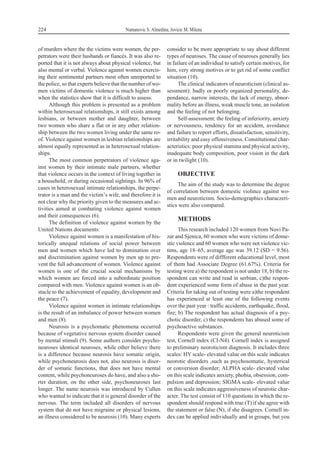
INTRODUCTION
Violence is the use of an absolute or psychological
force to another person. The violence is a pervasive
phenomenon that manifests itself in a number of forms:
physical violence, verbal abuse, domestic violence, vi-
olence against children, violence in the workplace, in-
strumental violence, actual violence, potential violen-
ce, motivated violence, etc. (1).
Domestic violence always represents an abuse of
power and the exercise of control over family members
who have less power and have less resources (2).
Domestic violence is the behaviour of a family
memeber endangering the physical integrity, mental
health or tranquility of another family member accord-
ing to Legislation on Domestic Violence in Serbia (ar-
ticle 197, pg 3) (3). Domestic violence is a term that
usually refers to violence between spouses or spousal
abuse, but it can also applies to unmarried intimate
partners or just people who live together. Domestic vi-
olence is a phenomenon that is present in all countries
and in all cultures; people of all races, ethnicities, reli-
gious, and political and sexual orientation, social and
cultural levels and genders can be perpetrators of do-
mestic violence.
The awareness of domestic violence as well as un-
derstanding and documentations of this offense vary
from country to country. It is estimated that in the Uni-
ted States and Great Britain only a third of cases of do-
mestic violence reported to the police (4).
The most common victims of domestic violence
are women and that is the reason we call it even gender
based violence. The family is a social institution with
most violence cases, except for the army during the
war. According to the UN, the leading cause of death
and disability for women between 15–45 years are not
an illness or a car accident, but the violence, and the
most dangerous place for a woman is her own home (5).
Women are often victims of their loved ones. Do-
mestic violence is the most common form of the more
general problem of violence against women, which
speak in favor of the statistics: between 40% and 70 %
UDK: 616.891-055.2; 316.624:316.356.2
2014; 9(3): 223–228 ID: 212450316
ISSN-1452-662X Stru~ni rad
of murders where the the victims were women, the per-
petrators were their husbands or fiancés. It was also re-
ported that it is not always about physical violence, but
also mental or verbal. Violence against women exercis-
ing their sentimental partners most often unreported to
the police, so that experts believe that the number of wo-
men victims of domestic violence is much higher than
when the statistics show that it is difficult to assess.
Although this problem is presented as a problem
within heterosexual relationships, it still exists among
lesbians, or between mother and daughter, between
two women who share a flat or in any other relation-
ship between the two women living under the same ro-
of. Violence against women in lesbian relationships are
almost equally represented as in heterosexual relation-
ships.
The most common perpetrators of violence aga-
inst women by their intimate male partners, whether
that violence occurs in the context of living together in
a household, or during occasional sightings. In 96% of
cases in heterosexual intimate relationships, the perpe-
trator is a man and the victim’s wife, and therefore it is
not clear why the priority given to the measures and ac-
tivities aimed at combating violence against women
and their consequences (6).
The definition of violence against women by the
United Nations documents:
Violence against women is a manifestation of his-
torically unequal relations of social power between
men and women which have led to domination over
and discrimination against women by men up to pre-
vent the full advancement of women. Violence against
women is one of the crucial social mechanisms by
which women are forced into a subordinate position
compared with men. Violence against women is an ob-
stacle to the achievement of equality, development and
the peace (7).
Violence against women in intimate relationships
is the result of an imbalance of power between women
and men (8).
Neurosis is a psychomatic phenomena occurred
because of vegetative nervous system disorder caused
by mental stimuli (9). Some authors consider psycho-
neuroses identical neuroses, while other believe there
is a difference because neurosis have somatic origin,
while psychoneurosis does not, also neurosis is disor-
der of somatic functions, that does not have mental
content, while psychoneuroses do have, and also a sho-
rter duration, on the other side, psychoneuroses last
longer. The name neurosis was introduced by Cullen
who wanted to indicate that it is general disorder of the
nervous. The term included all disorders of nervous
system that do not have migraine or physical lesions,
an illness considered to be neurosis (10). Many experts
consider to be more appropriate to say about different
types of neuroses. The cause of neuroses generally lies
in failure of an individual to satisfy certain motives, for
him, very strong motives or to get rid of some conflict
situation (10).
The clinical indicators of neuroticism (clinical as-
sessment): badly or poorly organized personality, de-
pendance, narrow interests, the lack of energy, abnor-
mality before an illness, weak muscle tone, an isolation
and the feeling of not belonging.
Self-assessment: the feeling of inferiority, anxiety
or nervousness, tendency for an accident, avoidance
and failure to report efforts, dissatisfaction, sensitivity,
irritability and easy offensiveness. Constitutional char-
acteristics: poor physical stamina and physical activity,
inadequate body composition, poor vision in the dark
or in twilight (10).
OBJECTIVE
The aim of the study was to determine the degree
of correlation between domestic violince against wo-
men and neuroticism. Socio-demographics characzeri-
stics were also compared.
METHODS
This research included 120 women from Novi Pa-
zar and Sjenica, 60 women who were victims of dome-
stic violence and 60 women who were not violence vic-
tims, age 18–65, average age was 39.12 (SD = 9.56).
Respondents were of diffferent educational level, most
of them had Associate Degree (61.67%). Criteria for
testing were a) the respondent is not under 18, b) the re-
spondent can write and read in serbian, c)the respon-
dent experienced some form of abuse in the past year.
Criteria for taking out of testing were a)the respondent
has experienced at least one of the following events
over the past year : traffic accidents, earthquake, flood,
fire; b) The respondent has actual diagnosis of a psy-
chotic disorder, c) the respondents has abused some of
psychoactive substances.
Respondents were given the general neuroticism
test, Cornell index (CI-N4). Cornell index is assigned
to preliminary neoroticism diagnosis. It includes three
scales: HY scale- elevated value on this scale indicates
neorotic disorders ,such as psychosomatic, hysterical
or conversion disorder; ALPHA scale- elevated value
on this scale indicates anxiety, phobia, obsession, com-
pulsion and depression; SIGMA scale- elevated value
on this scale indicates aggressiveness of neurotic char-
acter. The test consist of 110 questions in which the re-
spondent should respond with true (T) if she agree with
the statement or false (N), if she disagrees. Cornell in-
dex can be applied individually and in groups, but you
224 Numanovic S. Almedina, Jovicic M. Milena
can explain aforementioned scales only for individual
testing, because the results are assessed on the basis of
the total score, which is the sum of correct answers.
Retrospective study has been used. For statistical
analysis we used the methods of descriptive statistics, t
test and Spearman’s correlation coefficient. Data pro-
cessing was performed using SPSS 18.
RESULTS
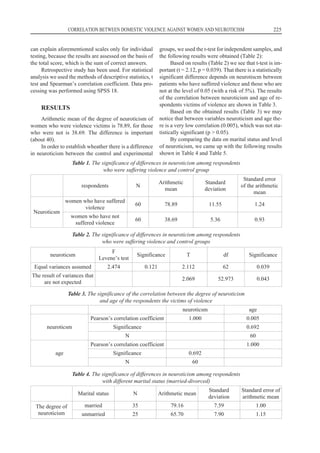
Arithmetic mean of the degree of neuroticism of
women who were violence victims is 78.89, for those
who were not is 38.69. The difference is important
(about 40).
In order to establish wheather there is a difference
in neuroticism between the control and experimental
groups, we used the t-test for independent samples, and
the following results were obtained (Table 2):
Based on results (Table 2) we see that t-test is im-
portant (t = 2.12, p = 0.039). That there is a statistically
significant difference depends on neurotiscm between
patients who have suffered violence and those who are
not at the level of 0.05 (with a risk of 5%). The results
of the correlation between neuroticism and age of re-
spondents victims of violence are shown in Table 3.
Based on the obtained results (Table 3) we may
notice that between variables neuroticism and age the-
re is a very low correlation (0.005), which was not sta-
tistically significant (p > 0.05).
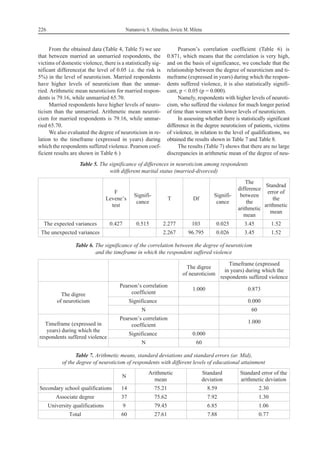
By comparing the data on marital status and level
of neuroticism, we came up with the following results
shown in Table 4 and Table 5.
CORRELATION BETWEEN DOMESTIC VIOLENCE AGAINST WOMEN AND NEUROTICISM 225
respondents N
Arithmetic
mean
Standard
deviation
Standard error
of the arithmetic
mean
Neuroticsm
women who have suffered
violence
60 78.89 11.55 1.24
women who have not
suffered violence
60 38.69 5.36 0.93
Table 1. The significance of differences in neuroticism among respondents
who were suffering violence and control group
Table 2. The significance of differences in neuroticism among respondents
who were suffering violence and control groups
neuroticsm
F
Levene’s test
Significance T df Significance
Equal variances assumed 2.474 0.121 2.112 62 0.039
The result of variances that
are not expected
2.069 52.973 0.043
Table 3. The significance of the correlation between the degree of neuroticism
and age of the respondents the victims of violence
neuroticsm age
neuroticsm
Pearson’s correlation coefficient 1.000 0.005
Significance 0.692
N 60
age
Pearson’s correlation coefficient 1.000
Significance 0.692
N 60
Table 4. The significance of differences in neuroticism among respondents
with different marital status (married-divorced)
Marital status N Arithmetic mean
Standard
deviation
Standard error of
arithmetic mean
The degree of
neuroticism
married 35 79.16 7.59 1.00
unmarried 25 65.70 7.90 1.15
From the obtained data (Table 4, Table 5) we see
that between married an unmarried respondents, the
victims of domestic violence, there is a statistically sig-
nificant difference(at the level of 0.05 i.e. the risk is
5%) in the level of neuroticism. Married respondents
have higher levels of neuroticism than the unmar-
ried. Arithmetic mean neuroticism for married respon-
dents is 79.16, while unmarried 65.70.
Married respondents have higher levels of neuro-
ticism than the unmarried. Arithmetic mean neuroti-
cism for married respondents is 79.16, while unmar-
ried 65.70.
We also evaluated the degree of neuroticism in re-
lation to the timeframe (expressed in years) during
which the respondents suffered violence. Pearson coef-
ficient results are shown in Table 6 )
Pearson’s correlation coefficient (Table 6) is
0.871, which means that the correlation is very high,
and on the basis of significance, we conclude that the
relationship between the degree of neuroticism and ti-
meframe (expressed in years) during which the respon-
dents suffered violence, it is also statistically signifi-
cant, p < 0.05 (p = 0.000).
Namely, respondents with higher levels of neuroti-
cism, who suffered the violence for much longer period
of time than women with lower levels of neuroticism.
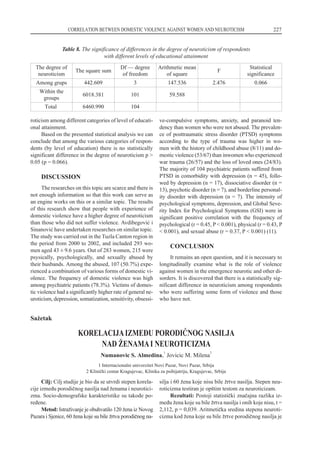
In assessing whether there is statistically significant
difference in the degree neuroticism of patients, victims
of violence, in relation to the level of qualifications, we
obtained the results shown in Table 7 and Table 8.
The results (Table 7) shows that there are no large
discrepancies in arithmetic mean of the degree of neu-
226 Numanovic S. Almedina, Jovicic M. Milena
Table 5. The significance of differences in neuroticism among respondents
with different marital status (married-divorced)
F
Levene’s
test
Signifi-
cance
T Df
Signifi-
cance
The
difference
between
the
arithmetic
mean
Standrad
error of
the
arithmetic
mean
The expected variances 0.427 0.515 2.277 103 0.025 3.45 1.52
The unexpected variances 2.267 96.795 0.026 3.45 1.52
Table 6. The significance of the correlation between the degree of neuroticism
and the timeframe in which the respondent suffered violence
The digree
of neuroticism
Timeframe (expressed
in years) during which the
respondents suffered violence
The digree
of neuroticism
Pearson’s correlation
coefficient
1.000 0.873
Significance 0.000
N 60
Timeframe (expressed in
years) during which the
respondents suffered violence
Pearson’s correlation
coefficient
1.000
Significance 0.000
N 60
Table 7. Arithmetic means, standard deviations and standard errors (ar. Mid),
of the degree of neuroticism of respondents with different levels of educational attainment
N
Arithmetic
mean
Standard
deviation
Standard error of the
arithmetic deviation
Secondary school qualifications 14 75.21 8.59 2.30
Associate degree 37 75.62 7.92 1.30
University qualifications 9 79.45 6.85 1.06
Total 60 27.61 7.88 0.77
roticism among different categories of level of educati-
onal attainment.
Based on the presented statistical analysis we can
conclude that among the various categories of respon-
dents (by level of education) there is no statistically
significant difference in the degree of neuroticism p >
0.05 (p = 0.066).
DISCUSSION
The researches on this topic are scarce and there is
not enough information so that this work can serve as
an engine works on this or a similar topic. The results
of this research show that people with experience of
domestic violence have a higher degree of neuroticism
than those who did not suffer violence. Avdibegovi} i
Sinanovi} have undertaken researches on similar topic.
The study was carried out in the Tuzla Canton region in
the period from 2000 to 2002, and included 293 wo-
men aged 43 ± 9.6 years. Out of 283 women, 215 were
psysically, psychologically, and sexually abused by
their husbands. Among the abused, 107 (50.7%) expe-
rienced a combination of various forms of domestic vi-
olence. The frequency of domestic violence was high
among psychiatric patients (78.3%). Victims of domes-
tic violence had a significantly higher rate of general ne-
uroticism, depression, somatization, sensitivity, obsessi-
ve-compulsive symptoms, anxiety, and paranoid ten-
dency than women who were not abused. The prevalen-
ce of posttraumatic stress disorder (PTSD) symptoms
according to the type of trauma was higher in wo-
men with the history of childhood abuse (8/11) and do-
mestic violence (53/67) than inwomen who experienced
war trauma (26/57) and the loss of loved ones (24/83).
The majority of 104 psychiatric patients suffered from
PTSD in comorbidity with depression (n = 45), follo-
wed by depression (n = 17), dissociative disorder (n =
13), psychotic disorder (n = 7), and borderline personal-
ity disorder with depression (n = 7). The intensity of
psychological symptoms, depression, and Global Seve-
rity Index for Psychological Symptoms (GSI) were in
significant positive correlation with the frequency of
psychological (r = 0.45, P < 0.001), physical (r = 0.43, P
< 0.001), and sexual abuse (r = 0.37, P < 0.001) (11).
CONCLUSION
It remains an open question, and it is necessary to
longitudinally examine what is the role of violence
against women in the emergence neurotic and other di-
sorders. It is discovered that there is a statistically sig-
nificant difference in neuroticism among respondents
who were suffering some form of violence and those
who have not.
CORRELATION BETWEEN DOMESTIC VIOLENCE AGAINST WOMEN AND NEUROTICISM 227
Table 8. The significance of differences in the degree of neuroticism of respondents
with different levels of educational attainment
The degree of
neuroticism
The square sum
Df — degree
of freedom
Arithmetic mean
of square
F
Statistical
significance
Among grups 442.609 3 147.536 2.476 0.066
Within the
groups
6018.381 101 59.588
Total 6460.990 104
Sa`etak
KORELACIJAIZMEU PORODI^NOG NASILJA
NAD @ENAMAI NEUROTICIZMA
Numanovic S. Almedina,
1
Jovicic M. Milena
2
1 Internacionalni univerzitet Novi Pazar, Novi Pazar, Srbija
2 Klini~ki centar Kragujevac, Klinika za psihijatriju, Kragujevac, Srbija
Cilj: Cilj studije je bio da se utvrdi stepen korela-
cije izme|u porodi~nog nasilja nad `enama i neurotici-
zma. Socio-demografske karakteristike su tako|e po-
re|ene.
Metod: Istra`ivanje je obuhvatilo 120 `ena iz Novog
Pazara i Sjenice, 60 `ena koje su bile `rtva porodi~nog na-
silja i 60 `ena koje nisu bile `rtve nasilja. Stepen neu-
roticizma testiran je op{tim testom za neuroticizam.
Rezultati: Postoji statisti~ki zna~ajna razlika iz-
me|u `ena koje su bile `rtva nasilja i onih koje nisu, t =
2,112, p = 0,039. Aritmeti~ka sredina stepena neuroti-
cizma kod `ena koje su bile `rtve porodi~nog nasilja je
REFERENCES
1. Kora} H. Kriminologija/maloletni~ko prestupni{tvo. 1.
izd. Kiseljak: Pravni fakultet; 2011.
2. Ignjatovi} T. Nasilje u porodici i institucionalna za{tita.
1. izd. Beograd: Autonomni `enski centar; 2010.
3. Slu`beni glasnik RS br. 18/2005. Beograd: JP „Slu`beni
glasnik“; 2005.
4. Tjaden P, Thoennes N. Full Report of the Prevalence, In-
cidence, and Consequences of Violence Against Women. Wash-
ington DC: National Institute of Justice and the Centers for Dis-
ease Control and Prevention; 2000.
5. Rusac S. Nasilje nad starijim osobama. Zagreb: Pravni
fakultet; 2006.
6. Posebni protokol Ministarstva zdravlja Republike Sr-
bije za za{titu i postupanje sa `enama koje su izlo`ene nasilju,
Beograd, 2011.
7. Deklaracija o eliminaciji nasilja nad `enama. Rezolu-
cija Generalne skup{tine UN 48/104. Peking, 1993.
8. Op{ti protokol o postupanju i saradnji ustanova, organa i or-
ganizacija u situacijama nasilja nad `enama u porodici i u partnerskim
odnosima. Beograd:Ministarstvo rada i socijalne politike; 2012.
9. Dimi} P J. Osnovi psihijatrije. 2. izd. Beograd:Zavod
za ud`benike i nastavna sredstva; 2000.
10. Nenadovi} M. Propedevtika psihijatrije, psihijatrijske
dijagnostike i terapije. Pri{tina: Medicinski fakultet; 2004.
11. Avdibegovi} E,Sinanovi} O. Consequences of domes-
tic violence on women’s mental health in Bosnia and Herzego-
vina. Croat Med J. 2006; 47(5): 730–41.
228 Numanovic S. Almedina, Jovicic M. Milena
78,89, a kod onih koje nisu 38,69. Postoji statisti~ki
zna~ajna razlika izme|u udatih i neudatih `ena koje su
bile `rtve nasilja, kod udatih je ve}i stepen neurotici-
zma. Ispitanici koji su imali ve}i stepen neuroticizma
su du`i vremenski period patili od onih sa ni`im stepe-
nom neuroticizma, razlika je statisti~ki zna~ajna. Ne
postoji statisti~ki zna~ajna razlika u stepenu neurotici-
zma me|u ispitanicima u odnosu na stru~nu i profesio-
nalnu kvalifikaciju.
Zaklju~ak: Ovo ostaje otvoreno pitanje, i potreb-
no je dalje ispitati kakva je uloga nasilja nad `enama u
nastanku neuroti~nog i drugih poreme}aja.
Klju~ne re~i: nasilje nad `enama, neuroticizam,
neuroza.
Correspondence to /Autor za korespondenciju
Almedina [. Numanovi}
ul. Vehba Kola{inca, 14
069 62 62 32
Internacionalni Univerzitet u Novom Pazaru
Milena M. Jovi~i}
Ul. Dragoljub Milovanovi} Bene
064 3848877
KC Kragujevac, Psihijatrijska klinika
EARLY DIAGNOSIS OF CRANIOSYNOSTOSIS IN INFANTS
AT PRIMARY HEALTH CARE
Skoric Jasmina
Children and Youth Health Care Center “Simo Miloseviæ”, Belgrade, Serbia
Primljen/Received 07. 09. 2014. god. Prihva}en/Accepted 07. 10. 2014. god.
Abstract: Craniosynostosis or premature fusion of
one or more cranial sutures in infants disturbs normal
brain growth. This condition causes abnormal skull
configuration, increased intracranial pressure, headac-
he, strabismus, blurred vision, blindness, psychomotor
retardation. The diagnosis of craniosynostosis is very
simple. Pediatricians should routinely assess neurolog-
ical status and measure head circumference and anteri-
or fontanelle. When necessary, ultrasound of CNS,
X-ray and cranial CT scan can be done. When it comes
to this condition, early diagnosis and surgical interven-
tion are of utmost importance. In this paper, we have
presented a case on craniosynostosis in a female infant,
discovered in the third month of life during systematic
review that included measurement of head circumfer-
ence, palpation of anterior fontanelle and cranial sutu-
res. The child was referred to a neurosurgeon who per-
formed the CT scan of endocranium and confirmed the
initial diagnosis of craniosynostosis. With head cir-
cumference of 40 cm and fused anterior fontanelle, the
surgery was timely performed at the sixth month of life
due to early diagnosis.
Key words: premature closure of cranial sutures,
infants, early diagnosis, surgical treatment.
INTRODUCTION
Craniosynostosis or premature fusion of cranial
sutures in the infant period is a serious condition that
disrupts brain growth and development due to limited
endocranium (1). Clinical features depend on the num-
ber of fused sutures and duration of the disorder in que-
stion. Symptoms occur as a result of pressure on the
brain tissue. The most common type of craniosynosto-
sis represents the fusion of one suture, that is, the sagit-
tal one (2). Craniosynostosis may be primary, i.e., pres-
ent at birth or in the first months of life, and secondary
which is more frequent, whereby it arises as a part of
numerous other syndromes (3).
Clinical findings include an abnormal skull confi-
guration, reduced head circumference with fused ante-
rior fontanelle or fontanelle with reduced dimensions,
increased intracranial pressure, impaired vision or
blindness due to pressure on the optic nerve, psycho-
motor development delay, whereas epileptic seizures
and other disorders are rarely identified (4).
CASE PRESENTATION
The patient is a full term female infant, born on
March the 6
th
, 2013, to mother who had not been preg-
nant before. The pregnancy was normal and supervi-
sed. Normal childbirth, BM of 2950 g, BL of 49 cm,
head circumference of 33 cm (above third length per-
centile for her age class and sex) Apgar score 9. Family
anamnesis is normal.
At the first systematic review on the ninth day of li-
fe, a spontaneously resolving mild degree of jaundice
was noted, whereas the other findings were normal. At
the second systematic review (2 months and 12 days of
age), protrusion of the forehead in the midline, overlap-
ping parietal bones, dimensions of anterior fontanelle
1 x 0.5 cm, folds in the occipital region of the scalp, head
circumference of 36.5 cm (third length percentile) were
identified. Neurological status was normal. Child was li-
vely and attentive with no signs of psychomotor devel-
opment delay. Other findings were normal.
The child was referred to a neurologist and neuro-
surgeon under the suspicion of craniosynostosis. CT
revealed fusion of both lambdoid sutures with overlap-
ping parietal and occipital bones. Brain parenchyma
was of the proper volume and density with no focal
changes. Subarachnoid space was very constricted in
the occipital region. The head had occipital flattening.
On the basis of clinical findings and CT scan results,
the child was diagnosed with Craniosynostosis and re-
ferred to surgical treatment.
UDK: 616.714-007.2-053.31
2014; 9(3): 229–231 ID: 212447756
ISSN-1452-662X Prikaz slu~aja
With the upcoming surgery, at the age of 4 months
and 16 days, the attending pediatrician performed an
examination. Neurological status was normal and the
head circumference was 37.5 cm, which is below the
third length percentile for her age class and sex.
After the sixth month of life, the following sur-
gery was performed: Suturectomia suturae lamdoideae
billateralis. The child was admitted to the hospital with
fused anterior fontanelle and head circumference of 40
cm which is below the third length percentile. The po-
stoperative course was uneventful and the child was
discharged home in good general condition. Apediatri-
cian performed four more check-ups at the Health Care
Center. At the age of seven months, the head circumfe-
rence was 40.5 cm, at the age of eight months was 41
cm, at the age of 10 months was 42 cm, at the age of 11
months was 42 cm, still below the third length percen-
tile for her age class and sex — see percentile growth
curve of the head (Figure 1). Neurological status and
psychomotor development of the child were within
normal limits for the whole time. Child was being ta-
ken to regular check-ups with the neurosurgeon.
DISCUSSION
Clinical features of craniosynostosis with the fu-
sion of one suture, and especially with the fusion of
multiple cranial sutures, are very serious and therefore
pediatricians should strive for early diagnosis. Treat-
ment depends on the timing of the diagnosis and which
sutures are involved. While the timing of surgery is
controversial, most doctors prefer to do surgery when
the child is 3–6 months old. Older children (12–18
months) with a very mild deformity will probably not
need surgery, while younger children with an obvious
deformity that is moderate to severe will probably ben-
efit from early surgery (5, 6). In my opinion, the diag-
nosis can be easily set at the level of primary health ca-
re during regular medical examinations within the first
months of life, or up to one year at the latest. Ultraso-
und of CNS as a part of prenatal diagnostics enables us
to examine the condition of cranial sutures, fontanelles
and brain structures at the stage of intrauterine life (7,
8). As for postnatal diagnostics, regular measurement
of head circumference and dimensions of anterior fon-
tanelle, as well as palpation of the cranial sutures are
simple diagnostic procedures. If the anterior fontanelle
is still open, it would be advisable to perform an ultra-
sound of CNS due to increased intracranial pressure
(9). Since changes in the retina might occur, it is desira-
ble to do ophthalmologic examination, and possibly
ENT screening (10). And finally, skull X-ray can be
performed if necessary, as well as the CT scan of en-
docranium, as it was done in the case presented.
Although the head circumference is still below the
third percentile for her age class and sex, there is an in-
crease in head circumference by 3 cm, with the expec-
tation of reaching its full size in time (Figure 2).
CONCLUSION
On the basis of the case presented, we may come to
a conclusion that regular health pediatric examination is
one of the key components in detecting anomalies such
as craniosynostosis. In this case, the condition was diag-
nosed at the primary health care on the basis of clinical
and physical findings, and was confirmed by additional
testing such as the CT scan at the level of secondary he-
alth care. The time of diagnosis, in this case the third
month of life, and early surgical procedure are of utmost
importance, seeing how the anomaly is quite alarming,
particularly when it comes to multiple cranial fusion.
Abbreviations
CT — computerized tomography
BM — body mass
BL — body length
CNS — Central Nervous System
P3 — third percentile
ENT — Otolaryngology
230 Skoric Jasmina
Figure 1. Infant’s Head Circumference for Age
Percentile Growth Chart
Figure 2. Head circumference growth per months
REFERENCES
1. Behrman RE, Kliegman RM, Jenson HB, Nelson text-
book of pediatrics. 17
th
ed. St. Louis, Mo: WB Saunders; 2004:
1992–1993.
2. Slater BJ, Lenton KA, Kwan MD, Gupta DM, Wan DC,
Longaker MT. Cranial Sutures: A Brief Review. Plast Reconstr.
Surg. 2008; 121(4): 170–8.
3. Cole P, Kaufman Y, Hollier L. Bifid Nose with Cleft
Hand Deformity: Syndromic Association or Undescribed Ano-
maly?. J Craniofac Surg. 2008; 19(6): 1594–6.
4. Patel A, Terner J, Travieso R, Clune JE, Steinbacher D,
Persing JA. On Bernard Sarnat’s 100
th
birthday: Pathology and
Management of Craniosynostosis. J Craniofac Surg. 2012;
23(1): 105–12.
5. Bristol RE, Lekovic GP, Rekate HL. The Effects of
Cranyiosinostosis on the Brain with Respect to Intracranial
Pressure. Semin Pediatr. Neurol. 2004; 11 (4): 262–7.
6. Cunningham ML, Heike CL. Evaluation of the Infant with
anAbnormalSkullShape. CurrOpinPediatr. 2007;19(6):645–51.
7. Lenton KA, Nacamuli RP, Wan DC, Helms JA, Longaker
MT. CranialSutureBiology. CurrTopDevBiol. 2005;66:287–328.
8. Lattanzi W, Bukvic N, Barba M, et al. Genetic Basis of
Single-suture Synostosis: genes, chromosomes, and clinical im-
plications. Child’s Nerv Syst. 2012; 28(9): 1301–10.
9. Rice DP. Clinical Features of Syndromic Craniosyno-
stosis. Front Oral Biol 2008; 12: 91–106.
10. Wiegant C, Richards P. Measurement of Intracranial
Pressure in Children: A Critical Review of Current Methods.
Dev Med Child Neurol. 2007; 49 (12): 935–41.
EARLY DIAGNOSIS OF CRANIOSYNOSTOSIS IN INFANTS AT PRIMARY HEALTH CARE 231
Sa`etak
RANADIJAGNOSTIKAKRANIOSINOSTOZE KOD ODOJ^ADI
U PRIMARNOJ ZDRAVSTVENOJ ZA[TITI
Skoric Jasmina
Dom zdravlja „Simo Milo{evi}“, Slu`ba za zdravstvenu za{titu dece i omladine ^ukarica, Beograd, Srbija
Kraniosinostoza ili prevremeno zatvaranje lo-
banjskih sutura kod odoj~adi remeti normalan rast mo-
zga. Ova anomalija uzrokuje abnormalnu konfiguraci-
ju glave, povi{eni intrakranijalni pritisak, glavobolje,
strabizam, poreme}aj vida, zastoj u psihomotornom
razvoju. Dijagnostikovati kraniosinostozu je veoma
jednostavno. Pedijatri bi trebalo rutinski da sprovode
kontrole obima glave, neurolo{kog statusa, kao i mere-
nje prednje fontanele. Ako je potrebno, tako|e se mo`e
uraditi ultrazvuk CNS-a, rendgen snimak, kao i CT lo-
banje. Rana dijagnoza i hirur{ka intervencija su u
ovom slu~aju od najve}e va`nosti. Prikazan je slu~aj
kraniosinostoze kod `enskog odoj~eta koja je otkivena
u tre}em mesecu `ivota u toku sistematskog pregleda,
merenjem obima glave, palpiranjem velike fontanele i
lobanjskih {avova. Dete je upu}eno na hospitalizaciju
sa uputnom dijagnozom kraniosinostoza, koja je potvr-
|ena pregledom od strane neurohirurga i CT-om endo-
kranijuma. Zahvaljuju}i blagovremenoj dijagnozi,
ura|ena je operacija sa navr{enih {est meseci `ivota
deteta, sa obimom glave (OG) od 40 cm i zatvorenom
velikom fontanelom.
Klju~ne re~i: prevremeno zatvaranje lobanjskih
sutura, odoj~e, rana dijagnoza, hirur{ka terapija.
Correspondence to /Autor za korespondenciju
Jasmina [kori}, MD
Address: Poru~nika Spasi}a i Ma{ere 53. Belgrade 11000
Phone No: +381637128664
COCAINE CARDIOMYOPATHY — ACASE REPORT
Georgiev Antonio,
1
Zhivadinovik Julija
2
1
University Clinic for Cardiology, Medical Faculty, Skopje, University “Ss. Cyril and Metodius”, R. Macedonia
2
Institute of Anatomy, Medical Faculty, Skopje, University “Ss. Cyril and Metodius”, R. Macedonia
Primljen/Received 05. 08. 2014. god. Prihva}en/Accepted 15. 11. 2014. god.
Abstract: Cocaine is the second most common il-
licit drug used and the most frequent cause of drug re-
lated deaths. The use of cocaine is associated with
both, acute and chronic complications, that may invol-
ve any system, but the most common system affected is
cardiovascular one. Cocaine cardiomyopathy may re-
sult from the use of cocaine.
This article presents a first case in Republic of
Macedonia of 24-year-old male with reversible cocai-
ne-related cardiomyopathy. Clinical presentation, lab-
oratory, X-ray, ultrasound findings and treatment are
reviewed.
Key words: cocaine, cocaine cardiomyopathy, di-
agnosis, treatment.
INTRODUCTION
Cocaine is the second most common illicit drug
used and the most frequent cause of drug related de-
aths. In a retrospective of European study of 479 ACS
patients younger than 50 years admitted to a critical ca-
re unit from 2001 to 2008, a total of 24 patients (5%)
had admitted to recent cocaine abuse or tested positive
on urine drug screening (1). In 2005, 2.4 million per-
sons were actively using cocaine. The younger age
groups of 18–25 are the most common users and it is
estimated that 11% of the population has used it at so-
me point (2). The 2008 National Survey on Drug Use
and Health reported that approximately 36.8 million
Americans aged 12 years and older (14.7% of Ameri-
cans in that age group) had tried cocaine at least once
(3). The trade with this illicit drug in Republic of Mac-
edonia is prosecuted by law. Yet there are people who
use this drug and have complications from it.
Cocaine acts as a powerful sympathomimetic
agent. It blocks the presynaptic reuptake of norepinep-
hrine and dopamine producing high level of these neu-
rotransmitters at the postsynaptic receptors. It also may
increase the release of catecholamines from central and
peripheral stores. The sympathomimetic actions of co-
caine, at cellular level, are mediated by stimulation of
thea andb adrenergic receptors. Cocaine also interacts
with the muscarinic receptors, and inhibits the reuptake
of dopamine and seretonin by nerve endings (1).
Cocaine intoxication usually presents with symp-
toms of adrenergic excess. Hypertension, occasionally
in the range of hypertensive crisis, may be present. Ce-
rebral vascular accidents of either thrombotic or hemo-
rrhagic origin are not uncommon. Acute delirium and
mania may be present, particularly if other drugs were
used concurrently (2).
The use of cocaine is associated with both acute
and chronic complications that may involve any sys-
tem, but the most common system affected is cardiova-
scular one (2–6). Cocain related complications inclu-
de: cardiac (myocardial ischaemia, coronary artery
spasm, myocardial infarction (MI), atherosclerosis,
myocarditis, cardiomyopathy, arrhythmia, hyperten-
sion, and endocarditis); vascular (aortic dissection and
rupture, vasculitis); gastrointestinal (mesenteric ischa-
emia or infarction, perforation); pulmonary (pulmo-
nary oedema, pulmonary infarction, and haemoptysis);
genitourinary and obstetric (renal and testicular infarc-
tion, abruptio placentae, spontaneous abortion, prema-
turity, and growth retardation); neurological (seizures,
migraine, cerebral infarction, and intracranial hemorr-
hage); musculoskeletal and dermatological (rhab-
domyolysis, skin ischemia, superficial and deep veno-
us thrombosis, and thrombophlebitis (2–6).
CASE REPORT
We present a case of a twenty four years old male,
with a history of inhaling vaporized cocaine, and mari-
huana for two years. The main complaints of patient
were fatigue, labored respiration, especially at night,
dyspnea, anxiety, increased heart rate and lost of appe-
tite during last 2–3 months. The patient was conscious,
UDK: 616.127-056.83(497.7); 613.83:616.127
2014; 9(3): 233–237 ID: 212446732
ISSN-1452-662X Prikaz slu~aja
anxious, oriented to time, space and persons. Heart so-
unds were clear with systolic murmur. The ECG sho-
wed sinus tachycardia (HR > 100/min) (Figure 1) and
about 0,5 mm upsloping ST segment depression in lat-
eral leads. Blood pressure was elevated (150/105
mmHg). Laboratory analysis showed elevation of
blood Urea (10.6 mmol/L), Creatinine (154 mmol/L),
Na (149 mEq/L), K (4.2 mEq/L) and iron-deficiency
anemia with Fe (7.1 mcg/dl). X-ray findings obtained
enlarged heart silhouette (Figure 2). Echocardiograp-
hic evaluation showed left chamber dilatation with re-
duced global systolic function and ejection fraction
(EF) 38%, designated mitral cusps with posterior cusp
prolapsed, thin regurgitated flow and intraatrial septum
tissue changes.
Preceding therapy Carvedilol and Acetylsalicylic
acid was changed to heart failure — guideline-based
heart failure therapy: Carvedilol, nonselective alfa/be-
ta — adrenergic blocker (2 x 6,25 mg per day), Perin-
dopril, ACE inhibitor (4 mg per day), Spironolactone,
mineral corticoid receptor antagonist, MRA(25 mg per
day), Thiazide diuretic (25 mg per day) and Acetylsa-
licylic acid (100 mg per day). Therapy for correction of
anemic syndrome was recommended. Cocaine cessa-
tion was obligated.
Two months later, after cocaine cessation and tre-
atment in specialized hospital, the patient didn’t fill the
symptoms from the first examination, but he was at bad
physical condition. Laboratory findings were normali-
zed: Urea 7.6 mmol/L; Creatinin 108 mmol/L; Na 139
mEq/L; K 4.2 mEq/L and Fe 16.2 mcg/dl. EKG sho-
wed sinus rhythm with HR 65/min. Blood pressure was
120/80 mm Hg. Dimensions of left ventricle were in
referent values. Left ventricle function was slightly re-
duced with EF 49%, mitral cusps were designated with
posterior cusp prolapsed and intraatrial septum tissue
changes. The patient continued with the same therapy.
The patient abstained from cocaine use and five
months later he didn’t fill any of the symptoms from
the first examination, and he was in good physical con-
dition. Laboratory findings were in the ranges of refer-
ent values. Left and right ventricles function and di-
mensions were preserved. Left ventricle EF was 62%.
The patient continued with medications: Nebivolol,
cardioselectiveb1 — receptor blocker (2,5 mg per day)
and Acetylsalicylic acid (100 mg per day).
DISCUSSION
Cocaine users may have various symptoms refera-
ble to the cardiac system. Symptoms can include chest
pain with or without myocardial ischemia or aortic dis-
section, hypertension with or without hypertensive cri-
sis, cerebral ischemia, and hemorrhage. Patients also
may present with acute myocardial decompensation
with or without pulmonary edema and shock. In this
case, shortness of breath and hypoperfusion dominate
the clinical picture (1, 6, 7, 8).
Morbidity and mortality information associated
with cocaine-related cardiomyopathy is commonly ba-
sed on case reports (9, 10). Chokshi et al. were among
the first authors to describe a reversible cocaine-related
cardiomyopathy. The patient in their report, a 35-year-old
woman, underwent endomyocardial biopsy that failed
to reveal any necrosis, fibrosis, or inflammatory infil-
trate (9).
While most cases of cocaine-related cardiomyo-
pathy have proved to be reversible, others have resul-
ted in permanent cardiac dysfunction or death. The
symptoms of cocaine-related cardiomyopathy are the
same as symptoms for other forms of congestive heart
failure. The onset may be very sudden and of short du-
ration. A cocaine-related etiology for cardiomyopathy
should be suspected in any patient with a history of co-
caine use, particularly binge use, and heart failure, wit-
234 Georgiev Antonio, Zhivadinovik Julija
Figure 1. ECG findings
Figure 2. X-ray findings of enlarged heart silhouette
hout another established etiology for the heart failure,
such as coronary artery disease. If the clinical suspi-
cion is high, the diagnosis of cocaine use should be in-
vestigated with a urine screen for cocaine and its meta-
bolites. The typical patient with cocaine cardiomyopathy
is a young male smoker who presents with signs of
adrenergic excess (5, 10). With acute binge use of co-
caine, the patient may present with acute congestive
heart failure and pulmonary edema. Hypotension, rat-
er than hypertension, may predominate, making the
diagnosis and treatment more difficult. Cocaine-rela-
ted cardiomyopathy presents more acutely than other
types of congestive heart failure, and fewer findings of
chronic congestive heart failure are present. Otherwi-
se, the physical findings are similar. Diaphoresis, pal-
lor, and acute dyspnea are present. Cardiogenic shock
or evidence of cardiac ischemia also may be present.
The laboratory investigation of cardiomyopathy
of any etiology generally shows abnormalities of elec-
trolytes, usually anemia and compromised renal func-
tion, with elevation of blood urea nitrogen (BUN) and
creatinine.
Cocaine usually is evident on a urine toxicology
screen, because these cases almost always present im-
mediately after use of the drug. Because individuals
who use cocaine are predisposed to the development of
endocarditis, consider blood cultures if the setting is at
all appropriate.
In cases of cardiomyopathy, the chest radiograph
usually shows evidence of cardiomegaly and congesti-
ve heart failure. Evidence of septic emboli may be pre-
sent if endocarditis is present. The radiograph may be
normal in many cases.
Echocardiographic evaluation shows chamber di-
lation and global dysfunction or regional wall motion
abnormalities if myocardial infarction is present. Ec-
hocardiographic studies have shown that individuals
who abuse cocaine have an increased left ventricular
mass index with a higher tendency toward increased
posterior wall thickness.
Cardiac catheterization usually shows normal cor-
onary arteries or only minimal disease, even in the pre-
sence of myocardial infarction.
In cases of cardiomyopathy, the ECG is not speci-
fic but may show evidence of left ventricular hypertro-
phy and nonspecific ST-T wave changes. Arrhythmias
also may be detected, and continuous monitoring may
be advisable.
In autopsies of 40 patients, 31 of whom died coca-
ine-related deaths and 9 of whom were homicide vic-
tims with detectable blood cocaine levels, Virmani et
al. found that 20% of the patients showed evidence of
myocarditis on toxic screening tests (11). Tazelaar, in
an autopsy study, reported contraction-based myocar-
dial necrosis similar to that observed in pheochro-
mocytoma (12).
In a case report by Robledo-Carmona, histologic
findings of the left ventricular myocardium included
sparse mononuclear infiltrates associated with degene-
rative changes, myocyte necrosis, and severe intersti-
tial fibrosis (13).
Management
Associations of cardiologists don’t have recom-
mendations for concrete medicamentous treatment of
cocaine cardiomyopathy (1). Management of these pa-
tients is similar to that of patients with other forms of
dilated cardiomyopathy, although beta-blockers sho-
uld be included in patients with cocaine-associated he-
art failure and benzodiazepines should be given in this
setting to blunt adrenergic excess. If shock is present,
inotropic agents and vasopressors are indicated. If evi-
dence of ongoing ischemia is present, aggressive use of
agents directed at relieving vasospasm (nitrates and
calcium channel blocking drugs) are indicated. Endo-
tracheal intubation may be necessary. If arrhythmias
are present and are felt to be compromising the clinical
situation, they should be treated aggressively. The use
of beta-blocking drugs as single agents is contraindica-
ted. For the purpose of these patients need to know and
be used in medical practice cardiac magnetic resonan-
ce as a method that is quite useful for predicts reversi-
bility of cocaine-induced ventricular dysfunction (1,
14, 15, 16).
John McMurray et al. ESC Guidelines for the di-
agnosis and treatment of acute and chronic heart failure
2012 (17) recommend the following therapy:
An ACE inhibitor in addition to the beta-blocker
is used for all patients with an EF £ 40% to reduce the
risk of heart failure hospitalization and the risk of pre-
mature death. A beta-blocker in addition to an ACE in-
hibitor is used for all patient with an EF £ 40 % to redu-
ce the risk of heart failure, hospitalization and the risk
of premature death. An MRA is recommended for all
patients with persisting symptoms and EF < 35%, de-
spite treatment with ACE inhibitor and a beta-blocker
to reduce the risk of heart failure hospitalization and
the risk of premature death. It is good to mention that
analysis of B-type natriuretic peptide (BNP) level can
help monitor the presence of congestive heart failure.
Also BNP is very helpful to monitor response to treat-
ment.
In most of reported cases of cocaine-related cardi-
omyopathy, patients have shown significant improve-
ment following the cessation of cocaine use. In some
cases, patients have returned to normal cardiac func-
COCAINE CARDIOMYOPATHY — A CASE REPORT 235
tion, but recurrence is reported if the patient relapses
into cocaine use (5).
Efforts to assist the patient with their drug addic-
tion should be a part of every treatment plan. Hospitali-
zation for detoxification may be necessary, particularly
if other drugs also are being abused. Outpatient treat-
ment of drug dependence is strongly advised. Absti-
nence from cocaine use and long time follow up is
mandatory.
CONCLUSION
This is the first publication of cocaine-related car-
diomyopathy in our country. Physicians usually don’t
consider the possibility of cocaine use of their patients.
Many cocaine users have little or no idea of the risks
associated with its use. So, patients, health care work-
ers and the public should be educated about the dan-
gers and the considerable risks of cocaine use.
Abbreviations
ACE — Angiotensin converting enzyme
BNP — Natriuretic peptide
BUN — Blood urea nitrogen
ECG — Electrocardiography
EF — Ejection fraction
ESC — European Society of Cardiology
HR — Heart rate
MI — Myocardial infarction
MRA — Mineral corticoid receptor antagonist
ST — ECG between the end of the S wave (the J
point) and the beginning of the T wave
236 Georgiev Antonio, Zhivadinovik Julija
Sa`etak
KOKAINSKAKARDIOMIOPATIJA— PRIKAZ SLU^AJA
Georgiev Antonio,
1
Zhivadinovik Julija
2
1
Univerzitetska Klinika za kardiologiju, Univerzitet „Sv. ]irilo i Metodije“, Medicinski fakultet, Skoplje, R. Makedonija
2
Institut za anatomiju, Univerzitet „Sv. ]irilo i Metodije“, Medicinski fakultet, Skoplje, R. Makedonija
Kokain je druga naj~e{}a nezakonita droga koja
se koristi i naj~e{}i uzrok smrti zbog droge. Upotreba
kokaina daje akutne i hroni~ne komplikacije, koje
mogu uklju~ivati bilo koji sistem organa, naj~e{}e
kardiovaskularni sistem. Kardiomiopatija mo`e biti
izazvana konzumiranjem kokaina. Ovaj ~lanak pred-
stavlja slu~aj dvadeset~etvorogodi{njeg mu{karca s
reverzibilnom kokainskom kardiomiopatijom, {to
predstavlja prvi takav u Republici Makedoniji. Nalazi
klini~kog pregleda, laboratorijskih analiza, rendgen-
grafije srca i plu}a, ultrazvuka srca i tretman su prika-
zani.
Klju~ne re~i: kokain, kokainska kardiomiopatija,
dijagnoza, le~enje.
References
1. Finkel JB, Marhefka GD. Rethinking cocaine-associa-
ted chest pain and acute coronary syndromes. Mayo Clin Proc.
2011; 86(12): 1198–207.
2. Egred M, Davis GK. Cocaine and the heart. Postgrad
Med J. 2005; 81(959): 568–71.
3. SAMHSA— Substance abuse and mental health service
administration. Sharp decline also continues for methampheta-
mine use. US Department of Health and Human Services
(DHS); Office of Applied Studies Results from the 2008 Natio-
nal Survey on Drug Use and Health: National Findings.
http://oas.samhsa.gov/nsduh/2k8nsduh/2k8Results.cfm. 2009.
4. Phillips K, Luk A, Soor GS, Abraham JR, Leong S, Bu-
tany J. Cocaine cardiotoxicity: a review of the pathophysiology,
pathology, and treatment options. Am J Cardiovasc Drugs.
2009; 9(3): 177–96.
5. Schwartz BG, Rezkalla S, Kloner RA. Cardiovascular
effects of cocaine. Circulation. 2010; 122(24): 2558–69.
6. Awtry EH, Philippides GJ. Alcoholic and cocaine-asso-
ciated cardiomyopathies. Prog Cardiovasc Dis. 2010; 52(4):
289–99.
7. Freeman K, Feldman JA. Cocaine, myocardial infarc-
tion, and b-blockers: time to rethink the equation? Ann Emerg
Med. 2008; 51(2): 130–4.
8. Bhargava S, Arora RR. Cocaine and cardiovascular
complications. Am J Ther. 2011; 18(4): e95–e100.
9. Velasquez EM, Anand RC, Newman WP 3rd, Richard
SS, Glancy DL. Cardiovascular complications associated with
cocaine use. J La State Med Soc. 2004; 156(6): 302–10.
10. Chokshi SK, Moore R, Pandian NG, Isner JM. Revers-
ible cardiomyopathy associated with cocaine intoxication. Ann
Intern Med. 1989; 111(12): 1039–40.
11. Virmani R, Robinowitz M, Smialek JE, Smyth DF.
Cardiovascular effects of cocaine: an autopsy study of 40 pati-
ents. Am Heart J. 1989; 115(5): 1068–76.
12. Tazelaar HD, Karch SB, Stephens BG, Billingham
ME. Cocaine and the heart. Hum Pathol. 1987; 18(2): 195–9.
13. Robledo-Carmona J, Ortega-Jimenez MV, Garcia-Pi-
nilla JM, Cabra B, de Teresa E. Severe Cardiomyopathy Associ-
ated to Cocaine Abuse. Int J Cardiol. 2006; 112(1): 130–1.
14. Rangel C, Shu RG, Lazar LD, Vittinghoff E, Hsue PY,
Marcus GM. Beta-blockers for chest pain associated with recent
cocaine use. Arch Intern Med 2010; 170(10): 874–9.
Correspondence to /Autor za korespondenciju
Georgiev Antonio
University Clinic for Cardiology
Vodnjanska bb
1000 Skopje, Republic of Macedonia
e-mail: antoniogeorgievªyahoo.com
tel: 0038970 305114
COCAINE CARDIOMYOPATHY — A CASE REPORT 237
15. Littmann L, Narveson SY, Fesel MN, Marconi SL. Be-
ta blocker treatment of heart failure patients with ongoing cocai-
ne use. Int J Cardiol. 2013; 168(3): 2919–20.
16. Smedema JP. Cardiac magnetic resonance predicts re-
versibility of cocaine-induced ventricular dysfunction. Cardio-
vasc J Afr. 2009; 20(3): 198–9.
17. McMurray JJ, Adamopoulos S, Anker SD, Auricchio
A, Bohm M, Dickstein K, et al. ESC Guidelines for the diagno-
sis and treatment of acute and chronic heart failure 2012: The
Task Force for the Diagnosis and Treatment of Acute and Chro-
nic Heart Failure 2012 of the European Society of Cardiology.
Developed in collaboration with the Heart Failure Association
(HFA) of the ESC. Eur Heart J. 2012; 33(14): 1787–847.
SENTINELLYMPH NODE CONCEPT IN DIFFERENTIATED
THYROID CANCER
Markovic Ivan, Dzodic Radan
Medical faculty University of Belgrade, Institute of oncology and radiology of Serbia, Belgrade, Serbia
Primljen/Received 15. 11. 2014. god. Prihva}en/Accepted 15. 12. 2014. god.
Abstract: Introduction: Differentiated thyroid car-
cinoma (DTC) account up to 90% of all thyroid malig-
nacies, and represents the most common malignant
tumors of endocrine system. The incidence of papil-
lary thyroid carcinoma (PTC), especially small tu-
mors is rapidly increasing during past three decades.
At the time of diagnosis, the incidence of lymph node
metastases (LNM) ranges from 80 to 90%. During the
last 15 years, LNM were recognized as bad prognos-
tic factor for both local-regional relapse (LRR) and
cancer specific survival. There is general agreement
that neck dissections are indicated in cases of clini-
cally apparent LNM. The subject of the current con-
troversy is the surgical treatment of occult LNM that
remain unrecognized on preoperative diagnosis (cN0).
The extent of operations of the lymph nodes ranges
from “wait and see” so-called “Western school” princi-
ple substantiated the role of applying ablative I131the-
rapy and frequency peroperative complications (recur-
rent laryngeal nerve injury and hypoparathyroidism),
especially for less experienced teams to mutual pro-
phylactic dissection of the central and lateral com-
partments so-called “Japanese school” due to the lim-
ited use of radioactive iodine therapy and signifi-
cantly lower operating morbidity if dissetion was do-
ne during primary operation. Despite high prevalence
of occult LNM, existing controversies regarding di-
agnosis, longterm prognostic impact and extent of
lymph node surgery, motivated some authors to apply
consept of sentinel lymph node biopsy (SLNb) in
DTC, taking into account excellent results of SLN
concept in breast cancer and skin melanoma. This re-
view presents the summarized results of relevant stu-
dies and three meta-analysis of accuracy and applica-
bility of SLN concept in patients with differentiated
thyroid carcinoma.
Key words: Differentiated thyroid cancer, lymph
node mestastases, sentinel lymph nodes.
INTRODUCTION
Thyroid cancer represents about 1.7% of all ma-
lignancies in humans. Survival of patients is favorable,
but the disease and its treatment carries out morbidity
and mortality (1). Differentiated thyroid carcinoma
(DTC) account 90% of all thyroid malignancies and
are the most common primary malignancy of the endo-
crine system, and their incidence is increasing.
Papillary thyroid carcinoma (PTC) metastasized
to the regional lymph nodes in 30 to 80% of patients
and up to 90% of children and adolescents. Metastasi-
zes to the central (pretracheal and paratracheal, level
VI), upper mediastinal (level VII) and lateral (suprac-
lavicular, jugulocarotid, level II, III, IV and V) lymph
nodes of the neck. Follicular thyroid carcinoma extre-
mela rare metastasize to the lymph node, but often me-
tastasize to distant organs such as the lungs and bones.
Lymph nodes in the neck are most commonly
classified by the American Academy of Otolaryngol-
ogy and the American Joint Committee on Cancer rec-
comendation. According to this classification, lymph
nodes of the neck were divided into seven groups or le-
vels (Figure 1).
UDK: 616.441-006.6
2014; 9(3): 239–245 ID: 212449292
ISSN-1452-662X Revijalni rad
Figure 1. Neck lymph node levels
At the time of the first clinical presentation, 20 to
30% of patients with papillary thyroid carcinoma
(PTC) has metastatic lymph nodes in the neck, and aro-
und 90% have micrometastases in lymph nodes (2, 3).
Although very common, lymph node metastasis
(LNM) are just in recent 15 years recognized as a factor
of poor cancer-specific outcome (4, 5). Despite the fact
that lymph node metastases have a high prevalence, the
patients with PTC have an excellent prognosis. In the
past few decades, LNM were not considered a signifi-
cant factor for overall survival of patients and were the
subject of numerous controversies.
Finally, in the last two decades LNM are recogni-
zed as a negative prognostic factor for disease recur-
rence and cancer-specific survival, especially for older
patients with large tumors and extra-thyroid extension
(6, 7, 8).
Impact of LNM to disease recurrence is certainly
less controversial. The existence of LNM significantly
increases the rate of locoregional recurrence. Moreo-
ver, recurrence or rest of tumor in the neck after appar-
ently curative surgery remains a major cause of morbi-
dity and represents a significant therapeutic challenge
for clinicians (9). Despite the best efforts of therapy, 10
to 30% of patients with DTC develop locoregional re-
currence after the initial surgery, causing an increase in
morbidity. Numerous studies have shown that relapses
are the most common in lymph nodes. Therefore, sur-
gery is a key therapeutic modality in the treatment of
DTC. Total or near total thyroidectomy is standard in
the treatment of primary thyroid carcinoma. Therapeu-
tic dissection of central or lateral neck compartments is
indicated in patients with clinically suspected or cyto-
logically or histologically proven lymph node metasta-
ses (10).
The procedure with occult LNM, which are radiolo-
gically undetectable (clinically N0, cN0) is still contro-
versial, considering the high prevalence of histologically
proven micrometastases in prophylactic dissections.
American Thyroid Association (ATA) in its most
recent review (2009) recommends prophylactic central
neck dissection (CND) in cN0 and advanced tumors
(T3 and T4). ATA also admits that avoiding the central
dissection in the case of smaller tumors, “may increase
the risk of locoregional recurrence, but in total can be
safer in the hands of unexperienced surgeon” because
of higher rates of morbidity (recurrent laryngeal nerve
injury and hypoparathyroidism) when working toget-
her with total thyroidectomy (2 , 11).
In Europe and the United States prophylactic late-
ral neck dissection is not routinely done because of the
role of ablative radioactive iodine therapy (2, 12).
On the other hand, some European authors, espe-
cially some Japanese say that the prophylactic lateral
neck dissection improves prognosis. According to re-
cently published reccomendations of Japanese Associ-
ation of thyroid surgeons and the Japanese Association
of Endocrine Surgeons, CND in papillary thyroid can-
cer is standard, and prophylactic modified radical neck
dissection (MRND) is routinely applied in most cen-
ters dealing with endocrine surgery in Japan (6, 7, 13,
14).
Current controversies in the surgical approach and
prognostic significance of lymph node metastases, as
well as the limitations of preoperative diagnosis and adju-
vant therapy, has led some authors to apply the concept of
sentinel lymph nodes (SLN) in patients with DTC.
SENTINEL LYMPH NODES
— HISTORICAL REVIEW
Sentinel lymph node is the first lymph node/s in
the corresponding lymph drainage area that receives
afferent lymphatic drainage of malignant tumors. Go-
uld and colleagues, from Washington Hospital Center,
in 1960, were the first to use the term sentinel lymph
node of nearest lymph node within parotidectomy for
cancer of the parotid gland (15).
The concept of SLN and its predictive value in the
staging of regional spread of malignant tumors, is most
commonly associated with Ramon Cabanas, South Af-
rican surgeon, and his pioneering work (1977) on lym-
phatic drainage using vital dye injection in 100 patients
with carcinoma of the penis (16).
Although Cabanas first demonstrated the useful-
ness of this concept, many authors in the last 100 years
have investigated and documented the concept of sen-
tinel lymph nodes in different malignat tumors.
THE CONCEPT OF SENTINEL
LYMPH NODES
The assumption is that the existence or absence of
metastasis in the SLN expected to reflect the status of
the regional lymph nodes.
The primary objectives of this procedure are to ac-
hieve reliable detection of LNM in clinically unaffec-
ted lymph nodes and thus avoid unnecessary dissection
and its complications and to provide optimal and ti-
mely selective surgical treatment.
The secondary objectives are optimal planning of
adjuvant therapy and potentially reducing the risk of
locoregional relapse.
The concept of SLN has become a standard in the
detection of occult LNM in case of early breast cancer
and skin melanoma. The effectiveness of the method
was confirmed by its inclusion in the UICC TNM classi-
fication of malignant tumors (17, 18, 19, 20).
240 Markovic Ivan, Dzodic Radan
Pioneering study of Kelemen and coworkers
(1998) on SLN for thyroid nodules inducted a series of
studies that have shown that SLN biopsy may be ap-
propriate procedure in assessment of lymph node sta-
tus in patients with differentiated thyroid cancer (21).
The concept involves mapping, detection and sur-
ical biopsy and their frozen-section and standard hi -
stopathologic analysis. The choice of markers (vital
colors and/or nanocolloid), skills and experience of the
surgeon in detecting (learning curve), the experience
and knowledge of the pathologist in the processing of
SLN are of key importance. The ratio of positive (malig-
nant) and negative (benign) SLN presents the findings
of sensitivity (Se), specificity (Sp), positive (PPV) and
negative predictive value (NPV). On the basis of these
findings overall accuracy of the method is calculated.
RESULTS OF SLN BIOPSY
FOR DIFFERENTIATED
THYROID CANCER
— REVIEW OF LITERATURE
By 2012, three meta-analysis were published in-
vestigating the SLN techniques, the use of different
markers and the results of methods accuracy of all rele-
vant studies.
The first meta-analysis published by Raijmakers
(2008), included 14 studies, of which in 10 were used
the vital dye, and in four radiocolloid (Tc99m). The ra-
te of SLN detection (identification rate, IR) in studies
with vital dye was 83%, and 96% in four studies with
radiocolloid. The data on the
sensitivity of the method were
available in six of the 10 studies
with a vital dye, and only one of
the four studies with radiocol-
loid in which only a percentage
of false negative results was
available. Sensitivity in studies
with vital dye was 87.3% (79 to
93%) with a rate of false negati-
ve results of 12.7%, versus
11.3% in the only study with ra-
diocolloid. Histologically SLN
somewhat questionable because
several studies have included
patients with benign thyroid tu-
mors. Percentage of thyroid ma-
lignancy in seven studies ran-
ged from 33 to 98%, while in ot-
her studies, all patients had thy-
roid cancer. As a conclusion,
with the real limitation, accord-
ing to the detection of SLN in
thyroid cancer is possible and potentially useful, but
there is a need for new and more numerous prospective
studies (22) (Figure 2).
The second meta-analysis by Balasubramanian
and Harrison (2011) cover 24 relevant original studies
on the role of SLN biopsy in thyroid cancer published
until February 2010. In 17 studies vital dye was used as
a marker, in four radiocolloid, while in the two studies,
the combination of these two markers was used. Detec-
tion rate (IR) was 83.7%, 98.4% and 96% successively.
SENTINEL LYMPH NODE CONCEPT IN DIFFERENTIATED THYROID CANCER 241
Figure 3. Detection rate of SLN in Balasubramanian’s meta-analysis
Figure 2. Detection rate of SLN in Raijmakers’s
meta-analysis
Source: Raijmakers P. G. H. M., Paul M. A., Lips P.
Sentinel node detection in patients with thyroid
carcinoma: A meta-analysis. World J Surg (2008)
Analysis of sensitivity, specificity
and overall accuracy of the method
was possible in 12 studies with a vi-
tal stain, and only by one study with
radiocolloid and combined method.
The percentage of false negatives
was successively 7.7%, 16% and
0%. Lymph node metastasis in the
SLN were observed in 42.9% of pa-
tients, whereas in eight studies,
which is used for additional immu-
nohistochemical analysis, micro-
metastases verified in another
14.8% of patients. Balasubrama-
nian and Harrison concluded that
SLNb method has high expectation
and with its implementation can be
avoided prophylactic dissection in
almost 57% of patients with thyroid
cancer and clinically negative
lymph nodes (23) (Figures 3 and 4).
Finally, the third meta-analy-
sis by Kaczka and associates (2012)
included 25 studies, which accord-
ing to the techniques of marking
and detection of SLN was divided
into three groups. The first group
of 18 study used the vital dye, in
the second group of four studies,
radiocolloid was used, and in the
third group the two studies used a
combined technique. SLN detec-
tion rate in patients was 83.1% in
the first group, 98.8% in the sec-
ond group and 97.8% in the third
group. In two studies of the third
group, Catarci have shown better
result of detection with radiocol-
loid relative to the vital dye
(83.3% versus 50%), while Lee
showed a better IR with vital dye
(93% versus 88.4%) (24, 25, 26).
This meta-analysis showed the
advantage in IR of peritumoural in-
jection of the vital dye compared to
intratumoural application (92.2% to
71.8%). It also showed a better de-
tection rate of SLN using methylene
blue (Methylene blue), compared to
isosulfan blue (Isosulfan blue) and
patent blue (Patent blue) — (91.9%
versus 86.1% and 68.3%). There
were no differences in the rate of de-
tection of intratumoral and peritu-
242 Markovic Ivan, Dzodic Radan
Figure 4. Results of studies with different markers used in
Balasubramanian`s meta-analysis
Source: Balasubramanian S, Harrison B Systematic review and
meta-analysis of sentinel node biopsy in thyroid cancer. Br J Surg (2011)
Figure 5. Methodology and results of studies in which only blue dye was
used in Kaczka’s meta-analysis
Source: Kaczka K, Celnik A, Luks B, Jasion J, Pomorski L. Sentinel
lymph node biopsy techniques in thyroid pathologies — a meta-analysis.
Endokrynol Pol. (2012)
moural applications of radiocollodi. Lymph node metas-
tasis in the SLN were detected successively in 40.8%,
39.9% and 52.1% of cases (24) (Figure 5).
Disparity of histopathological findings of primary
thyroid tumor, involvement of benign tumors and can-
cers with different biological behavior, relatively few
studies have been undertaken a complete surgical ex-
ploration of central and lateral neck compartmments
and the lack of data on the statistical reliability of the
testing methods, represent real constraints.
In the experimental study of Li and associates in
laboratory rabbits, the advantage of methylene blue
staining in speed, depth of penetration and persistence
of staining compared to other vital colors have been
shown (27).
Thevarajah and associates in the review paper an-
alyzed the side effects and allergic reactions to the use
of vital blue dye in the detection of SLN in breast can-
cer in the period from 1985 to 2002. They concluded
that isosulfan blue cause significant allergic reactions,
even life-threatening. Therefore, the use of methylene
blue strongly recommended as an equally effective and
safe alternative in the detection SLN (28).
The results of previous prospective study by Dzodic
and associates (2006) are included in all three meta-anal-
ysis. Also, by 2011, our concept SLN biopsy in the lateral
compartment was only published in the relevant literatu-
re. We used a 1% solution of methylene blue as peritumo-
ral injection in 40 patients with thyroid cancer in the pe-
riod from 2001 to 2004. Lymph node metastases in the la-
teral neck compartment were histologically confirmed in
22.5% of patients with clinically unaffected lymph nodes
(cN0). SLN detection rate was 92.5%, sensitivity 77.7%,
specificity 100%, positive predictive value of 100%, neg-
ative predictive value 94%, while the overall accuracy of
the method was 95% (29).
Unlike other studies that were based on the identi-
fication of the SLN biopsy in the central neck compart-
ment, in this study the path of the vital dye was follo-
wed to the lymph nodes in lateral compartment with
the idea to check them histologically in the case of me-
tastases and perform selective lateral neck dissection.
During 2011, two studies that have analyzed
rezltate SLNb lateral neck compartment were publis-
hed. Ikeda presented the results of detection SLNb
with Indocyanin green peritumoral application in 12
patients with PTC. The rate of detection was 100% as
well as sensitivity, specificity and overall accuracy of
the method. Lymph node metastases in the lateral com-
partment were confirmed in 50% of patients preopera-
tively staged as cN0 (30).
Lee and associates were included 94 patients with
PTC, which had undergone SLN detection in the late-
ral compartment with intratumoral application of radi-
ocolloid (Tc99m), preoperative lymphoscintigraphy
and intraoperative hand held gamma probe. Detection
rate was 63.8%. The study included patients with PTC
larger than 1 cm in diameter or evident central metasta-
ses. Lymph node metastases in the lateral compartment
were confirmed in 31.7% of cN0 patients. Approxima-
tely 93% of SLN was located in the ipsilateral compart-
ment in the level III and IV, 4.6% in level II and 2.3% in
the third level. The sensitivity and accuracy of the met-
hod were not tested in this study (31).
CONCLUSIONS
AND PERSPECTIVES
Based on the three meta-analysis it could be con-
cluded that SLN biopsy is a safe and feasible, with high
reliability in predicting occult lymph node metastases
in differentiated thyroid carcinoma. Using vital dye is
cheap and does not require technical equipment. The
sensitivity of the method is increasing, while the com-
plementary immunohistochemical and molecular tech-
niques evolve. SLNb for thyroid cancer may prove
practical use in precise staging of cervical lymph node
status, detection LNM outside the central compart-
ment, the selection of patients who will benefit with
adequate and timely selective neck dissection and opti-
mize application of ablative radioiodine therapy.
Currently, there is no direct evidence that SLNb could
associated with long-term prognosis in terms of locoregi-
onal relapse and survival of patients with thyroid cancer.
Controlled prospective clinical studies on a larger
number of patients and longer follow-up period will
determine the clinical significance of occult LNM and
their early detection method SLNb in patients with thy-
roid cancer.
The authors have no conflict of interests.
Abbreviations:
TC — Differentiated thyroid carcinoma
PTC — Papillary thyroid carcinoma
UICC — Union International Against Cancer
LNM — Lymph node metastases
ATA — American Thyroid Association
CND — Central neck dissection
MRND — Modified radical neck dissection
SLN — Sentinel lymph node
SLNB — Sentinel lymph node biopsy
SENTINEL LYMPH NODE CONCEPT IN DIFFERENTIATED THYROID CANCER 243
Sa`etak
KONCEPT STRA@ARSKIH LIMFNIH NODUSAKOD DIFERENTOVANOG
TIROIDNOG KARCINOMA
Markovi} Ivan, D`odi} Radan
Medicinski fakultet Univerziteta u Beogradu, Institut za onkologiju i radiologiju Srbije, Beograd, Srbija
Diferentovani tiroidni karcinomi (DTK) ~ine do
90% svih tiroidnih maligniteta i naj~e{}i su primarni
maligniteti endokrinog sistema. Njihova u~estalost je u
zna~ajnom porastu u poslednje tri decenije, a posebno
malih papilarnih tiroidnih karcinoma (PTK). U vreme
dijagnoze, u~estalost limfonodalnih metastaza (LNM)
iznosi od 80 do 90%. U poslednjih 15 godina, LNM su
prepoznate kao lo{ prognosti~ki faktor za pojavu loko-
regionalnog relapsa bolesti (LRR) i kancer-speci-
fi~nog pre`ivljavanja. Postoji generalna saglasnost da
su disekcije vrata indikovane kod klini~ki suspektnih
LNM. Predmet aktuelnih kontroverzi predstavlja hi-
rur{ki postupak sa okultnim LNM koje preoperativ-
nom dijagnostikom ostaju neprepoznate (cN0). Opseg
operacije na limfnim nodusima kre}e se od teorije „sa-
~ekati i videti“ takozvane „zapadne {kole“ argumento-
vane ulogom primene ablativne terapije J131 i u~esta-
lo{}u peroperativnih komplikacija (povrede povratnog
laringealnog nerva i hipoparatireoidizma) posebno kod
manje iskusnih timova, do obostranih profilakti~kih di-
sekcija centralne i lateralne regije vrata takozvane „ja-
panske {kole“ zbog ograni~ene upotrebe radioaktivnog
joda u terapijske svrhe kao i zna~ajno manjeg operativ-
nog morbiditeta ukoliko se disekcija uradi u primarnom
aktu. Uprkos visokoj prevalenci okultnih LNM, posto-
je}e kontroverze u dijagnostici, dugoro~nom progno-
sti~kom zna~aju i opsegu operacija na limfnim nodusi-
ma, motivisale su neke autore da koncept provere stra-
`arskih limfnih nodusa (SLN) primene kod pacijenata
sa DTK, imaju}i u vidu odli~ne rezultate kod karcinoma
dojke i melanoma ko`e. U ovom pregledu prikazani su
sumirani rezultati relevantnih studija i tri meta analize
pouzdanosti i primenljivosti konecpta SLN kod pacije-
nata sa diferentovanim tiroidnim karcinomom.
Klju~ne re~i: Diferentovani tiroidni karcinom, lim-
fonodalne metastaze, stra`arski limfni nodusi.
244 Markovic Ivan, Dzodic Radan
REFERENCES
1. CuradoMP, Edwards B, Shin HR et al. Cancer Incidence
in Five Continents. IARC Scientific Publications, Vol. 9, No.
160, IARC, France, Lyon 2007.
2. Cooper DS, Doherty GM, Haugen BR et al. Revised
American thyroid association management guidelines for pati-
ents with thyroid nodules and differentiated thyroid cancer.Thy-
roid. 2009; 19(11): 1167–214.
3. Hay ID, Thompson GB, Grant CS et al. Papillary thy-
roid carcinoma managed at the Mayo Clinic during six decades
(1940–1999): temporal trends in initial therapy and long-term
outcome in 2444 consecutively treated patients. World J Surg.
2002; 26(8): 879–85.
4. Machens A, Hinze R, Thomusch O, Dralle H. Pattern of
nodal metastasis for primary and reoperative thyroid cancer.
World J Surg.2002; 26(1): 22–8.
5. Podnos YD, Smith D, Wagman LD, Ellenhorn JD. The
implication of lymph node metastasis on survival in patients with
well differentiated thyroid cancer. Am Surg. 2005; 71(9): 731–4.
6. Lundgren CI, Hall P, Dickman PW, Zedenius J. Clini-
cally significant prognostic factors for differentiated thyroid
carcinoma: a population-based, nested case control study. Can-
cer. 2006; 106(3): 524–31.
7. Bhattacharyya N. Surgical treatment of cervical nodal
metastases in patients with papillary thyroid carcinoma. Arch
Otolaryngol Head Neck Surg. 2003; 129(10): 1101–4.
8. Simon D, Goretzki PE, Witte J, Röher HD. Incidence of
regional recurrence guiding radicality in differentiated thyroid
carcinoma. World J Surg. 1996; 20(7): 860–6.
9. Randolph GW, Duh QY, Heller KS, et al.The prognos-
tic significance of nodal metastases from papillary thyroid carci-
noma can be stratified based on the size and number of metasta-
tic lymph nodes, as well as the presence of extranodal extension.
Thyroid. 2012; 22(11): 1144–52.
10. Mazzaferri EL, Kloos RT. Clinical review 128:Current
approaches to primary therapy for papillary and follicular thy-
roid cancer. J Clin Endocrinol Metab. 2001; 86(4): 1447–63.
11. Roh JL, Park JY, Park CI. Total thyroidectomy plus
neck dissection in differentiated papillary thyroid carcinoma pa-
tients: pattern of nodal metastasis, morbidity, recurrence, and
postoperative levels of serum parathyroid hormone. Ann Surg.
2007; 245(4): 604–10.
12. British Thyroid Association, Royal College of Physici-
ans. Guidelines for the management of thyroid cancer (Perros P,
ed) 2nd edition. Report of the Thyroid Cancer Guidelines Upda-
te Group. London: Royal College of Physicians, 2007.
13. Noguchi S, Yamashita H, Uchino S. Modified radical
neck dissection is better than partial dissection of lymph nodes.
World J Surg.2009; 33(3): 394–6.
14. Japanese Society of Thyroid Surgery — Japanese So-
ciety of Endocrine Surgeons. Guidelines for management of
thyroid tumor. Tokyo: Kanehara; 2010.
15. Gould EA, Winship T, Philbin PH, Kerr HH.Observations
ona“SentinelNode”incanceroftheparotid.Cancer.1960;13:77–8.
16. Cabanas RM. An approach for the treatment of penile
carcinoma. Cancer. 1977; 39(2): 456–66.
17. Giuliano AE, Kirgan DM, Guenther JM, Morton DL.
Lymphatic mapping and sentinel lymphadenectomy for breast
cancer. Ann Surg. 1994; 220(3): 391–8; discussion 398–401.
Corresponding author/ Autor za korespondenciju
Ivan Markovic, MD, PhD,
Medical faculty University of Belgrade,
Institute of oncology and radiology of Serbia
Pasterova 14
11000 Belgrade
Serbia
Tel: +381637792716
Fax: +381112685300
SENTINEL LYMPH NODE CONCEPT IN DIFFERENTIATED THYROID CANCER 245
18. Morton DL, Wen DR, Wong JH, et al. Technical details
of intraoperative lymphatic mapping for early stage melanoma.
Arch Surg. 1992; 127(4): 392–9.
19. Krag DN, Weaver DL, Alex JC, Fairbank JT. Surgical
resection and radio localisation of the sentinel node in breast
cancer using gamma probe. Surg Oncol. 1993; 2(6): 335–9.
20. Sobin L.H., Gospodarowicz M., Wittekind C. eds.
UICC: TNM classification of malignant tumors, 7th ed. New
York: Wiley-Blackwell, 2010.
21. Kelemen PR, Van Herle AJ, Giuliano AE. Sentinel
lymphadenectomy in thyroid malignant neoplasms. Arch Surg
1998; 133(3): 288–92.
22. Raijmakers PG,Paul MA, Lips P. Sentinel node detec-
tion in patients with thyroid carcinoma: A meta-analysis. World
J Surg. 2008; 32(9): 1961–7.
23. Balasubramanian SP, Harrison BJ. Systematic review
and meta-analysis of sentinel node biopsy in thyroid cancer. Br J
Surg.2011; 98(3): 334–44.
24. Kaczka K, Celnik A, Luks B, Jasion J, Pomorski L.
Sentinel lymph node biopsy techniques in thyroid pathologies –
a meta-analysis. Endocrynol Pol. 2012; 63(3): 222–31.
25. Catarci M, Zaraca F, Angeloni R.,et al. Preoperative
Lymphoscintigraphy and Sentinel Lymph Node Biopsy in Papil-
lary Thyroid Cancer. A Pilot Study. J. Surg Oncol. 2001; 77(1):
21–4.
26. Lee SK, Choi JH, Lim HI, et al. Sentinel lymph node
biopsy in papillary thyroid cancer. Comparison study of blue
dye method and combined radioisotope and blue dye method in
papillary thyroid cancer. Eur J Surg Oncol. 2009; 35(9): 974–9.
27. Li X, Wang J, Zhou Z. Experimental study of sentinel
node biopsy in thyroid by using three kinds of vital dyes at diffe-
rent concentration and dose (article in Chinese). Lin Chung Er
Bi Yan Hou Tou Jing Wai Ke Za Zhi. 2007; 21(21): 988–90.
28. Thevarajah S, Huston TL, Simmons RM. A compari-
son of the adverse reactions associated with isosulfan blue ver-
sus methylene blue dye in sentinel lymph node biopsy for breast
cancer. Am J Surg. 2005; 189(2): 236–9.
29. Dzodic R, Markovic I, Inic M, et al. Sentinel Lymph
Node Biopsy May be Used to Support Decision to Perform Mo-
dified Radical Neck Dissection in Differentiated Thyroid Carci-
noma. World J Surg. 2006; 30(5): 841–6.
30. Ikeda Y. Sentinel lymph node biopsy as guidance for
lateral neck dissection in patients with papillary thyroid carcino-
ma. Surgical Science.2011; 2(2): 57–61.
31. Lee SK, Kim SH, Hur SM, Choe JH, Kim JH, Kim JS.
The efficacy of lateral neck sentinel lymph node biopsy in papil-
lary thyroid carcinoma. World J Surg. 2011; 35(12): 2675–82.
SYSTEMIC DISORDERS AFFECTING DENTALPATHOLOGY
Knezevic R. Milan,
1
Andjelic S. Gordana,
2
Knezevic M. Milena
3
1
FEBOMFS, University Las Palmas, Spain
2
Institute for Medical Research, Military Medical Academy, Belgrade, Serbia
3
Medical School, University Las Palmas, Spain
Primljen/Received 20. 10. 2014. god. Prihva}en/Accepted 08. 12. 2014. god.
Abstract: A retrospective overview of systemic
disorders which might be associated with dental patho-
logy is made. They are grouped as follows: (a) congen-
ital dental developmental disorders, (b) chromosomal
anomalies, (c) radiations, (d) immune disorders, (e) in-
toxications, (f) neurological alterations, (g) gastrointe-
stinal diseases, (h) osteodystrophy and associated con-
ditions, (i) skin diseases, (j) metabolic and endocrine
disorders, (k) craniofacial malformation syndromes
and other congenital general malformations. The asso-
ciated dental pathology is described in each case.
Key words: Dental diseases, Symptoms, Systemic
disease, Retrospective overview.
INTRODUCTION
Dental pathology may be divided into five etiolo-
gical groups /1/ infections (e.g., caries) /2/, trauma-
tisms /3/, disorders resulting from dental wear (e.g., at-
trition, erosion, and abrasion) /4/, pathologic formati-
ons /5/ and dental developmental disorders — the latter
usually being associated to other extra oral clinical ma-
nifestations that may or may not form part of a com-
mon syndrome.
Many diseases and pathological conditions, invol-
ving practically all human apparatuses and systems,
exhibit associated dental pathology or manifestations.
The present study reviews those systemic disorders
that may associate dental pathology, grouped as shown
below. The grouping of such systemic diseases into ca-
tegories is complicated; however, since group overlap-
ping inevitably occurs. On reviewing the etiologies of
dental disorders, no uniform classification criteria are
to be found among the different authors who have ad-
dressed the subject. As an example, in the case of mor-
phology — structural dental enamel defects, Neville et
al. (1) propose an exhaustive classification comprising
trauma to developing tissues, the ingestion of chemical
substances, chromosomal anomalies, infections, here-
ditary diseases, malnutrition, metabolic alterations and
neurological disorders. In contrast, Wright (2) descri-
bes only three etiological groups: metabolic diseases,
syndromic hereditary disorders and nonsyndromic he-
reditary disorders (e.g., amelo génesis imperfecta and
other enamel developmental disorders). As commen-
ted above, the classification or grouping of the differ-
ent diseases poses difficultness — particularly when
referring to congenital disorders. In this context, it is
accepted that in addition to the etiological factors asso-
ciated to the dental anomalies described below, other
underlying factors — probably genetic, related to tooth
development and individual resistance to disease —
are also implicated (3).
CONGENITAL ALTERATIONS
OF TOOTH DEVELOPMENT
In this first group of dental disorders associated to
systemic pathology, mention should be made of tauro-
dontism, characterized by the presence of large pulp
chambers that can occupy the entire root. This dental
condition is associated to the trichodentoosseous
(TDO) syndrome, hypohidronic ectodermal dysplasia
and Klinefelter’s syndrome (4). All pacients with TDO
syndrome present this malformation (5); in contrast, it
is only observed in certain hypo maturate variants of
amelogenesis imperfecta (6). This marked association
between both entities suggests the existence of a gene-
tic determining characteristic referred to as idiopathic
dental fluorosis (4). On the other hand, 28.9% of paents
with oligodontia suffer taurodontism of one or more,
lower molars, with greatly diminished length of the
mandibular cuspids and first molars in women (7). In
turn, the hypoplastic form of amelogenesis imperfecta
can manifest in combination with multiple unerupted
teeth, hypercementosis and different root malformati-
UDK: 616.31-02
2014; 9(3): 247–251 ID: 212448012
ISSN-1452-662X Revijalni rad
ons (8). In animals - specifically, in mice with transge-
nic cystic fibrosis (9) — anomalies have been observed
in the form of soft whitish-blue enamel together with
enamel of normal thickness and structure; ameloblasts
that rapidly degenerate after the secretory phase, and
enamel crystals of granular appearance and low mole-
cular weight.
In the case of odontodysplasia associated to ecto-
dermal dysplasia, clinical manifestations such as hypo-
dontia and hypoplastic enamel appear (10).
Dentinogenesis imperfecta associated to osteoge-
nesis imperfecta constitutes a structural anomaly affec-
ting only the dentine. The teeth appear normal, though
their development is abnormal (11); alterations in den-
tine formation occur in such cases (12). In experimen-
tal studies in rats, cyclosporine Ahas been shown to af-
fect dentine formation, with alterations in the amount
of secondary dentine appositioning and the generation
of globular dental structures; the pulp is also affected in
such situations (13).
CHROMOSOMAL ANOMALIES
Turner’s syndrome involves morphological and
volumetric dental alterations, with root abnormalities
in lower molars and premolars, and reductions in size;
the coronal portions of the incisors, canines and pre-
molars are also affected (14), and the mesio-distal dia-
meters are reduced (except in the upper canines) along
with the vestibule lingual diameter of some teeth only
(15). In Down syndrome the frequency of agenesis is
10 times greater than in the general population, with a
higher incidence in males than in females. In order of
descending frequency, agenesis affects the maxillary
central incisors, the maxillary lateral incisors, the ma-
xillary second premolars, and the mandibular second
premolars (16). Microdontia is also observed. Another
trisomy-involving chromosome 16 , is also associated
to dental alterations. In this sense, decreases in the size
of different dental organs have been documented in mi-
ce, together with the appearance of hypoplasias (17).
In one case of triple X syndrome the congenital
absence of teeth was reported, with the presence of
only one maxillary central incisor in both the deciduo-
us and permanent dentition (18). Internals with a 45,
XO karyotype, reductions in cuspid surface can be ob-
served, along with decreases in volumenn -as reflec-
tedby shortened mesiodistal and vestibulolingual dia-
meters (19). Taurodontism has also been described
(20). In Klinefelter’s syndrome (males 47, XXY), im-
portant increments in enamel (but not of dentine) have
been reported — in contrast to what is seen internals
(21). As regards the gnostic condition 45, X/46, XX,
43% of the mandibular premolars have two roots — the
proportion being approximately the same as internals
with a 45, X karyotype (22).
RADIATIONS
Radiotherapy for head and neck cancer produces
symptoms such as mucositis, oral dryness and taste al-
terations (23). A consequence of xerostomia is the in-
creased risk of caries, which in these patients tend to be
rapidly evolving, extensive and located in non-habitual
zones (24). In children receiving radio-and chemother-
apy, the number of dental anomalies has been found to
increase (25).
INTOXICATIONS
Dental pathology associated to drug ingestion is
diverse (26). As regards the production of caries, three
groups of drugs can be cited: (a) those containing sac-
charose as excipient; (b) drugs that depress salivation
and there-fore reduce the action of salivary caryopro-
phylactic agents in general (ie., buffer systems, dilu-
tion effect, etc.) — including tricyclic antidepressants,
antipsychotic drugs, antihistamines, medication for ar-
thritis, analgesics, diuretics, muscle relaxants, antia-
rrhythmic drugs, anticonvulsive agents, antidiarrhea
formulations, antihypertensive drugs, medication for
Parkinson’s disease, antispasmodic drugs, anorexige-
nic agents; and (c) lithium-containing drugs. Drug in-
toxications can also cause dental discoloration, e.g., to-
pical tin fluoride and systemically administered flours,
chlorhexidine (though in this concrete case the dental
plaque rather than the actual dental structure is stai-
ned), tetracyclines and ciprofloxacin. Regarding morp-
ho-structural alterations of teeth, phenytoin should be
mentioned, as it produces shortening, resorption and
increased cement deposisitioning turn; local anesthet-
ics are cytotoxic for tooth enamel and can interfere
with amelogenesis when introduced under pressure in-
to deciduous tooth ligaments. Additionaly, they may
cause enamel hypoplasias in permanent dentition.
Lastly, doxapram has been reported to induce the
pre-mature appearance of dental germs (27).
GASTROINTESTINAL DISEASES
One of the most frequent dental alterations is ero-
sion associated to gastrointestinal disorders. An exam-
ple of this is provided by voluntary regurgitation (28),
where the acid gastric contents attack the dental surfa-
ce, causing progressive dental erosion (wear). In such
situations the patient suffers marked dental hard tissue
loss in the anterior group, and even in the palatine (lin-
gual) surfaces of the premolars — to the point of expo-
sing the pulp chambers. These alterations may in turn
248 Knezevic R. Milan, Andjelic S. Gordana, Knezevic M. Milena
be associated to dental discoloration. Similar effects
are observed in patients with gastro esophageal reflux,
where continuous exposure to low pH values leads to
irreversible loss of dental substance once the salivary
buffering capacity has been overcome (29, 30).
Patients with celiac disease have been found to
suffer an increased incidence of amelogenesis imper-
fecta and other enamel developmental defects (31). In
turn, Gardner’s syndrome involves dental anomalies
associated to maxillary osteomas.
OSTEODYSTROPHY AND
ASSOCIATED CONDITIONS
In two siblings with dwarfism, severe microcep-
haly has been observed in association with generalizad
microdontia (32). The appearance of dental dyschro-
mia (gray-yellowish teeth) has also been described,
probably as a residue of connective tissue alterations
— in one case associated to osteopenia, fetal hydrops
and communicating hydrocephalus (33). In three pati-
ents in whom retarded growth was associated to hypo-
tonus and hypotrophy, microdontia with extensive dia-
stases were recorded (34).
In the Hallermann-Streiff syndrome, generalized
(though sometimes occasional) microdontia can be ob-
served (35), as well as hypodontia, persistent deciduo-
us dentition, enamel developmental defects, late dental
development, mandibular hypoplasia, and caries (36).
A typical feature of this syndrome is the proximity of
the lower molar root apexes to the inferior mandibular
mar-gin (37). Ehlers-Danlos mucopolysaccharidosis
(type VII syndrome) involves the appearance of micro-
dontia with yellowish discoloration ofthe teeth, and ca-
ries. Radiologicaly, marked dentinal opacity is obser-
ved (38). In turn, Ehlers-Danlos syndrome type I may
present imperfect dentinogenesis (particularly of the
mandibular incisors), alterations in root size, and occa-
sionally also root hypoplasia or aplasia. Histologically,
giant root canals are observed, with pulp calcifications
and vascular inclusions (39). In the Winchester syndro-
me — another example of mucopolysaccharidosis — a
clinical case has been reported involving the presence
of supernumerary teeth together with unerupted teeth,
irregularly spaced teeth and caries (40).
This extensive group of syndromes also compri-
ses the following disorders: infiltrating congenital li-
pomatosis, with unilateral coronal enlargement or
ma-crodontia, anomalous root formation and chronic
periodontitis (41); tumor al calcinosis, where in addi-
tion to microdontia and dental structural wear the den-
tal alterations may also involve the root and dental
pulp, with the formation of short and bulbous roots, ta-
urodontism ofthe first molars, pulp calcifications and
partial pulp obliteration (42); and pyknodysostosis,
where in one documen-ted case sharpened teeth with
narrow pulp chambers were observed, together with
enamel and root developmental alterations, malocclu-
sion and caries (8).
Dwarfism associated to Grebe chondrodysplasia
involves permanent dentition hypodontia along with
diminished dental volume; additional findings include
delayed formation and eruption of retained deciduous
teeth. The jaws are hypoplastic (42). The Russell-Sil-
ver syndrome is in turn quite similar as regards the den-
tal manifestations, with hypodontia, microdontia, de-
layed eruption, an arched palate, and crowding (39,
41); in another case reported in the literature, additio-
nal findings comprised the presence of double teeth in
the deciduous dentition (40, 41). This form of dwarf-
ism also manifests in the facial region, with an inverted
orientation of the labial commissures.
CONCLUSION
The oral cavity is an important, very specific ana-
tomical location with a significant role in many critical
physiologic processes, such as digestion, respiration,
and speech. It is also unique for the presence of expo-
sed hard tissue surrounded by mucosa. Diseases of the
tissues of the oral cavity can be categorized in the vari-
ous groups: viral, hormonal, fungal, bacterial, derma-
tological, pharmaceutical, systemic disease, non-can-
cerous growths, psychiatric disorders, cancer and ge-
netics. The primary and most important factor contrib-
uting to oral disease is tobacco use. However, other
factors such as: alcohol beverage use, bad oral hygie-
ne, diabetes and other medical conditions affecting the
immune system, medications, stress and genetics can
all play a role. The mouth is frequently involved in
conditions that affect the skin or other multiorgan dis-
eases. In many instances, oral involvement precedes
the appearance of other symptoms or lesions at other
locations.
SYSTEMIC DISORDERS AFFECTING DENTAL PATHOLOGY 249
REFERENCES
1. U.S. Department of Health and Human Services. Oral
health in America: a report of the Surgeon General. Rockville,
Md.: U.S. Department of Health and Human Services, National
Institute of Dental and Craniofacial Research, National Institu-
tes of Health; 2000.
2. Janket SJ, Baird AE, Chuang SK, Jones JA. Me-
ta-analysis of periodontal disease and risk of coronary heart dis-
ease and stroke. Oral Surg Oral Med Oral Pathol Oral Radiol
Endod. 2003; 95(5): 559–69.
3. Xiong X, Buekens P, Fraser WD, Beck J, Offenbacher
S. Periodontal disease and adverse pregnancy outcomes: a sys-
tematic review. BJOG. 2006; 113(2): 135–43.
4. Demmer RT, Jacobs DR Jr, Desvarieux M. Periodontal
disease and incident type 2 diabetes: results from the First Nati-
onal Health and Nutrition Examination Survey and its epidemi-
ologic follow-up study. Diabetes Care. 2008; 31(7): 1373–9.
5. Moazzez AH, Alvi A. Head and neck manifestations
of AIDS in adults. Am Fam Physician. 1998; 57(8): 1813–22.
6. Gonsalves WC, Chi AC, Neville BW. Common oral
lesions: Part I. Superficial mucosal lesions. Am Fam Physician.
2007; 75(4): 501–7.
7. Neville BW, Damm DD, Allen CM, Bouquot JE. Per-
nicious anemia. In: Oral and Maxillofacial Pathology. 3rd ed. St.
Louis, Mo.: Saunders Elsevier; 2009: 829–31.
8. Schirdt M. Oral manifestations of lupus erythemato-
sus. Int J Oral Surg. 1984; 13(2): 101–47.
9. Nico MM, Vilela MA, Rivitti EA, Lourenço SV. Oral
lesions in lupus erythematosus: correlation with cutaneous lesi-
ons. Eur J Dermatol. 2008; 18(4): 376–81.
10. Callen JP. Oral manifestations of collagen vascular dis-
ease. Semin Cutan Med Surg. 1997; 16(4): 323–7.
11. Jessop S, Whitelaw DA, Delamere FM. Drugs for dis-
coid lupus erythematosus. Cochrane Database Syst Rev. 2009;
(4): CD002954.
12. Sirois DA, Fatahzadeh M, Roth R, Ettlin D. Diagnostic
patterns and delays in pemphigus vulgaris: experience with 99
patients. Arch Dermatol. 2000; 136(12): 1569–70.
13. Hyams JS. Extraintestinal manifestations of inflamma-
tory bowel disease in children. J Pediatr Gastroenterol Nutr.
1994; 19(1): 7–21.
14. Pittock S, Drumm B, Fleming P, et al. The oral cavity
in Crohn’s disease. J Pediatr. 2001; 138(5): 767–71.
15. Coenen C, Börsch G, Müller KM, Fabry H. Oral in-
flammatory changes as an initial manifestation of Crohn’s dise-
ase antedating abdominal diagnosis. Report of a case. Dis Colon
Rectum. 1988; 31(7): 548–52.
16. Talbot T, Jewell L, Schloss E, Yakimets W, Thomson AB.
Cheilitis antedating Crohn’s disease: case report and literature up-
date of oral lesions. J Clin Gastroenterol. 1984; 6(4): 349–54.
17. Plauth M, Jenss H, Meyle J. Oral manifestations of
Crohn’s disease. An analysis of 79 cases. J Clin Gastroenterol.
1991; 13(1): 29–37.
18. Field EA, Tyldesley WR. Oral Crohn’s disease revisi-
ted — a 10-yearreview. Br J Oral Maxillofac Surg. 1989;
27(2):1 14–23.
19. Strakosch CR, Gordon RD. Early diagnosis of Addi-
son’s disease; pigmentation as sole symptom. Aust N Z J Med.
1978; 8(2): 189–90.
20. Mealey BL. Periodontal disease and diabetes. A
two-way street Špublished correction appears in J Am Dent As-
soc. 2008; 139(3) :252¹. J Am Dent Assoc. 2006; 137(suppl):
26S–31S.
21. Moore PA, Weyant RJ, Mongelluzzo MB, et al. Type 1
diabetes mellitus and oral health: assessment of periodontal dis-
ease. J Periodontol. 1999; 70(4): 409–17.
22. Taylor GW, Burt BA, Becker MP, et al. Non-insulin de-
pendent diabetes mellitus and alveolar bone loss progression
over 2 years. J Periodontol. 1998; 69(1): 76–83.
23. Teeuw WJ, Gerdes VE, Loos BG. Effect of periodontal
treatment on glycemic control of diabetic patients: a systematic
review and metaanalysis. Diabetes Care. 2010; 33(2): 421–7.
24. Janket SJ, Wightman A, Baird AE, Van Dyke TE, Jo-
nes JA. Does periodontal treatment improve glycemic control in
diabetic patients? A metaanalysis of intervention studies. J Dent
Res. 2005; 84(12): 1154–9.
25. Stewart JE, Wager KA, Friedlander AH, Zadeh HH.
The effect of periodontal treatment on glycemic control in pati-
ents with type 2 diabetes mellitus. J Clin Periodontol. 2001;
28(4): 306–10.
26. Grossi SG. Treatment of periodontal disease and con-
trol of diabetes: an assessment of the evidence and need for futu-
re research. Ann Periodontol. 2001; 6(1): 138–45.
250 Knezevic R. Milan, Andjelic S. Gordana, Knezevic M. Milena
Sa`etak
SISTEMSKE BOLESTI KOJE UTI^U NAZUBNU PATOLOGIJU
Knezevic R. Milan,
1
Andjelic S. Gordana,
2
Knezevic M. Milena
3
1
FEBOMFS, University Las Palmas, Spain
2
Institute for Medical Research, Military Medical Academy, Belgrade, Serbia
3
Medical School, University Las Palmas, Spain
Prikazan je retrospektivni pregled sistemskih po-
reme}aja koji mogu biti povezani sa zubnom patologi-
jom. Oni su grupisani na slede}i na~in: (a) kongenitalni
dentalni razvojni poreme}aji, (b) anomalije hromozo-
ma, (c) zra~enja, (d) poreme}aji imunskog sistema, (e)
trovanja, (f) neurolo{ki poreme}aji, (g) gastrointesti-
nalne bolesti, (h) osteodistrofija i sli~ni poreme}aji, (i)
ko`na oboljenja, (j) metaboli~ki poreme}aji i endokri-
ne bolesti, (k) kraniofacijalni sindromi i udru`ene kon-
genitalne malformacije. Za svaki slu~aj je ponaosob
data udru`ena dentalna patologija.
Klju~ne re~i: bolesti zuba, simptomi, sistemske
bolesti, retrospektivni pregled.
27. Rodrigues DC, Taba MJ, Novaes AB, Souza SL, Grisi
MF. Effect of nonsurgical periodontal therapy on glycemic con-
trol in patients with type 2 diabetes mellitus Špublished correc-
tion appears in J Periodontol. 2004; 75(5): 780¹. J Periodontol.
2003; 74(9): 1361–7.
28. Darré L, Vergnes JN, Gourdy P, Sixou M. Efficacy of
periodontal treatment on glycaemic control in diabetic patients:
A meta-analysis of interventional studies. Diabetes Metab.
2008; 34(5): 497–506.
29. Thorstensson H, Kuylenstierna J, Hugoson A. Medical
status and complications in relation to periodontal disease expe-
rience in insulindependent diabetics. J Clin Periodontol. 1996;
23(3 pt 1): 194–202.
30. Shultis WA, Weil EJ, Looker HC, et al. Effect of perio-
dontitis on overt nephropathy and end-stage renal disease in
type 2 diabetes. Diabetes Care. 2007; 30(2): 306–11.
31. IDF Clinical Guidelines Task Force. IDF guideline on
oral health for people with diabetes. Brussels, Belgium: Interna-
tional Diabetes Federation; 2009.
32. Dreizen S, McCredie KB, Keating MJ, Luna MA. Ma-
lignant gingival and skin “infiltrates” in adult leukemia. Oral
Surg Oral Med Oral Pathol. 1983; 55(6): 572–9.
33. Levy-Polack MP, Sebelli P, Polack NL. Incidence of oral
complications and application of a preventive protocol in children
with acute leukemia. Spec Care Dentist. 1998; 18(5): 189–93.
34. Glenny AM, Fernandez Mauleffinch LM, Pavitt S,
Walsh T. Interventions for the prevention and treatment of her-
pes simplex virus in patients being treated for cancer. Cochrane
Database Syst Rev. 2009; (1): CD006706.
35. Worthington HV, Clarkson JE, Eden OB. Interventions
for preventing oral mucositis for patients with cancer receiving
treatment. Cochrane Database Syst Rev. 2007; (4): CD000978.
36. Pereira Pinto L, de Souza LB, Gordón-NúZez MA, et
al. Prevention of oral lesions in children with acute lymphobla-
stic leukemia. Int J Pediatr Otorhinolaryngol. 2006; 70 (11):
1847–51.
37. Cheng KK, Chang AM, Yuen MP. Prevention of oral
mucositis in paediatric patients treated with chemotherapy; a
randomised crossover trial comparing two protocols of oral ca-
re. Eur J Cancer. 2004; 40(8): 1208–16.
38. Stokman MA, Spijkervet FK, Boezen HM, Schouten
JP, Roodenburg JL, de Vries EG. Preventive intervention possi-
bilities in radiotherapy- and chemotherapy-induced oral muco-
sitis: results of meta-analyses. J Dent Res. 2006; 85(8):
690–700.
39. Valena V, Young WG. Dental erosion patterns from in-
trinsic acid regurgitation and vomiting. Aust Dent J. 2002;
47(2): 106–15.
40. Dynesen AW, Bardow A, Petersson B, Nielsen LR, Na-
untofte B. Salivary changes and dental erosion in bulimia nervo-
sa. Oral Surg Oral Med Oral Pathol Oral Radiol Endod. 2008;
106(5): 696–707.
41. Riad M, Barton JR, Wilson JA, Freeman CP, Maran
AG. Parotid salivary secretory pattern in bulimia nervosa. Acta
Otolaryngol. 1991; 111(2): 392–5.
42. Mehler PS, Wallace JA. Sialadenosis in bulimia. A
new treatment. Arch Otolaryngol Head Neck Surg. 1993;
119(7): 787–8.
SYSTEMIC DISORDERS AFFECTING DENTAL PATHOLOGY 251
Correspondence to /Autor za korespondenciju
Prof. dr Knezevic R. Milan
FEBOMFS, University Las Palmas, Spain
Email makmilk1ªgmail.com
ETHNICITY AND TYPE 2 DIABETES IN ASIAN INDIAN MIGRANTS
IN AUCKLAND, NEW ZEALAND
Jowitt Ljiljana
University of Auckland, Department of Surgery, Auckland, New Zealand
Primljen/Received 11. 07. 2014. god. Prihvaæen/Accepted 15. 10. 2014. god.
Abstract: The aim of this review was to present et-
hnic differences in body size and body composition in
Asian Indian migrants in New Zealand, associated
with metabolic syndrome and type 2 diabetes, through
the comparison with other ethnic groups in New Zea-
land. International databases including PubMed and
Google scholar were consulted, as well as the websites
of the World Health Organization and International
Diabetes Federation. About 74 studies out of 128 pub-
lications were selected to ensure relevance to the topic
of the review. Seven research projects were presented
for the body size and body composition of Asian In-
dian migrants in New Zealand. The prevalence of type
2 diabetes of 8.6% in Asian Indians in New Zealand is
still higher than in their homeland, owing to their ethni-
city, genetic predisposition, sedentary lifestyle and al-
tered nutrition, and other psychosocial factors related
to migration and living conditions like stress at work
and depression. For the same body mass index, in com-
parison with people of other ethnic groups in New Zea-
land Asian Indians had more total body fat, higher per-
cent body fat, more central fat, less lean mass and ap-
pendicular skeletal muscle mass. Central obesity was
associated with insulin resistance and low grade syste-
mic inflammation. Considering the evidence that type
2 diabetes develops ten years earlier in Asian Indians
than in other populations, further studies are warranted
to shed some light on the still incompletely understood
metabolic syndrome and “thin-fat” Indian phenotype.
Key words: ethnicity, Asian Indian migrants, body
composition, insulin resistance, metabolic syndrome.
INTRODUCTION
Asia has become the major epicenter of a diabetes
epidemic, and accounts for 60% of the world”s diabe-
tic population (1). The number of people with diabetes
in the region of South Asia is estimated to increase to
120.9 million by 2030 (2). Estimates based on popula-
tion growth, ageing, and rate of urbanization in Asia
show that by the year 2030 India as the largest country
in the region will have about 79.4 million people with
diabetes. Studies from India showed higher prevalence
rates in urban areas compared to rural settings, a find-
ing that has been partly attributed to the adoption of a
„Western” lifestyle as in the case of migrant South Asi-
ans. Rapid economic development, urbanization, and
changes in nutritional status, have led to an explosive
increase in prevalence of type 2 diabetes. South Asians
who migrated to westernized countries have about four
times higher prevalence of diabetes than those living in
urban India (3). Factors which contributed to increase
in higher prevalence of type 2 diabetes in Asian Indian
migrants include ethnicity, genetic predisposition,
change in diet and lifestyle, and other psychosocial
factors mostly depression and stress at work place rela-
ted to migration and living conditions (4, 5). From a di-
et rich in pulses and cereals, which contain large amo-
unts of fruits and vegetables, Asian Indian migrants ha-
ve changed to a diet high in sugars and saturated and
total fats, low in fruits, vegetables and fibre (6).
The prevalence of type 2 diabetes in Indian dias-
pora was the highest in the United Kingdom (11–33%)
followed by Norway (14–28%), United States (18%),
Singapore (12.8%) and Canada (10%), whereas the
prevalence in native South Asians of Pakistan, India
and Bangladesh is 7.6, 7.1, and 6.1% respectively (7).
The prevalence of type 2 diabetes of 8.6% in Asian In-
dians in New Zealand is still higher than in their coun-
try of origin.
The number of Asian Indians who migrated to
New Zealand, has grown from the 2001 census to 2006
census, from 61, 803 to 104,583 respectively making
them, after the Chinese ethnic group, the second largest
Asian ethnic group in New Zealand. Between the two
censuses, the population in New Zealand has grown by
UDK: 616.379-008.64-054.7(931)
2014; 9(3): 253–263 ID: 212448524
ISSN-1452-662X Revijalni rad
6.4%, with a 40% increase in the Asian populations
(8). About 26% of the New Zealand Asian population
comprises Asian Indians. In 2013 the Asian Indian eth-
nic group was the second largest Asian ethnic group,
with 155,178 people (32.9 percent of the Asian ethnic
group, up from 29.5 percent in 2006) (9).
Comprehensive epidemiological data about the
prevalence of type 2 diabetes were obtained in South
Auckland between 1991 and 1995, where a household
survey of 100,000 residents was undertaken, recorded a
highest prevalence of diabetes of 8.6% in Asian Indians
in the 40–49 age groups (10). Between the two New Ze-
aland Health Surveys (NZHSs), in the 2002–03 and
2006–07, a significant rise in obesity from 44% to 55%
respectively was recorded in Asian Indians, as well as
the highest prevalence of diabetes and coronary heart di-
sease (CHD) (11). Arecent HbA1c (glycated haemoglo-
bin (A1c)) screening in South Auckland for undiagno-
sed diabetes of 50,819 volunteers aged 20+ recorded
particularly high rates of HbA1c in Asian Indians (12).
In spite of their population growth, Asian ethnic
groups have been largely neglected by New Zealand
health and research policies (13), although the research
on health issues in Asian Indian migrants has been de-
veloped in the recent years.
The aim of this review was to present ethnic diffe-
rences in body size and body composition in Asian In-
dian migrants in New Zealand associated with metabo-
lic syndrome and type 2 diabetes, through the compari-
son with other ethnic groups in New Zealand Presented
studies were part of the current health research carried
out in Asian Indian migrants at AUT University and
University of Auckland, New Zealand. In this review,
the name Asian Indians is used to define the ethnic gro-
up of South Asian Indians, who migrated to New Zea-
land from Indian subcontinent, Sri-Lanka, Pakistan,
and Bangladesh.
International databases including PubMed and
Google scholar were consulted in a search using the
terms “South Asians”, “Asian Indians”, “Asian Indian
migrants”, “central obesity”, “metabolic syndrome”,
“insulin resistance”, and “body composition”, “obe-
sity”, and their combinations. The websites of the
World Health Organization and International Diabetes
Federation were also consulted. The searches provi-
ded 128 publications from which 74 were selected and
assessed to ensure their relevance to the main topic of
the review. Seven research projects, out of 74, were se-
parately presented in terms of body composition and
body size relevant to “thin-fat” phenotype of Asian In-
dian migrants in New Zealand. Manual search was em-
ployed to allocate these studies from the database of
the AUT University, published by the researchers at the
Faculty of Health and Environmental Sciences.
Participants in these studies were clinically he-
althy, although the most of the participants were over-
weight, and had no knowledge of presence of the meta-
bolic syndrome. Recruitment of participants for these
studies was from the urban Auckland areas, by perso-
nal contact, advertisement or through existing net-
works of recruiters.
Pathogenesis of type 2 diabetes
The healthy pancreatic b cell is capable of adapt-
ing to changes in insulin action (14). Any decrease in
adaptation of the â pancreatic cells to insulin levels, le-
ads to impaired glucose tolerance (IGT), and impaired
fasting glucose (IFG) or type 2 diabetes. Impaired pan-
creatic insulin secretion has been reported in all type 2
diabetic patients in all ethnic groups. Decreased insulin
secretion and IFG cause acceleration of endogenous
glucose production or hyperglycemia. Increased endo-
genous glucose production and hepatic insulin resis-
tance represent the driving force for hyperglycemia in
type 2 diabetes. The process of conversion from an in-
sulin resistant state to type 2 diabetes is dependent on a
relative deficit in â cell insulin secretion capacity. Ho-
wever, type 2 diabetes cannot develop as long as b cell
secretory capacity matches the degree of insulin resi-
stance (15).
The role of adipokines in metabolic
syndrome and type 2 diabetes
Besides storing fat for excess energy, adipose tis-
sue is an endocrine organ which produces and releases
molecules commonly referred to as adipokines (16).
Most adipokines in obesity form an important part of
an “adipo-insular” axis, dysregulaton which may sup-
port b-cell failure and development of type 2 diabetes
(17).
Research studies suggest that the adipokines, adi-
ponectin and leptin, regulate functional b cell mass,
and are crucial for protection against the development
of metabolic syndrome and diabetes (18, 19). Adipo-
nectin is a key regulator of insulin sensitivity and tissue
inflammation, with predominant action in the liver,
skeletal muscles, and vasculature (20). Prominent roles
of adiponectin are to improve hepatic insulin sensitiv-
ity, increase fuel oxidation, and reduce vascular in-
flammation. Circulating levels of adiponectin are in-
versely proportional to body fat content.
Adipokine leptin plays a major role in regulation
of energy intake and energy expenditure, and its levels
increase in response to accumulation of long-chain free
fatty acids (21). In obesity, leptin resistance causes in-
sulin resistance, hepatic steatosis, type 2 diabetes, and
254 Jowitt Ljiljana
cardiac dysfunction (22). Circulating plasma levels of
free fatty acids (FFAs), ceramides and glucose, promo-
te serine phosphorylation of insulin receptor substrate
(IRS-1) present in the skeletal muscle tissue; tumor ne-
crosis factor a (TNF-a), promotes serine/threonine
phosphorylation of the insulin receptor and IRS-1 (23).
Serine-phosphorylated IRS-1 inhibits insulin receptor
tyrosine kinase activity, which inhibits downstream in-
sulin signaling. Defective insulin signaling in both the
skeletal muscle tissue and fat tissue seems to play a ro-
le in development of type 2 diabetes (24, 25).
Inflammatory cytokine interleukin -6 (IL-6) is
produced by adipocytes which may also be responsive
to IL-6, owing to the presence of IL-6 receptors in the
membrane of abdominal subcutaneous adipocytes
(26). It was also observed that IL-6 expression was in-
creased 15 fold in the fat tissue of insulin resistant peo-
ple, which indicated IL-6 induced insulin resistance in
fat cells by which it was produced (27). Insulin resis-
tance leads to increased fat mass and BMI. It was sug-
gested that the IL-6- 174C allele from the common fun-
ctional gene variant IL-6-174GC, is associated with
higher BMI in people with type 2 diabetes, and a role
for this gene is in mediating inflammatory insulin resi-
stance (28).
The plasma levels of interleukin -6 (IL-6) increase
in obesity, and in combination with other cytokines has
cytotoxic effects on b-cells causing b-cells apoptosis,
and synergizes with interleukin -1 (IL-1) in this respect
(29). The interleukin-1 (IL-1) family of ligands and re-
ceptors is primarily associated with acute and chronic
inflammation, where IL-1b causes local and systemic
inflammatory conditions called autoinflammatory dise-
ases (30, 31). The type of inflammation associated with
type 2 diabetes is mediated by IL-1b. Asensitive marker
for systemic inflammation is the acute-phase C-reactive
protein (CRP) (32, 33). Higher plasma concentrations of
CRP suggest a state of low-grade systemic inflamma-
tion in obese and/or insulin resistant people.
Excessive insulin resistance
and metabolic syndrome in Asian Indians
Apparently, both insulin resistance and reduced
insulin secretion are involved in the pathogenesis of
type 2 diabetes, and the predominant mechanism se-
ems to be different in various ethnic groups. Excessive
insulin resistance in Asian Indian migrants appears to
be the predominant mechanism for the excessive prev-
alence of diabetes in this population (34).
Genetic predisposition, central obesity, and unfa-
vorable lifestyle, including unhealthy diet, sedentary
lifestyle, and other psycho-social factors related to mi-
gration and living conditions were associated with the
prevalence of type 2 diabetes in Asian Indian migrants
However, lifestyle changes associated with the process
of urbanization/westernization might largely explain
an ongoing increase in the prevalence of type 2 diabe-
tes in Asian Indian migrants. Apparently, environmen-
tal factors certainly play a major role in diabetes epide-
mics, which occurs on a background of genetic suscep-
tibility (35).
Asian Indians have different body phenotype
from Europeans (36). The major differences are in high
body fat, high truncal, subcutaneous and intra-abdomi-
nal fat, and low muscle mass. Biochemical parameters
include hyperinsulinemia, hyperglycemia, dyslipide-
mia, hyperleptinemia, low levels of adiponectin and
high levels of CRP, procoagulant state and endothelial
dysfunction.
Owing to lean appearance and lower mean BMI,
central obesity in Asian Indians cannot be clinically
observed (37). Central obesity plays a significant role
in pathogenesis of insulin resistance and is associated
with increased risk of diabetes, hypertension, dyslipi-
demias and atherosclerosis, and represents the cor-
ner-stone of the metabolic syndrome (38). Centrally
obese people have the most severe insulin resistance
and low plasma levels of cytokine adiponectin, as is
commonly seen in Asian Indians (39). Low adiponec-
tin concentrations in Asian Indians with impaired glu-
cose tolerance, are predictive of prospective diabetes.
Apparently, high percent of total body fat, central obe-
sity, insulin resistance, hyperinsulinaemia, and low
muscle mass, predispose Asian Indians to the develop-
ment of the metabolic syndrome (40). Moreover, about
25% of the urban Indian population of obese or
non-obese adults has non-alcoholic fatty liver disease
(NAFLD) with significantly higher insulin resistance
than those without NAFLD (41). Aproton magnetic re-
sonance spectroscopy study of enzymes involved in
gluconeogenesis pathway showed elevated gluconeo-
genesis in non-diabetic, non-obese Indian people with
NAFLD. This finding indicates increased risk for the
development of type 2 diabetes in later life.
An explanation proposed by Barker as “thrifty
phenotype” hypothesis, ascribes the epidemic of type 2
diabetes to an unfavorable intrauterine environment
(42). Fetal under-nutrition leads to altered metabolic
programming in resource-poor developing countries
like India (43, 44). An abundance of food supply may
lead to increased velocity of weight gain during child-
hood and catch-up obesity in low-birth weight Indian
babies, which has been reported to be important for
adult-onset hyperglycemia and cardiovascular risk fac-
tors (45).
Intrauterine growth and development of Indian
babies is completed before birth, and is the result of or-
ETHNICITY AND TYPE 2 DIABETES IN ASIAN INDIAN MIGRANTS IN AUCKLAND, NEW ZEALAND 255
chestrated gene expression influenced by the mother
(46). Indian mothers are small and thought to be chron-
ically malnourished, with iron, vitamin, and nutrient
deficiencies. One third of Indian babies are born with
low birth weight (LBW < 2,5 kg). In comparison with
European babies, Indian “thin-fat” babies were lighter
and smaller, with the smallest abdominal circumferen-
ce and mid-arm circumference, while the most preser-
ved measurement was the subscapular skinfold thick-
ness, even in the lightest babies (47). The sub-scapular
skinfold in Indian babies is better preserved than the
triceps skinfold, suggesting a tendency in Indians to
central adiposity, even during intrauterine develop-
ment. It seems that the relatively thin and centrally fat
phenotype of Indian adults originates in intrauterine li-
fe (48).
The possibility exists that observed abnormalities
might have genetic causes (49). It has been reported
that a possible role in regulation of insulin receptor sig-
naling is attributed to ectonucleotide pyrophosphatase
phosphodiesterase 1 (ENPP1), a widely expressed class
II transmembrane glycoprotein, which could interact
with the insulin receptor and decrease insulin-induced
tyrosine phosphorylation of its intra-cytoplasmic do-
main (50, 51). Possibly, this physical interaction oc-
curs on the cell surface between gene ENPP1 and the
insulin receptor, preventing insulin-induced conforma-
tional changes of the extracellular receptor alpha subu-
nit. This failure prevents beta subunit autophosphoryla-
tion and tyrosine-kinase activity, which switches off in-
sulin signaling. A reported gene variant ENPP1 121Q,
appears to contribute to the excessive insulin resistance
and type 2 diabetes in Asian Indian migrants living in
Dallas and South Asians in Chennai, and might provi-
de an important genetic marker to identify Asian In-
dian people at risk with type 2 diabetes (52).
The D1057 D genotype of insulin receptor substrate
-2 (IRS-2) gene, makes Asian Indians susceptible to type
2 diabetes by interacting with obesity (53). Similarly, the
peroxisome proliferator activated receptor-co-activator-1
a (PGC-1) gene polymorphism Thr394Thr (G-A) is as-
sociated with type 2 diabetes among Asian Indians, and
with total, central, and subcutaneous body fat (54, 55).
Vitamin D deficiency and insulin
resistance in Asian Indians
The association between vitamin D deficiency
and insulin resistance is still incompletely understood
in Asian Indians. Serum concentrations of vitamin D
are largely determined by food intake and ultraviolet
exposure in sunny India (56). Prevalent social and cul-
tural practices in India preclude exposure to sunshine.
The problem of vitamin D deficiency worsens in wo-
men during pregnancy and has important consequen-
ces for the newborn, including fetal hypovitaminosis
D, neonatal rickets, tetany, and infantile rickets which
is associated with infection of the lower respiratory
tract, zand is the leading cause of infant mortality (57,
58). Vitamin D has more targets such as heart, stomach,
brain, liver, skin, pancreaticb cells, thyroid, parathyroid
and adrenal glands and immune cells which contain the
nuclear vitamin D receptor (VDR) and the enzyme 1a-
hydroxylase which facilitates conversion of vitamin D
into its active form in kidneys (59, 60). This finding in-
dicates actions of vitamin D other than calcium homeo-
stasis and bone metabolism. The presence of the VDR
in pancreatic b cells supports the findings that vitamin
D affects insulin secretion and/or insulin sensitivity
through the insulin receptor gene. In Asian Indian mi-
grants vitamin D deficiency is further associated with
elevated parathyroid hormone (PTH). When serum
25-xydroxyvitamin D (25OHD) falls below 15 ng/mL,
PTH levels rise sharply (61). Low levels of vitamin D
correlate positively with BMD and/or increased mark-
ers of bone catabolism when compared with Caucasi-
ans (62). In cultured fibroblasts derived from two gro-
ups of participants (Asian Indians and Caucasians) an
enzyme 25OHD-24-hydroxylase activity (in vitro) was
higher in Asian Indians, which raised concerns about
increased catabolism of serum vitamin D. Further, skin
capacity for vitamin D synthesis seems to be substan-
tial in both ethnic groups, Asian Indians and Caucasi-
ans. Serum vitamin D was measured after exposure to
UV-radiation (63). To achieve a given level of vitamin
D production, Asian Indians needed over twice as
much UV-B exposure when compared to Caucasians.
However, suboptimal production of vitamin D in Asian
Indians might be the result of conjoined effects of pos-
sible catabolism of serum vitamin D and dark skin pig-
mentation which has been found to decrease skin syn-
thesis of vitamin D because longer exposure to UV ra-
diation is needed. In addition, Asian Indian migrants in
sunny Auckland have very low BMC and BMD, which
might be related to low serum concentrations of vita-
min D, which further is associated with insulin resis-
tance.
HEALTH RESEARCH IN ASIAN INDIAN
MIGRANTS AT AUT UNIVERSITY
Research studies present ethnic differences
in body size and body composition
in Asian Indian migrants in NZ
The study by Rush et al., (64) provided comparati-
ve analysis of the body composition of European, Ma-
ori, Pacific Island, and Asian Indian peoples in urban
256 Jowitt Ljiljana
Auckland, New Zealand. The method used in this
study included anthropometric measurements (height,
weight, and BMI kg/m
2
) and the whole body composi-
tion (fat mass, fat-free soft tissue and bone mineral
content (BMC)) was assessed by DEXA. Fat — free
mass was calculated as the sum of fat-free soft tissue
and BMC. Percentage of body fat (%BF) was calcula-
ted as 100 x FM/DEXAweight. This was the first study
which made direct comparison between Polynesian
and Asian Indian peoples in New Zealand, the two eth-
nic groups considered to lie at opposite ends of the
spectrum in terms of their body size and body compo-
sition. At a fixed percentage of body fat corresponding
to BMI of 30 kg/m
2
for Pacific Island people BMI valu-
es were up to 5 units higher and for Asian Indians up to
6 units lower, a span of 11 BMI units. For the same
BMI, body fat in Pacific men and women was 25% and
38% respectively, while in Asian Indian men and wo-
men percent body fat was 37% and 47%, respectively.
Therefore, Asian Indian people have more total body
fat (TBF) than Pacific people, more central fat, less
lean mass and appendicular skeletal muscle mass
(APSMM), and less bone mineral content (BMC) than
other participants in the study of different ethnicities.
Use of universal BMI cut-off points underestimate
risks associated with the levels of obesity in Polyne-
sian and Asian Indian ethnic groups, although it does
show a need for ethnic specific BMI cutoffs for people
of both ethnicities. The BMI cutoff point for observed
metabolic risk in different Asian populations should be
between 22 kg/m
2
and 25 kg/m
2
, and for high risk the
range from 26 kg/m
2
to 31 kg/m
2
is appropriate (65). It
was also observed that with increasing age, body fat in
Asian Indian people showed a shift in the fat body dis-
tribution to the abdominal area which shows their ten-
dency for the development of central obesity and con-
sequently insulin resistance, while in people of other
ethnicities in the study increase in abdominal fat was
coupled with increase in total body fat.
The aim of the study by Rush et al., (66) was to
characterize ethnic differences in the relationships bet-
ween total body fatness and body size and body fat dis-
tribution in women from five ethnic groups in New Ze-
aland and South Africa (SA). The objective of the
study was to investigate differences in body composi-
tion, especially the relationship between BMI kg/m
2
and %BF among female participants. The study partic-
ipants were 721 women aged 18–60 years from five et-
hnic groups in New Zealand (173 European, 76 Maori,
84 Pacific, and 93 Asian Indian) and South Africa (SA
201 black and 94 European). The method used inclu-
ded anthropometry (measurements of height, weight,
waist and hip circumference), and TBF, central and pe-
ripheral body fat, BMC and ASMM were derived from
dual X-ray absorptiometry in the Department of Sur-
gery, University of Auckland, New Zealand and the
Department of Human Biology, University of Cape
Town in South Africa. BMI was derived from height
and weight. It was reported that for the same BMI of 30
kg/m
2
, the Pacific women had the lowest body fat
(¬38%BF) while Asian Indian women had the greatest
body fat content (¬48%BF). Pacific women had the
highest levels of fat free mass (FFM) and APSMM,
while Asian Indian women had the lowest FFM and
APSMM. More importantly, New Zealand Asian In-
dian women had the greatest central fat mass, followed
by the NZ Maori, NZ European and NZ Pacific women
who had the least. Also, DEXA derived peripheral or
appendicular fat mass (AFM) was the highest in SA
black women and Asian Indian women, which can be
explained by their greater total body fatness. In addi-
tion, the whole body BMC was lower in Asian Indian
women followed by Pacific and Maori women. This
finding suggests that vitamin D deficiency in Asian In-
dians in New Zealand is associated with impaired glu-
cose tolerance in the population under a high risk of de-
veloping type 2 diabetes.
The study by Rush et al., (67) recruited a total of
114 healthy male volunteers (64 European, 31 Pacific
Island, and 19 Asian Indian) aged 17–30 years. Height
and weight were measured, BMI was calculated, while
%BF, FFM, BMC, bone mineral density (BMD), abdo-
minal fat, thigh fat, and APSMM were obtained from
total body DEXA scans. For the fixed BMI, Asian In-
dian men had significantly more body fat than Pacific
Island and European men. These ethnic differences
were explained by differences in body build and mus-
cularity in particular. Compared with European men of
similar weight and height, Asian Indian men had signi-
ficantly less skeletal muscle mass, while Pacific Island
men had significantly more. Examination of body fat
distribution has shown that Asian Indian men have mo-
re central fat than European or Pacific Island men.
BMC and BMD were lower in Asian Indian than in Eu-
ropean and Pacific Island men.
The levels of body fatness, physical activity, and
nutritional behavior in 52 Asian Indian men and 62
Asian Indian women, aged 44–91 years (mean 67,5 ±
7.6ys) in the study by Kolt et al., (68). The study draws
attention to the different levels of fatness in Asian In-
dian men and women. The measurements of the BF by
the bioelectrical impedance (BIA) have ranged from
13.2% to 58.8% (mean = 41.1, SD = 9.1) for both of the
sexes. Asian Indian men (34.6%, SD = 6.8) had signifi-
cantly less body fat than their female (45.7%, SD = 6.8)
counterparts. Cutoff points of greater than 25% body
fat for Asian Indian men, and 30% body fat for Asian
Indian women, put them under the increased risk of
ETHNICITY AND TYPE 2 DIABETES IN ASIAN INDIAN MIGRANTS IN AUCKLAND, NEW ZEALAND 257
type 2 diabetes and CHD associated with excess body
fat. The use of WC ethnic specific cutoff points in
Asian Indian men and women (greater than 90 cm for
men and 80 cm for women), have shown that 82% of
men and 90% of women had significantly high levels
of central obesity, which predispose them to insulin re-
sistance and risk of type 2 diabetes.
Ethnic differences in body size and body
compositioninAsianIndianchildreninNZ
The study by Duncan et al., (69), investigated de-
mographic and lifestyle risk factors for excess body
fatness in a multiethnic group of 1229 healthy children
aged 5–11 years, which consisted of 46.8% European,
33.1% Polynesian, 15.9% Asian, and 4.1% from other
ethnicities. The Asian group comprised of Asian In-
dian children (38.3%), Chinese (21.9%), and Korean
(13.8%), Filipino (9.7%), Sri Lankan (4.1%), and other
Asian (12.2%) children. The study draws attention to
the body composition of Asian Indian children, which
in this study is presented only through the %BF, mea-
sured using hand-to-foot BIA. Over-fat children were
defined as those with a %BF ³ 25% (boys) and %BF ³
30% (girls). Asian children had more excess body fat
than European children. Asian Indian and Sri Lankan
children comprised the majority of Asian children
(42.4%), who at the age of eight had more fat tissue
than their European counterparts of the same age,
which already put them under the high risk of develop-
ing insulin resistance in adolescence or later life.
Genetics and/or lifestyle changes
Living predominantly sedentary lifestyle with low
level of physical activity, predispose Asian Indian pop-
ulation in New Zealand to type 2 diabetes and CHD. It
appears that early intervention programs are more suc-
cessful when initiated at an early stage of metabolic
syndrome. It is well known that metabolic syndrome is
not a diagnosis (70). It is rather a pre-morbid condition
that can be reversed at an early stage. The impact of a
group diet and physical activity on body composition,
lipid profile and insulin resistance in Asian Indian mi-
grants was assessed in the study by Rush et al., (71).
Study participants were Asian Indian men and women
(aged ? 50 y), recruited from urban Auckland. Anthro-
pometric measures of obesity for total body (BMI) and
central fat (WC), and fasting blood tests for serum glu-
cose, insulin and lipids, and blood pressure, were obta-
ined one month prior to the commencement of the in-
tervention program, and were repeated after a fi-
ve-month period, following the intervention of altered
diet and exercise. Significant decrease in body weight,
total and central body fat, resulted in decrease in blood
pressure in Asian Indian men, while these changes we-
re not significant in women. Lipid profiles in both men
and women improved, such as increased blood level of
high density lipoprotein (HDL), decreased low density
lipoprotein (LDL), and total cholesterol/HDL ratio,
without changes in serum glucose, insulin resistance
and triglycerides. Apparently, the intervention pro-
gram was a good indicator that change was possible
but limited. However, in the early stages of the disease,
insulin resistance is compensated by an increase in
pancreatic b- cell mass and function, that often delays
diagnosis of type 2 diabetes for a period of years (72).
The role of inflammation
in metabolic syndrome
The relationships between markers of insulin resi-
stance and inflammation, resting energy expenditure
(REE), and body composition were examined by pro-
fessor Rush et al., (73). The participants in the study
were 79 (38F, 41M; age 30–49 years) healthy adult
Asian Indian migrants from urban Auckland. Total and
regional body composition, including regional FM and
ASMM were determined by DEXA. Beta-cell function
(HOMA B %) (74) and insulin sensitivity (HOMA S
%) were derived, using homeostatic model assessment.
The REE was measured using indirect calorimetry, and
fasting blood samples were taken for the measurement
of serum glucose, insulin, and cytokines interleukin
(IL)-6, tumour necrosis factor (TNF)-a, and CRP. The
association of inflammation and metabolic syndrome
is particularly relevant to Asian Indians, owing to their
high propensity to insulin resistance and central obe-
sity. Apparently, Asian Indian men had more central
body fat distribution than women, and their REE rate
was highly associated with plasma circulating cytokine
IL-6 concentrations. Further, in both sexes IL-6 concen-
trations were associated positively with % BF and insu-
lin resistance, and inversely with APSMM and insulin
sensitivity. The study showed that the relationship bet-
ween body fat distribution and insulin sensitivity were
strongly sex dependent, where male Asian Indians had a
greater propensity for the development of the metabolic
syndrome than their female counterparts.
CONCLUSION
The research projects which were presented have
recognized the major ethnic characteristics of the typi-
cal “thin-fat” Indian phenotype in the population at
high risk for development of the metabolic syndrome
and type 2 diabetes. In comparison with other ethnic
groups in New Zealand Asian Indians had more total
258 Jowitt Ljiljana
ETHNICITY AND TYPE 2 DIABETES IN ASIAN INDIAN MIGRANTS IN AUCKLAND, NEW ZEALAND 259
Table1. Summary of findings in selected studies
Study Findings
Rush et al., 2009
“Body size, body composition and fat distribution: compara-
tive analysis of European, Maori, Pacific Island and Asian
Indian adults”
3
3
3
Participants: 933 (454 men and 479 women) of European,
Maori, Pacific Island, and Asian Indian ethnicity, aged
17–80 years
For the same BMI Asian Indian men and women (37% and
47% respectively) have more total body fat than Pacific men
and women (25% and 35% respectively).
Asian Indian people have more central fat, less lean mass
and ASMM, and less BMC than other participants in the
study
With increasing age, body fat in Indian people showed a shift
in the body fat distribution to the abdominal area (increase in
central fat and insulin resistance)
Rush et al., 2007
“BMI, fat and muscle differences in urban women of five et-
hnicities from two countries” 3
3
3
3
Participants:173NZ European, 76 Maori, 84 Pacific, 93
Asian Indian, and South African (201 South African black
and 94 South African white) women, aged 18–60years
For the same BMI of 30 kg/m
2
Asian Indian women had the
greatest body fat content (¬48%BF) while Pacific Island
women had the least (¬38%BF)
Asian Indian women had the lowest FFM and ASMM
AFM was the highest in South African and Asian Indian wo-
men (general fatness)
Asian Indian women had the greatest central fat mass follo-
wed by Maori, NZ European, and Pacific Island women
The whole body BMC was lower in Asian Indian women
followed by Pacific and Maori women. Low BMC indicates
vitamin D deficiency and its association with insulin resis-
tance
Rush et al., 2004
“Body size, body composition and fat distribution: a compar-
ison of young New Zealand men of European, Pacific Island
and Asian Indian ethnicities”
3
3
3
3
Participants: 64 Europeans, 31 Pacific Island, and 19 Asian
Indian healthy men, aged 17–30 years
For the fixed BMI Asian Indian men had significantly more
body fat than Pacific Island and European men
Asian Indian men when compared with their European coun-
terparts had significantly less skeletal muscle mass, while
Pacific Island men had significantly more
Asian Indian men had more central fat than European or Pa-
cific Island men
BMC and BMD were lower in Asian Indian men than in Eu-
ropean and Pacific Island people
Kolt et al., 2007
“Body fatness, physical activity, and nutritional behaviors in
Asian Indian immigrants to New Zealand”
3
3
Participants:52 Asian Indian men and 62 Asian Indian wo-
men, aged 44–91 years
The %BF have ranged from 13.2% to 58.8% for both of the
sexes
About 82% of Asian Indian men(25% BF) and 90% of wo-
men (30%BF) had significantly high levels of central fat
which predisposed them to high risk of type 2 diabetes
Duncan et al., 2008
“Risk factors foe excess body fatness in New Zealand chil-
dren”
3
3
Participants: 1229 healthy children aged 5–11 years
Over-fat children were defined as those with $ 25%BF
Asian Indian and Sri Lankan children at the age of eight had
more fat tissue than their European counterparts at the same
age
Continued on the next page
body fat, percent body fat, and central fat, less lean
mass and appendicular skeletal muscle mass. Higher
plasma circulating levels of inflammatory marker CRP
indicated the state of low-grade systemic inflammation
in obese and insulin resistant people. CRP reflected
higher plasma circulating levels of inflammatory cyto-
kine IL-6 in Asian Indian men and women, which were
accompanied by an increase in %BF and insulin resis-
tance. It has been notified that male Asian Indians have
a greater propensity for the development of the meta-
bolic syndrome than their female counterparts, owing
to the presence of more central fat. BMC and BMD we-
re the lowest in Asian Indian migrants, which might be
associated with low serum concentrations of vitamin
D, which is further associated with insulin resistance.
Further research is warranted to clarify metabolic syn-
drome and associated comorbidities in Asian Indians.
Abbreviations
AFM — appendicular fat mass
APSMM — appendicular skeletal muscle mass
BMI — body mass index
CRP — C-reactive protein
FFM — fat free mass
HbA1c — glycated haemoglobin (A1c)
HOMA B % — beta cell function
HOMA S % — insulin sensitivity
IL-6 — interleukin-6
IL-1 — interleukin-1
IRS-1 — insulin receptor substrate-1
NAFLD — non-alcoholic fatty liver disease
REE — resting energy expenditure
TBF — total body fat
TNF-a — tumour necrosis factor alpha
260 Jowitt Ljiljana
Rush et al., 2007
“Reduction of abdominal fat and chronic disease factors by
lifestyle change in migrant Asian Indians older than 50
years”
3
3
3
3
3
Participants: 41 Asian Indians (21 men and 20 women) aged
> 50 years
Decrease in body weight, total and central body fat, and dec-
rease in blood pressure
Lipid profiles in both Asian men and women improved
(HDL, LDL, and total cholesterol/HDL ratio.
Serum glucose, insulin resistance and triglycerides have not
changed
Asian Indian men had higher â cell function (HOMA-B%)
and lower
Insulin sensitivity (HOMA-S%)
Rush et al., 2007
“Interleukin-6, tumor necrosis factor-alpha and insulin rela-
tionships to body composition, metabolism and resting en-
ergy expenditure in a migrant Asian Indian population”
3
3
3
3
Participants: 79 healthy Asian Indians (38 women and 41
men), aged 30–49 years
Asian Indian men had more central body fat than women
Interleukin-6 was associated with REE in Asian Indian men
In both sexes interleukin-6 was positively associated with:
%BF and insulin resistance and inversely associated with
ASMM and insulin sensitivity
Asian Indian men have a greater propensity for the develop-
ment of the metabolic syndrome than their female counter-
parts
Sa`etak
ETNI^KAPRIPADNOST I DIABETES TIP2 KOD AZIJSKIH
INDIJSKIH MIGRANATAU OKLANDU, NOVI ZELAND
Jowitt Ljiljana
University of Auckland, Department of Surgery, Auckland, New Zealand
Cilj ovog revijalnog rada je bio da se prika`u et-
ni~ke razlike u veli~ini i sastavu tela kod Azijskih In-
dijskih migranata na Novom Zelandu, u vezi sa meta-
boli~kim sindromom i tip 2 dijabetesom, kroz pore|e-
nja sa drugim etni~kim grupama na Novom Zelandu.
Me|unarodne baze podataka, uklju~uju}i i PubMed i
Google Scholar su konsultovani, kao i sajtovi Svetske
Zdravstvene Organizacije i Me|unarodne Dijabetes
Federacije. Oko 74 studija od 128 publikacija su iza-
brane kao relevantne za temu revijalnog rada. Sedam
istra`iva~kih projekata su prikazali veli~inu i sastav te-
la u Azijskih Indijskih migranata na Novom Zelandu.
REFERENCES
1. Chan JC, Malik V, Jia W, Kadowaki T, Yajnik CS,
Yoon KH, et al. Diabetes in Asia:epidemiology, risk factors, and
patophysiology. JAMA. 2009; 301 (20): 2129–40.
2. Jain R, von Hurst PR, Stonehouse W, Love DR, Hig-
gins CM, Coad J. Association of vitamin D receptor gene
polymorphisms with insulin resistance and response to vitamin
D. Metabolism. 2012; 61(3): 293–301.
3. Zimmet P, Dowse G, Finch C, Serjeantson S, King H.
The epidemiology and natural history of NIDDM–lessons from
the South Pacific. Diabetes Metab Rev. 1990; 6(2): 91–124.
4. Diaz VA, Mainous AG 3rd, Baker R, Carnemolla M,
Majeed A. How does ethnicity affect the association between
obesity and diabetes? Diabetic Med. 2007; 24(11): 1199–204.
5. Sachan A, Gupta R, Das V, Agarwal A, Awasthi PK,
Bhatia V. High prevalence of vitamin D deficiency among preg-
nant women and their newborns in northern India. Am J Clin
Nutr. 2005; 81(5): 1060–4.
6. Joshi P, Islam S, Pais P, Reddy S, Dorairaj P, Kazmi K,
et al. Risk factors for early myocardial infarction in South Asi-
ans compared with individuals in other countries. Jama. 2007;
297(3): 286–94.
7. Garduño Diaz SD, Khokhar S. Prevalence, risk factors
and complications associated with type 2 diabetes in migrant
South Asians. Diabetes Metab Res Rev. 2012; 28(1): 6–24.
8. Bristow S, Rowan J, Rush E. Obesity and gestational
diabetes mellitus: breaking the cycle. N Z Med J. 2009;
122(1306): 12–9.
9. Statistics New Zeland 2014. 2013 Census QuickStats
about culture and identity.
10. Simmons D, Harry T, Gatland B. Prevalence of known
diabetes in different ethnic groups in inner urban South Auc-
kland. N Z Med J. 1999; 112(1094): 316–9.
11. Abbott M, Young W. Asian Health Chart Book
2006:foundation for a new health agenda in New Zeland. N Z
Med J. 2006; 119(1244): U2278.
12. Ellison TL, Elliott R, Moyes SA. HbA1c screening for
undiagnosed diabetes in New Zealand. Diabetes Metab Res Rev.
2005;21(1): 65–70.
13. Duncan E, Schofield G, Duncan S, Kolt G, Rush E. Et-
hnicity and body fatness in New Zealanders. NZ Med J. 2004;
117(1195): U913.
14. Stumvoll M, Goldstein BJ, van Haeften TW. Pathoge-
nesis of type 2 diabetes. Endocr Res. 2007; 32(1–2): 19–37.
15. Aguirre V, Werner ED, Giraud J, Lee YH, Shoelson
SE, White MF. Phosphorylation of Ser307 in insulin receptor
substrate-1 blocks interactions with the insulin receptor and in-
hibits insulin action. J Biol Chem. 2002; 277(2): 1531–7.
16. Deng Y, Scherer PE. Adipokines as novel biomarkers
and regulators of the metabolic syndrome. Ann N Y Acad Sci.
2010; 1212(1): E1–E19.
17. Wellen KE, Hotamisligil GS. Inflammation, stress, and
diabetes. J Clin Invest. 2005; 115(5): 1111–9.
18. Weyer C, Funahashi T, Tanaka S, Hotta K, Matsuzawa
Y, Pratley RE, et al. Hypoadiponectinemia in obesity and type 2
diabetes: close association with insulin resistance and hyperin-
sulinemia. J Clin Endocrinol Metab. 2001; 86(5): 1930–5.
19. Oral E, Simha V, Ruiz E, Andewelt A, Premkumar A,
Nell P, et al. Leptin-replacement therapy for lipodystrophy. New
Engl J Med. 2002; 346(8): 570–8.
20. Whitehead JP, Richards AA, Hickman IJ, Macdonald
GA, Prins JJ. Adiponectin–a key adipokine in the metabolic
syndrome. Diabetes Obes Metab. 2006; 8(3): 264–80.
21. Donath MY, Shoelson SE. Type 2 diabetes as an in-
flammatory disease. Nat Rev Immunol. 2011; 11(2): 98–107.
22. Panunti B, Jawa AA, Fonseca VA. Mechanisms and
therapeutic targets in type diabetes mellitus. Drug Discov Today
Dis Mech. 2004; 1(2): 151–7.
23. Peraldi P, Hotamisligil GS, Buurman WA, White MF,
Spiegelman BM. Tumor necrosis factor (TNF)-a inhibits insu-
lin signaling through stimulation of the p55 TNF receptor and
activation of sphingomyelinase. J Biol Chem. 1996; 271(22):
13018–22.
24. Caro JF, Sinha MK, Raju SM, Ittoop O, Pories WJ,
Flickinger EG, et al. Insulin receptor kinase in human skeletal
muscle from obese subjects with and without noninsulin depen-
dent diabetes. J Clin Invest. 1987; 79(5): 1330–7.
25. Olefsky JM. The insulin receptor: its role in insulin re-
sistance of obesity and diabetes. Diabetes. 1976; 25(12):
1154–62.
26. Bastard JP, Maachi M, Van Nhieu JT, Jardel C, Bru-
skert E, Grimaldi A, et al. Adipose tissue IL-6 content correlates
with resistance to insulin activation of glucose uptake both in vi-
vo and in vitro. J Clin Endocrinol Metab. 2002; 87(5): 2084–9.
27. Rotter V, Nagaev I, Smith U. Interleukin-6 (IL-6) indu-
ces insulin resistance in 3T3-L1 adipocytes and is, like IL-8 and
tumor necrosis factor-a, overexpressed in human fat cells from
insulin-resistant subjects. J Biol Chem. 2003; 278(46): 45777–84.
28. Stephens JW, Hurel SJ, Cooper JA, Acharya J, Miller
GJ, Humphries SE. Acommon functional variant in the interleu-
kin-6 gene is associated with increased body mass index in sub-
jects with type 2 diabetes mellitus. Mol Genet Metab. 2004;
82(2): 180–6.
29. Eizirik DL, Sandler S, Welsh N, Cetkovic-Cvrlje M,
Nieman A, Geller DA, et al. Cytokines suppress human islet
function irrespective of their effects on nitric oxide generation. J
Clin Invest. 1994; 93(5): 1968–74.
ETHNICITY AND TYPE 2 DIABETES IN ASIAN INDIAN MIGRANTS IN AUCKLAND, NEW ZEALAND 261
Prevalenca tipa 2 dijabetesa od 8,6% kod Azijskih In-
dusa na Novom Zelandu je jo{ uvek ve}a nego u njiho-
voj domovini, zbog njihove etni~ke pripadnosti, genet-
ske predispozicije, sedela~kog na~ina `ivota i izmenje-
ne ishrane, i drugih psihosocijalnih faktora koji su ve-
zani za migracije i uslove `ivota kao i stres na radnom
mestu i depresiju. Za isti indeks telesne mase, u pore-
|enju sa ljudima iz drugih etni~kih grupa na Novom
Zelandu, Azijski Indusi imaju vi{e ukupne telesne ma-
sti, veci procenat masti u telu, vi{e centralne masti, ma-
nje mi{i}ne mase i skeletne mi{i}ne mase. Centralna
gojaznost je povezana sa insulinskom rezistencijom i
niskim stepenom sistemske inflamacije. S obzirom na
dokaze da se tip 2 dijabetesa razvija deset godina ranije
u Azijskih Indusa nego u drugim populacijama, dalja
istra`ivanja su neophodna da se razjasni jo{ uvek ne-
kompletno shva}en metaboli~ki sindrom i „tanki–de-
beli“ indijski fenotip.
30. Dinarello CA. Immunological and inflammatory func-
tions of the interleukin-1 family. Annu Rev Immunol. 2009; 27:
519–50.
31. Dinarello CA. A clinical perspective of IL 1b as the
gatekeeper of inflammation. Eur J Immunol. 2011; 41(5):
1203–17.
32. Visser M, Bouter LM, McQuillan GM, Wener MH,
Harris TB. Elevated C-reactive protein levels in overweight and
obese adults. JAMA. 1999; 282(22): 2131–5.
33. Heilbronn LK, Noakes M, Clifton PM. Energy restric-
tion and weight loss on very-low-fat diets reduce C-reactive pro-
tein concentrations in obese, healthy women. Arterioscler
Thromb Vasc Biol. 2001; 21(6): 968–70.
34. Abate N, Chandalia M. Ethnicity, type 2 diabetes &
migrant Asian Indians. Indian J Med Res. 2007; 125(3): 251–8.
35. Mohan V, Sudha V, Radhika G, Radha V, Rema M, De-
epa R. Gene-environment interactions and the diabetes epide-
mic in India. Forum Nutr. 2007; 60: 118–26.
36. Misra A, Khurana L. Obesity-related non-communica-
ble diseases: South Asians vs White Caucasians. Int J Obes
(Lond). 2011; 35(2): 167–87.
37. Misra A, Vikram NK. Clinical and pathophysiological
consequences of abdominal adiposity and abdominal adipose
tissue depots. Nutrition. 2003; 19(5): 457–66.
38. Després JP. Health consequences of visceral obesity.
Ann Med. 2001; 33(8): 534–41.
39. Snehalatha C, Mukesh B, Simon M, Viswanathan V,
Haffner SM, Ramachandran A. Plasma adiponectin is an inde-
pendent predictor of type 2 diabetes in Asian indians. Diabetes
Care. 2003; 26(12): 3226–9.
40. Yajnik CS, Lubree HG, Rege SS, Naik SS, Deshpande
JA, Deshpande SS, et al. Adiposity and hyperinsulinemia in In-
dians are present at birth. J Clin Endocrinol Metab. 2002;
87(12): 5575–80.
41. Krishnaveni GV, Veena SR, Winder NR, Hill JC, Noo-
nan K, Boucher BJ, et al. Maternal vitamin D status during preg-
nancy and body composition and cardiovascular risk markers in
Indian children: the Mysore Parthenon Study. Am J Clin Nutr.
2011; 93(3): 628–35.
42. Barker DJP, ed. Mothers, babies and health in later life.
2nd ed. Edinburgh: Churchill Livingstone; 1998.
43. Prentice AM. Intrauterine factors, adiposity, and hype-
rinsulinaemia. BMJ. 2003; 327(7420): 880–1.
44. Prentice AM, Moore SE. Early programming of adult
diseases in resource poor countries. Arch Dis Child. 2005;
90(4): 429–32.
45. Sachdev HS, Fall CH, Osmond C, Lakshmy R, Biswas
SKD, Leary SD, et al. Anthropometric indicators of body com-
position in young adults: relation to size at birth and serial mea-
surements of body mass index in childhood in the New Delhi
birth cohort. Am J Clin Nutr. 2005; 82(2): 456–66.
46. Yajnik CS. Early life origins of insulin resistance and
type 2 diabetes in India and other Asian countries. J Nutr. 2004;
134(1): 205–10.
47. Yajnik CS, Fall CHD, Coyaji KJ, Hirve SS, Rao S,
Barker DJ, et al. Neonatal anthropometry: the thin-fat Indian
baby. The Pune Maternal Nutrition Study. Int J Obes Relat Me-
tab Disord. 2003; 27(2): 173–80.
48. Yajnik C. Interactions of perturbations in intrauterine
growth and growth during childhood on the risk of adult-onset
disease. Proc Nutr Soc. 2000; 59(2): 257–65.
49. Abate N, Carulli L, Cabo-Chan Jr A, Chandalia M,
Snell PG, Grundy SM. Genetic polymorphism PC-1 K121Q and
ethnic susceptibility to insulin resistance. J Clin Endocrinol Me-
tab. 2003; 88(12): 5927–34.
50. Goding JW, Grobben B, Slegers H. Physiological and
pathophysiological functions of the ecto-nucleotide pyrophosp-
hatase/phosphodiesterase family. Biochim Biophys Acta. 2003;
1638(1): 1–19.
51. Maddux BA, Goldfine ID. Membrane glycoprotein
PC-1 inhibition of insulin receptor function occurs via direct in-
teraction with the receptor alpha-subunit. Diabetes. 2000; 49(1):
13–9.
52. Abate N, Chandalia M, Satija P, Adams-Huet B,
Grundy SM, Sandeep S, et al. ENPP1/PC-1 K121Q polymorp-
hism and genetic susceptibility to type 2 diabetes. Diabetes.
2005; 54(4): 1207–13.
53. Bodhini D, Radha V, Deepa R, Ghosh S, Majumder PP,
Rao MR, et al. The G1057D polymorphism of IRS-2 gene and
its relationship with obesity in conferring susceptibility to type 2
diabetes in Asian Indians. Int J Obes (Lond). 2007; 31(1):
97–102.
54. Vimaleswaran KS, Loos RJ. Progress in the genetics of
common obesity and type 2 diabetes. Expert Rev Mol Med.
2010; 12:e7.
55. Vimaleswaran K, Radha V, Ghosh S, Majumder PP,
Deepa R, Babu H, et al. Peroxisome proliferator-activated re-
ceptor-gamma co-activator-1alpha (PGC-1alpha) gene
polymorphisms and their relationship to Type 2 diabetes in
Asian Indians. Diabet Med. 2005; 22(11): 1516–21.
56. Rajeswari J, Balasubramanian K, Bhatia V, Sharma
VP, Agarwal AK. Aetiology and clinical profile of osteomalacia
in adolescent girls in northern India. Natl Med J India. 2003;
16(3): 139–42.
57. Delvin EE, Salle BL, Glorieux FH, Adeleine P, David
LS. Vitamin D supplementation during pregnancy: effect on
neonatal calcium homeostasis. J Pediatr. 1986; 109(2): 328–34.
58. Muhe L, Lulseged S, Mason KE, Simoes EA. Ca-
se-control study of the role of nutritional rickets in the risk of de-
veloping pneumonia in Ethiopian children. Lancet. 1997;
349(9068): 1801–4.
59. Chiu KC, Chu A, Go VLW, Saad MF. Hypovitaminosis
D is associated with insulin resistance and â cell dysfunction.
Am J Clin Nutr. 2004; 79(5): 820–5.
60. Holick MF. Vitamin D: the underappreciated
D-lightful hormone that is important for skeletal and cellular he-
alth. Curr Opin Endocrinol Diabetes. 2002; 9(1): 87–98.
61. McCarty MF. Poor vitamin D status may contribute to
high risk for insulin resistance, obesity, and cardiovascular dise-
ase in Asian Indians. Med Hypotheses. 2009; 72(6): 647–51.
62. Awumey EM, Mitra DA, Hollis BW, Kumar R, Bell
NH. Vitamin D Metabolism Is Altered in Asian Indians in the
Southern United States: A Clinical Research Center Study 1. J
Clin Endocrinol Metab. 1998; 83(1): 169–73.
63. Lo CW, Paris PW, Holick MF. Indian and Pakistani im-
migrants have the same capacity as Caucasians to produce vita-
min D in response to ultraviolet irradiation. Am J Clin Nutr.
1986; 44(5): 683–5.
64. Rush EC, Freitas I, Plank LD. Body size, body compo-
sition and fat distribution: comparative analysis of European,
Maori, Pacific Island and Asian Indian adults. Br J Nutr. 2009;
102(4): 632–41.
262 Jowitt Ljiljana
65. WHO Expert Consultation. Appropriate body-mass in-
dex for Asian populations and its implications for policy and in-
tervention strategies. Lancet. 2004; 363(9403): 157–63.
66. Rush EC, Goedecke JH, Jennings C, Micklesfield L,
Dugas L, Lambert EV, et al. BMI, fat and muscle differences in
urban women of five ethnicities from two countries. Int J Obes
(Lond). 2007; 31(8): 1232–9.
67. Rush E, Plank L, Chandu V, Laulu M, Simmons D,
Swinburn B, et al. Body size, body composition, and fat distri-
bution: a comparison of young New Zealand men of European,
Pacific Island, and Asian Indian ethnicities. N Z Med J. 2004.
117(1207): U1203.
68. Kolt GS, Schofield GM, Rush EC, Oliver M, Chadha
NK. Body fatness, physical activity, and nutritional behaviours
in Asian Indian immigrants to New Zealand. Asia Pac J Clin Nu-
tr. 2007; 16(4): 663–70.
69. Duncan JS, Schofield G, Duncan EK, Rush EC. Risk
factors for excess body fatness in New Zealand children. Asia
Pac J Clin Nutr. 2008; 17(1): 138–47.
70. McAuley KA, Williams SM, Mann JI, Walker RJ, Le-
wis-Barned NJ, Templa LA, et al. Diagnosing insulin resistance
in the general population. Diabetes Care. 2001; 24(3): 460–4.
71. Rush EC, Chandu V, Plank LD. Reduction of abdomi-
nal fat and chronic disease factors by lifestyle change in migrant
Asian Indians older than 50 years. Asia Pac J Clin Nutr. 2007;
16(4): 671–6.
72. Jonas JC, Bensellam M, Duprez J, Elouil H, Guiot Y,
Pascal SM. Glucose regulation of islet stress responses and â
cell failure in type 2 diabetes. Diabetes, obesity and metabolism.
2009; 11 Suppl 4: 65–81.
73. Rush EC, Plank LD, Yajnik CS. Interleukin 6, tumour ne-
crosis factor alpha and insulin relationships to body composition,
metabolism and resting energy expenditure in a migrant Asian In-
dian population. Clin Endocrinol (Oxf). 2007; 66(5): 684–90.
74. Matthews DR, Hosker JP, Rudenski AS, Naylor BA,
Treacher DF, Turner RC. Homeostasis model assessment: insulin
resistance and â-cell function from fasting plasma glucose and in-
sulin concentrations in man. Diabetologia. 1985; 28(7): 412–9.
ETHNICITY AND TYPE 2 DIABETES IN ASIAN INDIAN MIGRANTS IN AUCKLAND, NEW ZEALAND 263
Correspondence to /Autor za korespondenciju
MD Ljiljana Jowitt MA
Faculty of Health and Environmental Sciences
Interprofessional Health Studies
North Shore Campus, AF 416
90 Akoranga Drive, North Shore Campus,
Auckland 0627
New Zealand
Work phone number: +649 921999 x 8096;
Work fax number: +649 9219721
Mobile phone number: +649226515962
Email address: ljowittªaut.ac.nz
UPUTSTVO AUTORIMA
SANAMED je medicinski ~asopis osnovan 2006.
godine. ^asopis objavljuje: originalne nau~ne i stru~ne
~lanke, prikaze bolesnika, revijske radove, pisma ured-
niku, ~lanke iz istorije medicine, prikaz objavljenih
knjiga i druge medicinske informacije.
Rukopise slati na adresu:
Prim. dr Avdo ]erani},
(za Sanamed)
Ul. Palih boraca 52, 36300 Novi Pazar
Email: sanamednp2006ªgmail.com
www.sanamed.rs
Prispeli rukopis Ure|iva~ki odbor {alje recenzen-
tima radi stru~ne procene. Ukoliko recenzenti predlo`e
izmene ili dopune, kopija recenzije se dostavlja autoru
s molbom da unese tra`ene izmene u tekst rada ili da
argumentovano obrazlo`i svoje neslaganje s primed-
bama recenzenta. Kona~nu odluku o prihvatanju rada
za {tampu donosi glavni i odgovorni urednik.
Za objavljene radove se ne ispla}uje honorar, a
autorska prava se prenose na izdava~a. Rukopisi i pri-
lozi se ne vra}aju. Za reprodukciju ili ponovno obja-
vljivanje nekog segmenta rada publikovanog u Sana-
medu neophodna je saglasnost izdava~a.
^asopis se {tampa na srpskom jeziku, sa kratkim
sadr`ajem prevedenim na engleski jezik. Radovi stra-
nih autora se {tampaju na engleskom jeziku sa kratkim
sadr`ajem na srpskom i engleskom jeziku.
OP[TA UPUTSTVA
Rukopis treba poslati u tri primerka, otkucan jedno-
strano na beloj hartiji formata A4. Tekst rada kucati u pro-
gramu za obradu teksta Word, latinicom, sa dvostrukim
proredom, isklju~ivo fontom Times New Roman i veli~i-
nom slova 12 ta~aka (12 pt). Sve margine podesiti na 25
mm, a tekst kucati sa levim poravnanjem i uvla~enjem
svakog pasusa za 10 mm, bez deljenja re~i (hifenacije).
Rukopis mora biti organizovan na slede}i na~in:
naslovna strana, sa`etak na srpskom jeziku, sa`etak na
engleskom jeziku, klju~ne re~i, uvod, cilj rada, bole-
snici i metodi/materijal i metodi, rezultati, diskusija,
zaklju~ak, literatura, tabele, legende za slike i slike.
Svaki deo rukopisa (naslovna strana, itd.) mora
po~eti na posebnoj strani. Sve strane moraju biti nume-
risane po redosledu, po~ev od naslovne strane. Prezime
prvog autora se mora otkucati u gornjem desnom uglu
svake stranice. Podaci o kori{}enoj literaturi u tekstu
ozna~avaju se arapskim brojevima u zagradama, i to
onim redosledom kojim se pojavljuju u tekstu.
Obim rukopisa. Celokupni rukopis rada, koji ~i-
ne naslovna strana, kratak sadr`aj, tekst rada, spisak li-
terature, svi prilozi, odnosno potpisi za njih i legenda
(tabele, slike, grafikoni, sheme, crte`i), naslovna stra-
na i sa`etak na engleskom jeziku, mora iznositi za ori-
ginalni rad, saop{tenje, rad iz istorije medicine i pre-
gled literature do 5.000 re~i, a za prikaz bolesnika, rad
za praksu, edukativni ~lanak do 3.000 re~i; radovi za
ostale rubrike moraju imati do 1.500 re~i.
Provera broja re~i u dokumentu mo`e se izvr{iti u
programu Word kroz podmeni Tools-Word Count ili Fi-
le-Properties-Statistics.
Sva merenja, izuzev krvnog pritiska, moraju biti
izra`ena u internacionalnim SI jedinicama, a ako je
neophodno, i u konvencionalnim jedinicama (u zagra-
di). Za lekove se moraju koristiti generi~ka imena. Za-
{ti}ena imena se mogu dodati u zagradi.
Savetujemo autore da sa~uvaju bar jednu kopiju
rukopisa za sebe. SANAMED nije odgovoran ako se
rukopis izgubi u po{ti.
Naslovna strana. Naslovna strana sadr`i naslov ra-
da, kratak naslov rada (do 50 slovnih mesta), puna prezi-
mena i imena svih autora, naziv i mesto institucije u ko-
joj je rad izvr{en, zahvalnost za pomo} u izvr{enju rada
(ako je ima), obja{njenje skra}enica koje su kori{}ene u
tekstu (ako ih je bilo) i u donjem desnom uglu ime i
adresu autora sa kojim }e se obavljati korespondencija.
Naslov rada treba da bude sa`et, ali informativan.
Ako je potrebno, mo`e se dodati i podnaslov.
Kratak naslov treba da sadr`i najbitnije informaci-
je iz punog naslova rada, ali ne sme biti du`i od 50
slovnih mesta.
Ako je bilo materijalne ili neke druge pomo}i u iz-
radi rada, onda se mo`e sa`eto izre}i zahvalnost osoba-
ma ili institucijama koje su tu pomo} pru`ile.
Treba otkucati listu svih skra}enica upotrebljenih
u tekstu. Lista mora biti ure|ena po abecednom redu
pri ~emu svaku skra}enicu sledi obja{njenje. Uop{te,
skra}enice treba izbegavati, ako nisu neophodne.
U donjem desnom uglu naslovne strane treba ot-
kucati ime i prezime, telefonski broj, broj faksa i ta~nu
adresu autora sa kojim ce se obavljati korespodencija.
Stranica sa sa`etkom. Sa`etak mora imati do 350
re~i. Treba koncizno da iska`e cilj, rezultate i zaklju-
~ak rada koji je opisan u rukopisu. Sa`etak ne mo`e sa-
dr`ati skra}enice, fusnote i reference.
Klju~ne re~i. Ispod sa`etka treba navesti 3 do 8
klju~nih re~i koje su potrebne za indeksiranje rada. U
izboru klju~nih re~i koristiti Medical Subject Headings
— MeSH.
Stranica sa sa`etkom na engleskom jeziku. Tre-
ba da sadr`i pun naslov rada na engleskom jeziku, kra-
tak naslov rada na engleskom jeziku, naziv institucije
gde je rad ura|en na engleskom jeziku, tekst sa`etka na
engleskom jeziku i klju~ne re~i na engleskom jeziku.
Struktura rada. Svi podnaslovi se pi{u velikim
slovima i boldovano.
Originalni rad treba da ima slede}e podnaslove:
uvod, cilj rada, metod rada, rezultati, diskusija, zaklju-
~ak, literatura.
Prikaz bolesnika ~ine: uvod, prikaz bolesnika, di-
skusija, literatura.
Pregled iz literature ~ine: uvod, odgovaraju}i pod-
naslovi, zaklju~ak, literatura.
Bolesnici i metode/materijal i metode. Treba
opisati izbor bolesnika ili eksperimentalnih `ivotinja,
uklju~uju}i kontrolu. Imena bolesnika i brojeve istorija
ne treba koristiti.
Metode rada treba opisati sa dovoljno detalja kako
bi drugi istra`iva~i mogli proceniti i ponoviti rad.
Kada se pi{e o eksperimentima na ljudima, treba
prilo`iti pismenu izjavu u kojoj se tvrdi da su eksperi-
menti obavljeni u skladu sa moralnim standardima Ko-
miteta za eksperimente na ljudima institucije u kojoj su
autori radili, kao i prema uslovima Helsin{ke deklara-
cije. Rizi~ne procedure ili hemikalije koje su upotre-
bljene se moraju opisati do detalja, uklju~uju}i sve me-
re predostro`nosti. Tako|e, ako je ra|eno na `ivotinja-
ma, treba prilo`iti izjavu da se sa njima postupalo u
skladu sa prihva}enim standardima.
Treba navesti statisti~ke metode koje su kori{}ene
u obradi rezultata.
Rezultati. Rezultati treba da budu jasni i sa`eti, sa
minimalnim brojem tabela i slika neophodnih za dobru
prezentaciju.
Diskusija. Ne treba ~initi obiman pregled literatu-
re. Treba diskutovati glavne rezultate u vezi sa rezulta-
tima objavljenim u drugim radovima. Poku{ati da se
objasne razlike izme|u dobijenih rezultata i rezultata
drugih autora. Hipoteze i spekulativne zaklju~ke treba
jasno izdvojiti. Diskusija ne treba da bude ponovo iz-
no{enje zaklju~aka.
Literatura. Reference numerisati rednim arapskim
brojevima prema redosledu navo|enja u tekstu. Broj re-
ferenci ne bi trebalo da bude ve}i od 30, osim u pregledu
literature, u kojem je dozvoljeno da ih bude do 50.
Izbegavati kori{}enje apstrakta kao reference, a
apstrakte starije od dve godine ne citirati.
Reference se citiraju prema tzv. Vankuverskim
pravilima, koja su zasnovana na formatima koja kori-
ste National Library of Medicine i Index Medicus.
Primeri:
1. ^lanak: (svi autori se navode ako ih je {est i
manje, ako ih je vi{e navode se samo prva tri i dodaje
se ”et al.”)
Spates ST, Mellette JR, Fitzpatrick J. Metastatic
basal cell carcinoma. J Dermatol Surg 2003; 29:
650–652.
2. Knjiga:
Sherlock S. Disease of the liver and biliary sys-
tem. 8th ed. Oxford: Blackwell Sc Publ, 1989.
3. Poglavlje ili ~lanak u knjizi:
Latkovi} Z. Tumori o~nih kapaka. U: Litri~in O i
sar. Tumori oka. 1. izd. Beograd: Zavod za ud`be-
nike i nastavna sredstva, 1998: 18–23.
Tabele. Tabele se ozna~avaju arapskim brojevima
po redosledu navo|enja u tekstu, sa nazivom tabele iz-
nad. Svaku tabelu od{tampati na posebnom listu papira
i dostaviti po jedan primerak uz svaku kopiju rada.
Slike. Sve ilustracije (fotografije, grafici, crte`i) se
smatraju slikama i ozna~avaju se arapskim brojevima u
tekstu i na legendama, prema redosledu pojavljivanja.
Treba koristiti minimalni broj slika koje su zaista neop-
hodne za razumevanje rada. Slike nemaju nazive. Slova,
brojevi i simboli moraju biti jasni, proporcionalni, i do-
voljno veliki da se mogu reprodukovati. Pri izboru veli-
~ine grafika treba voditi ra~una da prilikom njihovog
smanjivanja na {irinu jednog stupca teksta ne}e do}i do
gubitka ~itljivosti. Legende za slike se moraju dati na
posebnim listovima, nikako na samoj slici.
Ako je uveli~anje zna~ajno (fotomikrografije) ono
treba da bude nazna~eno kalibracionom linijom na samoj
slici. Du`ina kalibracione linije se unosi u legendu slike.
Treba poslati dva kompleta slika, u dva odvojena
koverta, za{ti}ene tvrdim kartonom. Na pozadini slika
treba napisati obi~nom olovkom prezime prvog autora,
broj slike i strelicu koja pokazuje vrh slike.
Uz fotografije na kojima se bolesnici mogu prepo-
znati treba poslati pismenu saglasnost bolesnika da se
one objave.
Za slike koje su ranije ve} objavljivane treba na-
vesti ta~an izvor, treba se zahvaliti autoru, i treba prilo-
266
`iti pismeni pristanak nosioca izdava~kog prava da se
slike ponovo objave.
Pisma uredniku. Mogu se publikovali pisma ured-
niku koja se odnose na radove koji su objavljeni u SA-
NAMEDU, ali i druga pisma. Ona mogu sadr`ati i jed-
nu tabelu ili sliku, i do pet referenci.
Propratno pismo. Uz rukopis obavezno prilo`iti
pismo koje su potpisali svi autori, a koje treba da sadr-
`i: izjavu da rad prethodno nije publikovan i da nije
istovremeno podnet za objavljivanje u nekom drugom
~asopisu, te izjavu da su rukopis pro~itali i odobrili svi
autori koji ispunjavaju merila autorstva. Tako|e je po-
trebno dostaviti kopije svih dozvola za: reprodukova-
nje prethodno objavljenog materijala, upotrebu ilustra-
cija i objavljivanje informacija o poznatim ljudima ili
imenovanje ljudi koji su doprineli izradi rada.
Tro{kovi pripreme rada
Svi autori radova, imaju obavezu da pre nego {to
dobiju potvrdu da }e rad biti objavljen u Sanamedu, iz-
vr{e uplatu za pokri}e dela tro{kova {tampe koja za
autora rada iznosi 1200 dinara, a za koautore po 700 di-
nara, za svaki prihva}eni rad. Za autora rada iz ino-
stranstva naknada za {tampanje iznosi 30 eura (u dinar-
skoj protivrednosti po kursu na dan uplate), a za koau-
tore 15 eura. Dodatno }e biti napla}ena svaka stranica
na kojoj se nalaze slike u boji, po ceni od 30 eura; crno
bele slike se ne napla}uju.
^asopis Sanamed zadr`ava pravo dalje distribuci-
je i {tampanja radova. Naknade za {tampanje su oslo-
bo|eni autori koji objave rad, na poziv Uredni{tva.
Za sva dalja uputstva i informacije kontaktirajte
Uredni{tvo.
Napomena. Rad koji ne ispunjava uslove ovog
uputstva ne mo`e biti upu}en na recenziju i bi}e vra}en
autorima da ga dopune i isprave. Pridr`avanjem uput-
stva za pisanje rada za SANAMED znatno }e se skratiti
vreme celokupnog procesa do objavljivanja rada u ~a-
sopisu, {to }e pozitivno uticati na kvalitet i redovnost
izla`enja svezaka.
267
INSTRUCTIONS TO AUTHORS
SANAMED is a medical journal, published since
2006. The journal publishes: original papers, case re-
ports, review articles, letters to the Editor, other articles
and information concerned with practice and research
in medicine.
Address manuscripts to:
Prim. dr Avdo ]erani},
(for Sanamed)
Ul. Palih boraca 52, 36300 Novi Pazar
Email sanamednp2006ªgmail.com
www.sanamed.rs
Arrived manuscript is sent to reviewers for expert
assessment by the Editorial Board. If reviewers propo-
se changes or amendments, copies of reviews are sub-
mitted to authors with a request to enter the required
changes to the text or explain its disagreement with the
remarks of the reviewer. The final decision of accep-
tance for publishing is given by Editor in chief.
There are no paid royalties for published works,
and copyrights are transferred to publisher. Manu-
scripts are not returned. To reproduce or republish any
part of paper in SANAMED approval of publishers is
required.
The journal is published in Serbian, with the sum-
mary translated into English. Works of foreign authors
are published in English with a summary in English
and Serbian.
GENERAL GUIDELINES
The manuscript should be submitted in triplicate,
typed on one side of A4 white paper. Text of the paper
should be typed in a word processing program Word,
written in Latin, double-spaced, only in Times New Ro-
man font size 12 points. All margins should be set at 25
mm, and the text should be typed with the left align-
ment and paragraph indentations of 10 mm, without di-
viding the words.
The manuscript should be arranged as following:
title page, abstract, key words, introduction, patients and
methods/material and methods, results, discussion, con-
clusion, references, tables, figure legends and figures.
Each manuscript component (title page, etc.) be-
gins on a separate page. All pages are numbered consec-
utively beginning with the title page. The first author’s
last name is typed at the top right corner of each page.
References in the text are designated with Arabic
numerals in parentheses, and the order in which they
appear in the text.
Manuscript volume. The complete manuscript,
which includes title page, short abstract, text of the ar-
ticle, literature, all figures and permisions for them and
legends (tables, images, graphs, diagrams, drawings),
title page and abstract in English, can have the length
up to 5000 words for original paper, report, paper on
the history of medicine and literature overview, while
for patient presentation, practice paper, educative arti-
cle it can be up to 3000 words, and other papers can be
up to 1500 words.
The word count check in a document can be done
in Word processor program in submenu Tools Word Co-
unt or File Properties Statistics.
All measurements, except blood pressure, are re-
ported in the System International (SI) and, if neces-
sary, in conventional units (in parentheses). Generic
names are used for drugs. Brand names may be inser-
ted in parentheses.
Authors are advised to retain extra copies of the
manuscript. SANAMED is not responsible for the loss
of manuscripts in the mail.
Title page. The title page contains the title, short
title, full names of all the authors, names and full loca-
tion of the department and institution where work was
performed, acknowledgments, abbreviations used,
and name of the corresponding author. The title of the
article is concise but informative, and it includes ani-
mal species if appropriate. A subtitle can be added if
necessary.
Ashort title of less than 50 spaces, for use as a run-
ning head, is included.
Abrief acknowledgment of grants and other assis-
tance, if any, is included.
A list of abbreviations used in the paper, if any, is
included. List abbreviations alphabetically followed
by an explanation of what they stand for. In general, the
use of abbreviations is discouraged unless they are es-
sential for improving the readabillity of the text.
The name, telephone number, fax number, and ex-
act postal address of the author to whom communicati-
ons and reprints should be sent, are typed at the lower
right corner of the title page.
Abstract page. An abstract of less than 180 words
concisely states the objective, findings, and conclusion
of the studies described in the manuscript. The abstract
does not contain abbreviations, footnotes or references.
Below the abstract, 3 to 8 keywords or short phra-
ses are provided for indexing purposes.
The structure of work. All headings are written
in capital letters and bold.
Original work should have the following head-
ings: introduction, aim, methods, results, discussion,
conclusion, references.
A case report include: introduction, case report,
discussion, references.
Review of the literature include: an introduction,
subheadings, conclusion, references.
Patients and methods/Material and methods.
The selection of patients or experimental animals, in-
cluding controls is described. Patients’names and hos-
pital numbers are not used.
Methods are described in sufficient detail to per-
mit evaluation and duplication of the work by other in-
vestigators.
When reporting experiments on human subjects,
it should be indicated whether the procedures followed
were in accordance with ethical standards of the Com-
mittee on human experimentation of the institution in
which they were done and in accordance with the Dec-
laration of Helsinki. Hazardous procedures or chemi-
cals, if used, are described in detail, including the sa-
fety precautions observed. When appropriate, a state-
ment is included verifying that the care of laboratory
animals followed the accepted standards.
Statistical methods used, are outlined.
Results. Results are clear and concise, and inclu-
de a minimum number of tables and figures necessary
for proper presentation.
Discussion. An exhaustive review of literature is
not necessary. The major findings should be discussed
in relation to other published works. Attempts should
be made to explain differences between results of the
present study and those of the others. The hypothesis
and speculative statements should be clearly identi-
fied. The discussion section should not be a restate-
ment of results, and new results should not be introdu-
ced in the discussion.
References. References are identified in the text
by Arabic numerals in parentheses. They are numbe-
red consecutively in the order in which they appear in
the text. Number of references should not exceed 30,
except in the literature review, which is allowed to be
to 50.
Avoid using abstracts as references and abstract
older than two years are not cited.
References are cited by the so-called Vancouver
rules, which are based on formats that use the National
Library of Medicine and Index Medicus. The follow-
ing are examples:
1. Article: (all authors are listed if there are six or
fewer, otherwise only the first three are listed followed
by “et al.“)
Spates ST, Mellette JR, Fitzpatrick J. Metastatic
basal cell carcinoma. J Dermatol Surg 2003; 29:
650–652.
2. Book:
Sherlock S. Disease of the liver and biliary sys-
tem. 8th ed. Oxford: Blackwell Sc Publ, 1989.
3. Chapter or article in a book:
Trier JJ. Celiac sprue. In: Sleisenger MH, For-
dtran J5, eds. Gastro-intestinal disease. 4 th ed.
Philadelphia: WB Saunders Co, 1989: 1134–52.
Tables. Tables are typed on separate sheets with
figure numbers (Arabic) and title above the table and
explanatory notes, if any, below the table.
Figures and figure legends. All illustrations
(photographs, graphs, diagrams) are to be considered
figures, and are numbered consecutively in the text and
figure legend in Arabic numerals. The number of figu-
res included is the least required to convey the message
of the paper, and no figure duplicates the data presen-
ted in the tables or text. Figures do not have titles. Let-
ters, numerals and symbols must be clear, in proportion
to each other, and large enough to be readable when re-
duced for publication. Figures are submitted as near to
their printed size as possible. Legends for figures sho-
uld be given on separate pages.
If magnification is significant (photomicrographs),
it is indicated by a calibration bar on the print, not by a
magnification factor in the figure legend. The length of
the bar is indicated on the figure or in the figure legend.
Two complete sets of high quality unmounted
glossy prints are submitted in two separate envelopes,
and shielded by an appropriate cardboard. The backs of
single or grouped illustrations (plates) bear the first au-
thor’s last name, figure number, and an arrow indicat-
ing the top. This information is penciled in lightly or
placed on a typed self-adhesive label in order to pre-
vent marking the front surface of the illustration.
Photographs of identifiable patients are accompa-
nied by written permission from the patient.
270
For figures published previously, the original sou-
rce is acknowledged, and written permission from the
copyright holder to reproduce it is submitted.
Letters to the Editor. Both letters concerning and
those not concerning the articles that have been published
in SANAMED will be considered for publication. They
may contain one table or figure and up to five references.
Cover letter. The letter signed by all authors must
be attached with the manuscript. The letter should con-
sist of: the statement that the paper has not been publis-
hed previously and that it is not submitted for publica-
tion to some other journal, the statement that the manu-
script has been read and approved by all the authors
who fulfill the authorship criteria. Furthermore, aut-
hors should attach copies of all permits: for reproduc-
tion of previously published materials, for use of illus-
trations and for publication of information about pub-
licly known persons or naming the people who contrib-
uted to the creation of the work.
Costs of paper preparation
All authors of papers, have obligation, before they
receive confirmation that the paper will be published in
Sanamed, to pay part of expenses of printing, which is
1200 RSD for author, 700 RSD for co-authors, for each
paper.
For paper author from abroad printing fees are 30
Euro (in Dinar equivalent at the exchange rate on the
day of payment), and 15 Euro for co-authors. Addition-
ally will be charged each page with pictures in color,
costing 30 Euro; black and white pictures will not be
charged.
Sanamed journal keeps the right of further distri-
bution and paper printing.
Authors, invited by the Editorial Board for publis-
hing in Sanamed journal are free of payment.
For any further instructions and information, con-
tact Editorial Board.
Note. The paper which does not fulfill the conditi-
ons set in this instruction cannot be set to reviewers and
will be returned to the authors for amendments and cor-
rections. By following the instructions for writing the
papers for Medical Journal, the time needed for the
process of publication of papers in the journal will be
shortened, which will have positive impact on the qual-
ity and regularity of publication of volumes.
271
61
SANAMED / glavni i odgovorni urednik Avdo ]erani}. —
God. 1, br. 1 (2006)– . — Novi Pazar : Udru`enje lekara Sana-
med, 2006– (Novi Pazar : ProGraphico). — 30 cm
Tri puta godišnje. - Drugo izdanje na drugom medijumu: Sana-
med (Online) = ISSN 2217-8171
ISSN 1452-662X = Sanamed
COBISS.SR-ID 135154444
CIP — Katalogizacija u publikaciji
Narodna biblioteka Srbije, Beograd
Sanamed 9(3) 2014
Sanamed 9(3) 2014

Sanamed 9(3) 2014

  • 3.
    UREDNI[TVO Glavni i odgovorniurednik: Prim. dr Avdo ]erani} Pomo}nik glavnog i odgovornog urednika: dr D`enana Detanac Tehni~ki urednik: dr D`email Detanac Nau~ni savet Me|unarodni nau~ni savet Prof. dr Aleksandar Karamarkovi} (Srbija) Prof. dr Ivan Damjanov (SAD) Prof. dr Branka Nikoli} (Srbija) Prof. dr Milan R.Kne`evi} ([panija) Prof. dr Radivoj Koci} (Srbija) Prof. dr Ino Hused`inovi} (Hrvatska) Prof. dr Ivan Dimitrijevi} (Srbija) Prof. dr Anastasika Poposka (Makedonija) Prof. dr Stojan Sekuli} (Srbija) Prof. dr Sergio Zylbersztejn (Brazil) Prof. dr Marina Savin (Srbija) Prof. dr Beniamino Palmieri (Italija) Prof. dr Milica Berisavac (Srbija) Prof. dr Sahib H. Muminagi} (Bosna i Hercegovina) Prof. dr Milan Kne`evi} (Srbija) Prof. dr Osman Sinanovi} (Bosna i Hercegovina) Prof. dr Milo{ Jovanovi} (Srbija) Prof. dr Selma Uzunovi}-Kamberovi} (Bosna i Hercegovina) Prof. dr Sne`ana Jan~i} (Srbija) Prof. dr Agima Ljaljevi} (Crna Gora) Prof. dr ^edomir S. Vu~eti} (Srbija) Prof. dr Suada Helji} (Bosna i Hercegovina) Prof. dr Slobodan Obradovi} (Srbija) Prof. dr Milica Martinovi} (Crna Gora) Prof. dr Slobodan Grebeldinger (Srbija) Prof. dr Nermina Had`igrahi} (Bosna i Hercegovina) Prof. dr Slobodan M. Jankovi} (Srbija) Prof. dr Miralem Musi} (Bosna i Hercegovina) Prof. dr @ivan Maksimovi} (Srbija) Prof. dr Spase Jovkovski (Makedonija) Prof. dr Zlata Janji} (Srbija) Prof. dr Evangelos J. Giamarellos-Bourboulis (Gr~ka) Prof. dr Svetislav Milenkovi} (Srbija) Prof. dr Paolo Pelosi (Italija) Prof. dr Radmilo Jankovi} (Srbija) Prof. dr Zsolt Molnar (Ma|arska) Lektor za engleski jezik Selma Mehovi} Dizajn Prim. dr Avdo ]erani} Izdava~ Udru`enje lekara Sanamed, Novi Pazar ^ASOPIS IZLAZI TRI PUTA GODI[NJE Adresa uredni{tva „SANAMED“, Ul. Palih boraca 52, 36300 Novi Pazar, Srbija email: sanamednp2006ªgmail.com, www.sanamed.rs [tampa „ProGraphico“, Novi Pazar Tira` 500 Pretplata Godi{nja pretplata: 4000 din. za doma}e ustanove; 1500 din. za pojedince; za inostranstvo 75 eura (u dinarskoj protivrednosti po kursu na dan uplate). Pretplatu vr{iti na ra~un 205-185654-03, Komercijalna banka. Za sve do- datne informacije kontaktirati Uredni{tvo. ISSN-1452-662X
  • 4.
    EDITORIAL BOARD Editor-in-chief: Prim. drAvdo ]erani} Associate Editor: dr D`enana Detanac Technical Editor: dr D`email Detanac Scientific council International scientific council Prof. dr Aleksandar Karamarkovi} (Serbia) Prof. dr Ivan Damjanov (USA) Prof. dr Branka Nikoli} (Serbia) Prof. dr Milan R.Kne`evi} (Spain) Prof. dr Radivoj Koci} (Serbia) Prof. dr Ino Hused`inovi} (Croatia) Prof. dr Ivan Dimitrijevi} (Serbia) Prof. dr Anastasika Poposka (R. Macedonia) Prof. dr Stojan Sekuli} (Serbia) Prof. dr Sergio Zylbersztejn (Brazil) Prof. dr Marina Savin (Serbia) Prof. dr Beniamino Palmieri (Italy) Prof. dr Milica Berisavac (Serbia) Prof. dr Sahib H. Muminagi} (Bosnia and Herzegovina) Prof. dr Milan Kne`evi} (Serbia) Prof. dr Osman Sinanovi} (Bosnia and Herzegovina) Prof. dr Milo{ Jovanovi} (Serbia) Prof.drSelmaUzunovi}-Kamberovi}(BosniaandHerzegovina) Prof. dr Sne`ana Jan~i} (Serbia) Prof. dr Agima Ljaljevi} (Montenegro) Prof. dr ^edomir S. Vu~eti} (Serbia) Prof. dr Suada Helji} (Bosnia and Herzegovina) Prof. dr Slobodan Obradovi} (Serbia) Prof. dr Milica Martinovi} (Montenegro) Prof. dr Slobodan Grebeldinger (Serbia) Prof. dr Nermina Had`igrahi} (Bosnia and Herzegovina) Prof. dr Slobodan M. Jankovi} (Serbia) Prof. dr Miralem Musi} (Bosnia and Herzegovina) Prof. dr @ivan Maksimovi} (Serbia) Prof. dr Spase Jovkovski (R. Macedonia) Prof. dr Zlata Janji} (Serbia) Prof. dr Evangelos J. Giamarellos-Bourboulis (Greece) Prof. dr Svetislav Milenkovi} (Serbia) Prof. dr Paolo Pelosi (Italy) Prof. dr Radmilo Jankovi}(Serbia) Prof. dr Zsolt Molnar (Hungary) English language editor Selma Mehovi} Design Prim dr Avdo ]erani} Publisher Association of medical doctors “Sanamed”, Novi Pazar ISSUED three times a year. Editorial address “SANAMED”, Ul. Palih boraca 52, 36 300 Novi Pazar, Serbia email: sanamednpªgmail.com, www.sanamed.rs Print “ProGraphico”, Novi Pazar Circulation 500 Subscription Annual subscriptions: 4000 RSD for domestic institutions and 1500 RSD for individuals. For readers abroad, an- nual subscription is 75 Euro (in Dinar equivalent at the exchange rate on the day of payment). For further instruc- tions and informations, contact Editorial Board. ISSN-1452-662X
  • 5.
    CONTENTS • AWORD FROMTHE EDITOR ................................................................................................................. • ORIGINAL ARTICLE • THE EFFECTS OF CHRONIC LEAD POISONING ON THE VALUES OF HYPERTENSION IN CHILDREN Zivkovic Jovan, 1 Savic Zoran 2 1 Faculty of Medicine, University of Pri{tina, based in Kosovska Mitrovica 2 Health Center Kosovska Mitrovica • PROFESSIONAL ARTICLE • CORRELATION BETWEEN DOMESTIC VIOLENCE AGAINSTWOMEN AND NEUROTICISM ... Numanovic S. Almedina, 1 Jovicic M. Milena 2 1 International University of Novi Pazar, Novi Pazar, Serbia 2 Clinical Center Kragujevac, Psychiatric Clinic, Kragujevac, Serbia • CASE REPORT • EARLYDIAGNOSIS OF CRANIOSYNOSTOSIS IN INFANTS AT PRIMARYHEALTH CARE .......... Skoric Jasmina Children and Youth Health Care Center “Simo Milo{evi}”, Belgrade, Serbia • COCAINE CARDIOMYOPATHY— ACASE REPORT........................................................................... Georgiev Antonio, 1 Zhivadinovik Julija 2 1 University Clinic for Cardiology, Medical Faculty, Skopje, University “Ss. Cyril and Metodius”, R. Macedonia 2 Institute of Anatomy, Medical Faculty, Skopje, University “Ss. Cyril and Metodius”, R. Macedonia • REVIEW ARTICLE • SENTINELLYMPH NODE CONCEPT IN DIFFERENTIATED THYROID CANCER........................... Markovic Ivan, Dzodic Radan Medical faculty University of Belgrade, Institute of oncology and radiology of Serbia, Belgrade, Serbia • SYSTEMIC DISORDERS AFFECTING DENTALPATHOLOGY........................................................... Knezevic R. Milan, 1 Andjelic S. Gordana, 2 Knezevic M. Milena 3 1 FEBOMFS, University Las Palmas, Spain 2 Institute for Medical Research, Military Medical Academy, Belgrade, Serbia 3 Medical School, University Las Palmas, Spain • ETHNICITY AND TYPE 2 DIABETES IN ASIAN INDIAN MIGRANTS IN AUCKLAND, NEW ZEALAND........................................................................................................... Jowitt Ljiljana University of Auckland, Department of Surgery, Auckland, New Zealand • INSTRUCTIONS FOR AUTHORS............................................................................................................ Broj 9(3)/2014
  • 6.
    SADR@AJ • RE^ UREDNIKA....................................................................................................................................... •ORIGINALNI NAU^NI RAD • DEJSTVO HRONI^NOG TROVANJA OLOVOM NA VREDNOST KRVNOG PRITISKAKOD DECE............................................................................................................. @ivkovi} Jovan, 1 Savi} Zoran 2 1 Medicinski fakultet Univerziteta u Pri{tini, sa sedi{tem u Kosovskoj Mitrovici 2 Zdravstveni centar Kosovska Mitrovica • STRU^NI RAD • KORELACIJAIZMEU PORODI^NOG NASILJANAD @ENAMAI NEUROTICIZMA..................... Numanovi} S. Almedina, 1 Jovi~i} M. Milena 2 1 Internacionalni univerzitet Novi Pazar, Novi Pazar, Srbija 2 Klini~ki centar Kragujevac, Klinika za psihijatriju, Kragujevac, Srbija • PRIKAZ SLU^AJA • RANA DIJAGNOSTIKA KRANIOSINOSTOZE KOD ODOJ^ADI U PRIMARNOJ ZDRAVSTVENOJ ZA[TITI ........................................................................................... Skoric Jasmina Dom zdravlja „Simo Milo{evi}“, Slu`ba za zdravstvenu za{titu dece i omladine ^ukarica, Beograd, Srbija • KOKAINSKAKARDIOMIOPATIJA— PRIKAZ SLU^AJA................................................................... Georgiev Antonio, 1 Zhivadinovik Julija 2 1 Univerzitetska Klinika za kardiologiju, Univerzitet „Sv. ]irilo i Metodije“, Medicinski fakultet, Skoplje, R. Makedonija 2 Institut za anatomiju, Univerzitet „Sv. ]irilo i Metodije“, Medicinski fakultet, Skoplje, R. Makedonija • REVIJALNI RAD • KONCEPT STRA@ARSKIH LIMFNIH NODUSA KOD DIFERENTOVANOG TIROIDNOG KARCINOMA ....................................................................... Markovi} Ivan, D`odi} Radan Medicinski fakultet Univerziteta u Beogradu, Institut za onkologiju i radiologiju Srbije, Beograd, Srbija • SISTEMSKE BOLESTI KOJE UTI^U NAZUBNU PATOLOGIJU.......................................................... Kne`evi} R. Milan, 1 An|eli} S. Gordana, 2 Kne`evi} M. Milena 3 1 FEBOMFS, University Las Palmas, Spain 2 Institute for Medical Research, Military Medical Academy, Belgrade, Serbia 3 Medical School, University Las Palmas, Spain • ETNI^KA PRIPADNOST I DIABETES TIP 2 KOD AZIJSKIH INDIJSKIH MIGRANATAU OKLANDU, NOVI ZELAND..................................................................... Jowitt Ljiljana University of Auckland, Department of Surgery, Auckland, New Zealand • UPUTSTVO AUTORIMA.......................................................................................................................... Broj 9(3)/2014
  • 7.
    Recenzenti / Reviewers AleksandarKaramarkovi} (Serbia) Ivan Dimitrijevi} (Serbia) Radivoj Koci} (Serbia) Radan D`odi} (Serbia) Stojan Sekuli} (Serbia) Marina Savin (Serbia) Milan Kne`evi} (Serbia) Milo{ Jovanovi} (Serbia) Milica Berisavac (Serbia) Sne`ana Jan~i} (Serbia) Sa~a ^aki} (Serbia) Branka Nikoli} (Serbia) Suada Helji} (Bosnia and Herzegovina) Slobodan M. Jankovi} (Serbia) Rada Trajkovi} (Serbia) Velimir Kosti} (Serbia) Ksenija Bo`i} (Serbia) Svetlana Pavlovi} (Serbia) Nermina Babi} (Bosnia and Herzegovina) Miralem Musi} (Bosnia and Herzegovina) Emina Alimanovi} Halilovi} (Bosnia and Herzegovina) Nermina Had`igrahi} (Bosnia and Herzegovina) Maja Abram (Croatia) Zijad Durakovi} (Croatia) Aida Salihagi} Kadi} (Croatia) Goran Spasojevi} (Bosnia and Herzegovina) Ljubica @ivi} (Serbia) Hasan @uti} (Bosnia and Herzegovina) Lejla Ibrahimagi} [eper (Bosnia and Herzegovina) Jasna Lovri} (Croatia) Vladislava Vesovi} Poti} (Serbia) Ivica Stojkovi} (Serbia) Slobodan Milisavljevi} (Serbia) Zoran Todorovi} (Serbia) Lep{a Zori} (Serbia) Ivan Dobri} (Croatia) Jovan Mladenovi} (Serbia) Sergio Zylbersztejn (Brazil) Spase Jovkovski (R. Macedonia) Dejan Petrovi} (Serbia) Samir Delibegovi} (Bosnia and Herzegovina) Naima Arslanagi} (Bosnia and Herzegovina) Nada Ma~vanin (Serbia) Gordana Petru~evska (R. Macedonia) Todorovi} Vladimir (Montenegro) Neboj{a Krsti} (Serbia) Miodrag V. [o} (Montenegro) Eugen Carasevici (Romania) Andrey Eu. Kratnov (Russia) Kostandina L. Korneti-Pekevska (R. Macedonia) Sne`ana Lazi} (Serbia) Sanja Milenkovi} (Serbia) Slavica Vujisi} (Montenegro) Vasileios K. Nitsas (Greece) Miroslava Gojni} Dugali} (Serbia) Tatjana ur|evi} Mirkovi} (Serbia) Zoran Miju{kovi} (Serbia) Radmila Gudovi} (Serbia) ^edomir Dimitrovski (R. Macedonia) Katarina Vukojevi} (Croatia) Marija [orak (Serbia) Dragana Nik~i} (Bosnia and Herzegovina) Alexander Hinev (Bulgaria) Svetoslav Kalevski (Bulgaria) Milos Tatar (Slovakia) Ludek Vajner (Czech Republic) Miroslav Votava (Czech Republic) Patricia Rosarie Casey (Ireland) Claus Peter Hovendal (Denmark) Vladimir Tsyrkunov (Belarus) @ivana Gavri} (Bosnia and Herzegovina) Budimka D. Novakovi} (Serbia) Nada Majki}-Singh (Serbia) Radoica Joki} (Serbia) Izet Hozo (Croatia) Milan Vi{nji} (Serbia) Snje`ana Mili}evi} (Bosnia and Herzegovina) Ralph Pinnock (Australia) A. Yasemin Öztop (Turkey) Branka Radoj~i} (Serbia) Ljiljana Kesi} (Serbia) Alexander Rapoport (Latvia) Dejan Vulovi} (Serbia) Sun~ica Sre}kovi} (Serbia) Vesna Kesi} (Serbia) Slobodanka uki} (Serbia) Fahrija Skoki} (Bosnia and Herzegovina) Suzana Pavlja{evi} (Bosnia and Herzegovina) Milovan Matovi} (Serbia) Zsolt Molnar (Hungary) Emir Tupkovi} (Bosnia and Herzegovina) Mai Rosenberg (Estonia) ISSN-1452-662X
  • 8.
    Peter Laszlo Kanizsai(Hungary) Janko Kersnik (Slovenia) Miklós Garami (Hungary) Fatima Numanovi} (Bosnia and Herzegovina) Bo`ena Pejkovi} (Slovenia) Ervin Alibegovi} (Bosnia and Herzegovina) @eljko Mijailovi} (Serbia) Vesna Ko`elj (Slovenia) Mirko Omejc (Slovenia) Karmen Lon~arek (Croatia) Mina Cvjetkovi} Bo{njak (Serbia) Branko Kolari} (Croatia) Andrej ^retnik (Slovenia) Iztok Taka~ (Slovenia) Nela onovi} (Serbia) Anastasika Poposka (R. Macedonia) Sr|an Vlajkovi} (New Zealand) Mirjana Be}arevi} (Serbia) Kenan Arnautovi} (USA) Biljana Antonijevi} (Serbia) Milkica Ne{i} (Serbia) Vesna Matovi} (Serbia) Irena Ho~evar-Bolte`ar (Slovenia) Vu~kovi} Darinka (Croatia) Ivica Ma`urani} (Croatia) Darko Ka{telan (Croatia) Grozdanko Grbe{a (Serbia) Enes M. Kanli} (USA) Branislav Ba{kot (Serbia) Ivan Kopitovi} (Serbia) Vjekoslav Gerc (Bosnia and Herzegovina) Nihada Ahmetovi} (Bosnia and Herzegovina) Jasna Huremovi} (Bosnia and Herzegovina) Risto Kozomara (Bosnia and Herzegovina) Mevludin Meki} (Bosnia and Herzegovina) Elvira Konji} (Bosnia and Herzegovina) Handan Ankarali (Turkey) Anton Gali} (Bosnia and Herzegovina) Amila Kapetanovi} (Bosnia and Herzegovina) Gorica Sbutega Milo{evi} (Serbia) Modesto Leite Rolim Neto (Brazil) Zijah Rifatbegovi} (Bosnia and Herzegovina) Hajrudin Halilovi} (Bosnia and Herzegovina) Alija Ge`o (Bosnia and Herzegovina) Beniamino Palmieri (Italia) Branka Bedeni~ (Croatia) Vesna [kodri} Trifunovi} (Serbia) Badr Eldin Mostafa (Egypt) Tarek Mohmmed Tawfik Amin (Egypt) Mostafa Hamed Nabih (Egypt) Marina Titli} (Croatia) Jasneet Singh Bhullar (USA) Antonio Georgiev (Macedonia) Jasmina Guti} (Bosnia and Herzegovina) Ilker Sengul (Turkey) Jiri Pasta (Czech Republic) Abdulzahra Hussain (UK) Claudio Feliciani (Italy) Pavel Rozsíval (Czech Republic) Lejla Me{ali} (Bosnia and Herzegovina) Blanka Koristkova (Czech Republic) Christian D. Rolfo (Belgium) Marko Boban (Croatia) Georges Khalil (Lebanon) JarosÓaw Damian Kasprzak (Poland) Khalid S. Al-Gelban (Kingdom of Saudia Arabia) Vladimir Startsev (Russia) Berislav Vekic (Serbia) Francesco Signorelli (France) Dilek Ozturk (Turkey) Ferdinand Rudolf Waldenberger (Austria) Yog Raj Sharma (India) E. F. Ehtuish (Libya) George Blaskó (Hungary) Nabila Talat Baila (Pakistan) Costas Karabatsas (Greece) Syed Nasir Ali Shah (China) Oztekin Oto (Turkey) Du{anka Krajnovi} (Serbia) Yuyu Song (USA) Kartheek R. Balapala (Malaysia) Mohamed Alaa El Din Abdou Habib (Egypt) Marko Bo`i} (Slovenia) Krstina Doklesti} (Serbia) Mirjana Janicijevic Petrovic, Serbia Zlatan Stojanovi}, Bosnia and Herzegovina Yaºam Kemal Akpak, Turkey Radmilo Jankovic, Serbia Paolo Pelosi, Italy Evangelos J. Giamarellos-Bourboulis, Greece Ljiljana Gvozdenovi}, Serbia Milica Labudovi} Borovi}, Serbia Krassimir Metodiev, Bulgaria Tatjana Terzi}, Serbia Elhassan Mohamed Elhassan, Sudan Vassil Borislavov Traykov, Bulgaria Gazment Koduzi, Albania Zoran Mihailovic, Serbia Huiting Dong, China Lydia G. Katrova, Bulgaria Ljiljana M. Jowitt, New Zealand Ivana Marasovi} [u{njara, Croatia Elias J. Arbid, Lebanon Arben Gjata, Albania Tatjana [imurina, Croatia Aleksandra M. Kne`evi}, Serbia Radmila Obradovic, Serbia Erika N. Eskina, Russia Aleksandra Tomi} Lu~i}, Serbia Miranda Muhvi} Urek, Croatia Miroslava Jasovic Gasic, Serbia Kemal Dizdarevic, Bosnia and Herzegovina Jovan @ivkovi}, Serbia
  • 9.
    RIJE^ UREDNIKA Uzimaju}i papirda napi{em par re~enica ~ini mi i obavezu, i zadovoljstvo da ne{to ka`em i osvr- nem se saradnicima uredni{tva sa iskrenim i du`nim po{tovanjem, jer oni daju poseban ton ovome {to svi skupa radimo. Kako sam po struci hirurg i slikar, podsjeti me to na jedan davni period iza nas. Postoji negde zapisa- no da „zlatno doba hirurgije je period poslije 1870. godine, kada se posebno izu~ava anatomija“. Jedan paradoks tog vremjena i vremjena u kome `ivimo, izaziva ~u|enje. Tada su se umjetnici, i to sa velikim problemima interesovali za ljudsko tijelo, njegov iz- gled i proporcije. „Tako je Donatelo (1386–1486), prvi slikar koji je radio disekcije ljudskog tijela. Leo- nardo da Vin~i (1452–1519), je zasnovao portretsku i fiziolo{ku anatomiju i tvrdio je da je sam uradio tri- desetak disekcija ljudskog tijela.“ Paradoks se ogleda u tome da su se ljudi koji nikada nisu imali na umu da se bave medicinom ba- vili ljudskim tijelom ne bi li dali svoj doprinos nauci radi bli`ih spoznaja u re{avanju svih tajni za to do- ba, u korist ~ovjeka, u borbi za o~uvanje zdravlja. Danas, kada se tajne u medicini mijenjaju iz nedje- lje u nedjelju, i kada postoje uslovi sa najsavreme- nijim pristupom u tehnici i kada znaju za lije~enje obolelih, toliko postoji nezainteresovanost, i to ba{ kod onih koji su najpozvaniji da se uklju~e u razne programe i postanu deo medicinske nauke za do- brobit dru{tva. Tragi~no je {to je opao taj tonus i mnogi lekari zaustavljaju sebe u daljem radu na pr- voj stepenici obrazovanja, na koju stanu po zavr{e- noj specijalizaciji. Pa dobro, nijesu motivisani da pi{u, da stvara- ju, ali je jo{ tragi~nije {to neki ba{ tada pomisle da oni ve} sve znaju i da su se ve} umorili za dalje usa- vr{avanje. Neki su i opasni po druge jer su se uvrsti- li u one ljude koji „ne znaju, a misle da znaju“, i njih se treba kloniti. Takvi pojedinci su izbrisali hijerarhiju, oni bi da gaze po u~iteljima, misle da je njih sam Bog po- slao da re{avaju probleme, a pacijent im je no}na mora, i on je taj koji mora da trpi, ~eka i tra`i spas. [ta bi rekao Leonardo da Vin~i kada bi video hirur- ga koji ne zna anatomiju a ide da operi{e ~ovjeka? To je taj paradoks za koji ne znam da li sam ga plasti~no prikazao, ali znam da sam ga upotrijebio namjerno, `ele}i da se osvrnem na na{ rad od prvog broja SANAMED-a, kada smo ga izdavali jednom godi{nje i koji je od tada sazreo i stao u red ~asopi- sa starih nekoliko decenija i sada ve} izlazi tri puta godi{nje, a po kvalitetu mnogi nam ve} i zavide, i ve}ina nam ~estita na njegovom uzrastu. Po ko zna koji put moram da zahvalim na{im saradnicima, a posebno sada{njoj ekipi mladih le- kara koji svojim entuzijazmom potvr|uju, kroz kva- litet onoga {to ~ine, da je vjera u ~ovjeka vrijedna samo onda kad, „zna{ da zna, a on zna da zna“ i to- ga treba slijediti. Sam `ivot predstavlja vje~itu borbu da bi se sti- glo na vrh. Ako ste rije{ili da budete u~esnik u toj bor- bi, budite ponosni {to imate izazov, bez obzira {to }ete do tog vrha biti mnogo puta povre|eni i neshva}eni. U na{em ~asopisu ima mnogo mesta za takve entuzijaste. Koristim priliku da svima ~estitam Novu Godi- nu i po`elim puno uspeha u profesionalnom i privat- nom `ivotu. Srda~an pozdrav, Prim. dr Avdo ]erani} glavni i odgovorni urednik
  • 11.
    THE EFFECTS OFCHRONIC LEAD POISONING ON THE VALUES OF HYPERTENSION IN CHILDREN Zivkovic Jovan, 1 Savic Zoran 2 1 Faculty of Medicine, University of Pri{tina, based in Kosovska Mitrovica 2 Health Center Kosovska Mitrovica Primljen/Received 20. 11. 2014. god. Prihva}en/Accepted 20. 12. 2014. god. Abstract: Introduction: During the treatment of Roma children from Kosovska Mitrovica suffering from chronic lead poisoning (which began in the sec- ond half of the last decade), hypertension has also been observed. The examination and treatment were con- ducted under the patronage of World Health Organiza- tion, Ministry of Health of the Republic of Serbia and local administration. Aim of this work is show corre- lation between lead levels in blood and hypertension in children. Materials and methods: Lead from capil- lary blood flow was measured by Lead care analyzer. Extracted blood from a vein measured lead level in the toxicological laboratory of the Institute „Karajovi}“ Belgrade. The pressure was measured by standard de- vices with changeable cuffs and has been expressed in mmHg. Hypertension has been observed in 159 chil- dren. They were divided into four groups. First group: non-Roma children (n = 32) with blood lead level of up to 10 mcg/dl. Second group: Roma children (n = 31) with blood lead level of up to 10 mcg/dl. Third group: Roma children (n = 53) with blood lead levels of 10–45 mcg/dl. Fourth group: Roma children (n = 43) with blood lead levels more than 45 mcg/dl, with an average value of 61.6 mcg/dl. Results: There is a statistically signifi- cant difference in the elevation of systolic blood pres- sure between group (chi-square = 31,179; p < 0,001), the first (x = 107,2 mmHg) and the fourth group (x = 114,6 mmHg), the second (x = 104,5 mmHg) and fou- rth group, third (x =106,4 mmHg) and fourth group. There is a statistically significant difference in the ele- vation of diastolic blood pressure between group (chi-square = 32,028; p < 0,001), the first (x = 67,7 mmHg) and the fourth group (x =73,4 mmHg), the sec- ond (x = 66 mmHg) and third group (x = 69 mmHg), second and fourth group, third and fourth group of chil- dren. It is concluded that when the value of lead in the blood was higher its effect on blood pressure was more pronounced. Conclusion: Most children with lead lev- els over 45 mcg/dl have developed an increased blood pressure as well, which required further observation and testing. Twelve of the children from the fourth gro- up have significant hypertension. But, none of the chil- dren have shown severe hypertension values. Key words: children, lead in the blood, hyperten- sion. INTRODUCTION Lead has been known to man before all other met- als. It has been used widely for a very long time. Ever since the ancient and Roman times, the production and use of lead have been constantly increasing throughout history (with only slight oscillations). Many of the an- cient civilizations, such as Egypt, Greece, Rome and Phoenicia, were familiar with lead (1). There is histori- cal evidence that indicates the exploitation of lead in pre-Roman times in the northern region of Kosovo and Metohija (today’s territory of Trep~a). Year 1927 is considered a milestone — the English company “Trep- ca Mines Limited” began working on the opening of the mine, while the production started in 1939 when the lead smelter was built (2). Lead can enter the body by inhalation and ingestion, while the absorption of lead through undamaged skin is insignificant. Lead can also be transported transplacentally (3). When lead is inhaled, the absorption occurs within the whole respi- ratory tract, especially in bronchioles and alveoli (4). After the absorption, lead is transported by blood, mostly by erythrocytes (about 95% of the intake), then by protein fractions of plasma, and minimally in terms of ionic transport. Ionized lead represents metaboli- cally active nucleus of the entire amount of lead in the body responsible for toxic effects. Lead toxicity may have multiple mechanisms. As other heavy metals, lead UDK: 615.9:546.815(497.115); 616.12-008.331.1-053.2(497.115) 2014; 9(3): 215–222 ID: 212447500 ISSN-1452-662X Originalni nau~ni rad
  • 12.
    forms a seriesof complexes with ligands that contain sulphur, nitrogen or oxygen. The interaction of lead with sulphur groups, amine and simple amino acids (inhibition of enzyme activity) is especially significant (5, 6). Chronic lead poisoning is common, especially in children. Lead affects many systems and organs in hu- man body: hematopoietic system, hearing, peripheral and autonomic nervous system, skeletal system, liver, kidneys, reproductive system, metabolism of vitamin D, etc (7). There is no hard evidence of heart damage due to chronic lead poisoning. Lead poisoning causes spasms of the smooth muscles of blood vessels (especi- ally of smaller blood vessels of the central nervous sys- tem, kidneys and bowels). The main effect of lead poi- soning on the cardiovascular system is hypertension with all its consequences (8). Hypertension is a health problem of national sig- nificance. It is one of the main risk factors for athero- sclerosis and consequential cardiovascular, cerebrova- scular and renal diseases, which are the leading cause of morbidity and mortality in our country, as well as other developed countries and many developing countries. The primary goal of pediatricians and other child care medical personnel is to recognize children and ad- olescents who either have the risk factors for develop- ing hypertension, or have already developed it, and ta- ke preventive and therapeutic measures in a timely manner (since hypertension in childhood and adoles- cence is one of the strongest predictors of adult hyper- tension) (9). AIM OF THE STUDY The aim of this study is to process and represent the test results of examined children chronically poiso- ned by lead in Kosovska Mitrovica, using statisti- cal-epidemiological methods, as well as to show corre- lation between lead levels in blood and hypertension in children. MATERIALS AND METHODS Examination and treatment of Roma children, identified as the group with the highest risk for lead po- isoning by the World Health Organization, started in the second half of the last decade. The investigation in- cluded almost all Roma children from North Kosovska Mitrovica within the age group of 1–14. The research also included two control groups- Roma children from Leposavi} and non-Roma children from Kosovska Mi- trovica. Lead Care Analyzer (No 70–2233) at Kosovska Mitrovica Public Health Institute was used for determi- nation of capillary blood lead levels. Venous blood lead levels were determined in toxicological laboratory of the Institute for Occupational Health “Karajovi}”, Belgrade. Basic hematological and biochemical analyses were performed in the central laboratory of Health Center Kosovska Mitrovica (Le, Le formula, Er, Hb, Hct, MCV, MCH, MCHC, Tr, feritin, AST, ALT, Urea, Cr, serum Fe). Children with lead levels above 40 mi- crogr/dl were treated with “Chemet”, a medication used for the first time in Europe with these children. For analysis of obtained data, descriptive-statisti- cal methods were used, as well as methods for testing the statistical hypotheses. Among the descriptive met- hods, measures of central tendency (arithmetic mean) were used and measures of variability (standard devia- tion) and relative numbers. The methods used for test- ing statistical hypotheses were: Kruskal-Wallis with Mann-Whitney post hoc test and chi-square test. For analysis of correlation, the Spearman’s rho test was used. For variable of age in children, ANOVAwas per- formed. Distribution of results was normal. For the rest of analysis Kruskal-Wallis test was performed. After the application of Bonferroni correction, there was no change in significance. Statistical processing was done by SPSS21 software program. Statistical hypotheses were tested at a significance level of 0.05. During the investigation, the blood pressure of 159 children (ages 5–14) was monitored in order to de- termine the effects of chronic lead poisoning. The gro- ups were formed based on the recommendation by The World Health Organization. The children were divided into four groups. The first group (n = 32) consisted of non-Roma children with blood lead levels of up to 10 mcg/dl (the average lead level of 7.78 mcg/dl). Roma children from Kosovska Mitrovica and Leposavic we- re first joined based on the capillary blood lead level, and then divided into the remaining three groups: the second group (n = 31) consisted of Roma children with blood lead levels of up to 10 mcg/dl (the average lead level being 7.7 mcg/dl); the third group (n = 53) consi- sted of Roma children with blood lead levels between 10 and 45 mcg/dl (the average lead level value of 25.47 mcg/dl); the forth group (n = 43) consisted of Roma children with blood lead levels greater than 45 mcg/dl (the average lead level of 61.70 mcg/dl). Each child’s blood pressure was measured several times and the average values were calculated. The blood pressure was measured using the auscultatory method. The values are expressed in millimeters of mercury (mmHg). The following table provided by WHO was used for blood pressure interpretation: 216 Zivkovic Jovan, Savic Zoran
  • 13.
    These values representthe lower limits of high blood pressure in accordance with the age and gender of the children. Each value, equal or higher, represents marginal blood pressure, HTN degree I or II and requi- res further examination. It is evident from Table 1 that gender does not af- fect the blood pressure values, and was therefore disre- garded from further research (recommended by WHO). RESEARCH/INVESTIGATION RESULTS Blood pressure values and average blood lead lev- els in examined children are outlined in Table 2. The average age of examinees in the research was 9.6 ± 2.9 years of age. The youngest examinee was 5 years old, while the oldest was 14 years of age (Table 3, Graph 1). Table 3. Ages of examined children THE EFFECTS OF CHRONIC LEAD POISONINGON THE VALUES OF HYPERTENSION IN CHILDREN 217 Table 1. Normal blood pressure values in children (mmHg) (upper limits of normal blood pressure — recommended by WHO) AGES BOYS GIRLS Years of age Systolic Diastolic Systolic Diastolic 5 104 65 103 66 6 105 68 104 68 7 106 70 106 69 8 107 71 108 71 9 109 72 110 72 10 111 73 112 73 11 113 74 114 74 12 115 74 116 75 13 117 75 117 76 14 120 75 119 77 Ages Group I Group II Group III Group IV years of age SBP DBP Pb SBP DBP Pb SBP DBP Pb SBP DBP Pb 5 102 62 7 99 60 7 100 64 25 106 69 60 6 103 65 7 100 62 8 102 65 25 108 70 60 7 104 65 8 101 63 7 103 65 25 110 69 62 8 105 68 8 103 65 8 103 67 26 110 70 62 9 105 68 7 105 66 7 105 69 26 112 72 61 10 108 69 8 106 68 7 106 70 25 115 72 62 11 110 70 9 107 68 7 108 72 25 115 75 62 12 110 71 9 107 70 8 110 72 26 120 75 65 13 113 71 7 110 70 8 110 73 26 120 78 65 14 118 72 7 112 70 8 114 73 26 125 81 65 Table 2. Average values of arterial blood pressure (mmHg) and blood lead levels (mcg/dl) (SBP — systolic blood pressure, DBP — diastolic blood pressure, Pb — blood lead level) Group n x SD Med Min Max 1 32 9.4 2.9 9.5 5 14 2 31 9.3 2.9 9 5 14 3 53 9.7 2.9 10 5 14 4 43 9.5 2.9 10 5 14 Total 159 9.6 2.9 10 5 14
  • 14.
    The first controlgroup consisted of children of si- milar age as other examined children. Average values of blood lead levels in examined groups of children are presented in Table 4 and Graph 2. Table 4. Blood lead levels Blood lead levels in the third group of children ex- ceed the (upper) limits of normal values (25.4). The treatment with diet was applied. Blood lead levels in the children from the fourth group was very high (61.6). These children were treated with Chemet. Average values of systolic blood pressure of exa- minees are shown in Table 5 and Graph 3. Table 5. Average values of systolic blood pressure Table 6. Average values of diastolic blood pressure The values of diastolic blood pressure in children from the fourth group are increased with regard to their 218 Zivkovic Jovan, Savic Zoran Graph 1. The average age of examined children Group n x SD Med Min Max 1 32 7.9 1.4 8 3 9 2 31 7.6 1.4 8 4 9 3 53 25.4 7.5 25 12 42 4 43 61.6 4.2 62 51 68 Total 159 28.2 22.3 20 3 68 Graph 2. Blood lead levels Group n x SD Med Min Max 1 32 107.2 5.2 106 98 118 2 31 104.5 4.6 104 95 116 3 53 106.4 4.9 105 95 115 4 43 114.6 9.5 113 102 138 Average 159 108.4 7.5 106 95 138 Graph 3. Values of systolic blood pressure Group n x SD Med Min Max 1 32 67.7 4.2 69.5 58 74 2 31 66 4.0 66 58 72 3 53 69 3.7 69 60 75 4 43 73.4 5.9 73 65 88 Total 159 69.4 5.3 69 58 88 Graph 4. Values of diastolic blood pressure
  • 15.
    age. The increaseof diastolic blood pressure is less no- ticeable than the increase of systolic blood pressure. DISCUSSION Lead can enter the body by ingestion and inhala- tion. It is distributed to almost all tissues and organs and has adverse effects on them. These effects are mostly reversible, however, in cases of longer and in- tense poisoning, irreversible changes can occur. In children, the central nervous system is the most vulner- able and severe changes can be manifested. Chronic lead poisoning is more common than acute lead poiso- ning in children. The clinical picture does not show anything specific that can indicate chronic poisoning. The only means of diagnosing chronic lead poisoning is by determining the blood lead level. All other exami- nations are of less importance, or even irrelevant. However, the fact that there were about 200 deaths from chronic lead poisoning among children per year in the United States during the mid 20th century is as- tonishing. The children who suffered from chronic lead poisoning lived in wooden houses painted with lead colors (lead-based paint) (10). The investigation of blood lead levels of 92 immi- grant children from Africa, and 401 control group chil- dren, was conducted in 2004 in New Hampshire. The blood lead levels above 10 mcg/dl were found in 29% of immigrant children and only in 1.5% of the control gro- up children. The reasons were the residential area (resi- dence near the industrial zone), lifestyle and diet (11). An examination conducted in India in 2007 inclu- ded 107 children who lived near the lead mine. Blood lead levels between10 and 20 cmg/dl were found in 43% of the children, while 39% of the children had blood lead levels greater than 20 mcg/dl. Only 18% of the exa- mined children had normal blood lead values (12). Similar research was published in 2008 in Colum- bia. The examined group consisted of 110 children whose parents were involved in battery recycling. Blood lead levels between 10 and 20 mcg/dl were found in 25% of the children. Almost half of the children (49%) had blood lead level of 20 mcg/dl. Only 26% of examinees had the allowed blood lead level values (13). Two separate investigations were conducted in Germany (Duisburg). The first one, performed in 1983, included 843 children with place of residence in the city centre and 872 children from the suburbs. The ave- rage blood lead level in children from the city center was 5.3 mcg/dl, as opposed to 1.8 mcg/dl found in chil- dren who lived in the suburbs. The second investiga- tion took place in 2008. The children who lived in the city center had the average blood lead level of 2.2 mcg/dl, while the average blood lead level in children from the suburbs was 1.4 mcg/dl. The reduction was achieved by the use of unleaded fuel and driving re- strictions in the city center (14). According to the standards of the World Health Organization (WHO), the optimal blood lead level is up to 5 mcg/dl. The values up to 10 mcg/dl can be toler- ated. Blood lead levels of 10–45 mcg/dl indicate chro- nic lead poisoning. These values do not require medi- camentous treatment, but only the change of residence and proper diet. Blood lead values of above 45 mcg/dl demand urgent medical treatment. During the 50 years of his work, Howard perfor- med longitudinal monitoring of 192 lead-intoxicated (former) children. He concluded that there was a high risk for the development of hypertension (15). Ho H. and associates concluded that the long term exposure of children to lead and the accumulation of lead in bones represent high risk factors for developing hypertension (16). The US national poison control center (DCC) pub- lished that the blood lead level higher than 10 mcg/dl was found in 310.000 children in the period 1999–2002 (17). Kopp and associates came to a conclusion that the exposure of children to lead can induce significant changes in cardiovascular system functioning and hy- pertension. Myocarditis, ECG changes, increased cate- cholamines, hypertension, hypercholesterolemia, athe- rosclerosis, and vascular degeneration signs are associ- ated with lead poisoning which has been proved in cli- nical and experimental studies. Morphological and bi- ochemical postmortem changes in the myocardium ha- ve been proved in humans, whereas cardiovascular changes have been established in animals (18). The American Academy of Pediatrics announced in the journal “Pediatrics” in 2005 that the lead level in blood decreases in children in America, but 25% of them still lives in houses painted with lead paint. In the samples taken it was recorded over 10 mcg/dl lead le- vel, resulting in weakened cognitive functions and ot- her consequences (19). Binns et al are announcing that the Center for Dis- ease Control and Prevention (CDC) reported that in studies from 1991 children with increased lead in the blood showed that physical and mental health of chil- dren may be affected even when lead level is below 10 mcg/dl. In children throughout the USAwith increased lead level in blood were recorded weakened cognitive functions, functions of motor skills, reduced physical abilities and changed behavior. Accordingly CDC pro- posed training measures, prevention and enhancement of awareness of health centers, families and local he- alth programs (20). THE EFFECTS OF CHRONIC LEAD POISONINGON THE VALUES OF HYPERTENSION IN CHILDREN 219
  • 16.
    Lyn Patrick amountsthat even smaller amounts of lead in the blood, over a long period of time, result in di- sorders in cognition, neuro-behavioral disorders, neuro- logical damages, hypertension, and kidney failure (21). Shiring Weng et al during the six years of monitor- ing the levels of lead in the blood in middle age people found a significant interaction with hypertension and increased level of serum creatinine. They conclude that diabetes and hypertension are the consequences of sho- rt-term and long-term exposure to lead (22). Barbosa et al claim that there is no lower limit sa- fety of lead level in blood. Bad influence on health, in- cluding intellectual deterioration in young children, occurs when the lead level is less than 10 mcg/dl (23). By examining the blood lead levels in Roma chil- dren who live in camps in Kosovska Mitrovica, and by comparing the obtained results with the results of many authors who investigated this problem, the same con- clusion is reached: the two main risk factors for chronic lead poisoning in children are the place of residence and lifestyle. Primitive battery recycling has a special significance as a risk factor for chronic lead poisoning in children. Our results of the blood lead levels in Roma chil- dren show that the children from the first and second group do not suffer from chronic lead poisoning. The children from the third group suffer from low-intensity chronic lead poisoning. However, chronic lead poison- ing in children from the fourth group is of very high, even alarming, intensity (up to 65 mcg/dl). In the course of our research, no statistical signifi- cance in the age of examined groups was established (F = 2.332; DF = 3; p = 0.916). Statistical significance was found in the level of diastolic blood pressure among the examined groups (chi-square = 32.028; p < 0.001), especially between the first and the fourth group (p = 0.001), the second and the third group (p = 0.002), the second and the fou- rth group (p < 0.001), and finally the third and the fou- rth group (p = 0.001). The median diastolic blood pres- sure value is statistically significant in the fourth group of examinees. There is a positive correlation between the values of blood lead levels and diastolic blood pressure (r = 0.48; p < 0.001). High blood lead level is followed by the increase in diastolic blood pressure. Statistical significance was established in blood lead levels among the examined groups (chi-square = 140.2; p < 0.001). The median blood lead value is statis- tically significant between the first and the third, the first and fourth, the second and third, the second and the fou- rth, and the third and the fourth group (p < 0.001). Statistical significance was found in the level of systolic blood pressure among the examined groups (chi-square = 31.179; p < 0.001), especially between the first and the fourth group (p = 0.001), the second and the fourth group (p < 0.001) and the third and the fourth group (p < 0.001). The median systolic blood pressure value is statistically significant in the fourth group of examinees. Apositive correlation between the values of blood lead levels and systolic blood pressure (r = 0.42; p < 0.001) has also been proven. High blood lead level is followed by the increase in systolic blood pressure. CONCLUSION There is evidence of significant lead poisoning in Roma children who live in camps in the north region of Kosovo and Metohija. Lead poisoning was determi- ned by the reliable methods of measuring the blood lead levels. Chronic lead poisoning, especially if significant, leads to the increase of blood pressure values, both sys- tolic and diastolic. The higher the blood lead levels, the greater the effects on the blood pressure. The blood pressure valu- es in the majority of children with high blood lead lev- els (higher than 45 mcg/dl) required detailed examina- tion and further observation. Abbreviations WHO — Word Health Organization CDC — Center for Disease Control and Preven- tion Er — red blood cell (RBC) Le — white blood cell(WBC) Le — formula = WBC formula Hb — hemoglobin Hct — hematocrit MCV — mean corpuscular volume MCH — mean corpuscular hemoglobin MCHC — mean corpuscular hemoglobin con- centracion Tr — trombocit AST — aspartat aminotransferaza ALT — alanin aminotransferaza Fe — iron Pb — lead Cr — creatinin HTN — high hypertension SBP — systolic blood pressure DBP — diastolic blood pressure 220 Zivkovic Jovan, Savic Zoran
  • 17.
    REFERENCES 1. Aub JC,Fairhall LT, Minot AS, Reznikoff P. Lead poi- soning. Medicine 1925; 4: 1–50. 2. Sto`ini} S, ^olakovi} B. Kardiovaskularni sindrom u intoksikaciji olovom. Jedinstvo Pri{tina 1976: 189–93. 3. Dona A, Dourakis S, Papadimitropoulos B, Maravelias C, Koutselinis A. Flour contamination as a source of lead intoxi- cation. J Toxicol Clin Toxico. 1999; 37(1): 109–12. 4. Saryan LA, Zenz C. Lead and its compounds. In: Zenz C, Dickerson OB, Horvath EP Jr, Occupational medicine. St. Louis: Mosby, 1994: 506–41. 5. McKinney PE. Acute elvation of blood lead levels wit- hin hours of ingestion of lead shot. J. Toxicol/Clin Toxicol. 2000; 38(4): 435–40. 6. Ellenhorn MJ, Barceloux DG. Medical Toxicology: Di- agnosis, Treatment of Human Poisoning. Elsevier New York 1988: 1030–42. 7. Shannon M, Graef JW. Prevent and Cope with Lead Poi- soning. Plenum Publishing 1997. Lead intoxication in children with pervasive developmental disorders J Toxicol Clin Toxicol. 1996; 34(2): 177–81. 8. Korrick SA, Hunter DJ, Rotnitzky A, Hu H, Speizer FE. Lead and hypertension in a sample of middle-aged women. Am J Public Health. 1999; 89(3): 330–5. 9. Bogdanovi} R. Evropske smernice za prevenciju, dijag- nozu i terapiju visokog krvnog pritiska kod dece i adolescenata, Beograd: Institut za zdravstvenu za{titu majke i deteta Srbije „Dr Vukan ^upi}“; 2010. 10. Savi} Z. Hroni~no trovanje olovom kod dece u popula- ciji interno raseljenih Roma, magistarski rad, Kosovska Mitro- vica; 2010. 11. Plotinsky RN, Straetemans M, Wong LY et al. Risk factors for elevated blood lead levels among African refugee children in New Hampshire, 2004. Environ. Res. 2008; 108(3): 404–12. 12. Vishwanath P, Prashant A, Devanand D, Nayak N, D’souza V, Venkatesh T. Screening of school children for blood lead levels and attempts to reduce them by nonpharmacological means in a coastal city of India. Indian J. Med. Sci. 2008; 62(5): 185–92. 13. Hurtado CM, Gutiérrez M, Echeverry J.Clinical mani- festation of lead levels in children exposed to automobile bat- tery recycling process in soacha and Bogota.Biomedica. 2008; 28(1): 116–25. 14. Ranft U, Delschen T, Machtolf M, Sugiri D, Wilhelm M..Lead concentracion in the blood of children and its association with lead in soil and ambient air-trend between 1983–2008 in Du- isburg. J Toxicol Environ Health A. 2008; 71(11–12): 710–15. 15. Hu H. A50-year follow-up of chilhood plumbism. Hy- pertension, renal function and hemoglobin levels among survi- vors. Am J Dis Child. 1991; 145(6): 681–7. 16. Hu H, Aro A, Payton M et al. The relationship of bone and blood; ead to hypertension. The normative aging study. JA- MA. 1996; 275(15): 1171–6. 17. Centers for Disease Control and Prevention (CDC) Blood lead levels — United States, 1999–2002. MMWR Morb Mortal Wkly Rep. 2005; 54: 513–6. THE EFFECTS OF CHRONIC LEAD POISONINGON THE VALUES OF HYPERTENSION IN CHILDREN 221 Sa`etak DEJSTVO HRONI^NOG TROVANJAOLOVOM NAVREDNOST KRVNOG PRITISKAKOD DECE @ivkovi} Jovan, 1 Savi} Zoran 2 1 Medicinski fakultet Univerziteta u Pri{tini, sa sedi{tem u Kosovskoj Mitrovici 2 Zdravstveni centar Kosovska Mitrovica Uvod: Tokom projekta le~enja romske dece, iz Ko- sovske Mitrovice, hroni~no trovanih olovom (zapo~e- tog u drugoj polovini pro{le decenije), pra}ena je i hi- pertenzija. Ispitivanje i le~enje je vr{eno pod patrona- tom Svetske zdravstvene organizacije, Ministarstva zdravlja Srbije, lokalne administracije. Cilj rada je da se utvrdi korelacija izme|u povi{enog nivoa olova u krvi dece i hipertenzije. Materijal i metode: nivo olova iz kapilarne krvi je odre|ivan na aparatu Lead care ana- lyzer. Nivo olova iz venske krvi odre|ivan je u toksiko- lo{koj laboratoriji Instituta „Karajovi}“ u Beogradu. Pritisak je meren standardnom metodom. Pra}ena je tenzija kod 159-ro dece. Podeljena su u ~etiri grupe. Pr- va grupa: ne-romska deca (n = 32) olovo u krvi do 10 mcg/dl. Druga grupa: romska deca (n = 31), olovo do 10 mcg/dl. Tre}a grupa: romska deca (n = 53) olovo u krvi 10–45 mcg/dl. ^etvrta grupa: romska deca (n = 43), olo- vo u krvi ve}e od 45 mcg/dl, sa srednjom vredno{}u 61,6 mcg/dl. Rezultati: Postoji statisti~ki zna~ajna raz- lika u visini sistolnog krvnog pritiska izme|u ispitivanih grupa (hi-kvadtat = 31,179; p < 0,001). Izme|u prve (X =107,2 mmHg) i ~etvrte grupe (X = 114,6 mmHg), dru- ge (X = 104,5mmHg) i ~etvrte grupe, tre}e (X = 106,4 mmHg) i ~etvrte grupe. Postoji statisti~ki zna~ajna razli- ka u visini dijastolnog krvnog pritiska izme|u grupa (hi-kvadrat = 32,028; p <0,001). Izme|u prve(X = 67,7 mmHg) i ~etvrte grupe(X = 73,4 mmHg) druge (X = 66 mmHg) i tre}e (X = 69 mmHg) druge i ~etvrte, tre}e i ~etvrte grupe dece. Zaklju~ak: [to je ve}a vrednost olova u krvi njegovo dejstvo na krvni pritisak je izra`e- nije. Deca sa olovom iznad 45 mcg/dl imaju pove}ane vrednosti krvnog pritiska i kod njih je indikovano dalje pra}enje i detaljnije ispitivanje. Dvanaestoro dece iz ~e- tvrte grupe ima signifikantnu hipertenziju. Ni jedno dete nema vrednosti ozbiljne hipertenzije. Klju~ne re~i: deca, olovo u krvi, hipertenzija.
  • 18.
    18. Kopp SJ,Barron JT, Tow JP. Cardiovascular actions of lead and relationship to hypertension. Environ Health Perspect. 1988; 78: 91–9. 19. American Academy of Pediatrics Committee on Envi- ronmental Health. Lead exposure in children: prevention, detec- tion, and management. Pediatrics. 2005; 116(4): 1036–46. 20. Binns HJ, Campbell C, Brown MJ. Interpreting and managing blood lead levels of less than 10 microg/dL in chil- dren and reducing childhood exposure to lead: recommendati- ons of the Centers for Disease Control and Prevention Advisory Committee on Childhood Lead Poisoning Prevention. Pediat- rics. 2007; 120(5): e1285–e98. 21. Patrick L. Lead toxicity, a review of the literature. Part 1: Exposure, evaluation, and treatment. Altern Med Rev 2006; 11(1): 2–22. 22. Tsaih SW, Korrick S, Schwartz J. et al. Lead, diabetes, hypertension, and renal function: the normative aging study. En- viron Health Perspect 2004; 112(11): 1178–82. 23. Barbosa F Jr, Tanus-Santos J S, Gerlach R F, Parson P J. A critical review of biomarkers used for monitoring human exposure to lead: advantages, limitations, and future needs. En- viron Health Perspect 2005; 113(12): 1669–74. 222 Zivkovic Jovan, Savic Zoran Correspondence to /Autor za korespondenciju Prof dr Jovan @ivkovi} Donjovre`inska 10/13 18000 Ni{, Mob. Tel.063/408-694 Email: drjovanzivkovicªgmail.com
  • 19.
    CORRELATION BETWEEN DOMESTICVIOLENCE AGAINST WOMEN AND NEUROTICISM Numanovic S. Almedina, 1 Jovicic M. Milena 2 1 International University of Novi Pazar, Novi Pazar, Serbia 2 Clinical Center Kragujevac, Psychiatric Clinic, Kragujevac, Serbia Primljen/Received 01. 12. 2014. god. Prihva}en/Accepted 20. 12. 2014. god. Abstract: Objective: The aim of the study was to determine the degree of correlation between domestic violince against women and neuroticism. Socio-demo- graphics characzeristics were also compared. Method: This research included 120 women from Novi Pazar and Sjenica, 60 women who were victims of domestic violence and 60 women who were not vio- lence victims. The degree of neuroticism has been te- sted with general neuroticism test. Results: There is significant difference between women who were violnce victims and those who were not, on 0.05 level (with 5% risk), t = 2.112, p = 0.039. Arithmetic mean of the degree of neuroticism of wo- men who were violence victims is 78,89, for those who were not is 38,69. The difference is important (about 40). There is statistically significant difference betwe- en married and single women who were violence vic- tims. Married examinees have higher degree of neuro- ticism than single ones. Examinees with higher degree of neuroticism have been suffering from domestic vio- lence longer than those with less degree of neuroti- cism. There is no statistically significant difference in the the degree of neuroticism between different catego- ries of examinees, according to the degree of profesio- nal qualifications. Conclusion: It remains an open question, and it is necessary to longitudinally examine what is the role of violence against women in the emergence neurotic and other disorders. Key words: violence against women, neuroticism, neurosis. INTRODUCTION Violence is the use of an absolute or psychological force to another person. The violence is a pervasive phenomenon that manifests itself in a number of forms: physical violence, verbal abuse, domestic violence, vi- olence against children, violence in the workplace, in- strumental violence, actual violence, potential violen- ce, motivated violence, etc. (1). Domestic violence always represents an abuse of power and the exercise of control over family members who have less power and have less resources (2). Domestic violence is the behaviour of a family memeber endangering the physical integrity, mental health or tranquility of another family member accord- ing to Legislation on Domestic Violence in Serbia (ar- ticle 197, pg 3) (3). Domestic violence is a term that usually refers to violence between spouses or spousal abuse, but it can also applies to unmarried intimate partners or just people who live together. Domestic vi- olence is a phenomenon that is present in all countries and in all cultures; people of all races, ethnicities, reli- gious, and political and sexual orientation, social and cultural levels and genders can be perpetrators of do- mestic violence. The awareness of domestic violence as well as un- derstanding and documentations of this offense vary from country to country. It is estimated that in the Uni- ted States and Great Britain only a third of cases of do- mestic violence reported to the police (4). The most common victims of domestic violence are women and that is the reason we call it even gender based violence. The family is a social institution with most violence cases, except for the army during the war. According to the UN, the leading cause of death and disability for women between 15–45 years are not an illness or a car accident, but the violence, and the most dangerous place for a woman is her own home (5). Women are often victims of their loved ones. Do- mestic violence is the most common form of the more general problem of violence against women, which speak in favor of the statistics: between 40% and 70 % UDK: 616.891-055.2; 316.624:316.356.2 2014; 9(3): 223–228 ID: 212450316 ISSN-1452-662X Stru~ni rad
  • 20.
    of murders wherethe the victims were women, the per- petrators were their husbands or fiancés. It was also re- ported that it is not always about physical violence, but also mental or verbal. Violence against women exercis- ing their sentimental partners most often unreported to the police, so that experts believe that the number of wo- men victims of domestic violence is much higher than when the statistics show that it is difficult to assess. Although this problem is presented as a problem within heterosexual relationships, it still exists among lesbians, or between mother and daughter, between two women who share a flat or in any other relation- ship between the two women living under the same ro- of. Violence against women in lesbian relationships are almost equally represented as in heterosexual relation- ships. The most common perpetrators of violence aga- inst women by their intimate male partners, whether that violence occurs in the context of living together in a household, or during occasional sightings. In 96% of cases in heterosexual intimate relationships, the perpe- trator is a man and the victim’s wife, and therefore it is not clear why the priority given to the measures and ac- tivities aimed at combating violence against women and their consequences (6). The definition of violence against women by the United Nations documents: Violence against women is a manifestation of his- torically unequal relations of social power between men and women which have led to domination over and discrimination against women by men up to pre- vent the full advancement of women. Violence against women is one of the crucial social mechanisms by which women are forced into a subordinate position compared with men. Violence against women is an ob- stacle to the achievement of equality, development and the peace (7). Violence against women in intimate relationships is the result of an imbalance of power between women and men (8). Neurosis is a psychomatic phenomena occurred because of vegetative nervous system disorder caused by mental stimuli (9). Some authors consider psycho- neuroses identical neuroses, while other believe there is a difference because neurosis have somatic origin, while psychoneurosis does not, also neurosis is disor- der of somatic functions, that does not have mental content, while psychoneuroses do have, and also a sho- rter duration, on the other side, psychoneuroses last longer. The name neurosis was introduced by Cullen who wanted to indicate that it is general disorder of the nervous. The term included all disorders of nervous system that do not have migraine or physical lesions, an illness considered to be neurosis (10). Many experts consider to be more appropriate to say about different types of neuroses. The cause of neuroses generally lies in failure of an individual to satisfy certain motives, for him, very strong motives or to get rid of some conflict situation (10). The clinical indicators of neuroticism (clinical as- sessment): badly or poorly organized personality, de- pendance, narrow interests, the lack of energy, abnor- mality before an illness, weak muscle tone, an isolation and the feeling of not belonging. Self-assessment: the feeling of inferiority, anxiety or nervousness, tendency for an accident, avoidance and failure to report efforts, dissatisfaction, sensitivity, irritability and easy offensiveness. Constitutional char- acteristics: poor physical stamina and physical activity, inadequate body composition, poor vision in the dark or in twilight (10). OBJECTIVE The aim of the study was to determine the degree of correlation between domestic violince against wo- men and neuroticism. Socio-demographics characzeri- stics were also compared. METHODS This research included 120 women from Novi Pa- zar and Sjenica, 60 women who were victims of dome- stic violence and 60 women who were not violence vic- tims, age 18–65, average age was 39.12 (SD = 9.56). Respondents were of diffferent educational level, most of them had Associate Degree (61.67%). Criteria for testing were a) the respondent is not under 18, b) the re- spondent can write and read in serbian, c)the respon- dent experienced some form of abuse in the past year. Criteria for taking out of testing were a)the respondent has experienced at least one of the following events over the past year : traffic accidents, earthquake, flood, fire; b) The respondent has actual diagnosis of a psy- chotic disorder, c) the respondents has abused some of psychoactive substances. Respondents were given the general neuroticism test, Cornell index (CI-N4). Cornell index is assigned to preliminary neoroticism diagnosis. It includes three scales: HY scale- elevated value on this scale indicates neorotic disorders ,such as psychosomatic, hysterical or conversion disorder; ALPHA scale- elevated value on this scale indicates anxiety, phobia, obsession, com- pulsion and depression; SIGMA scale- elevated value on this scale indicates aggressiveness of neurotic char- acter. The test consist of 110 questions in which the re- spondent should respond with true (T) if she agree with the statement or false (N), if she disagrees. Cornell in- dex can be applied individually and in groups, but you 224 Numanovic S. Almedina, Jovicic M. Milena
  • 21.
    can explain aforementionedscales only for individual testing, because the results are assessed on the basis of the total score, which is the sum of correct answers. Retrospective study has been used. For statistical analysis we used the methods of descriptive statistics, t test and Spearman’s correlation coefficient. Data pro- cessing was performed using SPSS 18. RESULTS Arithmetic mean of the degree of neuroticism of women who were violence victims is 78.89, for those who were not is 38.69. The difference is important (about 40). In order to establish wheather there is a difference in neuroticism between the control and experimental groups, we used the t-test for independent samples, and the following results were obtained (Table 2): Based on results (Table 2) we see that t-test is im- portant (t = 2.12, p = 0.039). That there is a statistically significant difference depends on neurotiscm between patients who have suffered violence and those who are not at the level of 0.05 (with a risk of 5%). The results of the correlation between neuroticism and age of re- spondents victims of violence are shown in Table 3. Based on the obtained results (Table 3) we may notice that between variables neuroticism and age the- re is a very low correlation (0.005), which was not sta- tistically significant (p > 0.05). By comparing the data on marital status and level of neuroticism, we came up with the following results shown in Table 4 and Table 5. CORRELATION BETWEEN DOMESTIC VIOLENCE AGAINST WOMEN AND NEUROTICISM 225 respondents N Arithmetic mean Standard deviation Standard error of the arithmetic mean Neuroticsm women who have suffered violence 60 78.89 11.55 1.24 women who have not suffered violence 60 38.69 5.36 0.93 Table 1. The significance of differences in neuroticism among respondents who were suffering violence and control group Table 2. The significance of differences in neuroticism among respondents who were suffering violence and control groups neuroticsm F Levene’s test Significance T df Significance Equal variances assumed 2.474 0.121 2.112 62 0.039 The result of variances that are not expected 2.069 52.973 0.043 Table 3. The significance of the correlation between the degree of neuroticism and age of the respondents the victims of violence neuroticsm age neuroticsm Pearson’s correlation coefficient 1.000 0.005 Significance 0.692 N 60 age Pearson’s correlation coefficient 1.000 Significance 0.692 N 60 Table 4. The significance of differences in neuroticism among respondents with different marital status (married-divorced) Marital status N Arithmetic mean Standard deviation Standard error of arithmetic mean The degree of neuroticism married 35 79.16 7.59 1.00 unmarried 25 65.70 7.90 1.15
  • 22.
    From the obtaineddata (Table 4, Table 5) we see that between married an unmarried respondents, the victims of domestic violence, there is a statistically sig- nificant difference(at the level of 0.05 i.e. the risk is 5%) in the level of neuroticism. Married respondents have higher levels of neuroticism than the unmar- ried. Arithmetic mean neuroticism for married respon- dents is 79.16, while unmarried 65.70. Married respondents have higher levels of neuro- ticism than the unmarried. Arithmetic mean neuroti- cism for married respondents is 79.16, while unmar- ried 65.70. We also evaluated the degree of neuroticism in re- lation to the timeframe (expressed in years) during which the respondents suffered violence. Pearson coef- ficient results are shown in Table 6 ) Pearson’s correlation coefficient (Table 6) is 0.871, which means that the correlation is very high, and on the basis of significance, we conclude that the relationship between the degree of neuroticism and ti- meframe (expressed in years) during which the respon- dents suffered violence, it is also statistically signifi- cant, p < 0.05 (p = 0.000). Namely, respondents with higher levels of neuroti- cism, who suffered the violence for much longer period of time than women with lower levels of neuroticism. In assessing whether there is statistically significant difference in the degree neuroticism of patients, victims of violence, in relation to the level of qualifications, we obtained the results shown in Table 7 and Table 8. The results (Table 7) shows that there are no large discrepancies in arithmetic mean of the degree of neu- 226 Numanovic S. Almedina, Jovicic M. Milena Table 5. The significance of differences in neuroticism among respondents with different marital status (married-divorced) F Levene’s test Signifi- cance T Df Signifi- cance The difference between the arithmetic mean Standrad error of the arithmetic mean The expected variances 0.427 0.515 2.277 103 0.025 3.45 1.52 The unexpected variances 2.267 96.795 0.026 3.45 1.52 Table 6. The significance of the correlation between the degree of neuroticism and the timeframe in which the respondent suffered violence The digree of neuroticism Timeframe (expressed in years) during which the respondents suffered violence The digree of neuroticism Pearson’s correlation coefficient 1.000 0.873 Significance 0.000 N 60 Timeframe (expressed in years) during which the respondents suffered violence Pearson’s correlation coefficient 1.000 Significance 0.000 N 60 Table 7. Arithmetic means, standard deviations and standard errors (ar. Mid), of the degree of neuroticism of respondents with different levels of educational attainment N Arithmetic mean Standard deviation Standard error of the arithmetic deviation Secondary school qualifications 14 75.21 8.59 2.30 Associate degree 37 75.62 7.92 1.30 University qualifications 9 79.45 6.85 1.06 Total 60 27.61 7.88 0.77
  • 23.
    roticism among differentcategories of level of educati- onal attainment. Based on the presented statistical analysis we can conclude that among the various categories of respon- dents (by level of education) there is no statistically significant difference in the degree of neuroticism p > 0.05 (p = 0.066). DISCUSSION The researches on this topic are scarce and there is not enough information so that this work can serve as an engine works on this or a similar topic. The results of this research show that people with experience of domestic violence have a higher degree of neuroticism than those who did not suffer violence. Avdibegovi} i Sinanovi} have undertaken researches on similar topic. The study was carried out in the Tuzla Canton region in the period from 2000 to 2002, and included 293 wo- men aged 43 ± 9.6 years. Out of 283 women, 215 were psysically, psychologically, and sexually abused by their husbands. Among the abused, 107 (50.7%) expe- rienced a combination of various forms of domestic vi- olence. The frequency of domestic violence was high among psychiatric patients (78.3%). Victims of domes- tic violence had a significantly higher rate of general ne- uroticism, depression, somatization, sensitivity, obsessi- ve-compulsive symptoms, anxiety, and paranoid ten- dency than women who were not abused. The prevalen- ce of posttraumatic stress disorder (PTSD) symptoms according to the type of trauma was higher in wo- men with the history of childhood abuse (8/11) and do- mestic violence (53/67) than inwomen who experienced war trauma (26/57) and the loss of loved ones (24/83). The majority of 104 psychiatric patients suffered from PTSD in comorbidity with depression (n = 45), follo- wed by depression (n = 17), dissociative disorder (n = 13), psychotic disorder (n = 7), and borderline personal- ity disorder with depression (n = 7). The intensity of psychological symptoms, depression, and Global Seve- rity Index for Psychological Symptoms (GSI) were in significant positive correlation with the frequency of psychological (r = 0.45, P < 0.001), physical (r = 0.43, P < 0.001), and sexual abuse (r = 0.37, P < 0.001) (11). CONCLUSION It remains an open question, and it is necessary to longitudinally examine what is the role of violence against women in the emergence neurotic and other di- sorders. It is discovered that there is a statistically sig- nificant difference in neuroticism among respondents who were suffering some form of violence and those who have not. CORRELATION BETWEEN DOMESTIC VIOLENCE AGAINST WOMEN AND NEUROTICISM 227 Table 8. The significance of differences in the degree of neuroticism of respondents with different levels of educational attainment The degree of neuroticism The square sum Df — degree of freedom Arithmetic mean of square F Statistical significance Among grups 442.609 3 147.536 2.476 0.066 Within the groups 6018.381 101 59.588 Total 6460.990 104 Sa`etak KORELACIJAIZMEU PORODI^NOG NASILJA NAD @ENAMAI NEUROTICIZMA Numanovic S. Almedina, 1 Jovicic M. Milena 2 1 Internacionalni univerzitet Novi Pazar, Novi Pazar, Srbija 2 Klini~ki centar Kragujevac, Klinika za psihijatriju, Kragujevac, Srbija Cilj: Cilj studije je bio da se utvrdi stepen korela- cije izme|u porodi~nog nasilja nad `enama i neurotici- zma. Socio-demografske karakteristike su tako|e po- re|ene. Metod: Istra`ivanje je obuhvatilo 120 `ena iz Novog Pazara i Sjenice, 60 `ena koje su bile `rtva porodi~nog na- silja i 60 `ena koje nisu bile `rtve nasilja. Stepen neu- roticizma testiran je op{tim testom za neuroticizam. Rezultati: Postoji statisti~ki zna~ajna razlika iz- me|u `ena koje su bile `rtva nasilja i onih koje nisu, t = 2,112, p = 0,039. Aritmeti~ka sredina stepena neuroti- cizma kod `ena koje su bile `rtve porodi~nog nasilja je
  • 24.
    REFERENCES 1. Kora} H.Kriminologija/maloletni~ko prestupni{tvo. 1. izd. Kiseljak: Pravni fakultet; 2011. 2. Ignjatovi} T. Nasilje u porodici i institucionalna za{tita. 1. izd. Beograd: Autonomni `enski centar; 2010. 3. Slu`beni glasnik RS br. 18/2005. Beograd: JP „Slu`beni glasnik“; 2005. 4. Tjaden P, Thoennes N. Full Report of the Prevalence, In- cidence, and Consequences of Violence Against Women. Wash- ington DC: National Institute of Justice and the Centers for Dis- ease Control and Prevention; 2000. 5. Rusac S. Nasilje nad starijim osobama. Zagreb: Pravni fakultet; 2006. 6. Posebni protokol Ministarstva zdravlja Republike Sr- bije za za{titu i postupanje sa `enama koje su izlo`ene nasilju, Beograd, 2011. 7. Deklaracija o eliminaciji nasilja nad `enama. Rezolu- cija Generalne skup{tine UN 48/104. Peking, 1993. 8. Op{ti protokol o postupanju i saradnji ustanova, organa i or- ganizacija u situacijama nasilja nad `enama u porodici i u partnerskim odnosima. Beograd:Ministarstvo rada i socijalne politike; 2012. 9. Dimi} P J. Osnovi psihijatrije. 2. izd. Beograd:Zavod za ud`benike i nastavna sredstva; 2000. 10. Nenadovi} M. Propedevtika psihijatrije, psihijatrijske dijagnostike i terapije. Pri{tina: Medicinski fakultet; 2004. 11. Avdibegovi} E,Sinanovi} O. Consequences of domes- tic violence on women’s mental health in Bosnia and Herzego- vina. Croat Med J. 2006; 47(5): 730–41. 228 Numanovic S. Almedina, Jovicic M. Milena 78,89, a kod onih koje nisu 38,69. Postoji statisti~ki zna~ajna razlika izme|u udatih i neudatih `ena koje su bile `rtve nasilja, kod udatih je ve}i stepen neurotici- zma. Ispitanici koji su imali ve}i stepen neuroticizma su du`i vremenski period patili od onih sa ni`im stepe- nom neuroticizma, razlika je statisti~ki zna~ajna. Ne postoji statisti~ki zna~ajna razlika u stepenu neurotici- zma me|u ispitanicima u odnosu na stru~nu i profesio- nalnu kvalifikaciju. Zaklju~ak: Ovo ostaje otvoreno pitanje, i potreb- no je dalje ispitati kakva je uloga nasilja nad `enama u nastanku neuroti~nog i drugih poreme}aja. Klju~ne re~i: nasilje nad `enama, neuroticizam, neuroza. Correspondence to /Autor za korespondenciju Almedina [. Numanovi} ul. Vehba Kola{inca, 14 069 62 62 32 Internacionalni Univerzitet u Novom Pazaru Milena M. Jovi~i} Ul. Dragoljub Milovanovi} Bene 064 3848877 KC Kragujevac, Psihijatrijska klinika
  • 25.
    EARLY DIAGNOSIS OFCRANIOSYNOSTOSIS IN INFANTS AT PRIMARY HEALTH CARE Skoric Jasmina Children and Youth Health Care Center “Simo Miloseviæ”, Belgrade, Serbia Primljen/Received 07. 09. 2014. god. Prihva}en/Accepted 07. 10. 2014. god. Abstract: Craniosynostosis or premature fusion of one or more cranial sutures in infants disturbs normal brain growth. This condition causes abnormal skull configuration, increased intracranial pressure, headac- he, strabismus, blurred vision, blindness, psychomotor retardation. The diagnosis of craniosynostosis is very simple. Pediatricians should routinely assess neurolog- ical status and measure head circumference and anteri- or fontanelle. When necessary, ultrasound of CNS, X-ray and cranial CT scan can be done. When it comes to this condition, early diagnosis and surgical interven- tion are of utmost importance. In this paper, we have presented a case on craniosynostosis in a female infant, discovered in the third month of life during systematic review that included measurement of head circumfer- ence, palpation of anterior fontanelle and cranial sutu- res. The child was referred to a neurosurgeon who per- formed the CT scan of endocranium and confirmed the initial diagnosis of craniosynostosis. With head cir- cumference of 40 cm and fused anterior fontanelle, the surgery was timely performed at the sixth month of life due to early diagnosis. Key words: premature closure of cranial sutures, infants, early diagnosis, surgical treatment. INTRODUCTION Craniosynostosis or premature fusion of cranial sutures in the infant period is a serious condition that disrupts brain growth and development due to limited endocranium (1). Clinical features depend on the num- ber of fused sutures and duration of the disorder in que- stion. Symptoms occur as a result of pressure on the brain tissue. The most common type of craniosynosto- sis represents the fusion of one suture, that is, the sagit- tal one (2). Craniosynostosis may be primary, i.e., pres- ent at birth or in the first months of life, and secondary which is more frequent, whereby it arises as a part of numerous other syndromes (3). Clinical findings include an abnormal skull confi- guration, reduced head circumference with fused ante- rior fontanelle or fontanelle with reduced dimensions, increased intracranial pressure, impaired vision or blindness due to pressure on the optic nerve, psycho- motor development delay, whereas epileptic seizures and other disorders are rarely identified (4). CASE PRESENTATION The patient is a full term female infant, born on March the 6 th , 2013, to mother who had not been preg- nant before. The pregnancy was normal and supervi- sed. Normal childbirth, BM of 2950 g, BL of 49 cm, head circumference of 33 cm (above third length per- centile for her age class and sex) Apgar score 9. Family anamnesis is normal. At the first systematic review on the ninth day of li- fe, a spontaneously resolving mild degree of jaundice was noted, whereas the other findings were normal. At the second systematic review (2 months and 12 days of age), protrusion of the forehead in the midline, overlap- ping parietal bones, dimensions of anterior fontanelle 1 x 0.5 cm, folds in the occipital region of the scalp, head circumference of 36.5 cm (third length percentile) were identified. Neurological status was normal. Child was li- vely and attentive with no signs of psychomotor devel- opment delay. Other findings were normal. The child was referred to a neurologist and neuro- surgeon under the suspicion of craniosynostosis. CT revealed fusion of both lambdoid sutures with overlap- ping parietal and occipital bones. Brain parenchyma was of the proper volume and density with no focal changes. Subarachnoid space was very constricted in the occipital region. The head had occipital flattening. On the basis of clinical findings and CT scan results, the child was diagnosed with Craniosynostosis and re- ferred to surgical treatment. UDK: 616.714-007.2-053.31 2014; 9(3): 229–231 ID: 212447756 ISSN-1452-662X Prikaz slu~aja
  • 26.
    With the upcomingsurgery, at the age of 4 months and 16 days, the attending pediatrician performed an examination. Neurological status was normal and the head circumference was 37.5 cm, which is below the third length percentile for her age class and sex. After the sixth month of life, the following sur- gery was performed: Suturectomia suturae lamdoideae billateralis. The child was admitted to the hospital with fused anterior fontanelle and head circumference of 40 cm which is below the third length percentile. The po- stoperative course was uneventful and the child was discharged home in good general condition. Apediatri- cian performed four more check-ups at the Health Care Center. At the age of seven months, the head circumfe- rence was 40.5 cm, at the age of eight months was 41 cm, at the age of 10 months was 42 cm, at the age of 11 months was 42 cm, still below the third length percen- tile for her age class and sex — see percentile growth curve of the head (Figure 1). Neurological status and psychomotor development of the child were within normal limits for the whole time. Child was being ta- ken to regular check-ups with the neurosurgeon. DISCUSSION Clinical features of craniosynostosis with the fu- sion of one suture, and especially with the fusion of multiple cranial sutures, are very serious and therefore pediatricians should strive for early diagnosis. Treat- ment depends on the timing of the diagnosis and which sutures are involved. While the timing of surgery is controversial, most doctors prefer to do surgery when the child is 3–6 months old. Older children (12–18 months) with a very mild deformity will probably not need surgery, while younger children with an obvious deformity that is moderate to severe will probably ben- efit from early surgery (5, 6). In my opinion, the diag- nosis can be easily set at the level of primary health ca- re during regular medical examinations within the first months of life, or up to one year at the latest. Ultraso- und of CNS as a part of prenatal diagnostics enables us to examine the condition of cranial sutures, fontanelles and brain structures at the stage of intrauterine life (7, 8). As for postnatal diagnostics, regular measurement of head circumference and dimensions of anterior fon- tanelle, as well as palpation of the cranial sutures are simple diagnostic procedures. If the anterior fontanelle is still open, it would be advisable to perform an ultra- sound of CNS due to increased intracranial pressure (9). Since changes in the retina might occur, it is desira- ble to do ophthalmologic examination, and possibly ENT screening (10). And finally, skull X-ray can be performed if necessary, as well as the CT scan of en- docranium, as it was done in the case presented. Although the head circumference is still below the third percentile for her age class and sex, there is an in- crease in head circumference by 3 cm, with the expec- tation of reaching its full size in time (Figure 2). CONCLUSION On the basis of the case presented, we may come to a conclusion that regular health pediatric examination is one of the key components in detecting anomalies such as craniosynostosis. In this case, the condition was diag- nosed at the primary health care on the basis of clinical and physical findings, and was confirmed by additional testing such as the CT scan at the level of secondary he- alth care. The time of diagnosis, in this case the third month of life, and early surgical procedure are of utmost importance, seeing how the anomaly is quite alarming, particularly when it comes to multiple cranial fusion. Abbreviations CT — computerized tomography BM — body mass BL — body length CNS — Central Nervous System P3 — third percentile ENT — Otolaryngology 230 Skoric Jasmina Figure 1. Infant’s Head Circumference for Age Percentile Growth Chart Figure 2. Head circumference growth per months
  • 27.
    REFERENCES 1. Behrman RE,Kliegman RM, Jenson HB, Nelson text- book of pediatrics. 17 th ed. St. Louis, Mo: WB Saunders; 2004: 1992–1993. 2. Slater BJ, Lenton KA, Kwan MD, Gupta DM, Wan DC, Longaker MT. Cranial Sutures: A Brief Review. Plast Reconstr. Surg. 2008; 121(4): 170–8. 3. Cole P, Kaufman Y, Hollier L. Bifid Nose with Cleft Hand Deformity: Syndromic Association or Undescribed Ano- maly?. J Craniofac Surg. 2008; 19(6): 1594–6. 4. Patel A, Terner J, Travieso R, Clune JE, Steinbacher D, Persing JA. On Bernard Sarnat’s 100 th birthday: Pathology and Management of Craniosynostosis. J Craniofac Surg. 2012; 23(1): 105–12. 5. Bristol RE, Lekovic GP, Rekate HL. The Effects of Cranyiosinostosis on the Brain with Respect to Intracranial Pressure. Semin Pediatr. Neurol. 2004; 11 (4): 262–7. 6. Cunningham ML, Heike CL. Evaluation of the Infant with anAbnormalSkullShape. CurrOpinPediatr. 2007;19(6):645–51. 7. Lenton KA, Nacamuli RP, Wan DC, Helms JA, Longaker MT. CranialSutureBiology. CurrTopDevBiol. 2005;66:287–328. 8. Lattanzi W, Bukvic N, Barba M, et al. Genetic Basis of Single-suture Synostosis: genes, chromosomes, and clinical im- plications. Child’s Nerv Syst. 2012; 28(9): 1301–10. 9. Rice DP. Clinical Features of Syndromic Craniosyno- stosis. Front Oral Biol 2008; 12: 91–106. 10. Wiegant C, Richards P. Measurement of Intracranial Pressure in Children: A Critical Review of Current Methods. Dev Med Child Neurol. 2007; 49 (12): 935–41. EARLY DIAGNOSIS OF CRANIOSYNOSTOSIS IN INFANTS AT PRIMARY HEALTH CARE 231 Sa`etak RANADIJAGNOSTIKAKRANIOSINOSTOZE KOD ODOJ^ADI U PRIMARNOJ ZDRAVSTVENOJ ZA[TITI Skoric Jasmina Dom zdravlja „Simo Milo{evi}“, Slu`ba za zdravstvenu za{titu dece i omladine ^ukarica, Beograd, Srbija Kraniosinostoza ili prevremeno zatvaranje lo- banjskih sutura kod odoj~adi remeti normalan rast mo- zga. Ova anomalija uzrokuje abnormalnu konfiguraci- ju glave, povi{eni intrakranijalni pritisak, glavobolje, strabizam, poreme}aj vida, zastoj u psihomotornom razvoju. Dijagnostikovati kraniosinostozu je veoma jednostavno. Pedijatri bi trebalo rutinski da sprovode kontrole obima glave, neurolo{kog statusa, kao i mere- nje prednje fontanele. Ako je potrebno, tako|e se mo`e uraditi ultrazvuk CNS-a, rendgen snimak, kao i CT lo- banje. Rana dijagnoza i hirur{ka intervencija su u ovom slu~aju od najve}e va`nosti. Prikazan je slu~aj kraniosinostoze kod `enskog odoj~eta koja je otkivena u tre}em mesecu `ivota u toku sistematskog pregleda, merenjem obima glave, palpiranjem velike fontanele i lobanjskih {avova. Dete je upu}eno na hospitalizaciju sa uputnom dijagnozom kraniosinostoza, koja je potvr- |ena pregledom od strane neurohirurga i CT-om endo- kranijuma. Zahvaljuju}i blagovremenoj dijagnozi, ura|ena je operacija sa navr{enih {est meseci `ivota deteta, sa obimom glave (OG) od 40 cm i zatvorenom velikom fontanelom. Klju~ne re~i: prevremeno zatvaranje lobanjskih sutura, odoj~e, rana dijagnoza, hirur{ka terapija. Correspondence to /Autor za korespondenciju Jasmina [kori}, MD Address: Poru~nika Spasi}a i Ma{ere 53. Belgrade 11000 Phone No: +381637128664
  • 29.
    COCAINE CARDIOMYOPATHY —ACASE REPORT Georgiev Antonio, 1 Zhivadinovik Julija 2 1 University Clinic for Cardiology, Medical Faculty, Skopje, University “Ss. Cyril and Metodius”, R. Macedonia 2 Institute of Anatomy, Medical Faculty, Skopje, University “Ss. Cyril and Metodius”, R. Macedonia Primljen/Received 05. 08. 2014. god. Prihva}en/Accepted 15. 11. 2014. god. Abstract: Cocaine is the second most common il- licit drug used and the most frequent cause of drug re- lated deaths. The use of cocaine is associated with both, acute and chronic complications, that may invol- ve any system, but the most common system affected is cardiovascular one. Cocaine cardiomyopathy may re- sult from the use of cocaine. This article presents a first case in Republic of Macedonia of 24-year-old male with reversible cocai- ne-related cardiomyopathy. Clinical presentation, lab- oratory, X-ray, ultrasound findings and treatment are reviewed. Key words: cocaine, cocaine cardiomyopathy, di- agnosis, treatment. INTRODUCTION Cocaine is the second most common illicit drug used and the most frequent cause of drug related de- aths. In a retrospective of European study of 479 ACS patients younger than 50 years admitted to a critical ca- re unit from 2001 to 2008, a total of 24 patients (5%) had admitted to recent cocaine abuse or tested positive on urine drug screening (1). In 2005, 2.4 million per- sons were actively using cocaine. The younger age groups of 18–25 are the most common users and it is estimated that 11% of the population has used it at so- me point (2). The 2008 National Survey on Drug Use and Health reported that approximately 36.8 million Americans aged 12 years and older (14.7% of Ameri- cans in that age group) had tried cocaine at least once (3). The trade with this illicit drug in Republic of Mac- edonia is prosecuted by law. Yet there are people who use this drug and have complications from it. Cocaine acts as a powerful sympathomimetic agent. It blocks the presynaptic reuptake of norepinep- hrine and dopamine producing high level of these neu- rotransmitters at the postsynaptic receptors. It also may increase the release of catecholamines from central and peripheral stores. The sympathomimetic actions of co- caine, at cellular level, are mediated by stimulation of thea andb adrenergic receptors. Cocaine also interacts with the muscarinic receptors, and inhibits the reuptake of dopamine and seretonin by nerve endings (1). Cocaine intoxication usually presents with symp- toms of adrenergic excess. Hypertension, occasionally in the range of hypertensive crisis, may be present. Ce- rebral vascular accidents of either thrombotic or hemo- rrhagic origin are not uncommon. Acute delirium and mania may be present, particularly if other drugs were used concurrently (2). The use of cocaine is associated with both acute and chronic complications that may involve any sys- tem, but the most common system affected is cardiova- scular one (2–6). Cocain related complications inclu- de: cardiac (myocardial ischaemia, coronary artery spasm, myocardial infarction (MI), atherosclerosis, myocarditis, cardiomyopathy, arrhythmia, hyperten- sion, and endocarditis); vascular (aortic dissection and rupture, vasculitis); gastrointestinal (mesenteric ischa- emia or infarction, perforation); pulmonary (pulmo- nary oedema, pulmonary infarction, and haemoptysis); genitourinary and obstetric (renal and testicular infarc- tion, abruptio placentae, spontaneous abortion, prema- turity, and growth retardation); neurological (seizures, migraine, cerebral infarction, and intracranial hemorr- hage); musculoskeletal and dermatological (rhab- domyolysis, skin ischemia, superficial and deep veno- us thrombosis, and thrombophlebitis (2–6). CASE REPORT We present a case of a twenty four years old male, with a history of inhaling vaporized cocaine, and mari- huana for two years. The main complaints of patient were fatigue, labored respiration, especially at night, dyspnea, anxiety, increased heart rate and lost of appe- tite during last 2–3 months. The patient was conscious, UDK: 616.127-056.83(497.7); 613.83:616.127 2014; 9(3): 233–237 ID: 212446732 ISSN-1452-662X Prikaz slu~aja
  • 30.
    anxious, oriented totime, space and persons. Heart so- unds were clear with systolic murmur. The ECG sho- wed sinus tachycardia (HR > 100/min) (Figure 1) and about 0,5 mm upsloping ST segment depression in lat- eral leads. Blood pressure was elevated (150/105 mmHg). Laboratory analysis showed elevation of blood Urea (10.6 mmol/L), Creatinine (154 mmol/L), Na (149 mEq/L), K (4.2 mEq/L) and iron-deficiency anemia with Fe (7.1 mcg/dl). X-ray findings obtained enlarged heart silhouette (Figure 2). Echocardiograp- hic evaluation showed left chamber dilatation with re- duced global systolic function and ejection fraction (EF) 38%, designated mitral cusps with posterior cusp prolapsed, thin regurgitated flow and intraatrial septum tissue changes. Preceding therapy Carvedilol and Acetylsalicylic acid was changed to heart failure — guideline-based heart failure therapy: Carvedilol, nonselective alfa/be- ta — adrenergic blocker (2 x 6,25 mg per day), Perin- dopril, ACE inhibitor (4 mg per day), Spironolactone, mineral corticoid receptor antagonist, MRA(25 mg per day), Thiazide diuretic (25 mg per day) and Acetylsa- licylic acid (100 mg per day). Therapy for correction of anemic syndrome was recommended. Cocaine cessa- tion was obligated. Two months later, after cocaine cessation and tre- atment in specialized hospital, the patient didn’t fill the symptoms from the first examination, but he was at bad physical condition. Laboratory findings were normali- zed: Urea 7.6 mmol/L; Creatinin 108 mmol/L; Na 139 mEq/L; K 4.2 mEq/L and Fe 16.2 mcg/dl. EKG sho- wed sinus rhythm with HR 65/min. Blood pressure was 120/80 mm Hg. Dimensions of left ventricle were in referent values. Left ventricle function was slightly re- duced with EF 49%, mitral cusps were designated with posterior cusp prolapsed and intraatrial septum tissue changes. The patient continued with the same therapy. The patient abstained from cocaine use and five months later he didn’t fill any of the symptoms from the first examination, and he was in good physical con- dition. Laboratory findings were in the ranges of refer- ent values. Left and right ventricles function and di- mensions were preserved. Left ventricle EF was 62%. The patient continued with medications: Nebivolol, cardioselectiveb1 — receptor blocker (2,5 mg per day) and Acetylsalicylic acid (100 mg per day). DISCUSSION Cocaine users may have various symptoms refera- ble to the cardiac system. Symptoms can include chest pain with or without myocardial ischemia or aortic dis- section, hypertension with or without hypertensive cri- sis, cerebral ischemia, and hemorrhage. Patients also may present with acute myocardial decompensation with or without pulmonary edema and shock. In this case, shortness of breath and hypoperfusion dominate the clinical picture (1, 6, 7, 8). Morbidity and mortality information associated with cocaine-related cardiomyopathy is commonly ba- sed on case reports (9, 10). Chokshi et al. were among the first authors to describe a reversible cocaine-related cardiomyopathy. The patient in their report, a 35-year-old woman, underwent endomyocardial biopsy that failed to reveal any necrosis, fibrosis, or inflammatory infil- trate (9). While most cases of cocaine-related cardiomyo- pathy have proved to be reversible, others have resul- ted in permanent cardiac dysfunction or death. The symptoms of cocaine-related cardiomyopathy are the same as symptoms for other forms of congestive heart failure. The onset may be very sudden and of short du- ration. A cocaine-related etiology for cardiomyopathy should be suspected in any patient with a history of co- caine use, particularly binge use, and heart failure, wit- 234 Georgiev Antonio, Zhivadinovik Julija Figure 1. ECG findings Figure 2. X-ray findings of enlarged heart silhouette
  • 31.
    hout another establishedetiology for the heart failure, such as coronary artery disease. If the clinical suspi- cion is high, the diagnosis of cocaine use should be in- vestigated with a urine screen for cocaine and its meta- bolites. The typical patient with cocaine cardiomyopathy is a young male smoker who presents with signs of adrenergic excess (5, 10). With acute binge use of co- caine, the patient may present with acute congestive heart failure and pulmonary edema. Hypotension, rat- er than hypertension, may predominate, making the diagnosis and treatment more difficult. Cocaine-rela- ted cardiomyopathy presents more acutely than other types of congestive heart failure, and fewer findings of chronic congestive heart failure are present. Otherwi- se, the physical findings are similar. Diaphoresis, pal- lor, and acute dyspnea are present. Cardiogenic shock or evidence of cardiac ischemia also may be present. The laboratory investigation of cardiomyopathy of any etiology generally shows abnormalities of elec- trolytes, usually anemia and compromised renal func- tion, with elevation of blood urea nitrogen (BUN) and creatinine. Cocaine usually is evident on a urine toxicology screen, because these cases almost always present im- mediately after use of the drug. Because individuals who use cocaine are predisposed to the development of endocarditis, consider blood cultures if the setting is at all appropriate. In cases of cardiomyopathy, the chest radiograph usually shows evidence of cardiomegaly and congesti- ve heart failure. Evidence of septic emboli may be pre- sent if endocarditis is present. The radiograph may be normal in many cases. Echocardiographic evaluation shows chamber di- lation and global dysfunction or regional wall motion abnormalities if myocardial infarction is present. Ec- hocardiographic studies have shown that individuals who abuse cocaine have an increased left ventricular mass index with a higher tendency toward increased posterior wall thickness. Cardiac catheterization usually shows normal cor- onary arteries or only minimal disease, even in the pre- sence of myocardial infarction. In cases of cardiomyopathy, the ECG is not speci- fic but may show evidence of left ventricular hypertro- phy and nonspecific ST-T wave changes. Arrhythmias also may be detected, and continuous monitoring may be advisable. In autopsies of 40 patients, 31 of whom died coca- ine-related deaths and 9 of whom were homicide vic- tims with detectable blood cocaine levels, Virmani et al. found that 20% of the patients showed evidence of myocarditis on toxic screening tests (11). Tazelaar, in an autopsy study, reported contraction-based myocar- dial necrosis similar to that observed in pheochro- mocytoma (12). In a case report by Robledo-Carmona, histologic findings of the left ventricular myocardium included sparse mononuclear infiltrates associated with degene- rative changes, myocyte necrosis, and severe intersti- tial fibrosis (13). Management Associations of cardiologists don’t have recom- mendations for concrete medicamentous treatment of cocaine cardiomyopathy (1). Management of these pa- tients is similar to that of patients with other forms of dilated cardiomyopathy, although beta-blockers sho- uld be included in patients with cocaine-associated he- art failure and benzodiazepines should be given in this setting to blunt adrenergic excess. If shock is present, inotropic agents and vasopressors are indicated. If evi- dence of ongoing ischemia is present, aggressive use of agents directed at relieving vasospasm (nitrates and calcium channel blocking drugs) are indicated. Endo- tracheal intubation may be necessary. If arrhythmias are present and are felt to be compromising the clinical situation, they should be treated aggressively. The use of beta-blocking drugs as single agents is contraindica- ted. For the purpose of these patients need to know and be used in medical practice cardiac magnetic resonan- ce as a method that is quite useful for predicts reversi- bility of cocaine-induced ventricular dysfunction (1, 14, 15, 16). John McMurray et al. ESC Guidelines for the di- agnosis and treatment of acute and chronic heart failure 2012 (17) recommend the following therapy: An ACE inhibitor in addition to the beta-blocker is used for all patients with an EF £ 40% to reduce the risk of heart failure hospitalization and the risk of pre- mature death. A beta-blocker in addition to an ACE in- hibitor is used for all patient with an EF £ 40 % to redu- ce the risk of heart failure, hospitalization and the risk of premature death. An MRA is recommended for all patients with persisting symptoms and EF < 35%, de- spite treatment with ACE inhibitor and a beta-blocker to reduce the risk of heart failure hospitalization and the risk of premature death. It is good to mention that analysis of B-type natriuretic peptide (BNP) level can help monitor the presence of congestive heart failure. Also BNP is very helpful to monitor response to treat- ment. In most of reported cases of cocaine-related cardi- omyopathy, patients have shown significant improve- ment following the cessation of cocaine use. In some cases, patients have returned to normal cardiac func- COCAINE CARDIOMYOPATHY — A CASE REPORT 235
  • 32.
    tion, but recurrenceis reported if the patient relapses into cocaine use (5). Efforts to assist the patient with their drug addic- tion should be a part of every treatment plan. Hospitali- zation for detoxification may be necessary, particularly if other drugs also are being abused. Outpatient treat- ment of drug dependence is strongly advised. Absti- nence from cocaine use and long time follow up is mandatory. CONCLUSION This is the first publication of cocaine-related car- diomyopathy in our country. Physicians usually don’t consider the possibility of cocaine use of their patients. Many cocaine users have little or no idea of the risks associated with its use. So, patients, health care work- ers and the public should be educated about the dan- gers and the considerable risks of cocaine use. Abbreviations ACE — Angiotensin converting enzyme BNP — Natriuretic peptide BUN — Blood urea nitrogen ECG — Electrocardiography EF — Ejection fraction ESC — European Society of Cardiology HR — Heart rate MI — Myocardial infarction MRA — Mineral corticoid receptor antagonist ST — ECG between the end of the S wave (the J point) and the beginning of the T wave 236 Georgiev Antonio, Zhivadinovik Julija Sa`etak KOKAINSKAKARDIOMIOPATIJA— PRIKAZ SLU^AJA Georgiev Antonio, 1 Zhivadinovik Julija 2 1 Univerzitetska Klinika za kardiologiju, Univerzitet „Sv. ]irilo i Metodije“, Medicinski fakultet, Skoplje, R. Makedonija 2 Institut za anatomiju, Univerzitet „Sv. ]irilo i Metodije“, Medicinski fakultet, Skoplje, R. Makedonija Kokain je druga naj~e{}a nezakonita droga koja se koristi i naj~e{}i uzrok smrti zbog droge. Upotreba kokaina daje akutne i hroni~ne komplikacije, koje mogu uklju~ivati bilo koji sistem organa, naj~e{}e kardiovaskularni sistem. Kardiomiopatija mo`e biti izazvana konzumiranjem kokaina. Ovaj ~lanak pred- stavlja slu~aj dvadeset~etvorogodi{njeg mu{karca s reverzibilnom kokainskom kardiomiopatijom, {to predstavlja prvi takav u Republici Makedoniji. Nalazi klini~kog pregleda, laboratorijskih analiza, rendgen- grafije srca i plu}a, ultrazvuka srca i tretman su prika- zani. Klju~ne re~i: kokain, kokainska kardiomiopatija, dijagnoza, le~enje. References 1. Finkel JB, Marhefka GD. Rethinking cocaine-associa- ted chest pain and acute coronary syndromes. Mayo Clin Proc. 2011; 86(12): 1198–207. 2. Egred M, Davis GK. Cocaine and the heart. Postgrad Med J. 2005; 81(959): 568–71. 3. SAMHSA— Substance abuse and mental health service administration. Sharp decline also continues for methampheta- mine use. US Department of Health and Human Services (DHS); Office of Applied Studies Results from the 2008 Natio- nal Survey on Drug Use and Health: National Findings. http://oas.samhsa.gov/nsduh/2k8nsduh/2k8Results.cfm. 2009. 4. Phillips K, Luk A, Soor GS, Abraham JR, Leong S, Bu- tany J. Cocaine cardiotoxicity: a review of the pathophysiology, pathology, and treatment options. Am J Cardiovasc Drugs. 2009; 9(3): 177–96. 5. Schwartz BG, Rezkalla S, Kloner RA. Cardiovascular effects of cocaine. Circulation. 2010; 122(24): 2558–69. 6. Awtry EH, Philippides GJ. Alcoholic and cocaine-asso- ciated cardiomyopathies. Prog Cardiovasc Dis. 2010; 52(4): 289–99. 7. Freeman K, Feldman JA. Cocaine, myocardial infarc- tion, and b-blockers: time to rethink the equation? Ann Emerg Med. 2008; 51(2): 130–4. 8. Bhargava S, Arora RR. Cocaine and cardiovascular complications. Am J Ther. 2011; 18(4): e95–e100. 9. Velasquez EM, Anand RC, Newman WP 3rd, Richard SS, Glancy DL. Cardiovascular complications associated with cocaine use. J La State Med Soc. 2004; 156(6): 302–10. 10. Chokshi SK, Moore R, Pandian NG, Isner JM. Revers- ible cardiomyopathy associated with cocaine intoxication. Ann Intern Med. 1989; 111(12): 1039–40. 11. Virmani R, Robinowitz M, Smialek JE, Smyth DF. Cardiovascular effects of cocaine: an autopsy study of 40 pati- ents. Am Heart J. 1989; 115(5): 1068–76. 12. Tazelaar HD, Karch SB, Stephens BG, Billingham ME. Cocaine and the heart. Hum Pathol. 1987; 18(2): 195–9. 13. Robledo-Carmona J, Ortega-Jimenez MV, Garcia-Pi- nilla JM, Cabra B, de Teresa E. Severe Cardiomyopathy Associ- ated to Cocaine Abuse. Int J Cardiol. 2006; 112(1): 130–1. 14. Rangel C, Shu RG, Lazar LD, Vittinghoff E, Hsue PY, Marcus GM. Beta-blockers for chest pain associated with recent cocaine use. Arch Intern Med 2010; 170(10): 874–9.
  • 33.
    Correspondence to /Autorza korespondenciju Georgiev Antonio University Clinic for Cardiology Vodnjanska bb 1000 Skopje, Republic of Macedonia e-mail: antoniogeorgievªyahoo.com tel: 0038970 305114 COCAINE CARDIOMYOPATHY — A CASE REPORT 237 15. Littmann L, Narveson SY, Fesel MN, Marconi SL. Be- ta blocker treatment of heart failure patients with ongoing cocai- ne use. Int J Cardiol. 2013; 168(3): 2919–20. 16. Smedema JP. Cardiac magnetic resonance predicts re- versibility of cocaine-induced ventricular dysfunction. Cardio- vasc J Afr. 2009; 20(3): 198–9. 17. McMurray JJ, Adamopoulos S, Anker SD, Auricchio A, Bohm M, Dickstein K, et al. ESC Guidelines for the diagno- sis and treatment of acute and chronic heart failure 2012: The Task Force for the Diagnosis and Treatment of Acute and Chro- nic Heart Failure 2012 of the European Society of Cardiology. Developed in collaboration with the Heart Failure Association (HFA) of the ESC. Eur Heart J. 2012; 33(14): 1787–847.
  • 35.
    SENTINELLYMPH NODE CONCEPTIN DIFFERENTIATED THYROID CANCER Markovic Ivan, Dzodic Radan Medical faculty University of Belgrade, Institute of oncology and radiology of Serbia, Belgrade, Serbia Primljen/Received 15. 11. 2014. god. Prihva}en/Accepted 15. 12. 2014. god. Abstract: Introduction: Differentiated thyroid car- cinoma (DTC) account up to 90% of all thyroid malig- nacies, and represents the most common malignant tumors of endocrine system. The incidence of papil- lary thyroid carcinoma (PTC), especially small tu- mors is rapidly increasing during past three decades. At the time of diagnosis, the incidence of lymph node metastases (LNM) ranges from 80 to 90%. During the last 15 years, LNM were recognized as bad prognos- tic factor for both local-regional relapse (LRR) and cancer specific survival. There is general agreement that neck dissections are indicated in cases of clini- cally apparent LNM. The subject of the current con- troversy is the surgical treatment of occult LNM that remain unrecognized on preoperative diagnosis (cN0). The extent of operations of the lymph nodes ranges from “wait and see” so-called “Western school” princi- ple substantiated the role of applying ablative I131the- rapy and frequency peroperative complications (recur- rent laryngeal nerve injury and hypoparathyroidism), especially for less experienced teams to mutual pro- phylactic dissection of the central and lateral com- partments so-called “Japanese school” due to the lim- ited use of radioactive iodine therapy and signifi- cantly lower operating morbidity if dissetion was do- ne during primary operation. Despite high prevalence of occult LNM, existing controversies regarding di- agnosis, longterm prognostic impact and extent of lymph node surgery, motivated some authors to apply consept of sentinel lymph node biopsy (SLNb) in DTC, taking into account excellent results of SLN concept in breast cancer and skin melanoma. This re- view presents the summarized results of relevant stu- dies and three meta-analysis of accuracy and applica- bility of SLN concept in patients with differentiated thyroid carcinoma. Key words: Differentiated thyroid cancer, lymph node mestastases, sentinel lymph nodes. INTRODUCTION Thyroid cancer represents about 1.7% of all ma- lignancies in humans. Survival of patients is favorable, but the disease and its treatment carries out morbidity and mortality (1). Differentiated thyroid carcinoma (DTC) account 90% of all thyroid malignancies and are the most common primary malignancy of the endo- crine system, and their incidence is increasing. Papillary thyroid carcinoma (PTC) metastasized to the regional lymph nodes in 30 to 80% of patients and up to 90% of children and adolescents. Metastasi- zes to the central (pretracheal and paratracheal, level VI), upper mediastinal (level VII) and lateral (suprac- lavicular, jugulocarotid, level II, III, IV and V) lymph nodes of the neck. Follicular thyroid carcinoma extre- mela rare metastasize to the lymph node, but often me- tastasize to distant organs such as the lungs and bones. Lymph nodes in the neck are most commonly classified by the American Academy of Otolaryngol- ogy and the American Joint Committee on Cancer rec- comendation. According to this classification, lymph nodes of the neck were divided into seven groups or le- vels (Figure 1). UDK: 616.441-006.6 2014; 9(3): 239–245 ID: 212449292 ISSN-1452-662X Revijalni rad Figure 1. Neck lymph node levels
  • 36.
    At the timeof the first clinical presentation, 20 to 30% of patients with papillary thyroid carcinoma (PTC) has metastatic lymph nodes in the neck, and aro- und 90% have micrometastases in lymph nodes (2, 3). Although very common, lymph node metastasis (LNM) are just in recent 15 years recognized as a factor of poor cancer-specific outcome (4, 5). Despite the fact that lymph node metastases have a high prevalence, the patients with PTC have an excellent prognosis. In the past few decades, LNM were not considered a signifi- cant factor for overall survival of patients and were the subject of numerous controversies. Finally, in the last two decades LNM are recogni- zed as a negative prognostic factor for disease recur- rence and cancer-specific survival, especially for older patients with large tumors and extra-thyroid extension (6, 7, 8). Impact of LNM to disease recurrence is certainly less controversial. The existence of LNM significantly increases the rate of locoregional recurrence. Moreo- ver, recurrence or rest of tumor in the neck after appar- ently curative surgery remains a major cause of morbi- dity and represents a significant therapeutic challenge for clinicians (9). Despite the best efforts of therapy, 10 to 30% of patients with DTC develop locoregional re- currence after the initial surgery, causing an increase in morbidity. Numerous studies have shown that relapses are the most common in lymph nodes. Therefore, sur- gery is a key therapeutic modality in the treatment of DTC. Total or near total thyroidectomy is standard in the treatment of primary thyroid carcinoma. Therapeu- tic dissection of central or lateral neck compartments is indicated in patients with clinically suspected or cyto- logically or histologically proven lymph node metasta- ses (10). The procedure with occult LNM, which are radiolo- gically undetectable (clinically N0, cN0) is still contro- versial, considering the high prevalence of histologically proven micrometastases in prophylactic dissections. American Thyroid Association (ATA) in its most recent review (2009) recommends prophylactic central neck dissection (CND) in cN0 and advanced tumors (T3 and T4). ATA also admits that avoiding the central dissection in the case of smaller tumors, “may increase the risk of locoregional recurrence, but in total can be safer in the hands of unexperienced surgeon” because of higher rates of morbidity (recurrent laryngeal nerve injury and hypoparathyroidism) when working toget- her with total thyroidectomy (2 , 11). In Europe and the United States prophylactic late- ral neck dissection is not routinely done because of the role of ablative radioactive iodine therapy (2, 12). On the other hand, some European authors, espe- cially some Japanese say that the prophylactic lateral neck dissection improves prognosis. According to re- cently published reccomendations of Japanese Associ- ation of thyroid surgeons and the Japanese Association of Endocrine Surgeons, CND in papillary thyroid can- cer is standard, and prophylactic modified radical neck dissection (MRND) is routinely applied in most cen- ters dealing with endocrine surgery in Japan (6, 7, 13, 14). Current controversies in the surgical approach and prognostic significance of lymph node metastases, as well as the limitations of preoperative diagnosis and adju- vant therapy, has led some authors to apply the concept of sentinel lymph nodes (SLN) in patients with DTC. SENTINEL LYMPH NODES — HISTORICAL REVIEW Sentinel lymph node is the first lymph node/s in the corresponding lymph drainage area that receives afferent lymphatic drainage of malignant tumors. Go- uld and colleagues, from Washington Hospital Center, in 1960, were the first to use the term sentinel lymph node of nearest lymph node within parotidectomy for cancer of the parotid gland (15). The concept of SLN and its predictive value in the staging of regional spread of malignant tumors, is most commonly associated with Ramon Cabanas, South Af- rican surgeon, and his pioneering work (1977) on lym- phatic drainage using vital dye injection in 100 patients with carcinoma of the penis (16). Although Cabanas first demonstrated the useful- ness of this concept, many authors in the last 100 years have investigated and documented the concept of sen- tinel lymph nodes in different malignat tumors. THE CONCEPT OF SENTINEL LYMPH NODES The assumption is that the existence or absence of metastasis in the SLN expected to reflect the status of the regional lymph nodes. The primary objectives of this procedure are to ac- hieve reliable detection of LNM in clinically unaffec- ted lymph nodes and thus avoid unnecessary dissection and its complications and to provide optimal and ti- mely selective surgical treatment. The secondary objectives are optimal planning of adjuvant therapy and potentially reducing the risk of locoregional relapse. The concept of SLN has become a standard in the detection of occult LNM in case of early breast cancer and skin melanoma. The effectiveness of the method was confirmed by its inclusion in the UICC TNM classi- fication of malignant tumors (17, 18, 19, 20). 240 Markovic Ivan, Dzodic Radan
  • 37.
    Pioneering study ofKelemen and coworkers (1998) on SLN for thyroid nodules inducted a series of studies that have shown that SLN biopsy may be ap- propriate procedure in assessment of lymph node sta- tus in patients with differentiated thyroid cancer (21). The concept involves mapping, detection and sur- ical biopsy and their frozen-section and standard hi - stopathologic analysis. The choice of markers (vital colors and/or nanocolloid), skills and experience of the surgeon in detecting (learning curve), the experience and knowledge of the pathologist in the processing of SLN are of key importance. The ratio of positive (malig- nant) and negative (benign) SLN presents the findings of sensitivity (Se), specificity (Sp), positive (PPV) and negative predictive value (NPV). On the basis of these findings overall accuracy of the method is calculated. RESULTS OF SLN BIOPSY FOR DIFFERENTIATED THYROID CANCER — REVIEW OF LITERATURE By 2012, three meta-analysis were published in- vestigating the SLN techniques, the use of different markers and the results of methods accuracy of all rele- vant studies. The first meta-analysis published by Raijmakers (2008), included 14 studies, of which in 10 were used the vital dye, and in four radiocolloid (Tc99m). The ra- te of SLN detection (identification rate, IR) in studies with vital dye was 83%, and 96% in four studies with radiocolloid. The data on the sensitivity of the method were available in six of the 10 studies with a vital dye, and only one of the four studies with radiocol- loid in which only a percentage of false negative results was available. Sensitivity in studies with vital dye was 87.3% (79 to 93%) with a rate of false negati- ve results of 12.7%, versus 11.3% in the only study with ra- diocolloid. Histologically SLN somewhat questionable because several studies have included patients with benign thyroid tu- mors. Percentage of thyroid ma- lignancy in seven studies ran- ged from 33 to 98%, while in ot- her studies, all patients had thy- roid cancer. As a conclusion, with the real limitation, accord- ing to the detection of SLN in thyroid cancer is possible and potentially useful, but there is a need for new and more numerous prospective studies (22) (Figure 2). The second meta-analysis by Balasubramanian and Harrison (2011) cover 24 relevant original studies on the role of SLN biopsy in thyroid cancer published until February 2010. In 17 studies vital dye was used as a marker, in four radiocolloid, while in the two studies, the combination of these two markers was used. Detec- tion rate (IR) was 83.7%, 98.4% and 96% successively. SENTINEL LYMPH NODE CONCEPT IN DIFFERENTIATED THYROID CANCER 241 Figure 3. Detection rate of SLN in Balasubramanian’s meta-analysis Figure 2. Detection rate of SLN in Raijmakers’s meta-analysis Source: Raijmakers P. G. H. M., Paul M. A., Lips P. Sentinel node detection in patients with thyroid carcinoma: A meta-analysis. World J Surg (2008)
  • 38.
    Analysis of sensitivity,specificity and overall accuracy of the method was possible in 12 studies with a vi- tal stain, and only by one study with radiocolloid and combined method. The percentage of false negatives was successively 7.7%, 16% and 0%. Lymph node metastasis in the SLN were observed in 42.9% of pa- tients, whereas in eight studies, which is used for additional immu- nohistochemical analysis, micro- metastases verified in another 14.8% of patients. Balasubrama- nian and Harrison concluded that SLNb method has high expectation and with its implementation can be avoided prophylactic dissection in almost 57% of patients with thyroid cancer and clinically negative lymph nodes (23) (Figures 3 and 4). Finally, the third meta-analy- sis by Kaczka and associates (2012) included 25 studies, which accord- ing to the techniques of marking and detection of SLN was divided into three groups. The first group of 18 study used the vital dye, in the second group of four studies, radiocolloid was used, and in the third group the two studies used a combined technique. SLN detec- tion rate in patients was 83.1% in the first group, 98.8% in the sec- ond group and 97.8% in the third group. In two studies of the third group, Catarci have shown better result of detection with radiocol- loid relative to the vital dye (83.3% versus 50%), while Lee showed a better IR with vital dye (93% versus 88.4%) (24, 25, 26). This meta-analysis showed the advantage in IR of peritumoural in- jection of the vital dye compared to intratumoural application (92.2% to 71.8%). It also showed a better de- tection rate of SLN using methylene blue (Methylene blue), compared to isosulfan blue (Isosulfan blue) and patent blue (Patent blue) — (91.9% versus 86.1% and 68.3%). There were no differences in the rate of de- tection of intratumoral and peritu- 242 Markovic Ivan, Dzodic Radan Figure 4. Results of studies with different markers used in Balasubramanian`s meta-analysis Source: Balasubramanian S, Harrison B Systematic review and meta-analysis of sentinel node biopsy in thyroid cancer. Br J Surg (2011) Figure 5. Methodology and results of studies in which only blue dye was used in Kaczka’s meta-analysis Source: Kaczka K, Celnik A, Luks B, Jasion J, Pomorski L. Sentinel lymph node biopsy techniques in thyroid pathologies — a meta-analysis. Endokrynol Pol. (2012)
  • 39.
    moural applications ofradiocollodi. Lymph node metas- tasis in the SLN were detected successively in 40.8%, 39.9% and 52.1% of cases (24) (Figure 5). Disparity of histopathological findings of primary thyroid tumor, involvement of benign tumors and can- cers with different biological behavior, relatively few studies have been undertaken a complete surgical ex- ploration of central and lateral neck compartmments and the lack of data on the statistical reliability of the testing methods, represent real constraints. In the experimental study of Li and associates in laboratory rabbits, the advantage of methylene blue staining in speed, depth of penetration and persistence of staining compared to other vital colors have been shown (27). Thevarajah and associates in the review paper an- alyzed the side effects and allergic reactions to the use of vital blue dye in the detection of SLN in breast can- cer in the period from 1985 to 2002. They concluded that isosulfan blue cause significant allergic reactions, even life-threatening. Therefore, the use of methylene blue strongly recommended as an equally effective and safe alternative in the detection SLN (28). The results of previous prospective study by Dzodic and associates (2006) are included in all three meta-anal- ysis. Also, by 2011, our concept SLN biopsy in the lateral compartment was only published in the relevant literatu- re. We used a 1% solution of methylene blue as peritumo- ral injection in 40 patients with thyroid cancer in the pe- riod from 2001 to 2004. Lymph node metastases in the la- teral neck compartment were histologically confirmed in 22.5% of patients with clinically unaffected lymph nodes (cN0). SLN detection rate was 92.5%, sensitivity 77.7%, specificity 100%, positive predictive value of 100%, neg- ative predictive value 94%, while the overall accuracy of the method was 95% (29). Unlike other studies that were based on the identi- fication of the SLN biopsy in the central neck compart- ment, in this study the path of the vital dye was follo- wed to the lymph nodes in lateral compartment with the idea to check them histologically in the case of me- tastases and perform selective lateral neck dissection. During 2011, two studies that have analyzed rezltate SLNb lateral neck compartment were publis- hed. Ikeda presented the results of detection SLNb with Indocyanin green peritumoral application in 12 patients with PTC. The rate of detection was 100% as well as sensitivity, specificity and overall accuracy of the method. Lymph node metastases in the lateral com- partment were confirmed in 50% of patients preopera- tively staged as cN0 (30). Lee and associates were included 94 patients with PTC, which had undergone SLN detection in the late- ral compartment with intratumoral application of radi- ocolloid (Tc99m), preoperative lymphoscintigraphy and intraoperative hand held gamma probe. Detection rate was 63.8%. The study included patients with PTC larger than 1 cm in diameter or evident central metasta- ses. Lymph node metastases in the lateral compartment were confirmed in 31.7% of cN0 patients. Approxima- tely 93% of SLN was located in the ipsilateral compart- ment in the level III and IV, 4.6% in level II and 2.3% in the third level. The sensitivity and accuracy of the met- hod were not tested in this study (31). CONCLUSIONS AND PERSPECTIVES Based on the three meta-analysis it could be con- cluded that SLN biopsy is a safe and feasible, with high reliability in predicting occult lymph node metastases in differentiated thyroid carcinoma. Using vital dye is cheap and does not require technical equipment. The sensitivity of the method is increasing, while the com- plementary immunohistochemical and molecular tech- niques evolve. SLNb for thyroid cancer may prove practical use in precise staging of cervical lymph node status, detection LNM outside the central compart- ment, the selection of patients who will benefit with adequate and timely selective neck dissection and opti- mize application of ablative radioiodine therapy. Currently, there is no direct evidence that SLNb could associated with long-term prognosis in terms of locoregi- onal relapse and survival of patients with thyroid cancer. Controlled prospective clinical studies on a larger number of patients and longer follow-up period will determine the clinical significance of occult LNM and their early detection method SLNb in patients with thy- roid cancer. The authors have no conflict of interests. Abbreviations: TC — Differentiated thyroid carcinoma PTC — Papillary thyroid carcinoma UICC — Union International Against Cancer LNM — Lymph node metastases ATA — American Thyroid Association CND — Central neck dissection MRND — Modified radical neck dissection SLN — Sentinel lymph node SLNB — Sentinel lymph node biopsy SENTINEL LYMPH NODE CONCEPT IN DIFFERENTIATED THYROID CANCER 243
  • 40.
    Sa`etak KONCEPT STRA@ARSKIH LIMFNIHNODUSAKOD DIFERENTOVANOG TIROIDNOG KARCINOMA Markovi} Ivan, D`odi} Radan Medicinski fakultet Univerziteta u Beogradu, Institut za onkologiju i radiologiju Srbije, Beograd, Srbija Diferentovani tiroidni karcinomi (DTK) ~ine do 90% svih tiroidnih maligniteta i naj~e{}i su primarni maligniteti endokrinog sistema. Njihova u~estalost je u zna~ajnom porastu u poslednje tri decenije, a posebno malih papilarnih tiroidnih karcinoma (PTK). U vreme dijagnoze, u~estalost limfonodalnih metastaza (LNM) iznosi od 80 do 90%. U poslednjih 15 godina, LNM su prepoznate kao lo{ prognosti~ki faktor za pojavu loko- regionalnog relapsa bolesti (LRR) i kancer-speci- fi~nog pre`ivljavanja. Postoji generalna saglasnost da su disekcije vrata indikovane kod klini~ki suspektnih LNM. Predmet aktuelnih kontroverzi predstavlja hi- rur{ki postupak sa okultnim LNM koje preoperativ- nom dijagnostikom ostaju neprepoznate (cN0). Opseg operacije na limfnim nodusima kre}e se od teorije „sa- ~ekati i videti“ takozvane „zapadne {kole“ argumento- vane ulogom primene ablativne terapije J131 i u~esta- lo{}u peroperativnih komplikacija (povrede povratnog laringealnog nerva i hipoparatireoidizma) posebno kod manje iskusnih timova, do obostranih profilakti~kih di- sekcija centralne i lateralne regije vrata takozvane „ja- panske {kole“ zbog ograni~ene upotrebe radioaktivnog joda u terapijske svrhe kao i zna~ajno manjeg operativ- nog morbiditeta ukoliko se disekcija uradi u primarnom aktu. Uprkos visokoj prevalenci okultnih LNM, posto- je}e kontroverze u dijagnostici, dugoro~nom progno- sti~kom zna~aju i opsegu operacija na limfnim nodusi- ma, motivisale su neke autore da koncept provere stra- `arskih limfnih nodusa (SLN) primene kod pacijenata sa DTK, imaju}i u vidu odli~ne rezultate kod karcinoma dojke i melanoma ko`e. U ovom pregledu prikazani su sumirani rezultati relevantnih studija i tri meta analize pouzdanosti i primenljivosti konecpta SLN kod pacije- nata sa diferentovanim tiroidnim karcinomom. Klju~ne re~i: Diferentovani tiroidni karcinom, lim- fonodalne metastaze, stra`arski limfni nodusi. 244 Markovic Ivan, Dzodic Radan REFERENCES 1. CuradoMP, Edwards B, Shin HR et al. Cancer Incidence in Five Continents. IARC Scientific Publications, Vol. 9, No. 160, IARC, France, Lyon 2007. 2. Cooper DS, Doherty GM, Haugen BR et al. Revised American thyroid association management guidelines for pati- ents with thyroid nodules and differentiated thyroid cancer.Thy- roid. 2009; 19(11): 1167–214. 3. Hay ID, Thompson GB, Grant CS et al. Papillary thy- roid carcinoma managed at the Mayo Clinic during six decades (1940–1999): temporal trends in initial therapy and long-term outcome in 2444 consecutively treated patients. World J Surg. 2002; 26(8): 879–85. 4. Machens A, Hinze R, Thomusch O, Dralle H. Pattern of nodal metastasis for primary and reoperative thyroid cancer. World J Surg.2002; 26(1): 22–8. 5. Podnos YD, Smith D, Wagman LD, Ellenhorn JD. The implication of lymph node metastasis on survival in patients with well differentiated thyroid cancer. Am Surg. 2005; 71(9): 731–4. 6. Lundgren CI, Hall P, Dickman PW, Zedenius J. Clini- cally significant prognostic factors for differentiated thyroid carcinoma: a population-based, nested case control study. Can- cer. 2006; 106(3): 524–31. 7. Bhattacharyya N. Surgical treatment of cervical nodal metastases in patients with papillary thyroid carcinoma. Arch Otolaryngol Head Neck Surg. 2003; 129(10): 1101–4. 8. Simon D, Goretzki PE, Witte J, Röher HD. Incidence of regional recurrence guiding radicality in differentiated thyroid carcinoma. World J Surg. 1996; 20(7): 860–6. 9. Randolph GW, Duh QY, Heller KS, et al.The prognos- tic significance of nodal metastases from papillary thyroid carci- noma can be stratified based on the size and number of metasta- tic lymph nodes, as well as the presence of extranodal extension. Thyroid. 2012; 22(11): 1144–52. 10. Mazzaferri EL, Kloos RT. Clinical review 128:Current approaches to primary therapy for papillary and follicular thy- roid cancer. J Clin Endocrinol Metab. 2001; 86(4): 1447–63. 11. Roh JL, Park JY, Park CI. Total thyroidectomy plus neck dissection in differentiated papillary thyroid carcinoma pa- tients: pattern of nodal metastasis, morbidity, recurrence, and postoperative levels of serum parathyroid hormone. Ann Surg. 2007; 245(4): 604–10. 12. British Thyroid Association, Royal College of Physici- ans. Guidelines for the management of thyroid cancer (Perros P, ed) 2nd edition. Report of the Thyroid Cancer Guidelines Upda- te Group. London: Royal College of Physicians, 2007. 13. Noguchi S, Yamashita H, Uchino S. Modified radical neck dissection is better than partial dissection of lymph nodes. World J Surg.2009; 33(3): 394–6. 14. Japanese Society of Thyroid Surgery — Japanese So- ciety of Endocrine Surgeons. Guidelines for management of thyroid tumor. Tokyo: Kanehara; 2010. 15. Gould EA, Winship T, Philbin PH, Kerr HH.Observations ona“SentinelNode”incanceroftheparotid.Cancer.1960;13:77–8. 16. Cabanas RM. An approach for the treatment of penile carcinoma. Cancer. 1977; 39(2): 456–66. 17. Giuliano AE, Kirgan DM, Guenther JM, Morton DL. Lymphatic mapping and sentinel lymphadenectomy for breast cancer. Ann Surg. 1994; 220(3): 391–8; discussion 398–401.
  • 41.
    Corresponding author/ Autorza korespondenciju Ivan Markovic, MD, PhD, Medical faculty University of Belgrade, Institute of oncology and radiology of Serbia Pasterova 14 11000 Belgrade Serbia Tel: +381637792716 Fax: +381112685300 SENTINEL LYMPH NODE CONCEPT IN DIFFERENTIATED THYROID CANCER 245 18. Morton DL, Wen DR, Wong JH, et al. Technical details of intraoperative lymphatic mapping for early stage melanoma. Arch Surg. 1992; 127(4): 392–9. 19. Krag DN, Weaver DL, Alex JC, Fairbank JT. Surgical resection and radio localisation of the sentinel node in breast cancer using gamma probe. Surg Oncol. 1993; 2(6): 335–9. 20. Sobin L.H., Gospodarowicz M., Wittekind C. eds. UICC: TNM classification of malignant tumors, 7th ed. New York: Wiley-Blackwell, 2010. 21. Kelemen PR, Van Herle AJ, Giuliano AE. Sentinel lymphadenectomy in thyroid malignant neoplasms. Arch Surg 1998; 133(3): 288–92. 22. Raijmakers PG,Paul MA, Lips P. Sentinel node detec- tion in patients with thyroid carcinoma: A meta-analysis. World J Surg. 2008; 32(9): 1961–7. 23. Balasubramanian SP, Harrison BJ. Systematic review and meta-analysis of sentinel node biopsy in thyroid cancer. Br J Surg.2011; 98(3): 334–44. 24. Kaczka K, Celnik A, Luks B, Jasion J, Pomorski L. Sentinel lymph node biopsy techniques in thyroid pathologies – a meta-analysis. Endocrynol Pol. 2012; 63(3): 222–31. 25. Catarci M, Zaraca F, Angeloni R.,et al. Preoperative Lymphoscintigraphy and Sentinel Lymph Node Biopsy in Papil- lary Thyroid Cancer. A Pilot Study. J. Surg Oncol. 2001; 77(1): 21–4. 26. Lee SK, Choi JH, Lim HI, et al. Sentinel lymph node biopsy in papillary thyroid cancer. Comparison study of blue dye method and combined radioisotope and blue dye method in papillary thyroid cancer. Eur J Surg Oncol. 2009; 35(9): 974–9. 27. Li X, Wang J, Zhou Z. Experimental study of sentinel node biopsy in thyroid by using three kinds of vital dyes at diffe- rent concentration and dose (article in Chinese). Lin Chung Er Bi Yan Hou Tou Jing Wai Ke Za Zhi. 2007; 21(21): 988–90. 28. Thevarajah S, Huston TL, Simmons RM. A compari- son of the adverse reactions associated with isosulfan blue ver- sus methylene blue dye in sentinel lymph node biopsy for breast cancer. Am J Surg. 2005; 189(2): 236–9. 29. Dzodic R, Markovic I, Inic M, et al. Sentinel Lymph Node Biopsy May be Used to Support Decision to Perform Mo- dified Radical Neck Dissection in Differentiated Thyroid Carci- noma. World J Surg. 2006; 30(5): 841–6. 30. Ikeda Y. Sentinel lymph node biopsy as guidance for lateral neck dissection in patients with papillary thyroid carcino- ma. Surgical Science.2011; 2(2): 57–61. 31. Lee SK, Kim SH, Hur SM, Choe JH, Kim JH, Kim JS. The efficacy of lateral neck sentinel lymph node biopsy in papil- lary thyroid carcinoma. World J Surg. 2011; 35(12): 2675–82.
  • 43.
    SYSTEMIC DISORDERS AFFECTINGDENTALPATHOLOGY Knezevic R. Milan, 1 Andjelic S. Gordana, 2 Knezevic M. Milena 3 1 FEBOMFS, University Las Palmas, Spain 2 Institute for Medical Research, Military Medical Academy, Belgrade, Serbia 3 Medical School, University Las Palmas, Spain Primljen/Received 20. 10. 2014. god. Prihva}en/Accepted 08. 12. 2014. god. Abstract: A retrospective overview of systemic disorders which might be associated with dental patho- logy is made. They are grouped as follows: (a) congen- ital dental developmental disorders, (b) chromosomal anomalies, (c) radiations, (d) immune disorders, (e) in- toxications, (f) neurological alterations, (g) gastrointe- stinal diseases, (h) osteodystrophy and associated con- ditions, (i) skin diseases, (j) metabolic and endocrine disorders, (k) craniofacial malformation syndromes and other congenital general malformations. The asso- ciated dental pathology is described in each case. Key words: Dental diseases, Symptoms, Systemic disease, Retrospective overview. INTRODUCTION Dental pathology may be divided into five etiolo- gical groups /1/ infections (e.g., caries) /2/, trauma- tisms /3/, disorders resulting from dental wear (e.g., at- trition, erosion, and abrasion) /4/, pathologic formati- ons /5/ and dental developmental disorders — the latter usually being associated to other extra oral clinical ma- nifestations that may or may not form part of a com- mon syndrome. Many diseases and pathological conditions, invol- ving practically all human apparatuses and systems, exhibit associated dental pathology or manifestations. The present study reviews those systemic disorders that may associate dental pathology, grouped as shown below. The grouping of such systemic diseases into ca- tegories is complicated; however, since group overlap- ping inevitably occurs. On reviewing the etiologies of dental disorders, no uniform classification criteria are to be found among the different authors who have ad- dressed the subject. As an example, in the case of mor- phology — structural dental enamel defects, Neville et al. (1) propose an exhaustive classification comprising trauma to developing tissues, the ingestion of chemical substances, chromosomal anomalies, infections, here- ditary diseases, malnutrition, metabolic alterations and neurological disorders. In contrast, Wright (2) descri- bes only three etiological groups: metabolic diseases, syndromic hereditary disorders and nonsyndromic he- reditary disorders (e.g., amelo génesis imperfecta and other enamel developmental disorders). As commen- ted above, the classification or grouping of the differ- ent diseases poses difficultness — particularly when referring to congenital disorders. In this context, it is accepted that in addition to the etiological factors asso- ciated to the dental anomalies described below, other underlying factors — probably genetic, related to tooth development and individual resistance to disease — are also implicated (3). CONGENITAL ALTERATIONS OF TOOTH DEVELOPMENT In this first group of dental disorders associated to systemic pathology, mention should be made of tauro- dontism, characterized by the presence of large pulp chambers that can occupy the entire root. This dental condition is associated to the trichodentoosseous (TDO) syndrome, hypohidronic ectodermal dysplasia and Klinefelter’s syndrome (4). All pacients with TDO syndrome present this malformation (5); in contrast, it is only observed in certain hypo maturate variants of amelogenesis imperfecta (6). This marked association between both entities suggests the existence of a gene- tic determining characteristic referred to as idiopathic dental fluorosis (4). On the other hand, 28.9% of paents with oligodontia suffer taurodontism of one or more, lower molars, with greatly diminished length of the mandibular cuspids and first molars in women (7). In turn, the hypoplastic form of amelogenesis imperfecta can manifest in combination with multiple unerupted teeth, hypercementosis and different root malformati- UDK: 616.31-02 2014; 9(3): 247–251 ID: 212448012 ISSN-1452-662X Revijalni rad
  • 44.
    ons (8). Inanimals - specifically, in mice with transge- nic cystic fibrosis (9) — anomalies have been observed in the form of soft whitish-blue enamel together with enamel of normal thickness and structure; ameloblasts that rapidly degenerate after the secretory phase, and enamel crystals of granular appearance and low mole- cular weight. In the case of odontodysplasia associated to ecto- dermal dysplasia, clinical manifestations such as hypo- dontia and hypoplastic enamel appear (10). Dentinogenesis imperfecta associated to osteoge- nesis imperfecta constitutes a structural anomaly affec- ting only the dentine. The teeth appear normal, though their development is abnormal (11); alterations in den- tine formation occur in such cases (12). In experimen- tal studies in rats, cyclosporine Ahas been shown to af- fect dentine formation, with alterations in the amount of secondary dentine appositioning and the generation of globular dental structures; the pulp is also affected in such situations (13). CHROMOSOMAL ANOMALIES Turner’s syndrome involves morphological and volumetric dental alterations, with root abnormalities in lower molars and premolars, and reductions in size; the coronal portions of the incisors, canines and pre- molars are also affected (14), and the mesio-distal dia- meters are reduced (except in the upper canines) along with the vestibule lingual diameter of some teeth only (15). In Down syndrome the frequency of agenesis is 10 times greater than in the general population, with a higher incidence in males than in females. In order of descending frequency, agenesis affects the maxillary central incisors, the maxillary lateral incisors, the ma- xillary second premolars, and the mandibular second premolars (16). Microdontia is also observed. Another trisomy-involving chromosome 16 , is also associated to dental alterations. In this sense, decreases in the size of different dental organs have been documented in mi- ce, together with the appearance of hypoplasias (17). In one case of triple X syndrome the congenital absence of teeth was reported, with the presence of only one maxillary central incisor in both the deciduo- us and permanent dentition (18). Internals with a 45, XO karyotype, reductions in cuspid surface can be ob- served, along with decreases in volumenn -as reflec- tedby shortened mesiodistal and vestibulolingual dia- meters (19). Taurodontism has also been described (20). In Klinefelter’s syndrome (males 47, XXY), im- portant increments in enamel (but not of dentine) have been reported — in contrast to what is seen internals (21). As regards the gnostic condition 45, X/46, XX, 43% of the mandibular premolars have two roots — the proportion being approximately the same as internals with a 45, X karyotype (22). RADIATIONS Radiotherapy for head and neck cancer produces symptoms such as mucositis, oral dryness and taste al- terations (23). A consequence of xerostomia is the in- creased risk of caries, which in these patients tend to be rapidly evolving, extensive and located in non-habitual zones (24). In children receiving radio-and chemother- apy, the number of dental anomalies has been found to increase (25). INTOXICATIONS Dental pathology associated to drug ingestion is diverse (26). As regards the production of caries, three groups of drugs can be cited: (a) those containing sac- charose as excipient; (b) drugs that depress salivation and there-fore reduce the action of salivary caryopro- phylactic agents in general (ie., buffer systems, dilu- tion effect, etc.) — including tricyclic antidepressants, antipsychotic drugs, antihistamines, medication for ar- thritis, analgesics, diuretics, muscle relaxants, antia- rrhythmic drugs, anticonvulsive agents, antidiarrhea formulations, antihypertensive drugs, medication for Parkinson’s disease, antispasmodic drugs, anorexige- nic agents; and (c) lithium-containing drugs. Drug in- toxications can also cause dental discoloration, e.g., to- pical tin fluoride and systemically administered flours, chlorhexidine (though in this concrete case the dental plaque rather than the actual dental structure is stai- ned), tetracyclines and ciprofloxacin. Regarding morp- ho-structural alterations of teeth, phenytoin should be mentioned, as it produces shortening, resorption and increased cement deposisitioning turn; local anesthet- ics are cytotoxic for tooth enamel and can interfere with amelogenesis when introduced under pressure in- to deciduous tooth ligaments. Additionaly, they may cause enamel hypoplasias in permanent dentition. Lastly, doxapram has been reported to induce the pre-mature appearance of dental germs (27). GASTROINTESTINAL DISEASES One of the most frequent dental alterations is ero- sion associated to gastrointestinal disorders. An exam- ple of this is provided by voluntary regurgitation (28), where the acid gastric contents attack the dental surfa- ce, causing progressive dental erosion (wear). In such situations the patient suffers marked dental hard tissue loss in the anterior group, and even in the palatine (lin- gual) surfaces of the premolars — to the point of expo- sing the pulp chambers. These alterations may in turn 248 Knezevic R. Milan, Andjelic S. Gordana, Knezevic M. Milena
  • 45.
    be associated todental discoloration. Similar effects are observed in patients with gastro esophageal reflux, where continuous exposure to low pH values leads to irreversible loss of dental substance once the salivary buffering capacity has been overcome (29, 30). Patients with celiac disease have been found to suffer an increased incidence of amelogenesis imper- fecta and other enamel developmental defects (31). In turn, Gardner’s syndrome involves dental anomalies associated to maxillary osteomas. OSTEODYSTROPHY AND ASSOCIATED CONDITIONS In two siblings with dwarfism, severe microcep- haly has been observed in association with generalizad microdontia (32). The appearance of dental dyschro- mia (gray-yellowish teeth) has also been described, probably as a residue of connective tissue alterations — in one case associated to osteopenia, fetal hydrops and communicating hydrocephalus (33). In three pati- ents in whom retarded growth was associated to hypo- tonus and hypotrophy, microdontia with extensive dia- stases were recorded (34). In the Hallermann-Streiff syndrome, generalized (though sometimes occasional) microdontia can be ob- served (35), as well as hypodontia, persistent deciduo- us dentition, enamel developmental defects, late dental development, mandibular hypoplasia, and caries (36). A typical feature of this syndrome is the proximity of the lower molar root apexes to the inferior mandibular mar-gin (37). Ehlers-Danlos mucopolysaccharidosis (type VII syndrome) involves the appearance of micro- dontia with yellowish discoloration ofthe teeth, and ca- ries. Radiologicaly, marked dentinal opacity is obser- ved (38). In turn, Ehlers-Danlos syndrome type I may present imperfect dentinogenesis (particularly of the mandibular incisors), alterations in root size, and occa- sionally also root hypoplasia or aplasia. Histologically, giant root canals are observed, with pulp calcifications and vascular inclusions (39). In the Winchester syndro- me — another example of mucopolysaccharidosis — a clinical case has been reported involving the presence of supernumerary teeth together with unerupted teeth, irregularly spaced teeth and caries (40). This extensive group of syndromes also compri- ses the following disorders: infiltrating congenital li- pomatosis, with unilateral coronal enlargement or ma-crodontia, anomalous root formation and chronic periodontitis (41); tumor al calcinosis, where in addi- tion to microdontia and dental structural wear the den- tal alterations may also involve the root and dental pulp, with the formation of short and bulbous roots, ta- urodontism ofthe first molars, pulp calcifications and partial pulp obliteration (42); and pyknodysostosis, where in one documen-ted case sharpened teeth with narrow pulp chambers were observed, together with enamel and root developmental alterations, malocclu- sion and caries (8). Dwarfism associated to Grebe chondrodysplasia involves permanent dentition hypodontia along with diminished dental volume; additional findings include delayed formation and eruption of retained deciduous teeth. The jaws are hypoplastic (42). The Russell-Sil- ver syndrome is in turn quite similar as regards the den- tal manifestations, with hypodontia, microdontia, de- layed eruption, an arched palate, and crowding (39, 41); in another case reported in the literature, additio- nal findings comprised the presence of double teeth in the deciduous dentition (40, 41). This form of dwarf- ism also manifests in the facial region, with an inverted orientation of the labial commissures. CONCLUSION The oral cavity is an important, very specific ana- tomical location with a significant role in many critical physiologic processes, such as digestion, respiration, and speech. It is also unique for the presence of expo- sed hard tissue surrounded by mucosa. Diseases of the tissues of the oral cavity can be categorized in the vari- ous groups: viral, hormonal, fungal, bacterial, derma- tological, pharmaceutical, systemic disease, non-can- cerous growths, psychiatric disorders, cancer and ge- netics. The primary and most important factor contrib- uting to oral disease is tobacco use. However, other factors such as: alcohol beverage use, bad oral hygie- ne, diabetes and other medical conditions affecting the immune system, medications, stress and genetics can all play a role. The mouth is frequently involved in conditions that affect the skin or other multiorgan dis- eases. In many instances, oral involvement precedes the appearance of other symptoms or lesions at other locations. SYSTEMIC DISORDERS AFFECTING DENTAL PATHOLOGY 249
  • 46.
    REFERENCES 1. U.S. Departmentof Health and Human Services. Oral health in America: a report of the Surgeon General. Rockville, Md.: U.S. Department of Health and Human Services, National Institute of Dental and Craniofacial Research, National Institu- tes of Health; 2000. 2. Janket SJ, Baird AE, Chuang SK, Jones JA. Me- ta-analysis of periodontal disease and risk of coronary heart dis- ease and stroke. Oral Surg Oral Med Oral Pathol Oral Radiol Endod. 2003; 95(5): 559–69. 3. Xiong X, Buekens P, Fraser WD, Beck J, Offenbacher S. Periodontal disease and adverse pregnancy outcomes: a sys- tematic review. BJOG. 2006; 113(2): 135–43. 4. Demmer RT, Jacobs DR Jr, Desvarieux M. Periodontal disease and incident type 2 diabetes: results from the First Nati- onal Health and Nutrition Examination Survey and its epidemi- ologic follow-up study. Diabetes Care. 2008; 31(7): 1373–9. 5. Moazzez AH, Alvi A. Head and neck manifestations of AIDS in adults. Am Fam Physician. 1998; 57(8): 1813–22. 6. Gonsalves WC, Chi AC, Neville BW. Common oral lesions: Part I. Superficial mucosal lesions. Am Fam Physician. 2007; 75(4): 501–7. 7. Neville BW, Damm DD, Allen CM, Bouquot JE. Per- nicious anemia. In: Oral and Maxillofacial Pathology. 3rd ed. St. Louis, Mo.: Saunders Elsevier; 2009: 829–31. 8. Schirdt M. Oral manifestations of lupus erythemato- sus. Int J Oral Surg. 1984; 13(2): 101–47. 9. Nico MM, Vilela MA, Rivitti EA, Lourenço SV. Oral lesions in lupus erythematosus: correlation with cutaneous lesi- ons. Eur J Dermatol. 2008; 18(4): 376–81. 10. Callen JP. Oral manifestations of collagen vascular dis- ease. Semin Cutan Med Surg. 1997; 16(4): 323–7. 11. Jessop S, Whitelaw DA, Delamere FM. Drugs for dis- coid lupus erythematosus. Cochrane Database Syst Rev. 2009; (4): CD002954. 12. Sirois DA, Fatahzadeh M, Roth R, Ettlin D. Diagnostic patterns and delays in pemphigus vulgaris: experience with 99 patients. Arch Dermatol. 2000; 136(12): 1569–70. 13. Hyams JS. Extraintestinal manifestations of inflamma- tory bowel disease in children. J Pediatr Gastroenterol Nutr. 1994; 19(1): 7–21. 14. Pittock S, Drumm B, Fleming P, et al. The oral cavity in Crohn’s disease. J Pediatr. 2001; 138(5): 767–71. 15. Coenen C, Börsch G, Müller KM, Fabry H. Oral in- flammatory changes as an initial manifestation of Crohn’s dise- ase antedating abdominal diagnosis. Report of a case. Dis Colon Rectum. 1988; 31(7): 548–52. 16. Talbot T, Jewell L, Schloss E, Yakimets W, Thomson AB. Cheilitis antedating Crohn’s disease: case report and literature up- date of oral lesions. J Clin Gastroenterol. 1984; 6(4): 349–54. 17. Plauth M, Jenss H, Meyle J. Oral manifestations of Crohn’s disease. An analysis of 79 cases. J Clin Gastroenterol. 1991; 13(1): 29–37. 18. Field EA, Tyldesley WR. Oral Crohn’s disease revisi- ted — a 10-yearreview. Br J Oral Maxillofac Surg. 1989; 27(2):1 14–23. 19. Strakosch CR, Gordon RD. Early diagnosis of Addi- son’s disease; pigmentation as sole symptom. Aust N Z J Med. 1978; 8(2): 189–90. 20. Mealey BL. Periodontal disease and diabetes. A two-way street Špublished correction appears in J Am Dent As- soc. 2008; 139(3) :252¹. J Am Dent Assoc. 2006; 137(suppl): 26S–31S. 21. Moore PA, Weyant RJ, Mongelluzzo MB, et al. Type 1 diabetes mellitus and oral health: assessment of periodontal dis- ease. J Periodontol. 1999; 70(4): 409–17. 22. Taylor GW, Burt BA, Becker MP, et al. Non-insulin de- pendent diabetes mellitus and alveolar bone loss progression over 2 years. J Periodontol. 1998; 69(1): 76–83. 23. Teeuw WJ, Gerdes VE, Loos BG. Effect of periodontal treatment on glycemic control of diabetic patients: a systematic review and metaanalysis. Diabetes Care. 2010; 33(2): 421–7. 24. Janket SJ, Wightman A, Baird AE, Van Dyke TE, Jo- nes JA. Does periodontal treatment improve glycemic control in diabetic patients? A metaanalysis of intervention studies. J Dent Res. 2005; 84(12): 1154–9. 25. Stewart JE, Wager KA, Friedlander AH, Zadeh HH. The effect of periodontal treatment on glycemic control in pati- ents with type 2 diabetes mellitus. J Clin Periodontol. 2001; 28(4): 306–10. 26. Grossi SG. Treatment of periodontal disease and con- trol of diabetes: an assessment of the evidence and need for futu- re research. Ann Periodontol. 2001; 6(1): 138–45. 250 Knezevic R. Milan, Andjelic S. Gordana, Knezevic M. Milena Sa`etak SISTEMSKE BOLESTI KOJE UTI^U NAZUBNU PATOLOGIJU Knezevic R. Milan, 1 Andjelic S. Gordana, 2 Knezevic M. Milena 3 1 FEBOMFS, University Las Palmas, Spain 2 Institute for Medical Research, Military Medical Academy, Belgrade, Serbia 3 Medical School, University Las Palmas, Spain Prikazan je retrospektivni pregled sistemskih po- reme}aja koji mogu biti povezani sa zubnom patologi- jom. Oni su grupisani na slede}i na~in: (a) kongenitalni dentalni razvojni poreme}aji, (b) anomalije hromozo- ma, (c) zra~enja, (d) poreme}aji imunskog sistema, (e) trovanja, (f) neurolo{ki poreme}aji, (g) gastrointesti- nalne bolesti, (h) osteodistrofija i sli~ni poreme}aji, (i) ko`na oboljenja, (j) metaboli~ki poreme}aji i endokri- ne bolesti, (k) kraniofacijalni sindromi i udru`ene kon- genitalne malformacije. Za svaki slu~aj je ponaosob data udru`ena dentalna patologija. Klju~ne re~i: bolesti zuba, simptomi, sistemske bolesti, retrospektivni pregled.
  • 47.
    27. Rodrigues DC,Taba MJ, Novaes AB, Souza SL, Grisi MF. Effect of nonsurgical periodontal therapy on glycemic con- trol in patients with type 2 diabetes mellitus Špublished correc- tion appears in J Periodontol. 2004; 75(5): 780¹. J Periodontol. 2003; 74(9): 1361–7. 28. Darré L, Vergnes JN, Gourdy P, Sixou M. Efficacy of periodontal treatment on glycaemic control in diabetic patients: A meta-analysis of interventional studies. Diabetes Metab. 2008; 34(5): 497–506. 29. Thorstensson H, Kuylenstierna J, Hugoson A. Medical status and complications in relation to periodontal disease expe- rience in insulindependent diabetics. J Clin Periodontol. 1996; 23(3 pt 1): 194–202. 30. Shultis WA, Weil EJ, Looker HC, et al. Effect of perio- dontitis on overt nephropathy and end-stage renal disease in type 2 diabetes. Diabetes Care. 2007; 30(2): 306–11. 31. IDF Clinical Guidelines Task Force. IDF guideline on oral health for people with diabetes. Brussels, Belgium: Interna- tional Diabetes Federation; 2009. 32. Dreizen S, McCredie KB, Keating MJ, Luna MA. Ma- lignant gingival and skin “infiltrates” in adult leukemia. Oral Surg Oral Med Oral Pathol. 1983; 55(6): 572–9. 33. Levy-Polack MP, Sebelli P, Polack NL. Incidence of oral complications and application of a preventive protocol in children with acute leukemia. Spec Care Dentist. 1998; 18(5): 189–93. 34. Glenny AM, Fernandez Mauleffinch LM, Pavitt S, Walsh T. Interventions for the prevention and treatment of her- pes simplex virus in patients being treated for cancer. Cochrane Database Syst Rev. 2009; (1): CD006706. 35. Worthington HV, Clarkson JE, Eden OB. Interventions for preventing oral mucositis for patients with cancer receiving treatment. Cochrane Database Syst Rev. 2007; (4): CD000978. 36. Pereira Pinto L, de Souza LB, Gordón-NúZez MA, et al. Prevention of oral lesions in children with acute lymphobla- stic leukemia. Int J Pediatr Otorhinolaryngol. 2006; 70 (11): 1847–51. 37. Cheng KK, Chang AM, Yuen MP. Prevention of oral mucositis in paediatric patients treated with chemotherapy; a randomised crossover trial comparing two protocols of oral ca- re. Eur J Cancer. 2004; 40(8): 1208–16. 38. Stokman MA, Spijkervet FK, Boezen HM, Schouten JP, Roodenburg JL, de Vries EG. Preventive intervention possi- bilities in radiotherapy- and chemotherapy-induced oral muco- sitis: results of meta-analyses. J Dent Res. 2006; 85(8): 690–700. 39. Valena V, Young WG. Dental erosion patterns from in- trinsic acid regurgitation and vomiting. Aust Dent J. 2002; 47(2): 106–15. 40. Dynesen AW, Bardow A, Petersson B, Nielsen LR, Na- untofte B. Salivary changes and dental erosion in bulimia nervo- sa. Oral Surg Oral Med Oral Pathol Oral Radiol Endod. 2008; 106(5): 696–707. 41. Riad M, Barton JR, Wilson JA, Freeman CP, Maran AG. Parotid salivary secretory pattern in bulimia nervosa. Acta Otolaryngol. 1991; 111(2): 392–5. 42. Mehler PS, Wallace JA. Sialadenosis in bulimia. A new treatment. Arch Otolaryngol Head Neck Surg. 1993; 119(7): 787–8. SYSTEMIC DISORDERS AFFECTING DENTAL PATHOLOGY 251 Correspondence to /Autor za korespondenciju Prof. dr Knezevic R. Milan FEBOMFS, University Las Palmas, Spain Email makmilk1ªgmail.com
  • 49.
    ETHNICITY AND TYPE2 DIABETES IN ASIAN INDIAN MIGRANTS IN AUCKLAND, NEW ZEALAND Jowitt Ljiljana University of Auckland, Department of Surgery, Auckland, New Zealand Primljen/Received 11. 07. 2014. god. Prihvaæen/Accepted 15. 10. 2014. god. Abstract: The aim of this review was to present et- hnic differences in body size and body composition in Asian Indian migrants in New Zealand, associated with metabolic syndrome and type 2 diabetes, through the comparison with other ethnic groups in New Zea- land. International databases including PubMed and Google scholar were consulted, as well as the websites of the World Health Organization and International Diabetes Federation. About 74 studies out of 128 pub- lications were selected to ensure relevance to the topic of the review. Seven research projects were presented for the body size and body composition of Asian In- dian migrants in New Zealand. The prevalence of type 2 diabetes of 8.6% in Asian Indians in New Zealand is still higher than in their homeland, owing to their ethni- city, genetic predisposition, sedentary lifestyle and al- tered nutrition, and other psychosocial factors related to migration and living conditions like stress at work and depression. For the same body mass index, in com- parison with people of other ethnic groups in New Zea- land Asian Indians had more total body fat, higher per- cent body fat, more central fat, less lean mass and ap- pendicular skeletal muscle mass. Central obesity was associated with insulin resistance and low grade syste- mic inflammation. Considering the evidence that type 2 diabetes develops ten years earlier in Asian Indians than in other populations, further studies are warranted to shed some light on the still incompletely understood metabolic syndrome and “thin-fat” Indian phenotype. Key words: ethnicity, Asian Indian migrants, body composition, insulin resistance, metabolic syndrome. INTRODUCTION Asia has become the major epicenter of a diabetes epidemic, and accounts for 60% of the world”s diabe- tic population (1). The number of people with diabetes in the region of South Asia is estimated to increase to 120.9 million by 2030 (2). Estimates based on popula- tion growth, ageing, and rate of urbanization in Asia show that by the year 2030 India as the largest country in the region will have about 79.4 million people with diabetes. Studies from India showed higher prevalence rates in urban areas compared to rural settings, a find- ing that has been partly attributed to the adoption of a „Western” lifestyle as in the case of migrant South Asi- ans. Rapid economic development, urbanization, and changes in nutritional status, have led to an explosive increase in prevalence of type 2 diabetes. South Asians who migrated to westernized countries have about four times higher prevalence of diabetes than those living in urban India (3). Factors which contributed to increase in higher prevalence of type 2 diabetes in Asian Indian migrants include ethnicity, genetic predisposition, change in diet and lifestyle, and other psychosocial factors mostly depression and stress at work place rela- ted to migration and living conditions (4, 5). From a di- et rich in pulses and cereals, which contain large amo- unts of fruits and vegetables, Asian Indian migrants ha- ve changed to a diet high in sugars and saturated and total fats, low in fruits, vegetables and fibre (6). The prevalence of type 2 diabetes in Indian dias- pora was the highest in the United Kingdom (11–33%) followed by Norway (14–28%), United States (18%), Singapore (12.8%) and Canada (10%), whereas the prevalence in native South Asians of Pakistan, India and Bangladesh is 7.6, 7.1, and 6.1% respectively (7). The prevalence of type 2 diabetes of 8.6% in Asian In- dians in New Zealand is still higher than in their coun- try of origin. The number of Asian Indians who migrated to New Zealand, has grown from the 2001 census to 2006 census, from 61, 803 to 104,583 respectively making them, after the Chinese ethnic group, the second largest Asian ethnic group in New Zealand. Between the two censuses, the population in New Zealand has grown by UDK: 616.379-008.64-054.7(931) 2014; 9(3): 253–263 ID: 212448524 ISSN-1452-662X Revijalni rad
  • 50.
    6.4%, with a40% increase in the Asian populations (8). About 26% of the New Zealand Asian population comprises Asian Indians. In 2013 the Asian Indian eth- nic group was the second largest Asian ethnic group, with 155,178 people (32.9 percent of the Asian ethnic group, up from 29.5 percent in 2006) (9). Comprehensive epidemiological data about the prevalence of type 2 diabetes were obtained in South Auckland between 1991 and 1995, where a household survey of 100,000 residents was undertaken, recorded a highest prevalence of diabetes of 8.6% in Asian Indians in the 40–49 age groups (10). Between the two New Ze- aland Health Surveys (NZHSs), in the 2002–03 and 2006–07, a significant rise in obesity from 44% to 55% respectively was recorded in Asian Indians, as well as the highest prevalence of diabetes and coronary heart di- sease (CHD) (11). Arecent HbA1c (glycated haemoglo- bin (A1c)) screening in South Auckland for undiagno- sed diabetes of 50,819 volunteers aged 20+ recorded particularly high rates of HbA1c in Asian Indians (12). In spite of their population growth, Asian ethnic groups have been largely neglected by New Zealand health and research policies (13), although the research on health issues in Asian Indian migrants has been de- veloped in the recent years. The aim of this review was to present ethnic diffe- rences in body size and body composition in Asian In- dian migrants in New Zealand associated with metabo- lic syndrome and type 2 diabetes, through the compari- son with other ethnic groups in New Zealand Presented studies were part of the current health research carried out in Asian Indian migrants at AUT University and University of Auckland, New Zealand. In this review, the name Asian Indians is used to define the ethnic gro- up of South Asian Indians, who migrated to New Zea- land from Indian subcontinent, Sri-Lanka, Pakistan, and Bangladesh. International databases including PubMed and Google scholar were consulted in a search using the terms “South Asians”, “Asian Indians”, “Asian Indian migrants”, “central obesity”, “metabolic syndrome”, “insulin resistance”, and “body composition”, “obe- sity”, and their combinations. The websites of the World Health Organization and International Diabetes Federation were also consulted. The searches provi- ded 128 publications from which 74 were selected and assessed to ensure their relevance to the main topic of the review. Seven research projects, out of 74, were se- parately presented in terms of body composition and body size relevant to “thin-fat” phenotype of Asian In- dian migrants in New Zealand. Manual search was em- ployed to allocate these studies from the database of the AUT University, published by the researchers at the Faculty of Health and Environmental Sciences. Participants in these studies were clinically he- althy, although the most of the participants were over- weight, and had no knowledge of presence of the meta- bolic syndrome. Recruitment of participants for these studies was from the urban Auckland areas, by perso- nal contact, advertisement or through existing net- works of recruiters. Pathogenesis of type 2 diabetes The healthy pancreatic b cell is capable of adapt- ing to changes in insulin action (14). Any decrease in adaptation of the â pancreatic cells to insulin levels, le- ads to impaired glucose tolerance (IGT), and impaired fasting glucose (IFG) or type 2 diabetes. Impaired pan- creatic insulin secretion has been reported in all type 2 diabetic patients in all ethnic groups. Decreased insulin secretion and IFG cause acceleration of endogenous glucose production or hyperglycemia. Increased endo- genous glucose production and hepatic insulin resis- tance represent the driving force for hyperglycemia in type 2 diabetes. The process of conversion from an in- sulin resistant state to type 2 diabetes is dependent on a relative deficit in â cell insulin secretion capacity. Ho- wever, type 2 diabetes cannot develop as long as b cell secretory capacity matches the degree of insulin resi- stance (15). The role of adipokines in metabolic syndrome and type 2 diabetes Besides storing fat for excess energy, adipose tis- sue is an endocrine organ which produces and releases molecules commonly referred to as adipokines (16). Most adipokines in obesity form an important part of an “adipo-insular” axis, dysregulaton which may sup- port b-cell failure and development of type 2 diabetes (17). Research studies suggest that the adipokines, adi- ponectin and leptin, regulate functional b cell mass, and are crucial for protection against the development of metabolic syndrome and diabetes (18, 19). Adipo- nectin is a key regulator of insulin sensitivity and tissue inflammation, with predominant action in the liver, skeletal muscles, and vasculature (20). Prominent roles of adiponectin are to improve hepatic insulin sensitiv- ity, increase fuel oxidation, and reduce vascular in- flammation. Circulating levels of adiponectin are in- versely proportional to body fat content. Adipokine leptin plays a major role in regulation of energy intake and energy expenditure, and its levels increase in response to accumulation of long-chain free fatty acids (21). In obesity, leptin resistance causes in- sulin resistance, hepatic steatosis, type 2 diabetes, and 254 Jowitt Ljiljana
  • 51.
    cardiac dysfunction (22).Circulating plasma levels of free fatty acids (FFAs), ceramides and glucose, promo- te serine phosphorylation of insulin receptor substrate (IRS-1) present in the skeletal muscle tissue; tumor ne- crosis factor a (TNF-a), promotes serine/threonine phosphorylation of the insulin receptor and IRS-1 (23). Serine-phosphorylated IRS-1 inhibits insulin receptor tyrosine kinase activity, which inhibits downstream in- sulin signaling. Defective insulin signaling in both the skeletal muscle tissue and fat tissue seems to play a ro- le in development of type 2 diabetes (24, 25). Inflammatory cytokine interleukin -6 (IL-6) is produced by adipocytes which may also be responsive to IL-6, owing to the presence of IL-6 receptors in the membrane of abdominal subcutaneous adipocytes (26). It was also observed that IL-6 expression was in- creased 15 fold in the fat tissue of insulin resistant peo- ple, which indicated IL-6 induced insulin resistance in fat cells by which it was produced (27). Insulin resis- tance leads to increased fat mass and BMI. It was sug- gested that the IL-6- 174C allele from the common fun- ctional gene variant IL-6-174GC, is associated with higher BMI in people with type 2 diabetes, and a role for this gene is in mediating inflammatory insulin resi- stance (28). The plasma levels of interleukin -6 (IL-6) increase in obesity, and in combination with other cytokines has cytotoxic effects on b-cells causing b-cells apoptosis, and synergizes with interleukin -1 (IL-1) in this respect (29). The interleukin-1 (IL-1) family of ligands and re- ceptors is primarily associated with acute and chronic inflammation, where IL-1b causes local and systemic inflammatory conditions called autoinflammatory dise- ases (30, 31). The type of inflammation associated with type 2 diabetes is mediated by IL-1b. Asensitive marker for systemic inflammation is the acute-phase C-reactive protein (CRP) (32, 33). Higher plasma concentrations of CRP suggest a state of low-grade systemic inflamma- tion in obese and/or insulin resistant people. Excessive insulin resistance and metabolic syndrome in Asian Indians Apparently, both insulin resistance and reduced insulin secretion are involved in the pathogenesis of type 2 diabetes, and the predominant mechanism se- ems to be different in various ethnic groups. Excessive insulin resistance in Asian Indian migrants appears to be the predominant mechanism for the excessive prev- alence of diabetes in this population (34). Genetic predisposition, central obesity, and unfa- vorable lifestyle, including unhealthy diet, sedentary lifestyle, and other psycho-social factors related to mi- gration and living conditions were associated with the prevalence of type 2 diabetes in Asian Indian migrants However, lifestyle changes associated with the process of urbanization/westernization might largely explain an ongoing increase in the prevalence of type 2 diabe- tes in Asian Indian migrants. Apparently, environmen- tal factors certainly play a major role in diabetes epide- mics, which occurs on a background of genetic suscep- tibility (35). Asian Indians have different body phenotype from Europeans (36). The major differences are in high body fat, high truncal, subcutaneous and intra-abdomi- nal fat, and low muscle mass. Biochemical parameters include hyperinsulinemia, hyperglycemia, dyslipide- mia, hyperleptinemia, low levels of adiponectin and high levels of CRP, procoagulant state and endothelial dysfunction. Owing to lean appearance and lower mean BMI, central obesity in Asian Indians cannot be clinically observed (37). Central obesity plays a significant role in pathogenesis of insulin resistance and is associated with increased risk of diabetes, hypertension, dyslipi- demias and atherosclerosis, and represents the cor- ner-stone of the metabolic syndrome (38). Centrally obese people have the most severe insulin resistance and low plasma levels of cytokine adiponectin, as is commonly seen in Asian Indians (39). Low adiponec- tin concentrations in Asian Indians with impaired glu- cose tolerance, are predictive of prospective diabetes. Apparently, high percent of total body fat, central obe- sity, insulin resistance, hyperinsulinaemia, and low muscle mass, predispose Asian Indians to the develop- ment of the metabolic syndrome (40). Moreover, about 25% of the urban Indian population of obese or non-obese adults has non-alcoholic fatty liver disease (NAFLD) with significantly higher insulin resistance than those without NAFLD (41). Aproton magnetic re- sonance spectroscopy study of enzymes involved in gluconeogenesis pathway showed elevated gluconeo- genesis in non-diabetic, non-obese Indian people with NAFLD. This finding indicates increased risk for the development of type 2 diabetes in later life. An explanation proposed by Barker as “thrifty phenotype” hypothesis, ascribes the epidemic of type 2 diabetes to an unfavorable intrauterine environment (42). Fetal under-nutrition leads to altered metabolic programming in resource-poor developing countries like India (43, 44). An abundance of food supply may lead to increased velocity of weight gain during child- hood and catch-up obesity in low-birth weight Indian babies, which has been reported to be important for adult-onset hyperglycemia and cardiovascular risk fac- tors (45). Intrauterine growth and development of Indian babies is completed before birth, and is the result of or- ETHNICITY AND TYPE 2 DIABETES IN ASIAN INDIAN MIGRANTS IN AUCKLAND, NEW ZEALAND 255
  • 52.
    chestrated gene expressioninfluenced by the mother (46). Indian mothers are small and thought to be chron- ically malnourished, with iron, vitamin, and nutrient deficiencies. One third of Indian babies are born with low birth weight (LBW < 2,5 kg). In comparison with European babies, Indian “thin-fat” babies were lighter and smaller, with the smallest abdominal circumferen- ce and mid-arm circumference, while the most preser- ved measurement was the subscapular skinfold thick- ness, even in the lightest babies (47). The sub-scapular skinfold in Indian babies is better preserved than the triceps skinfold, suggesting a tendency in Indians to central adiposity, even during intrauterine develop- ment. It seems that the relatively thin and centrally fat phenotype of Indian adults originates in intrauterine li- fe (48). The possibility exists that observed abnormalities might have genetic causes (49). It has been reported that a possible role in regulation of insulin receptor sig- naling is attributed to ectonucleotide pyrophosphatase phosphodiesterase 1 (ENPP1), a widely expressed class II transmembrane glycoprotein, which could interact with the insulin receptor and decrease insulin-induced tyrosine phosphorylation of its intra-cytoplasmic do- main (50, 51). Possibly, this physical interaction oc- curs on the cell surface between gene ENPP1 and the insulin receptor, preventing insulin-induced conforma- tional changes of the extracellular receptor alpha subu- nit. This failure prevents beta subunit autophosphoryla- tion and tyrosine-kinase activity, which switches off in- sulin signaling. A reported gene variant ENPP1 121Q, appears to contribute to the excessive insulin resistance and type 2 diabetes in Asian Indian migrants living in Dallas and South Asians in Chennai, and might provi- de an important genetic marker to identify Asian In- dian people at risk with type 2 diabetes (52). The D1057 D genotype of insulin receptor substrate -2 (IRS-2) gene, makes Asian Indians susceptible to type 2 diabetes by interacting with obesity (53). Similarly, the peroxisome proliferator activated receptor-co-activator-1 a (PGC-1) gene polymorphism Thr394Thr (G-A) is as- sociated with type 2 diabetes among Asian Indians, and with total, central, and subcutaneous body fat (54, 55). Vitamin D deficiency and insulin resistance in Asian Indians The association between vitamin D deficiency and insulin resistance is still incompletely understood in Asian Indians. Serum concentrations of vitamin D are largely determined by food intake and ultraviolet exposure in sunny India (56). Prevalent social and cul- tural practices in India preclude exposure to sunshine. The problem of vitamin D deficiency worsens in wo- men during pregnancy and has important consequen- ces for the newborn, including fetal hypovitaminosis D, neonatal rickets, tetany, and infantile rickets which is associated with infection of the lower respiratory tract, zand is the leading cause of infant mortality (57, 58). Vitamin D has more targets such as heart, stomach, brain, liver, skin, pancreaticb cells, thyroid, parathyroid and adrenal glands and immune cells which contain the nuclear vitamin D receptor (VDR) and the enzyme 1a- hydroxylase which facilitates conversion of vitamin D into its active form in kidneys (59, 60). This finding in- dicates actions of vitamin D other than calcium homeo- stasis and bone metabolism. The presence of the VDR in pancreatic b cells supports the findings that vitamin D affects insulin secretion and/or insulin sensitivity through the insulin receptor gene. In Asian Indian mi- grants vitamin D deficiency is further associated with elevated parathyroid hormone (PTH). When serum 25-xydroxyvitamin D (25OHD) falls below 15 ng/mL, PTH levels rise sharply (61). Low levels of vitamin D correlate positively with BMD and/or increased mark- ers of bone catabolism when compared with Caucasi- ans (62). In cultured fibroblasts derived from two gro- ups of participants (Asian Indians and Caucasians) an enzyme 25OHD-24-hydroxylase activity (in vitro) was higher in Asian Indians, which raised concerns about increased catabolism of serum vitamin D. Further, skin capacity for vitamin D synthesis seems to be substan- tial in both ethnic groups, Asian Indians and Caucasi- ans. Serum vitamin D was measured after exposure to UV-radiation (63). To achieve a given level of vitamin D production, Asian Indians needed over twice as much UV-B exposure when compared to Caucasians. However, suboptimal production of vitamin D in Asian Indians might be the result of conjoined effects of pos- sible catabolism of serum vitamin D and dark skin pig- mentation which has been found to decrease skin syn- thesis of vitamin D because longer exposure to UV ra- diation is needed. In addition, Asian Indian migrants in sunny Auckland have very low BMC and BMD, which might be related to low serum concentrations of vita- min D, which further is associated with insulin resis- tance. HEALTH RESEARCH IN ASIAN INDIAN MIGRANTS AT AUT UNIVERSITY Research studies present ethnic differences in body size and body composition in Asian Indian migrants in NZ The study by Rush et al., (64) provided comparati- ve analysis of the body composition of European, Ma- ori, Pacific Island, and Asian Indian peoples in urban 256 Jowitt Ljiljana
  • 53.
    Auckland, New Zealand.The method used in this study included anthropometric measurements (height, weight, and BMI kg/m 2 ) and the whole body composi- tion (fat mass, fat-free soft tissue and bone mineral content (BMC)) was assessed by DEXA. Fat — free mass was calculated as the sum of fat-free soft tissue and BMC. Percentage of body fat (%BF) was calcula- ted as 100 x FM/DEXAweight. This was the first study which made direct comparison between Polynesian and Asian Indian peoples in New Zealand, the two eth- nic groups considered to lie at opposite ends of the spectrum in terms of their body size and body compo- sition. At a fixed percentage of body fat corresponding to BMI of 30 kg/m 2 for Pacific Island people BMI valu- es were up to 5 units higher and for Asian Indians up to 6 units lower, a span of 11 BMI units. For the same BMI, body fat in Pacific men and women was 25% and 38% respectively, while in Asian Indian men and wo- men percent body fat was 37% and 47%, respectively. Therefore, Asian Indian people have more total body fat (TBF) than Pacific people, more central fat, less lean mass and appendicular skeletal muscle mass (APSMM), and less bone mineral content (BMC) than other participants in the study of different ethnicities. Use of universal BMI cut-off points underestimate risks associated with the levels of obesity in Polyne- sian and Asian Indian ethnic groups, although it does show a need for ethnic specific BMI cutoffs for people of both ethnicities. The BMI cutoff point for observed metabolic risk in different Asian populations should be between 22 kg/m 2 and 25 kg/m 2 , and for high risk the range from 26 kg/m 2 to 31 kg/m 2 is appropriate (65). It was also observed that with increasing age, body fat in Asian Indian people showed a shift in the fat body dis- tribution to the abdominal area which shows their ten- dency for the development of central obesity and con- sequently insulin resistance, while in people of other ethnicities in the study increase in abdominal fat was coupled with increase in total body fat. The aim of the study by Rush et al., (66) was to characterize ethnic differences in the relationships bet- ween total body fatness and body size and body fat dis- tribution in women from five ethnic groups in New Ze- aland and South Africa (SA). The objective of the study was to investigate differences in body composi- tion, especially the relationship between BMI kg/m 2 and %BF among female participants. The study partic- ipants were 721 women aged 18–60 years from five et- hnic groups in New Zealand (173 European, 76 Maori, 84 Pacific, and 93 Asian Indian) and South Africa (SA 201 black and 94 European). The method used inclu- ded anthropometry (measurements of height, weight, waist and hip circumference), and TBF, central and pe- ripheral body fat, BMC and ASMM were derived from dual X-ray absorptiometry in the Department of Sur- gery, University of Auckland, New Zealand and the Department of Human Biology, University of Cape Town in South Africa. BMI was derived from height and weight. It was reported that for the same BMI of 30 kg/m 2 , the Pacific women had the lowest body fat (¬38%BF) while Asian Indian women had the greatest body fat content (¬48%BF). Pacific women had the highest levels of fat free mass (FFM) and APSMM, while Asian Indian women had the lowest FFM and APSMM. More importantly, New Zealand Asian In- dian women had the greatest central fat mass, followed by the NZ Maori, NZ European and NZ Pacific women who had the least. Also, DEXA derived peripheral or appendicular fat mass (AFM) was the highest in SA black women and Asian Indian women, which can be explained by their greater total body fatness. In addi- tion, the whole body BMC was lower in Asian Indian women followed by Pacific and Maori women. This finding suggests that vitamin D deficiency in Asian In- dians in New Zealand is associated with impaired glu- cose tolerance in the population under a high risk of de- veloping type 2 diabetes. The study by Rush et al., (67) recruited a total of 114 healthy male volunteers (64 European, 31 Pacific Island, and 19 Asian Indian) aged 17–30 years. Height and weight were measured, BMI was calculated, while %BF, FFM, BMC, bone mineral density (BMD), abdo- minal fat, thigh fat, and APSMM were obtained from total body DEXA scans. For the fixed BMI, Asian In- dian men had significantly more body fat than Pacific Island and European men. These ethnic differences were explained by differences in body build and mus- cularity in particular. Compared with European men of similar weight and height, Asian Indian men had signi- ficantly less skeletal muscle mass, while Pacific Island men had significantly more. Examination of body fat distribution has shown that Asian Indian men have mo- re central fat than European or Pacific Island men. BMC and BMD were lower in Asian Indian than in Eu- ropean and Pacific Island men. The levels of body fatness, physical activity, and nutritional behavior in 52 Asian Indian men and 62 Asian Indian women, aged 44–91 years (mean 67,5 ± 7.6ys) in the study by Kolt et al., (68). The study draws attention to the different levels of fatness in Asian In- dian men and women. The measurements of the BF by the bioelectrical impedance (BIA) have ranged from 13.2% to 58.8% (mean = 41.1, SD = 9.1) for both of the sexes. Asian Indian men (34.6%, SD = 6.8) had signifi- cantly less body fat than their female (45.7%, SD = 6.8) counterparts. Cutoff points of greater than 25% body fat for Asian Indian men, and 30% body fat for Asian Indian women, put them under the increased risk of ETHNICITY AND TYPE 2 DIABETES IN ASIAN INDIAN MIGRANTS IN AUCKLAND, NEW ZEALAND 257
  • 54.
    type 2 diabetesand CHD associated with excess body fat. The use of WC ethnic specific cutoff points in Asian Indian men and women (greater than 90 cm for men and 80 cm for women), have shown that 82% of men and 90% of women had significantly high levels of central obesity, which predispose them to insulin re- sistance and risk of type 2 diabetes. Ethnic differences in body size and body compositioninAsianIndianchildreninNZ The study by Duncan et al., (69), investigated de- mographic and lifestyle risk factors for excess body fatness in a multiethnic group of 1229 healthy children aged 5–11 years, which consisted of 46.8% European, 33.1% Polynesian, 15.9% Asian, and 4.1% from other ethnicities. The Asian group comprised of Asian In- dian children (38.3%), Chinese (21.9%), and Korean (13.8%), Filipino (9.7%), Sri Lankan (4.1%), and other Asian (12.2%) children. The study draws attention to the body composition of Asian Indian children, which in this study is presented only through the %BF, mea- sured using hand-to-foot BIA. Over-fat children were defined as those with a %BF ³ 25% (boys) and %BF ³ 30% (girls). Asian children had more excess body fat than European children. Asian Indian and Sri Lankan children comprised the majority of Asian children (42.4%), who at the age of eight had more fat tissue than their European counterparts of the same age, which already put them under the high risk of develop- ing insulin resistance in adolescence or later life. Genetics and/or lifestyle changes Living predominantly sedentary lifestyle with low level of physical activity, predispose Asian Indian pop- ulation in New Zealand to type 2 diabetes and CHD. It appears that early intervention programs are more suc- cessful when initiated at an early stage of metabolic syndrome. It is well known that metabolic syndrome is not a diagnosis (70). It is rather a pre-morbid condition that can be reversed at an early stage. The impact of a group diet and physical activity on body composition, lipid profile and insulin resistance in Asian Indian mi- grants was assessed in the study by Rush et al., (71). Study participants were Asian Indian men and women (aged ? 50 y), recruited from urban Auckland. Anthro- pometric measures of obesity for total body (BMI) and central fat (WC), and fasting blood tests for serum glu- cose, insulin and lipids, and blood pressure, were obta- ined one month prior to the commencement of the in- tervention program, and were repeated after a fi- ve-month period, following the intervention of altered diet and exercise. Significant decrease in body weight, total and central body fat, resulted in decrease in blood pressure in Asian Indian men, while these changes we- re not significant in women. Lipid profiles in both men and women improved, such as increased blood level of high density lipoprotein (HDL), decreased low density lipoprotein (LDL), and total cholesterol/HDL ratio, without changes in serum glucose, insulin resistance and triglycerides. Apparently, the intervention pro- gram was a good indicator that change was possible but limited. However, in the early stages of the disease, insulin resistance is compensated by an increase in pancreatic b- cell mass and function, that often delays diagnosis of type 2 diabetes for a period of years (72). The role of inflammation in metabolic syndrome The relationships between markers of insulin resi- stance and inflammation, resting energy expenditure (REE), and body composition were examined by pro- fessor Rush et al., (73). The participants in the study were 79 (38F, 41M; age 30–49 years) healthy adult Asian Indian migrants from urban Auckland. Total and regional body composition, including regional FM and ASMM were determined by DEXA. Beta-cell function (HOMA B %) (74) and insulin sensitivity (HOMA S %) were derived, using homeostatic model assessment. The REE was measured using indirect calorimetry, and fasting blood samples were taken for the measurement of serum glucose, insulin, and cytokines interleukin (IL)-6, tumour necrosis factor (TNF)-a, and CRP. The association of inflammation and metabolic syndrome is particularly relevant to Asian Indians, owing to their high propensity to insulin resistance and central obe- sity. Apparently, Asian Indian men had more central body fat distribution than women, and their REE rate was highly associated with plasma circulating cytokine IL-6 concentrations. Further, in both sexes IL-6 concen- trations were associated positively with % BF and insu- lin resistance, and inversely with APSMM and insulin sensitivity. The study showed that the relationship bet- ween body fat distribution and insulin sensitivity were strongly sex dependent, where male Asian Indians had a greater propensity for the development of the metabolic syndrome than their female counterparts. CONCLUSION The research projects which were presented have recognized the major ethnic characteristics of the typi- cal “thin-fat” Indian phenotype in the population at high risk for development of the metabolic syndrome and type 2 diabetes. In comparison with other ethnic groups in New Zealand Asian Indians had more total 258 Jowitt Ljiljana
  • 55.
    ETHNICITY AND TYPE2 DIABETES IN ASIAN INDIAN MIGRANTS IN AUCKLAND, NEW ZEALAND 259 Table1. Summary of findings in selected studies Study Findings Rush et al., 2009 “Body size, body composition and fat distribution: compara- tive analysis of European, Maori, Pacific Island and Asian Indian adults” 3 3 3 Participants: 933 (454 men and 479 women) of European, Maori, Pacific Island, and Asian Indian ethnicity, aged 17–80 years For the same BMI Asian Indian men and women (37% and 47% respectively) have more total body fat than Pacific men and women (25% and 35% respectively). Asian Indian people have more central fat, less lean mass and ASMM, and less BMC than other participants in the study With increasing age, body fat in Indian people showed a shift in the body fat distribution to the abdominal area (increase in central fat and insulin resistance) Rush et al., 2007 “BMI, fat and muscle differences in urban women of five et- hnicities from two countries” 3 3 3 3 Participants:173NZ European, 76 Maori, 84 Pacific, 93 Asian Indian, and South African (201 South African black and 94 South African white) women, aged 18–60years For the same BMI of 30 kg/m 2 Asian Indian women had the greatest body fat content (¬48%BF) while Pacific Island women had the least (¬38%BF) Asian Indian women had the lowest FFM and ASMM AFM was the highest in South African and Asian Indian wo- men (general fatness) Asian Indian women had the greatest central fat mass follo- wed by Maori, NZ European, and Pacific Island women The whole body BMC was lower in Asian Indian women followed by Pacific and Maori women. Low BMC indicates vitamin D deficiency and its association with insulin resis- tance Rush et al., 2004 “Body size, body composition and fat distribution: a compar- ison of young New Zealand men of European, Pacific Island and Asian Indian ethnicities” 3 3 3 3 Participants: 64 Europeans, 31 Pacific Island, and 19 Asian Indian healthy men, aged 17–30 years For the fixed BMI Asian Indian men had significantly more body fat than Pacific Island and European men Asian Indian men when compared with their European coun- terparts had significantly less skeletal muscle mass, while Pacific Island men had significantly more Asian Indian men had more central fat than European or Pa- cific Island men BMC and BMD were lower in Asian Indian men than in Eu- ropean and Pacific Island people Kolt et al., 2007 “Body fatness, physical activity, and nutritional behaviors in Asian Indian immigrants to New Zealand” 3 3 Participants:52 Asian Indian men and 62 Asian Indian wo- men, aged 44–91 years The %BF have ranged from 13.2% to 58.8% for both of the sexes About 82% of Asian Indian men(25% BF) and 90% of wo- men (30%BF) had significantly high levels of central fat which predisposed them to high risk of type 2 diabetes Duncan et al., 2008 “Risk factors foe excess body fatness in New Zealand chil- dren” 3 3 Participants: 1229 healthy children aged 5–11 years Over-fat children were defined as those with $ 25%BF Asian Indian and Sri Lankan children at the age of eight had more fat tissue than their European counterparts at the same age Continued on the next page
  • 56.
    body fat, percentbody fat, and central fat, less lean mass and appendicular skeletal muscle mass. Higher plasma circulating levels of inflammatory marker CRP indicated the state of low-grade systemic inflammation in obese and insulin resistant people. CRP reflected higher plasma circulating levels of inflammatory cyto- kine IL-6 in Asian Indian men and women, which were accompanied by an increase in %BF and insulin resis- tance. It has been notified that male Asian Indians have a greater propensity for the development of the meta- bolic syndrome than their female counterparts, owing to the presence of more central fat. BMC and BMD we- re the lowest in Asian Indian migrants, which might be associated with low serum concentrations of vitamin D, which is further associated with insulin resistance. Further research is warranted to clarify metabolic syn- drome and associated comorbidities in Asian Indians. Abbreviations AFM — appendicular fat mass APSMM — appendicular skeletal muscle mass BMI — body mass index CRP — C-reactive protein FFM — fat free mass HbA1c — glycated haemoglobin (A1c) HOMA B % — beta cell function HOMA S % — insulin sensitivity IL-6 — interleukin-6 IL-1 — interleukin-1 IRS-1 — insulin receptor substrate-1 NAFLD — non-alcoholic fatty liver disease REE — resting energy expenditure TBF — total body fat TNF-a — tumour necrosis factor alpha 260 Jowitt Ljiljana Rush et al., 2007 “Reduction of abdominal fat and chronic disease factors by lifestyle change in migrant Asian Indians older than 50 years” 3 3 3 3 3 Participants: 41 Asian Indians (21 men and 20 women) aged > 50 years Decrease in body weight, total and central body fat, and dec- rease in blood pressure Lipid profiles in both Asian men and women improved (HDL, LDL, and total cholesterol/HDL ratio. Serum glucose, insulin resistance and triglycerides have not changed Asian Indian men had higher â cell function (HOMA-B%) and lower Insulin sensitivity (HOMA-S%) Rush et al., 2007 “Interleukin-6, tumor necrosis factor-alpha and insulin rela- tionships to body composition, metabolism and resting en- ergy expenditure in a migrant Asian Indian population” 3 3 3 3 Participants: 79 healthy Asian Indians (38 women and 41 men), aged 30–49 years Asian Indian men had more central body fat than women Interleukin-6 was associated with REE in Asian Indian men In both sexes interleukin-6 was positively associated with: %BF and insulin resistance and inversely associated with ASMM and insulin sensitivity Asian Indian men have a greater propensity for the develop- ment of the metabolic syndrome than their female counter- parts Sa`etak ETNI^KAPRIPADNOST I DIABETES TIP2 KOD AZIJSKIH INDIJSKIH MIGRANATAU OKLANDU, NOVI ZELAND Jowitt Ljiljana University of Auckland, Department of Surgery, Auckland, New Zealand Cilj ovog revijalnog rada je bio da se prika`u et- ni~ke razlike u veli~ini i sastavu tela kod Azijskih In- dijskih migranata na Novom Zelandu, u vezi sa meta- boli~kim sindromom i tip 2 dijabetesom, kroz pore|e- nja sa drugim etni~kim grupama na Novom Zelandu. Me|unarodne baze podataka, uklju~uju}i i PubMed i Google Scholar su konsultovani, kao i sajtovi Svetske Zdravstvene Organizacije i Me|unarodne Dijabetes Federacije. Oko 74 studija od 128 publikacija su iza- brane kao relevantne za temu revijalnog rada. Sedam istra`iva~kih projekata su prikazali veli~inu i sastav te- la u Azijskih Indijskih migranata na Novom Zelandu.
  • 57.
    REFERENCES 1. Chan JC,Malik V, Jia W, Kadowaki T, Yajnik CS, Yoon KH, et al. Diabetes in Asia:epidemiology, risk factors, and patophysiology. JAMA. 2009; 301 (20): 2129–40. 2. Jain R, von Hurst PR, Stonehouse W, Love DR, Hig- gins CM, Coad J. Association of vitamin D receptor gene polymorphisms with insulin resistance and response to vitamin D. Metabolism. 2012; 61(3): 293–301. 3. Zimmet P, Dowse G, Finch C, Serjeantson S, King H. The epidemiology and natural history of NIDDM–lessons from the South Pacific. Diabetes Metab Rev. 1990; 6(2): 91–124. 4. Diaz VA, Mainous AG 3rd, Baker R, Carnemolla M, Majeed A. How does ethnicity affect the association between obesity and diabetes? Diabetic Med. 2007; 24(11): 1199–204. 5. Sachan A, Gupta R, Das V, Agarwal A, Awasthi PK, Bhatia V. High prevalence of vitamin D deficiency among preg- nant women and their newborns in northern India. Am J Clin Nutr. 2005; 81(5): 1060–4. 6. Joshi P, Islam S, Pais P, Reddy S, Dorairaj P, Kazmi K, et al. Risk factors for early myocardial infarction in South Asi- ans compared with individuals in other countries. Jama. 2007; 297(3): 286–94. 7. Garduño Diaz SD, Khokhar S. Prevalence, risk factors and complications associated with type 2 diabetes in migrant South Asians. Diabetes Metab Res Rev. 2012; 28(1): 6–24. 8. Bristow S, Rowan J, Rush E. Obesity and gestational diabetes mellitus: breaking the cycle. N Z Med J. 2009; 122(1306): 12–9. 9. Statistics New Zeland 2014. 2013 Census QuickStats about culture and identity. 10. Simmons D, Harry T, Gatland B. Prevalence of known diabetes in different ethnic groups in inner urban South Auc- kland. N Z Med J. 1999; 112(1094): 316–9. 11. Abbott M, Young W. Asian Health Chart Book 2006:foundation for a new health agenda in New Zeland. N Z Med J. 2006; 119(1244): U2278. 12. Ellison TL, Elliott R, Moyes SA. HbA1c screening for undiagnosed diabetes in New Zealand. Diabetes Metab Res Rev. 2005;21(1): 65–70. 13. Duncan E, Schofield G, Duncan S, Kolt G, Rush E. Et- hnicity and body fatness in New Zealanders. NZ Med J. 2004; 117(1195): U913. 14. Stumvoll M, Goldstein BJ, van Haeften TW. Pathoge- nesis of type 2 diabetes. Endocr Res. 2007; 32(1–2): 19–37. 15. Aguirre V, Werner ED, Giraud J, Lee YH, Shoelson SE, White MF. Phosphorylation of Ser307 in insulin receptor substrate-1 blocks interactions with the insulin receptor and in- hibits insulin action. J Biol Chem. 2002; 277(2): 1531–7. 16. Deng Y, Scherer PE. Adipokines as novel biomarkers and regulators of the metabolic syndrome. Ann N Y Acad Sci. 2010; 1212(1): E1–E19. 17. Wellen KE, Hotamisligil GS. Inflammation, stress, and diabetes. J Clin Invest. 2005; 115(5): 1111–9. 18. Weyer C, Funahashi T, Tanaka S, Hotta K, Matsuzawa Y, Pratley RE, et al. Hypoadiponectinemia in obesity and type 2 diabetes: close association with insulin resistance and hyperin- sulinemia. J Clin Endocrinol Metab. 2001; 86(5): 1930–5. 19. Oral E, Simha V, Ruiz E, Andewelt A, Premkumar A, Nell P, et al. Leptin-replacement therapy for lipodystrophy. New Engl J Med. 2002; 346(8): 570–8. 20. Whitehead JP, Richards AA, Hickman IJ, Macdonald GA, Prins JJ. Adiponectin–a key adipokine in the metabolic syndrome. Diabetes Obes Metab. 2006; 8(3): 264–80. 21. Donath MY, Shoelson SE. Type 2 diabetes as an in- flammatory disease. Nat Rev Immunol. 2011; 11(2): 98–107. 22. Panunti B, Jawa AA, Fonseca VA. Mechanisms and therapeutic targets in type diabetes mellitus. Drug Discov Today Dis Mech. 2004; 1(2): 151–7. 23. Peraldi P, Hotamisligil GS, Buurman WA, White MF, Spiegelman BM. Tumor necrosis factor (TNF)-a inhibits insu- lin signaling through stimulation of the p55 TNF receptor and activation of sphingomyelinase. J Biol Chem. 1996; 271(22): 13018–22. 24. Caro JF, Sinha MK, Raju SM, Ittoop O, Pories WJ, Flickinger EG, et al. Insulin receptor kinase in human skeletal muscle from obese subjects with and without noninsulin depen- dent diabetes. J Clin Invest. 1987; 79(5): 1330–7. 25. Olefsky JM. The insulin receptor: its role in insulin re- sistance of obesity and diabetes. Diabetes. 1976; 25(12): 1154–62. 26. Bastard JP, Maachi M, Van Nhieu JT, Jardel C, Bru- skert E, Grimaldi A, et al. Adipose tissue IL-6 content correlates with resistance to insulin activation of glucose uptake both in vi- vo and in vitro. J Clin Endocrinol Metab. 2002; 87(5): 2084–9. 27. Rotter V, Nagaev I, Smith U. Interleukin-6 (IL-6) indu- ces insulin resistance in 3T3-L1 adipocytes and is, like IL-8 and tumor necrosis factor-a, overexpressed in human fat cells from insulin-resistant subjects. J Biol Chem. 2003; 278(46): 45777–84. 28. Stephens JW, Hurel SJ, Cooper JA, Acharya J, Miller GJ, Humphries SE. Acommon functional variant in the interleu- kin-6 gene is associated with increased body mass index in sub- jects with type 2 diabetes mellitus. Mol Genet Metab. 2004; 82(2): 180–6. 29. Eizirik DL, Sandler S, Welsh N, Cetkovic-Cvrlje M, Nieman A, Geller DA, et al. Cytokines suppress human islet function irrespective of their effects on nitric oxide generation. J Clin Invest. 1994; 93(5): 1968–74. ETHNICITY AND TYPE 2 DIABETES IN ASIAN INDIAN MIGRANTS IN AUCKLAND, NEW ZEALAND 261 Prevalenca tipa 2 dijabetesa od 8,6% kod Azijskih In- dusa na Novom Zelandu je jo{ uvek ve}a nego u njiho- voj domovini, zbog njihove etni~ke pripadnosti, genet- ske predispozicije, sedela~kog na~ina `ivota i izmenje- ne ishrane, i drugih psihosocijalnih faktora koji su ve- zani za migracije i uslove `ivota kao i stres na radnom mestu i depresiju. Za isti indeks telesne mase, u pore- |enju sa ljudima iz drugih etni~kih grupa na Novom Zelandu, Azijski Indusi imaju vi{e ukupne telesne ma- sti, veci procenat masti u telu, vi{e centralne masti, ma- nje mi{i}ne mase i skeletne mi{i}ne mase. Centralna gojaznost je povezana sa insulinskom rezistencijom i niskim stepenom sistemske inflamacije. S obzirom na dokaze da se tip 2 dijabetesa razvija deset godina ranije u Azijskih Indusa nego u drugim populacijama, dalja istra`ivanja su neophodna da se razjasni jo{ uvek ne- kompletno shva}en metaboli~ki sindrom i „tanki–de- beli“ indijski fenotip.
  • 58.
    30. Dinarello CA.Immunological and inflammatory func- tions of the interleukin-1 family. Annu Rev Immunol. 2009; 27: 519–50. 31. Dinarello CA. A clinical perspective of IL 1b as the gatekeeper of inflammation. Eur J Immunol. 2011; 41(5): 1203–17. 32. Visser M, Bouter LM, McQuillan GM, Wener MH, Harris TB. Elevated C-reactive protein levels in overweight and obese adults. JAMA. 1999; 282(22): 2131–5. 33. Heilbronn LK, Noakes M, Clifton PM. Energy restric- tion and weight loss on very-low-fat diets reduce C-reactive pro- tein concentrations in obese, healthy women. Arterioscler Thromb Vasc Biol. 2001; 21(6): 968–70. 34. Abate N, Chandalia M. Ethnicity, type 2 diabetes & migrant Asian Indians. Indian J Med Res. 2007; 125(3): 251–8. 35. Mohan V, Sudha V, Radhika G, Radha V, Rema M, De- epa R. Gene-environment interactions and the diabetes epide- mic in India. Forum Nutr. 2007; 60: 118–26. 36. Misra A, Khurana L. Obesity-related non-communica- ble diseases: South Asians vs White Caucasians. Int J Obes (Lond). 2011; 35(2): 167–87. 37. Misra A, Vikram NK. Clinical and pathophysiological consequences of abdominal adiposity and abdominal adipose tissue depots. Nutrition. 2003; 19(5): 457–66. 38. Després JP. Health consequences of visceral obesity. Ann Med. 2001; 33(8): 534–41. 39. Snehalatha C, Mukesh B, Simon M, Viswanathan V, Haffner SM, Ramachandran A. Plasma adiponectin is an inde- pendent predictor of type 2 diabetes in Asian indians. Diabetes Care. 2003; 26(12): 3226–9. 40. Yajnik CS, Lubree HG, Rege SS, Naik SS, Deshpande JA, Deshpande SS, et al. Adiposity and hyperinsulinemia in In- dians are present at birth. J Clin Endocrinol Metab. 2002; 87(12): 5575–80. 41. Krishnaveni GV, Veena SR, Winder NR, Hill JC, Noo- nan K, Boucher BJ, et al. Maternal vitamin D status during preg- nancy and body composition and cardiovascular risk markers in Indian children: the Mysore Parthenon Study. Am J Clin Nutr. 2011; 93(3): 628–35. 42. Barker DJP, ed. Mothers, babies and health in later life. 2nd ed. Edinburgh: Churchill Livingstone; 1998. 43. Prentice AM. Intrauterine factors, adiposity, and hype- rinsulinaemia. BMJ. 2003; 327(7420): 880–1. 44. Prentice AM, Moore SE. Early programming of adult diseases in resource poor countries. Arch Dis Child. 2005; 90(4): 429–32. 45. Sachdev HS, Fall CH, Osmond C, Lakshmy R, Biswas SKD, Leary SD, et al. Anthropometric indicators of body com- position in young adults: relation to size at birth and serial mea- surements of body mass index in childhood in the New Delhi birth cohort. Am J Clin Nutr. 2005; 82(2): 456–66. 46. Yajnik CS. Early life origins of insulin resistance and type 2 diabetes in India and other Asian countries. J Nutr. 2004; 134(1): 205–10. 47. Yajnik CS, Fall CHD, Coyaji KJ, Hirve SS, Rao S, Barker DJ, et al. Neonatal anthropometry: the thin-fat Indian baby. The Pune Maternal Nutrition Study. Int J Obes Relat Me- tab Disord. 2003; 27(2): 173–80. 48. Yajnik C. Interactions of perturbations in intrauterine growth and growth during childhood on the risk of adult-onset disease. Proc Nutr Soc. 2000; 59(2): 257–65. 49. Abate N, Carulli L, Cabo-Chan Jr A, Chandalia M, Snell PG, Grundy SM. Genetic polymorphism PC-1 K121Q and ethnic susceptibility to insulin resistance. J Clin Endocrinol Me- tab. 2003; 88(12): 5927–34. 50. Goding JW, Grobben B, Slegers H. Physiological and pathophysiological functions of the ecto-nucleotide pyrophosp- hatase/phosphodiesterase family. Biochim Biophys Acta. 2003; 1638(1): 1–19. 51. Maddux BA, Goldfine ID. Membrane glycoprotein PC-1 inhibition of insulin receptor function occurs via direct in- teraction with the receptor alpha-subunit. Diabetes. 2000; 49(1): 13–9. 52. Abate N, Chandalia M, Satija P, Adams-Huet B, Grundy SM, Sandeep S, et al. ENPP1/PC-1 K121Q polymorp- hism and genetic susceptibility to type 2 diabetes. Diabetes. 2005; 54(4): 1207–13. 53. Bodhini D, Radha V, Deepa R, Ghosh S, Majumder PP, Rao MR, et al. The G1057D polymorphism of IRS-2 gene and its relationship with obesity in conferring susceptibility to type 2 diabetes in Asian Indians. Int J Obes (Lond). 2007; 31(1): 97–102. 54. Vimaleswaran KS, Loos RJ. Progress in the genetics of common obesity and type 2 diabetes. Expert Rev Mol Med. 2010; 12:e7. 55. Vimaleswaran K, Radha V, Ghosh S, Majumder PP, Deepa R, Babu H, et al. Peroxisome proliferator-activated re- ceptor-gamma co-activator-1alpha (PGC-1alpha) gene polymorphisms and their relationship to Type 2 diabetes in Asian Indians. Diabet Med. 2005; 22(11): 1516–21. 56. Rajeswari J, Balasubramanian K, Bhatia V, Sharma VP, Agarwal AK. Aetiology and clinical profile of osteomalacia in adolescent girls in northern India. Natl Med J India. 2003; 16(3): 139–42. 57. Delvin EE, Salle BL, Glorieux FH, Adeleine P, David LS. Vitamin D supplementation during pregnancy: effect on neonatal calcium homeostasis. J Pediatr. 1986; 109(2): 328–34. 58. Muhe L, Lulseged S, Mason KE, Simoes EA. Ca- se-control study of the role of nutritional rickets in the risk of de- veloping pneumonia in Ethiopian children. Lancet. 1997; 349(9068): 1801–4. 59. Chiu KC, Chu A, Go VLW, Saad MF. Hypovitaminosis D is associated with insulin resistance and â cell dysfunction. Am J Clin Nutr. 2004; 79(5): 820–5. 60. Holick MF. Vitamin D: the underappreciated D-lightful hormone that is important for skeletal and cellular he- alth. Curr Opin Endocrinol Diabetes. 2002; 9(1): 87–98. 61. McCarty MF. Poor vitamin D status may contribute to high risk for insulin resistance, obesity, and cardiovascular dise- ase in Asian Indians. Med Hypotheses. 2009; 72(6): 647–51. 62. Awumey EM, Mitra DA, Hollis BW, Kumar R, Bell NH. Vitamin D Metabolism Is Altered in Asian Indians in the Southern United States: A Clinical Research Center Study 1. J Clin Endocrinol Metab. 1998; 83(1): 169–73. 63. Lo CW, Paris PW, Holick MF. Indian and Pakistani im- migrants have the same capacity as Caucasians to produce vita- min D in response to ultraviolet irradiation. Am J Clin Nutr. 1986; 44(5): 683–5. 64. Rush EC, Freitas I, Plank LD. Body size, body compo- sition and fat distribution: comparative analysis of European, Maori, Pacific Island and Asian Indian adults. Br J Nutr. 2009; 102(4): 632–41. 262 Jowitt Ljiljana
  • 59.
    65. WHO ExpertConsultation. Appropriate body-mass in- dex for Asian populations and its implications for policy and in- tervention strategies. Lancet. 2004; 363(9403): 157–63. 66. Rush EC, Goedecke JH, Jennings C, Micklesfield L, Dugas L, Lambert EV, et al. BMI, fat and muscle differences in urban women of five ethnicities from two countries. Int J Obes (Lond). 2007; 31(8): 1232–9. 67. Rush E, Plank L, Chandu V, Laulu M, Simmons D, Swinburn B, et al. Body size, body composition, and fat distri- bution: a comparison of young New Zealand men of European, Pacific Island, and Asian Indian ethnicities. N Z Med J. 2004. 117(1207): U1203. 68. Kolt GS, Schofield GM, Rush EC, Oliver M, Chadha NK. Body fatness, physical activity, and nutritional behaviours in Asian Indian immigrants to New Zealand. Asia Pac J Clin Nu- tr. 2007; 16(4): 663–70. 69. Duncan JS, Schofield G, Duncan EK, Rush EC. Risk factors for excess body fatness in New Zealand children. Asia Pac J Clin Nutr. 2008; 17(1): 138–47. 70. McAuley KA, Williams SM, Mann JI, Walker RJ, Le- wis-Barned NJ, Templa LA, et al. Diagnosing insulin resistance in the general population. Diabetes Care. 2001; 24(3): 460–4. 71. Rush EC, Chandu V, Plank LD. Reduction of abdomi- nal fat and chronic disease factors by lifestyle change in migrant Asian Indians older than 50 years. Asia Pac J Clin Nutr. 2007; 16(4): 671–6. 72. Jonas JC, Bensellam M, Duprez J, Elouil H, Guiot Y, Pascal SM. Glucose regulation of islet stress responses and â cell failure in type 2 diabetes. Diabetes, obesity and metabolism. 2009; 11 Suppl 4: 65–81. 73. Rush EC, Plank LD, Yajnik CS. Interleukin 6, tumour ne- crosis factor alpha and insulin relationships to body composition, metabolism and resting energy expenditure in a migrant Asian In- dian population. Clin Endocrinol (Oxf). 2007; 66(5): 684–90. 74. Matthews DR, Hosker JP, Rudenski AS, Naylor BA, Treacher DF, Turner RC. Homeostasis model assessment: insulin resistance and â-cell function from fasting plasma glucose and in- sulin concentrations in man. Diabetologia. 1985; 28(7): 412–9. ETHNICITY AND TYPE 2 DIABETES IN ASIAN INDIAN MIGRANTS IN AUCKLAND, NEW ZEALAND 263 Correspondence to /Autor za korespondenciju MD Ljiljana Jowitt MA Faculty of Health and Environmental Sciences Interprofessional Health Studies North Shore Campus, AF 416 90 Akoranga Drive, North Shore Campus, Auckland 0627 New Zealand Work phone number: +649 921999 x 8096; Work fax number: +649 9219721 Mobile phone number: +649226515962 Email address: ljowittªaut.ac.nz
  • 61.
    UPUTSTVO AUTORIMA SANAMED jemedicinski ~asopis osnovan 2006. godine. ^asopis objavljuje: originalne nau~ne i stru~ne ~lanke, prikaze bolesnika, revijske radove, pisma ured- niku, ~lanke iz istorije medicine, prikaz objavljenih knjiga i druge medicinske informacije. Rukopise slati na adresu: Prim. dr Avdo ]erani}, (za Sanamed) Ul. Palih boraca 52, 36300 Novi Pazar Email: sanamednp2006ªgmail.com www.sanamed.rs Prispeli rukopis Ure|iva~ki odbor {alje recenzen- tima radi stru~ne procene. Ukoliko recenzenti predlo`e izmene ili dopune, kopija recenzije se dostavlja autoru s molbom da unese tra`ene izmene u tekst rada ili da argumentovano obrazlo`i svoje neslaganje s primed- bama recenzenta. Kona~nu odluku o prihvatanju rada za {tampu donosi glavni i odgovorni urednik. Za objavljene radove se ne ispla}uje honorar, a autorska prava se prenose na izdava~a. Rukopisi i pri- lozi se ne vra}aju. Za reprodukciju ili ponovno obja- vljivanje nekog segmenta rada publikovanog u Sana- medu neophodna je saglasnost izdava~a. ^asopis se {tampa na srpskom jeziku, sa kratkim sadr`ajem prevedenim na engleski jezik. Radovi stra- nih autora se {tampaju na engleskom jeziku sa kratkim sadr`ajem na srpskom i engleskom jeziku. OP[TA UPUTSTVA Rukopis treba poslati u tri primerka, otkucan jedno- strano na beloj hartiji formata A4. Tekst rada kucati u pro- gramu za obradu teksta Word, latinicom, sa dvostrukim proredom, isklju~ivo fontom Times New Roman i veli~i- nom slova 12 ta~aka (12 pt). Sve margine podesiti na 25 mm, a tekst kucati sa levim poravnanjem i uvla~enjem svakog pasusa za 10 mm, bez deljenja re~i (hifenacije). Rukopis mora biti organizovan na slede}i na~in: naslovna strana, sa`etak na srpskom jeziku, sa`etak na engleskom jeziku, klju~ne re~i, uvod, cilj rada, bole- snici i metodi/materijal i metodi, rezultati, diskusija, zaklju~ak, literatura, tabele, legende za slike i slike. Svaki deo rukopisa (naslovna strana, itd.) mora po~eti na posebnoj strani. Sve strane moraju biti nume- risane po redosledu, po~ev od naslovne strane. Prezime prvog autora se mora otkucati u gornjem desnom uglu svake stranice. Podaci o kori{}enoj literaturi u tekstu ozna~avaju se arapskim brojevima u zagradama, i to onim redosledom kojim se pojavljuju u tekstu. Obim rukopisa. Celokupni rukopis rada, koji ~i- ne naslovna strana, kratak sadr`aj, tekst rada, spisak li- terature, svi prilozi, odnosno potpisi za njih i legenda (tabele, slike, grafikoni, sheme, crte`i), naslovna stra- na i sa`etak na engleskom jeziku, mora iznositi za ori- ginalni rad, saop{tenje, rad iz istorije medicine i pre- gled literature do 5.000 re~i, a za prikaz bolesnika, rad za praksu, edukativni ~lanak do 3.000 re~i; radovi za ostale rubrike moraju imati do 1.500 re~i. Provera broja re~i u dokumentu mo`e se izvr{iti u programu Word kroz podmeni Tools-Word Count ili Fi- le-Properties-Statistics. Sva merenja, izuzev krvnog pritiska, moraju biti izra`ena u internacionalnim SI jedinicama, a ako je neophodno, i u konvencionalnim jedinicama (u zagra- di). Za lekove se moraju koristiti generi~ka imena. Za- {ti}ena imena se mogu dodati u zagradi. Savetujemo autore da sa~uvaju bar jednu kopiju rukopisa za sebe. SANAMED nije odgovoran ako se rukopis izgubi u po{ti. Naslovna strana. Naslovna strana sadr`i naslov ra- da, kratak naslov rada (do 50 slovnih mesta), puna prezi- mena i imena svih autora, naziv i mesto institucije u ko- joj je rad izvr{en, zahvalnost za pomo} u izvr{enju rada (ako je ima), obja{njenje skra}enica koje su kori{}ene u tekstu (ako ih je bilo) i u donjem desnom uglu ime i adresu autora sa kojim }e se obavljati korespondencija. Naslov rada treba da bude sa`et, ali informativan. Ako je potrebno, mo`e se dodati i podnaslov. Kratak naslov treba da sadr`i najbitnije informaci- je iz punog naslova rada, ali ne sme biti du`i od 50 slovnih mesta. Ako je bilo materijalne ili neke druge pomo}i u iz- radi rada, onda se mo`e sa`eto izre}i zahvalnost osoba- ma ili institucijama koje su tu pomo} pru`ile.
  • 62.
    Treba otkucati listusvih skra}enica upotrebljenih u tekstu. Lista mora biti ure|ena po abecednom redu pri ~emu svaku skra}enicu sledi obja{njenje. Uop{te, skra}enice treba izbegavati, ako nisu neophodne. U donjem desnom uglu naslovne strane treba ot- kucati ime i prezime, telefonski broj, broj faksa i ta~nu adresu autora sa kojim ce se obavljati korespodencija. Stranica sa sa`etkom. Sa`etak mora imati do 350 re~i. Treba koncizno da iska`e cilj, rezultate i zaklju- ~ak rada koji je opisan u rukopisu. Sa`etak ne mo`e sa- dr`ati skra}enice, fusnote i reference. Klju~ne re~i. Ispod sa`etka treba navesti 3 do 8 klju~nih re~i koje su potrebne za indeksiranje rada. U izboru klju~nih re~i koristiti Medical Subject Headings — MeSH. Stranica sa sa`etkom na engleskom jeziku. Tre- ba da sadr`i pun naslov rada na engleskom jeziku, kra- tak naslov rada na engleskom jeziku, naziv institucije gde je rad ura|en na engleskom jeziku, tekst sa`etka na engleskom jeziku i klju~ne re~i na engleskom jeziku. Struktura rada. Svi podnaslovi se pi{u velikim slovima i boldovano. Originalni rad treba da ima slede}e podnaslove: uvod, cilj rada, metod rada, rezultati, diskusija, zaklju- ~ak, literatura. Prikaz bolesnika ~ine: uvod, prikaz bolesnika, di- skusija, literatura. Pregled iz literature ~ine: uvod, odgovaraju}i pod- naslovi, zaklju~ak, literatura. Bolesnici i metode/materijal i metode. Treba opisati izbor bolesnika ili eksperimentalnih `ivotinja, uklju~uju}i kontrolu. Imena bolesnika i brojeve istorija ne treba koristiti. Metode rada treba opisati sa dovoljno detalja kako bi drugi istra`iva~i mogli proceniti i ponoviti rad. Kada se pi{e o eksperimentima na ljudima, treba prilo`iti pismenu izjavu u kojoj se tvrdi da su eksperi- menti obavljeni u skladu sa moralnim standardima Ko- miteta za eksperimente na ljudima institucije u kojoj su autori radili, kao i prema uslovima Helsin{ke deklara- cije. Rizi~ne procedure ili hemikalije koje su upotre- bljene se moraju opisati do detalja, uklju~uju}i sve me- re predostro`nosti. Tako|e, ako je ra|eno na `ivotinja- ma, treba prilo`iti izjavu da se sa njima postupalo u skladu sa prihva}enim standardima. Treba navesti statisti~ke metode koje su kori{}ene u obradi rezultata. Rezultati. Rezultati treba da budu jasni i sa`eti, sa minimalnim brojem tabela i slika neophodnih za dobru prezentaciju. Diskusija. Ne treba ~initi obiman pregled literatu- re. Treba diskutovati glavne rezultate u vezi sa rezulta- tima objavljenim u drugim radovima. Poku{ati da se objasne razlike izme|u dobijenih rezultata i rezultata drugih autora. Hipoteze i spekulativne zaklju~ke treba jasno izdvojiti. Diskusija ne treba da bude ponovo iz- no{enje zaklju~aka. Literatura. Reference numerisati rednim arapskim brojevima prema redosledu navo|enja u tekstu. Broj re- ferenci ne bi trebalo da bude ve}i od 30, osim u pregledu literature, u kojem je dozvoljeno da ih bude do 50. Izbegavati kori{}enje apstrakta kao reference, a apstrakte starije od dve godine ne citirati. Reference se citiraju prema tzv. Vankuverskim pravilima, koja su zasnovana na formatima koja kori- ste National Library of Medicine i Index Medicus. Primeri: 1. ^lanak: (svi autori se navode ako ih je {est i manje, ako ih je vi{e navode se samo prva tri i dodaje se ”et al.”) Spates ST, Mellette JR, Fitzpatrick J. Metastatic basal cell carcinoma. J Dermatol Surg 2003; 29: 650–652. 2. Knjiga: Sherlock S. Disease of the liver and biliary sys- tem. 8th ed. Oxford: Blackwell Sc Publ, 1989. 3. Poglavlje ili ~lanak u knjizi: Latkovi} Z. Tumori o~nih kapaka. U: Litri~in O i sar. Tumori oka. 1. izd. Beograd: Zavod za ud`be- nike i nastavna sredstva, 1998: 18–23. Tabele. Tabele se ozna~avaju arapskim brojevima po redosledu navo|enja u tekstu, sa nazivom tabele iz- nad. Svaku tabelu od{tampati na posebnom listu papira i dostaviti po jedan primerak uz svaku kopiju rada. Slike. Sve ilustracije (fotografije, grafici, crte`i) se smatraju slikama i ozna~avaju se arapskim brojevima u tekstu i na legendama, prema redosledu pojavljivanja. Treba koristiti minimalni broj slika koje su zaista neop- hodne za razumevanje rada. Slike nemaju nazive. Slova, brojevi i simboli moraju biti jasni, proporcionalni, i do- voljno veliki da se mogu reprodukovati. Pri izboru veli- ~ine grafika treba voditi ra~una da prilikom njihovog smanjivanja na {irinu jednog stupca teksta ne}e do}i do gubitka ~itljivosti. Legende za slike se moraju dati na posebnim listovima, nikako na samoj slici. Ako je uveli~anje zna~ajno (fotomikrografije) ono treba da bude nazna~eno kalibracionom linijom na samoj slici. Du`ina kalibracione linije se unosi u legendu slike. Treba poslati dva kompleta slika, u dva odvojena koverta, za{ti}ene tvrdim kartonom. Na pozadini slika treba napisati obi~nom olovkom prezime prvog autora, broj slike i strelicu koja pokazuje vrh slike. Uz fotografije na kojima se bolesnici mogu prepo- znati treba poslati pismenu saglasnost bolesnika da se one objave. Za slike koje su ranije ve} objavljivane treba na- vesti ta~an izvor, treba se zahvaliti autoru, i treba prilo- 266
  • 63.
    `iti pismeni pristanaknosioca izdava~kog prava da se slike ponovo objave. Pisma uredniku. Mogu se publikovali pisma ured- niku koja se odnose na radove koji su objavljeni u SA- NAMEDU, ali i druga pisma. Ona mogu sadr`ati i jed- nu tabelu ili sliku, i do pet referenci. Propratno pismo. Uz rukopis obavezno prilo`iti pismo koje su potpisali svi autori, a koje treba da sadr- `i: izjavu da rad prethodno nije publikovan i da nije istovremeno podnet za objavljivanje u nekom drugom ~asopisu, te izjavu da su rukopis pro~itali i odobrili svi autori koji ispunjavaju merila autorstva. Tako|e je po- trebno dostaviti kopije svih dozvola za: reprodukova- nje prethodno objavljenog materijala, upotrebu ilustra- cija i objavljivanje informacija o poznatim ljudima ili imenovanje ljudi koji su doprineli izradi rada. Tro{kovi pripreme rada Svi autori radova, imaju obavezu da pre nego {to dobiju potvrdu da }e rad biti objavljen u Sanamedu, iz- vr{e uplatu za pokri}e dela tro{kova {tampe koja za autora rada iznosi 1200 dinara, a za koautore po 700 di- nara, za svaki prihva}eni rad. Za autora rada iz ino- stranstva naknada za {tampanje iznosi 30 eura (u dinar- skoj protivrednosti po kursu na dan uplate), a za koau- tore 15 eura. Dodatno }e biti napla}ena svaka stranica na kojoj se nalaze slike u boji, po ceni od 30 eura; crno bele slike se ne napla}uju. ^asopis Sanamed zadr`ava pravo dalje distribuci- je i {tampanja radova. Naknade za {tampanje su oslo- bo|eni autori koji objave rad, na poziv Uredni{tva. Za sva dalja uputstva i informacije kontaktirajte Uredni{tvo. Napomena. Rad koji ne ispunjava uslove ovog uputstva ne mo`e biti upu}en na recenziju i bi}e vra}en autorima da ga dopune i isprave. Pridr`avanjem uput- stva za pisanje rada za SANAMED znatno }e se skratiti vreme celokupnog procesa do objavljivanja rada u ~a- sopisu, {to }e pozitivno uticati na kvalitet i redovnost izla`enja svezaka. 267
  • 65.
    INSTRUCTIONS TO AUTHORS SANAMEDis a medical journal, published since 2006. The journal publishes: original papers, case re- ports, review articles, letters to the Editor, other articles and information concerned with practice and research in medicine. Address manuscripts to: Prim. dr Avdo ]erani}, (for Sanamed) Ul. Palih boraca 52, 36300 Novi Pazar Email sanamednp2006ªgmail.com www.sanamed.rs Arrived manuscript is sent to reviewers for expert assessment by the Editorial Board. If reviewers propo- se changes or amendments, copies of reviews are sub- mitted to authors with a request to enter the required changes to the text or explain its disagreement with the remarks of the reviewer. The final decision of accep- tance for publishing is given by Editor in chief. There are no paid royalties for published works, and copyrights are transferred to publisher. Manu- scripts are not returned. To reproduce or republish any part of paper in SANAMED approval of publishers is required. The journal is published in Serbian, with the sum- mary translated into English. Works of foreign authors are published in English with a summary in English and Serbian. GENERAL GUIDELINES The manuscript should be submitted in triplicate, typed on one side of A4 white paper. Text of the paper should be typed in a word processing program Word, written in Latin, double-spaced, only in Times New Ro- man font size 12 points. All margins should be set at 25 mm, and the text should be typed with the left align- ment and paragraph indentations of 10 mm, without di- viding the words. The manuscript should be arranged as following: title page, abstract, key words, introduction, patients and methods/material and methods, results, discussion, con- clusion, references, tables, figure legends and figures. Each manuscript component (title page, etc.) be- gins on a separate page. All pages are numbered consec- utively beginning with the title page. The first author’s last name is typed at the top right corner of each page. References in the text are designated with Arabic numerals in parentheses, and the order in which they appear in the text. Manuscript volume. The complete manuscript, which includes title page, short abstract, text of the ar- ticle, literature, all figures and permisions for them and legends (tables, images, graphs, diagrams, drawings), title page and abstract in English, can have the length up to 5000 words for original paper, report, paper on the history of medicine and literature overview, while for patient presentation, practice paper, educative arti- cle it can be up to 3000 words, and other papers can be up to 1500 words. The word count check in a document can be done in Word processor program in submenu Tools Word Co- unt or File Properties Statistics. All measurements, except blood pressure, are re- ported in the System International (SI) and, if neces- sary, in conventional units (in parentheses). Generic names are used for drugs. Brand names may be inser- ted in parentheses. Authors are advised to retain extra copies of the manuscript. SANAMED is not responsible for the loss of manuscripts in the mail. Title page. The title page contains the title, short title, full names of all the authors, names and full loca- tion of the department and institution where work was performed, acknowledgments, abbreviations used, and name of the corresponding author. The title of the article is concise but informative, and it includes ani- mal species if appropriate. A subtitle can be added if necessary. Ashort title of less than 50 spaces, for use as a run- ning head, is included. Abrief acknowledgment of grants and other assis- tance, if any, is included. A list of abbreviations used in the paper, if any, is included. List abbreviations alphabetically followed
  • 66.
    by an explanationof what they stand for. In general, the use of abbreviations is discouraged unless they are es- sential for improving the readabillity of the text. The name, telephone number, fax number, and ex- act postal address of the author to whom communicati- ons and reprints should be sent, are typed at the lower right corner of the title page. Abstract page. An abstract of less than 180 words concisely states the objective, findings, and conclusion of the studies described in the manuscript. The abstract does not contain abbreviations, footnotes or references. Below the abstract, 3 to 8 keywords or short phra- ses are provided for indexing purposes. The structure of work. All headings are written in capital letters and bold. Original work should have the following head- ings: introduction, aim, methods, results, discussion, conclusion, references. A case report include: introduction, case report, discussion, references. Review of the literature include: an introduction, subheadings, conclusion, references. Patients and methods/Material and methods. The selection of patients or experimental animals, in- cluding controls is described. Patients’names and hos- pital numbers are not used. Methods are described in sufficient detail to per- mit evaluation and duplication of the work by other in- vestigators. When reporting experiments on human subjects, it should be indicated whether the procedures followed were in accordance with ethical standards of the Com- mittee on human experimentation of the institution in which they were done and in accordance with the Dec- laration of Helsinki. Hazardous procedures or chemi- cals, if used, are described in detail, including the sa- fety precautions observed. When appropriate, a state- ment is included verifying that the care of laboratory animals followed the accepted standards. Statistical methods used, are outlined. Results. Results are clear and concise, and inclu- de a minimum number of tables and figures necessary for proper presentation. Discussion. An exhaustive review of literature is not necessary. The major findings should be discussed in relation to other published works. Attempts should be made to explain differences between results of the present study and those of the others. The hypothesis and speculative statements should be clearly identi- fied. The discussion section should not be a restate- ment of results, and new results should not be introdu- ced in the discussion. References. References are identified in the text by Arabic numerals in parentheses. They are numbe- red consecutively in the order in which they appear in the text. Number of references should not exceed 30, except in the literature review, which is allowed to be to 50. Avoid using abstracts as references and abstract older than two years are not cited. References are cited by the so-called Vancouver rules, which are based on formats that use the National Library of Medicine and Index Medicus. The follow- ing are examples: 1. Article: (all authors are listed if there are six or fewer, otherwise only the first three are listed followed by “et al.“) Spates ST, Mellette JR, Fitzpatrick J. Metastatic basal cell carcinoma. J Dermatol Surg 2003; 29: 650–652. 2. Book: Sherlock S. Disease of the liver and biliary sys- tem. 8th ed. Oxford: Blackwell Sc Publ, 1989. 3. Chapter or article in a book: Trier JJ. Celiac sprue. In: Sleisenger MH, For- dtran J5, eds. Gastro-intestinal disease. 4 th ed. Philadelphia: WB Saunders Co, 1989: 1134–52. Tables. Tables are typed on separate sheets with figure numbers (Arabic) and title above the table and explanatory notes, if any, below the table. Figures and figure legends. All illustrations (photographs, graphs, diagrams) are to be considered figures, and are numbered consecutively in the text and figure legend in Arabic numerals. The number of figu- res included is the least required to convey the message of the paper, and no figure duplicates the data presen- ted in the tables or text. Figures do not have titles. Let- ters, numerals and symbols must be clear, in proportion to each other, and large enough to be readable when re- duced for publication. Figures are submitted as near to their printed size as possible. Legends for figures sho- uld be given on separate pages. If magnification is significant (photomicrographs), it is indicated by a calibration bar on the print, not by a magnification factor in the figure legend. The length of the bar is indicated on the figure or in the figure legend. Two complete sets of high quality unmounted glossy prints are submitted in two separate envelopes, and shielded by an appropriate cardboard. The backs of single or grouped illustrations (plates) bear the first au- thor’s last name, figure number, and an arrow indicat- ing the top. This information is penciled in lightly or placed on a typed self-adhesive label in order to pre- vent marking the front surface of the illustration. Photographs of identifiable patients are accompa- nied by written permission from the patient. 270
  • 67.
    For figures publishedpreviously, the original sou- rce is acknowledged, and written permission from the copyright holder to reproduce it is submitted. Letters to the Editor. Both letters concerning and those not concerning the articles that have been published in SANAMED will be considered for publication. They may contain one table or figure and up to five references. Cover letter. The letter signed by all authors must be attached with the manuscript. The letter should con- sist of: the statement that the paper has not been publis- hed previously and that it is not submitted for publica- tion to some other journal, the statement that the manu- script has been read and approved by all the authors who fulfill the authorship criteria. Furthermore, aut- hors should attach copies of all permits: for reproduc- tion of previously published materials, for use of illus- trations and for publication of information about pub- licly known persons or naming the people who contrib- uted to the creation of the work. Costs of paper preparation All authors of papers, have obligation, before they receive confirmation that the paper will be published in Sanamed, to pay part of expenses of printing, which is 1200 RSD for author, 700 RSD for co-authors, for each paper. For paper author from abroad printing fees are 30 Euro (in Dinar equivalent at the exchange rate on the day of payment), and 15 Euro for co-authors. Addition- ally will be charged each page with pictures in color, costing 30 Euro; black and white pictures will not be charged. Sanamed journal keeps the right of further distri- bution and paper printing. Authors, invited by the Editorial Board for publis- hing in Sanamed journal are free of payment. For any further instructions and information, con- tact Editorial Board. Note. The paper which does not fulfill the conditi- ons set in this instruction cannot be set to reviewers and will be returned to the authors for amendments and cor- rections. By following the instructions for writing the papers for Medical Journal, the time needed for the process of publication of papers in the journal will be shortened, which will have positive impact on the qual- ity and regularity of publication of volumes. 271
  • 68.
    61 SANAMED / glavnii odgovorni urednik Avdo ]erani}. — God. 1, br. 1 (2006)– . — Novi Pazar : Udru`enje lekara Sana- med, 2006– (Novi Pazar : ProGraphico). — 30 cm Tri puta godišnje. - Drugo izdanje na drugom medijumu: Sana- med (Online) = ISSN 2217-8171 ISSN 1452-662X = Sanamed COBISS.SR-ID 135154444 CIP — Katalogizacija u publikaciji Narodna biblioteka Srbije, Beograd