
Copyright © 2010-2014 9Lenses®, All Rights Reserved Worldwide. Not for redistribution in any outlet or form without prior written consent from 9Lenses, Inc.
Enterprise SaaS for Organizational Intelligence
Sales AlignmentSales Alignment
See How Leading Fortune 500
Companies Are Gaining Clarity and
Closing More Deals
Copyright © 2010-2014 9Lenses®, All Rights Reserved Worldwide. Not for redistribution in any outlet or form without prior written consent from 9Lenses, Inc.
Outline
1. Market Research
2. Visualizing Alignment
3. Benefits of Alignment
4. The Recipe
5. Best Practices
Copyright © 2010-2014 9Lenses®, All Rights Reserved Worldwide. Not for redistribution in any outlet or form without prior written consent from 9Lenses, Inc.
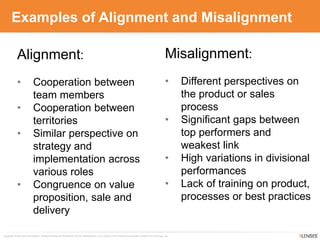
Examples of Alignment and Misalignment
Alignment:
• Cooperation between
team members
• Cooperation between
territories
• Similar perspective on
strategy and
implementation across
various roles
• Congruence on value
proposition, sale and
delivery
Misalignment:
• Different perspectives on
the product or sales
process
• Significant gaps between
top performers and
weakest link
• High variations in divisional
performances
• Lack of training on product,
processes or best practices
Copyright © 2010-2014 9Lenses®, All Rights Reserved Worldwide. Not for redistribution in any outlet or form without prior written consent from 9Lenses, Inc.
1. Market Research: The Complexity
One of the main sales problems that we identified is
the complexity of ongoing interactions between
customers, marketing, and sales.
Complexity:
• The number of people on the team and in company
• Seniority and training of the team
• The number of hand-offs
• Multitude of tools and best practices
• Complex products across many product lines
• Changing market landscape
• Customer demands and expectations
Copyright © 2010-2014 9Lenses®, All Rights Reserved Worldwide. Not for redistribution in any outlet or form without prior written consent from 9Lenses, Inc.
1. Market Research: The Complexity
Unsolved Misalignment = Loss of Revenue
Misalignment produces messy pipelines, inefficient
processes, and loss of revenue.
• 43% of salespeople pursue less than 75% of marketing-
generated leads
• Failure to align sales and marketing teams costs B2B
companies more than 10% of revenue per year or $100M
for a $1BN company!
References: IDC, CSO Insights
Copyright © 2010-2014 9Lenses®, All Rights Reserved Worldwide. Not for redistribution in any outlet or form without prior written consent from 9Lenses, Inc.
1. Market Research: The Opportunity
High alignment = Higher revenues
• Highly-aligned organizations saw annual revenue growth
of 32%
• Highly-aligned marketing and sales operations achieved
24% faster 3-year revenue growth and 27% faster 3-
year profit growth
References: Aberdeen Group, Sirius Decisions
“Fortune favors the aligned”
Matthew Griffin
Copyright © 2010-2014 9Lenses®, All Rights Reserved Worldwide. Not for redistribution in any outlet or form without prior written consent from 9Lenses, Inc.
1. Market Research: 9Lenses Approach
9Lenses gathered more than 800,000 data
points for:
• Sales and marketing alignment
• Sales team engagement
• Win/loss cycles
• Customer intelligence
• Other sales interactions
We identified the best metrics that influence sales
performance and increased revenue.
Copyright © 2010-2014 9Lenses®, All Rights Reserved Worldwide. Not for redistribution in any outlet or form without prior written consent from 9Lenses, Inc.
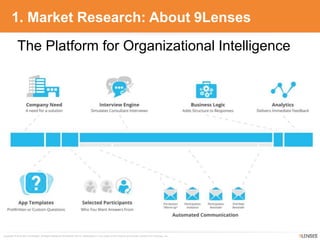
1. Market Research: About 9Lenses
The Platform for Organizational Intelligence
Copyright © 2010-2014 9Lenses®, All Rights Reserved Worldwide. Not for redistribution in any outlet or form without prior written consent from 9Lenses, Inc.
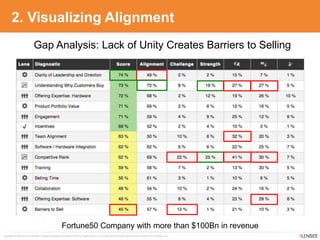
2. Visualizing Alignment
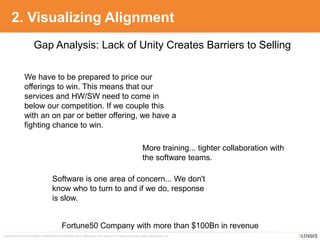
Fortune50 Company with more than $100Bn in revenue
Gap Analysis: Lack of Unity Creates Barriers to Selling
Copyright © 2010-2014 9Lenses®, All Rights Reserved Worldwide. Not for redistribution in any outlet or form without prior written consent from 9Lenses, Inc.
2. Visualizing Alignment
Fortune50 Company with more than $100Bn in revenue
Gap Analysis: Lack of Unity Creates Barriers to Selling
We have to be prepared to price our
offerings to win. This means that our
services and HW/SW need to come in
below our competition. If we couple this
with an on par or better offering, we have a
fighting chance to win.
More training... tighter collaboration with
the software teams.
Software is one area of concern... We don't
know who to turn to and if we do, response
is slow.
Copyright © 2010-2014 9Lenses®, All Rights Reserved Worldwide. Not for redistribution in any outlet or form without prior written consent from 9Lenses, Inc.
2. Visualizing Alignment
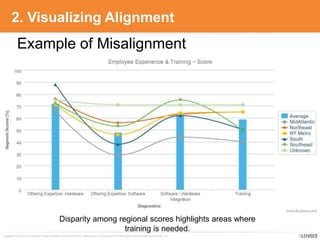
Example of Misalignment
Disparity among regional scores highlights areas where
training is needed.
Copyright © 2010-2014 9Lenses®, All Rights Reserved Worldwide. Not for redistribution in any outlet or form without prior written consent from 9Lenses, Inc.
2. Visualizing Alignment
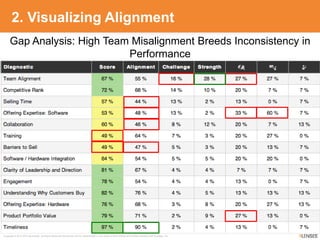
Gap Analysis: High Team Misalignment Breeds Inconsistency in
Performance
Copyright © 2010-2014 9Lenses®, All Rights Reserved Worldwide. Not for redistribution in any outlet or form without prior written consent from 9Lenses, Inc.
2. Visualizing Alignment
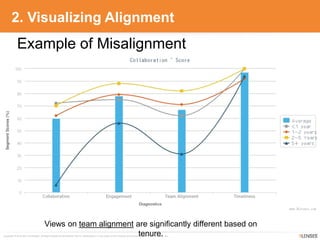
Example of Misalignment
Views on team alignment are significantly different based on
tenure.
Copyright © 2010-2014 9Lenses®, All Rights Reserved Worldwide. Not for redistribution in any outlet or form without prior written consent from 9Lenses, Inc.
2. Visualizing Alignment
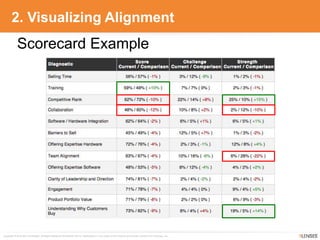
Scorecard Example
Copyright © 2010-2014 9Lenses®, All Rights Reserved Worldwide. Not for redistribution in any outlet or form without prior written consent from 9Lenses, Inc.
• More revenue
• Better lead generation
• Healthy pipelines
• Higher conversion rates
• Efficient integration with organizational processes
and tools
• Faster follow-up on leads
• Targeted training
• Faster go to market
• Shorter time between touches
• More time interacting with the right contacts
• Value prop = sale pitch = product/sale delivery
3. Alignment Benefits
Copyright © 2010-2014 9Lenses®, All Rights Reserved Worldwide. Not for redistribution in any outlet or form without prior written consent from 9Lenses, Inc.
4. The Recipe
1. Simplify complexity by measuring gaps between the
sales, marketing, product and the customers
2. Identify root causes of misalignment
3. Reduce gaps with targeted training
4. Measure the alignment gaps periodically to assess
progress
5. Continue refining the process until the complexity
problem is solved and high alignment is achieved
You can’t improve what you don’t know.
You don’t know what you don’t measure.
It’s starts with measurement.
Copyright © 2010-2014 9Lenses®, All Rights Reserved Worldwide. Not for redistribution in any outlet or form without prior written consent from 9Lenses, Inc.
5. Best Practices
• Assess and align the team internally
• Gather and measure employee feedback
• Align with your team globally and across various
territories
• Align with organizational processes and tools
• Identify top-performers and emulate their tactics
• Offer trainings for the weakest link in the team
• Align with the market via persona development
(feedback loop from previous customers)
• Alignment with marketing campaigns
• Fine tune the process: initial touch to sale handoff
• Assess periodically to maintain high alignment
• Offer trainings for the weakest link in the team
Copyright © 2010-2014 9Lenses®, All Rights Reserved Worldwide. Not for redistribution in any outlet or form without prior written consent from 9Lenses, Inc.
5. Best Practices: Training
Determine
Specific
Gaps
Implement
Training
Follow Up
Analysis
Example: Implement a roadmap for continuous feedback & training.
“I would personally like to be invited to
[local] in person training sessions
rather than any Computer based or
Instructor led trainings.”
“I would like to spend more face to face
time with the Reps in my territory to learn
the benefits and business value that
our solution can bring.”
“I think ongoing training to learn new
product features and capabilities is
needed on a regular basis.”
Copyright © 2010-2014 9Lenses®, All Rights Reserved Worldwide. Not for redistribution in any outlet or form without prior written consent from 9Lenses, Inc.
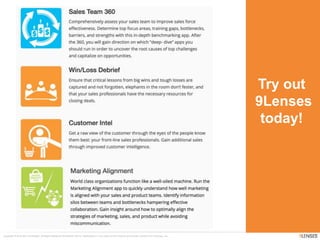
Try out
9Lenses
today!
Copyright © 2010-2014 9Lenses®, All Rights Reserved Worldwide. Not for redistribution in any outlet or form without prior written consent from 9Lenses, Inc.
Thank You for your Time!
Tom Hessen
VP of Sales
Tom.Hessen@9lenses.com
For more information or to run a 9Lenses App visit
our website.

Sales Alignment

  • 1.
    Copyright © 2010-20149Lenses®, All Rights Reserved Worldwide. Not for redistribution in any outlet or form without prior written consent from 9Lenses, Inc. Enterprise SaaS for Organizational Intelligence Sales AlignmentSales Alignment See How Leading Fortune 500 Companies Are Gaining Clarity and Closing More Deals
  • 2.
    Copyright © 2010-20149Lenses®, All Rights Reserved Worldwide. Not for redistribution in any outlet or form without prior written consent from 9Lenses, Inc. Outline 1. Market Research 2. Visualizing Alignment 3. Benefits of Alignment 4. The Recipe 5. Best Practices
  • 3.
    Copyright © 2010-20149Lenses®, All Rights Reserved Worldwide. Not for redistribution in any outlet or form without prior written consent from 9Lenses, Inc. Examples of Alignment and Misalignment Alignment: • Cooperation between team members • Cooperation between territories • Similar perspective on strategy and implementation across various roles • Congruence on value proposition, sale and delivery Misalignment: • Different perspectives on the product or sales process • Significant gaps between top performers and weakest link • High variations in divisional performances • Lack of training on product, processes or best practices
  • 4.
    Copyright © 2010-20149Lenses®, All Rights Reserved Worldwide. Not for redistribution in any outlet or form without prior written consent from 9Lenses, Inc. 1. Market Research: The Complexity One of the main sales problems that we identified is the complexity of ongoing interactions between customers, marketing, and sales. Complexity: • The number of people on the team and in company • Seniority and training of the team • The number of hand-offs • Multitude of tools and best practices • Complex products across many product lines • Changing market landscape • Customer demands and expectations
  • 5.
    Copyright © 2010-20149Lenses®, All Rights Reserved Worldwide. Not for redistribution in any outlet or form without prior written consent from 9Lenses, Inc. 1. Market Research: The Complexity Unsolved Misalignment = Loss of Revenue Misalignment produces messy pipelines, inefficient processes, and loss of revenue. • 43% of salespeople pursue less than 75% of marketing- generated leads • Failure to align sales and marketing teams costs B2B companies more than 10% of revenue per year or $100M for a $1BN company! References: IDC, CSO Insights
  • 6.
    Copyright © 2010-20149Lenses®, All Rights Reserved Worldwide. Not for redistribution in any outlet or form without prior written consent from 9Lenses, Inc. 1. Market Research: The Opportunity High alignment = Higher revenues • Highly-aligned organizations saw annual revenue growth of 32% • Highly-aligned marketing and sales operations achieved 24% faster 3-year revenue growth and 27% faster 3- year profit growth References: Aberdeen Group, Sirius Decisions “Fortune favors the aligned” Matthew Griffin
  • 7.
    Copyright © 2010-20149Lenses®, All Rights Reserved Worldwide. Not for redistribution in any outlet or form without prior written consent from 9Lenses, Inc. 1. Market Research: 9Lenses Approach 9Lenses gathered more than 800,000 data points for: • Sales and marketing alignment • Sales team engagement • Win/loss cycles • Customer intelligence • Other sales interactions We identified the best metrics that influence sales performance and increased revenue.
  • 8.
    Copyright © 2010-20149Lenses®, All Rights Reserved Worldwide. Not for redistribution in any outlet or form without prior written consent from 9Lenses, Inc. 1. Market Research: About 9Lenses The Platform for Organizational Intelligence
  • 9.
    Copyright © 2010-20149Lenses®, All Rights Reserved Worldwide. Not for redistribution in any outlet or form without prior written consent from 9Lenses, Inc. 2. Visualizing Alignment Fortune50 Company with more than $100Bn in revenue Gap Analysis: Lack of Unity Creates Barriers to Selling
  • 10.
    Copyright © 2010-20149Lenses®, All Rights Reserved Worldwide. Not for redistribution in any outlet or form without prior written consent from 9Lenses, Inc. 2. Visualizing Alignment Fortune50 Company with more than $100Bn in revenue Gap Analysis: Lack of Unity Creates Barriers to Selling We have to be prepared to price our offerings to win. This means that our services and HW/SW need to come in below our competition. If we couple this with an on par or better offering, we have a fighting chance to win. More training... tighter collaboration with the software teams. Software is one area of concern... We don't know who to turn to and if we do, response is slow.
  • 11.
    Copyright © 2010-20149Lenses®, All Rights Reserved Worldwide. Not for redistribution in any outlet or form without prior written consent from 9Lenses, Inc. 2. Visualizing Alignment Example of Misalignment Disparity among regional scores highlights areas where training is needed.
  • 12.
    Copyright © 2010-20149Lenses®, All Rights Reserved Worldwide. Not for redistribution in any outlet or form without prior written consent from 9Lenses, Inc. 2. Visualizing Alignment Gap Analysis: High Team Misalignment Breeds Inconsistency in Performance
  • 13.
    Copyright © 2010-20149Lenses®, All Rights Reserved Worldwide. Not for redistribution in any outlet or form without prior written consent from 9Lenses, Inc. 2. Visualizing Alignment Example of Misalignment Views on team alignment are significantly different based on tenure.
  • 14.
    Copyright © 2010-20149Lenses®, All Rights Reserved Worldwide. Not for redistribution in any outlet or form without prior written consent from 9Lenses, Inc. 2. Visualizing Alignment Scorecard Example
  • 15.
    Copyright © 2010-20149Lenses®, All Rights Reserved Worldwide. Not for redistribution in any outlet or form without prior written consent from 9Lenses, Inc. • More revenue • Better lead generation • Healthy pipelines • Higher conversion rates • Efficient integration with organizational processes and tools • Faster follow-up on leads • Targeted training • Faster go to market • Shorter time between touches • More time interacting with the right contacts • Value prop = sale pitch = product/sale delivery 3. Alignment Benefits
  • 16.
    Copyright © 2010-20149Lenses®, All Rights Reserved Worldwide. Not for redistribution in any outlet or form without prior written consent from 9Lenses, Inc. 4. The Recipe 1. Simplify complexity by measuring gaps between the sales, marketing, product and the customers 2. Identify root causes of misalignment 3. Reduce gaps with targeted training 4. Measure the alignment gaps periodically to assess progress 5. Continue refining the process until the complexity problem is solved and high alignment is achieved You can’t improve what you don’t know. You don’t know what you don’t measure. It’s starts with measurement.
  • 17.
    Copyright © 2010-20149Lenses®, All Rights Reserved Worldwide. Not for redistribution in any outlet or form without prior written consent from 9Lenses, Inc. 5. Best Practices • Assess and align the team internally • Gather and measure employee feedback • Align with your team globally and across various territories • Align with organizational processes and tools • Identify top-performers and emulate their tactics • Offer trainings for the weakest link in the team • Align with the market via persona development (feedback loop from previous customers) • Alignment with marketing campaigns • Fine tune the process: initial touch to sale handoff • Assess periodically to maintain high alignment • Offer trainings for the weakest link in the team
  • 18.
    Copyright © 2010-20149Lenses®, All Rights Reserved Worldwide. Not for redistribution in any outlet or form without prior written consent from 9Lenses, Inc. 5. Best Practices: Training Determine Specific Gaps Implement Training Follow Up Analysis Example: Implement a roadmap for continuous feedback & training. “I would personally like to be invited to [local] in person training sessions rather than any Computer based or Instructor led trainings.” “I would like to spend more face to face time with the Reps in my territory to learn the benefits and business value that our solution can bring.” “I think ongoing training to learn new product features and capabilities is needed on a regular basis.”
  • 19.
    Copyright © 2010-20149Lenses®, All Rights Reserved Worldwide. Not for redistribution in any outlet or form without prior written consent from 9Lenses, Inc. Try out 9Lenses today!
  • 20.
    Copyright © 2010-20149Lenses®, All Rights Reserved Worldwide. Not for redistribution in any outlet or form without prior written consent from 9Lenses, Inc. Thank You for your Time! Tom Hessen VP of Sales Tom.Hessen@9lenses.com For more information or to run a 9Lenses App visit our website.

Editor's Notes

  • #4 In this slide we define the terms we use and their application in the business Essentially Alignment – working together according to best practices to achieve best possible results. Misalignment Drain on company resources Losing time and momentum Loss of profits in product delivery More time needed for training
  • #5 THE THESIS Complexity is main problem in gaining traction between sales, marketing and the customer. Misalignment exists because the relationship management process is complex and time consuming. Loos of revenue and loss of time. Sales and maketing are trying Reasaon why Lots of people Complex prdouctds Lots of moving parts Vizlauise unknown complexity sales and marketing don't have the same view of the customer The customer doesn't always understand what they need until they see it 1. Sales 2. Marketing 3. Customer- how do you know with hundreds or thousands (understand all these perspective and how they different is near impossible) Complexity problem - how to break it down and solve it Getting insight into these previously not understood problems brings new insight Misalignment is the secret revenue killer. Performing poorly and misaligned -> with expertise and software addressing the problem way to high level example with customers where we saw misalignment maybe there is something that this group is doing re-educate people on the value of their here is the diagnosis - vizualise what was previously unknow. Bring out the qualitative Having the clarity of where the problmes resize - creating a roadmap: more training, understanding top performers Now you have a map to address the complexity with clarity A slide on score card - repetative benchmark You constantly see thorugh complexity getting closer to customer and revenue
  • #6 THE THESIS Complexity is main problem in gaining traction between sales, marketing and the customer. Misalignment exists because the relationship management process is complex and time consuming. Loos of revenue and loss of time. Sales and maketing are trying Reasaon why Lots of people Complex prdouctds Lots of moving parts Vizlauise unknown complexity sales and marketing don't have the same view of the customer The customer doesn't always understand what they need until they see it 1. Sales 2. Marketing 3. Customer- how do you know with hundreds or thousands (understand all these perspective and how they different is near impossible) Complexity problem - how to break it down and solve it Getting insight into these previously not understood problems brings new insight Misalignment is the secret revenue killer. Performing poorly and misaligned -> with expertise and software addressing the problem way to high level example with customers where we saw misalignment maybe there is something that this group is doing re-educate people on the value of their here is the diagnosis - vizualise what was previously unknow. Bring out the qualitative Having the clarity of where the problmes resize - creating a roadmap: more training, understanding top performers Now you have a map to address the complexity with clarity A slide on score card - repetative benchmark You constantly see thorugh complexity getting closer to customer and revenue
  • #7 Stating the the problem – sales and marketing don't interact in the same way with each other research firms are discovering the same thing: if you get sales and marketing aligned, you’ll make a lot more money. If you don’t, you’ll fall behind or even go backward. So how are businesses responding? In most cases, not particularly well This failure of perception carries over into the ways leads are handled
  • #8 Showcasing our authority on the subject by pointing to the data and amount of research. Break it down
  • #9 9 lenses shows where misalignment shows in sales and marketing teams.
  • #10 This was run on a Fortune 50 company with over 100 billions in annual revenue. Our platform collects two types of active data: quantitative and qualitative. This Gap Analysis report gives an overview of all the quantitative data the platform collected. We look at the quantitative data here to find where the top areas of focus are, and then we look at the qualitative data to determine the root causes of the issues raised and the necessary actions to follow. For this engagement, we covered a total of 14 Diagnostics, or Topic Areas, and we segmented participant responses according to Role, Region, and Tenure. Score, Alignment, Top Challenge, Top Strength, Better Communication Needed, Better Training Needed, Volunteer to Help A couple of top focus areas jump out clearly here. Clarity of Leadership and Direction: Received the highest score, but has the lowest overall alignment, indicating again a wide variety of participant perceptions. We’ll focus in on this particular topic area a little later on. (better focus needed – “too many cooks” Understanding Why Customers Buy: 2nd highest score, highest alignment, 2nd highest strength, indicating that participants are largely in agreement that they understand what the drivers for customers are. At the same time, almost a third voted that both communication and training around this area are lacking. We’ll look further into this as well down the line. (support issues, solution selling issues, messaging issues) Competitive Rank: Received a score 10% below last engagement, received the largest number of strength, challenge, communication gap, and training gap votes. Clearly competitive rank is a topic on which participants have widely varied opinions. 41% noted a communication gap, so a lot of this can probably be straightened out with better communication. (same as last time – people believe in the product but need differentiation message) Barriers to Sell: Lowest score and 2nd highest challenge indicate this is clearly a top focus area. (product vs. solution selling)
  • #11 This was run on a Fortune 50 company with over 100 billions in annual revenue. Our platform collects two types of active data: quantitative and qualitative. This Gap Analysis report gives an overview of all the quantitative data the platform collected. We look at the quantitative data here to find where the top areas of focus are, and then we look at the qualitative data to determine the root causes of the issues raised and the necessary actions to follow. For this engagement, we covered a total of 14 Diagnostics, or Topic Areas, and we segmented participant responses according to Role, Region, and Tenure. Score, Alignment, Top Challenge, Top Strength, Better Communication Needed, Better Training Needed, Volunteer to Help A couple of top focus areas jump out clearly here. Clarity of Leadership and Direction: Received the highest score, but has the lowest overall alignment, indicating again a wide variety of participant perceptions. We’ll focus in on this particular topic area a little later on. (better focus needed – “too many cooks” Understanding Why Customers Buy: 2nd highest score, highest alignment, 2nd highest strength, indicating that participants are largely in agreement that they understand what the drivers for customers are. At the same time, almost a third voted that both communication and training around this area are lacking. We’ll look further into this as well down the line. (support issues, solution selling issues, messaging issues) Competitive Rank: Received a score 10% below last engagement, received the largest number of strength, challenge, communication gap, and training gap votes. Clearly competitive rank is a topic on which participants have widely varied opinions. 41% noted a communication gap, so a lot of this can probably be straightened out with better communication. (same as last time – people believe in the product but need differentiation message) Barriers to Sell: Lowest score and 2nd highest challenge indicate this is clearly a top focus area. (product vs. solution selling)
  • #12 This slides shows that expertise on the software varies from one region to another with a difference of almost 30% between the MidAtlantic region and Northeast
  • #13 Story: Many areas of high misalignment – people disagree on key issues Clear top focus areas – Barriers to Sell and Training Clear areas of training – offering expertise and differentiation Clear areas of communication – alignment (account management) and differentiation (product portfolio value) Clear areas of strength – Understanding why Customers Buy and Timeliness (frequency of engaging a specialist)
  • #14 Story: In looking at alignment, we decided to see if there was any cross-section of the data that would shed some light on the issue. We found that segmenting the data according to participant tenure showed wide misalignment. Would any of you have any ideas as to why that would be? Across the board, newer employees were less positive. The exception is those with 5+ year tenure, which were significantly more negative (nearly all comments said “no alignment at all”).
  • #15 This next report is our Scorecard report, which does our benchmarking. The scorecard here compares the current engagement with the engagement we did in July. For the July engagement, we queried a team of Storage Sales Reps, Storage Solutions Architects, and BURA Reps. For this engagement we added Software Sales Reps. Overall, scores as a whole were a little lower than in the last engagement, but this engagement more or less reiterated and further confirmed a lot of what we saw from the last engagement. It also brought up some new focus areas, however, as we will see further down. Again, a few top focus areas jump out here. Training: Training was the lowest scoring area from last time, scoring at only 49%. For this engagement, the score jumped up by a full 10%. Competitive Rank: Competitive Rank was a top focus area for the last engagement, and we can see here that it remains a focus area. It’s score decreased by 10%, challenge votes increased by 8%, and strength votes increased by 15%. Collaboration: Collaboration was a top focus area from last time, and remains one. Score decreased by 12%, and strength votes decreased by 10%. Team Alignment: Team Alignment was also an area of focus from last time, in the same bucket as Collaboration. Team Alignment received the top number of both strength and challenge votes last time, but for this engagement strength votes went down a full 22%, suggesting that teams are better aligned on this question (i.e. that it’s a solid challenge and not a strength). Understanding Why Customers Buy: This diagnostic’s challenge votes increased by 14%, although its score actually went down. We’ll look at this diagnostic in more detail to determine what might have caused this.
  • #16  Sales and markeing not having the shared understading of the custmer impacts performance. Misperceptions is very hard to understand more time spent on creating relationships and connections more meaningful context for sales calls and follow-up emails More time interacting with the right contacts