http://www.novareinna.com/festive/valentine.html
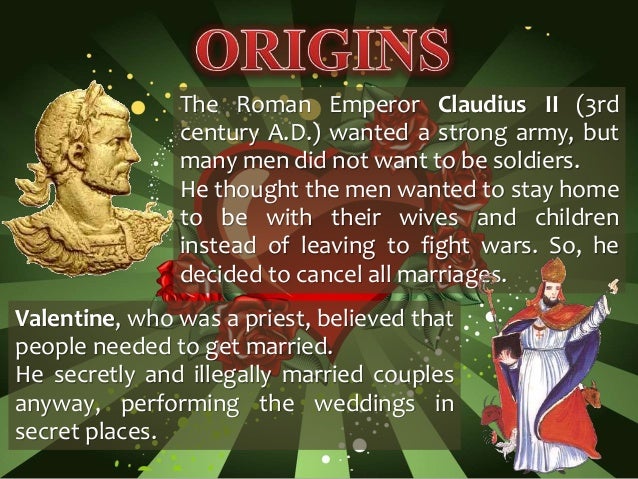
The Roman Emperor Claudius II (3rd
century A.D.) wanted a strong army, but
many men did not want to be soldiers.
He thought the men wanted to stay home
to be with their wives and children
instead of leaving to fight wars. So, he
decided to cancel all marriages.
Valentine, who was a priest, believed that
people needed to get married.
He secretly and illegally married couples
anyway, performing the weddings in
secret places.
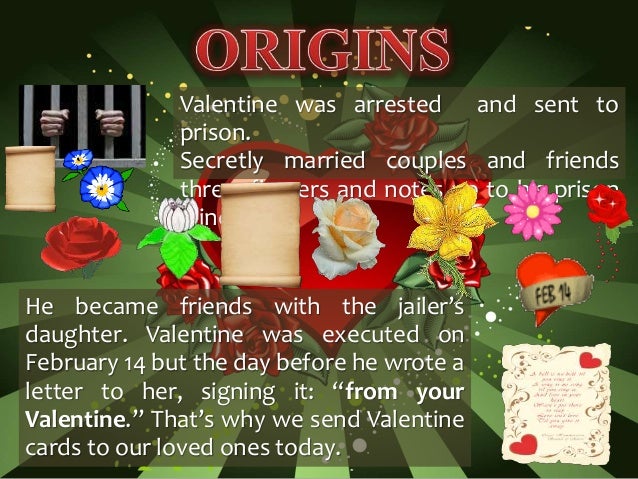
Valentine was arrested and sent to
prison.
Secretly married couples and friends
threw flowers and notes up to his prison
window.
He became friends with the jailer’s
daughter. Valentine was executed on
February 14 but the day before he wrote a
letter to her, signing it: “from your
Valentine.” That’s why we send Valentine
cards to our loved ones today.
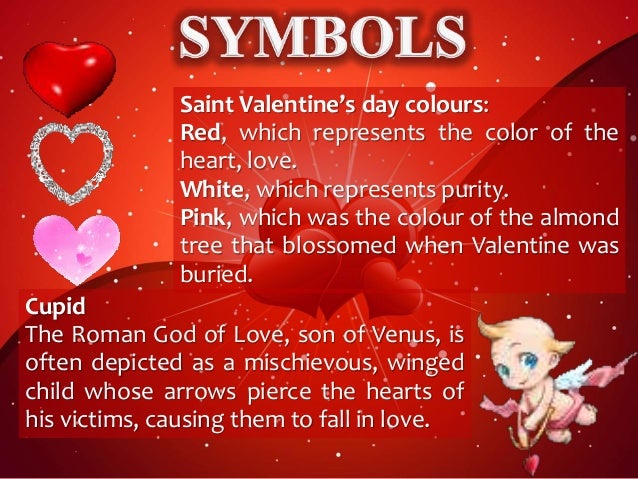
Saint Valentine’s day colours:
Red, which represents the color of the
heart, love.
White, which represents purity.
Pink, which was the colour of the almond
tree that blossomed when Valentine was
buried.
Cupid
The Roman God of Love, son of Venus, is
often depicted as a mischievous, winged
child whose arrows pierce the hearts of
his victims, causing them to fall in love.
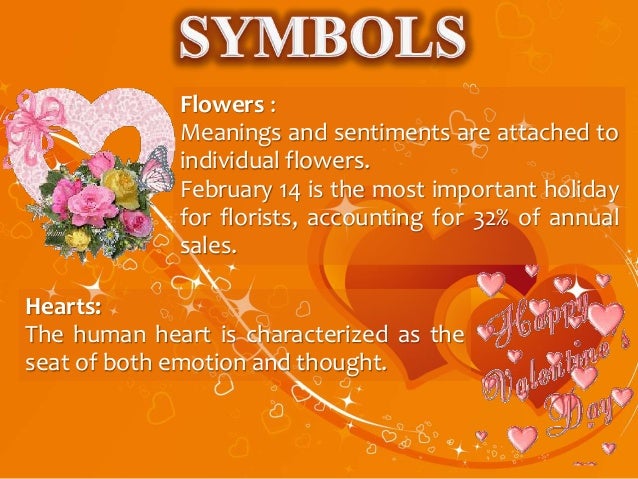
Flowers :
Meanings and sentiments are attached to
individual flowers.
February 14 is the most important holiday
for florists, accounting for 32% of annual
sales.
Hearts:
The human heart is characterized as the
seat of both emotion and thought.
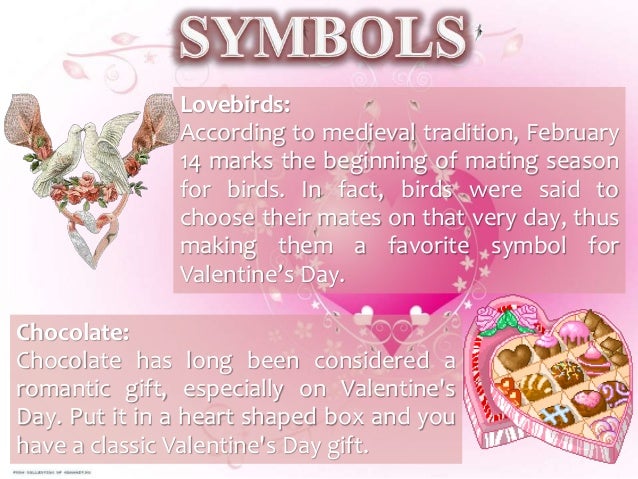
Lovebirds:
According to medieval tradition, February
14 marks the beginning of mating season
for birds. In fact, birds were said to
choose their mates on that very day, thus
making them a favorite symbol for
Valentine’s Day.
Chocolate:
Chocolate has long been considered a
romantic gift, especially on Valentine's
Day. Put it in a heart shaped box and you
have a classic Valentine's Day gift.
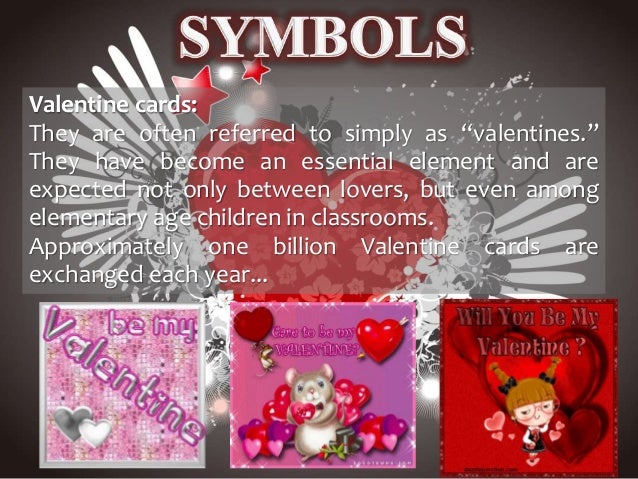
Valentine cards:
They are often referred to simply as “valentines.”
They have become an essential element and are
expected not only between lovers, but even among
elementary age children in classrooms.
Approximately one billion Valentine cards are
exchanged each year...
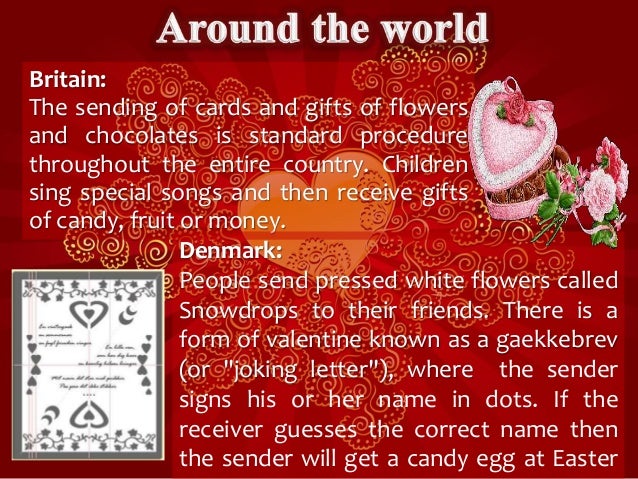
Britain:
The sending of cards and gifts of flowers
and chocolates is standard procedure
throughout the entire country. Children
sing special songs and then receive gifts
of candy, fruit or money.
Denmark:
People send pressed white flowers called
Snowdrops to their friends. There is a
form of valentine known as a gaekkebrev
(or "joking letter"), where the sender
signs his or her name in dots. If the
receiver guesses the correct name then
the sender will get a candy egg at Easter
Germany:
It has become customary for the young
man to present his beloved with flowers
on February 14. Valentine gifts in Germany
are usually in the shape of love tokens,
completed with love messages.
Japan:
Valentine's Day is celebrated on two different
dates...February 14 and March 14. On the first
date, the female gives a gift to the male and on
the second date (known as White Day) the male
has to return the gift he received on February 14.
Thus, strictly speaking, a Japanese female has
the luxury of actually choosing her own gift.
Korea:
The traditional gift of candy takes place in Korea
on February 14, but only from females to males.
They also celebrate the White day (March 14)
and for those young people who have no
particular romantic partners get together on
April 14 ("Black Day”) and partake of Jajang
noodles, which are black in color, hence the
name of the day.
Spain:
it is customary for couples to exchange
gifts on Valentine's Day and for husbands
to send their wives bouquets of roses.
Scotland:
Valentine's Day is celebrated with a festival. There is
an equal number of unmarried males and females.
Each person writes his/her name on a piece of paper.
Pieces are folded and placed into one hat for the
ladies and one for the men. Then both females and
males draw a name from the hat. Probably, their
names will not match but men must partner with the
female who selected their names. The females would
then pin the name of their partner over their hearts or
on their sleeves. A dance often follows and, at the
end of the festival, it is not unusual for marriages to
take place.
Valentine's Day gifts in Scotland are frequently given
by both parties in the form of a love-token or true-

Saint valentines-day-reading-comprehension-exercises 64955

  • 1.
  • 2.
    The Roman EmperorClaudius II (3rd century A.D.) wanted a strong army, but many men did not want to be soldiers. He thought the men wanted to stay home to be with their wives and children instead of leaving to fight wars. So, he decided to cancel all marriages. Valentine, who was a priest, believed that people needed to get married. He secretly and illegally married couples anyway, performing the weddings in secret places.
  • 3.
    Valentine was arrestedand sent to prison. Secretly married couples and friends threw flowers and notes up to his prison window. He became friends with the jailer’s daughter. Valentine was executed on February 14 but the day before he wrote a letter to her, signing it: “from your Valentine.” That’s why we send Valentine cards to our loved ones today.
  • 4.
    Saint Valentine’s daycolours: Red, which represents the color of the heart, love. White, which represents purity. Pink, which was the colour of the almond tree that blossomed when Valentine was buried. Cupid The Roman God of Love, son of Venus, is often depicted as a mischievous, winged child whose arrows pierce the hearts of his victims, causing them to fall in love.
  • 5.
    Flowers : Meanings andsentiments are attached to individual flowers. February 14 is the most important holiday for florists, accounting for 32% of annual sales. Hearts: The human heart is characterized as the seat of both emotion and thought.
  • 6.
    Lovebirds: According to medievaltradition, February 14 marks the beginning of mating season for birds. In fact, birds were said to choose their mates on that very day, thus making them a favorite symbol for Valentine’s Day. Chocolate: Chocolate has long been considered a romantic gift, especially on Valentine's Day. Put it in a heart shaped box and you have a classic Valentine's Day gift.
  • 7.
    Valentine cards: They areoften referred to simply as “valentines.” They have become an essential element and are expected not only between lovers, but even among elementary age children in classrooms. Approximately one billion Valentine cards are exchanged each year...
  • 8.
    Britain: The sending ofcards and gifts of flowers and chocolates is standard procedure throughout the entire country. Children sing special songs and then receive gifts of candy, fruit or money. Denmark: People send pressed white flowers called Snowdrops to their friends. There is a form of valentine known as a gaekkebrev (or "joking letter"), where the sender signs his or her name in dots. If the receiver guesses the correct name then the sender will get a candy egg at Easter
  • 9.
    Germany: It has becomecustomary for the young man to present his beloved with flowers on February 14. Valentine gifts in Germany are usually in the shape of love tokens, completed with love messages. Japan: Valentine's Day is celebrated on two different dates...February 14 and March 14. On the first date, the female gives a gift to the male and on the second date (known as White Day) the male has to return the gift he received on February 14. Thus, strictly speaking, a Japanese female has the luxury of actually choosing her own gift.
  • 10.
    Korea: The traditional giftof candy takes place in Korea on February 14, but only from females to males. They also celebrate the White day (March 14) and for those young people who have no particular romantic partners get together on April 14 ("Black Day”) and partake of Jajang noodles, which are black in color, hence the name of the day. Spain: it is customary for couples to exchange gifts on Valentine's Day and for husbands to send their wives bouquets of roses.
  • 11.
    Scotland: Valentine's Day iscelebrated with a festival. There is an equal number of unmarried males and females. Each person writes his/her name on a piece of paper. Pieces are folded and placed into one hat for the ladies and one for the men. Then both females and males draw a name from the hat. Probably, their names will not match but men must partner with the female who selected their names. The females would then pin the name of their partner over their hearts or on their sleeves. A dance often follows and, at the end of the festival, it is not unusual for marriages to take place. Valentine's Day gifts in Scotland are frequently given by both parties in the form of a love-token or true-