Brakes
 Front : Hydraulically actuated Rockwell calliper disc.
 Rear : Oil-cooled hydraulically actuated multiple disc brakes .
 Brakes are sealed for protection from environmental contaminants.
 Automatic emergency brake system : Unique designed brake control module constantly monitors
brake pressure in the dual brake accumulators and will activate an audio - visual alarm if pressure
on either accumulator drops below a tolerable level. If pressure should continue to drop, service
brakes will automatically apply.
Brakes
 Manual emergency braking system : In the event of failure of the brake pedal, the service brakes can be
manually applied by an operator switch located on the instrument panel.
 Parking brake : Spring applied hydraulically released in board Parking Brake.
 Dynamic retarder : Constant speed retarder is provided by a separate foot pedal for the retarder function,
allowing the operator to apply the retarder without removing his hands from the steering wheel.
 Wheel brake lock : Controlled by a switch on control panel activates and locks brakes while loading and
dumping.
AFDSS
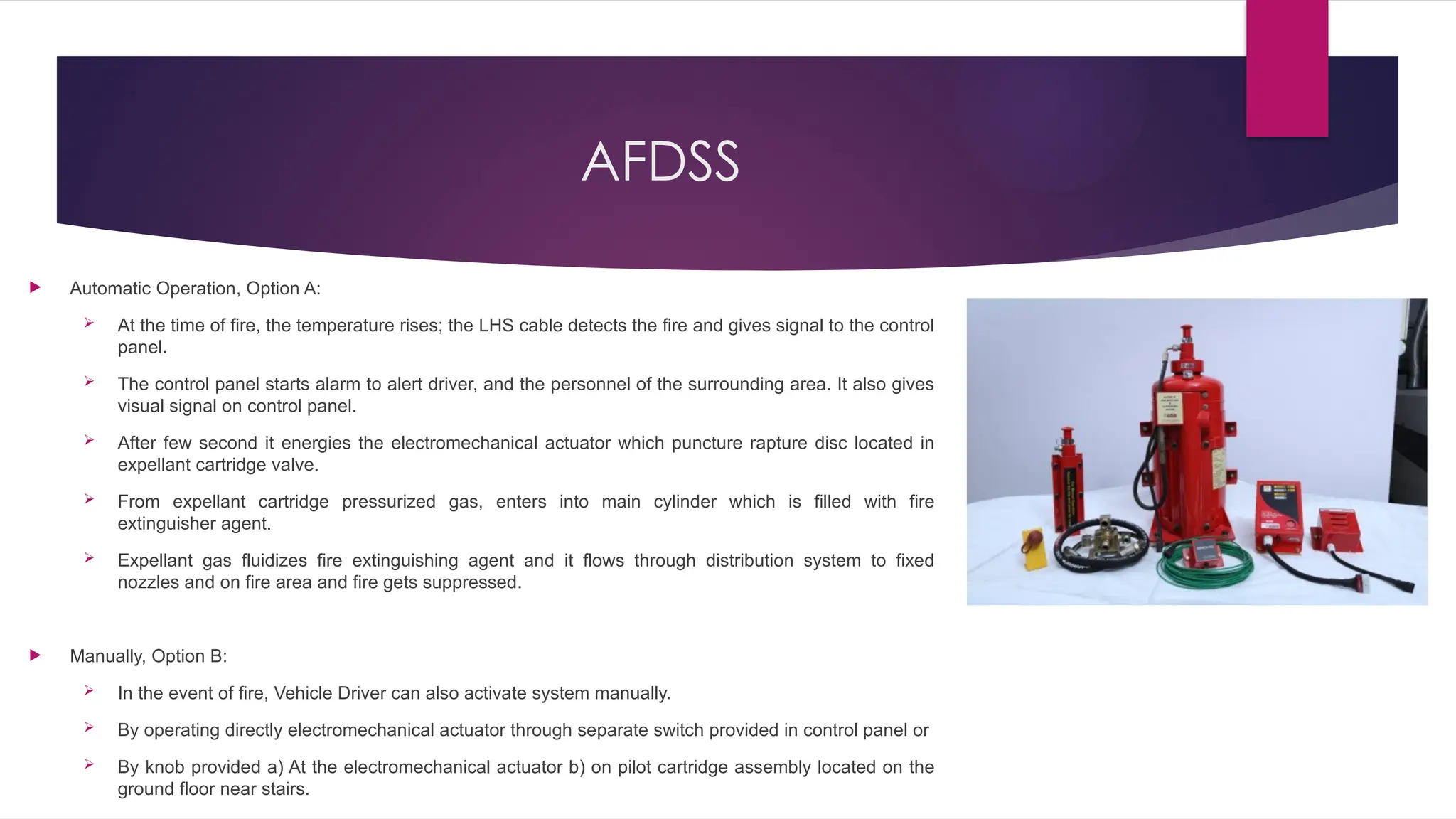
 Automatic Operation, Option A:
 At the time of fire, the temperature rises; the LHS cable detects the fire and gives signal to the control
panel.
 The control panel starts alarm to alert driver, and the personnel of the surrounding area. It also gives
visual signal on control panel.
 After few second it energies the electromechanical actuator which puncture rapture disc located in
expellant cartridge valve.
 From expellant cartridge pressurized gas, enters into main cylinder which is filled with fire
extinguisher agent.
 Expellant gas fluidizes fire extinguishing agent and it flows through distribution system to fixed
nozzles and on fire area and fire gets suppressed.
 Manually, Option B:
 In the event of fire, Vehicle Driver can also activate system manually.
 By operating directly electromechanical actuator through separate switch provided in control panel or
 By knob provided a) At the electromechanical actuator b) on pilot cartridge assembly located on the
ground floor near stairs.
Emergency steering and braking
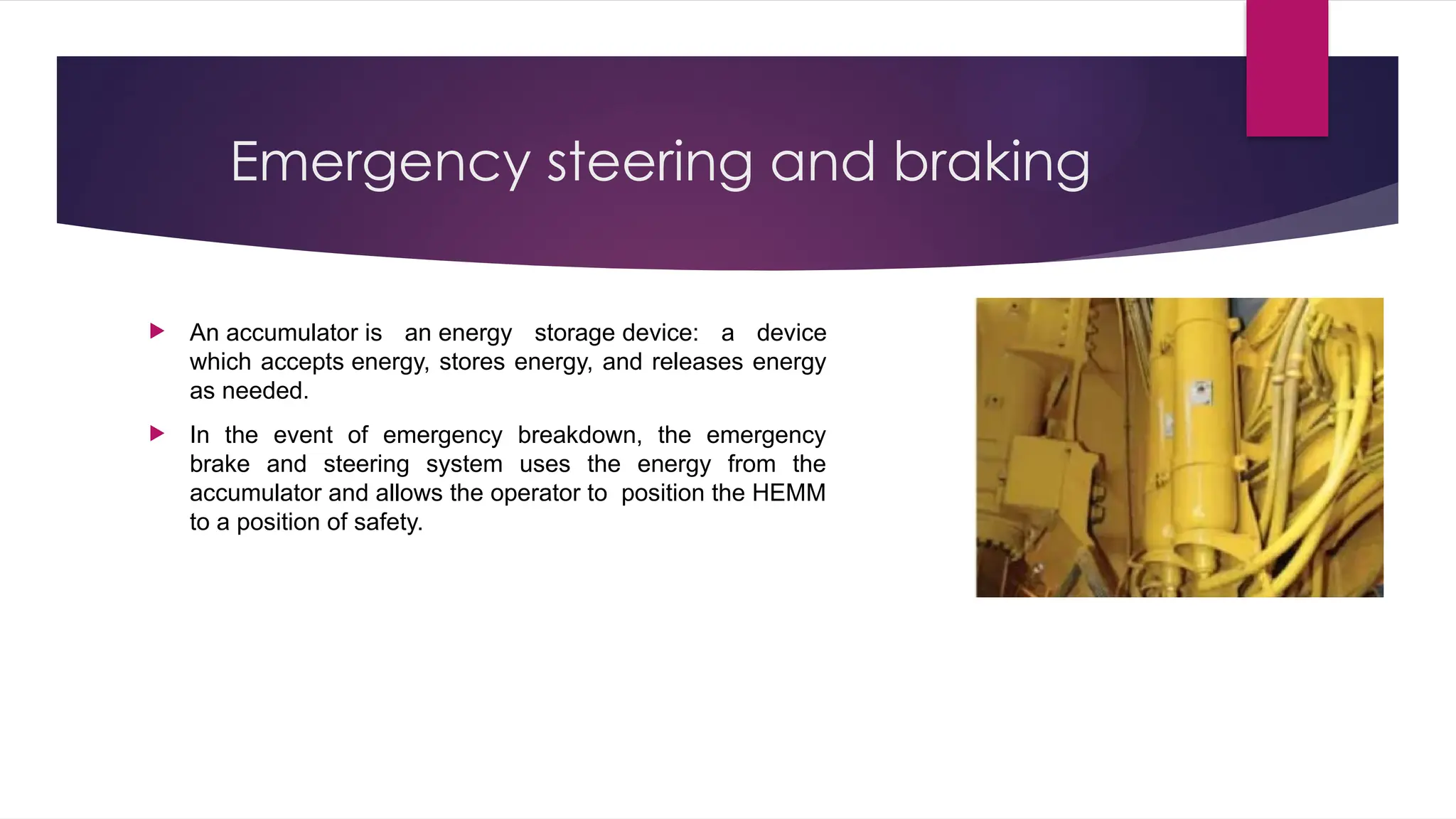
 An accumulator is an energy storage device: a device
which accepts energy, stores energy, and releases energy
as needed.
 In the event of emergency breakdown, the emergency
brake and steering system uses the energy from the
accumulator and allows the operator to position the HEMM
to a position of safety.
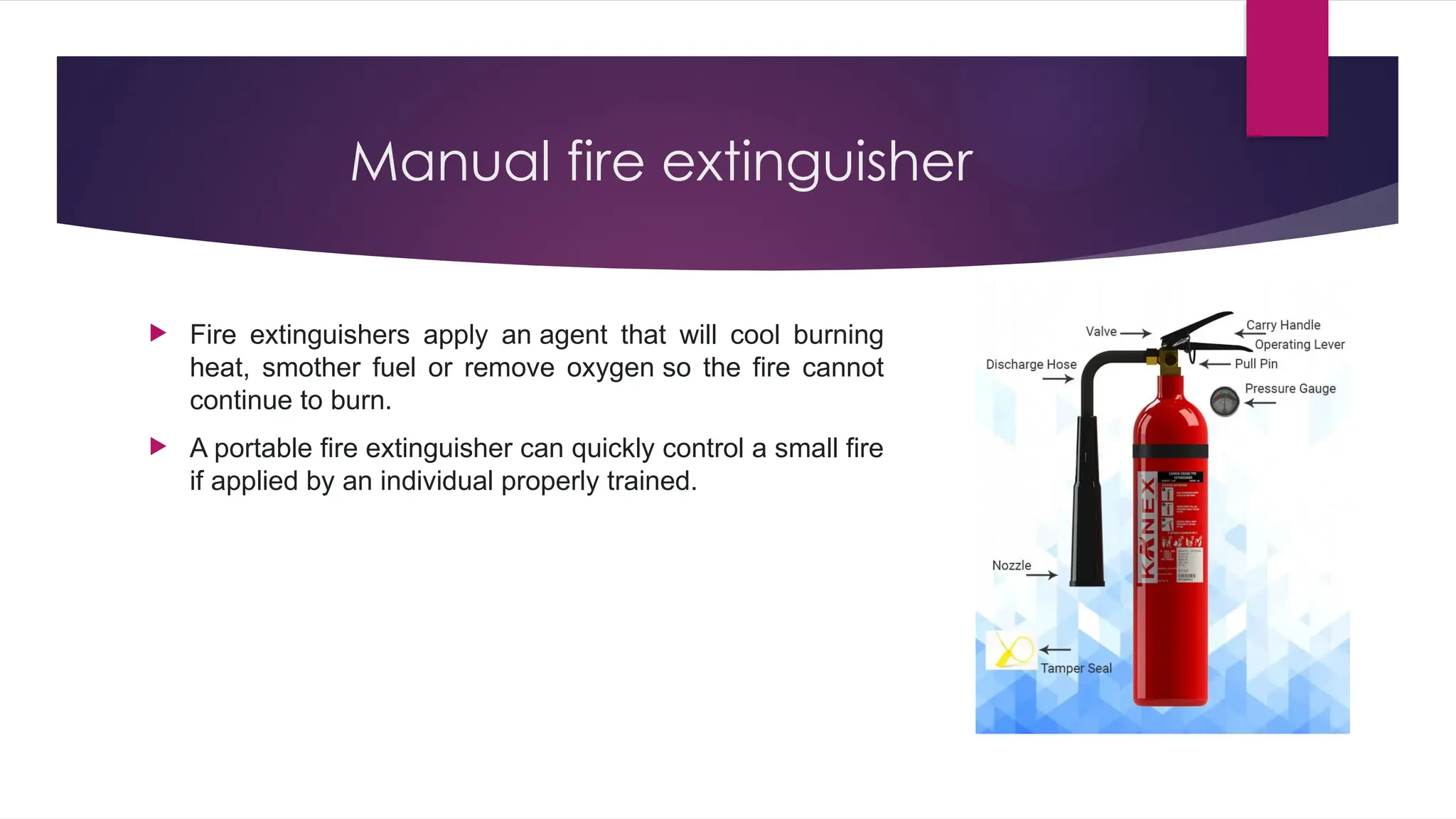
Manual fire extinguisher
 Fire extinguishers apply an agent that will cool burning
heat, smother fuel or remove oxygen so the fire cannot
continue to burn.
 A portable fire extinguisher can quickly control a small fire
if applied by an individual properly trained.
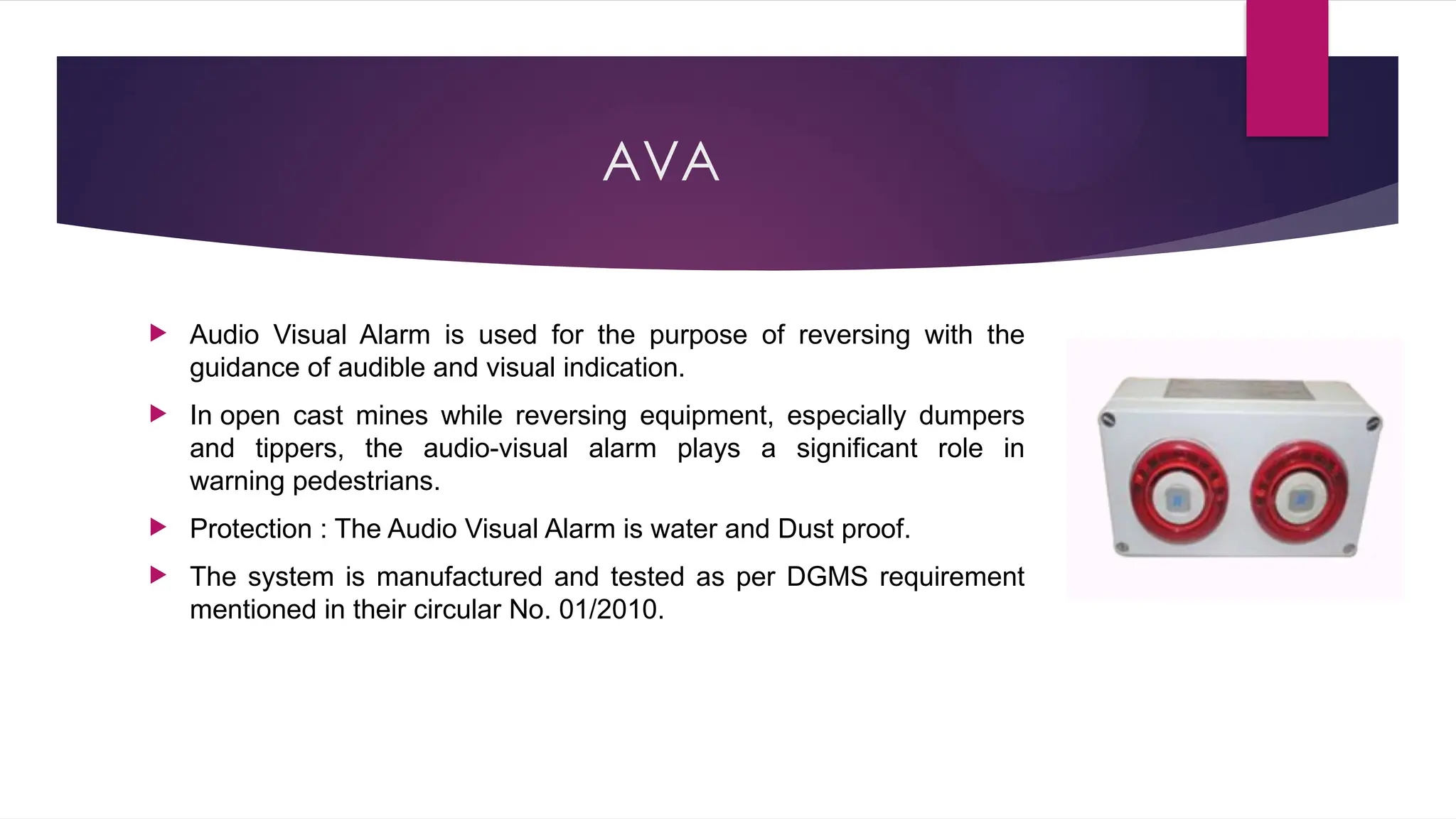
AVA
 Audio Visual Alarm is used for the purpose of reversing with the
guidance of audible and visual indication.
 In open cast mines while reversing equipment, especially dumpers
and tippers, the audio-visual alarm plays a significant role in
warning pedestrians.
 Protection : The Audio Visual Alarm is water and Dust proof.
 The system is manufactured and tested as per DGMS requirement
mentioned in their circular No. 01/2010.
ROPS and FOPS(Roll over/Falling object protection system)
 HEMM’s working in field are exposed to the risk of overturning, on the other hand,
the operator of HEMM’s working can be endangered by an object falling on the
roof of the cab.
 For better safety of the operator, HEMM’s are equipped with protective structures:
 Roll-Over Protective Structures (ROPS): It prevents rolling/overturning of HEMM’s
 Falling-Object Protective Structures (FOPS): It protects the structure of HEMM’s during
an object fall on it, for which it has to go through destructive test.
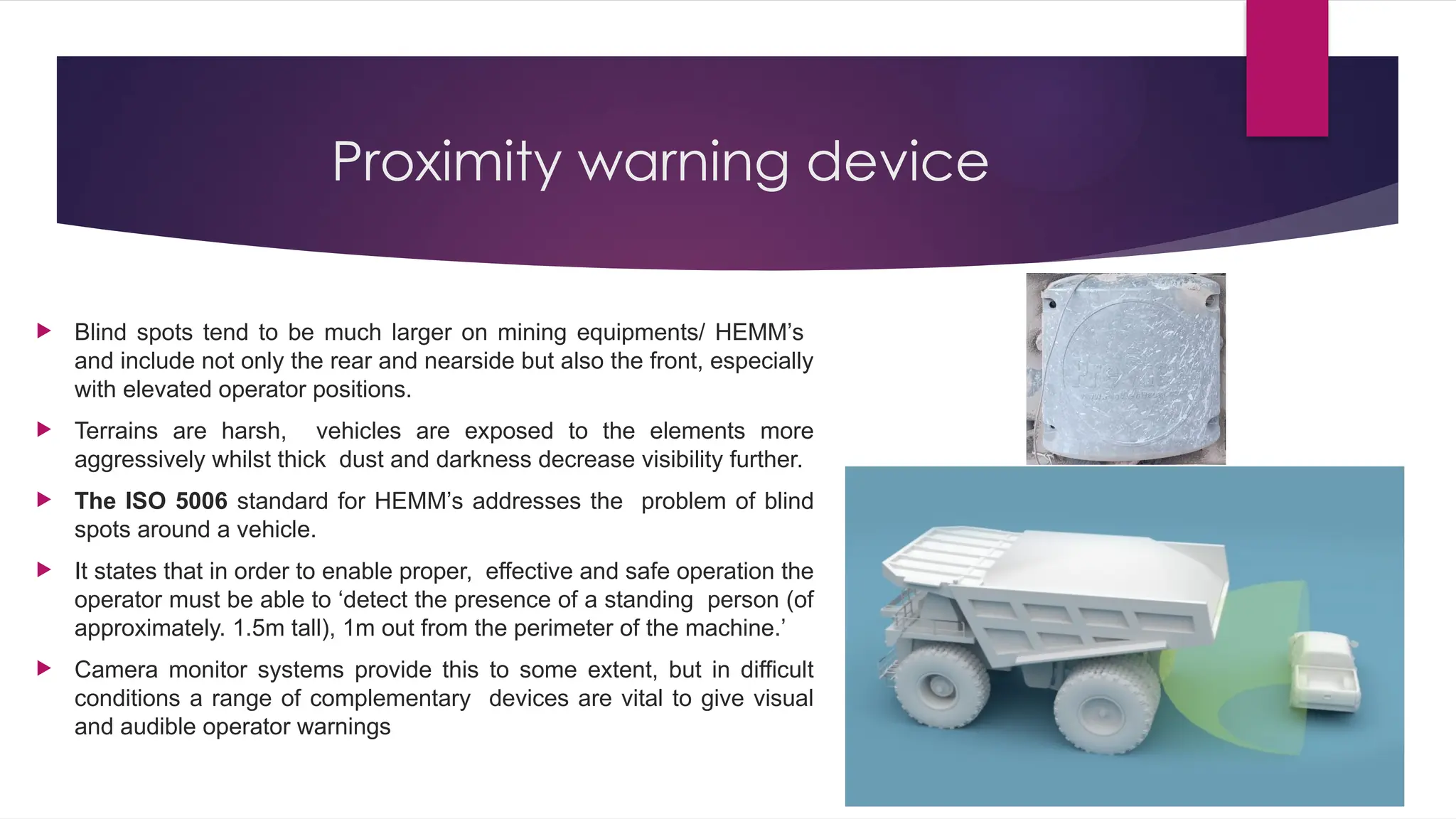
Proximity warning device
 Blind spots tend to be much larger on mining equipments/ HEMM’s
and include not only the rear and nearside but also the front, especially
with elevated operator positions.
 Terrains are harsh, vehicles are exposed to the elements more
aggressively whilst thick dust and darkness decrease visibility further.
 The ISO 5006 standard for HEMM’s addresses the problem of blind
spots around a vehicle.
 It states that in order to enable proper, effective and safe operation the
operator must be able to ‘detect the presence of a standing person (of
approximately. 1.5m tall), 1m out from the perimeter of the machine.’
 Camera monitor systems provide this to some extent, but in difficult
conditions a range of complementary devices are vital to give visual
and audible operator warnings
Rear view camera
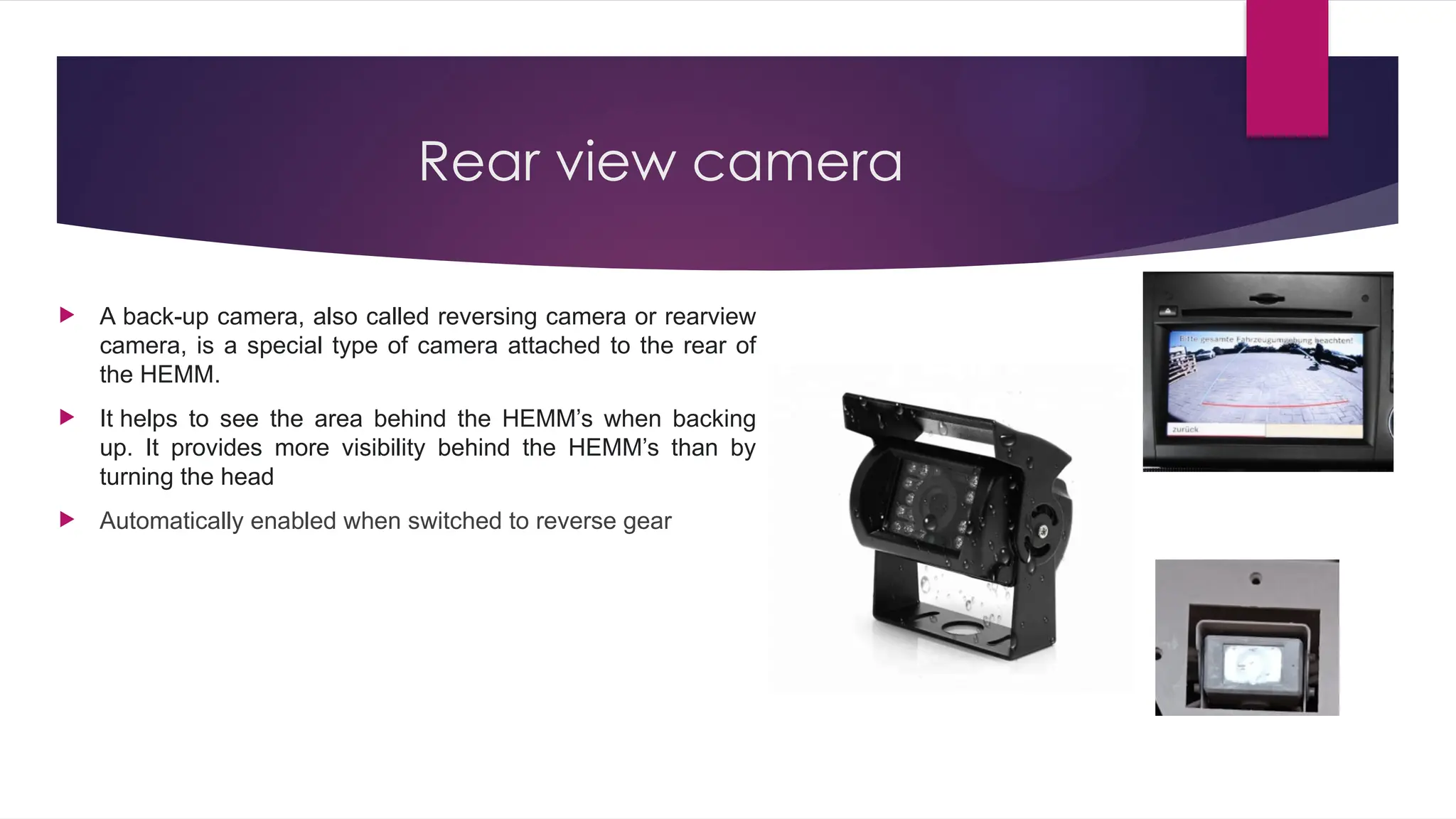
 A back-up camera, also called reversing camera or rearview
camera, is a special type of camera attached to the rear of
the HEMM.
 It helps to see the area behind the HEMM’s when backing
up. It provides more visibility behind the HEMM’s than by
turning the head
 Automatically enabled when switched to reverse gear
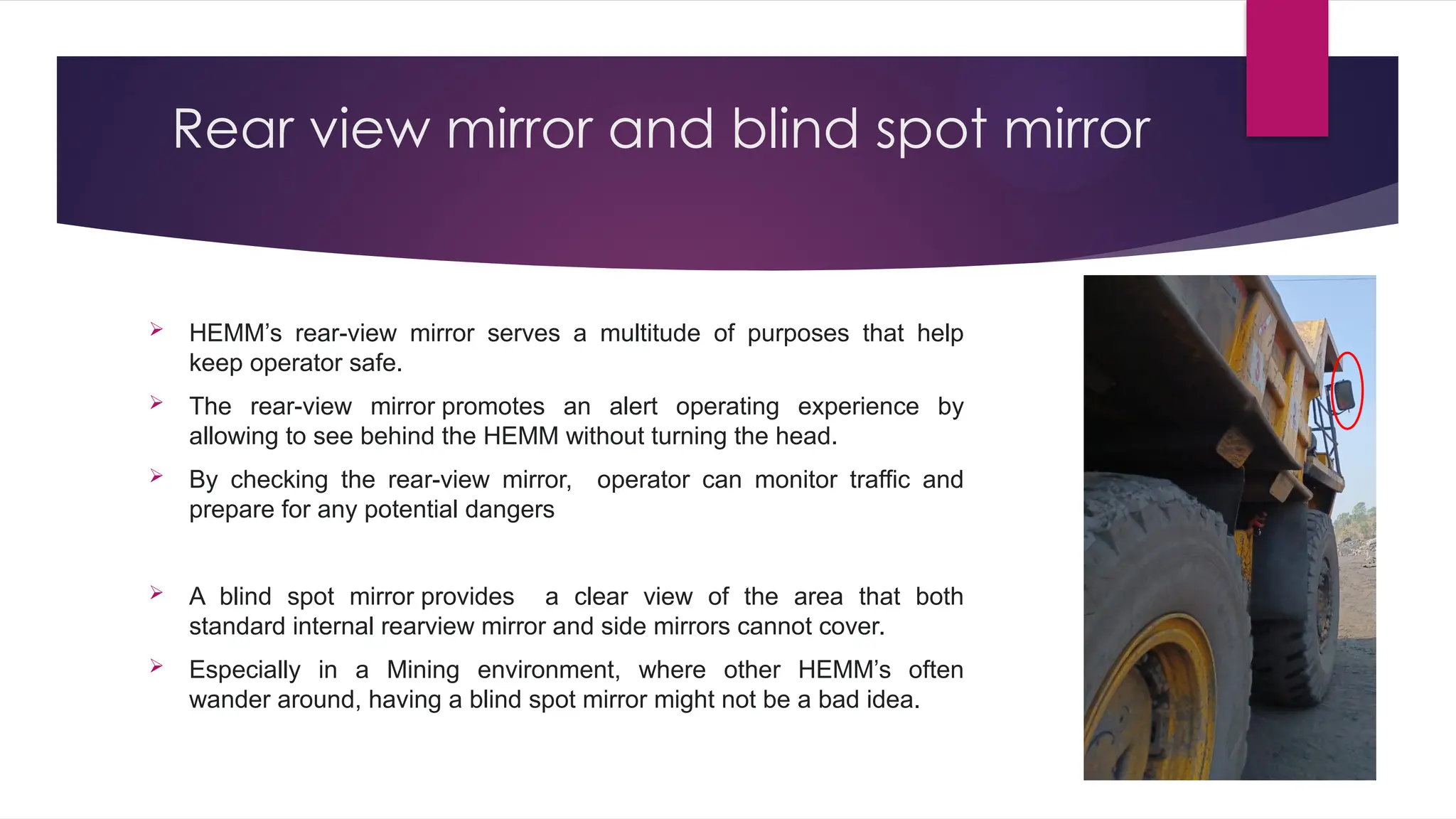
Rear view mirror and blind spot mirror
 HEMM’s rear-view mirror serves a multitude of purposes that help
keep operator safe.
 The rear-view mirror promotes an alert operating experience by
allowing to see behind the HEMM without turning the head.
 By checking the rear-view mirror, operator can monitor traffic and
prepare for any potential dangers
 A blind spot mirror provides a clear view of the area that both
standard internal rearview mirror and side mirrors cannot cover.
 Especially in a Mining environment, where other HEMM’s often
wander around, having a blind spot mirror might not be a bad idea.
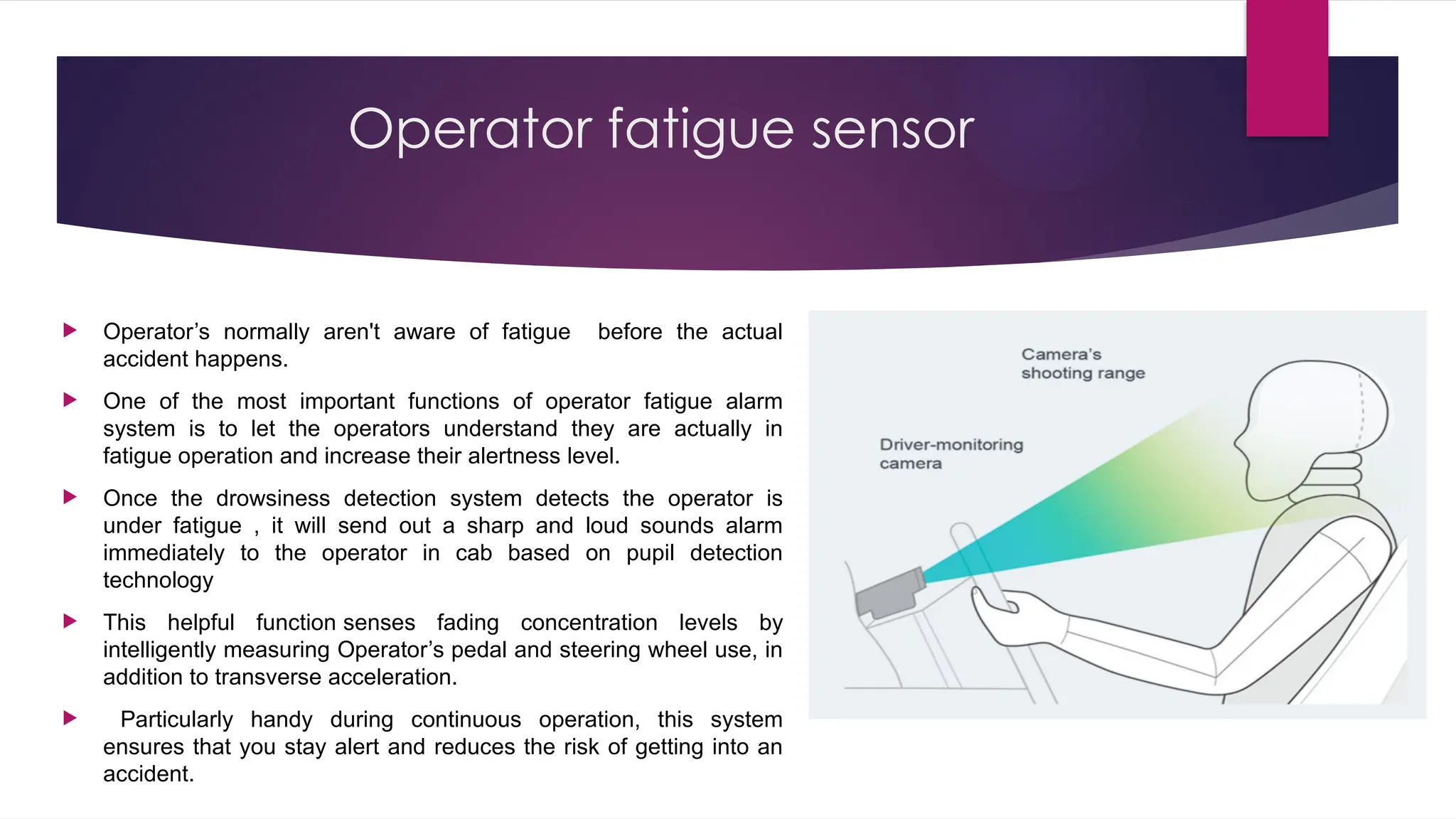
Operator fatigue sensor
 Operator’s normally aren't aware of fatigue before the actual
accident happens.
 One of the most important functions of operator fatigue alarm
system is to let the operators understand they are actually in
fatigue operation and increase their alertness level.
 Once the drowsiness detection system detects the operator is
under fatigue , it will send out a sharp and loud sounds alarm
immediately to the operator in cab based on pupil detection
technology
 This helpful function senses fading concentration levels by
intelligently measuring Operator’s pedal and steering wheel use, in
addition to transverse acceleration.
 Particularly handy during continuous operation, this system
ensures that you stay alert and reduces the risk of getting into an
accident.
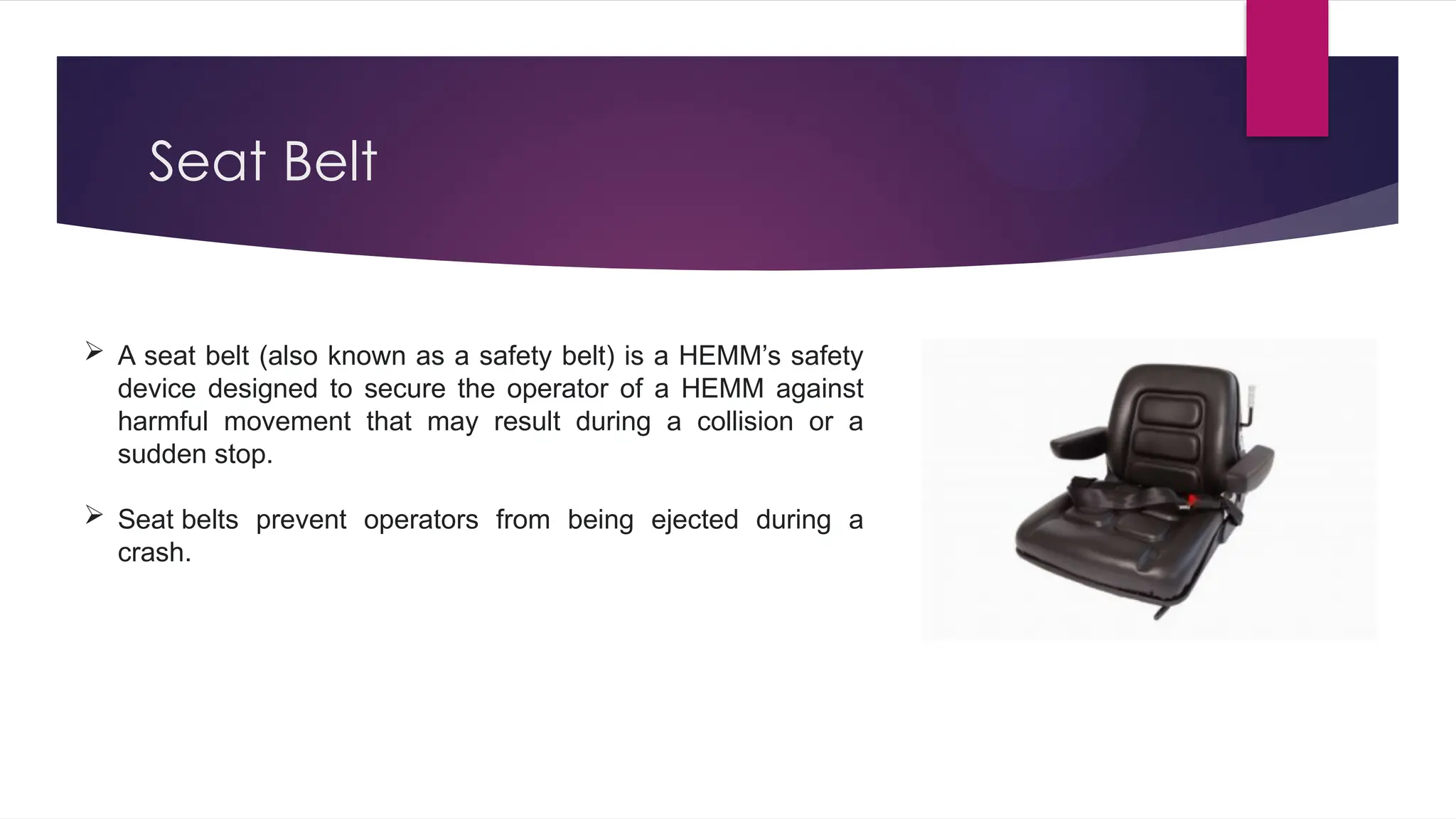
Seat Belt
 A seat belt (also known as a safety belt) is a HEMM’s safety
device designed to secure the operator of a HEMM against
harmful movement that may result during a collision or a
sudden stop.
 Seat belts prevent operators from being ejected during a
crash.
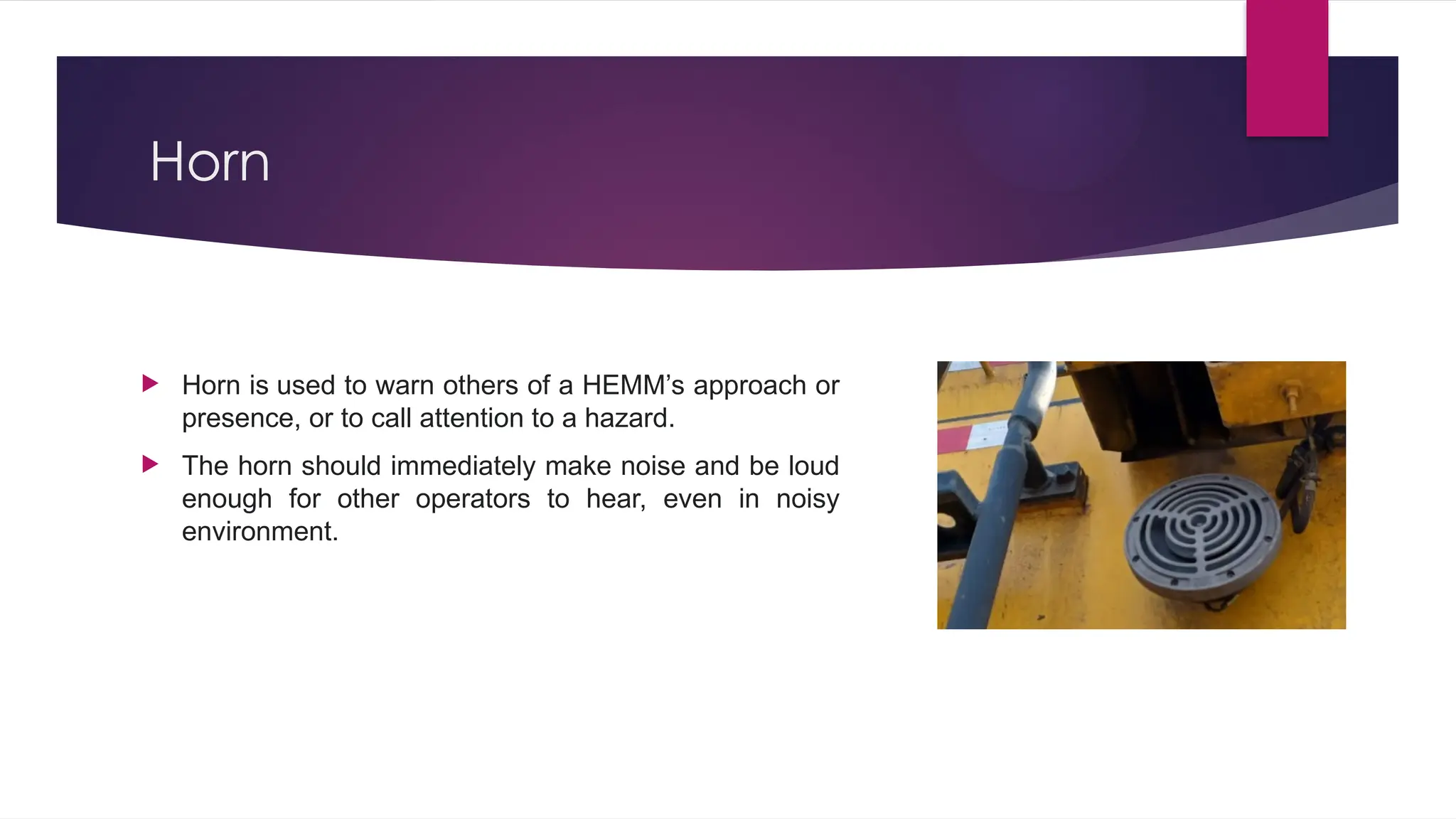
Horn
 Horn is used to warn others of a HEMM’s approach or
presence, or to call attention to a hazard.
 The horn should immediately make noise and be loud
enough for other operators to hear, even in noisy
environment.
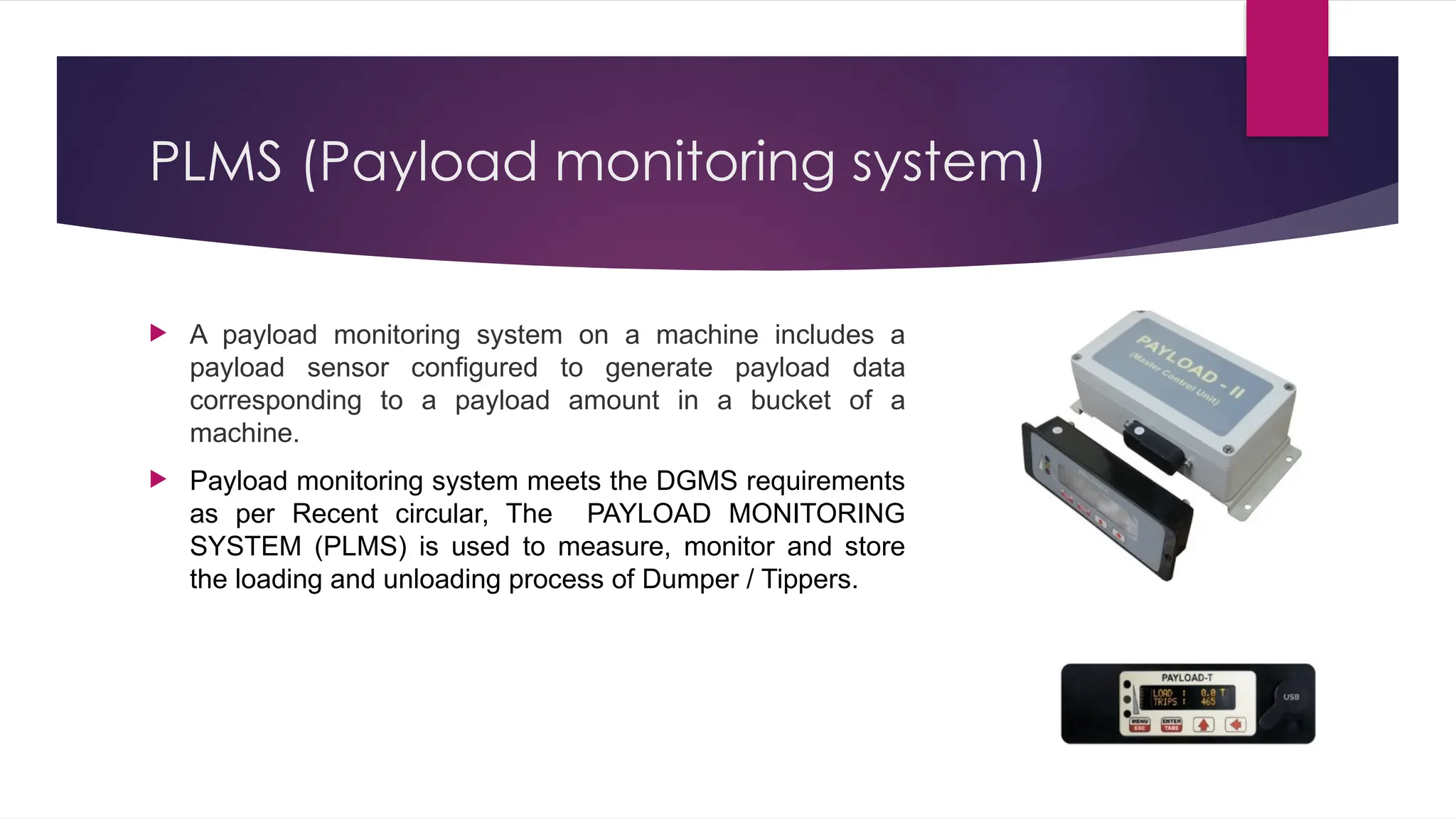
PLMS (Payload monitoring system)
 A payload monitoring system on a machine includes a
payload sensor configured to generate payload data
corresponding to a payload amount in a bucket of a
machine.
 Payload monitoring system meets the DGMS requirements
as per Recent circular, The PAYLOAD MONITORING
SYSTEM (PLMS) is used to measure, monitor and store
the loading and unloading process of Dumper / Tippers.

Safety process and various available method

  • 1.
    Brakes  Front :Hydraulically actuated Rockwell calliper disc.  Rear : Oil-cooled hydraulically actuated multiple disc brakes .  Brakes are sealed for protection from environmental contaminants.  Automatic emergency brake system : Unique designed brake control module constantly monitors brake pressure in the dual brake accumulators and will activate an audio - visual alarm if pressure on either accumulator drops below a tolerable level. If pressure should continue to drop, service brakes will automatically apply.
  • 2.
    Brakes  Manual emergencybraking system : In the event of failure of the brake pedal, the service brakes can be manually applied by an operator switch located on the instrument panel.  Parking brake : Spring applied hydraulically released in board Parking Brake.  Dynamic retarder : Constant speed retarder is provided by a separate foot pedal for the retarder function, allowing the operator to apply the retarder without removing his hands from the steering wheel.  Wheel brake lock : Controlled by a switch on control panel activates and locks brakes while loading and dumping.
  • 3.
    AFDSS  Automatic Operation,Option A:  At the time of fire, the temperature rises; the LHS cable detects the fire and gives signal to the control panel.  The control panel starts alarm to alert driver, and the personnel of the surrounding area. It also gives visual signal on control panel.  After few second it energies the electromechanical actuator which puncture rapture disc located in expellant cartridge valve.  From expellant cartridge pressurized gas, enters into main cylinder which is filled with fire extinguisher agent.  Expellant gas fluidizes fire extinguishing agent and it flows through distribution system to fixed nozzles and on fire area and fire gets suppressed.  Manually, Option B:  In the event of fire, Vehicle Driver can also activate system manually.  By operating directly electromechanical actuator through separate switch provided in control panel or  By knob provided a) At the electromechanical actuator b) on pilot cartridge assembly located on the ground floor near stairs.
  • 4.
    Emergency steering andbraking  An accumulator is an energy storage device: a device which accepts energy, stores energy, and releases energy as needed.  In the event of emergency breakdown, the emergency brake and steering system uses the energy from the accumulator and allows the operator to position the HEMM to a position of safety.
  • 5.
    Manual fire extinguisher Fire extinguishers apply an agent that will cool burning heat, smother fuel or remove oxygen so the fire cannot continue to burn.  A portable fire extinguisher can quickly control a small fire if applied by an individual properly trained.
  • 6.
    AVA  Audio VisualAlarm is used for the purpose of reversing with the guidance of audible and visual indication.  In open cast mines while reversing equipment, especially dumpers and tippers, the audio-visual alarm plays a significant role in warning pedestrians.  Protection : The Audio Visual Alarm is water and Dust proof.  The system is manufactured and tested as per DGMS requirement mentioned in their circular No. 01/2010.
  • 7.
    ROPS and FOPS(Rollover/Falling object protection system)  HEMM’s working in field are exposed to the risk of overturning, on the other hand, the operator of HEMM’s working can be endangered by an object falling on the roof of the cab.  For better safety of the operator, HEMM’s are equipped with protective structures:  Roll-Over Protective Structures (ROPS): It prevents rolling/overturning of HEMM’s  Falling-Object Protective Structures (FOPS): It protects the structure of HEMM’s during an object fall on it, for which it has to go through destructive test.
  • 8.
    Proximity warning device Blind spots tend to be much larger on mining equipments/ HEMM’s and include not only the rear and nearside but also the front, especially with elevated operator positions.  Terrains are harsh, vehicles are exposed to the elements more aggressively whilst thick dust and darkness decrease visibility further.  The ISO 5006 standard for HEMM’s addresses the problem of blind spots around a vehicle.  It states that in order to enable proper, effective and safe operation the operator must be able to ‘detect the presence of a standing person (of approximately. 1.5m tall), 1m out from the perimeter of the machine.’  Camera monitor systems provide this to some extent, but in difficult conditions a range of complementary devices are vital to give visual and audible operator warnings
  • 9.
    Rear view camera A back-up camera, also called reversing camera or rearview camera, is a special type of camera attached to the rear of the HEMM.  It helps to see the area behind the HEMM’s when backing up. It provides more visibility behind the HEMM’s than by turning the head  Automatically enabled when switched to reverse gear
  • 10.
    Rear view mirrorand blind spot mirror  HEMM’s rear-view mirror serves a multitude of purposes that help keep operator safe.  The rear-view mirror promotes an alert operating experience by allowing to see behind the HEMM without turning the head.  By checking the rear-view mirror, operator can monitor traffic and prepare for any potential dangers  A blind spot mirror provides a clear view of the area that both standard internal rearview mirror and side mirrors cannot cover.  Especially in a Mining environment, where other HEMM’s often wander around, having a blind spot mirror might not be a bad idea.
  • 11.
    Operator fatigue sensor Operator’s normally aren't aware of fatigue before the actual accident happens.  One of the most important functions of operator fatigue alarm system is to let the operators understand they are actually in fatigue operation and increase their alertness level.  Once the drowsiness detection system detects the operator is under fatigue , it will send out a sharp and loud sounds alarm immediately to the operator in cab based on pupil detection technology  This helpful function senses fading concentration levels by intelligently measuring Operator’s pedal and steering wheel use, in addition to transverse acceleration.  Particularly handy during continuous operation, this system ensures that you stay alert and reduces the risk of getting into an accident.
  • 12.
    Seat Belt  Aseat belt (also known as a safety belt) is a HEMM’s safety device designed to secure the operator of a HEMM against harmful movement that may result during a collision or a sudden stop.  Seat belts prevent operators from being ejected during a crash.
  • 13.
    Horn  Horn isused to warn others of a HEMM’s approach or presence, or to call attention to a hazard.  The horn should immediately make noise and be loud enough for other operators to hear, even in noisy environment.
  • 14.
    PLMS (Payload monitoringsystem)  A payload monitoring system on a machine includes a payload sensor configured to generate payload data corresponding to a payload amount in a bucket of a machine.  Payload monitoring system meets the DGMS requirements as per Recent circular, The PAYLOAD MONITORING SYSTEM (PLMS) is used to measure, monitor and store the loading and unloading process of Dumper / Tippers.