Electrical Safety
 29 CFR 1910 Subpart S
Objectives
In this course, we will discuss the following:
 Recent changes to the regulation
 Common electrical hazards
 Electrical equipment defects/hazards
 Tools/techniques used in identifying hazards
 Safe working practices
Electrical Hazards
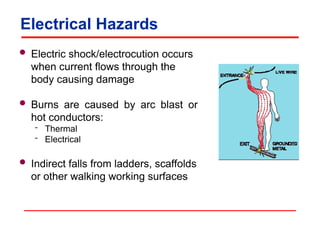
 Electric shock/electrocution occurs
when current flows through the
body causing damage
 Burns are caused by arc blast or
hot conductors:
 Thermal
 Electrical
 Indirect falls from ladders, scaffolds
or other walking working surfaces
Electrical Hazards
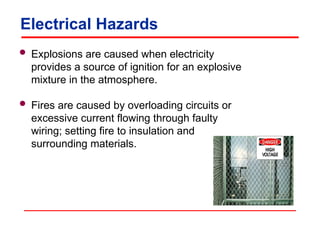
 Explosions are caused when electricity
provides a source of ignition for an explosive
mixture in the atmosphere.
 Fires are caused by overloading circuits or
excessive current flowing through faulty
wiring; setting fire to insulation and
surrounding materials.
Electrical Utilization Systems
Scope and application
 Electrical installations and utilization equipment installed or
used within or on buildings, structures and other premises:
» Yards
» Carnivals
» Parking and other lots
» Mobile homes
» Recreational vehicles
» Industrial substations
» Conductors that connect the installations to a supply of
electricity
» Other outside conductors on the premises
1910.302(a)
 Not covered
 Installations in ships
 Installations underground in mines
 Installations of railways for generation exclusively for signaling
and communication purposes
 Installations of communication equipment under the exclusive
control of communication utilities
 Installations under the exclusive control of electric utilities for the
purpose of communication or metering
Electrical Utilization Systems 1910.302(a)
Extent of Application
 These requirements are applicable to all installations, regardless of
when they were designed or installed §§1910.302 (b)(1).
 Installations made after March 15, 1972, shall comply with the
provisions of §§1910.302 through 1910.308, except paragraphs (b)
(3) and (b)(4) of this section.
 Requirements applicable to installations made after April 16, 1981
§§1910.302 (b)(1) and §§1910.302 (b)(3).
 Requirements applicable to installations made after August 13, 2007
§§1910.302 (b)(1), §§1910.302 (b)(3) and §§1910.302 (b)(4).
1910.302(b)
General Requirements
Examination, installation, and use of
equipment
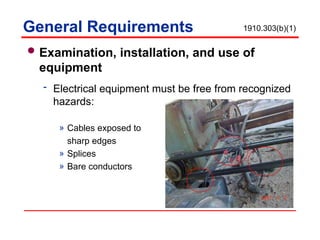
 Electrical equipment must be free from recognized
hazards:
» Cables exposed to
sharp edges
» Splices
» Bare conductors
1910.303(b)(1)
General Requirements
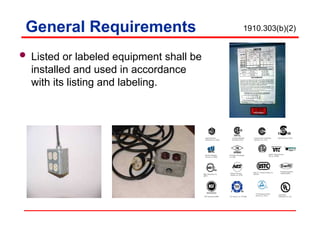
 Listed or labeled equipment shall be
installed and used in accordance
with its listing and labeling.
1910.303(b)(2)
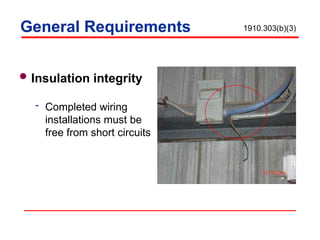
Insulation integrity
 Completed wiring
installations must be
free from short circuits
General Requirements 1910.303(b)(3)
General Requirements
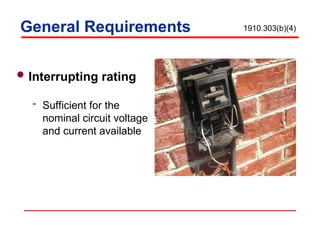
Interrupting rating
 Sufficient for the
nominal circuit voltage
and current available
1910.303(b)(4)
General Requirements
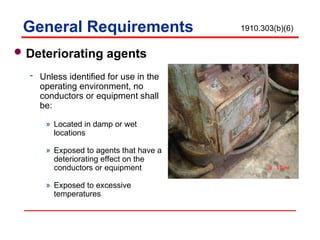
Deteriorating agents
 Unless identified for use in the
operating environment, no
conductors or equipment shall
be:
» Located in damp or wet
locations
» Exposed to agents that have a
deteriorating effect on the
conductors or equipment
» Exposed to excessive
temperatures
1910.303(b)(6)
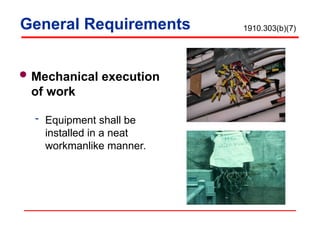
Mechanical execution
of work
 Equipment shall be
installed in a neat
workmanlike manner.
General Requirements 1910.303(b)(7)
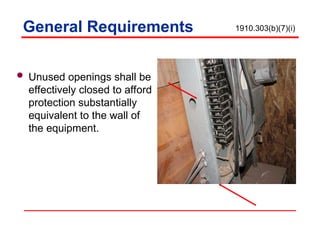
 Unused openings shall be
effectively closed to afford
protection substantially
equivalent to the wall of
the equipment.
General Requirements 1910.303(b)(7)(i)
General Requirements
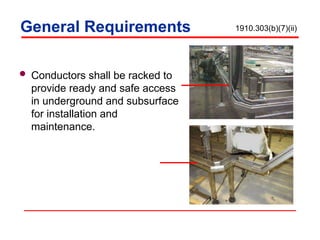
 Conductors shall be racked to
provide ready and safe access
in underground and subsurface
for installation and
maintenance.
1910.303(b)(7)(ii)
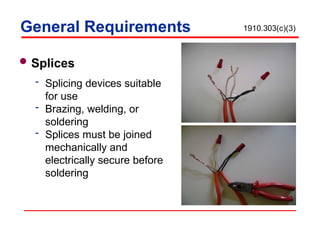
Splices
 Splicing devices suitable
for use
 Brazing, welding, or
soldering
 Splices must be joined
mechanically and
electrically secure before
soldering
General Requirements 1910.303(c)(3)
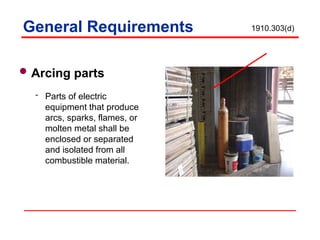
Arcing parts
 Parts of electric
equipment that produce
arcs, sparks, flames, or
molten metal shall be
enclosed or separated
and isolated from all
combustible material.
General Requirements 1910.303(d)
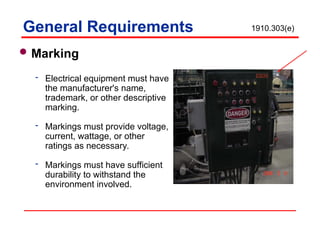
Marking
 Electrical equipment must have
the manufacturer's name,
trademark, or other descriptive
marking.
 Markings must provide voltage,
current, wattage, or other
ratings as necessary.
 Markings must have sufficient
durability to withstand the
environment involved.
General Requirements 1910.303(e)
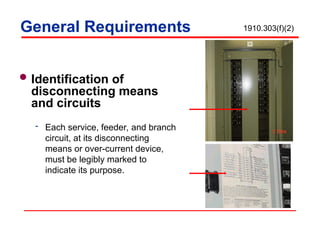
General Requirements
Identification of
disconnecting means
and circuits
 Each service, feeder, and branch
circuit, at its disconnecting
means or over-current device,
must be legibly marked to
indicate its purpose.
1910.303(f)(2)
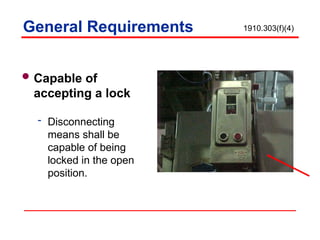
Capable of
accepting a lock
 Disconnecting
means shall be
capable of being
locked in the open
position.
General Requirements 1910.303(f)(4)
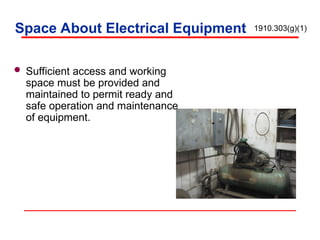
Space About Electrical Equipment
 Sufficient access and working
space must be provided and
maintained to permit ready and
safe operation and maintenance
of equipment.
1910.303(g)(1)
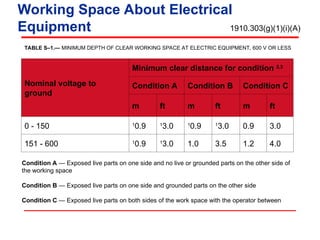
Working Space About Electrical
Equipment
TABLE S–1.— MINIMUM DEPTH OF CLEAR WORKING SPACE AT ELECTRIC EQUIPMENT, 600 V OR LESS
Nominal voltage to
ground
Minimum clear distance for condition 2,3
Condition A Condition B Condition C
m ft m ft m ft
0 - 150 1
0.9 1
3.0 1
0.9 1
3.0 0.9 3.0
151 - 600 1
0.9 1
3.0 1.0 3.5 1.2 4.0
Condition A — Exposed live parts on one side and no live or grounded parts on the other side of
the working space
Condition B — Exposed live parts on one side and grounded parts on the other side
Condition C — Exposed live parts on both sides of the work space with the operator between
1910.303(g)(1)(i)(A)
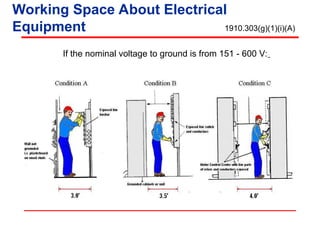
If the nominal voltage to ground is from 151 - 600 V:
Working Space About Electrical
Equipment 1910.303(g)(1)(i)(A)
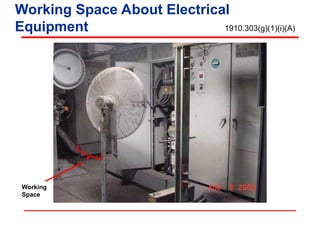
Working Space About Electrical
Equipment
Working
Space
1910.303(g)(1)(i)(A)
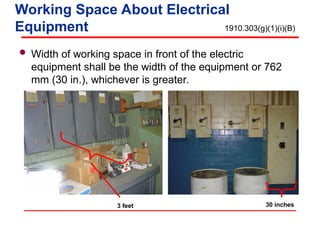
 Width of working space in front of the electric
equipment shall be the width of the equipment or 762
mm (30 in.), whichever is greater.
Working Space About Electrical
Equipment
30 inches
3 feet
1910.303(g)(1)(i)(B)
Guarding of Live Parts
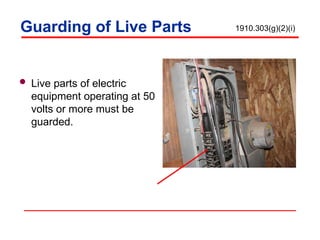
 Live parts of electric
equipment operating at 50
volts or more must be
guarded.
1910.303(g)(2)(i)
Wiring Design and Protection
Polarity of
connections
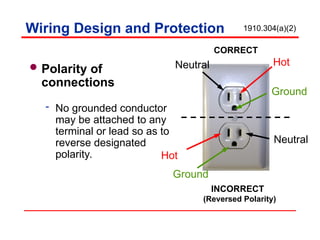
 No grounded conductor
may be attached to any
terminal or lead so as to
reverse designated
polarity.
1910.304(a)(2)
Ground
Hot
Ground
Neutral
Neutral
Hot
CORRECT
INCORRECT
(Reversed Polarity)
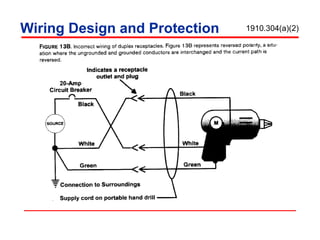
Wiring Design and Protection 1910.304(a)(2)
Receptacles and Cord Connectors
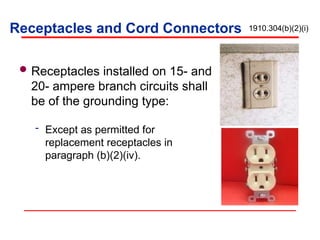
Receptacles installed on 15- and
20- ampere branch circuits shall
be of the grounding type:
 Except as permitted for
replacement receptacles in
paragraph (b)(2)(iv).
1910.304(b)(2)(i)
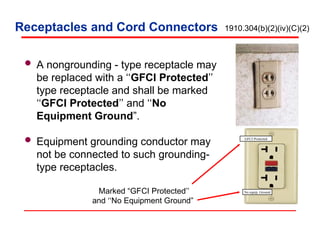
 A nongrounding - type receptacle may
be replaced with a ‘‘GFCI Protected’’
type receptacle and shall be marked
‘‘GFCI Protected’’ and ‘‘No
Equipment Ground”.
 Equipment grounding conductor may
not be connected to such grounding-
type receptacles.
Receptacles and Cord Connectors
Marked “GFCI Protected’’
and ‘‘No Equipment Ground”
No equip. Ground
GFCI Protected
1910.304(b)(2)(iv)(C)(2)
GFCI Protection for Personnel
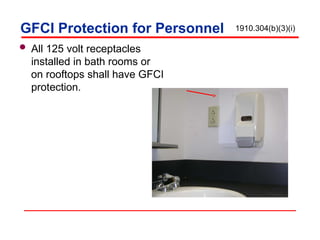
 All 125 volt receptacles
installed in bath rooms or
on rooftops shall have GFCI
protection.
1910.304(b)(3)(i)
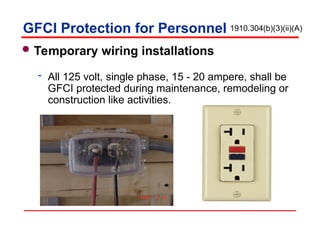
Temporary wiring installations
 All 125 volt, single phase, 15 - 20 ampere, shall be
GFCI protected during maintenance, remodeling or
construction like activities.
GFCI Protection for Personnel 1910.304(b)(3)(ii)(A)
 Portable GFCI
GFCI Protection for Personnel 1910.304(b)(3)(ii)(A)
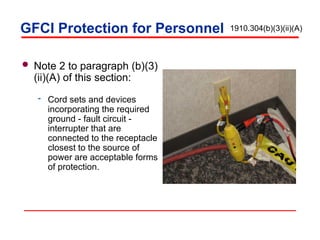
 Note 2 to paragraph (b)(3)
(ii)(A) of this section:
 Cord sets and devices
incorporating the required
ground - fault circuit -
interrupter that are
connected to the receptacle
closest to the source of
power are acceptable forms
of protection.
GFCI Protection for Personnel 1910.304(b)(3)(ii)(A)
GFCI Protection for Personnel
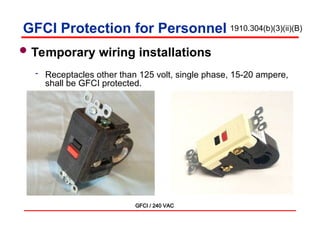
Temporary wiring installations
 Receptacles other than 125 volt, single phase, 15-20 ampere,
shall be GFCI protected.
GFCI / 240 VAC
1910.304(b)(3)(ii)(B)
Outlet Devices
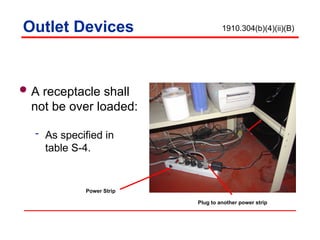
A receptacle shall
not be over loaded:
 As specified in
table S-4.
1910.304(b)(4)(ii)(B)
Power Strip
Plug to another power strip
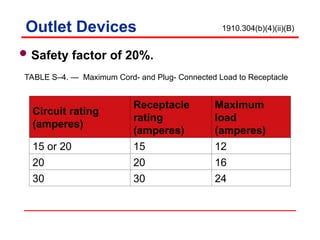
Safety factor of 20%.
Outlet Devices
TABLE S–4. — Maximum Cord- and Plug- Connected Load to Receptacle
Circuit rating
(amperes)
Receptacle
rating
(amperes)
Maximum
load
(amperes)
15 or 20 15 12
20 20 16
30 30 24
1910.304(b)(4)(ii)(B)
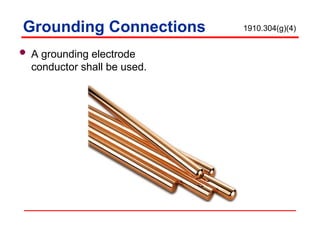
Grounding Connections
 A grounding electrode
conductor shall be used.
1910.304(g)(4)
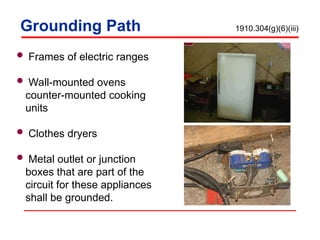
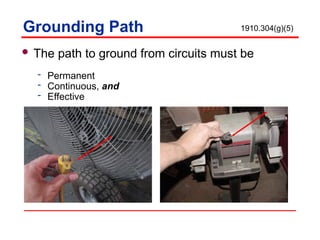
Grounding Path
 The path to ground from circuits must be
 Permanent
 Continuous, and
 Effective
1910.304(g)(5)
Grounding Path 1910.304(g)(6)(iii)
 Frames of electric ranges
 Wall-mounted ovens
counter-mounted cooking
units
 Clothes dryers
 Metal outlet or junction
boxes that are part of the
circuit for these appliances
shall be grounded.
Wiring Methods, Components, and
Equipment
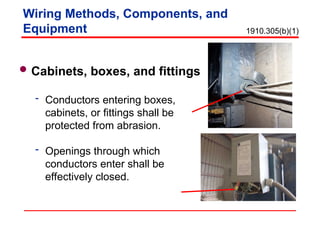
Cabinets, boxes, and fittings
 Conductors entering boxes,
cabinets, or fittings shall be
protected from abrasion.
 Openings through which
conductors enter shall be
effectively closed.
1910.305(b)(1)
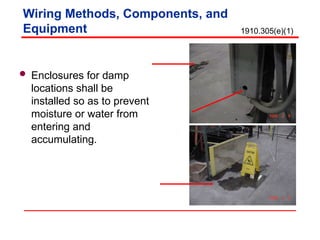
 Enclosures for damp
locations shall be
installed so as to prevent
moisture or water from
entering and
accumulating.
Wiring Methods, Components, and
Equipment 1910.305(e)(1)
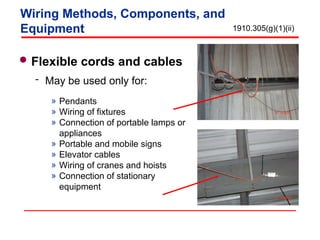
Flexible cords and cables
 May be used only for:
» Pendants
» Wiring of fixtures
» Connection of portable lamps or
appliances
» Portable and mobile signs
» Elevator cables
» Wiring of cranes and hoists
» Connection of stationary
equipment
1910.305(g)(1)(ii)
Wiring Methods, Components, and
Equipment
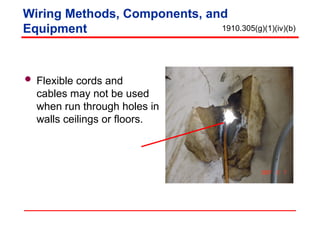
 Flexible cords and
cables may not be used
when run through holes in
walls ceilings or floors.
Wiring Methods, Components, and
Equipment 1910.305(g)(1)(iv)(b)
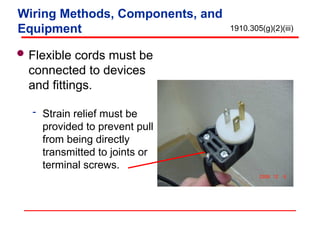
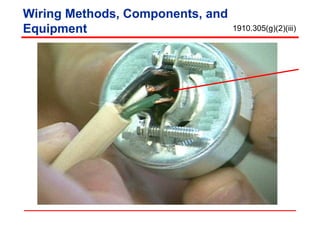
Flexible cords must be
connected to devices
and fittings.
 Strain relief must be
provided to prevent pull
from being directly
transmitted to joints or
terminal screws.
1910.305(g)(2)(iii)
Wiring Methods, Components, and
Equipment
1910.305(g)(2)(iii)
Wiring Methods, Components, and
Equipment
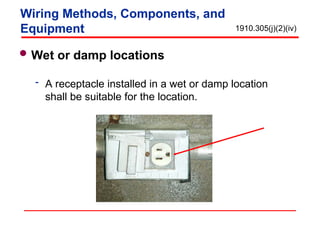
Wet or damp locations
 A receptacle installed in a wet or damp location
shall be suitable for the location.
1910.305(j)(2)(iv)
Wiring Methods, Components, and
Equipment
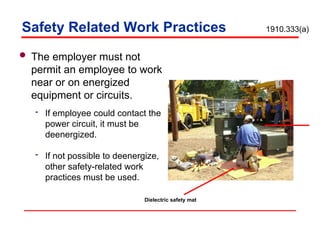
 The employer must not
permit an employee to work
near or on energized
equipment or circuits.
 If employee could contact the
power circuit, it must be
deenergized.
 If not possible to deenergize,
other safety-related work
practices must be used.
Safety Related Work Practices 1910.333(a)
Dielectric safety mat
Summary
• In this course, we discussed:
 Recent changes to the regulation
 Common electrical hazards
 Electrical equipment defects/hazards
 Tools/techniques used in identifying hazards
 Safe working practices
Thank You For Attending!
Final Questions?

Safety and environment, Electrical General.ppt

  • 1.
    Electrical Safety  29CFR 1910 Subpart S
  • 2.
    Objectives In this course,we will discuss the following:  Recent changes to the regulation  Common electrical hazards  Electrical equipment defects/hazards  Tools/techniques used in identifying hazards  Safe working practices
  • 3.
    Electrical Hazards  Electricshock/electrocution occurs when current flows through the body causing damage  Burns are caused by arc blast or hot conductors:  Thermal  Electrical  Indirect falls from ladders, scaffolds or other walking working surfaces
  • 4.
    Electrical Hazards  Explosionsare caused when electricity provides a source of ignition for an explosive mixture in the atmosphere.  Fires are caused by overloading circuits or excessive current flowing through faulty wiring; setting fire to insulation and surrounding materials.
  • 5.
    Electrical Utilization Systems Scopeand application  Electrical installations and utilization equipment installed or used within or on buildings, structures and other premises: » Yards » Carnivals » Parking and other lots » Mobile homes » Recreational vehicles » Industrial substations » Conductors that connect the installations to a supply of electricity » Other outside conductors on the premises 1910.302(a)
  • 6.
     Not covered Installations in ships  Installations underground in mines  Installations of railways for generation exclusively for signaling and communication purposes  Installations of communication equipment under the exclusive control of communication utilities  Installations under the exclusive control of electric utilities for the purpose of communication or metering Electrical Utilization Systems 1910.302(a)
  • 7.
    Extent of Application These requirements are applicable to all installations, regardless of when they were designed or installed §§1910.302 (b)(1).  Installations made after March 15, 1972, shall comply with the provisions of §§1910.302 through 1910.308, except paragraphs (b) (3) and (b)(4) of this section.  Requirements applicable to installations made after April 16, 1981 §§1910.302 (b)(1) and §§1910.302 (b)(3).  Requirements applicable to installations made after August 13, 2007 §§1910.302 (b)(1), §§1910.302 (b)(3) and §§1910.302 (b)(4). 1910.302(b)
  • 8.
    General Requirements Examination, installation,and use of equipment  Electrical equipment must be free from recognized hazards: » Cables exposed to sharp edges » Splices » Bare conductors 1910.303(b)(1)
  • 9.
    General Requirements  Listedor labeled equipment shall be installed and used in accordance with its listing and labeling. 1910.303(b)(2)
  • 10.
    Insulation integrity  Completedwiring installations must be free from short circuits General Requirements 1910.303(b)(3)
  • 11.
    General Requirements Interrupting rating Sufficient for the nominal circuit voltage and current available 1910.303(b)(4)
  • 12.
    General Requirements Deteriorating agents Unless identified for use in the operating environment, no conductors or equipment shall be: » Located in damp or wet locations » Exposed to agents that have a deteriorating effect on the conductors or equipment » Exposed to excessive temperatures 1910.303(b)(6)
  • 13.
    Mechanical execution of work Equipment shall be installed in a neat workmanlike manner. General Requirements 1910.303(b)(7)
  • 14.
     Unused openingsshall be effectively closed to afford protection substantially equivalent to the wall of the equipment. General Requirements 1910.303(b)(7)(i)
  • 15.
    General Requirements  Conductorsshall be racked to provide ready and safe access in underground and subsurface for installation and maintenance. 1910.303(b)(7)(ii)
  • 16.
    Splices  Splicing devicessuitable for use  Brazing, welding, or soldering  Splices must be joined mechanically and electrically secure before soldering General Requirements 1910.303(c)(3)
  • 17.
    Arcing parts  Partsof electric equipment that produce arcs, sparks, flames, or molten metal shall be enclosed or separated and isolated from all combustible material. General Requirements 1910.303(d)
  • 18.
    Marking  Electrical equipmentmust have the manufacturer's name, trademark, or other descriptive marking.  Markings must provide voltage, current, wattage, or other ratings as necessary.  Markings must have sufficient durability to withstand the environment involved. General Requirements 1910.303(e)
  • 19.
    General Requirements Identification of disconnectingmeans and circuits  Each service, feeder, and branch circuit, at its disconnecting means or over-current device, must be legibly marked to indicate its purpose. 1910.303(f)(2)
  • 20.
    Capable of accepting alock  Disconnecting means shall be capable of being locked in the open position. General Requirements 1910.303(f)(4)
  • 21.
    Space About ElectricalEquipment  Sufficient access and working space must be provided and maintained to permit ready and safe operation and maintenance of equipment. 1910.303(g)(1)
  • 22.
    Working Space AboutElectrical Equipment TABLE S–1.— MINIMUM DEPTH OF CLEAR WORKING SPACE AT ELECTRIC EQUIPMENT, 600 V OR LESS Nominal voltage to ground Minimum clear distance for condition 2,3 Condition A Condition B Condition C m ft m ft m ft 0 - 150 1 0.9 1 3.0 1 0.9 1 3.0 0.9 3.0 151 - 600 1 0.9 1 3.0 1.0 3.5 1.2 4.0 Condition A — Exposed live parts on one side and no live or grounded parts on the other side of the working space Condition B — Exposed live parts on one side and grounded parts on the other side Condition C — Exposed live parts on both sides of the work space with the operator between 1910.303(g)(1)(i)(A)
  • 23.
    If the nominalvoltage to ground is from 151 - 600 V: Working Space About Electrical Equipment 1910.303(g)(1)(i)(A)
  • 24.
    Working Space AboutElectrical Equipment Working Space 1910.303(g)(1)(i)(A)
  • 25.
     Width ofworking space in front of the electric equipment shall be the width of the equipment or 762 mm (30 in.), whichever is greater. Working Space About Electrical Equipment 30 inches 3 feet 1910.303(g)(1)(i)(B)
  • 26.
    Guarding of LiveParts  Live parts of electric equipment operating at 50 volts or more must be guarded. 1910.303(g)(2)(i)
  • 27.
    Wiring Design andProtection Polarity of connections  No grounded conductor may be attached to any terminal or lead so as to reverse designated polarity. 1910.304(a)(2) Ground Hot Ground Neutral Neutral Hot CORRECT INCORRECT (Reversed Polarity)
  • 28.
    Wiring Design andProtection 1910.304(a)(2)
  • 29.
    Receptacles and CordConnectors Receptacles installed on 15- and 20- ampere branch circuits shall be of the grounding type:  Except as permitted for replacement receptacles in paragraph (b)(2)(iv). 1910.304(b)(2)(i)
  • 30.
     A nongrounding- type receptacle may be replaced with a ‘‘GFCI Protected’’ type receptacle and shall be marked ‘‘GFCI Protected’’ and ‘‘No Equipment Ground”.  Equipment grounding conductor may not be connected to such grounding- type receptacles. Receptacles and Cord Connectors Marked “GFCI Protected’’ and ‘‘No Equipment Ground” No equip. Ground GFCI Protected 1910.304(b)(2)(iv)(C)(2)
  • 31.
    GFCI Protection forPersonnel  All 125 volt receptacles installed in bath rooms or on rooftops shall have GFCI protection. 1910.304(b)(3)(i)
  • 32.
    Temporary wiring installations All 125 volt, single phase, 15 - 20 ampere, shall be GFCI protected during maintenance, remodeling or construction like activities. GFCI Protection for Personnel 1910.304(b)(3)(ii)(A)
  • 33.
     Portable GFCI GFCIProtection for Personnel 1910.304(b)(3)(ii)(A)
  • 34.
     Note 2to paragraph (b)(3) (ii)(A) of this section:  Cord sets and devices incorporating the required ground - fault circuit - interrupter that are connected to the receptacle closest to the source of power are acceptable forms of protection. GFCI Protection for Personnel 1910.304(b)(3)(ii)(A)
  • 35.
    GFCI Protection forPersonnel Temporary wiring installations  Receptacles other than 125 volt, single phase, 15-20 ampere, shall be GFCI protected. GFCI / 240 VAC 1910.304(b)(3)(ii)(B)
  • 36.
    Outlet Devices A receptacleshall not be over loaded:  As specified in table S-4. 1910.304(b)(4)(ii)(B) Power Strip Plug to another power strip
  • 37.
    Safety factor of20%. Outlet Devices TABLE S–4. — Maximum Cord- and Plug- Connected Load to Receptacle Circuit rating (amperes) Receptacle rating (amperes) Maximum load (amperes) 15 or 20 15 12 20 20 16 30 30 24 1910.304(b)(4)(ii)(B)
  • 38.
    Grounding Connections  Agrounding electrode conductor shall be used. 1910.304(g)(4)
  • 39.
    Grounding Path  Thepath to ground from circuits must be  Permanent  Continuous, and  Effective 1910.304(g)(5)
  • 40.
    Grounding Path 1910.304(g)(6)(iii) Frames of electric ranges  Wall-mounted ovens counter-mounted cooking units  Clothes dryers  Metal outlet or junction boxes that are part of the circuit for these appliances shall be grounded.
  • 41.
    Wiring Methods, Components,and Equipment Cabinets, boxes, and fittings  Conductors entering boxes, cabinets, or fittings shall be protected from abrasion.  Openings through which conductors enter shall be effectively closed. 1910.305(b)(1)
  • 42.
     Enclosures fordamp locations shall be installed so as to prevent moisture or water from entering and accumulating. Wiring Methods, Components, and Equipment 1910.305(e)(1)
  • 43.
    Flexible cords andcables  May be used only for: » Pendants » Wiring of fixtures » Connection of portable lamps or appliances » Portable and mobile signs » Elevator cables » Wiring of cranes and hoists » Connection of stationary equipment 1910.305(g)(1)(ii) Wiring Methods, Components, and Equipment
  • 44.
     Flexible cordsand cables may not be used when run through holes in walls ceilings or floors. Wiring Methods, Components, and Equipment 1910.305(g)(1)(iv)(b)
  • 45.
    Flexible cords mustbe connected to devices and fittings.  Strain relief must be provided to prevent pull from being directly transmitted to joints or terminal screws. 1910.305(g)(2)(iii) Wiring Methods, Components, and Equipment
  • 46.
  • 47.
    Wet or damplocations  A receptacle installed in a wet or damp location shall be suitable for the location. 1910.305(j)(2)(iv) Wiring Methods, Components, and Equipment
  • 48.
     The employermust not permit an employee to work near or on energized equipment or circuits.  If employee could contact the power circuit, it must be deenergized.  If not possible to deenergize, other safety-related work practices must be used. Safety Related Work Practices 1910.333(a) Dielectric safety mat
  • 49.
    Summary • In thiscourse, we discussed:  Recent changes to the regulation  Common electrical hazards  Electrical equipment defects/hazards  Tools/techniques used in identifying hazards  Safe working practices
  • 50.
    Thank You ForAttending! Final Questions?

Editor's Notes

  • #1 The information in this presentation is provided voluntarily by the N.C. Department of Labor, Education Training and Technical Assistance Bureau as a public service and is made available in good faith. This presentation is designed to assist trainers conducting OSHA outreach training for workers. Since workers are the target audience, this presentation emphasizes hazard identification, avoidance, and control – not standards. No attempt has been made to treat the topic exhaustively. It is essential that trainers tailor their presentations to the needs and understanding of their audience. The information and advice provided on this site and on linked sites is provided solely on the basis that users will be responsible for making their own assessment of the matters discussed herein and are advised to verify all relevant representations, statements, and information. This presentation is not a substitute for any of the provisions of the Occupational Safety and Health Act of North Carolina or for any standards issued by the N.C. Department of Labor. Mention of trade names, commercial products, or organizations does not imply endorsement by the N.C. Department of Labor.
  • #8 Photo source: NCDOL
  • #9 Photo source: NCDOL
  • #10 Photo source: NCDOL
  • #11 Photo source: NCDOL
  • #12 Photo source: NCDOL
  • #13 Photo source: NCDOL
  • #14  Photo source: NCDOL
  • #15  Photo source: www.niedaxusa.com
  • #16 Photo source: NCDOL
  • #17 Photo source: NCDOL
  • #18 Photo source: NCDOL
  • #19 Photo source: NCDOL
  • #20 Photo source: NCDOL
  • #21 Photo source: NCDOL
  • #22 Graphic source: CFR 1910 North Carolina.
  • #23 Graphics source: An Illustrated Guide to Electrical Safety, 5th Edition.
  • #24 Photo source: NCDOL
  • #25 Photo source: NCDOL
  • #26 Photo source: NCDOL
  • #27 Photo source: NCDOL
  • #28 Graphic source: An Illustrated Guide to Electrical Safety, 5th Edition.
  • #29 Photo source: NCDOL
  • #30 Photo source: NCDOL
  • #31  Photo source: NCDOL
  • #32 Photo source: NCDOL
  • #33 Photo source: NCDOL
  • #34 Photo source: NCDOL
  • #35 Photo source: NCDOL
  • #36 Photo source: NCDOL
  • #37 Graphic source: CFR 1910 North Carolina.
  • #38 Photo source: www.stormcopper.com
  • #39 Photo source: NCDOL
  • #40 Photo source: NCDOL
  • #41 Photo source: NCDOL
  • #42 Photo source: NCDOL
  • #43 Photo source: NCDOL
  • #44 Photo source: NCDOL
  • #45  Photo source: NCDOL
  • #46 Photo source: NCDOL
  • #47 Photo source: NCDOL
  • #48 Photo source: NCDOL