Adapted from www.fustero.es
Lesson8 for May 24, 2025
www.gmahktanjungpinang.org
“Then I looked, and behold, a Lamb standing on Mount
Zion, and with Him one hundred and forty-four
thousand, having His Father’s name written on their
foreheads” Revelation 14:1, NKJV
2.
“Then I looked,and behold, a
Lamb standing on Mount Zion,
and with Him one hundred and
forty-four thousand, having
His Father’s name written on
their foreheads”
Revelation 14:1, NKJV
3.
Psalm 122: TheHeavenly Sanctuary
Psalms 15 and 24: The Holy Mountain
Psalm 119: The Name of God
Psalm 5: The Redeemed
Psalm 51: The Proclamation of the Gospel
Beyond its function as a hymnal to be used in public and private
worship, the book of Psalms is an eminently prophetic book,
written by prophets (Acts 2:30-31).
The New Testament authors used it as a prophetic text to show that
Jesus was the Messiah (e.g., Acts 13:33; Heb. 1:8).
But Psalms are not limited to prophesying about Jesus' earthly
ministry, but are rich in various themes related to the history of
Redemption.
4.
By studying thedetails of Israel's Sanctuary and Temple, we see how
God related to his people and how he taught the Plan of Redemption.
By moving the ark, David centralized divine worship in Jerusalem.
That was where the house of God was located.
THE LAMPSTAND
Revelation 4:5
THE GOLDEN
ALTAR
Revelation 8:3;
14:18; 16:7
THE ARK
Revelation 11:19
Psalm 122 prophetically points to the gathering of the redeemed into the
New Jerusalem, to worship at the real, heavenly sanctuary (Heb. 8:1-2;
9:11-12, 24; Rev. 14:17; 21:3).
Revelation offers several visions of this Heavenly Sanctuary (from which the
Courtyard, which represents the Earth (Rev. 11:2), is excluded):
THE CELESTIAL SANCTUARY
Examining Psalm 122, we can also
appreciate other themes closely
linked to the message of Revelation:
praise (v. 4); judgment (v. 5); peace
(v. 6, 8); security (v. 7).
“I rejoiced with those who said to me, "Let us go to
the house of the LORD.’” (Psalm 122:1)
5.
“Christ, our greatHigh Priest, is “a minister of the sanctuary, and of the true
tabernacle, which the Lord pitched, and not man.” Hebrews 9:9, 23; 8:2. […]
The prophet was permitted to behold the first apartment of the sanctuary in
heaven; and he saw there the “seven lamps of fire” and the “golden altar”
represented by the golden candlestick and the altar of incense in the
sanctuary on earth. […] Here he beheld “the ark of His testament” (Revelation
11:19), represented by the sacred chest constructed by Moses to contain the
law of God.
Moses made the earthly sanctuary, “according to the fashion that he had
seen.” Paul declares that “the tabernacle, and all the vessels of the ministry,”
when completed, were “the patterns of things in the heavens.” Acts 7:44;
Hebrews 9:21, 23. And John says that he saw the sanctuary in heaven. That
sanctuary, in which Jesus ministers in our behalf, is the great original, of
which the sanctuary built by Moses was a copy.
EGW (Patriarchs and Prophets, pg. 324)
6.
Mount Zion occupiedpart of the city of Jerusalem
and, by extension, was used to name the hill where
the Temple was built (originally called Mount Moriah).
It is also called the holy mountain (Ps. 2:6), as it is a
symbol of God's throne (Is. 8:18).
He who walks uprightly does
righteousness and does not lie
(Ps. 15:2)
He who does not slander does no harm
to his neighbor, nor does he allow evil
to be spoken of (Ps. 15:3)
He who honors those who fear God
and does not change, even if it is
detrimental (Ps. 15:4)
He who does not love money nor can
be bribed (Ps. 15:5)
He who has clean hands and a pure
heart, who is neither proud nor a liar
(Ps. 24:4)
In prophetic writings, it is
used to define the place
where the redeemed will
gather (Is. 37:32; Ps. 74:2;
Rev. 14:1). Who will be able
to stand on Mount Zion with
Jesus?
Psalms 15 and 24 define
the characteristics of
those who are worthy to
be there.
THE HOLY MOUNTAIN
It's clear that none of us, on our own, meet all
these requirements. Therefore, we can only be
there by the grace and power of Jesus. Praise
be to Him!
“Lord, who may dwell in
your sacred tent? Who
may live on your holy
mountain?” (Psalm 15:1)
7.
“The vision ofthe prophet pictures them as standing on Mount
Zion, girt for holy service, clothed in white linen, which is the
righteousness of the saints. But all who follow the Lamb in
heaven must first have followed Him on earth, not fretfully or
capriciously, but in trustful, loving, willing obedience, as the
flock follows the shepherd.”
EGW (The Acts of the Apostles, p. 591)
8.
T HE NAMEOF GO D “In the night, Lord, I remember your name, that
I may keep your law!” (Psalm 119:55 NIV)
Mount Zion is also closely linked to the name of God (Is. 18:7;
Rev. 14:1). The name, especially in biblical times, was
associated with a person's character (Gen. 32:28).
Therefore, the name of God, inscribed on the forehead of the
redeemed, goes beyond the four Hebrew letters that define it:
יהוה (YWHW).
God’s name is his unique and unrepeatable character: “I AM
WHO I AM” (Ex. 3:14). His name—which is his character—is his
glory and his goodness (Ex. 33:18-19).
When the psalmist evoked the name of God
(meditated on his character), he was overcome
with the desire to keep God's Law (Ps. 119:55
NIV).
Why? Because God's Law is a transcript of His character. God's name will be
inscribed on the foreheads of those who love God and desire to obey His Law.
9.
“The glory ofChrist is his character, and
his character is an expression of the law
of God. He fulfilled the law in its every
specification, and gave to the world in
his life a perfect pattern of what it is
possible for humanity to attain unto by
cooperation with divinity. In his
humanity Christ was dependent upon the
Father, even as humanity is now
dependent upon God for divine power in
attaining unto perfection of character.”
EGW (The Signs of the Times, December 12, 1895)
10.
Psalm 5 drawsa sharp contrast between those who accept God and those
who reject him. This psalm anticipates the definition of the two groups
facing each other in the end-time: those who receive the name of God,
or the name of the beast (Rev. 13 and 14).
THE NAME OF THE BEAST
They shall not dwell with God
(Ps. 5:4)
They worship the beast
(Rev. 13:8)
They are liars (Ps. 5:9)
They will be punished (Ps. 5:10)
They blaspheme against God
(Rev. 13:6)
THE NAME OF GOD
They will dwell with God
(Rev. 14:1)
They worship God (Ps. 5:7)
They do not lie (Rev. 14:5)
They will be redeemed
(Rev. 14:4)
They proclaim salvation with joy
(Ps. 5:11; Rev. 14:6-7)
THE REDEEMED “For you are not a God who is pleased with wickedness;
with you, evil people are not welcome” (Psalm 5:4)
11.
“Difficulties will arisethat will try your faith and
patience. Face them bravely. Look on the bright side.
[…] Heaven is full of joy. It resounds with the praises
of Him who made so wonderful a sacrifice for the
redemption of the human race. Should not the
church on earth be full of praise? Should not
Christians publish throughout the world the joy of
serving Christ? […]
If you make a mistake, turn your defeat into victory.
The lessons that God sends will always, if well
learned, bring help in due time. Put your trust in
God. Pray much, and believe. Trusting, hoping,
believing, holding fast the hand of Infinite Power, you
will be more than conquerors.
EGW (Testimonies for the Church, volume 7, page 244)
12.
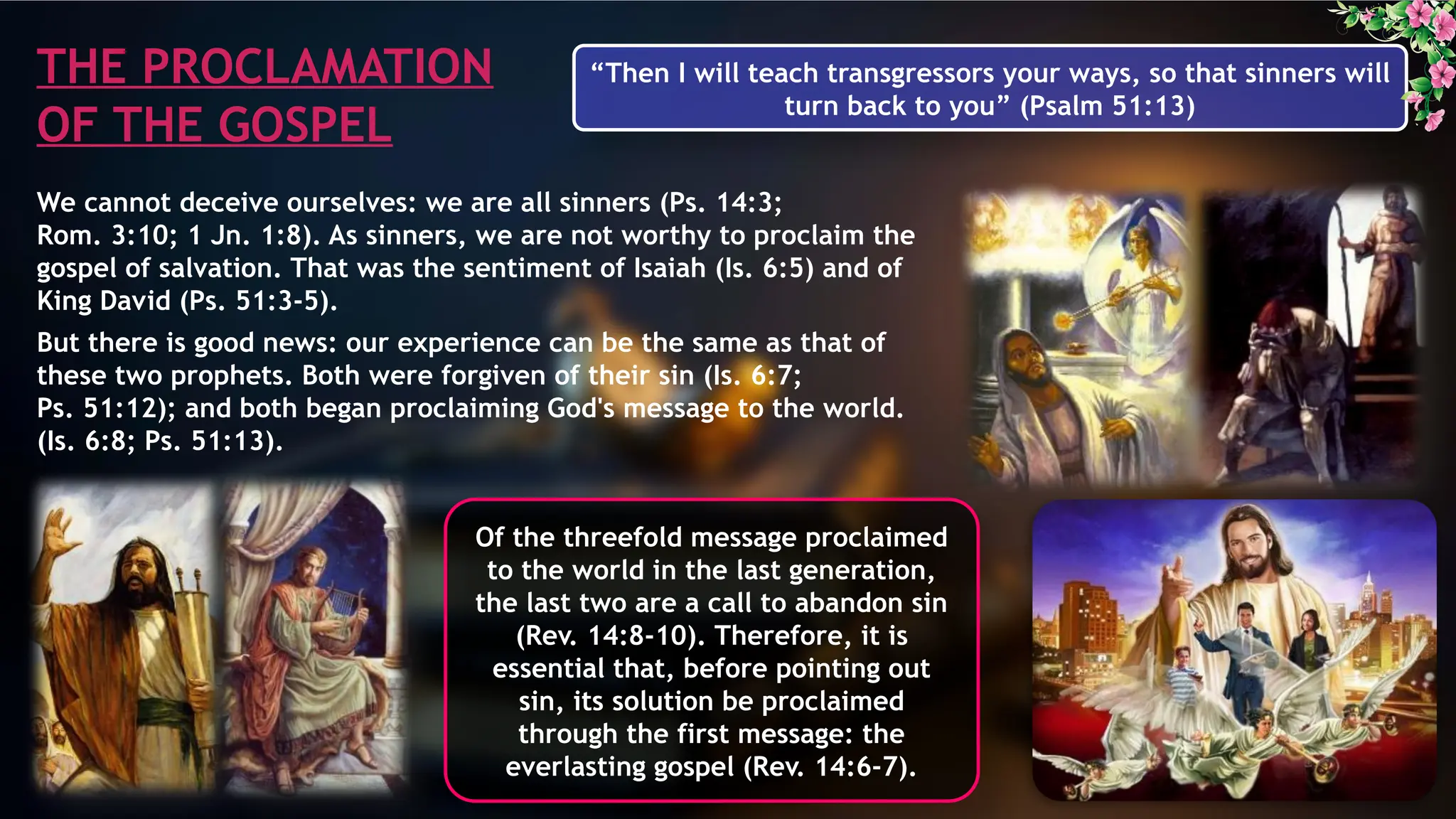
We cannot deceiveourselves: we are all sinners (Ps. 14:3;
Rom. 3:10; 1 Jn. 1:8). As sinners, we are not worthy to proclaim the
gospel of salvation. That was the sentiment of Isaiah (Is. 6:5) and of
King David (Ps. 51:3-5).
But there is good news: our experience can be the same as that of
these two prophets. Both were forgiven of their sin (Is. 6:7;
Ps. 51:12); and both began proclaiming God's message to the world.
(Is. 6:8; Ps. 51:13).
THE PROCLAMATION
OF THE GOSPEL
Of the threefold message proclaimed
to the world in the last generation,
the last two are a call to abandon sin
(Rev. 14:8-10). Therefore, it is
essential that, before pointing out
sin, its solution be proclaimed
through the first message: the
everlasting gospel (Rev. 14:6-7).
“Then I will teach transgressors your ways, so that sinners will
turn back to you” (Psalm 51:13)
13.
“The prophecies inthe eighteenth of Revelation
will soon be fulfilled. During the proclamation
of the third angel's message, “another angel” is
to “come down from heaven, having great
power,” and the earth is to be “lightened with
his glory.” The Spirit of the Lord will so
graciously bless consecrated human
instrumentalities that men, women, and
children will open their lips in praise and
thanksgiving, filling the earth with the
knowledge of God, and with His unsurpassed
glory, as the waters cover the sea.”
EGW (Maranatha: The Angel of Revelation 18, July 29)
14.
«The central themeof the Bible, the theme about which
every other in the whole book clusters, is the redemption
plan, the restoration in the human soul of the image of God.
From the first intimation of hope in the sentence pronounced
in Eden to that last glorious promise of the Revelation, “They
shall see His face; and His name shall be in their foreheads”
(Revelation 22:4), the burden of every book and every
passage of the Bible is the unfolding of this wondrous theme,
—man's uplifting, —the power of God, “which giveth us the
victory through our Lord Jesus Christ.”»
EGW (Education, p. 125)


![“Christ, our great High Priest, is “a minister of the sanctuary, and of the true
tabernacle, which the Lord pitched, and not man.” Hebrews 9:9, 23; 8:2. […]
The prophet was permitted to behold the first apartment of the sanctuary in
heaven; and he saw there the “seven lamps of fire” and the “golden altar”
represented by the golden candlestick and the altar of incense in the
sanctuary on earth. […] Here he beheld “the ark of His testament” (Revelation
11:19), represented by the sacred chest constructed by Moses to contain the
law of God.
Moses made the earthly sanctuary, “according to the fashion that he had
seen.” Paul declares that “the tabernacle, and all the vessels of the ministry,”
when completed, were “the patterns of things in the heavens.” Acts 7:44;
Hebrews 9:21, 23. And John says that he saw the sanctuary in heaven. That
sanctuary, in which Jesus ministers in our behalf, is the great original, of
which the sanctuary built by Moses was a copy.
EGW (Patriarchs and Prophets, pg. 324)](https://image.slidesharecdn.com/sabbathschoollesson82ndquarter2025-250527084419-bf3fa173/75/Sabbath-School-Lesson-8-2nd-Quarter-2025-pptx-5-2048.jpg)


![“Difficulties will arise that will try your faith and
patience. Face them bravely. Look on the bright side.
[…] Heaven is full of joy. It resounds with the praises
of Him who made so wonderful a sacrifice for the
redemption of the human race. Should not the
church on earth be full of praise? Should not
Christians publish throughout the world the joy of
serving Christ? […]
If you make a mistake, turn your defeat into victory.
The lessons that God sends will always, if well
learned, bring help in due time. Put your trust in
God. Pray much, and believe. Trusting, hoping,
believing, holding fast the hand of Infinite Power, you
will be more than conquerors.
EGW (Testimonies for the Church, volume 7, page 244)](https://image.slidesharecdn.com/sabbathschoollesson82ndquarter2025-250527084419-bf3fa173/75/Sabbath-School-Lesson-8-2nd-Quarter-2025-pptx-11-2048.jpg)