“And the Lordpassed before
him and proclaimed, ‘The
Lord, the Lord God, merciful
and gracious, longsuffering,
and abounding in goodness
and truth, keeping mercy for
thousands, forgiving iniquity
and transgression and sin, by
no means clearing the guilty,
visiting the iniquity of the
fathers upon the children and
the children’s children to the
third and the fourth
generation’ ”
Exodus 34:6, 7, NKJV
3.
God and Moses:
Meetingwith God (Exodus 33:7-11)
Getting to Know God Better (Exodus 33:12-17)
The glory of God:
The desire to know the glory of God (Exodus 33:18-23)
The vision of the glory of God (Exodus 34:1-28)
The result of seeing the glory of God (Exodus 34:29-35)
There's no doubt about it. God and Moses became close
friends.
This didn't happen overnight. It was a slow process. It began in
his early years, when his mother spoke to him about the
wonderful God they served.
Their friendship was strengthened during the various
encounters they had on Mount Sinai, and continued to grow
until the day God called Moses to rest.
Chapters 33 and 34 of Exodus record a special moment in this
intense relationship: Moses' request to see the glory of God.
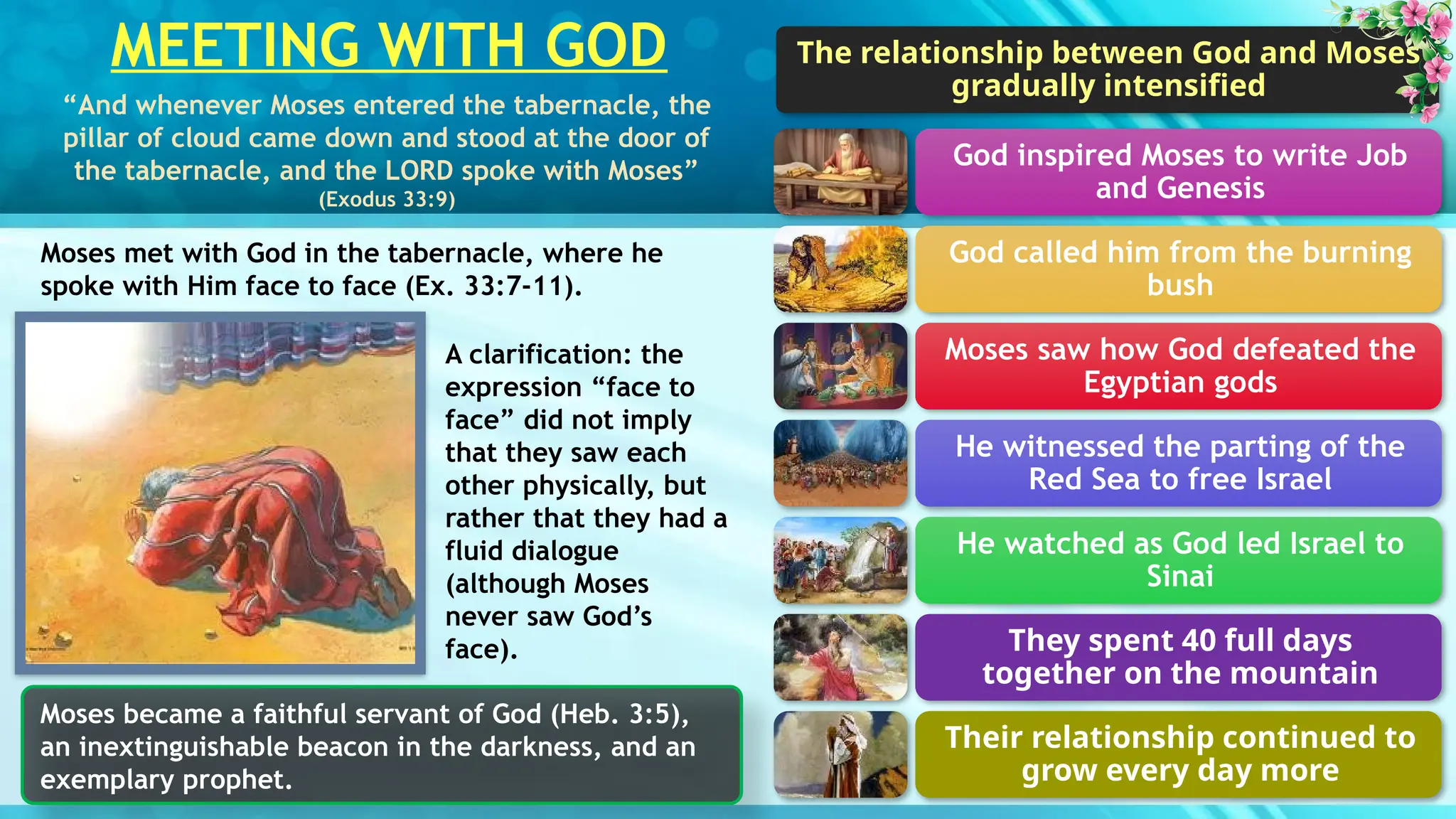
MEETING WITH GOD
“Andwhenever Moses entered the tabernacle, the
pillar of cloud came down and stood at the door of
the tabernacle, and the LORD spoke with Moses”
(Exodus 33:9)
Moses met with God in the tabernacle, where he
spoke with Him face to face (Ex. 33:7-11).
The relationship between God and Moses
gradually intensified
God inspired Moses to write Job
and Genesis
God called him from the burning
bush
Moses saw how God defeated the
Egyptian gods
He witnessed the parting of the
Red Sea to free Israel
He watched as God led Israel to
Sinai
They spent 40 full days
together on the mountain
Their relationship continued to
grow every day more
A clarification: the
expression “face to
face” did not imply
that they saw each
other physically, but
rather that they had a
fluid dialogue
(although Moses
never saw God’s
face).
Moses became a faithful servant of God (Heb. 3:5),
an inextinguishable beacon in the darkness, and an
exemplary prophet.
6.
God You aremy friend and you have my favor
Moses If it is really so, teach me your way, that I may know you
God My Presence will go with you, and I will give you rest
Moses If your Presence does not go with us, do not send us up from here
Moses
If you don't come with us, how will anyone know that you are pleased with
me?
God
Okay, I'll do what you ask, because you have my favor and I consider you my
friend.
When God told Moses that He would not accompany the people to Canaan (Ex. 33:1-3), an interesting
conversation ensued (Ex. 33:12-17 NIV):
Moses had spent 40 days with God, receiving the Ten
Commandments and instructions for building the sanctuary.
Now he was once again before God, interceding for the
people. He seemed to know God quite well, for he spoke to
Him very familiarly. In what sense, then, did he need to
know Him (Ex. 33:13)? In what sense do you also need to
know Him?
“If you are pleased with me, teach me your ways so I may know
you and continue to find favor with you. Remember that this
nation is your people.” (Exodus 33:13)
GETTING TO KNOW
GOD BETTER
Moses asked: Showme your
glory (Ex. 33:18)
God answered: I will show you
my goodness (Ex. 33:19)
What God showed him was his
character (Ex. 34:6-7)
The glory
of God is
his
goodness
, that is,
his
character
Ellen G. White adds that God's glory consists in empowering his
children; embracing repentant sinners; and providing everything
necessary for their transformation.
Thus, our “glory” is to reflect the character of God in our lives
(2 Cor. 1:12; 3:18).
When we look at the Cross, we have the greatest revelation of
God's glory, his goodness, and his character.
“Then Moses said, ‘Now show me your glory.’ ” (Exodus 33:18)
THE DESIRE TO KNOW
THE GLORY OF GOD
9.
God showed hisglory to Moses on the seventh occasion he ascended Mount Sinai. At what times and for what
purpose did Moses present himself before God?
To receive the bases of the covenant (Ex. 19:3-7)
1
To give the people's response and receive instructions on the
theophany at Sinai (Ex. 19:8-14)
2
To receive new instructions (Ex. 19:20-25)
3
To receive the complementary laws (Ex. 20:21; 24:3)
4
To receive the Ten Commandments written by the finger of
God, and the pattern of the Sanctuary (Ex. 24:12, 18; 32:15)
5
To intercede for the sin of the golden calf (Ex. 32:30)
6
So that God could show him his glory, and receive new tablets
with the Ten Commandments (Ex. 34:1-5)
7
The vision of God's glory proved to be a self-proclamation of God's character (Exod. 34:6-7). At this glimpse
of God's love, Moses worshipped (Exodus 34:8; 1 John 4:19). Eventually, God reaffirmed his covenant with
Israel and forgave the calf incident.
“And he passed in front of Moses, proclaiming, ‘THE LORD, THE
LORD, the compassionate and gracious God, slow to anger,
abounding in love and faithfulness’ ” (Exodus 34:6 NIV)
THE VISION OF THE
GLORY OF GOD
10.
Moses had spokenwith God “face to face” many times before, and
until then, his face had never shone. What had changed this time?
Notice, moreover, that the change persisted over the long term
(Ex. 34:34-35).
Echoing this episode, Paul invites us to imitate Moses and contemplate
the glory of God to be transformed as he was (2 Cor. 3:12-18).
Now Moses knew God much
better. His friendship had
reached maturity. He had
contemplated God's glory, and
had been transformed by that
glory.
Moses is a model that demonstrates what God can do for us when we
allow him to transform our character and mold us into his divine image.
THE RESULT OF
SEEING THE GLORY
OF GOD
“When Moses came down from Mount Sinai with the two tablets of
the covenant law in his hands, he was not aware that his face was
radiant because he had spoken with the Lord.” (Exodus 34:29)
11.
“Think you thatGod reproved Moses for his presumption? No,
indeed. Moses did not make this request from idle curiosity. He had
an object in view. He saw that in his own strength he could not do
the work of God acceptably. He knew that if he could obtain a clear
view of the glory of God, he would be enabled to go forward in his
important mission, not in his own strength, but in the strength of
the Lord God Almighty. His whole soul was drawn out after God; he
longed to know more of Him, that he might feel the divine presence
near in every emergency or perplexity. It was not selfishness that
led Moses to ask for a sight of the glory of God. His only object was a
desire better to honor his Maker”
EGW (In Heavenly Places, August 22)