Lesson 12 for June 20, 2020
Logic
Honesty
Humbleness
Perseverance
Prayer
Have you ever found a Bible passage that you couldn't understand?
Maybe a difficult passage written by the apostle Paul (2 Peter 3:15-16)?
Difficult passages may lead to wrong interpretations, so it's important to
study them with the right attitude. How should we deal with difficult
passages?
“Solemnly charge them before the Lord not to
wrangle over words. […] teaching the message of
truth accurately.” (2 Timothy 2:14-15 NET)
The Word of God is infallible. How should we deal with apparent errors or
contradictions in it? Many of them have a logical answer.
Most of the apparent contradictions the in the Bible are
found in parallel passages.
When two people tell the same event, they usually
recall different details, even if both witnessed it at
first hand. This happens because different things
caught the attention of each person. Logically, this
results in differences between the two accounts.
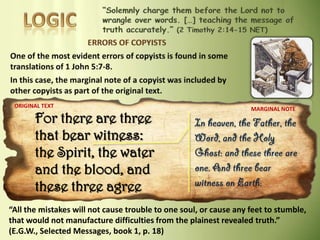
For there are three
that bear witness:
the Spirit, the water
and the blood, and
these three agree
ORIGINAL TEXT
MARGINAL NOTE
“All the mistakes will not cause trouble to one soul, or cause any feet to stumble,
that would not manufacture difficulties from the plainest revealed truth.”
(E.G.W., Selected Messages, book 1, p. 18)
TRANSLATION ERRORS
Sometimes, the error of a copyist may result in
translation errors, like in Revelation 22:14.
Some Greek manuscripts use an expression
(HOIPOIOUNTESTASENTOLAS) that translates as
“those who do His commandments” (NKJV).
Other manuscripts use a different expression
(HOIPLUNONTESTASSTOLAS) that translates as
“those who wash their robes” (NIV).
We must check these passages against similar
ones to understand which interpretation is the
right one. These errors are human, they have
nothing to do with the divine inspiration of the
Bible.
“Solemnly charge them before the Lord
not to wrangle over words. […] teaching
the message of truth accurately.”
(2 Timothy 2:14-15 NET)
“He stores up sound wisdom for the
upright; He is a shield to those
who walk uprightly.” (Proverbs 2:7)
We may find some passages that we
cannot understand or explain.
In those cases, we should be honest and
acknowledge that we are not able to solve
the problem.
If we know that an explanation may be
wrong, it's a serious mistake to embrace it
as true. It's even worse to introduce this
explanation with the intention of
deceiving others, making them believe
something we know the text does not
actually support.
Honest Christians will wait until God
enlightens them to understand those
difficult texts better.
“But He gives more grace. Therefore He
says: 'God resists the proud, but gives
grace to the humble.’” (James 4:6)
What about those passages that seem to go
against something we believe it's true?
What if those passages are pointing out
something we're doing as sin?
Pride may prevent us from admitting we're
not right. We may try to find an explanation
to make the passages support our "truth" or
sin at any cost, no matter how twisted the
explanation.
On the other hand, a humble spirit will help
us to accept the truth as written in the Bible,
and let God mold our lives according to that
truth.
Some texts require a special effort to
be understood. For example, we may
have to compare them to similar ones,
to understand their original context, to
investigate why the original author
decided to write them that way.
We must take time to perseveringly study those
texts. We may even have to set them aside for
some time, until God gives us more light to
understand them. After all, we're serving “the
God of patience” (Ro. 15:5).
The time we devote to a matter is directly
proportional to how interested we are on it.
Therefore, be persistent and patient in Bible
Study.
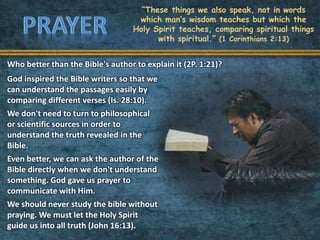
“These things we also speak, not in words
which man’s wisdom teaches but which the
Holy Spirit teaches, comparing spiritual things
with spiritual.” (1 Corinthians 2:13)
God inspired the Bible writers so that we
can understand the passages easily by
comparing different verses (Is. 28:10).
We don't need to turn to philosophical
or scientific sources in order to
understand the truth revealed in the
Bible.
Even better, we can ask the author of the
Bible directly when we don't understand
something. God gave us prayer to
communicate with Him.
We should never study the bible without
praying. We must let the Holy Spirit
guide us into all truth (John 16:13).
Who better than the Bible's author to explain it (2P. 1:21)?
“We shall advance in true spiritual
knowledge only as we realize our own
littleness and our entire dependence
upon God; but all who come to the
Bible with a teachable and prayerful
spirit, to study its utterances as the
word of God, will receive divine
enlightenment. There are many things
apparently difficult or obscure which
God will make plain and simple to
those who thus seek an understanding
of them.”
E.G.W. (Testimonies for the Church, book 5, cp. 84, p. 704)

SABBATH SCHOOL - 2nd quarter lessons 12.

  • 1.
    Lesson 12 forJune 20, 2020
  • 2.
    Logic Honesty Humbleness Perseverance Prayer Have you everfound a Bible passage that you couldn't understand? Maybe a difficult passage written by the apostle Paul (2 Peter 3:15-16)? Difficult passages may lead to wrong interpretations, so it's important to study them with the right attitude. How should we deal with difficult passages?
  • 3.
    “Solemnly charge thembefore the Lord not to wrangle over words. […] teaching the message of truth accurately.” (2 Timothy 2:14-15 NET) The Word of God is infallible. How should we deal with apparent errors or contradictions in it? Many of them have a logical answer. Most of the apparent contradictions the in the Bible are found in parallel passages. When two people tell the same event, they usually recall different details, even if both witnessed it at first hand. This happens because different things caught the attention of each person. Logically, this results in differences between the two accounts.
  • 4.
    For there arethree that bear witness: the Spirit, the water and the blood, and these three agree ORIGINAL TEXT MARGINAL NOTE “All the mistakes will not cause trouble to one soul, or cause any feet to stumble, that would not manufacture difficulties from the plainest revealed truth.” (E.G.W., Selected Messages, book 1, p. 18)
  • 5.
    TRANSLATION ERRORS Sometimes, theerror of a copyist may result in translation errors, like in Revelation 22:14. Some Greek manuscripts use an expression (HOIPOIOUNTESTASENTOLAS) that translates as “those who do His commandments” (NKJV). Other manuscripts use a different expression (HOIPLUNONTESTASSTOLAS) that translates as “those who wash their robes” (NIV). We must check these passages against similar ones to understand which interpretation is the right one. These errors are human, they have nothing to do with the divine inspiration of the Bible. “Solemnly charge them before the Lord not to wrangle over words. […] teaching the message of truth accurately.” (2 Timothy 2:14-15 NET)
  • 6.
    “He stores upsound wisdom for the upright; He is a shield to those who walk uprightly.” (Proverbs 2:7) We may find some passages that we cannot understand or explain. In those cases, we should be honest and acknowledge that we are not able to solve the problem. If we know that an explanation may be wrong, it's a serious mistake to embrace it as true. It's even worse to introduce this explanation with the intention of deceiving others, making them believe something we know the text does not actually support. Honest Christians will wait until God enlightens them to understand those difficult texts better.
  • 7.
    “But He givesmore grace. Therefore He says: 'God resists the proud, but gives grace to the humble.’” (James 4:6) What about those passages that seem to go against something we believe it's true? What if those passages are pointing out something we're doing as sin? Pride may prevent us from admitting we're not right. We may try to find an explanation to make the passages support our "truth" or sin at any cost, no matter how twisted the explanation. On the other hand, a humble spirit will help us to accept the truth as written in the Bible, and let God mold our lives according to that truth.
  • 8.
    Some texts requirea special effort to be understood. For example, we may have to compare them to similar ones, to understand their original context, to investigate why the original author decided to write them that way. We must take time to perseveringly study those texts. We may even have to set them aside for some time, until God gives us more light to understand them. After all, we're serving “the God of patience” (Ro. 15:5). The time we devote to a matter is directly proportional to how interested we are on it. Therefore, be persistent and patient in Bible Study.
  • 9.
    “These things wealso speak, not in words which man’s wisdom teaches but which the Holy Spirit teaches, comparing spiritual things with spiritual.” (1 Corinthians 2:13) God inspired the Bible writers so that we can understand the passages easily by comparing different verses (Is. 28:10). We don't need to turn to philosophical or scientific sources in order to understand the truth revealed in the Bible. Even better, we can ask the author of the Bible directly when we don't understand something. God gave us prayer to communicate with Him. We should never study the bible without praying. We must let the Holy Spirit guide us into all truth (John 16:13). Who better than the Bible's author to explain it (2P. 1:21)?
  • 10.
    “We shall advancein true spiritual knowledge only as we realize our own littleness and our entire dependence upon God; but all who come to the Bible with a teachable and prayerful spirit, to study its utterances as the word of God, will receive divine enlightenment. There are many things apparently difficult or obscure which God will make plain and simple to those who thus seek an understanding of them.” E.G.W. (Testimonies for the Church, book 5, cp. 84, p. 704)