1
For the teachers
Ears
Science 3
2
Exploring the Senses
Lesson 2
Big Question
Why do we need to take care of our
ears?
3
Real-Life Link
4
● What are the sounds you hear everyday?
● Think of the sounds you could hear when you were
able to go outside regularly? Is it similar or different to
the sounds you hear now?
● Have you ever experienced an earache before? What
caused it?
Learning Targets
● Identify the parts of the ears.
● Identify the functions of the ears.
● Name the common illnesses and disorders of the ears
among young children.
● Enumerate ways of protecting and caring for the ears.
5
Let’s Learn
6
Let’s start the class with a simple activity!
7
● Close your eyes or lay your forehead on the table.
● Identify the sounds that you will hear.
● Answer this question: “How were you able to identify the
sounds with your eyes closed?”
8
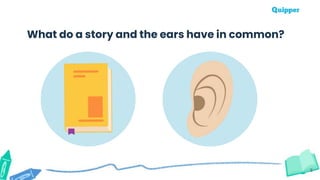
What do a story and the ears have in common?
9
Just like stories, the ears also have a beginning,
middle, and end. The major parts of the ears are the
outer ear, the middle ear, and the inner ear.
10
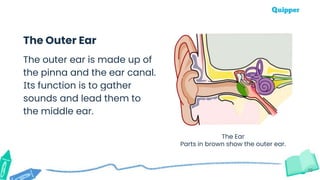
The Outer Ear
The Ear
Parts in brown show the outer ear.
The outer ear is made up of
the pinna and the ear canal.
Its function is to gather
sounds and lead them to
the middle ear.
11
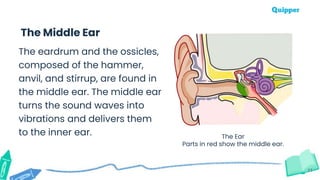
The Middle Ear
The Ear
Parts in red show the middle ear.
The eardrum and the ossicles,
composed of the hammer,
anvil, and stirrup, are found in
the middle ear. The middle ear
turns the sound waves into
vibrations and delivers them
to the inner ear.
12
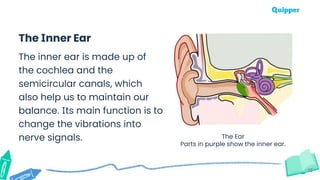
The Inner Ear
The Ear
Parts in purple show the inner ear.
The inner ear is made up of
the cochlea and the
semicircular canals, which
also help us to maintain our
balance. Its main function is to
change the vibrations into
nerve signals.
13
Let’s do a simple experiment. Half of the class will cover
their ears as I talk. The other half will listen as you
normally would.
After the experiment, share your observations on the
experiment.
14
Not being able to hear clearly is one of the
many common ear disorders.
15
Other common ear disorders are the following:
● Swimmer’s ear is an inflammation from an infection of
the outer part of the ear canal. It may be caused by
fungi or bacteria.
● Young children, especially infants, may put an object in
their ears which may cause an infection.
16
Other common ear disorders are the following:
● Middle ear infection is an inflammation in the middle
ear after a sore throat or a cold.
● Mastoiditis is a bacterial infection in the mastoid bone.
17
To ensure that we keep our ears healthy, we need to
do the following:
● Avoid listening to music at a very high volume
● Avoid cleaning the ears using cotton buds
● Keep stress under control
● Keep the ears dry
● Exercise regularly
Let’s Do It
18
19
We will conduct a simple activity called
“Do You Hear What I Hear?”
● Get an item that makes some sounds.
● You will take turns making a sound with your
item, and wait for your peers to guess your item!
You Can Do It
20
21
We will conduct an experiment called
“Model Eardrum”
● Gather your materials
● Wrap the bowl or pot with a plastic wrap, and put the
uncooked rice on top.
● You will need to make noise by hitting an object near
the plastic wrap.
● Record your observations on your science notebook.
Let’s Connect
22
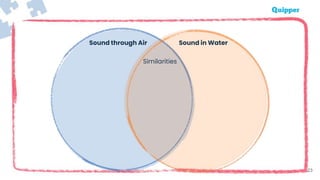
23
Sound through Air Sound in Water
Similarities
Big Idea
Our ears, just like the rest of the body,
need to be properly taken care of.
We must take care of our ears
because it is the only sensory organ
we can use to hear.
24
Remember
25
Our ears have three main parts:
the outer ear, middle ear, and inner ear.
Remember
26
The outer ear is responsible for
collecting the sounds.
Remember
27
The middle ear turns the sound
waves into vibrations to deliver
them to the inner ear.
Remember
28
The inner ear changes the vibrations
into nerve signals to send them to
the brain.
Remember
29
The common ear disorders are the
swimmer’s ear, infection caused by a
foreign object, middle ear infection,
and mastoiditis.
What Have
You Learned?
30
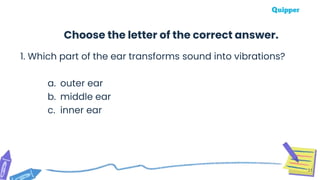
1. Which part of the ear transforms sound into vibrations?
a. outer ear
b. middle ear
c. inner ear
31
Choose the letter of the correct answer.
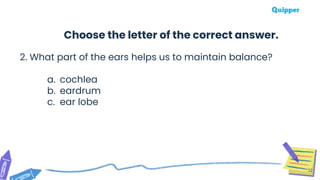
2. What part of the ears helps us to maintain balance?
a. cochlea
b. eardrum
c. ear lobe
32
Choose the letter of the correct answer.
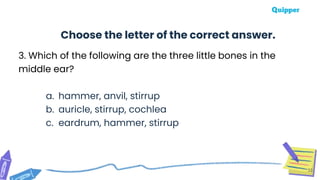
3. Which of the following are the three little bones in the
middle ear?
a. hammer, anvil, stirrup
b. auricle, stirrup, cochlea
c. eardrum, hammer, stirrup
33
Choose the letter of the correct answer.
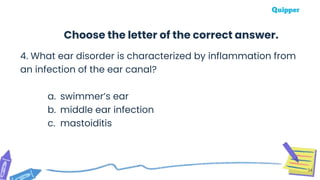
4. What ear disorder is characterized by inflammation from
an infection of the ear canal?
a. swimmer’s ear
b. middle ear infection
c. mastoiditis
34
Choose the letter of the correct answer.
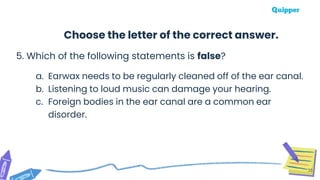
5. Which of the following statements is false?
a. Earwax needs to be regularly cleaned off of the ear canal.
b. Listening to loud music can damage your hearing.
c. Foreign bodies in the ear canal are a common ear
disorder.
35
Choose the letter of the correct answer.
36
Attribution
Fig. 1. Anatomy of the Human Ear blank by M.Komorniczak. is licensed under CC BY 2.5 via Wikimedia
Commons..
37
References
"Foreign Bodies In The Ear, Nose, And Airway". 2021. UC San Diego Health.
https://myhealth.ucsd.edu/conditions/cancer/tools/90,P02035.
"How To Care For Your Ears | South East Hearing Care Centres". 2017. South East Hearing Care Centres.
https://www.hearingcarecentres.co.uk/10-tips-care-ears-properly/.
"Mastoiditis In Children". 2021. UC San Diego Health.
https://myhealth.ucsd.edu/conditions/cancer/tools/90,P02048.
"Middle Ear Infection (Otitis Media) In Adults". 2021. UC San Diego Health.
https://myhealth.ucsd.edu/conditions/cancer/tools/85,P00461.
"Senses Experiment: Do You Hear What I Hear? (For Kids) - Nemours Kidshealth". 2021. Kidshealth.Org.
https://kidshealth.org/en/kids/experiment-hear.html.
"Senses Experiment: Model Eardrum (For Kids) - Nemours Kidshealth". 2021. Kidshealth.Org.
https://kidshealth.org/en/kids/experiment-eardrum.html.
38
References
"Swimmer’s Ear In Children". 2020. UC San Diego Health.
https://myhealth.ucsd.edu/conditions/cancer/tools/90,P02059.
Teacher's Guide: Hearing (Grades 3 To 5). 2017. Ebook. The Nemours Foundation/KidsHealth.
https://classroom.kidshealth.org/classroom/3to5/body/functions/hearing.pdf.
"Your Ears (For Kids) - Nemours Kidshealth". 2021. Kidshealth.Org. https://kidshealth.org/en/kids/ears.html.

S_G3_U01L02_TPS.pptx power point presentation

  • 1.
  • 2.
  • 3.
    Big Question Why dowe need to take care of our ears? 3
  • 4.
    Real-Life Link 4 ● Whatare the sounds you hear everyday? ● Think of the sounds you could hear when you were able to go outside regularly? Is it similar or different to the sounds you hear now? ● Have you ever experienced an earache before? What caused it?
  • 5.
    Learning Targets ● Identifythe parts of the ears. ● Identify the functions of the ears. ● Name the common illnesses and disorders of the ears among young children. ● Enumerate ways of protecting and caring for the ears. 5
  • 6.
  • 7.
    Let’s start theclass with a simple activity! 7 ● Close your eyes or lay your forehead on the table. ● Identify the sounds that you will hear. ● Answer this question: “How were you able to identify the sounds with your eyes closed?”
  • 8.
    8 What do astory and the ears have in common?
  • 9.
    9 Just like stories,the ears also have a beginning, middle, and end. The major parts of the ears are the outer ear, the middle ear, and the inner ear.
  • 10.
    10 The Outer Ear TheEar Parts in brown show the outer ear. The outer ear is made up of the pinna and the ear canal. Its function is to gather sounds and lead them to the middle ear.
  • 11.
    11 The Middle Ear TheEar Parts in red show the middle ear. The eardrum and the ossicles, composed of the hammer, anvil, and stirrup, are found in the middle ear. The middle ear turns the sound waves into vibrations and delivers them to the inner ear.
  • 12.
    12 The Inner Ear TheEar Parts in purple show the inner ear. The inner ear is made up of the cochlea and the semicircular canals, which also help us to maintain our balance. Its main function is to change the vibrations into nerve signals.
  • 13.
    13 Let’s do asimple experiment. Half of the class will cover their ears as I talk. The other half will listen as you normally would. After the experiment, share your observations on the experiment.
  • 14.
    14 Not being ableto hear clearly is one of the many common ear disorders.
  • 15.
    15 Other common eardisorders are the following: ● Swimmer’s ear is an inflammation from an infection of the outer part of the ear canal. It may be caused by fungi or bacteria. ● Young children, especially infants, may put an object in their ears which may cause an infection.
  • 16.
    16 Other common eardisorders are the following: ● Middle ear infection is an inflammation in the middle ear after a sore throat or a cold. ● Mastoiditis is a bacterial infection in the mastoid bone.
  • 17.
    17 To ensure thatwe keep our ears healthy, we need to do the following: ● Avoid listening to music at a very high volume ● Avoid cleaning the ears using cotton buds ● Keep stress under control ● Keep the ears dry ● Exercise regularly
  • 18.
  • 19.
    19 We will conducta simple activity called “Do You Hear What I Hear?” ● Get an item that makes some sounds. ● You will take turns making a sound with your item, and wait for your peers to guess your item!
  • 20.
  • 21.
    21 We will conductan experiment called “Model Eardrum” ● Gather your materials ● Wrap the bowl or pot with a plastic wrap, and put the uncooked rice on top. ● You will need to make noise by hitting an object near the plastic wrap. ● Record your observations on your science notebook.
  • 22.
  • 23.
    23 Sound through AirSound in Water Similarities
  • 24.
    Big Idea Our ears,just like the rest of the body, need to be properly taken care of. We must take care of our ears because it is the only sensory organ we can use to hear. 24
  • 25.
    Remember 25 Our ears havethree main parts: the outer ear, middle ear, and inner ear.
  • 26.
    Remember 26 The outer earis responsible for collecting the sounds.
  • 27.
    Remember 27 The middle earturns the sound waves into vibrations to deliver them to the inner ear.
  • 28.
    Remember 28 The inner earchanges the vibrations into nerve signals to send them to the brain.
  • 29.
    Remember 29 The common eardisorders are the swimmer’s ear, infection caused by a foreign object, middle ear infection, and mastoiditis.
  • 30.
  • 31.
    1. Which partof the ear transforms sound into vibrations? a. outer ear b. middle ear c. inner ear 31 Choose the letter of the correct answer.
  • 32.
    2. What partof the ears helps us to maintain balance? a. cochlea b. eardrum c. ear lobe 32 Choose the letter of the correct answer.
  • 33.
    3. Which ofthe following are the three little bones in the middle ear? a. hammer, anvil, stirrup b. auricle, stirrup, cochlea c. eardrum, hammer, stirrup 33 Choose the letter of the correct answer.
  • 34.
    4. What eardisorder is characterized by inflammation from an infection of the ear canal? a. swimmer’s ear b. middle ear infection c. mastoiditis 34 Choose the letter of the correct answer.
  • 35.
    5. Which ofthe following statements is false? a. Earwax needs to be regularly cleaned off of the ear canal. b. Listening to loud music can damage your hearing. c. Foreign bodies in the ear canal are a common ear disorder. 35 Choose the letter of the correct answer.
  • 36.
    36 Attribution Fig. 1. Anatomyof the Human Ear blank by M.Komorniczak. is licensed under CC BY 2.5 via Wikimedia Commons..
  • 37.
    37 References "Foreign Bodies InThe Ear, Nose, And Airway". 2021. UC San Diego Health. https://myhealth.ucsd.edu/conditions/cancer/tools/90,P02035. "How To Care For Your Ears | South East Hearing Care Centres". 2017. South East Hearing Care Centres. https://www.hearingcarecentres.co.uk/10-tips-care-ears-properly/. "Mastoiditis In Children". 2021. UC San Diego Health. https://myhealth.ucsd.edu/conditions/cancer/tools/90,P02048. "Middle Ear Infection (Otitis Media) In Adults". 2021. UC San Diego Health. https://myhealth.ucsd.edu/conditions/cancer/tools/85,P00461. "Senses Experiment: Do You Hear What I Hear? (For Kids) - Nemours Kidshealth". 2021. Kidshealth.Org. https://kidshealth.org/en/kids/experiment-hear.html. "Senses Experiment: Model Eardrum (For Kids) - Nemours Kidshealth". 2021. Kidshealth.Org. https://kidshealth.org/en/kids/experiment-eardrum.html.
  • 38.
    38 References "Swimmer’s Ear InChildren". 2020. UC San Diego Health. https://myhealth.ucsd.edu/conditions/cancer/tools/90,P02059. Teacher's Guide: Hearing (Grades 3 To 5). 2017. Ebook. The Nemours Foundation/KidsHealth. https://classroom.kidshealth.org/classroom/3to5/body/functions/hearing.pdf. "Your Ears (For Kids) - Nemours Kidshealth". 2021. Kidshealth.Org. https://kidshealth.org/en/kids/ears.html.

Editor's Notes