The Activation of Q-PAC
A New Model for Consumer Involvement in
         Quality Management


                  Adam Thompson
                  Tuesday, November 27, 3:30-5 pm
                  Delaware A
Session Agenda

    Introductions                      5 Minutes
    Overview of Patient Activation    15 Minutes
    Building Patient Capacity for
                                      30 Minutes
    Meaningful Involvement
    Patient Centered Data Reporting   10 Minutes
    Panel Discussion: Q-PAC and the
                                      30 Minutes
    DC Collaborative

2
Session Objectives

    • Introduce patient activation as a method for improving
      consumer involvement in quality management activities at
      the clinical and systems levels.
    • Provide participants with a replicable model of consumer
      involvement in quality management activities
    • Provide participants with a framework for introducing
      patient centered data for consumers in quality management
      activities.


3
Introductions


4
Reflection Question


    What are the greatest barriers to
     patients being involved on
     quality management teams?


5
Patient Activation

    “A fundamental belief underlying efforts to
    reshape health care institutions and systems is
     that patients who are activated to participate
      in their own health care are more likely to
     adopt healthy behaviors leading to improved
                   health outcomes.”

        (van Korff et al. 1997; Bodenheimer et al. 2002a, b’ Mosen et al. 2007)


6
Four Stages of Patient Activation

    Patients:
      1. Play important roles in self-management
      2. Possess knowledge needed to manage
         their health
      3. Act by using their skills and behaviors to
         maintain well-being
      4. Manage stress and stay the course


7
History of Involvement

    •   Fingerprints – The Denver Principles; Authors and Souls
    •   Blueprints – The Ryan White Program; Drafters and Supporters
    •   Nuts and Bolts – Community Planning Members
    •   Betterment – Quality Improvement Advocates


8
Methods of Involvement


    • Agitation
    • Activism
    • Advocacy

9
Quality Champions into Quality Experts

     • Champion
        (noun) - a person who vigorously supports or defends a
         person or cause
     • Expert
        (noun) - a person who is very knowledgeable about or skillful
         in a particular area
        (adjective) - having or involving a great deal of knowledge or
         skill in a particular area


10
Identifying a Champion

     • Draw from your ENTIRE patient population
     • Choose patients who
         Are self-managing patients
         Demonstrate prosocial characteristics
         Are comfortable with and have access to technology
         Are able to commit to a defined period of involvement
         Can work collaboratively
         Express a desire to learn new skills
     • The “squeaky wheel” might not be the best choice


11
Preparing a Champion

     • Recognition of patient experience as only a foundation
     • Identification of Capacities for Quality Management
         Performance Measurement
         Computational Skills
            • Statistical Calculations
            • Evaluating Data
         Quality Improvement & Management Models
     • Advocacy Skills


12
Developing an Expert

     • Adult Learning Theory
     • Facilitation of Disenfranchised Learners
         Math
         Science
     • Building Capacity of Non-Medical Professionals
         Performance Measurement
         Data Analysis
         Quality Management


13
A New Model for Patient Involvement


14
IHI Collaborative Learning Model


     The Breakthrough Series: IHI’s Collaborative Model for Achieving Breakthrough Improvement. IHI Innovation Series white paper.
     Boston: Institute for Healthcare Improvement; 2003.


15
Securing Buy-In for Success

                    Funders               •   HRSA/HAB
                                          •   Faculty
      Patients                 Faculty
                                          •   DC Response Team
                                          •   Patients
                                          •   HAHSTA
     Participants              Grantees        Part A and Part B

                     Sub-
                                          • DC EMA Clinics
                    Grantees
                                               Part C and Part D


16
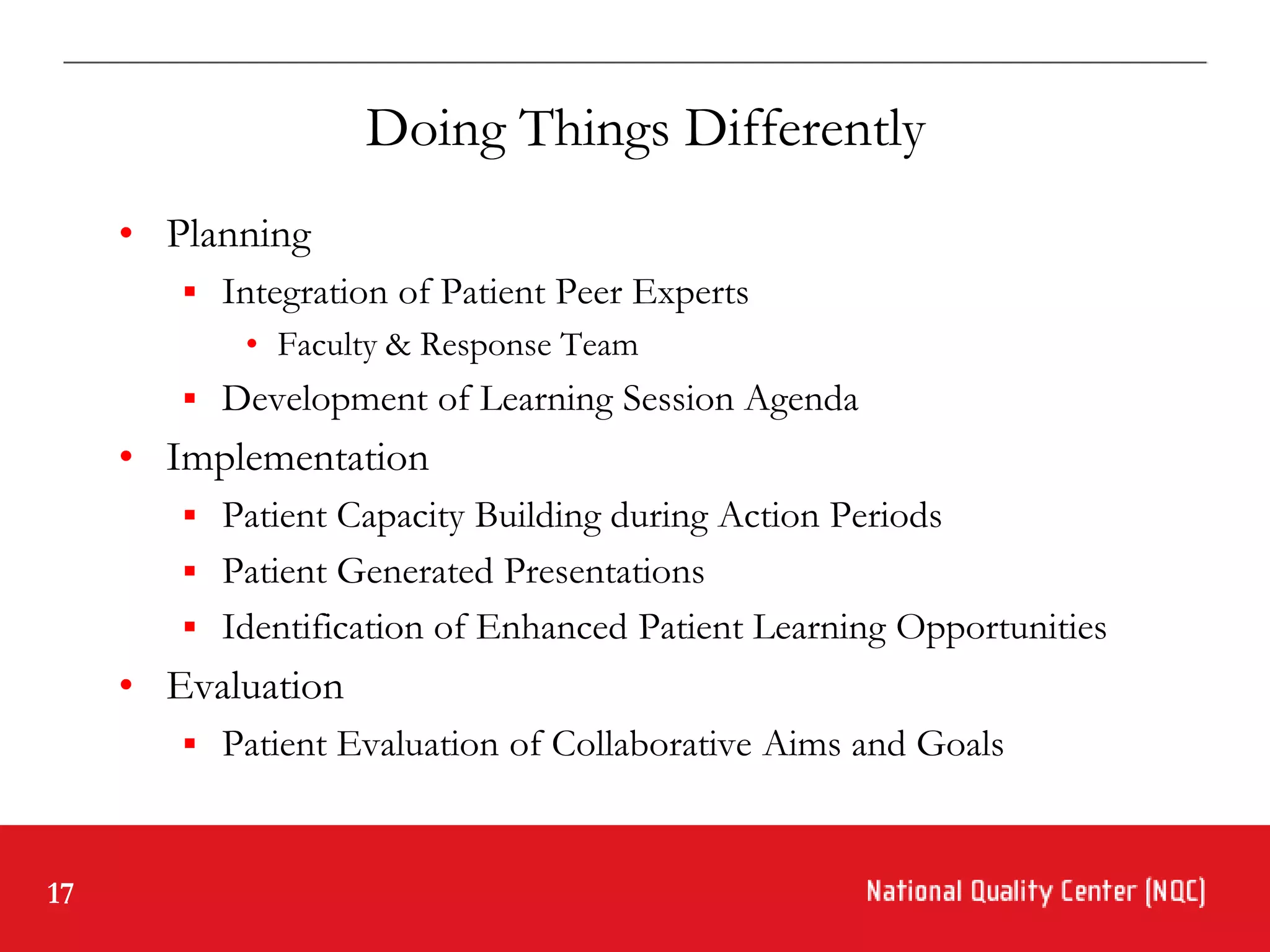
Doing Things Differently
     • Planning
         Integration of Patient Peer Experts
            • Faculty & Response Team
         Development of Learning Session Agenda
     • Implementation
         Patient Capacity Building during Action Periods
         Patient Generated Presentations
         Identification of Enhanced Patient Learning Opportunities
     • Evaluation
         Patient Evaluation of Collaborative Aims and Goals


17
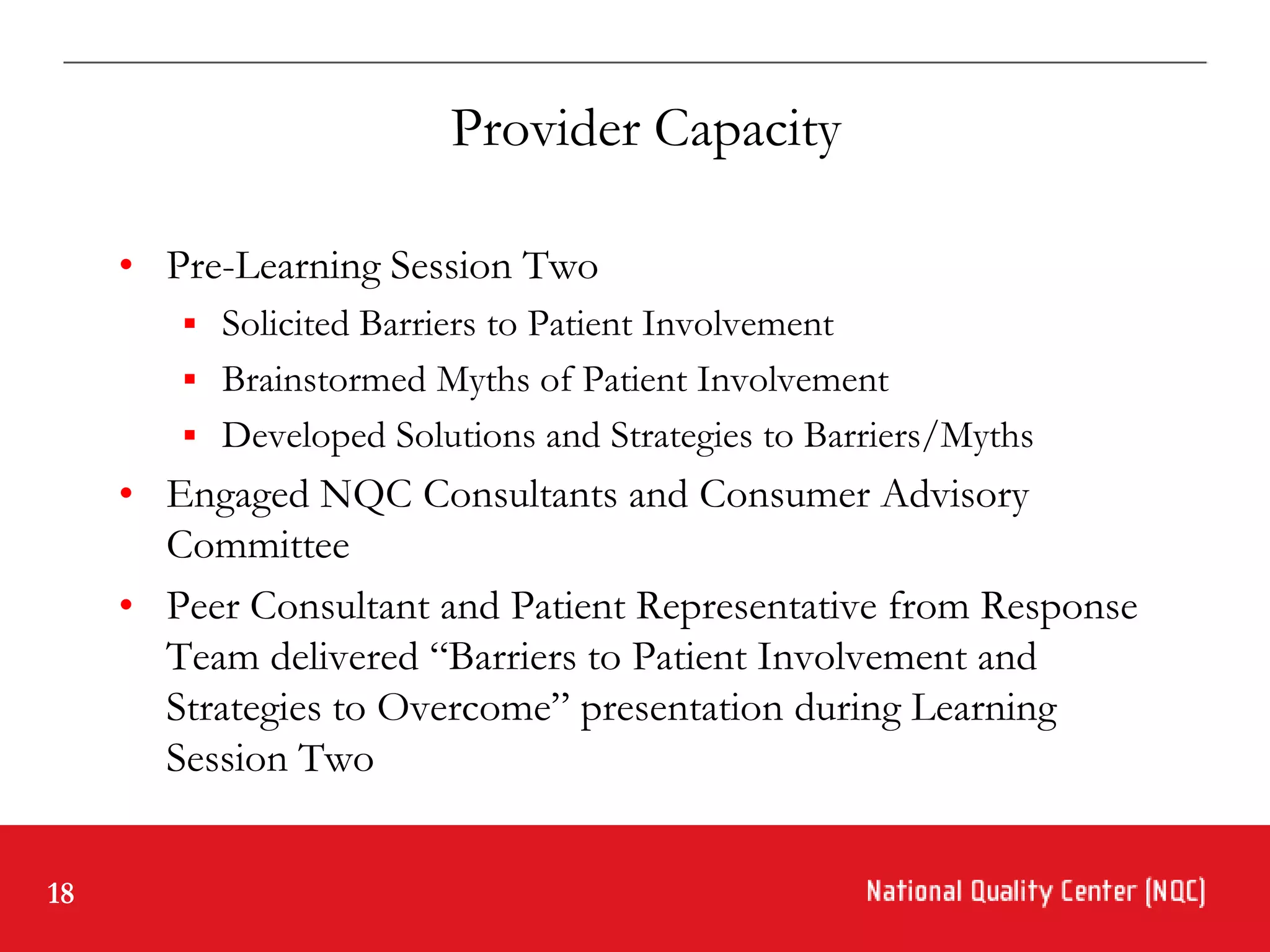
Provider Capacity

     • Pre-Learning Session Two
         Solicited Barriers to Patient Involvement
         Brainstormed Myths of Patient Involvement
         Developed Solutions and Strategies to Barriers/Myths
     • Engaged NQC Consultants and Consumer Advisory
       Committee
     • Peer Consultant and Patient Representative from Response
       Team delivered “Barriers to Patient Involvement and
       Strategies to Overcome” presentation during Learning
       Session Two


18
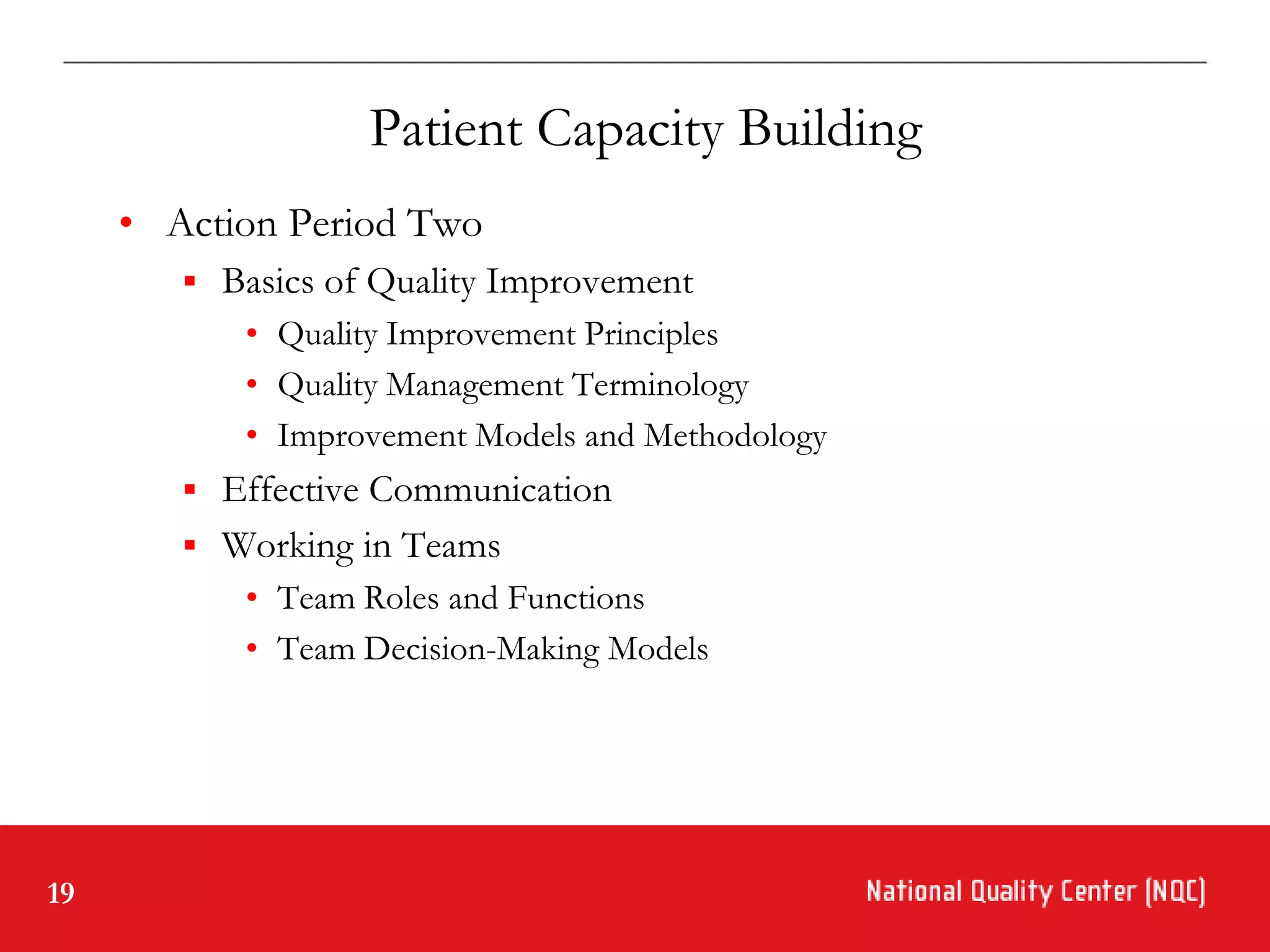
Patient Capacity Building
     • Action Period Two
         Basics of Quality Improvement
           • Quality Improvement Principles
           • Quality Management Terminology
           • Improvement Models and Methodology
         Effective Communication
         Working in Teams
           • Team Roles and Functions
           • Team Decision-Making Models


19
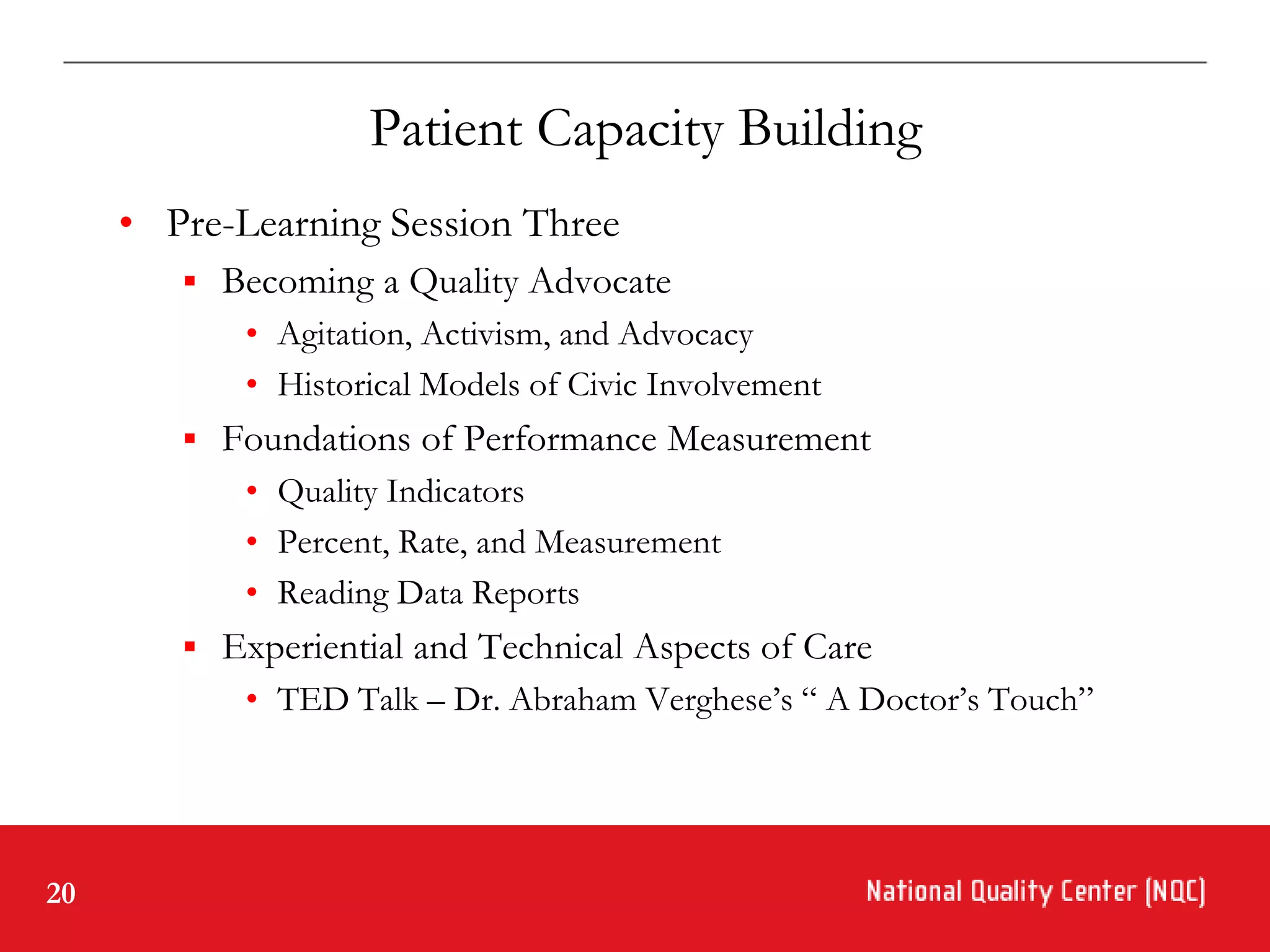
Patient Capacity Building
     • Pre-Learning Session Three
         Becoming a Quality Advocate
            • Agitation, Activism, and Advocacy
            • Historical Models of Civic Involvement
         Foundations of Performance Measurement
            • Quality Indicators
            • Percent, Rate, and Measurement
            • Reading Data Reports
         Experiential and Technical Aspects of Care
            • TED Talk – Dr. Abraham Verghese’s “ A Doctor’s Touch”


20
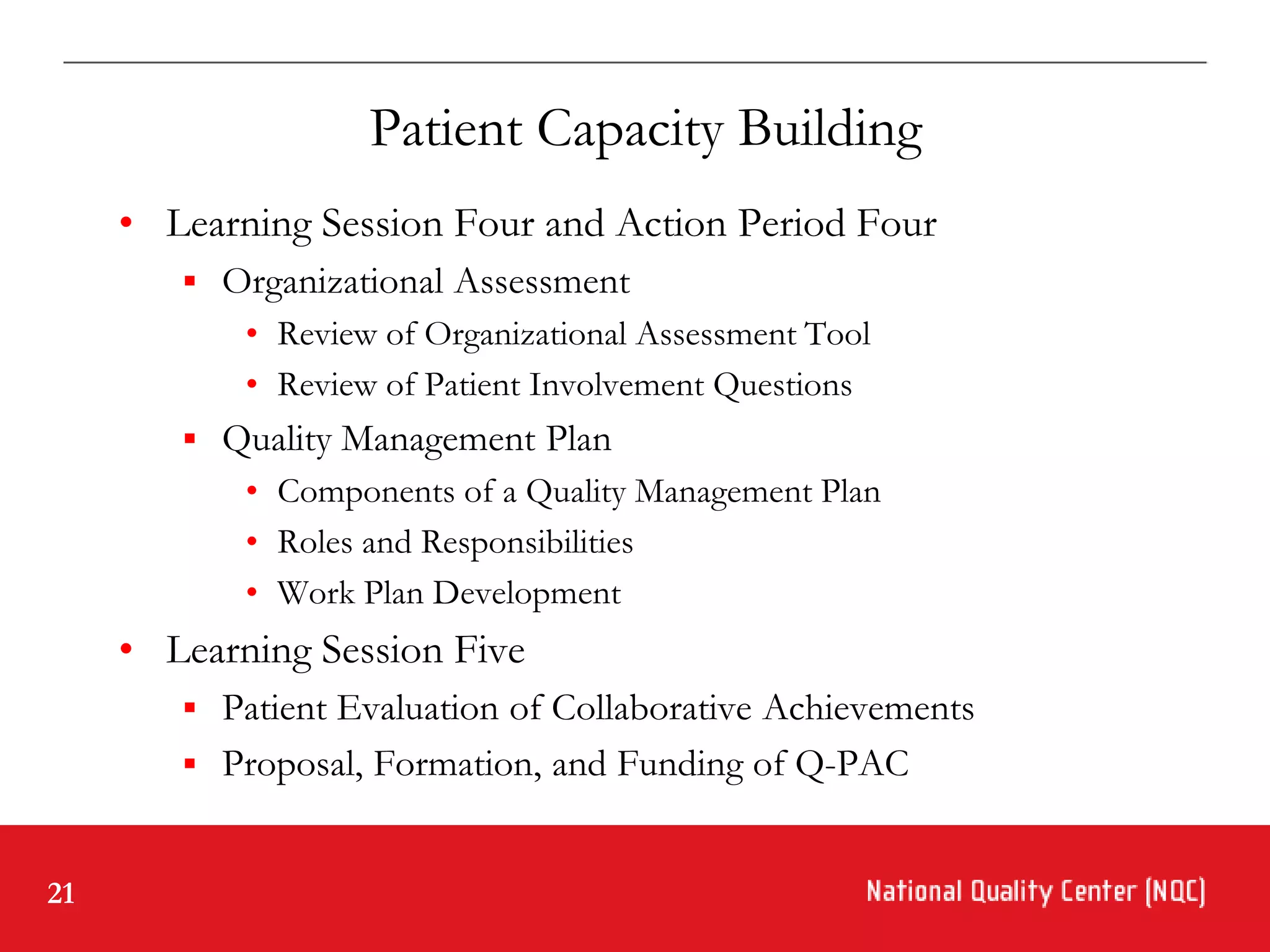
Patient Capacity Building
     • Learning Session Four and Action Period Four
         Organizational Assessment
            • Review of Organizational Assessment Tool
            • Review of Patient Involvement Questions
         Quality Management Plan
            • Components of a Quality Management Plan
            • Roles and Responsibilities
            • Work Plan Development
     • Learning Session Five
         Patient Evaluation of Collaborative Achievements
         Proposal, Formation, and Funding of Q-PAC


21
Outcomes

     • Formation of Core Group of Patient Participants in
       Collaborative (Q-PAC)
         Quality Management Plan
         Quality Improvement Projects
            • Assessment of Patient Involvement at Clinical Level
            • Delivery of Patient Self-Management Capacity to Clinic Patients
              in the EMA
     • Framework for NQC Training of Consumers for Quality
       (TCQ)
     • New Model for Patient Involvement in Collaborative
       Learning Efforts

22
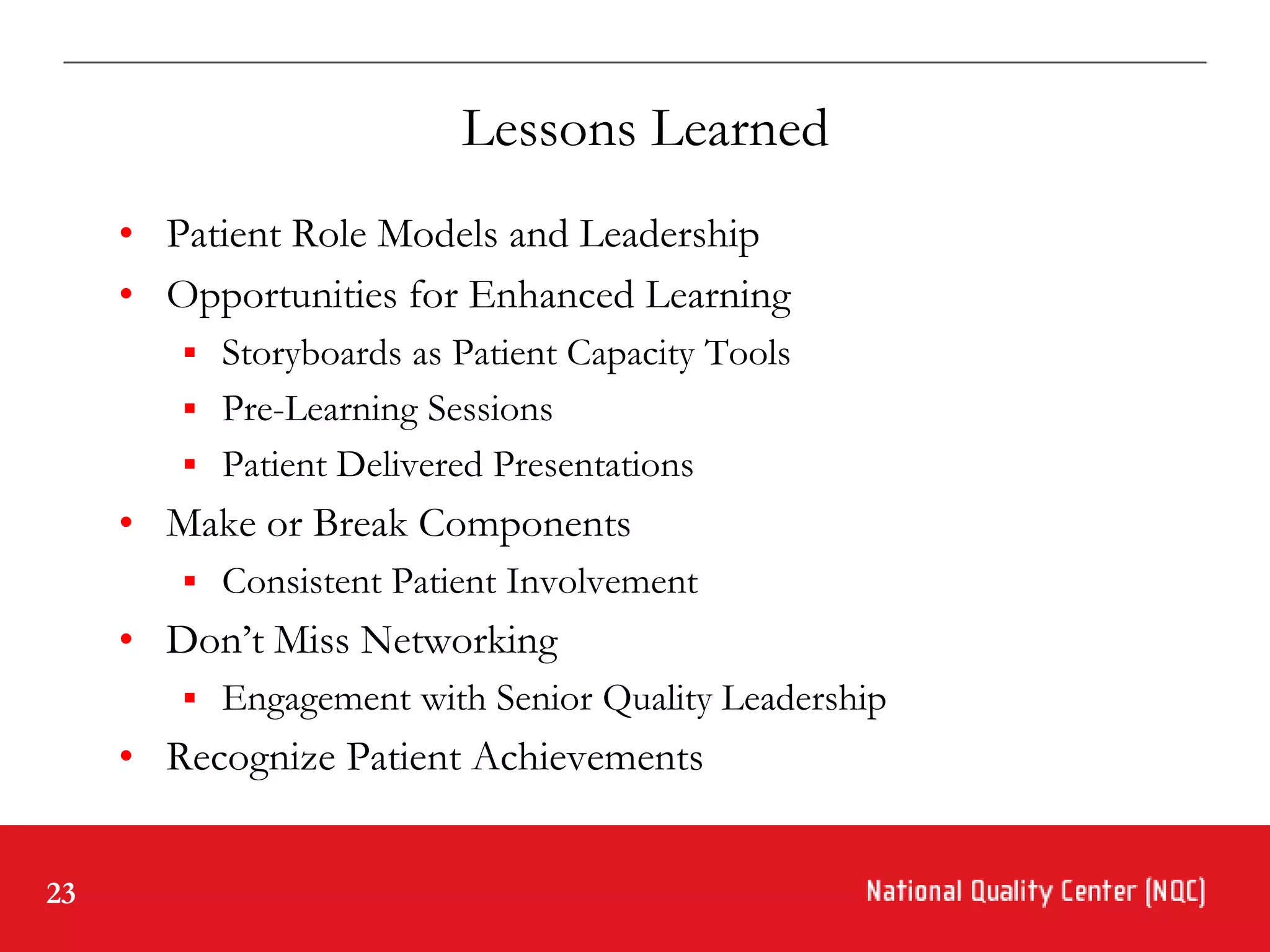
Lessons Learned
     • Patient Role Models and Leadership
     • Opportunities for Enhanced Learning
         Storyboards as Patient Capacity Tools
         Pre-Learning Sessions
         Patient Delivered Presentations
     • Make or Break Components
         Consistent Patient Involvement
     • Don’t Miss Networking
         Engagement with Senior Quality Leadership
     • Recognize Patient Achievements


23
Playing with Data


24
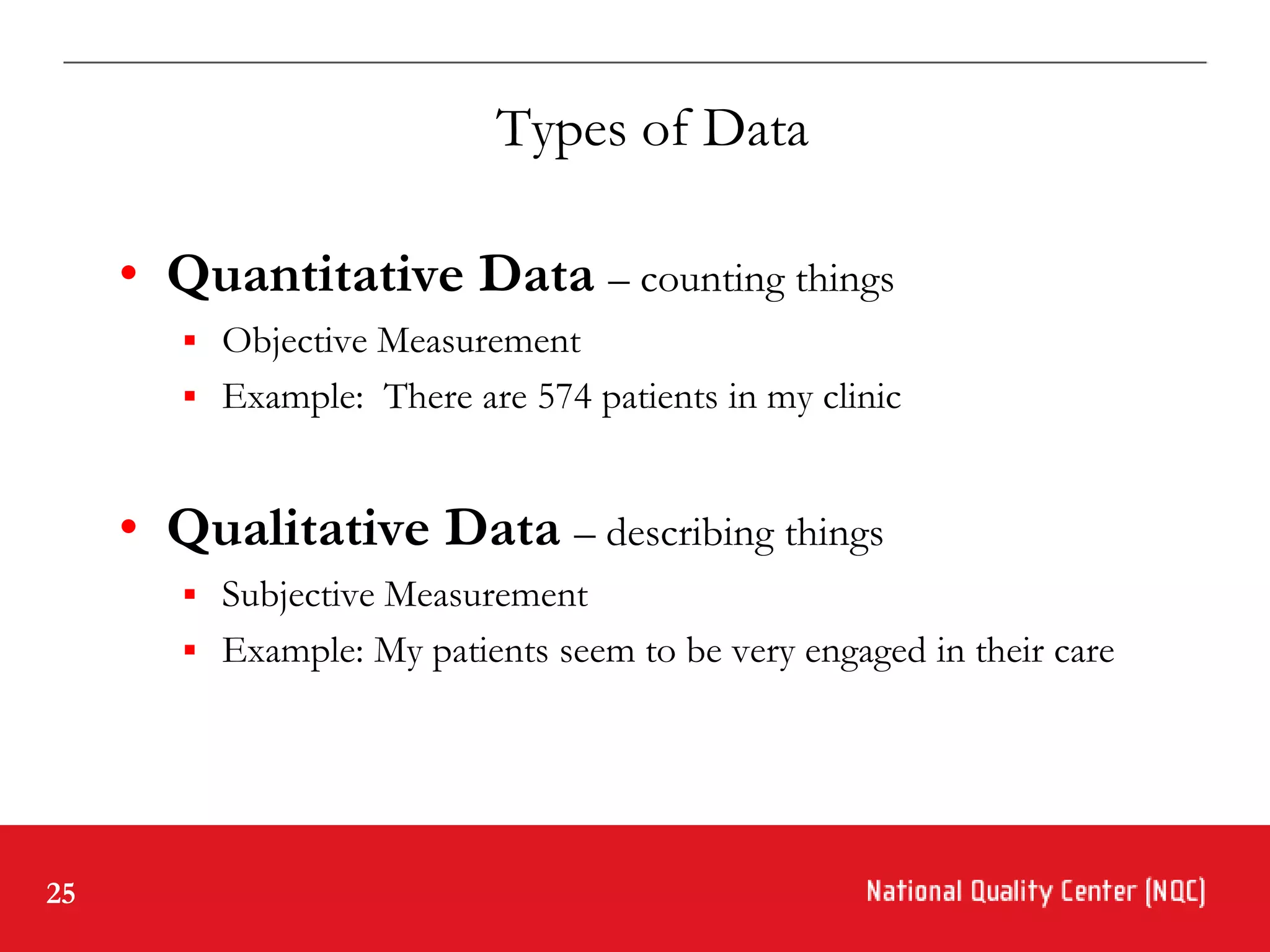
Types of Data

     • Quantitative Data – counting things
         Objective Measurement
         Example: There are 574 patients in my clinic


     • Qualitative Data – describing things
         Subjective Measurement
         Example: My patients seem to be very engaged in their care


25
TCQ Game: Bag of Data

     1. Select a Recorder and
        Facilitator
     2. Open and examine the
        contents of your “Bag of
        Data”
     3. Record 3 qualitative and 3
        quantitative observations
        about the contents


26
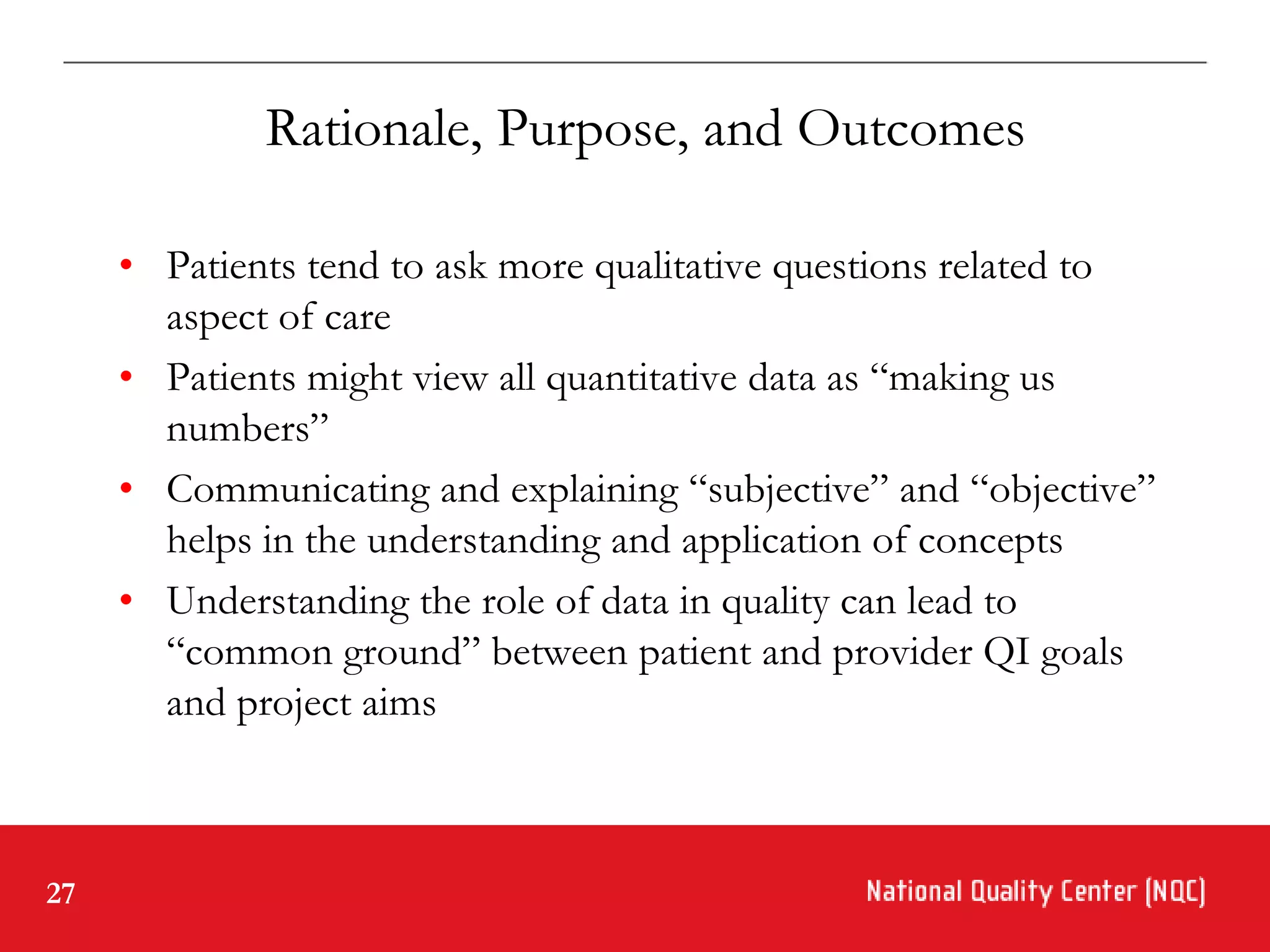
Rationale, Purpose, and Outcomes

     • Patients tend to ask more qualitative questions related to
       aspect of care
     • Patients might view all quantitative data as “making us
       numbers”
     • Communicating and explaining “subjective” and “objective”
       helps in the understanding and application of concepts
     • Understanding the role of data in quality can lead to
       “common ground” between patient and provider QI goals
       and project aims


27
Patient Centered Data Reporting


28
Presenting Data to Patients
     1. Determine if there is particular data your patients NEED to
        have
     2. Ask your patients what data they are interested in viewing
        a.   Sub-Population or Demographic Based Disparities
        b.   Outcomes of Quality Improvement Projects
        c.   Concerning Clinical Trends or Findings
     3. Review your data and ask yourself, “What is the story that
        this data are telling?”
     4. Consider how you would visually represent this story
        instead of simply handing out a table or chart


29
1.    Interestingness
                                                                                                           a.   Relevant, Meaningful,
                                                                                                                New
                                                                                                      2.    Integrity
                                                                                                           a.   Truth, Consistency,
                                                                                                                Honesty, Accuracy
                                                                                                      3.    Form
                                                                                                           a.   Beauty, Structure,
                                                                                                                Appearance
                                                                                                      4.    Function
                                                                                                           a.   Easiness, Usefulness,
                                                                                                                Usability, Fit

     McCandless, David. http://www.informationisbeautiful.net/2009/interesting-easy-beautiful-true/


30
Telling Your Story


     25% of patients in the      60% of patients reported
      clinic received annual   stigma as a significant barrier to
        syphilis screenings     adhering to their medical visits


31
National HIV/AIDS Strategy


32
DC Patient Involvement Champions


33
Collaborative Team Members
     Moderator:
     • Adam Thompson
     Panelists
     • Jane Caruso
          DC Collaborative Faculty - NQC Consultant
     • Martha Cameron
          DC Response Team Member - Q-PAC Team Leader
     • Amelia Khalil
          DC Response Team Member – Capacity Sub-Committee
     • Dan Tietz
          Manager of Consumer Affairs – NYS DOH


34
THANK YOU
• The National Quality Center
• Health Resources and Services
  Administration
• DC Department of Health
  (HAHSTA)
• Northern Virginia Regional
  Commission
• Greater Baden Medical Services
• Family and Medical Counseling
  Service, Inc.

     Without these partners this would not have been possible.

35
Contact Information
     • Adam Thompson
         AdamTThompson@gmail.com
     • Amelia Khalil
         ameliakhalil@gmail.com
     • Dan Tietz
         det01@health.state.ny.us
     • Martha Sichone-Cameron
         marthasichone@hotmail.com
     • National Quality Center
         www.nationalqualitycenter.org


36

Ryan White All Grantee Meeting

  • 1.
    The Activation ofQ-PAC A New Model for Consumer Involvement in Quality Management Adam Thompson Tuesday, November 27, 3:30-5 pm Delaware A
  • 2.
    Session Agenda Introductions 5 Minutes Overview of Patient Activation 15 Minutes Building Patient Capacity for 30 Minutes Meaningful Involvement Patient Centered Data Reporting 10 Minutes Panel Discussion: Q-PAC and the 30 Minutes DC Collaborative 2
  • 3.
    Session Objectives • Introduce patient activation as a method for improving consumer involvement in quality management activities at the clinical and systems levels. • Provide participants with a replicable model of consumer involvement in quality management activities • Provide participants with a framework for introducing patient centered data for consumers in quality management activities. 3
  • 4.
  • 5.
    Reflection Question What are the greatest barriers to patients being involved on quality management teams? 5
  • 6.
    Patient Activation “A fundamental belief underlying efforts to reshape health care institutions and systems is that patients who are activated to participate in their own health care are more likely to adopt healthy behaviors leading to improved health outcomes.” (van Korff et al. 1997; Bodenheimer et al. 2002a, b’ Mosen et al. 2007) 6
  • 7.
    Four Stages ofPatient Activation Patients: 1. Play important roles in self-management 2. Possess knowledge needed to manage their health 3. Act by using their skills and behaviors to maintain well-being 4. Manage stress and stay the course 7
  • 8.
    History of Involvement • Fingerprints – The Denver Principles; Authors and Souls • Blueprints – The Ryan White Program; Drafters and Supporters • Nuts and Bolts – Community Planning Members • Betterment – Quality Improvement Advocates 8
  • 9.
    Methods of Involvement • Agitation • Activism • Advocacy 9
  • 10.
    Quality Champions intoQuality Experts • Champion  (noun) - a person who vigorously supports or defends a person or cause • Expert  (noun) - a person who is very knowledgeable about or skillful in a particular area  (adjective) - having or involving a great deal of knowledge or skill in a particular area 10
  • 11.
    Identifying a Champion • Draw from your ENTIRE patient population • Choose patients who  Are self-managing patients  Demonstrate prosocial characteristics  Are comfortable with and have access to technology  Are able to commit to a defined period of involvement  Can work collaboratively  Express a desire to learn new skills • The “squeaky wheel” might not be the best choice 11
  • 12.
    Preparing a Champion • Recognition of patient experience as only a foundation • Identification of Capacities for Quality Management  Performance Measurement  Computational Skills • Statistical Calculations • Evaluating Data  Quality Improvement & Management Models • Advocacy Skills 12
  • 13.
    Developing an Expert • Adult Learning Theory • Facilitation of Disenfranchised Learners  Math  Science • Building Capacity of Non-Medical Professionals  Performance Measurement  Data Analysis  Quality Management 13
  • 14.
    A New Modelfor Patient Involvement 14
  • 15.
    IHI Collaborative LearningModel The Breakthrough Series: IHI’s Collaborative Model for Achieving Breakthrough Improvement. IHI Innovation Series white paper. Boston: Institute for Healthcare Improvement; 2003. 15
  • 16.
    Securing Buy-In forSuccess Funders • HRSA/HAB • Faculty Patients Faculty • DC Response Team • Patients • HAHSTA Participants Grantees  Part A and Part B Sub- • DC EMA Clinics Grantees  Part C and Part D 16
  • 17.
    Doing Things Differently • Planning  Integration of Patient Peer Experts • Faculty & Response Team  Development of Learning Session Agenda • Implementation  Patient Capacity Building during Action Periods  Patient Generated Presentations  Identification of Enhanced Patient Learning Opportunities • Evaluation  Patient Evaluation of Collaborative Aims and Goals 17
  • 18.
    Provider Capacity • Pre-Learning Session Two  Solicited Barriers to Patient Involvement  Brainstormed Myths of Patient Involvement  Developed Solutions and Strategies to Barriers/Myths • Engaged NQC Consultants and Consumer Advisory Committee • Peer Consultant and Patient Representative from Response Team delivered “Barriers to Patient Involvement and Strategies to Overcome” presentation during Learning Session Two 18
  • 19.
    Patient Capacity Building • Action Period Two  Basics of Quality Improvement • Quality Improvement Principles • Quality Management Terminology • Improvement Models and Methodology  Effective Communication  Working in Teams • Team Roles and Functions • Team Decision-Making Models 19
  • 20.
    Patient Capacity Building • Pre-Learning Session Three  Becoming a Quality Advocate • Agitation, Activism, and Advocacy • Historical Models of Civic Involvement  Foundations of Performance Measurement • Quality Indicators • Percent, Rate, and Measurement • Reading Data Reports  Experiential and Technical Aspects of Care • TED Talk – Dr. Abraham Verghese’s “ A Doctor’s Touch” 20
  • 21.
    Patient Capacity Building • Learning Session Four and Action Period Four  Organizational Assessment • Review of Organizational Assessment Tool • Review of Patient Involvement Questions  Quality Management Plan • Components of a Quality Management Plan • Roles and Responsibilities • Work Plan Development • Learning Session Five  Patient Evaluation of Collaborative Achievements  Proposal, Formation, and Funding of Q-PAC 21
  • 22.
    Outcomes • Formation of Core Group of Patient Participants in Collaborative (Q-PAC)  Quality Management Plan  Quality Improvement Projects • Assessment of Patient Involvement at Clinical Level • Delivery of Patient Self-Management Capacity to Clinic Patients in the EMA • Framework for NQC Training of Consumers for Quality (TCQ) • New Model for Patient Involvement in Collaborative Learning Efforts 22
  • 23.
    Lessons Learned • Patient Role Models and Leadership • Opportunities for Enhanced Learning  Storyboards as Patient Capacity Tools  Pre-Learning Sessions  Patient Delivered Presentations • Make or Break Components  Consistent Patient Involvement • Don’t Miss Networking  Engagement with Senior Quality Leadership • Recognize Patient Achievements 23
  • 24.
  • 25.
    Types of Data • Quantitative Data – counting things  Objective Measurement  Example: There are 574 patients in my clinic • Qualitative Data – describing things  Subjective Measurement  Example: My patients seem to be very engaged in their care 25
  • 26.
    TCQ Game: Bagof Data 1. Select a Recorder and Facilitator 2. Open and examine the contents of your “Bag of Data” 3. Record 3 qualitative and 3 quantitative observations about the contents 26
  • 27.
    Rationale, Purpose, andOutcomes • Patients tend to ask more qualitative questions related to aspect of care • Patients might view all quantitative data as “making us numbers” • Communicating and explaining “subjective” and “objective” helps in the understanding and application of concepts • Understanding the role of data in quality can lead to “common ground” between patient and provider QI goals and project aims 27
  • 28.
  • 29.
    Presenting Data toPatients 1. Determine if there is particular data your patients NEED to have 2. Ask your patients what data they are interested in viewing a. Sub-Population or Demographic Based Disparities b. Outcomes of Quality Improvement Projects c. Concerning Clinical Trends or Findings 3. Review your data and ask yourself, “What is the story that this data are telling?” 4. Consider how you would visually represent this story instead of simply handing out a table or chart 29
  • 30.
    1. Interestingness a. Relevant, Meaningful, New 2. Integrity a. Truth, Consistency, Honesty, Accuracy 3. Form a. Beauty, Structure, Appearance 4. Function a. Easiness, Usefulness, Usability, Fit McCandless, David. http://www.informationisbeautiful.net/2009/interesting-easy-beautiful-true/ 30
  • 31.
    Telling Your Story 25% of patients in the 60% of patients reported clinic received annual stigma as a significant barrier to syphilis screenings adhering to their medical visits 31
  • 32.
  • 33.
  • 34.
    Collaborative Team Members Moderator: • Adam Thompson Panelists • Jane Caruso  DC Collaborative Faculty - NQC Consultant • Martha Cameron  DC Response Team Member - Q-PAC Team Leader • Amelia Khalil  DC Response Team Member – Capacity Sub-Committee • Dan Tietz  Manager of Consumer Affairs – NYS DOH 34
  • 35.
    THANK YOU • TheNational Quality Center • Health Resources and Services Administration • DC Department of Health (HAHSTA) • Northern Virginia Regional Commission • Greater Baden Medical Services • Family and Medical Counseling Service, Inc. Without these partners this would not have been possible. 35
  • 36.
    Contact Information • Adam Thompson  AdamTThompson@gmail.com • Amelia Khalil  ameliakhalil@gmail.com • Dan Tietz  det01@health.state.ny.us • Martha Sichone-Cameron  marthasichone@hotmail.com • National Quality Center  www.nationalqualitycenter.org 36

Editor's Notes

  • #2 Fix slide design
  • #3 Animations:Where participants are often asked to consider patient representatives in collaborativeWhere participants are challenged to find a patient participantWhere most clinics begin to seriously look for a patient participantWhere patients should first be includedWhere you should consider whether faculty has the capacity to work with patient participantsWhere we began our work and achieved these outcomes in the DC Collaborative