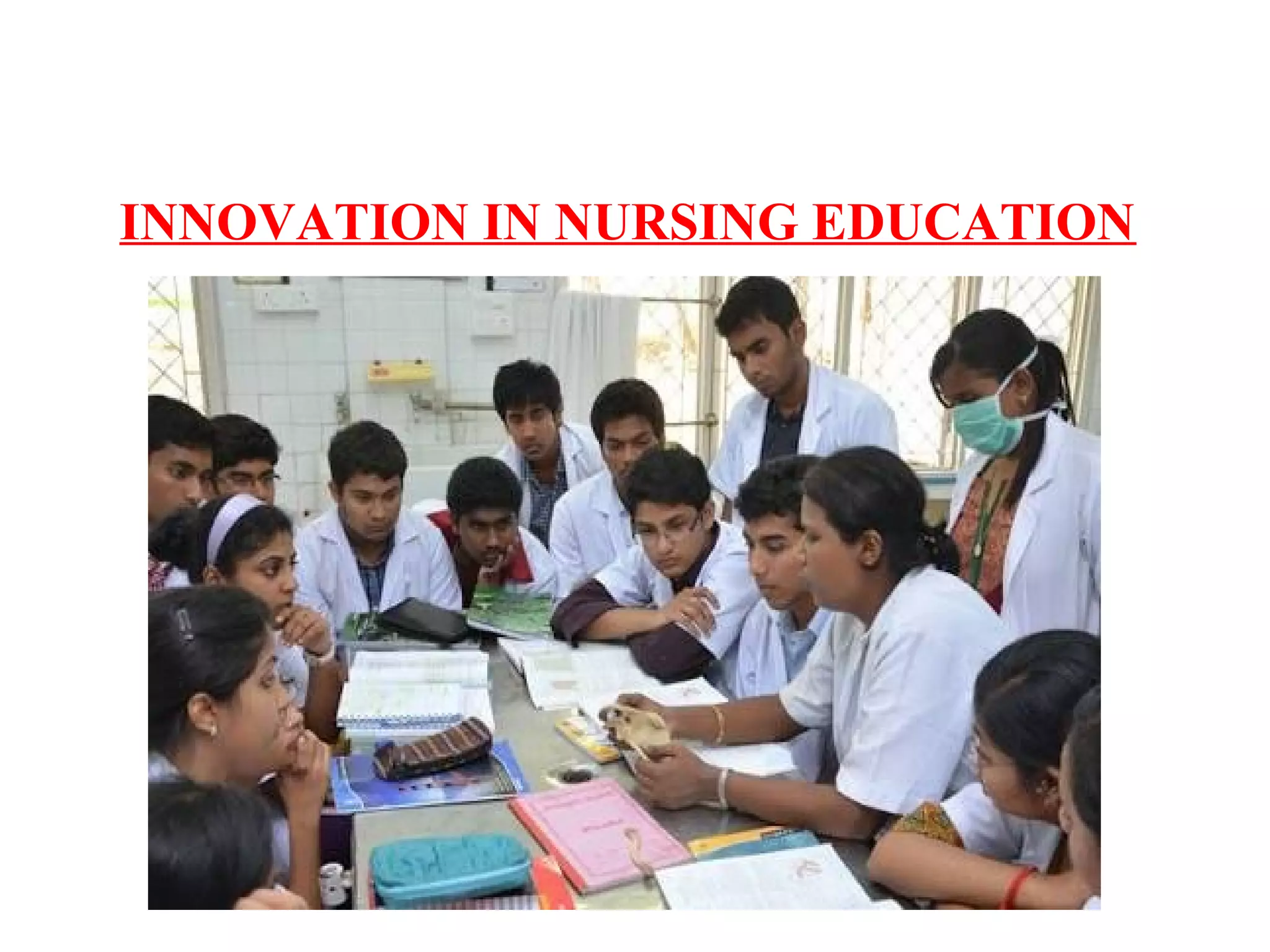
INNOVATION IN NURSING
CREATIVITY IS THINKING UP NEW THINGS
INNOVATION IS DOING NEW THINGS
BY-MR.YOGESH DENGALE
1ST
YEAR M.SC NSG
INTRODUCTION
• The only constant feature in this world is change.
• While all the change may not lead to progress, there can be no
progress without change.
• This is true for the individual, institution, organization or the
country.
• Civilization owes its existence to change.
• The success or even survival of an institution or organization on
depends on making necessary changes.
DEFINITION
Innovation is the act-
1)Constructive thinking
2)Grouping knowledge
3)Skill
4)Attitude into original & new ideas
5)Critical thinking imagination plan action achieve objective
DEFINITIONS:
• Innovation is defined as the generation of new ideas or
application of existing ideas to a new situation resulting in
improvement in organization
Or
• Innovation is the action of introducing a new method, idea
or product
NEED OF INNOVATION:
1. INOVATION TO CENTRAL TO MAINTAINING AND
IMPROVING QUALITY OF CARE
2. GROWING DEMANDS IN HEALTH SERVICES
3. GLOBAL WORKFORCE SHORTAGE
CHARACTERISTICS OF INNOVATION
• RELATIVE ADVANTAGE:
It is the degree to which the new idea is considered
superior to the old one
• COMPATIBILITY:
It refers to the degree of congruence between the
innovation and existing values, habits, past experience and
need of the participant
COMPLEXITY:
It describes the amount of difficulty that participants have in
understanding and subsequently using the innovation
TRIALABILITY:
it is the degree to which the new idea can be pretested or
tried on a limited basis
OBSERVABILITY:
It refers to how visible the innovation is to participants and
onlookers
PRINCIPLES
• Innovation is to analyze the opportunities or sources
• Innovation is both conceptual and perceptual
• It should be simple and focused
• Effective innovation start small and they aim to do one
specific thing
• Successful innovation aim at being the best from the very
beginning
INNOVATION IN NURSING EDUCATION
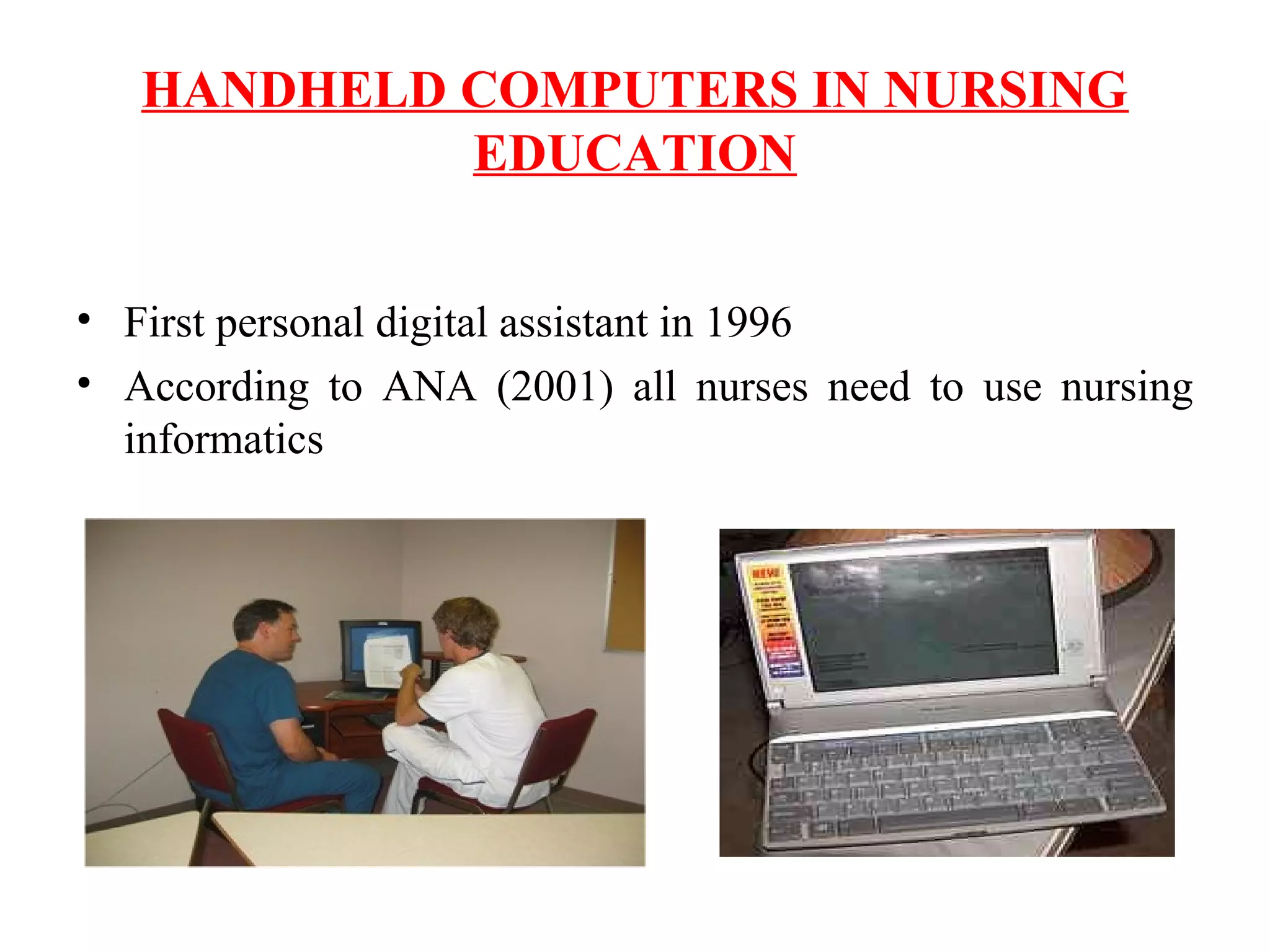
HANDHELD COMPUTERS IN NURSING
EDUCATION
• First personal digital assistant in 1996
• According to ANA (2001) all nurses need to use nursing
informatics
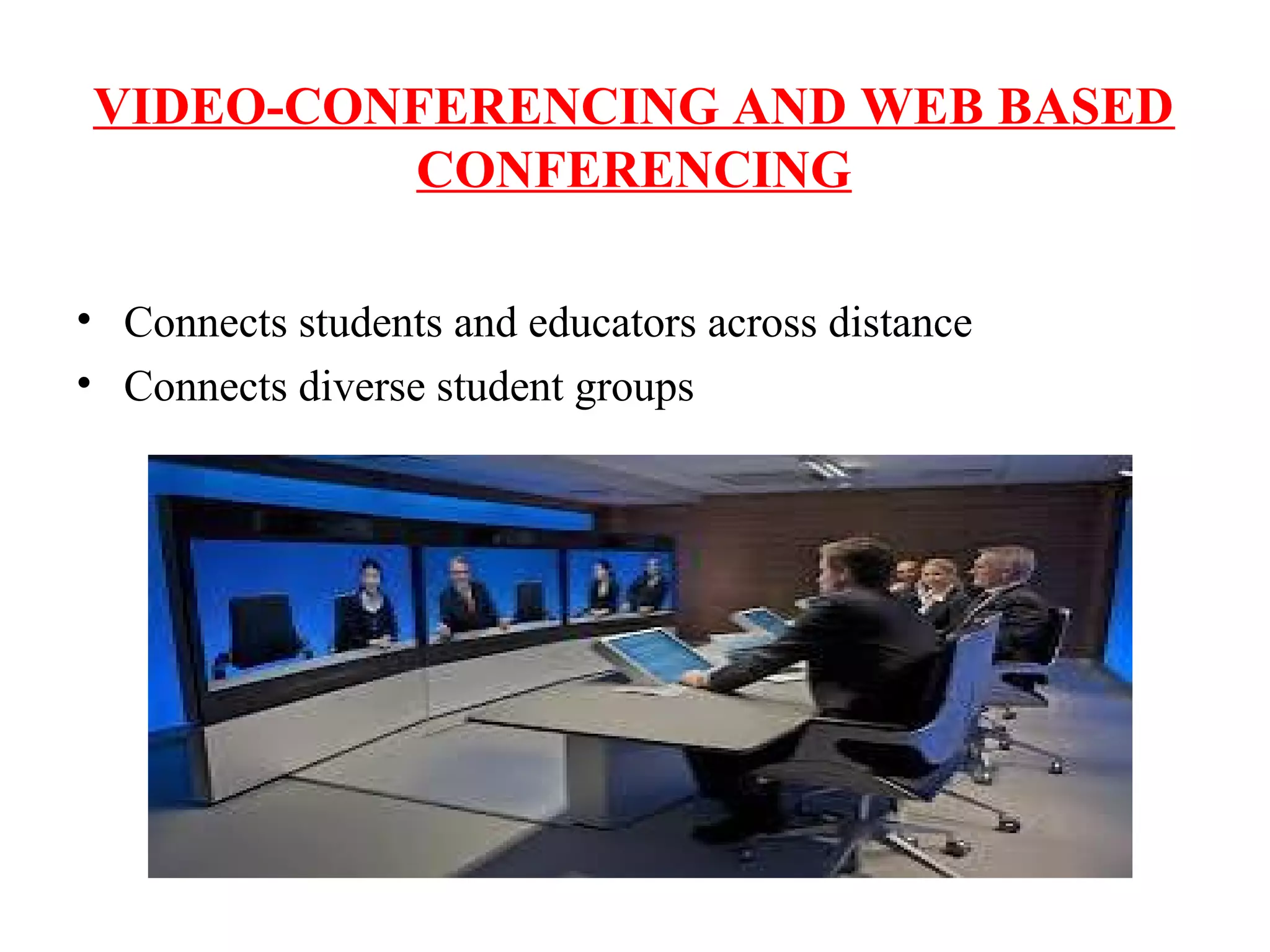
VIDEO-CONFERENCING AND WEB BASED
CONFERENCING
• Connects students and educators across distance
• Connects diverse student groups
E-LEARNING
• Adaptation of different distance learning technologies
• Self directed, active learning
• Refocusing from educator to the subject
SERVICE-LEARNING
• Structured learning experience that combines community
service with preparation and reflection
• Achieves a balance between service and learning objective
HIGH FIDELITY PATIENT SIMULATOR
• Help student practice decision making and problem solving
skill and to develop human interaction
• Simulation is the third leg in the stool of education and
science
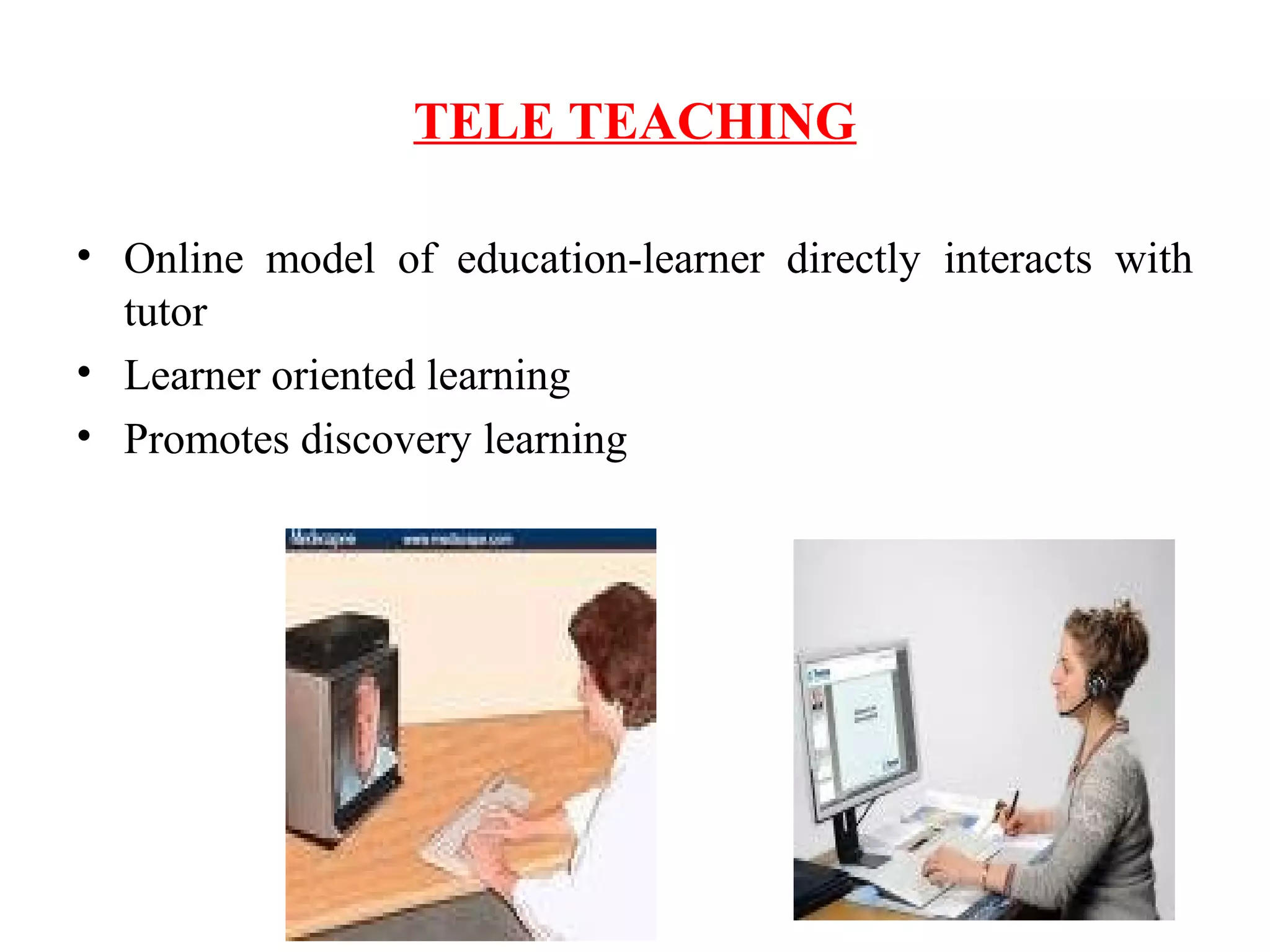
TELE TEACHING
• Online model of education-learner directly interacts with
tutor
• Learner oriented learning
• Promotes discovery learning
MICRO TEACHING
• Miniature classroom teaching
• Small duration
• Paying full attention to a particular unit and skill
• Content reduced to one unit with a single concept
NURSING INFORMATICS
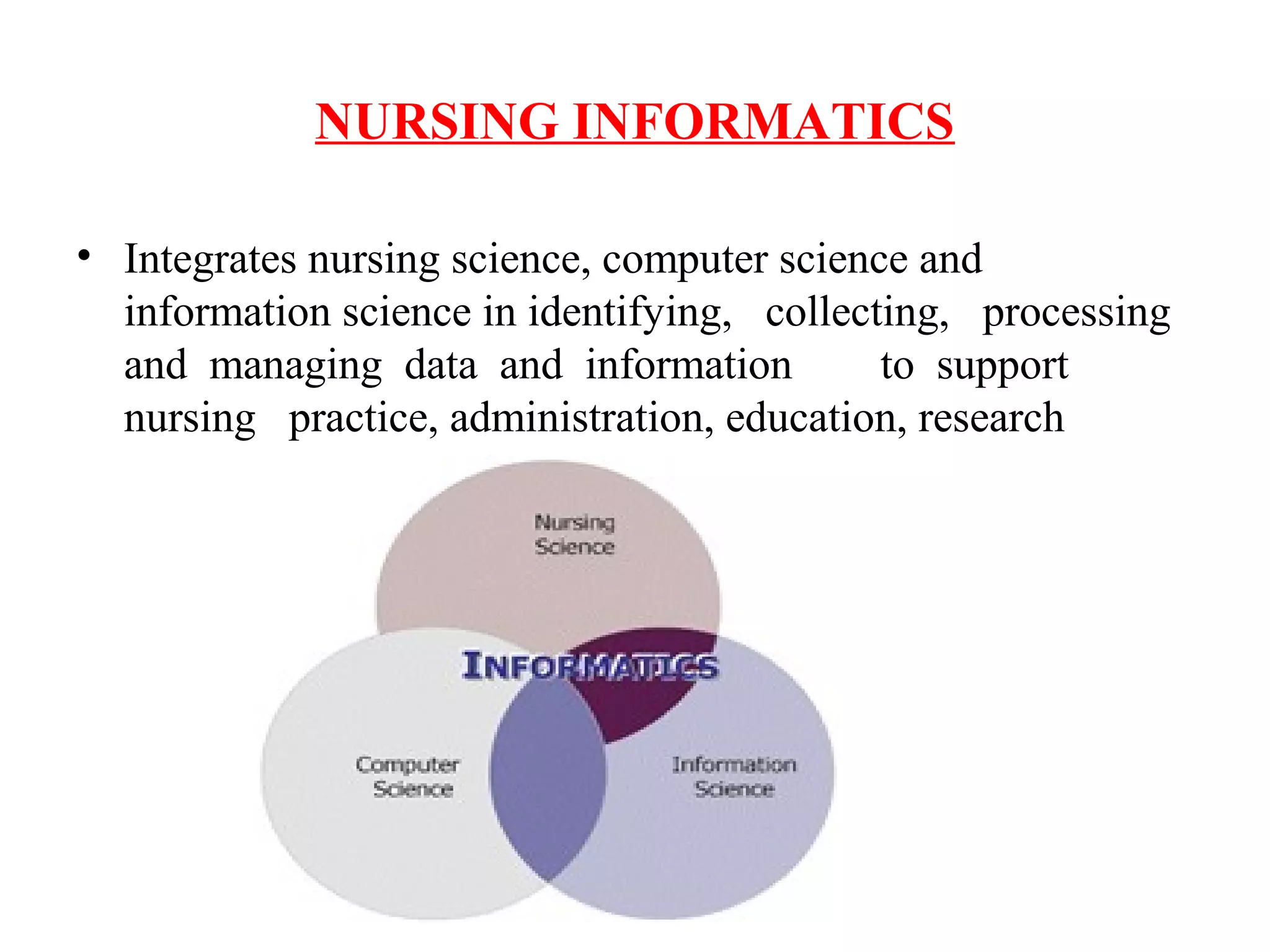
• Integrates nursing science, computer science and
information science in identifying, collecting, processing
and managing data and information to support
nursing practice, administration, education, research
Certification example
• Advanced cardiac life support
• Basic life support
• Certified emergency nurse
• Critical care registered nurse
• Neonatal resuscitation program
• Pediatric advanced life support
• Cardio thoracic nursing
• Emergency and trauma care nursing
• Oncology nursing
• Renal nursing
• Fellowship in family nurse practice
• Fellowship in Hematology Nursing
• Fellowship in Respiratory Nursing
• OT technique and management
• Psychiatric nursing
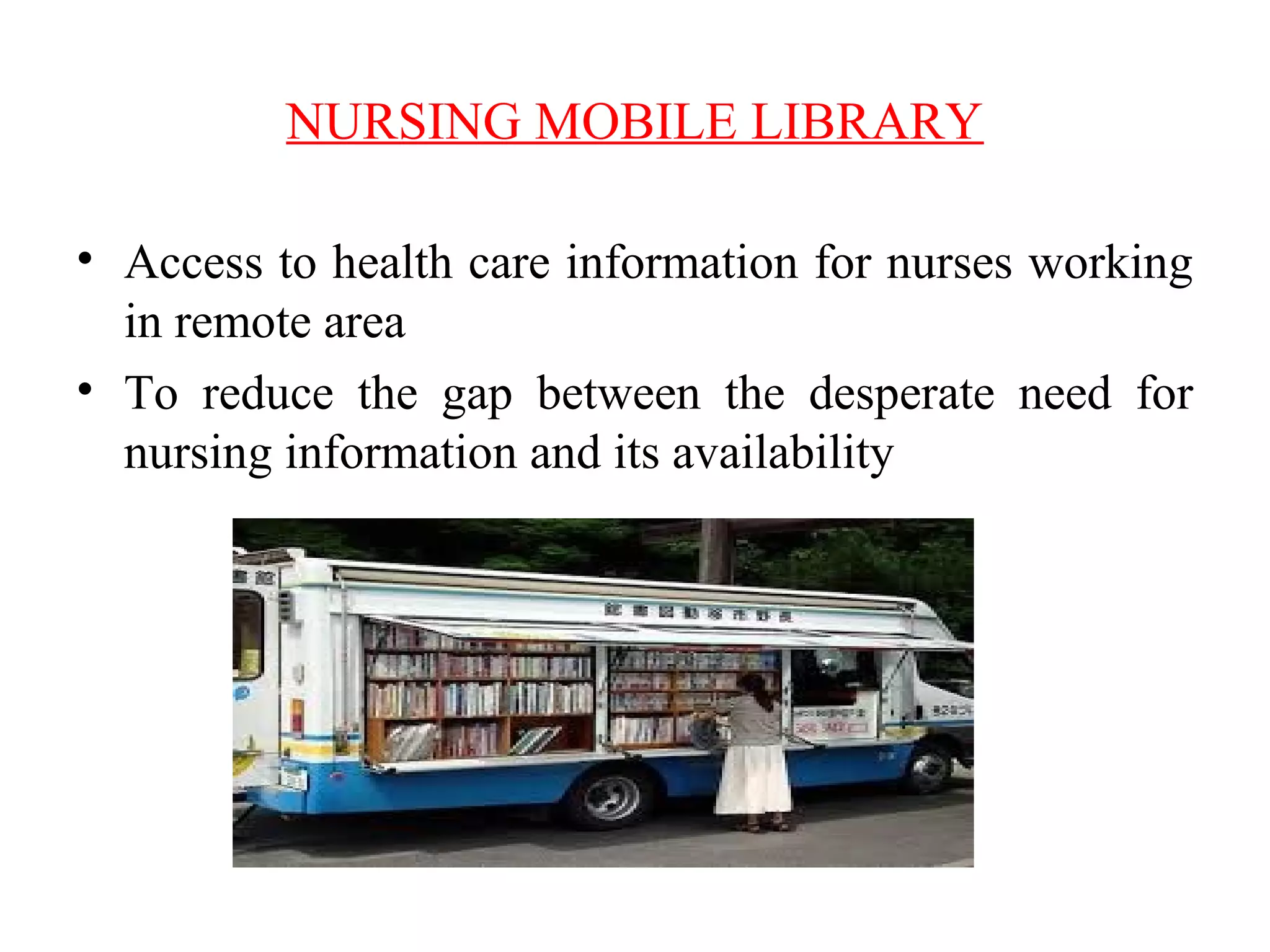
NURSING MOBILE LIBRARY
• Access to health care information for nurses working
in remote area
• To reduce the gap between the desperate need for
nursing information and its availability
STAFF AND STUDENT RECRUITMENT
• New methods like OSCE & OSPE
• Objective because examiner use a checklist for evaluating the
trainee
• Structured, because every trainee sees the same problem and
performs the same task in same time frame
• Clinical, because the task are representative of those faced in
real clinical situation
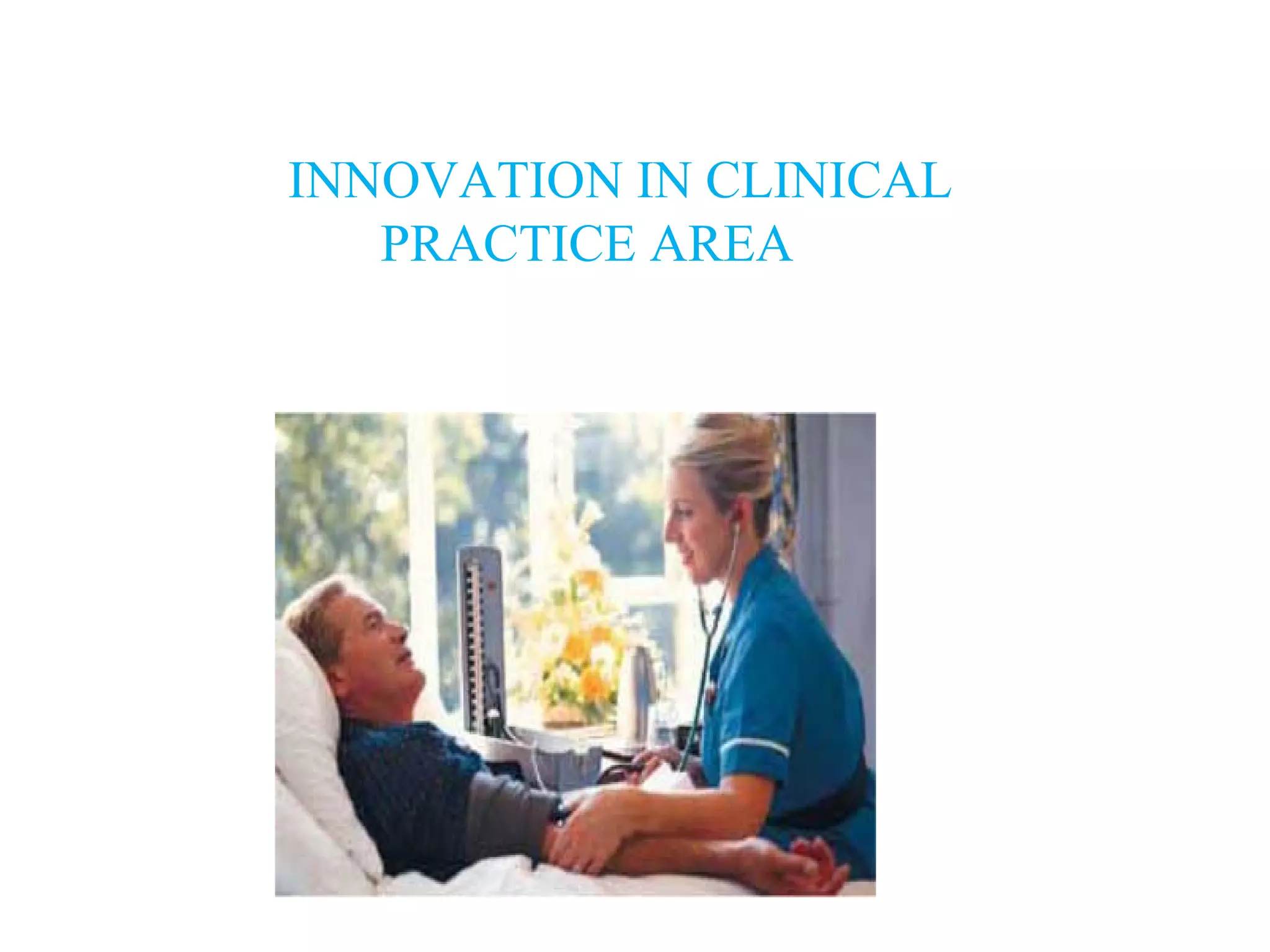
INNOVATION IN CLINICAL
PRACTICE AREA
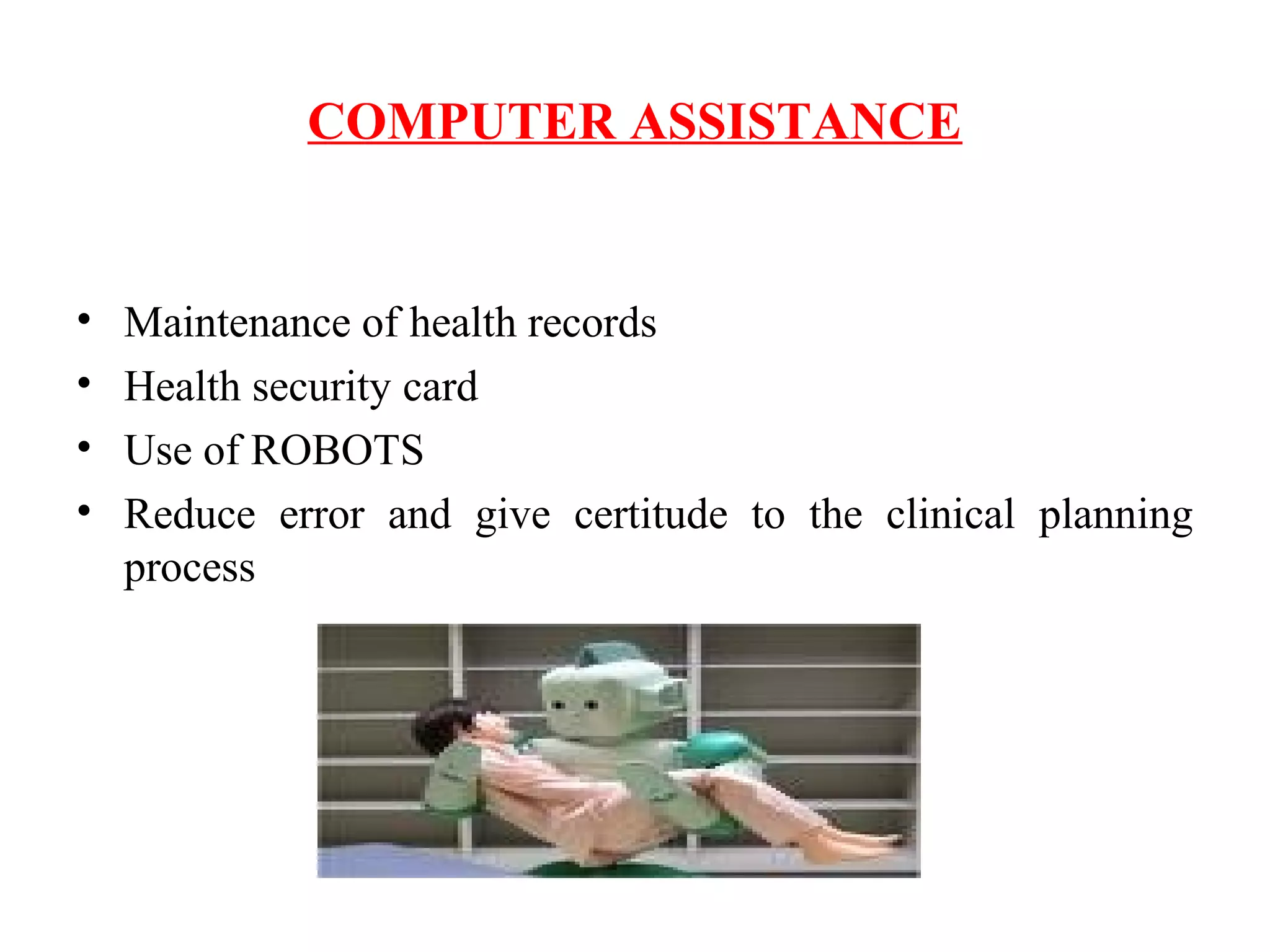
COMPUTER ASSISTANCE
• Maintenance of health records
• Health security card
• Use of ROBOTS
• Reduce error and give certitude to the clinical planning
process
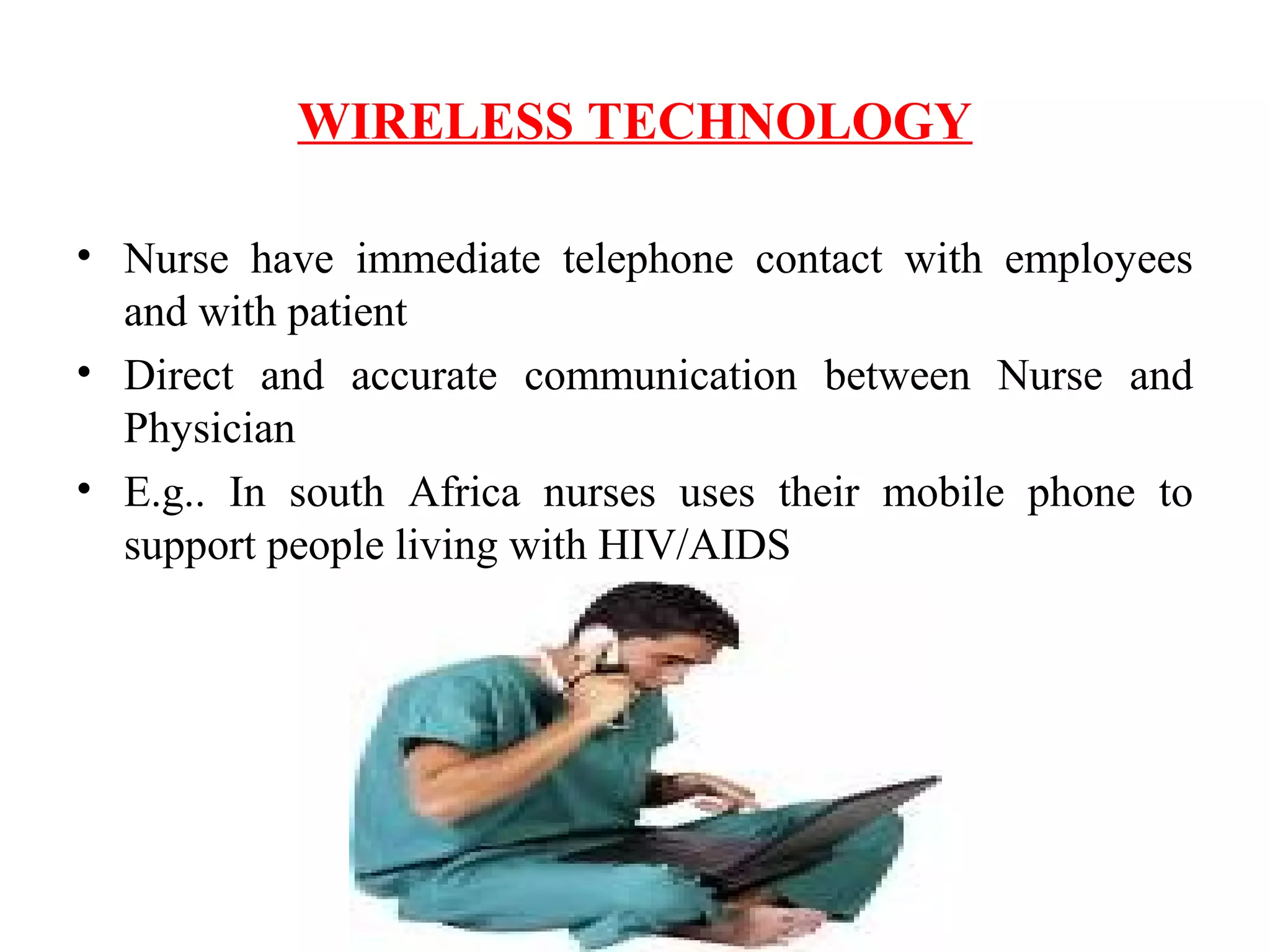
WIRELESS TECHNOLOGY
• Nurse have immediate telephone contact with employees
and with patient
• Direct and accurate communication between Nurse and
Physician
• E.g.. In south Africa nurses uses their mobile phone to
support people living with HIV/AIDS
EVIDENCE BASED PRACTICE
• It is combination of professional expertise with available
evidence to produce practice that lead a positive outcome
for client
• Steps:
1. Identify a knowledge need and formulate an
answerable clinical question
2. Locate the best available evidence
3. Critically evaluate the evidence
4. Integrate the evidence with patient’s unique biology,
preferences and values
5. evaluate
PATIENT CLASSIFICATION BY
ACTIVITY & ACUITY OF ILLNESS
• This will provide more nurses for each shift.
• INC says 1 : 9 / shift.
• In areas where they are unable to use that ratio, an activity
study is done & they come to a conclusion about the number
of needed staff nurses.
INFECTION CONTROL
• To meet the annual JCAH educational requirement.
• To identify available resources which in the Hospital while
maintaining good patient care.
• Infection control has become Paramount importance.
• Segregation of waste has become mandatory in all the
hospitals.
• Every hospital need to have Hospital infection control
committee & policy.
MANAGEMENT & LEADERSHIP
Nursing leaders and managers are exposed to different
management principles relevant to nursing practice. They
are as follows:
 Management theory & leadership principles
 Time management
 Decision making & problem solving
 Teaching & performance strategies
 Identifying and achieving patient goals
 Documentation as an instrument
 Performance evaluation
 Quality assurance
OUTCOME
By exposing them to all the aforesaid concepts
o the nurses have developed personal plans for using time
more effectively.
o There is an increase in written agendas for staff meetings.
o Routine tasks are delegated more effectively.
o A calendar system for planning & setting appointments is
used.
o Are able to identify and achieve patient goals.
o Documentation on the nursing care has improved in
measurable terms
JOB DESCRIPTION
• These are written according to specific practice area and
level of responsibility.
• Nurses are also given format of the standards for
performance.
PROCEDURE MANUALS
• Procedure manual has become mandatory.
EMERGENCY MEDICAL SERVICES
• To disseminate information about emergency medical
services, pre hospital care & emergency department care,
as well as to share ideas, problem solving & develop
relationships among many emergency departments within
the country.
• By doing this kind of networking will enhance pre hospital
and emergency care in our country.
TRIAGE
• Triage has become mandatory in the accident and
emergency and thereby they are able to prioritize the
patients those who come to causality and are able to
treat the sick and vulnerable one as early as possible.
ETHICS
• This is to increase more awareness among nurses that they
will be able to apply ethics principles while caring for
patients.
• It significantly increase their knowledge about ethics and
improves patient satisfaction and the litigation rates.
• Many hospitals encourages nurses to attend such conferences
and workshops.
MAGNET HOSPITAL STATUS
• In 1980, the concept of magnet hospital came into being.
• In 1994, the American Nurses Association through the
American Nurses, credentiality centres (ANCC), established
a ‘new magnet’ hospital designation process that would
allow hospitals to self – nominate under the “Magnet
Nursing Services recognition program” for excellence in
Nursing Services.
• Becoming a magnet hospital is not easy. First the hospital
must create and promote a professional practice culture in all
aspects of nursing care.
MAGNET HOSPITAL STATUS CONTD….
• Then, they must apply to ANCC, submit comprehensive
documentation that demonstrates its compliance with
standards in the ANA’s scope & standards for nurse
administrators and undergo a multi day onsite evaluation to
verify the information in the documentation submitted and to
assess the presence of the “forces of magnetism within the
organization (Joint commission For the Accreditation of
Hospitals, 2003)
•Magnet status is awarded for a 4year period after which the
organization must reapply.
•As of October 15, 2003, there were 88 magnet – designated
organization.
•The first ANCC magnet hospital, university of Washington,
was designated in 1994 & international certification began in
1999.
FORCES OF MAGNETISM FOR
MAGNET HOSPITAL STATUS
• Quality of nursing leadership
• Organizational structure
• Management style
• Personnel policies & programs
• Professional model of care
• Quality of care
• Quality improvement
FORCES OF MAGNETISM FOR MAGNET
HOSPITAL STATUS CONTD…
• Consultation & resources
• Autonomy
• Community and the Hospital
• Nurses as Teachers
• Image of Nursing
• Interdisciplinary relationships
• Professional development
FORENSIC NURSING SPECIALIST
• Forensic psychiatric nurse work with mentally ill offenders
and with victims of crime
• It is the management of crime victims from trauma to trial
• SANE-Sexual Assault Nurse Examiner
COMMUNITY BASED NURSING ROLE
• People in communities in partnership with health care
professionals will define the health needs to be met and
maintain control of strategies for meeting those needs
NURSE RESEARCHER
• Nurse researcher is pivotal to the profession and discipline
because it directs the future path of nursing
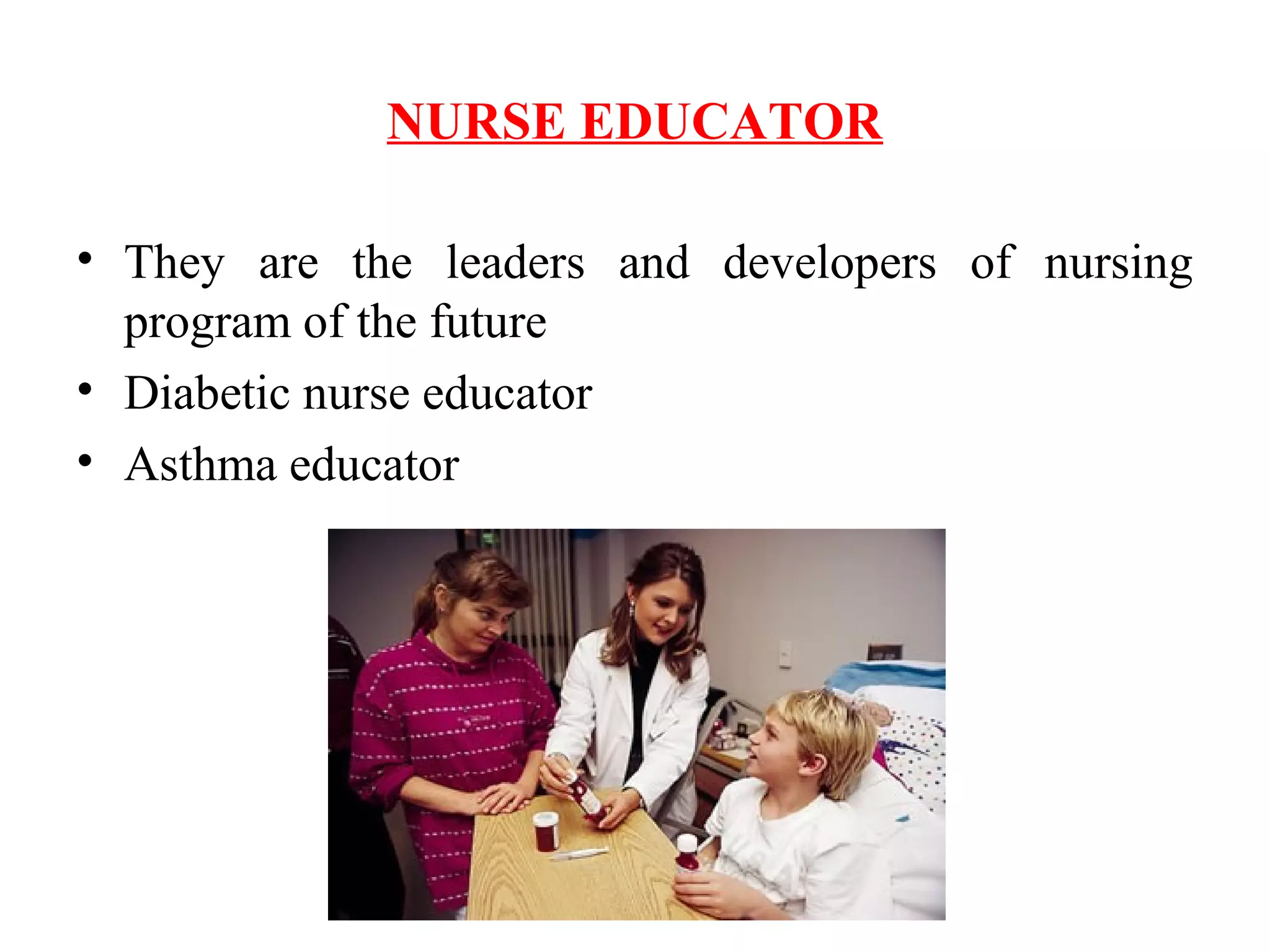
NURSE EDUCATOR
• They are the leaders and developers of nursing
program of the future
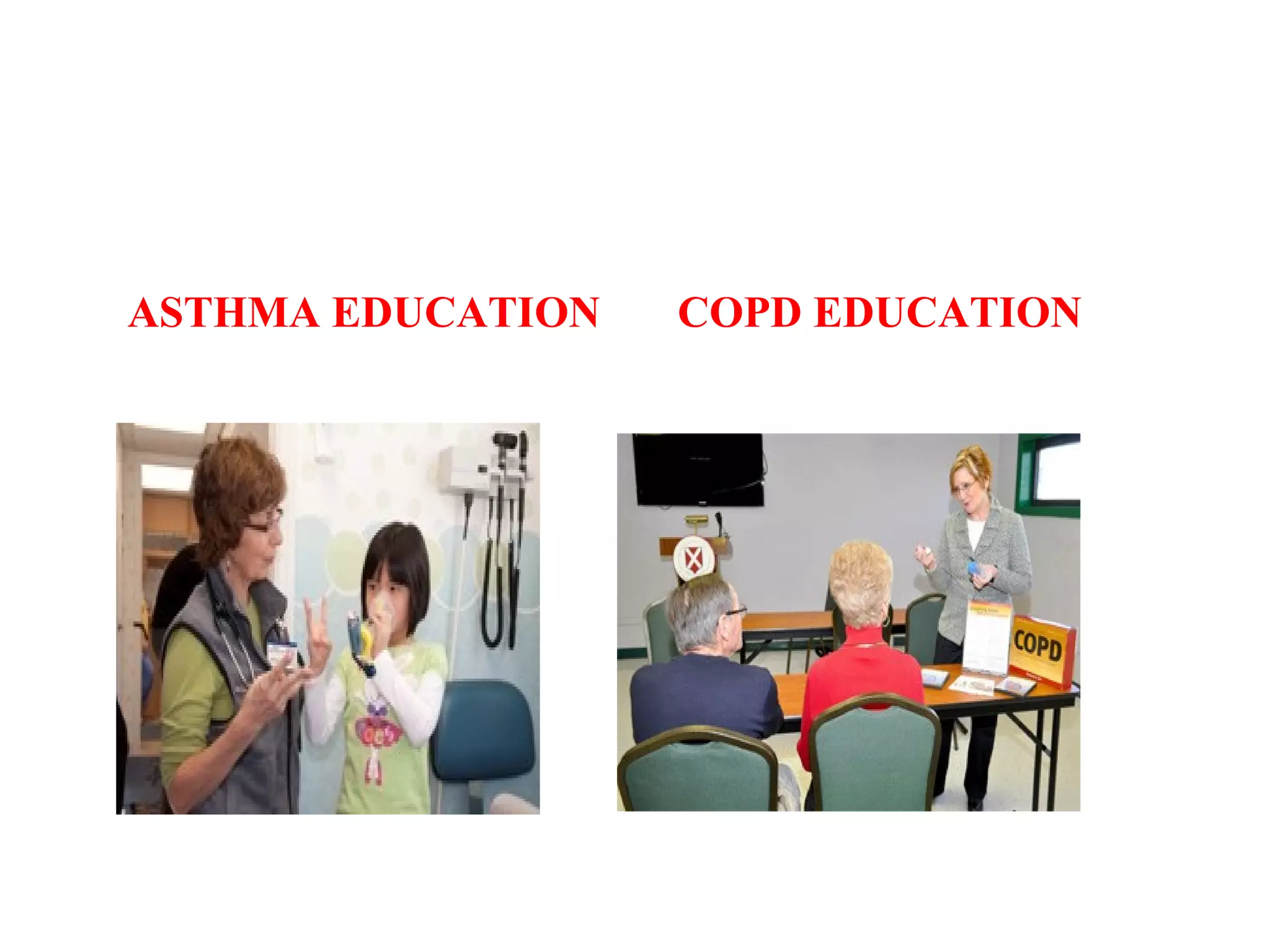
• Diabetic nurse educator
• Asthma educator
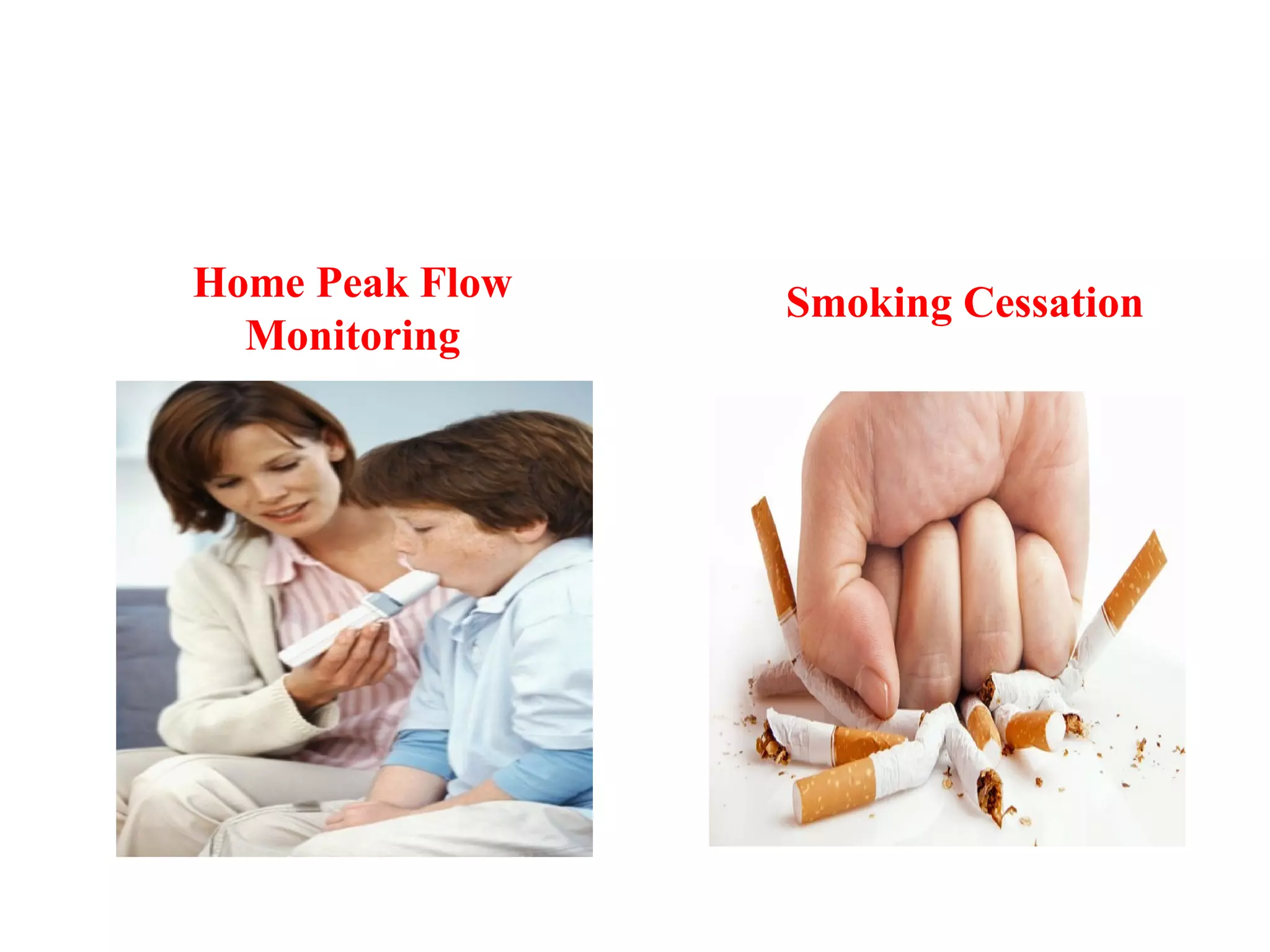
ASTHMA EDUCATION COPD EDUCATION
Home Peak Flow
Monitoring
Smoking Cessation
NURSE ANESTHETIST
Nurse anesthetist is a registered nurse who got specialization
in anesthesia and is responsible for monitoring ,
administering anesthesia, to detect equipment fault
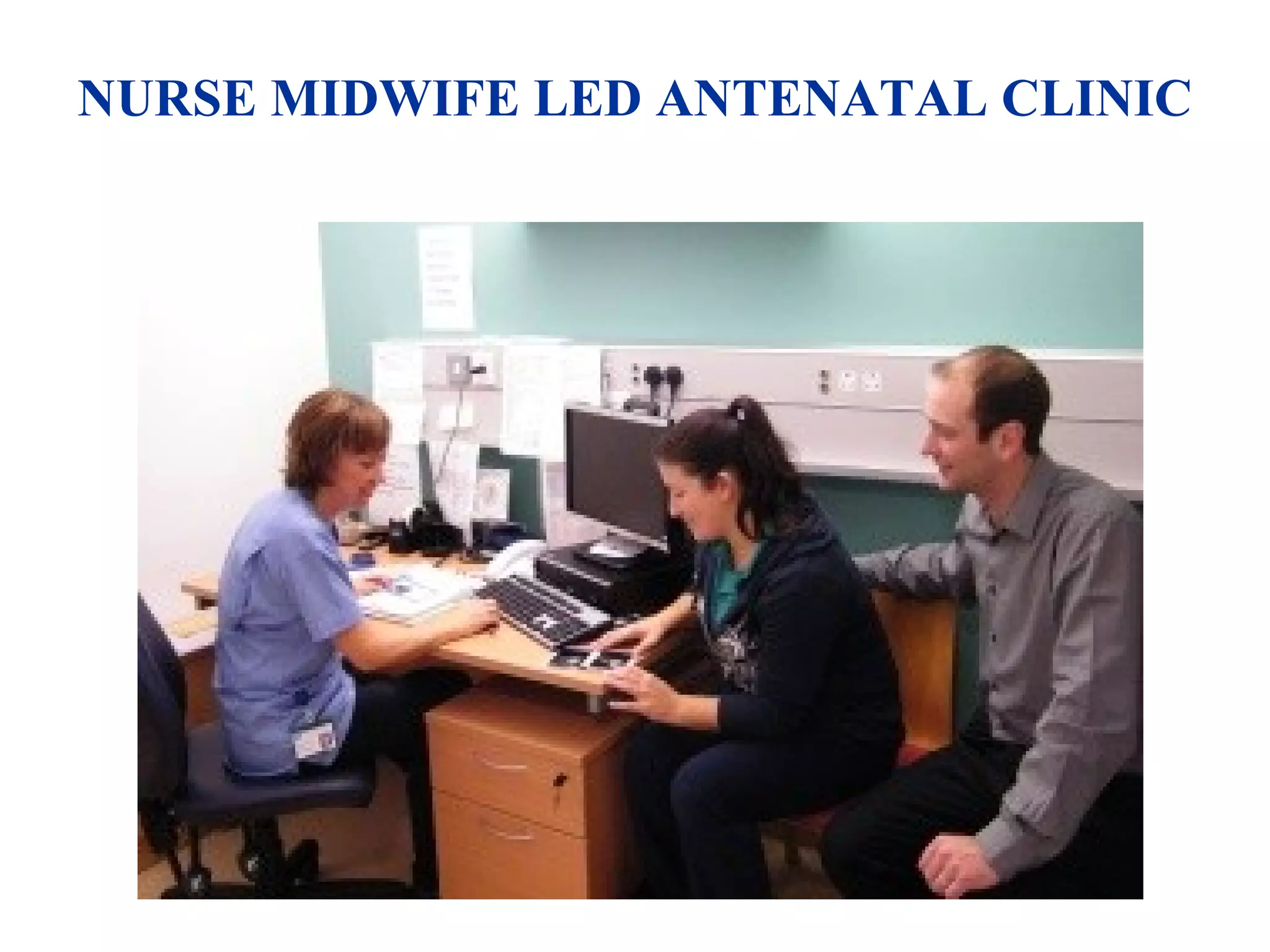
NURSE MIDWIFE LED ANTENATAL CLINIC
TELE NURSING
• Tele nursing is nursing practice that occurs through the
utilization of telecommunication and includes the use of
nursing knowledge, skills and abilities; the application of
critical thinking and nursing judgement;and provision of
nursing direction or care in specific client situation
VARIATIONS IN TRADITIONAL ROLE
• HOSPICE NURSE
The nurse works holistically with clients and family.
• INFORMATICS NURSE SPECIALIST
Nursing specialty whose activities center or management
and processing of health care information
• OCCUPATIONAL HEALTH OPPORTUNITIES
Nurse designs and implement a program of health
promotion and disease prevention for employees
• QUALITY MANAGER
Quality management nurses research and describe
findings and look for opportunities to improve care
• CASE MANAGER:
case manager co-ordinate resources to achieve health
care outcomes based on quality, access and cost.
• FLIGHT NURSE:
military and civilian flight nurse
• TELEPHONE TRIAGE NURSE
The practice nurse interacts with clients on telephone
to assess needs, intervene and evaluate
• TRAVEL NURSE
Assignment usually for a minimum time. Extra
allowance will be provided
• PARISH NURSE
The role focuses on health promotion within the beliefs,
values and practices of various faith communities
• NURSE PRACTITIONER
Nurse serves as a primary care provider and consultant
for individuals, families or communities
• CERTIFIED NURSE MIDWIFE
Independent management of women’s health care.
should pass the national certification examination conducted
by ACNM
• CLINICAL NURSE SPECIALIST
Clinical expertise in a defined area of nursing practice
for a selected client population or clinical setting
• NURSE ADMINISTRATOR
Nurse administrator unites the leadership perspective of
professional nursing with various aspects of business and
health administration
INNOVATION IN ADMINISTRATION AND
MANAGEMENT
• USE OF COMPUTER
Computerized physician order entry (CPOE)
Clinical decision support system (CDSS)
ELECTRONIC MEDICAL RECORDS
• Affordable & integrated.
• For improving patient care.
• Powerful practice management system for practices of any
size.
• Fast, flexible, Easy to use schedule for increasing
productivity.
• Clinical desktop for improving enterprise work flow.
• Integrated, Internet – based solution that securely connects
clinics and patients.
• Electronic document management system for eliminating
paper charts.
• LEADERSHIP FOR CHANGE
It is an action learning programme to develop nurses as
effective leaders and managers
• OUTSOURCING
outsourcing is subcontracting a process to a third
party company
 it helps to provide core job-care giving
 transcription
 electronic medical record
 medical billing and coding services
 entry level recruitment, security, house keeping,
nursing assistance
• STAFFING STRUCTURE
Benchmarking: organization has varying levels of support in
place at the unit level for the nurse.eg. Nursing unit that has
dietary aides
JCAHO: surveys hospitals for the quality of care provided.
sees for the right number of competent staff to meet the
need of patient
Skill mix: it is the percentage of RN staff to other direct care
staff, LPNs and unlicensed assistive personnel
• PERSONAL MANAGEMENT
Use of computer in recording staff
files,biodata,accounts
INNOVATION IN RESEARCH
• TYPES OF RESEARCH
QUALITATIVE RESEARCH
QUANTITATIVE RESEARCH
• USING NURSING RESEARCH TO PROMOTE EBP
EBP requires integration of best research evidence
with clinical expertise and patient value and needs in the
delivery of quality, cost effective care
• INCREASED FOCUS ON OUTCOME RESEARCH
Outcome research is research designed to assess and
document the effectiveness of health care services
• PROMOTION OR RESEARCH UTILIZATION
Translate research findings into practice and nurses at
all levels are encouraged to evidence in evidence based
patient care
• EXPANDED DISSEMINATION
CINAHL (CCumulative Index to Nursing and
Allied Heath Literature)
MEDLINE (Medical Literature on line)
psyc –INFO( Psychology Information)
AIDSLINE(AIDS information on- line)
Cancerlit (Cancer literature)
HEALTH STAR(Health services Technology,
Administration and Research)
CHID (Combined Heath Information Database)
ELECTRONIC PUBLICATION
• Information of all type is disseminated in computer and in
internet
• Many journals that publish in hard copy format now also
have online capabilities
• Some researches or research team develop their own web
page with information about their studies
• Electronic research reports are accessible to worldwide
audience of potential consumers, typically without page
limitations, thus enabling researchers to describe and
discuss complex studies more fully
INNOVATION IN PRIMARY AND
COMMUNITY HEALTH CARE
• INNOVATION IN HEALTH PROMOTION AND
DISEASE PREVENTION
Nurses are uniquely positioned to identify risk factors,
provide information about how to manage these risks and
promote the benefits of healthier lifestyles , diet and avoid
risky behavior
• APPLICATION OF TELENURSING IN HOME CARE
The programme targets families living in rural areas who
often find it difficult to repeatedly travel to a distance
medical center for necessary follow up.
• POPULATION BASED HEALTH CARE
Acts on three levels: the community system within the
community, and individuals, families and groups.
Population based individual focused practice changes the
knowledge, attitude, beliefs, practices and behavior of
individuals , families and groups
INNOVATION IMPLEMENTATION
• DISSEMINATION
Planned, formal communication of information about
the innovation, through formal channels
• DIFFUSION
ideas become adopted through more informal,
decentralized means. It occurs through a series of
communication channels over a period of time among the
member of similar social system
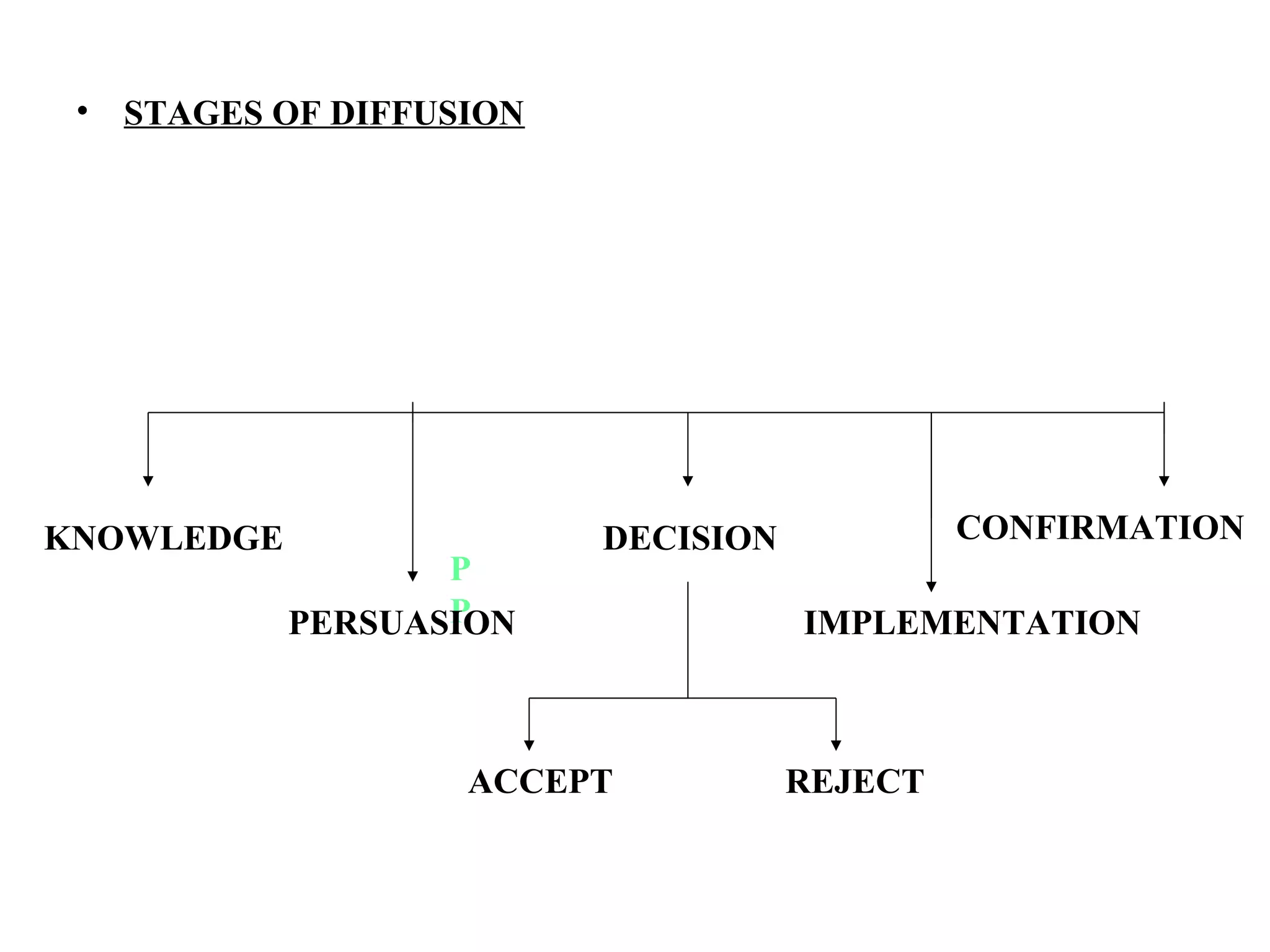
• STAGES OF DIFFUSION
KNOWLEDGE
P
PPERSUASION
DECISION
IMPLEMENTATION
CONFIRMATION
ACCEPT REJECT
READINESS TO CHANGE
• Some individuals and organizations are more ready to affect
changes than others.
• This depends often on the degree of felt security.
• In turn, it depends on the knowledge
• skill
• attitude
• self confidence
• tolerance to stress
• motivation of the individuals
It also depends on the security to change. If there is optimal
feeling of security , then the acceptance of change will be
possible.
Change is crucial. Change is a must for progress.
CAUSES FOR NOT ATTEMPTING
INNOVATION
• Afraid of failures; of opposition; of the
unknown.
• Lacking adequate and correct information.
• Reluctant to experiment.
• Bound by custom & tradition.
• Unaware of our strengths for achievement.
Nursing innovation are key to improvement and
progress in health systems worldwide
RESEARCH ARTICAL
Innovation in Nursing and Midwifery Education and Research
Abstract
Currently, all professions are using information communication technology (ICT) innovations that
are transforming the 21st century learning environment. Nursing and midwifery need to use ICT to
provide evidence based care and acquire new skills to function efficiently in high impact
technology environments. Business and community partnership will enhance an uptake and
assist in mapping out programs. The purpose of this paper is to discuss innovative initiatives:
blended learning, massive open online courses, simulation and embracing technology in a
community oriented, primary care outreach program design. In addition, innovations in
nursing research are discussed through the lens of chronic disease, the major cause of
disability and death throughout the world. Innovations in nursing research are centered in
three areas – study design, nursing theory and the use of technology.
THANK YOU

Innovation in nsg

  • 1.
    INNOVATION IN NURSING CREATIVITYIS THINKING UP NEW THINGS INNOVATION IS DOING NEW THINGS BY-MR.YOGESH DENGALE 1ST YEAR M.SC NSG
  • 2.
    INTRODUCTION • The onlyconstant feature in this world is change. • While all the change may not lead to progress, there can be no progress without change. • This is true for the individual, institution, organization or the country. • Civilization owes its existence to change. • The success or even survival of an institution or organization on depends on making necessary changes.
  • 3.
    DEFINITION Innovation is theact- 1)Constructive thinking 2)Grouping knowledge 3)Skill 4)Attitude into original & new ideas 5)Critical thinking imagination plan action achieve objective
  • 4.
    DEFINITIONS: • Innovation isdefined as the generation of new ideas or application of existing ideas to a new situation resulting in improvement in organization Or • Innovation is the action of introducing a new method, idea or product
  • 5.
    NEED OF INNOVATION: 1.INOVATION TO CENTRAL TO MAINTAINING AND IMPROVING QUALITY OF CARE 2. GROWING DEMANDS IN HEALTH SERVICES 3. GLOBAL WORKFORCE SHORTAGE
  • 6.
    CHARACTERISTICS OF INNOVATION •RELATIVE ADVANTAGE: It is the degree to which the new idea is considered superior to the old one • COMPATIBILITY: It refers to the degree of congruence between the innovation and existing values, habits, past experience and need of the participant
  • 7.
    COMPLEXITY: It describes theamount of difficulty that participants have in understanding and subsequently using the innovation TRIALABILITY: it is the degree to which the new idea can be pretested or tried on a limited basis OBSERVABILITY: It refers to how visible the innovation is to participants and onlookers
  • 8.
    PRINCIPLES • Innovation isto analyze the opportunities or sources • Innovation is both conceptual and perceptual • It should be simple and focused • Effective innovation start small and they aim to do one specific thing • Successful innovation aim at being the best from the very beginning
  • 9.
  • 10.
    HANDHELD COMPUTERS INNURSING EDUCATION • First personal digital assistant in 1996 • According to ANA (2001) all nurses need to use nursing informatics
  • 11.
    VIDEO-CONFERENCING AND WEBBASED CONFERENCING • Connects students and educators across distance • Connects diverse student groups
  • 12.
    E-LEARNING • Adaptation ofdifferent distance learning technologies • Self directed, active learning • Refocusing from educator to the subject
  • 13.
    SERVICE-LEARNING • Structured learningexperience that combines community service with preparation and reflection • Achieves a balance between service and learning objective
  • 14.
    HIGH FIDELITY PATIENTSIMULATOR • Help student practice decision making and problem solving skill and to develop human interaction • Simulation is the third leg in the stool of education and science
  • 15.
    TELE TEACHING • Onlinemodel of education-learner directly interacts with tutor • Learner oriented learning • Promotes discovery learning
  • 16.
    MICRO TEACHING • Miniatureclassroom teaching • Small duration • Paying full attention to a particular unit and skill • Content reduced to one unit with a single concept
  • 17.
    NURSING INFORMATICS • Integratesnursing science, computer science and information science in identifying, collecting, processing and managing data and information to support nursing practice, administration, education, research
  • 18.
    Certification example • Advancedcardiac life support • Basic life support • Certified emergency nurse • Critical care registered nurse • Neonatal resuscitation program • Pediatric advanced life support • Cardio thoracic nursing
  • 19.
    • Emergency andtrauma care nursing • Oncology nursing • Renal nursing • Fellowship in family nurse practice • Fellowship in Hematology Nursing • Fellowship in Respiratory Nursing • OT technique and management • Psychiatric nursing
  • 20.
    NURSING MOBILE LIBRARY •Access to health care information for nurses working in remote area • To reduce the gap between the desperate need for nursing information and its availability
  • 21.
    STAFF AND STUDENTRECRUITMENT • New methods like OSCE & OSPE • Objective because examiner use a checklist for evaluating the trainee • Structured, because every trainee sees the same problem and performs the same task in same time frame • Clinical, because the task are representative of those faced in real clinical situation
  • 22.
  • 23.
    COMPUTER ASSISTANCE • Maintenanceof health records • Health security card • Use of ROBOTS • Reduce error and give certitude to the clinical planning process
  • 24.
    WIRELESS TECHNOLOGY • Nursehave immediate telephone contact with employees and with patient • Direct and accurate communication between Nurse and Physician • E.g.. In south Africa nurses uses their mobile phone to support people living with HIV/AIDS
  • 25.
    EVIDENCE BASED PRACTICE •It is combination of professional expertise with available evidence to produce practice that lead a positive outcome for client • Steps: 1. Identify a knowledge need and formulate an answerable clinical question 2. Locate the best available evidence 3. Critically evaluate the evidence 4. Integrate the evidence with patient’s unique biology, preferences and values 5. evaluate
  • 26.
    PATIENT CLASSIFICATION BY ACTIVITY& ACUITY OF ILLNESS • This will provide more nurses for each shift. • INC says 1 : 9 / shift. • In areas where they are unable to use that ratio, an activity study is done & they come to a conclusion about the number of needed staff nurses.
  • 27.
    INFECTION CONTROL • Tomeet the annual JCAH educational requirement. • To identify available resources which in the Hospital while maintaining good patient care. • Infection control has become Paramount importance. • Segregation of waste has become mandatory in all the hospitals. • Every hospital need to have Hospital infection control committee & policy.
  • 28.
    MANAGEMENT & LEADERSHIP Nursingleaders and managers are exposed to different management principles relevant to nursing practice. They are as follows:  Management theory & leadership principles  Time management  Decision making & problem solving  Teaching & performance strategies  Identifying and achieving patient goals  Documentation as an instrument  Performance evaluation  Quality assurance
  • 29.
    OUTCOME By exposing themto all the aforesaid concepts o the nurses have developed personal plans for using time more effectively. o There is an increase in written agendas for staff meetings. o Routine tasks are delegated more effectively. o A calendar system for planning & setting appointments is used. o Are able to identify and achieve patient goals. o Documentation on the nursing care has improved in measurable terms
  • 30.
    JOB DESCRIPTION • Theseare written according to specific practice area and level of responsibility. • Nurses are also given format of the standards for performance.
  • 31.
    PROCEDURE MANUALS • Proceduremanual has become mandatory.
  • 32.
    EMERGENCY MEDICAL SERVICES •To disseminate information about emergency medical services, pre hospital care & emergency department care, as well as to share ideas, problem solving & develop relationships among many emergency departments within the country. • By doing this kind of networking will enhance pre hospital and emergency care in our country.
  • 33.
    TRIAGE • Triage hasbecome mandatory in the accident and emergency and thereby they are able to prioritize the patients those who come to causality and are able to treat the sick and vulnerable one as early as possible.
  • 34.
    ETHICS • This isto increase more awareness among nurses that they will be able to apply ethics principles while caring for patients. • It significantly increase their knowledge about ethics and improves patient satisfaction and the litigation rates. • Many hospitals encourages nurses to attend such conferences and workshops.
  • 35.
    MAGNET HOSPITAL STATUS •In 1980, the concept of magnet hospital came into being. • In 1994, the American Nurses Association through the American Nurses, credentiality centres (ANCC), established a ‘new magnet’ hospital designation process that would allow hospitals to self – nominate under the “Magnet Nursing Services recognition program” for excellence in Nursing Services. • Becoming a magnet hospital is not easy. First the hospital must create and promote a professional practice culture in all aspects of nursing care.
  • 36.
    MAGNET HOSPITAL STATUSCONTD…. • Then, they must apply to ANCC, submit comprehensive documentation that demonstrates its compliance with standards in the ANA’s scope & standards for nurse administrators and undergo a multi day onsite evaluation to verify the information in the documentation submitted and to assess the presence of the “forces of magnetism within the organization (Joint commission For the Accreditation of Hospitals, 2003)
  • 37.
    •Magnet status isawarded for a 4year period after which the organization must reapply. •As of October 15, 2003, there were 88 magnet – designated organization. •The first ANCC magnet hospital, university of Washington, was designated in 1994 & international certification began in 1999.
  • 38.
    FORCES OF MAGNETISMFOR MAGNET HOSPITAL STATUS • Quality of nursing leadership • Organizational structure • Management style • Personnel policies & programs • Professional model of care • Quality of care • Quality improvement
  • 39.
    FORCES OF MAGNETISMFOR MAGNET HOSPITAL STATUS CONTD… • Consultation & resources • Autonomy • Community and the Hospital • Nurses as Teachers • Image of Nursing • Interdisciplinary relationships • Professional development
  • 40.
    FORENSIC NURSING SPECIALIST •Forensic psychiatric nurse work with mentally ill offenders and with victims of crime • It is the management of crime victims from trauma to trial • SANE-Sexual Assault Nurse Examiner
  • 41.
    COMMUNITY BASED NURSINGROLE • People in communities in partnership with health care professionals will define the health needs to be met and maintain control of strategies for meeting those needs
  • 42.
    NURSE RESEARCHER • Nurseresearcher is pivotal to the profession and discipline because it directs the future path of nursing
  • 43.
    NURSE EDUCATOR • Theyare the leaders and developers of nursing program of the future • Diabetic nurse educator • Asthma educator
  • 44.
  • 45.
  • 46.
    NURSE ANESTHETIST Nurse anesthetistis a registered nurse who got specialization in anesthesia and is responsible for monitoring , administering anesthesia, to detect equipment fault
  • 47.
    NURSE MIDWIFE LEDANTENATAL CLINIC
  • 48.
    TELE NURSING • Telenursing is nursing practice that occurs through the utilization of telecommunication and includes the use of nursing knowledge, skills and abilities; the application of critical thinking and nursing judgement;and provision of nursing direction or care in specific client situation
  • 49.
    VARIATIONS IN TRADITIONALROLE • HOSPICE NURSE The nurse works holistically with clients and family. • INFORMATICS NURSE SPECIALIST Nursing specialty whose activities center or management and processing of health care information
  • 50.
    • OCCUPATIONAL HEALTHOPPORTUNITIES Nurse designs and implement a program of health promotion and disease prevention for employees • QUALITY MANAGER Quality management nurses research and describe findings and look for opportunities to improve care
  • 51.
    • CASE MANAGER: casemanager co-ordinate resources to achieve health care outcomes based on quality, access and cost. • FLIGHT NURSE: military and civilian flight nurse
  • 52.
    • TELEPHONE TRIAGENURSE The practice nurse interacts with clients on telephone to assess needs, intervene and evaluate • TRAVEL NURSE Assignment usually for a minimum time. Extra allowance will be provided
  • 53.
    • PARISH NURSE Therole focuses on health promotion within the beliefs, values and practices of various faith communities
  • 54.
    • NURSE PRACTITIONER Nurseserves as a primary care provider and consultant for individuals, families or communities • CERTIFIED NURSE MIDWIFE Independent management of women’s health care. should pass the national certification examination conducted by ACNM
  • 55.
    • CLINICAL NURSESPECIALIST Clinical expertise in a defined area of nursing practice for a selected client population or clinical setting • NURSE ADMINISTRATOR Nurse administrator unites the leadership perspective of professional nursing with various aspects of business and health administration
  • 56.
  • 57.
    • USE OFCOMPUTER Computerized physician order entry (CPOE) Clinical decision support system (CDSS)
  • 58.
    ELECTRONIC MEDICAL RECORDS •Affordable & integrated. • For improving patient care. • Powerful practice management system for practices of any size. • Fast, flexible, Easy to use schedule for increasing productivity. • Clinical desktop for improving enterprise work flow. • Integrated, Internet – based solution that securely connects clinics and patients. • Electronic document management system for eliminating paper charts.
  • 59.
    • LEADERSHIP FORCHANGE It is an action learning programme to develop nurses as effective leaders and managers • OUTSOURCING outsourcing is subcontracting a process to a third party company  it helps to provide core job-care giving  transcription  electronic medical record  medical billing and coding services  entry level recruitment, security, house keeping, nursing assistance
  • 60.
    • STAFFING STRUCTURE Benchmarking:organization has varying levels of support in place at the unit level for the nurse.eg. Nursing unit that has dietary aides JCAHO: surveys hospitals for the quality of care provided. sees for the right number of competent staff to meet the need of patient Skill mix: it is the percentage of RN staff to other direct care staff, LPNs and unlicensed assistive personnel • PERSONAL MANAGEMENT Use of computer in recording staff files,biodata,accounts
  • 61.
  • 62.
    • TYPES OFRESEARCH QUALITATIVE RESEARCH QUANTITATIVE RESEARCH • USING NURSING RESEARCH TO PROMOTE EBP EBP requires integration of best research evidence with clinical expertise and patient value and needs in the delivery of quality, cost effective care
  • 63.
    • INCREASED FOCUSON OUTCOME RESEARCH Outcome research is research designed to assess and document the effectiveness of health care services • PROMOTION OR RESEARCH UTILIZATION Translate research findings into practice and nurses at all levels are encouraged to evidence in evidence based patient care
  • 64.
    • EXPANDED DISSEMINATION CINAHL(CCumulative Index to Nursing and Allied Heath Literature) MEDLINE (Medical Literature on line) psyc –INFO( Psychology Information) AIDSLINE(AIDS information on- line) Cancerlit (Cancer literature) HEALTH STAR(Health services Technology, Administration and Research) CHID (Combined Heath Information Database)
  • 65.
    ELECTRONIC PUBLICATION • Informationof all type is disseminated in computer and in internet • Many journals that publish in hard copy format now also have online capabilities • Some researches or research team develop their own web page with information about their studies • Electronic research reports are accessible to worldwide audience of potential consumers, typically without page limitations, thus enabling researchers to describe and discuss complex studies more fully
  • 66.
    INNOVATION IN PRIMARYAND COMMUNITY HEALTH CARE
  • 67.
    • INNOVATION INHEALTH PROMOTION AND DISEASE PREVENTION Nurses are uniquely positioned to identify risk factors, provide information about how to manage these risks and promote the benefits of healthier lifestyles , diet and avoid risky behavior • APPLICATION OF TELENURSING IN HOME CARE The programme targets families living in rural areas who often find it difficult to repeatedly travel to a distance medical center for necessary follow up.
  • 68.
    • POPULATION BASEDHEALTH CARE Acts on three levels: the community system within the community, and individuals, families and groups. Population based individual focused practice changes the knowledge, attitude, beliefs, practices and behavior of individuals , families and groups
  • 69.
    INNOVATION IMPLEMENTATION • DISSEMINATION Planned,formal communication of information about the innovation, through formal channels • DIFFUSION ideas become adopted through more informal, decentralized means. It occurs through a series of communication channels over a period of time among the member of similar social system
  • 70.
    • STAGES OFDIFFUSION KNOWLEDGE P PPERSUASION DECISION IMPLEMENTATION CONFIRMATION ACCEPT REJECT
  • 71.
    READINESS TO CHANGE •Some individuals and organizations are more ready to affect changes than others. • This depends often on the degree of felt security. • In turn, it depends on the knowledge • skill • attitude • self confidence • tolerance to stress • motivation of the individuals It also depends on the security to change. If there is optimal feeling of security , then the acceptance of change will be possible. Change is crucial. Change is a must for progress.
  • 72.
    CAUSES FOR NOTATTEMPTING INNOVATION • Afraid of failures; of opposition; of the unknown. • Lacking adequate and correct information. • Reluctant to experiment. • Bound by custom & tradition. • Unaware of our strengths for achievement.
  • 73.
    Nursing innovation arekey to improvement and progress in health systems worldwide
  • 74.
    RESEARCH ARTICAL Innovation inNursing and Midwifery Education and Research Abstract Currently, all professions are using information communication technology (ICT) innovations that are transforming the 21st century learning environment. Nursing and midwifery need to use ICT to provide evidence based care and acquire new skills to function efficiently in high impact technology environments. Business and community partnership will enhance an uptake and assist in mapping out programs. The purpose of this paper is to discuss innovative initiatives: blended learning, massive open online courses, simulation and embracing technology in a community oriented, primary care outreach program design. In addition, innovations in nursing research are discussed through the lens of chronic disease, the major cause of disability and death throughout the world. Innovations in nursing research are centered in three areas – study design, nursing theory and the use of technology.
  • 75.