Towards a Continuous Learning Ecosystem:
Data Innovations and Collaborations to Improve Clinical Outcomes and
                        Reduce Cost of Care


                            Vipul Kashyap*, Ph.D.
                              Cigna Healthcare
                         vipul.kashyap@cigna.com
                                April 9, 2013
               Medical Informatics World, 2013, Boston, MA


      * Acknowledgments – Jeff Catteau, Knowledgent (jeff.catteau@knowledgent.com)
        Discussions and feedback on the Economic Decision Model
Outline
• The Healthcare Ecosystem:
   – Current State  Continuous Learning Ecosystem


• Interactions at the Point of Care

• “Coordinated Healthcare Intervention”

• Making it Happen: Incentivizing Research & Knowledge Sharing
   – Economic Decision Model


• Conclusions and Next Steps
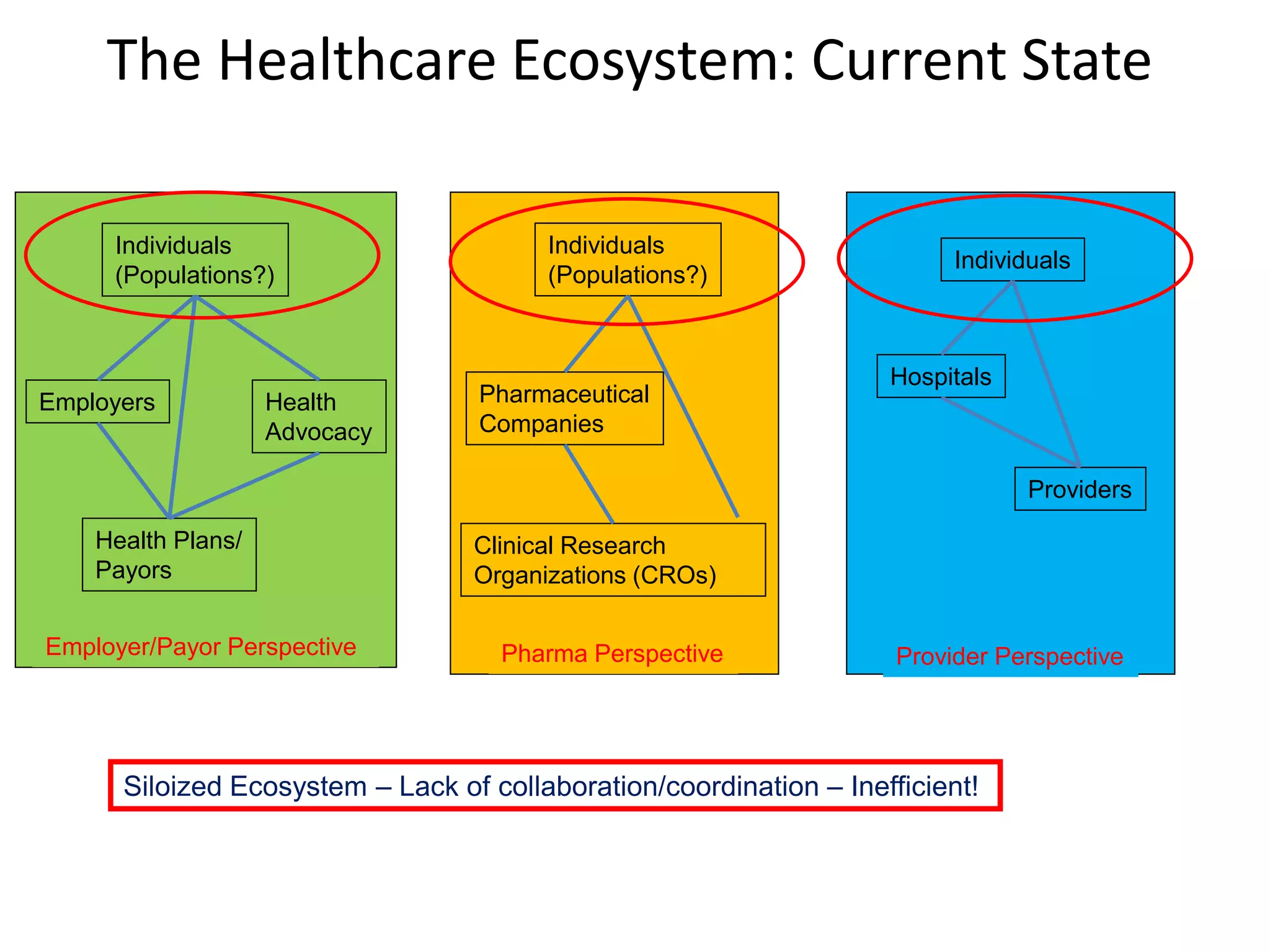
The Healthcare Ecosystem: Current State

     Individuals                        Individuals
                                                                          Individuals
     (Populations?)                     (Populations?)


                                                                    Hospitals
Employers           Health         Pharmaceutical
                    Advocacy       Companies

                                                                                Providers

    Health Plans/                 Clinical Research
    Payors                        Organizations (CROs)

Employer/Payor Perspective          Pharma Perspective               Provider Perspective


      Siloized Ecosystem – Lack of collaboration/coordination – Inefficient!
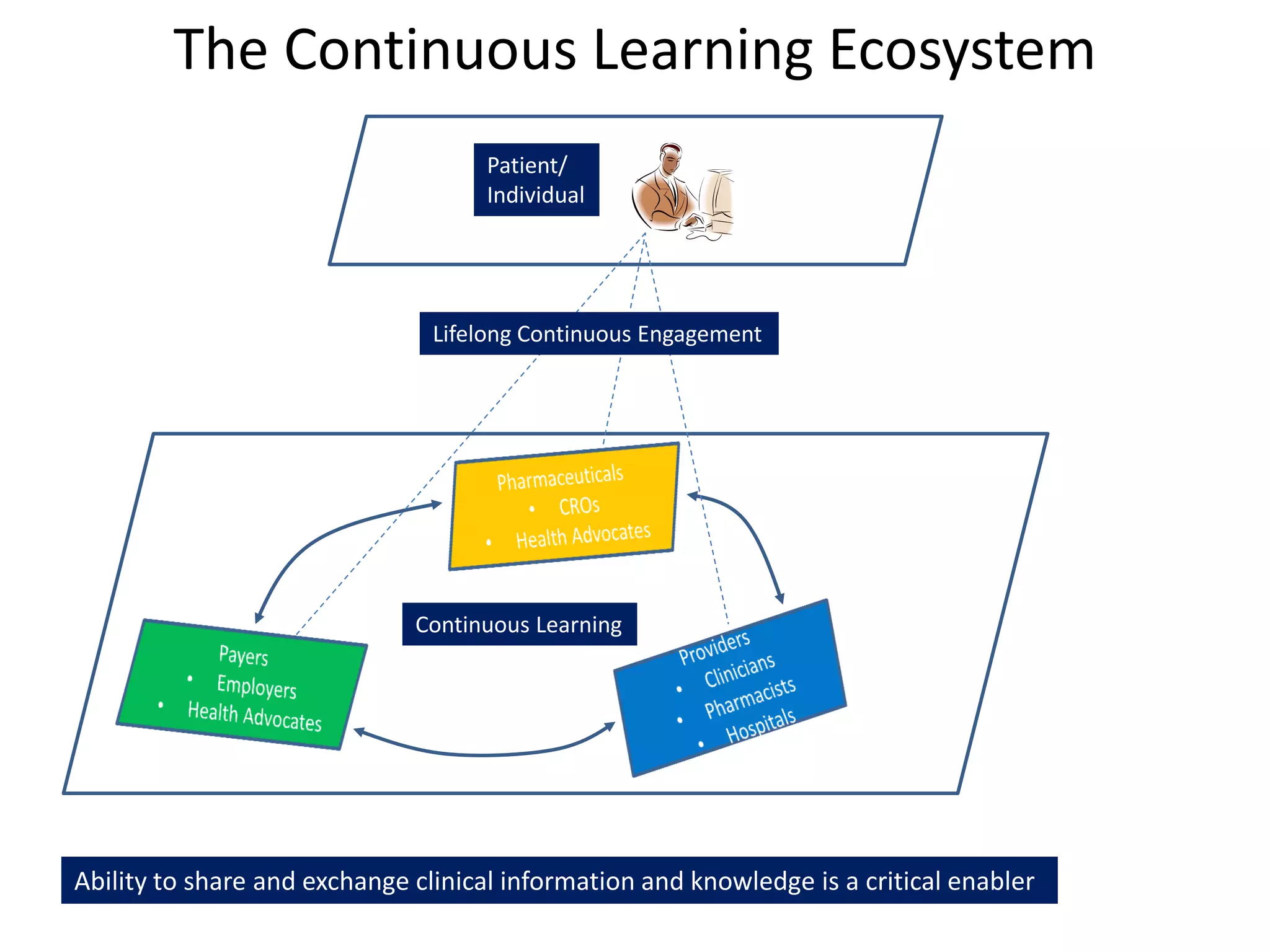
The Continuous Learning Ecosystem
                                    Patient/
                                    Individual


                                Lifelong Continuous Engagement


                              Continuous Learning


Ability to share and exchange clinical information and knowledge is a critical enabler
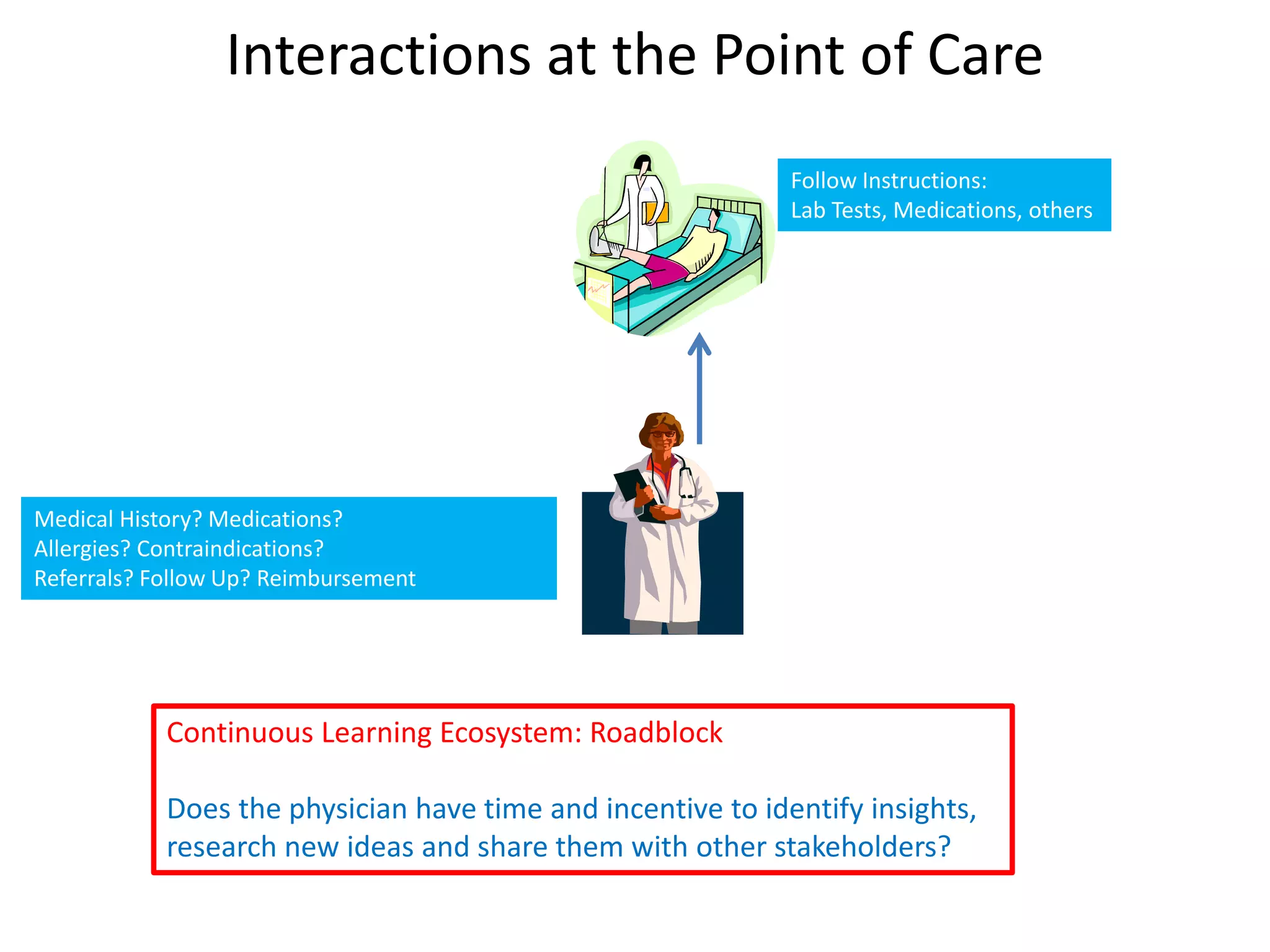
Interactions at the Point of Care
                                                             Follow Instructions:
                                                             Lab Tests, Medications, others


Medical History? Medications?
Allergies? Contraindications?
Referrals? Follow Up? Reimbursement


            Continuous Learning Ecosystem: Roadblock

            Does the physician have time and incentive to identify insights,
            research new ideas and share them with other stakeholders?
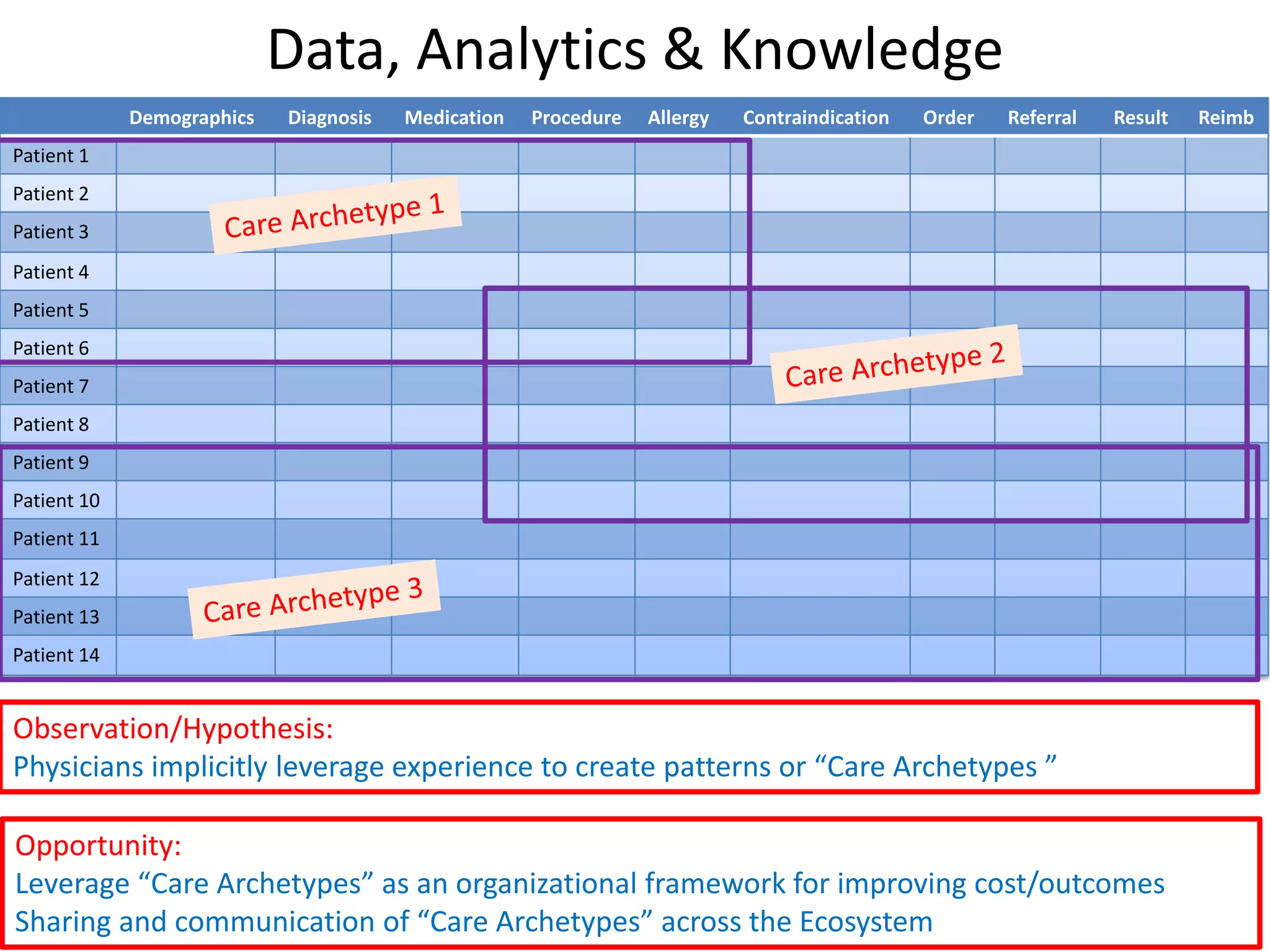
Data, Analytics & Knowledge
             Demographics   Diagnosis   Medication   Procedure   Allergy   Contraindication   Order   Referral   Result   Reimb
Patient 1
Patient 2
Patient 3
Patient 4
Patient 5
Patient 6
Patient 7
Patient 8
Patient 9
Patient 10
Patient 11
Patient 12
Patient 13
Patient 14


Observation/Hypothesis:
Physicians implicitly leverage experience to create patterns or “Care Archetypes ”

Opportunity:
Leverage “Care Archetypes” as an organizational framework for improving cost/outcomes
Sharing and communication of “Care Archetypes” across the Ecosystem
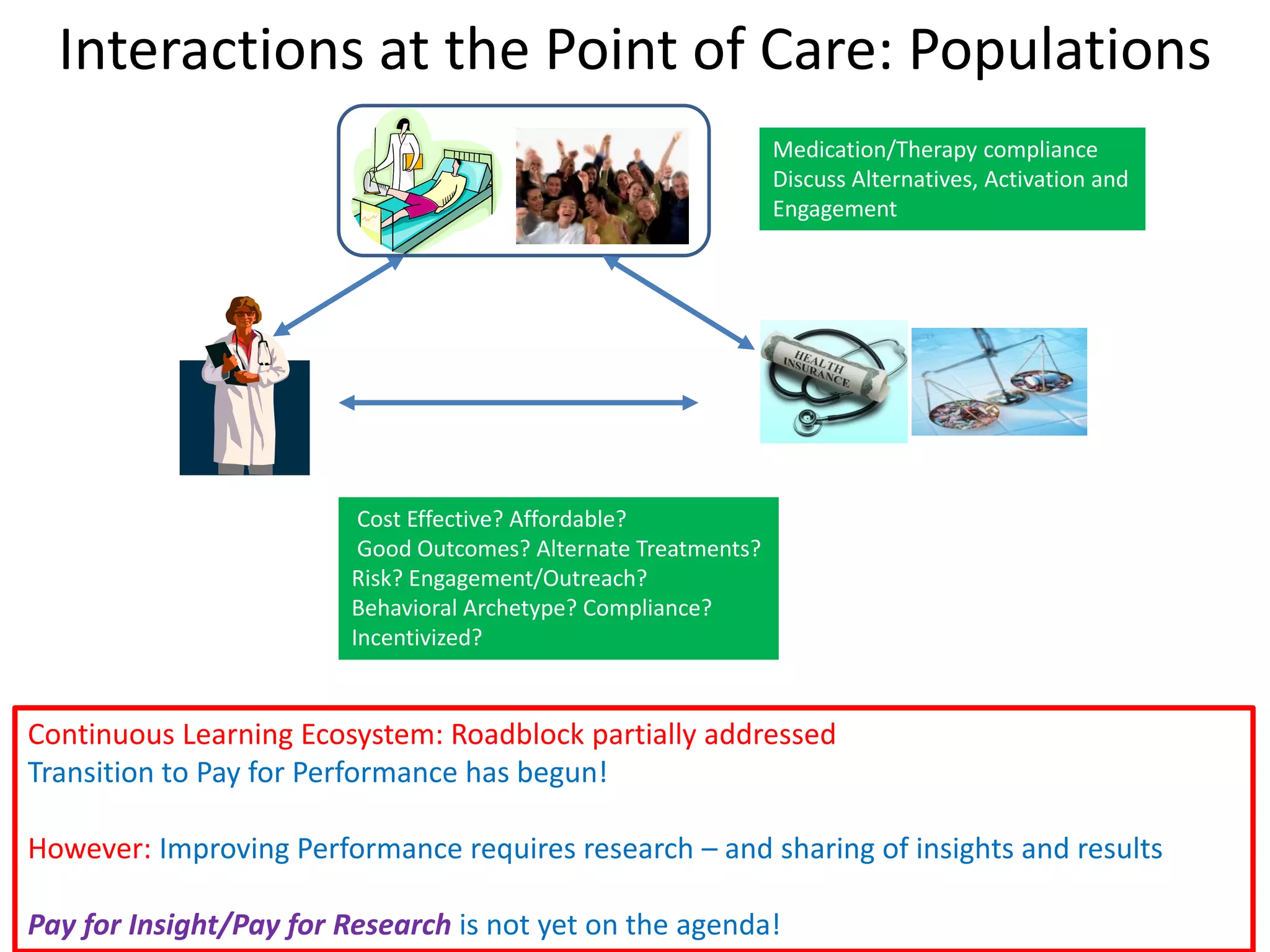
Interactions at the Point of Care: Populations
                                                                Medication/Therapy compliance
                                                                Discuss Alternatives, Activation and
                                                                Engagement


                         Cost Effective? Affordable?
                         Good Outcomes? Alternate Treatments?
                        Risk? Engagement/Outreach?
                        Behavioral Archetype? Compliance?
                        Incentivized?


Continuous Learning Ecosystem: Roadblock partially addressed
Transition to Pay for Performance has begun!

However: Improving Performance requires research – and sharing of insights and results

Pay for Insight/Pay for Research is not yet on the agenda!
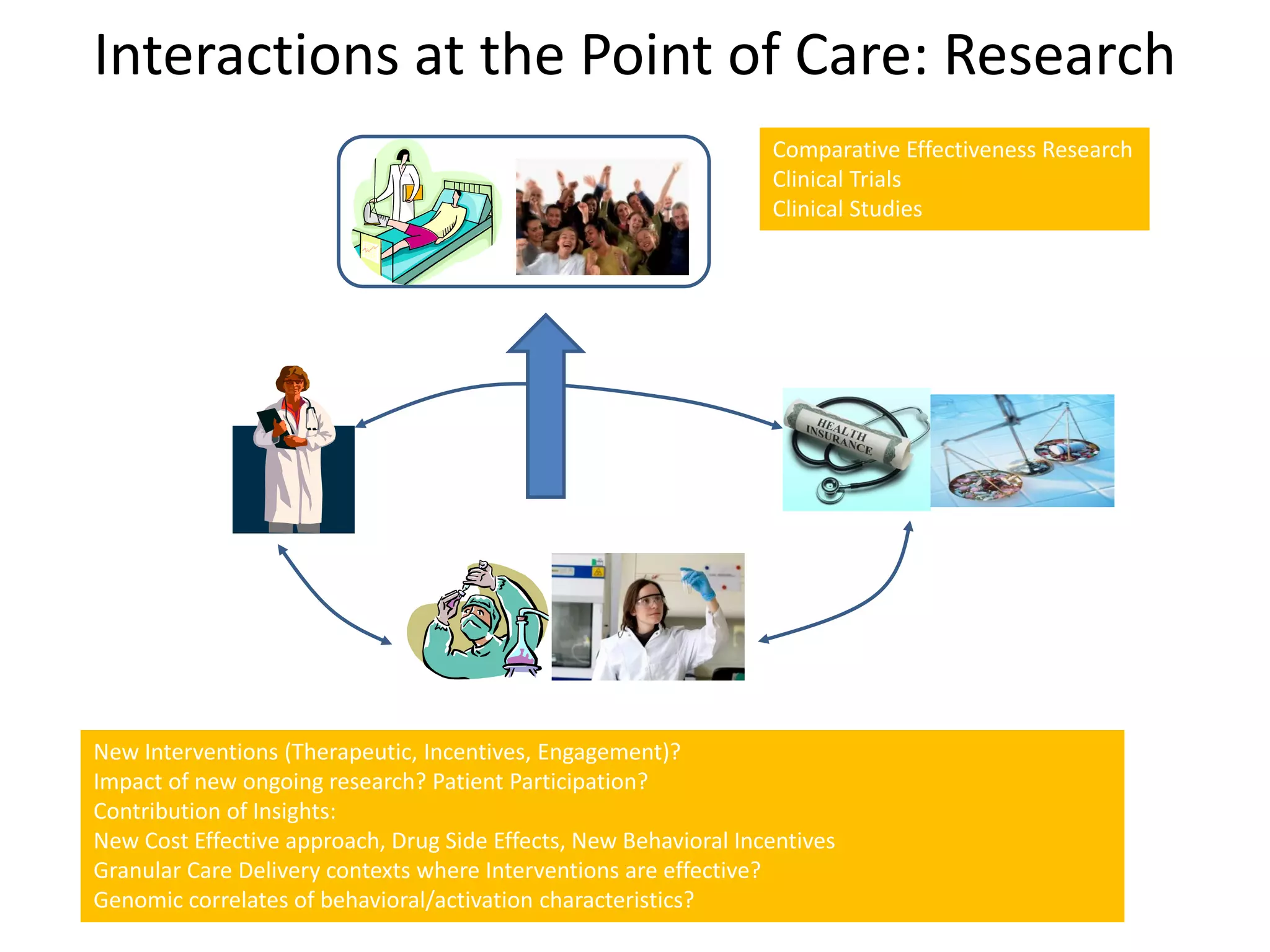
Interactions at the Point of Care: Research
                                                                  Comparative Effectiveness Research
                                                                  Clinical Trials
                                                                  Clinical Studies


New Interventions (Therapeutic, Incentives, Engagement)?
Impact of new ongoing research? Patient Participation?
Contribution of Insights:
New Cost Effective approach, Drug Side Effects, New Behavioral Incentives
Granular Care Delivery contexts where Interventions are effective?
Genomic correlates of behavioral/activation characteristics?
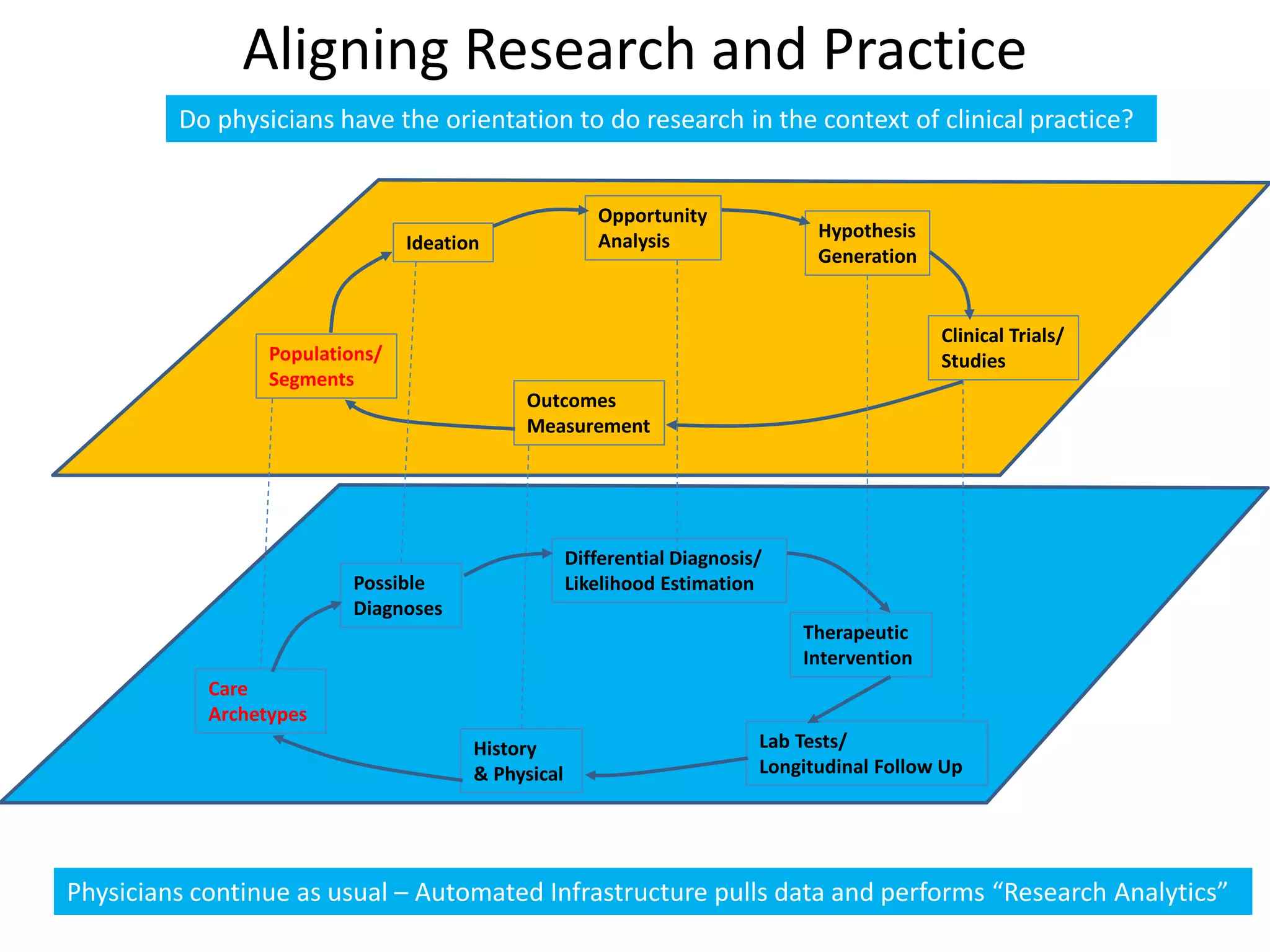
Aligning Research and Practice
         Do physicians have the orientation to do research in the context of clinical practice?


                                                        Opportunity
                                                        Analysis                 Hypothesis
                                 Ideation
                                                                                 Generation


                                                                                              Clinical Trials/
                  Populations/                                                                Studies
                  Segments
                                             Outcomes
                                             Measurement


                                                     Differential Diagnosis/
                          Possible                   Likelihood Estimation
                          Diagnoses
                                                                               Therapeutic
                                                                               Intervention
            Care
            Archetypes
                                        History                            Lab Tests/
                                        & Physical                         Longitudinal Follow Up


Physicians continue as usual – Automated Infrastructure pulls data and performs “Research Analytics”
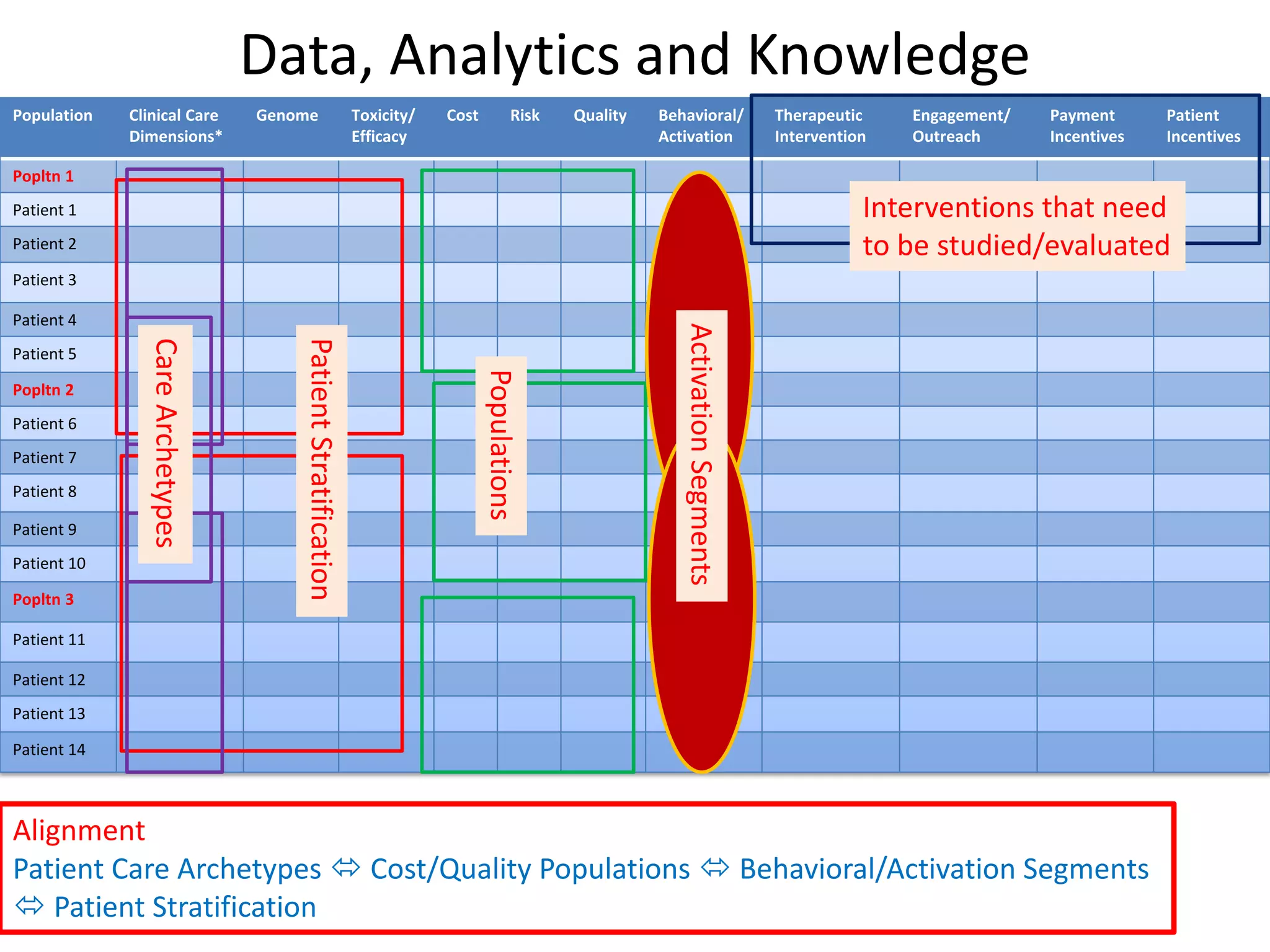
Data, Analytics and Knowledge
Population   Clinical Care       Genome                       Toxicity/   Cost            Risk   Quality   Behavioral/              Therapeutic    Engagement/   Payment      Patient
             Dimensions*                                      Efficacy                                     Activation               Intervention   Outreach      Incentives   Incentives

Popltn 1
Patient 1                                                                                                                                      Interventions that need
Patient 2                                                                                                                                      to be studied/evaluated
Patient 3

Patient 4


                                                                                                              Activation Segments
               Care Archetypes


                                     Patient Stratification
Patient 5


                                                                                 Populations
Popltn 2
Patient 6
Patient 7
Patient 8

Patient 9
Patient 10

Popltn 3

Patient 11

Patient 12
Patient 13

Patient 14


Alignment
Patient Care Archetypes  Cost/Quality Populations  Behavioral/Activation Segments
 Patient Stratification
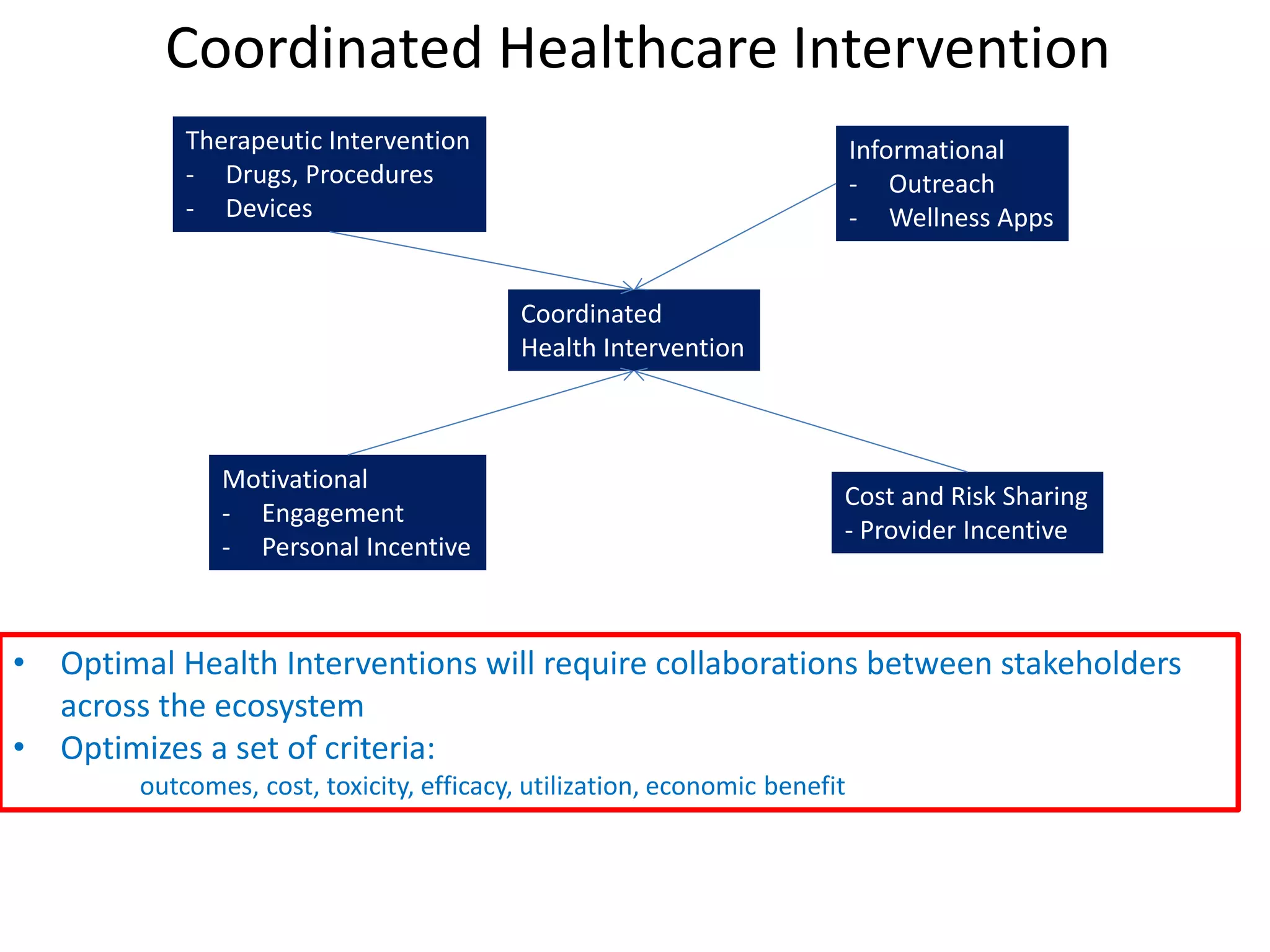
Coordinated Healthcare Intervention
            Therapeutic Intervention                                        Informational
            - Drugs, Procedures                                             - Outreach
            - Devices                                                       - Wellness Apps


                                           Coordinated
                                           Health Intervention


               Motivational
                                                                        Cost and Risk Sharing
               - Engagement
                                                                        - Provider Incentive
               - Personal Incentive


• Optimal Health Interventions will require collaborations between stakeholders
  across the ecosystem
• Optimizes a set of criteria:
        outcomes, cost, toxicity, efficacy, utilization, economic benefit
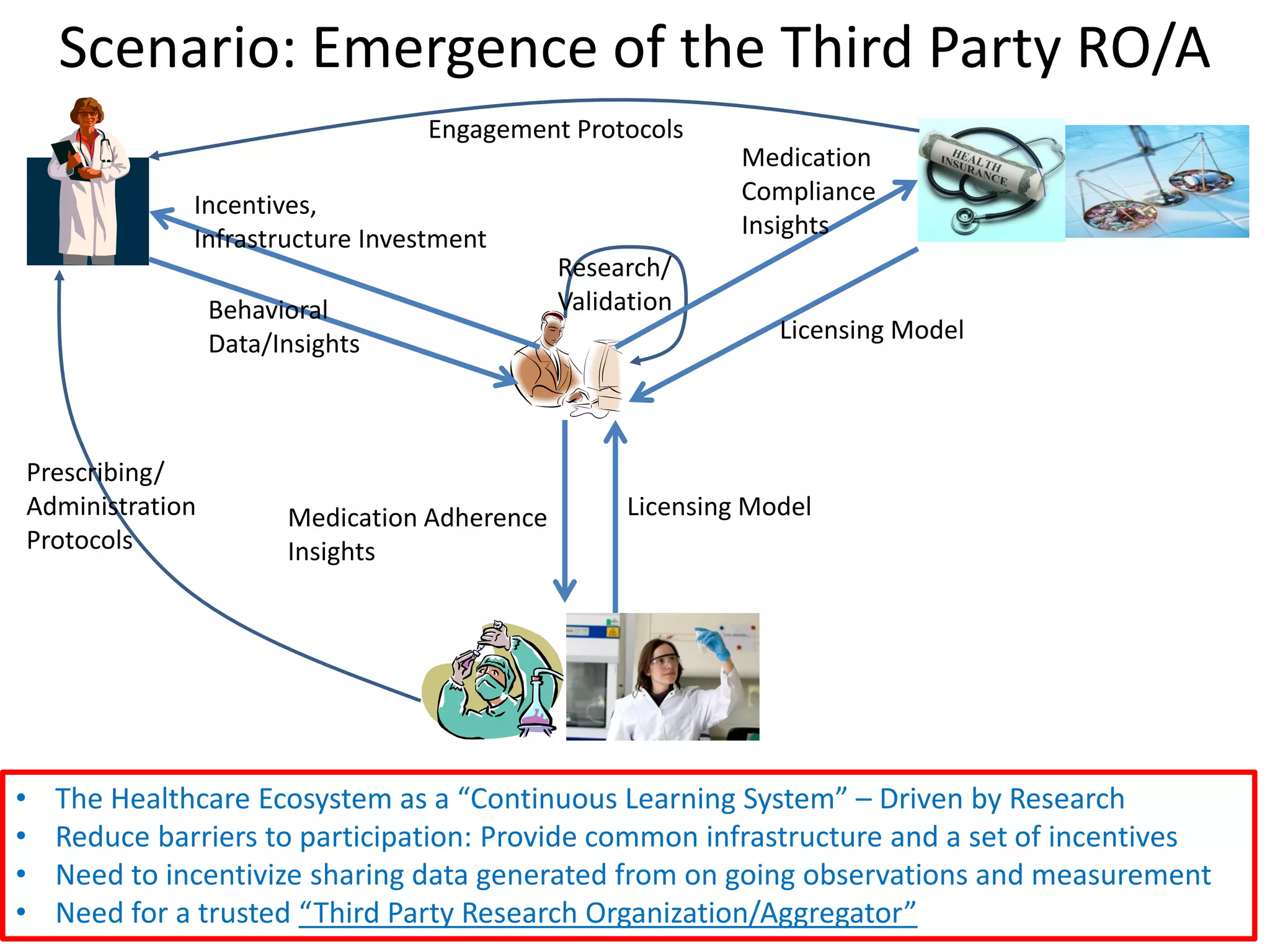
Scenario: Emergence of the Third Party RO/A
                                 Engagement Protocols
                                                             Medication
              Incentives,                                    Compliance
              Infrastructure Investment                      Insights
                                              Research/
                 Behavioral                   Validation
                 Data/Insights                                  Licensing Model


Prescribing/
Administration         Medication Adherence         Licensing Model
Protocols              Insights


•   The Healthcare Ecosystem as a “Continuous Learning System” – Driven by Research
•   Reduce barriers to participation: Provide common infrastructure and a set of incentives
•   Need to incentivize sharing data generated from on going observations and measurement
•   Need for a trusted “Third Party Research Organization/Aggregator”
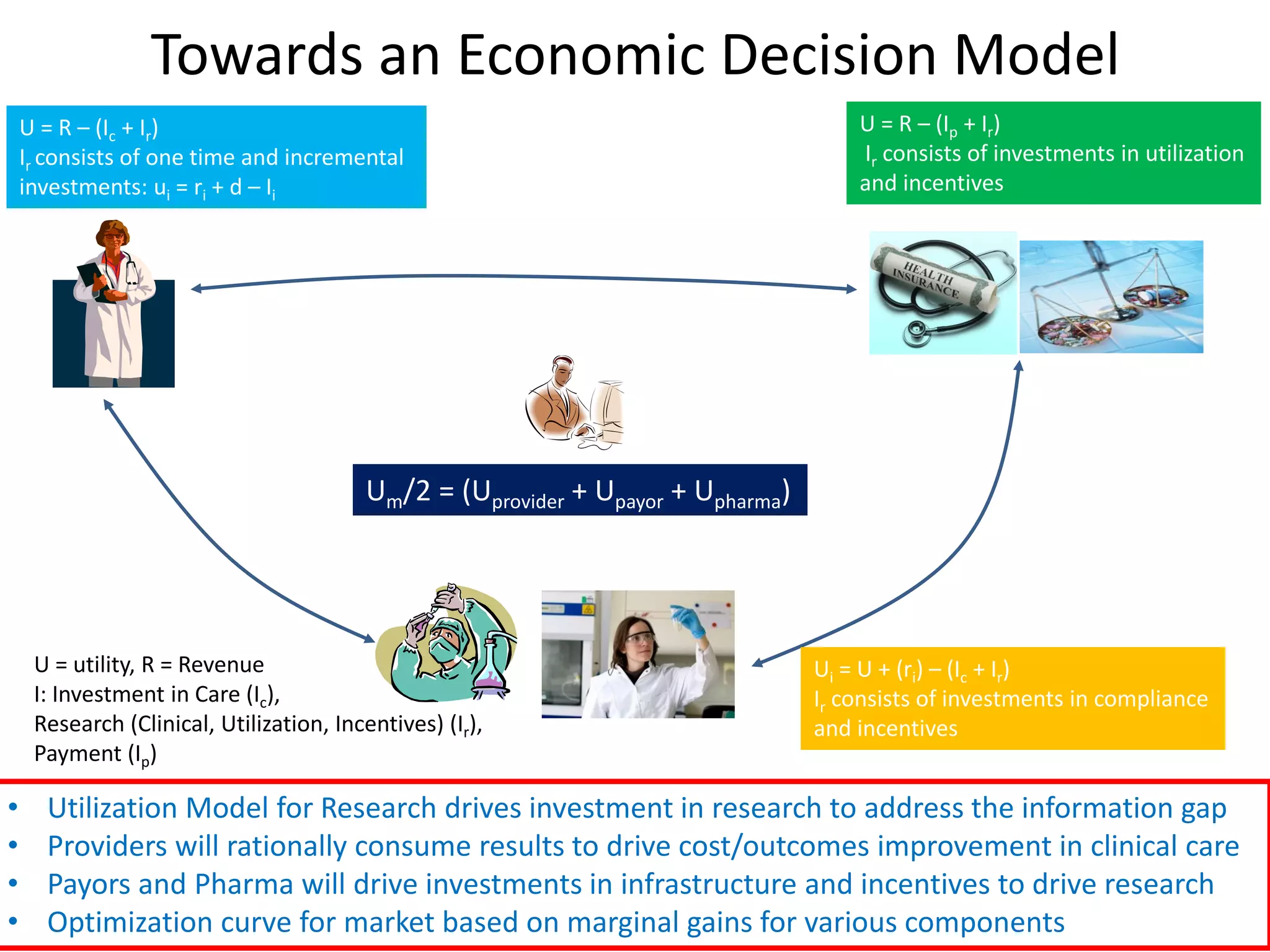
Towards an Economic Decision Model
    U = R – (Ic + Ir)                                                                U = R – (Ip + Ir)
    Ir consists of one time and incremental                                          Ir consists of investments in utilization
    investments: ui = ri + d – Ii                                                    and incentives


                                         Um/2 = (Uprovider + Upayor + Upharma)


     U = utility, R = Revenue                                                    Ui = U + (ri) – (Ic + Ir)
     I: Investment in Care (Ic),                                                 Ir consists of investments in compliance
     Research (Clinical, Utilization, Incentives) (Ir),                          and incentives
     Payment (Ip)

•     Utilization Model for Research drives investment in research to address the information gap
•     Providers will rationally consume results to drive cost/outcomes improvement in clinical care
•     Payors and Pharma will drive investments in infrastructure and incentives to drive research
•     Optimization curve for market based on marginal gains for various components
Conclusions
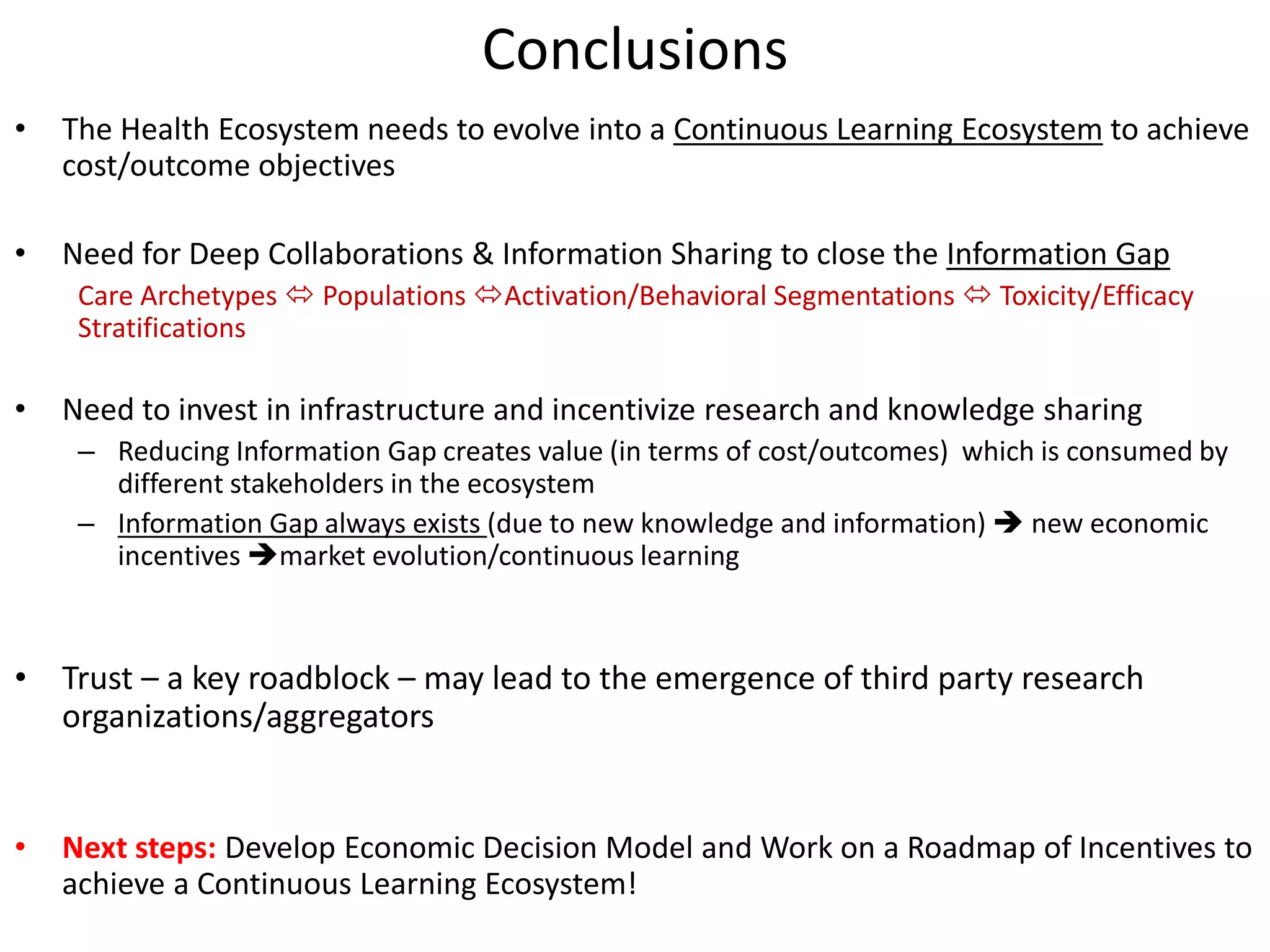
•   The Health Ecosystem needs to evolve into a Continuous Learning Ecosystem to achieve
    cost/outcome objectives

•   Need for Deep Collaborations & Information Sharing to close the Information Gap
     Care Archetypes  Populations Activation/Behavioral Segmentations  Toxicity/Efficacy
     Stratifications

•   Need to invest in infrastructure and incentivize research and knowledge sharing
     – Reducing Information Gap creates value (in terms of cost/outcomes) which is consumed by
       different stakeholders in the ecosystem
     – Information Gap always exists (due to new knowledge and information)  new economic
       incentives market evolution/continuous learning


• Trust – a key roadblock – may lead to the emergence of third party research
  organizations/aggregators


•   Next steps: Develop Economic Decision Model and Work on a Roadmap of Incentives to
    achieve a Continuous Learning Ecosystem!
Blog

http://continuouslearningecosystem.blogspot.com

Look forward to comments, feedback, critique, suggestions!

Towards a Continuous Learning Ecosystem: Data Innovations and Collaborations to Improve Clinical Outcomes and Reduce Cost of Care

  • 1.
    Towards a ContinuousLearning Ecosystem: Data Innovations and Collaborations to Improve Clinical Outcomes and Reduce Cost of Care Vipul Kashyap*, Ph.D. Cigna Healthcare vipul.kashyap@cigna.com April 9, 2013 Medical Informatics World, 2013, Boston, MA * Acknowledgments – Jeff Catteau, Knowledgent (jeff.catteau@knowledgent.com) Discussions and feedback on the Economic Decision Model
  • 2.
    Outline • The HealthcareEcosystem: – Current State  Continuous Learning Ecosystem • Interactions at the Point of Care • “Coordinated Healthcare Intervention” • Making it Happen: Incentivizing Research & Knowledge Sharing – Economic Decision Model • Conclusions and Next Steps
  • 3.
    The Healthcare Ecosystem:Current State Individuals Individuals Individuals (Populations?) (Populations?) Hospitals Employers Health Pharmaceutical Advocacy Companies Providers Health Plans/ Clinical Research Payors Organizations (CROs) Employer/Payor Perspective Pharma Perspective Provider Perspective Siloized Ecosystem – Lack of collaboration/coordination – Inefficient!
  • 4.
    The Continuous LearningEcosystem Patient/ Individual Lifelong Continuous Engagement Continuous Learning Ability to share and exchange clinical information and knowledge is a critical enabler
  • 5.
    Interactions at thePoint of Care Follow Instructions: Lab Tests, Medications, others Medical History? Medications? Allergies? Contraindications? Referrals? Follow Up? Reimbursement Continuous Learning Ecosystem: Roadblock Does the physician have time and incentive to identify insights, research new ideas and share them with other stakeholders?
  • 6.
    Data, Analytics &Knowledge Demographics Diagnosis Medication Procedure Allergy Contraindication Order Referral Result Reimb Patient 1 Patient 2 Patient 3 Patient 4 Patient 5 Patient 6 Patient 7 Patient 8 Patient 9 Patient 10 Patient 11 Patient 12 Patient 13 Patient 14 Observation/Hypothesis: Physicians implicitly leverage experience to create patterns or “Care Archetypes ” Opportunity: Leverage “Care Archetypes” as an organizational framework for improving cost/outcomes Sharing and communication of “Care Archetypes” across the Ecosystem
  • 7.
    Interactions at thePoint of Care: Populations Medication/Therapy compliance Discuss Alternatives, Activation and Engagement Cost Effective? Affordable? Good Outcomes? Alternate Treatments? Risk? Engagement/Outreach? Behavioral Archetype? Compliance? Incentivized? Continuous Learning Ecosystem: Roadblock partially addressed Transition to Pay for Performance has begun! However: Improving Performance requires research – and sharing of insights and results Pay for Insight/Pay for Research is not yet on the agenda!
  • 8.
    Interactions at thePoint of Care: Research Comparative Effectiveness Research Clinical Trials Clinical Studies New Interventions (Therapeutic, Incentives, Engagement)? Impact of new ongoing research? Patient Participation? Contribution of Insights: New Cost Effective approach, Drug Side Effects, New Behavioral Incentives Granular Care Delivery contexts where Interventions are effective? Genomic correlates of behavioral/activation characteristics?
  • 9.
    Aligning Research andPractice Do physicians have the orientation to do research in the context of clinical practice? Opportunity Analysis Hypothesis Ideation Generation Clinical Trials/ Populations/ Studies Segments Outcomes Measurement Differential Diagnosis/ Possible Likelihood Estimation Diagnoses Therapeutic Intervention Care Archetypes History Lab Tests/ & Physical Longitudinal Follow Up Physicians continue as usual – Automated Infrastructure pulls data and performs “Research Analytics”
  • 10.
    Data, Analytics andKnowledge Population Clinical Care Genome Toxicity/ Cost Risk Quality Behavioral/ Therapeutic Engagement/ Payment Patient Dimensions* Efficacy Activation Intervention Outreach Incentives Incentives Popltn 1 Patient 1 Interventions that need Patient 2 to be studied/evaluated Patient 3 Patient 4 Activation Segments Care Archetypes Patient Stratification Patient 5 Populations Popltn 2 Patient 6 Patient 7 Patient 8 Patient 9 Patient 10 Popltn 3 Patient 11 Patient 12 Patient 13 Patient 14 Alignment Patient Care Archetypes  Cost/Quality Populations  Behavioral/Activation Segments  Patient Stratification
  • 11.
    Coordinated Healthcare Intervention Therapeutic Intervention Informational - Drugs, Procedures - Outreach - Devices - Wellness Apps Coordinated Health Intervention Motivational Cost and Risk Sharing - Engagement - Provider Incentive - Personal Incentive • Optimal Health Interventions will require collaborations between stakeholders across the ecosystem • Optimizes a set of criteria: outcomes, cost, toxicity, efficacy, utilization, economic benefit
  • 12.
    Scenario: Emergence ofthe Third Party RO/A Engagement Protocols Medication Incentives, Compliance Infrastructure Investment Insights Research/ Behavioral Validation Data/Insights Licensing Model Prescribing/ Administration Medication Adherence Licensing Model Protocols Insights • The Healthcare Ecosystem as a “Continuous Learning System” – Driven by Research • Reduce barriers to participation: Provide common infrastructure and a set of incentives • Need to incentivize sharing data generated from on going observations and measurement • Need for a trusted “Third Party Research Organization/Aggregator”
  • 13.
    Towards an EconomicDecision Model U = R – (Ic + Ir) U = R – (Ip + Ir) Ir consists of one time and incremental Ir consists of investments in utilization investments: ui = ri + d – Ii and incentives Um/2 = (Uprovider + Upayor + Upharma) U = utility, R = Revenue Ui = U + (ri) – (Ic + Ir) I: Investment in Care (Ic), Ir consists of investments in compliance Research (Clinical, Utilization, Incentives) (Ir), and incentives Payment (Ip) • Utilization Model for Research drives investment in research to address the information gap • Providers will rationally consume results to drive cost/outcomes improvement in clinical care • Payors and Pharma will drive investments in infrastructure and incentives to drive research • Optimization curve for market based on marginal gains for various components
  • 14.
    Conclusions • The Health Ecosystem needs to evolve into a Continuous Learning Ecosystem to achieve cost/outcome objectives • Need for Deep Collaborations & Information Sharing to close the Information Gap Care Archetypes  Populations Activation/Behavioral Segmentations  Toxicity/Efficacy Stratifications • Need to invest in infrastructure and incentivize research and knowledge sharing – Reducing Information Gap creates value (in terms of cost/outcomes) which is consumed by different stakeholders in the ecosystem – Information Gap always exists (due to new knowledge and information)  new economic incentives market evolution/continuous learning • Trust – a key roadblock – may lead to the emergence of third party research organizations/aggregators • Next steps: Develop Economic Decision Model and Work on a Roadmap of Incentives to achieve a Continuous Learning Ecosystem!
  • 15.