
Uploaded byKarthikeyan Sivapragassam
Types of rule engine
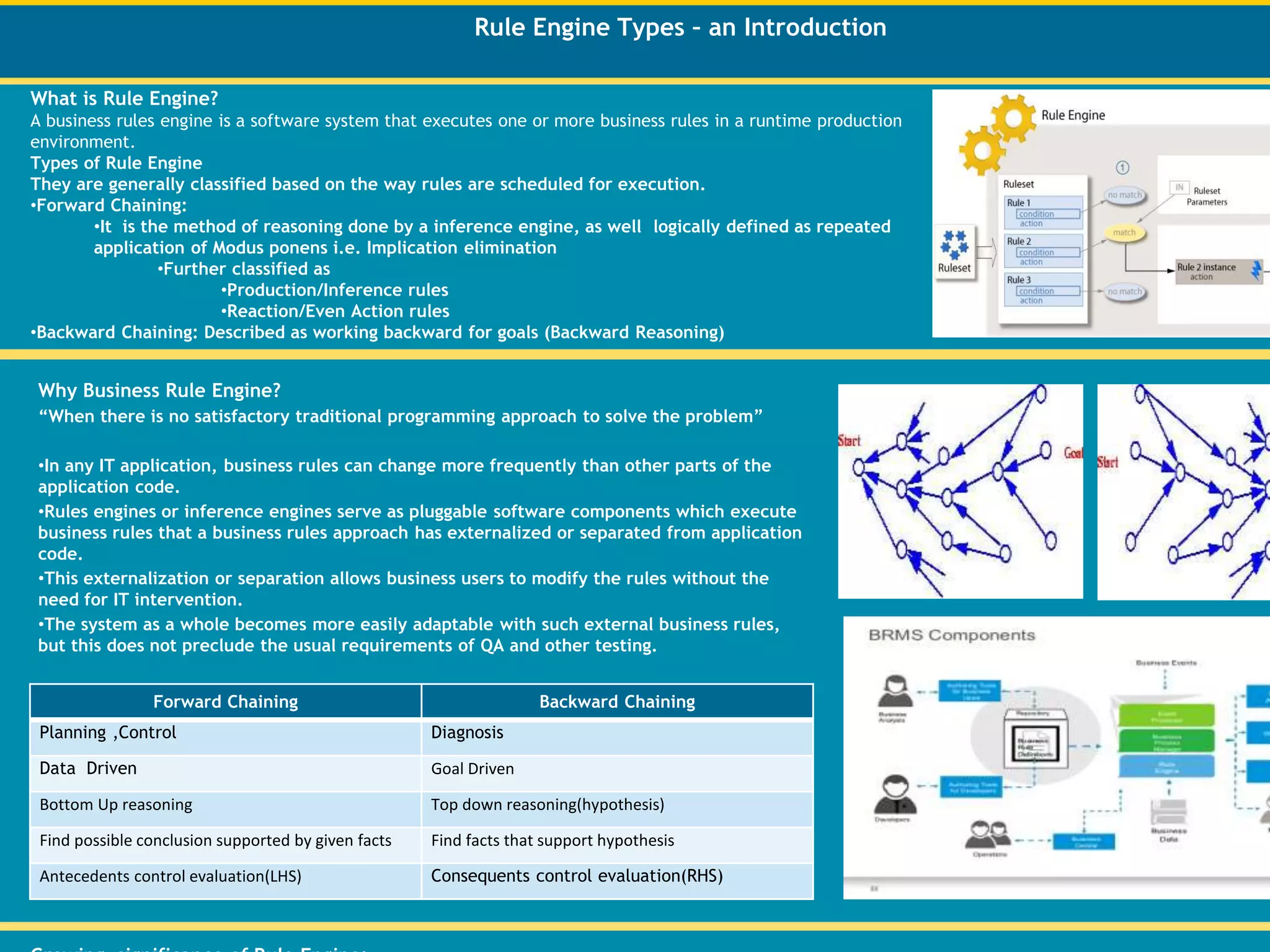
A rule engine is a software system that executes business rules in a production environment. There are two main types of rule engines: forward chaining, which repeatedly applies rules to infer new facts from existing facts, and backward chaining, which works backwards from goals to find facts that support those goals. Business rule engines are useful when traditional programming cannot easily adapt to changing business rules, as they allow non-technical users to modify rules without requiring code changes.
More Related Content


Types of rule engine
- 1. Rule Engine Types– an Introduction What is Rule Engine? A business rules engine is a software system that executes one or more business rules in a runtime production environment. Types of Rule Engine They are generally classified based on the way rules are scheduled for execution. •Forward Chaining: •It is the method of reasoning done by a inference engine, as well logically defined as repeated application of Modus ponens i.e. Implication elimination •Further classified as •Production/Inference rules •Reaction/Even Action rules •Backward Chaining: Described as working backward for goals (Backward Reasoning) Why Business Rule Engine? “When there is no satisfactory traditional programming approach to solve the problem” •In any IT application, business rules can change more frequently than other parts of the application code. •Rules engines or inference engines serve as pluggable software components which execute business rules that a business rules approach has externalized or separated from application code. •This externalization or separation allows business users to modify the rules without the need for IT intervention. •The system as a whole becomes more easily adaptable with such external business rules, but this does not preclude the usual requirements of QA and other testing. Forward Chaining Backward Chaining Planning ,Control Diagnosis Data Driven Goal Driven Bottom Up reasoning Top down reasoning(hypothesis) Find possible conclusion supported by given facts Find facts that support hypothesis Antecedents control evaluation(LHS) Consequents control evaluation(RHS)