A REVIEW AND REFLECTION ON PROVIDING LIBRARY SERVICE TO YOUTH
Nicholle Ruhlman
OVERVIEW
 Theoretical frameworks
 DiverseYouth Identities
 Library Anxiety
 Library as aThird Space
 FutureTrends
THEORETICAL FRAMEWORKS
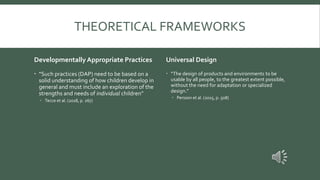
Developmentally Appropriate Practices
 “Such practices (DAP) need to be based on a
solid understanding of how children develop in
general and must include an exploration of the
strengths and needs of individual children”
 Tecce et al. (2018, p. 267)
Universal Design
 “The design of products and environments to be
usable by all people, to the greatest extent possible,
without the need for adaptation or specialized
design.”
 Persson et al. (2015, p. 508)
DIVERSEYOUTH IDENTITIES
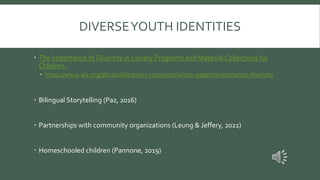
 The Importance of Diversity in Library Programs and Material Collections for
Children.
 https://www.ala.org/alsc/publications-resources/white-papers/importance-diversity
 Bilingual Storytelling (Paz, 2016)
 Partnerships with community organizations (Leung & Jeffery, 2021)
 Homeschooled children (Pannone, 2019)
VIEW OFTHE LIBRARY
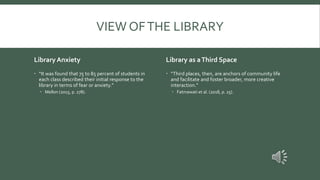
Library Anxiety
 “It was found that 75 to 85 percent of students in
each class described their initial response to the
library in terms of fear or anxiety.”
 Mellon (2015, p. 278).
Library as aThird Space
 “Third places, then, are anchors of community life
and facilitate and foster broader, more creative
interaction.”
 Fatmawati et al. (2018, p. 25).
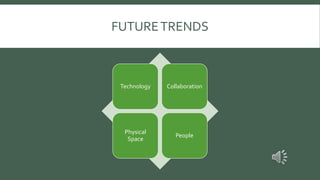
FUTURETRENDS
Technology Collaboration
Physical
Space
People
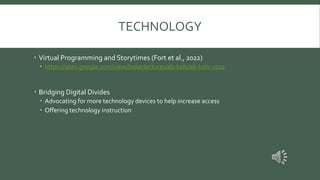
TECHNOLOGY
 Virtual Programming and Storytimes (Fort et al., 2022)
 https://sites.google.com/view/bakerlectures/ab-kids/ab-kids-2022
 Bridging Digital Divides
 Advocating for more technology devices to help increase access
 Offering technology instruction
COLLABORATION
 Partnering with community organizations
 Social Workers
 Volunteers
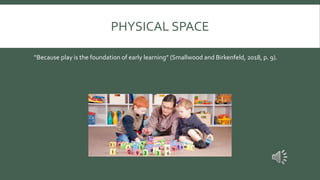
PHYSICAL SPACE
“Because play is the foundation of early learning” (Smallwood and Birkenfeld, 2018, p. 9).
PEOPLE
 Professional Development of Staff
 Parents and Guardians
 https://www.belleville.lib.mi.us/youth/parents-page/
THANKYOU
REFERENCES
 American Library Association, (2014). Importance of Diversity in Library Programs and Material
Collections for Children. http://www.ala.org/alsc/publications-resources/white-papers/importance-diversity.
 Chang, A. (2017). Citrus County Library System Unleashes the Power of Technology Training, and
Increases Attendance and Engagement. Florida Libraries, 60(2), 15–17.
 Fatmawati, E., Udasmoro, W., & Noviani, R. (2018). Functional shift of library: The third space; production.
In M. Amini, M. Yusuf, & V. I. Yulianto. (Eds.), UGM Digital Press Social Sciences and Humanities: Vol. 1.
Proceeding of the 2nd International Conference on South East Asia Studies (pp. 19–26).
 Fort, V. B., Cooke, N., & Hartnett, L. (2022). Obstacles and Opportunities: Inclusive Programming Goes
Virtual. Children & Libraries: The Journal of the Association for Library Service to Children, 20(2), 38–39.
https://doi-org.proxy.lib.wayne.edu/10.5860/cal.20.2.39
 Leung, M., & Jeffery, M. (2021). It Takes Two (Or More): Developing Partnerships to Serve Marginalized
Populations. Children & Libraries: The Journal of the Association for Library Service to Children, 19(2),
28–30. https://doi-org.proxy.lib.wayne.edu/10.5860/cal.19.2.28
 Mellon, C. A. (2015). Library Anxiety: A Grounded Theory and Its Development. College & Research
Libraries, 76(3), 276–282. https://doi-org.proxy.lib.wayne.edu/10.5860/crl.76.3.276
REFERENCES
 Mellon, C. A. (2015). Library Anxiety: A Grounded Theory and Its Development. College & Research Libraries, 76(3), 276–282.
https://doi-org.proxy.lib.wayne.edu/10.5860/crl.76.3.276
 Palmer, M. (2022). Study of Future Public Library Trends & Best Practices, Public Library Quarterly, 41:1, 83-
107, DOI: 10.1080/01616846.2020.1868224
 Pannone, S. (2019). Homeschoolers’ Experiences with the Public Library: A Phenomenological Study. Children & Libraries: The
Journal of the Association for Library Service to Children, 17(1), 5–10. https://doi-org.proxy.lib.wayne.edu/10.5860/cal.17.1.5
 Persson, H., åhman, H., Yngling, A. A., & Gulliksen, J. (2015). Universal design, inclusive design, accessible design, design for all:
Different concepts—one goal? on the concept of accessibility—historical, methodological and philosophical aspects. Universal
Access in the Information Society, 14(4), 505-526. https://doi.org/10.1007/s10209-014-0358-z
 Paz, S. (2016) "From Theory to Practice (Read/Leer; Bilingual Storytelling in the Public Library)," Storytelling, Self, Society: Vol.
12: Iss. 1, Article 5.
https://digitalcommons.wayne.edu/storytelling/vol12/iss1/5
 Smallwood, S., & Birkenfeld, J. (2018). A Place to Play: An Assessment of a Public Library’s Play Centers. Children & Libraries:
The Journal of the Association for Library Service to Children, 16(4), 9–11. https://doi-org.proxy.lib.wayne.edu/10.5860/cal.16.4.9
 Tecce DeCarlo, M. J., Allen, G., Lee, V. J., & Neuman, D. (2018). Information and Digital Literacies in a Kindergarten Classroom:
An I-LEARN Case Study. Early Childhood Education Journal, 46(3), 265-275. https://doi.org/10.1007/s10643-017-0857-7

Ruhlman_Final_Presentation.pptx

  • 1.
    A REVIEW ANDREFLECTION ON PROVIDING LIBRARY SERVICE TO YOUTH Nicholle Ruhlman
  • 2.
    OVERVIEW  Theoretical frameworks DiverseYouth Identities  Library Anxiety  Library as aThird Space  FutureTrends
  • 3.
    THEORETICAL FRAMEWORKS Developmentally AppropriatePractices  “Such practices (DAP) need to be based on a solid understanding of how children develop in general and must include an exploration of the strengths and needs of individual children”  Tecce et al. (2018, p. 267) Universal Design  “The design of products and environments to be usable by all people, to the greatest extent possible, without the need for adaptation or specialized design.”  Persson et al. (2015, p. 508)
  • 4.
    DIVERSEYOUTH IDENTITIES  TheImportance of Diversity in Library Programs and Material Collections for Children.  https://www.ala.org/alsc/publications-resources/white-papers/importance-diversity  Bilingual Storytelling (Paz, 2016)  Partnerships with community organizations (Leung & Jeffery, 2021)  Homeschooled children (Pannone, 2019)
  • 5.
    VIEW OFTHE LIBRARY LibraryAnxiety  “It was found that 75 to 85 percent of students in each class described their initial response to the library in terms of fear or anxiety.”  Mellon (2015, p. 278). Library as aThird Space  “Third places, then, are anchors of community life and facilitate and foster broader, more creative interaction.”  Fatmawati et al. (2018, p. 25).
  • 6.
  • 7.
    TECHNOLOGY  Virtual Programmingand Storytimes (Fort et al., 2022)  https://sites.google.com/view/bakerlectures/ab-kids/ab-kids-2022  Bridging Digital Divides  Advocating for more technology devices to help increase access  Offering technology instruction
  • 8.
    COLLABORATION  Partnering withcommunity organizations  Social Workers  Volunteers
  • 9.
    PHYSICAL SPACE “Because playis the foundation of early learning” (Smallwood and Birkenfeld, 2018, p. 9).
  • 10.
    PEOPLE  Professional Developmentof Staff  Parents and Guardians  https://www.belleville.lib.mi.us/youth/parents-page/
  • 11.
  • 12.
    REFERENCES  American LibraryAssociation, (2014). Importance of Diversity in Library Programs and Material Collections for Children. http://www.ala.org/alsc/publications-resources/white-papers/importance-diversity.  Chang, A. (2017). Citrus County Library System Unleashes the Power of Technology Training, and Increases Attendance and Engagement. Florida Libraries, 60(2), 15–17.  Fatmawati, E., Udasmoro, W., & Noviani, R. (2018). Functional shift of library: The third space; production. In M. Amini, M. Yusuf, & V. I. Yulianto. (Eds.), UGM Digital Press Social Sciences and Humanities: Vol. 1. Proceeding of the 2nd International Conference on South East Asia Studies (pp. 19–26).  Fort, V. B., Cooke, N., & Hartnett, L. (2022). Obstacles and Opportunities: Inclusive Programming Goes Virtual. Children & Libraries: The Journal of the Association for Library Service to Children, 20(2), 38–39. https://doi-org.proxy.lib.wayne.edu/10.5860/cal.20.2.39  Leung, M., & Jeffery, M. (2021). It Takes Two (Or More): Developing Partnerships to Serve Marginalized Populations. Children & Libraries: The Journal of the Association for Library Service to Children, 19(2), 28–30. https://doi-org.proxy.lib.wayne.edu/10.5860/cal.19.2.28  Mellon, C. A. (2015). Library Anxiety: A Grounded Theory and Its Development. College & Research Libraries, 76(3), 276–282. https://doi-org.proxy.lib.wayne.edu/10.5860/crl.76.3.276
  • 13.
    REFERENCES  Mellon, C.A. (2015). Library Anxiety: A Grounded Theory and Its Development. College & Research Libraries, 76(3), 276–282. https://doi-org.proxy.lib.wayne.edu/10.5860/crl.76.3.276  Palmer, M. (2022). Study of Future Public Library Trends & Best Practices, Public Library Quarterly, 41:1, 83- 107, DOI: 10.1080/01616846.2020.1868224  Pannone, S. (2019). Homeschoolers’ Experiences with the Public Library: A Phenomenological Study. Children & Libraries: The Journal of the Association for Library Service to Children, 17(1), 5–10. https://doi-org.proxy.lib.wayne.edu/10.5860/cal.17.1.5  Persson, H., åhman, H., Yngling, A. A., & Gulliksen, J. (2015). Universal design, inclusive design, accessible design, design for all: Different concepts—one goal? on the concept of accessibility—historical, methodological and philosophical aspects. Universal Access in the Information Society, 14(4), 505-526. https://doi.org/10.1007/s10209-014-0358-z  Paz, S. (2016) "From Theory to Practice (Read/Leer; Bilingual Storytelling in the Public Library)," Storytelling, Self, Society: Vol. 12: Iss. 1, Article 5. https://digitalcommons.wayne.edu/storytelling/vol12/iss1/5  Smallwood, S., & Birkenfeld, J. (2018). A Place to Play: An Assessment of a Public Library’s Play Centers. Children & Libraries: The Journal of the Association for Library Service to Children, 16(4), 9–11. https://doi-org.proxy.lib.wayne.edu/10.5860/cal.16.4.9  Tecce DeCarlo, M. J., Allen, G., Lee, V. J., & Neuman, D. (2018). Information and Digital Literacies in a Kindergarten Classroom: An I-LEARN Case Study. Early Childhood Education Journal, 46(3), 265-275. https://doi.org/10.1007/s10643-017-0857-7

Editor's Notes

  • #5 Paz, S. (2016) "From Theory to Practice (Read/Leer; Bilingual Storytelling in the Public Library)," Storytelling, Self, Society: Vol. 12: Iss. 1, Article 5. https://digitalcommons.wayne.edu/storytelling/vol12/iss1/5 Pannone, S. (2019). Homeschoolers’ Experiences with the Public Library: A Phenomenological Study. Children & Libraries: The Journal of the Association for Library Service to Children, 17(1), 5–10. https://doi-org.proxy.lib.wayne.edu/10.5860/cal.17.1.5 Leung, M., & Jeffery, M. (2021). It Takes Two (Or More): Developing Partnerships to Serve Marginalized Populations. Children & Libraries: The Journal of the Association for Library Service to Children, 19(2), 28–30. https://doi-org.proxy.lib.wayne.edu/10.5860/cal.19.2.28
  • #7 Palmer (2022) identifies four overlapping tools that that librarians will need to have at their disposal: “technology, collaboration, physical space, and people” (p. 83).
  • #8 Fort, V. B., Cooke, N., & Hartnett, L. (2022). Obstacles and Opportunities: Inclusive Programming Goes Virtual. Children & Libraries: The Journal of the Association for Library Service to Children, 20(2), 38–39. https://doi-org.proxy.lib.wayne.edu/10.5860/cal.20.2.39
  • #11 http://everychildreadytoread.org/ https://www.pbs.org/parents