JAMMU AND KASHMIR RIGHT TO INFORMATION ACT 2009
Important features of of RTI
Act with section
Presented by: RAMAN SHARMA
‫شرما‬ ‫رمن‬
रमन शमार
1Raman Sharma : jkrtiact@gmail.com
The Act
There are total 28 sections in
Jammu and Kashmir Right To
Information Act 2009
2Raman Sharma : jkrtiact@gmail.com
The Rules
There are only 13 provisions in
Jammu and Kashmir Right To
Information Rules, 2012
3Raman Sharma : jkrtiact@gmail.com
Latest ammended on 30th
Aug/2012
vide SRO No. 279
Amendments in the Rules
The Rules have been amended
Twice since 2009
4Raman Sharma : jkrtiact@gmail.com
Latest ammended on 30th
Aug/2012
vide SRO No. 279
No Amendments in the Act
Since Inception of the J & K RTI
Act 2009, so far no amendment
is made in the Parent Act
5Raman Sharma : jkrtiact@gmail.com
The Right to information Act is
Enacted by Jammu and Kashmir
State legislature
Vide Act No. VIII of 2009
dated 20th
March 2009.
6Raman Sharma : jkrtiact@gmail.com
Know Officials Secret Act 1923 ?
RTI Act Overrides Officials
Secret Act 1923
7Raman Sharma : jkrtiact@gmail.com
J & K RTI extends to the whole of
Jammu and Kashmir and it has come
into force at once.
Section 1(2,3)
8Raman Sharma : jkrtiact@gmail.com
J & K RTI Act 2009 is even applicable
to the Central government
Department falling under the
territorial Jurisdiction of J & K State.
As per J&K SCIC’s Direction;
Order No: SIC-J-15-09/2011/21
dated 05/04/20122
9Raman Sharma : jkrtiact@gmail.com
The Central RTI Act 2005 is not
Applicable to the offices, department
under the authority of J & K Govt.
10Raman Sharma : jkrtiact@gmail.com
Though RTI Act 2005 is applicable to
the Central Govt Departments
situated in the Territorial
Jurisdiction of J & K State
Eligibility to seek information
under J & K RTI Act 2009
Every person residing in the state
has the right to information..
Section 3 of JK RTI Act
11Raman Sharma : jkrtiact@gmail.com
Eligibility to seek information
under RTI Act 2005
All Citizens Shall have the Right to
Information
Section 3/ Central RTI Act
12Raman Sharma : jkrtiact@gmail.com
Every person residing in the state has
the right to information, irrespective
of his, her gender, age, profession,
job…e.tc
Even a govt. employee can seek
information from his department or
any other department
Section 3
13Raman Sharma : jkrtiact@gmail.com
INFORMATION MEANS:
Any material in any form including
Records, Documents, Memos, E-Mails,
Opinions, Advices, Press Releases,
Circulars, Orders, Logbooks,
Contracts…. ..
Section 3
14Raman Sharma : jkrtiact@gmail.com
INFORMATION MEANS:
… Reports, Papers, Samples, Models, Data
Material held in any Electronic Form and
information relating to any private body
which can be accessed by a public
authority under any other law for the time
being in force
Section 3
15Raman Sharma : jkrtiact@gmail.com
INFORMATION MEANS:
… Information Relating to Any Private
Body Which can be Accessed by a Public
Authority under any other Law for the
Time Being in Force
Section 3
16Raman Sharma : jkrtiact@gmail.com
Public Authorities
Public Authorities : Any
Authority/Body or Institution of Self
Govt constituted by Constitution of
India/J&K
or by any Law of Parliament or JK
Legislature, or body owned/controlled by
Govt, even NGO that are substantially
Financed, directly or indirectly
Sec 2-f
17Raman Sharma : jkrtiact@gmail.com
Public Information Officer:
The Public Information officer is
officer designated by a Public
Authority to provide Information to an
applicant, Every Public Authority shall
designate as many PIOs in an
administrative department or office as
necessary to provide information
Section 5 (1)
18Raman Sharma : jkrtiact@gmail.com
Role and Responsibility of PIO
The officer i.e Public Information
officer can not say no to receive RTI
Application in fact he has to render all
reasonable assistance to the
applicant.
Section 6 (1)
19Raman Sharma : jkrtiact@gmail.com
The PIO cannot reject an RTI
application without citing the valid
exemption clauses and that too
the rejection order is to be given
in writing
. Section 7(1)
20Raman Sharma : jkrtiact@gmail.com
An RTI application can be in
English, Urdu or Hindi Language, it
can be typed/handwritten.
Section 6(1)
21Raman Sharma : jkrtiact@gmail.com
Application procedure and language
An RTI applicant can submit his
application through post/self or
even via electronic means.
Section 6(1)
22Raman Sharma : jkrtiact@gmail.com
How to Submit RTI application
PIO has to Accept RTI application
even if it is not related to his
department.
Section 6(3)
23Raman Sharma : jkrtiact@gmail.com
PIO must be attentive and careful
PIO cannot ask the applicant any
personal question, like his
intention or motive for seeking
information, his job, family etc.
Section 6(2)
24Raman Sharma : jkrtiact@gmail.com
Protection to Applicant
Accept the initial RTI fees of Rs.
10/-* in shape of Indian Postal
Order, Demand Draft, Bankers
Cheque or Cash receipt
Rule 3 of J & K RTI Rules 2012
25Raman Sharma : jkrtiact@gmail.com
Prescribed Fees and modes
No fees to be charged from the
person belonging to BPL category.
Section 7(5)
26Raman Sharma : jkrtiact@gmail.com
PIO has to Intimate the applicant for
additional fees for supplying the
information along with the
calculations, his right to review
decision and particulars of the
appellate authority.
Section 7,3(a,b)
27Raman Sharma : jkrtiact@gmail.com
Provide Information within 30 days
but related to life and liberty within
48 hours.
Section, 7(1)
28Raman Sharma : jkrtiact@gmail.com
No fees can be charged from the
applicant where the information is not
provided within 30 days.
Section 7(6)
29Raman Sharma : jkrtiact@gmail.com
Provide the Information to the
applicant in the format in which it is
sought.
Section 7(9)
30Raman Sharma : jkrtiact@gmail.com
Failure in providing or silence on any
RTI application more than 30 days
shall be deemed as refusal.
Section 7(2)
31Raman Sharma : jkrtiact@gmail.com
Privilege
The Information which cannot be
denied to the Parliament or the State
Legislature shall not be denied to any
person.
Section, 8(i)
32Raman Sharma : jkrtiact@gmail.com
Exemptions
Certain kind of information
cannot be provided under RTI Act
Section, 8(i)
33Raman Sharma : jkrtiact@gmail.com
Exempt information:
Affecting sovereignty, integrity,
security, strategic, scientific or
economic, or other interests of the
State,
Relation with foreign state or
leading to incitement of an
offence;
Section, 8
34Raman Sharma : jkrtiact@gmail.com
Exempt information:
Forbidden by courts;
Affecting privilege of
Parliament or Legislature;
Section, 8
35Raman Sharma : jkrtiact@gmail.com
Exempt information:
Commercial confidence, trade
secrets or intellectual property,
unless larger public interest so
warrants;
received in confidence from
foreign government;
Section, 8
36Raman Sharma : jkrtiact@gmail.com
Exempt information:
Endangers life or physical safety or
identifies confidential source of
information or assistance Impedes the
process of investigation or
apprehension
Section, 8
37Raman Sharma : jkrtiact@gmail.com
Exempt information:
cabinet papers, till after the decision has
been taken, and the matter is complete, or
over:
Personal information which would cause
invasion of the privacy unless larger public
interest justifies it.
Section, 8
38Raman Sharma : jkrtiact@gmail.com
After 20 Years…..
Most exempt information released
after 20 years. Notwithstanding
anything a public authority may allow
access to information, if public
interests in disclosure outweighs the
harm to the protected interests.
39Raman Sharma : jkrtiact@gmail.com
Certain Organizations, departments
are kept out of the ambit of RTI
In J & K State only CID is kept out
under section 21
40Raman Sharma : jkrtiact@gmail.com
An RTI applicant has the right to
inspection of work, documents,
records, he can take notes, extracts or
certified copies of documents, can
also take certified samples.
Section 2, i(I,II,III)
41Raman Sharma : jkrtiact@gmail.com
An RTI applicant can obtain
information in the form of diskettes,
floppies, tapes, videos cassettes or in
any other electronic or through
printout.
Section 2,I (IV)
42Raman Sharma : jkrtiact@gmail.com
The PIO may seek assistance of any
other officers, if he considers it
necessary for furnishing the
Information.
Section 5(4)
43Raman Sharma : jkrtiact@gmail.com
The officer, who assistance is sought
by the PIO is under obligation to
render assistance and he shall also be
treated as PIO
Section 5(4) & Section 17
44Raman Sharma : jkrtiact@gmail.com
Protection of action taken in good
faith.-No suit, prosecution or other
legal proceeding shall lie against any
person for anything which is in good
faith done or intended to be done
under this Act or any rule made there
under.
Section 18
45Raman Sharma : jkrtiact@gmail.com
Bar of Jurisdiction of Courts: Section 20 of the
Act provides that no court shall entertain any
suit, application or
other proceeding in respect of any order made
under the Act and no such order shall
be called in question otherwise than by way of
an appeal under the Act
Section 20
46Raman Sharma : jkrtiact@gmail.com
IF PIO provides Incorrect, incomplete
and misleading information then he
may attract penalty up to Rs. 25000/-
besides disciplinary action under
service rules
Section 17(1)
47Raman Sharma : jkrtiact@gmail.com
First Appellate Authority
First Appeal before the Senior officer
of the PIO within 30 days
Section 16(1)*
However, the officer may condone the time
48Raman Sharma : jkrtiact@gmail.com
Time Limit for 1st
Appeal
First Appeal to be decided only by the
Senior officer and not by the PIO
himself, it is to be decided within 30
days and maximum 45 days
Section 16(7)*
In cases of45 days , the reason to be recorded in writing
49Raman Sharma : jkrtiact@gmail.com
2nd
Appeal before the State
Information Commission within 90
days
Section 16(4)*
The Commission has condone the time, if satisfied with delay
50Raman Sharma : jkrtiact@gmail.com
2nd
Appeal to be decided by
Information Commissioner or Bench
and it is to be decided within 60 days
or maximum 120 days
Section 16(11)*
In cases of 120 days , the reason to be recorded in writing
51Raman Sharma : jkrtiact@gmail.com
RTI Act have overriding effect, the
provisions of the Act shall have effect
notwithstanding anything inconsistent
therewith contained in the State
Official Secrets Act, Samvat 1977 and
any other law for the time being in
force
Section 19
52Raman Sharma : jkrtiact@gmail.com
RTI Act shall supersede
The Most Important Section or we
may soul of the Act is section 4.
This section if implemented properly it
can reduce the burden of the PIO and
minimize the number of RTI
application
This section 4 is to be complied by the
Public Authority
53Raman Sharma : jkrtiact@gmail.com
Secton 4 of J & K RTI Act is further
divided into different sub-sections
and there are around 17 main points
in this section.
Pro-Active Disclosure under the J&K Right to
Information Act,2009
54Raman Sharma : jkrtiact@gmail.com
Particulars of Organization, Functions and
Duties
Section 4 (1) (b) (i)
55Raman Sharma : jkrtiact@gmail.com
The procedure followed in the decision making
process, including channels of supervision &
accountability
Section 4 (1) (b) (iii)
56Raman Sharma : jkrtiact@gmail.com
The Norms set by it for the discharge of its functions
Section 4 (1) (b) (iv)
57Raman Sharma : jkrtiact@gmail.com
The Rules, Regulations, Instruction manuals & Records, held by
it or under its control or used by its employees for discharging
its functions
 
 
Section 4 (1) (b) (v)
58Raman Sharma : jkrtiact@gmail.com
 
Statement of categories of documents that are held by it or under its
control
 
Section 4 (1) (b) (vi)
59Raman Sharma : jkrtiact@gmail.com
 
The particulars of any arrangement that exists
for consultation with, or representation by,
the members of the public in relation to the
formulation of its policy or implementation
thereof
 
Section 4 (1) (b) (vii)
60Raman Sharma : jkrtiact@gmail.com
A statement of the Boards, Councils, Committees &
other bodies consisting of two or more persons
constituted as its part or for the purpose of its advice,
& as to whether meetings of those boards, councils,
committees & other bodies are open to the public, or
the minutes of such meetings are accessible for public
 
Section 4 (1) (b) (viii)
61Raman Sharma : jkrtiact@gmail.com
 
Directory of Officers & Employees of the
department
 
Section 4 (1) (b) (ix)
62Raman Sharma : jkrtiact@gmail.com
The Monthly remuneration received by
each of its Officers and Employees,
including the system of compensation as
provided in its regulations.
Section 4 (1) (b) (x)
63Raman Sharma : jkrtiact@gmail.com
The Budget allocated to each of its agency,
indicating the particular of all Plans, proposed
Expenditures & Reports on Disbursements
made
Section 4 (1) (b) (xi)
64Raman Sharma : jkrtiact@gmail.com
The manner of execution of Subsidy programmes,
including the amounts allocated & the details of
beneficiaries of such programmes
Section 4 (1) (b) (xii)
65Raman Sharma : jkrtiact@gmail.com
Particulars of recipients of
concessions, permits or
authorizations granted by it
Section 4 (1) (b) (xiii)
66Raman Sharma : jkrtiact@gmail.com
Details in respect of the information available to or held by it,
reduced in an Electronic form.
Section 4 (1) (b) (xiv)
67Raman Sharma : jkrtiact@gmail.com
Particulars of facilities available to citizens for
obtaining information, including the working
hours of a Library or Reading room, if
maintained for Public use.
 
Section 4 (1) (b) (xv)
68Raman Sharma : jkrtiact@gmail.com
Appellate Authority & Public Information
Officer of the department.  
 
Section 4 (1) (b) (xvi)
69Raman Sharma : jkrtiact@gmail.com
Such Other Information as may be prescribed
 
Section 4 (1) (b) (xvii)
70Raman Sharma : jkrtiact@gmail.com
Commission office:
Jammu: Wazarat Road, Near DC 
Jammu’s Office
Kashmir: Old Assembly Complex, 
Srinagar.
Tel Jammu: 0191-2520927, 2520947
Tel Srinagar: 0194-2484257
71Raman Sharma : jkrtiact@gmail.com
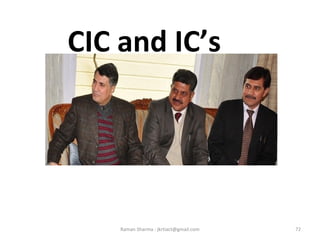
CIC and IC’s
72Raman Sharma : jkrtiact@gmail.com
IMPORTANT WEBLINKS
WWW.JKGAD.NIC.IN
WWW.JKSIC.NIC.IN
WWW.CIC.GOV.IN
JKRTIACT.BLOGSPOT.IN
73Raman Sharma : jkrtiact@gmail.com
Thank you,
for the patience !
Feedback [@] 
JKRTIACT@GMAIL.COM
Mobile: 97968--11012
74Raman Sharma : jkrtiact@gmail.com

Rti Act PPT

  • 1.
    JAMMU AND KASHMIRRIGHT TO INFORMATION ACT 2009 Important features of of RTI Act with section Presented by: RAMAN SHARMA ‫شرما‬ ‫رمن‬ रमन शमार 1Raman Sharma : jkrtiact@gmail.com
  • 2.
    The Act There aretotal 28 sections in Jammu and Kashmir Right To Information Act 2009 2Raman Sharma : jkrtiact@gmail.com
  • 3.
    The Rules There areonly 13 provisions in Jammu and Kashmir Right To Information Rules, 2012 3Raman Sharma : jkrtiact@gmail.com Latest ammended on 30th Aug/2012 vide SRO No. 279
  • 4.
    Amendments in theRules The Rules have been amended Twice since 2009 4Raman Sharma : jkrtiact@gmail.com Latest ammended on 30th Aug/2012 vide SRO No. 279
  • 5.
    No Amendments inthe Act Since Inception of the J & K RTI Act 2009, so far no amendment is made in the Parent Act 5Raman Sharma : jkrtiact@gmail.com
  • 6.
    The Right toinformation Act is Enacted by Jammu and Kashmir State legislature Vide Act No. VIII of 2009 dated 20th March 2009. 6Raman Sharma : jkrtiact@gmail.com
  • 7.
    Know Officials SecretAct 1923 ? RTI Act Overrides Officials Secret Act 1923 7Raman Sharma : jkrtiact@gmail.com
  • 8.
    J & KRTI extends to the whole of Jammu and Kashmir and it has come into force at once. Section 1(2,3) 8Raman Sharma : jkrtiact@gmail.com
  • 9.
    J & KRTI Act 2009 is even applicable to the Central government Department falling under the territorial Jurisdiction of J & K State. As per J&K SCIC’s Direction; Order No: SIC-J-15-09/2011/21 dated 05/04/20122 9Raman Sharma : jkrtiact@gmail.com
  • 10.
    The Central RTIAct 2005 is not Applicable to the offices, department under the authority of J & K Govt. 10Raman Sharma : jkrtiact@gmail.com Though RTI Act 2005 is applicable to the Central Govt Departments situated in the Territorial Jurisdiction of J & K State
  • 11.
    Eligibility to seekinformation under J & K RTI Act 2009 Every person residing in the state has the right to information.. Section 3 of JK RTI Act 11Raman Sharma : jkrtiact@gmail.com
  • 12.
    Eligibility to seekinformation under RTI Act 2005 All Citizens Shall have the Right to Information Section 3/ Central RTI Act 12Raman Sharma : jkrtiact@gmail.com
  • 13.
    Every person residingin the state has the right to information, irrespective of his, her gender, age, profession, job…e.tc Even a govt. employee can seek information from his department or any other department Section 3 13Raman Sharma : jkrtiact@gmail.com
  • 14.
    INFORMATION MEANS: Any materialin any form including Records, Documents, Memos, E-Mails, Opinions, Advices, Press Releases, Circulars, Orders, Logbooks, Contracts…. .. Section 3 14Raman Sharma : jkrtiact@gmail.com
  • 15.
    INFORMATION MEANS: … Reports,Papers, Samples, Models, Data Material held in any Electronic Form and information relating to any private body which can be accessed by a public authority under any other law for the time being in force Section 3 15Raman Sharma : jkrtiact@gmail.com
  • 16.
    INFORMATION MEANS: … InformationRelating to Any Private Body Which can be Accessed by a Public Authority under any other Law for the Time Being in Force Section 3 16Raman Sharma : jkrtiact@gmail.com
  • 17.
    Public Authorities Public Authorities: Any Authority/Body or Institution of Self Govt constituted by Constitution of India/J&K or by any Law of Parliament or JK Legislature, or body owned/controlled by Govt, even NGO that are substantially Financed, directly or indirectly Sec 2-f 17Raman Sharma : jkrtiact@gmail.com
  • 18.
    Public Information Officer: ThePublic Information officer is officer designated by a Public Authority to provide Information to an applicant, Every Public Authority shall designate as many PIOs in an administrative department or office as necessary to provide information Section 5 (1) 18Raman Sharma : jkrtiact@gmail.com
  • 19.
    Role and Responsibilityof PIO The officer i.e Public Information officer can not say no to receive RTI Application in fact he has to render all reasonable assistance to the applicant. Section 6 (1) 19Raman Sharma : jkrtiact@gmail.com
  • 20.
    The PIO cannotreject an RTI application without citing the valid exemption clauses and that too the rejection order is to be given in writing . Section 7(1) 20Raman Sharma : jkrtiact@gmail.com
  • 21.
    An RTI applicationcan be in English, Urdu or Hindi Language, it can be typed/handwritten. Section 6(1) 21Raman Sharma : jkrtiact@gmail.com Application procedure and language
  • 22.
    An RTI applicantcan submit his application through post/self or even via electronic means. Section 6(1) 22Raman Sharma : jkrtiact@gmail.com How to Submit RTI application
  • 23.
    PIO has toAccept RTI application even if it is not related to his department. Section 6(3) 23Raman Sharma : jkrtiact@gmail.com PIO must be attentive and careful
  • 24.
    PIO cannot askthe applicant any personal question, like his intention or motive for seeking information, his job, family etc. Section 6(2) 24Raman Sharma : jkrtiact@gmail.com Protection to Applicant
  • 25.
    Accept the initialRTI fees of Rs. 10/-* in shape of Indian Postal Order, Demand Draft, Bankers Cheque or Cash receipt Rule 3 of J & K RTI Rules 2012 25Raman Sharma : jkrtiact@gmail.com Prescribed Fees and modes
  • 26.
    No fees tobe charged from the person belonging to BPL category. Section 7(5) 26Raman Sharma : jkrtiact@gmail.com
  • 27.
    PIO has toIntimate the applicant for additional fees for supplying the information along with the calculations, his right to review decision and particulars of the appellate authority. Section 7,3(a,b) 27Raman Sharma : jkrtiact@gmail.com
  • 28.
    Provide Information within30 days but related to life and liberty within 48 hours. Section, 7(1) 28Raman Sharma : jkrtiact@gmail.com
  • 29.
    No fees canbe charged from the applicant where the information is not provided within 30 days. Section 7(6) 29Raman Sharma : jkrtiact@gmail.com
  • 30.
    Provide the Informationto the applicant in the format in which it is sought. Section 7(9) 30Raman Sharma : jkrtiact@gmail.com
  • 31.
    Failure in providingor silence on any RTI application more than 30 days shall be deemed as refusal. Section 7(2) 31Raman Sharma : jkrtiact@gmail.com
  • 32.
    Privilege The Information whichcannot be denied to the Parliament or the State Legislature shall not be denied to any person. Section, 8(i) 32Raman Sharma : jkrtiact@gmail.com
  • 33.
    Exemptions Certain kind ofinformation cannot be provided under RTI Act Section, 8(i) 33Raman Sharma : jkrtiact@gmail.com
  • 34.
    Exempt information: Affecting sovereignty,integrity, security, strategic, scientific or economic, or other interests of the State, Relation with foreign state or leading to incitement of an offence; Section, 8 34Raman Sharma : jkrtiact@gmail.com
  • 35.
    Exempt information: Forbidden bycourts; Affecting privilege of Parliament or Legislature; Section, 8 35Raman Sharma : jkrtiact@gmail.com
  • 36.
    Exempt information: Commercial confidence,trade secrets or intellectual property, unless larger public interest so warrants; received in confidence from foreign government; Section, 8 36Raman Sharma : jkrtiact@gmail.com
  • 37.
    Exempt information: Endangers lifeor physical safety or identifies confidential source of information or assistance Impedes the process of investigation or apprehension Section, 8 37Raman Sharma : jkrtiact@gmail.com
  • 38.
    Exempt information: cabinet papers,till after the decision has been taken, and the matter is complete, or over: Personal information which would cause invasion of the privacy unless larger public interest justifies it. Section, 8 38Raman Sharma : jkrtiact@gmail.com
  • 39.
    After 20 Years….. Mostexempt information released after 20 years. Notwithstanding anything a public authority may allow access to information, if public interests in disclosure outweighs the harm to the protected interests. 39Raman Sharma : jkrtiact@gmail.com
  • 40.
    Certain Organizations, departments arekept out of the ambit of RTI In J & K State only CID is kept out under section 21 40Raman Sharma : jkrtiact@gmail.com
  • 41.
    An RTI applicanthas the right to inspection of work, documents, records, he can take notes, extracts or certified copies of documents, can also take certified samples. Section 2, i(I,II,III) 41Raman Sharma : jkrtiact@gmail.com
  • 42.
    An RTI applicantcan obtain information in the form of diskettes, floppies, tapes, videos cassettes or in any other electronic or through printout. Section 2,I (IV) 42Raman Sharma : jkrtiact@gmail.com
  • 43.
    The PIO mayseek assistance of any other officers, if he considers it necessary for furnishing the Information. Section 5(4) 43Raman Sharma : jkrtiact@gmail.com
  • 44.
    The officer, whoassistance is sought by the PIO is under obligation to render assistance and he shall also be treated as PIO Section 5(4) & Section 17 44Raman Sharma : jkrtiact@gmail.com
  • 45.
    Protection of actiontaken in good faith.-No suit, prosecution or other legal proceeding shall lie against any person for anything which is in good faith done or intended to be done under this Act or any rule made there under. Section 18 45Raman Sharma : jkrtiact@gmail.com
  • 46.
    Bar of Jurisdictionof Courts: Section 20 of the Act provides that no court shall entertain any suit, application or other proceeding in respect of any order made under the Act and no such order shall be called in question otherwise than by way of an appeal under the Act Section 20 46Raman Sharma : jkrtiact@gmail.com
  • 47.
    IF PIO providesIncorrect, incomplete and misleading information then he may attract penalty up to Rs. 25000/- besides disciplinary action under service rules Section 17(1) 47Raman Sharma : jkrtiact@gmail.com
  • 48.
    First Appellate Authority FirstAppeal before the Senior officer of the PIO within 30 days Section 16(1)* However, the officer may condone the time 48Raman Sharma : jkrtiact@gmail.com
  • 49.
    Time Limit for1st Appeal First Appeal to be decided only by the Senior officer and not by the PIO himself, it is to be decided within 30 days and maximum 45 days Section 16(7)* In cases of45 days , the reason to be recorded in writing 49Raman Sharma : jkrtiact@gmail.com
  • 50.
    2nd Appeal before theState Information Commission within 90 days Section 16(4)* The Commission has condone the time, if satisfied with delay 50Raman Sharma : jkrtiact@gmail.com
  • 51.
    2nd Appeal to bedecided by Information Commissioner or Bench and it is to be decided within 60 days or maximum 120 days Section 16(11)* In cases of 120 days , the reason to be recorded in writing 51Raman Sharma : jkrtiact@gmail.com
  • 52.
    RTI Act haveoverriding effect, the provisions of the Act shall have effect notwithstanding anything inconsistent therewith contained in the State Official Secrets Act, Samvat 1977 and any other law for the time being in force Section 19 52Raman Sharma : jkrtiact@gmail.com RTI Act shall supersede
  • 53.
    The Most ImportantSection or we may soul of the Act is section 4. This section if implemented properly it can reduce the burden of the PIO and minimize the number of RTI application This section 4 is to be complied by the Public Authority 53Raman Sharma : jkrtiact@gmail.com
  • 54.
    Secton 4 ofJ & K RTI Act is further divided into different sub-sections and there are around 17 main points in this section. Pro-Active Disclosure under the J&K Right to Information Act,2009 54Raman Sharma : jkrtiact@gmail.com
  • 55.
    Particulars of Organization,Functions and Duties Section 4 (1) (b) (i) 55Raman Sharma : jkrtiact@gmail.com
  • 56.
    The procedure followedin the decision making process, including channels of supervision & accountability Section 4 (1) (b) (iii) 56Raman Sharma : jkrtiact@gmail.com
  • 57.
    The Norms setby it for the discharge of its functions Section 4 (1) (b) (iv) 57Raman Sharma : jkrtiact@gmail.com
  • 58.
    The Rules, Regulations,Instruction manuals & Records, held by it or under its control or used by its employees for discharging its functions     Section 4 (1) (b) (v) 58Raman Sharma : jkrtiact@gmail.com
  • 59.
      Statement of categoriesof documents that are held by it or under its control   Section 4 (1) (b) (vi) 59Raman Sharma : jkrtiact@gmail.com
  • 60.
      The particulars ofany arrangement that exists for consultation with, or representation by, the members of the public in relation to the formulation of its policy or implementation thereof   Section 4 (1) (b) (vii) 60Raman Sharma : jkrtiact@gmail.com
  • 61.
    A statement ofthe Boards, Councils, Committees & other bodies consisting of two or more persons constituted as its part or for the purpose of its advice, & as to whether meetings of those boards, councils, committees & other bodies are open to the public, or the minutes of such meetings are accessible for public   Section 4 (1) (b) (viii) 61Raman Sharma : jkrtiact@gmail.com
  • 62.
      Directory of Officers& Employees of the department   Section 4 (1) (b) (ix) 62Raman Sharma : jkrtiact@gmail.com
  • 63.
    The Monthly remunerationreceived by each of its Officers and Employees, including the system of compensation as provided in its regulations. Section 4 (1) (b) (x) 63Raman Sharma : jkrtiact@gmail.com
  • 64.
    The Budget allocatedto each of its agency, indicating the particular of all Plans, proposed Expenditures & Reports on Disbursements made Section 4 (1) (b) (xi) 64Raman Sharma : jkrtiact@gmail.com
  • 65.
    The manner ofexecution of Subsidy programmes, including the amounts allocated & the details of beneficiaries of such programmes Section 4 (1) (b) (xii) 65Raman Sharma : jkrtiact@gmail.com
  • 66.
    Particulars of recipientsof concessions, permits or authorizations granted by it Section 4 (1) (b) (xiii) 66Raman Sharma : jkrtiact@gmail.com
  • 67.
    Details in respectof the information available to or held by it, reduced in an Electronic form. Section 4 (1) (b) (xiv) 67Raman Sharma : jkrtiact@gmail.com
  • 68.
    Particulars of facilitiesavailable to citizens for obtaining information, including the working hours of a Library or Reading room, if maintained for Public use.   Section 4 (1) (b) (xv) 68Raman Sharma : jkrtiact@gmail.com
  • 69.
    Appellate Authority &Public Information Officer of the department.     Section 4 (1) (b) (xvi) 69Raman Sharma : jkrtiact@gmail.com
  • 70.
    Such Other Informationas may be prescribed   Section 4 (1) (b) (xvii) 70Raman Sharma : jkrtiact@gmail.com
  • 71.
  • 72.
  • 73.
  • 74.
    Thank you, for thepatience ! Feedback [@]  JKRTIACT@GMAIL.COM Mobile: 97968--11012 74Raman Sharma : jkrtiact@gmail.com