For Oracle employees and authorized partners only. Do not distribute to third parties.
© 2012 Oracle Corporation – Proprietary and Confidential 1
Performance Tuning: Como escribir y correr
correctamente una sentencia SQL
By Ronald Vargas Quesada, Oracle ACE Director
Expertise Database Management & Performance
Oracledbacr.blogspot.com
@rovaque
For Oracle employees and authorized partners only. Do not distribute to third parties.
© 2012 Oracle Corporation – Proprietary and Confidential 2
For Oracle employees and authorized partners only. Do not distribute to third parties.
© 2012 Oracle Corporation – Proprietary and Confidential
Background
50% mistype a statement
&
9 out of 10 the incorrectly executed
Performance Tuning: How to write & run correctly
For Oracle employees and authorized partners only. Do not distribute to third parties.
© 2012 Oracle Corporation – Proprietary and Confidential 3
For Oracle employees and authorized partners only. Do not distribute to third parties.
© 2012 Oracle Corporation – Proprietary and Confidential
Performance Tuning: How to write & run correctly
Programar siempre y de la misma manera es eficiente ! No!!
For Oracle employees and authorized partners only. Do not distribute to third parties.
© 2012 Oracle Corporation – Proprietary and Confidential 4
For Oracle employees and authorized partners only. Do not distribute to third parties.
© 2012 Oracle Corporation – Proprietary and Confidential
Continuo aprendizaje
Performance Tuning: How to write & run correctly
For Oracle employees and authorized partners only. Do not distribute to third parties.
© 2012 Oracle Corporation – Proprietary and Confidential 5
For Oracle employees and authorized partners only. Do not distribute to third parties.
© 2012 Oracle Corporation – Proprietary and Confidential
There's a tradeoff between efficiency (fewer conditional
statements) and ease of comprehension.
Existe un equilibrio entre la eficiencia ( menos sentencias
condicionales ) y la facilidad de comprensión.
Declaración #1 absoluta
Performance Tuning: How to write & run correctly
For Oracle employees and authorized partners only. Do not distribute to third parties.
© 2012 Oracle Corporation – Proprietary and Confidential 6
For Oracle employees and authorized partners only. Do not distribute to third parties.
© 2012 Oracle Corporation – Proprietary and Confidential
The real world is very complicated; the software we write is supposed to map
those complexities into applications. The result is that we often end up
needing to deal with convoluted logical expressions.
El mundo real es muy complicado; el software que escribimos supone un
mapeo de esas complejidades en las aplicaciones. El resultado es que a
menudo terminamos con la necesidad de lidiar con expresiones lógicas
complejas.
Performance Tuning: How to write & run correctly
Declaración #2 absoluta
For Oracle employees and authorized partners only. Do not distribute to third parties.
© 2012 Oracle Corporation – Proprietary and Confidential 7
For Oracle employees and authorized partners only. Do not distribute to third parties.
© 2012 Oracle Corporation – Proprietary and Confidential
Following this best practice will make your code more readable and
expressive.
You avoid redundant code, always bad news in a program, since it increases
maintenance costs and the chance of introducing bugs into your code.
Aplicando buenas prácticas se puede lograr que su código sea más legible y
expresivo.
Evite el código redundante, este siempre es una mala noticia en un
programa, ya que aumenta los costos de mantenimiento y la posibilidad de
introducir errores en el código.
Declaración #3 absoluta
Performance Tuning: How to write & run correctly
For Oracle employees and authorized partners only. Do not distribute to third parties.
© 2012 Oracle Corporation – Proprietary and Confidential 8
For Oracle employees and authorized partners only. Do not distribute to third parties.
© 2012 Oracle Corporation – Proprietary and Confidential
You need not take out "programmer's insurance": "Gee, I don't know if I need
to declare that or not, so I'd better declare it." Instead, you make certain you
understand how PL/SQL works and write appropriate code.
"Vaya, no sé si tengo que declararlo o no, así que será mejor que lo declare.“
En su lugar, asegúrese de que entiende cómo funciona el PL/SQL y escriba
el código apropiado.
Performance Tuning: How to write & run correctly
Declaración #4 absoluta
For Oracle employees and authorized partners only. Do not distribute to third parties.
© 2012 Oracle Corporation – Proprietary and Confidential 9
For Oracle employees and authorized partners only. Do not distribute to third parties.
© 2012 Oracle Corporation – Proprietary and Confidential
Your code doesn't do any unnecessary work and so executes more efficiently.
TIP: You can, in general, expect the performance of built-in functions such as
SUBSTR to work more efficiently in SQL than in PL/SQL, so move the
processing to the SQL layer whenever possible.
“El código no hace ningún trabajo innecesario y así se ejecuta de manera
más eficiente.”
En general el desempeño de las funciones integradas tales como SUBSTR
trabajan más eficientemente en SQL que en PL/SQL.
Performance Tuning: How to write & run correctly
Declaración #5 absoluta
For Oracle employees and authorized partners only. Do not distribute to third parties.
© 2012 Oracle Corporation – Proprietary and Confidential 10
For Oracle employees and authorized partners only. Do not distribute to third parties.
© 2012 Oracle Corporation – Proprietary and Confidential
Performance Tuning: How to write correctly
That´s it !
That´s it friends!
For Oracle employees and authorized partners only. Do not distribute to third parties.
© 2012 Oracle Corporation – Proprietary and Confidential 11
For Oracle employees and authorized partners only. Do not distribute to third parties.
© 2012 Oracle Corporation – Proprietary and Confidential
quick example #1
Performance Tuning: How to write correctly
For Oracle employees and authorized partners only. Do not distribute to third parties.
© 2012 Oracle Corporation – Proprietary and Confidential 12
For Oracle employees and authorized partners only. Do not distribute to third parties.
© 2012 Oracle Corporation – Proprietary and Confidential
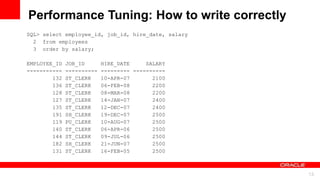
employees by salary
For Oracle employees and authorized partners only. Do not distribute to third parties.
© 2012 Oracle Corporation – Proprietary and Confidential 13
For Oracle employees and authorized partners only. Do not distribute to third parties.
© 2012 Oracle Corporation – Proprietary and Confidential
SQL> select employee_id, job_id, hire_date, salary
2 from employees
3 order by salary;
EMPLOYEE_ID JOB_ID HIRE_DATE SALARY
----------- ---------- --------- ----------
132 ST_CLERK 10-APR-07 2100
136 ST_CLERK 06-FEB-08 2200
128 ST_CLERK 08-MAR-08 2200
127 ST_CLERK 14-JAN-07 2400
135 ST_CLERK 12-DEC-07 2400
191 SH_CLERK 19-DEC-07 2500
119 PU_CLERK 10-AUG-07 2500
140 ST_CLERK 06-APR-06 2500
144 ST_CLERK 09-JUL-06 2500
182 SH_CLERK 21-JUN-07 2500
131 ST_CLERK 16-FEB-05 2500
Performance Tuning: How to write correctly
For Oracle employees and authorized partners only. Do not distribute to third parties.
© 2012 Oracle Corporation – Proprietary and Confidential 14
For Oracle employees and authorized partners only. Do not distribute to third parties.
© 2012 Oracle Corporation – Proprietary and Confidential
Who hired first ?
hiring sequence
Performance Tuning: How to write correctly
For Oracle employees and authorized partners only. Do not distribute to third parties.
© 2012 Oracle Corporation – Proprietary and Confidential 15
For Oracle employees and authorized partners only. Do not distribute to third parties.
© 2012 Oracle Corporation – Proprietary and Confidential
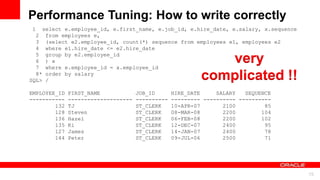
1 select e.employee_id, e.first_name, e.job_id, e.hire_date, e.salary, x.sequence
2 from employees e,
3 (select e2.employee_id, count(*) sequence from employees e1, employees e2
4 where e1.hire_date <= e2.hire_date
5 group by e2.employee_id
6 ) x
7 where e.employee_id = x.employee_id
8* order by salary
SQL> /
EMPLOYEE_ID FIRST_NAME JOB_ID HIRE_DATE SALARY SEQUENCE
----------- -------------------- ---------- --------- ---------- ----------
132 TJ ST_CLERK 10-APR-07 2100 85
128 Steven ST_CLERK 08-MAR-08 2200 104
136 Hazel ST_CLERK 06-FEB-08 2200 102
135 Ki ST_CLERK 12-DEC-07 2400 95
127 James ST_CLERK 14-JAN-07 2400 78
144 Peter ST_CLERK 09-JUL-06 2500 71
Performance Tuning: How to write correctly
very
complicated !!
For Oracle employees and authorized partners only. Do not distribute to third parties.
© 2012 Oracle Corporation – Proprietary and Confidential 16
For Oracle employees and authorized partners only. Do not distribute to third parties.
© 2012 Oracle Corporation – Proprietary and Confidential
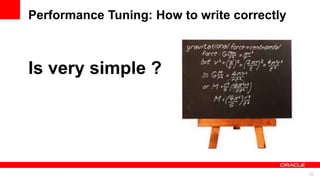
Is very simple ?
Performance Tuning: How to write correctly
For Oracle employees and authorized partners only. Do not distribute to third parties.
© 2012 Oracle Corporation – Proprietary and Confidential 17
For Oracle employees and authorized partners only. Do not distribute to third parties.
© 2012 Oracle Corporation – Proprietary and Confidential
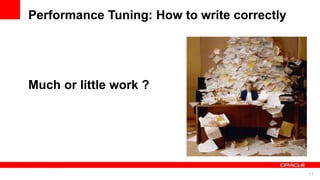
Much or little work ?
Performance Tuning: How to write correctly
For Oracle employees and authorized partners only. Do not distribute to third parties.
© 2012 Oracle Corporation – Proprietary and Confidential 18
For Oracle employees and authorized partners only. Do not distribute to third parties.
© 2012 Oracle Corporation – Proprietary and Confidential
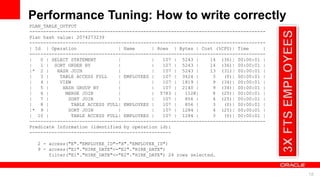
PLAN_TABLE_OUTPUT
-------------------------------------------------------------------------------------
Plan hash value: 2074273239
-------------------------------------------------------------------------------------
| Id | Operation | Name | Rows | Bytes | Cost (%CPU)| Time |
-------------------------------------------------------------------------------------
| 0 | SELECT STATEMENT | | 107 | 5243 | 14 (36)| 00:00:01 |
| 1 | SORT ORDER BY | | 107 | 5243 | 14 (36)| 00:00:01 |
|* 2 | HASH JOIN | | 107 | 5243 | 13 (31)| 00:00:01 |
| 3 | TABLE ACCESS FULL | EMPLOYEES | 107 | 3424 | 3 (0)| 00:00:01 |
| 4 | VIEW | | 107 | 1819 | 9 (34)| 00:00:01 |
| 5 | HASH GROUP BY | | 107 | 2140 | 9 (34)| 00:00:01 |
| 6 | MERGE JOIN | | 5783 | 112K| 8 (25)| 00:00:01 |
| 7 | SORT JOIN | | 107 | 856 | 4 (25)| 00:00:01 |
| 8 | TABLE ACCESS FULL| EMPLOYEES | 107 | 856 | 3 (0)| 00:00:01 |
|* 9 | SORT JOIN | | 107 | 1284 | 4 (25)| 00:00:01 |
| 10 | TABLE ACCESS FULL| EMPLOYEES | 107 | 1284 | 3 (0)| 00:00:01 |
-------------------------------------------------------------------------------------
Predicate Information (identified by operation id):
---------------------------------------------------
2 - access("E"."EMPLOYEE_ID"="X"."EMPLOYEE_ID")
9 - access("E1"."HIRE_DATE"<="E2"."HIRE_DATE")
filter("E1"."HIRE_DATE"<="E2"."HIRE_DATE") 24 rows selected.
Performance Tuning: How to write correctly
For Oracle employees and authorized partners only. Do not distribute to third parties.
© 2012 Oracle Corporation – Proprietary and Confidential 19
For Oracle employees and authorized partners only. Do not distribute to third parties.
© 2012 Oracle Corporation – Proprietary and Confidential
Make it Simple !!
Performance Tuning: How to write correctly
For Oracle employees and authorized partners only. Do not distribute to third parties.
© 2012 Oracle Corporation – Proprietary and Confidential 20
For Oracle employees and authorized partners only. Do not distribute to third parties.
© 2012 Oracle Corporation – Proprietary and Confidential
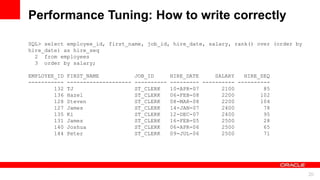
SQL> select employee_id, first_name, job_id, hire_date, salary, rank() over (order by
hire_date) as hire_seq
2 from employees
3 order by salary;
EMPLOYEE_ID FIRST_NAME JOB_ID HIRE_DATE SALARY HIRE_SEQ
----------- -------------------- ---------- --------- ---------- ----------
132 TJ ST_CLERK 10-APR-07 2100 85
136 Hazel ST_CLERK 06-FEB-08 2200 102
128 Steven ST_CLERK 08-MAR-08 2200 104
127 James ST_CLERK 14-JAN-07 2400 78
135 Ki ST_CLERK 12-DEC-07 2400 95
131 James ST_CLERK 16-FEB-05 2500 28
140 Joshua ST_CLERK 06-APR-06 2500 65
144 Peter ST_CLERK 09-JUL-06 2500 71
Performance Tuning: How to write correctly
For Oracle employees and authorized partners only. Do not distribute to third parties.
© 2012 Oracle Corporation – Proprietary and Confidential 21
For Oracle employees and authorized partners only. Do not distribute to third parties.
© 2012 Oracle Corporation – Proprietary and Confidential
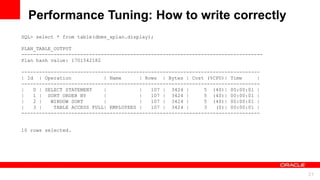
SQL> select * from table(dbms_xplan.display);
PLAN_TABLE_OUTPUT
----------------------------------------------------------------------------------
Plan hash value: 1701542182
---------------------------------------------------------------------------------
| Id | Operation | Name | Rows | Bytes | Cost (%CPU)| Time |
---------------------------------------------------------------------------------
| 0 | SELECT STATEMENT | | 107 | 3424 | 5 (40)| 00:00:01 |
| 1 | SORT ORDER BY | | 107 | 3424 | 5 (40)| 00:00:01 |
| 2 | WINDOW SORT | | 107 | 3424 | 5 (40)| 00:00:01 |
| 3 | TABLE ACCESS FULL| EMPLOYEES | 107 | 3424 | 3 (0)| 00:00:01 |
---------------------------------------------------------------------------------
10 rows selected.
Performance Tuning: How to write correctly
For Oracle employees and authorized partners only. Do not distribute to third parties.
© 2012 Oracle Corporation – Proprietary and Confidential 22
For Oracle employees and authorized partners only. Do not distribute to third parties.
© 2012 Oracle Corporation – Proprietary and Confidential
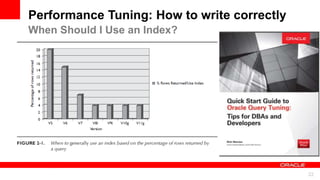
When Should I Use an Index?
Performance Tuning: How to write correctly
For Oracle employees and authorized partners only. Do not distribute to third parties.
© 2012 Oracle Corporation – Proprietary and Confidential 23
For Oracle employees and authorized partners only. Do not distribute to third parties.
© 2012 Oracle Corporation – Proprietary and Confidential
When Should I Use an Index?
Performance Tuning: How to write correctly
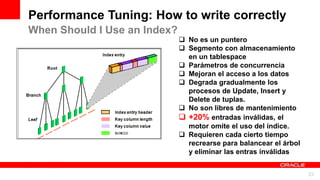
 No es un puntero
 Segmento con almacenamiento
en un tablespace
 Parámetros de concurrencia
 Mejoran el acceso a los datos
 Degrada gradualmente los
procesos de Update, Insert y
Delete de tuplas.
 No son libres de mantenimiento
 +20% entradas inválidas, el
motor omite el uso del índice.
 Requieren cada cierto tiempo
recrearse para balancear el árbol
y eliminar las entras inválidas
For Oracle employees and authorized partners only. Do not distribute to third parties.
© 2012 Oracle Corporation – Proprietary and Confidential 24
For Oracle employees and authorized partners only. Do not distribute to third parties.
© 2012 Oracle Corporation – Proprietary and Confidential
Performance Tuning: How to write correctly
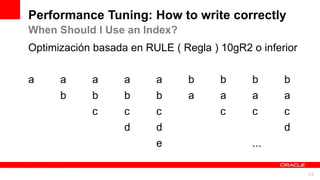
Optimización basada en RULE ( Regla ) 10gR2 o inferior
a a a a a b b b b
b b b b a a a a
c c c c c c
d d d
e ...
When Should I Use an Index?
For Oracle employees and authorized partners only. Do not distribute to third parties.
© 2012 Oracle Corporation – Proprietary and Confidential 25
For Oracle employees and authorized partners only. Do not distribute to third parties.
© 2012 Oracle Corporation – Proprietary and Confidential
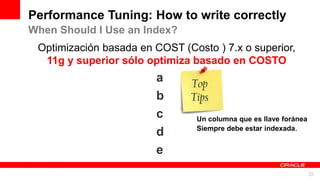
Optimización basada en COST (Costo ) 7.x o superior,
11g y superior sólo optimiza basado en COSTO
a
b
c
d
e
When Should I Use an Index?
Performance Tuning: How to write correctly
Un columna que es llave foránea
Siempre debe estar indexada.
For Oracle employees and authorized partners only. Do not distribute to third parties.
© 2012 Oracle Corporation – Proprietary and Confidential 26
For Oracle employees and authorized partners only. Do not distribute to third parties.
© 2012 Oracle Corporation – Proprietary and Confidential
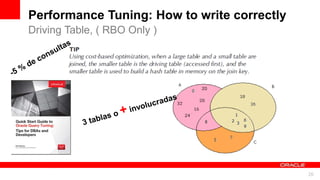
Driving Table, ( RBO Only )
Performance Tuning: How to write correctly
For Oracle employees and authorized partners only. Do not distribute to third parties.
© 2012 Oracle Corporation – Proprietary and Confidential 27
For Oracle employees and authorized partners only. Do not distribute to third parties.
© 2012 Oracle Corporation – Proprietary and Confidential
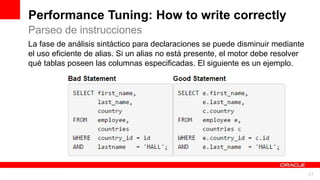
Parseo de instrucciones
Performance Tuning: How to write correctly
La fase de análisis sintáctico para declaraciones se puede disminuir mediante
el uso eficiente de alias. Si un alias no está presente, el motor debe resolver
qué tablas poseen las columnas especificadas. El siguiente es un ejemplo.
For Oracle employees and authorized partners only. Do not distribute to third parties.
© 2012 Oracle Corporation – Proprietary and Confidential 28
For Oracle employees and authorized partners only. Do not distribute to third parties.
© 2012 Oracle Corporation – Proprietary and Confidential
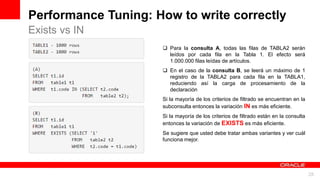
 Para la consulta A, todas las filas de TABLA2 serán
leídos por cada fila en la Tabla 1. El efecto será
1.000.000 filas leídas de artículos.
 En el caso de la consulta B, se leerá un máximo de 1
registro de la TABLA2 para cada fila en la TABLA1,
reduciendo así la carga de procesamiento de la
declaración
Si la mayoría de los criterios de filtrado se encuentran en la
subconsulta entonces la variación IN es más eficiente.
Si la mayoría de los criterios de filtrado están en la consulta
entonces la variación de EXISTS es más eficiente.
Se sugiere que usted debe tratar ambas variantes y ver cuál
funciona mejor.
Exists vs IN
Performance Tuning: How to write correctly
For Oracle employees and authorized partners only. Do not distribute to third parties.
© 2012 Oracle Corporation – Proprietary and Confidential 29
For Oracle employees and authorized partners only. Do not distribute to third parties.
© 2012 Oracle Corporation – Proprietary and Confidential
SQL> host
[oracle@LAB1 ~]$ vi script1.sql
[oracle@LAB1 ~]$ more script1.sql
set timing on
begin
for i in 1 .. 100000
loop
execute immediate
'insert into t (x,y)
values ( ' || i || ', ''x'') ';
end loop;
end;
/
[oracle@LAB1 ~]$
Not using bind variable
Performance Tuning: How to write correctly
For Oracle employees and authorized partners only. Do not distribute to third parties.
© 2012 Oracle Corporation – Proprietary and Confidential 30
For Oracle employees and authorized partners only. Do not distribute to third parties.
© 2012 Oracle Corporation – Proprietary and Confidential
[oracle@LAB1 ~]$ more script2.sql
set timing on
begin
for i in 1 .. 100000
loop
execute immediate
'insert into t (x,y)
values ( :i, ''x'')'
using i;
end loop;
end;
/
[oracle@LAB1 ~]$
Using Bind variable
Performance Tuning: How to write correctly
(*) Up to 1320% higher
For Oracle employees and authorized partners only. Do not distribute to third parties.
© 2012 Oracle Corporation – Proprietary and Confidential 31
For Oracle employees and authorized partners only. Do not distribute to third parties.
© 2012 Oracle Corporation – Proprietary and Confidential
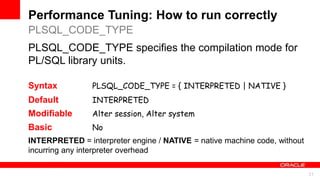
PLSQL_CODE_TYPE specifies the compilation mode for
PL/SQL library units.
Syntax PLSQL_CODE_TYPE = { INTERPRETED | NATIVE }
Default INTERPRETED
Modifiable Alter session, Alter system
Basic No
INTERPRETED = interpreter engine / NATIVE = native machine code, without
incurring any interpreter overhead
PLSQL_CODE_TYPE
Performance Tuning: How to run correctly
For Oracle employees and authorized partners only. Do not distribute to third parties.
© 2012 Oracle Corporation – Proprietary and Confidential 32
For Oracle employees and authorized partners only. Do not distribute to third parties.
© 2012 Oracle Corporation – Proprietary and Confidential
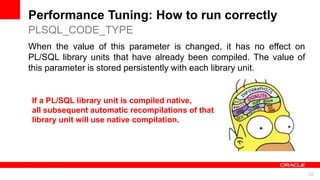
When the value of this parameter is changed, it has no effect on
PL/SQL library units that have already been compiled. The value of
this parameter is stored persistently with each library unit.
Performance Tuning: How to run correctly
PLSQL_CODE_TYPE
If a PL/SQL library unit is compiled native,
all subsequent automatic recompilations of that
library unit will use native compilation.
For Oracle employees and authorized partners only. Do not distribute to third parties.
© 2012 Oracle Corporation – Proprietary and Confidential 33
For Oracle employees and authorized partners only. Do not distribute to third parties.
© 2012 Oracle Corporation – Proprietary and Confidential
Performance Tuning: How to run correctly
Environment
For Oracle employees and authorized partners only. Do not distribute to third parties.
© 2012 Oracle Corporation – Proprietary and Confidential 34
For Oracle employees and authorized partners only. Do not distribute to third parties.
© 2012 Oracle Corporation – Proprietary and Confidential
Performance Tuning: How to run correctly
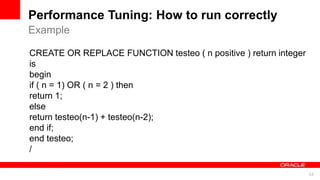
CREATE OR REPLACE FUNCTION testeo ( n positive ) return integer
is
begin
if ( n = 1) OR ( n = 2 ) then
return 1;
else
return testeo(n-1) + testeo(n-2);
end if;
end testeo;
/
Example
For Oracle employees and authorized partners only. Do not distribute to third parties.
© 2012 Oracle Corporation – Proprietary and Confidential 35
For Oracle employees and authorized partners only. Do not distribute to third parties.
© 2012 Oracle Corporation – Proprietary and Confidential
Performance Tuning: How to run correctly
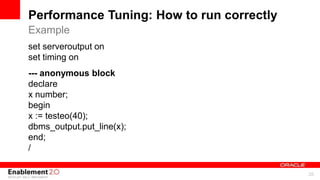
set serveroutput on
set timing on
--- anonymous block
declare
x number;
begin
x := testeo(40);
dbms_output.put_line(x);
end;
/
Example
For Oracle employees and authorized partners only. Do not distribute to third parties.
© 2012 Oracle Corporation – Proprietary and Confidential 36
For Oracle employees and authorized partners only. Do not distribute to third parties.
© 2012 Oracle Corporation – Proprietary and Confidential
Performance Tuning: How to run correctly
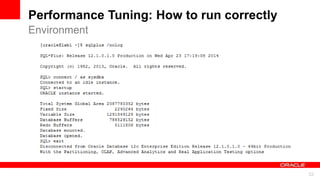
[oracle@lab1 admin]$ sqlplus hr/hr@PDB1
SQL*Plus: Release 12.1.0.1.0 Production on Wed Apr 23 17:23:43 2014
Copyright (c) 1982, 2013, Oracle. All rights reserved.
Last Successful login time: Wed Jan 15 2014 12:14:36 -06:00
Connected to:
Oracle Database 12c Enterprise Edition Release 12.1.0.1.0 - 64bit
Production
With the Partitioning, OLAP, Advanced Analytics and Real Application
Testing options
SQL>
Example
For Oracle employees and authorized partners only. Do not distribute to third parties.
© 2012 Oracle Corporation – Proprietary and Confidential 37
For Oracle employees and authorized partners only. Do not distribute to third parties.
© 2012 Oracle Corporation – Proprietary and Confidential
Performance Tuning: How to run correctly
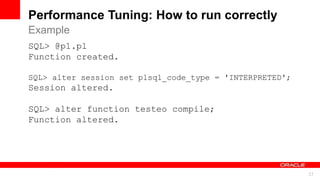
SQL> @p1.pl
Function created.
SQL> alter session set plsql_code_type = 'INTERPRETED';
Session altered.
SQL> alter function testeo compile;
Function altered.
Example
For Oracle employees and authorized partners only. Do not distribute to third parties.
© 2012 Oracle Corporation – Proprietary and Confidential 38
For Oracle employees and authorized partners only. Do not distribute to third parties.
© 2012 Oracle Corporation – Proprietary and Confidential
Performance Tuning: How to run correctly
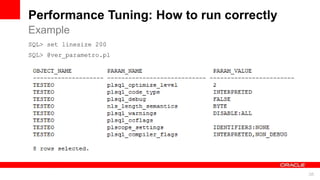
SQL> set linesize 200
SQL> @ver_parametro.pl
Example
For Oracle employees and authorized partners only. Do not distribute to third parties.
© 2012 Oracle Corporation – Proprietary and Confidential 39
For Oracle employees and authorized partners only. Do not distribute to third parties.
© 2012 Oracle Corporation – Proprietary and Confidential
Performance Tuning: How to run correctly
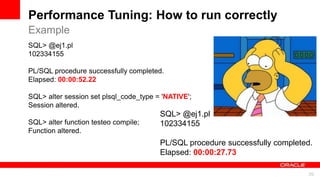
SQL> @ej1.pl
102334155
PL/SQL procedure successfully completed.
Elapsed: 00:00:52.22
SQL> alter session set plsql_code_type = 'NATIVE';
Session altered.
SQL> alter function testeo compile;
Function altered.
Example
SQL> @ej1.pl
102334155
PL/SQL procedure successfully completed.
Elapsed: 00:00:27.73
For Oracle employees and authorized partners only. Do not distribute to third parties.
© 2012 Oracle Corporation – Proprietary and Confidential 40
For Oracle employees and authorized partners only. Do not distribute to third parties.
© 2012 Oracle Corporation – Proprietary and Confidential
Performance Tuning: How to run correctly
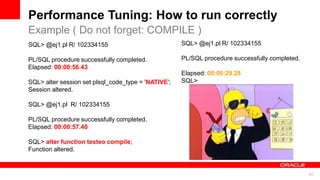
SQL> @ej1.pl R/ 102334155
PL/SQL procedure successfully completed.
Elapsed: 00:00:56.43
SQL> alter session set plsql_code_type = 'NATIVE';
Session altered.
SQL> @ej1.pl R/ 102334155
PL/SQL procedure successfully completed.
Elapsed: 00:00:57.40
SQL> alter function testeo compile;
Function altered.
Example ( Do not forget: COMPILE )
SQL> @ej1.pl R/ 102334155
PL/SQL procedure successfully completed.
Elapsed: 00:00:29.28
SQL>
For Oracle employees and authorized partners only. Do not distribute to third parties.
© 2012 Oracle Corporation – Proprietary and Confidential 41
For Oracle employees and authorized partners only. Do not distribute to third parties.
© 2012 Oracle Corporation – Proprietary and Confidential
Performance Tuning: How to run correctly
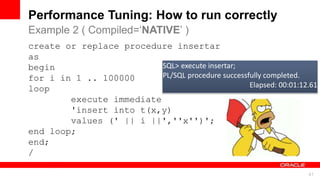
create or replace procedure insertar
as
begin
for i in 1 .. 100000
loop
execute immediate
'insert into t(x,y)
values (' || i ||',''x'')';
end loop;
end;
/
Example 2 ( Compiled=‘NATIVE’ )
SQL> execute insertar;
PL/SQL procedure successfully completed.
Elapsed: 00:01:12.61
For Oracle employees and authorized partners only. Do not distribute to third parties.
© 2012 Oracle Corporation – Proprietary and Confidential 42
For Oracle employees and authorized partners only. Do not distribute to third parties.
© 2012 Oracle Corporation – Proprietary and Confidential
Performance Tuning: How to run correctly
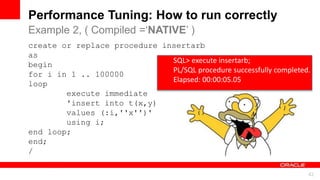
create or replace procedure insertarb
as
begin
for i in 1 .. 100000
loop
execute immediate
'insert into t(x,y)
values (:i,''x'')'
using i;
end loop;
end;
/
Example 2, ( Compiled =‘NATIVE’ )
SQL> execute insertarb;
PL/SQL procedure successfully completed.
Elapsed: 00:00:05.05
For Oracle employees and authorized partners only. Do not distribute to third parties.
© 2012 Oracle Corporation – Proprietary and Confidential 43
For Oracle employees and authorized partners only. Do not distribute to third parties.
© 2012 Oracle Corporation – Proprietary and Confidential
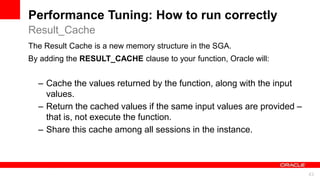
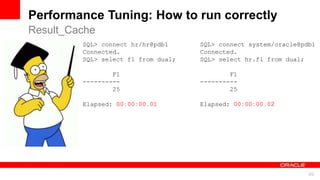
The Result Cache is a new memory structure in the SGA.
By adding the RESULT_CACHE clause to your function, Oracle will:
– Cache the values returned by the function, along with the input
values.
– Return the cached values if the same input values are provided –
that is, not execute the function.
– Share this cache among all sessions in the instance.
Result_Cache
Performance Tuning: How to run correctly
For Oracle employees and authorized partners only. Do not distribute to third parties.
© 2012 Oracle Corporation – Proprietary and Confidential 44
For Oracle employees and authorized partners only. Do not distribute to third parties.
© 2012 Oracle Corporation – Proprietary and Confidential
SQL> select count(*) from hr.employees2;
COUNT(*)
----------
10700214
Elapsed: 00:00:00.46
SQL> host
[oracle@lab1 ~]$ more cache2_result.sql
SELECT count(*)
FROM ( SELECT department_id, manager_id,
count(*) count
FROM hr.employees
GROUP BY department_id, manager_id )
view1
WHERE department_id <> 30;
SQL> connect hr/hr@pdb1
Connected.
SQL> @cache2_result
COUNT(*)
----------
25
Elapsed: 00:00:02.04
Performance Tuning: How to run correctly
Result_Cache
For Oracle employees and authorized partners only. Do not distribute to third parties.
© 2012 Oracle Corporation – Proprietary and Confidential 45
For Oracle employees and authorized partners only. Do not distribute to third parties.
© 2012 Oracle Corporation – Proprietary and Confidential
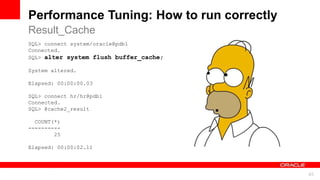
SQL> connect system/oracle@pdb1
Connected.
SQL> alter system flush buffer_cache;
System altered.
Elapsed: 00:00:00.03
SQL> connect hr/hr@pdb1
Connected.
SQL> @cache2_result
COUNT(*)
----------
25
Elapsed: 00:00:02.11
Performance Tuning: How to run correctly
Result_Cache
For Oracle employees and authorized partners only. Do not distribute to third parties.
© 2012 Oracle Corporation – Proprietary and Confidential 46
For Oracle employees and authorized partners only. Do not distribute to third parties.
© 2012 Oracle Corporation – Proprietary and Confidential
SQL> host
[oracle@lab1 ~]$ more cache2_result.sql
CREATE OR REPLACE FUNCTION f1 RETURN number is
x number;
begin
SELECT count(*)
INTO x
FROM ( SELECT /*+ RESULT_CACHE */
department_id, manager_id, count(*)
count
FROM hr.employees2
GROUP BY department_id, manager_id )
view1
WHERE department_id <> 30;
return x;
end f1;
SQL> @cache2_result
Function created.
Performance Tuning: How to run correctly
Result_Cache
For Oracle employees and authorized partners only. Do not distribute to third parties.
© 2012 Oracle Corporation – Proprietary and Confidential 47
For Oracle employees and authorized partners only. Do not distribute to third parties.
© 2012 Oracle Corporation – Proprietary and Confidential
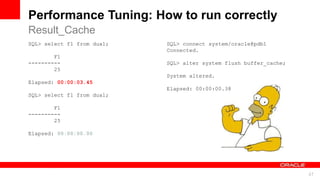
SQL> select f1 from dual;
F1
----------
25
Elapsed: 00:00:03.45
SQL> select f1 from dual;
F1
----------
25
Elapsed: 00:00:00.00
SQL> connect system/oracle@pdb1
Connected.
SQL> alter system flush buffer_cache;
System altered.
Elapsed: 00:00:00.38
Performance Tuning: How to run correctly
Result_Cache
For Oracle employees and authorized partners only. Do not distribute to third parties.
© 2012 Oracle Corporation – Proprietary and Confidential 48
For Oracle employees and authorized partners only. Do not distribute to third parties.
© 2012 Oracle Corporation – Proprietary and Confidential
Performance Tuning: How to run correctly
In-Memory Database
For Oracle employees and authorized partners only. Do not distribute to third parties.
© 2012 Oracle Corporation – Proprietary and Confidential 49
For Oracle employees and authorized partners only. Do not distribute to third parties.
© 2012 Oracle Corporation – Proprietary and Confidential
SQL> connect hr/hr@pdb1
Connected.
SQL> select f1 from dual;
F1
----------
25
Elapsed: 00:00:00.01
SQL> connect system/oracle@pdb1
Connected.
SQL> select hr.f1 from dual;
F1
----------
25
Elapsed: 00:00:00.02
Performance Tuning: How to run correctly
Result_Cache
For Oracle employees and authorized partners only. Do not distribute to third parties.
© 2012 Oracle Corporation – Proprietary and Confidential 50
For Oracle employees and authorized partners only. Do not distribute to third parties.
© 2012 Oracle Corporation – Proprietary and Confidential
Performance Tuning: How to run correctly
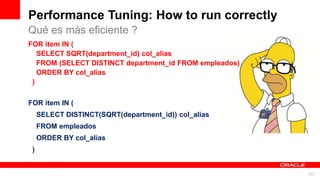
FOR item IN (
SELECT SQRT(department_id) col_alias
FROM (SELECT DISTINCT department_id FROM empleados)
ORDER BY col_alias
)
FOR item IN (
SELECT DISTINCT(SQRT(department_id)) col_alias
FROM empleados
ORDER BY col_alias
)
Qué es más eficiente ?
For Oracle employees and authorized partners only. Do not distribute to third parties.
© 2012 Oracle Corporation – Proprietary and Confidential 51
For Oracle employees and authorized partners only. Do not distribute to third parties.
© 2012 Oracle Corporation – Proprietary and Confidential
Performance Tuning: How to run correctly
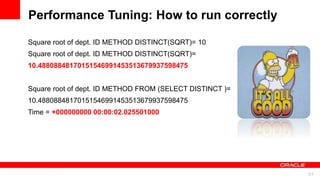
Square root of dept. ID METHOD DISTINCT(SQRT)= 10
Square root of dept. ID METHOD DISTINCT(SQRT)=
10.48808848170151546991453513679937598475
Square root of dept. ID METHOD FROM (SELECT DISTINCT )=
10.48808848170151546991453513679937598475
Time = +000000000 00:00:02.025501000
For Oracle employees and authorized partners only. Do not distribute to third parties.
© 2012 Oracle Corporation – Proprietary and Confidential 52
For Oracle employees and authorized partners only. Do not distribute to third parties.
© 2012 Oracle Corporation – Proprietary and Confidential
Performance Tuning: How to run correctly
• EXEC DBMS_STATS.gather_table_stats('HR',
'EMPLOYEES');
• EXEC DBMS_STATS.gather_index_stats(‘HR',
'EMPLOYEES_PK');
• EXEC DBMS_STATS.gather_dictionary_stats;
TIP: Hacer magia, mantener estadísticas actualizadas
For Oracle employees and authorized partners only. Do not distribute to third parties.
© 2012 Oracle Corporation – Proprietary and Confidential 53
For Oracle employees and authorized partners only. Do not distribute to third parties.
© 2012 Oracle Corporation – Proprietary and Confidential
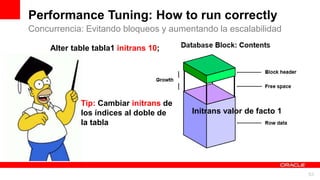
Concurrencia: Evitando bloqueos y aumentando la escalabilidad
Performance Tuning: How to run correctly
Initrans valor de facto 1
Alter table tabla1 initrans 10;
Tip: Cambiar initrans de
los índices al doble de
la tabla
For Oracle employees and authorized partners only. Do not distribute to third parties.
© 2012 Oracle Corporation – Proprietary and Confidential 54
For Oracle employees and authorized partners only. Do not distribute to third parties.
© 2012 Oracle Corporation – Proprietary and Confidential
@rovaque
oracledbacr.blogspot.com
ronald.vargas.quesada@gmail.com
‘Live Your Dreams, Not the Dreams of Others’
Larry Ellison

Ronald Vargas Performance Tuning how to write and run correctly sql statement recargado

  • 1.
    For Oracle employeesand authorized partners only. Do not distribute to third parties. © 2012 Oracle Corporation – Proprietary and Confidential 1 Performance Tuning: Como escribir y correr correctamente una sentencia SQL By Ronald Vargas Quesada, Oracle ACE Director Expertise Database Management & Performance Oracledbacr.blogspot.com @rovaque
  • 2.
    For Oracle employeesand authorized partners only. Do not distribute to third parties. © 2012 Oracle Corporation – Proprietary and Confidential 2 For Oracle employees and authorized partners only. Do not distribute to third parties. © 2012 Oracle Corporation – Proprietary and Confidential Background 50% mistype a statement & 9 out of 10 the incorrectly executed Performance Tuning: How to write & run correctly
  • 3.
    For Oracle employeesand authorized partners only. Do not distribute to third parties. © 2012 Oracle Corporation – Proprietary and Confidential 3 For Oracle employees and authorized partners only. Do not distribute to third parties. © 2012 Oracle Corporation – Proprietary and Confidential Performance Tuning: How to write & run correctly Programar siempre y de la misma manera es eficiente ! No!!
  • 4.
    For Oracle employeesand authorized partners only. Do not distribute to third parties. © 2012 Oracle Corporation – Proprietary and Confidential 4 For Oracle employees and authorized partners only. Do not distribute to third parties. © 2012 Oracle Corporation – Proprietary and Confidential Continuo aprendizaje Performance Tuning: How to write & run correctly
  • 5.
    For Oracle employeesand authorized partners only. Do not distribute to third parties. © 2012 Oracle Corporation – Proprietary and Confidential 5 For Oracle employees and authorized partners only. Do not distribute to third parties. © 2012 Oracle Corporation – Proprietary and Confidential There's a tradeoff between efficiency (fewer conditional statements) and ease of comprehension. Existe un equilibrio entre la eficiencia ( menos sentencias condicionales ) y la facilidad de comprensión. Declaración #1 absoluta Performance Tuning: How to write & run correctly
  • 6.
    For Oracle employeesand authorized partners only. Do not distribute to third parties. © 2012 Oracle Corporation – Proprietary and Confidential 6 For Oracle employees and authorized partners only. Do not distribute to third parties. © 2012 Oracle Corporation – Proprietary and Confidential The real world is very complicated; the software we write is supposed to map those complexities into applications. The result is that we often end up needing to deal with convoluted logical expressions. El mundo real es muy complicado; el software que escribimos supone un mapeo de esas complejidades en las aplicaciones. El resultado es que a menudo terminamos con la necesidad de lidiar con expresiones lógicas complejas. Performance Tuning: How to write & run correctly Declaración #2 absoluta
  • 7.
    For Oracle employeesand authorized partners only. Do not distribute to third parties. © 2012 Oracle Corporation – Proprietary and Confidential 7 For Oracle employees and authorized partners only. Do not distribute to third parties. © 2012 Oracle Corporation – Proprietary and Confidential Following this best practice will make your code more readable and expressive. You avoid redundant code, always bad news in a program, since it increases maintenance costs and the chance of introducing bugs into your code. Aplicando buenas prácticas se puede lograr que su código sea más legible y expresivo. Evite el código redundante, este siempre es una mala noticia en un programa, ya que aumenta los costos de mantenimiento y la posibilidad de introducir errores en el código. Declaración #3 absoluta Performance Tuning: How to write & run correctly
  • 8.
    For Oracle employeesand authorized partners only. Do not distribute to third parties. © 2012 Oracle Corporation – Proprietary and Confidential 8 For Oracle employees and authorized partners only. Do not distribute to third parties. © 2012 Oracle Corporation – Proprietary and Confidential You need not take out "programmer's insurance": "Gee, I don't know if I need to declare that or not, so I'd better declare it." Instead, you make certain you understand how PL/SQL works and write appropriate code. "Vaya, no sé si tengo que declararlo o no, así que será mejor que lo declare.“ En su lugar, asegúrese de que entiende cómo funciona el PL/SQL y escriba el código apropiado. Performance Tuning: How to write & run correctly Declaración #4 absoluta
  • 9.
    For Oracle employeesand authorized partners only. Do not distribute to third parties. © 2012 Oracle Corporation – Proprietary and Confidential 9 For Oracle employees and authorized partners only. Do not distribute to third parties. © 2012 Oracle Corporation – Proprietary and Confidential Your code doesn't do any unnecessary work and so executes more efficiently. TIP: You can, in general, expect the performance of built-in functions such as SUBSTR to work more efficiently in SQL than in PL/SQL, so move the processing to the SQL layer whenever possible. “El código no hace ningún trabajo innecesario y así se ejecuta de manera más eficiente.” En general el desempeño de las funciones integradas tales como SUBSTR trabajan más eficientemente en SQL que en PL/SQL. Performance Tuning: How to write & run correctly Declaración #5 absoluta
  • 10.
    For Oracle employeesand authorized partners only. Do not distribute to third parties. © 2012 Oracle Corporation – Proprietary and Confidential 10 For Oracle employees and authorized partners only. Do not distribute to third parties. © 2012 Oracle Corporation – Proprietary and Confidential Performance Tuning: How to write correctly That´s it ! That´s it friends!
  • 11.
    For Oracle employeesand authorized partners only. Do not distribute to third parties. © 2012 Oracle Corporation – Proprietary and Confidential 11 For Oracle employees and authorized partners only. Do not distribute to third parties. © 2012 Oracle Corporation – Proprietary and Confidential quick example #1 Performance Tuning: How to write correctly
  • 12.
    For Oracle employeesand authorized partners only. Do not distribute to third parties. © 2012 Oracle Corporation – Proprietary and Confidential 12 For Oracle employees and authorized partners only. Do not distribute to third parties. © 2012 Oracle Corporation – Proprietary and Confidential employees by salary
  • 13.
    For Oracle employeesand authorized partners only. Do not distribute to third parties. © 2012 Oracle Corporation – Proprietary and Confidential 13 For Oracle employees and authorized partners only. Do not distribute to third parties. © 2012 Oracle Corporation – Proprietary and Confidential SQL> select employee_id, job_id, hire_date, salary 2 from employees 3 order by salary; EMPLOYEE_ID JOB_ID HIRE_DATE SALARY ----------- ---------- --------- ---------- 132 ST_CLERK 10-APR-07 2100 136 ST_CLERK 06-FEB-08 2200 128 ST_CLERK 08-MAR-08 2200 127 ST_CLERK 14-JAN-07 2400 135 ST_CLERK 12-DEC-07 2400 191 SH_CLERK 19-DEC-07 2500 119 PU_CLERK 10-AUG-07 2500 140 ST_CLERK 06-APR-06 2500 144 ST_CLERK 09-JUL-06 2500 182 SH_CLERK 21-JUN-07 2500 131 ST_CLERK 16-FEB-05 2500 Performance Tuning: How to write correctly
  • 14.
    For Oracle employeesand authorized partners only. Do not distribute to third parties. © 2012 Oracle Corporation – Proprietary and Confidential 14 For Oracle employees and authorized partners only. Do not distribute to third parties. © 2012 Oracle Corporation – Proprietary and Confidential Who hired first ? hiring sequence Performance Tuning: How to write correctly
  • 15.
    For Oracle employeesand authorized partners only. Do not distribute to third parties. © 2012 Oracle Corporation – Proprietary and Confidential 15 For Oracle employees and authorized partners only. Do not distribute to third parties. © 2012 Oracle Corporation – Proprietary and Confidential 1 select e.employee_id, e.first_name, e.job_id, e.hire_date, e.salary, x.sequence 2 from employees e, 3 (select e2.employee_id, count(*) sequence from employees e1, employees e2 4 where e1.hire_date <= e2.hire_date 5 group by e2.employee_id 6 ) x 7 where e.employee_id = x.employee_id 8* order by salary SQL> / EMPLOYEE_ID FIRST_NAME JOB_ID HIRE_DATE SALARY SEQUENCE ----------- -------------------- ---------- --------- ---------- ---------- 132 TJ ST_CLERK 10-APR-07 2100 85 128 Steven ST_CLERK 08-MAR-08 2200 104 136 Hazel ST_CLERK 06-FEB-08 2200 102 135 Ki ST_CLERK 12-DEC-07 2400 95 127 James ST_CLERK 14-JAN-07 2400 78 144 Peter ST_CLERK 09-JUL-06 2500 71 Performance Tuning: How to write correctly very complicated !!
  • 16.
    For Oracle employeesand authorized partners only. Do not distribute to third parties. © 2012 Oracle Corporation – Proprietary and Confidential 16 For Oracle employees and authorized partners only. Do not distribute to third parties. © 2012 Oracle Corporation – Proprietary and Confidential Is very simple ? Performance Tuning: How to write correctly
  • 17.
    For Oracle employeesand authorized partners only. Do not distribute to third parties. © 2012 Oracle Corporation – Proprietary and Confidential 17 For Oracle employees and authorized partners only. Do not distribute to third parties. © 2012 Oracle Corporation – Proprietary and Confidential Much or little work ? Performance Tuning: How to write correctly
  • 18.
    For Oracle employeesand authorized partners only. Do not distribute to third parties. © 2012 Oracle Corporation – Proprietary and Confidential 18 For Oracle employees and authorized partners only. Do not distribute to third parties. © 2012 Oracle Corporation – Proprietary and Confidential PLAN_TABLE_OUTPUT ------------------------------------------------------------------------------------- Plan hash value: 2074273239 ------------------------------------------------------------------------------------- | Id | Operation | Name | Rows | Bytes | Cost (%CPU)| Time | ------------------------------------------------------------------------------------- | 0 | SELECT STATEMENT | | 107 | 5243 | 14 (36)| 00:00:01 | | 1 | SORT ORDER BY | | 107 | 5243 | 14 (36)| 00:00:01 | |* 2 | HASH JOIN | | 107 | 5243 | 13 (31)| 00:00:01 | | 3 | TABLE ACCESS FULL | EMPLOYEES | 107 | 3424 | 3 (0)| 00:00:01 | | 4 | VIEW | | 107 | 1819 | 9 (34)| 00:00:01 | | 5 | HASH GROUP BY | | 107 | 2140 | 9 (34)| 00:00:01 | | 6 | MERGE JOIN | | 5783 | 112K| 8 (25)| 00:00:01 | | 7 | SORT JOIN | | 107 | 856 | 4 (25)| 00:00:01 | | 8 | TABLE ACCESS FULL| EMPLOYEES | 107 | 856 | 3 (0)| 00:00:01 | |* 9 | SORT JOIN | | 107 | 1284 | 4 (25)| 00:00:01 | | 10 | TABLE ACCESS FULL| EMPLOYEES | 107 | 1284 | 3 (0)| 00:00:01 | ------------------------------------------------------------------------------------- Predicate Information (identified by operation id): --------------------------------------------------- 2 - access("E"."EMPLOYEE_ID"="X"."EMPLOYEE_ID") 9 - access("E1"."HIRE_DATE"<="E2"."HIRE_DATE") filter("E1"."HIRE_DATE"<="E2"."HIRE_DATE") 24 rows selected. Performance Tuning: How to write correctly
  • 19.
    For Oracle employeesand authorized partners only. Do not distribute to third parties. © 2012 Oracle Corporation – Proprietary and Confidential 19 For Oracle employees and authorized partners only. Do not distribute to third parties. © 2012 Oracle Corporation – Proprietary and Confidential Make it Simple !! Performance Tuning: How to write correctly
  • 20.
    For Oracle employeesand authorized partners only. Do not distribute to third parties. © 2012 Oracle Corporation – Proprietary and Confidential 20 For Oracle employees and authorized partners only. Do not distribute to third parties. © 2012 Oracle Corporation – Proprietary and Confidential SQL> select employee_id, first_name, job_id, hire_date, salary, rank() over (order by hire_date) as hire_seq 2 from employees 3 order by salary; EMPLOYEE_ID FIRST_NAME JOB_ID HIRE_DATE SALARY HIRE_SEQ ----------- -------------------- ---------- --------- ---------- ---------- 132 TJ ST_CLERK 10-APR-07 2100 85 136 Hazel ST_CLERK 06-FEB-08 2200 102 128 Steven ST_CLERK 08-MAR-08 2200 104 127 James ST_CLERK 14-JAN-07 2400 78 135 Ki ST_CLERK 12-DEC-07 2400 95 131 James ST_CLERK 16-FEB-05 2500 28 140 Joshua ST_CLERK 06-APR-06 2500 65 144 Peter ST_CLERK 09-JUL-06 2500 71 Performance Tuning: How to write correctly
  • 21.
    For Oracle employeesand authorized partners only. Do not distribute to third parties. © 2012 Oracle Corporation – Proprietary and Confidential 21 For Oracle employees and authorized partners only. Do not distribute to third parties. © 2012 Oracle Corporation – Proprietary and Confidential SQL> select * from table(dbms_xplan.display); PLAN_TABLE_OUTPUT ---------------------------------------------------------------------------------- Plan hash value: 1701542182 --------------------------------------------------------------------------------- | Id | Operation | Name | Rows | Bytes | Cost (%CPU)| Time | --------------------------------------------------------------------------------- | 0 | SELECT STATEMENT | | 107 | 3424 | 5 (40)| 00:00:01 | | 1 | SORT ORDER BY | | 107 | 3424 | 5 (40)| 00:00:01 | | 2 | WINDOW SORT | | 107 | 3424 | 5 (40)| 00:00:01 | | 3 | TABLE ACCESS FULL| EMPLOYEES | 107 | 3424 | 3 (0)| 00:00:01 | --------------------------------------------------------------------------------- 10 rows selected. Performance Tuning: How to write correctly
  • 22.
    For Oracle employeesand authorized partners only. Do not distribute to third parties. © 2012 Oracle Corporation – Proprietary and Confidential 22 For Oracle employees and authorized partners only. Do not distribute to third parties. © 2012 Oracle Corporation – Proprietary and Confidential When Should I Use an Index? Performance Tuning: How to write correctly
  • 23.
    For Oracle employeesand authorized partners only. Do not distribute to third parties. © 2012 Oracle Corporation – Proprietary and Confidential 23 For Oracle employees and authorized partners only. Do not distribute to third parties. © 2012 Oracle Corporation – Proprietary and Confidential When Should I Use an Index? Performance Tuning: How to write correctly  No es un puntero  Segmento con almacenamiento en un tablespace  Parámetros de concurrencia  Mejoran el acceso a los datos  Degrada gradualmente los procesos de Update, Insert y Delete de tuplas.  No son libres de mantenimiento  +20% entradas inválidas, el motor omite el uso del índice.  Requieren cada cierto tiempo recrearse para balancear el árbol y eliminar las entras inválidas
  • 24.
    For Oracle employeesand authorized partners only. Do not distribute to third parties. © 2012 Oracle Corporation – Proprietary and Confidential 24 For Oracle employees and authorized partners only. Do not distribute to third parties. © 2012 Oracle Corporation – Proprietary and Confidential Performance Tuning: How to write correctly Optimización basada en RULE ( Regla ) 10gR2 o inferior a a a a a b b b b b b b b a a a a c c c c c c d d d e ... When Should I Use an Index?
  • 25.
    For Oracle employeesand authorized partners only. Do not distribute to third parties. © 2012 Oracle Corporation – Proprietary and Confidential 25 For Oracle employees and authorized partners only. Do not distribute to third parties. © 2012 Oracle Corporation – Proprietary and Confidential Optimización basada en COST (Costo ) 7.x o superior, 11g y superior sólo optimiza basado en COSTO a b c d e When Should I Use an Index? Performance Tuning: How to write correctly Un columna que es llave foránea Siempre debe estar indexada.
  • 26.
    For Oracle employeesand authorized partners only. Do not distribute to third parties. © 2012 Oracle Corporation – Proprietary and Confidential 26 For Oracle employees and authorized partners only. Do not distribute to third parties. © 2012 Oracle Corporation – Proprietary and Confidential Driving Table, ( RBO Only ) Performance Tuning: How to write correctly
  • 27.
    For Oracle employeesand authorized partners only. Do not distribute to third parties. © 2012 Oracle Corporation – Proprietary and Confidential 27 For Oracle employees and authorized partners only. Do not distribute to third parties. © 2012 Oracle Corporation – Proprietary and Confidential Parseo de instrucciones Performance Tuning: How to write correctly La fase de análisis sintáctico para declaraciones se puede disminuir mediante el uso eficiente de alias. Si un alias no está presente, el motor debe resolver qué tablas poseen las columnas especificadas. El siguiente es un ejemplo.
  • 28.
    For Oracle employeesand authorized partners only. Do not distribute to third parties. © 2012 Oracle Corporation – Proprietary and Confidential 28 For Oracle employees and authorized partners only. Do not distribute to third parties. © 2012 Oracle Corporation – Proprietary and Confidential  Para la consulta A, todas las filas de TABLA2 serán leídos por cada fila en la Tabla 1. El efecto será 1.000.000 filas leídas de artículos.  En el caso de la consulta B, se leerá un máximo de 1 registro de la TABLA2 para cada fila en la TABLA1, reduciendo así la carga de procesamiento de la declaración Si la mayoría de los criterios de filtrado se encuentran en la subconsulta entonces la variación IN es más eficiente. Si la mayoría de los criterios de filtrado están en la consulta entonces la variación de EXISTS es más eficiente. Se sugiere que usted debe tratar ambas variantes y ver cuál funciona mejor. Exists vs IN Performance Tuning: How to write correctly
  • 29.
    For Oracle employeesand authorized partners only. Do not distribute to third parties. © 2012 Oracle Corporation – Proprietary and Confidential 29 For Oracle employees and authorized partners only. Do not distribute to third parties. © 2012 Oracle Corporation – Proprietary and Confidential SQL> host [oracle@LAB1 ~]$ vi script1.sql [oracle@LAB1 ~]$ more script1.sql set timing on begin for i in 1 .. 100000 loop execute immediate 'insert into t (x,y) values ( ' || i || ', ''x'') '; end loop; end; / [oracle@LAB1 ~]$ Not using bind variable Performance Tuning: How to write correctly
  • 30.
    For Oracle employeesand authorized partners only. Do not distribute to third parties. © 2012 Oracle Corporation – Proprietary and Confidential 30 For Oracle employees and authorized partners only. Do not distribute to third parties. © 2012 Oracle Corporation – Proprietary and Confidential [oracle@LAB1 ~]$ more script2.sql set timing on begin for i in 1 .. 100000 loop execute immediate 'insert into t (x,y) values ( :i, ''x'')' using i; end loop; end; / [oracle@LAB1 ~]$ Using Bind variable Performance Tuning: How to write correctly (*) Up to 1320% higher
  • 31.
    For Oracle employeesand authorized partners only. Do not distribute to third parties. © 2012 Oracle Corporation – Proprietary and Confidential 31 For Oracle employees and authorized partners only. Do not distribute to third parties. © 2012 Oracle Corporation – Proprietary and Confidential PLSQL_CODE_TYPE specifies the compilation mode for PL/SQL library units. Syntax PLSQL_CODE_TYPE = { INTERPRETED | NATIVE } Default INTERPRETED Modifiable Alter session, Alter system Basic No INTERPRETED = interpreter engine / NATIVE = native machine code, without incurring any interpreter overhead PLSQL_CODE_TYPE Performance Tuning: How to run correctly
  • 32.
    For Oracle employeesand authorized partners only. Do not distribute to third parties. © 2012 Oracle Corporation – Proprietary and Confidential 32 For Oracle employees and authorized partners only. Do not distribute to third parties. © 2012 Oracle Corporation – Proprietary and Confidential When the value of this parameter is changed, it has no effect on PL/SQL library units that have already been compiled. The value of this parameter is stored persistently with each library unit. Performance Tuning: How to run correctly PLSQL_CODE_TYPE If a PL/SQL library unit is compiled native, all subsequent automatic recompilations of that library unit will use native compilation.
  • 33.
    For Oracle employeesand authorized partners only. Do not distribute to third parties. © 2012 Oracle Corporation – Proprietary and Confidential 33 For Oracle employees and authorized partners only. Do not distribute to third parties. © 2012 Oracle Corporation – Proprietary and Confidential Performance Tuning: How to run correctly Environment
  • 34.
    For Oracle employeesand authorized partners only. Do not distribute to third parties. © 2012 Oracle Corporation – Proprietary and Confidential 34 For Oracle employees and authorized partners only. Do not distribute to third parties. © 2012 Oracle Corporation – Proprietary and Confidential Performance Tuning: How to run correctly CREATE OR REPLACE FUNCTION testeo ( n positive ) return integer is begin if ( n = 1) OR ( n = 2 ) then return 1; else return testeo(n-1) + testeo(n-2); end if; end testeo; / Example
  • 35.
    For Oracle employeesand authorized partners only. Do not distribute to third parties. © 2012 Oracle Corporation – Proprietary and Confidential 35 For Oracle employees and authorized partners only. Do not distribute to third parties. © 2012 Oracle Corporation – Proprietary and Confidential Performance Tuning: How to run correctly set serveroutput on set timing on --- anonymous block declare x number; begin x := testeo(40); dbms_output.put_line(x); end; / Example
  • 36.
    For Oracle employeesand authorized partners only. Do not distribute to third parties. © 2012 Oracle Corporation – Proprietary and Confidential 36 For Oracle employees and authorized partners only. Do not distribute to third parties. © 2012 Oracle Corporation – Proprietary and Confidential Performance Tuning: How to run correctly [oracle@lab1 admin]$ sqlplus hr/hr@PDB1 SQL*Plus: Release 12.1.0.1.0 Production on Wed Apr 23 17:23:43 2014 Copyright (c) 1982, 2013, Oracle. All rights reserved. Last Successful login time: Wed Jan 15 2014 12:14:36 -06:00 Connected to: Oracle Database 12c Enterprise Edition Release 12.1.0.1.0 - 64bit Production With the Partitioning, OLAP, Advanced Analytics and Real Application Testing options SQL> Example
  • 37.
    For Oracle employeesand authorized partners only. Do not distribute to third parties. © 2012 Oracle Corporation – Proprietary and Confidential 37 For Oracle employees and authorized partners only. Do not distribute to third parties. © 2012 Oracle Corporation – Proprietary and Confidential Performance Tuning: How to run correctly SQL> @p1.pl Function created. SQL> alter session set plsql_code_type = 'INTERPRETED'; Session altered. SQL> alter function testeo compile; Function altered. Example
  • 38.
    For Oracle employeesand authorized partners only. Do not distribute to third parties. © 2012 Oracle Corporation – Proprietary and Confidential 38 For Oracle employees and authorized partners only. Do not distribute to third parties. © 2012 Oracle Corporation – Proprietary and Confidential Performance Tuning: How to run correctly SQL> set linesize 200 SQL> @ver_parametro.pl Example
  • 39.
    For Oracle employeesand authorized partners only. Do not distribute to third parties. © 2012 Oracle Corporation – Proprietary and Confidential 39 For Oracle employees and authorized partners only. Do not distribute to third parties. © 2012 Oracle Corporation – Proprietary and Confidential Performance Tuning: How to run correctly SQL> @ej1.pl 102334155 PL/SQL procedure successfully completed. Elapsed: 00:00:52.22 SQL> alter session set plsql_code_type = 'NATIVE'; Session altered. SQL> alter function testeo compile; Function altered. Example SQL> @ej1.pl 102334155 PL/SQL procedure successfully completed. Elapsed: 00:00:27.73
  • 40.
    For Oracle employeesand authorized partners only. Do not distribute to third parties. © 2012 Oracle Corporation – Proprietary and Confidential 40 For Oracle employees and authorized partners only. Do not distribute to third parties. © 2012 Oracle Corporation – Proprietary and Confidential Performance Tuning: How to run correctly SQL> @ej1.pl R/ 102334155 PL/SQL procedure successfully completed. Elapsed: 00:00:56.43 SQL> alter session set plsql_code_type = 'NATIVE'; Session altered. SQL> @ej1.pl R/ 102334155 PL/SQL procedure successfully completed. Elapsed: 00:00:57.40 SQL> alter function testeo compile; Function altered. Example ( Do not forget: COMPILE ) SQL> @ej1.pl R/ 102334155 PL/SQL procedure successfully completed. Elapsed: 00:00:29.28 SQL>
  • 41.
    For Oracle employeesand authorized partners only. Do not distribute to third parties. © 2012 Oracle Corporation – Proprietary and Confidential 41 For Oracle employees and authorized partners only. Do not distribute to third parties. © 2012 Oracle Corporation – Proprietary and Confidential Performance Tuning: How to run correctly create or replace procedure insertar as begin for i in 1 .. 100000 loop execute immediate 'insert into t(x,y) values (' || i ||',''x'')'; end loop; end; / Example 2 ( Compiled=‘NATIVE’ ) SQL> execute insertar; PL/SQL procedure successfully completed. Elapsed: 00:01:12.61
  • 42.
    For Oracle employeesand authorized partners only. Do not distribute to third parties. © 2012 Oracle Corporation – Proprietary and Confidential 42 For Oracle employees and authorized partners only. Do not distribute to third parties. © 2012 Oracle Corporation – Proprietary and Confidential Performance Tuning: How to run correctly create or replace procedure insertarb as begin for i in 1 .. 100000 loop execute immediate 'insert into t(x,y) values (:i,''x'')' using i; end loop; end; / Example 2, ( Compiled =‘NATIVE’ ) SQL> execute insertarb; PL/SQL procedure successfully completed. Elapsed: 00:00:05.05
  • 43.
    For Oracle employeesand authorized partners only. Do not distribute to third parties. © 2012 Oracle Corporation – Proprietary and Confidential 43 For Oracle employees and authorized partners only. Do not distribute to third parties. © 2012 Oracle Corporation – Proprietary and Confidential The Result Cache is a new memory structure in the SGA. By adding the RESULT_CACHE clause to your function, Oracle will: – Cache the values returned by the function, along with the input values. – Return the cached values if the same input values are provided – that is, not execute the function. – Share this cache among all sessions in the instance. Result_Cache Performance Tuning: How to run correctly
  • 44.
    For Oracle employeesand authorized partners only. Do not distribute to third parties. © 2012 Oracle Corporation – Proprietary and Confidential 44 For Oracle employees and authorized partners only. Do not distribute to third parties. © 2012 Oracle Corporation – Proprietary and Confidential SQL> select count(*) from hr.employees2; COUNT(*) ---------- 10700214 Elapsed: 00:00:00.46 SQL> host [oracle@lab1 ~]$ more cache2_result.sql SELECT count(*) FROM ( SELECT department_id, manager_id, count(*) count FROM hr.employees GROUP BY department_id, manager_id ) view1 WHERE department_id <> 30; SQL> connect hr/hr@pdb1 Connected. SQL> @cache2_result COUNT(*) ---------- 25 Elapsed: 00:00:02.04 Performance Tuning: How to run correctly Result_Cache
  • 45.
    For Oracle employeesand authorized partners only. Do not distribute to third parties. © 2012 Oracle Corporation – Proprietary and Confidential 45 For Oracle employees and authorized partners only. Do not distribute to third parties. © 2012 Oracle Corporation – Proprietary and Confidential SQL> connect system/oracle@pdb1 Connected. SQL> alter system flush buffer_cache; System altered. Elapsed: 00:00:00.03 SQL> connect hr/hr@pdb1 Connected. SQL> @cache2_result COUNT(*) ---------- 25 Elapsed: 00:00:02.11 Performance Tuning: How to run correctly Result_Cache
  • 46.
    For Oracle employeesand authorized partners only. Do not distribute to third parties. © 2012 Oracle Corporation – Proprietary and Confidential 46 For Oracle employees and authorized partners only. Do not distribute to third parties. © 2012 Oracle Corporation – Proprietary and Confidential SQL> host [oracle@lab1 ~]$ more cache2_result.sql CREATE OR REPLACE FUNCTION f1 RETURN number is x number; begin SELECT count(*) INTO x FROM ( SELECT /*+ RESULT_CACHE */ department_id, manager_id, count(*) count FROM hr.employees2 GROUP BY department_id, manager_id ) view1 WHERE department_id <> 30; return x; end f1; SQL> @cache2_result Function created. Performance Tuning: How to run correctly Result_Cache
  • 47.
    For Oracle employeesand authorized partners only. Do not distribute to third parties. © 2012 Oracle Corporation – Proprietary and Confidential 47 For Oracle employees and authorized partners only. Do not distribute to third parties. © 2012 Oracle Corporation – Proprietary and Confidential SQL> select f1 from dual; F1 ---------- 25 Elapsed: 00:00:03.45 SQL> select f1 from dual; F1 ---------- 25 Elapsed: 00:00:00.00 SQL> connect system/oracle@pdb1 Connected. SQL> alter system flush buffer_cache; System altered. Elapsed: 00:00:00.38 Performance Tuning: How to run correctly Result_Cache
  • 48.
    For Oracle employeesand authorized partners only. Do not distribute to third parties. © 2012 Oracle Corporation – Proprietary and Confidential 48 For Oracle employees and authorized partners only. Do not distribute to third parties. © 2012 Oracle Corporation – Proprietary and Confidential Performance Tuning: How to run correctly In-Memory Database
  • 49.
    For Oracle employeesand authorized partners only. Do not distribute to third parties. © 2012 Oracle Corporation – Proprietary and Confidential 49 For Oracle employees and authorized partners only. Do not distribute to third parties. © 2012 Oracle Corporation – Proprietary and Confidential SQL> connect hr/hr@pdb1 Connected. SQL> select f1 from dual; F1 ---------- 25 Elapsed: 00:00:00.01 SQL> connect system/oracle@pdb1 Connected. SQL> select hr.f1 from dual; F1 ---------- 25 Elapsed: 00:00:00.02 Performance Tuning: How to run correctly Result_Cache
  • 50.
    For Oracle employeesand authorized partners only. Do not distribute to third parties. © 2012 Oracle Corporation – Proprietary and Confidential 50 For Oracle employees and authorized partners only. Do not distribute to third parties. © 2012 Oracle Corporation – Proprietary and Confidential Performance Tuning: How to run correctly FOR item IN ( SELECT SQRT(department_id) col_alias FROM (SELECT DISTINCT department_id FROM empleados) ORDER BY col_alias ) FOR item IN ( SELECT DISTINCT(SQRT(department_id)) col_alias FROM empleados ORDER BY col_alias ) Qué es más eficiente ?
  • 51.
    For Oracle employeesand authorized partners only. Do not distribute to third parties. © 2012 Oracle Corporation – Proprietary and Confidential 51 For Oracle employees and authorized partners only. Do not distribute to third parties. © 2012 Oracle Corporation – Proprietary and Confidential Performance Tuning: How to run correctly Square root of dept. ID METHOD DISTINCT(SQRT)= 10 Square root of dept. ID METHOD DISTINCT(SQRT)= 10.48808848170151546991453513679937598475 Square root of dept. ID METHOD FROM (SELECT DISTINCT )= 10.48808848170151546991453513679937598475 Time = +000000000 00:00:02.025501000
  • 52.
    For Oracle employeesand authorized partners only. Do not distribute to third parties. © 2012 Oracle Corporation – Proprietary and Confidential 52 For Oracle employees and authorized partners only. Do not distribute to third parties. © 2012 Oracle Corporation – Proprietary and Confidential Performance Tuning: How to run correctly • EXEC DBMS_STATS.gather_table_stats('HR', 'EMPLOYEES'); • EXEC DBMS_STATS.gather_index_stats(‘HR', 'EMPLOYEES_PK'); • EXEC DBMS_STATS.gather_dictionary_stats; TIP: Hacer magia, mantener estadísticas actualizadas
  • 53.
    For Oracle employeesand authorized partners only. Do not distribute to third parties. © 2012 Oracle Corporation – Proprietary and Confidential 53 For Oracle employees and authorized partners only. Do not distribute to third parties. © 2012 Oracle Corporation – Proprietary and Confidential Concurrencia: Evitando bloqueos y aumentando la escalabilidad Performance Tuning: How to run correctly Initrans valor de facto 1 Alter table tabla1 initrans 10; Tip: Cambiar initrans de los índices al doble de la tabla
  • 54.
    For Oracle employeesand authorized partners only. Do not distribute to third parties. © 2012 Oracle Corporation – Proprietary and Confidential 54 For Oracle employees and authorized partners only. Do not distribute to third parties. © 2012 Oracle Corporation – Proprietary and Confidential @rovaque oracledbacr.blogspot.com ronald.vargas.quesada@gmail.com ‘Live Your Dreams, Not the Dreams of Others’ Larry Ellison