Role of AIin
Skill
Developmen
t of Youth
Exploring AI's impact on education
and learning
2.
Agenda for
Discussion
• UnderstandingAI and Its Applications
• How Youth Use AI for Skill
Development
• Best Practices for Using AI in Skill
Development
• Potential Negative Effects of AI
• Conclusion and Future Directions
Definition and Types
ofAI
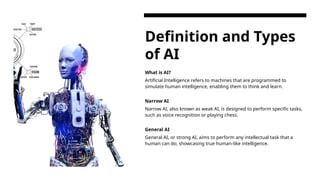
What is AI?
Artificial Intelligence refers to machines that are programmed to
simulate human intelligence, enabling them to think and learn.
Narrow AI
Narrow AI, also known as weak AI, is designed to perform specific tasks,
such as voice recognition or playing chess.
General AI
General AI, or strong AI, aims to perform any intellectual task that a
human can do, showcasing true human-like intelligence.
5.
Common
Applications
of AI in
Everyday
Life
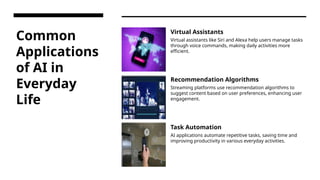
VirtualAssistants
Virtual assistants like Siri and Alexa help users manage tasks
through voice commands, making daily activities more
efficient.
Recommendation Algorithms
Streaming platforms use recommendation algorithms to
suggest content based on user preferences, enhancing user
engagement.
Task Automation
AI applications automate repetitive tasks, saving time and
improving productivity in various everyday activities.
6.
AI in Educationand
Skill Development
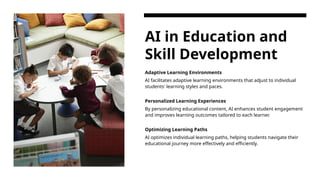
Adaptive Learning Environments
AI facilitates adaptive learning environments that adjust to individual
students' learning styles and paces.
Personalized Learning Experiences
By personalizing educational content, AI enhances student engagement
and improves learning outcomes tailored to each learner.
Optimizing Learning Paths
AI optimizes individual learning paths, helping students navigate their
educational journey more effectively and efficiently.
Online
Learning
Platforms
and AI
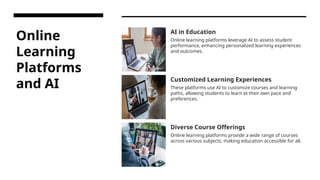
AI inEducation
Online learning platforms leverage AI to assess student
performance, enhancing personalized learning experiences
and outcomes.
Customized Learning Experiences
These platforms use AI to customize courses and learning
paths, allowing students to learn at their own pace and
preferences.
Diverse Course Offerings
Online learning platforms provide a wide range of courses
across various subjects, making education accessible for all.
9.
Personalized
Learning Experiences
AI inEducation
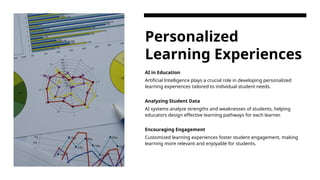
Artificial Intelligence plays a crucial role in developing personalized
learning experiences tailored to individual student needs.
Analyzing Student Data
AI systems analyze strengths and weaknesses of students, helping
educators design effective learning pathways for each learner.
Encouraging Engagement
Customized learning experiences foster student engagement, making
learning more relevant and enjoyable for students.
10.
AI-Driven Career
Guidance
Personalized CareerAnalysis
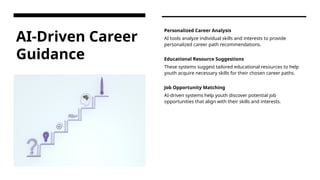
AI tools analyze individual skills and interests to provide
personalized career path recommendations.
Educational Resource Suggestions
These systems suggest tailored educational resources to help
youth acquire necessary skills for their chosen career paths.
Job Opportunity Matching
AI-driven systems help youth discover potential job
opportunities that align with their skills and interests.
Choosing
Reliable AI
Tools and
Platforms
Importanceof Reliability
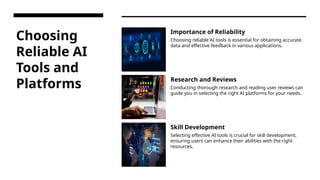
Choosing reliable AI tools is essential for obtaining accurate
data and effective feedback in various applications.
Research and Reviews
Conducting thorough research and reading user reviews can
guide you in selecting the right AI platforms for your needs.
Skill Development
Selecting effective AI tools is crucial for skill development,
ensuring users can enhance their abilities with the right
resources.
13.
Balancing AI with
TraditionalLearning
Methods
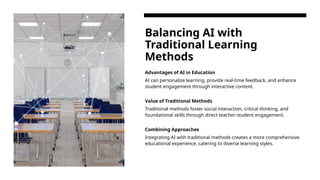
Advantages of AI in Education
AI can personalize learning, provide real-time feedback, and enhance
student engagement through interactive content.
Value of Traditional Methods
Traditional methods foster social interaction, critical thinking, and
foundational skills through direct teacher-student engagement.
Combining Approaches
Integrating AI with traditional methods creates a more comprehensive
educational experience, catering to diverse learning styles.
14.
Ensuring Ethical Use
ofAI
Data Privacy in AI
Protecting student data privacy is crucial when implementing AI in
educational settings to build trust among users.
Transparency in Algorithms
Promoting transparency in AI algorithms helps users understand how
decisions are made, fostering accountability and trust.
Responsible AI Usage
Encouraging responsible usage of AI tools among youth ensures that
they understand ethical implications and usage guidelines.
Dependency on
Technology
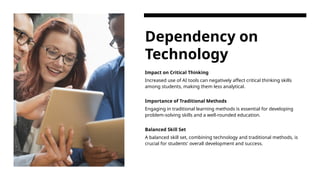
Impact onCritical Thinking
Increased use of AI tools can negatively affect critical thinking skills
among students, making them less analytical.
Importance of Traditional Methods
Engaging in traditional learning methods is essential for developing
problem-solving skills and a well-rounded education.
Balanced Skill Set
A balanced skill set, combining technology and traditional methods, is
crucial for students' overall development and success.
17.
Privacy Concerns
Data CollectionRisks
AI systems often collect large amounts of data, which can lead to
potential privacy violations if not managed properly.
Ethical Use of Data
It is essential to ensure that personal information is used ethically and
responsibly to maintain trust and safety.
Protecting Personal Information
Implementing robust privacy measures is crucial for safeguarding
personal data in AI applications and fostering a secure environment.
18.
Impact on Critical
Thinkingand Creativity
Overreliance on AI
Relying too much on AI tools can impede our ability to engage in critical
thinking and creative problem-solving.
Encouraging Independent Thinking
It is vital to encourage young people to think independently, fostering
creativity and analytical skills beyond AI assistance.
Balancing AI Convenience
Finding a balance between using AI for convenience and maintaining our
cognitive skills is crucial for future generations.
Summary of Key
Points
InnovativeLearning
AI offers personalized learning experiences that help youth
enhance their skills effectively and efficiently.
Career Guidance
AI provides valuable career guidance to youth, helping them
make informed decisions about their future paths.
Ethical Concerns
It is essential to address the ethical concerns related to AI to
ensure responsible usage and outcomes.
Potential Negative Effects
Awareness of potential negative effects of AI on youth is crucial
in developing safeguards and strategies.
21.
Future Potential ofAI
in Skill Development
Tailored Learning Experiences
AI advancements are expected to create personalized learning
experiences that cater to individual student needs and learning styles.
Skill Development Enhancement
Continuous innovation in AI will significantly enhance skill development
opportunities for youth, preparing them for future careers.
Innovative Educational Tools
Future AI tools in education will provide innovative ways to learn and
develop skills, making education more accessible and engaging.
22.
Encouraging
Responsible and
Ethical Useof AI
Promoting Ethical AI Practices
Educating youth on the importance of responsible AI usage is
crucial for minimizing potential risks and promoting ethical
behavior.
Data Privacy Awareness
Understanding data privacy is essential for young people to
navigate the digital landscape responsibly and protect their
information.
Critical Thinking Skills
Encouraging critical thinking helps youth assess information
and make informed decisions about AI technologies.
Balanced Learning Approaches
Implementing balanced learning approaches ensures that
youth can effectively leverage AI while understanding its
implications.
AI in
Healthcare
• MEDICALIMAGING
AND DIAGNOSTICS
• PREDICTIVE
ANALYTICS FOR
PATIENT CARE
• DRUG DISCOVERY
AND PERSONALIZED
MEDICINE
• VIRTUAL HEALTH
ASSISTANTS
26.
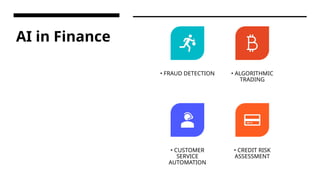
AI in Finance
•FRAUD DETECTION • ALGORITHMIC
TRADING
• CUSTOMER
SERVICE
AUTOMATION
• CREDIT RISK
ASSESSMENT
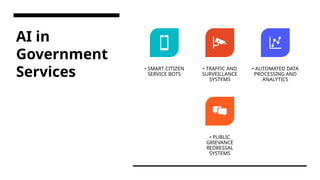
AI in
Government
Services •SMART CITIZEN
SERVICE BOTS
• TRAFFIC AND
SURVEILLANCE
SYSTEMS
• AUTOMATED DATA
PROCESSING AND
ANALYTICS
• PUBLIC
GRIEVANCE
REDRESSAL
SYSTEMS
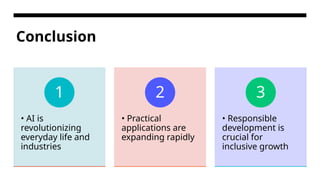
Conclusion
• AI is
revolutionizing
everydaylife and
industries
1
• Practical
applications are
expanding rapidly
2
• Responsible
development is
crucial for
inclusive growth
3
Editor's Notes
#1 AI-generated content may be incorrect.
---
Artificial Intelligence (AI) is transforming the landscape of youth education and skill development. In this presentation, we will explore AI's definitions, applications, and implications for young learners.
#2 We will start by understanding what AI is and its various applications. Then, we will discuss how youth are leveraging AI for their skill development through online platforms and personalized learning experiences. We'll also cover best practices for using AI, potential negative effects, and conclude with future directions for responsible AI use.
#3 AI encompasses a wide range of technologies and methodologies that enable machines to simulate human intelligence. This section will provide an overview of AI's definition, types, and its application in various sectors.
#4 Artificial Intelligence can be defined as the simulation of human intelligence in machines programmed to think and learn. The two main types include Narrow AI, designed for specific tasks, and General AI, which aims to perform any intellectual task that a human can do.
#5 AI is integrated into many aspects of our daily lives, from virtual assistants like Siri and Alexa to recommendation algorithms in streaming platforms. These applications enhance user experience and streamline tasks.
#6 In education, AI helps create adaptive learning environments, enabling personalized learning experiences. This can optimize individual learning paths and provide valuable resources tailored to students' needs.
#7 Young people are increasingly utilizing AI technologies for their education and skill enhancement. This section will delve into how they engage with online learning platforms and personalized applications.
#8 Many online learning platforms use AI to assess student performance and customize their learning experiences. These platforms provide courses in various subjects and allow youth to learn at their own pace.
#9 AI enables the creation of personalized learning experiences by analyzing a student's strengths, weaknesses, and learning styles. This customization promotes effective learning and encourages student engagement.
#10 AI tools can assist youth in identifying career paths by analyzing their skills and interests. These AI-driven systems can suggest educational resources and potential job opportunities tailored to individual profiles.
#11 To maximize the benefits of AI in education, it is essential to follow best practices. This section covers guidelines for selecting the right tools and integrating AI with traditional learning methods.
#12 It is crucial to choose reliable AI tools that provide accurate data and feedback. Researching credible platforms and reading user reviews can help ensure that the selected tools are effective for skill development.
#13 While AI offers numerous advantages, it is essential to balance its use with traditional learning methods. Combining both approaches can lead to a comprehensive educational experience.
#14 Ethical considerations are vital when using AI in education. Ensuring data privacy and promoting transparency in AI algorithms can foster trust and encourage responsible usage among youth.
#15 Despite its benefits, AI has potential negative effects that must be acknowledged. This section explores how dependence on technology and privacy concerns can impact youth.
#16 A growing reliance on AI tools may lead to decreased critical thinking and problem-solving skills among youth. It's important for students to engage in traditional methods to maintain a balanced skill set.
#17 The use of AI often involves data collection, raising significant privacy concerns. Ensuring that personal information is protected and used ethically is crucial for fostering a safe learning environment.
#18 Overreliance on AI can hinder creative thinking and critical analysis. Encouraging youth to think independently and creatively is essential to counterbalance the convenience offered by AI tools.
#19 As we have explored, AI plays a significant role in youth skill development, offering numerous advantages along with potential challenges. Looking ahead, we need to encourage responsible and ethical use of AI in education.
#20 In summary, AI provides innovative ways for youth to enhance their skills through personalized learning and career guidance. However, it is crucial to address the ethical concerns and potential negative effects it poses.
#21 The future of AI in education holds significant promise, with advancements expected to create even more tailored learning experiences. Continuous innovation will enhance skill development for youth.
#22 To fully harness AI's potential while minimizing risks, we must promote responsible and ethical practices among youth. This includes education on data privacy, critical thinking, and balanced learning approaches.