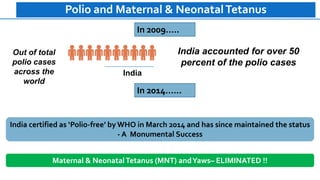
Out of total
poliocases
across the
world
India
India accounted for over 50
percent of the polio cases
In 2009…..
In 2014…...
India certified as ‘Polio-free’ by WHO in March 2014 and has since maintained the status
- A Monumental Success
Polio and Maternal & NeonatalTetanus
Maternal & NeonatalTetanus (MNT) andYaws– ELIMINATED !!
4.
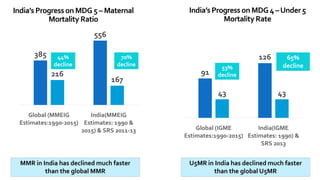
385
556
216
167
Global (MMEIG
Estimates:1990-2015)
India(MMEIG
Estimates: 1990&
2015) & SRS 2011-13
India’s Progresson MDG 5 – Maternal
Mortality Ratio
MMR in India has declined much faster
than the global MMR
91
126
43 43
Global (IGME
Estimates:1990-2015)
India(IGME
Estimates: 1990) &
SRS 2013
44%
decline
70%
decline
India’s Progresson MDG 4 –Under5
Mortality Rate
53%
decline
65%
decline
U5MR in India has declined much faster
than the global U5MR
5.
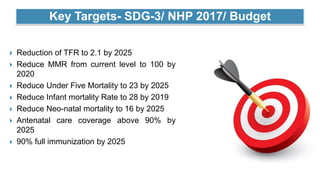
Key Targets- SDG-3/NHP 2017/ Budget
Reduction of TFR to 2.1 by 2025
Reduce MMR from current level to 100 by
2020
Reduce Under Five Mortality to 23 by 2025
Reduce Infant mortality Rate to 28 by 2019
Reduce Neo-natal mortality to 16 by 2025
Antenatal care coverage above 90% by
2025
90% full immunization by 2025
6.
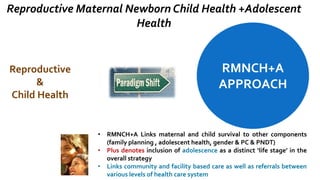
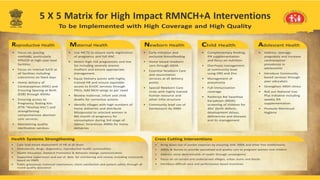
Reproductive Maternal NewbornChild Health +Adolescent
Health
Reproductive
&
Child Health
Reprod
-uctive
Mater
nal
New-
born
Child
Adoles
-cent
RMNCH+A
APPROACH
• RMNCH+A Links maternal and child survival to other components
(family planning , adolescent health, gender & PC & PNDT)
• Plus denotes inclusion of adolescence as a distinct ‘life stage’ in the
overall strategy
• Links community and facility based care as well as referrals between
various levels of health care system
7.
KeyStrategies – RMNCH+A
FamilyPlanning
• Expansion of the basket of FP Choices
• Home Delivery of Contraceptives by
ASHAs,
• Fixed Day Static Services at all facilities
• Enhanced Compensation Scheme
• National Family Planning Indemnity
Scheme,
• Emphasis on Post Partum and Post
Abortion FP services
8.
KeyStrategies – RMNCH+A
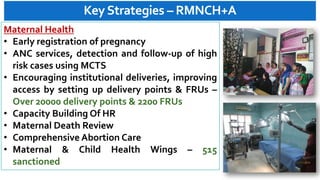
MaternalHealth
• Early registration of pregnancy
• ANC services, detection and follow-up of high
risk cases using MCTS
• Encouraging institutional deliveries, improving
access by setting up delivery points & FRUs –
Over 20000 delivery points & 2200 FRUs
• Capacity Building Of HR
• Maternal Death Review
• Comprehensive Abortion Care
• Maternal & Child Health Wings – 515
sanctioned
9.
KeyStratagies– RMNCH+A
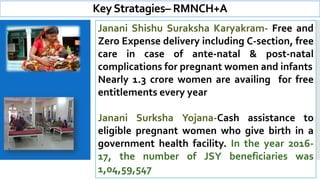
Janani ShishuSuraksha Karyakram- Free and
Zero Expense delivery including C-section, free
care in case of ante-natal & post-natal
complications for pregnant women and infants
Nearly 1.3 crore women are availing for free
entitlements every year
Janani Surksha Yojana-Cash assistance to
eligible pregnant women who give birth in a
government health facility. In the year 2016-
17, the number of JSY beneficiaries was
1,04,59,547
10.
KeyStrategies – RMNCH+A
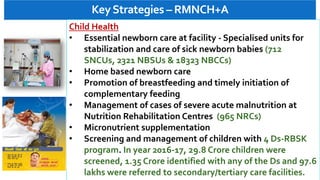
ChildHealth
• Essential newborn care at facility - Specialised units for
stabilization and care of sick newborn babies (712
SNCUs, 2321 NBSUs & 18323 NBCCs)
• Home based newborn care
• Promotion of breastfeeding and timely initiation of
complementary feeding
• Management of cases of severe acute malnutrition at
Nutrition Rehabilitation Centres (965 NRCs)
• Micronutrient supplementation
• Screening and management of children with 4 Ds-RBSK
program. In year 2016-17, 29.8 Crore children were
screened, 1.35 Crore identified with any of the Ds and 97.6
lakhs were referred to secondary/tertiary care facilities.
11.
Key Programmes –RMNCH+A
Universal Immunization Programme
• Largest immunization programme in World
• 30 million pregnant women; 26 million newborns targeted annually
• 9 million sessions held annually
• 27,000+ cold chain points
• Twelve Vaccine Preventable Diseases covered:
Tuberculosis, Diphtheria, Pertussis, Tetanus, Polio, Measles, Hepatitis
B, H. Influenzae B, Japanese Encephalitis Rotavirus diarrhoea, Rubella and
Pneumococcal pneumonia.
• India is the largest manufacturer of vaccines with a functional National
Regulatory Authority
• Full Immunisation has increased from 43.5% (2005-06) to 62% (2015-16)
12.
KeyStrategies– RMNCH+A
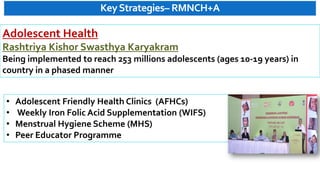
• AdolescentFriendly Health Clinics (AFHCs)
• Weekly Iron Folic Acid Supplementation (WIFS)
• Menstrual Hygiene Scheme (MHS)
• Peer Educator Programme
Adolescent Health
Rashtriya Kishor Swasthya Karyakram
Being implemented to reach 253 millions adolescents (ages 10-19 years) in
country in a phased manner
13.
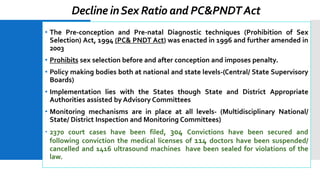
Decline inSex Ratioand PC&PNDTAct
• The Pre-conception and Pre-natal Diagnostic techniques (Prohibition of Sex
Selection) Act, 1994 (PC& PNDT Act) was enacted in 1996 and further amended in
2003
• Prohibits sex selection before and after conception and imposes penalty.
• Policy making bodies both at national and state levels-(Central/ State Supervisory
Boards)
• Implementation lies with the States though State and District Appropriate
Authorities assisted by Advisory Committees
• Monitoring mechanisms are in place at all levels- (Multidisciplinary National/
State/ District Inspection and Monitoring Committees)
2370 court cases have been filed, 304 Convictions have been secured and
following conviction the medical licenses of 114 doctors have been suspended/
cancelled and 1416 ultrasound machines have been sealed for violations of the
law.
14.
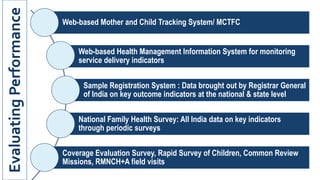
Web-based Mother andChild Tracking System/ MCTFC
Web-based Health Management Information System for monitoring
service delivery indicators
Sample Registration System : Data brought out by Registrar General
of India on key outcome indicators at the national & state level
National Family Health Survey: All India data on key indicators
through periodic surveys
Coverage Evaluation Survey, Rapid Survey of Children, Common Review
Missions, RMNCH+A field visits
Evaluating
Performance
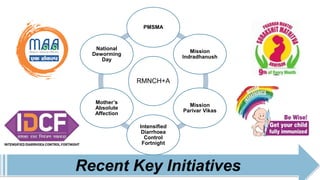
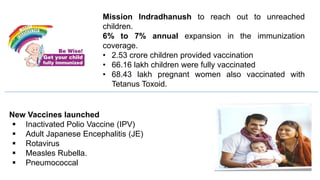
Mission Indradhanush toreach out to unreached
children.
6% to 7% annual expansion in the immunization
coverage.
• 2.53 crore children provided vaccination
• 66.16 lakh children were fully vaccinated
• 68.43 lakh pregnant women also vaccinated with
Tetanus Toxoid.
New Vaccines launched
Inactivated Polio Vaccine (IPV)
Adult Japanese Encephalitis (JE)
Rotavirus
Measles Rubella.
Pneumococcal
17.
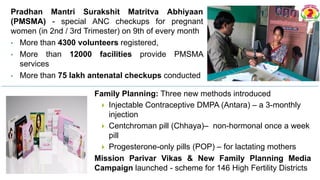
Pradhan Mantri SurakshitMatritva Abhiyaan
(PMSMA) - special ANC checkups for pregnant
women (in 2nd / 3rd Trimester) on 9th of every month
• More than 4300 volunteers registered,
• More than 12000 facilities provide PMSMA
services
• More than 75 lakh antenatal checkups conducted
Family Planning: Three new methods introduced
Injectable Contraceptive DMPA (Antara) – a 3-monthly
injection
Centchroman pill (Chhaya)– non-hormonal once a week
pill
Progesterone-only pills (POP) – for lactating mothers
Mission Parivar Vikas & New Family Planning Media
Campaign launched - scheme for 146 High Fertility Districts
18.
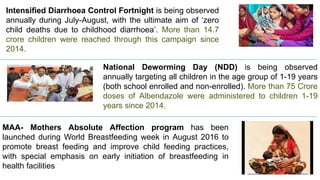
Intensified Diarrhoea ControlFortnight is being observed
annually during July-August, with the ultimate aim of ‘zero
child deaths due to childhood diarrhoea’. More than 14.7
crore children were reached through this campaign since
2014.
National Deworming Day (NDD) is being observed
annually targeting all children in the age group of 1-19 years
(both school enrolled and non-enrolled). More than 75 Crore
doses of Albendazole were administered to children 1-19
years since 2014.
MAA- Mothers Absolute Affection program has been
launched during World Breastfeeding week in August 2016 to
promote breast feeding and improve child feeding practices,
with special emphasis on early initiation of breastfeeding in
health facilities
20.
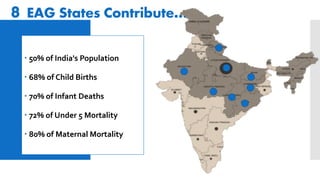
8 EAG StatesContribute…
50% of India's Population
68% of Child Births
70% of Infant Deaths
72% of Under 5 Mortality
80% of Maternal Mortality
21.
Challenges
Intra –State and intra district disparities- lack of
focus on HPDs
Poor tracking of high risk pregnancies
Paucity of Human Resources for
Health, irrational postings
Irregular availability of essential drugs and
diagnostics e.g. availability of IFA
Weak focus on quality of care
Poor infection prevention and control practices
Lack of grievance redressal forums for JSSK/ JSY
etc
Overall lack of focus on adolescent health
Lack of adequate focus on Supportive
Supervision
23.
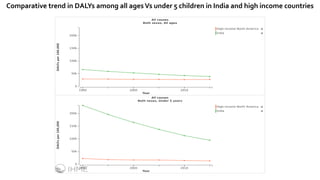
Comparative trend inDALYs among all ages Vs under 5 children in India and high income countries
28
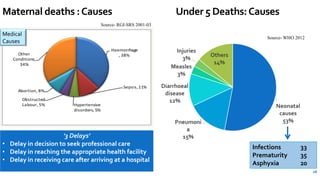
Under 5 Deaths:Causes
Haemorrhage
,38%
Sepsis,11%
Hypertensive
disorders, 5%
Obstructed
Labour, 5%
Abortion, 8%
Other
Conditions,
34%
Source- RGI-SRS 2001-03
‘3 Delays’
• Delay in decision to seek professional care
• Delay in reaching the appropriate health facility
• Delay in receiving care after arriving at a hospital
Medical
Causes
Neonatal
causes
53%
Pneumoni
a
15%
Diarrhoeal
disease
12%
Measles
3%
Injuries
3%
Others
14%
Maternal deaths :Causes
Source- WHO 2012
Infections 33
Prematurity 35
Asphyxia 20