PARIS to BERLIN
(1885 -1887)
Chapter 7
Prepared by Gil Nino Agnabo
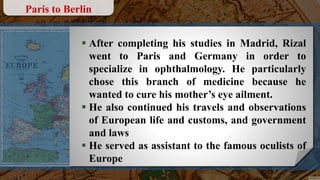
 After completing his studies in Madrid, Rizal
went to Paris and Germany in order to
specialize in ophthalmology. He particularly
chose this branch of medicine because he
wanted to cure his mother’s eye ailment.
 He also continued his travels and observations
of European life and customs, and government
and laws
 He served as assistant to the famous oculists of
Europe
Paris to Berlin
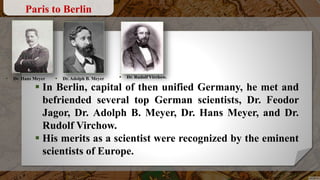
 In Berlin, capital of then unified Germany, he met and
befriended several top German scientists, Dr. Feodor
Jagor, Dr. Adolph B. Meyer, Dr. Hans Meyer, and Dr.
Rudolf Virchow.
 His merits as a scientist were recognized by the eminent
scientists of Europe.
Paris to Berlin
 Dr. Rudolf Virchow. Dr. Adolph B. Meyer Dr. Hans Meyer
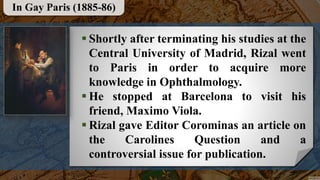
 Shortly after terminating his studies at the
Central University of Madrid, Rizal went
to Paris in order to acquire more
knowledge in Ophthalmology.
 He stopped at Barcelona to visit his
friend, Maximo Viola.
 Rizal gave Editor Corominas an article on
the Carolines Question and a
controversial issue for publication.
In Gay Paris (1885-86)
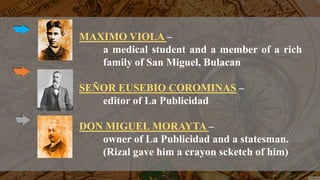
MAXIMO VIOLA –
a medical student and a member of a rich
family of San Miguel, Bulacan
SEÑOR EUSEBIO COROMINAS –
editor of La Publicidad
DON MIGUEL MORAYTA –
owner of La Publicidad and a statesman.
(Rizal gave him a crayon scketch of him)
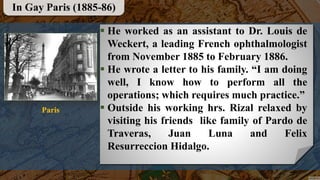
 He worked as an assistant to Dr. Louis de
Weckert, a leading French ophthalmologist
from November 1885 to February 1886.
 He wrote a letter to his family. “I am doing
well, I know how to perform all the
operations; which requires much practice.”
 Outside his working hrs. Rizal relaxed by
visiting his friends like family of Pardo de
Traveras, Juan Luna and Felix
Resurreccion Hidalgo.
In Gay Paris (1885-86)
Paris
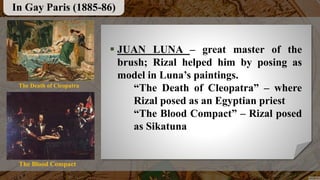
 JUAN LUNA – great master of the
brush; Rizal helped him by posing as
model in Luna’s paintings.
“The Death of Cleopatra” – where
Rizal posed as an Egyptian priest
“The Blood Compact” – Rizal posed
as Sikatuna
In Gay Paris (1885-86)
The Death of Cleopatra
The Blood Compact
 Music played an important part in all Filipino
Reunions in many places in Europe.
 Rizal had no natural aptitude for music, and this
he admitted. He studied music only because many
of his schoolmates at Ateneo were taking music
lessons.
 He told Enrique Lete that he “learned the
solfeggio, piano, and voice culture in one month
and a half”. And described his voice as “braying
of the asses.”
Rizal as Musician
 He is also a flutist in various Filipino reunion in
Paris.
 Some of his compositions are:
Alin Mang Lahi (Any Race) – a pariotic song
which asserts that any race aspires for
freedom
La Deportacion (Deportation) – a sad danza,
composed by José Rizal, July 1892 in Dapitan
during hi s exile.
Rizal as Musician
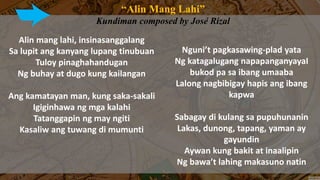
“Alin Mang Lahi”
Kundiman composed by José Rizal
Alin mang lahi, insinasanggalang
Sa lupit ang kanyang lupang tinubuan
Tuloy pinaghahandugan
Ng buhay at dugo kung kailangan
Ang kamatayan man, kung saka-sakali
Igiginhawa ng mga kalahi
Tatanggapin ng may ngiti
Kasaliw ang tuwang di mumunti
Nguni’t pagkasawing-plad yata
Ng katagalugang napapanganyayaI
bukod pa sa ibang umaaba
Lalong nagbibigay hapis ang ibang
kapwa
Sabagay di kulang sa pupuhunanin
Lakas, dunong, tapang, yaman ay
gayundin
Aywan kung bakit at inaalipin
Ng bawa’t lahing makasuno natin
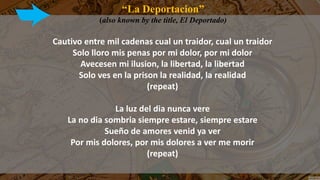
“La Deportacion”
(also known by the title, El Deportado)
Cautivo entre mil cadenas cual un traidor, cual un traidor
Solo lloro mis penas por mi dolor, por mi dolor
Avecesen mi ilusion, la libertad, la libertad
Solo ves en la prison la realidad, la realidad
(repeat)
La luz del dia nunca vere
La no dia sombria siempre estare, siempre estare
Sueño de amores venid ya ver
Por mis dolores, por mis dolores a ver me morir
(repeat)
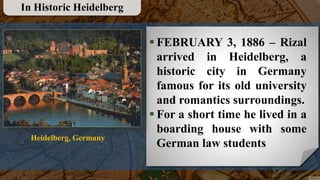
 FEBRUARY 3, 1886 – Rizal
arrived in Heidelberg, a
historic city in Germany
famous for its old university
and romantics surroundings.
 For a short time he lived in a
boarding house with some
German law students
In Historic Heidelberg
Heidelberg, Germany
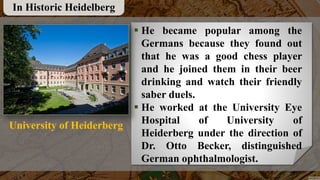
 He became popular among the
Germans because they found out
that he was a good chess player
and he joined them in their beer
drinking and watch their friendly
saber duels.
 He worked at the University Eye
Hospital of University of
Heiderberg under the direction of
Dr. Otto Becker, distinguished
German ophthalmologist.
In Historic Heidelberg
University of Heiderberg
 He attended the lectures of Doctor Becker and Prof.
Wilhelm Kuehne at the university.
 During his weekends he visited some scenic
spot.(Heidelberg Castle, Churches etc.)
 He noticed that German Catholics and Protestants
practiced ecumenism.
 One of the town churches was used “ one-half ny the
Catholics and the other half by the Protestants”
In Historic Heidelberg
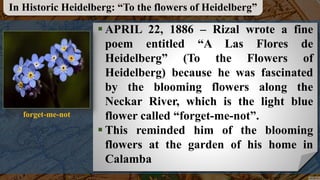
 APRIL 22, 1886 – Rizal wrote a fine
poem entitled “A Las Flores de
Heidelberg” (To the Flowers of
Heidelberg) because he was fascinated
by the blooming flowers along the
Neckar River, which is the light blue
flower called “forget-me-not”.
 This reminded him of the blooming
flowers at the garden of his home in
Calamba
In Historic Heidelberg: “To the flowers of Heidelberg”
forget-me-not
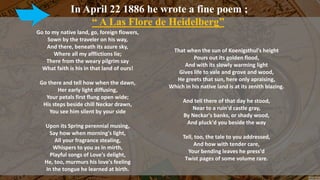
In April 22 1886 he wrote a fine poem ;
“ A Las Flore de Heidelberg”
Go to my native land, go, foreign flowers,
Sown by the traveler on his way,
And there, beneath its azure sky,
Where all my afflictions lie;
There from the weary pilgrim say
What faith is his in that land of ours!
Go there and tell how when the dawn,
Her early light diffusing,
Your petals first flung open wide;
His steps beside chill Neckar drawn,
You see him silent by your side
Upon its Spring perennial musing,
Say how when morning's light,
All your fragrance stealing,
Whispers to you as in mirth,
Playful songs of Love's delight,
He, too, murmurs his love's feeling
In the tongue he learned at birth.
That when the sun of Koenigsthul's height
Pours out its golden flood,
And with its slowly warming light
Gives life to vale and grove and wood,
He greets that sun, here only apraising,
Which in his native land is at its zenith blazing.
And tell there of that day he stood,
Near to a ruin'd castle gray,
By Neckar's banks, or shady wood,
And pluck'd you beside the way
Tell, too, the tale to you addressed,
And how with tender care,
Your bending leaves he press'd
Twist pages of some volume rare.
 Rizal spent a three-month summer vacation at
Wilhelmsfeld where he stayed at the place of a
Protestant pastor, Dr. Karl Ullmer. Who became his
good friend and admirer because of his pleasant
personality and talent in languages. The pastor has
a wife and two children named Etta and Fritz.
 On June 25 1886 he returned to Heidelberg
carrying with him beautiful memories of the Ulmers
friendship and hospitality.
With Pastor Ullmer at Wilhelmsfeld
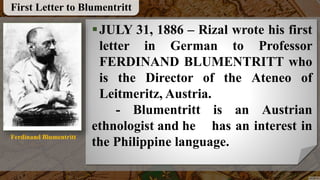
JULY 31, 1886 – Rizal wrote his first
letter in German to Professor
FERDINAND BLUMENTRITT who
is the Director of the Ateneo of
Leitmeritz, Austria.
- Blumentritt is an Austrian
ethnologist and he has an interest in
the Philippine language.
First Letter to Blumentritt
Ferdinand Blumentritt
- along with his letter he gave him Aritmetica
(Arithmetic) book published in two different
languages -Spanish and Tagalog by Rufino
Baltazar Hernandez.
 Rizal’s letter impressed Blumentitt, who
reciprocated by sending Rizal’s a gift of two books.
 This become the start of their friendship that lasted
all their lives
First Letter to Blumentritt
I have heard that you are studying our
language and that you already published some
works about it; permit me to you a book written by
my country men in our language. The Spanish
version is mediocre because the author is only the
modest writer but the Tagalog part is good, and it
is precisely the language spoken in our province.
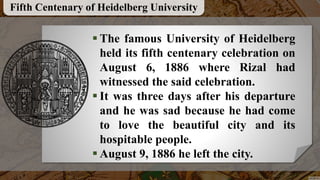
 The famous University of Heidelberg
held its fifth centenary celebration on
August 6, 1886 where Rizal had
witnessed the said celebration.
 It was three days after his departure
and he was sad because he had come
to love the beautiful city and its
hospitable people.
 August 9, 1886 he left the city.
Fifth Centenary of Heidelberg University
In Leipzig and Dresden
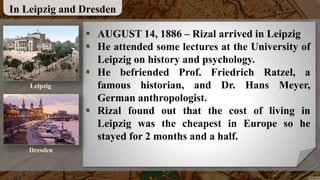
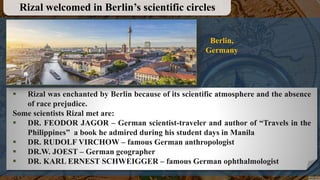
 AUGUST 14, 1886 – Rizal arrived in Leipzig
 He attended some lectures at the University of
Leipzig on history and psychology.
 He befriended Prof. Friedrich Ratzel, a
famous historian, and Dr. Hans Meyer,
German anthropologist.
 Rizal found out that the cost of living in
Leipzig was the cheapest in Europe so he
stayed for 2 months and a half.
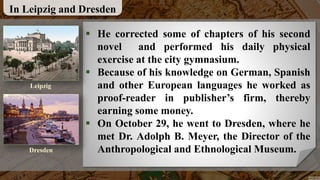
Leipzig
Dresden
In Leipzig and Dresden
 He corrected some of chapters of his second
novel and performed his daily physical
exercise at the city gymnasium.
 Because of his knowledge on German, Spanish
and other European languages he worked as
proof-reader in publisher’s firm, thereby
earning some money.
 On October 29, he went to Dresden, where he
met Dr. Adolph B. Meyer, the Director of the
Anthropological and Ethnological Museum.
Leipzig
Dresden
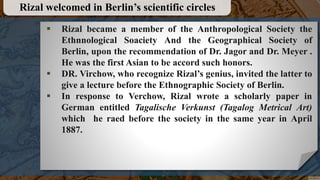
 Rizal was enchanted by Berlin because of its scientific atmosphere and the absence
of race prejudice.
Some scientists Rizal met are:
 DR. FEODOR JAGOR – German scientist-traveler and author of “Travels in the
Philippines” a book he admired during his student days in Manila
 DR. RUDOLF VIRCHOW – famous German anthropologist
 DR.W. JOEST – German geographer
 DR. KARL ERNEST SCHWEIGGER – famous German ophthalmologist
Rizal welcomed in Berlin’s scientific circles
Berlin,
Germany
 Rizal became a member of the Anthropological Society the
Ethnnological Soaciety And the Geographical Society of
Berlin, upon the recommendation of Dr. Jagor and Dr. Meyer .
He was the first Asian to be accord such honors.
 DR. Virchow, who recognize Rizal’s genius, invited the latter to
give a lecture before the Ethnographic Society of Berlin.
 In response to Verchow, Rizal wrote a scholarly paper in
German entitled Tagalische Verkunst (Tagalog Metrical Art)
which he raed before the society in the same year in April
1887.
Rizal welcomed in Berlin’s scientific circles
Five reasons why Rizal stayed in Berlin:
To gain further knowledge of ophthalmology
To further his studies of science and languages
To observe the economic and political conditions of the
German nation
To associate with famous German scientists and scholars
To publish his novel, Noli Me Tangere
 Rizal worked as an assistant in the clinic of Dr. Scweigger, and
at night, he attended lectures in the University of Berlin.
 He also took private lessons in French under Madame Lucie
Cerdole.
Rizal’s Life in Berlin
Rizal on German Women
 Rizal sent a letter to his sister, Trinidad, dated on March 11, 1886. In
his letter, Rizal expressed his high regard and admiration for German
womanhood. Rizal said that German woman is serious, diligent,
educated and friendly.
German Customs
Some of the German customs Rizal admired:
 On Yuletide season, people will select a pine tree from the bushes and
adorned it with lanterns, papers, lights, dolls, candies, fruits, etc.
 Self-introduction to strangers in a social gathering.
 The winter of 1886 in Berlin was his darkest winter.
 He lived in poverty because no money arrived from Calamba
and he was flat broke.
 He could not pay his landlord and he was eating only one meal
a day.
 His clothes were old and threadbare.
 His health broke down due to lack of proper nourishment.
 Out in far away Calamba, Paciano tried desperately to raise
money. But the corps had failed due to the raveges of the
locusts. Poosr Paciano was delayed in raisng the necessary
funds.
Rizal’s Darkest Winter

Rizal Chapter 7.0

  • 2.
    PARIS to BERLIN (1885-1887) Chapter 7 Prepared by Gil Nino Agnabo
  • 3.
     After completinghis studies in Madrid, Rizal went to Paris and Germany in order to specialize in ophthalmology. He particularly chose this branch of medicine because he wanted to cure his mother’s eye ailment.  He also continued his travels and observations of European life and customs, and government and laws  He served as assistant to the famous oculists of Europe Paris to Berlin
  • 4.
     In Berlin,capital of then unified Germany, he met and befriended several top German scientists, Dr. Feodor Jagor, Dr. Adolph B. Meyer, Dr. Hans Meyer, and Dr. Rudolf Virchow.  His merits as a scientist were recognized by the eminent scientists of Europe. Paris to Berlin  Dr. Rudolf Virchow. Dr. Adolph B. Meyer Dr. Hans Meyer
  • 5.
     Shortly afterterminating his studies at the Central University of Madrid, Rizal went to Paris in order to acquire more knowledge in Ophthalmology.  He stopped at Barcelona to visit his friend, Maximo Viola.  Rizal gave Editor Corominas an article on the Carolines Question and a controversial issue for publication. In Gay Paris (1885-86)
  • 6.
    MAXIMO VIOLA – amedical student and a member of a rich family of San Miguel, Bulacan SEÑOR EUSEBIO COROMINAS – editor of La Publicidad DON MIGUEL MORAYTA – owner of La Publicidad and a statesman. (Rizal gave him a crayon scketch of him)
  • 7.
     He workedas an assistant to Dr. Louis de Weckert, a leading French ophthalmologist from November 1885 to February 1886.  He wrote a letter to his family. “I am doing well, I know how to perform all the operations; which requires much practice.”  Outside his working hrs. Rizal relaxed by visiting his friends like family of Pardo de Traveras, Juan Luna and Felix Resurreccion Hidalgo. In Gay Paris (1885-86) Paris
  • 8.
     JUAN LUNA– great master of the brush; Rizal helped him by posing as model in Luna’s paintings. “The Death of Cleopatra” – where Rizal posed as an Egyptian priest “The Blood Compact” – Rizal posed as Sikatuna In Gay Paris (1885-86) The Death of Cleopatra The Blood Compact
  • 9.
     Music playedan important part in all Filipino Reunions in many places in Europe.  Rizal had no natural aptitude for music, and this he admitted. He studied music only because many of his schoolmates at Ateneo were taking music lessons.  He told Enrique Lete that he “learned the solfeggio, piano, and voice culture in one month and a half”. And described his voice as “braying of the asses.” Rizal as Musician
  • 10.
     He isalso a flutist in various Filipino reunion in Paris.  Some of his compositions are: Alin Mang Lahi (Any Race) – a pariotic song which asserts that any race aspires for freedom La Deportacion (Deportation) – a sad danza, composed by José Rizal, July 1892 in Dapitan during hi s exile. Rizal as Musician
  • 11.
    “Alin Mang Lahi” Kundimancomposed by José Rizal Alin mang lahi, insinasanggalang Sa lupit ang kanyang lupang tinubuan Tuloy pinaghahandugan Ng buhay at dugo kung kailangan Ang kamatayan man, kung saka-sakali Igiginhawa ng mga kalahi Tatanggapin ng may ngiti Kasaliw ang tuwang di mumunti Nguni’t pagkasawing-plad yata Ng katagalugang napapanganyayaI bukod pa sa ibang umaaba Lalong nagbibigay hapis ang ibang kapwa Sabagay di kulang sa pupuhunanin Lakas, dunong, tapang, yaman ay gayundin Aywan kung bakit at inaalipin Ng bawa’t lahing makasuno natin
  • 12.
    “La Deportacion” (also knownby the title, El Deportado) Cautivo entre mil cadenas cual un traidor, cual un traidor Solo lloro mis penas por mi dolor, por mi dolor Avecesen mi ilusion, la libertad, la libertad Solo ves en la prison la realidad, la realidad (repeat) La luz del dia nunca vere La no dia sombria siempre estare, siempre estare Sueño de amores venid ya ver Por mis dolores, por mis dolores a ver me morir (repeat)
  • 13.
     FEBRUARY 3,1886 – Rizal arrived in Heidelberg, a historic city in Germany famous for its old university and romantics surroundings.  For a short time he lived in a boarding house with some German law students In Historic Heidelberg Heidelberg, Germany
  • 14.
     He becamepopular among the Germans because they found out that he was a good chess player and he joined them in their beer drinking and watch their friendly saber duels.  He worked at the University Eye Hospital of University of Heiderberg under the direction of Dr. Otto Becker, distinguished German ophthalmologist. In Historic Heidelberg University of Heiderberg
  • 15.
     He attendedthe lectures of Doctor Becker and Prof. Wilhelm Kuehne at the university.  During his weekends he visited some scenic spot.(Heidelberg Castle, Churches etc.)  He noticed that German Catholics and Protestants practiced ecumenism.  One of the town churches was used “ one-half ny the Catholics and the other half by the Protestants” In Historic Heidelberg
  • 16.
     APRIL 22,1886 – Rizal wrote a fine poem entitled “A Las Flores de Heidelberg” (To the Flowers of Heidelberg) because he was fascinated by the blooming flowers along the Neckar River, which is the light blue flower called “forget-me-not”.  This reminded him of the blooming flowers at the garden of his home in Calamba In Historic Heidelberg: “To the flowers of Heidelberg” forget-me-not
  • 17.
    In April 221886 he wrote a fine poem ; “ A Las Flore de Heidelberg” Go to my native land, go, foreign flowers, Sown by the traveler on his way, And there, beneath its azure sky, Where all my afflictions lie; There from the weary pilgrim say What faith is his in that land of ours! Go there and tell how when the dawn, Her early light diffusing, Your petals first flung open wide; His steps beside chill Neckar drawn, You see him silent by your side Upon its Spring perennial musing, Say how when morning's light, All your fragrance stealing, Whispers to you as in mirth, Playful songs of Love's delight, He, too, murmurs his love's feeling In the tongue he learned at birth. That when the sun of Koenigsthul's height Pours out its golden flood, And with its slowly warming light Gives life to vale and grove and wood, He greets that sun, here only apraising, Which in his native land is at its zenith blazing. And tell there of that day he stood, Near to a ruin'd castle gray, By Neckar's banks, or shady wood, And pluck'd you beside the way Tell, too, the tale to you addressed, And how with tender care, Your bending leaves he press'd Twist pages of some volume rare.
  • 18.
     Rizal spenta three-month summer vacation at Wilhelmsfeld where he stayed at the place of a Protestant pastor, Dr. Karl Ullmer. Who became his good friend and admirer because of his pleasant personality and talent in languages. The pastor has a wife and two children named Etta and Fritz.  On June 25 1886 he returned to Heidelberg carrying with him beautiful memories of the Ulmers friendship and hospitality. With Pastor Ullmer at Wilhelmsfeld
  • 19.
    JULY 31, 1886– Rizal wrote his first letter in German to Professor FERDINAND BLUMENTRITT who is the Director of the Ateneo of Leitmeritz, Austria. - Blumentritt is an Austrian ethnologist and he has an interest in the Philippine language. First Letter to Blumentritt Ferdinand Blumentritt
  • 20.
    - along withhis letter he gave him Aritmetica (Arithmetic) book published in two different languages -Spanish and Tagalog by Rufino Baltazar Hernandez.  Rizal’s letter impressed Blumentitt, who reciprocated by sending Rizal’s a gift of two books.  This become the start of their friendship that lasted all their lives First Letter to Blumentritt
  • 21.
    First Letter toBlumentritt I have heard that you are studying our language and that you already published some works about it; permit me to you a book written by my country men in our language. The Spanish version is mediocre because the author is only the modest writer but the Tagalog part is good, and it is precisely the language spoken in our province.
  • 22.
     The famousUniversity of Heidelberg held its fifth centenary celebration on August 6, 1886 where Rizal had witnessed the said celebration.  It was three days after his departure and he was sad because he had come to love the beautiful city and its hospitable people.  August 9, 1886 he left the city. Fifth Centenary of Heidelberg University
  • 23.
    In Leipzig andDresden  AUGUST 14, 1886 – Rizal arrived in Leipzig  He attended some lectures at the University of Leipzig on history and psychology.  He befriended Prof. Friedrich Ratzel, a famous historian, and Dr. Hans Meyer, German anthropologist.  Rizal found out that the cost of living in Leipzig was the cheapest in Europe so he stayed for 2 months and a half. Leipzig Dresden
  • 24.
    In Leipzig andDresden  He corrected some of chapters of his second novel and performed his daily physical exercise at the city gymnasium.  Because of his knowledge on German, Spanish and other European languages he worked as proof-reader in publisher’s firm, thereby earning some money.  On October 29, he went to Dresden, where he met Dr. Adolph B. Meyer, the Director of the Anthropological and Ethnological Museum. Leipzig Dresden
  • 25.
     Rizal wasenchanted by Berlin because of its scientific atmosphere and the absence of race prejudice. Some scientists Rizal met are:  DR. FEODOR JAGOR – German scientist-traveler and author of “Travels in the Philippines” a book he admired during his student days in Manila  DR. RUDOLF VIRCHOW – famous German anthropologist  DR.W. JOEST – German geographer  DR. KARL ERNEST SCHWEIGGER – famous German ophthalmologist Rizal welcomed in Berlin’s scientific circles Berlin, Germany
  • 26.
     Rizal becamea member of the Anthropological Society the Ethnnological Soaciety And the Geographical Society of Berlin, upon the recommendation of Dr. Jagor and Dr. Meyer . He was the first Asian to be accord such honors.  DR. Virchow, who recognize Rizal’s genius, invited the latter to give a lecture before the Ethnographic Society of Berlin.  In response to Verchow, Rizal wrote a scholarly paper in German entitled Tagalische Verkunst (Tagalog Metrical Art) which he raed before the society in the same year in April 1887. Rizal welcomed in Berlin’s scientific circles
  • 27.
    Five reasons whyRizal stayed in Berlin: To gain further knowledge of ophthalmology To further his studies of science and languages To observe the economic and political conditions of the German nation To associate with famous German scientists and scholars To publish his novel, Noli Me Tangere  Rizal worked as an assistant in the clinic of Dr. Scweigger, and at night, he attended lectures in the University of Berlin.  He also took private lessons in French under Madame Lucie Cerdole. Rizal’s Life in Berlin
  • 28.
    Rizal on GermanWomen  Rizal sent a letter to his sister, Trinidad, dated on March 11, 1886. In his letter, Rizal expressed his high regard and admiration for German womanhood. Rizal said that German woman is serious, diligent, educated and friendly. German Customs Some of the German customs Rizal admired:  On Yuletide season, people will select a pine tree from the bushes and adorned it with lanterns, papers, lights, dolls, candies, fruits, etc.  Self-introduction to strangers in a social gathering.
  • 29.
     The winterof 1886 in Berlin was his darkest winter.  He lived in poverty because no money arrived from Calamba and he was flat broke.  He could not pay his landlord and he was eating only one meal a day.  His clothes were old and threadbare.  His health broke down due to lack of proper nourishment.  Out in far away Calamba, Paciano tried desperately to raise money. But the corps had failed due to the raveges of the locusts. Poosr Paciano was delayed in raisng the necessary funds. Rizal’s Darkest Winter