Rita Levi MontalciniBy: Loa Gordon
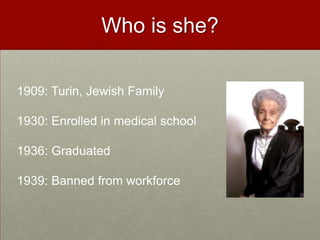
Who is she?1909: Turin, Jewish Family1930: Enrolled in medical school1936: Graduated1939: Banned from workforce
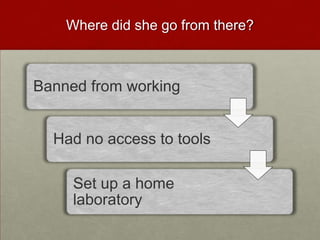
Where did she go from there?
1946: Invited to Washington University by biochemist Viktor Hamburger for a semester, ended up staying 30 yearsWith professor Hamburger and Stanley Cohen, discovered the nerve growth factor
Scientific MethodObservation: Tumor & nerve connectionsQuestion: What promotes the cells connections?Hypothesis: Factor extends dendrites, causes pathwaysExperiment: Snake poison & male mouse salivaConclusion: Links (ex: brain/spinal) create due to NGFConfirmation of hypothesis
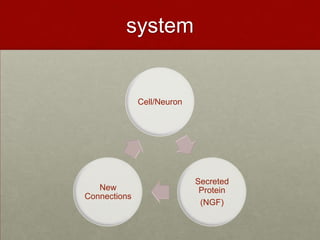
system
importance- Progress of treatment of nervous system diseases- Accelerate wound healing through stimulation- Understanding of psychiatric disorders (ex: depression, schizophrenia)- Understanding the phenomenon of loveHuman body = Network
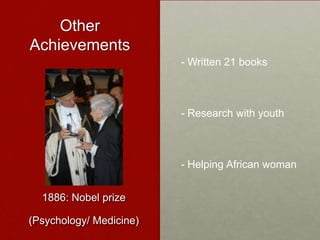
Other Achievements- Written 21 books Research with youth
 Helping African woman1886: Nobel prize (Psychology/ Medicine)

Rita Levi-Montalcini

  • 1.
  • 2.
    Who is she?1909:Turin, Jewish Family1930: Enrolled in medical school1936: Graduated1939: Banned from workforce
  • 3.
    Where did shego from there?
  • 4.
    1946: Invited toWashington University by biochemist Viktor Hamburger for a semester, ended up staying 30 yearsWith professor Hamburger and Stanley Cohen, discovered the nerve growth factor
  • 5.
    Scientific MethodObservation: Tumor& nerve connectionsQuestion: What promotes the cells connections?Hypothesis: Factor extends dendrites, causes pathwaysExperiment: Snake poison & male mouse salivaConclusion: Links (ex: brain/spinal) create due to NGFConfirmation of hypothesis
  • 6.
  • 7.
    importance- Progress oftreatment of nervous system diseases- Accelerate wound healing through stimulation- Understanding of psychiatric disorders (ex: depression, schizophrenia)- Understanding the phenomenon of loveHuman body = Network
  • 8.
    Other Achievements- Written21 books Research with youth
  • 9.
    Helping Africanwoman1886: Nobel prize (Psychology/ Medicine)