Making the case for risk management and business continuity
planning
Outline
Introduction
What is the importance of risk management
The need for BCP/DRP in any environment
List business considerations and drivers for risk
management and business continuity planning
Determine which drivers apply to your environment
Introduction
Introduction
Making the case for risk management and business continuity
planning
Means create evidence to show the importance and value of having a
structured planning to managing risks
 and ensuring a business can continue operating before, during and
after risk.
What is the importance of risk management
Risk management is essential for any organization
Means we need risk management
to identify, asses and reduce the risks that could affect the
business negatively.
Risk management helps organizations identify potential
risks, assess their impact,
 and implement strategies to mitigate or avoid those risks.
Cont….
Ensures Operational Resilience:
BCP involves creating strategies to ensure that critical business
operations can continue during and after a disruption,
Such as natural disasters, cyberattacks, or other emergencies.
Risks could be financial, operational, strategic, or related to
cybersecurity, compliance, and reputation.
The need for BCP/DRP in any environment
Disaster recovery is the process involved in restoring a business in
normal operation
 after its operation have been partially or completely interrupted by
some event
Business continuity planning is planning to keep your business
operating through an un expected event
Business continuity the process of developing advance arrangement
of that enable an organization to respond to an event
Cont….
BCP is a document stating who and what are required
When they are required
Where to operate your business for an indefinite period
It is a standard format for a procedures should be used for
consistency and maintenance
Risk management, Business Continuity Planning (BCP),
and Disaster Recovery Planning (DRP) are all crucial
components for ensuring the resilience and stability of any
organization
Cont….
Business continuity management (BCM) is a process that applies to
any business
 That helps to manage the risks that threaten its survival
The objective of BCM is to identify hazards that may affect
critical functions or activities to ensure these can be reduced to in an
effective way.
Cont….
Why we need BCP
Loss or injury
Compliance
Loss of revenue
Damage to critical resources
Loss of customers
Reputation damage
Civil and criminal liabilities
Cont….
With in BCP, you have some key components
Assessment : a way to identify threats
Evaluation: the likelihood and impact of each threat
Preparation: some contingent operations
Mitigation: the reduction or elimination of risks
Response : the response to minimize the impact of an emergency the
return to normal form
Cont….
Minimizes Data Loss: DRP is particularly important in the context
of IT infrastructure.
It involves strategies to recover lost data, systems, or applications in
the event of a disaster
BCP requires to ensure the continuation of critical business process
in an organization.
Often includes non IT aspects of business
Cont….
DRP assessment, repair and eventual restoration of damaged facilities
and systems
Often focuses on IT systems
Benefits of BCP and DRP
Reduced risk
Process improvements
Improve organizational maturity
Improved availability and reliability
Marketplace advantage
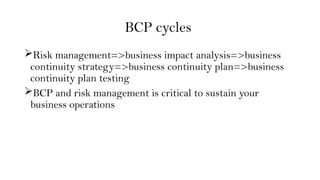
BCP cycles
Risk management=>business impact analysis=>business
continuity strategy=>business continuity plan=>business
continuity plan testing
BCP and risk management is critical to sustain your
business operations
List business considerations and drivers for risk
management and business continuity planning
Business considerations is the operational factors that organizations
need to address when developing risk management and business
continuity plans.
Drivers: are forces that influence these considerations and guide
decision-making.
List of business consideration and drivers for risk management and
business continuity
Cont….
Technology and Cybersecurity
Consideration: As businesses become increasingly dependent on
technology, protecting digital infrastructure and sensitive data from
cyber threats is critical.
Driver Increasing cyber threats, data breaches, new technologies, and
changing security regulations.
Financial impact
Consideration: The financial consequences of risks (e.g., revenue loss,
increased operational costs, penalties) need to be carefully evaluated
and managed.
Cont….
Driver Economic downturns, unforeseen events (e.g., natural disasters, market crashes),
and operational inefficiencies.
Operational Continuity
 Consideration Businesses must plan for how to continue core operations during or after
a disruption (e.g., supply chain breakdown, employee absence, technology failures).
Driver Vulnerabilities in operations, supply chain risks, or employee availability.
Regulatory and Legal Compliance
Consideration: Businesses must comply with industry regulations and legal
requirements
Non-compliance can lead to penalties or legal consequences.
Driver : Regulatory changes, legal frameworks, and compliance audits.
Cont….
Human Resources
Consideration The availability of skilled workers and their ability to
perform essential functions is crucial, especially in times of crisis.
Driver Employee health, remote work trends, and training programs.
Strategic Planning
Consideration Changes in strategy, leadership, or business structure
may introduce new risks that need to be addressed.
Driver Mergers and acquisitions, organizational restructuring, new
business ventures
Cont….
Natural Disasters
 Consideration Businesses must plan for risks posed by natural
events, such as floods, earthquakes, which can disrupt operations.
Driver Geographic location, climate change, and the frequency of
natural disasters.
Determine which drivers apply to your
environment
Identify Industry-Specific Risks:
Every industry faces unique risks.
For instance, the healthcare sector has strict regulatory requirements and
cybersecurity concerns,
 while the retail industry may face risks related to supply chain
management and customer loyalty.
Assess Organizational Size
Large organizations may need to focus more on global supply chain risks,
cybersecurity, and regulatory compliance, while smaller businesses may be
more concerned with operational continuity and financial impacts
Cont….
Geographic Location
Consider the region in which your business operates. For example,
businesses in coastal areas might prioritize natural disaster preparedness,
while businesses in areas with harsh winters may focus on weather-
related disruptions
Technology Dependency
If your business relies heavily on digital systems,
 IT infrastructure, or cloud services, drivers related to cybersecurity and
technology disruptions will be more relevant.
Cont….
Learn from Past Experiences
Analyze past disruptions or challenges to understand what drivers
may impact your business moving forward.
Monitor External Factors
 Be aware of market trends, economic shifts, and emerging risks. For
example, if there is an economic downturn,
Financial impact and operational efficiency might be the key drivers
for your risk management strategy.

risk management chapter 2 this pptis.pptx

  • 1.
    Making the casefor risk management and business continuity planning Outline Introduction What is the importance of risk management The need for BCP/DRP in any environment List business considerations and drivers for risk management and business continuity planning Determine which drivers apply to your environment
  • 2.
    Introduction Introduction Making the casefor risk management and business continuity planning Means create evidence to show the importance and value of having a structured planning to managing risks  and ensuring a business can continue operating before, during and after risk.
  • 3.
    What is theimportance of risk management Risk management is essential for any organization Means we need risk management to identify, asses and reduce the risks that could affect the business negatively. Risk management helps organizations identify potential risks, assess their impact,  and implement strategies to mitigate or avoid those risks.
  • 4.
    Cont…. Ensures Operational Resilience: BCPinvolves creating strategies to ensure that critical business operations can continue during and after a disruption, Such as natural disasters, cyberattacks, or other emergencies. Risks could be financial, operational, strategic, or related to cybersecurity, compliance, and reputation.
  • 5.
    The need forBCP/DRP in any environment Disaster recovery is the process involved in restoring a business in normal operation  after its operation have been partially or completely interrupted by some event Business continuity planning is planning to keep your business operating through an un expected event Business continuity the process of developing advance arrangement of that enable an organization to respond to an event
  • 6.
    Cont…. BCP is adocument stating who and what are required When they are required Where to operate your business for an indefinite period It is a standard format for a procedures should be used for consistency and maintenance Risk management, Business Continuity Planning (BCP), and Disaster Recovery Planning (DRP) are all crucial components for ensuring the resilience and stability of any organization
  • 7.
    Cont…. Business continuity management(BCM) is a process that applies to any business  That helps to manage the risks that threaten its survival The objective of BCM is to identify hazards that may affect critical functions or activities to ensure these can be reduced to in an effective way.
  • 8.
    Cont…. Why we needBCP Loss or injury Compliance Loss of revenue Damage to critical resources Loss of customers Reputation damage Civil and criminal liabilities
  • 9.
    Cont…. With in BCP,you have some key components Assessment : a way to identify threats Evaluation: the likelihood and impact of each threat Preparation: some contingent operations Mitigation: the reduction or elimination of risks Response : the response to minimize the impact of an emergency the return to normal form
  • 10.
    Cont…. Minimizes Data Loss:DRP is particularly important in the context of IT infrastructure. It involves strategies to recover lost data, systems, or applications in the event of a disaster BCP requires to ensure the continuation of critical business process in an organization. Often includes non IT aspects of business
  • 11.
    Cont…. DRP assessment, repairand eventual restoration of damaged facilities and systems Often focuses on IT systems Benefits of BCP and DRP Reduced risk Process improvements Improve organizational maturity Improved availability and reliability Marketplace advantage
  • 12.
    BCP cycles Risk management=>businessimpact analysis=>business continuity strategy=>business continuity plan=>business continuity plan testing BCP and risk management is critical to sustain your business operations
  • 13.
    List business considerationsand drivers for risk management and business continuity planning Business considerations is the operational factors that organizations need to address when developing risk management and business continuity plans. Drivers: are forces that influence these considerations and guide decision-making. List of business consideration and drivers for risk management and business continuity
  • 14.
    Cont…. Technology and Cybersecurity Consideration:As businesses become increasingly dependent on technology, protecting digital infrastructure and sensitive data from cyber threats is critical. Driver Increasing cyber threats, data breaches, new technologies, and changing security regulations. Financial impact Consideration: The financial consequences of risks (e.g., revenue loss, increased operational costs, penalties) need to be carefully evaluated and managed.
  • 15.
    Cont…. Driver Economic downturns,unforeseen events (e.g., natural disasters, market crashes), and operational inefficiencies. Operational Continuity  Consideration Businesses must plan for how to continue core operations during or after a disruption (e.g., supply chain breakdown, employee absence, technology failures). Driver Vulnerabilities in operations, supply chain risks, or employee availability. Regulatory and Legal Compliance Consideration: Businesses must comply with industry regulations and legal requirements Non-compliance can lead to penalties or legal consequences. Driver : Regulatory changes, legal frameworks, and compliance audits.
  • 16.
    Cont…. Human Resources Consideration Theavailability of skilled workers and their ability to perform essential functions is crucial, especially in times of crisis. Driver Employee health, remote work trends, and training programs. Strategic Planning Consideration Changes in strategy, leadership, or business structure may introduce new risks that need to be addressed. Driver Mergers and acquisitions, organizational restructuring, new business ventures
  • 17.
    Cont…. Natural Disasters  ConsiderationBusinesses must plan for risks posed by natural events, such as floods, earthquakes, which can disrupt operations. Driver Geographic location, climate change, and the frequency of natural disasters.
  • 18.
    Determine which driversapply to your environment Identify Industry-Specific Risks: Every industry faces unique risks. For instance, the healthcare sector has strict regulatory requirements and cybersecurity concerns,  while the retail industry may face risks related to supply chain management and customer loyalty. Assess Organizational Size Large organizations may need to focus more on global supply chain risks, cybersecurity, and regulatory compliance, while smaller businesses may be more concerned with operational continuity and financial impacts
  • 19.
    Cont…. Geographic Location Consider theregion in which your business operates. For example, businesses in coastal areas might prioritize natural disaster preparedness, while businesses in areas with harsh winters may focus on weather- related disruptions Technology Dependency If your business relies heavily on digital systems,  IT infrastructure, or cloud services, drivers related to cybersecurity and technology disruptions will be more relevant.
  • 20.
    Cont…. Learn from PastExperiences Analyze past disruptions or challenges to understand what drivers may impact your business moving forward. Monitor External Factors  Be aware of market trends, economic shifts, and emerging risks. For example, if there is an economic downturn, Financial impact and operational efficiency might be the key drivers for your risk management strategy.