Rev. 03/19
General Education Common Graded Assignment: History 111-
History of the United States I
Primary Source Analysis
HIST 111 – History of the United States is a general education
course designed to assist students in the
development of critical life skills. One of the goals of this
assignment is to assess student competence for each
of these objectives:
I. Written and Oral Communication — examine a variety of
primary and secondary sources of historical
information, which may include scholarly books and articles,
websites and blogs, historical
documentaries, biographies, diaries, letters, newspapers, novels
and statistical reports (CCO1);
II. Critical Analysis and Reasoning — identify the major
concepts, events and issues that shaped the
history of the US and defined its place in the global community
up to 1865 (CCO2);
IV. Information Literacy— find, evaluate, use and cite academic
resources that assess historical research
(CCO7);
V. Scientific, Quantitative or Logical Reasoning – construct an
historical argument that is based on the
logical presentation of specific historical facts and that analyzes
the causal factors of a historical event or
process (CCO3);
VI. Local and Global Diversity — determine the role that
religion, race, class, gender, and ethnicity play in
influencing US domestic and foreign policy to 1865 (CCO5);
In addition to the above general education objectives, this
assignment assesses students’ understanding and
application of the following skills and knowledge specific to
United States History:
I. Analyze and interpret primary sources.
II. Locate and identify primary sources and assess their
credibility and usefulness.
III. Place primary source materials in proper historical context
using information gained in class.
IV. Demonstrate awareness of important events and concepts in
US history.
V. Identify biases, distortions and inaccuracies in primary
sources.
VI. Explain how a particular primary source can enhance our
understanding of US history.
ASSIGNMENT:
For this assignment students will select a topic from a list
provided by the instructor and use the WEB and/or
library databases to locate two (2) primary sources relating to
their chosen topic. Students will then write a
cohesive essay analyzing and comparing the two sources and
reflecting upon what these sources tell us about
the topic at hand and the study of history in general.
Primary Sources provide first-hand accounts of the events,
practices, or conditions. In general, these are
documents that were created by the witnesses or first recorders
of these events at about the time they
occurred, and include diaries, letters, reports, court decisions,
speeches, photographs, newspaper articles, and
creative works – poems, novels, or political cartoons. Primary
Sources form the base that supports historians’
reconstructions of the past. To use primary sources with
confidence, historians need to be alert to potential
causes of bias, distortion, and inaccuracy in these sources. This
assignment will give you practice in analyzing
and interpreting primary sources and identifying such causes.
Essays MUST address the following:
1. The Background and perspective of each document’s creator.
Who created each document and how might their race, ethnicity
gender, age, religion, educational
background, professional training and/or political ideology
shape their perspective and view point?
Is there anything in each creator’s background that might make
them either a more or less
Rev. 03/19
reliable/valuable source of information?
2. The intended purpose of and audience for each document.
Why was each document created and what form does it have?
A document’s purpose and form (e.g. legal opinion, prohibition,
instruction manual) will affect the sorts
of material it contains and might cause a systematic bias.
Who was the intended audience for each document and how
might this shape the document itself?
3. The value and reliability of each source.
How do author, audience, purpose, and form relate to the event
or phenomenon that the document
describes?
Was the author in a position to have reliable knowledge of the
event or phenomenon?
Does the form permit accurate reporting?
Does the author have any reason to avoid telling the truth as he
or she saw it?
How reliable do you think each document is and what
interpretive value does it have?
4. Similarities and differences between the two sources.
Do these sources complement or contradict one another?
Taken together, how do these sources help us to better
understand the topic at hand and what are the
limitations of these sources?
What, if anything, is left out or ignored by these sources?
What other kinds of documents would you want to examine to
corroborate these sources and/or
provide a fuller understanding of the topic?
ASSIGNMENT SPECIFICATIONS: Your paper should not be a
simple a list of answers to individual questions, but
a coherent essay with an introduction and conclusion. The
writing should conform to standard rules of grammar
and the paper should be clearly and logically organized.
12-pt font, double-spaced with 1”
margins. The Works Cited page is not included in the assigned
page length.
website for a style guide.
(https://libraryguides.ccbcmd.edu/american-history ), library
databases and the web.
CHOOSING APPROPRIATE SOURCES: To earn maximum
credit, you will need to put some thought and effort into
selecting your sources. You should not choose the first sources
that appear in an internet or database search,
but those that seem to best fit your topic and shed the most
significant light on that topic.
● Your primary sources may NOT come from the class
materials or PowerPoints, they must be derived from
independent research.
● Your primary sources should be directly relevant to your
chosen topic and should relate to each other in some
meaningful way.
● Choose primary sources that are substantive. Textual sources
should be more than just a few sentences long.
Visual sources and creative works should come from well-
known and/or influential individuals.
SUGGESTIONS:
● Primary Sources can easily be located via the GALE
HISTORY Database (https://www.gale.com/c/world-
history-in-context) or other accredited and vetted governmental
or educational entities including colleges
and universities and the National Archives.
http://libraryguides.ccbcmd.edu/Citations/chicago
https://libraryguides.ccbcmd.edu/american-history
https://www.gale.com/c/world-history-in-context
https://www.archives.gov/
Rev. 03/19
GRADING:
grade.
graded
SUBMISSION GUIDELINES:
WO copies. One copy should include your
student ID, course number and section; it
should omit student and faculty names.
number (900#) as the file name through
Blackboard. Student and instructor names should not appear on
electronic submissions.
Rev. 03/19
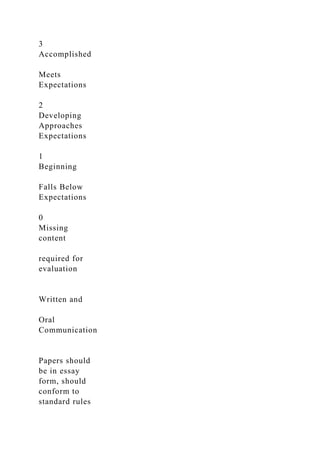
GREAT Rubric
History 111 – History of the United States I
General
Education
Competency
Related
Assignment
Requirement
4
Exemplary
Exceeds
Expectations
3
Accomplished
Meets
Expectations
2
Developing
Approaches
Expectations
1
Beginning
Falls Below
Expectations
0
Missing
content
required for
evaluation
Written and
Oral
Communication
Papers should
be in essay
form, should
conform to
standard rules
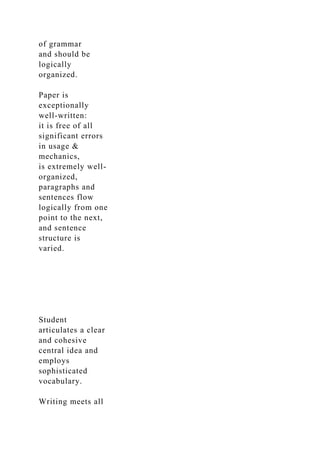
of grammar
and should be
logically
organized.
Paper is
exceptionally
well-written:
it is free of all
significant errors
in usage &
mechanics,
is extremely well-
organized,
paragraphs and
sentences flow
logically from one
point to the next,
and sentence
structure is
varied.
Student
articulates a clear
and cohesive
central idea and
employs
sophisticated
vocabulary.
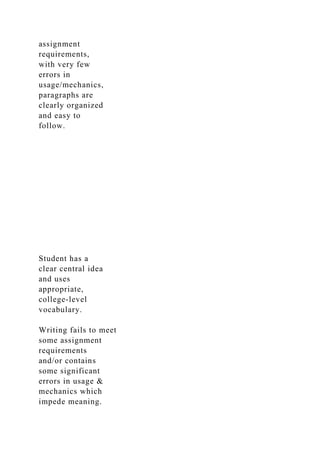
Writing meets all
assignment
requirements,
with very few
errors in
usage/mechanics,
paragraphs are
clearly organized
and easy to
follow.
Student has a
clear central idea
and uses
appropriate,
college-level
vocabulary.
Writing fails to meet
some assignment
requirements
and/or contains
some significant
errors in usage &
mechanics which
impede meaning.
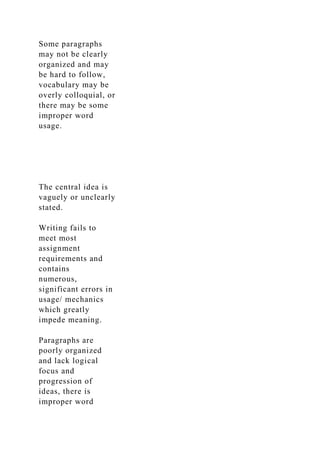
Some paragraphs
may not be clearly
organized and may
be hard to follow,
vocabulary may be
overly colloquial, or
there may be some
improper word
usage.
The central idea is
vaguely or unclearly
stated.
Writing fails to
meet most
assignment
requirements and
contains
numerous,
significant errors in
usage/ mechanics
which greatly
impede meaning.
Paragraphs are
poorly organized
and lack logical
focus and
progression of
ideas, there is
improper word
usage and/or
vocabulary is not
college-level.
There is no clear
central idea to
unify the paper.
Writing does
not meet
assignment
requirements:
errors
completely
impede
meaning.
Paragraphs are
disorganized,
lacking focus
and cohesion,
and proper
vocabulary is
lacking.
No evidence of
a central idea.
Critical Analysis
and Reasoning
Analyze and
interpret
primary
sources,
compare and
contrast the
two sources
and identify
biases,
distortions
and
inaccuracies in
each source.
Both documents
are exceptionally
well analyzed:
the student
provides a very
clear and cogent
summary of the
most salient
points/arguments
contained in
each.
AND
Student
demonstrates
very strong
evidence of
Both sources are
adequately
analyzed:
the student
provides a clear
and accurate
statement of key
points and ideas
contained in each
source.
AND
Student
demonstrates
critical thinking in
comparing and
interpreting both
One or both
sources are poorly
analyzed:
the student has
neglected to fully
or accurately
identify some of
the main points or
ideas in one or
both sources.
AND
There is minimal
evidence of critical
thinking:
comparisons
between the two
One or both sources
are insufficiently
analyzed:
the student fails to
identify key points
and ideas,
AND/OR
Shows very little to
no evidence of
critical thinking:
comparisons
between sources
Student does
not analyze
primary
sources:
Key
points/ideas
are not
identified,
no comparisons
are made, no
analysis of bias,
distortion or
inaccuracy is
provided.
Rev. 03/19
critical thinking
with comparisons
between the two
documents
reflecting an
unusual level of
insight, and there
is a very thorough
and nuanced
analysis biases,
distortions and
inaccuracies that
goes beyond the
obvious.
sources and
identifies any
obvious biases,
distortions or
inaccuracies.
sources may be
vague or tenuous
and they may have
failed to identify
obvious biases,
distortions or
inaccuracies.
are non-existent or
extremely vague,
and there is no
meaningful analysis
of biases,
distortions and
inaccuracies.
Information
Literacy
Locate and
identify two
primary
sources that
relate to the
chosen topic
and assess
their
credibility and
usefulness.
Citation
format:
Chicago
Student shows
skill and
discernment in
identifying
sources that fit
together well and
are exceptionally
well-suited to the
chosen topic.
Student provides
a very clear and
accurate
assessment of the
credibility and
usefulness of
each source.
Chicago style is
met without
error.
Student correctly
locates and
identifies primary
sources that are
relevant to their
chosen topic
Student
adequately
assesses the
reliability and
usefulness of
each source.
Chicago style is
met with only
minor errors.
The primary sources
selected may be
only marginally
connected the
student’s chosen
topic and/or appear
to have been
selected out of
expediency or haste
rather than with
deliberate thought.
Student is unable to
fully and clearly
assess the reliability
and usefulness of
one or both
sources.
Chicago style is met
with limited major
errors.
One or both of the
chosen sources are
inappropriate, they
are either not
primary sources or
they do not clearly
relate to the
chosen topic.
Student fails to
assess the
reliability or
usefulness of their
sources or
provides very weak
or unconvincing
assessments.
Chicago style is
met with
numerous major
errors.
No primary
sources are
correctly
identified.
No assessment
of reliability
provided.
Chicago style is
not evident.
Logical
Reasoning
Explain what
these sources
tell us about
the topic at
hand and the
study of
history in
general.
Place sources
in proper
historical
context using
information
gained in
class.
Student provides
an exceptionally
clear, explicit and
compelling logical
analysis of why
each source was
chosen and how
together they
help us
understand the
chosen topic.
Student provides
a clear and logical
explanation as to
why each source
was chosen and
how these
sources help us
understand the
chosen topic.
Student fails to fully
and clearly explain
why one or both of
their sources were
selected and
provides a vague or
partial explanation
of how the sources
help us understand
the topic at hand.
Student exhibits
personal biases
and/or lapses of
logical reasoning
that prevent them
from reaching
reasonable
conclusions. They
jump to
conclusions that
are illogical and/or
cannot stand up to
the facts. There is
very little factual
evidence to
support the
student’s
Logical
discussion &
analysis are
lacking.
Rev. 03/19
Student does an
exceptional job of
placing
documents in
historical context
and making
logical links to
information
gained in class.
The student’s
thought process
is extremely
well-explained.
Assertions are
supported with
an abundance of
appropriate
factual evidence.
Student is able to
place these
documents in
historical context
using information
gained in class.
The student’s
thought process is
clear, if not
always fully
explained.
Assertions are
supported with
appropriate
factual evidence.
Student does not
fully explain the
historical context
and makes only a
tangential
connection to
information learned
in class.
Students thought
process is unclear
and not fully
explained.
Student attempts to
support their
assertions with
factual information,
but may do so in an
unconvincing or
superficial way.
assertions.
Student fails to
provide a logical
explanation as to
how the sources
help us understand
the topic at hand,
and does not place
the documents in
proper historical
context.
Student does not
logically connect
information in the
documents to
material learned in
class.
Attempts to
support assertions
are incomplete and
lack sufficient
evidence or
argument.
Documents are
not placed in
historical
context or are
incorrectly
categorized.
Documents are
not linked to
class materials.
No attempt to
support
assertions.
Local and Global
Diversity
Determine
and explain
the role that
religion, race,
class, gender,
and ethnicity
play in
influencing US
domestic and
foreign policy
between 1865
and the
present.
Student very
effectively
determines and
explains how
religion, race,
class, gender,
and/or ethnicity
relates to the
chosen topic.
There is
substantive,
thorough and
compelling
analysis of how
these factors may
have shaped the
ideas and
viewpoints
reflected in their
sources, going
beyond the
superficial
aspects of
identity, and/or
provides an
insightful
assessment of
how these
Student is able to
explain how
religion, race,
class, gender,
and/or ethnicity
relates to the
chosen topic.
Analyzes how
these factors may
have shaped the
ideas and
viewpoints
reflected in their
sources, and/or is
able to explain
how these
sources may have
influenced
discourse/policies
relating to
diversity or
identity.
Student provides
some explanation of
how religion, race,
class, gender,
and/or ethnicity
have shaped US
history/policy.
Provides brief or
superficial analysis
of how these
factors may have
shaped the ideas
and viewpoints
reflected in their
sources, or may be
able to provide only
a very vague or
weak explanation of
how their sources
may have
influenced
discourse/policies
relating to diversity
or identity.
Student provides
very little
explanation of
how religion, race,
class, gender,
and/or ethnicity
have shaped US
history/policy.
Provides little or
no real analysis of
how these factors
may have shaped
the ideas and
viewpoints
reflected in their
sources, or fails to
provide any
meaningful
assessment of how
their sources may
have influenced
discourse/policies
relating to diversity
or identity.
Students
provides no
explanation of
how religion,
race, class,
gender and/or
ethnicity have
shaped US
history/policy.
Provides no
analysis of
these factors.
Rev. 03/19
sources may have
influenced
specific
discourse/policies
relating to
diversity or
identity.
Rev. 0319 General Education Common Graded Assignment H.docx

Rev. 0319 General Education Common Graded Assignment H.docx

  • 1.
    Rev. 03/19 General EducationCommon Graded Assignment: History 111- History of the United States I Primary Source Analysis HIST 111 – History of the United States is a general education course designed to assist students in the development of critical life skills. One of the goals of this assignment is to assess student competence for each of these objectives: I. Written and Oral Communication — examine a variety of primary and secondary sources of historical information, which may include scholarly books and articles, websites and blogs, historical documentaries, biographies, diaries, letters, newspapers, novels and statistical reports (CCO1); II. Critical Analysis and Reasoning — identify the major concepts, events and issues that shaped the history of the US and defined its place in the global community up to 1865 (CCO2); IV. Information Literacy— find, evaluate, use and cite academic resources that assess historical research (CCO7); V. Scientific, Quantitative or Logical Reasoning – construct an
  • 2.
    historical argument thatis based on the logical presentation of specific historical facts and that analyzes the causal factors of a historical event or process (CCO3); VI. Local and Global Diversity — determine the role that religion, race, class, gender, and ethnicity play in influencing US domestic and foreign policy to 1865 (CCO5); In addition to the above general education objectives, this assignment assesses students’ understanding and application of the following skills and knowledge specific to United States History: I. Analyze and interpret primary sources. II. Locate and identify primary sources and assess their credibility and usefulness. III. Place primary source materials in proper historical context using information gained in class. IV. Demonstrate awareness of important events and concepts in US history. V. Identify biases, distortions and inaccuracies in primary sources. VI. Explain how a particular primary source can enhance our understanding of US history. ASSIGNMENT: For this assignment students will select a topic from a list provided by the instructor and use the WEB and/or library databases to locate two (2) primary sources relating to
  • 3.
    their chosen topic.Students will then write a cohesive essay analyzing and comparing the two sources and reflecting upon what these sources tell us about the topic at hand and the study of history in general. Primary Sources provide first-hand accounts of the events, practices, or conditions. In general, these are documents that were created by the witnesses or first recorders of these events at about the time they occurred, and include diaries, letters, reports, court decisions, speeches, photographs, newspaper articles, and creative works – poems, novels, or political cartoons. Primary Sources form the base that supports historians’ reconstructions of the past. To use primary sources with confidence, historians need to be alert to potential causes of bias, distortion, and inaccuracy in these sources. This assignment will give you practice in analyzing and interpreting primary sources and identifying such causes. Essays MUST address the following: 1. The Background and perspective of each document’s creator. Who created each document and how might their race, ethnicity gender, age, religion, educational background, professional training and/or political ideology shape their perspective and view point? Is there anything in each creator’s background that might make them either a more or less Rev. 03/19 reliable/valuable source of information?
  • 4.
    2. The intendedpurpose of and audience for each document. Why was each document created and what form does it have? A document’s purpose and form (e.g. legal opinion, prohibition, instruction manual) will affect the sorts of material it contains and might cause a systematic bias. Who was the intended audience for each document and how might this shape the document itself? 3. The value and reliability of each source. How do author, audience, purpose, and form relate to the event or phenomenon that the document describes? Was the author in a position to have reliable knowledge of the event or phenomenon? Does the form permit accurate reporting? Does the author have any reason to avoid telling the truth as he or she saw it? How reliable do you think each document is and what interpretive value does it have? 4. Similarities and differences between the two sources. Do these sources complement or contradict one another? Taken together, how do these sources help us to better understand the topic at hand and what are the limitations of these sources? What, if anything, is left out or ignored by these sources? What other kinds of documents would you want to examine to corroborate these sources and/or provide a fuller understanding of the topic? ASSIGNMENT SPECIFICATIONS: Your paper should not be a
  • 5.
    simple a listof answers to individual questions, but a coherent essay with an introduction and conclusion. The writing should conform to standard rules of grammar and the paper should be clearly and logically organized. 12-pt font, double-spaced with 1” margins. The Works Cited page is not included in the assigned page length. website for a style guide. (https://libraryguides.ccbcmd.edu/american-history ), library databases and the web. CHOOSING APPROPRIATE SOURCES: To earn maximum credit, you will need to put some thought and effort into selecting your sources. You should not choose the first sources that appear in an internet or database search, but those that seem to best fit your topic and shed the most significant light on that topic. ● Your primary sources may NOT come from the class materials or PowerPoints, they must be derived from independent research. ● Your primary sources should be directly relevant to your chosen topic and should relate to each other in some meaningful way. ● Choose primary sources that are substantive. Textual sources should be more than just a few sentences long. Visual sources and creative works should come from well- known and/or influential individuals.
  • 6.
    SUGGESTIONS: ● Primary Sourcescan easily be located via the GALE HISTORY Database (https://www.gale.com/c/world- history-in-context) or other accredited and vetted governmental or educational entities including colleges and universities and the National Archives. http://libraryguides.ccbcmd.edu/Citations/chicago https://libraryguides.ccbcmd.edu/american-history https://www.gale.com/c/world-history-in-context https://www.gale.com/c/world-history-in-context https://www.archives.gov/ Rev. 03/19 GRADING: grade. graded SUBMISSION GUIDELINES: WO copies. One copy should include your student ID, course number and section; it should omit student and faculty names.
  • 7.
    number (900#) asthe file name through Blackboard. Student and instructor names should not appear on electronic submissions. Rev. 03/19 GREAT Rubric History 111 – History of the United States I General Education Competency Related Assignment Requirement 4 Exemplary Exceeds Expectations
  • 8.
  • 9.
    of grammar and shouldbe logically organized. Paper is exceptionally well-written: it is free of all significant errors in usage & mechanics, is extremely well- organized, paragraphs and sentences flow logically from one point to the next, and sentence structure is varied. Student articulates a clear and cohesive central idea and employs sophisticated vocabulary. Writing meets all
  • 10.
    assignment requirements, with very few errorsin usage/mechanics, paragraphs are clearly organized and easy to follow. Student has a clear central idea and uses appropriate, college-level vocabulary. Writing fails to meet some assignment requirements and/or contains some significant errors in usage & mechanics which impede meaning.
  • 11.
    Some paragraphs may notbe clearly organized and may be hard to follow, vocabulary may be overly colloquial, or there may be some improper word usage. The central idea is vaguely or unclearly stated. Writing fails to meet most assignment requirements and contains numerous, significant errors in usage/ mechanics which greatly impede meaning. Paragraphs are poorly organized and lack logical focus and progression of ideas, there is improper word
  • 12.
    usage and/or vocabulary isnot college-level. There is no clear central idea to unify the paper. Writing does not meet assignment requirements: errors completely impede meaning. Paragraphs are disorganized, lacking focus and cohesion, and proper vocabulary is lacking. No evidence of a central idea. Critical Analysis and Reasoning
  • 13.
    Analyze and interpret primary sources, compare and contrastthe two sources and identify biases, distortions and inaccuracies in each source. Both documents are exceptionally well analyzed: the student provides a very clear and cogent summary of the most salient points/arguments contained in each. AND Student demonstrates very strong evidence of
  • 14.
    Both sources are adequately analyzed: thestudent provides a clear and accurate statement of key points and ideas contained in each source. AND Student demonstrates critical thinking in comparing and interpreting both One or both sources are poorly analyzed: the student has neglected to fully or accurately identify some of the main points or ideas in one or both sources. AND There is minimal evidence of critical
  • 15.
    thinking: comparisons between the two Oneor both sources are insufficiently analyzed: the student fails to identify key points and ideas, AND/OR Shows very little to no evidence of critical thinking: comparisons between sources Student does not analyze primary sources: Key points/ideas are not identified, no comparisons are made, no analysis of bias,
  • 16.
    distortion or inaccuracy is provided. Rev.03/19 critical thinking with comparisons between the two documents reflecting an unusual level of insight, and there is a very thorough and nuanced analysis biases, distortions and inaccuracies that goes beyond the obvious. sources and identifies any obvious biases, distortions or inaccuracies. sources may be vague or tenuous and they may have failed to identify obvious biases, distortions or
  • 17.
    inaccuracies. are non-existent or extremelyvague, and there is no meaningful analysis of biases, distortions and inaccuracies. Information Literacy Locate and identify two primary sources that relate to the chosen topic and assess their credibility and usefulness. Citation format: Chicago Student shows skill and
  • 18.
    discernment in identifying sources thatfit together well and are exceptionally well-suited to the chosen topic. Student provides a very clear and accurate assessment of the credibility and usefulness of each source. Chicago style is met without error. Student correctly locates and identifies primary sources that are relevant to their chosen topic Student
  • 19.
    adequately assesses the reliability and usefulnessof each source. Chicago style is met with only minor errors. The primary sources selected may be only marginally connected the student’s chosen topic and/or appear to have been selected out of expediency or haste rather than with deliberate thought. Student is unable to fully and clearly assess the reliability and usefulness of one or both sources. Chicago style is met with limited major errors.
  • 20.
    One or bothof the chosen sources are inappropriate, they are either not primary sources or they do not clearly relate to the chosen topic. Student fails to assess the reliability or usefulness of their sources or provides very weak or unconvincing assessments. Chicago style is met with numerous major errors. No primary sources are correctly identified.
  • 21.
    No assessment of reliability provided. Chicagostyle is not evident. Logical Reasoning Explain what these sources tell us about the topic at hand and the study of history in general. Place sources in proper historical context using information gained in
  • 22.
    class. Student provides an exceptionally clear,explicit and compelling logical analysis of why each source was chosen and how together they help us understand the chosen topic. Student provides a clear and logical explanation as to why each source was chosen and how these sources help us understand the chosen topic.
  • 23.
    Student fails tofully and clearly explain why one or both of their sources were selected and provides a vague or partial explanation of how the sources help us understand the topic at hand. Student exhibits personal biases and/or lapses of logical reasoning that prevent them from reaching reasonable conclusions. They jump to conclusions that are illogical and/or cannot stand up to the facts. There is very little factual evidence to support the
  • 24.
    student’s Logical discussion & analysis are lacking. Rev.03/19 Student does an exceptional job of placing documents in historical context and making logical links to information gained in class.
  • 25.
    The student’s thought process isextremely well-explained. Assertions are supported with an abundance of appropriate factual evidence. Student is able to place these documents in historical context using information gained in class. The student’s thought process is clear, if not always fully explained. Assertions are
  • 26.
    supported with appropriate factual evidence. Studentdoes not fully explain the historical context and makes only a tangential connection to information learned in class. Students thought process is unclear and not fully explained. Student attempts to support their assertions with factual information, but may do so in an unconvincing or superficial way. assertions. Student fails to provide a logical
  • 27.
    explanation as to howthe sources help us understand the topic at hand, and does not place the documents in proper historical context. Student does not logically connect information in the documents to material learned in class. Attempts to support assertions are incomplete and lack sufficient evidence or argument. Documents are not placed in historical context or are incorrectly categorized.
  • 28.
    Documents are not linkedto class materials. No attempt to support assertions. Local and Global Diversity Determine and explain the role that religion, race, class, gender, and ethnicity play in influencing US domestic and foreign policy between 1865 and the present. Student very effectively determines and explains how religion, race,
  • 29.
    class, gender, and/or ethnicity relatesto the chosen topic. There is substantive, thorough and compelling analysis of how these factors may have shaped the ideas and viewpoints reflected in their sources, going beyond the superficial aspects of identity, and/or provides an insightful assessment of how these Student is able to explain how religion, race, class, gender, and/or ethnicity relates to the chosen topic. Analyzes how
  • 30.
    these factors may haveshaped the ideas and viewpoints reflected in their sources, and/or is able to explain how these sources may have influenced discourse/policies relating to diversity or identity. Student provides some explanation of how religion, race, class, gender, and/or ethnicity have shaped US history/policy. Provides brief or superficial analysis of how these factors may have shaped the ideas and viewpoints reflected in their sources, or may be able to provide only a very vague or weak explanation of
  • 31.
    how their sources mayhave influenced discourse/policies relating to diversity or identity. Student provides very little explanation of how religion, race, class, gender, and/or ethnicity have shaped US history/policy. Provides little or no real analysis of how these factors may have shaped the ideas and viewpoints reflected in their sources, or fails to provide any meaningful assessment of how their sources may have influenced discourse/policies relating to diversity or identity. Students provides no
  • 32.
    explanation of how religion, race,class, gender and/or ethnicity have shaped US history/policy. Provides no analysis of these factors. Rev. 03/19 sources may have influenced specific discourse/policies relating to diversity or identity.