



A new Method for Retrofitting Reinforced Concrete
Columns
School of Civil, Mining & Environmental Engineering
University of Wollongong
M.N.S. Hadi, T.M. Pham, and X. Lei
Presentation Outline
Introduction & Research Significance
Experimental Program
Test Results
Discussions & Conclusions
Introduction
FRP has been widely used to strengthen
existing structures;
For concrete columns, FRP is used to wrap the
columns thereby provides confining pressure;
Experimental studies confirmed that FRP
confinement increases the ultimate load and
ductility by a significant amount;
Introduction
For square columns, the confinement efficiency
is lower compared with circular columns;
A common solution is to round the sharp
corners, but limited improvement was found.
Research Significance
Circularisation – A new technique is proposed
and examined to increase the confinement
efficiency for FRP-confined square columns;
Eccentric loading was incorporated to investigate
the combined load – bending moment behaviour.
Research Significance
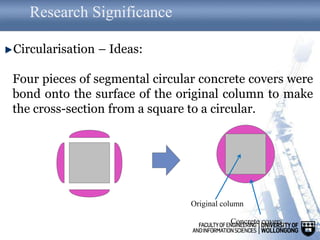
Circularisation – Ideas:
Four pieces of segmental circular concrete covers were
bond onto the surface of the original column to make
the cross-section from a square to a circular.
Original column
Concrete covers
Experimental Program
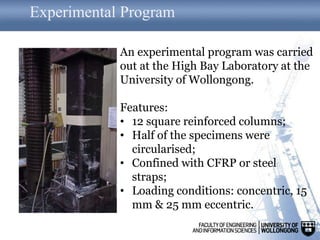
An experimental program was carried
out at the High Bay Laboratory at the
University of Wollongong.
Features:
• 12 square reinforced columns;
• Half of the specimens were
circularised;
• Confined with CFRP or steel
straps;
• Loading conditions: concentric, 15
mm & 25 mm eccentric.
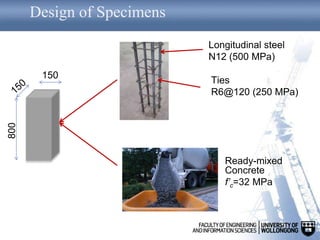
Design of Specimens
150
800
Longitudinal steel
N12 (500 MPa)
Ties
R6@120 (250 MPa)
Ready-mixed
Concrete
f’c=32 MPa
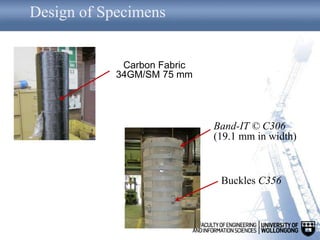
Design of Specimens
Carbon Fabric
34GM/SM 75 mm
Band-IT © C306
(19.1 mm in width)
Buckles C356
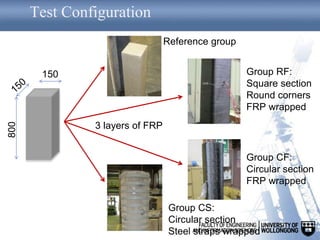
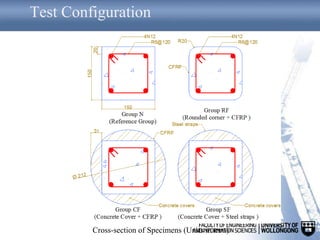
Test Configuration
150
800
Reference group
Group RF:
Square section
Round corners
FRP wrapped
Group CF:
Circular section
FRP wrapped
Group CS:
Circular section
Steel straps wrapped
3 layers of FRP
Test Configuration
Cross-section of Specimens (Units in mm)
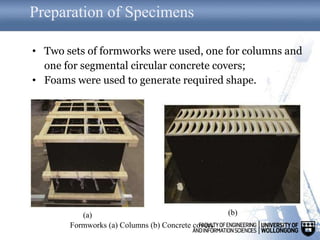
Preparation of Specimens
• Two sets of formworks were used, one for columns and
one for segmental circular concrete covers;
• Foams were used to generate required shape.
Formworks (a) Columns (b) Concrete covers
(a) (b)
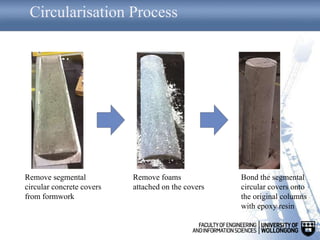
Circularisation Process
Remove segmental
circular concrete covers
from formwork
Remove foams
attached on the covers
Bond the segmental
circular covers onto
the original columns
with epoxy resin
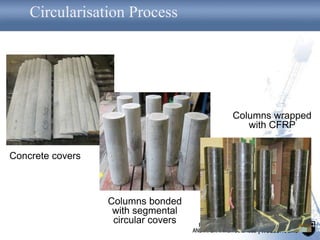
Circularisation Process
Concrete covers
Columns bonded
with segmental
circular covers
Columns wrapped
with CFRP
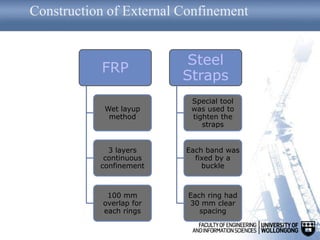
Construction of External Confinement
FRP
Wet layup
method
3 layers
continuous
confinement
100 mm
overlap for
each rings
Steel
Straps
Special tool
was used to
tighten the
straps
Each band was
fixed by a
buckle
Each ring had
30 mm clear
spacing
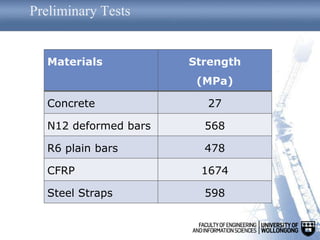
Preliminary Tests
Materials Strength
(MPa)
Concrete 27
N12 deformed bars 568
R6 plain bars 478
CFRP 1674
Steel Straps 598
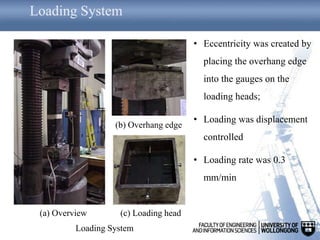
Loading System
Loading System
(a) Overview
(b) Overhang edge
(c) Loading head
• Eccentricity was created by
placing the overhang edge
into the gauges on the
loading heads;
• Loading was displacement
controlled
• Loading rate was 0.3
mm/min
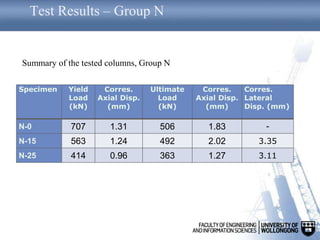
Test Results – Group N
Specimen Yield
Load
(kN)
Corres.
Axial Disp.
(mm)
Ultimate
Load
(kN)
Corres.
Axial Disp.
(mm)
Corres.
Lateral
Disp. (mm)
N-0 707 1.31 506 1.83 -
N-15 563 1.24 492 2.02 3.35
N-25 414 0.96 363 1.27 3.11
Summary of the tested columns, Group N
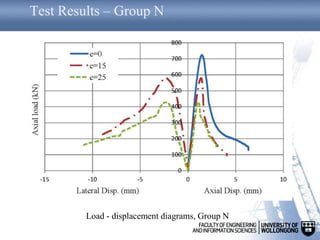
Test Results – Group N
Load - displacement diagrams, Group N
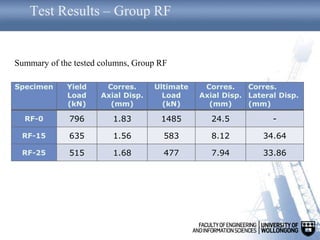
Test Results – Group RF
Summary of the tested columns, Group RF
Specimen Yield
Load
(kN)
Corres.
Axial Disp.
(mm)
Ultimate
Load
(kN)
Corres.
Axial Disp.
(mm)
Corres.
Lateral Disp.
(mm)
RF-0 796 1.83 1485 24.5 -
RF-15 635 1.56 583 8.12 34.64
RF-25 515 1.68 477 7.94 33.86
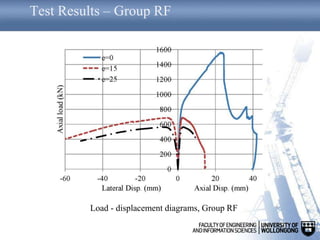
Test Results – Group RF
Load - displacement diagrams, Group RF
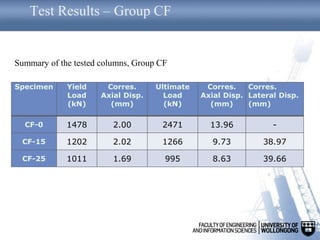
Test Results – Group CF
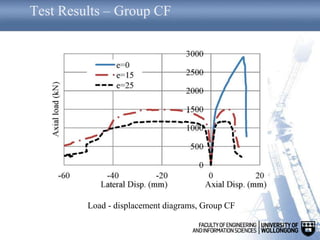
Summary of the tested columns, Group CF
Specimen Yield
Load
(kN)
Corres.
Axial Disp.
(mm)
Ultimate
Load
(kN)
Corres.
Axial Disp.
(mm)
Corres.
Lateral Disp.
(mm)
CF-0 1478 2.00 2471 13.96 -
CF-15 1202 2.02 1266 9.73 38.97
CF-25 1011 1.69 995 8.63 39.66
Test Results – Group CF
Load - displacement diagrams, Group CF
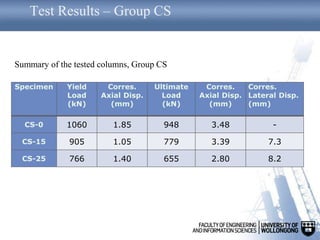
Test Results – Group CS
Summary of the tested columns, Group CS
Specimen Yield
Load
(kN)
Corres.
Axial Disp.
(mm)
Ultimate
Load
(kN)
Corres.
Axial Disp.
(mm)
Corres.
Lateral Disp.
(mm)
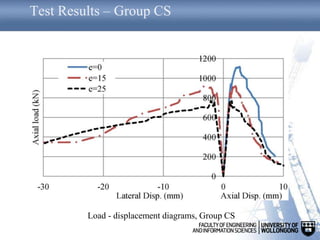
CS-0 1060 1.85 948 3.48 -
CS-15 905 1.05 779 3.39 7.3
CS-25 766 1.40 655 2.80 8.2
Test Results – Group CS
Load - displacement diagrams, Group CS
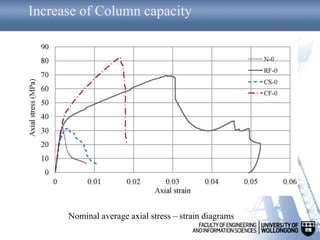
Increase of Column capacity
Nominal average axial stress – strain diagrams
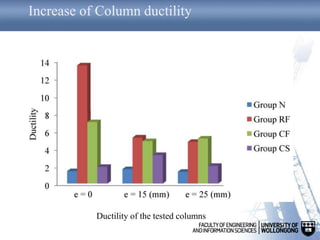
Increase of Column ductility
Ductility of the tested columns
Discussions and Conclusions
• Circularisation dramatically increases the
efficiency of FRP confinement. By circularising
square concrete columns, the efficiency of
FRP confinement can be maximised;
• Eccentricity dramatically reduced the ultimate
load of all specimens, regardless of the
technique incorporated;
• Most significantly, test results showed that the
proposed circularisation technique is a viable
and efficient method for strengthening square
RC columns.
Thank you

Retrofitting Reinforced Concrete

  • 1.
    A new Methodfor Retrofitting Reinforced Concrete Columns School of Civil, Mining & Environmental Engineering University of Wollongong M.N.S. Hadi, T.M. Pham, and X. Lei
  • 2.
    Presentation Outline Introduction &Research Significance Experimental Program Test Results Discussions & Conclusions
  • 3.
    Introduction FRP has beenwidely used to strengthen existing structures; For concrete columns, FRP is used to wrap the columns thereby provides confining pressure; Experimental studies confirmed that FRP confinement increases the ultimate load and ductility by a significant amount;
  • 4.
    Introduction For square columns,the confinement efficiency is lower compared with circular columns; A common solution is to round the sharp corners, but limited improvement was found.
  • 5.
    Research Significance Circularisation –A new technique is proposed and examined to increase the confinement efficiency for FRP-confined square columns; Eccentric loading was incorporated to investigate the combined load – bending moment behaviour.
  • 6.
    Research Significance Circularisation –Ideas: Four pieces of segmental circular concrete covers were bond onto the surface of the original column to make the cross-section from a square to a circular. Original column Concrete covers
  • 7.
    Experimental Program An experimentalprogram was carried out at the High Bay Laboratory at the University of Wollongong. Features: • 12 square reinforced columns; • Half of the specimens were circularised; • Confined with CFRP or steel straps; • Loading conditions: concentric, 15 mm & 25 mm eccentric.
  • 8.
    Design of Specimens 150 800 Longitudinalsteel N12 (500 MPa) Ties R6@120 (250 MPa) Ready-mixed Concrete f’c=32 MPa
  • 9.
    Design of Specimens CarbonFabric 34GM/SM 75 mm Band-IT © C306 (19.1 mm in width) Buckles C356
  • 10.
    Test Configuration 150 800 Reference group GroupRF: Square section Round corners FRP wrapped Group CF: Circular section FRP wrapped Group CS: Circular section Steel straps wrapped 3 layers of FRP
  • 11.
    Test Configuration Cross-section ofSpecimens (Units in mm)
  • 12.
    Preparation of Specimens •Two sets of formworks were used, one for columns and one for segmental circular concrete covers; • Foams were used to generate required shape. Formworks (a) Columns (b) Concrete covers (a) (b)
  • 13.
    Circularisation Process Remove segmental circularconcrete covers from formwork Remove foams attached on the covers Bond the segmental circular covers onto the original columns with epoxy resin
  • 14.
    Circularisation Process Concrete covers Columnsbonded with segmental circular covers Columns wrapped with CFRP
  • 15.
    Construction of ExternalConfinement FRP Wet layup method 3 layers continuous confinement 100 mm overlap for each rings Steel Straps Special tool was used to tighten the straps Each band was fixed by a buckle Each ring had 30 mm clear spacing
  • 16.
    Preliminary Tests Materials Strength (MPa) Concrete27 N12 deformed bars 568 R6 plain bars 478 CFRP 1674 Steel Straps 598
  • 17.
    Loading System Loading System (a)Overview (b) Overhang edge (c) Loading head • Eccentricity was created by placing the overhang edge into the gauges on the loading heads; • Loading was displacement controlled • Loading rate was 0.3 mm/min
  • 18.
    Test Results –Group N Specimen Yield Load (kN) Corres. Axial Disp. (mm) Ultimate Load (kN) Corres. Axial Disp. (mm) Corres. Lateral Disp. (mm) N-0 707 1.31 506 1.83 - N-15 563 1.24 492 2.02 3.35 N-25 414 0.96 363 1.27 3.11 Summary of the tested columns, Group N
  • 19.
    Test Results –Group N Load - displacement diagrams, Group N
  • 20.
    Test Results –Group RF Summary of the tested columns, Group RF Specimen Yield Load (kN) Corres. Axial Disp. (mm) Ultimate Load (kN) Corres. Axial Disp. (mm) Corres. Lateral Disp. (mm) RF-0 796 1.83 1485 24.5 - RF-15 635 1.56 583 8.12 34.64 RF-25 515 1.68 477 7.94 33.86
  • 21.
    Test Results –Group RF Load - displacement diagrams, Group RF
  • 22.
    Test Results –Group CF Summary of the tested columns, Group CF Specimen Yield Load (kN) Corres. Axial Disp. (mm) Ultimate Load (kN) Corres. Axial Disp. (mm) Corres. Lateral Disp. (mm) CF-0 1478 2.00 2471 13.96 - CF-15 1202 2.02 1266 9.73 38.97 CF-25 1011 1.69 995 8.63 39.66
  • 23.
    Test Results –Group CF Load - displacement diagrams, Group CF
  • 24.
    Test Results –Group CS Summary of the tested columns, Group CS Specimen Yield Load (kN) Corres. Axial Disp. (mm) Ultimate Load (kN) Corres. Axial Disp. (mm) Corres. Lateral Disp. (mm) CS-0 1060 1.85 948 3.48 - CS-15 905 1.05 779 3.39 7.3 CS-25 766 1.40 655 2.80 8.2
  • 25.
    Test Results –Group CS Load - displacement diagrams, Group CS
  • 26.
    Increase of Columncapacity Nominal average axial stress – strain diagrams
  • 27.
    Increase of Columnductility Ductility of the tested columns
  • 28.
    Discussions and Conclusions •Circularisation dramatically increases the efficiency of FRP confinement. By circularising square concrete columns, the efficiency of FRP confinement can be maximised; • Eccentricity dramatically reduced the ultimate load of all specimens, regardless of the technique incorporated; • Most significantly, test results showed that the proposed circularisation technique is a viable and efficient method for strengthening square RC columns.
  • 29.