7 Key Performance Indicators (KPIs) for Retail Businesses
1. Top 7 Key Performance Indicators for Retail Businesses
1. Inventory Turnover Ratio
2. Sales Per Employee
3. Performance Comparison KPI
4. Return Rate & Refunds
5. Customer Retention
6. Sales Per Square Foot
7. Conversion Rate
8. Conclusion
The KPI or Key Performance Indicator is a metric used to measure the business performance using
metrics. But you need to decide what form of metrics you want to use for easier evaluation of your
company’s goal. Keep in mind that you need to know what metrics you want to use to measure units
in KPI. You can use the following to measure KPIs:
 What are the problems areas in your organization?
 What are the business objectives that you want to achieve?
 How do customers perceive your brand?
There are different KPIs that your eCommerce business could use to monitor its future plan.
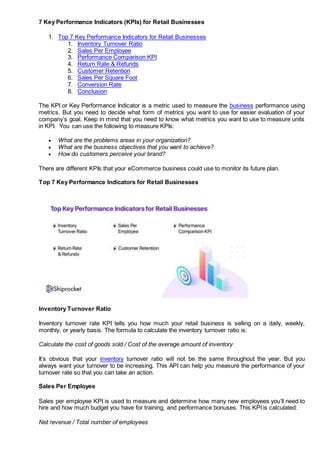
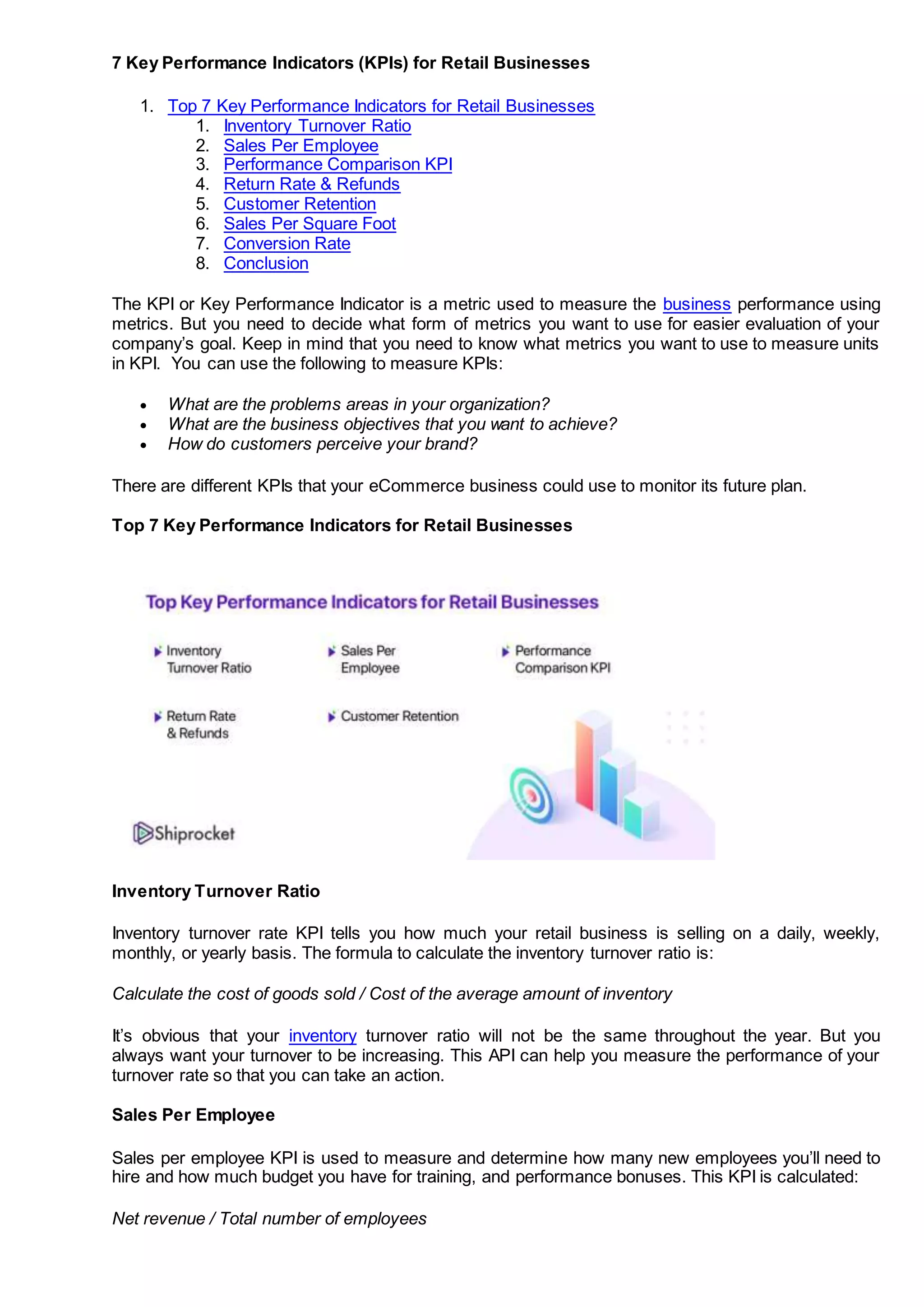
Top 7 Key Performance Indicators for Retail Businesses
Inventory Turnover Ratio
Inventory turnover rate KPI tells you how much your retail business is selling on a daily, weekly,
monthly, or yearly basis. The formula to calculate the inventory turnover ratio is:
Calculate the cost of goods sold / Cost of the average amount of inventory
It’s obvious that your inventory turnover ratio will not be the same throughout the year. But you
always want your turnover to be increasing. This API can help you measure the performance of your
turnover rate so that you can take an action.
Sales Per Employee
Sales per employee KPI is used to measure and determine how many new employees you’ll need to
hire and how much budget you have for training, and performance bonuses. This KPI is calculated:
Net revenue / Total number of employees
Keeping track of sales performance per employee helps you make your business more productive
and optimize your costs.
Performance Comparison KPI
This KPI can be used to measure the performance of both your online store and the brick-and-mortar
store. It’s also used to compare sales metrics and revenue accordingly. With this KPI you can find
what will get you more sales and the number of customers visiting your website before they visit a
physical location.
Return Rate & Refunds
Use this KPI to measure your return rate and refunds for services that you’re selling. It also tells you
how satisfied your customers are with their purchases on your online store. So, if you want to know
the reasons behind returns, get this KPI to get the details of how a return is processed. For example,
if your return rate is higher than 10%, then it can be considered having a quality issue or an issue
from your sales team.
Customer Retention
It is important to know your customer retention rate, as this is the financial backbone of any retail
business. Tracking customer retention rates can help you make the right business decisions to
streamline customer service. If you are not getting repeat sales, check your online reviews to find and
fix the issue. This KPI is also helpful for you to understand how you can boost sales and earn loyal
and repeat customers.
Sales Per Square Foot
Measuring your sales per square foot through KPI could help you to diversify your business plan. You
can easily know what store layout and product presentation can influence your business. The sales
per square foot KPI calculates your net sales by considering your sales figure, showroom, or gallery
space.
Conversion Rate
Conversion Rate KPI helps measure the total number of visitors to your store who made a purchase
and who don’t make a purchase. This KPI is basically to measure how your sales and profits are
performing. You can also know how well your product or service appeals to consumers.
Conclusion
KPIs allow you to have a complete view of the performance of your retail business. You can
streamline processes that you’ll likely need to improve. Now that you know the types of key
performance indicators for your retail business, you’ll be better prepared to monitor the health of your
business. These KPIs can help you see where your business is, where you are lacking, and, how you
can make positive changes to ensure you’re business continues to
KPI Metrics Every Retail Manager Should Track in 2022
The implementation of a data-driven culture in a retail company is a transformation project that
requires the definition of Key Performance Indicators (KPIs).
KPI is a performance measure that effectively monitors retail processes. These measures are
monitored by retailers to enable them to increase their profits by identifying consumer habits or
barriers during the purchasing process.
Facilitating access to this information allows retail managers to better understand what works or does
not work in the sales funnel.
The retail industry has the specificity of producing a very large amount of data. Among all the
information at your disposal, tracking the “right” measures depends on your sales organization, your
sector of activity, and your company. However, these 9 KPIs are the most important to track for sales
managers throughout the retail sector.
What Are the 9 KPIs Every Retail Manager Should Track?
SALES ANALYTICS
KPI tracking linked to sales activities helps to increase the performance of your store. Also, these
measures are essential because they are predictive. Their monitoring over time allows retail
managers to predict future sales performance and identify trends.
Furthermore, allowing intuitive access to this data allows retail managers to better analyze consumer
behaviors and communicate it to the company’s other departments (marketing, visual merchandising,
etc.)
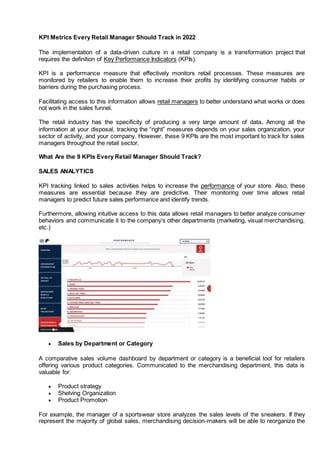
 Sales by Department or Category
A comparative sales volume dashboard by department or category is a beneficial tool for retailers
offering various product categories. Communicated to the merchandising department, this data is
valuable for:
 Product strategy
 Shelving Organization
 Product Promotion
For example, the manager of a sportswear store analyzes the sales levels of the sneakers. If they
represent the majority of global sales, merchandising decision-makers will be able to reorganize the
space to place these items at the entrance of the store – and thus obtain a good transformation rate
paired with increased customer satisfaction.
 Average Purchase Value
This KPI measures the average value of each purchase made by customers. Integrating this measure
allows retail managers to easily analyze historical trends. This is an effective strategy to increase the
average purchase value of each sale.
Thanks to data storytelling software, you can easily observe the evolution of this KPI over time.
Furthermore, thanks to the cross-referencing of several data, you can also better segment your
customers according to their demographic characteristics, for example.
 Amount of Sales Reduced or Promoted
This KPIs is an excellent tool to measure the effectiveness of promotional campaigns. As a store
manager, this measure allows you to identify and report customer spending behavior. In addition,
reviewing this type of data is essential to compare the locations of promotional items. A very useful
measure to improve merchandising and therefore your sales performance.
INVENTORY ANALYTICS
Retail inventory management allows store managers to offer customers excellent service through a
clear understanding of their requirements. The lack of a good inventory management process
decreases your ability to track product status and location.
Moreover, optimizing inventories leads to convincing savings by avoiding ownership costs and
unnecessary product depreciation. In addition, savings can also be made by reducing the time
previously spent on manual inventory management.
Yet, inventory optimization poses significant challenges due to the volume of information to be
analyzed. How much of each item is in stock? What should I order again and when? Do you order too
much or too little inventory? What are your best-selling and worst-selling items?
To address this issue, data storytelling software provides a complete understanding of inventory
management at a glance. It is indeed possible to incorporate figures easily and to obtain
visualizations that can be understood by everyone. There is no need to make calculations and the
data are updated automatically. All in a single app!
Here are some inventory-related KPIs that you can track from your dashboard and that will be very
useful:
 Inventory Turnover
The inventory turnover rate is used to determine the number of times your entire inventory has been
used up over a given period of time.
If you have a high turnover rate:
 Your store is performing well
 Your sales teams sell high rates of goods
 Your inventory is not excessive
If you have a low turnover rate:
 You have difficulty translating stock into profits.
 Look for bottlenecks at any level in your supply chain process
This KPI is an excellent piece of information to share with retail managers and decision-makers. This
data helps to determine which item inventories are worth expanding or shrinking in each store’s
inventory. Also, this KPI reflects the good management of your store, a rewarding element to
communicate with your management, to support the quality of your work.
 Gross Margin Return on Investment (GMROI)
Gross Margin Return on Investment is an essential KPI to track because it enables the evaluation of
each dollar invested in inventories. In short, it evaluates how many dollars your company has been
able to recover.
As a retail manager, tracking this key performance indicator provides a more accurate picture of
inventory strategy profitability. This is the most appropriate way to make better decisions about which
products to store or which items to no longer store.
 Product Performance
How fast are items selling? Which products are making the most money? Such questions can be
answered by tracking the product performance KPI.
This measure is based on the number of items sold over a given period.
This results in an inventory of the best-selling items for this period (by week, month, year).
Knowing the best and worst-performing products allows the store manager to determine which items
are worth investing in and which ones shouldn’t be re-ordered. In this way, they anticipate customer
needs, increase customer satisfaction and sales volume.
CUSTOMER ENGAGEMENT ANALYTICS
Retail managers must ask themselves the following questions on a daily basis:
 How many customers can we expect in the stores?
 How long will they stay?
 Which way will they go?
 Which products are they most interested in?
 Will they make a purchase?
To answer these questions, managers are the only ones able to provide such varied and accurate
information about clients. They can communicate customer service goals across all company levels
for a fully consistent and targeted, even personalized experience.
However, due to the lack of tools and the mass of data they encounter, it is not easy for managers to
report this information. What information should be prioritized? How should it be communicated to the
entire company? How often?
Here are some essential measures that can be aggregated in a data storytelling application to
organize and facilitate the communication of information related to purchasing behavior in stores.
 Foot Traffic
Foot traffic refers to the number of people entering your store. It is measured using people
counters and retail sales analysis software.
Tracking this KPI is essential for the retail manager. Indeed, monitoring this metric over time allows
them to identify hours or seasonalities when it needs more or less staff.
In addition to serving in-store managers, the efficient tracking of this KPI is very useful throughout the
company. For example, foot traffic allows marketing teams to evaluate the success of a campaign.
With this data, merchandisers can easily evaluate the success of their window displays designs.
 Conversion Rate
The conversion rate refers to the percentage of conversions made possible based on the total
number of visitors.
A conversion can be:
 A purchase
 Registration to a loyalty program
 The purchase of a product on promotion
For retail managers, monitoring this KPI is essential to measuring effectiveness. From a comparative
perspective (between several stores in a given region, for example), measuring this data makes it
possible to identify good practices and extend them to all your stores.
 Customer Retention
Customer retention measures the rate of customer return to your store. This measure is an excellent
indicator of customer experience, the diversity of your offer, and the performance of your products.
Communicating this information to your stakeholders will allow your company to develop marketing
and event offers at strategic times.
This KPI also serves as a strategy for loyalty programs, to further encourage customers to return to
the store.
Key performance indicators or KPIs are measurements of data used to track important
processes, efficiency, company growth, customer engagement and many other patterns.
Every industry has unique KPIs that inform business leaders of the direction their business is
moving – positive or negative.
KPIs are best utilized to understand whether your business has attained specific goals
related to an increase in profits, identification of consumer patterns or brand growth. In the
retail industry, an example goal could be to increase daily revenue by 6% during the fall
season.
This post describes 5 of the most important small business retail KPIs.
Retail Key Performance Indicators and Metrics
1. Sell-through Rate
Number of units sold / original inventory x 100
Sell-through is the rate or percentage of units sold compared to the number of units available
to be sold. This is an effective measurement to help you understand how quickly a product
has sold, and how often to re-order the item or which items you can promote over others.
2. Year-over-year Growth
(current period revenue – previous period revenue) / previous period revenue x 100
Year-over-year growth is a revenue-based measurement. It is one of the more basic KPIs,
but provides more insight than a simple numbers comparison. A YOY rate increase looks
great to start, but if you plot this over a number of months you may see trends or changing
patterns. Cross-matched with sell-through rate, you can understand what might have led to
those patterns. Winter clothing item revenue may be down at launch, while fall clothing items
have sold consistently for a longer period due to weather patterns.
3. Gross Margin Return on Investment (GMROI)
Average Sales / Average Inventory Cost x Gross Margin
GMROI tells you how much profit you’ve made against what you’ve invested in inventory
stock. There are industry standards for most niche markets, making this metric a tangible
way to see if your store is hitting benchmarks. It also informs you on which items are giving
you the most value and when products need to be switched out.
4. Conversion Rate
Total sales / total transactions
Simply put, conversion rate measures the percentage of people making purchases when
they visit your store. Although a more general number, if the data is interpreted correctly you
can understand what may be affecting customers decision to purchase. In a cluttered store,
the customer might not easily find the items they need and decide to just leave and try
somewhere else.
5. Sales per Square Foot
Net sales / amount of sales space
Some KPIs are better suited to help you understand how your store layout or staff affects
sales. Sales per square foot details this well. Let’s say your clothing store just launched a
winter line and you know customers are viewing the items but sales aren’t as high as you’d
like. Tracking sales per square foot for the winter section could indicate a need to improve
staff performance.
These 5 small business retail KPIs should form the foundation of your store performance
analysis.
Small business owners often serve in more than one position for their business, leaving them
with little time to properly track KPIs. Action Card can help you create retail audits to ensure
product displays are always stocked, well designed and up to date. Request a free demo of
our software if you’re ready to build a better data foundation for your retail business.
Retail Metrics: 15 Essential KPIs for Tracking Your Business’ Performance
Francesca Nicasio • August 18, 2021 • No Comments
What are KPIs in retail?
KPIs — aka “key performance indicators” are the most important metrics in your business. These are
numbers that you must regularly monitor so you can determine if your business is on the right track.
What metrics should you look at? That depends. Each retail business is different, so specific
measures may be more significant to you than others.
But to help point you in the right direction, we’ve compiled the top retail metrics and KPIs to track in
your business, along with the formulas and methods to calculate them.
How to use retail KPIs
Generally speaking, KPIs are used to determine if you’re meeting your goals. They’re called key
performance indicators for reason: they help you gauge your performance, so you can decide on the
right course of action.
Depending on what you’re measuring, KPIs help you see where you’re at in terms of sales, inventory
movement, growth, customer satisfaction etc. In the points below, we’ll dive into the specific KPIs you
should be looking at how to use them.
Note: In the following paragraphs, you’ll see a quick description of each retail metric and the forumula
to calculate it. And while we think this is a great starting point to understanding what to track in your
retail biz, we’d be remiss if we didn’t mention retail analytics and reporting.
You should certainly know how to calculate various metrics and KPIs, but in real-world applications
(particularly if you’re running a fully-fledged retail business), it’s best to use a retail software solution
that crunches the numbers for you. Doing so will save you time and help you gain the insights you
need much faster.
With that said, let’s dive into the metrics!
Sales metrics and KPIs
Sales are the lifeblood of any retail business, so it’s critical that you keep a close eye on them.
Consider the following KPIs:
1. Sales per square foot
This metric pertains to the amount of sales you generate per square footage of sales space in your
store. (Note: this doesn’t include fitting rooms or stockrooms.)
You can calculate your sales per square foot using the following formula:
net sales / amount of sales space
Why measure your sales per square foot?
Retail sales per square foot is a good indicator of store productivity, and it can also tell you if you’re
making good use of space and fixtures in your shop. You can use this metric when planning your
store layout and merchandise.
Certain stores and industries make their sales per square foot public, which means knowing this
metric will help you determine how your business compares with others. Here’s a look at the average
sales per square footage in different retail sectors:
 Apparel – $336
 Specialty retail – $325
 Grocery – $510
How do you improve your sales per square foot?
The right sales and retail productivity tactics will depend on your store, but here some general tips for
improving your sales per square footage:
 Improve your store layout
 Have a winning product assortment
 Optimize your prices or promotions
 Increase transaction or basket value
 Train your staff to sell more
 Encourage people to stay longer in your shop
Related: How to Increase Retail Sales per Square Foot and Improve Store Productivity
2. Sales per employee
Sales per employee is a measure that comes in handy when you’re planning your staff’s schedules
and initiatives. You can easily measure it using this equation:
net sales / number of employees
Why measure retail sales per employee?
This metric can help you make smarter employment decisions, particularly when it comes to hiring,
rostering, and compensation.
If you want to get more profound insights into your revenue and staffing, go beyond the formula
above and measure the revenue generated by individual employees. The easiest way to do this is
through your point of sale system. Find a POS solution that tracks sales per employee, and use that
data to come up with sales targets and determine who best associates are.
How do you improve your sales per employee?
The best way to improve on this metric is to get your associates to generate more sales. Depending
on your store, this may include actions like:
 Setting smart sales goals per employee
 Investing in sales training
 Motivating your staff to perform better
 Running friendly competitons to gamify that sales process
 Giving staff members the tools (like a good CRM) to make it easier to generate sales.
Related: Want more specific tips? Check out our post on meeting and beating your retail sales
targets.
3. Conversion rate
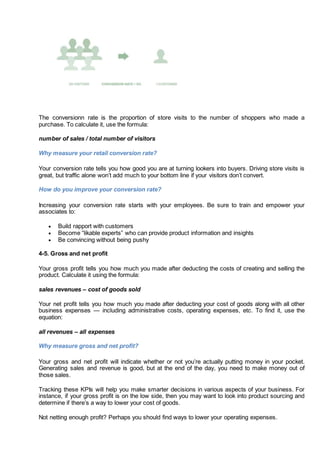
The conversionn rate is the proportion of store visits to the number of shoppers who made a
purchase. To calculate it, use the formula:
number of sales / total number of visitors
Why measure your retail conversion rate?
Your conversion rate tells you how good you are at turning lookers into buyers. Driving store visits is
great, but traffic alone won’t add much to your bottom line if your visitors don’t convert.
How do you improve your conversion rate?
Increasing your conversion rate starts with your employees. Be sure to train and empower your
associates to:
 Build rapport with customers
 Become “likable experts” who can provide product information and insights
 Be convincing without being pushy
4-5. Gross and net profit
Your gross profit tells you how much you made after deducting the costs of creating and selling the
product. Calculate it using the formula:
sales revenues – cost of goods sold
Your net profit tells you how much you made after deducting your cost of goods along with all other
business expenses — including administrative costs, operating expenses, etc. To find it, use the
equation:
all revenues – all expenses
Why measure gross and net profit?
Your gross and net profit will indicate whether or not you’re actually putting money in your pocket.
Generating sales and revenue is good, but at the end of the day, you need to make money out of
those sales.
Tracking these KPIs will help you make smarter decisions in various aspects of your business. For
instance, if your gross profit is on the low side, then you may want to look into product sourcing and
determine if there’s a way to lower your cost of goods.
Not netting enough profit? Perhaps you should find ways to lower your operating expenses.
How do you improve your gross and net profit?
You can try several profit-increasing strategies in your business. Here are some quick ideas:
 Streamline your operations to reduce expenses
 Raise your prices
 Increase your average order value
 Implement savvier purchasing practices
 Optimize your vendor relationships
 Limit markdowns and be more strategic with your promotions
Related: Want to Improve Your Profit Margins? Here are 6 Tips to Try
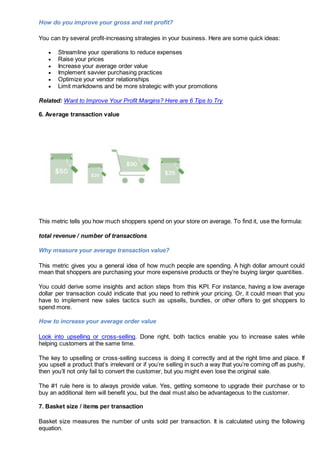
6. Average transaction value
This metric tells you how much shoppers spend on your store on average. To find it, use the formula:
total revenue / number of transactions
Why measure your average transaction value?
This metric gives you a general idea of how much people are spending. A high dollar amount could
mean that shoppers are purchasing your more expensive products or they’re buying larger quantities.
You could derive some insights and action steps from this KPI. For instance, having a low average
dollar per transaction could indicate that you need to rethink your pricing. Or, it could mean that you
have to implement new sales tactics such as upsells, bundles, or other offers to get shoppers to
spend more.
How to increase your average order value
Look into upselling or cross-selling. Done right, both tactics enable you to increase sales while
helping customers at the same time.
The key to upselling or cross-selling success is doing it correctly and at the right time and place. If
you upsell a product that’s irrelevant or if you’re selling in such a way that you’re coming off as pushy,
then you’ll not only fail to convert the customer, but you might even lose the original sale.
The #1 rule here is to always provide value. Yes, getting someone to upgrade their purchase or to
buy an additional item will benefit you, but the deal must also be advantageous to the customer.
7. Basket size / items per transaction
Basket size measures the number of units sold per transaction. It is calculated using the following
equation.
Basket size = Total number of units sold / Total number of transactions
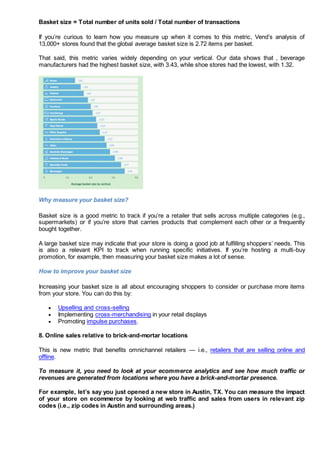
If you’re curious to learn how you measure up when it comes to this metric, Vend’s analysis of
13,000+ stores found that the global average basket size is 2.72 items per basket.
That said, this metric varies widely depending on your vertical. Our data shows that , beverage
manufacturers had the highest basket size, with 3.43, while shoe stores had the lowest, with 1.32.
Why measure your basket size?
Basket size is a good metric to track if you’re a retailer that sells across multiple categories (e.g.,
supermarkets) or if you’re store that carries products that complement each other or a frequently
bought together.
A large basket size may indicate that your store is doing a good job at fulfilling shoppers’ needs. This
is also a relevant KPI to track when running specific initiatives. If you’re hosting a multi-buy
promotion, for example, then measuring your basket size makes a lot of sense.
How to improve your basket size
Increasing your basket size is all about encouraging shoppers to consider or purchase more items
from your store. You can do this by:
 Upselling and cross-selling
 Implementing cross-merchandising in your retail displays
 Promoting impulse purchases.
8. Online sales relative to brick-and-mortar locations
This is new metric that benefits omnichannel retailers — i.e., retailers that are selling online and
offline.
To measure it, you need to look at your ecommerce analytics and see how much traffic or
revenues are generated from locations where you have a brick-and-mortar presence.
For example, let’s say you just opened a new store in Austin, TX. You can measure the impact
of your store on ecommerce by looking at web traffic and sales from users in relevant zip
codes (i.e., zip codes in Austin and surrounding areas.)
Why measure the impact of physical retail on digital?
Consumers today are increasingly using multiple channels to shop, so you need to get a handle on
how your physical presence influences your ecommerce sales. These days, crediting sales to a single
channel isn’t enough, when people are interacting with your brand in many different ways and places.
9. Year over year growth
If your business growing? How better off are you compared to your previous years in business? To
figure this out, calculate your year over year revenue growth with the following equation:
(current period revenue – prior period revenue) / prior period revenue x 100
Why measure YOY growth?
Continuous improvement is a goal you want to strive for, and the best way to track your progress is to
measure your current results against the previous period. This will help you track how your business
doing so you can react accordingly.
For example, if you find that you’re falling behind and your business isn’t performing as well as the
previous year, then you can strive to change that.
How to improve your YOY growth
The first step to improving this is to figure out why you’re not growing at your ideal rate. If your growth
has stalled, then drill down on the reason behind it. Is it the market? Are you failing to keep up with
the latest trends? Is a competitor eating up market share?
Whatever the case, figure out the reason and then take the necessary steps to improve.
Inventory metrics and KPIs
Getting your inventory levels “just right” is a tricky task, but it’s completely doable with the help of the
metrics below.
10. Stock turn
Also known as inventory turnover, this metric pertains to the number of times stock is sold through or
used in a given time period. Calculate it using the formula:
cost of goods sold / average inventory
Why measure stock turn?
Stock turn is a critical metric for determining your optimal inventory levels. If your stock turn is too low,
then it means you’re not selling out of inventory fast enough, and you risk carrying slow or dead
stock.
However, if your stock turn is too fast (i.e., you’re selling out of the product 4 or more times a year),
then it could mean that you’re not stocking up enough, and customers are continually dealing with out
of stocks.
How to improve stock turn
It all depends. If your inventory turnover is too low, you need to be leaner with your merchandise and
avoid over-ordering products. You should also make it a goal to move your slow-moving or dead
merchandise ASAP. Here are some posts to help you do just that:
Dealing with high stock turn? Optimize your stock ordering procedures to ensure that you’re not
running out of inventory too frequently.
11. GMROI
Gross Margin Return on Investment (GMROI) measures your profit return on the funds invested in
stock. It answers the question, “For every dollar invested in inventory, how many dollars did I get
back?”
The formula for GMROI is:
gross profit / average inventory
Why measure GMROI?
GMROI tells you how much money your inventory has made. You use this metric to figure out if your
stock is turning a profit. It’s typically measured for specific products or categories because it can give
you a good idea of which types of merchandise are worth carrying in your shop.
How to improve your GMROI
To increase your GMROI, ask yourself, how can I get more money out of my merchandise?
Accomplishing that can mean:
 Increasing your prices
 Lowering your cost of goods
 Improving profit margins
 Improving inventory turnover
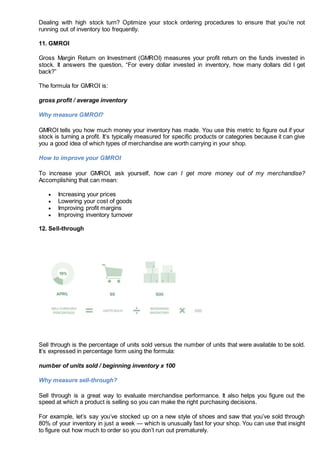
12. Sell-through
Sell through is the percentage of units sold versus the number of units that were available to be sold.
It’s expressed in percentage form using the formula:
number of units sold / beginning inventory x 100
Why measure sell-through?
Sell through is a great way to evaluate merchandise performance. It also helps you figure out the
speed at which a product is selling so you can make the right purchasing decisions.
For example, let’s say you’ve stocked up on a new style of shoes and saw that you’ve sold through
80% of your inventory in just a week — which is unusually fast for your shop. You can use that insight
to figure out how much to order so you don’t run out prematurely.
How to improve sell-through
The steps required to strengthen sell-through depends on your situation. A high sell-through rate
could mean that you need to stock up on merchandise (unless of course, you’re deliberately trying to
sell out of the item).
On the other hand, a slow sell-through rate means the item isn’t moving fast enough, and you need to
figure out how to sell more. Should you run a promotion? Mark it down? Again, the right answer
depends on your store’s situation.
13. Shrinkage
Shrinkage pertains to a loss of inventory that isn’t caused by actual sales. The common causes of
shrinkage are employee theft, shoplifting, administrative errors, and supplier fraud. To calculate it,
use the formula:
ending inventory value – physically counted inventory value
Why measure shrinkage?
The last thing you want is to lose product or money to things like theft or admin errors. Tracking
shrinkage keeps you vigilant and helps ensure that nothing shady is going on in your business.
How to reduce shrinkage
The right way to deal with shrinkage depends on what’s causing it. If it’s consumer theft, then you
need to work on beefing up store security. Dealing with employee theft? Work on hiring the people
and setting up procedures to prevent inside jobs from happening. Tightening up your processes also
works for admin errors and vendor fraud.
Customers
In this section, we discuss some of the top customer-centric metrics to look at:
14. Foot traffic
This one is pretty straightforward. Foot traffic refers to the number of people who walk into your store.
You can measure it using people counters and retail analytics software.
Why measure foot traffic?
Foot traffic helps you evaluate your marketing and advertising efforts. For example, if you recently
launched a promotion to drive people to your shop, then looking at your foot traffic can tell you
whether or not your campaign was successful.
This is also a significant metric for evaluating the success of your window displays.
How to improve foot traffic
There are various ways to drive traffic to your brick and mortar store. Some of our favorites include:
 Increasing your curb appeal
 Leveraging digital tools such as click and collect, online business listings, Google’s Local
Inventory Ads, etc.
 Holding events
 Driving traffic from existing customers
Related: 7 Proven Ways to Drive Foot Traffic to Your Retail Store
15. Customer retention
You’ve worked hard to get new customers, so it’s only right that you figure out whether or not you’re
keeping them. There are a number of ways to find your customer retention rate, but here’s a relatively
simple formula from Inc.com:
((CE-CN)/CS)) x 100
CE = number of customers at the end of period
CN = number of new customers acquired during period
CS = number of customers at start of period
Why measure customer retention?
Your customer retention rate tells you the amount of customers that return to your store. This metric
is an excellent gauge for customer service, product performance, and loyalty.
How to improve customer retention
Getting people to come back boils down to how well you manage your customer relationships. Doing
that can mean various things including:
 Tracking customer purchases and offering personalized recommendations
 Developing meaningful relationships through amazing customer service as well as
community-building efforts like classes, events, or online groups
 Implementing a killer loyalty program to encourage shoppers to keep coming back
How to decide which KPIs to consider
So, which of the above KPIs should you measure? To figure this out, consider which metrics are
relevant to your business.
A KPI like year over year growth, for example, is a good thing to track if you’re established business,
but it isn’t relevant if you’re a brand new retailer. Meanwhile, the metric sales per employee is good if
you have a large team, but it won’t apply to your business if you’re the only one manning the store.
Another thing to consider is your focus and priorities. Your key performance indicators may shift
depending on your current business objectives or the challenges that you’re facing.
Let’s say you’re currently dealing with issues around inventory discrepancies. If this the case, then
shrink would be a good metric to track. Or maybe you’re looking to motivate your team to perform
better. If this is your goal, then sales per employee is something to monitor more closely.
The point is, the right KPIs in retail will vary depending on your business. One retailer’s key metrics
aren’t the same for others, so examine your practices, priorities, and goals, then decide on your KPIs
from there.
Whatever the case, figure out who to efficiently measure these on a regular basis. Formulas are
useful, but you’ll save time by automating data and metric-tracking in your business.
Invest in a retail solution with robust reporting and analytics capabilities, so you can focus less on
manual calculations and get straight to the insights you need.
Next is to take action. It’s not enough to know your metrics; you need to do something with your data.
Use the info that you gain to identify areas for improvement, and then take the necessary steps to
level up your game.

retail kpi.docx

  • 1.
    7 Key PerformanceIndicators (KPIs) for Retail Businesses 1. Top 7 Key Performance Indicators for Retail Businesses 1. Inventory Turnover Ratio 2. Sales Per Employee 3. Performance Comparison KPI 4. Return Rate & Refunds 5. Customer Retention 6. Sales Per Square Foot 7. Conversion Rate 8. Conclusion The KPI or Key Performance Indicator is a metric used to measure the business performance using metrics. But you need to decide what form of metrics you want to use for easier evaluation of your company’s goal. Keep in mind that you need to know what metrics you want to use to measure units in KPI. You can use the following to measure KPIs:  What are the problems areas in your organization?  What are the business objectives that you want to achieve?  How do customers perceive your brand? There are different KPIs that your eCommerce business could use to monitor its future plan. Top 7 Key Performance Indicators for Retail Businesses Inventory Turnover Ratio Inventory turnover rate KPI tells you how much your retail business is selling on a daily, weekly, monthly, or yearly basis. The formula to calculate the inventory turnover ratio is: Calculate the cost of goods sold / Cost of the average amount of inventory It’s obvious that your inventory turnover ratio will not be the same throughout the year. But you always want your turnover to be increasing. This API can help you measure the performance of your turnover rate so that you can take an action. Sales Per Employee Sales per employee KPI is used to measure and determine how many new employees you’ll need to hire and how much budget you have for training, and performance bonuses. This KPI is calculated: Net revenue / Total number of employees
  • 2.
    Keeping track ofsales performance per employee helps you make your business more productive and optimize your costs. Performance Comparison KPI This KPI can be used to measure the performance of both your online store and the brick-and-mortar store. It’s also used to compare sales metrics and revenue accordingly. With this KPI you can find what will get you more sales and the number of customers visiting your website before they visit a physical location. Return Rate & Refunds Use this KPI to measure your return rate and refunds for services that you’re selling. It also tells you how satisfied your customers are with their purchases on your online store. So, if you want to know the reasons behind returns, get this KPI to get the details of how a return is processed. For example, if your return rate is higher than 10%, then it can be considered having a quality issue or an issue from your sales team. Customer Retention It is important to know your customer retention rate, as this is the financial backbone of any retail business. Tracking customer retention rates can help you make the right business decisions to streamline customer service. If you are not getting repeat sales, check your online reviews to find and fix the issue. This KPI is also helpful for you to understand how you can boost sales and earn loyal and repeat customers. Sales Per Square Foot Measuring your sales per square foot through KPI could help you to diversify your business plan. You can easily know what store layout and product presentation can influence your business. The sales per square foot KPI calculates your net sales by considering your sales figure, showroom, or gallery space. Conversion Rate Conversion Rate KPI helps measure the total number of visitors to your store who made a purchase and who don’t make a purchase. This KPI is basically to measure how your sales and profits are performing. You can also know how well your product or service appeals to consumers. Conclusion KPIs allow you to have a complete view of the performance of your retail business. You can streamline processes that you’ll likely need to improve. Now that you know the types of key performance indicators for your retail business, you’ll be better prepared to monitor the health of your business. These KPIs can help you see where your business is, where you are lacking, and, how you can make positive changes to ensure you’re business continues to
  • 3.
    KPI Metrics EveryRetail Manager Should Track in 2022 The implementation of a data-driven culture in a retail company is a transformation project that requires the definition of Key Performance Indicators (KPIs). KPI is a performance measure that effectively monitors retail processes. These measures are monitored by retailers to enable them to increase their profits by identifying consumer habits or barriers during the purchasing process. Facilitating access to this information allows retail managers to better understand what works or does not work in the sales funnel. The retail industry has the specificity of producing a very large amount of data. Among all the information at your disposal, tracking the “right” measures depends on your sales organization, your sector of activity, and your company. However, these 9 KPIs are the most important to track for sales managers throughout the retail sector. What Are the 9 KPIs Every Retail Manager Should Track? SALES ANALYTICS KPI tracking linked to sales activities helps to increase the performance of your store. Also, these measures are essential because they are predictive. Their monitoring over time allows retail managers to predict future sales performance and identify trends. Furthermore, allowing intuitive access to this data allows retail managers to better analyze consumer behaviors and communicate it to the company’s other departments (marketing, visual merchandising, etc.)  Sales by Department or Category A comparative sales volume dashboard by department or category is a beneficial tool for retailers offering various product categories. Communicated to the merchandising department, this data is valuable for:  Product strategy  Shelving Organization  Product Promotion For example, the manager of a sportswear store analyzes the sales levels of the sneakers. If they represent the majority of global sales, merchandising decision-makers will be able to reorganize the
  • 4.
    space to placethese items at the entrance of the store – and thus obtain a good transformation rate paired with increased customer satisfaction.  Average Purchase Value This KPI measures the average value of each purchase made by customers. Integrating this measure allows retail managers to easily analyze historical trends. This is an effective strategy to increase the average purchase value of each sale. Thanks to data storytelling software, you can easily observe the evolution of this KPI over time. Furthermore, thanks to the cross-referencing of several data, you can also better segment your customers according to their demographic characteristics, for example.  Amount of Sales Reduced or Promoted This KPIs is an excellent tool to measure the effectiveness of promotional campaigns. As a store manager, this measure allows you to identify and report customer spending behavior. In addition, reviewing this type of data is essential to compare the locations of promotional items. A very useful measure to improve merchandising and therefore your sales performance. INVENTORY ANALYTICS Retail inventory management allows store managers to offer customers excellent service through a clear understanding of their requirements. The lack of a good inventory management process decreases your ability to track product status and location. Moreover, optimizing inventories leads to convincing savings by avoiding ownership costs and unnecessary product depreciation. In addition, savings can also be made by reducing the time previously spent on manual inventory management. Yet, inventory optimization poses significant challenges due to the volume of information to be analyzed. How much of each item is in stock? What should I order again and when? Do you order too much or too little inventory? What are your best-selling and worst-selling items? To address this issue, data storytelling software provides a complete understanding of inventory management at a glance. It is indeed possible to incorporate figures easily and to obtain visualizations that can be understood by everyone. There is no need to make calculations and the data are updated automatically. All in a single app! Here are some inventory-related KPIs that you can track from your dashboard and that will be very useful:  Inventory Turnover
  • 5.
    The inventory turnoverrate is used to determine the number of times your entire inventory has been used up over a given period of time. If you have a high turnover rate:  Your store is performing well  Your sales teams sell high rates of goods  Your inventory is not excessive If you have a low turnover rate:  You have difficulty translating stock into profits.  Look for bottlenecks at any level in your supply chain process This KPI is an excellent piece of information to share with retail managers and decision-makers. This data helps to determine which item inventories are worth expanding or shrinking in each store’s inventory. Also, this KPI reflects the good management of your store, a rewarding element to communicate with your management, to support the quality of your work.  Gross Margin Return on Investment (GMROI) Gross Margin Return on Investment is an essential KPI to track because it enables the evaluation of each dollar invested in inventories. In short, it evaluates how many dollars your company has been able to recover. As a retail manager, tracking this key performance indicator provides a more accurate picture of inventory strategy profitability. This is the most appropriate way to make better decisions about which products to store or which items to no longer store.  Product Performance How fast are items selling? Which products are making the most money? Such questions can be answered by tracking the product performance KPI. This measure is based on the number of items sold over a given period. This results in an inventory of the best-selling items for this period (by week, month, year). Knowing the best and worst-performing products allows the store manager to determine which items are worth investing in and which ones shouldn’t be re-ordered. In this way, they anticipate customer needs, increase customer satisfaction and sales volume. CUSTOMER ENGAGEMENT ANALYTICS Retail managers must ask themselves the following questions on a daily basis:  How many customers can we expect in the stores?  How long will they stay?  Which way will they go?  Which products are they most interested in?  Will they make a purchase? To answer these questions, managers are the only ones able to provide such varied and accurate information about clients. They can communicate customer service goals across all company levels for a fully consistent and targeted, even personalized experience.
  • 6.
    However, due tothe lack of tools and the mass of data they encounter, it is not easy for managers to report this information. What information should be prioritized? How should it be communicated to the entire company? How often? Here are some essential measures that can be aggregated in a data storytelling application to organize and facilitate the communication of information related to purchasing behavior in stores.  Foot Traffic Foot traffic refers to the number of people entering your store. It is measured using people counters and retail sales analysis software. Tracking this KPI is essential for the retail manager. Indeed, monitoring this metric over time allows them to identify hours or seasonalities when it needs more or less staff. In addition to serving in-store managers, the efficient tracking of this KPI is very useful throughout the company. For example, foot traffic allows marketing teams to evaluate the success of a campaign. With this data, merchandisers can easily evaluate the success of their window displays designs.  Conversion Rate The conversion rate refers to the percentage of conversions made possible based on the total number of visitors. A conversion can be:  A purchase  Registration to a loyalty program  The purchase of a product on promotion For retail managers, monitoring this KPI is essential to measuring effectiveness. From a comparative perspective (between several stores in a given region, for example), measuring this data makes it possible to identify good practices and extend them to all your stores.  Customer Retention Customer retention measures the rate of customer return to your store. This measure is an excellent indicator of customer experience, the diversity of your offer, and the performance of your products. Communicating this information to your stakeholders will allow your company to develop marketing and event offers at strategic times. This KPI also serves as a strategy for loyalty programs, to further encourage customers to return to the store.
  • 7.
    Key performance indicatorsor KPIs are measurements of data used to track important processes, efficiency, company growth, customer engagement and many other patterns. Every industry has unique KPIs that inform business leaders of the direction their business is moving – positive or negative. KPIs are best utilized to understand whether your business has attained specific goals related to an increase in profits, identification of consumer patterns or brand growth. In the retail industry, an example goal could be to increase daily revenue by 6% during the fall season. This post describes 5 of the most important small business retail KPIs. Retail Key Performance Indicators and Metrics 1. Sell-through Rate Number of units sold / original inventory x 100 Sell-through is the rate or percentage of units sold compared to the number of units available to be sold. This is an effective measurement to help you understand how quickly a product has sold, and how often to re-order the item or which items you can promote over others. 2. Year-over-year Growth (current period revenue – previous period revenue) / previous period revenue x 100 Year-over-year growth is a revenue-based measurement. It is one of the more basic KPIs, but provides more insight than a simple numbers comparison. A YOY rate increase looks great to start, but if you plot this over a number of months you may see trends or changing patterns. Cross-matched with sell-through rate, you can understand what might have led to those patterns. Winter clothing item revenue may be down at launch, while fall clothing items have sold consistently for a longer period due to weather patterns. 3. Gross Margin Return on Investment (GMROI) Average Sales / Average Inventory Cost x Gross Margin GMROI tells you how much profit you’ve made against what you’ve invested in inventory stock. There are industry standards for most niche markets, making this metric a tangible way to see if your store is hitting benchmarks. It also informs you on which items are giving you the most value and when products need to be switched out. 4. Conversion Rate Total sales / total transactions Simply put, conversion rate measures the percentage of people making purchases when they visit your store. Although a more general number, if the data is interpreted correctly you can understand what may be affecting customers decision to purchase. In a cluttered store, the customer might not easily find the items they need and decide to just leave and try somewhere else.
  • 8.
    5. Sales perSquare Foot Net sales / amount of sales space Some KPIs are better suited to help you understand how your store layout or staff affects sales. Sales per square foot details this well. Let’s say your clothing store just launched a winter line and you know customers are viewing the items but sales aren’t as high as you’d like. Tracking sales per square foot for the winter section could indicate a need to improve staff performance. These 5 small business retail KPIs should form the foundation of your store performance analysis. Small business owners often serve in more than one position for their business, leaving them with little time to properly track KPIs. Action Card can help you create retail audits to ensure product displays are always stocked, well designed and up to date. Request a free demo of our software if you’re ready to build a better data foundation for your retail business.
  • 9.
    Retail Metrics: 15Essential KPIs for Tracking Your Business’ Performance Francesca Nicasio • August 18, 2021 • No Comments What are KPIs in retail? KPIs — aka “key performance indicators” are the most important metrics in your business. These are numbers that you must regularly monitor so you can determine if your business is on the right track. What metrics should you look at? That depends. Each retail business is different, so specific measures may be more significant to you than others. But to help point you in the right direction, we’ve compiled the top retail metrics and KPIs to track in your business, along with the formulas and methods to calculate them. How to use retail KPIs Generally speaking, KPIs are used to determine if you’re meeting your goals. They’re called key performance indicators for reason: they help you gauge your performance, so you can decide on the right course of action. Depending on what you’re measuring, KPIs help you see where you’re at in terms of sales, inventory movement, growth, customer satisfaction etc. In the points below, we’ll dive into the specific KPIs you should be looking at how to use them. Note: In the following paragraphs, you’ll see a quick description of each retail metric and the forumula to calculate it. And while we think this is a great starting point to understanding what to track in your retail biz, we’d be remiss if we didn’t mention retail analytics and reporting. You should certainly know how to calculate various metrics and KPIs, but in real-world applications (particularly if you’re running a fully-fledged retail business), it’s best to use a retail software solution that crunches the numbers for you. Doing so will save you time and help you gain the insights you need much faster. With that said, let’s dive into the metrics! Sales metrics and KPIs Sales are the lifeblood of any retail business, so it’s critical that you keep a close eye on them. Consider the following KPIs: 1. Sales per square foot This metric pertains to the amount of sales you generate per square footage of sales space in your store. (Note: this doesn’t include fitting rooms or stockrooms.) You can calculate your sales per square foot using the following formula: net sales / amount of sales space Why measure your sales per square foot? Retail sales per square foot is a good indicator of store productivity, and it can also tell you if you’re making good use of space and fixtures in your shop. You can use this metric when planning your store layout and merchandise.
  • 10.
    Certain stores andindustries make their sales per square foot public, which means knowing this metric will help you determine how your business compares with others. Here’s a look at the average sales per square footage in different retail sectors:  Apparel – $336  Specialty retail – $325  Grocery – $510 How do you improve your sales per square foot? The right sales and retail productivity tactics will depend on your store, but here some general tips for improving your sales per square footage:  Improve your store layout  Have a winning product assortment  Optimize your prices or promotions  Increase transaction or basket value  Train your staff to sell more  Encourage people to stay longer in your shop Related: How to Increase Retail Sales per Square Foot and Improve Store Productivity 2. Sales per employee Sales per employee is a measure that comes in handy when you’re planning your staff’s schedules and initiatives. You can easily measure it using this equation: net sales / number of employees Why measure retail sales per employee? This metric can help you make smarter employment decisions, particularly when it comes to hiring, rostering, and compensation. If you want to get more profound insights into your revenue and staffing, go beyond the formula above and measure the revenue generated by individual employees. The easiest way to do this is through your point of sale system. Find a POS solution that tracks sales per employee, and use that data to come up with sales targets and determine who best associates are. How do you improve your sales per employee? The best way to improve on this metric is to get your associates to generate more sales. Depending on your store, this may include actions like:  Setting smart sales goals per employee  Investing in sales training  Motivating your staff to perform better  Running friendly competitons to gamify that sales process  Giving staff members the tools (like a good CRM) to make it easier to generate sales. Related: Want more specific tips? Check out our post on meeting and beating your retail sales targets. 3. Conversion rate
  • 11.
    The conversionn rateis the proportion of store visits to the number of shoppers who made a purchase. To calculate it, use the formula: number of sales / total number of visitors Why measure your retail conversion rate? Your conversion rate tells you how good you are at turning lookers into buyers. Driving store visits is great, but traffic alone won’t add much to your bottom line if your visitors don’t convert. How do you improve your conversion rate? Increasing your conversion rate starts with your employees. Be sure to train and empower your associates to:  Build rapport with customers  Become “likable experts” who can provide product information and insights  Be convincing without being pushy 4-5. Gross and net profit Your gross profit tells you how much you made after deducting the costs of creating and selling the product. Calculate it using the formula: sales revenues – cost of goods sold Your net profit tells you how much you made after deducting your cost of goods along with all other business expenses — including administrative costs, operating expenses, etc. To find it, use the equation: all revenues – all expenses Why measure gross and net profit? Your gross and net profit will indicate whether or not you’re actually putting money in your pocket. Generating sales and revenue is good, but at the end of the day, you need to make money out of those sales. Tracking these KPIs will help you make smarter decisions in various aspects of your business. For instance, if your gross profit is on the low side, then you may want to look into product sourcing and determine if there’s a way to lower your cost of goods. Not netting enough profit? Perhaps you should find ways to lower your operating expenses.
  • 12.
    How do youimprove your gross and net profit? You can try several profit-increasing strategies in your business. Here are some quick ideas:  Streamline your operations to reduce expenses  Raise your prices  Increase your average order value  Implement savvier purchasing practices  Optimize your vendor relationships  Limit markdowns and be more strategic with your promotions Related: Want to Improve Your Profit Margins? Here are 6 Tips to Try 6. Average transaction value This metric tells you how much shoppers spend on your store on average. To find it, use the formula: total revenue / number of transactions Why measure your average transaction value? This metric gives you a general idea of how much people are spending. A high dollar amount could mean that shoppers are purchasing your more expensive products or they’re buying larger quantities. You could derive some insights and action steps from this KPI. For instance, having a low average dollar per transaction could indicate that you need to rethink your pricing. Or, it could mean that you have to implement new sales tactics such as upsells, bundles, or other offers to get shoppers to spend more. How to increase your average order value Look into upselling or cross-selling. Done right, both tactics enable you to increase sales while helping customers at the same time. The key to upselling or cross-selling success is doing it correctly and at the right time and place. If you upsell a product that’s irrelevant or if you’re selling in such a way that you’re coming off as pushy, then you’ll not only fail to convert the customer, but you might even lose the original sale. The #1 rule here is to always provide value. Yes, getting someone to upgrade their purchase or to buy an additional item will benefit you, but the deal must also be advantageous to the customer. 7. Basket size / items per transaction Basket size measures the number of units sold per transaction. It is calculated using the following equation.
  • 13.
    Basket size =Total number of units sold / Total number of transactions If you’re curious to learn how you measure up when it comes to this metric, Vend’s analysis of 13,000+ stores found that the global average basket size is 2.72 items per basket. That said, this metric varies widely depending on your vertical. Our data shows that , beverage manufacturers had the highest basket size, with 3.43, while shoe stores had the lowest, with 1.32. Why measure your basket size? Basket size is a good metric to track if you’re a retailer that sells across multiple categories (e.g., supermarkets) or if you’re store that carries products that complement each other or a frequently bought together. A large basket size may indicate that your store is doing a good job at fulfilling shoppers’ needs. This is also a relevant KPI to track when running specific initiatives. If you’re hosting a multi-buy promotion, for example, then measuring your basket size makes a lot of sense. How to improve your basket size Increasing your basket size is all about encouraging shoppers to consider or purchase more items from your store. You can do this by:  Upselling and cross-selling  Implementing cross-merchandising in your retail displays  Promoting impulse purchases. 8. Online sales relative to brick-and-mortar locations This is new metric that benefits omnichannel retailers — i.e., retailers that are selling online and offline. To measure it, you need to look at your ecommerce analytics and see how much traffic or revenues are generated from locations where you have a brick-and-mortar presence. For example, let’s say you just opened a new store in Austin, TX. You can measure the impact of your store on ecommerce by looking at web traffic and sales from users in relevant zip codes (i.e., zip codes in Austin and surrounding areas.)
  • 14.
    Why measure theimpact of physical retail on digital? Consumers today are increasingly using multiple channels to shop, so you need to get a handle on how your physical presence influences your ecommerce sales. These days, crediting sales to a single channel isn’t enough, when people are interacting with your brand in many different ways and places. 9. Year over year growth If your business growing? How better off are you compared to your previous years in business? To figure this out, calculate your year over year revenue growth with the following equation: (current period revenue – prior period revenue) / prior period revenue x 100 Why measure YOY growth? Continuous improvement is a goal you want to strive for, and the best way to track your progress is to measure your current results against the previous period. This will help you track how your business doing so you can react accordingly. For example, if you find that you’re falling behind and your business isn’t performing as well as the previous year, then you can strive to change that. How to improve your YOY growth The first step to improving this is to figure out why you’re not growing at your ideal rate. If your growth has stalled, then drill down on the reason behind it. Is it the market? Are you failing to keep up with the latest trends? Is a competitor eating up market share? Whatever the case, figure out the reason and then take the necessary steps to improve. Inventory metrics and KPIs Getting your inventory levels “just right” is a tricky task, but it’s completely doable with the help of the metrics below. 10. Stock turn Also known as inventory turnover, this metric pertains to the number of times stock is sold through or used in a given time period. Calculate it using the formula: cost of goods sold / average inventory Why measure stock turn? Stock turn is a critical metric for determining your optimal inventory levels. If your stock turn is too low, then it means you’re not selling out of inventory fast enough, and you risk carrying slow or dead stock. However, if your stock turn is too fast (i.e., you’re selling out of the product 4 or more times a year), then it could mean that you’re not stocking up enough, and customers are continually dealing with out of stocks. How to improve stock turn It all depends. If your inventory turnover is too low, you need to be leaner with your merchandise and avoid over-ordering products. You should also make it a goal to move your slow-moving or dead merchandise ASAP. Here are some posts to help you do just that:
  • 15.
    Dealing with highstock turn? Optimize your stock ordering procedures to ensure that you’re not running out of inventory too frequently. 11. GMROI Gross Margin Return on Investment (GMROI) measures your profit return on the funds invested in stock. It answers the question, “For every dollar invested in inventory, how many dollars did I get back?” The formula for GMROI is: gross profit / average inventory Why measure GMROI? GMROI tells you how much money your inventory has made. You use this metric to figure out if your stock is turning a profit. It’s typically measured for specific products or categories because it can give you a good idea of which types of merchandise are worth carrying in your shop. How to improve your GMROI To increase your GMROI, ask yourself, how can I get more money out of my merchandise? Accomplishing that can mean:  Increasing your prices  Lowering your cost of goods  Improving profit margins  Improving inventory turnover 12. Sell-through Sell through is the percentage of units sold versus the number of units that were available to be sold. It’s expressed in percentage form using the formula: number of units sold / beginning inventory x 100 Why measure sell-through? Sell through is a great way to evaluate merchandise performance. It also helps you figure out the speed at which a product is selling so you can make the right purchasing decisions. For example, let’s say you’ve stocked up on a new style of shoes and saw that you’ve sold through 80% of your inventory in just a week — which is unusually fast for your shop. You can use that insight to figure out how much to order so you don’t run out prematurely.
  • 16.
    How to improvesell-through The steps required to strengthen sell-through depends on your situation. A high sell-through rate could mean that you need to stock up on merchandise (unless of course, you’re deliberately trying to sell out of the item). On the other hand, a slow sell-through rate means the item isn’t moving fast enough, and you need to figure out how to sell more. Should you run a promotion? Mark it down? Again, the right answer depends on your store’s situation. 13. Shrinkage Shrinkage pertains to a loss of inventory that isn’t caused by actual sales. The common causes of shrinkage are employee theft, shoplifting, administrative errors, and supplier fraud. To calculate it, use the formula: ending inventory value – physically counted inventory value Why measure shrinkage? The last thing you want is to lose product or money to things like theft or admin errors. Tracking shrinkage keeps you vigilant and helps ensure that nothing shady is going on in your business. How to reduce shrinkage The right way to deal with shrinkage depends on what’s causing it. If it’s consumer theft, then you need to work on beefing up store security. Dealing with employee theft? Work on hiring the people and setting up procedures to prevent inside jobs from happening. Tightening up your processes also works for admin errors and vendor fraud. Customers In this section, we discuss some of the top customer-centric metrics to look at: 14. Foot traffic This one is pretty straightforward. Foot traffic refers to the number of people who walk into your store. You can measure it using people counters and retail analytics software. Why measure foot traffic? Foot traffic helps you evaluate your marketing and advertising efforts. For example, if you recently launched a promotion to drive people to your shop, then looking at your foot traffic can tell you whether or not your campaign was successful. This is also a significant metric for evaluating the success of your window displays. How to improve foot traffic There are various ways to drive traffic to your brick and mortar store. Some of our favorites include:  Increasing your curb appeal  Leveraging digital tools such as click and collect, online business listings, Google’s Local Inventory Ads, etc.  Holding events  Driving traffic from existing customers Related: 7 Proven Ways to Drive Foot Traffic to Your Retail Store
  • 17.
    15. Customer retention You’veworked hard to get new customers, so it’s only right that you figure out whether or not you’re keeping them. There are a number of ways to find your customer retention rate, but here’s a relatively simple formula from Inc.com: ((CE-CN)/CS)) x 100 CE = number of customers at the end of period CN = number of new customers acquired during period CS = number of customers at start of period Why measure customer retention? Your customer retention rate tells you the amount of customers that return to your store. This metric is an excellent gauge for customer service, product performance, and loyalty. How to improve customer retention Getting people to come back boils down to how well you manage your customer relationships. Doing that can mean various things including:  Tracking customer purchases and offering personalized recommendations  Developing meaningful relationships through amazing customer service as well as community-building efforts like classes, events, or online groups  Implementing a killer loyalty program to encourage shoppers to keep coming back How to decide which KPIs to consider So, which of the above KPIs should you measure? To figure this out, consider which metrics are relevant to your business. A KPI like year over year growth, for example, is a good thing to track if you’re established business, but it isn’t relevant if you’re a brand new retailer. Meanwhile, the metric sales per employee is good if you have a large team, but it won’t apply to your business if you’re the only one manning the store. Another thing to consider is your focus and priorities. Your key performance indicators may shift depending on your current business objectives or the challenges that you’re facing. Let’s say you’re currently dealing with issues around inventory discrepancies. If this the case, then shrink would be a good metric to track. Or maybe you’re looking to motivate your team to perform better. If this is your goal, then sales per employee is something to monitor more closely. The point is, the right KPIs in retail will vary depending on your business. One retailer’s key metrics aren’t the same for others, so examine your practices, priorities, and goals, then decide on your KPIs from there. Whatever the case, figure out who to efficiently measure these on a regular basis. Formulas are useful, but you’ll save time by automating data and metric-tracking in your business. Invest in a retail solution with robust reporting and analytics capabilities, so you can focus less on manual calculations and get straight to the insights you need. Next is to take action. It’s not enough to know your metrics; you need to do something with your data. Use the info that you gain to identify areas for improvement, and then take the necessary steps to level up your game.