Hybridity
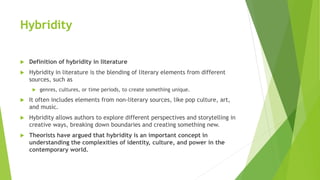
 Definition of hybridity in literature
 Hybridity in literature is the blending of literary elements from different
sources, such as
 genres, cultures, or time periods, to create something unique.
 It often includes elements from non-literary sources, like pop culture, art,
and music.
 Hybridity allows authors to explore different perspectives and storytelling in
creative ways, breaking down boundaries and creating something new.
 Theorists have argued that hybridity is an important concept in
understanding the complexities of identity, culture, and power in the
contemporary world.
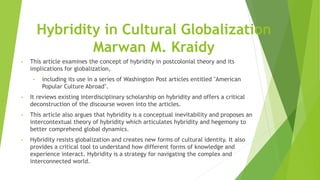
Hybridity in Cultural Globalization
Marwan M. Kraidy
• This article examines the concept of hybridity in postcolonial theory and its
implications for globalization,
• including its use in a series of Washington Post articles entitled "American
Popular Culture Abroad".
• It reviews existing interdisciplinary scholarship on hybridity and offers a critical
deconstruction of the discourse woven into the articles.
• This article also argues that hybridity is a conceptual inevitability and proposes an
intercontextual theory of hybridity which articulates hybridity and hegemony to
better comprehend global dynamics.
• Hybridity resists globalization and creates new forms of cultural identity. It also
provides a critical tool to understand how different forms of knowledge and
experience interact. Hybridity is a strategy for navigating the complex and
interconnected world.
Hybridity in Theory, Culture, and
Communication
 In the 18th century, debates on hybridity arose from interracial contact
caused by European conquest and displacement, and were largely rooted in
comparative anatomy and craniometry.
 Paul Gilroy and Homi K. Bhabha argue hybridity is pervasive in postcolonial
societies, and has had a positive impact on cultural renewal.
 Bhabha's idea of mimicry has been influential, yet critics have faulted his
Lacanian grounding and focus on the semiotic domain. Moore-Gilbert counters
this criticism.
Criticism
 The works of Werbner (1997) and Gilroy (1993) both suggest that hybridity is
impractical and should be disregarded, as it fails to
 recognize the intricacies of culture,
 instead merely preserving and immortalizing it.
 These critics of hybridity caution that it is
 a device employed by those in power to minimize variance and is a product of
hegemony.
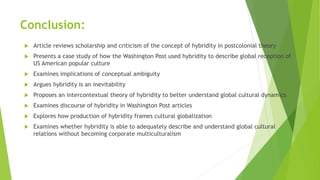
Conclusion:
 Article reviews scholarship and criticism of the concept of hybridity in postcolonial theory
 Presents a case study of how the Washington Post used hybridity to describe global reception of
US American popular culture
 Examines implications of conceptual ambiguity
 Argues hybridity is an inevitability
 Proposes an intercontextual theory of hybridity to better understand global cultural dynamics
 Examines discourse of hybridity in Washington Post articles
 Explores how production of hybridity frames cultural globalization
 Examines whether hybridity is able to adequately describe and understand global cultural
relations without becoming corporate multiculturalism

Research Skills Presentation.pptx

  • 1.
    Hybridity  Definition ofhybridity in literature  Hybridity in literature is the blending of literary elements from different sources, such as  genres, cultures, or time periods, to create something unique.  It often includes elements from non-literary sources, like pop culture, art, and music.  Hybridity allows authors to explore different perspectives and storytelling in creative ways, breaking down boundaries and creating something new.  Theorists have argued that hybridity is an important concept in understanding the complexities of identity, culture, and power in the contemporary world.
  • 2.
    Hybridity in CulturalGlobalization Marwan M. Kraidy • This article examines the concept of hybridity in postcolonial theory and its implications for globalization, • including its use in a series of Washington Post articles entitled "American Popular Culture Abroad". • It reviews existing interdisciplinary scholarship on hybridity and offers a critical deconstruction of the discourse woven into the articles. • This article also argues that hybridity is a conceptual inevitability and proposes an intercontextual theory of hybridity which articulates hybridity and hegemony to better comprehend global dynamics. • Hybridity resists globalization and creates new forms of cultural identity. It also provides a critical tool to understand how different forms of knowledge and experience interact. Hybridity is a strategy for navigating the complex and interconnected world.
  • 3.
    Hybridity in Theory,Culture, and Communication  In the 18th century, debates on hybridity arose from interracial contact caused by European conquest and displacement, and were largely rooted in comparative anatomy and craniometry.  Paul Gilroy and Homi K. Bhabha argue hybridity is pervasive in postcolonial societies, and has had a positive impact on cultural renewal.  Bhabha's idea of mimicry has been influential, yet critics have faulted his Lacanian grounding and focus on the semiotic domain. Moore-Gilbert counters this criticism.
  • 4.
    Criticism  The worksof Werbner (1997) and Gilroy (1993) both suggest that hybridity is impractical and should be disregarded, as it fails to  recognize the intricacies of culture,  instead merely preserving and immortalizing it.  These critics of hybridity caution that it is  a device employed by those in power to minimize variance and is a product of hegemony.
  • 5.
    Conclusion:  Article reviewsscholarship and criticism of the concept of hybridity in postcolonial theory  Presents a case study of how the Washington Post used hybridity to describe global reception of US American popular culture  Examines implications of conceptual ambiguity  Argues hybridity is an inevitability  Proposes an intercontextual theory of hybridity to better understand global cultural dynamics  Examines discourse of hybridity in Washington Post articles  Explores how production of hybridity frames cultural globalization  Examines whether hybridity is able to adequately describe and understand global cultural relations without becoming corporate multiculturalism