RESEARCH METHOD
SUBMITTED TO: SIR SAIF UL MUJAHID
GROUP MEMEBER
SIRTAJ AZIZ
JAWAD ZEB
ABSTRACT
This research contains the study about “How paid employment effects the student’s
academic performance”. Owing to increasing debts and lack of parental contribution to
undergraduates' income, students are taking paid employment during term time in order to
finance their studies. The aim of this investigation is to explore employed and
non‐employed students' perceptions of the impact of this paid employment on the university
experience. And how they effect their academic performance.
Contents
Introduction……………………………………………………………………………………… 1
Chapter # 02
LATRATURE REVIWE
Chapter # 03
Problem Statement
Broad Problem Area:
Chapter # 04
Theoretical framework
Variables:
Chapter # 05
Hypothesis testing
TIME MANAGEMENT
CAREER DEVELOPMENT
DEMOTIVATION
STRESS
Chapter # 06
Elements of Research Designs
Chapter # 07
Operationalization
Chapter 8
Methodology and Estimation Technique
Data Description
Estimation Technique
Methodology
Data Analysis and Result interpretation
R2 (Coefficient of determination)
Chapter # 9
Conclusion and Suggestions
INTRODUCTION
Background
One of the disadvantages of being a student while holding a job is that they are often short
on time and commonly find themselves with limited time to study sleep and maintain
healthy eating habits.
Object of Study
The object of this study is to check the effect of paid employment on student’s academic
performance.
Significance of Study
The importance of this study is to collect the data on the issues of, effect of paid
employment on student’s academic performance and find possible solutions to overcome
those issues.
Limitations of Study
The findings are limited by the relatively small sample size of self‐selected students: mainly
young, female and enrolled in Arts courses. The general findings point out that pre-
graduation working experiences are deterimental for academic outocomes but at the same
time, improve future employment potential
LITERARURE REVIEW
 Primary Data:
 80-90% people who filled the survey, agree that working while
studying effects the academic performance. And there are also other
factors that effect the academic performance of a student.
 Most of the people who we surveyed stated that working effects
academic performance. It is not easy to manage one’s working life
and academic performance. As being part of an organization you
have to get things done on time and if you indulge in extra activities
to keep things up and running side by side, you may end up not
been able to complete tasks that may have to shift to the next day
affecting your academic performance as well, might not have
enough time to study.
 Some people said that stress, cause us to lose interest in everything
one might want to do anything at a certain point due to lots of
workload, this will have a major effect on their academic
performance. Keeping balance between work and study can help us
in maintaining are mental stability and complete tasks on time.
SECODARY DATA
 Othman et al.(2012)
 Othman et al reported that out of the 1,968 undergraduate students
exposed to EE in Malaysia, only 24 (1.22%) of them became self-
employed after graduation, suggesting that 1,944 (98.78%) of them
went for paid-jobs. To corroborate Othman et al.'s findings, a report
published in 2017 by Malaysian Ministry of Education shows that
only 2% of the graduates in Malaysia chose self-employment career.

 Robert J. Manthei and Alison Gilmore (2010)
 Eighty-three undergraduates completed a questionnaire about their
academic workload, their paid employment commitments during
term time, their earnings and expenditure, and their recreational and
cultural activities. Results indicated that 81 per cent of the students
held at least one job during term time for an average of 14 hours per
week. The money earned was typically spent on essential living
expenses. Working left less time than desired for social activities,
study and recrea
BROAD PROBLEM AREA
BROAD PROBLEM AREA:
 The broad problem area refers to the entire situation where one
sees a possible need for research and problem solving such issues
might pertain to, Problems currently existing in an organizational
setting that need to be solved. Helps to find the important variables
that are likely to influence the problem situation are not left out of the
study.
PROBLEM STATEMENT:
 The students working as paid employees are unable to maintain
their academic performance
THEORETICAL FRAMEWORK
 Variables:
 To define the nature of relationship between work-life and
academic performance of student following independent
variables were taken out from the data.
 Time Management
 Career Development
 Performance
 Stress
HYPOTHESIS TESTING
 Time Management
 H0: There is no relationship between academic performance and time
management
 H1: There is negative relationship between academic performance and time
management
 Career Development
 H0: There is no relationship between career development and academic
performance of students.
 H1: If studentsare only busy in career development, they might have low
academic performance.
 Demotivation
 H0: There is a relation between demotivation and academic performance of
students.
 H1: There is negative relationship between demotivation and academic
performance.
 Stress
 H0: There is no relationship between stress and academic performance.
 H1: There is a negative relationship between academic performance and
stress.
RESEARCH DESIGN
 Purpose of study
 Explanatory study
 Type of Investigation.
◦ Correlational Investigation.
 None contrived.
 Filed study.
 Minimum Inference.
 Unit of analysis.
 Individual
 Time of horizon.
 Cross sectional
Academic Performance
Time Management
Academic Tasks
Managing Job
and Studies
Socializing
Workplace
Performance
Career
Development
Professional
Skills
Self
Development
Experience
Exploring future
options
Demotivation
Lack of Interest
No Clear Goals
No Rewards
Lack of
Motivation
Stress
Inablity to relax
Inequal Distributio
of Work
Failing Health
Work Load
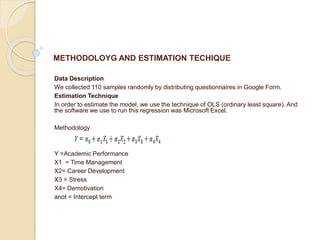
METHODOLOYG AND ESTIMATION TECHIQUE
Data Description
We collected 110 samples randomly by distributing questionnaires in Google Form.
Estimation Technique
In order to estimate the model, we use the technique of OLS (ordinary least square). And
the software we use to run this regression was Microsoft Excel.
Methodology
Y =Academic Performance
X1 = Time Management
X2= Career Development
X3 = Stress
X4= Demotivation
anot = Intercept term
Data Analysis and Result interpretation
After using the OLS technique for estimation, we get
R2 (Coefficient of determination)
The coefficient of determination, denoted R2is a number that indicates
the proportion of the variance in the dependent variable that is
predictable from the independent variable(s)
In this model the value of R2 is 0.432286 means there is 43.22%
variation in independent variables.
CONCLUSION
 many students it may be assumed that employment is an important
part of their university experience and to which more time is often
devoted than it is to attending lectures. Although many students
enjoy their work and the additional social life it brings, these are
outcomes of the work and not the reason for working. Debts and
lack of financial contribution from parents are the factors which most
influence the decision to work, the wage is therefore not extra
income, but is essential to finance living expenses. Around half of all
the students surveyed considered that their life situation is stressful.
Very few people are working because for teirself independence,
personal grooming and self development.
 The students who used to work may have had bad experiences at
work which affected their studies, or their perceptions of the harmful
effects may have become more negative since leaving. Whether the
disadvantages of working are significant or not is largely a matter of
perceptions, but it cannot be said that there are no disadvantages.
There is therefore not a comfortable fit between work and study.
SUMMARY OUTPUT
Regression Statistics
Multiple R 0.657485
R Square 0.432286
Adjusted R
Square 0.410659
Standard
Error 1.742262
Observation
s 110
Results:
ANOVA
df SS MS F
Significanc
e F
Regression 4 242.6931
60.6732
9
19.9880
6 2.93E-12
Residual 105 318.725
3.03547
6
Total 109 561.4182
Coefficient
s
Standar
d Error t Stat P-value
Lower
95%
Upper
95%
Lower
95.0%
Upper
95.0%
Coefficient
s
Standar
d Error t Stat P-value
Lower
95%
Upper
95%
Lower
95.0%
Upper
95.0%
Intercept 1.919993 0.759506 2.52795
0.01296
2 0.414033
3.42595
2
0.41403
3
3.42595
2
X Variable 1 0.308621 0.077317
3.99162
4
0.00012
2 0.155315
0.46192
6
0.15531
5
0.46192
6
X Variable 2 0.168664 0.069788 2.41681
0.01738
2 0.030288
0.30704
1
0.03028
8
0.30704
1
X Variable 3 -0.07015 0.090158 -0.77808
0.43827
2 -0.24892
0.10861
7 -0.24892
0.10861
7
X Variable 4 0.336599 0.094925
3.54596
3
0.00058
6 0.148381
0.52481
7
0.14838
1
0.52481
7

RESEARCH PPT.pptx

  • 1.
    RESEARCH METHOD SUBMITTED TO:SIR SAIF UL MUJAHID GROUP MEMEBER SIRTAJ AZIZ JAWAD ZEB
  • 2.
    ABSTRACT This research containsthe study about “How paid employment effects the student’s academic performance”. Owing to increasing debts and lack of parental contribution to undergraduates' income, students are taking paid employment during term time in order to finance their studies. The aim of this investigation is to explore employed and non‐employed students' perceptions of the impact of this paid employment on the university experience. And how they effect their academic performance.
  • 3.
    Contents Introduction……………………………………………………………………………………… 1 Chapter #02 LATRATURE REVIWE Chapter # 03 Problem Statement Broad Problem Area: Chapter # 04 Theoretical framework Variables: Chapter # 05 Hypothesis testing TIME MANAGEMENT CAREER DEVELOPMENT DEMOTIVATION STRESS Chapter # 06 Elements of Research Designs Chapter # 07 Operationalization Chapter 8 Methodology and Estimation Technique Data Description Estimation Technique Methodology Data Analysis and Result interpretation R2 (Coefficient of determination) Chapter # 9 Conclusion and Suggestions
  • 4.
    INTRODUCTION Background One of thedisadvantages of being a student while holding a job is that they are often short on time and commonly find themselves with limited time to study sleep and maintain healthy eating habits. Object of Study The object of this study is to check the effect of paid employment on student’s academic performance. Significance of Study The importance of this study is to collect the data on the issues of, effect of paid employment on student’s academic performance and find possible solutions to overcome those issues. Limitations of Study The findings are limited by the relatively small sample size of self‐selected students: mainly young, female and enrolled in Arts courses. The general findings point out that pre- graduation working experiences are deterimental for academic outocomes but at the same time, improve future employment potential
  • 5.
    LITERARURE REVIEW  PrimaryData:  80-90% people who filled the survey, agree that working while studying effects the academic performance. And there are also other factors that effect the academic performance of a student.  Most of the people who we surveyed stated that working effects academic performance. It is not easy to manage one’s working life and academic performance. As being part of an organization you have to get things done on time and if you indulge in extra activities to keep things up and running side by side, you may end up not been able to complete tasks that may have to shift to the next day affecting your academic performance as well, might not have enough time to study.  Some people said that stress, cause us to lose interest in everything one might want to do anything at a certain point due to lots of workload, this will have a major effect on their academic performance. Keeping balance between work and study can help us in maintaining are mental stability and complete tasks on time.
  • 6.
    SECODARY DATA  Othmanet al.(2012)  Othman et al reported that out of the 1,968 undergraduate students exposed to EE in Malaysia, only 24 (1.22%) of them became self- employed after graduation, suggesting that 1,944 (98.78%) of them went for paid-jobs. To corroborate Othman et al.'s findings, a report published in 2017 by Malaysian Ministry of Education shows that only 2% of the graduates in Malaysia chose self-employment career.   Robert J. Manthei and Alison Gilmore (2010)  Eighty-three undergraduates completed a questionnaire about their academic workload, their paid employment commitments during term time, their earnings and expenditure, and their recreational and cultural activities. Results indicated that 81 per cent of the students held at least one job during term time for an average of 14 hours per week. The money earned was typically spent on essential living expenses. Working left less time than desired for social activities, study and recrea
  • 7.
    BROAD PROBLEM AREA BROADPROBLEM AREA:  The broad problem area refers to the entire situation where one sees a possible need for research and problem solving such issues might pertain to, Problems currently existing in an organizational setting that need to be solved. Helps to find the important variables that are likely to influence the problem situation are not left out of the study. PROBLEM STATEMENT:  The students working as paid employees are unable to maintain their academic performance
  • 8.
    THEORETICAL FRAMEWORK  Variables: To define the nature of relationship between work-life and academic performance of student following independent variables were taken out from the data.  Time Management  Career Development  Performance  Stress
  • 9.
    HYPOTHESIS TESTING  TimeManagement  H0: There is no relationship between academic performance and time management  H1: There is negative relationship between academic performance and time management  Career Development  H0: There is no relationship between career development and academic performance of students.  H1: If studentsare only busy in career development, they might have low academic performance.  Demotivation  H0: There is a relation between demotivation and academic performance of students.  H1: There is negative relationship between demotivation and academic performance.  Stress  H0: There is no relationship between stress and academic performance.  H1: There is a negative relationship between academic performance and stress.
  • 10.
    RESEARCH DESIGN  Purposeof study  Explanatory study  Type of Investigation. ◦ Correlational Investigation.  None contrived.  Filed study.  Minimum Inference.  Unit of analysis.  Individual  Time of horizon.  Cross sectional
  • 11.
    Academic Performance Time Management AcademicTasks Managing Job and Studies Socializing Workplace Performance Career Development Professional Skills Self Development Experience Exploring future options Demotivation Lack of Interest No Clear Goals No Rewards Lack of Motivation Stress Inablity to relax Inequal Distributio of Work Failing Health Work Load
  • 12.
    METHODOLOYG AND ESTIMATIONTECHIQUE Data Description We collected 110 samples randomly by distributing questionnaires in Google Form. Estimation Technique In order to estimate the model, we use the technique of OLS (ordinary least square). And the software we use to run this regression was Microsoft Excel. Methodology Y =Academic Performance X1 = Time Management X2= Career Development X3 = Stress X4= Demotivation anot = Intercept term
  • 13.
    Data Analysis andResult interpretation After using the OLS technique for estimation, we get
  • 14.
    R2 (Coefficient ofdetermination) The coefficient of determination, denoted R2is a number that indicates the proportion of the variance in the dependent variable that is predictable from the independent variable(s) In this model the value of R2 is 0.432286 means there is 43.22% variation in independent variables.
  • 15.
    CONCLUSION  many studentsit may be assumed that employment is an important part of their university experience and to which more time is often devoted than it is to attending lectures. Although many students enjoy their work and the additional social life it brings, these are outcomes of the work and not the reason for working. Debts and lack of financial contribution from parents are the factors which most influence the decision to work, the wage is therefore not extra income, but is essential to finance living expenses. Around half of all the students surveyed considered that their life situation is stressful. Very few people are working because for teirself independence, personal grooming and self development.  The students who used to work may have had bad experiences at work which affected their studies, or their perceptions of the harmful effects may have become more negative since leaving. Whether the disadvantages of working are significant or not is largely a matter of perceptions, but it cannot be said that there are no disadvantages. There is therefore not a comfortable fit between work and study.
  • 16.
    SUMMARY OUTPUT Regression Statistics MultipleR 0.657485 R Square 0.432286 Adjusted R Square 0.410659 Standard Error 1.742262 Observation s 110 Results:
  • 17.
    ANOVA df SS MSF Significanc e F Regression 4 242.6931 60.6732 9 19.9880 6 2.93E-12 Residual 105 318.725 3.03547 6 Total 109 561.4182 Coefficient s Standar d Error t Stat P-value Lower 95% Upper 95% Lower 95.0% Upper 95.0%
  • 18.
    Coefficient s Standar d Error tStat P-value Lower 95% Upper 95% Lower 95.0% Upper 95.0% Intercept 1.919993 0.759506 2.52795 0.01296 2 0.414033 3.42595 2 0.41403 3 3.42595 2 X Variable 1 0.308621 0.077317 3.99162 4 0.00012 2 0.155315 0.46192 6 0.15531 5 0.46192 6 X Variable 2 0.168664 0.069788 2.41681 0.01738 2 0.030288 0.30704 1 0.03028 8 0.30704 1 X Variable 3 -0.07015 0.090158 -0.77808 0.43827 2 -0.24892 0.10861 7 -0.24892 0.10861 7 X Variable 4 0.336599 0.094925 3.54596 3 0.00058 6 0.148381 0.52481 7 0.14838 1 0.52481 7