1
Research Methodology – Sampling
Techniques
Dr. Deepa Paturkar
ILS Law College, Pune
2
Session by Dr Deepa Paturkar
Sampling in Research
Sampling helps a lot in research.
- the most important factor which determines the accuracy of your research/survey
result.
- wrong sample -reflected in the final result.
- There are lot of techniques which help us to gather sample depending upon the
need and situation.
3
Session by Dr Deepa Paturkar
Important Concepts
 Population- collection of the elements which has some or the other
characteristic in common. Number of elements in the population is the
size of the population.
 Sample- subset of the population.
 Sampling - the process of selecting a sample
4
Session by Dr Deepa Paturkar
Basis of Sampling
Selection of a sample is based upon some assumptions:-
 The samples selected must have similarity with other units to make it more scientific.
 The sample should represent adequately the whole data
 Each unit should be free to be included in the sample
 No need to have absolute accuracy; the results of sampling method should enable to make valid
generalizations
 The maximum amount of information must be gathered as accurately as possible
5
Session by Dr Deepa Paturkar
Importance and Merits of sampling
 Large number of units can be studied – easy to apply when area of study is vast
 Saves time, energy and money
 Intensive study is possible
 Unlimited data- sampling is useful to study
 When cent percent accuracy is not required- sample becomes inevitable
 Organisational Facilities:-
 Economy of Time
 Economy of Resources- Less Space and equipment as area is small.
 Accuracy – Ensures Completeness
 Reliability
6
Session by Dr Deepa Paturkar
Selection of Sample
Stages to follow-
 Nature of particular inquiry
 Time and money available identification and selection of sample
 Nature of population to be sampled - Defining the Universe – Definite and Indefinite; Real and
Hypothetical
 Definite- Units belong to a particular Universe – students of Law Colleges
 Indefinite-number of units can not be ascertained –
 Real- Population actually exists
 Hypothetical- it indicates some attributes – not used much in legal research; used in statistical research
 Sampling Unit- eg.-geographical, social, individual – Clear, unambiguous and standardized
 Source List- List of Names in the universe from which sample is drawn. Exhaustive, Valid and up to date,
reliable, relevant, absence of repetition
 Size of sample- important it must fulfill the requirements of efficiency, representativeness, reliability and
flexibility
7
Session by Dr Deepa Paturkar
Sampling Error
 Only few members in sample excluding others.. It may result in missing out some information leading to
inaccuracy.
 It results in inaccurate sample average which differs from the average of the population
 This difference is known as ‘Sampling Error”
 Lessor the size of sampling error, greater is the accuracy of the result
 The sixe or error depends on-
 Size of Sample
 Variability of Population- homogeneous units result in small eoor; greater the differences, freater is
the error
 Collection of sample- free from bias, as far as possible representative to minimize the error
8
Session by Dr Deepa Paturkar
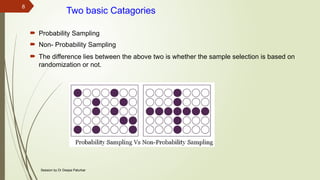
Two basic Catagories
 Probability Sampling
 Non- Probability Sampling
 The difference lies between the above two is whether the sample selection is based on
randomization or not.
9
Session by Dr Deepa Paturkar
Probability Sampling
 This Sampling technique uses randomization to make sure that every element of the population gets an
equal chance to be part of the selected sample. It’s alternatively known as random sampling.
 Simple Random Sampling
 Stratified sampling
 Systematic sampling
 Cluster Sampling
 Multi stage Sampling
10
Session by Dr Deepa Paturkar
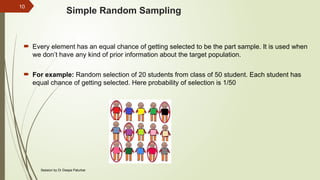
Simple Random Sampling
 Every element has an equal chance of getting selected to be the part sample. It is used when
we don’t have any kind of prior information about the target population.
 For example: Random selection of 20 students from class of 50 student. Each student has
equal chance of getting selected. Here probability of selection is 1/50
11
Session by Dr Deepa Paturkar
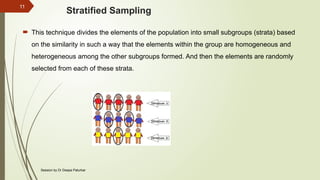
Stratified Sampling
 This technique divides the elements of the population into small subgroups (strata) based
on the similarity in such a way that the elements within the group are homogeneous and
heterogeneous among the other subgroups formed. And then the elements are randomly
selected from each of these strata.
12
Session by Dr Deepa Paturkar
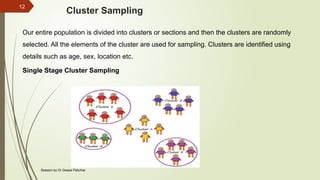
Cluster Sampling
Our entire population is divided into clusters or sections and then the clusters are randomly
selected. All the elements of the cluster are used for sampling. Clusters are identified using
details such as age, sex, location etc.
Single Stage Cluster Sampling
13
Session by Dr Deepa Paturkar
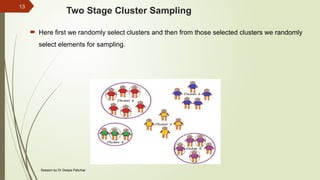
Two Stage Cluster Sampling
 Here first we randomly select clusters and then from those selected clusters we randomly
select elements for sampling.
14
Session by Dr Deepa Paturkar
Systematic Clustering
 Systematic Clustering
 Here the selection of elements is systematic and not random except the first element. Elements of a
sample are chosen at regular intervals of population. All the elements are put together in a sequence
first where each element has the equal chance of being selected.
 For a sample of size n, we divide our population of size N into subgroups of k elements.
 We select our first element randomly from the first subgroup of k elements.
 To select other elements of sample, perform following:
 We know number of elements in each group is k i.e N/n
15
Session by Dr Deepa Paturkar
……Contnd
 So if our first element is n1 then
 Second element is n1+k i.e n2
 Third element n2+k i.e n3 and so on..
 Taking an example of N=20, n=5
 No of elements in each of the subgroups is N/n i.e 20/5 =4= k
 Now, randomly select first element from the first subgroup.
 If we select n1= 3
 n2 = n1+k = 3+4 = 7
 n3 = n2+k = 7+4 = 11
16
Session by Dr Deepa Paturkar
Non-Probability Sampling
 It does not rely on randomization. This technique is more reliant on the researcher’s
ability to select elements for a sample. Outcome of sampling might be biased and makes
difficult for all the elements of population to be part of the sample equally. This type of
sampling is also known as non-random sampling.
 Convenience Sampling
 Purposive Sampling
 Quota Sampling
 Referral /Snowball Sampling
17
Session by Dr Deepa Paturkar
Convenience Sampling
 Here the samples are selected based on the availability. This method is used when the
availability of sample is rare and also costly. So based on the convenience samples are
selected.
 For example: Researchers prefer this during the initial stages of survey research, as it’s
quick and easy to deliver results.
18
Session by Dr Deepa Paturkar
Purposive Sampling
 This is based on the intention or the purpose of study. Only those elements will be selected from the
population which suits the best for the purpose of our study.
 For Example: If we want to understand the thought process of the people who are interested in pursuing
master’s degree then the selection criteria would be “Are you interested for Masters in..?”
 All the people who respond with a “No” will be excluded from our sample.
19
Session by Dr Deepa Paturkar
Quota Sampling
 This type of sampling depends of some pre-set standard. It selects the representative sample from the
population. Proportion of characteristics/ trait in sample should be same as population. Elements are
selected until exact proportions of certain types of data is obtained or sufficient data in different categories is
collected.
 For example: If our population has 45% females and 55% males then our sample should reflect the same
percentage of males and females.
20
Session by Dr Deepa Paturkar
Referral /Snowball Sampling
 This technique is used in the situations where the population is completely unknown and rare.
 Therefore we will take the help from the first element which we select for the population and
ask him to recommend other elements who will fit the description of the sample needed.
 So this referral technique goes on increasing the size of population like a snowball.
 For example: It’s used in situations of highly sensitive topics like Trans Genders where people
will not openly discuss and participate in research to share information their issues.
 Not all the victims will respond to the questions asked so researchers can contact people they
know or volunteer to get in touch with the victims and collect information
 Helps in situations where we do not have the access to sufficient people with the
characteristics we are seeking. It starts with finding people to study.
21
Session by Dr Deepa Paturkar
Strengths and Weaknesses of Sampling Methods
22
Session by Dr Deepa Paturkar
Any Questions?
Thank You!

Research Methodology - Sampling technique.pptx

  • 1.
    1 Research Methodology –Sampling Techniques Dr. Deepa Paturkar ILS Law College, Pune
  • 2.
    2 Session by DrDeepa Paturkar Sampling in Research Sampling helps a lot in research. - the most important factor which determines the accuracy of your research/survey result. - wrong sample -reflected in the final result. - There are lot of techniques which help us to gather sample depending upon the need and situation.
  • 3.
    3 Session by DrDeepa Paturkar Important Concepts  Population- collection of the elements which has some or the other characteristic in common. Number of elements in the population is the size of the population.  Sample- subset of the population.  Sampling - the process of selecting a sample
  • 4.
    4 Session by DrDeepa Paturkar Basis of Sampling Selection of a sample is based upon some assumptions:-  The samples selected must have similarity with other units to make it more scientific.  The sample should represent adequately the whole data  Each unit should be free to be included in the sample  No need to have absolute accuracy; the results of sampling method should enable to make valid generalizations  The maximum amount of information must be gathered as accurately as possible
  • 5.
    5 Session by DrDeepa Paturkar Importance and Merits of sampling  Large number of units can be studied – easy to apply when area of study is vast  Saves time, energy and money  Intensive study is possible  Unlimited data- sampling is useful to study  When cent percent accuracy is not required- sample becomes inevitable  Organisational Facilities:-  Economy of Time  Economy of Resources- Less Space and equipment as area is small.  Accuracy – Ensures Completeness  Reliability
  • 6.
    6 Session by DrDeepa Paturkar Selection of Sample Stages to follow-  Nature of particular inquiry  Time and money available identification and selection of sample  Nature of population to be sampled - Defining the Universe – Definite and Indefinite; Real and Hypothetical  Definite- Units belong to a particular Universe – students of Law Colleges  Indefinite-number of units can not be ascertained –  Real- Population actually exists  Hypothetical- it indicates some attributes – not used much in legal research; used in statistical research  Sampling Unit- eg.-geographical, social, individual – Clear, unambiguous and standardized  Source List- List of Names in the universe from which sample is drawn. Exhaustive, Valid and up to date, reliable, relevant, absence of repetition  Size of sample- important it must fulfill the requirements of efficiency, representativeness, reliability and flexibility
  • 7.
    7 Session by DrDeepa Paturkar Sampling Error  Only few members in sample excluding others.. It may result in missing out some information leading to inaccuracy.  It results in inaccurate sample average which differs from the average of the population  This difference is known as ‘Sampling Error”  Lessor the size of sampling error, greater is the accuracy of the result  The sixe or error depends on-  Size of Sample  Variability of Population- homogeneous units result in small eoor; greater the differences, freater is the error  Collection of sample- free from bias, as far as possible representative to minimize the error
  • 8.
    8 Session by DrDeepa Paturkar Two basic Catagories  Probability Sampling  Non- Probability Sampling  The difference lies between the above two is whether the sample selection is based on randomization or not.
  • 9.
    9 Session by DrDeepa Paturkar Probability Sampling  This Sampling technique uses randomization to make sure that every element of the population gets an equal chance to be part of the selected sample. It’s alternatively known as random sampling.  Simple Random Sampling  Stratified sampling  Systematic sampling  Cluster Sampling  Multi stage Sampling
  • 10.
    10 Session by DrDeepa Paturkar Simple Random Sampling  Every element has an equal chance of getting selected to be the part sample. It is used when we don’t have any kind of prior information about the target population.  For example: Random selection of 20 students from class of 50 student. Each student has equal chance of getting selected. Here probability of selection is 1/50
  • 11.
    11 Session by DrDeepa Paturkar Stratified Sampling  This technique divides the elements of the population into small subgroups (strata) based on the similarity in such a way that the elements within the group are homogeneous and heterogeneous among the other subgroups formed. And then the elements are randomly selected from each of these strata.
  • 12.
    12 Session by DrDeepa Paturkar Cluster Sampling Our entire population is divided into clusters or sections and then the clusters are randomly selected. All the elements of the cluster are used for sampling. Clusters are identified using details such as age, sex, location etc. Single Stage Cluster Sampling
  • 13.
    13 Session by DrDeepa Paturkar Two Stage Cluster Sampling  Here first we randomly select clusters and then from those selected clusters we randomly select elements for sampling.
  • 14.
    14 Session by DrDeepa Paturkar Systematic Clustering  Systematic Clustering  Here the selection of elements is systematic and not random except the first element. Elements of a sample are chosen at regular intervals of population. All the elements are put together in a sequence first where each element has the equal chance of being selected.  For a sample of size n, we divide our population of size N into subgroups of k elements.  We select our first element randomly from the first subgroup of k elements.  To select other elements of sample, perform following:  We know number of elements in each group is k i.e N/n
  • 15.
    15 Session by DrDeepa Paturkar ……Contnd  So if our first element is n1 then  Second element is n1+k i.e n2  Third element n2+k i.e n3 and so on..  Taking an example of N=20, n=5  No of elements in each of the subgroups is N/n i.e 20/5 =4= k  Now, randomly select first element from the first subgroup.  If we select n1= 3  n2 = n1+k = 3+4 = 7  n3 = n2+k = 7+4 = 11
  • 16.
    16 Session by DrDeepa Paturkar Non-Probability Sampling  It does not rely on randomization. This technique is more reliant on the researcher’s ability to select elements for a sample. Outcome of sampling might be biased and makes difficult for all the elements of population to be part of the sample equally. This type of sampling is also known as non-random sampling.  Convenience Sampling  Purposive Sampling  Quota Sampling  Referral /Snowball Sampling
  • 17.
    17 Session by DrDeepa Paturkar Convenience Sampling  Here the samples are selected based on the availability. This method is used when the availability of sample is rare and also costly. So based on the convenience samples are selected.  For example: Researchers prefer this during the initial stages of survey research, as it’s quick and easy to deliver results.
  • 18.
    18 Session by DrDeepa Paturkar Purposive Sampling  This is based on the intention or the purpose of study. Only those elements will be selected from the population which suits the best for the purpose of our study.  For Example: If we want to understand the thought process of the people who are interested in pursuing master’s degree then the selection criteria would be “Are you interested for Masters in..?”  All the people who respond with a “No” will be excluded from our sample.
  • 19.
    19 Session by DrDeepa Paturkar Quota Sampling  This type of sampling depends of some pre-set standard. It selects the representative sample from the population. Proportion of characteristics/ trait in sample should be same as population. Elements are selected until exact proportions of certain types of data is obtained or sufficient data in different categories is collected.  For example: If our population has 45% females and 55% males then our sample should reflect the same percentage of males and females.
  • 20.
    20 Session by DrDeepa Paturkar Referral /Snowball Sampling  This technique is used in the situations where the population is completely unknown and rare.  Therefore we will take the help from the first element which we select for the population and ask him to recommend other elements who will fit the description of the sample needed.  So this referral technique goes on increasing the size of population like a snowball.  For example: It’s used in situations of highly sensitive topics like Trans Genders where people will not openly discuss and participate in research to share information their issues.  Not all the victims will respond to the questions asked so researchers can contact people they know or volunteer to get in touch with the victims and collect information  Helps in situations where we do not have the access to sufficient people with the characteristics we are seeking. It starts with finding people to study.
  • 21.
    21 Session by DrDeepa Paturkar Strengths and Weaknesses of Sampling Methods
  • 22.
    22 Session by DrDeepa Paturkar Any Questions? Thank You!

Editor's Notes

  • #3 DO   Explain what situation that prevailed before passing of the act. On meaning of Industrial Dispute , stress on “connected with employment or labor conditions” Generate examples and validate if that is industrial dispute of not. If discussions don’t happen, you provide examples and ask if this is a ID or not.    
  • #4 DO   Explain what situation that prevailed before passing of the act. On meaning of Industrial Dispute , stress on “connected with employment or labor conditions” Generate examples and validate if that is industrial dispute of not. If discussions don’t happen, you provide examples and ask if this is a ID or not.    
  • #5 DO   Explain what situation that prevailed before passing of the act. On meaning of Industrial Dispute , stress on “connected with employment or labor conditions” Generate examples and validate if that is industrial dispute of not. If discussions don’t happen, you provide examples and ask if this is a ID or not.    
  • #6 DO   Explain what situation that prevailed before passing of the act. On meaning of Industrial Dispute , stress on “connected with employment or labor conditions” Generate examples and validate if that is industrial dispute of not. If discussions don’t happen, you provide examples and ask if this is a ID or not.    
  • #7 DO   Explain what situation that prevailed before passing of the act. On meaning of Industrial Dispute , stress on “connected with employment or labor conditions” Generate examples and validate if that is industrial dispute of not. If discussions don’t happen, you provide examples and ask if this is a ID or not.    
  • #8 DO   Explain what situation that prevailed before passing of the act. On meaning of Industrial Dispute , stress on “connected with employment or labor conditions” Generate examples and validate if that is industrial dispute of not. If discussions don’t happen, you provide examples and ask if this is a ID or not.    
  • #9 DO   Explain what situation that prevailed before passing of the act. On meaning of Industrial Dispute , stress on “connected with employment or labor conditions” Generate examples and validate if that is industrial dispute of not. If discussions don’t happen, you provide examples and ask if this is a ID or not.    
  • #10 DO   Explain what situation that prevailed before passing of the act. On meaning of Industrial Dispute , stress on “connected with employment or labor conditions” Generate examples and validate if that is industrial dispute of not. If discussions don’t happen, you provide examples and ask if this is a ID or not.    
  • #11 DO   Explain what situation that prevailed before passing of the act. On meaning of Industrial Dispute , stress on “connected with employment or labor conditions” Generate examples and validate if that is industrial dispute of not. If discussions don’t happen, you provide examples and ask if this is a ID or not.    
  • #12 DO   Explain what situation that prevailed before passing of the act. On meaning of Industrial Dispute , stress on “connected with employment or labor conditions” Generate examples and validate if that is industrial dispute of not. If discussions don’t happen, you provide examples and ask if this is a ID or not.    
  • #13 DO   Explain what situation that prevailed before passing of the act. On meaning of Industrial Dispute , stress on “connected with employment or labor conditions” Generate examples and validate if that is industrial dispute of not. If discussions don’t happen, you provide examples and ask if this is a ID or not.    
  • #14 DO   Explain what situation that prevailed before passing of the act. On meaning of Industrial Dispute , stress on “connected with employment or labor conditions” Generate examples and validate if that is industrial dispute of not. If discussions don’t happen, you provide examples and ask if this is a ID or not.    
  • #15 DO   Explain what situation that prevailed before passing of the act. On meaning of Industrial Dispute , stress on “connected with employment or labor conditions” Generate examples and validate if that is industrial dispute of not. If discussions don’t happen, you provide examples and ask if this is a ID or not.    
  • #16 DO   Explain what situation that prevailed before passing of the act. On meaning of Industrial Dispute , stress on “connected with employment or labor conditions” Generate examples and validate if that is industrial dispute of not. If discussions don’t happen, you provide examples and ask if this is a ID or not.    
  • #17 DO   Explain what situation that prevailed before passing of the act. On meaning of Industrial Dispute , stress on “connected with employment or labor conditions” Generate examples and validate if that is industrial dispute of not. If discussions don’t happen, you provide examples and ask if this is a ID or not.    
  • #18 DO   Explain what situation that prevailed before passing of the act. On meaning of Industrial Dispute , stress on “connected with employment or labor conditions” Generate examples and validate if that is industrial dispute of not. If discussions don’t happen, you provide examples and ask if this is a ID or not.    
  • #19 DO   Explain what situation that prevailed before passing of the act. On meaning of Industrial Dispute , stress on “connected with employment or labor conditions” Generate examples and validate if that is industrial dispute of not. If discussions don’t happen, you provide examples and ask if this is a ID or not.    
  • #20 DO   Explain what situation that prevailed before passing of the act. On meaning of Industrial Dispute , stress on “connected with employment or labor conditions” Generate examples and validate if that is industrial dispute of not. If discussions don’t happen, you provide examples and ask if this is a ID or not.    
  • #21 DO   Explain what situation that prevailed before passing of the act. On meaning of Industrial Dispute , stress on “connected with employment or labor conditions” Generate examples and validate if that is industrial dispute of not. If discussions don’t happen, you provide examples and ask if this is a ID or not.